







Abstract
The concern that mass media may be responsible for aggressive and criminal behavior is widespread. Comparatively little consideration has been given to its diversionary function. We test for the effect of television entertainment on crime by leveraging the randomness inherent in the scheduling of sporting events. We compare Chicago crime reports by the half hour when Chicago’s sports teams are playing to reports at the same time, day, and month when the teams are not playing. We conduct the same analysis for the Super Bowl, National Basketball Association Finals, and Major League Baseball World Series. We find consistent decreases in crime during games. Short-term crime displacement is minimal or nonexistent.
“Do this research…If we don’t have a season, watch how much evil, which we call crime, watch how much crime picks up if you take away our game…[People have] nothing else to do.”
The concern that mass media may be responsible for aggressive and criminal behavior is widespread, but comparatively little consideration has been given to its potential diversionary function. Social science research on the entertainment–crime connection has been mostly experimental, focusing primarily on the possible behavioral effects of mass media, whether viewing violent films promotes violent tendencies, for example (Adachi & Willoughby, 2011; Anderson, 2004; Anderson & Bushman, 2001, 2002; Uhlmann & Swanson, 2004). Some scholars have made the conceptual point that entertainment may in fact play a crime-reducing role by keeping people off the streets (e.g., Zimring & Hawkins, 1997), and a handful of papers have empirically examined the hypothesis that any increase in aggressive tendencies caused by violent media may be countered by its diversionary effect (e.g., Cunningham, Engelstätter, & Ward, 2011; Dahl & DellaVigna, 2009; Ward 2011). In this article, we offer quasi-experimental support for the incapacitation hypothesis. We find strong evidence that entertainment, specifically the entertainment provided by televised sports games, reduces crime in the short term by up to 25%.
We compare Chicago crime reports by the half hour when Chicago’s National Football League (NFL), National Basketball Association (NBA), or Major League Baseball (MLB) teams are playing to crime reports at the same time, day, and month when the teams are not playing. We conduct the same analysis for the Super Bowl, NBA Finals, and MLB World Series. 2 We estimate the effect of televised sporting events on crime in the city by exploiting the fact that the scheduling of sports games should be unrelated to crime within a given month, day of the week, and time slot. Consider, for example, the Chicago Bears’ regular season schedule. During a given NFL season, one or two Bears games are scheduled on a Monday night. By comparing crime reports on the Monday nights when they happen to play to crime reports on nongame Mondays (when they instead played on Sunday), we estimate the causal effect of Bears games on crime. 3 Unlike most other analysis of the relationship between sports and crime, we target the link between television viewership rather than stadium attendance by focusing on a large city, where stadium attendance is minimal as compared to the number of television viewers.
Our results show overall crime in Chicago during Bears Monday Night Football games is approximately 15% lower than the same time on Monday nights when the Bears are not playing. The Super Bowl generates even more dramatic crime reductions. Crime is approximately 25% lower during Super Bowl game coverage, which amounts to roughly 60 fewer crimes. We find similar but smaller effects for the NBA and MLB. Importantly, we find little evidence of effects in the hours before or after games or the day following a game. 4 The absence of temporal crime shifts is theoretically important, as it speaks to the question of displacement and the role of opportunity in determining criminal behavior. An opportunity denied to an individual, perhaps because he or she is watching sports, may be a crime prevented rather than shifted to another time or place. Methodologically, the fact that crime is significantly affected only during game hours provides assurance that it is indeed the game driving the results and not some unobserved feature of game days such as a blizzard or heat wave.
The consistent drop across all crime types (violent, property, drug, and other), in conjunction with the absence of displacement before or after games, suggests that fewer potential criminals on the streets, diverted from crime and toward television, best explains the reductions. 5 As we describe in the discussion section, other possibilities—reduced criminal opportunities, reduced crime reporting, or reduced law enforcement—do a poor job of accounting for the consistent and widespread declines.
Our analysis has important implications for the study of crime and its control. First, the reductions in crime we find during sports games speak to the nature of criminal behavior itself. Some share of crime may be best understood not as a predetermined and calculated activity but rather as itself recreation (Zimring & Hawkins, ch. 8, 1997). The reductions we find may be interpreted as the substitution of one diversionary activity with another. Relatedly, the absence of significant short-term temporal displacement supports a corollary theoretical point: criminal opportunities are important in determining not only how crime is distributed but also its volume. There is not a set “demand” for criminal activity. Rather, some amount of crime is opportunistic and situational—if prevented today, it does not inevitably occur tomorrow. The idiosyncrasies of the immediate situation or context are important determinants of crime. Traditional accounts of the etiology of crime have mostly looked either to “root” causes, whether biological, psychological, macrosociological, and economic, or at variation in policy—changes in police manpower or strategy, for example. On the other hand, “routine activities” theorists have drawn attention to the importance of everyday features of life that can have a significant impact on criminal activity (e.g., Clarke, 1997; Felson & Clarke, 1993). Our results support these situational theories of crime.
Second, our findings suggest entertainment may actually serve a prosocial crime preventative function. Social scientists have paid little attention to this possibility. While there is a vast literature analyzing the psychological effects of viewing violent movies, and television, or playing video games, the social benefits of people having something fun to do have been largely dismissed or unexplored. 6 Alternative leisure activities and entertainment can substitute for criminal activity, and the benefits may be substantial.
Literature Review
Media Effects
The psychological research on the behavioral effects of viewing violent media, whether video games, television, or movies, has consistently found that subjects act more aggressively (e.g., Adachi & Willoughby, 2011; Anderson, 2004; Anderson & Bushman, 2001, 2002; Uhlmann & Swanson, 2004). More recently, however, a handful of papers have explored the hypothesis that any increase in aggressive tendencies caused by violent media may be countered by its diversionary effect. Dahl and DellaVigna (2009) find violent movie attendance reduces violent crime in the short term by between 1% and 2%. This net decline includes a drop in crime both during and in the hours immediately following movie attendance. They theorize the decline is a function of “voluntary incapacitation”: Movie attendance offers a substitute for other alternative aggressive activities. The authors concede that violent movies may have an “arousal” effect, evidenced by their finding that there are smaller reductions in violence after more violent movies relative to mildly violent movies. But the authors conclude any arousal effect is swamped by the time-use effect.
Cunningham, et al. (2011) investigate the effect of violent video games on violent crime. They use the release of highly rated games as an instrument for increased video game play and conclude playing violent video games produces an overall decrease in violent crime. As Dahl and DellaVigna similarly concluded, they suggest that this net decline comprises both a positive behavioral effect—violent video games encourage aggressive behavior—and a larger negative voluntary incapacitation effect. Individuals substitute real-world aggressive conduct for video game play. Ward (2011) looks at the association of video game stores, movie theaters, and sports stores with crime rates, finding that additional sports and game stores are associated with decreases in crime.
Sporting Events and Crime
There is a small empirical literature examining sports and crime specifically. Several studies have focused on the effect of televised football games on rates of domestic violence. These studies are concerned with the effects of the game’s content rather than time-use trade-offs. Gantz, Bradley, and Wang (2006) engaged in the earliest of such studies collecting data from 15 local police departments, including Chicago, from 1996 to 2002 to examine rates of domestic violence during football games. The results suggest a small increase in domestic violence reports: Chicago, for example, would experience 3.5 more domestic violence incidents on the days in which the Bears were playing. Card and Dahl (2011) study the effect of unexpected NFL football game wins and losses on rates of family violence. They find that upset losses (defeats in which the home team was predicted by the Las Vegas oddsmakers to win by four or more points) lead to a 10% increase in domestic violence. Neither expected losses nor unexpected wins (victories when the home team was predicted to lose) have a significant impact on domestic violence. Kirby, Francis, and O’Flaherty (2013) study domestic abuse reports to an English police force during soccer matches. They find substantial increases on days in which the English national team played, with higher increases when the team lost.
A second set of sports and crime studies have looked at the effect of sports games on crime rates more generally, focusing in particular on the effect of mass gatherings at sport stadiums (as opposed to the effect of television viewership, the focus of our study). 7 Marie (2010) analyzes soccer matches in London, finding increases in property crime for home games and decreases for away games. The increase in property crimes during home games is hypothesized to be the result of fan concentration and police displacement; decreases in property crime during away games is hypothesized to be due to voluntary incapacitation of potential offenders attending the matches. Rees and Schnepel (2009) test the effect of college football matches on crime. They find sharp increases in the host community’s assaults, vandalism, arrests for disorderly conduct, and alcohol-related offenses, with particularly sharp increases for upset losses. Finally, most recently, Kalist and Lee (2014) test for the effect of NFL games on daily crime rates in a handful of cities. Specifically, using 2 years of daily crime data and NFL schedules for Baltimore, Detroit, Miami, Newark, New Orleans, LA, Philadelphia, St. Louis, and Washington, DC, the authors assess whether home games, by concentrating people at a sports stadium, increase crime. Kalist and Lee estimate NFL home games increase crime by 2.5%, statistically significant at the 10% level.
The apparent discrepancy between previous studies’ findings of crime increases, and our finding of crime declines can be explained by differences in the scope and context of analysis. Our results do not preclude the possibility that domestic violence may increase during football games; we simply cannot assess individual crime-type differences, given the small time increments that are the unit of our analysis. With respect to the second set of studies on sports and crime more generally, the divergence is likely related to the ratio of television watching to stadium attendance. Chicago is both home to one of the smallest NFL stadiums in the nation and is at least 4–5 times more populated than most of the cities included in the city study done by Kalist and Lee. More than 2.5 million people living in Chicago dwarf a stadium crowd of 62,000 at Soldier Field. On the other hand, one could easily imagine New Orleans, with a population under 400,000, experiencing relatively large crime effects from a stadium crowd of 75,000. Furthermore, the statistically and substantively strongest results from Kalist and Lee actually support our study: they find crime decreases by almost 10% on playoff game days, the days in which one would expect the ratio of television watching to stadium crowds to be at its highest.
Displacement and Criminal Opportunity
The literature on crime displacement is also relevant to our study of the effect of entertainment on crime. Insofar as there is a self-incapacitation function of televised sports game watching, or video game play, as Cunningham, Engelstätter, and Ward (2011) suggest, this would be of little societal benefit if individuals simply shifted all of their criminal activity to other times. And in fact, much of the empirical literature on displacement indicates that criminal behavior does not necessarily or completely shift in time, place, or kind (e.g., Weisburd et al., 2006). Jacob, Lefgren, and Moretti (2007), for example, use the randomization inherent in weather and find substantial, but not complete, displacement. They suggest a 10% increase in violent crime due to a weather shock results in a 2.6% decrease the following week and 5.4% increase over the following month. For property crimes, the authors find a 10% increase results in a 2% decrease the following week. 8 Braga, Papachristos, and Hureau’s (2012) review of the experimental and quasi-experimental evaluations of “hot spots” policing suggests concentrating police resources in crime hot spots produced significant reductions in crime in the majority of studies and importantly did not lead to physical crime displacement in surrounding locations. In fact, research suggests that place-based interventions are more likely to produce a diffusion of benefits—that is, decreases in crime in the surrounding areas rather than the displacement of crime (Weisburd, Cody, Hinkle, & Eck, 2010; Weisburd et al., 2006).
Researchers have studied the role of opportunity and activity in determining crime in a number of contexts and settings. Jacob and Lefgren (2003) study the short-term effect of extra school days on juvenile crime. They find school supervision provides an incapacitating function—property crime decreases by 14% on days in which school is in session. But school also serves to increase juvenile interactions and thereby increases levels of violence. Overall, the authors find violent crime increases by 28% during days in which school is in session. 9 More generally, the literature on the relationship between employment and crime (e.g., Brunette, 2002; Duwe, 2012) hypothesizes unemployment may increase crime not only because it might drive people to illegal sources of income but also because employment keeps people occupied and away from criminal activity.
As we detail below, we do not find offsetting increases in crime in the hours or days immediately before or after a televised sports game. This provides support for the theory that a crime prevented may truly be a crime saved; crime is not simply displaced. Nonetheless, our study cannot speak to long-term displacement. We therefore cannot rule out the possibility that the criminally inclined, knowing that they will not engage in crime while watching an upcoming game, could choose to commit crime in the days or weeks before or after the game instead.
Data and Analysis
Chicago Crime Reports
The crime data we use are provided by the city of Chicago Data Portal extracted from the Chicago Police Department’s (CPD) Citizen Law Enforcement Analysis and Reporting system. 10 The data set contains crimes that are reported to the police and includes data for all days from January 2001 through December 2013. The data reflect all criminal incidents in which the police responded and completed a case report. The police may respond to a call but determine that a crime has not occurred, in which case a report will not be completed (CPD Research & Development Division, personal communication, April 25, 2014). We aggregated the data into broad crime-type categories: violent, property, drugs, and other using the classifications provided by the CPD. 11 “Other” includes all crimes categorized as “crimes against society” that are not narcotics offenses.
There are some clear recording errors in the data set with respect to the precise date and time of an event. First, 12:00 a.m. and 12:00 p.m. of the first day of each month contains a disproportionate number of crime reports. The data are recorded on these dates as a matter of default when the time or day of the crime is unknown. We therefore exclude the first day of every month from our analyses. Second, crime reports on the hour are systematically higher than other times. Again, these times are entered as a default when reporters cannot reasonably estimate the exact time of the crime. Because we aggregate crime by the nearest half hour and compare the same 30-min time blocks on sports game days relative to nongame days, this quirk does not ultimately affect our analysis.
For the game dates, start times, and other game information for NFL, NBA, and MLB games, we collected schedules from sports-reference.com. For some sports games, sports-reference.com did not provide start times. In these instances, we supplemented the schedule data with cbssports.com. We analyze a total of 12 Super Bowl games, 186 Sunday Bears games, 18 Monday night Bears games (11 wins and 7 losses), 68 Bulls Playoff Games, 94 NBA Finals games, 34 Cubs and White Sox playoff games, and 70 World Series games.
Research Design
To estimate the effect of sports games on crime, we aggregate crime reports by the half hour and compare half hour blocks before, after, and during a game to the same half-hour blocks on the same day-of-week and in the same month. All analyses use this time–day–month fixed effects design and include year dummy variables. 12 Year dummies should not be needed for a correct model specification, as we have no a priori reason to believe that the frequency of games has changed systematically over the period of study. Nonetheless, because crime has systematically decreased over the study period, we include a dummy variable for each year as a precaution and as a means of increasing the efficiency of our estimators. Finally, because holidays may affect both game scheduling and levels of crime, we exclude all major holidays from the analysis. We estimate the effect of sporting events on crime with Poisson regression models, the standard approach for count data with zeros in the outcome variable, which precludes using a log-linear model (Nichols, 2010). 13
We estimate a model for each type of sporting event. The models are of the following form:

where λ represents the expected number of crimes in a particular block–day–month combination, β is the coefficient on a series of “game status” indicators for the temporal relationship between the half hour time block and a sports game (i.e., there is no game, the time block is 3 hr before a game, 2.5 hr before a game, and so on until 3 hr after a game), υ are the coefficients on the set of time–day–month indicator variables for each time block (e.g., Monday November 11, 7:00 p.m.–7:30 p.m.), and ω are the coefficients on the year indicators. 14
The coefficients of interest are those on each half-hour block Game Status indicator variable, indicating the relationship between a half-hour block and the start or end of a game. We do not have data on the official end time of the games, but we estimate that most games other than the Super Bowl end approximately, 3 hr after beginning. There is some measurement error that will affect the estimates near the beginning and ends of games. For example, we regard a game starting at 8:40 as having started at 8:30. In addition, some games last longer than 3 hr or go into overtime. Coefficients on the half-hour blocks post game will therefore represent, in part, the effect of overtime periods on crime.
For each individual game status coefficient, we report heteroscedasticity-robust standard errors. For estimates of the total effect of each sporting event, we cluster standard errors by date, as crime during each aggregated half-hour time block is not independent of crime during other time blocks on the same day. For example, a particularly cold-weather day could reduce crime in multiple half-hour blocks. 15
The coefficient on each game status dummy variable can be translated into an approximate proportionate change by exp(β)−1; (Wooldridge, 2012). Tables reflect this transformation of coefficients. For purposes of graphical representation, we estimate changes in the number of crimes by applying the Poisson percentage change estimates to the average crime count during each nongame block–day–month time slots. 16
More on Treatment and Control
Before presenting our results, it is important to clarify our research design and its implications for interpretation. We leverage the exogenous infusion of television diversion provided by sports games to test for the effect of entertainment on crime. Without such an exogenous infusion, a simple regression of television viewership on rates of crime would likely be subject to omitted variable bias—many things, such as weather, likely affect both crime and TV viewing. As we have argued above, the scheduling of major sporting events within a given month, day, and time should, however, both affect TV viewership and be random with respect to crime.
If the cost of data were not an impediment, we could directly measure, through Nielsen ratings, the effect of sporting events on TV viewership and then the effect of the spike in viewership on crime. 17 We do not currently have access to this data and thus estimate instead the “reduced form.” The magnitude of this “reduced” effect will depend on two major factors: (1) the popularity of the sporting event and (2) the popularity of TV programming during the comparison days. What determines the magnitude of the diversion—and ultimately the effects we find—depends on the additional viewership the game generates. This is driven in part by game popularity: More popular games offer a stronger treatment “dose.” But the magnitude of the diversion is also driven by our comparison or “control” days. Monday night Bears games provide an estimate of the effect of Bears games relative to a Monday night NFL game in which the local team is not playing. In this sense, the estimate as a measure of the effect of sports game watching on crime rates is conservative—it is an estimate of the effect of the additional viewership generated by the Bears as compared to any other NFL game. In the case of the Super Bowl, on the other hand, there are rarely other major television events in the month in which the Super Bowl falls, and thus, we are able to compare Super Bowl Sunday to “normal” television programming on an average Sunday in February.
Results
Table 1 summarizes the estimated reduction in crime during an average game for each type of sporting event. For each sporting event, we run the Poisson model described above, but with a single “Game on” indicator variable so as to estimate the total effect of the game on crime. We assume the average game length is 3 hr plus a half hour of pregame coverage; we assume the Super Bowl is 4 hr. The results show substantial and statistically significant effects for most sporting events across all crime-type category. The drop in drug crimes is larger than the drops we find in property or violent crime. Direct comparisons across sports should be made with caution. Differences in the size of the effects not only represent differences in the magnitude of “treatment” but also in how we are able to define our “control.” We, for example, derive estimates for Monday night Bears games by comparing Monday nights in which the Bears are playing with Monday nights when other NFL games are on television. The effects are thus derived from the additional viewership generated by the fact that the local team is playing compared to the viewership of nonlocal team games. On the other hand, Super Bowl Sunday is compared to other Sundays in February when there are no other major sporting events on television.
Chicago Crimes Prevented by a Professional Sporting Event 2001-2013.
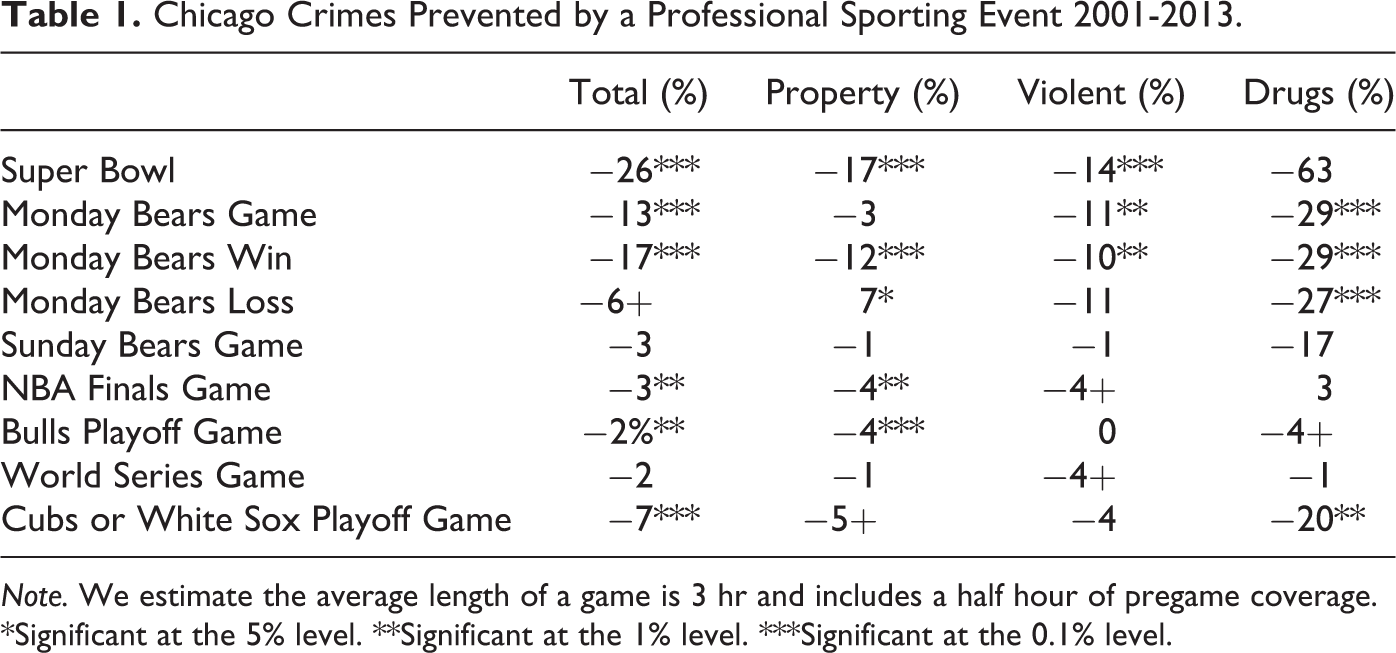
Note. We estimate the average length of a game is 3 hr and includes a half hour of pregame coverage.
*Significant at the 5% level. **Significant at the 1% level. ***Significant at the 0.1% level.
The following sections present the results for each sporting event in more detail.
Crime During the Super Bowl
The Super Bowl is always held on a Sunday afternoon, and coverage typically lasts from 1:30 p.m., at which point pregame commentary commences, through 5:30 p.m., at which point the game kicks off, until 9:30 p.m., at which point the game concludes. Figure 1 plots average total crime reports by the hour on Saturday night through Monday morning. The red line represents average crime reports during non-Super Bowl weekends. The blue line represents the estimates of crime on Super Bowl weekends generated by adjusting average crime by the Poisson estimates of the percentage changes in crime. Average crime on Super Bowl Sunday is slightly higher before pregame coverage begins (4 hr before the official start time). This increase is driven primarily by above-average drug and prostitution reports. Crime reports begin to decline during pregame coverage and are significantly lower until the end of the game when they converge to the mean.
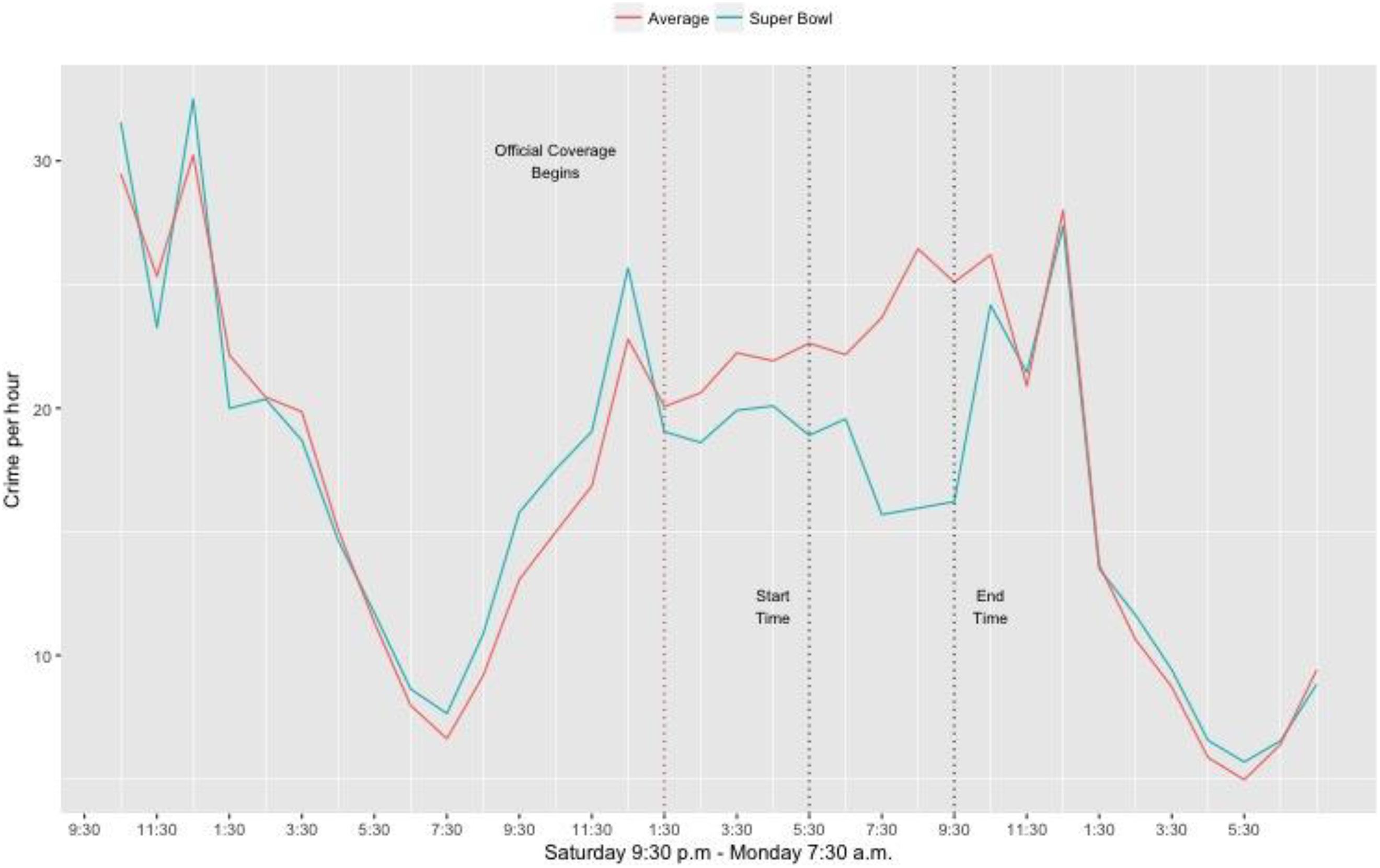
Crime reports in Chicago: The effect of the Super Bowl.
The Super Bowl regression results are presented in Table 2. The point estimate on each indicator variable represents the estimated difference in crime reports between each half-hour period on Super Bowl Sunday and the same half-hour periods on comparable non-Super Bowl Sundays.
Super Bowl Sunday: Crimes per Half Hour (Ordinary Least Squares).
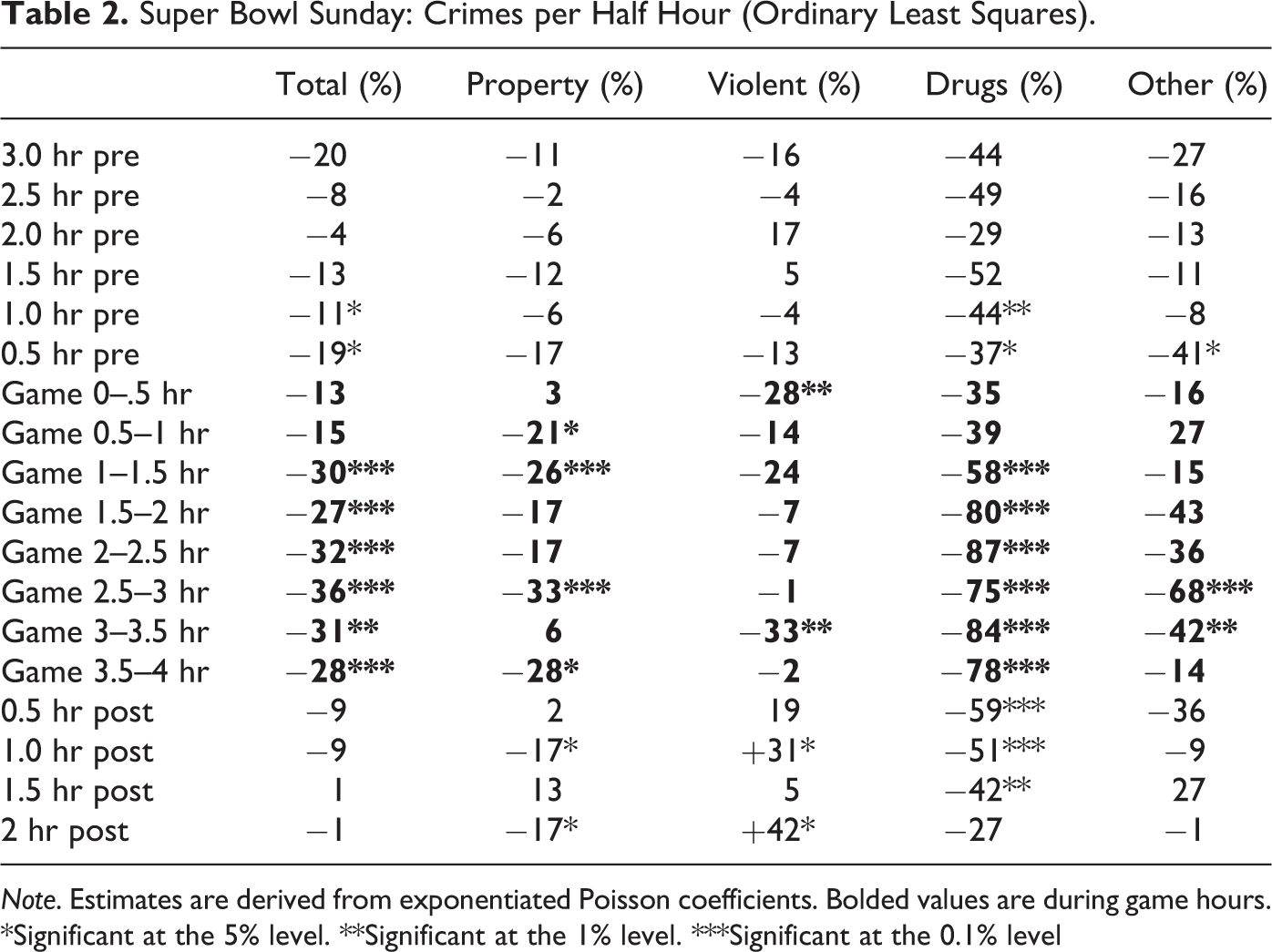
Note. Estimates are derived from exponentiated Poisson coefficients. Bolded values are during game hours.
*Significant at the 5% level. **Significant at the 1% level. ***Significant at the 0.1% level
In total, we find reductions of more than 25%, amounting to roughly 60 total crimes. The largest drops during the Super Bowl for drug crimes: There are over 60% fewer drug offenses reported during the Super Bowl. Violent and property crime are down 15–20% during the game hours. We do, however, find a spike in violent crime after the game that cancels out any reductions found during the Super Bowl.
Figure 2 offers another illustration of the Super Bowl crime trends broken out by crime category. Here, we present cumulative changes in crime over the course of the Super Bowl weekend, the same hours shown in Figure 1. That is, each trend represents the sum of the Poisson coefficients on a time indicator variables beginning at to (9:30 p.m. Saturday night) through tN (7:30 a.m. Monday morning) applied as percentage changes to the average crime in each time block. So, for example, the figure reveals total crime changes are near zero Saturday night, meaning the evening before the Super Bowl looks no different than the average Saturday night. The total percentage change estimates are positive and cumulatively increasing Sunday morning before the game and then drop precipitously during the game, ultimately resulting in an additive effect well below the dashed zero line.
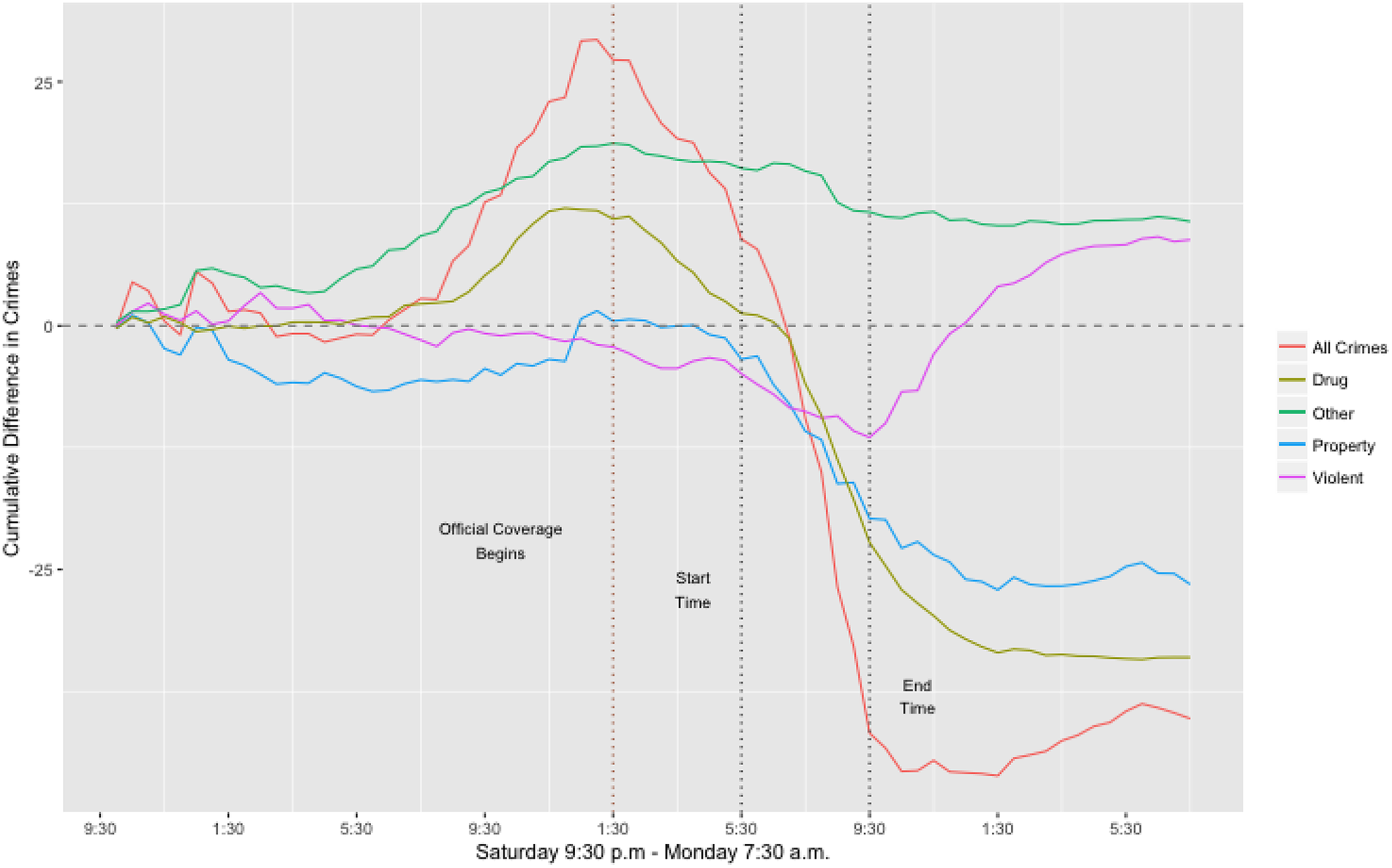
Crime reports in Chicago: The cumulative effect of the Super Bowl.
Local Chicago Team Games
For each of Chicago’s major professional sports team—the Bears (NFL), the White Sox (MLB), the Cubs (MLB), and the Bulls (NBA)—in addition to looking at the general effect on crime of a game, we also test for differential effects between home and away games and between home team wins and losses. As noted in the literature review, previous scholarship suggests there may be important differences across each of these categories. Rees and Schnepel (2009) show that college football games may generate increases in crime for the hosting location. Card and Dahl (2011), as well as Rees and Schnepel (2009), find games resulting in an unexpected win or loss may increase frustration levels which leads to rises in crime.
Because we expect results in a large city to be driven by television viewership rather than stadium attendance, we should not expect meaningful differences between home games and away games. Indeed, for none of the sports do we find crime effects are dependent on the location of the game. Insofar as home games may produce crime by concentrating individuals in and around stadiums, the million plus people watching the games on television swamp whatever stadium effect there may be. The relative importance of television viewership may explain the difference between our findings and those of Rees and Schnepel (2009), who report increases in crime during college games for hosting cities, and the findings of Kalist and Lee (2014), who report increases during home NFL games. As noted in the literature review, professional sporting events in Chicago generate a substantial number of television viewers as compared to college games and NFL games in the comparatively small cities studied by Kalist and Lee.
In general, we do not find differences in the magnitude of the effects for wins as compared to losses. The only exception is Monday Night Chicago Bears games: The game-time reductions in crime are driven almost entirely by winning games. We therefore present results for winning games and losing games separately. In part, the substantial reductions in crime during games the Bears won, but not for games that they lost, may be a matter of noise: The Bears were fairly successful on Monday nights in the last decade, so our sample size of games in which the Bears lost is only seven. The difference between winning and losing games may also be due in part to the fact that a good team will draw more viewers and is also more likely to win.
Chicago Bears Games
Figure 3 illustrates the model predictions for Monday night Bears games resulting in a win compared to average crime reports trends over the course of a Monday in which the Bears are not playing. Figure 4 plots the cumulative difference between Monday nights with a Bears win and Monday nights without a Bears game. Table 3 shows our transformed Poisson regression estimates for the NFL Bears games in which the outcome was a win; Table 4 presents the estimates for NFL Bear games in which the Bears lost. We also run the analysis for Bears games on Sundays relative to Sundays without Bears games. Reductions are minor and are reported in the Appendix.
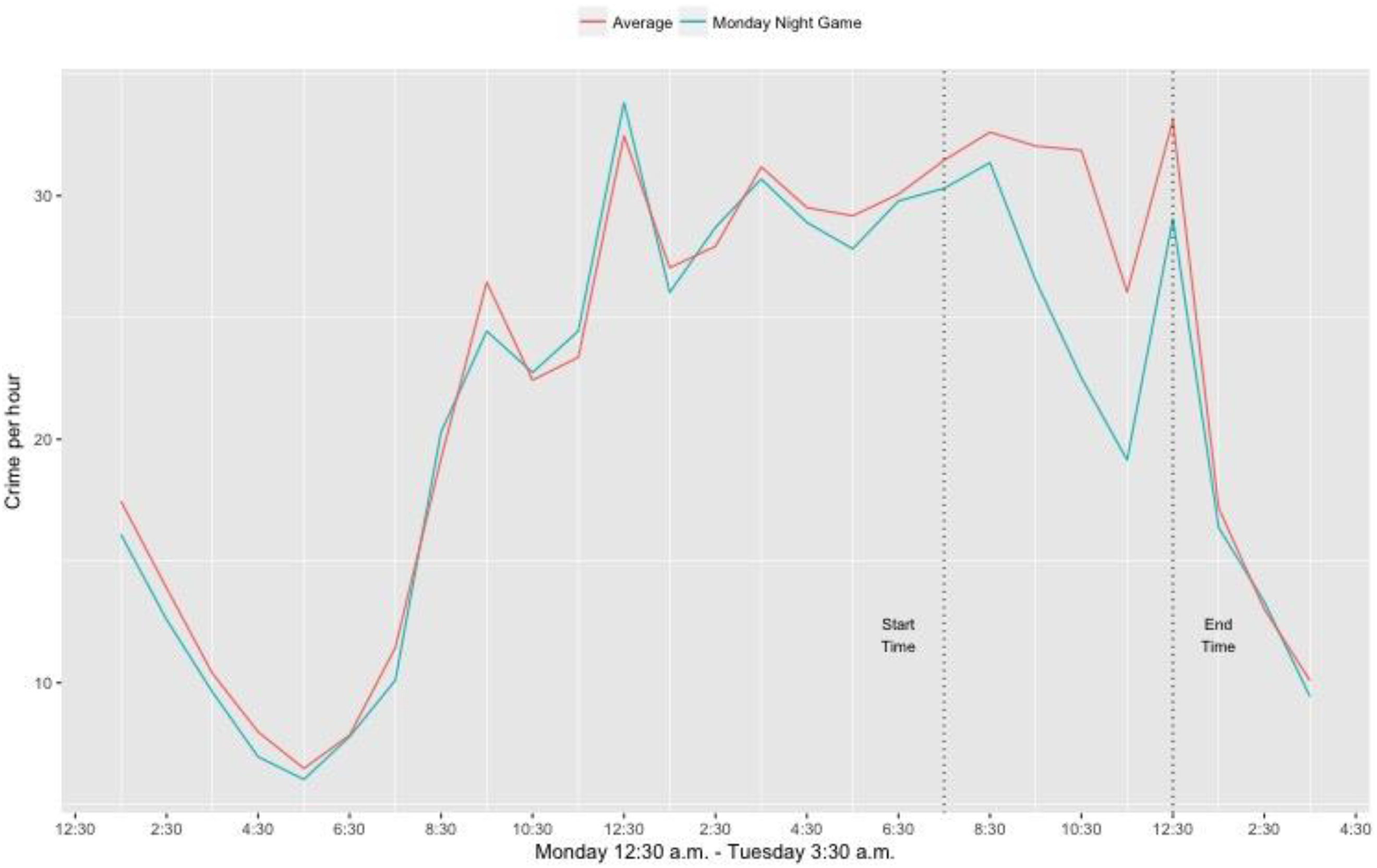
Crime reports in Chicago: The effect of Monday Night Bears Games resulting in a win.
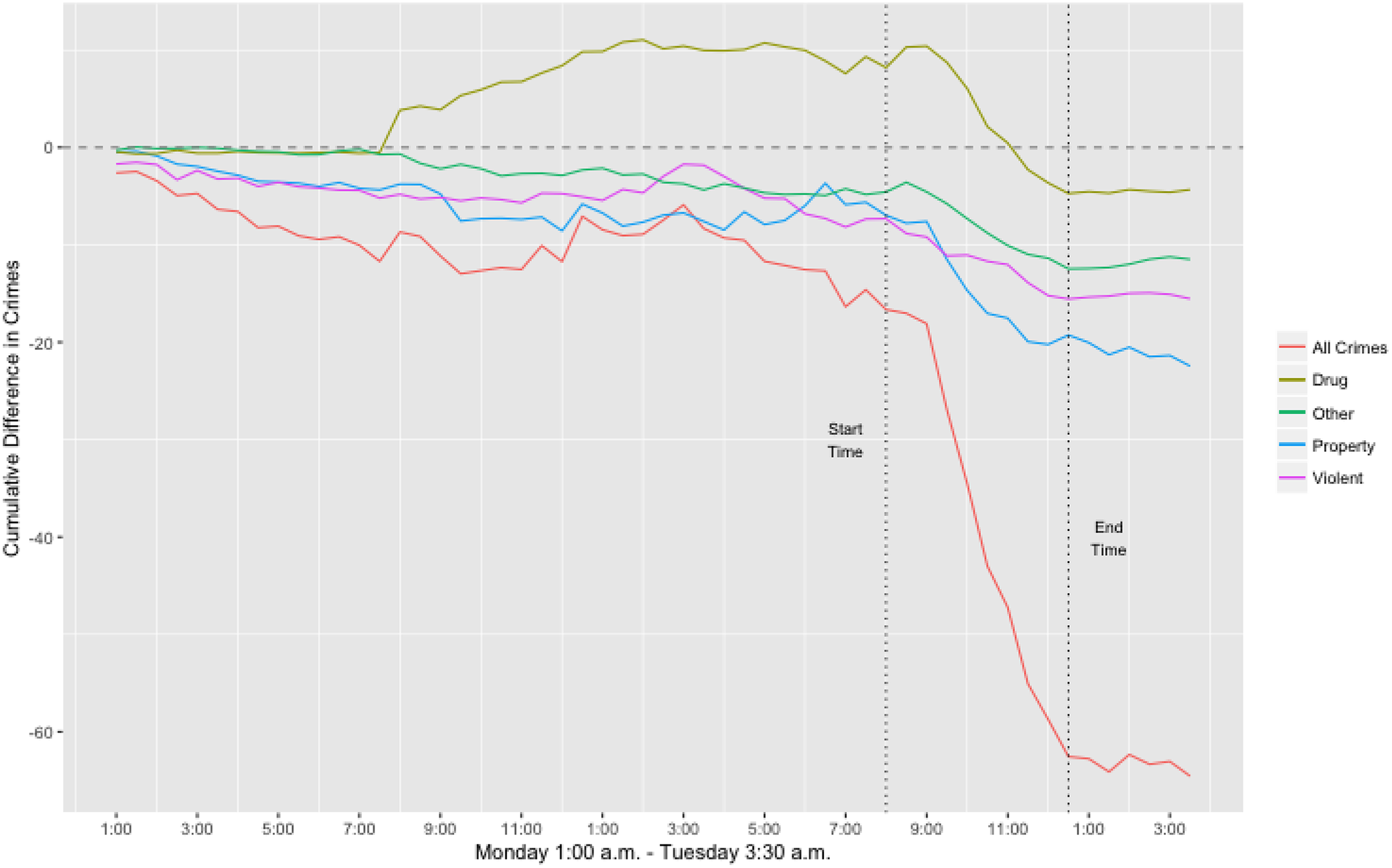
Crime reports in Chicago: The cumulative effect of Monday Night Bears Games resulting in a win.
Monday Night Bears Wins: Crimes per Half Hour.
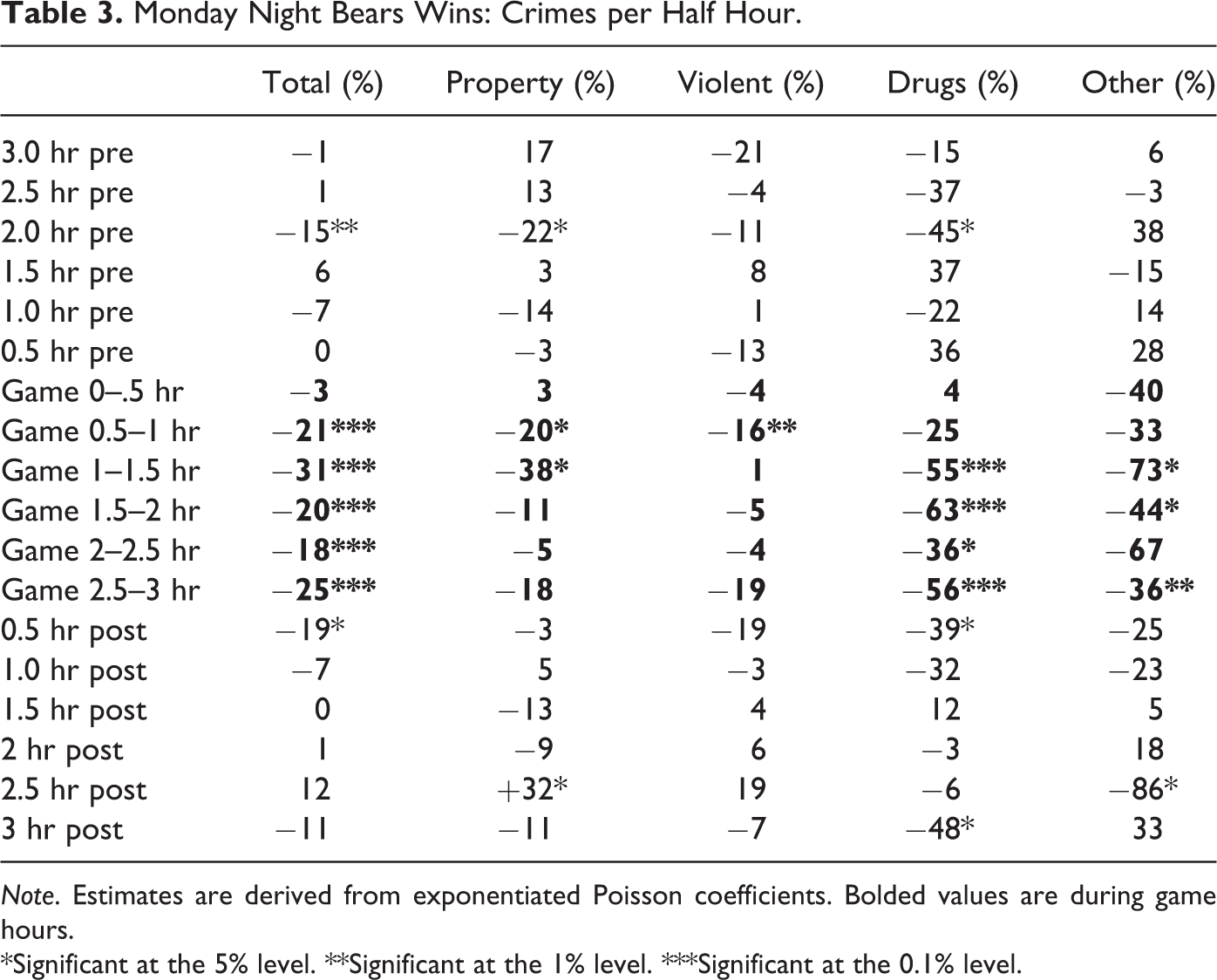
Note. Estimates are derived from exponentiated Poisson coefficients. Bolded values are during game hours.
*Significant at the 5% level. **Significant at the 1% level. ***Significant at the 0.1% level.
Monday Night Bears Losses: Crimes per Half Hour.
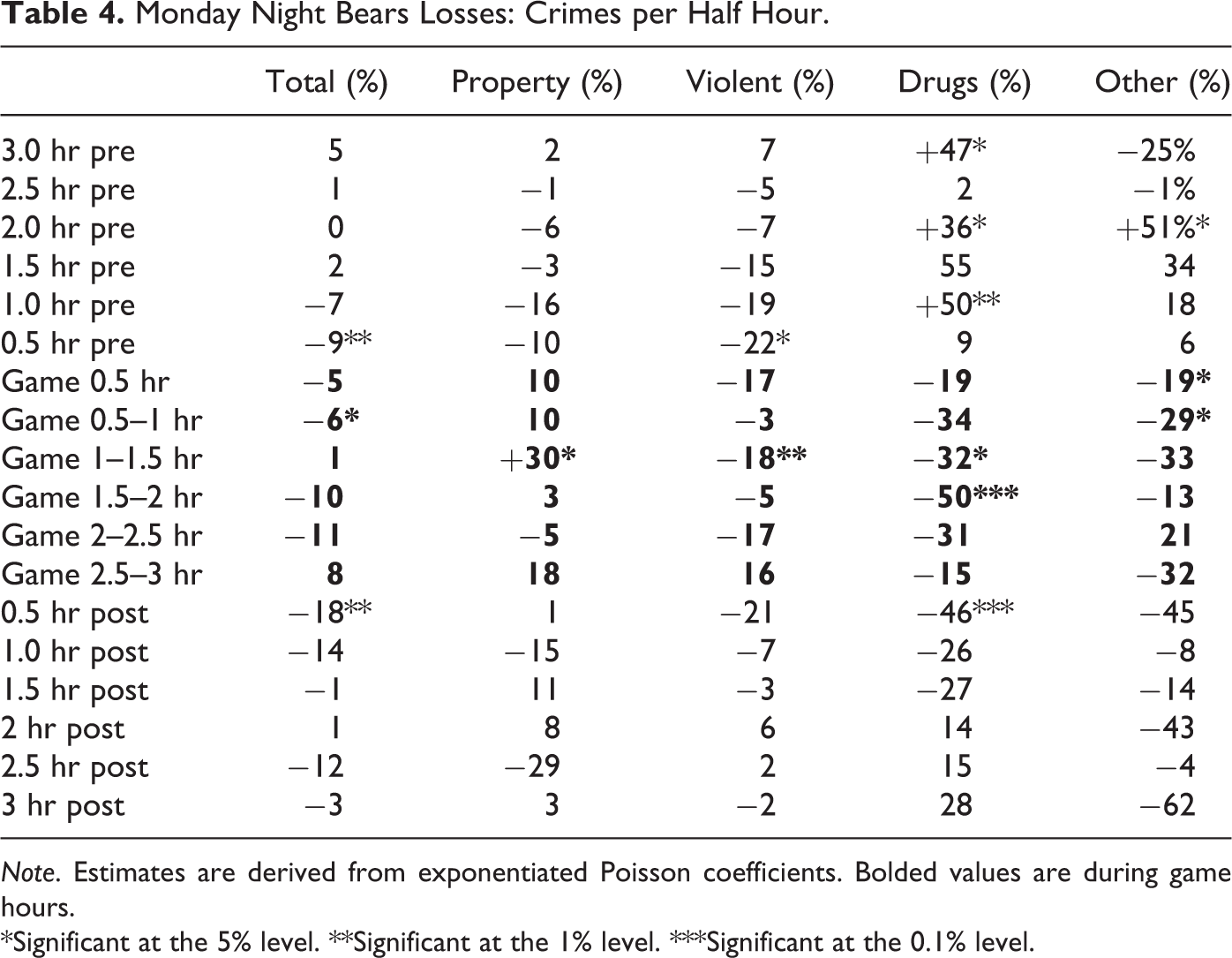
Note. Estimates are derived from exponentiated Poisson coefficients. Bolded values are during game hours.
*Significant at the 5% level. **Significant at the 1% level. ***Significant at the 0.1% level.
Chicago Bulls, White Sox, and Cubs
The regression results for our analyses of the Chicago Bulls, White Sox, and Cubs playoff games are reported in the Appendix. Overall, we find small but consistently negative coefficients on drug and property crime for each half-hour period during Bulls games; violent crime patterns are less consistent. Chicago Cubs and White Sox playoff games also generate estimates that are consistent with but smaller than the estimates generated by the NFL games. Property, drug, and violent crimes are consistently lower during game half hours.
NBA and MLB Championship Games
Crime is consistently lower during NBA finals games. These reductions include both lower violent and property crime reports, but, unlike the patterns we observe in the NFL analyses, the games have no effect on drug crimes. We do not find an effect from World Series games. As we discuss in greater detail in the following section, these results may be an artifact of our ability to compare World Series game days to comparable nongame days. World Series games are mostly in October, as are other baseball playoff games (including Cubs or White Sox games). We are thus comparing one “treatment dosage” to another, and this may explain why we do not find reductions in crime during World Series games. The Poisson regression estimates for the NBA championships and World Series are included in the Appendix.
Placebo Tests
The fact that there are not NFL games on Tuesdays allows us to run a placebo test. We shift the game schedules for Monday night football games as though they were scheduled on a Tuesday before running our same fixed-effects Poisson regression model. We find no persistent trends for these fake game half-hour times, which provides reassurance that the results we find in our actual regression are not spurious. The full results are available in the Appendix.
Discussion
Summary
The results presented above demonstrate clear reductions in violent, property, and drug crime reports in Chicago during the hours in which important sporting events are on television. Moreover, as we discuss in greater detail below, the hours before and after a game do not generally result in offsetting increases in crime. Thus, at least in the short term, major televised sports games produce real declines in crime reports.
The differences in the magnitude of the effects we find can be partially understood in relation to the “treatment,” that is, the television entertainment provided by a game. A more popular game, such as the Super Bowl, offers a stronger “dose.” The sizes of the effects we find generally correspond with game popularity. The Super Bowl, by far the most watched TV event, generates the largest crime reductions. TV ratings in Chicago indicate that local team NFL games, while less popular than the Super Bowl, are still significantly more popular than either the NBA or the MLB. But in addition to differences in treatment dosage, the days to which we compare each sporting event (our “controls”) also differ in terms of their treatment dosage. In other words, some sporting events are compared to days in which other sporting events are on television.
The fact that some of our control days are “partially treated” by the television airing of nonlocal team games likely also explains some of the differences in the magnitude of effects we find. Sunday football games are, for example, consistently among the most watched television programs; fans frequently dedicate their Sundays to watching NFL games, whether or not their home team is playing. As such, Sunday Bears games may draw in only a small extra number of Chicago viewers. Similarly, our estimates of the effect of NBA and MLB playoffs rely on the additional viewership generated by local team playoff games relative to playoff games in which the local team is not playing. Likewise, Monday night Bears games are compared to Monday nights airing nonlocal NFL team games. Because some share of local team sports fans also watch the season games in which their team is not playing, our estimates likely understate the effect of sports entertainment on crime.
The Mechanism and Displacement
Overall, we find little evidence of temporal crime displacement. The coefficients on the pre- and postgame indicators are mostly nonsignificant in all of our models. There are a few exceptions to the general pattern of no pre- or postgame effects. In particular, drug and prostitution offenses increase before the Super Bowl game and violence increases after the Super Bowl. We theorize that the spike in violence following the Super Bowl is the result of the gathering and drinking during the game that manifests in aggression after the game when its incapacitative effects are over.
We think the reductions in crime during sports games are best explained by games diverting potential offenders away from crime and toward television. There are, however, other potential explanations. One alternative account would suggest crime is lower during sporting events, not because potential offenders are inside watching the game, but rather because sports games generate conditions that offer fewer criminal opportunities. Both potential victims of crime and potential witnesses to crime may be kept inside and off the streets when games are on television. While fewer potential victims on the streets could help explain reductions in violent crime during games, it does not explain the drop in property crime. If anything, we might expect property crime to increase with fewer nonoffenders on the streets—abandoned streets present a perfect opportunity for looting. On the other hand, if the streets are abandoned, this might mean everyone is at home watching the game and potential offenders would be afforded fewer opportunities to commit home-based property offenses. This could help explain the decrease in property crime. But because major sporting events are often watched in groups, there may actually be more unguarded homes during a game night. We therefore think it unlikely that the decline in crime is due to fewer opportunities for potential offenders.
Another possibility is that crime reporting, not crime, is lower during sports games. People who would usually report a crime might be distracted by the game and therefore be unaware or unmotivated to make the report. This seems implausible for most violent crimes. It is plausible for property crime, but if this were the case, we would expect reports to spike in the hours after the game as people returned to their homes or cars and discovered evidence of theft or vandalism. We find no evidence of such spikes in reporting.
Finally, it is possible that crime reports are lower because law enforcement officials, rather than making arrests, are busy watching or listening to the game. This is an unlikely explanation for the consistent declines we find in all crime categories during sports games. We would expect most property and violent crimes to be reported by the citizenry and not generally subject to police discretion. On the other hand, police discretion may well explain the particularly large reductions in drug crimes that we find during sports games. The discretionary nature of drug law policing is well known (Skogan & Frydl, 2004). Drug crimes, like all “victimless” crimes, are rarely reported to police and are therefore, in significant part, the product of enforcement priorities and proactive targeting rather than a reflection of changes in drug supply or use (e.g., Warner & Coomer, 2003). While it is likely the declines in drug offenses during games are, at least in good part, explained by fewer individuals on the streets engaging in drug activity, the drug effects above and beyond what we see for other crimes may well be explained by the failure of police to pursue drug activity because they are themselves distracted by the game. In summary, we think the most plausible explanation for the effects we find is that potential offenders are diverted from crime by the televised airing of sports games.
Conclusion
The fact that we find significant reductions in crime during televised sports games implies some individuals trade-off participating in criminal activity for watching sports. This lends support to theories of crime that suggest some share of criminal behavior is recreational and opportunistic. If crime is not predetermined and calculated but rather is itself a form of recreation, the drops we find are not surprising—they represent the substitution of one diversionary activity for another. The absence of significant short-term temporal displacement underscores the importance of the immediate situation or context as determinants of crime. While we don’t know about idle hands, our article suggests that idle eyes are the devil’s playground.
Our findings speak not only to theories of criminal behavior but also have important practical implications. First, our results are relevant to the debate over the effects of entertainment on crime. While it has been suggested that the proliferation of modern technologies such as TV, video games, and online social networking may play a crime-reducing role by diverting individuals who might otherwise be at risk of engaging in criminal activity (Griffiths and Sutton, 2013), the idea has been subjected to relatively little empirical testing. We find strong evidence that entertainment, specifically the entertainment provided by televised sports games, can reduce criminal activity. The debate surrounding the effect of media on criminal behavior has been too narrowly focused on the psychological link between violent entertainment and aggression. Whatever short-term aggression-inducing effects movies, television, or video games have may be negligible in comparison to their diversionary power.
Our findings are also relevant to more immediate and narrow issues. For example, our results have implications for the current debate over whether to expand the NFL season or increase the number of weeknight games. If other weeknight games generate crime reductions similar to Monday night games and long-term crime displacement isn’t complete, additional game nights may have social benefits. Finally, most major sports seasons are played during low-crime winter months rather than in the summer when crime is substantially higher (roughly 30% higher in Chicago). Sporting events aired in the summer—traditionally a time of reruns and second-rate television—could generate real crime savings.
Footnotes
Appendix
Authors’ Note
Ryan Copus is now affiliated to Harvard Law School, Cambridge, MA, USA.
Declaration of Conflicting Interests
The author(s) declared no potential conflicts of interest with respect to the research, authorship, and/or publication of this article.
Funding
The author(s) received no financial support for the research, authorship, and/or publication of this article.