







Abstract
This study provides an experiment to examine whether announcer gender impacts audience demand. With special attention to literature detailing the role of women in sports, sports economics, as well as uses and gratifications theory, this study provides an experiment wherein participants watched a sporting event announced by a man or a woman. Afterward, the participants responded to questions regarding their attitudes toward the sporting event they watched. Overall, the male announcer engendered greater feelings of enjoyment and lower feelings of cognitive load than the female announcer. Feelings of autonomy and hostile sexism also played a significant role in mediating the relationship between independent and dependent variables. This study is diagnostic such that it provides empirical evidence that women will have a more difficult time succeeding in this labor market. Also, this study provides noteworthy areas for content producers to focus on in order to increase demand for a product.
During the 2018 National Football League (NFL) season, broadcasters Hannah Storm and Andrea Kremer called an NFL game. This was a historic event as it was the first all-female broadcast team in the history of the league (Schad, 2018). This, in conjunction with other events like Jenny Cavnar regularly calling Major League Baseball (MLB) games (Chiappelli, 2018), Jessica Mendoza being the first woman to call a MLB postseason game (D. Miller, 2015), and Aly Wagner serving as the first female analyst for the FIFA Men’s World Cup (Clayton, 2018), perhaps indicated a market demand for women in prominent roles in men’s sports broadcasts. However, the backlash against Storm and Kremer was almost instantaneous (Jenkins, 2018). Examining Storm’s announcement on Twitter, many were supportive and excited. Others, however, said that it was “sickening” or “disgusting” while claiming that these women knew nothing about the game and lacked credibility due to the fact that they had not played football in the past (Storm, 2018). As if anticipating this response, Amazon Prime, the platform hosting the NFL game, allowed for audiences to select from four commentary options (Schad, 2018). In other words, Storm and Kremer were not the main broadcasters. In fact, the main broadcast team featured a more traditional all-male team with award-winning sports caster Joe Buck and Pro Football Hall of Fame Member Troy Aikman. From an economic perspective, the question becomes do audiences actually have a different experience when watching a sporting event based on the gender of the announcer? This study provides an experiment to examine whether announcer gender does influence audience demand for the product. This also has implications for the labor market in sports media.
Sports as Product
In a seminal work on sports economics, Neale (1964) argued that the economics of sports is based on the quality provided to audiences. Similarly, Borland and MacDonald (2003, p. 479) stated “the essence of demand for the game or sporting contest is ‘fan interest’.” Also, Rottenberg (2000) said that the product of sport is entertainment. Indeed, attracting audiences is a major revenue stream for sports broadcasts and thus plays a major role in sports economics.
According to Rottenberg (2000), the entertainment value of the sports product can be high quality or low quality based on a variety of dimensions; however, Rottenberg largely missed the needs of the audience in this calculation of quality. As a result, this study argues that economic inquiries into sports should weigh the entertainment value provided for audience members.
In their review of the demand for sport, Borland and MacDonald (2003, p. 478) said, “demand for sport has in recent times attracted substantial attention in the fields of sports economics and marketing.” The tie between fans and sports economics is endemic throughout Borland and MacDonald’s review. In fact, Borland and MacDonald begin to link psychological factors like emotion and cognitive load to user demand for sport. Essentially, cognitive load refers to how much thought and effortful thinking a task requires from an individual.
Consequently, this study attempts to further bridge the gap between sports economics literature and media effects theory, which often focuses on audience members. There is no shortage of studies on why people watch sporting events. Billings and Ruihley (2013) and Raney (2006) provide a thorough summary of the different ways in which fan needs are served by sporting events. Uses and gratifications theory broadly argues that audience members have certain needs that they look to satisfy through media experiences (Ruggiero, 2000). Oliver (1993) argued that there is a noteworthy distinction between types of entertainment such that someone might find entertainment media enjoyable or meaningful. To put plainly, enjoyment refers to hedonic pleasures while a meaningful experience is related to deeper, more profound experiences like a heartwarming movie (Oliver & Raney, 2011; Tamborini et al., 2010). Notably, sports audiences make this distinction as well (Bartsch et al., 2016; Rogers, 2018). In the same vein, self-determination theory (SDT) has been used to help understand how audiences derive gratifications from media (Rogers et al., 2017; Ryan et al., 2006; Tamborini et al., 2010). SDT (Ryan & Deci, 2000) argues that when people feel competence, autonomy, and relatedness, they feel more intrinsically motivated. Evidence has indicated that media is capable of engendering feelings of competence, autonomy, and relatedness. These feelings then lead to greater feelings of entertainment. In this case, when a product is more entertaining, it should be in greater demand.
As mentioned, Borland and MacDonald (2003) said that cognitive load is an important factor regarding demand for sport. People have a limited capacity for cognition (Campbell & Kirmani, 2000). When this is stressed, it creates an unpleasant experience for the individual (Mayer & Moreno, 2003). This unpleasantness could override any feelings of entertainment derived from watching a sporting event. In sum, this article speculates that cognitive load, perceptions of an enjoyable experience, and perceptions of a meaningful experience are likely determinants of demand for sports media.
Women and Sports Media
To date, social science research and social norms dictate that sports are a man’s domain (Cooky, 2017; Gantz & Wenner, 1991; Kerr & Multon, 2015; Lopiano, 2000; Uzoma, 2017; Whiteside & Hardin, 2017). Broadly speaking, women’s sports are grossly underrepresented in the media such that men’s sports receive considerably more coverage and airtime than women’s sports (Messner et al., 2003). Historically, women Olympians have received far less coverage of their events than their male counterparts. However, the 2018 PyeongChang Winter Games marked the first time that women received more prime-time coverage than men—since data were aggregated on this topic in 1994 (Billings et al., 2017). Previously, coverage of the men’s events sometimes exceeded more than 20% of airtime compared to women. However, the most watched soccer game in the U.S. history was the U.S. women’s National Team win over Japan in the 2015 FIFA Women’s World Cup (Kaplan, 2015). These landmark events in coverage and viewership might show that the market demand for women’s sports is growing. However, Hardin (2005) demonstrated that sports content producers have expressed that they do not believe that their audiences have a demand for women’s sports. Likewise, the same sports content producers indicated that they had no obligation to hire women. This segues into the next topic: Women covering sports.
Fundamentally regarding the labor market, there are few women working in sports media. Men cover 88% of sports while women cover the remaining 11% (Womens Media Center, 2017), and the industry can be considered “overwhelmingly male” (Madkour, 2017). This may be the product of market demand or other sociological factors. Women in sports media encounter difficulty advancing their careers and achieving leadership positions (Whiteside & Hardin, 2017)—suggesting that Storm, Kremer, and Mendoza are anomalies. Meanwhile, women in sports media tend to be more heavily scrutinized than men. This creates an interesting dynamic such that women are held to a higher standard than men despite their lack of roles as organization leaders. From a production perspective, one might surmise that putting women on the air is riskier than putting men on the air due to increased scrutiny.
Alongside the lack of women in sports media, not surprisingly, there is a discrepancy in pay between male and female sports broadcasters. According to one list, not one female is noted as a top paid sports broadcaster (Honorato, 2019). Another list from Sports Illustrated highlighted the “best” play-by-play announcers in sports, and only 2 of 25 announcers listed were female (Deitsch, 2017). They were Numbers 22 and 24. From a labor market perspective, there are fewer women available to cover sporting events, but those women are cheaper to hire. Simultaneously, the perception is that men are more capable of delivering a higher quality product than women. Thus, hiring a woman becomes more cost-efficient but may risk the loss of audiences if the product is perceived as inferior. Even covering sports appears to be a man’s domain (Hardin & Shain, 2005a, 2005b, p. 814; P. Miller & Miller, 1995; Whiteside, 2017). The prevailing notion is that there is likely a degree of sexism for some members of the audience that may determine demand of sports media.
Sexism has generally been understood as hostility or antipathy toward women (Glick & Fiske, 1996). However, Glick and Fiske (1996) also discussed the notion of benevolent sexism. This form of sexism is more difficult to recognize as it often comes across as “nice” or “protective.” For example, someone might feel that a female reporter does not belong in a football locker room as she will be subjected to comments and behavior uncomfortable for a woman. While this may seem kind, this sentiment diminishes the ability and legitimacy of the female reporter as compared to a male.
In summary, as noted by Borland and MacDonald (2003), the demand for sports media is likely predicted by a multitude of psychological factors, and these psychological factors are likely to be influenced by the gender of the announcer.
The researcher also predicts that these outcomes will be mediated by the factors of SDT and feelings of sexism.
Method
Overview
The researcher employed a 2 (male announcer or female announcer) × 2 (male or female participant) experiment to address the above hypotheses. Participants were randomly assigned to watch a clip with a female announcer or a clip with a male announcer. Gender of participant was treated as a predictor as well. Please note that in the questionnaire, gender was not treated as dichotomous, but due to a low number of responses in categories other than male and female, the categories were removed from analysis. Likewise, in order to perform an experiment effectively with gender of announcer as a condition, the study treated the stimulus as dichotomous. This is justifiable because, as illustrated previously, this article examines a highly gendered space, and thus, it is appropriate to examine it as such. After participants watched the stimuli, they responded to a questionnaire assessing their opinions of the clip they watched as well as other psychological dimensions.
Participants and Procedures
The participants were recruited from Amazon.com’s Mechanical Turk service and offered 25 cents USD to participate in the study. This amount was decided upon because it was commensurate with similar tasks on Mechanical Turk. While some are rightly skeptical of data collected through Mechanical Turk, a series of best practices were followed to attain the highest quality data possible. First, settings were used to recruit a geographically diverse sample of participants who meet prespecified criteria and have proven to provide high-quality data for social scientific research (Buhrmester et al., 2011). For this study, participants were required to have an approval rate (%) that was greater than or equal to 90, their location had to be in the United States, and they had to have been approved for 50 or more tasks on Mechanical Turk. To even be eligible, for this study, the individual had already provided acceptable data for at least 45 other projects. These criteria have been used in multiple peer-reviewed studies (Eden & Rogers, 2020; Sheehan, 2018; Veksler & Boren, 2017). There were also several attention checks throughout the experiment. One question stated, “This question is to ensure participants are paying attention to the questionnaire, please select ‘usually’ for this item.” A second item further into the study was open-ended and stated, “This question is to ensure participants are paying attention to the questionnaire. Please type ‘I am paying attention’ in the text box below.” The final question on the survey stated, “It is vital to our study that we only include responses from people who devoted their full attention to the study. In your honest opinion, should we use your data?” These attention checks, along with reverse-coded items embedded within measures, help to prevent response set error. Each of these practices was based on existing protocols related to using Mechanical Turk research (Sheehan, 2018; Veksler & Boren, 2017). After analyzing the data set, any participant who did not meet any of these checks was deleted and excluded from analysis. Given these best practices, we believe that our sample is valid.
After removing participants who failed the attention checks, 96 remained. The participants were majority White (76.00%), females (54.20%), in their early 30s (M = 32.78, SD = 9.29). The sample watched sports on average for 7.65 hr per week (SD = 13.08). A power test indicated that n = 96 was a sufficient sample for the study. Given that this was an experiment, the minimum number of participants required would be 53.
After participants consented to partake, they watched a short video of a high school basketball game. A random high school basketball game was selected in order to reduce the chance that participants might have preexisting feelings toward the teams playing. A measure in the subsequent questionnaire indicated that no participants had any preexisting feelings toward or experiences with the teams in the video. Each participant watched the same clip. It was roughly 90 s long and featured an in-bounds play, a foul on a player, and the subsequent foul shots. The only difference between the clips was whether a male voice or female voice announced the game. The script, delivery, timing, and intonation were identical for male and female conditions. It is worth noting that the results of this study may be different if a different sport or even a different level of competition (college or professional) was used. However, the game was selected in order to experimentally control for as much as possible.
Measures
The main outcomes measured were feelings of enjoyment, feelings of meaningfulness, and cognitive load. Oliver and Bartsch’s (2011) and Oliver et al.’s (2016) measures for enjoyment (α = .97) and meaningfulness (α = .94) were used. Cognitive load was measured using the NASA Task Load Index (α = .87; Hart & Staveland, 1988). The NASA Task Load Index asks questions such as “How mentally demanding was the task?” and “How hurried or rushed did you feel during the task?”
The potential mediators were the three dimensions of SDT (Ryan et al., 2006; Tamborini et al., 2010) and feelings of sexism (Glick & Fiske, 1996). The dimensions of SDT are competence, autonomy, and relatedness. Feelings of sexism were split into hostile sexism and benevolent sexism. Each of these potential mediators had acceptable reliability (respectively, α = .84, .85, .94, .84, .78). Each item was measured on a 7-point Likert-type scale where 1 represented strongly disagree and 7 represented strongly agree with the exception of cognitive load where 1 represented not at all and 7 represented very much so.
Analysis
For testing H1 and H2, a multivariate analysis of covariance (MANCOVA) was run as this analysis allowed the researcher to examine the effects of the different conditions (gender of announcer and gender of participant) on the main outcome variables measured (enjoyment, meaningfulness, and cognitive load). As such, this provided answers to H1 and H2. A MANCOVA was also run for the front end of H3 in order to see how the different conditions impacted the potential mediating variables (competence, autonomy, relatedness, hostile sexism, and benevolent sexism).
With these answers, the researcher was able to move to second part of H3. Since H3 assessed mediation effects, the PROCESS macro (Hayes, 2018) was used because this allowed the researcher to analyze how the conditions both directly and indirectly impacted the main outcome variables. In other words, this analysis allowed the researcher to see how the conditions impacted the mediating variable, then how the mediating variables impacted the main outcome variables.
Results
In order to test H1 and H2, age, race, and time spent watching sports were entered as covariates in a MANCOVA. Feelings of enjoyment, feelings of meaningfulness, and cognitive load were entered as outcomes. Gender of participant and gender of announcer were entered as fixed factors. This analysis revealed a multivariate effect of the gender of the announcer, F(3, 84) = 3.36, p < .05, Wilks’ Λ = .89,
Those who heard a male announce the game felt less cognitive load and felt greater enjoyment. The effect on feelings of meaningfulness only approached significance. A summary of F values and effect sizes for announcer gender effect on enjoyment, meaningfulness, and cognitive load can be found in Table 1. Means and standard deviations for significant dimensions can be found in Table 2. Thus, H1 was partially supported and H2 was not.
Summary of F Values and Effect Size for Announcer Gender Effect on Enjoyment, Meaningfulness, and Cognitive Load.
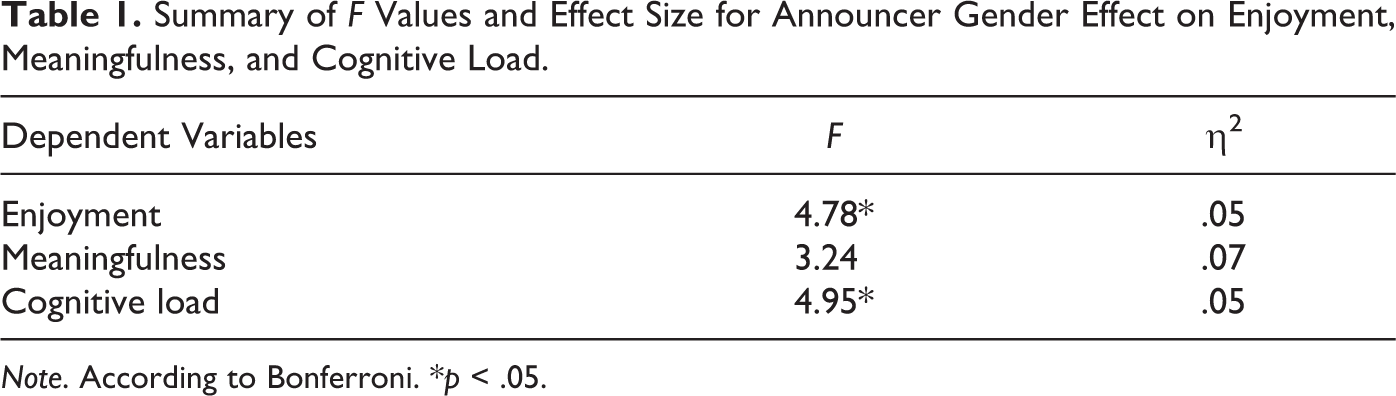
Note. According to Bonferroni. *p < .05.
Announcer Gender Effect on Enjoyment and Cognitive Load.

To test H3, age, race, and time spent watching sports were entered as covariates in a MANCOVA. Feelings of sexism (hostile sexism and benevolent sexism) and the dimensions of SDT (competence, autonomy, and relatedness) were entered as outcomes. The gender of the participant and gender of the announcer were entered as fixed factors. This analysis revealed a multivariate effect of the gender of the audience, F(5, 71) = 2.97, p < .05, Wilks’ Λ = .83,
Summary of F Values and Effect Size for Gender of Audience Effect on Hostile Sexism and Autonomy.
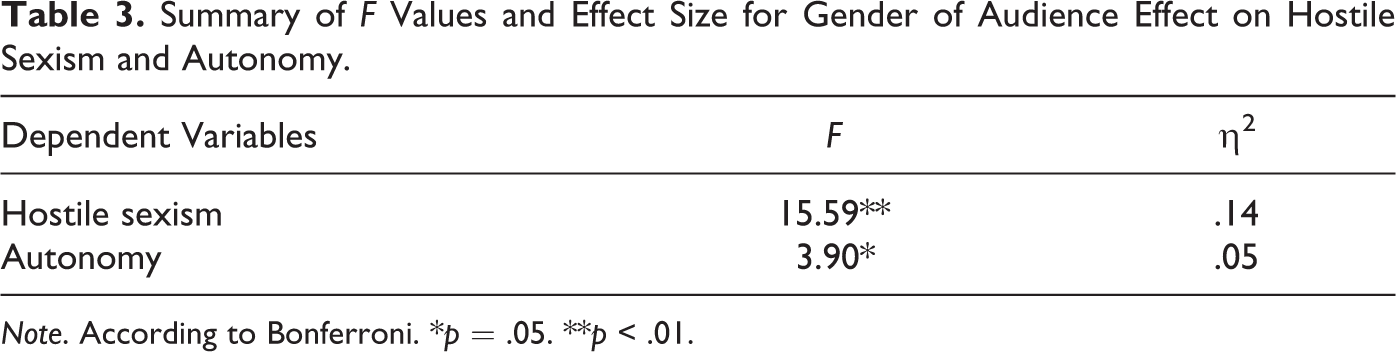
Note. According to Bonferroni. *p = .05. **p < .01.
Audience Gender Effect on Autonomy and Hostile Sexism.

To continue to test H3, the PROCESS macro (Hayes, 2018) was used to test the role of the mediating variables on the outcomes. Since the only mediating variables that were significant or approached significance were hostile sexism and autonomy, those were the only ones that were included in the final analysis. Each of the main outcome variables were significant or approached significance, so they were included as well. Age, race, and time spent watching sports were entered as covariates. Gender was entered as a moderating variable, and gender of the announcer was entered as the independent variable. Thus, Model 8 using 2,000 bootstrap samples and 95% confidence interval was used.
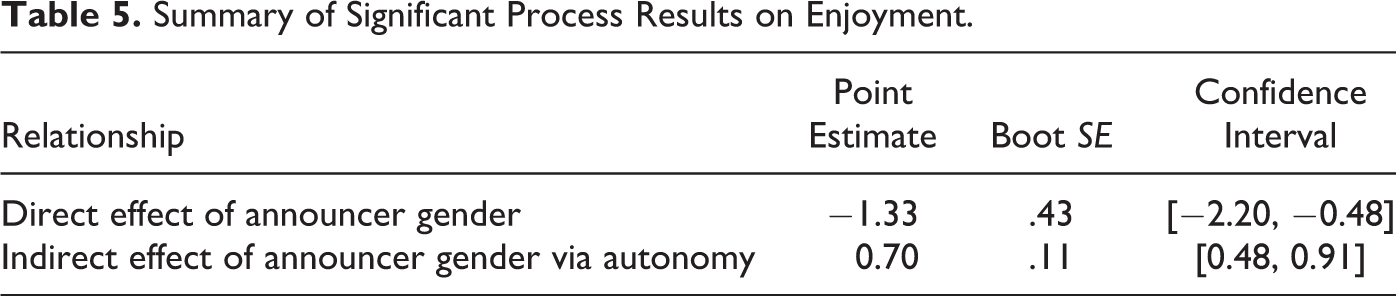
When feelings of enjoyment were entered as the outcome variable, there was a direct effect of announcer gender on enjoyment. Notably, this was a conditional direct effect such that the findings were only significant for men, not women. There was also an indirect effect of announcer gender on enjoyment via autonomy. A summary of significant Process results for enjoyment can be found in Table 5.
Summary of Significant Process Results on Enjoyment.
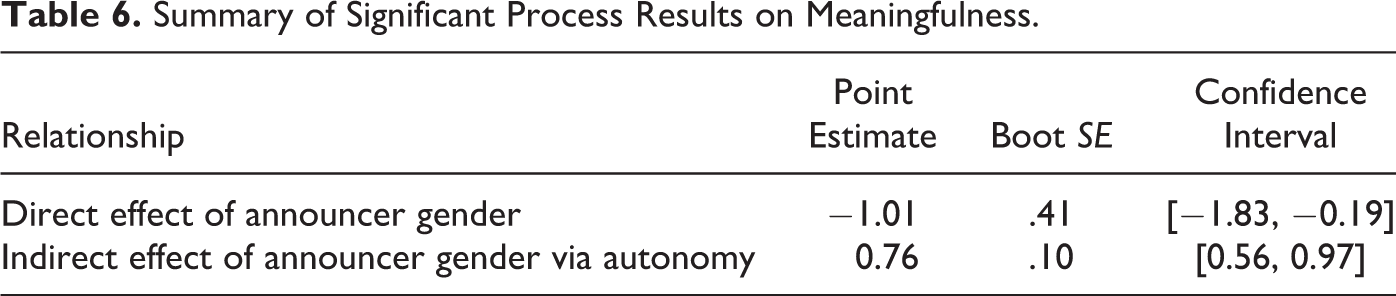
When feelings of meaningfulness were entered as the outcome variable, there was a direct effect of announcer gender on meaningful experience. Again, this was a conditional direct effect such that the findings were only significant for men, not women. Likewise, there was an indirect effect of announcer gender on feelings of meaningfulness via autonomy. A summary of significant Process results for meaningfulness can be found in Table 6.
Summary of Significant Process Results on Meaningfulness.
When cognitive load was entered as the outcome variable, there were no direct effects of the independent variable. There were, however, indirect effects through autonomy and hostile sexism. A summary of significant Process results for cognitive load can be found in Table 7.
Summary of Significant Process Results on Cognitive Load.

Discussion
This study aimed to understand how audiences might have different experiences when watching a sporting event based on the gender of the announcer. This study sheds light on this topic and therefore gives insights into audience demand for the sports media product and has implications for the labor market in sports media. The researcher wants to note that the results of this study will be interpreted objectively. However, these results should be understood as diagnostic of an issue facing the sports media industry, not as a justification of inequality for women working in the industry.
Overall, the findings of this study do not demonstrate encouraging results for female sports announcers in the workforce. In this case, sports fans were not as gratified by the event when a woman was announcing it. This echoes the literature discussed earlier such that sports are still by and large, a male domain (Gantz & Wenner, 1991; Kerr & Multon, 2015; Whiteside & Hardin, 2017) despite some significant moments involving women in sports like Aly Wagner’s groundbreaking coverage of the World Cup, National Broadcasting Company’s unprecedented coverage of women’s events during the Olympics, and the Storm/Kremer duo calling NFL games. The results in this case show little demand from audiences for female announcers. The lifeblood of sports economics is demand which can also be understood as the quality that the product offers to audiences and how much interest or entertainment a product offers (Borland & MacDonald, 2003; Neale, 1964; Rottenberg, 2000). If quality is directly tied to value, then this may help to explain why women are not paid as well as men and why women are not as prominent in the sports media industry. The perception is that women do not provide as much quality and thus are not worth as much in terms of pay.
While the findings here are discouraging for women announcers, this study should be considered an early step in the exploration of this phenomenon. This study clearly builds on the extant literature on the role of women in sports but also identifies an area where the industry may be interested in improving. Indeed, this may not be a question of sports media quality but of sports media representation. When audience members see themselves represented in sports broadcasts, they are more likely to engage and participate, which provides opportunities to broaden the audience and increase advertising revenue (Kanazawa & Funk, 2001). This helps explain the male domain of sports media; people are used to seeing men in these roles. In other words, people may not be responding to the quality of the broadcast but rather the fact that women are not typically in these roles, which can create psychological barriers to entertainment and fan interest (Billings & Ruihley, 2013; Raney, 2006). This suggests a potential economic growth area for women in sports media and sports media companies alike. If women begin to see themselves represented, they will watch more, and this will create more demand as well as interest (Borland & MacDonald, 2003; Neale, 1964; Rottenberg, 2000) and therefore more advertising revenue. Thoughtful content producers should recognize that demand can be created through more representation. Indeed, there was a time when there were no Black people on television as that was the norm but that norm has changed. Consider the average advertisement during football games. Very few are targeted at women despite women making up nearly half of the NFL’s audience (Hampton, 2017). This is a demographic that should be targeted and marketed toward. As such, the following discussion is diagnostic for sports media practitioners aiming to create more demand for and interest for their products (Borland & MacDonald, 2003; Rottenberg, 2000).
Men enjoyed the female announcer less, but it is not clear why. Since feelings of sexism did not mediate this relationship, there must be some other unassessed factor that should be explored in future studies. Other theoretical frameworks might be useful in uncovering the underlying mechanisms at work. One possible explanation discussed in the literature review is that female announcers are simply under more scrutiny than their male counterparts (Whiteside & Hardin, 2017). This relationship should be confirmed in future research. In the context of this study, this helps explain the labor market for women in sports media and why sports media remains dominated by men; it is harder to be a woman in sports (Hardin, 2005; Hardin & Shain, 2005a, 2005b, p. 814; Miller & Miller, 1995; Whiteside, 2017).
A particularly relevant lack of findings was uncovered in feelings of competence and relatedness. The most common complaints regarding women announcing games have been that they lack knowledge and game experience and thus do not belong calling games (Jenkins, 2018; Storm, 2018). However, competence can be understood in terms of knowledge and experience. Likewise, the idea of “not belonging” can be tied to the notion of relatedness. If someone does not belong, then it would follow that he or she would also not be relatable. Despite these common complaints, the gender of the announcer did not impact perceptions of competence or relatedness. This shows a lack of evidence for the most common complaints leveled at female announcers. Based on those complaints, the female announcer should have led to lower feelings of competence and relatedness. This may be a case of the consumer not knowing what he or she actually wants. Competence and relatedness were not precursors for demand despite consumer outcry. In this case, most of the dimensions of SDT were not useful in understanding how audiences derive gratifications from media (Oliver et al., 2016; Ryan & Deci, 2000; Ryan et al., 2006; Tamborini et al., 2010).
Another finding was that when feelings of meaningfulness were entered as the dependent variable, the findings were very similar—direct effect of announcer for men and an indirect effect via autonomy. This perhaps provides evidence that the meaningful/enjoyable paradigm produced less distinct results than in previous work (Oliver & Raney, 2011; Tamborini et al., 2010) especially in sports (Bartsch, et al., 2016; Rogers, 2018). When and why these two routes to entertainment manifest merits further exploration as this was unexpected. This study indicated that the gender of the announcer was not likely to impact demand in terms of meaningful/enjoyable experiences. This is a noteworthy finding for practitioners looking at the economy of sports, as meaningful and enjoyable experiences can often be parsed.
When cognitive load was entered as the main outcome, there were no direct effects of announcer gender. Instead, there were indirect effects via autonomy and hostile sexism. Greater feelings of hostile sexism led to higher feelings of cognitive load. This seems logical as experiencing feelings of hostile sexism likely requires a degree of cognition/information processing. Also, since sports are such a male-dominated industry, it might be unexpected to hear a female announce a game. This surprise could lead to greater feelings of cognitive load, as it requires reorientation by the audience (Borland & MacDonald, 2003; Campbell & Kirmani, 2000; Mayer & Moreno, 2003). What this amounts to, however, is further confirmation that sports are still a man’s domain and women might encounter outright hostility for the consequences of breaking social norms when they participate (Gantz & Wenner, 1991; Kerr & Multon, 2015; Whiteside & Hardin, 2017). The link between cognitive load and user demand for sport requires further study. Billings and Ruihley (2013) showed that some people consume sports for highly cognitive reasons while others use sports to relax and escape reality.
The findings related to autonomy are not as easily understood. The results indicated that when more autonomy was felt, more cognitive load was felt. Autonomy is generally understood as the ability to make choices for oneself, so cognitive load should decrease as the individual has freedom including the freedom to not think. However, if one feels that he or she has control, this could engender feelings of responsibility and become a cognitive burden (Mayer & Moreno, 2003). Typically, autonomy has been connected to positively valenced experiences (Ryan et al., 2006; Tamborini et al., 2010), not negatively valenced ones like cognitive load. One possible explanation for this finding is that autonomy led to more cognitive load, but it was not enough to become unpleasant, and/or the benefits of feeling autonomy outweighed the drawbacks of cognitive load. Again, Borland and MacDonald (2003) said that cognitive load is an important factor regarding demand for sport, but the picture appears to be quite complicated when adding in other factors.
While practical applications are endemic to this entire discussion section, this portion will dissect that specifically. Content producers might look at this study and interpret that women should be kept out of announcer roles, as it will negatively impact the audience experience. This would be a shortsighted interpretation of the findings presented. This study is diagnostic and reaffirms previous research (Hardin & Shain, 2005a, 2005b, p. 814; Miller & Miller, 1995; Whiteside, 2017) such that it provides empirical evidence that women will have a more difficult time succeeding in the sports industry, thereby impacting and explaining the labor market. As such, women and content producers should be aware of this issue so they can help to rectify it. In that vein, this study provides noteworthy areas for content producers to focus on in order to appeal to women and grow that segment of the market. In particular, the autonomy finding deserves attention. If content producers can enhance feelings of autonomy in their audiences, then that will provide more enjoyable experiences for audiences (Oliver et al., 2016; Ryan et al., 2006; Tamborini et al., 2010). In other words, more autonomy is likely to lead to greater demand, especially for women. When women feel autonomy, they enjoy a product more. Likewise, this study demonstrates that other areas are not quite as important to demand like competence, relatedness, and benevolent sexism. As such, those who are examining financial and business decisions may opt to avoid strategies related to these in order to generate feelings of entertainment and interest (Borland & MacDonald, 2003; Rottenberg, 2000)
As for limitations, this study had several, and the piece should be interpreted with them in mind. First, participants were asked at the end of the survey whether the announcer they heard was male or female. Ten in the male condition mistook the announcer for female, and 20 in the female condition mistook the announcer for male. Notably, male versus female voices are identifiable 88% of the time (Coleman, 1971). These responses were removed from analysis but further show that audience expectations were broken when watching this video. The event was a high school boys’ basketball game. The expectation was likely that a man would announce this event, not a woman (Hardin & Shain, 2005a, 2005b, p. 814; Miller & Miller, 1995; Whiteside, 2017). Similarly, the script that was used was based on calls done by a man. There may have been a mismatch such that the male announcer felt more natural and the female announcer was doing an impression of a man. Indeed, forcing the intonation to be similar allowed for experimental control but may have created this limitation. The results of this study may have been different if a different sport or even a different level of competition (college or professional) was used. This should be examined in future research. Another factor that might be a consideration is the frequency of a male voice versus a female voice, such that a female voice, typically at higher frequency (Puts, 2005), could be more difficult to hear and understand. The squeak of sneakers and echo of cheers are more likely to compete with a female voice than a male voice. Finally, this study used Mechanical Turk. However, best practices in this domain were implemented.
In conclusion, this study aimed to explore how audiences might have different experiences when watching a sporting event based on the gender of the announcer. Through the lens of sports economics and demand, the results do suggest that female announcers have challenges facing them in the labor market reflecting that sports are still a “man’s world.” However, this study does provide a deeper understanding of why these challenges may manifest. This study has hopefully added to that conversation, been diagnostic of an issue facing the industry, given guidance on best practices, and provided an avenue for further research to understand the connection between sports media demand and fan interest (Borland & MacDonald, 2003). In closing, sports media is a man’s world but pioneers in the field like Jenny Cavnar, Jessica Mendoza, and Aly Wagner are challenging sports media norms and those interested in sports economics should pay attention to the change in representation in media broadcasts.
Footnotes
Author’s Note
This study involved human subjects and was approved by the appropriate institutional review board. All ethical standards were followed. Informed consent was collected from each participant.
Declaration of Conflicting Interests
The author(s) declared no potential conflicts of interest with respect to the research, authorship, and/or publication of this article.
Funding
The author(s) received no financial support for the research, authorship, and/or publication of this article.
