







Abstract
Employers may favor applicants who played college sports if athletics participation contributes to leadership, conscientiousness, discipline, and other traits that are desirable for labor-market productivity. We conduct a resume audit to estimate the causal effect of listing collegiate athletics on employer callbacks and test for subgroup effects by ethnicity, gender, and sport type. We applied to more than 450 jobs on a large, well-known job board. For each job listing, we submitted two fictitious resumes, one of which was randomly assigned to include collegiate varsity athletics. Overall, listing a college sport does not produce a statistically significant change in the likelihood of receiving a callback or interview request. We find no statistically significant differences within ethnicities or genders.
Athletics are prominent in American high schools and colleges. In 2018, the number of participants in high school sports increased for the 29th consecutive year, up to a record-high of nearly eight million students (National Federation of State High School Associations, 2018). As of 2020, there were more than 460,000 college-athletes nationwide (National Collegiate Athletics Association, 2020). Employers may favor applicants who played college sports if athletics participation contributes to leadership, conscientiousness, discipline, and other traits considered desirable for labor-market productivity. Indeed, there is evidence that employers value interpersonal skills, self-motivation, and problem-solving ability (Baird & Parayitam, 2019; Chaflin et al., 2015; National Association of Colleges and Employers, 2020). Observational studies, including some longitudinal research that tracks students from high school through college and into their careers, suggest a positive relationship between sports and later-life outcomes, but much of this research is hampered by limited internal validity (Heckman & Loughlin, 2021). Until now, there have been few experimental evaluations of the relationship between college athletics and job-market outcomes.
In this study, we conduct an audit-correspondence study to estimate the causal effect of listing collegiate athletics on employer callbacks. Creating fictitious resumes and sending them to job postings are frequently used to estimate differences in employer preferences regarding applicants’ demographic traits or work history (Bertrand & Mullainathan, 2004; Cheng & Florick, 2020; Deming et al., 2016; Gaddis et al., 2021; Ghayad, 2013; Kroft et al., 2013; Lahey, 2008; Lahey & Beasley, 2016). Historically, audit-correspondence studies have been used to address the possibility of discriminatory hiring. They have also been used to examine discrimination in the rental housing market (Lahey & Beasley, 2016; Nemark, 2018; Neumark & Rich, 2019).
Our motivation is to understand whether employers demonstrate a preference for applicants with collegiate sports experience. We generate fictitious resumes by randomly assigning some to include college athletics and compare the callback rates of resumes with and without athletics. We applied to more than 450 jobs listed on a large, well-known job board. For each job listing, we submitted two fictitious resumes (one resume pair). Within each resume pair, one resume was randomly assigned to include experience in collegiate varsity athletics. Other parts of the resume such as gender, race, degree field, and postsecondary institution were held constant within pairs. Remaining parts of the resume such as work experience and other extracurricular involvement were extracted from actual resumes and randomly assigned to our fictions resumes.
The results from this study may be most valuable to a student who is on the margin of participating in collegiate athletics. Will one's labor-market prospects be limited, unaffected, or improved by listing this experience on a resume? Overall, we find that listing sports participation does not significantly change whether an applicant receives a callback or interview request. Among males and females, there were no meaningful differences in callback rates for athletes relative to non-athletes. We observed somewhat larger decreases in the likelihood that non-white applicants receive callbacks when their resumes include sports. These differences, though potentially economically meaningful, fell short of statistical significance due to statistical power limitations in our analysis.
In the next section, we review the literature on the effects of athletics on later-later life outcomes, with a focus on labor-market outcomes. We then detail our methods and explain our experimental design. Finally, we present results and conclude with a discussion our findings.
Background and Prior Research
Modern debate among education policy researchers about the effect of athletics on later-life outcomes was initiated by Coleman (1961), a sports pessimist who viewed athletics and academic pursuits as a zero-sum game (Hauser & Lueptow, 1978). Athletics come with opportunity costs. Some observers, concerned about United States’ middling standing in international achievement, speculate that funds currently spent on athletics should instead be used to enhance traditional academic expenditures (Ripley, 2013). An analysis of public Division I colleges and universities found that athletic departments spend three to six times more on the average athlete relative to the average non-athlete student (Desrochers, 2013).
Alternatively, advocates of athletics argue that participating in sports may lead to greater lifetime earnings, educational achievement, and expectations (Hanks & Eckland, 1976; Heckman & Loughlin, 2021; Long & Caudill, 1991; Snyder & Spreitzer, 1977). Recent observers such as Greene (2013), argue that athletics contribute to social capital and, as such, Coleman’s (1961) perceived trade-off between athletics and academics may be overstated. Moreover, employers may place value on intangible characteristics developed through sports participation (Bauer-Wolf, 2019). Indeed, some observational studies suggest that collegiate student-athletes exhibit higher levels of interpersonal and leadership skills that may be rewarded in the labor market (Barratt & Frederick, 2011).
Labor-Market Outcomes
There are challenges to estimating the causal effect of sports participation. Selection bias is an inherent problem since individuals cannot be randomly assigned to sports. Adolescents and young adults who participate in sports, for instance, may benefit from environmental or genetic factors that are associated with more favorable labor-market outcomes. Although researchers typically employ quasi-experimental or correlational methods to examine the influence of athletics participation on later-life outcomes, there have been a few experimental studies on this subject.
For example, Rooth (2011) presented causal evidence on the Swedish labor-market returns to physical fitness, which is related to—but slightly different from—collegiate sports participation. In this experiment, job applicants included written statements such as “I like to engage in recreational sport activities in order to stay in shape” (Rooth, 2011, p. 405). Male applicants who signaled having skills in athletics were two percentage points more likely to receive callbacks than those who did not signal skills in athletics. These effects were largest in physically demanding occupations, although they were not driven by the physically demanding types of athletics. In another experiment, Tracy, Erkut, and Pappano (2020) found that college athletes were no more likely than non-athletes to receive an interview. In this study, however, the authors presented fictitious resumes to be evaluated by human resource professionals who knew they were participating in an academic survey, rather than job recruiters employed by a company truly seeking to hire an employee.
Researchers have also used instrumental variables to estimate the effect of athletics on labor-market outcomes (Yeung, 2015). Unlike much of the correlational research, which suggests a positive relationship between sports and outcomes, instrumental variables estimations generally suggest null effects. Analyzing the 1980 cohort from the High School and Beyond survey, Eide and Ronan (2001) used students’ height at age 16 as an instrument for the otherwise endogenous decision to participate in sports. The authors found no statistically significant relationship between high school sports and earnings for men and women from all racial backgrounds, with the exception of black males for whom the relationship was positive. Another instrumental variables analysis of males in the National Longitudinal Survey of Youth found statistically significant effects of athletic participation on educational attainment but not for weekly wages (Barron et al., 2000). Furthermore, Stevenson (2010) used variation in boys’ athletic participation prior to passage of Title IX to instrument for the change in girls’ athletic participation. This study of the National Longitudinal Survey of Youth concluded that increased athletic opportunity for women was associated with an increase in labor force participation. However, no relationship was identified between sport participation and hourly wages.
Observational research generally suggests a positive association between athletics and earnings, but these studies cannot account for possible positive selection among students who play sports. Several studies indicated that male athletes earned higher wages than male non-athletes (Barron et al., 2000; Curtis et al., 1999; Ewing, 1995). One analysis found that former college athletes earn more, on average, but the wage advantage was skewed such that the median non-athlete earned more than the median athlete (Henderson et al., 2006). A nationally representative Gallup survey (2016), commissioned by the NCAA, found that 65 percent of former athletes reported being employed full-time compared to 63 percent of non-athletes. Among those who were employed full-time, former athletes were 4 percentage points more likely to report being “engaged” in the workplace than non-athletes. Similarly, multiple analyses have found that high school athletes were more likely to be employed and earn higher incomes than non-athletes by the time they reached their mid-20s (Carlson et al., 2005; Heckman & Loughlin, 2021).
Attainment and Achievement
Correlational evidence suggests benefits of sports participation on academic achievement. After controlling for poverty levels and student demographics, Bowen and Greene (2012) found Ohio high schools that offer more sports have students with higher test scores and graduation rates. A meta-analysis by the Centers for Disease Control (2010) reviewed 251 associations between physical activity and academic performance, finding that more than half of the associations were positive, less than two percent were negative, and the remainder were null. Other observational studies suggest a positive association between athletics and academic achievement (Broh, 2002; Eccles et al., 2003; Holland & Andre, 1987; Lipscomb, 2006; Marsh, 1993; McCormick & Tinsley, 1987; Soltz, 1986; Troutman & Dufur, 2007). More rigorous methods call into question the effects of sports participation on attainment and achievement. For example, Reese and Sabia (2010) use height as an instrument in their analysis of the National Longitudinal Study of Adolescent Health. The authors found no relationship between high school sports participation on academic achievement. In this paper, we use a different approach, namely a resume audit experiment, to investigate the value of sports participation as assessed by the potential employers’ behavioral response to resumes of student athletes and non-athletes. We describe our methods in the next section.
Methods
Setting for Resume Audit
Between March 2020 to February 2021, we submitted resumes to job postings for employment opportunities within a 25-mile radius of four large metropolitan areas in the Northeast and Midwest (New York City, Philadelphia, Pittsburgh, and Milwaukee; See Appendix A) that had both a concentration of collegiate sports programs and job openings. Using a large, popular online job board, we applied for any entry-level positions that sought candidates who recently completed their bachelor's degree.
All job postings sought candidates with four-year degrees in a business-related field, such as business administration, organizational management, marketing, logistics, financial management, accounting, data analytics, and information technology. In these job postings, employers sought candidates to fill positions such as administrative assistants, sales representatives, marketing specialists, customer service representatives, and account managers. We focused on business-related fields because they are among the most popular majors selected by college student-athletes (Foster & Huml, 2017; Schneider et al., 2010). About half of the job postings listed annual salaries, the median of which was about $40,000.
Resume Construction and Experimental Design
In our experiment, we submitted pairs of fictitious resumes to the same job opening. Each resume was crafted to represent an individual who completed a bachelor's degree within the past year. We randomly populated each resume with a name, contact information, educational background, prior professional work experience, skills, and extracurricular activities, following the approach used by past researchers (Deming et al., 2016; Lahey & Beasley, 2009). Within each pair, we also randomly assigned one resume to list participation in collegiate athletics to study its causal effect on receiving a callback from a potential employer. We discuss these components in turn.
Collegiate Sports Experience
To estimate the causal effect of participating in collegiate sports, we constructed one resume that identified the fictitious job candidate as a student athlete and a corresponding resume that made no mention of participation in collegiate sports. We randomly determined which of the two resumes would indicate collegiate sports experience and listed it next to information about the candidate's educational background, contact information, and name. We attempted to raise the salience of collegiate sports experience by placing it near the top of the resume. Given the existing evidence and theoretical benefits of athletic participation, we hypothesize that resumes listing college athletics will be more likely to receive callbacks than other resumes that display non-sport extracurricular activities.
On all resumes that included experience with collegiate sports, we listed participation in either soccer, track and field, or cross-country running. We selected institutions that do not participate at the NCAA Division I level to lower the chances that employers would recognize fictitious resumes. Listing participation in a major Division I sport might induce employers to look up rosters, and a simple check would harm the candidate's chances of receiving a callback. We attempted to avoid this problem by listing participation in less popular sports like soccer, track and field, and cross-country running at non-Division I postsecondary institutions.
Furthermore, we selected these sports to test our hypothesis that participation in team and individual sports might signal different skills to employers. We use soccer to test the effects of participation in team sports on receiving a callback. Track and cross-country running are used to examine potential effects of participating in an individual sport. We hypothesize that participation in a team sport like soccer signals greater interpersonal skills that may be valued on the job market (Chaflin et al., 2015). As such, we expect higher callback rates for soccer players relative to track or cross-country athletes.
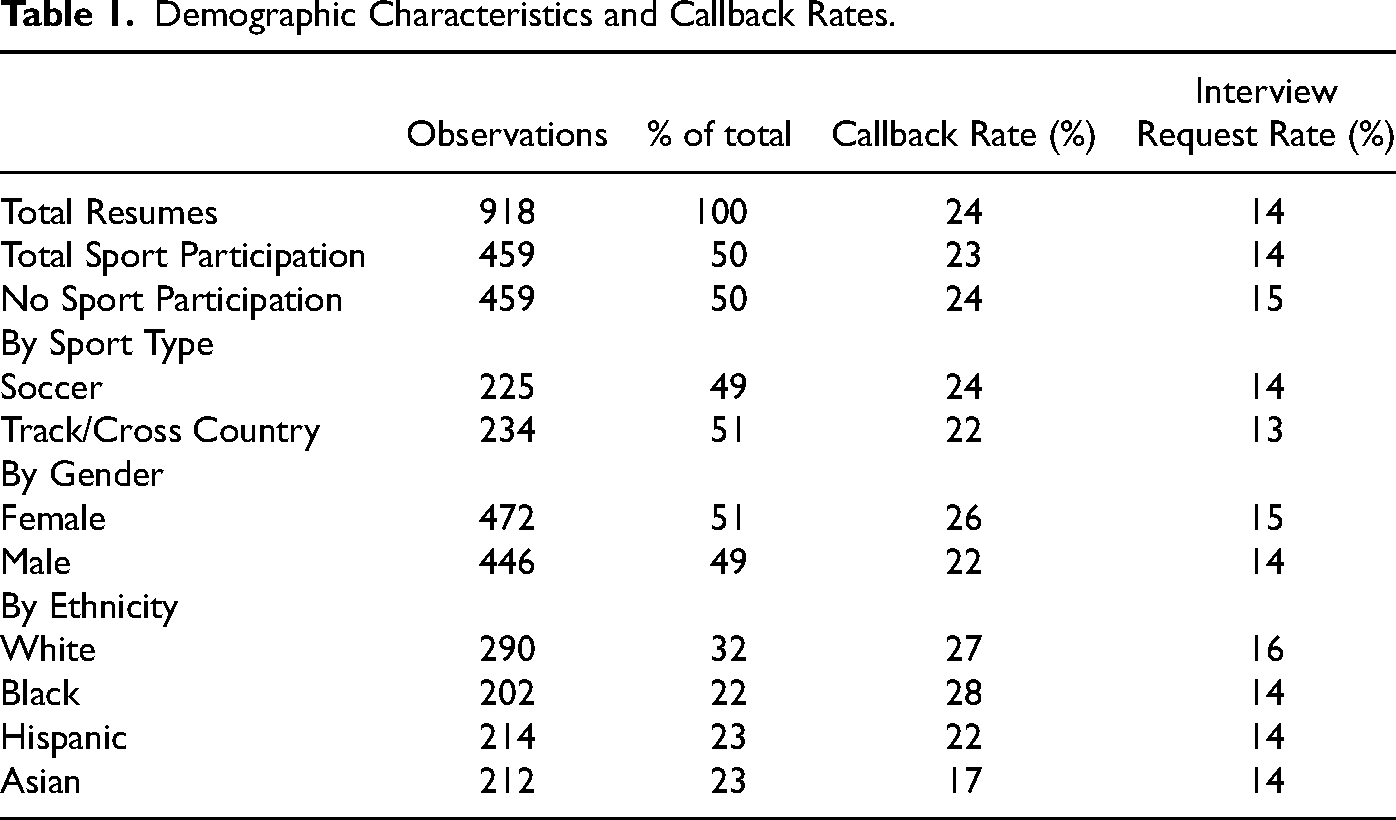
We sent out 918 resumes (459 pairs). Table 1 disaggregates the resumes we submitted by sport type, gender, and ethnicity.
Demographic Characteristics and Callback Rates.
Candidate Characteristics
Because race and gender might influence callbacks and interviews, we followed a standard practice of prior resume audit experiments and held race and gender constant within resume pairs but allowed them to vary across pairs (Bertrand & Mullainathan, 2004; Deming et al., 2016). In other words, for a given job posting, we randomly selected a gender (i.e., male or female) and race (i.e., White, Black, Hispanic, or Asian) combination. We then randomly generated two names that fit that gender and race profile based on lists of the most popular names of children born in the year 2000—the population who would be completing their four-year degrees at the time of our experiment. Holding gender and race fixed across both resumes sent to each job posting ensures any differences in callback rates are not attributable to differences in these demographic characteristics.
We hypothesize there could be disparate effects of sports participation on employment opportunities by gender and race. Both positive and negative stereotypes about college athletes are likely to be gender and racially coded. Athletic programs for women may be less emphasized than athletic programs for men and therefore be viewed as less likely to be distracting from academic success. However, according to some surveys, employers do not report valuing sports participation differently for men or women (Chaflin et al., 2015).
Prospective employers may see non-white athletes as negatively fitting stereotypes of unearned academic accomplishments even while possessing high levels of athletic talents (Eastman & Billings, 2001). Alternatively, employers may still positively interpret sports participation among non-white and white individuals alike as signaling leadership, self-discipline, and other desirable traits. Given limited past research on these issues, we do not have strong priors about the direction of these disparate effects but think that negative effects may predominate.
Contact Information
We generated email addresses and phone numbers for each resume. We regularly checked these email and voicemail accounts for callbacks by employers. Both email and voicemail messages were coded as callbacks. As is conventional practice in resume audits, we did not respond to any callbacks. To generate addresses, we listed units in large apartment complexes near the postsecondary institution named as the degree-granting institution on the resume.
Educational Background
Every resume listed completion of a bachelor's degree program in a business-related field at the end of an academic term in 2020. No resume listed the completion of a post-baccalaureate degree. We identified 30 postsecondary institutions for our fictitious resumes (Appendix B). These institutions were selected because they had non-Division I college athletics programs in soccer, track and field, or cross-country running. These institutions were also geographically located near the job markets for the setting of our experiment, and each institution offered degree programs in a business-related field. Like gender and race, we held the institution and degree fixed within each resume pair to rule out the possibility that callbacks from the same job posting were the result of differences in employer preferences for degree or institution.
Work Experience
We followed the practice of prior resume audits and populated our fictitious resumes with work experience (Deming et al., 2016). Specifically, we began by using the same job board to which we were submitting resumes to obtain nearly 1,000 resumes of real individuals who completed a bachelor's degree program in a business-related field from the postsecondary institutions in our study during the spring of 2020. We collected up to the three most recent work experiences listed in each of these actual resumes.
When crafting fictitious resumes, we randomly selected a work history from the resume of a real individual who attended the same postsecondary institution and degree. With the random selection of work histories, callbacks are unlikely to be driven by differences in work histories across pairs in the aggregate.
Skills
We likewise populated fictitious resumes with skills that were listed on real resumes that we sampled. For example, individuals listed competencies in a variety of computer software or foreign languages. We randomly selected lists of skills from the sampled resumes and added them to the fictitious resumes. Again, this approach reduces the possibility that overall differences in callback rates within resume pairs are attributable to differences in listed skills.
Extracurricular Activities and Awards
It is common for genuine resumes to list participation in extracurricular activities, membership in student groups, volunteering, and awards. As with skills and work experience, we randomly selected these items and populated our fictitious resumes with this content. Sometimes, resumes from which we sampled listed participation in collegiate sports; in these cases, we never used this content to populate our fictitious resumes. Examples of extracurricular activities include serving as a volunteer camp counselor, a grader for an accounting class, and participation in various clubs such as Glee Club, Voice Club, and Management Club.
Analytic Strategy
Econometric Model
We estimate differences in callback rates using a regression framework as specified in Equation (1):
We operationalize our dependent variable Callbackij in two ways. We first use a binary indicator of whether the particular resume received a callback from a prospective employer. We consider a callback to be any phone message or email left by the employer desiring information about the job candidate. The second dependent variable is a binary indicator of whether the callback specifically requested an interview. The independent variable of interest is Sportsi, the binary indicator of whether the resume included collegiate athletics. No further control variables are required to estimate the effect of listing collegiate athletics because we held race, gender, educational background, and degree program constant within pairs and randomized all of the content in each resume.
Model Assumptions and Interpretation
By holding race, gender, and educational background features constant within resume pairs as well as randomly populating the remaining features of the resumes such as skills and work experience, resumes within each pair will theoretically be the same, on average, except for the mention of collegiate sports participation on one of the resumes. Econometrically, the exogenous source of variation in whether the resume listed sports participation would provide an unbiased estimate of β1. However, as Heckman (1998) has argued, equivalence of means in observable and unobservable characteristics across resumes in the treatment and control conditions is insufficient for differentiating between taste and statistical discrimination in correspondence studies. Also required is equivalence of variances in unobservable characteristics. 1 However, our aim is not to differentiate between taste and statistical discrimination. In a departure from prior audit correspondence studies, our purposes are much more modest, namely, to empirically test whether whatever is signaled through collegiate athletic sports participation is something employers specifically prefer. Put differently, we estimate a reduced-form effect of sports participation, so to speak, without differentiating between taste and statistical discrimination or attempting to identify the precise aspects of human capital signaled by sports participation (Neumark, 2012).
Results
Raw Counts of Callbacks and Interview Requests
We begin by presenting results that compare callback and interview request rates for resumes with and without collegiate sports experience. Before discussing our regression estimates, we disaggregate our resume pairs by whether (1) they both received a callback, (2) only the resume that listed sports experience received a callback, (3) only the resume that did not list sports experience received a callback, or (4) none of the two resumes received a callback.
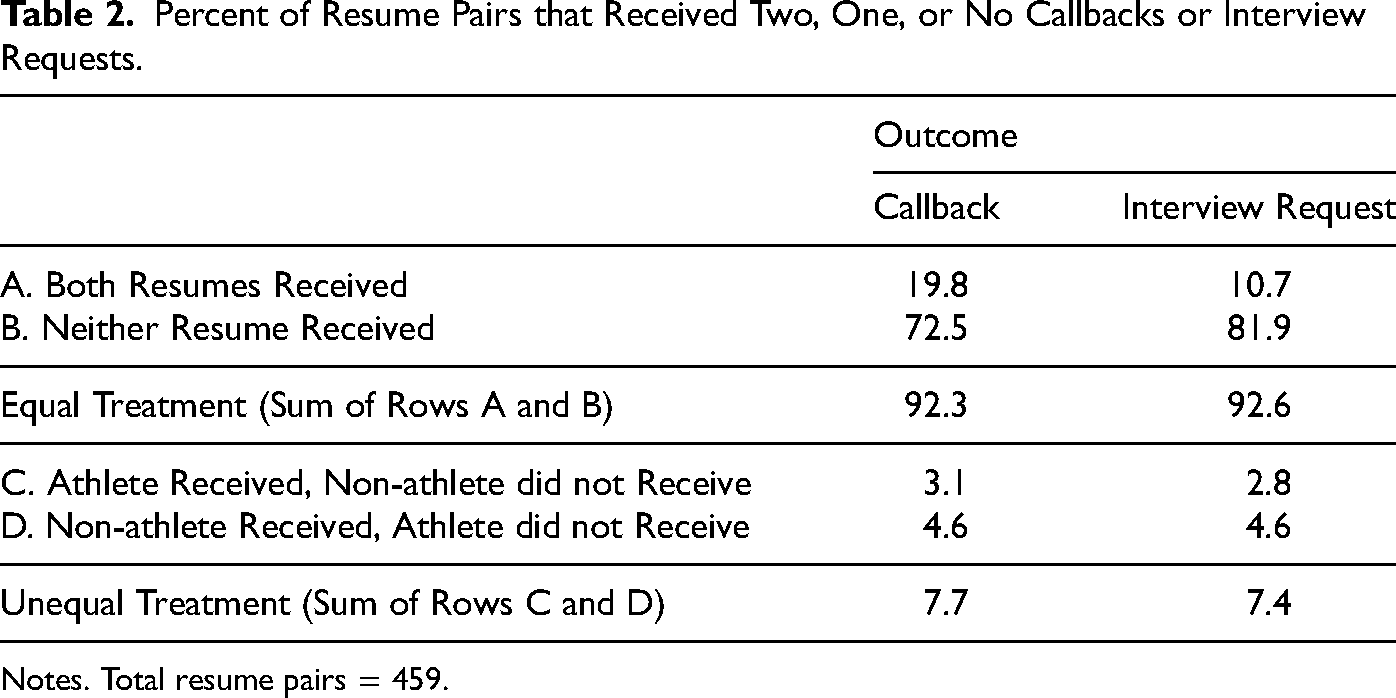
As shown in Table 2, both resumes in 19.8 percent of resume pairs received callbacks, while neither resume in 72.5 percent of the resume pairs received callbacks. That is, the resumes in each pair were treated equally in the vast majority of instances, 92.3 percent of them to be exact. Rows C and D of Table 2 display the proportion of resume pairs that received unequal treatment. In 3.1 percent of the pairs, the resume that listed sports involvement received a callback, while the resume that did not list sports involvement did not receive a callback. Meanwhile, resumes that did not list sports involvement received a callback, while the resume that listed sports involvement did not receive a callback in 4.6 percent of resume pairs. We observe similar patterns when we consider interview requests, though the proportion of resume pairs in which neither resume received an interview request was much higher at 81.9 percent.
Percent of Resume Pairs that Received Two, One, or No Callbacks or Interview Requests.
Notes. Total resume pairs = 459.
We present the callback and interview request rates disaggregated into these four categories for two main reasons. First, it is important to acknowledge the source of identifying variation in our sample. With the inclusion of fixed effects, such variation is identified from the proportion of resume pairs where the outcomes for each of the two resumes were different. For our sample, this is a relatively small proportion of resumes and is noticeably lower than those reported in, for example, earlier studies of job market racial discrimination where 75 to 90 percent of pairs are treated equally by employers (Heckman, 1998). With over 90 percent of pairs treated equally in our analysis, we have relatively less study power.
Second, results presented in Table 2 indicate low instances of differential treatment between resumes that list or do not list sports participation. Even among the 7 to 8 percent of resume pairs where the individual resumes were not treated equally, the disparities are not as pronounced some estimates reported in prior literature (Heckman, 1998). If anything, there is only a slight preference for resumes that do not list sports participation.
Regression Estimates of Callback and Interview Requests
We now turn to our regression estimates of Equation 1. As shown in Figure 1 and consistent with the percentages reported in Table 2, there are no meaningful differences in callback or interview request rates between these two groups. Slightly more than 24 percent of resumes that did not list collegiate sports received a callback, whereas nearly 23 percent of resumes that listed collegiate sports received a callback. Approximately 15 percent of resumes that did not include sports participation received a callback specifically requesting an interview, which is 1.7 percentage points greater than resumes that did list sports. Neither of these differences are statistically significant.
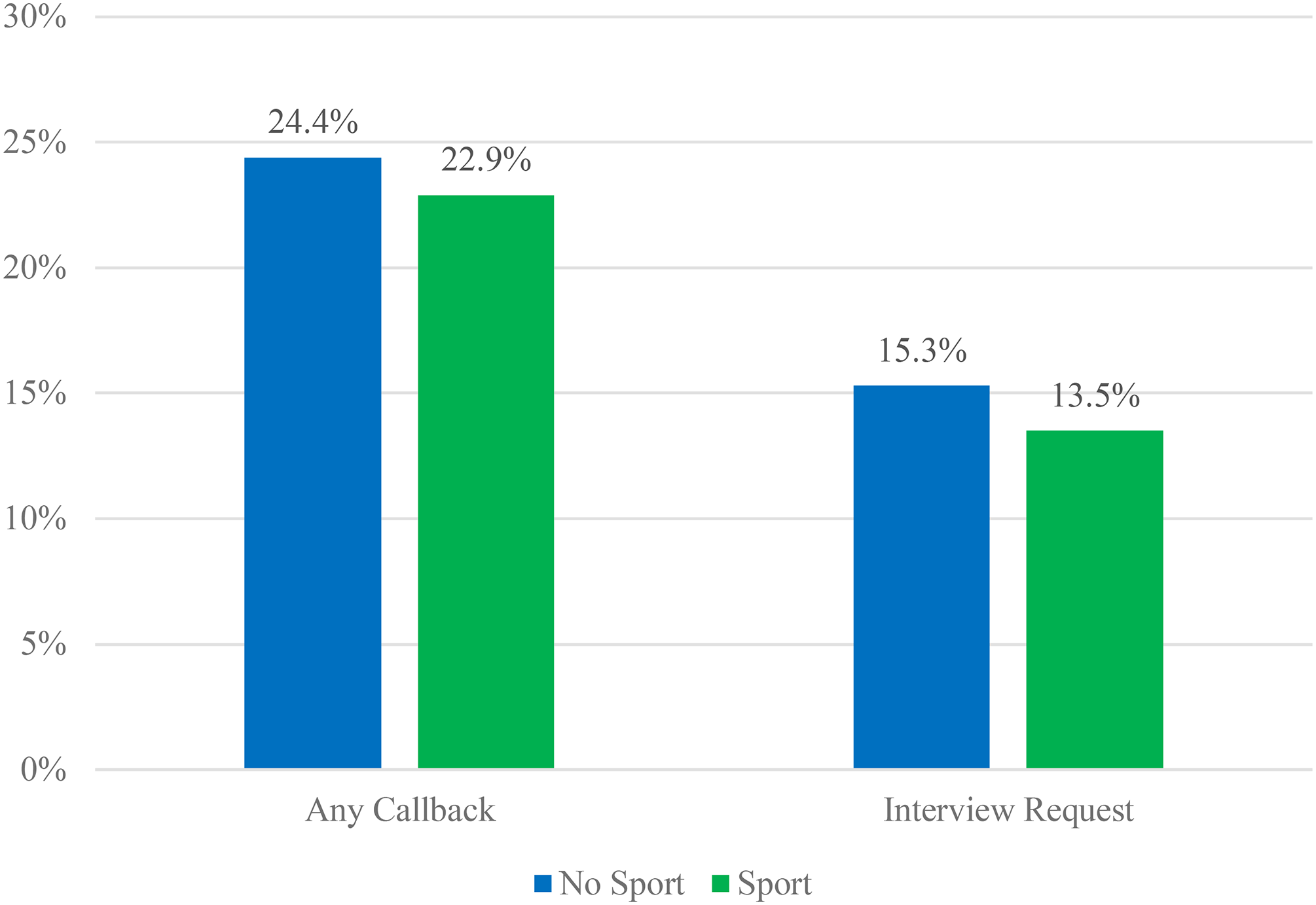
Callback and interview request rates, with and without collegiate athletics.
The full set of regression coefficient estimates for these results and all subsequent results are displayed in Table 3. We note that these callback rates are higher than those documented in some prior research, though they are not unprecedented as Heckman (1998) and Neumark and Rich (2019) have reported. For instance, Deming et al. (2016) report a callback rate of about 8 percent with half, or 4 percent of the callbacks in their sample, specifically mentioning an interview. It is uncertain why our callback rates are relatively high, though the particular labor markets and job postings we targeted in the study as well as the unique timing of the study in March 2020 through February 2021 when we had a global pandemic are potential explanations.
Regression Results.
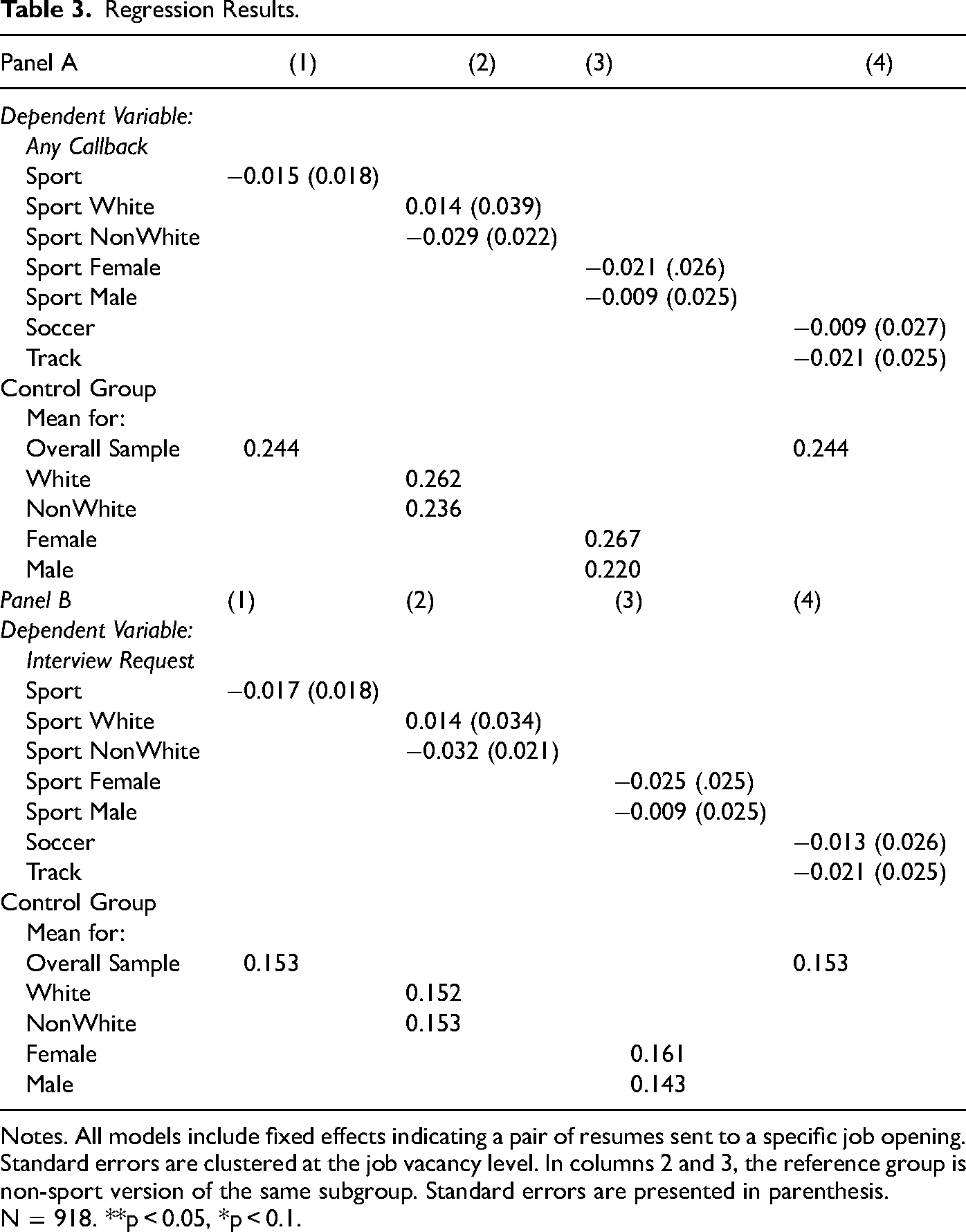
Notes. All models include fixed effects indicating a pair of resumes sent to a specific job opening. Standard errors are clustered at the job vacancy level. In columns 2 and 3, the reference group is non-sport version of the same subgroup. Standard errors are presented in parenthesis.
N = 918. **p < 0.05, *p < 0.1.
In Figure 2, we display callback and interview requests rates by sport type. There are no statistically significant differences in the likelihood an applicant received a callback or interview request among resumes that listed soccer compared to those that listed track or cross-country racing. In absolute terms, callback and interview requests rates are marginally higher for soccer resumes relative to track and cross country, but the results are neither statistically significant nor substantively large.
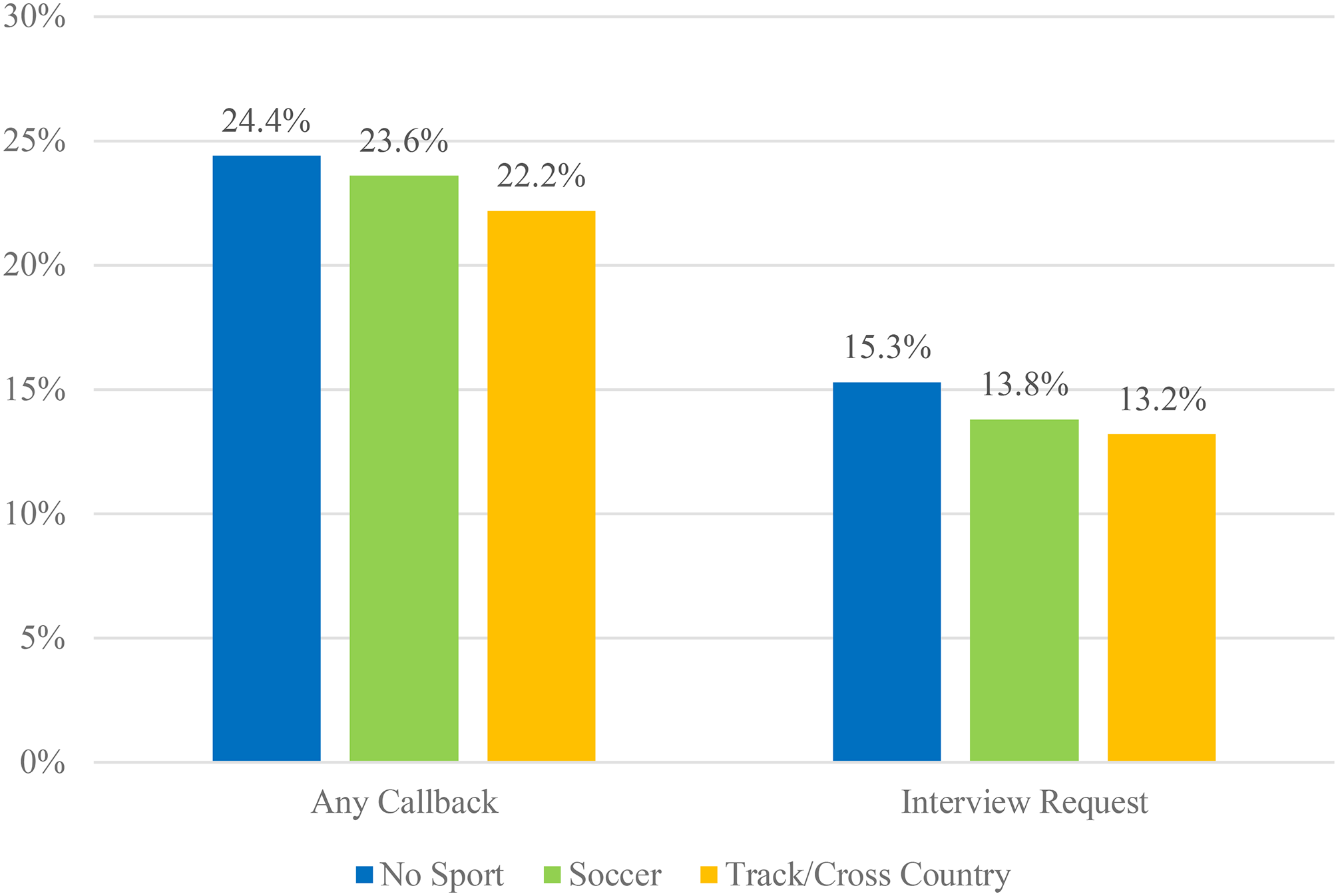
Callback and interview request rates, by sport type.
Subgroup Results
White and Nonwhite Applicants
We find practically larger differences in callback rates within subgroups. For example, as illustrated in Figure 3, 23.6 percent of nonwhite applicants who did not list sports received callbacks, while only 20.7 percent of nonwhite applicants who listed sports received callbacks. This apparent 3 percentage point penalty for sports participation is not statistically significant (p = .18). There is a similar finding among nonwhites for interview requests. Some 15.3 percent of nonwhite applicants who did not play sports received requests for interviews compared to only 12.1 percent of nonwhite applicants who did play sports (Figure 4). This difference is nearly twice the magnitude as the overall estimate of sports participation on interview requests, although it still falls short of statistical significance (p = .13).
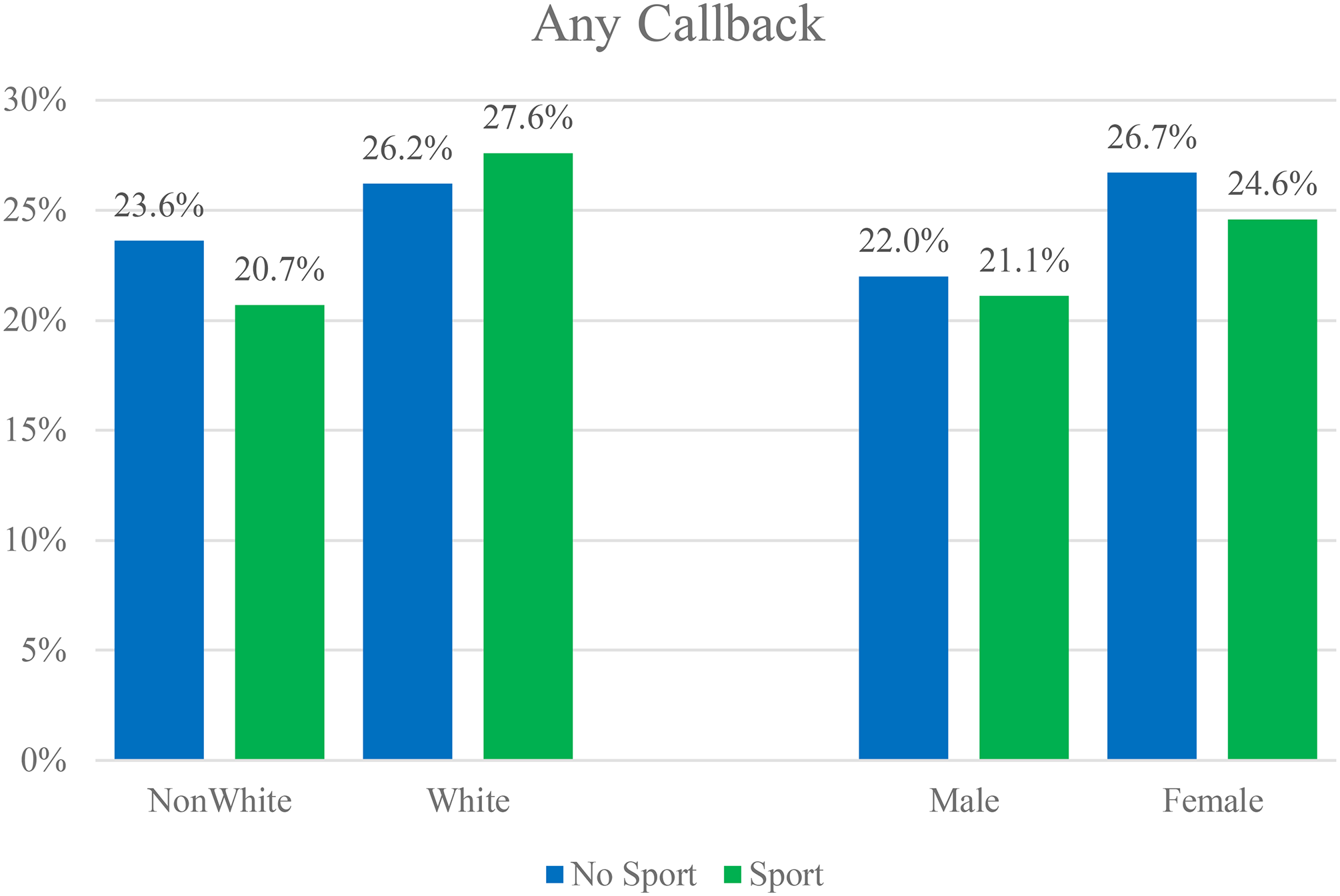
Callback rates for subgroups, with and without collegiate sports.
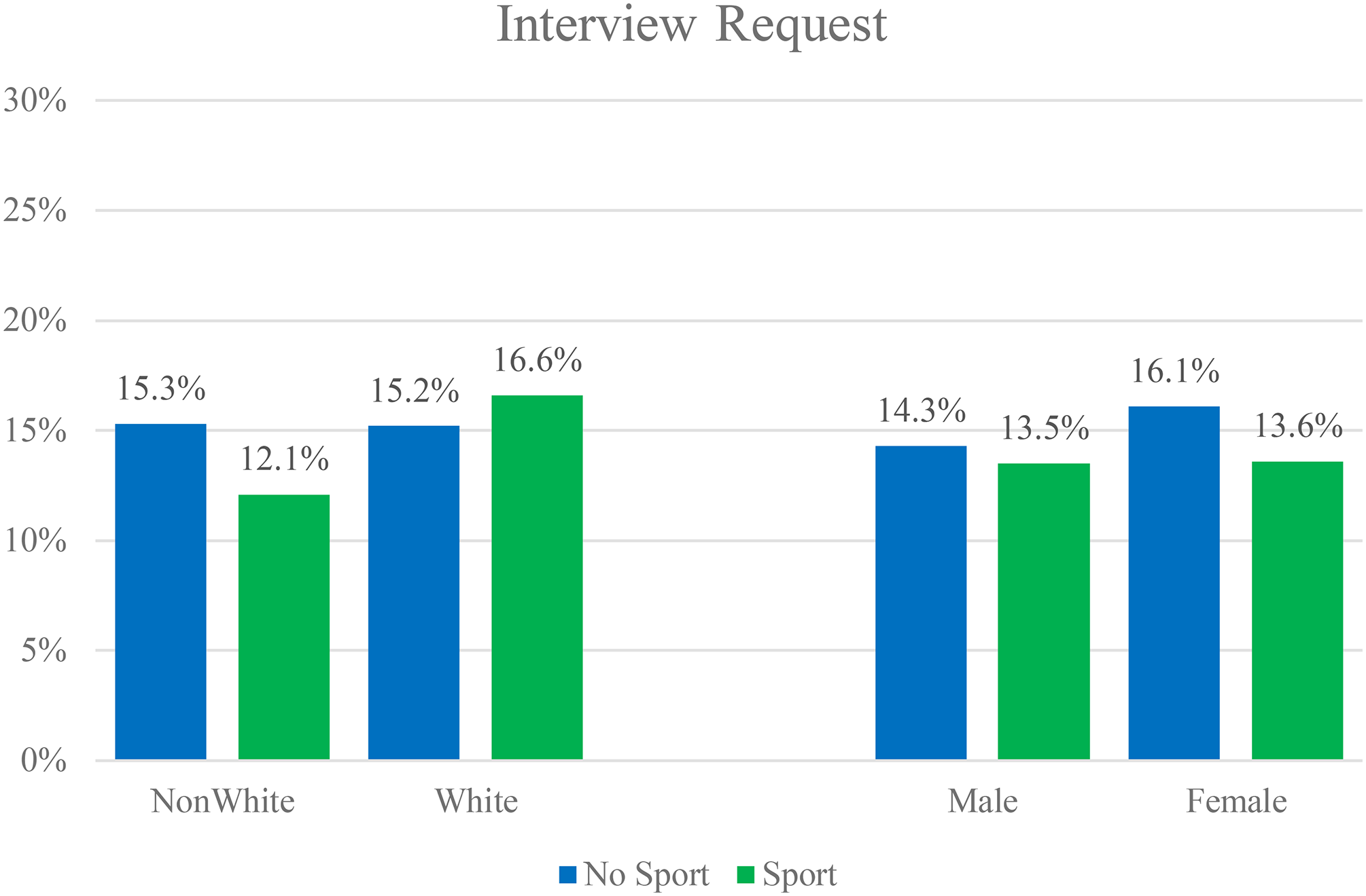
Interview request rates for subgroups, with and without collegiate sports.
Among white applicants, the likelihood for a callback or interview request increases, in absolute terms, when listing sports on a resume, but these increases are neither statistically significant nor substantively large. The callback rate and interview request rate for white applicants are both 1.4 percentage points higher for resumes that list sports relative to resumes that do not list sports. We fail to reject the null hypothesis that the respective treatment effects for white applicants and nonwhite applicants on callbacks and interview requests are statistically distinguishable, though the respective p-values of p = .19 and p = .15 fall just outside conventional levels.
Male and Female Applicants
Both males and females see small, non-statistically significant decreases in the likelihood of receiving both types of callbacks when listing collegiate sports on their resumes. In absolute terms, the penalty for listing sports is larger for females than males. Males who list sports see a 0.9 percentage point decrease in the likelihood of receiving any callback and a 0.8 percentage point decrease in the likelihood of receiving an interview request. Females see a 2.1 percentage point decrease in the likelihood of receiving any callback and a 2.5 percentage point decrease in the likelihood of receiving an interview request. We cannot reject the null hypothesis that the separate treatment effects on males and females are statistically distinguishable.
Discussion and Conclusion
Summary of Findings and Scholarly Significance
We conduct a resume audit to examine the effects of collegiate sports experience on one type of labor-market outcome. Overall, we find that sports participation does not have a significant effect on whether an applicant receives a callback or interview request. Moreover, employers in our sample did not prefer one type of sport to another. Thus, our hypotheses that sports participation would lead to higher callback rates and that team sports like soccer would drive the advantage more than individual sports like track or cross-country racing were not supported.
We also observe larger decreases in the likelihood that non-white applicants received callbacks and interview requests when they list sports on their resumes, although the differences within subgroups fall short of statistical significance. Given other evidence that finds white male athletes tend to be described by their hard work and mental skills, while black male athletes tend to be described for being athletic and other physical attributes (Eastman & Billings, 2001), we believe further research should investigate potential racial bias.
In fact, when we disaggregate non-white applicants into Black, Hispanic, and Asian, the penalty for sports participation is most negative and similar in magnitude for Blacks and Asians. Black and Asian applicants who played sports are 5 percentage points less likely to receive a callback compared to Black and Asian applicants who did not play sports. However, we have insufficient statistical power to make conclusive claims about these results. Observational or qualitative inquiries about perceptions of athletes would provide valuable empirical evidence to develop theories and hypotheses about the interaction between sports and labor-market success for these populations.
Our findings are inconsistent with studies that document a self-reported preference among employers for athletes presumably because they possess traits such as teamwork, leadership, or conscientiousness, that are conducive to labor-market success (Barratt & Frederick, 2011; Baird & Parayitam, 2019; Chaflin et al., 2015). On one hand, our diverging results may be attributable to the unique circumstances in which we conducted our experiment (e.g., job markets in the Northeast United States, majors in business-related fields, job applications during the COVID-19 pandemic). Nonetheless, by conducting an experiment to create an exogenous source of variation in collegiate sports participation as well as by relying on the revealed behavior of employers, we offer new evidence that calls into question the conventional view about collegiate athletics.
We urge caution in interpreting our results given the study power limitations in the analysis. Our main effects suggest about a 6 percent difference in callback rates and about an 11 percent difference in interview requests. Some subgroup effects were more substantial; among resumes with nonwhite applicants, the difference was 12 and 21 percent for callbacks and interview requests, respectively. These effects could be economically meaningful, yet our estimates are statistically insignificant at conventional levels.
There are additional avenues for related research to investigate issues related to the labor-market return to sports participation. For example, what is the effect of different types of sports participation within different labor markets? Given our subgroup findings by racial and ethnic background, is there indeed a penalty for sports participation among nonwhites? If so, why? More generally, studies could be conducted in which more than two fictional resumes are submitted to the same job posting. By expanding the experiment to include three different treatment arms—for example, resumes with sports, resumes with non-sport extracurricular participation, and resumes with no extracurricular participation—researchers can better understand how much employers value sports relative to different control conditions and the nature of the signal conveyed by sports participation.
Study Limitations and Future Research
We acknowledge some limitations in this study. First, as is common in resume audits, we only observe whether applicants receive callbacks. Our study was not designed to measure outcomes such as whether a job was offered, whether earnings were affected, or how long one remains in a job once hired. Each of these outcomes may be more meaningful measures of labor-market success. The callback, however, is a crucial first step toward labor-market productivity. Collegiate sports participation may be rewarded at other downstream stages of the job application process, such as the interview. In fact, it is conceivable that collegiate sport experience may instill qualities that make employees more productive workers in ways that are not evident on a resume but become apparent once assuming a job. Moreover, sports may contribute to social capital in ways that are not captured by our field experiment (Greene, 2013).
Second, because we limited our resumes to include only certain types of sports at Division III institutions and applied to entry-level openings in business fields, our study is limited in external validity. The most common job titles to which we applied were Administrative Assistant, Account Executive, Business Development Representative, Customer Service Representative, Entry Level Sales Representative, Executive Assistant, Sales Representative, Project Coordinator, and Sales Representative. Whether employers in other fields value participation in higher-profile, Division I sports at other institutions is possible, but we cannot empirically speak to that conjecture. Only new studies that are conducted at other times in different labor market settings with different sets of resumes can possibly clarify remaining questions regarding external validity. On a related note, these factors could potentially explain idiosyncrasies between other studies and ours, such as our relatively higher overall callback rates of about 25 percent.
Third, we note that the study was conducted during the Covid-19 pandemic. The global pandemic conceivably affected callback rates across the board, although it seems unlikely this would systematically increase or decrease the desirability of collegiate athletics to potential employers. It is also possible that the pandemic increased employers’ desire for remote employees, but again, we have little reason to suspect that college athletes would be more or less coveted for remote jobs relative to in-person jobs.
Fourth, we reiterate the underpowered nature of our study relative to other resume audit studies. We caution readers about the ambiguity of our results as they come to their own conclusions about how to interpret them. Are our sizeable but statistically insignificant results an artifact of low study power or a reflection of null labor-market returns to participating in collegiate sports? We encourage others to conduct similar studies to generate more empirical evidence that would inform claims about the value of sports participation in the labor market.
Finally, we reiterate the critique of audit studies originally raised by Heckman (1998) and restated by others (Neumark, 2012; Neumark and Rich, 2019) regarding their potential for Type 1 and Type 2 errors. Audit-correspondence studies that generate fictitious resumes to create an exogenous source of variation in a particular characteristic of a job applicant, as we have conducted here, can be useful for creating resumes such that the means of observable and unobservable characteristics are equal across treatment and control conditions. However, this approach cannot guarantee equal variances in the distribution of unobservable characteristics, which, in turn, can muddle the difference between taste and statistical discrimination. Although there are empirical techniques to disentangle these two forms of discrimination, we lack the necessary data to implement them for our analysis (Neumark, 2012; Neumark & Rich, 2019). However, unlike prior audit-correspondence studies of racial, gender, or linguistic discrimination in the labor market, distinguishing between taste and statistical discrimination is not our aim.
Still, future research desiring to examine the precise mechanisms and reasons for differential preference between athletes and non-athletes should consider designing their study to make distinctions between the two forms of discrimination. We encourage researchers to investigate the specific unobservable determinants of labor-market productivity for student-athletes. Prior research has suggested that they may comprise noncognitive skills such as leadership, conscientiousness, and interpersonal skills that enhance human capital and labor productivity (Baird & Parayitam, 2019; Chaflin et al., 2015; Heckman & Loughlin, 2021). Subsequent audit correspondence studies could then consider including such information on resumes. Collecting this data would enable researchers to implement empirical adjustments and tests described by Neumark (2012) and Neumark and Rich (2019) to account for possible unequal variances in unobservable determinants of productivity between student-athletes and other college graduates. In doing so, researchers can empirically test whether employers specifically prefer the set of noncognitive skills among student-athletes.
Despite these limitations, our study is among the first to investigate the causal effect of listing sports participation on labor market outcomes. We hope this research will spur future inquiry and new questions that can be valuable to better understanding labor-market dynamics, specifically the returns to labor productivity signaled by sports participation. On a more practical level, we hope this work will inform athletes who are on the margin of deciding whether it is worthwhile to continue participating in athletics beyond high school, and whether it is worthwhile to include athletic participation on their resumes.
Footnotes
Acknowledgements
We thank Laura Florick and Caleb Duke for their contributions to this work. We thank conference participants at the 46th Annual AEFP Conference for their comments.
Declaration of Conflicting Interests
The author(s) declared no potential conflicts of interest with respect to the research, authorship, and/or publication of this article.
Funding
The author(s) received no financial support for the research, authorship, and/or publication of this article.
