







Abstract
This study investigates differences in the preferences of daily ticket purchasers and season ticket holders, focusing on outcome uncertainty. Using unique game-level attendance data of both daily ticket purchasers and season ticket holders for every team in the Korean top-tier professional soccer league, we find heterogeneity in demand between daily ticket purchasers and season ticket holders with respect to outcome uncertainty, preference for home team success, team performance, geographical distance between competing teams, and weekend games. Our results suggest that season ticket holders do not care as much about their team's performance and outcome uncertainty as daily ticket purchasers do.
Introduction
The segmentation of consumers or sports fans enables sports-related organizations and businesses to adopt effective and efficient marketing strategies to attain business goals (Tapp & Clowes, 2002). Each consumer possesses a unique personality, motivation, and characteristics (Funk et al., 2016), which are driven by varied preferences that affect their consumption of goods and services (e.g., attending professional sporting events). One simple demand segmentation involves separating attending fans based on their purchase of a season ticket. Generally, season ticket holders (STHs) invest more time and money in their favorite team's matches compared to daily ticket purchasers (DTPs), which creates a need for teams to treat fans differently in accordance with their ticket purchase type (Tapp & Clowes, 2002).
Most previous studies on sports demand used attendance data as a proxy. However, according to Forrest et al. (2005), the limitation of publicly available attendance data generally does not distinguish between STHs and DTPs. Aggregated analyses of fans visiting stadiums may then inhibit the accurate estimation of factors affecting spectators, as each segment is assumed to possess heterogeneous inherent processing factors (e.g., commitment, loyalty, motivation, and marginal cost of each visit) that are relevant to the decision-making process. Thus, owing to the different preferences of STHs and DTPs for attending games, using aggregated public data on total attendance would generate misleading information because of the implicit assumption that all fans visiting stadiums have similar preferences (Allan & Roy, 2008; Forrest et al., 2005; Schreyer & Ansari, 2021). In this context, a previous effort was made on separating DTPs from STHs due to the heterogeneous nature of the different types of fans (Benz et al., 2009; Bond & Addesa, 2020; Di Domizio & Caruso, 2015).
One of the differences between STHs and DTPs would be the marginal cost of attending a match. When deciding whether to attend a game, DTPs consider not only the ticket price, but also the travel cost and/or time duration for every game. In contrast, STHs face a lower marginal cost of attending a game compared to DTPs, as the ticket price is paid in advance before the season begins (i.e., the price of the season ticket is a sunk cost). Therefore, it is plausible that DTPs would be more sensitive to the marginal benefits or expected utility of attending a game than STHs. As such, the literature has found that DTPs are more responsive to match day characteristics (e.g., quality of opponent and rivalry match), providing evidence of possible limitations when estimating demand using aggregated data (Allan & Roy, 2008).
In this context, this study aims to identify the differences in the game attendance decisions of STHs and DTPs as an additional contribution to the previous literature which attempted to understand the behavioral differences between STHs and DTPs which were mostly hampered by data inaccessibility (Schreyer & Ansari, 2021). First, we examine the differences in preference toward outcome uncertainty based on Rottenberg (1956) and the application of a reference-dependent preference with a loss-averse agent by Coates et al. (2014). We also discuss the differences in preference toward outcome uncertainty between STHs and DTPs by applying the reservation utility approach recommended by Coates et al. (2014). We use unique disaggregated attendance datasets from the Korean top-tier professional soccer league, which records the number of DTPs and STHs who attend each game rather than distributed tickets.
Earlier literature identified that STHs are the most loyal consumers of professional sport teams (McDonald, 2010). However, recent studies have provided evidence of behavioral disloyalty in STHs, indicating that loyalty may not be appropriate for distinguishing STHs from DTPs (Karg et al., 2021; Schreyer & Torgler, 2021). Therefore, we conceptualize DTPs and STHs as different segments of sports fans consuming the same product with heterogeneous purchasing behavior (e.g., bulk purchase or single purchase). Hence, the main contribution of our study is to extend the discussion on the need to estimate demand using disaggregated attendance data. Additionally, this study sheds light on an Asian soccer league, which has not been frequently covered in the literature (Schreyer & Ansari, 2021). It therefore contributes to extending the discussion in a relatively less-explored professional sports context by identifying features of Korean sports fans compared to fans from other countries or cultures using Humphreys and Zhou's (2015) empirical specification and decomposition.
Contextual and Theoretical Background
Rottenberg's (1956) uncertainty of outcome hypothesis (UOH) is undoubtedly the most debated topic within the realm of sports demand. Several studies have investigated fans’ responses to outcome uncertainty in various professional and international sports contexts (Borland & MacDonald, 2003; Szymanski, 2003; Villar & Guerrero, 2009). Within the fan demand literature, the unpredictability of game-level outcomes has been one of the most discussed themes in understanding fans’ preferences when attending a game. For instance, Schreyer and Ansari (2021) found that approximately a quarter of stadium attendance demand studies focused on identifying the effect of outcome uncertainty. Some previous studies identified an inverted U-shaped relationship between the home team's winning percentage and stadium attendance, in accordance with Rottenberg's UOH (Knowles et al., 1992; Rascher & Solmes, 2007). In these cases, the maximum level of attendance demand occurred at the point where the home and away winning probabilities tended to be equally distributed.
However, recent empirical research on the UOH's attendance demand has found evidence contradicting Rottenberg's original assumption of fan preference. This has been observed for various professional sports leagues where a higher level of stadium attendance was observed when the predictability of the game outcome was more evident for the home team's win or loss (Beckman et al., 2011; Coates & Humphreys, 2010; Czarnitzki & Stadtmann, 2002; Mills et al., 2016; Sung & Mills, 2018). A possible explanation for this phenomenon is that fans are more willing to consume games with more certain game outcomes, that is, when the home team is either deemed to be the final winner or the underdog that they can root for (Sung & Mills, 2018).
Coates et al. (2014) were the first to apply the theoretical model of reference-dependent preference with a loss-averse agent to sports consumer demand. They argued that consumers tend to prefer certain game outcomes to uncertain ones, as they want to avoid disutility from unexpected losses more than gaining extra utility from unexpected wins (i.e., loss aversion). Coates et al. (2014) also proposed the concept of reservation utility—expected utility from not attending a game—and argued that fans attend games only if the expected utility from attending (which depends on the expected game outcome) is higher than the reservation utility. They also argued that “strong fans” have lower reservation utility than “casual fans” and are thus less affected by outcome uncertainty. In this context, reservation utility depends on the marginal cost of attending a game, as higher costs imply higher opportunity costs or reservation utility; fans with higher (lower) marginal costs have higher (lower) reservation utility and are more (less) affected by expected game outcomes.
Furthermore, Humphreys and Zhou (2015) developed a structural econometric model to identify fan preferences, including the baseline utility from attending games, utility from a home team win, preference for uncertain outcomes, and loss aversion. Their model indicates that consumer preferences for uncertain outcomes and loss aversion are mutually conflicting and whether one dominates the other determines the overall relationship between expected outcomes and attendance.
In the current study's context, existing empirical evidence on soccer fans’ responses toward the UOH is mixed across different professional sports contexts. For instance, Benz et al. (2009) found that teams in the Bundesliga attracted more fans to the stadium by improving outcome uncertainty, whereas Buraimo and Simmons (2008) identified a link between an increase in outcome uncertainty and a decrease in stadium attendance in the English Premier League (EPL). Outside the European leagues, Jewell (2017) found no evidence of outcome uncertainty having explanatory power over variations in attendance demand in Major League Soccer. Sung and Mills (2018) found a U-shaped relationship between stadium attendance and the home team's winning probability, providing evidence contradictory to the UOH. As such, there is still a need for substantial examination of fan preferences for outcome uncertainty in various professional sports contexts, as Fort (2017) noted. However, recent empirical studies on European soccer leagues have revealed that fans are loss-averse and prefer games with more certain outcomes (Cox, 2018, on the EPL; Martins & Cró, 2018, on the Portuguese Primeira Liga; Besters et al., 2019, on the Dutch Eredivisie).
While outcome uncertainty in previous work has been mostly used to measure the relative quality of competing teams, there are other factors that have been used to measure absolute quality. For instance, total league points (Buraimo & Simmons, 2008; Czarnitzki & Stadtmann, 2002; DeSchriver et al., 2016; Jewell & Molina, 2005) and league standing (Benz et al., 2009; Czarnitzki & Stadtmann, 2002; Peel & Thomas, 1992) have been used to estimate the effects of individual team performance on fan demand. In most cases, increased attendance demand is associated with teams having higher league points or teams with higher league standings. Additionally, the existence of star players (DeSchriver, 2007; Jewell, 2017; Lawson et al., 2008; Sung & Mills, 2018) and athletes’ wages (Buraimo & Simmons, 2008; Humphreys & Johnson, 2020) have also been found to positively affect attendance demand. These findings show that sports fans are affected by the presence of high-performing, conspicuous, and/or distinguished athletic prowess. Matchday characteristics, such as the day of the match (Buraimo & Simmons, 2008; Forrest & Simmons, 2006), the timing of the event (Krumer, 2020), and the geographical distance between competing teams (Humphreys & Miceli, 2020; Wooten, 2018), are commonly used as determinants of sports demand. These studies revealed that weekend matches or post work-hour matches would enjoy increased attendance. Geographical distance commonly shows that a decrease in physical proximity between competing team would lead to increased attendance due to regional rivalry or increased accessibility for away fans to visit.
Despite various efforts to identify the effects of the above-mentioned demand determinants for professional sports, there has been limited research on estimating demand by segmenting fans visiting stadiums. As noted by Forrest et al. (2005), most of the attendance demand literature utilizes publicly available data that does not report individual purchase types. The authors note possible issues related to demand estimation without separating STHs from others. Once the season ticket has been purchased, the likelihood of STHs attending their favorite team's games increases, as the marginal cost of attending a game is far less than that of individual DTPs (Dobson & Goddard, 2011). Additionally, the literature suggests that STHs are relatively more involved with and attached to their teams and are unlikely to stop their consumption of games, even if their teams perform poorly (Bristow & Sebastian, 2001; Funk & James, 2006; McDonald, 2010).
In this context, there have been a few attempts to examine the determinants of the differences between spectators and the decisions of STHs. Allan and Roy (2008) were the first to examine disaggregated attendance demand for Scottish Premier League. The authors divided spectators into STHs, match day ticket purchasers, and visiting team fans. Although their main goal was to demonstrate the crowding-out effect of televised games on live attendance, they also reported that STHs were unaffected by match day characteristics such as past performance of home and away teams, derby (local rivalry) matches, and matches that involved high-quality visiting teams (Celtics or Rangers) compared to DTPs. Although the authors tried to test the effect of game outcome uncertainty, their outcome uncertainty measure was insufficient due to the lack of game-level odds data; they concluded that the away team supporters did not prefer a game favoring the home team but failed to identify the consumer preferences for outcome uncertainty.
Furthermore, a recent stream of literature with a specific interest in STHs’ behavior has emerged. Schreyer et al. (2016) collected STHs’ admission data and found that they preferred certain outcomes to uncertain outcomes. Further studies examined STHs’ behaviors, such as admission decisions and arrival times; however, most of these studies collected data from STHs of a single team (Amberger et al., 2021; Karg et al., 2021; Schreyer et al., 2016; Schreyer & Torgler, 2021). Few empirical evidence on DTPs only was reported as well but these results used either a proxy of DTPs admission (Benz et al., 2009) or distributed (or sold) tickets (Bond & Addesa, 2020; Di Domizio & Caruso, 2015). Hence, empirical analysis of DTPs’ actual admission and the identification of the differences between the preferences of DTPs and STHs was limited yet.
Data and Empirical Methods
Inaugurated in 1983, the K-League is a top-tier professional soccer league in South Korea. The K-League currently operates two divisions (K-League 1 and K-League 2) with promotion and relegation systems similar to those of European soccer leagues. There are a total of 12 and 10 teams in K-League 1 and K-League 2, respectively. Each team plays 33 matches during the regular K-League 1 season and then proceeds to five weeks of a “Split system,” where teams ranking 1st to 6th team compete for the championship, whereas teams ranking 7th to 12th compete for the remaining spots within the league. At the end of the season, the bottom team is automatically relegated to the lower division, K-League 2, whereas the top team in K-League 2 is promoted to K-League 1. The 11th team from K-League 1 and the 2nd team from K-League 2 then compete for the last spot in K-League 1, playing each other twice at their respective home fields. Note that K-League 1 runs an unbalanced game schedule; each team first plays home and away round-robin tournaments (22 rounds with 12 teams). From rounds 23–33, teams go through a single round-robin, and the home team is determined by a random draw. For the split rounds (rounds 34–38), teams that have either played fewer home games in prior rounds than the others or recorded higher win points than the others will play a home game. Owing to this complex nature, K-League teams play a varying number of home games, a number that ranged from 18 to 20 games in the 2019 season.
Data from the 2019 regular season games of the K-League 1 were used in this study. A total of 228 games among the 12 teams in K-League 1 were analyzed, with attendance separated into STH and DTP attendance. The data was non-public and was provided directly by the Korea Professional Football League. Additionally, the total number of season tickets sold was unobtainable, and thus, the no-show behavior of STHs was unobservable. Despite the merits of the data in investigating the heterogeneous behavior of each segment of attending fans, we must note that a small sample size may have limited further understanding. However, disaggregating attendance data is a relatively recent effort by the K-League, starting in the 2019 season; subsequent data collection was limited because of COVID-19.
K-league teams have several different season ticket segments. Although many teams offer a designated seat at a higher price and a free seat at a lower price, this information was not available in the data. Some teams offer half-season tickets, typically for 10 out of 18–20 home games. In the 2019 season, 7 out of 12 teams reported half-STHs’ attendance. Our data differentiate between the admissions of full-season and half-STHs. In addition, our dependent variables—STHs and DTPs—are the actual number of visitors to the stadium rather than the number of tickets sold.
Table 1 shows the attendance by team in K-League 1. The average attendance is 7,647, ranging from 2,279 (Sangju FC) to 16,559 (FC Seoul). The proportion of STHs is approximately 47%; the Pohang Steelers and Daegu FC have the highest and lowest percentage of STHs, respectively.
Average Attendance Figures for Each Team.
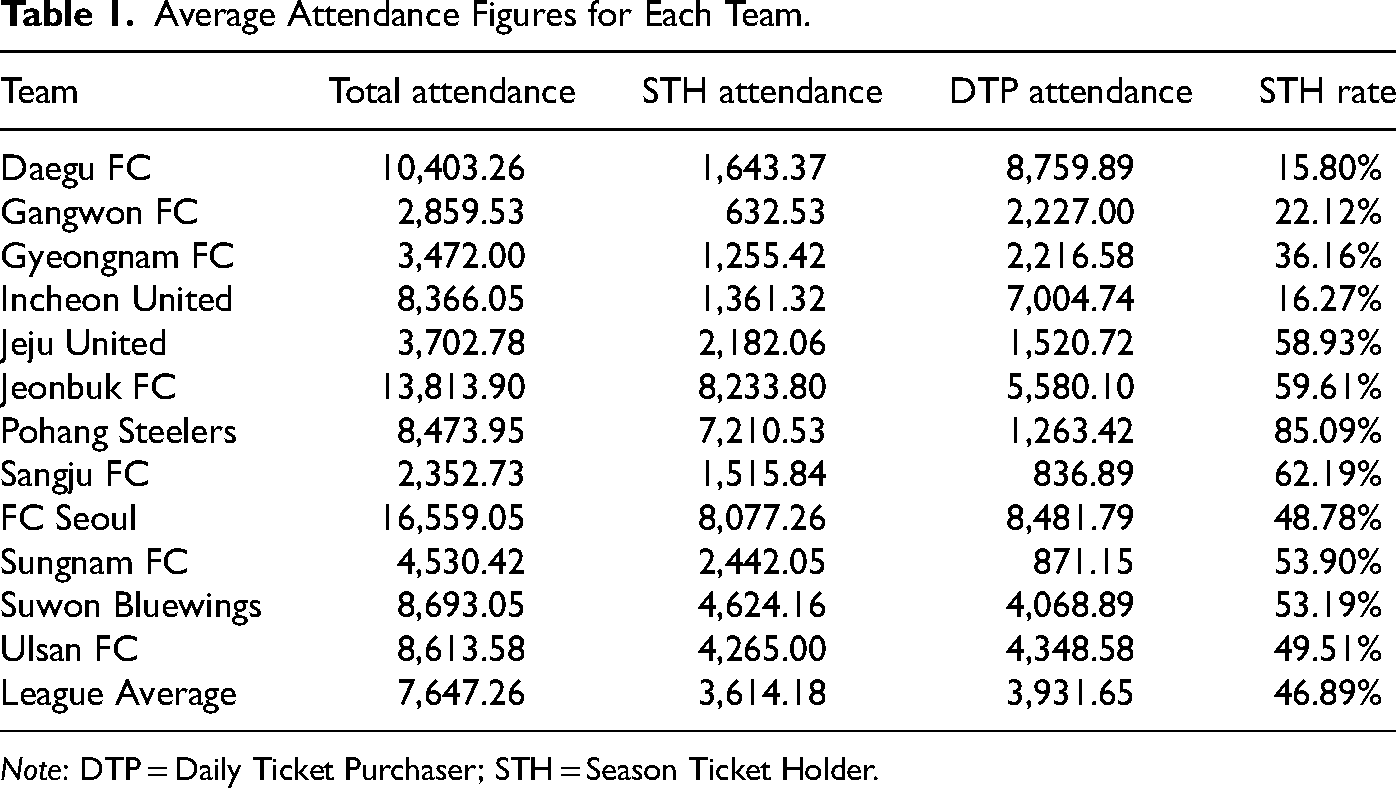
Note: DTP = Daily Ticket Purchaser; STH = Season Ticket Holder.
Humphreys and Zhou (2015) derived the exponential attendance demand function and developed a structural econometric model based on the demand function with logged transformed attendance. Similarly, we modified Humphreys and Zhou's (2015) empirical model to identify the difference between DTPs and STHs:
The explanatory variables of interest,
We applied Humphreys and Zhou's (2015) specification to our empirical model. Thus,
For the model estimation, we used ordinary least squares (OLS) regression with home and away teams and round fixed effects. One merit of using the K-League 1 dataset was that there were only 18 sold-out games of the 228 games observed (7.89% of total observations). Sold-out games may generate issues with latent demand because attendance is bounded by stadium capacity (Forrest et al., 2005); however, following Pawlowski and Anders (2012), the OLS estimation is likely to be consistent, as sold-out games constitute <20% of the total data. The equation error term was assumed to be correlated within the home team over time, and we clustered the standard errors accordingly.
Table 2 presents the descriptive statistics of the data used in the empirical model. The means for DTPs and STHs are approximately 4,051 and 3,641, respectively. The maximum attendance of DTPs and STHs was observed for the FC Seoul versus Suwon Bluewings game. Conversely, the lowest DTP attendance was for the Jeju United versus Sungnam FC game, and the lowest STH attendance was for the Sangju FC versus Suwon Bluewings game. The average expected win point and home team win probability were 1.56 and 0.42, respectively; they ranged from 0.68 and 0.15 (Gyeongnam FC vs. Jeonbuk FC) to 2.52 and 0.78 (Ulsan FC vs. Incheon United), respectively. FC Seoul and Sungnam FC were located the closest (20 km) to each other, and Gangwon FC and Jeju United were located the farthest apart (499 km). Of the teams, 23% were in the Asian Champions League Zone and 17% were in the relegation zone, on average. Finally, out of 228 matches, approximately 79% of the games were played on weekends, and approximately 54% were played after 18:00.
Descriptive Statistics.
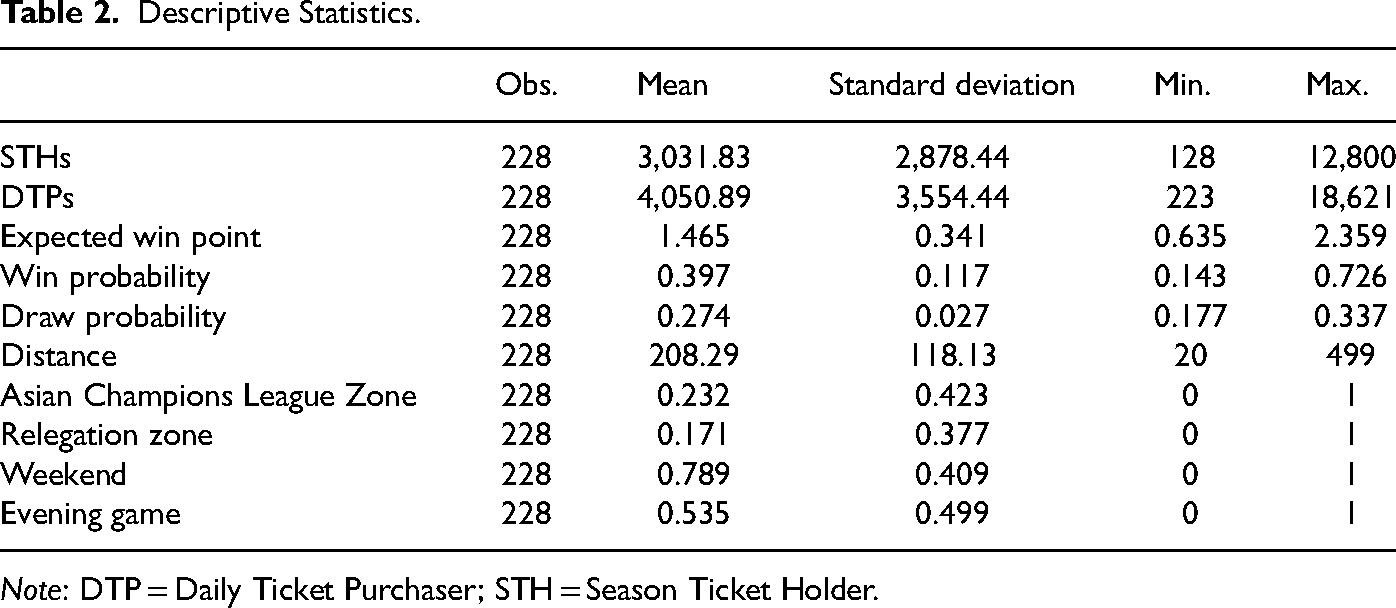
Note: DTP = Daily Ticket Purchaser; STH = Season Ticket Holder.
Results and Discussion
Table 3 contains the OLS results based on Equation 1, using logged DTP, STH, and total attendance (i.e., the sum of DTPs and STHs) as the dependent variables. The first, second, and third columns show the results for DTPs, STHs, and total attendance, respectively.
The Ordinary Least Squares Estimation Results.
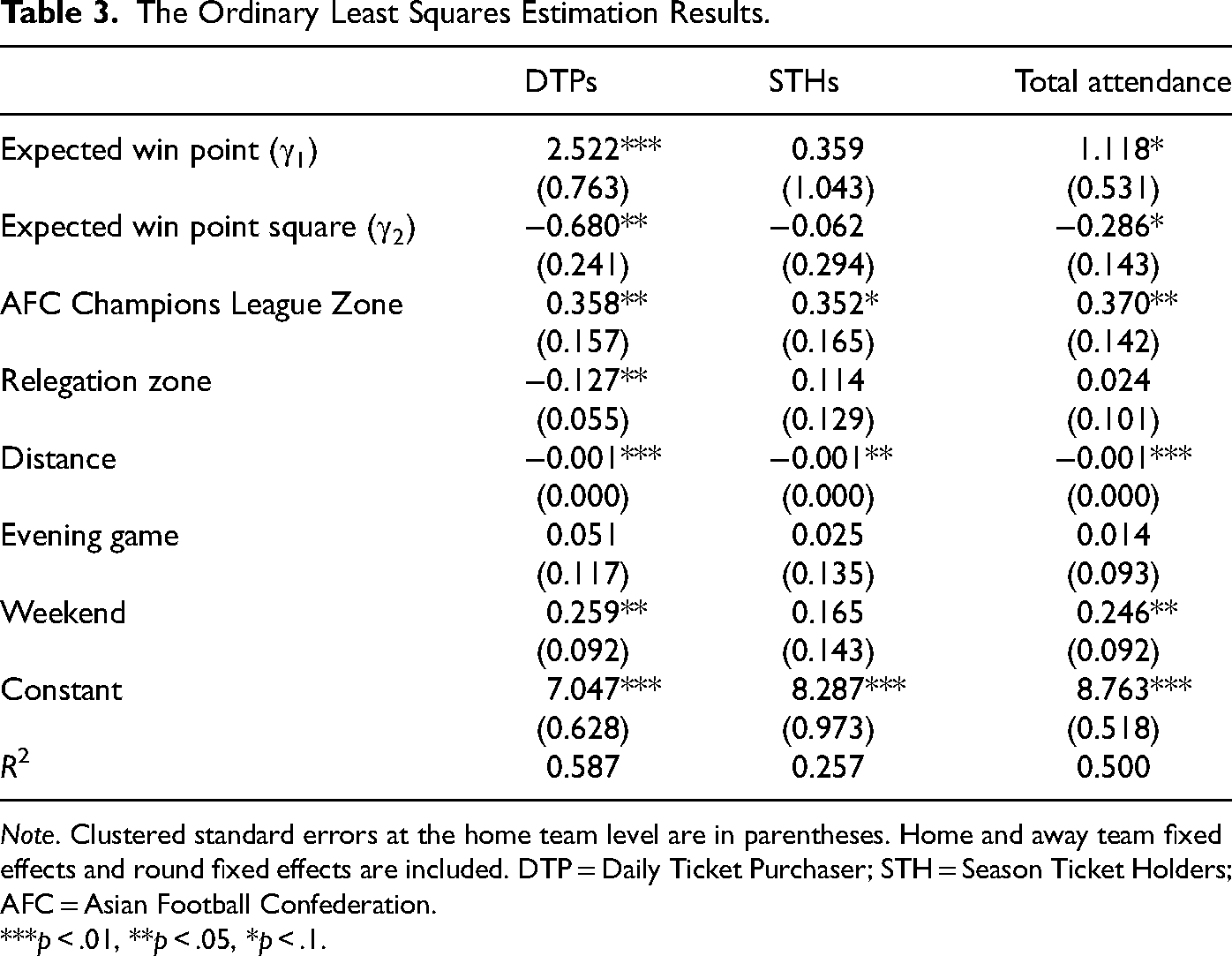
Note. Clustered standard errors at the home team level are in parentheses. Home and away team fixed effects and round fixed effects are included. DTP = Daily Ticket Purchaser; STH = Season Ticket Holders; AFC = Asian Football Confederation.
***p < .01, **p < .05, *p < .1.
As expected, the parameter estimates for the AFC Champions League Zone (i.e., the top three in the league standings) are statistically different from zero and positive for both attendee segments. Both DTPs and STHs preferred to attend games when their team had top league standings. Conversely, the estimated coefficient for the relegation zone is negative and significant for DTPs but not significant for STHs. The poor performance of a team negatively affected the stadium visits of DTPs, whereas STHs showed consistent support even if the team were at the bottom of the league. These results confirm previous findings (Bristow & Sebastian, 2001; Funk & James, 2006; McDonald, 2010).
We also tested the impact of match characteristics on attendance. First, there was a decrease in attendance when the distance increased for both attendance segments. This result is similar to that of previous studies, which found a negative effect of distance on demand (Forrest & Simmons, 2002; Lemke et al., 2010). Specifically, Allan and Roy (2008) found that visiting team fans’ attendance decreased as distance increased, which may be because of a decrease in the number of visiting fans. Additionally, this result could also be attributed to geographical rivalry, where attendance is relatively higher when both competing teams are located in close proximity. Second, we found no statistically significant evidence of an impact of any game played after 18:00 h for both DTPs and STHs. In contrast, the Weekend indicator shows that more DTPs visited stadiums for Saturday and Sunday games, whereas STHs were unaffected by weekend games.
The parameter estimates of fans’ preferences for the uncertainty of game outcomes are the main focus of this study. We found a positive and significant coefficient of the expected win point and a negative and significant coefficient of the expected win point square for DTPs; they preferred to watch games with uncertain outcomes. This result is not consistent with recent evidence from European soccer leagues (Cox, 2018, on the EPL; Martins & Cró, 2018, on the Portuguese Primeira Liga; Besters et al., 2019, on the Dutch Eredivisie). Following Humphreys and Zhou (2015), the sign of the coefficient on the expected win point square depends on the degree of loss aversion and preference for uncertain outcomes (i.e.,
The estimated coefficients of the expected win point and expected win point square were not statistically significant for STHs. These results add new evidence to the literature on STHs. Previous studies on a single team's STHs’ admission found that STHs tend to attend games with uncertain outcomes (Karg et al., 2021; Schreyer et al., 2016), which was not the case for K-League STHs. As both studies focused on only one team, which may have been because the team had had a successful season (i.e., a special case), our results are the first to identify the difference between STHs and DTPs considering the aggregated perspective of every team within the league.
Our results can be interpreted as follows: (a) The degree of loss aversion for STHs is higher than that for DTPs; or (b) STHs’ preferences for uncertain outcomes are weaker than those of DTPs. If a difference in loss aversion exists between DTPs and STHs, it may be driven by a difference in income level or wealth. As season tickets involve a relatively expensive one-time purchase, STHs are more likely to be wealthier (or have higher incomes) than DTPs (Pan et al., 1997). Additionally, previous studies have shown that wealthier individuals tend to have greater loss aversion (Gächter et al., 2007; Hjorth & Fosgerau, 2011).
Finally, the sum of the estimated coefficients of the expected win point and its square (
Overall, our findings identify heterogeneity in preferences for attending games between DTPs and STHs. DTPs highly prefer matches with uncertain outcomes and higher expected win points for home teams, and weekend games are not preferred when a home team is in the relegation zone. In contrast, the STHs’ decision to attend tends to be unaffected by these variables. These differences may be explained by the difference in the marginal costs of attending a game or reservation utility (i.e., the expected utility from not attending a game). STHs may incur lower costs for attending a game because they have already paid for the ticket in the past and thus may not react significantly to the home team's performance (Dobson & Goddard, 2011). Coates et al. (2014) also argued that fans with lower reservation utilities may not be as responsive toward outcome uncertainty as their counterparts. If the lower marginal costs of attending a game can be related to lower reservation utility, our findings may indicate that STHs are less affected by game outcomes, as their reservation utility is lower than the expected utility from attending a game regardless of home team performance and outcome uncertainty.
Finally, the total attendance results are similar to those for DTPs; however, either the significance level or impact size is smaller than that for DTPs. This indicates that the preferences for outcome uncertainty, home team performance, and game schedules are also reflected in the total attendance but mostly arise from DTPs and not STHs. This result provides additional evidence of possibly misleading sports demand with aggregated total attendance data, a drawback previously noted by Forrest et al. (2005).
Robustness Checks
For robustness checks, we used several outcome uncertainty measures instead of the expected win point and its square in Equation 1. We used (a) win probability and win probability square, (b) draw probability and its square, (c) the Theil measure, and (d) the relative win probability of the home team. The win and draw probabilities were calculated from the betting odds. The Theil method has been commonly used in previous studies on soccer (Besters et al., 2019; Pawlowski & Anders, 2012; Schreyer et al., 2018; Serrano et al., 2015) and is calculated using the following formula:
Roy (2004) criticized the Theil measure, which tends to be overestimated for three close game outcomes (33.3% of each). For example, if the home and away win probabilities are equal, implying a closed competition, the size of the Theil measure depends on the size of the draw probability. To address this concern, we applied the relative win probability following Benz et al. (2009),
3
calculated as follows:
Table 4 summarizes the results of the robustness checks. The first five columns show the results for the DTPs, and the last five columns show the results for the STHs. Columns (1) and (6) of Table 3 show the results of the main specification. The results of the robustness checks are similar to our main results. Both DTPs and STHs preferred to watch a game when their team was in the Asian Champions League Zone. The number of DTPs decreased when their team was in the relegation zone. The distance between the two teams decreased fan demand in the case of both DTPs and STHs. Games after 18:00 h did not change the demand, but DTPs’ demand increased for weekend games.
Results of Robustness Checks.
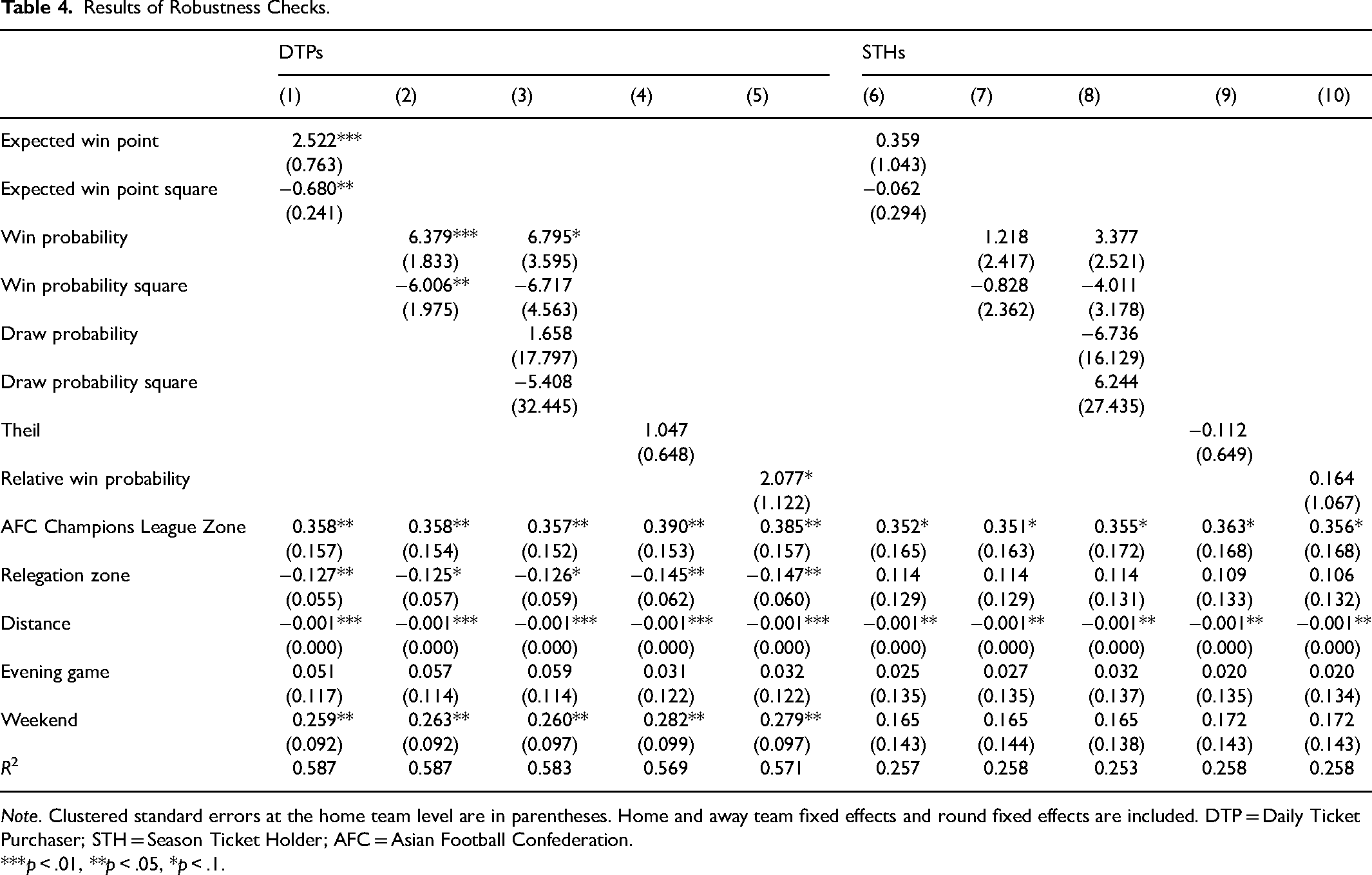
Note. Clustered standard errors at the home team level are in parentheses. Home and away team fixed effects and round fixed effects are included. DTP = Daily Ticket Purchaser; STH = Season Ticket Holder; AFC = Asian Football Confederation.
***p < .01, **p < .05, *p < .1.
The fan demand for outcome uncertainty also shows similar patterns. For DTPs, a negative and statistically significant coefficient on the win probability square in Model (2) implies that DTPs prefer a game with uncertain outcomes. The estimated coefficient of the Theil measure is positive but not significant (
However, STHs do not react toward uncertain outcomes, which is consistent with the main findings in Table 3: win probability (and its square), draw probability (and its square), the Theil measure, and relative win probability do not affect the STHs’ attending decision.
Conclusions
This study estimated the demand for sports by segmenting fans according to their ticket purchase type. Using a unique dataset from all teams in K-League 1, we found heterogeneity in the attending behavior of DTPs and STHs. Our results provide further evidence of a possible estimation bias when using public attendance data without segmenting fan types, as noted by Forrest et al. (2005). In particular, we found evidence that DTPs were more responsive to the unpredictability of outcomes than STHs. In addition, DTPs received extra utility from the home team's win, whereas STHs remained unaffected. The poor performance of the home team pushed away DTPs, but it did not affect STHs’ stadium attendance. DTPs’ attendance increased on weekends, whereas there were no differences in STHs’ attendance decisions between weekday and weekend games. The timing of the event did not affect attendance decisions for either DTPs or STHs.
A key managerial implication here is that sports teams should assess their fans differently, as their preferences and interests are not homogeneous. Compared to DTPs, STHs were rather unresponsive to team performance and outcome uncertainty. STHs did not seem to be disappointed when their team was at the bottom of the leagues. The ultimate goal of sports teams should be to steer DTPs to become STHs, who are less likely to be swayed by the dynamics of team performance or other external factors. Strategically, as geographical proximity affects both STHs and DTPs, league organizers could benefit from forming and promoting geographical rivalries, as it could lead to higher overall attendance demand.
Despite the merits of this study, it has several limitations. Owing to the COVID-19 pandemic and the short history of the league's efforts to segment attendance data, we were unable to use multiseason data. Additionally, although K-League 1 is one of the oldest and most established soccer leagues in Asia, our results here may not be wholly representative of the Asian sports market, as each league has a distinct structure, history, and culture. Hence, the results using a novel dataset from K-League 1 may represent features specific to Koreans. Furthermore, owing to the lack of information on annual season ticket sales, we were unable to investigate the no-show behavior of STHs, which may yield a further understanding of STHs within the literature and for practitioners.
Future studies should consider further diversifying segments of sports demand. For instance, future analyses using television ratings or digital platform viewership could extend our discussion on disaggregated demand estimation. Collectively investigating all possible segmentations of spectators according to their consumption type would better reveal fan behavior and different market responses to the same determinants. Furthermore, it would be noteworthy to examine whether STHs and general admission fans generate equal viewership demand after the COVID-19 outbreak to investigate any possible substitution behavior.
Footnotes
Declaration of conflicting interests
The author(s) declared no potential conflicts of interest with respect to the research, authorship, and/or publication of this article.
Funding
The author(s) disclosed receipt of the following financial support for the research, authorship, and/or publication of this article: This work was supported by the Incheon National University (grant number Research Grant 2020-0117).
