







Abstract
Do crowds affect professional basketball teams’ performance? Using results from matches played in the EuroLeague, EuroCup, and ACB (Spain) before, during, and after the COVID period (2014–2024) allows us to answer this question. Our estimations conclude that the probability of a team winning at home is 5.6% lower in the absence of a home crowd in ACB and 5.76% in the case of EuroLeague. Moreover, the difference between home points and away points is lower and the percentage home fouls versus away fouls is higher, but both results are only significant for ACB. Finally, the absence of spectators in the stands does not affect shooting percentages.
Introduction
Measures introduced to combat the COVID-19 pandemic provided a unique opportunity to measure a multitude of effects, since unusual situations could be used to study natural experiments. One of the effects of lockdown, for example, was the (elimination of) crowds at sporting events, as Home Advantage affects not only the home team, but away teams and referees (Nevill et al., 2002; Nevill & Holder, 1999). These circumstances allowed us to study how closed-door matches affected the performance of players and referees (see e.g., Bryson et al., 2021; Cohen et al., 2024; Cueva, 2020; Leitner et al., 2023; Reade et al., 2022) and even bets (see Winkelmann et al., 2021; De Angelis & Reade, 2023).
The influence of social environment on individual behavior has long been studied, not only from the economic perspective, but also sociology and psychology (see, e.g., Akerlof, 1980; Akerlof & Kranton, 2000; Bernheim, 1994; Elster, 1989). Specifically, the professional sport context has seen considerable empirical study through the analysis of different sources of Home Advantage, which combines several factors (Nevill & Holder, 1999; Pollard & Gómez, 2014; Winkelmann et al., 2021). Focusing on crowd effects, for example, Garicano et al. (2005) undertook a seminal study, which showed that referees in the Spanish soccer league favored home teams to satisfy stadium crowds. 1
Before the COVID-19 pandemic natural experiments in sports were scarce (Cueva, 2020), 2 and although subsequent opportunities arose to test the effect of crowd pressure, there has been a paucity of studies across both sports and leagues (Dohmen & Sauermann, 2016; Gong, 2022). In fact, and focusing on basketball, most studies have analyzed the National Basketball Association (NBA). Ehrlich and Potter (2023), for example, used an ordinary least squares (OLS) econometric model (and Probit model as a robustness check) on a sample of all regular season games played between the 2014/2015 and 2020/2021 seasons, to show that the total absence of fans removes the Home Advantage (measured as home point differential), but it was retained with a few fans. They also found that there is no “marginal fan” effect and that referees did not change their behavior because of public attendance.
Gong (2022) focused on referee bias using a Last Two Minute Reports dataset from 1,679 regular-season matches (from 2017/2018 to 2019/2020) that allows researchers to separate referee behavior from player behavior. Employing the linear probability model with OLS, the study did not find different treatment between home and away teams by referees (by analyzing the correctness of foul calls and noncalls), contrary to the results in most prior studies. Steinfeldt et al. (2022), drawing on OLS and Logit models with data from regular season games from 2010/2011 to 2020/2021, found a greater margin of victory and a greater probability of a 15, 20, or 25 point-win in empty arenas, but also in games with a small crowd. Ganz and Allsop (2024) used instrumental variables regression models with data from the 2020 to 2021 NBA regular seasons. They found a marginal effect of 1.74 points increase in the home point margin of one additional one thousand fans in attendance. With uninstrumented models, they also show that the effect of the presence of fans on home-court advantage is 4.53 points increase, and it is a nonlinear effect, that is, the marginal effect evaluated at a few thousand fans is smaller than the effect evaluated near zero fans.
Higgs and Stavness (2021) also studied Home Advantage via the NBA, together with other North American professional sport leagues. Regarding NBA, they analyzed matches played during the “COVID-19 bubble” (games played at neutral arenas with no fans). Their Bayesian multilevel regression over the five most recent seasons found a negative impact of the Home Advantage (expected points). Szabó (2022) employed data from three major leagues of North America (NBA, National Football League and National Hockey League) between the 2011/2012 and 2020/2021 seasons. The author used OLS (with nine outcome variables: home and away score, home win, score difference, total score, home and away penalties, penalty difference and total penalties). For the NBA he found that, without audience, Home Avantage is affected, with a lower prospect of winning and expected score of the home team, but no significant effect of the audience size on game outcomes. Moreover, lockdown significantly increased the total number of penalty decisions but there was no change in terms of referee bias. The author also studied the effects of audience size without closed doors, finding no effects on home or visiting team performance, and finding lower penalties for the home team.
We are only aware of one econometrical study that analyzed Home Advantage in basketball matches using data from Europe. De Angelis and Reade (2023) employed data from 2004 to 2021 to focus on the 10 most popular and followed basketball leagues in Europe. They studied Home Advantage using a linear probability model (using the home winning variable) and found a reduction in Home Advantage, but did not find that this effect disappeared over time.
Our article is the first to study the Home Advantage (player and referee performance, and marginal fan impact), not only in a European league (Spain) but also at supranational championships, such as the EuroLeague and EuroCup league, through econometric analysis. 3 Moreover, we have compiled a 10-year database, since season 2014/2015 to season 2023/2024, which allows us to analyze the period before, during and after COVID-19.
Following this introduction, the next section details the database employed. The third section shows the econometric specification used, as well as the results obtained. The last section presents the conclusions, which show the relevance of the absence of crowd: the Home Advantage exist in EuroLeague and the Spanish league (ACB), but not in EuroCup.
Database
We have compiled a database containing all basketball matches since 2014/2015 to 2023/2024 season (i.e., 10 seasons), across three European Leagues. Main restrictions to crowd assistance were in the 20/21 season. 4 Specifically, we collect data on ACB (in Spain, which represents 43% of total matches in this period in the database), Euroliga (37% of total matches), and the EuroCup (20% of total matches). The database contains 7,231 matches, in which 10.6% were played without crowd due to COVID-19 restrictions.
We collect general data on crowd attendance and principal referee, and those related to each team: points scored, fouls, and shots (1, 2, and 3 points). 5 Moreover, we have obtained some variables in order to capture team quality, concretely the average fouls, shooting productivity, and defensive productivity. First, we obtain a Home Season Point Differential, which is equal to the total points season points scored by the home team minus the total season points given up by the team. This was obtained by season and championship, and we have relativized it by the number of matches played in each of them, in order to homogenize the variable. We use a similar process for the away team.
Second, the average fouls per match by team, season, and championship were calculated (home and away). These two variables try to measure how often the home and away team commit fouls. Third, we include a defensive productivity measure for the 2 and 3 points regressions for the defensive team, and a shooting productivity measure for free throw, 2 and 3 points regressions for the shooting team. In this case, we obtain the average number of defensive rebounds per match, both home and away, per season and championship. For shooting productivity, we calculate and include the average percentage of 1, 2, and 3 points scored per match by season and championship, for each team.
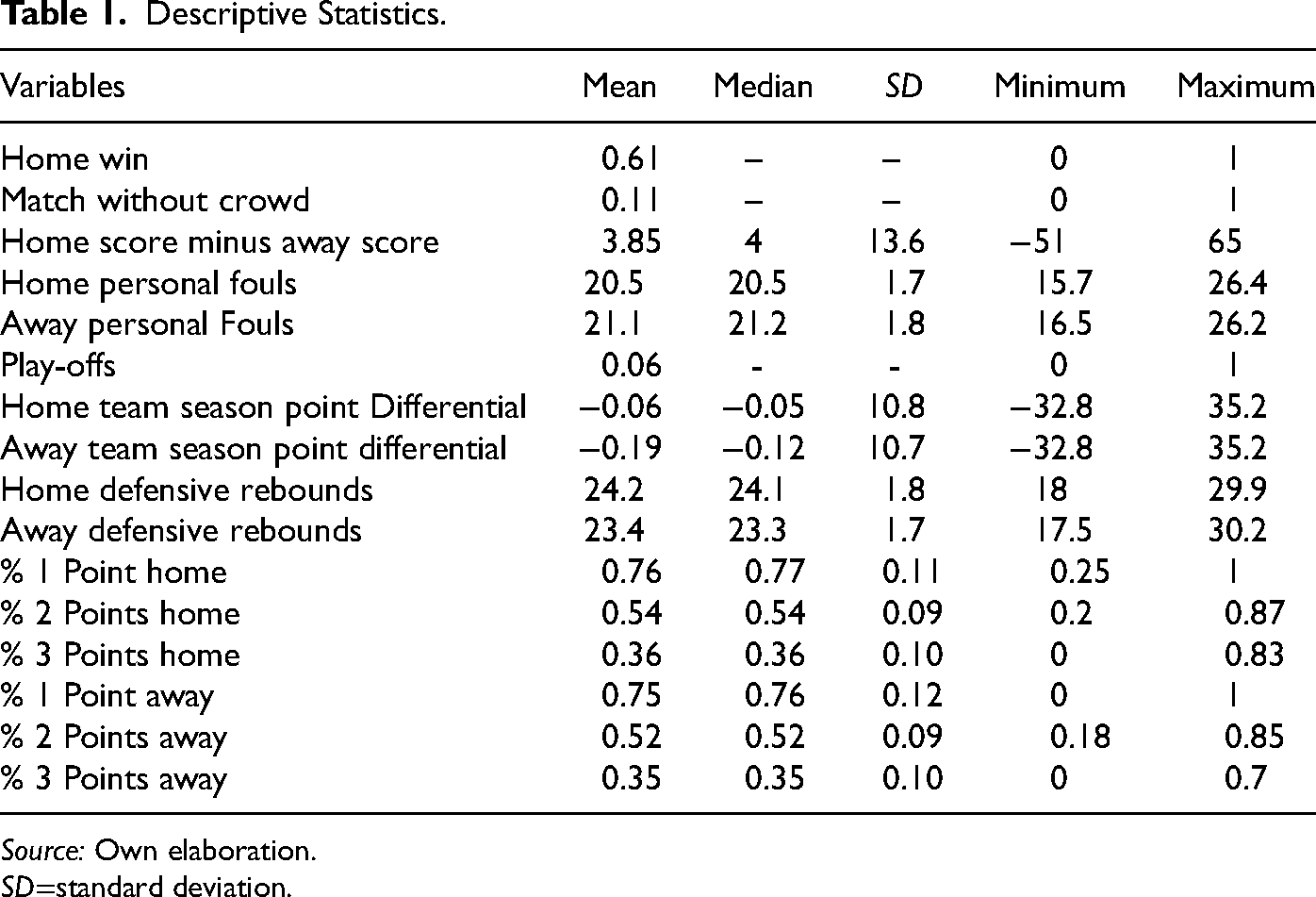
Table 1 shows some descriptive statistics about the main covariates used.
Descriptive Statistics.
Source: Own elaboration.
SD=standard deviation.
Matches without crowd represent almost 11% of the sample, as stated previously, and we have only considered those whose reason was COVID-19 restrictions. Moreover, it is worth highlighting that those matches played at neutral arenas have been excluded, including 19/20 final phase and play-off of the ACB, as well as the EuroLeague Final-Fours. Other descriptive statistics highlights are, for example that there are a 61% home victories, and the 94% are regular phase matches.
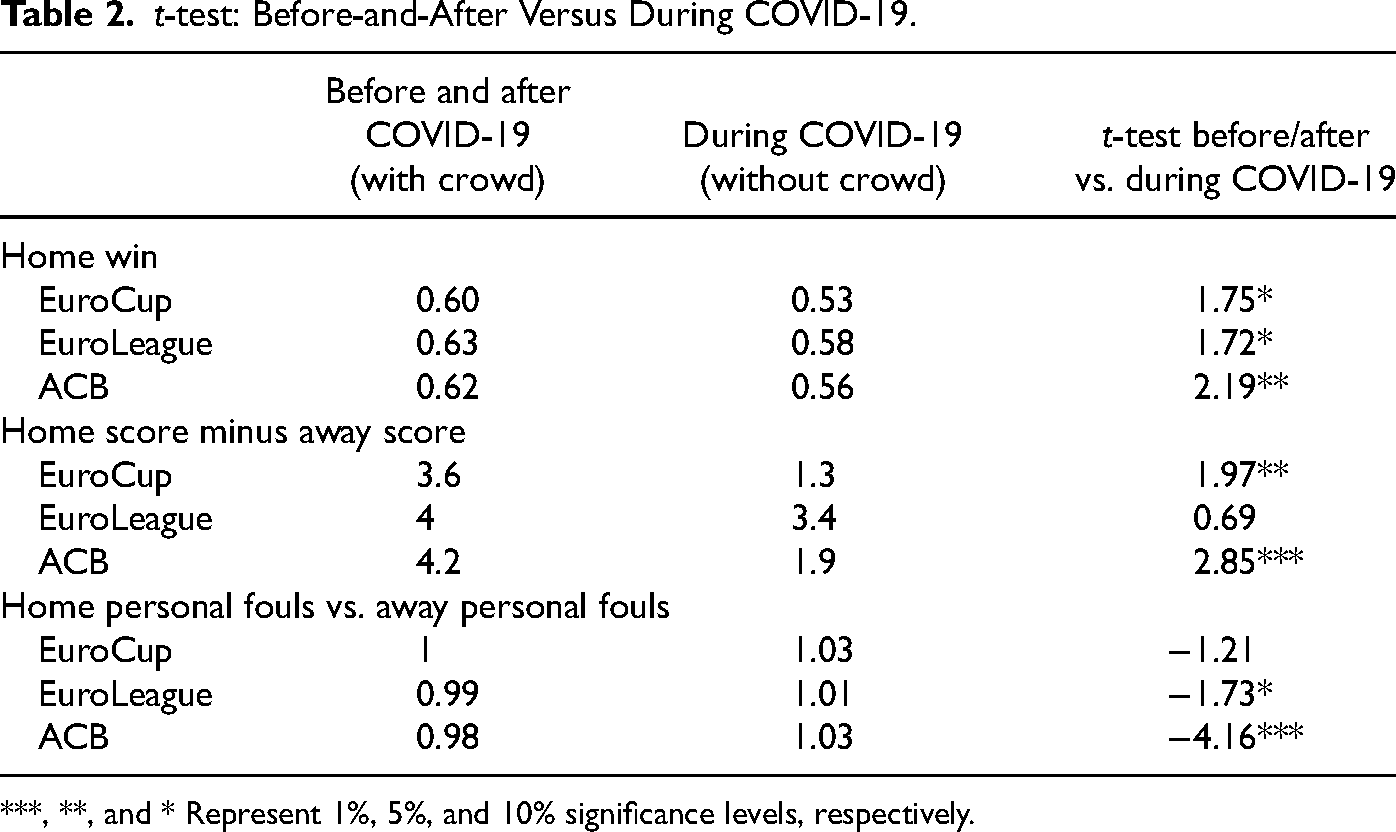
Table 2 includes a t-test for main basketball descriptives, which compares those before/after versus during COVID-19 (i.e., with and without crowd). Statistical significance highlights include that: the home team won less matches during COVID-19 at the EuroCup, EuroLeague and ACB; the home team committed more fouls than the away team in the absence of the crowd at the EuroLeague and ACB; and the match point differential (home minus away score) is lower without crowd in EuroCup and ACB (but shows no statistical significance for EuroLeague).
t-test: Before-and-After Versus During COVID-19.
***, **, and * Represent 1%, 5%, and 10% significance levels, respectively.
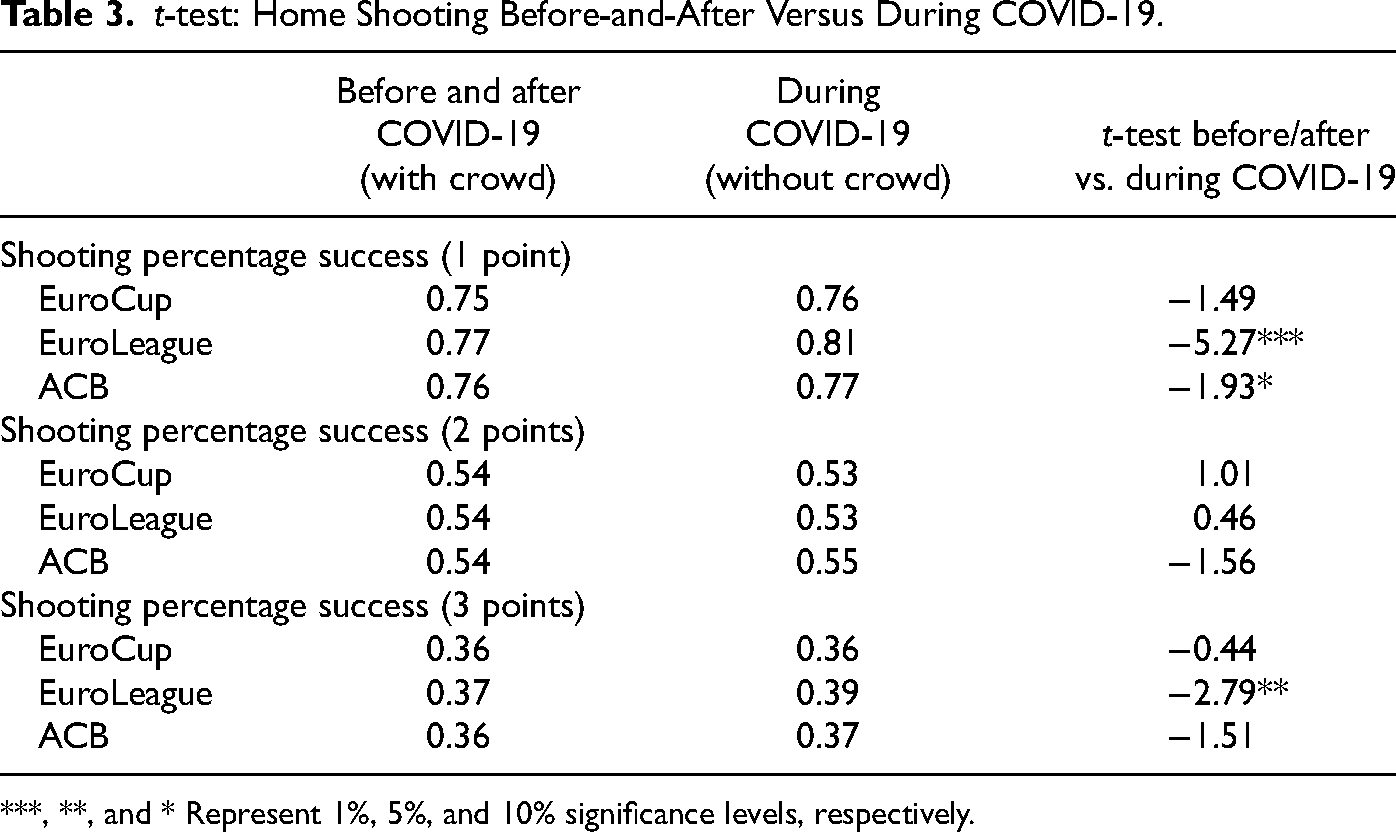
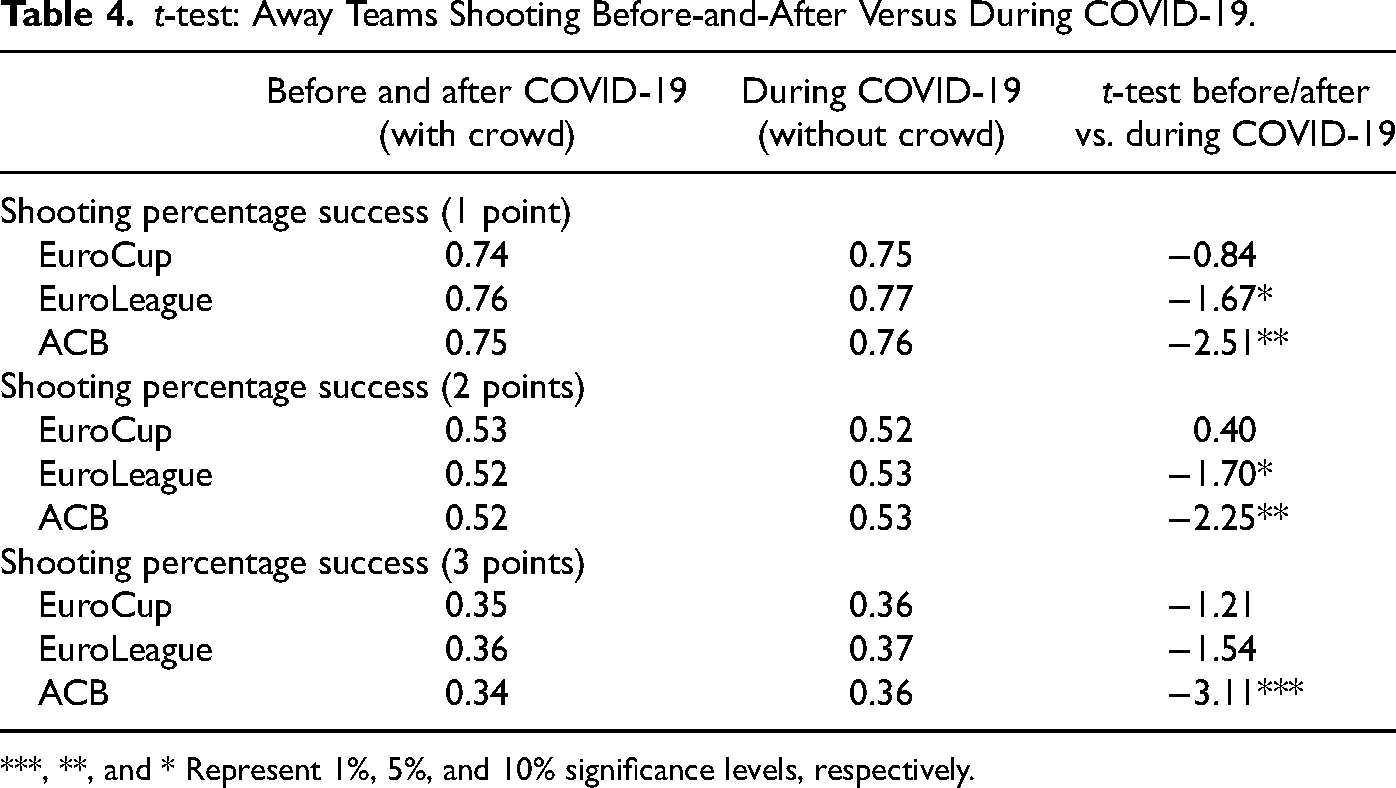
We focus on shooting percentage success because it allows us to isolate the effect of fans on players. The remaining dependent variables are affected by both referee and player behavior. Shooting percentage success is included in Table 3 (home team) and Table 4 (away team). In both cases, the markers that show statistical significance are negative (i.e., the percentage improved when there was no crowd in the stands).
t-test: Home Shooting Before-and-After Versus During COVID-19.
***, **, and * Represent 1%, 5%, and 10% significance levels, respectively.
t-test: Away Teams Shooting Before-and-After Versus During COVID-19.
***, **, and * Represent 1%, 5%, and 10% significance levels, respectively.
For example, comparing free-throws with and without crowd, the home team percentage is higher during COVID-19 than before and after it in EuroLeague and ACB, and so do away teams. In contrast, comparing 2 points shooting percentage, there is no statistical significance for home teams, but away teams have higher percentages in EuroLeague and ACB during COVID-19 than before and after it. Finally, there is statistical significance in 3 points shooting percentage success only in EuroLeague for home teams and in ACB for away team.
In any case, these are average changes, and they may be affected by other factors. For this reason, we estimate several equations to try to isolate the effect of playing basketball without a crowd, which is one of the main contributions of our paper related to previous papers that analyze similar databases through descriptive analysis (see, for example, Alonso et al., 2022; or Alonso Pérez-Chao et al., 2024).
Results
As in previous literature, the dependent variables are a dichotomous that capture home win (Probit) and eight performance variables (OLS): percentage home points versus away points; percentage home personal fouls versus away personal fouls; percentage home shooting (1, 2, and 3 points); and percentage away shooting (1, 2, and 3 points).
All estimations have similar explanatory variables: the binary variable of a match without crowd; the binary covariate whether the match is in a play-off (as opposed to in regular phase); the aforementioned variables by season and championship in order to control for team quality, and points, fouls or defensive productivity; and a control variable for main referee. All estimations also include cluster effects by match (i.e., Gran Canaria-Barcelona and Barcelona-Gran Canaria is considered as the same match for cluster purposes). Finally, we differentiate each estimation by championship.
Table 5 includes coefficients for the Probit model to explain home win probability. 6 We estimate two models for each championship, with and without team quality control variables. Two complementary facts arise: first, team quality is a good explanatory variable of the home win probability. Second, matches without a crowd have a negative effect on the home team, as previous literature findings.
Home Win Probability (Probit).
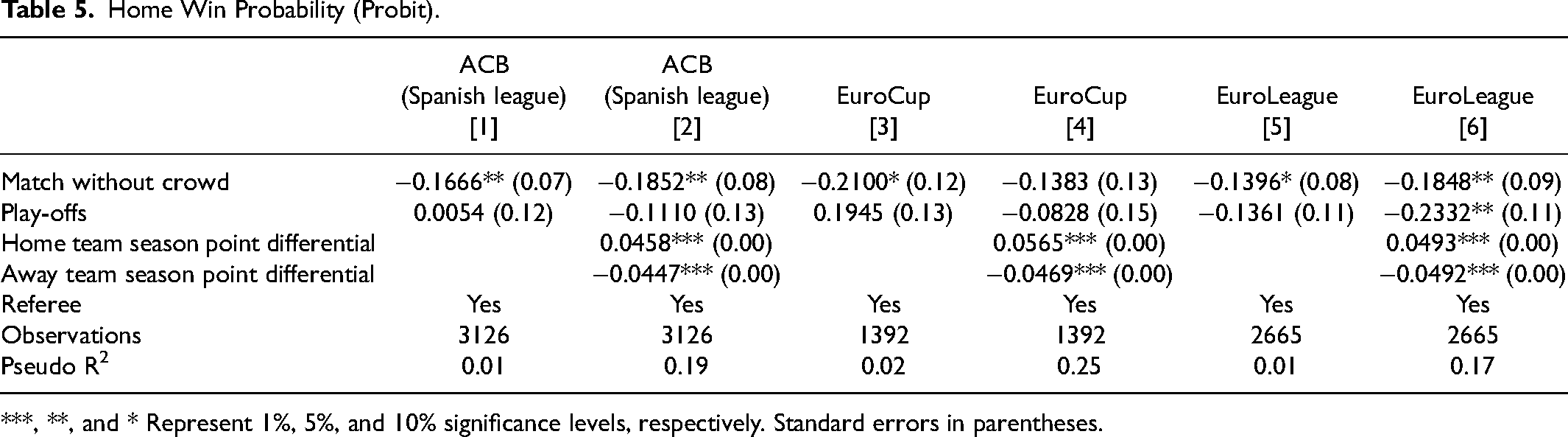
***, **, and * Represent 1%, 5%, and 10% significance levels, respectively. Standard errors in parentheses.
Using estimations in columns [2], [4], and [6], we calculate the marginal effect (not included in Table 5). We conclude that the probability of a team winning at home in ACB is 5.6 percentage points lower in the absence of a home crowd, and 5.76 percentage points in the case of EuroLeague. Estimations for EuroCup show no statistical significance.
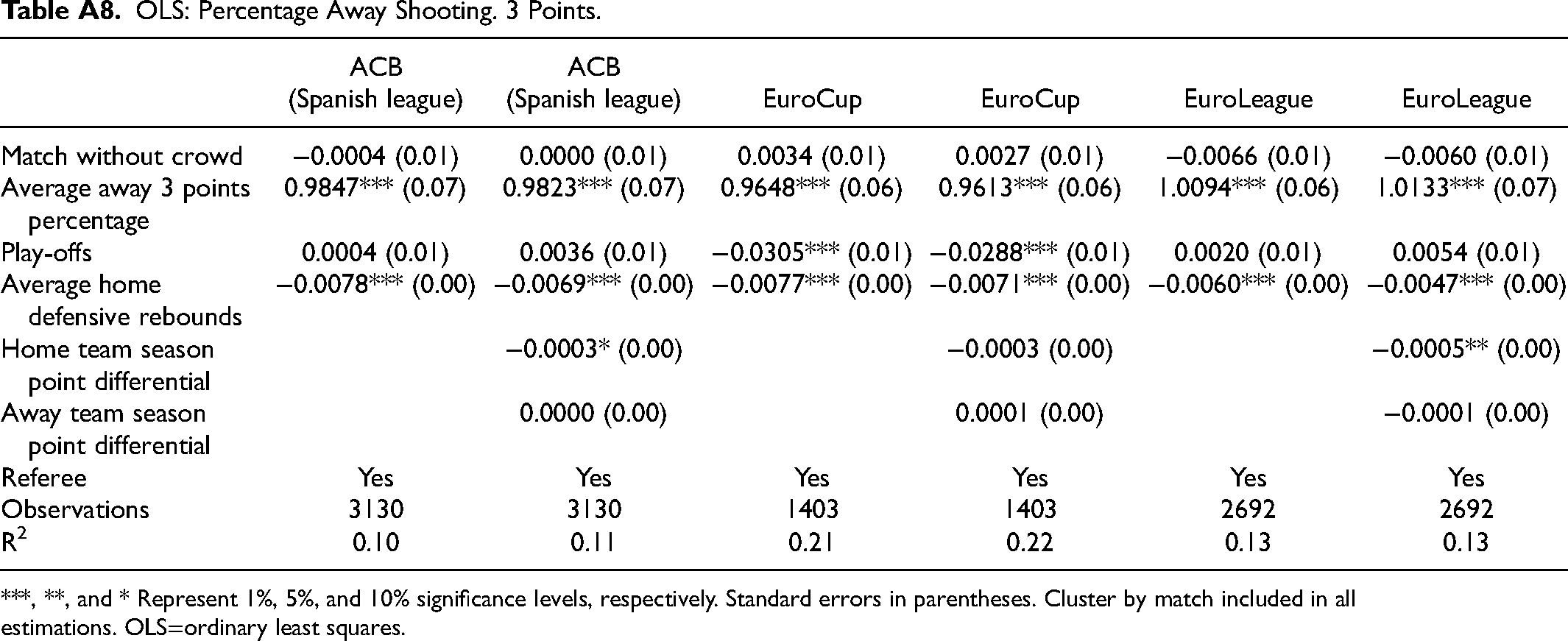
We repeat explanatory variables to explain home points versus away points (Table A1), the percentage of home personal fouls versus away personal fouls (Table A2) and the percentage of home shooting (Table A3 to A5) and away shooting (Table A6 to A8). All of these estimations have been obtained for each championship. Table 6 summarizes the results regarding the binary variable of match without crowd (see full estimations in Appendix).
Summary of Estimations: Effect of Match Without Crowd in...
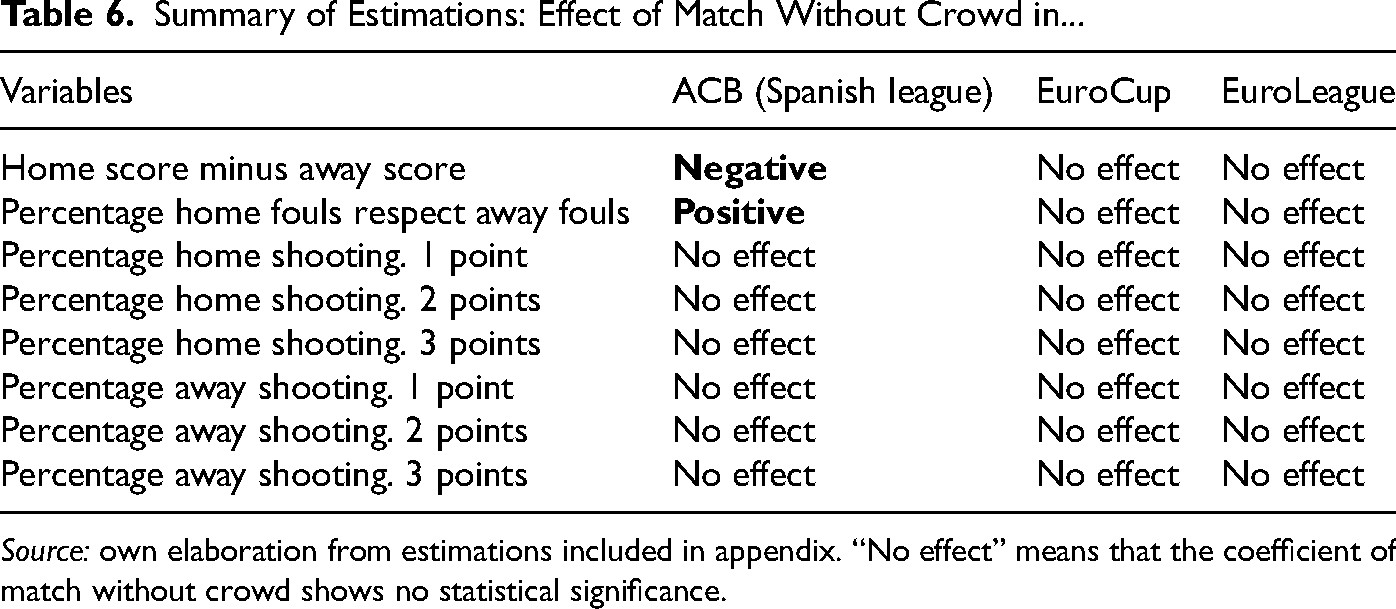
Source: own elaboration from estimations included in appendix. “No effect” means that the coefficient of match without crowd shows no statistical significance.
Only two main questions notice. First, the difference between home and away points is lower without crowd, and the percentage on home fouls versus away fouls is higher, 7 but these results are only significant for ACB. Second, the absence of spectators in the stands does not affect shooting percentages.
Conclusions
This article shows the existence of the Home Advantage, not only in a European National League (ACB), but also in a supranational championships (EuroLeague; this latter case for the first time econometrically, to our knowledge). Moreover, this kind of effect has previously mostly been analyzed in European football.
Using the natural experiment by COVID-19, we found the effect of “no crowd” in matches results in a lower home win probability, and a lower difference between home points and away teams in ACB. In fact, the home win probability decreases by 5.6 percentage points in ACB, and 5.76 percentage points in EuroLeague. No effect was found for EuroCup. Moreover, there is no effect on shooting percentages, but there is a positive effect in percentage of home fouls respect away fouls, but only in ACB.
We should highlight that some effects found in this article are like to previous comparable literature. For example, the probability of a team winning at home is close to the evidence found by De Angelis and Reade (2023) in the top 10 European basketball leagues. Steinfeldt et al. (2022) also found that that having no fans in attendance increases the expected margin of victory in NBA. Moreover, the effect of home score minus away score is close to the results found by Ehrlich and Potter (2023).
In sum, Home Advantage is affected by this “no crowd” effect. We suggest that these results—crowd effects in matches—are important not only in sport economics, but in any event where social pressure exists, for example TV shows or even jury trials (Bryson et al., 2021), and believe that this is a rich area for future research.
Footnotes
Acknowledgments
The authors are thankful for comments and suggestions by Carmen García and Paul Rigg.
Declaration of Conflicting Interests
The authors declared no potential conflicts of interest with respect to the research, authorship, and/or publication of this article.
Funding
The authors received no financial support for the research, authorship, and/or publication of this article.

Notes
Author Biographies
Appendix
OLS: Percentage Away Shooting. 3 Points.
| ACB (Spanish league) | ACB (Spanish league) | EuroCup | EuroCup | EuroLeague | EuroLeague | |
|---|---|---|---|---|---|---|
| Match without crowd | −0.0004 (0.01) | 0.0000 (0.01) | 0.0034 (0.01) | 0.0027 (0.01) | −0.0066 (0.01) | −0.0060 (0.01) |
| Average away 3 points percentage | 0.9847*** (0.07) | 0.9823*** (0.07) | 0.9648*** (0.06) | 0.9613*** (0.06) | 1.0094*** (0.06) | 1.0133*** (0.07) |
| Play-offs | 0.0004 (0.01) | 0.0036 (0.01) | −0.0305*** (0.01) | −0.0288*** (0.01) | 0.0020 (0.01) | 0.0054 (0.01) |
| Average home defensive rebounds | −0.0078*** (0.00) | −0.0069*** (0.00) | −0.0077*** (0.00) | −0.0071*** (0.00) | −0.0060*** (0.00) | −0.0047*** (0.00) |
| Home team season point differential | −0.0003* (0.00) | −0.0003 (0.00) | −0.0005** (0.00) | |||
| Away team season point differential | 0.0000 (0.00) | 0.0001 (0.00) | −0.0001 (0.00) | |||
| Referee | Yes | Yes | Yes | Yes | Yes | Yes |
| Observations | 3130 | 3130 | 1403 | 1403 | 2692 | 2692 |
| R2 | 0.10 | 0.11 | 0.21 | 0.22 | 0.13 | 0.13 |
***, **, and * Represent 1%, 5%, and 10% significance levels, respectively. Standard errors in parentheses. Cluster by match included in all estimations. OLS=ordinary least squares.