







Abstract
This study analyzed the NHANES database (2016–2018), investigating substance use patterns among 6,108 U.S. adults (18–64 years), with a focus on health insurance, race/ethnicity, age, gender, and socioeconomic status. Among participants, 1,063 reported a history of substance use. A key finding was the correlation between health insurance coverage and substance use history; notably, 80% of those with a history of substance use were insured. Non-Hispanic Whites represented a significant proportion (76%) of substance users, exceeding their population representation. Age and gender differences were prominent, with older adults (50–64 years) comprising 41% of substance users, and males accounting for 61%. The study's reliance on self-reported substance use history from NHANES may introduce measurement bias. Such bias necessitates careful interpretation of the data, considering variations across demographic and socioeconomic variables. Logistic regression analysis revealed that lacking health insurance increased the odds of a history of substance use (OR = 1.43, p < .01). The interaction between insurance coverage and race/ethnicity was not significant. These findings underscore the multifaceted nature of substance use, highlighting the need for comprehensive public health strategies to address the diverse factors influencing substance use behaviors.
Introduction
Substance use is a significant public health concern in the United States, with severe negative impacts on individuals, families, and society (Florence et al., 2021). According to the National Survey on Drug Use and Health (NSDUH), 20.3 million Americans aged 12 or older had a substance use disorder in 2020 (Substance Abuse and Mental Health Services Administration, 2021). Illicit drugs, such as cocaine, heroin, and methamphetamine, are particularly worrisome because of their high potential for addiction and the associated health risks (Volkow, 2021). Additionally, the economic burden of substance use in the United States is substantial, with an estimated $740 billion annually, including healthcare expenses, lost productivity, and criminal justice costs (Florence et al., 2021). Previous research has demonstrated that individuals with health insurance coverage are more likely to receive treatment for substance use disorders than those without insurance (Feder et al., 2019; Saloner et al., 2018). However, the relationship between health insurance coverage and the history of substance use remains underexplored. Given the significant role of health insurance in accessing healthcare services, including substance use treatment, this study aims to examine the association between health insurance coverage and the history of use of specific illicit drugs among adults aged 18–64 years in the United States. The selection of cocaine, heroin, and methamphetamine for this study was driven by their prominence in public health concerns due to their high potential for addiction and severe health implications. Furthermore, these drugs are well represented in the NHANES dataset, allowing for a comprehensive analysis. Given the recent policy changes, understanding the association between health insurance coverage and substance use is critical. The Affordable Care Act (ACA) has expanded access to health insurance coverage in the United States, with an estimated 20 million people gaining coverage through ACA marketplaces and Medicaid expansion (Bustamante et al., 2019). However, the impact of this policy on substance use patterns, particularly among those with a history of using drugs like cocaine, heroin, and methamphetamine, remains poorly understood. To better understand these dynamics, our study leverages the National Health and Nutrition Examination Survey (NHANES) dataset from 2015 to 2018. This dataset provides a nationally representative sample, allowing for a robust investigation into how health insurance coverage relates to the use of these specific substances. By examining the data, we aim to provide insights that could inform policy decisions and healthcare interventions targeting substance use disorders in the United States.
Methods
Data
Analytic Sample
The initial dataset from the National Health and Nutrition Examination Survey (NHANES) for the years 2015–2018 comprised a total of 8,574 participants aged 18–64 who completed the demographic interview and the Mobile Examination Center component of the survey. To ensure the quality and relevance of our data, we applied several exclusion criteria.
Firstly, we excluded 2,153 participants due to missing data on key study variables. This included 930 participants with missing information on substance use, 951 on poverty status, 533 on education level, and 23 on health insurance coverage. Additionally, we excluded 313 participants who identified their race category as “other.” This category was excluded due to the potential ambiguity, as it may contain individuals from various racial and ethnic backgrounds, making it challenging to draw meaningful conclusions based on this group. After applying these exclusions, our final analytical sample consisted of 6,108 participants.
Measures
Substance Use
In this study, substance use is measured based on the participants’ responses to the NHANES Drug Use Questionnaire (DUQ). The DUQ asks participants if they have ever used substances like cocaine, heroin, or methamphetamine. This response indicates history of substance use among the participants. Acknowledging the introduction timeline of the DUQ, we adjusted our analysis period to ensure consistency and completeness in our data. The DUQ was fully integrated into the NHANES survey in March 2016. Therefore, our analysis is confined to the period from 2016 to 2018, post the DUQ's implementation. This decision not only addresses potential gaps in data from the earlier year but also ensures that our findings are based on a uniform and comprehensive dataset, thus enhancing the reliability of our results.
Health Insurance Coverage
Health insurance coverage was measured using the participants’ responses to the health insurance questionnaire included in the NHANES data. Participants were asked whether they had health insurance coverage, including that from employers, government-assisted programs, or purchased directly. The participants’ responses were dichotomized as yes or no.
Demographic and Socioeconomic Status
Race and Ethnicity
The NHANES demographic section provides five categories for race/ethnicity: Mexican American, other Hispanic, non-Hispanic white (NHW), non-Hispanic black (NHB), Non-Hispanic Asian (NHA), and other races (RIDRETH3). We combined Mexican Americans and other Hispanics into a single category. Furthermore, we excluded participants identified as other races, resulting in race/ethnicity being measured as a categorical variable: Hispanic, NHW, NHB, and NHA, with NHW as the reference category.
Ratio of Family Income to Poverty
The NHANES demographic questionnaire provides data on the ratio of family income to poverty. This ratio is a measure that compares a family's income to the federal poverty level, considering the poverty threshold set by the U.S. government, adjusted for family size and composition. It serves as an indicator of economic status in relation to the established poverty line. In the dataset, the ratio values recorded ranged from 0 to 5. A value of 0 indicates no income, while values below 1 signify income levels that fall below the poverty threshold. A ratio of 1 represents income equal to the poverty line, and values between 1 and 5 indicate income levels above the poverty line, with higher values denoting greater economic security.
For our analysis, we dichotomized this variable into “living in poverty” and “not living in poverty.” Participants with a ratio value of <1 were categorized as living in poverty, reflecting that their income was below the federal poverty threshold. Conversely, participants with a ratio of 1 or above were considered as not living in poverty, indicating that their income meets or exceeds the poverty level. This dichotomization was applied to explore the association between economic status and health outcomes more effectively. The reference group in this variable were participants categorized as not living in poverty.
Education Level
We assessed participants’ highest completed education level using NHANES demographic data, categorizing it into three groups for analysis. The first category, “Less than a High School Diploma,” includes those with education up to 12th grade without a diploma, along with lower educational levels. The second, “High School Diploma,” comprises high school graduates and equivalent qualifications. The third, “Above a High School Diploma,” encompasses individuals with some college education and those holding a college degree or higher. Our reference category was “Less than a High School Diploma,” facilitating comparisons across varying educational attainments and their impact on health insurance coverage and substance use.
Age and Gender
Age was categorized into four categories: 18–24, 25–34, 35–49, and 50–64, with 18–24 as the reference group, while gender was dichotomized as male or female.
Analytic Strategy
In this study, we utilized the NHANES dataset to explore the association between health insurance coverage and the history of substance use among U.S. adults. Our primary outcome was defined as a history of substance use, based on participants’ responses to whether they had used specific substances, namely cocaine, heroin, or methamphetamine. A positive indication for any of these substances was coded as substance use, reflecting the focus on substances with significant health and social implications. To understand the baseline characteristics of our study population, a chi-square analysis was performed to compare groups based on their substance use status. This analysis, detailed in Table 1, compared the demographic and socioeconomic characteristics of individuals with and without a history of substance use. To account for the unequal probability of selection and to adjust for standard errors inherent in survey data, we employed a complex survey design. Observations were weighted using NHANES survey weights (WTMEC4YR), accounting for sampling units (SDMVPSU) and strata (SDMSTRA). This weighting approach was crucial in correcting for potential biases due to nonresponse and sampling design, thereby providing more accurate and nationally representative estimates of the U.S. adult population.
Weighted Descriptive Statistics for Health Insurance Coverage, Race, Gender, Poverty Status, and Education Level for U.S. Adults Between 18 and 64 Years by Substance Use.
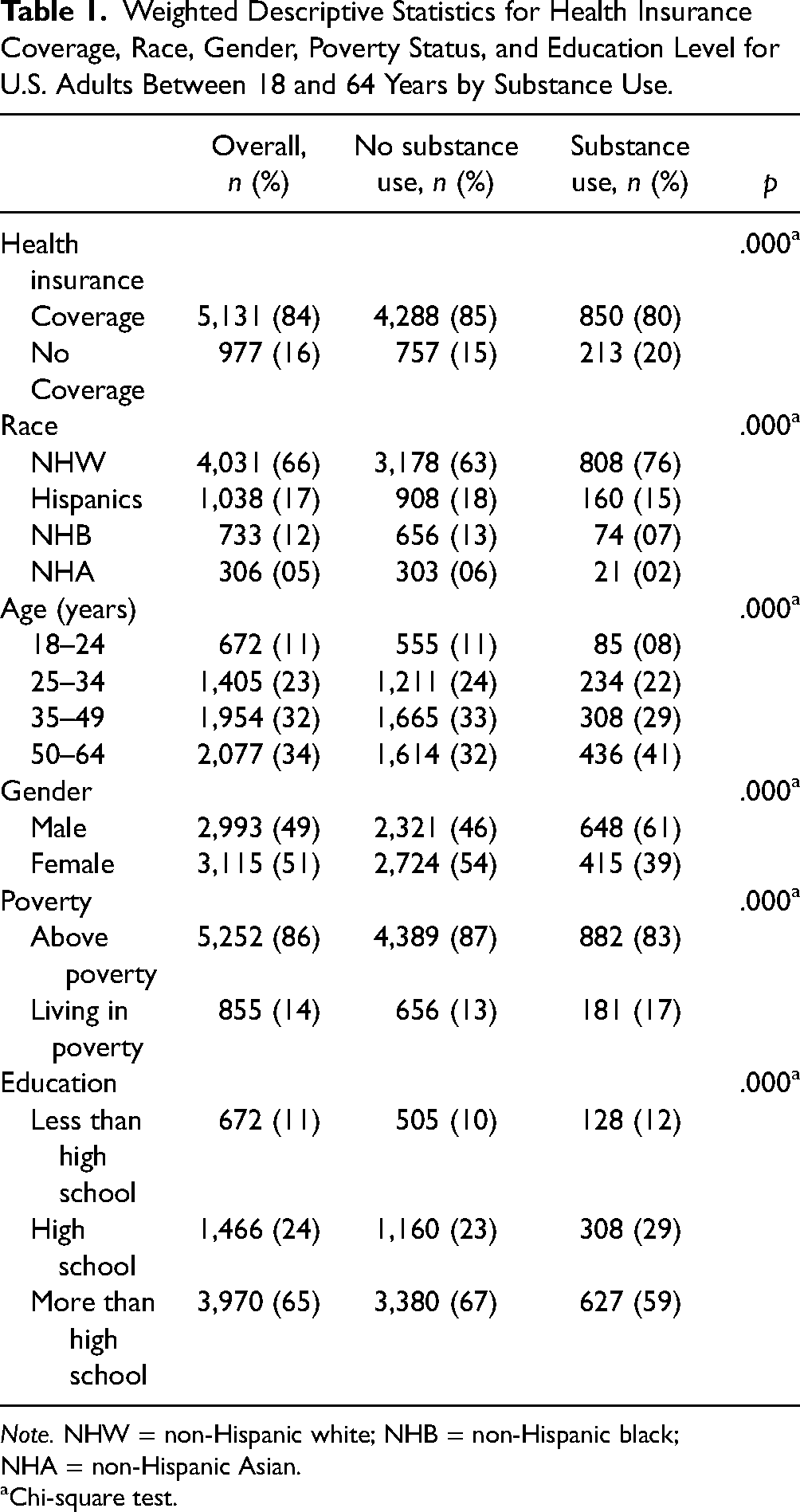
Note. NHW = non-Hispanic white; NHB = non-Hispanic black; NHA = non-Hispanic Asian.
aChi-square test.
Our analysis was conducted using STATA 17 software (StataCorp, 2017) which allowed for robust data management and statistical analysis. We first performed descriptive statistics to understand the prevalence of substance use (Table 1). In our multivariate logistic regression analysis (Table 2), health insurance coverage was included as the primary independent variable, with age, gender, race/ethnicity, poverty status, and education level as control variables in Model 1. In Model 2, we further examined the interaction between health insurance coverage and race/ethnicity. Logistic regression, chosen for its efficacy in analyzing associations between categorical independent and dependent variables, was ideal for our study design. The results are presented as odds ratios with corresponding standard errors and significance levels, providing a clear and statistically sound understanding of the associations between health insurance coverage, demographic variables, and the history of substance use. This analytic approach not only elucidates the direct associations but also offers insights into the interaction effects, contributing to a comprehensive understanding of the dynamics at play in substance use within the U.S. adult population.
Weighted Multivariate Logistic Regression Showing the Association Between Substance Use and Health Insurance Coverage in U.S. Adults Between 18 and 64 Years Old.
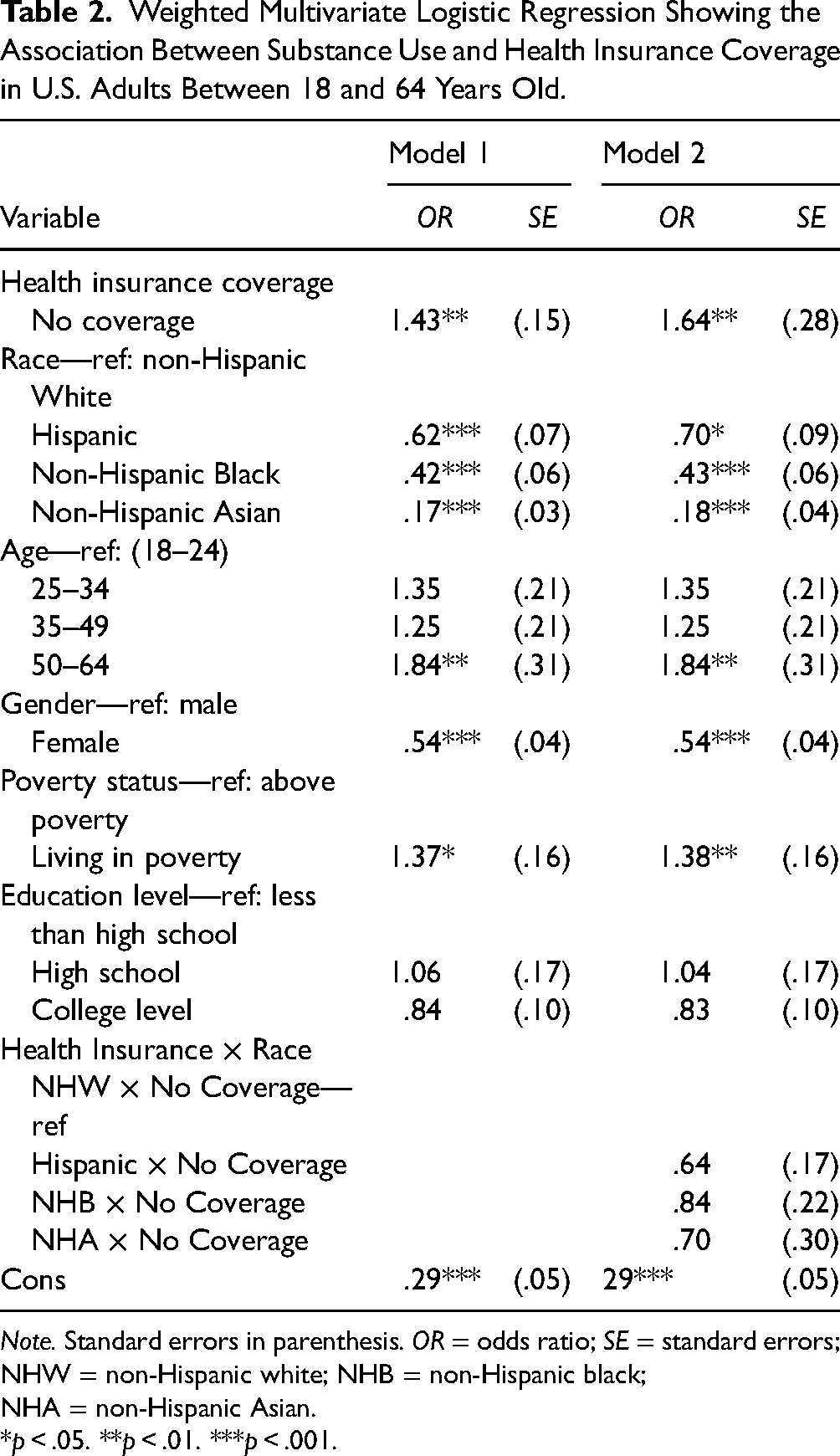
Note. Standard errors in parenthesis. OR = odds ratio; SE = standard errors; NHW = non-Hispanic white; NHB = non-Hispanic black; NHA = non-Hispanic Asian.
*p < .05. **p < .01. ***p < .001.
Results
Descriptive Results—Table 1
In an analysis of the NHANES database spanning from 2016 to 2018, which included 6,108 U.S. adults aged 18–64, 1,063 individuals (17.40%) were identified as having a history of substance use. This provided valuable insights into how historical substance use correlates with various demographic factors. The study found a significant association between health insurance coverage and a history of substance use; 80% of those with a history of substance use (850 out of 1,063) had health insurance, a relationship underscored by a p-value < .001. This trend was observed within the 5,131 insured participants. In our analysis focusing on racial distribution among individuals with a history of substance use, we found that NHWs constituted the largest group, representing 76% (808 out of 1,063) of this cohort. Notably, this proportion pertains to the internal comparison within substance use groups. As highlighted by the chi-square analysis in Table 1, these findings are significant when comparing different racial groups within the substance-using population, rather than contrasting with NHWs’ representation in the overall study population. Following NHWs, Hispanics, NHBs, and NHAs had lower percentages, with Hispanics making up 15%, NHBs 7%, and NHAs 2% of those with a history of substance use. Age also played a critical role, with the 50–64 age group showing the highest prevalence of a history of substance use, representing 41% of those with such a history, a significant distinction when compared to other age groups (p < .001). Gender differences were evident as well, with males accounting for 61% of those with a history of substance use, indicating a higher prevalence among males (p < .001). Socioeconomic status further influenced these patterns; individuals above the poverty line constituted 83% of those with a history of substance use, and those with more than a high school education made up 59% of this group. Both associations were statistically significant (p < .001).
Multivariate Logistic Regression
This study investigated the associations between health insurance coverage and the history of substance use among U.S. adults aged 18–64, while also considering the impact of race/ethnicity, age, gender, and poverty status. The findings from the weighted multivariate logistic regression, as shown in Models 1 and 2 of Table 2, provide insights into these relationships over a historical context. In Model 1, the absence of health insurance coverage was found to significantly increase the odds of a history of substance use (OR = 1.43, p < .01) compared to those with coverage. When examining racial/ethnic groups with NHW as the reference, NHB participants demonstrated significantly lower odds of having a history of substance use (OR = 0.42, p < .001), as did Hispanic participants (OR = 0.62, p < .001) and NHAs (OR = 0.17, p < .001), indicating a lower likelihood of past substance use compared to NHWs. Age emerged as a significant factor; those in the 50–64 age group had a higher likelihood of a history of substance use (OR = 1.84, p < .01) than the youngest group (18–24). In terms of gender, females showed substantially lower odds of having a history of substance use compared to males (OR = 0.54, p < .001). Socioeconomic status also played a role, with individuals living in poverty more likely to have a history of substance use compared to those above the poverty line (OR = 1.37, p < .05). Educational levels, however, did not exhibit a significant association with the history of substance use in this model. Model 2 included interaction terms to assess the combined effect of health insurance coverage and race/ethnicity on the history of substance use. These interaction terms were not statistically significant, indicating that the association between health insurance coverage and past substance use does not differ markedly by race/ethnicity. Race/ethnicity itself remained an independent predictor, with Hispanics exhibiting lower odds of a history of substance use compared to NHWs.
Discussion
This study, utilizing data from the NHANES database from 2016 to 2018, has provided critical insights into the historical patterns of substance use among 6,108 U.S. adults aged 18–64. A key discovery is the significant correlation between health insurance coverage and a history of substance use. Notably, most individuals with a history of substance use were insured, suggesting that access to health insurance does not necessarily correlate with lower substance use history (Ali et al., 2015). This could reflect the complexity of health insurance dynamics in the context of substance use and potentially indicates the necessity for more targeted interventions within insured populations (Feder et al., 2019; Saloner et al., 2018). The racial distribution of substance use history reveals significant disparities. NHWs represented the largest proportion of individuals with a history of substance use, a trend significantly higher than their representation in the overall study population. This finding contrasts with the lower likelihood of substance use history among Hispanic, NHB, and NHA participants (Pantea et al., 2020; Sahker et al., 2020). This disparity highlights the need for culturally sensitive approaches to understanding and addressing substance use (Palamar & Keyes, 2020; Vilsaint et al., 2019). Age and gender also emerged as significant factors. The oldest age group (50–64) had the highest prevalence of substance use history, indicating potential generational differences in substance use patterns or longevity of use (Maust et al., 2018). Furthermore, males were more likely to have a history of substance use than females, underscoring gender-specific factors that might influence substance use behaviors (Krasnova et al., 2021; Mereish, 2019; Substance Abuse and Mental Health Services Administration, 2021).
Socioeconomic status was another influential element, with a higher prevalence of substance use history noted among those above the poverty line and those with more than a high school education. This suggests that substance use issues are not confined to lower socioeconomic groups and that factors contributing to substance use may be more complex than financial or educational status alone (McCance-Katz, 2019; Substance Abuse and Mental Health Services Administration, 2021). The logistic regression analysis further deepened the understanding of these relationships. The lack of health insurance significantly increased the odds of a history of substance use. This reinforces the importance of health insurance in the broader context of substance use, but also points to underlying issues that health insurance alone may not address (McCance-Katz, 2019). Significantly, the interaction terms between health insurance coverage and race/ethnicity in the logistic model did not show statistical significance. This finding implies that the relationship between health insurance and substance use history does not vary considerably across different racial or ethnic groups. It suggests that while race and ethnicity are independent predictors of substance use history, their influence is not significantly modified by insurance status. In summary, the study's findings highlight the complex interplay of health insurance, race, ethnicity, age, gender, and socioeconomic status in relation to the historical patterns of substance use among U.S. adults. These insights underscore the need for multifaceted and nuanced public health strategies, policies, and interventions that consider these diverse factors. Future research should continue to explore these dynamics to better inform effective prevention and treatment programs tailored to various demographic groups.
Conclusion
The examination of the NHANES database from 2016 to 2018 has revealed pivotal insights into the historical patterns of substance use among U.S. adults aged 18–64. Key findings include the substantial presence of substance use history among insured individuals, highlighting the need for more targeted interventions within healthcare systems. The study also brought to light significant disparities in substance use history across racial, age, gender, and socioeconomic groups, underscoring the complexity of substance use dynamics. Notably, the study found that health insurance coverage, while important, does not uniformly correlate with lower instances of substance use history, indicating the need for broader and more inclusive health policies. The lack of significant interaction between insurance coverage and race/ethnicity in determining substance use history further suggests that these factors independently contribute to substance use patterns. This research emphasizes the multifaceted nature of substance use history and the necessity for nuanced public health strategies that address the diverse needs of various demographic groups. It advocates for ongoing research and policy development to effectively combat substance use issues and improve overall public health outcomes.
Policy Implications
This study's insights into the historical patterns of substance use among U.S. adults aged 18–64 have profound implications for public health policy. One of the primary revelations is the crucial role of health insurance coverage. While expanding access to health insurance is vital, it's clear that simply having insurance is not enough to mitigate substance use issues. Policies must evolve to include comprehensive substance use disorder screening and treatment within health insurance plans, ensuring that individuals have access to necessary prevention and early intervention resources. Furthermore, the disparities observed in substance use history across different racial and ethnic groups necessitate culturally sensitive and tailored public health interventions. Policies should aim to reduce barriers to healthcare access among minority populations, address systemic biases, and provide resources that are linguistically and culturally appropriate. Additionally, the higher prevalence of substance use history among older adults calls for age-specific intervention strategies. Policies supporting the development of programs catering to the needs of older adults, considering factors such as chronic pain management, mental health, and social support systems, are essential. Gender differences in substance use history also highlight the need for gender-responsive policies, which recognize and address specific challenges and needs related to substance use in both men and women. Despite the significant role of socioeconomic status, substance use issues cut across economic boundaries. Therefore, policies must ensure that prevention and treatment programs are accessible to all, irrespective of socioeconomic status, while addressing underlying issues such as poverty and education.
Future Research
Building on this study's findings requires a multifaceted approach in future research. Longitudinal research tracking substance use patterns over time would help understand its progression and potential intervention points. Investigating the mechanisms linking health insurance coverage to substance use history is crucial for leveraging insurance effectively in prevention and treatment. Evaluating the effectiveness of current and new intervention strategies, especially those that are culturally sensitive, age-specific, and gender-responsive, is necessary to determine best practices. Assessing the impact of changes in health insurance policies on substance use patterns, particularly in vulnerable populations, is imperative for understanding the real-world effects of policy shifts. Exploring holistic approaches to substance use treatment, integrated with other health and social services, offers a comprehensive strategy to address substance use disorders. Additionally, comparative studies across different healthcare systems and countries would provide insights into how various models of health insurance coverage and healthcare delivery impact substance use. Through such research, a more comprehensive understanding of substance use dynamics can be developed, leading to more effective and impactful public health policies and interventions. The goal of future research should be to expand on these findings, providing a robust foundation for policies and strategies that effectively combat substance use and improve public health outcomes across diverse populations.
Footnotes
Declaration of Conflicting Interests
The authors declared no potential conflicts of interest with respect to the research, authorship, and/or publication of this article.
Funding
The authors received no financial support for the research, authorship, and/or publication of this article.
