







Abstract
The Autonomous Sensory Meridian Response (ASMR) or Whisper Community is an online group of people who create and share videos through YouTube videos that are intended to produce a relaxing shivering sensation for the viewer. ASMR relies primarily affective power of the whispered voice’s impression to create an intimate sonic space shared by the listener and the whisperer. The ASMR community struggles with popular perception of the transgressive nature of their shared pleasure, which by its public nature is what Berlant and Warner call “nonstandard intimacy.” In this paper, I investigate the ways in which the whisper works on the viewer through YouTube, drawing on sonic associations between private domestic space and care, as well as the problematic distance of the YouTube-mediated intimate experience that troubles the Whisper Community’s pursuit of pleasure.
Dot, dot, line, line, Spiders crawling up your spine. Crack an egg, Let it run . . . Tight squeeze, Cool breeze: Now you’ve got the shiveries.
In the children’s rhyming game Dot dot line line, patterns are traced out on the participant’s back. Tapping fingers recreate spiders crawling, and a slow caress becomes the dripping of a slimy egg. The rhyme calls on a sensory experience of contact—with another person and by extension with the unusual or feared substances they tell a story about—to induce shivers, or shiveries, as the rhyme goes. The focused attention on the hands as they draw on the skin, the anticipation of described sensations, and the emotional investment in storytelling combine to create the shiveries. The shiveries is an affective experience that demonstrates the links between affect and emotion: without the story, the taps and pats are only a friend’s touch; without the touch, there are no crawling spiders, just a story. In the case of the children’s rhyme, role-play demonstrates the importance of emotional content in inducing a physiological sensation of the shiver.
The fascination with the shiveries does not end with children. Since at least 2008, an online community dedicated to the pursuit of a similar shivery sensation has used YouTube, the online video-sharing platform, to create, collect, and exchange videos made to trigger the tingles through a computer screen (Tufnell 2012). The sensation that they seek to recreate, variously described by users as head tingles (Cheadle 2012) or brain orgasms (AdenClements 2012), was christened the Autonomous Sensory Meridian Response (ASMR) by the founders of the website (http://www.asmr-research.org) in 2009 (AdenClements 2012; Cheadle 2012). Members of the ASMR community, or ASMRers, claim that the shivers themselves are “intense feelings of relaxation” (AdenClements 2012) that begin at the head and then extend out to the limbs. ASMR has been promoted within the community as a solution for stress and insomnia, inducing in the ASMRer feelings of comfort, bliss, and euphoria (AdenClements 2012; Tufnell 2012).
In its current iteration shared via YouTube, the ASMR community is created through interactions with a number of different types of videos. Perhaps drawing on the precedent set by the soothing tones of spa and meditation videos, most of these videos are performed in a whisper. For this reason, the ASMR community is also known as the Whisper Community. According to Vice, the ASMR community was first brought together online through a Yahoo group where people shared their experiences of head tingles when watching specific kinds of videos on YouTube (Cheadle 2012; Figure 1). Instructional videos for elements of self-care such as massage, spa treatments, or meditation are affirmed by the community as common triggers (SilentCitadel 2012). These videos generally involve a single person, usually female, speaking softly, slowly, and gently. The ASMR community uses these instructional videos as well as purpose-made role-play videos uploaded by members to YouTube to induce the shivery sensation of ASMR.
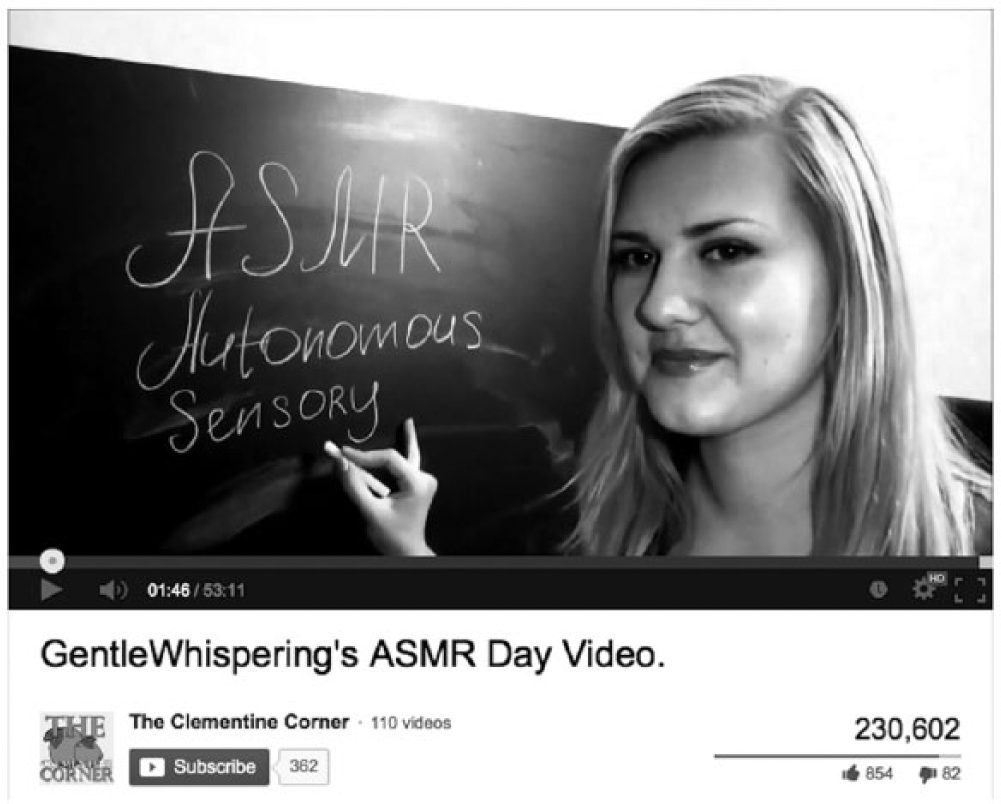
GentleWhispering explains ASMR using two common triggers: the whispered voice and chalk against a blackboard.
In this paper, I will examine how ASMR videos create pleasure through a distant intimacy that relies on the heteronormative gender roles of care and the aural impression of the whisper for its implementation and how their shared space on YouTube further defines that intimacy as public and communal. The ASMR community rejects any links with nonnormative sexual public intimacy, firmly denying the transgressiveness of their digital pleasure. Instead, they suggest that their experience of bodily pleasure is conjured up by the pure interaction between sound waves and brain. Yet, when read in the context of the content of ASMR videos, the assertion that the ASMR experience is created apart from the suggestions of physical proximity and intimacy created by the aural environment of the whisper and the situations acted out by whisperers does not stand to scrutiny. At first glance, ASMR seems to be an excellent case by which to examine affect divorced from emotion, as a pure instance of excess of sensation uncolored by emotional connection. However, although ASMR is not merely a physiological experience of pure affect, it is just as clearly linked to the emotional associations created through the experience of public intimacy. In the case of ASMR, affect and emotion exist hand in hand, tethered by intentionality, memory, and nostalgia. In this paper, I will explore the connotations of intimacy and care that create the affective ASMR experience to examine the ASMR community on YouTube as sharing in a public and therefore nonnormative experience of distant intimacy that reflects, if reluctantly, the potential of digital communities to make us feel.
Affect and ASMR
ASMR is pleasant or pleasurable, but its causes are subjective and contested even among those devotees who nonetheless insist on its existence. Affect has been identified by Massumi (1995, 88) as a physiological reaction to experience that precedes the cognitive coding of the event as an emotion. The ASMR experience is undeniably affective, as a sensation that has a wide array of mostly aural triggers not connected to any one specific cause or event. Common triggers include the whispered voice, rustling paper, the tapping of fingers, crinkling plastic, and combinations of all of these in role-play videos that recreate the performance of ordinary tasks. However, ASMR floats around a set of triggering experiences as a charge that defies logic, just as affective experience defies the cognitive positioning of emotion. As an affective experience, ASMR is felt as a physiological charge.
In her critique of the affective turn in theory, Ruth Leys (2011) suggests that the split between body and mind created when asserting that affect is divorced from emotion denies the complexity of subjectivity and the context provided by memory that guides the intentionality underlying all of our actions. People who watch ASMR videos bring with them the intention of being relaxed. Although it is unclear how the act of watching either role-play scenarios such as a visit to the dentist or repetitive actions like the sound of chalk on a chalkboard manifests itself as a shivery sensation, these events as experienced in real life are often characterized as grating or annoying rather than pleasant. Clearly the intention of care has a role in the way that these experiences manifest an affective experience with a content of pleasure. For children, hands tapping on the back are transformed when they are part of a story about spiders; for ASMRers, a warning about a cavity from a would-be dentist becomes a lullaby when it is welcomed as a paradigm of care within a relaxation exercise. The context of relaxation and care prepares the ASMRer to welcome the exchange of what Teresa Brennan (2004, 11) suggests are otherwise contained affects across individual boundaries. By seeking out these videos in a quest for pleasure, or a desire to recreate a certain sensation, ASMRers predispose themselves to these reactions through intention. Although certainly affective, ASMR is clearly induced through cognitive associations. In the case of ASMR, affect and emotion work hand in hand as ASMRers watch and share videos with the intention of being relaxed and eliciting that sensation in others by circulating them on the Internet.
Sharing ASMR on the Web
Like the sneeze or the hiccup, ASMR is difficult to explain physiologically; however, in their quest for legitimacy, the ASMR community has tried to ground their discussions of the experience in scientific terms that suggest empirical proof of its existence. In fact, no research has been published by the scientific community (Novella 2012). The name ASMR, while borrowed from science, dates back to 2009 when the founder of asmr-research.org coined the term as “a more polite term for ‘orgasm’” (Cheadle 2012). Biologically, an autonomous response usually refers to an involuntary motor reflex such as breathing or vomiting directed by the spinal cord that is not processed by the brain, yet the links between the sensation and science in this case are tenuous. This uncritical adoption of scientific jargon links the ASMR community to a tradition of fringe science that includes the aurally induced relaxing sensation of binaural beats, a phenomenon where, its proponents claim, interacting sound waves are said to activate parallel brain frequencies that promote concentration and even out-of-body experiences (The Monroe Institute 2013). As in the case of ASMR, its supporters have found a place to collect and distribute potentially affective soundscapes on YouTube (FulLengthBinaurals 2011). Using scientific jargon locates the currently nonnormative ASMR experience as potentially universal by locating its origins in human biology.
As ASMR has evolved on the Internet, the ASMR community as a public revolves less around defining how ASMR occurs than the Internet-enabled possibilities for sharing the experience. As Warner (2002, 9) writes,
to think of oneself as belonging to a public is to be a certain kind of person, to inhabit a certain kind of social world, to have at one’s disposal certain media and genres, to be motivated by a certain normative horizon . . ..
The ASMR community is aligned not only by their quest for affective experience but by their desire to share it through online media. The “original” ASMR community Facebook group has distanced their experiences explicitly from “medical conditions of the brain” (ASMR Group 2013). Public sharing of triggers over popular web forums such as Facebook and YouTube, rather than niche sites such as asmr-research.org, has allowed and encouraged the ASMR community to locate itself not as a niche community but as a public phenomenon. For a community that has adapted to the affordances and valorizations of the web, millions of views as attested by the YouTube format carry the weight of legitimacy more than pseudo-scientific claims.
Much more than binaural beats, the ASMR community in its present form owes its existence to the YouTube video-sharing platform. The first online community dedicated to ASMR was a Yahoo group that adopted the name Society of Sensationalists, a whimsical title that reflects the subjective qualities of the ASMR experience more than the later acronym that carries the weight of presumed quantitative evidence (Cheadle 2012). However, although this was their first documented appearance on the web, the group discussed experiences of this sensation triggered by sound going back several decades. Rhodri Marsden (2012), author of one of the first published pieces on ASMR, wrote that members recounted ASMR experiences brought on by listening in the classroom to lectures given by schoolteachers or, on television, to the soothing voice of painting show host Bob Ross. YouTube, which was founded in 2006, brings together in its collection of user-uploaded videos countless examples of potentially affective voices and even recordings of known triggers such as Bob Ross to create a compendium for those seeking out an ASMR experience. Instructional videos are made available on YouTube primarily for the consumption of a non-ASMR community, often as advertisements by massage therapists or spa technicians (djwetterstrand 2011). These videos have formed the foundation upon which new ASMR-focused whisper videos have been built by ASMRers with names such as GentleWhispering, TheWaterwhispers, or UnnamedFeeling13, who, following the genre of these existing videos, are usually female. Role-play extends beyond instruction to performance: single users will pretend to be dental hygienists, travel agents, home décor consultants, receptionists, or flight attendants and perform the routines and rituals of their assumed professions. The accidental archive of YouTube creates the perfect ground for possible triggers of ASMR to be explored by the curious (Burgess et al. 2009, 88).
Although other forums continue to exist, such as Facebook groups dedicated to sharing links to videos and limited activity on forums discussing videos, offline triggers, first experiences, and the loss of ASMR (ASMR Studio 2013; The Experience Project 2013), YouTube is the most public home of ASMR, and its affordances have helped to shape the ASMR community. As both an archive and a site of creative exchange, YouTube offers to the community what Warner (2002, 63) calls “the context of publicness” where it can “count in a public way” by enabling multiple pathways to interaction. First, YouTube has “removed the technical barriers to video sharing” (Burgess et al. 2009, 1), making it easy to upload videos. While producing binaural beats involves synthesizing complex tones and rhythms, the potential for an ordinary person to have an affective whisper combined with the ease of posting on YouTube makes it a more accessible genre to participate in as a producer of “vernacular creativity” (Burgess et al. 2009, 13). Many whisperer videos resemble the bedroom confessional genre that YouTube has encouraged by situating itself as a place to visually chronicle everyday life (Banet-Weiser 2012, 63). The transfer of the ASMR community’s locus to a popular forum such as YouTube, where, as Lange points out, the search function allows videos to be easily accessible via certain identifiable keywords such as “ASMR” or “Whisper,” has welcomed new users to the community who participate not by sharing videos or by commenting within a group, but simply by watching videos (Lange 2007) in much the same way that radio listeners in the twentieth century experienced listening to a common voice as a “participatory mystique” (Douglas 2004, 38). ASMRers also indicate variety is important to triggering the ASMR experience, so the ability to search and stream related videos instantly that YouTube has perfected for the casual user perhaps explains why ASMR has found its home on a video-sharing platform rather than earlier audio-centric file-sharing platforms based on downloading. Finally, YouTube has afforded the ASMR community a concrete indicator of its audience by documenting the number of views a video receives. When ASMR videos began to rate millions of views in 2012, a flurry of media attention was almost immediate (Cheadle 2012; Marsden 2012; Tufnell 2012). The catalyst in transforming ASMR from peripheral freakiness to the weird but visible Internet community has been its adoption of YouTube as the primary platform for sharing the ASMR experience. Yet, although YouTube as a video platform has been integral for establishing the ASMR community in its current web iteration, video itself is secondary to audio in the transmission of the ASMR as sensation.
The Voice
The voice is the focus of attention for the Whisper Community. As visual documents, ASMR videos are fairly weak. Often set in the private spaces of bedrooms or in front of blank walls that are typical of the vlogger (Lange 2009, 72), many videos present only the lips, the torso, or the hands to the camera (GentleWhispering 2012; TheWaterwhispers 2012a). The body is fragmented, directing the gaze of the viewer to the actions being demonstrated, such as the gestures of the flight attendant or towel folder. While sometimes the field of vision presented by a camera lens is not identical to that of the eye, the close-ups that ASMR videos feature jar the familiar conventions by which a person is framed onscreen. Attention is thus focused continuously on body parts in an unusual, meditative way. TheWaterwhispers’ mouth, for example, is such an image so close that the ridges of her teeth and wrinkles of her lips become almost abstract images rather than the familiar parts of a human face. Sometimes videos are actually only audio, where the display is completely black (WabiliciousWhispers 2011) or features a static image such as a forest photograph as a mask (Matwith0neT 2012b). Technically, ASMRers have begun to introduce binaural recording and better microphone setups that are then advertised in video titles, offering increasingly sophisticated audioscapes while the video quality remains poor (GentleWhispering 2013). The video component is secondary to the experience and exists primarily because of the affordances of YouTube. Sound is the key factor in the ASMR experience.
What does the whisper do? As Li (2011, 20) writes, the whisper is a site of power in our hypersonic world, which since the dawn of the industrial age has become more and more cacophonous. Many vocal sounds are indistinct when whispered, thus making clear communication difficult and requiring closeness between speaker and listener (Li 2011, 20). Whispers can only be exchanged between people in close quarters and intimacy, between lovers and family (Li 2011, 21). For Li, the whisper between a mother and a child is of particular importance. Interestingly, when asked to explain the reasons behind the affective charge of their whispers, giving name to the emotions they evoke, ASMR enthusiasts have described the experience as a recreation of maternal intimacy (Cheadle 2012; Tufnell 2012). The whisper recreates intimacy without the need for physical presence.
Although recording technology and the YouTube platform negate the need for close quarters to share a whisper, the experience requires attention. Fechner’s Law, which identifies “a perfect balancing mechanism of the human perceptive system that compensates for weak stimulus with increased sensitivity and strong stimulus with reduced effects” (Li 2011, 21), indicates that the whisper demands of its listener more attention than a normal voice register. The listener thus becomes intent on the sounds that he is hearing. Given that many listeners use headphones (Cheadle 2012; Marsden 2012), the effect of the whisper directly in one’s ear is all the more intense. There are thus two loci of attention: on the part of the whisperer, that the sound is recorded by his or her microphone, and on the part of the listener, who is attentive on the other end to catch the quality of the words coming through his or her headphones. Secrecy and privacy are likewise signified by the whisper, suggesting information that can circulate in a limited space. Performing or listening to a whisper in a venue such as YouTube where there is access to a multiplicity of voices and sounds creates an exchange that, despite being in the public commons, is enacting the choices of the private and intimate.
In ASMR, the voice itself is subjected to the type of attention that is usually reserved for speech. The nonstandard pronunciations of language by second-language speakers who speak intentionally slowly add to the demands of close attention that the whisper already makes on the listener. Yet, rather than focusing on the meaning of speech, the listener’s attention can turn more easily to the quality of the voice itself as a carrier of meaning. The nuances of the voice hold the listener’s attention. The impression it makes on the ear is greater than that of the normal voice because of the intensity of the attention given to it; following Ahmed, it makes sense that greater impression should thus result in a strong affective response. The popularity of foreign language ASMR videos demonstrates that the voice, rather than language, is the primary carrier of attentiveness as an ASMR trigger. Like most whisper videos, foreign language videos are usually instructional. Instruction demands a particular type of attention, because it passes on the necessary information to repeat an act from one body to another. In fact, Stiegler (1998, 155) has suggested that language and memory begin with the repetition of instruction. Because ASMRers cannot hope to understand the linguistic content of foreign language videos, the intimacy they find must be within the voice itself. Tones and patterns vary across languages; however, the intention of instruction is the same. Through the type of attention to the excess of the voice beyond speech that ASMRers harness, as Cavarero (2005, 12) insists, we return voice to its prelinguistic freedom and value.
Cavarero (2005, 3) discusses the importance of the voice as an indicator of meaning, alongside and equal to those meanings conveyed by speech. This argument is likewise followed by Henriques (2010, 76) in his investigation of sound and affect; it is only in a Western context outside of the oral tradition, writes Henriques, that representation and meaning have been split from one another, privileging the visual and the written. Thus, we are drilled in a manner of assessing sound for its linguistic content rather than hearing the sound itself. The ASMR experience relies on the primacy of speech to create the focus that lets listeners hear, intently, the voice. By straining to understand speech at the threshold of what is audible as identifiable language, the listener has to invoke a new way of hearing that attends to elements outside of the linguistic. For Cavarero (2005, 196), the voice signals the uniqueness of its bearer; perhaps ASMR convinces the listener to truly be impressed by a voice for the first time. The impression that the listener thus receives from a whisper video is of a strongly affective, intimate, and unique experience. The voice bridges the distance between them.
Distance, Affect, and Impression
Despite their distance, two bodies that cannot make physical contact can share an affective sense experience through the ASMR video and the impression of the voice. Hudelson (2012), writing about the phenomenon on the blog Sounding Out!, suggests “hyper-presence of the whisperer would seem to disavow the separation implicit in Internet communication,” a presence made possible through binaural microphones and immersive headphone sound. For Ahmed (2004), affect involves impressions, where impression is related to the pressing of bodies upon each other and against the spaces that they inhabit. Impression implies contact (Ahmed, 2004, 6). Following Massumi, Ahmed takes up the importance of movement in describing and ascribing affects and emotions. To create or to withdraw from impressions, bodies move. The impetus toward movement is the affect; the type of movement creates emotional content. Although there is no physical contact, ASMR video intimately connects two bodies, that of the whisperer and the spectator, and allows them to impress upon each other.
The impression created by affect at a distance in the case of ASMR is crucially aural. It can exist in other forms, such as the punctum that Barthes (1981) names in his affective experience of old photographs of strangers is a case where bodies have made an impression through their shadows on sensitive paper. In the case of the whisper-induced ASMR, the body casts its impression through the voice. As Cavarero (2005, 4) writes, the voice is the unique product of the vibrations through a body that always indicates “someone in flesh and bone who emits it.” Voices reproduced outside of human bodies are inhuman; consider the robotic, affectless voice-tones of early computer games or Alexander Graham Bell’s mechanical diaphragm, whose eerie tones were transformed into a recognizable voice only when its wind-producing bellows was replaced by human breath (Sterne 2003, 75). Drawing from the materiality of the sound wave reaching the eardrum, Dolar (2006, 137) has described listening as an act of touch. In the case of the ASMR videos, we can thus trace an impression either through the image or through the voice.
This affective impression at a distance is what I call distant intimacy. Among the litany of triggers produced by asmr-research.org and reiterated by users such as ASMR star GentleWhispering is “Close personal attention by another person,” a trigger that suggests physical proximity but in the case of the Whisper Community is evoked remotely through a video (AdenClements 2012). In the case of the videos, this close attention is actually distant, not only spatially but temporally, as people watch videos months and years after they have been recorded and uploaded to YouTube. For the ASMR community, constituted by participating in the shared space of YouTube rather than in a shared physical locale, any intimacy experienced is distant (Burgess et al. 2009, 56). Distant intimacy, because it is experienced not only as part of a group but in the absence of normal definitions of physical proximity, is what Berlant and Warner (1998, 558) define as a “nonstandard intimacy.”
For Berlant and Warner (1998, 555), intimate experiences in heteronormative culture have been limited to contact between couples in private. This definition limits both with whom one can be intimate and how a person can experience pleasure: one is not intimate with “strangers and acquaintances,” nor can the pleasure one experiences through that acquaintance be identified as sexual (Berlant and Warner 1998, 559). The ASMR community, as a loosely connected public that shares videos dedicated to the experience of pleasure, falls precisely into this border zone where “the spillage of eroticism into everyday social life seems transgressive in a way that provokes normal aversion” (Berlant and Warner 1998, 560). At question is how pleasure and intimacy are defined.
In their self-representation in member videos and in interviews, the ASMR community is careful to police the location of ASMR along the near end of a scale of pleasure that begins with relaxation and ends with eroticism. In interviews, comments, and reflective videos on their craft, ASMRers repeat again and again that the ASMR experience is “unsexual,” “totally nonsexual,” and “not at all sexual” (AdenClements 2012; Marsden 2012; TheWaterwhispers 2012a). The ASMR community hopes to situate its public nature firmly within the boundaries of relaxation without risking the “spillage of eroticism.” Yet, precisely because the affective charge of ASMR does not emerge without the emotional connotations of intimacy, the ASMR experience makes public a kind of intimacy that, in heteronormative culture, is exclusively the private experience of the couple. Distant intimacy refuses these norms, and therefore situates ASMR as a reluctant nonstandard intimacy.
Gender and Intimacy
Despite the fact that distant intimacy is by its nature nonnormative, the videos circulated by the ASMR community rely on rigidly normative scenarios of intimacy to provide the emotional content behind the affective charge. These heteronormative roles of intimate care are gendered as female. Whisperers and viewers alike have recalled the mother–child relationship in describing their ASMR experience, gendering the type of nostalgia, fantasy, and personal memory invoked by ASMR videos (Cheadle 2012; Marsden 2012). Many of the scenarios take place in either domestic spheres, such as towel folding or ironing tutorials, or in performances of the service professions where women traditionally have found equal or dominant roles, such as dental hygiene, retail, and travel. In the ASMR videos, the contexts of the agency, clinic, or spa are exchanged for the typical settings of YouTube videos in the bedroom, bathroom, or home office, further situating these working women within a domestic sphere. In fact, those tutorials not geared toward ASMR listeners that have been co-opted by the community, such as makeup tutorials, are similarly domestically situated. Bike maintenance or home repair tutorials are absent from the canon, perhaps because they take place in nonfeminized parts of the house that have been traditionally the domain of men. Even when men perform as whisperers, they often undertake tasks such as cooking or hair styling that in the home have been gendered as the domain of women (MatWith0neT 2012a; Tufnell 2012). Heteronormative experiences of intimacy are recreated in the videos but are transformed to become nonstandard distant intimacies because of their public circulation.
ASMR has a clear gender bias, recreating heteronormative models of care and intimacy directed by women toward men. The most popular whisperers, by number of views on YouTube, are women (Marsden 2012). While the individual attention promised by the video may seem to recreate the intimacy of the heteronormative couple, the nonnormative public experience of pleasure that constitutes distant intimacy in ASMR pushes back at heteronormative construction. But rather than allowing for play, listeners and whisperers alike are eager to reinforce static identifiers of gender. GentleWhispering has stated that “there are not a lot of things that men could whisper about that don’t seem creepy” (Cheadle 2012). In the hands of a male, the affect is transformed, from pleasure to fear. Male whisperer MatWith0neT has received comments on his videos asking if he is gay, claiming “not to be bad-mannered” (MatWith0neT 2012c) as if to ensure that the viewer is participating in accordance to the limits defined by their own or the whisperer’s sexual identification, rather than appropriating the video for their own uses. Self-labeled male-oriented videos such as JustAWhisperingGuy’s (2012) “MMA Handwrapping Role Play for ASMR” reinforce heteronormative roles for male whisperers, because, as he writes “between make-up tutorials, personal shoppers, spa trips and beauty consultations, I feel the need to represent the masculine camp in ASMR videos” (Figure 2). Because they have adopted scenarios within heteronormative norms of male and female intimacies, it is easy to see why the ASMR community would insist so aggressively that their distant intimacy is a normative one.
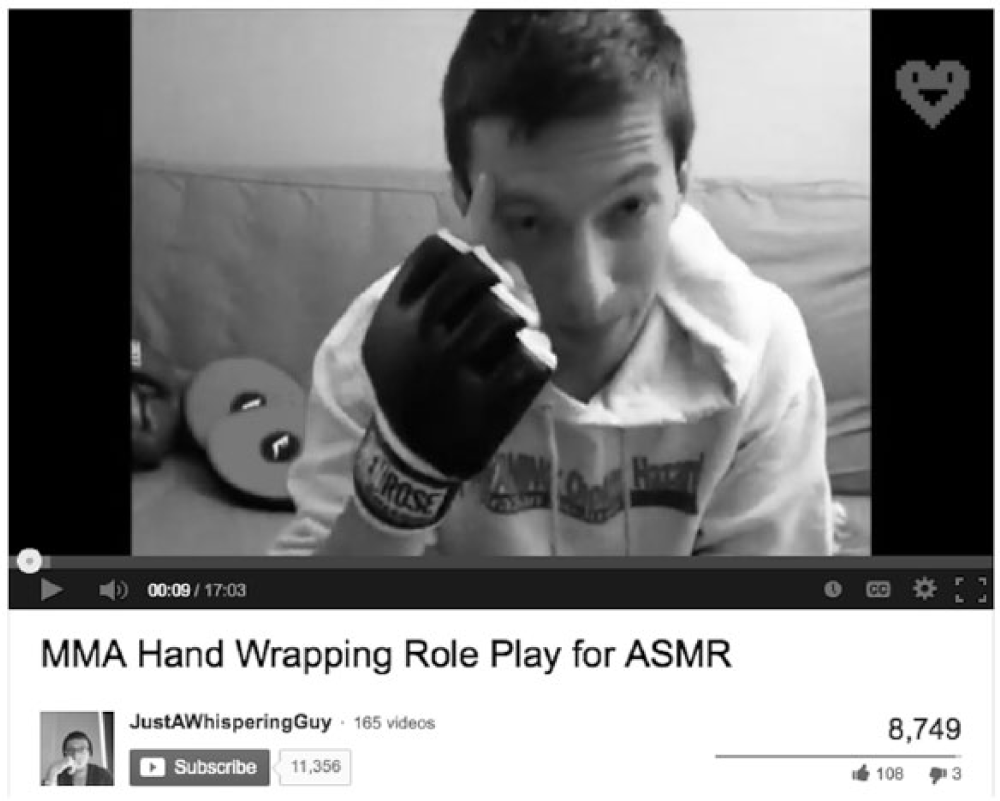
JustAWhisperingGuy “represent[ing] the masculine camp” with his MMA hand wrapping video.
The question of domination and control play out in the role of the Other in ASMR videos. bell hooks (2005) discusses sexual encounters with the Other as an imperialist pleasure of control, where invasion of foreign space, or the submission to the foreign in an intimate zone, is fraught with the politics of domination and fear. Foreignness, as performed by an accent or a different language, is a well-known ASMR trigger. Many ASMRers claim that accents help induce the ASMR more intensely and reliably than voices that share the same dialect as the listener (ASMR Research & Support 2012). Most whisperers choose to remain somewhat anonymous, withholding their last names, locations, and sometimes their faces (Marsden 2012), but the stories that their voices tell, that uniqueness of which Cavarero speaks, helps identify them. GentleWhispering, for example, speaks with a slight Eastern European accent. She also posts in Russian. One of TheWaterwhispers’s videos in Dutch has a comment from a listener who is also a Dutch speaker who states he prefers her English language videos (TheWaterwhispers 2012b). Distance and foreignness are as important to the ASMRer as intimacy and familiarity. For the ASMR community on the Internet, distant intimacy offers the promise of control, not only of the Other but of the time and space of interaction. Unsurprisingly, due to the models that ASMR community has taken for their videos, from medical to personal care, the extent of the ASMRer’s control over the flows of communication through video evokes similar controlled interactions within care service industries. In this way, the distant intimacy of ASMR mimics other, more recognizable forms of intimacy that nevertheless struggle within normative models of sexuality.
Distant Intimacy, Care, and Pleasure
ASMR scenarios recreate aspects of attention and intimacy that are closely linked to the care service industry. Distant intimacy in the case of therapeutic bodywork has to do with public pleasure and emotional rather than physical distance. The impressions on the body are physical, but the intimacy is carefully bounded outside of the couple. As Oerton (2004, 550) writes, the context of therapeutic bodywork is “episodic, exclusive, secluded and relatively unsupervised activity conducted between people in the intimate surroundings of private houses, etc.” To assert their participation in a public rather than a private intimacy, therapists adopt routines and signifiers of orthodox medical care, similar to ASMRs adoption of semi-medical terms such as “meridian response” (Marsden 2012) to avoid “over-rapport or over-sensitivity” (Oerton 2004, 554) with their clients. Triggers of ASMR, as listed by self-declared authority asmr-research.org, include accented speech, physical contact especially with the head, “watching another person complete a task, often in a diligent, attentive manner,” and the vague catch-all of “empathetic reactions” (ASMR Research & Support 2012), all elements that are regular parts of therapeutic bodywork. Spa work has long been an important employer for female immigrants, many of whom in an anglophone context speak an accented form of English. Experiences with care service professionals provide a context for the triggers employed by ASMR videos for relaxation. As with ASMR, the nonsexual yet pleasurable and intimate yet public nature of bodywork positions it as a nonnormative experience.
The stigma against the public nature of distant intimacy as shared through ASMR is palpable in the dismissive press covering the Whisper Community. In 2012, Wikipedia, which featured articles on, among other topics, Reiki healing, mesmerism, and Planking (the meme that involves lying face down in a public place), temporarily removed the article on ASMR from its database due to lack of scientific confirmation of the experience (Cheadle 2012). The first article on ASMR appeared in Vice, a publication known for its attention to the stupid and the horrifying, where ASMR was cast as “guided meditations” with a “New-Agey flavor” (Cheadle 2012). On the Huffington Post blog (Tufnell 2012), coverage of ASMR was subsequently described as the author’s “confession” of a dirty little secret (Marsden 2012). The Independent article, which featured a photograph of author Marsden staring wide eyed at his obscured computer screen, called up the specter of pornography. In fact, Marsden brought up pornography in the article, only, he wrote, to suggest that it was more socially acceptable than a regular dose of ASMR. National Public Radio (NPR) contributor Andrea Seigel (2013) likewise compared her own marathon ASMR video watching to “someone’s obsession with porn.”
Bloggers and journalists writing about the distant intimacy of ASMR have not had to look far for other precedents in sex; cybersex and phone sex evoke pleasure at a distance outside of what Berlant and Warner (1998, 558) call “the privatized forms normally associated with sexuality.” However, unlike ASMR, these pleasures at a distance are characterized through masturbation as well as aural or visual stimulation. Mattley (2005, 99) has noted that one type of distant intimacy, phone sex, is characterized as “false sex.” Mattley (2005, 100) likewise attributes disdain for participants in phone sex, both as callers and as operators, as disgust for “a private activity that has morphed into a more public activity.” While the ASMR community attempts to patrol the borders between sex and pleasure, there is no denying that phone sex and ASMR evoke distant intimacy and its attendant pleasure in similar ways. Like phone sex operators, whisperers perform an idealized femininity drawing on “powerful cultural traditions which link women with emotion, sensitivity and empathy” (Hudelson 2012; Mattley 2005, 558). A recent trend for ASMR video featuring kissing suggests the community itself may be abandoning its strictly nonsexual stance (15Olives 2014; asmrsongbird27 2014; LaLu Luna Whispering 2014). While the intention that colors the affective pleasure of ASMR may be insistently normatively nonsexual, the contexts and cues the videos employ to evoke intimacy are not so clearly defined. Ultimately, the ASMR community relies on an intimacy that is even more distant than that of phone sex, doing away with the need for temporal synchronicity. While this may seem like a technological advance in the potential of care, it also reflects what may be the limits of how intimacy can be conveyed across a distance and through the web.
The ASMR Community beyond ASMR
Echoing Dean’s (2005, 60) characterization of online communities as passive rather than reactive, linked but not necessarily interacting, the ASMR community in its most popular form on YouTube offers participation but is predicated on distance and limited interaction. Prerecorded videos are static; once they have been uploaded to YouTube, they continue to exist as they are, infinitely repeatable, until they are deleted. The potential for repetition is multiplied by the similarity of ASMR videos themselves, which are often tributes to other videos almost verbatim, reflecting the duplicative logic of YouTube. Most members of the ASMR community return to the same videos many times until the effects are no longer felt. When one prerecorded version of intimacy is no longer affective, ASMRers can simply and anonymously turn to the next video and voice.
The techniques used to counter burning out on ASMR give insight into the evolution of distant intimacy on the web. “Losing” ASMR, as themimimouse123 comments, is “upsetting” to those who rely on it for relaxation (TheWaterwhispers 2012c) and often drives ASMRers to new videos and whisperers, an option made possible as the community has grown. Variety, then, operates as a kind of stand-in for interactivity that preserves distance, where alternate renditions can be sourced from other whisperers rather than encouraging a reaction from the preferred whisperer. Burned out ASMRers have turned increasingly to deeper experiences of immersivity though technological aids to extend the occurrence of ASMR. ASMR stars such as GentleWhispering and TheWaterwhispers have embraced these technological improvements by introducing binaural sound and 3D microphones into their repertoire and encouraging the use of headphones (GentleWhispering 2013). The quest for immersivity suggests the desire to transform distant intimacy into a more immediate experience, where, unmediated, there would be the possibility of interaction. However, even without the potential thrill of ASMR, some burned out ASMRers remain attached to certain videos and whisperers. As one ASMRer comments, “even though I have lost ASMR, I love to hear your beautiful voice” (TheWaterwhispers 2012c). Even without the affective charge of ASMR, members of the community remain attached to the videos that, as much as memories of real-world care and intimacy, stand as relics of past experiences of intimate pleasure. The ASMR community is evolving within the limits of YouTube’s participative affordances to permit a kind of immersive, interactive, and intimate experiences, all at a distance.
The ASMR experience is technologically enabled, but it relies on attention to the body and its sensations. Admittedly, the YouTube platform makes the Whisper Community possible. Simple public access to user-generated streaming video content and accumulated instructional videos has provided the conditions for the ASMR community’s existence. Nevertheless, the ASMR experience is much more low tech; indeed, it owes its sensuality more to the reclamation of the care paradigms of personal attention, touch, and meditation through distant intimacy than to the isolated future bodies of science fiction. In fiction, the idea of digital pleasure enabled through computers has been imagined many times and the pitfalls of burning out compellingly rendered. From the fly-on-the-wall video fixes of Strange Days (1995) to the “stimming” of remote-controlled cyborg bodies in Surrogates (2009), these films imagine pleasure as a drug that hooks the brain up to the computer, a cyborg high, where the feedback from the machine fires the pleasure sensors of the body. More recently, Her (2013) explored intimacy with an entirely digital being enabled through voice contact and predicated on the adaptive and interactive nature of the intelligent operating systems. ASMR stands somewhere between the two, where the addiction is not only pleasure but intimacy, and the relationship is not only distant but anonymous. Hayles (1999, 3) discusses the ideal cyborg body as one that, rather than eschewing the body purely for the digital experience of the mind, uses the computer to reinstate the body in shared experiences. ASMR follows this dictum to the letter, uniting a group of people who use the archive provided by the Internet to focus intensely on a sensation triggered by the impression of a body transmitted through the ear in a nonnormative public experience of pleasure and distant intimacy.
Conclusion
Suggesting that the pleasure of ASMR exists as pure sensation apart from the experience of intimacy and the connotations of care in all its forms is as disingenuous as the claim that affect can exist without the intentions and associations of emotion. ASMR may seem to be pure affect, directed by the distant vocal impression of a body, but its meanings of relaxation are clearly colored by emotional content, where memories of intimacy, care, and attention are linked to the whisper itself. Because the public nature of distant intimacy is transgressive, the Whisper Community’s rites of intimacy have been openly ridiculed, and the community has fought back by fiercely allying their experiences with heteronormative culture rather than embracing the diverse forms of intimacy and pleasure that the existence of the ASMR community attests. However, despite their insistence on adhering to social norms, the Whisper Community uses technology to create new access to pleasure. As a community formed loosely through the passive sharing of videos, linked not through space or time but through affinities, the ASMR community is enabled exclusively through the affordances of YouTube and the Internet. As such, the ASMR community allows us to examine what intimacy will look like as we are increasingly linked to each other through the Internet rather than in person. Distant intimacy breaks with heteronormative culture, releasing a digital-enabled intimacy that is a queer intimacy. While ASMR videos as shared on YouTube draw on real-world paradigms of care, the attachments that ASMRers have to videos beyond their sensory power helps us as media scholars to envision a future where these queer experiences of computer-enabled intimacy are as emotionally compelling as those of maternal care, personal touch, or sex. Whatever the affect created, it is clear that distant intimacy carries emotional value, and that these sensations can be released, by strangers and acquaintances, remotely through digital networks.
Footnotes
Declaration of Conflicting Interests
The author declared no potential conflicts of interest with respect to the research, authorship, and/or publication of this article.
Funding
The author declared receipt of the following financial support for the research, authorship, and/or publication of this article: This research was supported by the Social Sciences and Humanities Research Council of Canada.