







Abstract
This article examines the role that the microblogging service Twitter plays in engaging audiences with televised political debate. Analysis focuses on Q&A, a political discussion show hosted by the Australian Broadcasting Corporation, and the #QandA hashtag used to discuss the broadcast. Analysis suggests that rather than enabling user-to-user communication, the #QandA stream is characterized by the struggle to signify and complex nonlinear temporalities. These contributions to ongoing language wars imply an emergent type of audience engagement, which may not be compatible with a normative framing of deliberative discourse.
This article describes the temporal affordances of the microblogging application Twitter and explores how “Twitter time” might influence Twitter’s capacity to host deliberative discourse. Researchers have long queried the democratic “potential” of Internet communication technologies. It is widely accepted that such technologies may have some bearing on democratic processes (Buchstein 2002), but it is less clear whether the overriding influence is beneficial or detrimental, nor is it certain how different affordances might construct communicative practices. The approach proposed here addresses this uncertainty. It builds on the concept of affordances (Hutchby 2001) to define a replicable empirical method for studying the temporality of Twitter communication. Temporal differences between the broadcast and digital dialectics could complicate any assumption that Twitter necessarily engages audiences in deliberative democratic practices.
Political theorists have proposed several mechanisms by which Internet technologies may affect democratic processes. Barber (2002) identified the “ambiguous” role of technology but noted that the Internet permitted point-to-point communication, was broadly participatory, and could host diverse political perspectives. However, this democratic logic was countered by a persistent “digital divide” (Hindeman 2010), a growing privatization of digital “space,” and the relentless corporatization of digital services, all of which run counter to democratic requirements for universal access, public discourse, and distributed control (Barber 2006; Buchstein 2002).
In the absence of a mono-causal logic, evaluating the democratic potential of digital communication tools becomes a study of individual affordances and specific democratic models, of which there are many (Habermas 1994; Held 2006). This article limits its engagement to a normative deliberative model, according to which “the public deliberation of free and equal citizens is the core of legitimate political decision making and self governance” (Bohman 1998, 401).
The normative deliberative model has been critiqued extensively in recent years (Dean 2001; Poell 2009), but it remains valid to call on Habermasian ideals of rational and inclusive discussion for the following reasons. First, despite the criticism, normative thinking continues to influence a great deal of debate and analysis (Roberts 2009; Tufekci and Freelon 2013). Second, the focus here is on the appropriateness and the productivity of using temporal analytics to frame an exploration of software-constructed communication. Finally, although it is relatively straightforward to examine individual blogs, forums, or social media streams and to identify departures from the normative model, this article aims to move beyond such situational critiques. Instead of asking whether or not #QandA discussions on Twitter look deliberative, the aim is to ask whether Twitter enables communicative conditions that could be deliberative. Twitter’s role is evaluated in terms of its communicative affordances and then the enabling potential of these affordances is assessed. Such an approach promises insights that are both more definite (if, for instance, the affordances of Twitter are found to preclude any possibility for normative deliberative discussion) and more widely applicable.
There is a concern that Internet technologies simply run too fast for the democratic processes they could be supporting. Either the sheer volume of information that flows in digital networks risks “information overload” or the inherent speed of that flow is deemed incompatible with deliberation.
Above all, communication on the Internet is fast . . . democracy is a process based on deliberateness. It is about slow and prudent movement . . . The difference between the tyranny of the majority and real democracy is deliberation. (Barber 2006, 7)
Theoretical Framework
Using this affordance-model approach, this article asks whether Twitter affords a temporality that can engage digital users in deliberative exchange. To do so, it establishes a theoretical framework based around a materially enabled network time, which it then uses to frame an empirical investigation of the #QandA hashtag used by viewers of Q&A—a political discussion show broadcast by the Australian Broadcasting Corporation (ABC).
The Speed of Social Media
Twitter, like many other social media technologies that “push” content to their users, is a complex and interactive ecology of different information flows, each with its own temporality. The overriding logic behind socially constructed timescapes (Adam 1998) has been assumed to work toward acceleration. Speed increasingly underwrites measures of urban space and social progress and frames the political economy (Armitage 1999; Virilio 1977). Internet technology “generates its own form of temporality, a ‘network time,’ that is a qualitatively different form of time from its technological predecessor” (Hassan 2009, 67). Manuel Castells’ notion of timeless time emphasizes the “systematic perturbation” of established social rhythms—time’s collapse into simultaneity—and the advent of real time in communication practices (Castells 2010, xli).
Real time is a conceptual response to the apparent “liveness” of Internet technologies, especially social media platforms, many of which appear “dedicated to immediacy” (Gehl 2011, 1229). Real time is “a mediated construct, created in software and managed through careful processing and presentational cues for the user” (Berry 2011), a product of socio-techno relations or “technicities,” computational factors, and user-facing interface design (Niederer and van Dijck 2012; Poell 2013). As a result, different social media generate distinct information flows with peculiar temporalities. For example, in the case of Twitter, the pace of information flows may depend upon individual user preferences (the number of accounts followed), user behavior (frequency of feed checking; the use of Twitter clients), the pace of content generation, the computational delay, and the algorithms that sort timelines and push trending topics. This complex socio-techno interaction is conceptualized here as Twitter time, a specific instance of network time, but itself only a “pattern of pace” from which further temporalities are instantiated (Weltevrede et al. 2014). It may be appealing to see a hashtag stream as representing a single instance of Twitter time, but this is an artificial declaration of temporal unity.
The hashtag is what Bruns and Moe (2014) described as a macrocommunication layer on Twitter. It is a coordination tool, a way of structuring message exchange around a particular topic, issue, or event—or what Bruns and Burgess (2011, 2) have termed “the rapid formation of ad hoc issue publics.” However, a hashtag does not construct a homogeneous experience for all users who contribute to it; information flows in many different ways, through follower networks, direct user–user interactions, and topic-specific search activity. It has become increasingly common to describe these flows as streams. A stream is a “dynamic flow of information . . . instantiated and enabled by code/software and a networked environment” (Berry 2011). It is an informational assemblage with a particular pace of becoming (Genosko 1996). It is this pace of becoming that is central to the concept of Twitter time and to the temporal critique of Twitter’s deliberative potential.
The Deliberative Period
Robert Hassan has argued that, under network time, “the rhythms of democracy . . . have been digitalized and therefore destabilized” (Hassan 2012, 8). The result is: “a wholly new post-modern political process, one whose dynamics are fast moving, whose contours are indistinct, and whose trajectory is uncertain—just like the digital networks that gave life to the impulse” (Hassan 2012, 10). Deliberation as a normative model is tied to the public sphere and to practices that Hassan locates in slower mediated dialectics: those founded on words and texts, on the rhythms of parliamentary debate, and, during the latter half of the twentieth century, upon the closely directed practices of mass broadcast media. How well can a normative deliberative model constructed for “slower media” navigate this uncertain relationship between emergent dialectics and their corresponding temporalities?
According to Habermas’ (1984) formative work on discourse in the public sphere, deliberative communication must enable its participants to engage in communicative action. Habermas argues that governments must engage with citizens in deliberative discourse if they are to achieve democratic legitimacy. The public sphere is where citizens interact with privileged actors in state-centered democracy. In modern western societies, this generally means mediated discourse (Hartley 1996; Lewis 2005). Crucially, this discourse must be of a certain type, or quality, to produce this legitimacy: it must enable communicative action (Jacobson and Storey 2004).
Communicative action is possible when discourse satisfies both Habermas’ validity claims and his ideal speech conditions. The validity claims describe “claims regarding the truth, appropriateness, and sincerity of each and every act of speech, even lies” (Jacobson and Pan 2008, 13). . In other words, to pursue productive discourse, communicators must be free and able to ask the following questions of the subject being debated—and of the claims about the subject made by their fellow communicators (1) to question what is comprehensible to them, (2) to determine what is true in light of their individual and shared knowledge, (3) to assess what is sincerely or “truthfully” stated, and (4) to decide what is a moral or an appropriate statement given the communicative situation. If disagreements arise over a validity claim, then reasonable deliberation requires three ideal speech conditions: (1) equal and symmetric opportunities to contribute, (2) the ability to raise any proposition or position, and (3) a “full and equal” consideration of propositions and positions raised (Jacobson and Pan 2008, 14).
The issue for Twitter as an enabler of communicative action is that it takes time to process the validity claims: time to receive and to comprehend, to reflect, to evaluate, to identify disagreements, and to deliberate. Concerns about information overload assume that network time stresses the deliberative period for all Twitter users to the point that communicative action becomes impossible. To date, however, little empirical evidence has been collected to help determine whether or not this assumption is valid. The #QandA hashtag is used to coordinate political discourse on Twitter focused on “live” televised political debate. It is an excellent opportunity, then, to explore the uncertain relationship between the normative deliberative model, different mediated dialectics, and their corresponding temporalities.
The Empirical Study: Q&A
Q&A is an Australian political panel discussion show that airs weekly on the ABC. According to its website, Q&A is “about democracy in action—on Q&A the audience gets to ask the questions” (Q&A 2014). It is an understanding of democratic endeavor firmly located within the public sphere. The Q&A guest list, for instance, is in keeping with Habermas’ (2006, 412) description of “elite” agents of mediated political communication. Panelists are politicians, journalists, issue experts, or intellectuals. Under supervision from a moderator, they take questions from a live audience, from e-mail submissions, or from social media. The question–response–debate format imposes a communicative structure seemingly meant to encourage ideal speech conditions.
In other words, Q&A engages its audience in democratic practices through their participation in discourse; an argument framed by a normative understanding of deliberation and the public sphere. Under this framing, engagement is about more than audience reception or participation; it requires that the audience engage in specific types of communicative exchange. If Twitter is to enhance audience engagement, then it needs to enable its users to participate in these exchanges.
Q&A can be watched live or in repeat, on a website, and on digital television services that permit the pausing and replaying of “live” programs. The website provides transcripts, question lists, guest biographies, and a Twitter widget. Q&A began incorporating Twitter into its broadcast in 2011 (Given and Radywyl 2013). The @QandA account is an active participant, and begins each broadcast with a tweet detailing the political affiliations of the studio audience. A moderated sample of tweets selected from the #QandA hashtag is displayed on-screen. Between eighty and hundred tweets are selected for broadcast each episode, the result of an initial algorithmic filtering process followed by moderator selection. The automated selection filters weigh a tweet’s popularity, so there is an element of “self-selection” by the Twitter audience (Given and Radywyl 2013). @QandA advises users to “Tweet often. Be on topic. Keep it short. Keep it clean. Always use the hashtag #QandA” (@QandA 2014).
The temporality of Q&A on television seems indelibly tied to the mechanized rhythms of the clock. Topics are discussed in four- to six-minute segments. These segments begin with an oral question from the audience; each panelist has two minutes in which to answer, and then a further thirty seconds to respond to other panelists. It is a temporality constructed around the demands of the broadcast technology, decisions taken by the Q&A production team, and multifarious sociopolitical interests and agencies converging in a multiplatform simulcast. A temporality conducive to normative democratic communication should no more be assumed for broadcast media than for social media. However, for the purpose of this empirical investigation, the broadcast is taken as a baseline—illustrative of an established or hegemonic clock time (Hassan 2009)—against which Twitter time may be compared.
Q&A: Describing Broadcast Temporality
On August 19, 2013, three weeks before an Australian federal (national) election, Q&A hosted the sitting Treasurer Chris Bowen and the opposition Finance Minister Joe Hockey, in a broadcast it billed “The National Economic Debate.” Topics discussed included housing affordability, plans to return the federal budget to surplus, social service provision, tax policies, and cuts to the ABC itself. During the election campaign, the issue of returning the Australian budget to surplus had dominated media attention, and caused particular problems for the governing Labor party, who had repeatedly promised to achieve surplus without doing so. Of all the different subjects debated during the television show, the surplus issue prompted far more tweets than any other.
Titled the “Surplus Obsession” in the transcript of the show, the exchange began with an audience question: “why has Australian politics turned into a constant obsession into who can reach a budget surplus first?” (Q&A 2013). Both politicians responded to this question by claiming that their respective parties could be trusted to deliver a budget surplus. Bowen first agreed with the questioner that the surplus: is an important thing but it shouldn’t be your first obligation. . . . To have jobs and growth . . . We have said we will get to surplus but we’re not going to get to surplus tomorrow or next year.
Hockey interjected “Or ever” but Bowen continued to emphasize the importance of placing “jobs” and “growth” above a surplus, before accusing: “Joe [Hockey] won’t say when he will get to surplus, despite the fact he spent three years banging his chest about it. He won’t actually tell you when he’d get to surplus.” In contrast, Hockey began with a criticism of Labor’s surplus record, and wanted to emphasize the economic importance of achieving surplus to offset an unsustainable deficit.
However, he was unwilling to reveal details of these economic plans beyond: “we will get to surplus a hell of a lot of time before you, mate.” Bowen’s rejoinder was driven by a moderator question about Labor’s record of promoting but not delivering a surplus. The remainder of the discussion featured tit-for-tat “credibility” claims concerning economic planning and the alleged failure of each man to be “honest” with the Australian public about the surplus issue. In total, the exchange lasted for approximately four-and-a-half minutes.
Tweet Collection
During the broadcast, an archiving tool 1 downloaded 30,812 tweets from the Twitter Application Programming Interface (API) containing the query string “#qanda.” It is a perennial uncertainty just how the API selects and restricts the tweets it returns in response to a query. This sort of “filtered” search potentially returns a far higher percentage of the total relevant tweets than a more general search. Such a query is less likely to fall foul of API rate limits and restrictions. Still, it may not include all tweets published, and potential selection biases persist (Ruths and Pfeffer 2014). The full sample collected across the four hours represented 7,077 user accounts. The most tweets any one account sent was eighty-five; nearly half the sample contributed just one tweet (3,220).
Australia incorporates three different time zones. Q&A is broadcast at 9:35 p.m. on Monday evening—the same slot in television schedules across Australia. This means that it actually airs across a three-hour Twitter window during the Australian winter, starting at 9:35 p.m. Australian Eastern Standard Time (AEST) and finishing at 10:35 p.m. Australian Western Standard Time (AWST). Tweets were collected over a four-hour period to cover the delayed broadcasts across time zones, starting at 9:00 p.m. AEST. As such, a lag between particularly busy discussion periods in the different time zones might be expected. This could complicate an analysis of the synchronicity between Twitter discussion and the broadcast.
However, there is little evidence that the temporality of the #QandA tweet stream was disrupted by the delayed broadcasts. Twitter enables users to add geographic coordinates to their tweets. This is a minority practice: in this sample, only 1 percent of tweets had coordinates attached to them. Consequently, any summary discussion of tweet location should be treated cautiously because of potential self-selection biases. However, an analysis of these tweets (n = 410) supports the suggestion that #QandA users were concentrated in the eastern states. Indeed, 96 percent of geo-located tweets originated in or near the major eastern metropolitan centers—Melbourne, Canberra, Sydney, and Brisbane. Furthermore, topical discussion was concentrated within periods contemporaneous with the AEST broadcast of Q&A. As such, it seems likely that on August 19, 2013, the #QandA Twitter audience was predominantly eastern and metropolitan.
Describing Twitter Time
Data handling and analysis were performed using Python. All tweets are stamped with a “created_at” data point, which was used for calculating temporal metrics. The four-hour collection period was divided into minute long intervals (240 in total) and then each tweet was assigned to an interval based on its time stamp value. The number of tweets in any given interval is interpreted as tweet stream density.
It should be noted that while Python scripts were written specifically for this analysis, similar approaches have been developed and deployed elsewhere (Thelwall 2014; Wohn and Na 2011). Stream density is often interpreted as “activity” or “interest” 2 in the search topic used to create the tweet stream (Thelwall 2014). Figure 1 shows a histogram charting the variations in stream density for the full #QandA sample over the four-hour collection window. It reveals two potential issues for the empiricist hoping to describe Twitter time. First, it is necessary to maintain the same period length as a denominator when comparing tweet streams, but otherwise period length can change so that a visualization best “represents” stream density (Thelwall 2014). This is a subjective decision, a trade-off between how best to represent the temporal characteristics of the stream and comparability requirements, and has the potential to influence visual interpretation. Second, it is notable how much variation there is within the stream. There is little logic in assigning Twitter time a numerical value. Is the temporality of the #QandA stream best represented by its maximum value or its mean? A better approach, perhaps, is to use stream density to identify periods during which #QandA communication was particularly dense relative to other periods within the same stream.
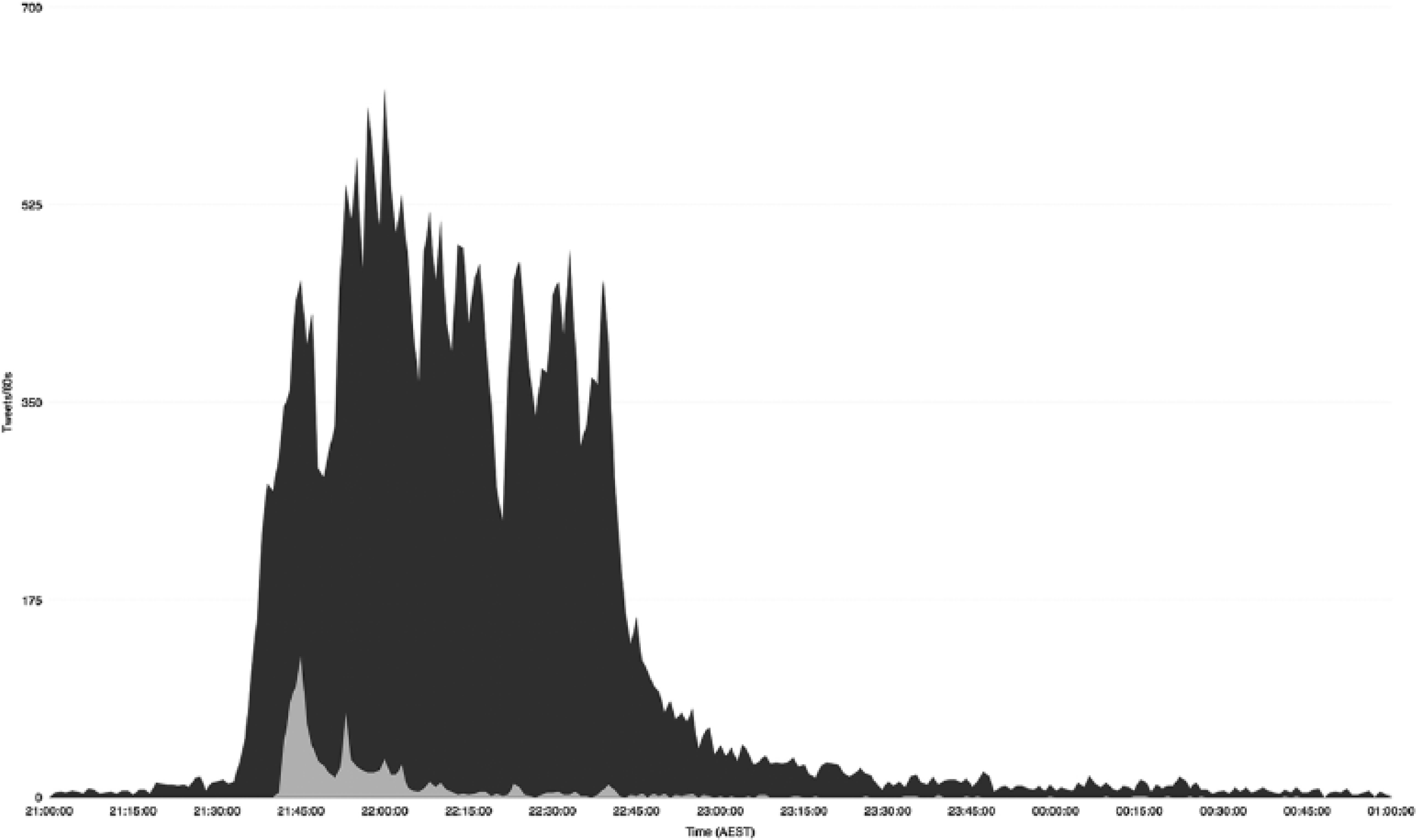
Histogram showing tweet stream density for #QandA between 9:00 p.m. and 1:00 a.m. AEST.
The surplus stream is shown in light gray in Figure 1. In total, 1,257 tweets were extracted from the #QandA stream because they contained the keyword “surplus.” 3 Within this sample, two periods were identified for closer analysis. The first period was from 9:40 to 9:50 p.m. and captured a high density period of tweet publication: this was contemporaneous with the broadcast segment just described. The second was from 10:00 to 10:25 p.m. when far fewer tweets were published.
Analysis: Retweet Rates
As a first step toward assessing the deliberative potential of different Twitter temporalities, manual retweet rates were compared in these two periods. The retweet is a Twitter convention by which users pass on information to their followers, copying the text of a published tweet and appending the “RT @user” syntax to it. It is used sometimes as an indicator of engagement or interest (Chen and Pirolli 2012). 4 In this context, it is argued that retweeting can be viewed as a lower value precursor to proper deliberation, because before retweeting, a user presumably makes a conscious decision that the content of a tweet is worth reposting. This, in turn, implies that the user has read the tweet text. As such, looking for retweets offers an accessible method for establishing—or, indeed, excluding—the possibility of deliberation. If #QandA tweets are published but not read, then more complex deliberative practices involving these tweets are clearly impossible.
The two graphs presented side by side in Figure 2 illustrate retweets as a percentage of total tweets within the high- and low-density streams.
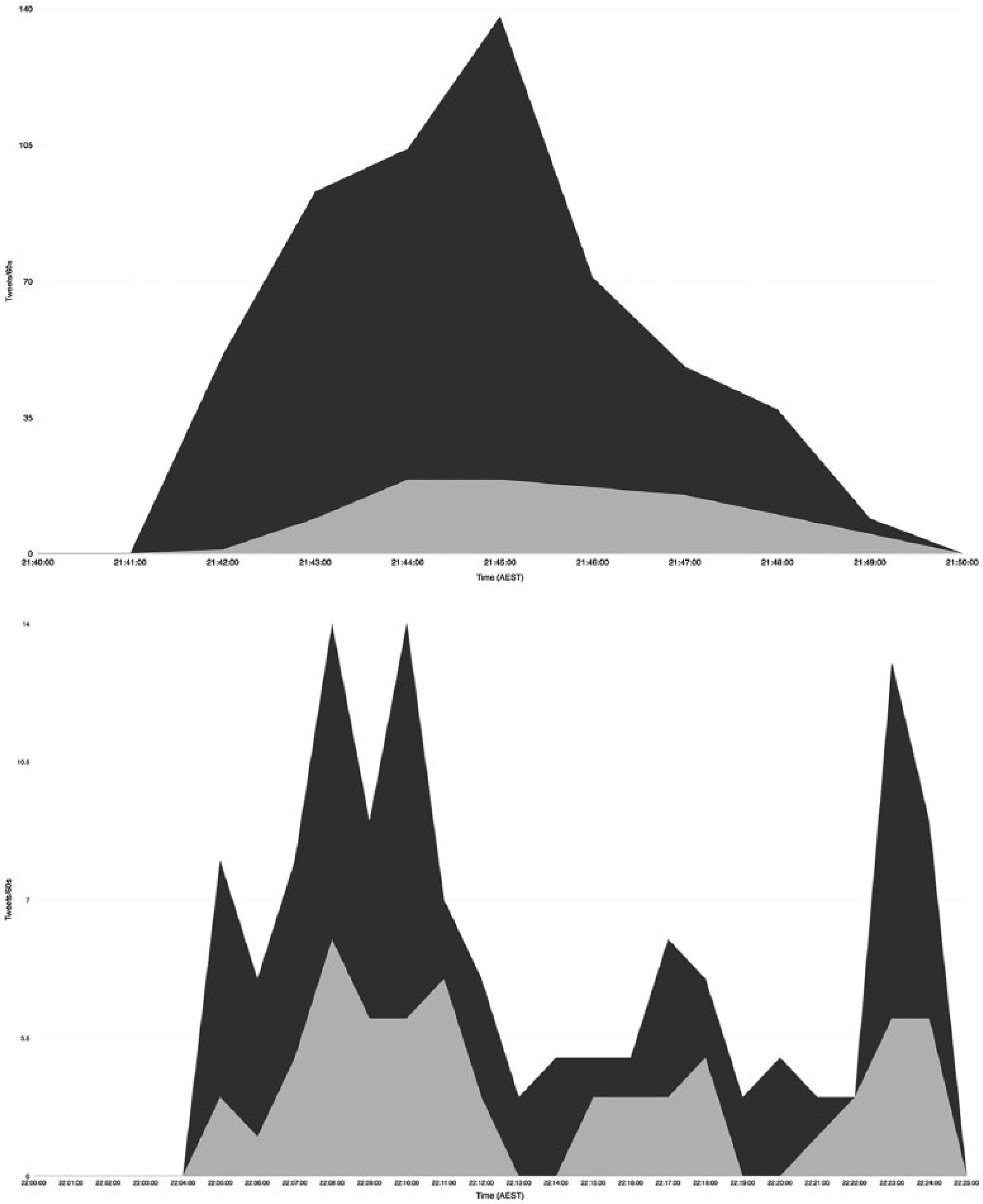
Retweet rates as a percentage of total tweet density for the “surplus” streams in two periods: 9:40 to 9:50 p.m. and 10:00 to 10:25 p.m.
In the first period, 18 percent of all tweets sent were retweets. In the second period, retweets accounted for 41 percent of total tweets sent and tracked stream density far more closely. It is important to note that these samples were not independent. The reason for the dependence is obvious—if a hashtag can be viewed as a conversation, then both samples were part of the same conversation. Seven of thirty-two unique retweets in the low-density sample originated in the high-density sample. There were fifteen different users active in both streams. As the broadcast moved on to other topics, and as the #QandA audience remained “on topic,” new tweets in the surplus stream were more likely to be retweets. Perhaps users identified content in their personal tweet streams and retweeted it. Rather than engagement with the broadcast discourse, then, these retweets may have been part of more complex, layered, Twitter-specific communication practices. What is clear is that, as a measure of deliberative engagement, the retweet is problematic, both insufficiently revealing and also entangled in complex temporal dependencies. A more sensitive and calibrated measure is clearly desirable.
Analysis: Deliberative Content
A random number script was used to select hundred tweets from each surplus sample for close textual reading, with two purposes in mind: to consider the content of tweets against Jacobson’s criteria for communicative action and to determine the extent of point-to-point exchange in the streams. Every tweet was examined for evidence—either explicit or implied—of the four validity claims, using the following interpretation. Does the user
assume his or her comprehension of the surplus debate, in terms of economic and political value?
make a call to empirical knowledge or cultural “truth,” including personal experience, external discourse, or existing tweets? (This includes the practice of retweeting.)
reveal a moral or political position, in relation to the surplus debate, that suggests that the contribution is sincerely made?
use language and form appropriate given the prevailing culture of #QandA?
After an initial reading, it was found to be difficult to determine whether or not a tweet was appropriate given the prevailing culture of #QandA. Plenty of contributions were considered inappropriate for a broadcast context, but this is different from their appropriateness for the hashtag. Assuming a more permissive “hashtag culture,” only a couple of tweets in either sample were deemed potentially inappropriate, either because they were “off topic” or not “clean” (@QandA 2014). Appropriateness seemed ill-suited for differentiating between tweets and too susceptible to the reviewer’s subjective interpretation. In a second reading, when tweets were assigned a coded score based on the validity claims, no score was assigned for the appropriateness criteria.
Tweets were scored zero to three, depending on how many of the validity claims were satisfied. Consider the following tweet text: The Coalition had about $60bn debt when they left office. And only a $10bn surplus. (#qanda)
This tweet contains an implied comprehension of the surplus debate, a call to empirical knowledge (note, under this interpretation of Habermas’ criteria, knowledge need not be “factually correct”), and an informed critique of the Liberal economic record, which implies a sincere position. It would score three.
Alternatively, consider the word surplus has lost all meaning. surplus, suuuurplus slurpus. (#qanda)
This tweet, in many ways, is an insightful critique of the evolution of the surplus debate in the Australian mediasphere. It is a reasoned, insightful, and valuable contribution to a deliberative discussion about the politics of the surplus debate, but it does not fit neatly into the coding metric. There is implied evidence of both comprehension and sincerity, but no call to personal or cultural empirics. It would only score two. A score of three is required to “qualify” as a communicative action tweet.
This comparative analysis found that a high number of tweets qualified as deliberative according to the coding criteria in both the high and low samples (43% and 47%, respectively). It may be fallacious to assign a percentage or proportional value at all—not all utterances in a deliberative conversation need to exhibit all the criteria of communicative action. Rather, participants will make different validity claims across the full range of utterances, evaluating their own positions against those of other participants. It is impressive, then, to discover that quite so many tweets exhibited characteristics suggestive of communicative action.
After this initial coding exercise, the two samples were considered in their entirety for evidence of ideal speech conditions. The aim was to determine whether or not #QandA permits users equal opportunity to contribute, allows users to raise any proposition, and enables full consideration of all of these propositions.
There were no @replies in either sample and there were only a handful of @mentions, all bar one directed to Hockey’s account. There was one retweet across both samples to which the user had appended a comment. In short, there was almost no evidence of point-to-point communication between users, or of communication in which users referenced each other; rather engagement occurred between individual users and the ongoing broadcast discourse, often via the accounts of the two politicians. Even once the broadcast had moved on to other subjects, surplus tweets continued to be directed at Bowen and Hockey. In other words, tweets were predominantly statements users made to position themselves relative to the broadcast discourse. This positioning involved political or moral alignment; it took the form of questions directed at the Q&A participants; and it took the form of fully deliberative contributions to an “imagined” community conducting a debate through the mediasphere. Imagined, here, suggests not that the community did not exist, but that it must have been constructed in the individual consciousness of users (Anderson 1991). In the case of the surplus stream, temporality appeared to have little effect on this practice.
The fact that the temporal comparison does not reveal any difference in deliberative practices suggests one of two possibilities. Perhaps, even at the highest speeds recorded, and the densest flow periods in the stream, Twitter remains able to afford deliberative communication. This interpretation relies on the coding criteria delivering an absolute measure of deliberation—which, of course, is not the case. Coding tweets like this can, at best, indicate relative differences in deliberative practices. It may be possible to say that neither stream is more deliberative than the other, but it is not possible to claim unambiguously that both streams are deliberative. The reason for this is that “true” normative deliberation may not occur in either stream and that, rather than being impressively high, a deliberative percentage in the mid-forties is actually a disappointingly low score. Without a comprehensive historical record of Twitter conversations coded in this way, an attempted calibration of the coding method will be speculative at best.
Care is necessary when interpreting and applying major assumptions from normative communication theory. For instance, the close reading of these samples suggests that it may be problematic to conceptualize #QandA as a “conversation” or a “forum for exchange” as required by normative models. #QandA would seem to be the archetypal hashtag-based “long-standing community of Twitter users” (Bruns and Moe 2014, 18), but there was very little evidence of micro-level conversation attached to the hashtag that might have indicated genuine user-to-user deliberative engagement.
In addition, the analysis suggests that it may be difficult for Twitter to support ideal speech conditions. Although there was little evidence that the 140-character limit restricted the propositions that users made, it is hard to conclude that Twitter enabled a full and equal consideration of these propositions. Indeed, the technicity of Twitter arguably works against full and equal consideration: some tweets are implicitly more visible than others because of large follower networks, “verified” user accounts, algorithmic sorting, and paid-for promotion. There is some evidence of user–user engagement, mostly in the form of retweets, and this practice appeared to respond to temporality. Perhaps, at higher stream densities, a full and equal consideration of propositions becomes more difficult: there are simply too many tweets published too fast to permit it. Drawing conclusions about this relationship is complex and requires further investigation.
As suggested, users seem to have posted their positional statements in response to the broadcast debate, either as an address to the participants in that debate, or as “coherent” epistemological, moral, and political statements. Neither tweet type, however, was published as part of an ongoing deliberative dialogue between users (individual citizens), in which free speech was combined with listening and reflection. In this reading, individual tweets, rather than being deliberative exchange statements, may be better interpreted as contributions to ongoing language wars: that is, the struggle for primacy between different “meanings” in the mediasphere (Lewis 2005). As such, it may be legitimate to claim that Twitter enhances and expands audience participation in the Q&A broadcast, but it is problematic to conflate this participation with engagement in productive deliberative exchange.
It seems likely that Twitter time is simply too fast to afford normative deliberative exchange. That, at least, is one possible explanation for the coding similarities. The “surplus” stream is embedded in the denser #QandA stream. Regardless of the relative fluctuations in topical tweet stream density, the hashtag is still producing incredibly dense information flows. It is quite possible that, under such circumstance, topical discussions are swamped by other flows, precluding any hope of deliberation.
Reflections on the Temporal Method
This analysis suggests that the relationship between temporality, communication practices, and deliberative potential is more complex than previously assumed. It raises questions too about the suitability of using hashtags to calibrate temporality on Twitter. There is a risk that “temporality” becomes something imposed on Twitter through data selection and processing techniques. As Bruns and Moe (2014) noted, the Twitter platform is more complex than hashtag sampling implies. There are retweets, @replies, and favoriting, not to mention the significant influence that follower networks can have on a tweet’s visibility and longevity. More sophisticated temporal measures could help explore these complexities. It might be more interesting and more productive, for instance, to consider the temporal lag between retweets and an original message. This might be a better indicator of interactive temporality than the stream-density measures used in this analysis. An advantage of the temporal perspective is that it suggests ways like this to “unflatten” the study of Twitter.
It is clear that #QandA is a complex and unusual hashtag. Many Twitter users return to it each week and are committed to established practices for engaging with a rarefied form of political television. It is an audience that already is very engaged politically. Relatively few #QandA tweets are published outside of the live broadcast period. Any attempt to relate #QandA to other “political” hashtag cultures must recognize that, in terms of deliberative potential, it may be very different from the ad hoc publics that form rapidly around other “live” political and social discourses.
Furthermore, the subject matter constructs its own discussion stream. At the time of broadcast, the “surplus obsession” had been hugely prominent in Australian politics for some time—many months. Perhaps, with such a topic, there is little chance of deliberation: positions are entrenched; the economics are complex and difficult to explain; the issue is as much an ideological as an economic one. Rather than responding deliberatively to Bowen and Hockey, many Twitter users were simply restating their established positions. This may explain the intense but short-lived “peak” in the surplus stream compared with flatter and longer distributions observed for other topics.
Selection biases and distortions are an issue with APIs that restrict data access though proprietary filters (Ruths and Pfeffer 2014). In comparing tweet streams, there are myriad confounding factors that complicate analysis. These complications can apply to any empirical study of Internet communication. The logic of hyperlinking has the potential to defy independence, to create confounding relationships between samples regardless of platform, audience, or sampling techniques. The “temporality” of Google search will be driven, in part, by the temporality of Facebook and Twitter and all the different sources that Google indexes. In the case of #QandA, there is a clear confounding factor: the Q&A broadcast itself. In part, the temporality of #QandA is constructed by the temporality of Q&A. Both the temporality and the content of the broadcast influence the temporality of communication on Twitter and the content of the tweets.
Finally, the retweet creates complications for the coding criteria. The act of retweeting was interpreted as an empirical citation, but one cannot assume a default motivation for retweeting, and in many cases, it was unclear how the retweet represented a call to what knowledge. Given the difference in retweeting rates between the two samples, adjusting a coding outcome on the basis of a retweet could influence the outcome of any analysis. If a retweet is not a true indicator for deliberative engagement, then it becomes a clear confounding variable. An exploration of the textual relationship between a tweet and its subsequent retweets could indicate whether or not retweeting is a reliable indicator of deliberative engagement, especially if the retweet text is edited to suggest positioning relative to the initial retweet. While temporally tweets may have been located in the second sample, in terms of a “conversation,” perhaps they are better viewed as “nested” in the first. It becomes legitimate to question how Twitter time should be approached, and indeed whether it can be measured “empirically” using clock-time assumptions. An implicit assumption has been that acceleration is progressive and mono-directional on a linear temporal axis, but perhaps it is far more disjunctive and discordant than this.
Conclusion
What do these observations about the relative temporalities of #QandA and Q&A suggest for social television, audience engagement, and the practice of deliberative democracy? The study began by asking whether Twitter accelerates communication until it is too chaotic for normative deliberative discourse. The relationship is undoubtedly more complex than this. #QandA users published tweets that are considered, informed, and, regardless of temporality, displayed characteristics suggestive of deliberative positioning. It is too simplistic to assume uniform acceleration and disruption. #QandA does not just compress the temporality of Q&A, it stretches it also, allowing users to continue posting positional statements long after the broadcast has moved on to other subjects.
In some respects, the temporality of #QandA is more conducive to deliberative discussion than the broadcast temporality. Q&A imposes a rigid clock-based rhythm on discussion. This analysis suggests that the temporality of Q&A may encourage prepared answers, place an emphasis on sound bites and slogans, and actually reduce the potential for deliberative communication. Communicative action requires time, but as this analysis shows, that “time” is both subject- and context-specific. To reduce all discourses to two-minute exchanges is to challenge the temporal complexity of deliberative engagement.
In terms of #QandA and hashtags more generally, there may be a temporal threshold (a stream density) above which user–user exchange becomes difficult, and “discussion” must take the form of positional contributions to an imagined mediasphere. That threshold is likely to be very low. Not many tweets need to be published each minute before user–user exchange is problematic and responses cannot be deliberative. #QandA appears to be well above this threshold: many hundreds of tweets are published each minute. Once this happens, the Twitter audience must operate various filtering mechanisms, excluding the vast majority of published tweets; some will be asserted by the user, others dictated by the technicity of Twitter code and platform design. These mechanisms are extremely complex and may introduce prejudices, reproduce biases, replicate power structures, and politicize the “language wars” that already compromise deliberative engagement in the mediasphere. Furthermore, they suggest that there is a difference between reception, participation, and deliberative engagement, and that further investigation is required to better understand the structures, logics, and practices of digital meaning making.
Footnotes
Declaration of Conflicting Interests
The author(s) declared no potential conflicts of interest with respect to the research, authorship, and/or publication of this article.
Funding
The author(s) received no financial support for the research, authorship, and/or publication of this article.