







Abstract
This essay examines the depiction of labor in the Netflix series Orange Is the New Black, paying specific attention to gender and race. It argues that the program’s interest in the historical link between coerced prison labor and enslavement in the United States, as well as the more recent implication of prison privatization in the neoliberal assault on labor rights, is undermined by its privileging of affective and interpersonal dynamics over political solidarity.
Keywords
A memorable subplot revolving around labor and pleasure emerges in season 1 of the Netflix hit series Orange Is the New Black (OITNB; Netflix, 2013–2015), set in the fictional Litchfield Correctional Facility for women. “Imaginary Enemies” (S1 E4) traces the circulation of a contraband screwdriver, a tool normally locked up behind bars in the electrical shop where Piper Chapman, the series protagonist, has been assigned to work. White, privileged, and educated at Smith College, Piper initially resists her work assignment, requesting a job in the education program, which has been discontinued. Later, it becomes clear that the program, along with a number of other activities related to recreation or rehabilitation, has succumbed to the financial machinations of Natalie Figueroa, the corrupt Assistant Warden who is siphoning off funds to support the ambitions of her politician husband.
The freely circulating screwdriver, potentially a weapon, poses multiple threats: if caught with it, an inmate would be sent to the infamous Solitary Housing Unit (the SHU) and have her sentence extended. Hidden from corrections officers in a soup pot and later under Piper’s mattress, the screwdriver is discovered by Litchfield’s resident butch, Carrie “Big Boo” Black. In her hands the screwdriver performs its best work, not as a weapon or tool but as a sex toy (Figure 1).
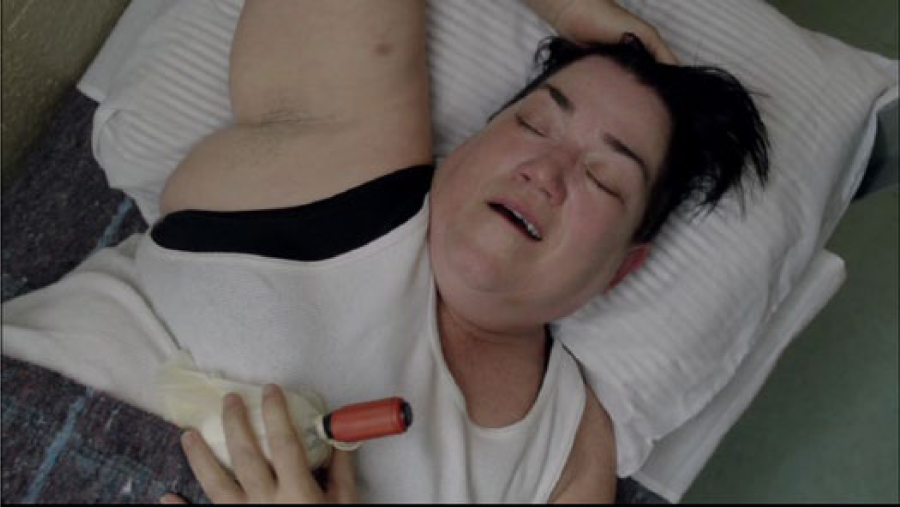
Boo (Lea DeLaria) repurposes the contraband screwdriver in season 1 of Orange Is the New Black.
Hygienically encased in a rubber glove, the screwdriver becomes a makeshift dildo, transformed from an emblem of manual labor and, arguably, masculine craftsmanship into a lesbian phallus, a queer fetish, anathema to both productive and reproductive labor. Possibly emphasizing the fact that most incarcerated women in the United States are imprisoned for nonviolent offenses or, perhaps, playing against stereotype, Boo eroticizes the master’s tool rather than turning it against the master’s house, or, for that matter, against another woman. 1
The saga of the voluptuously repurposed screwdriver, with its latent violence and its conflation of labor and sexuality, is far from over. In “Can’t Fix Crazy” (S1 E13), Boo returns the object to Piper, wrapped as a Christmas present, because the latter is being menaced by Tiffany Doggett (also known as Pennsatucky) and may need to protect herself. Two seasons later, in “Trust No Bitch” (S3 E13), the tool is finally confiscated by prison authorities during a search of Stella Carlin’s bunk on the eve of her release. Piper has planted the tool along with various other contraband items, thereby consigning Stella to an extended sentence in maximum security. The vicious act is retaliation for Stella’s theft of money from Piper’s profitable used panty empire, Felonious Spunk, and it serves as a warning to anyone who might challenge the latter’s hard won gangster authority. As Boo observes when Stella is led away, “That is some stone cold shit.” Never used as a physical weapon or as a carpenter’s tool, the screwdriver’s deconstructive work has, apparently, been done.
The migration of the screwdriver from workshop to honey pot and finally into Stella’s bunk exemplifies the ambivalent sensibility that pervades the political discourse of OITNB, and, more specifically, the program’s attitude toward labor. The screwdriver is first introduced within a context, that of the electrical shop, which is politicized through its association with coerced labor and racism (more on this below). Over three seasons, the screwdriver’s political potential decays, however; it ultimately serves individual pleasure (Boo) and power (Piper) rather than functioning as a tool of resistance. The elision of collective struggle—which the program treats in a sentimental fashion in the scenes of the Christmas pageant and makeshift mikvah that conclude seasons 1 and 3—in favor of emphasizing the plight of individuals exposes one way in which OITNB is complicit with postfeminist televisual culture, with its “preference for individual agency, and its disengagement from issues of structure and collective action” (Vered and Humphreys 2014, 159). These season finales fail to recoup the fractured sensibility of the preceding seasons, which are atomized through the show’s much vaunted flashback structure detailing individual prisoners’ backstories.
OITNB purports to mount a critique of the U.S. War on Drugs, its rhetoric around crime, punishment, and rehabilitation, and its impact on women by adopting the varied perspectives of incarcerated women across racial, gender, class, and sexual spectrums; yet it consistently undercuts its own critique by focusing on individual needs and affective ties over group solidarity against structural conditions. In this issue, Anne Schwan (2016) describes the show’s “subtle critique of (female) mass incarceration,” as shaping an “uneven and contradictory agenda”; those contradictions extend to the program’s treatment of labor. The errant screwdriver’s multiple repurposing might have focused on the failure of the U.S. prison industry to design an appropriate program of rehabilitation for women inmates, for example, but the narrative instead foregrounds the way Boo and especially Piper personalize the tool as a token of phallic dominance.
This article examines the failed potential of the program’s critique of prison labor by analyzing specific episodes and subplots in seasons 2 and 3 that relate to prison labor, including the Mock Job Fair, Vee’s empire, the takeover by Management and Corrections Corporation (MCC), a private prison management company), and the Felonious Spunk enterprise, all of which personalize and indeed feminize labor conflicts. This analysis resonates with conclusions drawn by others writing on OITNB: Lauren DeCarvalho and Nicole B. Cox (2016) argue that, whereas “the series has the potential to mobilize social awareness and activist sensibilities amongst its target audience,” its promotional activities and marketing tie-ins, aimed at keeping fan interest from flagging during the long hiatus between seasons, “emphasize stereotypes that the program itself problematizes”. As this article demonstrates, the show’s story lines and promotional activities create the contradictory agenda that DeCarvalho, Cox, and Schwan identify.
The screwdriver subplot feeds into the program’s motif of circulation, wherein objects and people are repurposed and recycled rather than released. During the first three seasons, Taystee (Tasha Jefferson), Vee (Yvonne Parker), Piper, Alex Vause, and Lorna Morello all engineer various forms of release, only to end up back at Litchfield. This motif confirms the “standing still is hard” lyric from Regina Spektor’s theme song and contributes to what Kathleen McHugh (2015, 20–21) calls the show’s “reversible semantic flow,” which “emphasizes seriality without direction or progress, a fitting structure for its prison setting.”.
Inside Litchfield, the women circulate as well, routinely obtaining new roommates or work assignments: Red, who is exiled from the kitchen in season 1 returns in season 3, a Pyrrhic victory, as she subsequently learns that MCC has outsourced meal preparation. Even Figueroa, who has been forced to resign as a result of her embezzlement, returns to the prison ecosystem in season 3 through an unexpected sexual affair with her former subordinate Joe Caputo.
These flows, while linked to seriality through televisual form, more often read instead as cycle, impasse, and dead end: a recursive game whose levels include only minimum and maximum security. The show’s reiterative structure suggests the implausibility of moving up from, out of, or beyond the social and spatial enclosures where characters, in their backstory sequences, inevitably find themselves faced with bad choices. In short, the American dream of mobility is firmly questioned through the program’s formal systems.
The series tagline that “every sentence is a story” is elaborated through flashback scenes that follow individual characters through an array of noncarceral spaces, their mobility always existing in the past. Lili Loofbourow (2015) characterizes this approach as “promiscuous protagonism” whose “egalitarian affect” narrates “the story of American decline. Everyone, regardless of race, class, gender or sexual orientation, is on this sinking ship together. We’re just sinking at different rates.”
The different rates at which characters sink are not accidental, however; they depend upon access to capital. The show’s writers are fully cognizant of the questionable status of the American dream under postindustrial neoliberalism: on OITNB, no amount, or kind, of labor, legitimate or illegitimate, moves characters out of cycles of poverty and disenfranchisement. (Even Figueroa’s blow job fails to sway Caputo). Only capital enables mobility: Figueroa, the paragon of liberal feminist aspirations for paid employment, succeeds to the extent that she rises with her husband’s fortunes (in a savage send-up of her feminist pretensions) because she uses her privileged perch to expropriate funds. Thus, although it is potentially egalitarian in affect, as Loofbourow has it, the program founders on its inability to detach affective expression from political struggles. When MCC scion Danny Pearson quits his job in frustration at the inhumane policies being enacted at the prison, his righteous anger may occupy the same register as that of Sophia Burset, the transgender inmate locked up in the SHU after transphobic attacks against her, but their unequal access to power (Pearson’s father is a company VP) and the vastly different consequences of their defiance are too easily erased.
Prison Labor, Race, and Neoliberal Economics
The depiction of inmate and corrections officer labor at Litchfield as integral to the prison’s functioning yet only incidentally valuable and easily replaced reflects the realities of the prison economy across the United States and makes explicit the ways in which prison labor regimes have come to define neoliberal labor relations more generally. From season 1, which introduces the inmate work that sustains the prison (laundry, kitchen, and commissary) to season 3, when Litchfield grapples with privatization, OITNB keenly observes the leading role that prisons play in the dynamics of twenty-first-century capitalism, yet ultimately displaces its potent critique onto personal conflicts that erupt between Vee and Red, or Piper and Flaca (Marisol Gonzalez).
In the United States, inmate labor is now clearly recognized as an engine for capital accumulation (Pollock 2005, 132) and prison privatization has become “a domestic ‘face’ of globalization” (Aman and Greenhouse 2014, 361). As Genevieve LeBaron (2012, 345) puts it, “the state has again opened its prisons to industry as part of a strategy to coercively impose the forms of labor discipline necessary to the neoliberal order.” OITNB spends a good deal of narrative time in seasons 2 and 3 linking Litchfield labor practices to broader U.S. trends. Major story strands include the Mock Job Fair, MCC privatization, the introduction of the Whispers lingerie sweatshop, and Piper’s dirty panty start-up.
OITNB centralizes the work experiences of white middle-class characters—not only Piper but also Red and corrections officers such as Bennett, Bell, Healy, and O’Neill—then attempts to complicate those frameworks by offering the perspectives of inmates such as Vee, Gloria, Taystee, and Flaca, whose backstories are marked by personal aspiration thwarted by social exclusion and domestic abuse. Vee is a drug dealer who conflates clan and commerce, whereas Sophia engages in credit card fraud to finance her gender transition. Taystee, who vainly aspires to a normative family and career, makes a valiant but unsuccessful attempt to avoid the drug trade by working for a fast food restaurant.
The show has been praised for its representation of racial, sexual, class, and gender diversity (Jones 2014) and also critiqued as “a lovingly crafted monument to White Girl Problems” (Gay 2013). It is fair to say that OITNB offers far greater racial and sexual diversity than most U.S. television programs. The added heft accorded to white and middle-class characters’ perspectives may be aimed at Netflix’s target audience. Market researchers have reported that “OTT” Netflix users (“Over The Top” subscribers viewing Netflix streaming content on televisions) are predominantly white, “upscale” homeowners (Harvey and Petrilli 2014b).
Jenji Kohan has made clear her intention that the program would move beyond Piper’s centrality to illuminate the stories of diverse women, going so far as to call Piper a “Trojan Horse” in a 2013 interview for NPR’s “Fresh Air.” Yet OITNB is premised upon the legibility of Piper’s educational and labor market history, which casts the experiences of nonwhite and non-middle-class characters as exotic. Piper’s arrest for carrying money for a drug dealer is linked not to adversity, but instead to privilege, as she slums as a waitress after college before becoming involved with drug maven Alex (mirroring the Piper Kerman memoir on which the show is based). Piper’s work history prior to Litchfield involves a day job in public relations and PoPi, a handmade soap business she starts up with her friend Polly, a paean to their Brooklyn lifestyle and rejection of mass consumer products.
The program’s foray into the world of prison labor begins in season 1 with Piper’s ineffectual resistance to her assignment in the electrical shop. The program accurately depicts the extent to which inmate labor is devoted to the support of the prisons in the form of kitchen, laundry, and commissary work. These workspaces at Litchfield are racially segregated and governed by dynamics of patronage and alliance. The kitchen is staffed by white women under Red’s leadership until she is replaced by Gloria Mendoza, who brings in her Latina cohort. The laundry is populated by white women, including Doggett and Alex. In season 2, Vee assembles her African American group strategically in maintenance to reestablish her drug empire inside the prison.
Although these scenarios may enhance the show’s ability to explore racial conflict, they also, perhaps unwittingly, reflect the racial and gender dynamics of inmate labor historically. In the early days of penitentiaries, women of color were housed in men’s prisons in attics or storehouses, which became unmonitored sites of violence and sexual abuse. Poor white and working-class women were screened out of penitentiaries and channeled into reformatories, where they were subjected to regimes of moral rehabilitation. Historian Nicole Hahn Rafter (1990) argues that this system of segregation was sustained by the ideology of true womanhood. Because women of color were considered incapable of domestic femininity, they were deemed ineligible for programs aimed at improvement. In penitentiaries, they performed manual labor, whereas in reformatories the white women were taught to sew and cook. Litchfield’s labor schemes both reiterate and resist this history. The African American women work maintenance under Vee, but Taystee and Poussey Washington are assigned library duty, and their vociferous love of books foregrounds their intellectual abilities.
Caputo calls attention to the labor performed by inmates that sustains the prison ecosystem in season 3 as he ushers the representatives of MCC through Litchfield, hoping they will agree to manage the prison so that it will not have to close down. Scholars of prison history refer to this as “traditional” prison labor or traditional industries (TIs), to distinguish it from the Federal Prison Industries (now UNICOR) and the Prison Industry Enhancement Certificate Program (PIECP). The former is a government agency established during the New Deal that became self-supporting in 1988; UNICOR operates industries selling goods and services to government agencies (the classic example being license plates) and employed 12,500 people at sixty-two prisons in 2014 (“UNICOR Annual Report” 2014). By contrast, the PIECP, “factories behind fences,” was established in 1979 and applies to approximately 6,500 inmates per year; PIE provides inmate laborers to private corporations, which must pay the prevailing local wage, from which board and victim reparations are deducted. OITNB models this program with Whispers in season 3. In a comparison of the programs, Aman and Greenhouse (2014, 384) report that inmate wages as a share of revenues for UNICOR amount to 6 percent as opposed to 40 percent in PIE. Economist Robynn Cox (2010, 30) finds that PIE experience may improve labor market outcomes because it serves as a “signal to freeworld employers of those inmates who have the skills necessary to be good workers.”
Piper’s wrinkle-nosed aversion to her TI assignment in the electrical shop is trumped by the pointed political critique offered by Janae Watson, an African American inmate who will ultimately serve time in SHU for the screwdriver incident. Told that the electrical job detail pays eleven cents an hour, Watson cites the larger historical context, telling the supervisor, “I ain’t picking cotton” (S1 E4).
As Watson’s remark suggests, prison labor schemes cannot be isolated from the labor theft under the institution of slavery in the United States. Coerced labor characterized the British workhouse system that persisted in America until the enactment of Social Security in the 1930s. That model also underlay the penitentiary system that emerged in the early nineteenth century. Long before the Thirteenth Amendment (1865) established that slavery and involuntary servitude were unconstitutional except in cases of convicted criminals, penitentiary inmates—men and women alike—were leased out for work on railroads, in quarries, cotton fields, and lumber camps. Labor historians Steve Fraser and Joshua Freeman (2012) write that
penal servitude now strikes us as a barbaric throwback to some long-lost moment that preceded the industrial revolution . . . but in that, we’re wrong. From its first appearance in this country, it has been associated with modern capitalist industry and large-scale agriculture.
In the Jim Crow South, spurious pretexts for arrest, particularly of blacks and poor whites, kept prisons well supplied. Established on former plantations, prison farms relied on formerly enslaved people for agricultural labor, and picking cotton was the primary mode of prison labor in Texas until the 1970s (Kovensky 2014). As of 2005, 298 prison farm facilities employed 31,000 inmates in Texas, Georgia, Florida, Oklahoma, Ohio, South Carolina, and Mississippi.
OITNB riffs on the historical connection between plantation and prison in season 3 when Red and her coterie of older women plant a garden, which improbably results in gourmet meals for a small number of lucky inmates. Here, the subject of plantation labor is potentially politicized—with Cindy clamoring for reparations and claiming slavery is the reason the African American inmates have raided Red’s garden and eaten the corn. Critique is redirected, however, as Taystee seeks to make peace and offers Poussey’s stash of hooch, along with their services as waitstaff at Red’s next gourmet dinner, as compensation. The practice of coerced agricultural labor—reframed by U.S. prisons and by OITNB as a voluntary hobby—here acquires the patina of the luxury economy. Prisons have in fact recast the contemporary plantation as a “Farm to Table” enterprise capable of improving inmate health and prison bottom lines, capitalizing on fads for permaculture, organic farming, and community gardening. One such scheme was piloted in San Diego’s Richard Donovan Correctional Facility in 2014 (Campbell 2014).
Rehabilitation as Fashion Sense
Whereas Watson characterizes work details as captive labor, Litchfield animates an empty rhetoric of rehabilitation with postfeminist platitudes in the Mock Job Fair Episode (“Looks Blue, Tastes Red,” S2 E2). This narrative, which revolves around fierce competitors Taystee and Flaca, highlights the emptiness of claims about activities and programs intended to promote job market preparedness. A 2014 article in Fortune cites Piper Kerman’s assertion that employment is the most significant challenge for those returning to society from prison, a group she estimates at 700,000 annually (Muse 2014). Gender plays a key role in rehabilitation, as vocational and educational programs in American prisons, like the electrical shop at Litchfield, were designed for men and are largely ineffective for women inmates. The courts have held that prison officials must provide equality for male and female offenders, but Barbara Bloom (2015) has called for “gender-responsive” strategies, arguing that equal treatment should not mean identical treatment. It is highly unlikely that the real-world counterparts of characters like Watson, Chapman, or Nicky Nichols will acquire skills that will help them reenter the labor force upon their release, particularly in a male-dominated trade such as carpentry, which requires an apprenticeship and licensure. In 2013, just 1.4 percent of carpenters in the United States were women, which suggests that transforming the screwdriver into a dildo might well have been the most productive use of that tool in women’s hands (Lundahl 2013).
The postfeminist rhetoric that equates improved appearance with personal empowerment (see Negra and Tasker 2007) will, in keeping with the program’s political ambivalence, be both challenged and shored up by the Mock Job Fair and the Whispers work detail. On one hand, OITNB uses these subplots to question the glamorous upward mobility featured in woman-centered quality television programs such as The Good Wife, How to Get Away with Murder, Damages, The Closer, Grey’s Anatomy, The Big C, Mad Men, and The L Word, programs in which, no matter what the narrative challenge, women remain impeccably coiffed and clad in designer apparel. On the other, the subplots reinforce an obsession with women’s appearance as a source of self-worth, for example, with Piper stealing and wearing a Whispers panty to feel pretty.
The Mock Job Fair episode (S2 E2) satirizes the nonprofit organization Dress for Success, whose activities combine liberal feminist beliefs in the self-actualization of gainful employment with a postfeminist emphasis on hair and wardrobe. On the show, the organization provides merely the signs of professionalism rather than the skills required for a career. When inmates confront racks of donated clothing, Sophia dons sequined glamour whereas Taystee cannily chooses the outfit that won the previous year, confirming her strategic skills and commenting on the currency of the styles on offer. Taystee is a true believer in the reform orientation of the job fair. Whereas Taystee and Flaca both aspire to rewarding work—a common thread reiterated by their backstory episodes—Flaca is skeptical, asking “If this is about career dressing for us, shouldn’t this be McDonald’s and maids’ uniforms?” Assembled on stage, the inmates are openly ridiculed for their fashion choices, in the mode of “What Not to Wear,” although some outfits were prompted by the Dress for Success expert herself.
Taystee’s careful preparation extends beyond merely dressing for success: she reads a book on interview skills and researches Philip Morris, so that she is able to praise the company for weathering adversity during the mock interview, whereas Flaca attempts to fall back on her charm. Taystee wins the competition, but Figueroa angrily rebuffs her when she inquires about her prize. In the next shot, Taystee’s surrogate mother and former employer Vee appears. The juxtaposition of Fig and Vee is a study in contrasting models of toxic female agency—nothing new in contemporary TV, from reality (The Real Housewives of . . .) to drama (Game of Thrones) to comedy (Brooklyn Nine-Nine’s Madeleine Wunch). In this case, both women wield near-absolute power in their respective settings, and both are also associated with improper mothering. Fig denounces the inmates for what she perceives as their childlike demands on her and Vee consolidates her tobacco and drug empire inside and outside the prison by recruiting orphaned children as her lieutenants.
The Mock Job Fair episode criticizes the expectations of prison outsiders that appropriate clothing can change the employability of the inmates. As scholar Lynn Haney (2010, 76) argues, self-help programs in prison “downplay the power imbalances among women while promising to provide poor women with the autonomy and confidence they are so often denied.” Thus, it is deeply ironic that Netflix and OITNB partnered with Dress for Success on a promotion involving the membership-only web retailer Gilt.com. During a two-week period in June 2014, each apparel purchase from the site’s “chic-office appropriate workwear” line was matched by a donated (but unspecified) item to Dress for Success (Childs 2014). Joi Gordon, the CEO of Dress for Success, used the type of magical thinking that the Mock Job Fair episode ridicules to characterize the effect of apparel on women inmates: “Once they step into these outfits, they are able to reconcile their past transgressions and focus on their future successes” (Young-Saver 2014). Visually, Gilt’s promotional materials reference the shame-based staging of inmate fashion in the Mock Job Fair episode, with an implicit before and after comparison using performers from the show. This startling collaboration suggests the contradictions that inform the approach of both Netflix and OITNB to women, work, and self-improvement through style because it hints that designer togs can serve as a panacea for the social inequities the program duly exposes. It speaks to the way the titular fashion metaphor of OITNB continues to shape its discourse in profound ways (Pramaggiore 2015). Finally, this relationship also reflects the TV universe in which Netflix and OITNB are situated, with the rise of the semi-ironic embrace of product placement, or “sponsortunities” in Stephen Colbert’s terms. Emily Nussbaum (2015b) links this duplicitous relationship to advertising to the chaos of contemporary television’s business model—a chaos to which Netflix has contributed.
Perversity and Privatization
In season 3, Litchfield undergoes privatization on several counts: first, through the management takeover by MCC, “a data-driven corporation of Amazonian proportions” (Nussbaum 2015a). The second inroad occurs with the introduction of Whispers, a women’s underwear company that throws the prison economy into disarray because it pays a dollar an hour, nearly ten times what the other jobs pay. Moreover, the Whispers workforce selection process exacts a psychological toll on the women, as the inmates are subjected to an irrelevant “personality” test downloaded from the Internet. Regardless of their answers—or their suitability for the assignment—inmates are randomly chosen for the work detail. Maureen Henderson (2015) characterizes the scenario: “Work is about the powerful taking advantage of the powerless often by convincing the powerless that they’re the ones benefitting most from the situation.”
The advent of MCC and Whispers makes clear that prison labor, though historically connected to slavery, must also be understood within the context of the neoliberal drive toward marketization, its rollback of rights and protections, and the rise in worker precarity that have resulted from government policy decisions and from the decline of labor unions. Currently, thirty-eight states in the United States allow companies such as IBM, Starbucks, Revlon, Boeing, McDonald’s, Walmart, American Airlines, Avis, and Microsoft to set up shop in prisons (Pelaez 2014). These names will come as no surprise to viewers of OITNB, for when word spreads that a new job detail is coming to Litchfield in season 3, Flaca speculates about whether they will be working for a call center. The example is no accident: Best Western operated a call center from a women’s prison in Arizona (Aman and Greenhouse 2014, 389). Under these contracts, workers are not provided with benefits, and their wages are garnished by the state to pay for maintenance costs (Lafer 1999). Anita Sinha (2013), an American University professor who works with parolees, writes,
Prison labor is being used today to put companies at a comparative advantage vis-à-vis those that rely on the regular labor market. Moreover, taxpayers are subsidizing prison companies for “employing” prisoners, because companies that pay inmates for their work can get up to 40 percent back in tax reimbursements. Prison labor today, therefore, is part of why penitentiaries yield a multi-billion dollar profit.
As Aman and Greenhouse argue, neoliberal globalization has repositioned government entities, including prisons, as competitors within international markets for goods and for labor, justifying the adoption of cost-saving and profit-motivated financial models. Whispers, in other words, could be justified as a step toward reestablishing American economic competitiveness. LeBaron (2012, 342) goes so far as to argue,
Whereas in the postwar years, the American state managed the tensions and insecurities generated by capitalism through a combination of macroeconomic and social policies, in the neoliberal era, the penal state has emerged as the preferred response.
Litchfield’s privatization drives do elicit pushback, but the resistance has questionable efficacy. First is the growing radicalization of the corrections officers, whose hours are cut and benefits eliminated at the same time that new, inexperienced, and poorly trained, part-time staff members swell their ranks.
The second response to privatization takes the form of Piper’s opportunistic establishment of the cottage industry, Felonious Spunk, which purveys panties worn by Litchfield inmates on the Internet. In keeping with the show’s awareness of historical labor inequities, it is Cindy who actually comes up with the idea: “dudes would be into polyester grannies if they knew they came from a bunch of biz-natches behind bars.” Piper recognizes that the Whispers patterns waste enough fabric to make additional panties, to her profit. After learning that Piper is making a killing selling the garments for upward of eighty dollars each, her employees, led by Flaca, rebel. Upon Red’s advice, Piper begins paying them in something other than ramen flavor packets but she fires Flaca for her role in worker agitation. Piper’s apotheosis as a take-no-prisoners gangster—a singular figure of hierarchical power—arrives with her retaliation against Stella.
The conflicts between labor and MCC management are drawn astutely to capture both worker precarity and the intensively interpersonal dynamics associated with the neoliberal agenda. The corrections officers, seeking to reunionize, ultimately turn to Caputo for help, but he is later bought off with a promotion. His status as a good guy who takes care of others hangs in the balance at the end of season 3.
OITNB intends to critique Piper’s Michael Corleone-like rise in season 3, when her ruthless business dealings alienate her from her friends, lovers, and allies, but the terms of that critique are individual and personal, based on concepts of betrayal, disloyalty, revenge, and paranoia. Piper, more than the system, emerges as the monster; her rise parallels that of Vee in season 2. Piper attempts the capitalist mode, maintaining her distance from her workers, offering incentives, and reluctantly agreeing to increased compensation. Threats and punishment are reserved for the truly disruptive and Piper becomes emotionally involved only in extreme cases (Flaca and Stella). Vee, by contrast, hews to a feudal model of fealty, relying upon emotional bonds, physical violence, and the promise of racial solidarity. Vee’s leadership, with its maternal overtones, comes close to reiterating the troubling mythology of the black matriarch, later recast as Ronald Reagan’s Welfare Queen, which has obsessed American conservatives since the Moynihan Report was published in 1965.
During the workplace disruptions in season 3—and particularly the threat to the well-being of the staff—affective ties are posed as paramount. The corrections officer stalwarts Bell, O’Neill, Ford, and Donaldson are more than disgruntled when their benefits are cut. Led by Ford, however, they appear satisfied that Caputo will look out for their interests because he is willing to tell them that he loves them. Similarly, Piper initially hatches her plan for Felonious Spunk with Alex, drawing on the latter’s drug dealing expertise, and grows closer to Stella, sharing details of the operation with her, as the business takes off. Her firing of Flaca becomes personal, as does her retaliation against Stella.
OITNB critiques the status quo by revealing that prison labor of all types has little to do with rehabilitation or job opportunities, but instead is directed toward goals of profit making and labor discipline. This supports research finding that prison labor does not increase the value of the laborer upon release (Pew Center on the States 2011). The program may accurately characterize the employment precarity facing corrections officers and working poor women, and it may make important links between Litchfield’s work details and the historical role of prisons in disciplining the American labor force. Yet it also displaces labor conflict—historically, a site of class solidarity—into the realm of the personal, so that jobs become pretexts for emotional power plays that exacerbate conflict among inmates rather than promoting solidarity against the system that has incarcerated them.
Footnotes
Declaration of Conflicting Interests
The author declared no potential conflicts of interest with respect to the research, authorship, and/or publication of this article.
Funding
The author received no financial support for the research, authorship, and/or publication of this article.