







Abstract
This article argues that the postfeminist gender politics of Friends (NBC, 1994–2004) are played out via a series of manipulations and reversals of space and mise-en-scène. Arguing that clearly gendered domestic space forms a stable part of the sitcom’s equilibrium, it analyses instances where the mise-en-scène boldly calls attention to men’s and women’s spaces, puts the gendering of space into flux, and highlights the burden of domestic labor. It reveals through close textual analysis how space in Friends is used to offer the playful promise of freedom from restrictive gender roles, but ultimately maintains a conservative status quo of both space and gender. It also makes a case for paying close attention to the aesthetics of the traditional sitcom to appreciate the expressivity of production design offered in such texts which, although (deliberately) unspectacular, is by no means unremarkable.
In the episode “The One With The Embryos” (S4 E12), the mise-en-scène of Friends (NBC, 1994–2004) gestures to the complex entanglement of gender roles, domestic spaces, and expressive use of studio space in the series. This episode sees Monica (Courteney Cox) and Rachel (Jennifer Aniston) lose their (larger, nicer) apartment to Joey (Matt LeBlanc) and Chandler (Matthew Perry) when a $10 bet escalates into a game of knowledge, compered by Ross (David Schwimmer). As part of Ross’s quiz, Joey and Chandler are asked how many categories Monica sorts her towels into. Under pressure, they desperately reel off the ones they can remember:
everyday use
fancy
guest
fancy guest
Eventually, Joey guesses “eleven,” which turns out to be the correct answer. Later, as Monica and Rachel pack up their belongings, cardboard boxes can be seen stacked prominently in the background of the master shot of their apartment. Ostensibly, this detail works as a visual shorthand for “moving house,” and shows the disruption to the space. On closer inspection, however, or perhaps a repeat viewing, the attentive viewer might notice what is written on these boxes. Labels such as “old towels,” “beach towels,” “everyday use towels,” “guest towels,” and “kitchen towels” are prominently inked in black caps across the cardboard. This visual punchline creates pleasure for the audience by rewarding our attention to detail, extending the joke of Monica’s excessive attention to domesticity.
This seemingly small detail of mise-en-scène illustrates several interlinked points about the presentation and function of gendered domestic spaces in Friends with which this article is concerned. It provides an obvious and straightforward example of the series calling attention to domestic space and living arrangements through a string of episodes devoted to a gendered turf war over living space. It executes this narrative maneuver through the use of the expressivity of mise-en-scène, demonstrating an attention to detail on the part of the production team, an interest in crafting a visually dense text that will reward its audience on both initial and subsequent viewings. As such, this is design for syndication, repetition, and home distribution. It is also, crucially, an instance where domestic labor and the labor of care is drawn attention to as a gendered concept and made prominent through both dialogue and mise-en-scène. Although Monica’s towel categories are marked as excessive (even obsessive) and thus create humor, it is also the case that the series is interested in exploring the work of domesticity and how that burden is shouldered by women and, in many cases, ignored by men. Here, a small textual detail makes a broader gesture toward Friends’s interest in postfeminist gender roles.
Friends’s status as a postfeminist media text determines the context for its constructions of gender. Elsewhere in this issue, Hannah Hamad (in press) outlines the case for viewing Friends as a “structuring absence from the central canon of the first wave of postfeminist media criticism.” Its original broadcast spans the period from the mid-1990s to the mid-2000s, a time that saw postfeminist discourses intensify and multiply across a range of contemporary media. These texts simultaneously portray the gains of second-wave feminism as a taken-for-granted element of gender relations while rendering feminism itself as both passé and “rigid, serious, anti-sex and romance, difficult and extremist” (Negra 2009, 2).
Postfeminism is a contested term; its meanings are multiple and sometimes contradictory. This article sees Friends as part of the postfeminist cultural sensibility outlined by Rosalind Gill (2007, 148), who describes postfeminism as a “sensibility that characterizes increasing numbers of films, television shows, advertisements and other media products.” Of the seven elements that Gill (2007, 158, 155) outlines as being constitutive of postfeminist discourse, the “resurgence in ideas of natural sexual difference” and the “emphasis on self-surveillance, monitoring and discipline” are of particular interest in the way that Friends articulates ideas of gender. Postfeminist media’s insistence upon a culture of “compulsory heterosexuality” (Rich 1980) and its rendering of singledom as “abject” (Negra 2009, 61) is played with at various times and inflected in various ways across Friends’s ten seasons, as this article will demonstrate. Specifically, work by Diane Negra (2009) and Joanne Hollows (2006) that has explored the complex relationships between postfeminism and “home” will be drawn upon to discuss the way in which Friends articulates gendered concepts of domesticity.
Taking seriously questions of aesthetics in the traditional sitcom, this article interrogates the key diegetic spaces of Friends: what they look like, how they are lived in, and what roles they perform. Specifically, it argues that anxieties and negotiations around domestic space in the postfeminist era, and in particular its relationship to gender, are played out via the mise-en-scène of the Friends “girls’” and “boys’” apartments. 1 The series’ stories of heterosexual coupling are frequently mapped out through spatial reconfiguration and negotiation. This connects to a wider argument about the role of space in the traditional, studio-based sitcom, which I demonstrate functions both as a liberating and containing force upon its characters. I argue that domestic space forms a key part of each episode’s stable “situation,” and is open to the same potential disruption as the narrative situation. In this article, close textual analysis reveals how the negotiations of heterosexual coupling, domestic labor, and homebuilding in the postfeminist era are worked through in the cultural forum of the primetime sitcom, highlighting the televisual specificity of such representations, and the potential for “cumulative meanings acquired by designs or design concepts over the course of the run of a series” (Britton and Barker 2003, 10). Television set designs not only change, develop, and evolve their meanings and aesthetics over time, they also become familiar to the regular viewer. Their familiarity is part of their purpose, to link in important ways to our own conceptions of the domestic sphere as “home”—a place that is familiar, safe, and predictable. A product of fin de siècle postfeminism, the critically acclaimed and (still) enormously popular Friends is of particular interest because of the way in which domestic spaces—and the arrangements for living in them—play such a key role in its playful articulation of performative gender identity and role reversals, and its ultimate conformity to hegemonic norms.
Living Spaces
This article considers the design, representation, and narrative foregrounding of the home within Friends through Raymond Williams’s ([1974] 1989) idea of the room as the most important space of television. The focus of many sitcoms on a relatively small collection of “rooms” represented by studio sets, becoming familiar to audiences through their constant repetition throughout series, underpins my analysis, particularly in the light of Williams’s ([1974] 1989, 12) remark that “the room is there, not as one scenic convention among all the possible others, but because it is an actively shaping environment—the particular structure within which we live.” Friends has much to say about gender relations in the postfeminist era and it frequently articulates this through the many choices made by the production team about the “rooms” that the characters inhabit, rooms which are both “actively shaping environments” and environments that are actively shaped—by characters, directors, and set designers—to articulate representations of contemporary living that resonate with Friends’s huge international audience.
Instructive here is Helen Wheatley’s (2005, 145) work on the costume drama, which encourages us to think of the studio not as “problem or handicap,” but instead to read the “meaningful and expressive uses of studio-based mise-en-scène.” As with the room in Upstairs Downstairs (LWT, 1971–1975), I propose that the sitcom room “asks to be read and understood as a meaningful space, as a space which is more than a neutral backdrop, but which acts as a shaping and defining structure within the dramas in hand” (Wheatley 2005, 146). Mary Beth Haralovich’s (1989) analysis of sitcom set design in early U.S. sitcoms Leave It to Beaver (CBS/ABC, 1957–1963) and Father Knows Best (CBS/NBC, 1954–1960) showed how such an approach can offer significant and detailed insight into the sitcom texts themselves and how they act as part of the contemporary cultural discourse around gender roles. This article adopts her approach, leads it into the urban apartment living of 1990s “homebuilders”—and, ultimately, rejoins her in the suburbs again at the end.
Numerous analyses of sitcom have noted that a fundamental characteristic of the genre is a distinctive episodic narrative structure, whereby the status quo is disrupted, and remains that way until the end of the episode where a “reset” of the original situation is achieved. 2 This article argues that such a pattern also applies to the spaces within sitcom. Although almost every academic analysis of sitcom makes reference to the consistent nature of the genre’s narrative architecture, very few see the need to point to the similar consistency that is offered visually through the production design. Analysis of setting and the aesthetics of the sitcom “situation” have been neglected, but these are just as static as narrative elements. This is particularly true of sitcoms that conform to the traditional three-camera-setup style of shooting, as the same spaces are viewed repeatedly from the same angles on the studio’s fourth-wall. Imbued within this set-up is the potential for much richness of meaning to be carried across through design.
Although there is undoubtedly much to be written about the function of Central Perk coffee shop as a surrogate home for the characters, my focus here will be on the two primary domestic spaces of Friends: apartment number 20, the girls’ apartment; and apartment number 19, the boys’ apartment. Having the doors directly opposite each other across a hallway sets up the potential for conflict and division, a fact that is further emphasized by the differences in size, aspect, and décor between the two spaces. The girls’ apartment is bigger, has a large window with a view and balcony, and is pleasantly decorated and furnished in line with ideals of feminine domesticity, including soft furnishings, chintz patterns, and lamps. 3 In her work exploring the “fantasy of alternative families” in Friends, Jillian Sandell (1998, 144) notes that “Monica and Rachel’s apartment serves as the affective center and shared familial space of the group,” highlighting the role of feminine domestic space in networks of care. The boys’ apartment features white walls, leather and wood furniture, and an assortment of quirky objects and toys, and functions as a space for homosocial masculine leisure.
The spatial set-up of Friends and its two contrasting gendered apartments supports and reinforces hegemonic models of gender. As Sandell (1998, 149) argues, the show endlessly reaffirms: that men and women are fundamentally different, even hip young men and women of the 1990s, and that gender divisions should be respected and maintained. This trope of inverting and then restating gender divisions becomes another form of cognitive dissonance within the show—inverting gender roles to address the constraints men and women in the 1990s face, but pushing these inversions “too far” to reaffirm normative femininity and masculinity.
The focus of my argument here is to demonstrate how frequently the inversions and divisions that Sandell discusses are mapped through domestic space. What follows is analysis of a series of examples where the mise-en-scène boldly calls attention to gendered domesticity. Through this textual analysis Friends’s status as an ambivalent postfeminist text emerges: a text which makes space (literally) for explorations of nontraditional gender roles and inversions of hegemonic models of domestic and family life, but often ultimately endorses traditional hegemonic models of gender.
The Apartment Plot
One of the biggest and most obvious disruptions to the arrangement of domestic space in Friends is the season 4 arc mentioned above, in which the men and women swap apartments. Here an extended, if ultimately temporary, switching of the roommates into alternately gendered spaces is played out and remains this way for eight episodes, a violation of the expected generic convention of the sitcoms’ episodic resetting.
The precredit sequence of “The One With The Embryos” (S4 E12) deftly and humorously introduces the episode’s key thematic concerns through aesthetic foreshadowing. Rather than opening with equilibrium, the episode begins with immediate disruption, both to the expected formal qualities of the series and to the lives of the characters. In most episodes, Friends’s nondiegetic soundtrack is consistently characterized by musical stings that punctate the interstitial exterior shots of the apartment building between scenes. However, this episode begins without music. Instead, the familiar visual—a slow tilt up the exterior of the apartment building—is accompanied by an unfamiliar aural cue—the sound of a rooster crowing. A disgruntled Rachel and Monica trace the sound to Joey and Chandler’s apartment where their “chick” is revealed to be the diegetic source of the noise. This aural departure from the established aesthetic conventions of the series will be notable to regular viewers. In a trope that is repeated numerous times in Friends, and indeed in postfeminist media texts more generally, the domestic lifestyle of male characters causes disruption to female characters; the rooster’s crow is totally out of keeping with the domestic order of urban apartment living.
Following the exterior shot is a slow track across the quiet, dark girls’ apartment that lingers slightly longer than is usual for the show. This disruptive presentation (the room is usually brightly lit and full of actors), slow camera movement, and lingering take ask the viewer to consider this space in and of itself and not just as a backdrop. On subsequent viewings, the message of this early shot becomes clear: it is the apartment that is at stake. The discussion that ensues over the chick, in which Chandler confirms that “the vet seems to think that she’s a rooster,” specifically foreshadows the idea of a gender-swap.
Later in the episode, the women’s struggle to accept the loss of their apartment is, unsurprisingly, drawn along gendered lines. Rachel protests against the move:
This is my apartment and I like it. This is a girls’ apartment, that [points across the hall] is a boys’ apartment. It’s dirty and it smells. This is pretty . . . it’s just so pretty. And it’s purple!
Here there are clear binaries drawn between the two spaces: girls’ versus boys’ spaces; dirty, smelly spaces versus pretty, purple spaces, demonstrating an essentialism in relation to gender and domestic labor and standards. As she speaks this line, Rachel runs across the room and begins to caress the wall of the apartment, a gesture showing her feminine affective connection to the space. Rachel’s protest highlights the transgression of gender norms that is about to be enforced upon her and Monica. The background of this shot is piled high with boxes of Monica’s meticulously categorized towels, discussed in the introduction to this article, a feminized system of domestic harmony disrupted and displaced, and about to be moved into an inappropriate space.
This episode contains further examples of the mise-en-scène of the apartment space being used to speak expressively about narrative events. A particularly notable example comes near the end of the episode, when the apartment switch is in full swing, in a shot featuring Phoebe (Lisa Kudrow) playing guitar in the girls’ apartment (Figure 1). This shot is filmed from an unusual angle, one not frequently seen in Friends. As is common with most studio sitcoms, almost all shots of the girls’ apartment come from cameras located on the “fourth wall” of the apartment, facing into the three-walled studio space. This “three-headed-monster” style of sitcom shooting was established in the 1950s by I Love Lucy (CBS, 1951–1957) and has remained the dominant model of sitcom style ever since (Landay 2010, 28), though some recent sitcoms have moved to a single-camera mode of shooting in an attempt to bring increased prestige and markers of “quality” to the genre. The shot of Phoebe illustrates a precise level of artistry and composition while still working within what Vermeulen and Whitfield (2013, 105) describe as the “inflexible standing sets” of studio-based sitcom. Rather than being filmed from the fourth-wall, the camera here is positioned near the doorway to Monica’s bedroom, looking across the apartment’s main living area toward the front door and kitchen. The unusual angle here presents itself as a disruption to audience expectations, asking us to “look closer” by offering a view of the apartment that we cannot usually access.
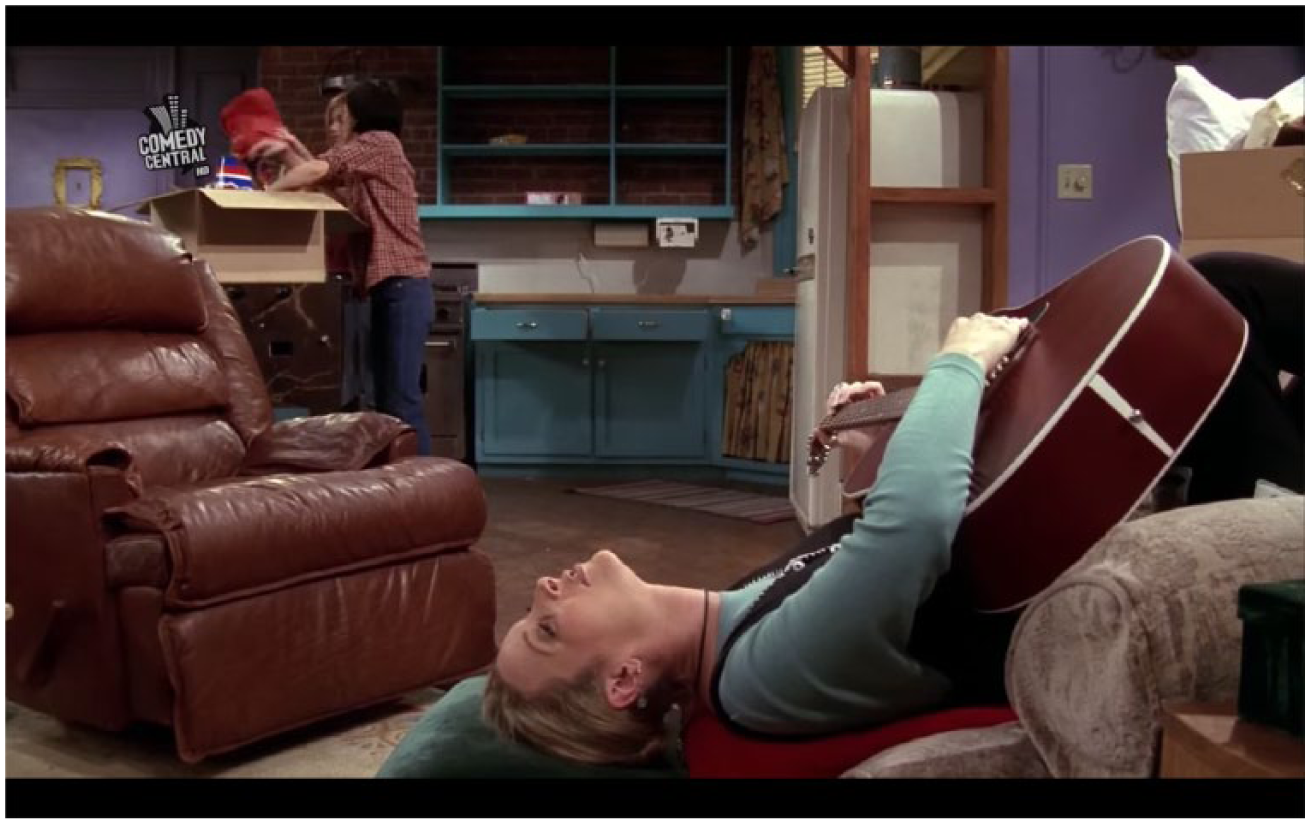
In this shot from “The One With The Embryos,” unusual angles and disturbances in every plane of action demonstrate the profound disruptions that are occurring to domestic space and the gender order.
Within the frame, Phoebe “sits” upside down in the armchair. Her physical inversion here has two functions. Ostensibly, within the episode’s B-plot, she is hanging upside down to encourage the embryos of her brother Frank (Giovanni Ribisi) and sister-in-law Alice (Debra Jo Rupp) with which she has just been inseminated, to implant (we might consider here the thematic mirroring of “switching rooms”!). But Phoebe’s positioning also provides a commentary on the events going on around her; while things are metaphorically being turned “upside down,” she will wait upside down. Also prominently visible at the left-hand side of the frame is one of the men’s brown Barcalounger chairs, which function in the series as a symbol of masculine domestic leisure. This places an object that is familiar to regular viewers into a space that it does not usually belong. In the background of the shot, the apartment walls and shelves of the kitchen have been emptied, meaning that in every plane of action something is “not right.” Everything about this image speaks disruption—the unusual angle, the upside-down actor, the familiar object in the wrong location, the altered backdrop. This episode as a whole, and this shot in particular, shows the significance of the mise-en-scène of domestic space of Friends: as a crucial aspect of the sitcom’s equilibrium, it is highly affective and effective when the show deliberately disrupts this space.
This commentary on the gendering of space is not restricted to the initial switch episode. Subsequent episodes feature plotlines where Monica and Rachel come into conflict with their new space. Although Joey and Chandler have appeared to be quite happy living there for four years, the unsuitability of the boys’ apartment is highlighted repeatedly once the women have moved in. The apartment is infested and smelly, and people do not want to spend time there. Where Monica is shown to struggle the most, however, is not with the living conditions themselves, but with living in a smaller apartment that upsets her usual (gendered) role as hostess. Along with Hannah Hamad (in press) elsewhere in this issue, who discusses her as the epitome of the postfeminist singleton figure, Naomi Rockler (2006, 252) argues that Monica is emblematic of the rhetoric of postfeminism. She suggests that Monica is arguably the most self-absorbed character on the show, and her self-absorption centers around an obsessive desire for domestic bliss. Her apartment is meticulously clean and organized, and the others dare not try to clean it themselves.
Rockler here interprets, perhaps quite reasonably, Monica’s domestic obsessions and fantasies as “self-absorption.” However, in the wider narrative of feminist concerns, I would argue that we could read Monica as a character who has internalized ideals of domesticity as central to women’s roles. Even her job as a chef positions her as a provider and carer. Her relationship to domestic labor is complex—she is shown to take pleasure from its execution and results, but is also anxiously entangled in it, needing to be seen as having managed showplace domesticity, to the point of obsession and exhaustion. Thus, what Rockler reads as self-absorption can also be read as a commentary-through-excess on the pressures of the stereotypically feminine role of homemaker. As if in response to some of the concerns of second-wave feminism, domestic labor here is made visible. It is also made clear by the text that Monica has been socialized into such a role: she boasts that the little girls in her neighborhood always wanted to go to her tea parties (“I served the best air!”); in other episodes she says she has dreamt of becoming a chef since she got her first Easy-Bake oven “and opened Easy Monica’s Bakery” (S3 E21, “The One with a Chick and a Duck”); and when her parents move house her father (Elliott Gould) finds “six or seven Easy-Bake ovens in the attic” (S7 E13, “The One Where Rosita Dies”). Monica’s role exemplifies the tensions of women’s dual burden in the postfeminist era, and shows the complex entanglement of women’s relationship to home and domestic labor. Even her fertility problems are expressed in these terms (“My uterus is an inhospitable environment? I’ve always tried so hard to be a good hostess!” [S9 E22, “The One with the Donor”]).
On one hand, Monica’s attachment to her domestic chores is coded as excessive, outdated, archaic. On the other, Monica’s presentation acknowledges a truth of postfeminist culture rarely given exposure—the labor and effort, both physical and emotional, that go into creating and maintaining the showplace domesticity sold by interiors magazines and lifestyle television. Rockler (2006, 253) also discusses Monica’s attempts to “empower herself through domestic labor” in the episode “The One With The Jam” (S3 E3), where Monica struggles to come to terms with her break-up with Richard (Tom Selleck) and channels her efforts into cooking up huge batches of jam. Rockler’s analysis forms a prescient link to Joanne Hollows’ work on narratives of retreatism and downshifting in postfeminist culture where she observed professional, educated women “having fantasies about giving up their jobs to make jam” (Hollows 2006, 99; see also Negra 2009). Rockler reads Monica’s postfeminist desires as evidence of depoliticization, but her struggle to achieve them draws attention to their impossibility, upholding postfeminist values but also exposing an ideological sleight of hand. Pertinently, Monica’s domestic labor is not just the flower-arranging, jam-making, “perfectionist domestic pursuits” (Negra 2009, 117) that so often form the basis of postfeminist downshifting fantasies, but mundane, dirty chores such as washing up, cleaning floors, and dusting, which connect her to the “abject” “hausfrau” version of domesticity that Negra argues sits in contrast to sensuous postfeminist homemaking (Negra 2009, 132). It is actually relatively rare to see cleaning on television outside of advertisements for cleaning products or lifestyle shows which concentrate on domestic failures such as How Clean Is Your House (Channel 4, 2003–2009). Indeed, Elizabeth Nathanson (2013, 2) notes the emergence of two polarized figures in relation to domesticity in postfeminist television: the woman who is unable to “do” domesticity (e.g., Liz Lemon [Tina Fey] in 30 Rock [NBC, 2006–2013], Carrie Bradshaw [Sarah Jessica Parker] in Sex and the City [HBO, 1998–2004]) versus the woman who only serves this function (e.g., Rachel Ray, Nigella Lawson): the former the comedic heroine of sitcom and the latter the domestic expert of lifestyle television. Although Rachel might fit this archetype of the domestically incompetent postfeminist, through the more nuanced presentation of the character of Monica, Friends occasionally puts this concern at center stage, making visible the unseen burden that most often falls to women. That Monica is shown to gain pleasure (almost orgasmic pleasure 4 ) from maintaining her home in this way also links to Rosalind Gill’s (2007, 155) arguments about how work upon the self and maintenance of appearance is sold to women “in an extraordinary ideological sleight of hand” as the pleasurable activity of “pampering” rather than a form of labor.
The episode immediately following the apartment switch (S4 E13, “The One with Rachel’s Crush”) deals with Monica’s identity crisis in a plotline that highlights the feminine labor of care that she provides to the other friends while also presenting this as a source of pleasure. Like Father Knows Best’s Margaret Anderson (Jane Wyatt) and Leave It to Beaver’s June Cleaver (Barbara Billingsley) in Haralovich’s (1989, 63) analysis, Monica is “simultaneously contained and liberated by domestic space.” At the beginning of the episode, the apartment is still in disarray, with unpacked boxes, bare walls and unplaced furniture—an image speaking of disequilibrium. Monica stops Joey’s attempt to take food from her fridge, explicitly highlighting to him the invisible labor that she has been performing thus far to provide for and host the other friends. She appears to reject continuing her labor, claiming it is the responsibility of whoever has the “big apartment.” However, through the course of the episode Monica is driven to increasing desperation by her need to host: she uses an electric fan to blow the smell of freshly baked cookies across the hallway, buys pornographic magazines for the men, and eventually subjects the apartment to a two-day makeover to make it a desirable space. At the climax of the episode, an exhausted Monica calls the other friends in to see the transformed apartment, which is now “redressed” with the women’s furniture, paintings, and curtains in place, with fresh flowers, and a newly polished wooden floor. As well as highlighting the continued invisibility of women’s labor (Joey does not notice that the floor has changed from carpet to wood), this scene also demonstrates the extreme physical toll that this work has taken upon Monica, who falls asleep exhausted on the sofa while encouraging the others to enjoy themselves.
It is not just through the character of Monica that we see domestic labor valued as a quality of femininity in Friends. When Ross dates a woman with a dirty apartment, he is unable to see past her slovenly domestic space, even though she is presented in all other ways as the perfect match for him (S4 E6, “The One with the Dirty Girl”). Rachel’s transition from spoiled Long Island princess into independent adulthood is marked by her successful completion of a series of domestic tasks—making coffee and doing laundry (S1 E1, “The Pilot” and S1 E5, “The One with the East German Laundry Detergent”). Throughout the run of the show, Rachel’s domestic incompetence is used as a source of humor; in the episode discussed above, she walks past Monica dragging a floor-polisher, feeling bad that she “never vacuums.” The studio audience laughs here at the implausible idea of a twenty-something woman not knowing what a vacuum cleaner looks like, thus providing implicit endorsement of the gendering of domestic labor.
Unlike Monica and Rachel, the men enjoy the new apartment set-up. However, the temporary nature of their living there is always felt by the narrative inevitability that stems in part from the audience’s knowledge of the sitcom genre and its impending reset. The trajectory of the arc is traced through another subtle gesture of mise-en-scène—messages on the men’s Magna Doodle, which has been relocated to the back of the girls’ apartment door. In the first episode after the swap, the message “have you seen our view?!” is scrawled on it in triumphant capitals. The men’s habitation of the bigger apartment is marked as a liminal space of impossible fantasy, especially when they discover that they have free pornography despite not paying their cable bill (S4 E17, “The One with the Free Porn”). The Magna Doodle now reads “clean bathroom,” a reminder that the space may not remain the “better” apartment in the absence of a woman to perform the domestic labor that kept it nice. Under the domestic management of heterosexual men, the apartment becomes “dirty” in at least two senses of the word. 5
The restoration of the status quo occurs in “The One with All the Haste” (S4 E19). The women try to exchange Knicks season tickets for their apartment, an offer that is met with cheers from the studio audience, demonstrating the viewer’s expected approval of a return to the status quo. Eventually, the women resort to deception (swapping their furniture over while the men are out) and sexual bribery (kissing each other for one minute while the men watch) to get their apartment back. As the men walk back into their original apartment, restoring the status quo, Chandler proclaims that the cost of the apartment was “totally worth it.” As with the men’s choice of watching free porn or cleaning the bathroom, sexual stimulation wins out over pleasant domestic circumstances. The inevitability of the restoration itself, and the means by which it is achieved, highlight the innate gendering of the spaces of Friends, thus reinforcing the postfeminist discourse of fundamental gender difference. The Magna Doodle, returned to its original home in the background, displays the women’s message of triumph: “you snooze, you lose.”
“A Guy’s Space”
In the example above, men’s domestic incompetence and their different demands of functionality from their living space disrupt women’s carefully maintained domestic order. However, it is not always men committing these disruptions. Instead, as motifs such as the foosball table and Barcalounger chairs demonstrate, masculine domestic space in the sitcom has its own set of rules and its own equilibrium, which contrast to ideals of feminine domesticity but are no less solid. “The One with Ross’ Teeth” (S6 E8) sees the gendering of Joey’s apartment in flux after Chandler has moved out to cohabit with Monica. The impact of Joey’s new roommate, Janine (Elle Macpherson), upon the space disturbs Chandler, who acts as a policeman of gender, inspecting the apartment periodically to check up on the level of feminization that has occurred. In the opening scene, Chandler asks if he can “check out what [Janine] did with [his] room?” On viewing the room, covered in floral prints, Chandler proclaims that it is “like a guy never lived here,” alerting the audience to the erasure of his masculinity from the space. He then looks in the communal area of the apartment for similar encroachment of the feminine, referring to it with the lexis of infection: “You’ve got to be careful, this girl thing is dangerous, it’s spreading already” (emphasis added). He then points out several manifest “symptoms” of the disease: “a pretty pink pillow” and a “tiny little box that’s too small to put anything in,” reflecting a masculine rejection of decoration and ornament. Chandler reiterates to Joey the importance of the apartment remaining a “guys’ space,” and tells him he needs to “be a man” and “defend” it, invoking the language of territory and battle.
These changes from the “normal” set-up of Joey’s apartment can again be easily noted by the audience because of our familiarity with this space through its repetition each episode. Although Chandler does not verbally specify what constitutes a “guys’ space,” there are signifiers which remain from previous episodes, reminding the audience what the space usually looks like. Thus, while Chandler is bemoaning the presence of cushions and trinket boxes, the audience is equally able to recognize the appropriately masculine furniture of the apartment: the dartboard, the entertainment unit, the Barcaloungers, and the foosball table. 6 This latter element, bought as a quite unsuitable replacement for a dining table in “The One With the Dozen Lasagnas” (S1 E12), is the ideal table for the men’s domestic set-up, providing the opportunity for masculine, competitive leisure within the home. The table becomes a stable part of the set design of the men’s apartment throughout the entire run of Friends. Its placement, between the kitchen and the “fourth wall” of the camera ensures that the table is always literally foregrounded in the show’s presentation of this domestic space. These signifiers of masculine domestic space are united by their strong associations with leisure activity, echoing the work of second-wave feminists such as Ann Oakley (1974) who argued that home is experienced as a site of work for women and leisure for men.
After the initial protestations from Chandler, Joey confronts Janine, telling her, “I don’t wanna be a jerk, but you’re changing too much around here.” His comment appeals both to the character’s and the sitcom’s need to preserve the status quo of space. As the episode progresses, Joey is shown to embrace Janine’s feminine presence, but these moments are always disrupted by Chandler, policing gender norms. Chandler interrupts Janine teaching Joey to knit, and highlights Joey’s feminization by calling him “Josephine.” Later, Chandler finds Joey showing Monica how to arrange flowers, the level of domestic expertise that he has acquired now so great that he is able to teach a highly competent female homemaker how to undertake such a task. Chandler and Joey then have an argument that, like many of their exchanges throughout the show’s run, mimics that of a stereotypical married heterosexual couple:
You’re turning into a woman.
No, I’m not, why would you say that, that’s just mean!
Now I’ve upset you? What did I say?
It’s not what you said, it’s just the way you said it . . . Oh my God, I’m a woman!
In her work on the “apartment plot,” Pamela Robertson Wojcik (2010, 126) notes the way in which homosocial relationships between male roommates “put pressure on the image of the bachelor” by using their relationship with one another to substitute “for their relationship with a woman.” She argues that “[t]he trope of the male roommate shows the slippage between the homosocial and the homosexual and also between the gendered binaries of masculine/feminine and married/single” (Wojcik 2010). The presentation of Joey and Chandler’s relationship in Friends frequently plays with these boundaries, highlighting the fluidity of gender. This particular scene occurs during a narrative in which gender identities are in flux, and thus the parodic rhythms and dialogue of their “marital spat” draw further attention to masculinity as an identity that is constructed and performed. Joey’s realization that he has transgressed the boundaries of his gender means that Chandler is eventually successful in his attempts to police and maintain Joey’s masculinity. Joey is initially shown to enjoy the changes wrought upon his domestic space. In this episode, it is Chandler who is uncomfortable and ensures that the status quo is maintained. The performance of gender norms is upheld through peer pressure. Given the text’s persistent attention to Chandler’s own “problematic masculinity” and “dubious sexuality” as explored by Neil Ewen (in press) elsewhere in this special issue, having him take on this role is a departure from audience expectations. As Ewen demonstrates, it is usually the other friends that police Chandler’s gender performance. Here the show’s playfulness with equilibrium in the mise-en-scène is paralleled in the reversal of characters’ behavior.
Joey’s internal desire for domestication, and the conflict with his externally motivated wish to disassociate himself from it, is confirmed in the final scene of the episode. He confronts Janine to reclaim the masculine territory of the living room and thus the status quo of the sitcom apartment, which, he says, “has to remain a guy place, that’s just the way it has to be.” As Janine offers to put all the feminine paraphernalia in her room, Joey hesitantly asks for the “picture of the famous baby” (an Anne Geddes print) to be put in his room. Recognizing his desire to retain the aesthetics of her feminized domestic space, Janine suggests that they put it all in his room, an offer that Joey eagerly accepts. Joey’s feminization is acceptable as long as it is not on display for others to see. His desire for domestication has to be closeted in order for him to maintain a publicly stable heterosexual masculine identity. Once again, Friends uses space as a way to play with a progressive stance toward gender roles, but ends conservatively, maintaining the status quo both spatially and with regard to Joey’s presentation of masculinity.
Inside the Heterosexual Closet
The term closeting has long been understood in relation to homosexuality, a metaphor relating to an individual’s concealment of his or her true sexual identity from people in various areas of their life. As sexuality theorists such as Steven Seidman (2002, 9) have argued for the disappearance of the closet in relation to contemporary Western homosexual lifestyles, the homebuilding sitcom seems to play with the image of the closet in relation to straight sexual identities. In Friends, Joey’s enjoyment of feminine homewares is acceptable, providing it is hidden in his bedroom, rather than on display in the more public space of the living room.
The homebuilding sitcom presents us with numerous examples of straight sexuality being hidden, literally, inside a closet. British sitcoms Coupling (BBC, 2000–2004) and Two Pints of Lager and A Packet of Crisps (BBC, 2001–2011), both of which owe a debt to Friends, feature episodes with plotlines that revolve around the discovery of pornographic material hidden away in a male character’s domestic space. In the very first episode of Two Pints, Donna (Natalie Casey) opens love interest Gaz’s (Will Mellor) wardrobe and is greeted by a cascade of pornographic magazines. Similarly, an episode of Coupling, “The Cupboard of Patrick’s Love” (S1 E6) revolves around Jane’s (Gina Bellman) discovery of a closet in Patrick’s (Ben Miles) apartment that contains videotapes of every women he has slept with. In both examples, male heterosexual desire is something to be hidden away, and which provokes embarrassment (and inevitably, humor) as it is revealed.
Lurking below these representations is the suggestion that, after the public gains of the feminist movement, some of the more retrograde elements of masculinity must be hidden. Through the seeming inevitability of its existence in these texts, sexual desire is coded as naturally masculine, but socially unacceptable. Conversely, as Joey’s closeting illustrates, feminine gender traits also present themselves as publicly unacceptable.
It is not just masculinity that is subject to closeting. In Sex and the City, Miranda is horrified when her cleaner discovers her “goody drawer,” where she keeps her condoms and vibrator (S3 E3, “The One With The Jam”). The Friends episode “The One with the Secret Closet” (S8 E14) focuses on Chandler’s quest to discover what is behind the locked door in the apartment he now shares with Monica. The episode climaxes with the opening of the cupboard, which reveals, much to Chandler’s delight, that Monica is, in fact, “messy.” The closeting of feminine domestic incompetence here suggests that anything that violates the gender order must be closeted. Together, this closeting of extremes of gender identity seems to illustrate the problematics of postfeminist life scripts by exposing the very narrow spectrum of acceptable gendered behaviors. Any gendered trait, sexual or otherwise, that transgresses the carefully policed boundaries of hegemonic masculinity or femininity must be kept hidden from the governing social gaze of postfeminist culture. Again though, these attempts at “exposure” demonstrate Friends’s interest in revealing what is underneath carefully performed gender identities.
In its finale, Friends offers a swansong maneuver of domestic space: Chandler and Monica move to the suburbs with their newly adopted baby twins. Here, the urban apartment living that has formed the backdrop to the narrative of coupling is deemed an unsuitable mise-en-scène within which to raise children. The city is the appropriate milieu for single mother Rachel, allowing her to be surrounded by a network of surrogate family, but Monica and Chandler and their adopted twins form an instant nuclear family for which the proper setting, the show suggests, is the suburbs. Despite the “now” of the sitcom having allowed and even tentatively celebrated alternative family models (surrogacy, adoption, homosexual parenting, single motherhood), the final episode holds up as the ultimate goal the heterosexual couple with two children moving to the suburbs (S10 E18, “The Last One”). Sandell’s (1998, 144) contention that the text does not offer an “unproblematic endorsement of ‘marriage-and-kids’ as a goal for young people in the 1990s” was accurate of Friends in its early seasons, but by the finale this is pushed aside in favor of settled, suburban, coupled domesticity. The show itself acknowledges the retrograde flavor of this move: as Monica and Chandler fantasize about their suburban idyll with “a lawn and swing set,” Ross dryly observes “so you want to buy a house in the fifties?” (S10 E10, “The One Where Chandler Gets Caught"”). In this way, “Friends takes on the quality of an extended prequel to the classic family sitcoms of the 1950s” (Nickel 2012, 40). The Bings’ Westchester home is reminiscent of the family homes of Leave It to Beaver or Father Knows Best, spaces characterized by the homogeneous “domestic architecture, and separation of gender associated with suburban design” (Haralovich 1989, 63). 7 In an earlier episode, Chandler’s fantasy of suburban postfeminist fatherhood also includes “a flat over the garage where Joey can grow old,” thus juxtaposing familial domestic space with the abject space of aging singledom (S7 E2, “The One with Rachel’s Book”).
However, for Friends, the Bings’ future is less important than their past, and time is devoted to allowing the characters and audience time to say goodbye to the most significant space in the series: the girls’ apartment. As Phoebe observes in the final scene, each of the characters has lived there at some point. Monica and Chandler lay their keys down on the kitchen counter, and the other friends sheepishly dig their illicit keys out of their pockets too, a gesture that confirms the apartment’s status as “home” to all of them. Even though the gang agree to go and get coffee before Monica and Chandler leave for the suburbs, the television audience does not join the characters at Central Perk. Instead, the slow-motion shot of the friends leaving through the hallway dissolves back into a panning shot of the empty, darkened apartment that takes in the whole room, lingering on the iconic framed peephole on the back of the door. The audience is given this temporal pause to say goodbye to this room, with which we have built up a connection through its characterization as the emotional “heart” of the series. This sentimental treatment of the apartment in the final episode demonstrates the significance of space to the sitcom, and the importance of this “room” in particular.
Monica and Chandler’s formation of a nuclear family unit also requires the severing of Joey and Chandler’s latent domestic bonds. In the finale, this is visualized through mise-en-scène when Monica destroys their foosball table (see also Cobb and Hamad 2018). As she claims, “my job here is done,” a panning shot takes in the splintered remains of the object that expresses the men’s homosocial relationship. In terms of spatial equilibrium, the foosball table is so central to the mise-en-scène of the boys’ apartment that it can only be removed in the very last episode. More worryingly, the series takes a borderline misogynistic stance at its finale. It is Monica, the wife and now mother, who eagerly volunteers to destroy homosocial bonds that Friends suggests must be relinquished to enable the formation of the nuclear family. The destruction of the foosball table also reflects the narratives of “growing up” through the discarding of toys and the paraphernalia of bachelorhood that are enacted through the domestic transformations in shows like Queer Eye for the Straight Guy (Bravo, 2003–2007) and films such as The 40-Year-Old Virgin (2005); a licensed period of adult male juvenility is coming to an end.
Throughout its 236 episodes, Friends does allow its characters periods of liminality and the freedom to explore transgressions of hegemonic gender roles. However, these situations are always temporary and are usually quickly restricted. Space—be it an appropriately gendered apartment, a closet, or a house in the suburbs—is frequently used as a containing force. Friends does make visible the burden of gendered labor, but presents it as a source of pleasure and an individual character quirk. Friends’s two most significant rooms act both as a canvas for the expression of gendered identities and behavior, and as a way of limiting and channeling gender transgressions to ensure that, ultimately, its characters follow appropriately gendered postfeminist life scripts.
Footnotes
Declaration of Conflicting Interests
The author declared no potential conflicts of interest with respect to the research, authorship, and/or publication of this article.
Funding
The author disclosed receipt of the following financial support for the research, authorship, and/ or publication of this article: The author gratefully acknowledges the support of the AHRC for funding parts of the research that informed this article.