







Abstract
Following work by John Ellis and John Langer, scholars often define television stardom against film stardom, a dichotomy that depends on a view of television as lesser than film, and which impedes our understanding of television stardom. Taking Friends as a case study, this article argues that situation comedies freeze stars in time, limiting their abilities to work both outside their character type and as they age, while offering limitless possibilities for the circulation of the star in a media culture characterized by self-referentiality and intertextuality. While previous scholarship on stardom might suggest that this failure to transcend character makes television stardom less valuable, in the television economy, the character is more valuable than the actor who plays her. Following Derek Kompare’s argument that the rerun is the quintessential television form, stardom gained from a Nielsen-dominating sitcom with an ever-present afterlife may be the most valuable form of television stardom.
In “The One Where Rosita Dies,” the 13th episode of Friends’ seventh season, Phoebe has a chance encounter with Earl, a suicidal man who explains that he has been working a dead-end job for ten years. Earl would be equally recognizable to viewers in 2001 and the present day as Jason Alexander, famous for his role as George Costanza on NBC’s other long-running 1990s sitcom, Seinfeld. Alexander essentially appears as George (pathetic, neurotic, and directionless) but also as the seemingly inevitable result of playing George: he either plays a variation of George for the rest of his career or he exists primarily in Seinfeld reruns. Alexander’s appearance on Friends three years following the final episode of Seinfeld serves as a meta-commentary on the nature of celebrity gained from the situation comedy, a type of celebrity that scholars often regard as always already degraded thanks to its origins on television, as opposed to film.
Following work by John Langer (1981) and John Ellis (1992), multiple scholars have discussed the specificity of television celebrity in comparison with film stardom, usually noting that television provides a sense of familiarity with the star whereas film produces distance. Ellis draws from Richard Dyer’s claim that film stars are both ordinary and extraordinary, and argues that television stars can only belong to the former category. He argues that television performers’ “notoriety results from their fairly constant presence on the medium rather than their rarity; they are familiar rather than remote” (Ellis 1992, 107). Playing off the rare versus ever-present dichotomy, Langer explains, “Television is always ‘there,’ routinely encountered and ready for use whenever the television experience is required. Cinema watching, on the other hand, needs to be pre-arranged, calculated and attended to” (Langer 1981, 355). For him, the mode of reception alone can explain the difference between the film star and what he calls the television “personality.” As Deborah Jermyn (2006), James Bennett (2011), and others have pointed out, the dichotomy between film and television stardom depends on a view of television (and fame gained from it) as lesser than film, a distinction that impedes our understanding of television stardom.
The generic conventions of the sitcom invite many of the older analyses of television stardom. Long-running sitcoms in particular foster a familiarity between character, actor, and viewer, as the genre works against significant character development, and endless syndication runs recirculate the image of the star/character into perpetuity. Susan Murray (2005, 176) notes, “Through repeats, certain television stars became a constant presence in the viewer’s home—like an ingratiating neighbor with whom you are extremely familiar.” P. David Marshall (1997, 130) claims of sitcom stars in particular, “The character’s name often dominates over the actor’s name in public memory. Thus, we remember Archie Bunker and less the actor Carroll O’Connor.” While previous scholarship on television stardom would suggest that this failure of the actor to transcend character and/or character type makes television stardom less valuable, in the television economy, the character is more valuable than the actor who plays her.
Following Derek Kompare’s (2004) argument that the rerun is the quintessential television form, stardom gained from a Nielsen-dominating sitcom with an ever-present afterlife in syndicated reruns and streaming platforms may be the most valuable form of television stardom. Friends, therefore, offers a unique opportunity to investigate the production and impact of television stardom. Drawing from work on television celebrity, alongside analysis of Friends and the circulation of its stars’ images, and their post-Friends roles, this article argues that sitcoms freeze their stars in time, limiting their abilities to work both outside the bounds of their character type and as they age, while offering limitless possibilities for the circulation of the star in a media culture characterized by self-referentiality and intertextuality. Friends’ own investment in self-referentiality and intertextuality in many ways predicts its stars’ futures, producing for them highly recognizable personas to be recycled and reformulated in reruns, in post-Friends projects, and in celebrity gossip media.
Friends consistently engages with discourses of stardom, incorporating many high-profile guest stars, and examining the nature of television celebrity through Joey’s (fictional) role as Dr. Drake Ramoray on NBC soap Days of Our Lives. Friends actors have found consistent work since the series finale, often benefiting from the self-referential nature of television. This is especially the case for Matt LeBlanc and Lisa Kudrow, both of whom occupied the most overtly comedic roles in the ensemble cast, resulting in a particularly pronounced collapse of actor and character, and making them ideal case studies for television celebrity. Thus, rather than surveying the post-Friends careers of all six actors, this article focuses on the afterlives of Joey/Matt LeBlanc in the Friends spin-off Joey and BBC Two/Showtime’s Episodes, Phoebe/Lisa Kudrow in HBO’s The Comeback, and Jennifer Aniston, who has worked in film almost exclusively post-Friends. Perhaps indicative of her transition from television to film star, Aniston’s appearances in gossip magazines often eclipse her film appearances, and the extratextual information that circulates about Aniston’s personal life is heavily shaped by her television stardom.
Many television scholars have noted the medium’s tendency to engage in intertextuality and self-referentiality, characteristics that have only become more extensive as conglomeration and the number of channels and platforms for television content have expanded (Collins 1992; Fiske 1987; White 1986). Partially thanks to these qualities, Mimi White (1989, 288) observes, television flattens history, offering its own versions of history-as-presence in its flow of programming. History is evoked, rewritten, retransmitted, and reconstructed across television’s genres and modes, in the reruns, remakes, compilations, and historical fictions that coexist with—and as—the originals, first runs, current events, and contemporary fictions that comprise television programming. . . . History is thus preserved in forms of dispersal, as the specificity of temporal anchorage is relativized in the process of repetition.
Television’s tendency to represent older texts in the present, and thus to flatten distinctions between past and present helps circulate the images of sitcom stars frozen in time—effectively presenting the past as present into perpetuity. The fact that Friends’ stars exist in the popular imagination as they appeared in their late twenties and thirties makes each actor’s aging especially apparent and potentially jarring for those who remember them primarily as their characters. Moreover, thanks to their prominence in 1990s popular culture, Friends stars belong to a generational cohort that the series helped cultivate, with the characters beginning as single young adults, and ending with transitions into marriage and parenthood. The freezing of stars in time could be perceived as a negative consequence of appearing in a long-running sitcom, but, as White (1989, 288) points out, syndicated reruns “are shown precisely because, or if, they are popular enough to draw an audience in the present.” Nothing guarantees the longstanding circulation of a celebrity image quite like a popular syndicated sitcom.
Celebrity Friends—Intertextuality, Special Guest Stars, and Dr. Drake Ramoray
When Friends debuted in 1994, Courteney Cox was perhaps the most recognizable ensemble member—having a cast of largely unknown actors helped solidify the connection between each actor and his or her character.
1
Rooting Friends in a complex web of intertextuality, Lisa Kudrow was a familiar face to NBC’s viewers thanks to her recurring role as Ursula Buffay on Mad about You (1992–1999), a character that then crossed over into Friends’ diegesis as Phoebe’s twin sister. Continuing this crossover, Helen Hunt appears as her Mad about You character in the first season of Friends. Indeed, Friends’ extensive use of guest stars provided its core cast with an air of celebrity by proxy. As a Los Angeles Times reporter puts it, Beginning with a stunt-heavy guest-star phase, [Friends] quickly turned itself into a self-conscious star parade that was consistently reinforcing its own status as a cultural phenomenon, and expanding on its own presence in the culture until it became a highly stylized, almost formal exercise in celebrity, star power, and self-referentiality. (Chocano 2004, E29)
The novelty of casting supermodel Elle Macpherson as Joey’s roommate-turned-girlfriend and A-list film star Julia Roberts as a woman seeking revenge on Chandler, for example, suggests that these stars are on the same plane as the central cast, while their short story arcs exemplify the “rarity” function Langer identifies as necessary for film stardom. Even so, the sheer number of famous guest stars that cycled through Friends creates a celebrified diegetic world where each character regularly interacts with, is romantically involved with, and/or is blood-related to a celebrity. Although these stars are rarely playing themselves, much of the comedy comes from the viewer’s understanding of the star’s image outside of their Friends role, especially in romantic pairings such as Rachel and Paul (Bruce Willis) or Phoebe and Ryan (Charlie Sheen). Friends cast an especially large number of older stars who were closely identified with the 1970s and 1980s, for example, Elliott Gould as Ross and Monica’s father, Morgan Fairchild as Chandler’s mother, Kathleen Turner as Chandler’s drag queen father, and Tom Selleck as Monica’s boyfriend Richard.
The casting of a variety of celebrities as Friends characters’ family members further demarcates the actors themselves as budding celebrities and situates them in a complex lineage of television and film stardom. Rachel is most prominently positioned as a star based on the casting of Reese Witherspoon and Christina Applegate as her sisters. Rachel’s mother is played by Marlo Thomas, famous for her role in 1960s sitcom That Girl, where her character was not unlike Rachel—a beautiful, single working woman who held a series of menial jobs while aspiring for more. Through establishing Rachel’s celebrity lineage, Friends sets up Aniston to be a tabloid darling post-Friends.
Friends directly engages with the nature of television celebrity. Just as Matt LeBlanc would come to be self-consciously associated with Joey in later roles, Friends plays on the slippage between character and actor by having Joey play Dr. Drake Ramoray on Days of Our Lives. This storyline produces cross-promotion for the network and a wealth of intertextual references, not least because Jennifer Aniston’s father John Aniston has played Days villain Victor Kiriakis since 1985. Joey’s role is itself an intertextual reference to long-time Days actor Drake Hogestyn, and Joey’s signature “smell the fart” eyebrow raise is characteristic of Hogestyn’s portrayal of John Black. In season 2, episode 12, “The One after the Super Bowl,” Brooke Shields plays Erica, Joey’s obsessive fan, a guest spot that helped Shields land her own NBC sitcom, Suddenly Susan (1996–2000), which premiered nine months later. Shields’ Erica is not obsessed with Joey Tribbiani, the actor, but with Dr. Drake Ramoray, the character, a distinction she seemingly cannot understand. When Erica confronts him about cheating on her with Days character Sabrina, she remains convinced that Joey is Drake even after Rachel turns on the concurrently airing Days of Our Lives, where Joey is playing opposite Days actor Roark Critchlow. Joey protests, “I’m not Drake,” and Ross interjects, “that’s right. He’s not Drake. He’s Hans Ramoray, Drake’s evil twin!” Erica buys this stock soap opera plot twist, and Joey sends her out the door to Days’ Salem to find the “real” Drake Ramoray. Despite his initial excitement—at the beginning of the episode, Joey reads Erica’s fan letter and exclaims, “I got my very own stalker!”—the end of the episode self-reflexively cuts him down, when Ross announces that Marcel, his former pet monkey, is performing in a movie in Manhattan. Dejected, Joey exclaims, “I finally get a part on TV, and the monkey is making movies,” reinforcing the popular hierarchy of stardom among the two media. At the same time, the novelty of casting Shields as Joey/Drake’s obsessive fan imbues his television stardom with some legitimacy—a well-remembered former child star and model, during this time, Shields was a highly visible celebrity thanks in part to her high-profile romance with tennis star Andre Agassi.
Mirroring a common soap opera actor trajectory, Dr. Drake Ramoray dies after falling down an elevator shaft in season 2, episode 18, “The One Where Dr. Ramoray Dies,” only to be resurrected thanks to a brain transplant in season 7, episode 15, “The One with Joey’s New Brain.” In a meta-commentary on television stardom and on Friends’ stars’ future careers, Drake is frozen in time, his image ready to be recirculated on demand. Susan Sarandon guest stars as Cecilia Monroe, whose Days character Jessica Lockhart’s brain will be transplanted into Drake’s body. This plotline further references the challenges aging (especially female) stars face, as Days opts to replace Jessica Lockhart with a significantly younger (male) actor thanks to an absurd plot device. After learning that she is being written off the show, Cecilia agrees to help Joey “capture the essence of the character” “to keep Jessica alive,” “because [she owes] it to Jessica” (see Figure 1). Despite her characterization as an ego-driven diva, Cecilia recognizes that the character she portrays is more important than her own celebrity—that Jessica Lockhart is more famous than Cecilia Monroe. Although the episode compares the soap star to a widely respected film actress through casting Sarandon, it also plays this comparison for laughs. As Cecilia vents to Joey about the opportunities she lost by remaining on Days for twenty years, she laments, “let’s just say, if I had left fifteen years ago, the landscape of Mexican cinema would be very different today.” While Joey is impressed, this line garners big laughs from the studio audience, suggesting that soap opera stardom is comparable with a national cinema that rarely travels to the United States. Cecilia ends up sleeping with Joey, and when Rachel encounters her in the apartment the next day, she exclaims, “Oh my God! Oh my God! Jessica Lockhart! In my apartment! I am such a huge fan!” and runs to alert Monica, who begs Cecilia to slap her, again collapsing actress with character, just as Brooke Shields’ Erica confused Joey with Drake.
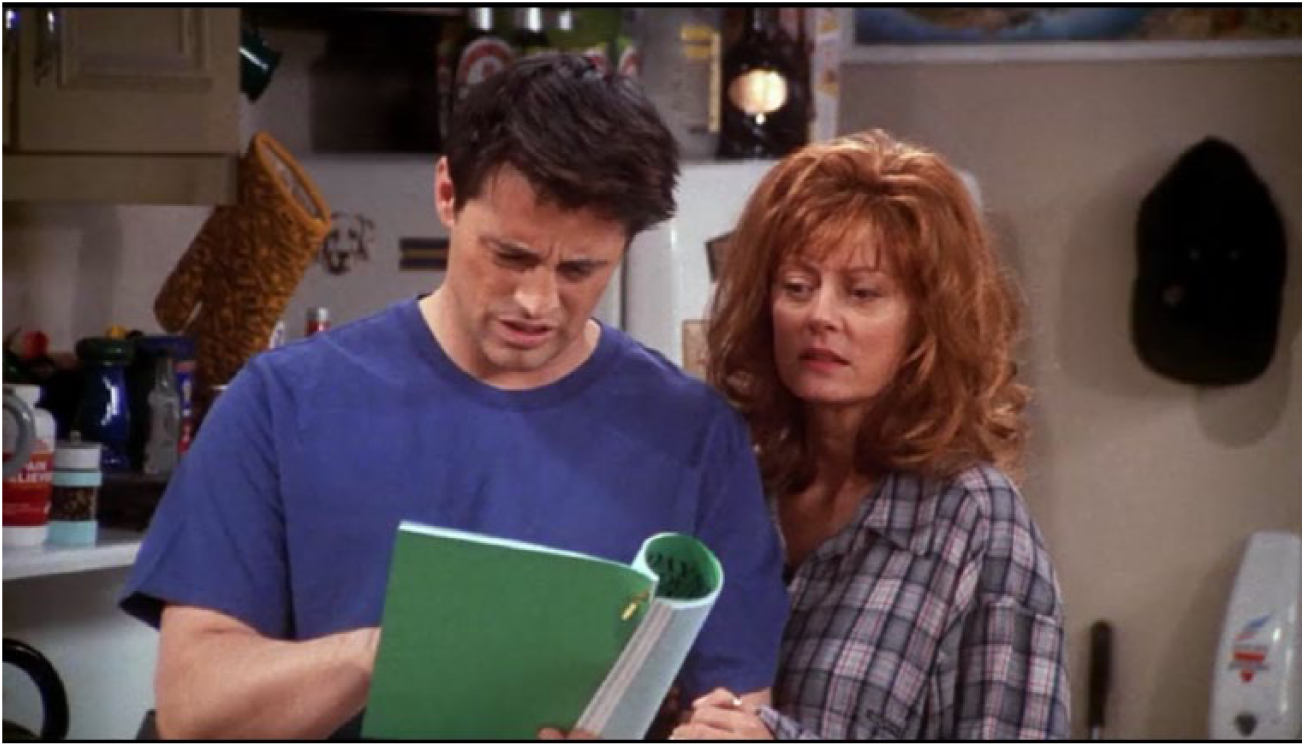
The difference between film and television stardom blurs, when soap diva Cecilia Monroe played by Susan Sarandon helps Joey get into character for his return to Days of Our Lives.
Rachel’s soap opera fandom propels season 8, episode 19, “The One with Joey’s Interview,” which opens with her bursting into Monica and Chandler’s apartment brandishing Soap Opera Digest to announce that Joey is part of the crossword puzzle. This sets into motion a clip show that demonstrates the disconnect between Joey’s performance of soap stardom (in an interview with Soap Opera Digest) and his authentic self (in the clips from previous episodes). The clip show as a narrative device reinforces Joey’s history, which LeBlanc’s later roles will reference and recirculate. The magazine writer’s question about Joey’s previous roles introduces a montage that reflects on Joey’s acting career, from bad theater productions, to infomercials, to porn. The montage dissolves back to the coffee shop, where Joey replies that he’s so proud of his work, choosing just one role as his favorite would be too difficult.
When the interviewer inquires about his personal life, a montage of Joey approaching women with his signature “how you doin’?” line cuts back to Joey claiming that he is shy. This response concludes the interview, and everyone congratulates Joey on making it through without any major gaffes, at which point the interviewer quickly returns with one final question: “other than Days of Our Lives, what’s your favorite soap opera?” Joey laughs dismissively and responds, “I don’t watch soap operas. Excuse me, I have a life.” Joey enjoys some level of celebrity as a soap actor, but his own treatment of his work suggests that he devalues it. His dismissal of soaps, however, doesn’t dismiss prime-time television, or stardom gained from it—instead, here, Friends sets up yet another hierarchy.
While Days of Our Lives actors occasionally appeared in the fictional diegetic footage of the show embedded in Friends, the actors themselves rarely appeared in Friends outside of fictionalized Days scenes. However, season 9, episode 20, “The One with the Soap Opera Party” brings Days stars into Friends’ diegesis with Joey hosting a cast party, once again positioning Friends characters as giddy soap opera fans. While two Days actors are credited and have speaking parts, others only appear in the background. The party scene begins with an establishing shot of Joey greeting Days actors Alexis Thorpe (who played Cassie DiMera) and Farah Fath (who played Mimi Lockhart)—they walk across the screen, giving way to Kyle Lowder (who played Brady Black), over whom Monica immediately fawns, calling out urgently, “I love you!” and later making him sign her bra. Rachel flirts with Matthew Ashford (who played Jack Devereaux) and later shares her stack of actors’ phone numbers with Joey. Joey demystifies the stars, telling her which ones wear toupees and are in Scientology-like cults. This episode seems to position soap stars as superior to the Friends characters (in Monica and Rachel’s giddy interactions with them), but in effect, it positions Friends stars as superior to soap stars, much as “The One with Joey’s Interview” does. Lowder and Ashford have minimal dialogue, yet they, along with Thorpe and Fath, remain visible in the background throughout the party scenes, marginalized by the unfolding narrative of Ross’s pursuit of Charlie and Rachel’s pursuit of Joey. Moreover, unless the viewer is a Days fan, these cameos are likely meaningless—especially those of Thorpe and Fath, who basically function as extras.
Mimi White (1986, 56) claims that these types of episodes produce a sense of television as a “continuous world,” noting, “Diegetic mixing on prime-time television shows presents one extreme of the progressively all-encompassing self-referentiality of commercial television.” Despite the fact that Dr. Drake Ramoray did not appear on Days of Our Lives proper, the character of Joey (as himself and as Drake) certainly traveled beyond the limits of Friends, expanding his visibility throughout the television landscape. The construction of Friends stars as sitcom stars through the show’s intertextuality and self-referentiality not only keeps their images in constant circulation but also shapes their post-Friends careers.
Phoebe and Joey after Friends
In the 2004 commemorative coffee table book Friends . . . ’til the End: The One with All Ten Years, David Wild interviews each actor, including a question that baits them to promote the Friends spin-off Joey (2004–2006). While each gamely obliges, Matthew Perry answers the question, “What’s your recommended Thursday night activity for the world post Friends?” by suggesting, “Well, hopefully the fine people at NBC will find some thing [sic] that can help it—like, say, Joey. But I think the smartest answer would be going to see one of our movies” (Wild 2004, 157–59). This not-so-subtle shift of the company line away from plugging Joey positions Perry as uniquely ready and able to move beyond television, to become a real, legitimate movie star, while leaving LeBlanc behind in the second-class world of sitcom stardom. Indicative of their roles on Friends as characters, the outrageous outliers among the more conventional friends, both LeBlanc and Lisa Kudrow would have a harder time leaving their iconic characters behind. Indeed, both have found significant success on television, playing hybrid versions of themselves and their Friends characters.
As kooky free-spirit Phoebe, Kudrow became a television star as a character, defined through her nonsensical folk songs and inappropriately cheery discussions of morbid topics such as her mother’s suicide. Perhaps because Phoebe as a character was so readymade for television comedy, and because she was positioned as a quirky foil for shallow, conventional Rachel and neurotic control-freak Monica, Kudrow generated less of a star presence outside of the Friends diegesis. In contrast to Jennifer Aniston and Courteney Cox, both of whom married film stars during Friends’ run and whose personal lives were regularly covered in celebrity gossip magazines, Kudrow married a noncelebrity in the first year of the series, thus garnering little public interest in her personal life. Celebrity magazines and Friends seemed to position Kudrow as lesser than Aniston and Cox in a hierarchy of conventional beauty, most notably when Friends responded to Kudrow’s pregnancy by having Phoebe carry her brother’s triplets, suggesting that Kudrow’s pregnant body was abnormally large for a single fetus. When Kudrow appeared in gossip magazines (usually along with the rest of the cast), discussion of her marriage and son revolved around how the shooting schedule of Friends was much more family-friendly than a movie career would be. In one of many stories about the cast’s contract negotiations, People noted, Kudrow, for one, has found sitcom work a stress-free way to raise Julian, 4, her son with advertising-exec husband Michel Stern, 45. “It’s a great gig for me,” she said recently. “It’s closer and often better than a regular 9-to-5. I get to take my son to school and have dinner with him.” (Gliatto et al. 2002, 54)
This sort of press coverage collapses information about Kudrow’s private life with her sitcom work, suggesting that the public was more interested in her role as Phoebe than her role as star/wife/mother. Thus, unlike Aniston, whose off-screen relationship with Brad Pitt regularly received press attention, Kudrow remains tied to her Friends character. Karen Lury (1995, 118) suggests this dynamic is part of the television viewer’s pleasure, the belief that “the actor is (or is at least like) the character he or she plays.”
Only a year after the last season of Friends, Kudrow starred in HBO’s The Comeback, a comedy shot as a reality series following faded sitcom star Valerie Cherish. For Friends fans, the character’s name refers to season 10, episode 14, “The One with Princess Consuela,” where Phoebe changes her name to Princess Consuela Banana Hammock but assures a skeptical Monica, “I’m going to have my friends call me Valerie,” creating an intertextual link between the two shows. The Comeback’s premise critiques the stigma of aging for female stars, as only a year post-Friends, Kudrow is cast as “over the hill”—as Jermyn (2012, 2) argues, in celebrity culture, women’s “value” is “intrinsically tied up with youth.” The Comeback follows Valerie as she pathetically attempts to return to her glory days (wherein she played the title role in the sitcom I’m It, a nod to fleeting It Girl status) only to be cast as “Aunt Sassy,” and pushed to the margins of a slew of young, attractive rising stars that evokes the Friends ensemble. Even though Valerie appears to be in her early forties, the costuming department puts her in a Golden Girls–style pastel nylon jogging suit, and the writers consistently give her jokes that suggest she is an octogenarian. 2 Noting the particular gendering of the “has-been” celebrity, Heather Osborne-Thompson (2009, 279) suggests that The Comeback foregrounds “the often humiliating processes by which ‘real’ female comedians attain visibility on television.” The Comeback comments on the struggles sitcom actors experience once their series end, harking back to Jason Alexander’s cameo on Friends. In the pilot episode (“The Comeback,” season 1, episode 1), Valerie competes against former sitcom stars Marilu Henner (famous for her role on Taxi) and Kim Fields (famous for her roles on The Facts of Life and Living Single), not only for the sitcom part but also for the reality series titled “The Comeback,” which will follow whoever lands the part. 3 When Valerie complains that none of them “need” a comeback, Henner shoots her a puzzled glance, implying that it is obvious that they are all struggling for work and cementing Valerie’s denial of her faded career.
Whereas Kudrow does not play herself in The Comeback, despite its self-reflexive references to the aftermath of sitcom stardom, Matt LeBlanc has almost exclusively played Joey or himself since the conclusion of Friends. Us magazine predicted in 1999 that he would have a particularly difficult transition, noting that LeBlanc, 32, is starting to live down his movie debut, opposite a monkey, although 100 years from now, network executives will be showing Ed to restless sitcom stars at contract time . . . the former Levi’s 501 model is probably the least likely candidate to throw off the oppressive chains of TV stardom. (Topping 1999, 69)
While Joey lamented that Marcel the monkey broke into movies before he did in “The One after the Super Bowl,” LeBlanc broke into movies alongside a monkey, a career choice that further connects him to his Friends character, and suggests he is more suited to television work.
After the cancelation of Joey mid-way through its second season in 2006, LeBlanc disappeared from the limelight until 2011, when he reemerged to play “Matt LeBlanc” in Episodes. Similar to The Comeback, Episodes chronicles the production of a network sitcom starring Matt LeBlanc. The pilot episode (“Episode 1,” season 1, episode 1) revolves around married British television writers Sean and Beverly being wooed to Hollywood with the promise of remaking their successful comedy “Lyman’s Boys” for U.S. network television. However, on their arrival stateside, they discover the network plans a major retool of their program. The episode ends with Sean and Beverly’s stunned silence after hearing that the network plans to cast Matt LeBlanc. The second episode (“Episode 2,” season 1, episode 2) opens with Sean exclaiming in disbelief, “for the erudite, verbally dexterous headmaster of an elite boys’ academy, you’re suggesting . . . Joey?” Sean’s inability to see LeBlanc as an actor, a capable performer separate from his Friends character, aptly sums up what many see as a downside to television stardom—the slippage between character and actor. While John Langer uses the primacy of character as evidence for the second-rate nature of the television personality, Episodes demonstrates the character’s immense value to television, as Carol, the head of network programming, notes that, for better or for worse, audiences love Joey/LeBlanc. The slippage between character and actor is redoubled throughout the series, with LeBlanc playing a character named Matt LeBlanc, with many of the elements of LeBlanc’s real-life backstory including his role on Friends and penchant for expensive fast cars, as detailed in a 2002 Entertainment Weekly interview (Snierson 2002, 40–41). 4 Still, Episodes’ Matt is not exactly LeBlanc, with some character details that do not match LeBlanc’s private life (including Matt’s two sons, in contrast to LeBlanc’s one daughter).
Like The Comeback, Episodes engages with the difficulties sitcom actors face after long-running roles on popular shows. In “Episode 6” (season 1, episode 6), Beverly and Matt get into a car accident, and while they survey the damage, a bus carrying tourists pulls up beside them. The driver announces, “take a look on your left, it’s TV’s Joey, Matt LeBlanc! Hey Matt! How you doin’?” By bookending his introduction with references to character (both in name and in catchphrase), rather than actor, the driver signals to his passengers that it is Joey who is truly famous, not Matt LeBlanc. The driver continues, “so when’s that Friends reunion gonna happen, huh?” and the scene ends with the driver looking at Matt with pity and asking, “how about you, you ever gonna work again?” With this exchange, the driver privileges Joey/Friends over Matt LeBlanc—the question of whether or not Matt will work again is secondary to whether or not he will play Joey again. For his part, though, Matt does not seem bothered by the pitying tone of these questions but rather by their inconvenient timing. Episodes self-consciously collapses Matt and Joey, and suggests that Matt uses Joey strategically in his career and in his personal life. In “Episode 4” (season 1, episode 4), Matt tells Sean that he’s not worried about his custody hearing—he will just “throw the judge a couple of ‘how you doins.’” In contrast to The Comeback’s framing of Valerie’s desperation, Episodes represents Matt as content with his faded career and the massive wealth with which it has provided him, a contrast that underscores the gendered differences in cultural attitudes toward aging, particularly when it comes to celebrities.
While both The Comeback and Episodes reference the struggles of aging sitcom stars, they elevate Kudrow and LeBlanc above sitcom star status thanks to the higher cultural status of premium cable. As Lisa Williamson points out, by appearing on premium cable and poking fun at the banality of network sitcoms, such programs aim to attract a savvy, upscale audience. She claims, “Even if the end result is less than flattering, actors are offered a certain amount of credibility by appearing on such shows as it demonstrates that they are willing to stand outside the confines of network programming and challenge conventions” (Williamson 2008, 119). Moreover, Williamson suggests that programs such as The Comeback act as industry award bait with their self-reflexive behind-the-scenes look at television production. Indeed, despite the fact that LeBlanc never won a major award for playing Joey, he won a Golden Globe for playing Matt LeBlanc, and has been nominated for four Emmy Awards for the role. The pilot episode of Joey (“Pilot,” season 1, episode 1) critiques the network/cable hierarchy when Joey explains the two job offers he has in Los Angeles to his sister Gina:
“The first one is about a bunch of male nurses, and I wasn’t really crazy about that one, I mean I’ve already been a brain surgeon—I don’t think my fans buy me as a nurse.”
“Well, they bought you as a brain surgeon, they’re pretty understanding, Joey.”
“Okay, well it doesn’t matter, all right, because the other show is about a cop, and I’m the star! Oh, also, it’s for cable, so there’s a combination of nudity and swearing that I find intriguing.”
The fact that cable, for Joey, signifies the potential for nudity and swearing partially undermines its prestige. By reducing cable’s claims to high production values and “quality” storytelling to vulgarity for the sake of vulgarity, Joey attempts to position itself as similarly self-reflexive as programs such as The Comeback and Episodes. When Joey goes to film the cable show, Joey further skewers the “quality” distinction of cable, aligning it with extreme, gratuitous violence. In the first scene he tapes, Joey pummels another actor, resulting in fake blood splattering with every punch. When the show fails to get picked up, Joey exclaims to Gina, “people thought it was [mockingly] disgusting. Jeez. You defecate on one corpse!” Gina asks if he wishes he had done the other show, and Joey dismissively claims, “believe me, no one is going to watch a show about nurses.” The episode then cuts to Nancy O’Dell, host of Access Hollywood, interviewing the star of “the smash hit ‘Nurses.’” Joey’s emphasis on mass audience popularity positions the fictional “Nurses” and by extension Joey itself as superior to the graphic violence that restricts a show to a niche audience, or no audience at all. Here, Joey suggests that Joey could be a much more successful, popular actor if he had done the mass market program, at once valorizing LeBlanc’s decision to participate in the spin-off while predicting his move to the more prestigious Episodes.
The fact that Kudrow and LeBlanc have found success on premium cable after their work on a network sitcom suggests that sitcom stardom was not, in fact, the career killer Us magazine predicted with its quip about LeBlanc being unable to “throw off the oppressive chains of TV stardom” (Topping 1999, 69). Instead, their upward mobility within the televisual hierarchy demonstrates the value of sitcom stardom. Their characters were so memorable and recognizable that they could capitalize on their own television histories to produce critically acclaimed programs that keep their past and present images in circulation.
Jennifer Aniston, Celebrity Gossip’s Favorite Friend
The Friends cast understood their value to the television economy early on, actively seeking to capitalize on the popularity of their characters and famously negotiating higher salaries as a unit. Much of the gossip media circulating around Friends during its original run was devoted to a narrative of “will-they-or-won’t-they” renew their contracts. Many articles speculated on movie roles the actors were taking and whom among the cast would be able to make it big as a movie star (e.g., Cagle 1999; Fretts and Tomashoff 2004; Gotti et al. 2003; Topping 1999). Some of the same articles suggested Jennifer Aniston needed to pull herself into the film world to be worthy of boyfriend-turned-husband Brad Pitt. In 1999, Us magazine wrote of Aniston, “She’s our top candidate to spin off her own series, but the world expects more of her if she’s going to marry some guy named Brad” (Topping 1999, 69). TV Guide’s end-of-series retrospective included a satirical look at ways the Friends could stay on the air, by writing each character into a different television series. After making Rachel into Alias’ Sydney Bristow, the feature ended with the disclaimer, “One final note: We ran our Rachel idea past Jennifer Aniston’s agents, and they offered a scenario of their own: ‘Rachel goes to Hollywood to be a movie star, wins an Oscar and never appears on television again’” (Borowitz 2002, 25). The last few years of Friends saw many gossip magazines positioning Aniston as biding her time for a film career, and People noted that Aniston was “primed to leave the nest” thanks to her critically acclaimed role in The Good Girl (Gliatto et al. 2002).
The combination of a high-profile celebrity marriage and a well-placed against-type film role helped Aniston smoothly transition from sitcom star to movie star. However, it was her role as Rachel that made her “America’s Sweetheart.” A 1999 People magazine article about Aniston’s relationship with Pitt drew comparisons between Aniston and Pitt’s previous girlfriend, Gwyneth Paltrow, claiming, On the surface, at least, Aniston seems a natural successor to Paltrow. Besides having two of the most envied heads of hair in Hollywood, both actresses were born into showbiz . . . [Yet] “Jennifer is the anti-Gwyneth,” says a Friends insider. “Gwyneth was into going out and being glamorous. Jennifer is not. She’s very nonglam.” (O’Neill and Smith 1999, https://people.com/archive/cover-story-brad-and-friend-vol-51-no-9/)
References to Aniston’s televisual ordinariness (as opposed to extraordinary Oscar-winning movie star Paltrow) continued to circulate around the image of Rachel as Aniston. Susan Berridge (2015, 120) notes how pivotal Rachel, and by extension, television, is to Aniston’s post-Friends career, arguing, Aniston’s star image more widely is predicated on the notion of her being accessible, and this accessibility notably hinges on connotations of authenticity and youthfulness. Aniston positions herself as the inherently low-maintenance, girl next door, reinforced by her preference for simple (albeit expensive, designer) outfits and “natural,” low-key (yet highly groomed) styling when at red carpet events.
Although Aniston portrays Rachel as “the girl next door,” as Berridge describes, Friends simultaneously positions Rachel as an unattainable object of desire for Ross. “The One with the East German Laundry Detergent” (season 1, episode 5) represents Ross hopelessly pining for Rachel, trumping up an excuse to do laundry with her and treating it (with Chandler’s coaching) as a date, going so far as buying “manly” laundry detergent to prove his virility. By putting Rachel on this veritable pedestal, the series already marks her as superior to her fellow cast member.
More than any other character, Friends defines Rachel primarily through her appearance. Most famous for her iconic haircut, Rachel’s career in the fashion industry also helps align her character with her looks. Whereas Phoebe is defined through her flighty, free-spirited personality and Monica is defined through her obsessive, controlling nature, Rachel is defined from the pilot episode (“The One Where Monica Gets a Roommate,” season 1, episode 1) as the visual embodiment of the feminine ideal. 5 The moment Ross laments that he “just wants to be married again,” Rachel appears for the first time, entering Central Perk in a gaudy wedding gown with tiara-like headpiece. Thanks to the emphasis on Rachel’s appearance as opposed to the quirky traits of most of the other characters, Aniston becomes a fashion icon and star through the image of Rachel, at least partially transcending her character, through endorsement contracts with beauty products such as Aveeno, L’Oreal, and Elizabeth Arden and countless fashion magazine covers, including Elle, Glamour, Cosmopolitan, and Vogue.
Even so, the circulation of Aniston’s post-Friends image is indebted to Rachel and television more broadly in a variety of ways. Most of the gossip media’s coverage of Aniston between her 2005 divorce and prior to her 2015 marriage to Justin Theroux focuses on her search for lasting love. The sheer number and structure of these stories mirror Friends’ eight-season narrative effort to defer Rachel’s union with Ross. Like Rachel, Aniston seemingly remained perpetually on the cusp of love, and the gossip media perpetuates the delayed gratification narrative structure of Friends, mapping it onto Aniston’s “real” life. An Us Weekly article from 2010 details Aniston’s love interests using the episodic organization of Friends, labeling three men, “The One Who Likes Younger Girls” (Reinstein 2010, 53), “The One Who Dated Lohan” (Reinstein 2010, 54), and “The One Who Is Getting Divorced” (Reinstein 2010, 55).
Although she has successfully transferred the image of “America’s Sweetheart” from television to film, the fact that gossip media pitted her against Angelina Jolie reinforced her ties to television, with Jolie often represented as a glamorous, seductive movie star in contrast to girl-next-door, sitcom darling Aniston. OK! Magazine juxtaposed the two actresses in hypothetical situations, including how much money each would spend on her appearance. In each case, the magazine positioned Jolie as effortlessly authentic (using $2 ChapStick and wearing a $26 vintage dress) and Aniston as a pathetic social climber, perpetually trying too hard (dropping $55 on “Z. Bigatti Re-Storation Lip Pout” and $2000 on a designer gown) (Murphy and Bass 2008, 47). The same article quotes a friend of Jolie claiming, “You might say she feels sorry for Jen, but that would be if Jen even registered on her radar. To Angie, Jen is just another TV actress in the sea of many” (Murphy and Bass 2008, 49). The intention of the article is clearly to make Aniston appear desperate to achieve the level of movie star fame that Jolie effortlessly possesses, yet the superficiality it ascribes to Aniston is consistent with fashion-obsessed Rachel. Paradoxically, it makes Jolie appear “ordinary,” claiming she does her own hair, while Aniston is “extraordinary,” supposedly traveling with her personal hairstylist.
The fact that Jolie’s “no-frills approach” could be favorably compared with Aniston’s glam routine suggests that traditional understandings of television celebrity as ordinary and intimate and film stardom as extraordinary and distanced is no longer useful. Just as Rachel often felt insecure in comparison with Ross’ many girlfriends, the gossip media framed Aniston as “too ordinary” for Brad Pitt. While Rachel may have seemed too shallow for Ross, Aniston here is “trying too hard,” in contrast to a natural, legitimate movie star like Jolie. At the same time, this opposites-attract love story makes viewers root for Rachel/Aniston, the underdog, the one who is “just like us.” The more mean-spirited, low-brow gossip magazines like OK! and Star may have favored Jolie in the split, but the middle-brow magazines such as People and Us Weekly were clearly Team Aniston. As Kudrow and LeBlanc have both managed to parlay their Friends roles into success on premium cable, the popular identification of Aniston with Rachel’s romantic foibles has contributed to an extratextual star persona that she can use to promote her film career, just as Matt uses Joey to manipulate situations to his advantage in Episodes.
Conclusion: They’ll (Always) Be There For You
Despite the many changes in the last three decades of the television industry, Ellis’s and Langer’s accounts of television stardom remain highly influential, regardless of the fact that they suffer from rigid distinctions between film and television—as Christine Becker (2008) has pointed out, these theories are ahistorical and oversimplified. Well before Friends originally aired, viewers could watch their favorite film stars on the same “routinely encountered,” “familiar” home television screens any time they desired thanks to home video technologies that became widely available in the 1980s. This wide availability complicates claims about the “rarity” of film stars. Citing the popularity of Sex and the City star Sarah Jessica Parker, Deborah Jermyn (2006) points to the necessity for star studies to reimagine television stardom, calling for a new conceptualization of the relationship between TV and stardom which recognizes how some of the differences that were once held to exist between TV “personalities” and cinematic stars have been eroded and yet nevertheless retains a sense of the distinctiveness of each medium. (p. 83)
Friends provides an ideal case study for just such a conceptualization—it is distinctly televisual in its genre, and it demonstrates the complicated and complex contours of stardom on television and across media.
Although the Friends cast are exemplary television stars by virtue of their constant recirculation through television’s intertextual world, they are also perhaps among the last sitcom stars of their caliber due to the steady erosion of network television’s audience share. With numerous streaming platforms, ubiquitous syndication runs, and the continuous circulation of Friends-related memes on social media, fans and casual viewers alike can engage with Friends stars as they were from 1994 to 2004 virtually any time, into the foreseeable future. The self-referential nature of television similarly keeps Friends and its stars in the popular imagination. On Netflix’s series Master of None, struggling actor Dev’s agent encourages him to book a sitcom, to “get that Friends money,” promising that she “could show [him] David Schwimmer’s house if [he] need[s] to see what’s at stake.” Although Matt LeBlanc’s choice to play Joey or himself may be seen as a “failure” to transcend character (a failure that prevents him from ascending the rarified ranks of film stardom), by the standards of television stardom, LeBlanc is an A-list star, and thanks to the financial perks of sitcom stardom, LeBlanc and his cast mates never need to work again. Earlier accounts of television stardom dismiss television stars as simply “ordinary,” but Friends’ characters inhabit an extraordinary world full of celebrities, while Friends actors appear on prestigious premium cable programs and live luxurious lives that make for abundant celebrity gossip fodder.
Footnotes
Acknowledgements
I would like to thank Shelley Cobb, Neil Ewen, and Hannah Hamad for their expert editing, encouragement, and patience throughout the writing and revision process, and Diane Negra and the anonymous reviewers for their helpful feedback.
Declaration of Conflicting Interests
The author declared no potential conflicts of interest with respect to the research, authorship, and/or publication of this article.
Funding
The author received no financial support for the research, authorship, and/or publication of this article.