







Abstract
Binge watching serialized video content is a phenomenon that has triggered interest from diverse research fields. Despite the progress researchers have made across different areas, a grounded conceptualization and definition of binge watching is still lacking. In this article, we conduct a transdisciplinary literature review to identify continuity and viewer autonomy as the two fundamental attributes underlying binge watching. Then, using these attributes as conceptual anchors, we offer a convergent definition and categorize the existing binge-watching definitions in the literature. The results of this categorization reveal that the vast majority of the definitions used in the literature fail to distinguish binge watching from other viewing practices such as casual viewing, single-episode appointments, and marathon appointments. We discuss the implications and, to move the binge-watching research forward, conclude with recommendations and an agenda for future research.
Keywords
Introduction
In 2012, Jurgensen from the Wall Street Journal declared that binge watching (BW) changed the television industry for good. By BW, he referred to “gobbling up entire seasons of shows in marathon sessions” (Jurgensen 2012). At that time, very few knew the term though many had already used online television and DVD box sets. As more viewers have subscribed to Netflix (2013), BW has become a buzzword to which also researchers refer. Matrix (2014), for instance, has written how Netflix is disrupting linear television because it offers a more autonomous viewership—the ability to binge-watch television shows. Besides autonomy, BW has since linked to various other attributes. According to Pittman and Sheehan (2015), for example, BW adds to relaxation, engagement, and hedonism, whereas Shim and Kim (2018) say it satisfies viewers’ desire for enjoyment, efficiency control, and fandom.
The literature seems to represent BW mostly as a hedonic viewing practice, though Silverman and Ryalls (2016) aptly remind us of its utilitarian attributes: it can be used as an analysis method (see also Rubenking et al. 2018). Researchers have also raised concerns that BW is not necessarily a positive but a negative practice. This line of research has gained more attention in the BW literature (e.g., Dickinson 2014; Hargraves 2015; Riddle et al. 2018) and made researchers suggest how to tackle it (e.g., Schweidel and Moe 2016).
Despite the stated progress, researchers seem to stand less united in how they define BW. Where some definitions build on time (Wagner 2016), others use the number of episodes a viewer consumes of a television show (e.g., Ahmed 2017; Walton-Pattison et al. 2018). Unfortunately, a clear definition of BW is still lacking—as is an explanation of why it should build on time, or why a certain number of episodes constitutes a binge, and in what way these episodes need be consumed (attributability). Without a solid definition, it will be difficult not only to distinguish BW from other viewing practices but also to produce comparable findings (comparability; see for results with two different BW definitions: Godinho de Matos and Ferreira 2017). In addition, if, by default, the definition excludes certain television shows (e.g., online-only content) from investigation (coverage), it will fail to capture its intensional meaning (Copi et al. 2014), potentially challenging scholarly progress altogether.
As a result, there is a clear need to scrutinize the scattered scholarly literature. To do this, we opt for a transdisciplinary review, as BW has attracted researchers from various disciplines (e.g., information systems, marketing, media, communication, and psychology) covering several television-related debates (e.g., BW as an addiction or a viewing pattern, and viewing patterns of serialized video content). We then identify the fundamental attributes that underlie the definitions presented in the BW literature. Based on these fundamental attributes, we propose a convergent definition and classification framework. With this endeavor, we offer a systematic analysis and synopsis of current knowledge, which aims to make the BW research more commensurate and generalizable in the future. We conclude our article with suggestions for further explorations to move BW research forward.
Literature Review and Analysis
In search for all relevant BW research, we used Elsevier’s Scopus, ResearchGate, and Google Scholar. The search words we employed were “binge watch” and “binge view,” including their conjugations (e.g., binge-watching). We then continued with backward search by screening the references for additional relevant publications, as well as with forward search for identifying newer publications. We focused on peer-reviewed publications, both empirical and conceptual. Although reviews typically include only articles, we made an exception and extended our analysis to two additional publications, Conlin’s (2015) doctoral thesis and Glebatis Perks’ (2014) book, which we consider are of high quality and relevance to the subject at hand. The search resulted in twenty-nine publications, most of which come from the field of media and communication.
We summarize the statistics in Table 1 and list the publications in detail in Supplemental Appendix 1.
Descriptive Statistics of the Binge-watching Literature.
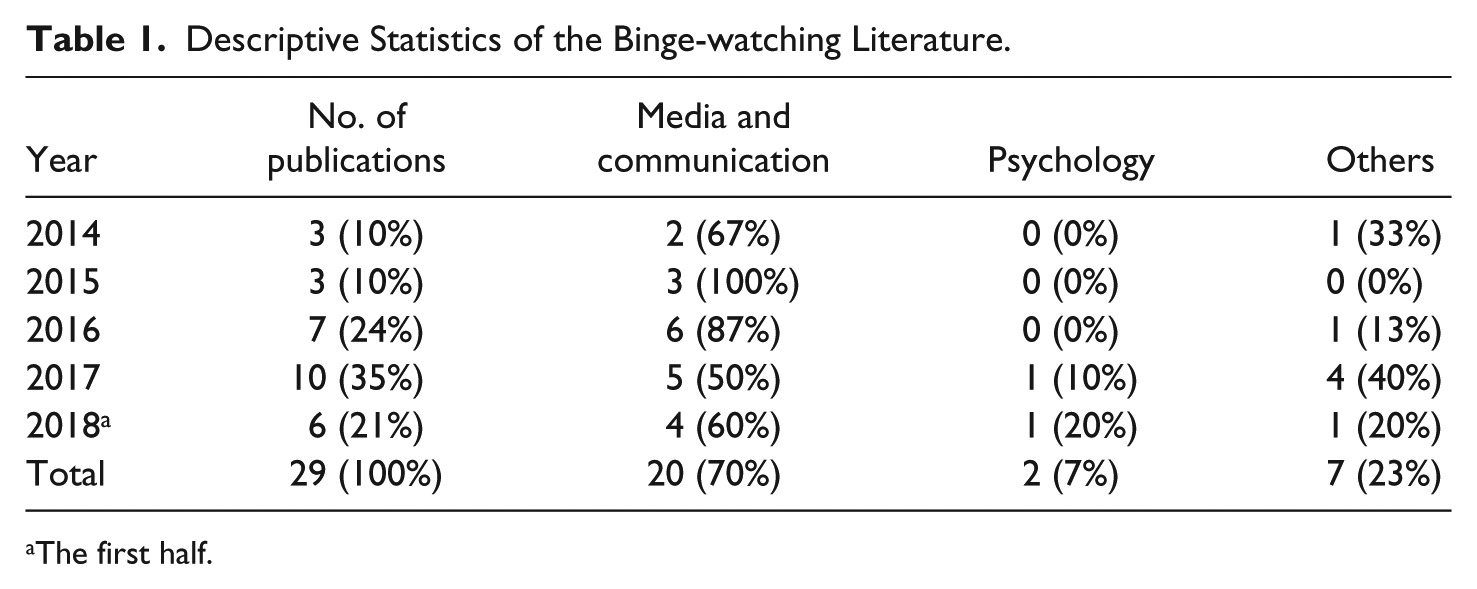
The first half.
Fundamental Attributes and a Convergent Definition of Binge Watching
To develop a convergent definition of BW, we followed the approach where one identifies the intensional meaning, referring to “the attributes shared by all and only the objects in the class that a given term denotes” (Copi et al. 2014, 91). That is, we focused on attributes that distinguish BW from other viewing patterns characterized by consuming serialized video content. 1
To identify these attributes, we analyzed the definitions of the listed publications. As one of them, the publication by Matrix (2014), had neither explicit nor implicit definition, we excluded it from the analysis altogether. The analysis revealed five fundamental attributes to be further scrutinized: viewer autonomy, continuity, completion, addiction, and immoderacy.
Viewer autonomy
This attribute underlines BW as a product of technological evolution, representing a breakaway from scheduled television to greater viewer autonomy (Jenner 2017). It pays attention to medium controllability (Friedman 1996; Friedman and Nissenbaum 1997), not whether BW is good or bad, or self-regulated (i.e., doing something they fully endorse, see Ryan and Deci 2006). Simply put, viewer autonomy here is about allowing the users to decide on how to use media.
Following Jenner (2017), BW has its origins in DVD box sets, which allow viewers to consume one season or the entire serialized video content. Her notion on viewer autonomy receives support from Kompare (2006, 352) who claims that DVD box sets make content “accessible at the whim of the viewer, without waiting for a rerun airing or searching through commercial breaks.” Unlike scheduled television, which requires an appointment with their favorite television show, 2 DVD box sets do allow viewers to consume serialized video content at their own convenience (see Figure 1).
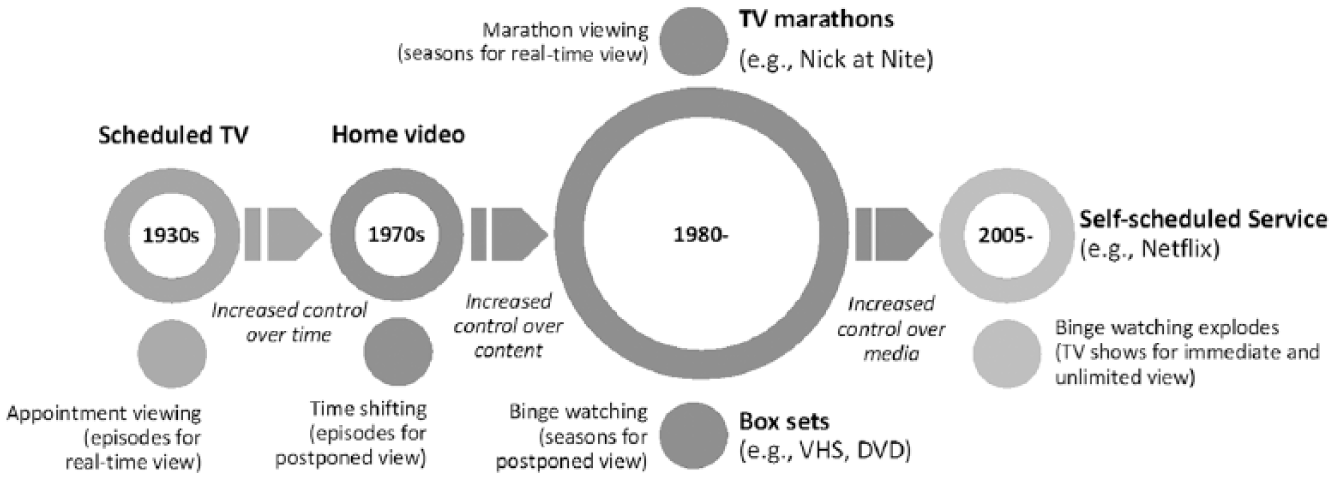
Historical continuum of viewer autonomy.
With box sets and their successors, online television streaming services, viewers are like readers who read a book whenever they want and as many chapters as they want. Therefore, linking viewer autonomy to BW differentiates it also from television marathons, which refer to broadcasting episodes of the same television show back-to-back (Conlin 2015; Fernandez 2017). Although television marathons allow viewing multiple episodes in one sitting, they are no more than extended viewing appointments as they are broadcasted at a specified time and date. It is thus not surprising why Jenner (2017, 308) claims BW “suggests an entirely different media experience than ‘traditional,’ scheduled television can offer.”
Continuity and completion
Researchers have also proposed that BW relates to continuity or completion, both attributes that address how BW occurs in practice.
Continuity refers to consuming episodes of a television show in one sitting without disturbances like commercial breaks during and between the episodes (Steiner and Xu 2018). The attribute puts flesh on the bones on what Pierce-Grove (2017) describes as the viewers’ immediate desire to indulge “in just one more of the same kind.” That is, continuity suggests that when viewers are BW, they want to consume episodes of a particular television show in continuous flow. Continuity is also what makes BW surpass the “norm” already after the first episode. This may not feel excessive, yet it amounts too much in relation to the “one episode at a time” standard set by scheduled television (for more about excess, see Abbott 2014). We derive the justification for the comparison from the viewers’ desire to break away from scheduled television (Jenner 2017).
Completion (or closure), in turn, stresses a desire for any definite knowledge on how the given television show ends (Kruglanski and Webster 1996). Viewers want to see season and show finales (see also Devasagayam 2014), and, hence, according to Glebatis Perks (2014), completion offers a basis for BW (or media marathoning as she terms it). 3 Completion does not necessarily require continuity, as long as a season is “consumed within one week” (Glebatis Perks 2014, xxxi). This attribute, however, may sometimes require unnecessarily extreme sittings or sittings that are beyond possible, as is the case with Days of Our Lives (1965–), a long-running U.S. soap opera by NBC. Since its single season has more than 250 one-hour-long episodes, its completion would take more than ten days, nonstop. Replacing continuity with a slightly longer time period is a cold comfort. Even if it did not rule out long-running television shows automatically, viewers would still have to complete them faster than shorter television shows.
Addiction and immoderacy
Two attributes emphasize that BW is excessive and harmful (e.g., Devasagayam 2014; Wagner 2016; Wheeler 2015). The focus is either on immoderacy (cf. Feeney 2014) or addiction (Schweidel and Moe 2016).
As for immoderacy, it is assumed that there is an ideal number of episodes that viewers should not exceed in a single session. If they did, their viewing would be so long that it makes them feel guilt (Wagner 2016), 4 and for that matter, turn into BW (Feeney 2014). Unfortunately, what is “too much” is difficult to pinpoint because it depends on two perceptions: episodes and feelings. Episodes vary in length within and across television shows, and some miniseries may even be too short to make viewers feel immoderate, in which case BW does not apply to all serialized video content. Feelings, in turn, vary from viewer to viewer and occasion to occasion (e.g., individuals are likely to allow themselves to consume more media during holidays). More importantly, to the best of our knowledge, there are currently no publications that seek to explain why BW must feel immoderate.
Concerning addiction, the literature is inharmonious. Where Devasagayam (2014) demonstrated BW is an addiction, Flayelle et al. (2017, 466) concluded, also based on empirical evidence, that it “should not a priori be analyzed through the lens of the biomedical model of addiction.” Riddle et al. (2018), in turn, give partial support to Flayelle et al. (2017) by reporting that negative effects are less likely to occur when BW is intentional. Given the above, it seems that addiction is a potential outcome of, but not a fundamental attribute to, BW.
Convergent Definition of Binge Watching
Based on the previous, we draw on two fundamental attributes, continuity and viewer autonomy (attributability). Continuity, which describes BW, is about concentrating on a specific television show and consuming its episodes in continuous flow. Viewer autonomy, in turn, captures the self-scheduled nature of BW: viewers must be able to binge-watch what they want at their own pace and time. This also implies that they can stop whenever they choose (Conlin 2015). Moreover, both the attributes are independent of subjective perceptions (comparability) and, perhaps even more importantly, concern all forms of serialized video content (coverage)—including long-running soap operas and online-only miniseries (e.g., The Show About the Show), whose episodes fail to adhere to the traditional (“hour-long” and “half-hour-long”) broadcast time slots (Volpe 2017). That said, the attribute selection leads us to propose the following convergent definition of BW: “a consumption of more than one episode of the same serialized video content in a single sitting at one’s own time and pace.”
Categorizing the Existing Definitions in the Literature
To gain an overall view of how researchers currently understand BW, we categorized the definitions presented in the literature according to the two fundamental attributes identified above. Together, continuity and viewer autonomy help distinguish BW from self-scheduled single-episode sessions, which we here term as casual viewing (CV), as well as from scheduled single-episode appointments (SEAs) and multiepisode appointments (i.e., marathon appointments: MAs). We illustrate the four distinct viewing practices in a quadrant framework (see Figure 2).
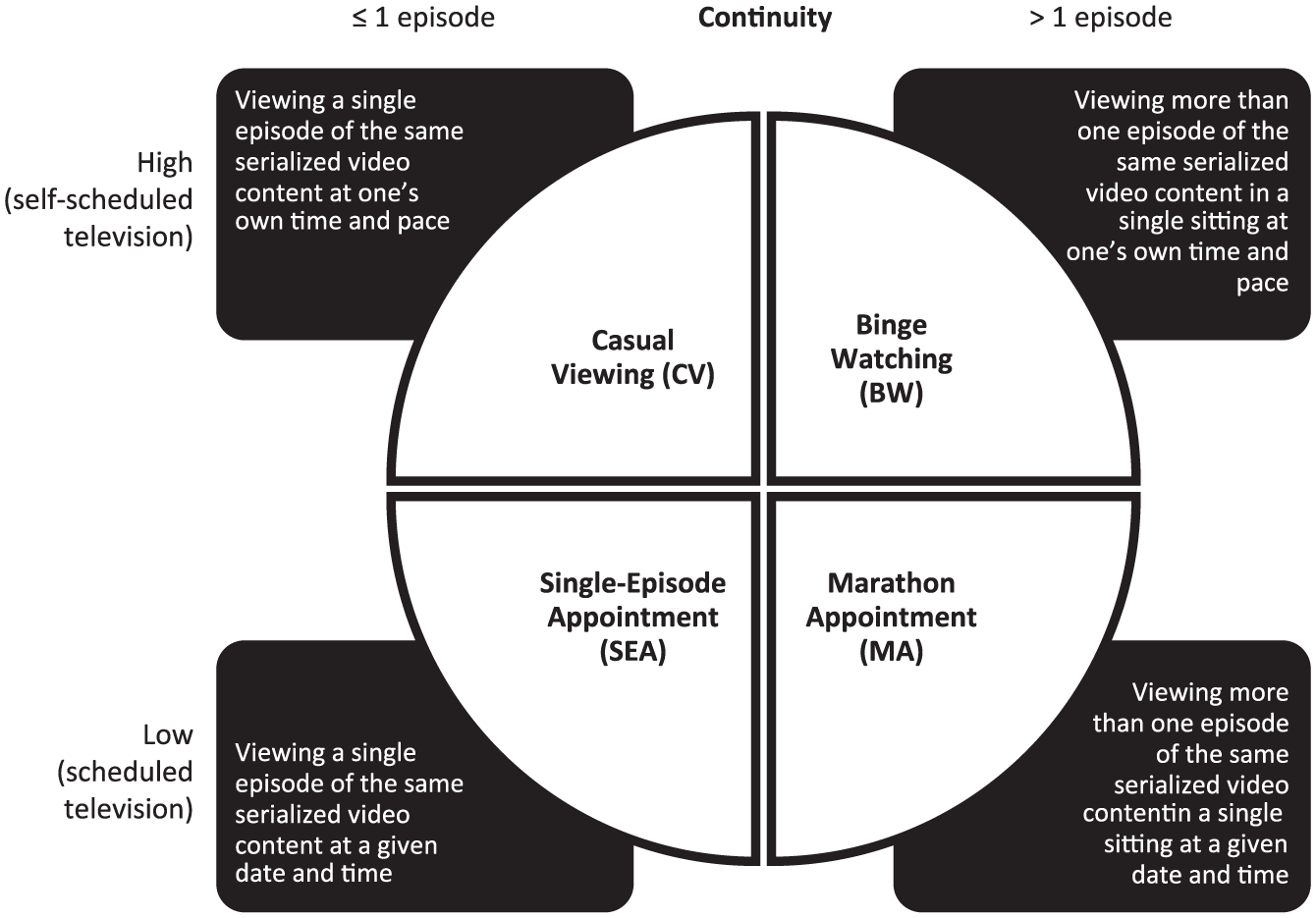
Quadrant framework of viewing practices.
Concerning the categorization process, three researchers undertook the task of coding the definitions found in the twenty-eight publications. First, the team agreed on the fundamental attributes (continuity and viewer autonomy). Then, each team member coded the listed definitions independently using the quadrant framework presented in Figure 2. Note that each definition presented in the literature could incorporate one or more fundamental attributes. Upon completion of the coding process, the team compared the results. With only a few exceptions, the three members agreed on the coding categorizations. When discussing their disagreements, they then reached a consensus concerning all definitions (cf. Krippendorff 2004).
Results
Altogether eighteen definitions categorized in our study acknowledged only continuity (64.3%: MA and BW). Six definitions were all-inclusive (21.4%: SEA, MA, CV, and BW), whereas three acknowledged the mere viewer autonomy (10.7%: CV and BW). Only one definition (3.6%; Pierce-Grove 2017) distinguished BW from other viewing practices (see Figure 3).
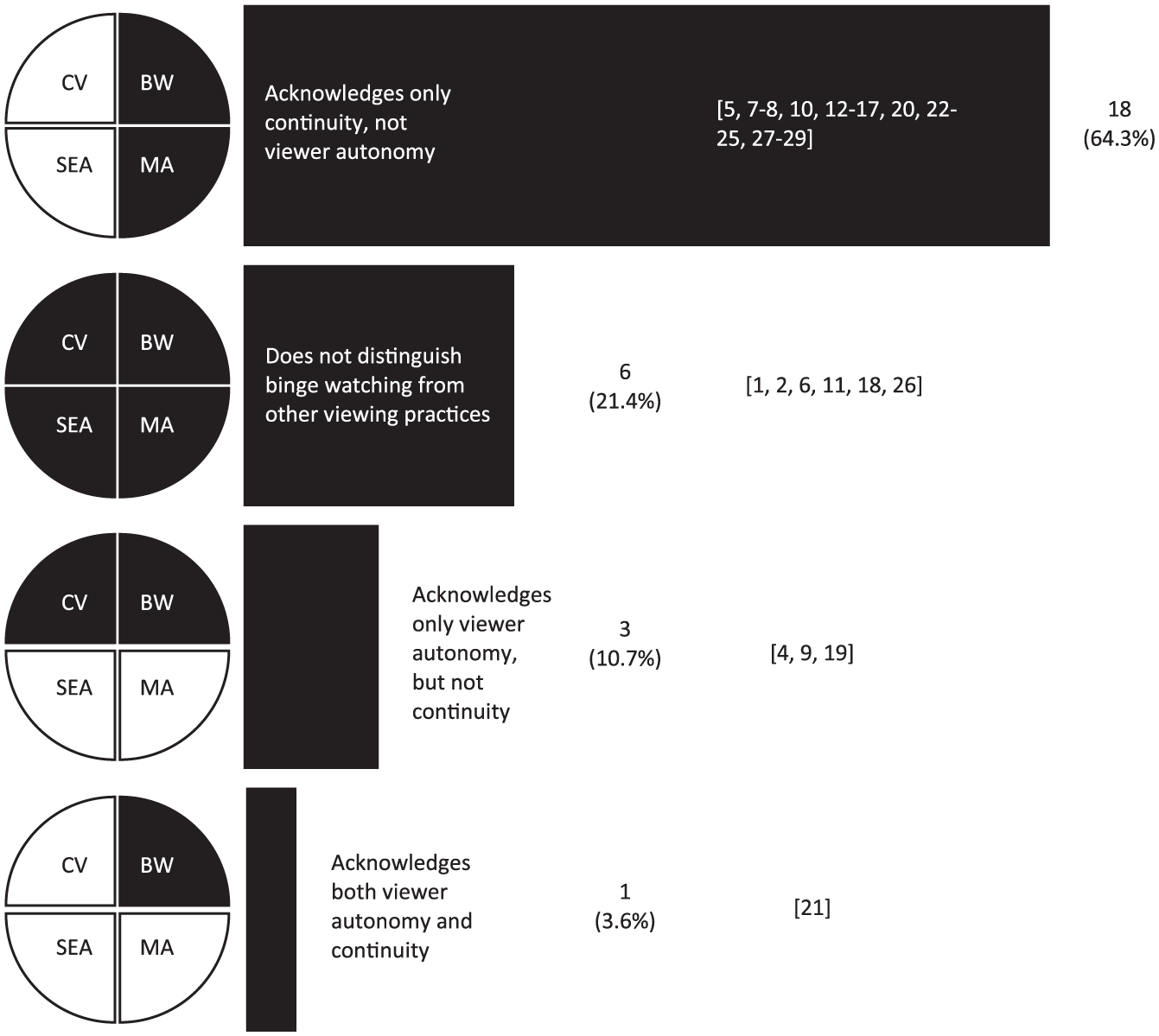
Categorization of definition types.
Continuity only
Definitions acknowledging only the continuity attribute are the most common among the reviewed publications (18 or 64.3%). In these definitions, BW refers to viewing episodes of the same television show in continuous flow. Interestingly, however, the definitions disagree on when viewing turns into BW (see Figure 4). For example, Walton-Pattison et al. (2018, 3) define that consumption of “more than two episodes of the same TV show in one sitting” counts as BW (also Flayelle et al. 2017; Silverman and Ryalls 2016). Riddle et al. (2018) in turn state that viewers must consume a minimum of three episodes of the same television show in one sitting (Hargraves 2015).
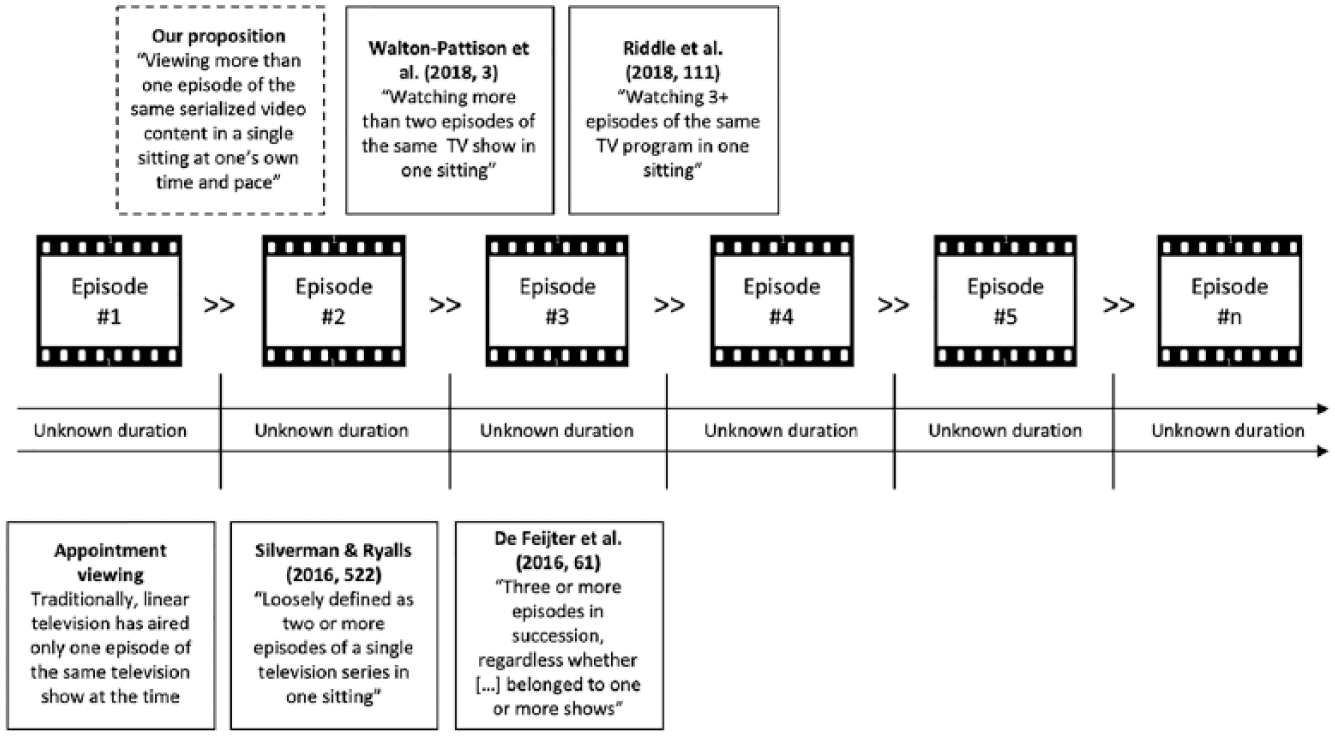
Various thresholds for binge watching proposed in the listed publications.
The disagreement is difficult to decode, as the relative standards underlying the definitions are not explicitly addressed (see Walton-Pattison et al. 2018). Furthermore, the definitions accept BW is possible both via self-scheduled and scheduled television, a view that parallels the activity to MA.
The research objectives covered by the publications of this category concern viewer personalities (Tukachinsky and Eyal 2018), motives (Panda and Pandey 2017), and negative outcomes (Ahmed 2017). Moreover, similar to publications belonging to the other categories, the publications in this category are mostly exploratory in nature (11 or 61.1%). Other publications of this group lean on transportation theory (Conlin 2015), addictive spectatorship (Hargraves 2015), and uses and gratifications theory (Pittman and Sheehan 2015; Shim and Kim 2018). The topmost perception is that many of these publications approach BW with reservation.
All-inclusive
The second most popular (6, 21.4%) definition type takes no notice of either continuity or viewer autonomy. The publications spread across various disciplines, including marketing, education, communication, and media. One half of the publications is exploratory in nature, seeking to identify the relationship between BW and advertising (Schweidel and Moe 2016) or memory (Horvath et al. 2017). The other half employs either theoretical synthesis or the uses and gratifications theory to investigate motivations (Shim and Kim 2018) or the phenomenon itself (i.e., media marathoning: Glebatis Perks 2014). Similar to the publications of the previous category (continuity only), publications listed in this category approach BW with reservation (Devasagayam 2014; Schweidel and Moe 2016).
Autonomy only
Three (10.7%) publications advocate nothing but viewer autonomy. As they mainly compare BW with appointment viewing, the definitions do not separate BW from CV (i.e., self-scheduled single-episode sessions). The publications belonging to this category are from the media and communication discipline with a focus on the BW phenomenon, viewers, and content. Conlin (2015), for example, investigates the depth with which the viewers transport into the story when BW. Jenner (2016, 2017), in turn, explores television industry, fandom, and the quality label given to television shows viewers choose to binge watch. These publications intend not to evaluate BW. Rather, they seek to understand the phenomenon and place the activity within the changing media environment.
Binge watching
One publication (Pierce-Grove 2017) in our review introduces a definition of BW that builds on both continuity and viewer autonomy. The publication, which examines how journalists frame BW, proposes that the activity refers to viewing episodes in continuous flow without constraint.
Pierce-Grove (2017) reminds that while box sets were the originating force, online television makes serialized video content immediately and largely available for BW. As viewers are able to easily continue their viewing, even completing the entire television shows to their liking, BW gratifies their impulses immediately. In addition, Pierce-Grove (2017) explains that new media platforms have removed constraints on immediate access, conditions which she highlights apply to BW. As such, her definition not only anchors BW to continuity and viewer autonomy but also helps distinguish it from other viewing practices.
Discussion
Although research on BW is still in its infancy, there appears to be a conceptual puzzle that inspired us to scrutinize the scattered literature and analyze how researchers conceptualize and define BW. In our article, we were particularly concerned that BW is lacking attributability, comparability, and coverage. Therefore, we conducted a transdisciplinary literature review aimed at identifying the necessary fundamental attributes upon which BW builds, providing a convergent definition of BW. To understand the current state of research, we also analyzed and categorized the definitions available in the literature based on the attributes of our definition.
As for our first goal, we maintained that viewer autonomy and continuity present two necessary and sufficient attributes for defining BW. Given these, we ruled out appointment viewing in all its different forms (SEAs and MAs) and located BW in self-scheduled television (e.g., box sets, online television; see also Horeck et al. 2018; Jenner 2017). In addition, we distinguished BW from CV (i.e., self-scheduled single-episode sessions).
As for our second research goal, we drew upon the fundamental attributes, viewer autonomy, and continuity and defined BW as viewing more than one episode of the same serialized video content in a single sitting with one’s own pace and time. The advantages this definition offers are threefold. First, it honors the origins of BW (Jenner 2017; Kompare 2006) and, as such, compares to viewing scheduled television, offering clarity currently unavailable in the existing literature. Second, as the definition gives credit to self-scheduled television (Jenner 2017), it also recognizes the opportunity to viewing in continuous flow. The one-episode threshold the definition addresses is fixed and independent of subjective perceptions. Third, the definition covers all serialized video content.
As for our third research goal, we formed a quadrant framework based on the two fundamental attributes to categorize the definitions that exist in the current literature. We found only one (Pierce-Grove 2017) that captured BW in its unique autonomous and continuous form. Other definitions addressed a mere continuity, viewer autonomy, or nothing in particular. Overall, our analysis clearly shows that there has been a conceptual puzzle of what BW stands for. We do hope that subsequent studies consider adopting our convergent definition, as we believe it will support further research on BW.
Future Research
Some publications reviewed in this article have linked BW to professionally produced quality television shows available on subscription services (Hargraves 2015; Jenner 2017). Of these television shows, dramas have received the most attention (Upreti et al. 2017), and consuming these hour-long episodes are likely to explain why BW seems inherently excessive. Yet, we claim that this is not necessarily the case as BW goes beyond popular content adhering to traditional molds of television (Volpe 2017).
Consider, for example, The Gay and Wondrous Life of Caleb Gallo (2016–). It is an online-only serial whose episodes last about fifteen minutes each. BW the five-episode long first season takes less than an hour and a half, comparing to the average runtime for a movie (Fussell 2016). Now, to put BW into better perspective, we recommend researchers to extend their future endeavors beyond dramas offered by popular subscription services. To do this, researchers may use real behavior data from transactional log files of video sharing platforms, such as YouTube (Red) and Vimeo, and study, for example, amateur-made video blogs. The serialized video content these platforms provide is currently underrepresented, and combining log data for instance with content bundling would enable researchers to analyze their influence on BW (see, for example, Godinho de Matos and Ferreira 2017). This, we believe, will throw more light on content-specific motives and outcomes and strengthen BW research in general.
Although empirical studies on BW have focused on viewers, comparative research across viewers from different backgrounds is still lacking. Such a comparison should examine whether there exist any major cultural differences between BW habits. For example, are some cultures more prone to encourage “hyper-bingeing” 5 (cf. Trouleau et al. 2016) or are there other cultural differences which, for example, influence the “second-screen” or community behavior (Giglietto and Selva 2014; Pittman and Tefertiller 2015)? Besides scrutinizing backgrounds around mere BW, we also urge researchers to compare with other viewing practices (e.g., CV, SEAs, and MAs).
Finally, our review reports that media and communication researchers have conducted more than 70 percent of the listed publications, and there are only occasional studies from other disciplines, such as psychology and marketing. Given it is likely that BW is only going to increase in the future (Warren 2016), we think it is important it will receive more attention in various domains. It is our belief that more versatile research will add to theory development around BW. This is because it supports generation and integration of various novel theoretical perspectives drawn from different disciplines (Rosenfield 1996; Stokols et al. 2003). These perspectives could then be analyzed and challenged from several perspectives, promoting quality of findings.
Indeed, 43 percent of the reviewed publications were theory light. Those that had a theory (18%) relied most often on the uses and gratifications theory (Katz 1959; Katz et al. 1974), which attempts to explain why individuals use a specific medium and what are the outcomes of use. Although it is an established theory, we believe that BW research could benefit from applying a wider set of theoretical frameworks (see Supplemental Appendix 1). One potential theory in this area could be the media system dependency theory (Ball-Rokeach and DeFleur 1976) that has recently been applied in predicting the continuance intention to use other ubiquitous media systems (Carillo et al. 2017). In addition, the mood management theory (Zillmann 1988) may be useful in analyzing the motivations for and effects of BW. Myrick (2015), for instance, has applied it in analyzing people who watch cat videos online, why and to what extent.
More importantly, though, we hope researchers will build new theories and models made specifically for BW.
Supplemental Material
Appendix_1_Reviewed_publications – Supplemental material for Binge-watching Serialized Video Content: A Transdisciplinary Review
Supplemental material, Appendix_1_Reviewed_publications for Binge-watching Serialized Video Content: A Transdisciplinary Review by Jani Merikivi, Johanna Bragge, Eusebio Scornavacca and Tibert Verhagen in Television & New Media
Footnotes
Declaration of Conflicting Interests
The authors declared no potential conflicts of interest with respect to the research, authorship, and/or publication of this article.
Funding
The authors received no financial support for the research, authorship, and/or publication of this article.
Notes
Supplemental material
Supplemental material for this article is available online.

Author Biographies
References
Supplementary Material
Please find the following supplemental material available below.
For Open Access articles published under a Creative Commons License, all supplemental material carries the same license as the article it is associated with.
For non-Open Access articles published, all supplemental material carries a non-exclusive license, and permission requests for re-use of supplemental material or any part of supplemental material shall be sent directly to the copyright owner as specified in the copyright notice associated with the article.
