







Abstract
This study examines how media representations of Palestinian–Israelis differ between broadcast media outlets and their social networking sites, using the “capabilities approach” as the theoretical framework. The study presents a quantitative content analysis comparison of the frequency and context of appearances of Palestinian–Israeli interviewees on all news and current affairs programs broadcast on the five major Israeli broadcast networks over twelve months, as well as the simultaneous appearances of the interviewees on the programs’ Facebook and Twitter accounts. The results suggest that social networking sites of broadcast media are more enabling of capabilities for Palestinian–Israelis relative to the broadcast media themselves. Thus, with changing consumption patterns and technological developments, this analysis points to the importance of examining social networks in addition to traditional broadcast platforms, for a more comprehensive understanding of which capabilities are enabled through traditional mass media as they expand their reach to new technologies.
While the representation of minorities, and specifically Palestinian–Israelis, on Israeli broadcast media has been widely studied (Bar-lev 2007; First 2016; First and Inbar-Lankeri 2013; Laor et al. 2004; Laor et al. 2006), their representation on social networking sites has never been analyzed nor compared with the representation on traditional media. Moreover, while previous representation studies focused on media-related social perceptions (Bar-lev 2007; First 2016; First and Inbar-Lankeri 2013; Laor et al. 2004; Laor et al. 2006), in this study we point to the capabilities enabled by the media. Capabilities need to be realized for an individual to be or do what she wishes (Sen 2005), and the capabilities approach focuses on the utilization of available social resources enabling capabilities rather than on audiences or their preferences.
This study uses a large dataset comprising all Palestinian–Israeli interviewees that appeared on all news and current affairs programs on all five public and commercial national over-the-air broadcasters in Israel, both television and radio, for the entire twelve months of 2016. The dataset was then statistically compared with a second dataset comprising the Facebook and Twitter feeds of those same programs during 2016, all through the capabilities prism (Sen 1993).
The capabilities approach (Sen 1993, 1999, 2005) addresses an individual’s ability to realize their self-defined needs. This approach differs from theories of justice that focus on ownership of goods (Sen 1993). A just society, according to this approach, is one in which individuals have the capabilities to achieve their goals and the opportunity to realize them (Sen 1993, 1999, 2005). Thus, in evaluating a just society, according to this approach, it is insufficient to rely only on the expressed will of society members, but rather the focus should be on what the social mechanisms enable people to do (Basu and Lopez-Calva 2011).
Scholars have defined the realization of capabilities as a right, making them a goal of public policy. Sen (1985, 15) states that “. . . if rights are fundamental, then they are also valuable, and if they are valuable intrinsically and not just instrumentally, then they should figure among the goals,” and Nussbaum (1997, 290) adds that “the aim of public policy is the production of combined capabilities.”
Sen did not directly make a specific connection between mass media, social networks, and capabilities, beyond a general statement that the “freedom of general communication” is “a very important capability” (Sen 2005, 160); however, other capabilities scholars have established that connection in relation to mass media (Basu and Lopez-Calva 2011; Couldry 2010; Hesmondhalgh 2016a, 2016b; Jacobson 2016) and social networks (Schejter and Tirosh 2016). Media, both traditional and contemporary, comprise a public resource, and, as a result, public policy should guarantee that each individual gets his or her fair share of them by recognizing the right to communicate as vital for freedom and democracy (Schejter and Tirosh 2016).
When applied to traditional media, the “capabilities approach” points to the ways in which individuals can use the media for their own needs (Hesmondhalgh 2016b) by asking two intertwining questions: which capabilities are enabled by the mass media (Jacobson 2016)? And how can people use the media for their own needs (Hesmondhalgh 2016b)? However, it should be noted that individuals have a limited ability to control traditional media content. Mass media, being unidirectional, offer their content mostly as a fait accompli, with individuals having no direct say on the content of broadcasting. However, social networking applications differ in this regard by allowing individuals to participate in the creation of content (Schejter and Tirosh 2016). Furthermore, social networking applications are characterized by an abundance of content, as well as by mobility, interactivity, and multimediality, which enhance the individual’s potential to realize their capabilities, relative to traditional media (Schejter and Tirosh 2016).
When adopting the capabilities approach, the question is not what the subjective desires of consumers are (Hesmondhalgh 2016b), but rather what the media’s role in the enablement of people’s wants is (Hesmondhalgh 2016a). Thus, realizing capabilities is not about the individual’s gratifications derived from media content (Mehrad and Tajer 2016) or consumer preferences (Hesmondhalgh 2016b), but rather about the media’s role in enabling individuals to voice their life conditions and circumstances (Couldry 2010), be informed (Hesmondhalgh 2016a, 2016b), be safe (Jacobson 2016), and engage in democratic discourse (Hesmondhalgh 2016a). The ultimate goal of using the capabilities approach as a basis for public policy is human flourishing, well-being, and freedom (Basu and Lopez-Calva 2011; Hesmondhalgh 2016a, 2016b; Sen 1993). Indeed, adapting the capabilities approach to the field of media and communication studies contributes in a meaningful way distinguishable from mainstream communication theories, by providing a wholesome understanding of mass media’s, as well as social networking applications’, role in society and their contribution to basic human rights and social justice.
Capabilities
In this study, we examine seven possible capabilities that we identified and aggregated based upon theoretical approaches to the media. We identified these capabilities by listing ascribed media functions appearing in the literature and in media legislation and grouping them into distinct capabilities by identifying common denominators. Many of the capabilities we formed had been previously identified in the literature: “being secure,” “pleasurable entertainment” (Nussbaum 2011), “civil participation” (Hesmondhalgh 2016a), “voicing” (Couldry 2010), and “being informed” (Shomron and Schejter 2019). Although Sen (2005) disapproved of creating lists of capabilities, fearing it would impose an external will on individuals, the creation and utilization of a capabilities list is essential in this study for implementing comparisons between the two types of media. Furthermore, we deem a capability list beneficial in the promotion of enabling media-related capabilities and functionings by transitioning from abstract notions to identifiable goals. However, despite these benefits, one should be mindful that additional capabilities exist beyond the following:
“Voicing” is defined as “giving an account of one’s life and its conditions” (Couldry 2010, 7), emphasizing that speaking is not sufficient, and that one must also be heard (Couldry 2010). This capability can be seen as reflecting Sen’s quest for “enhancing the hearing that people get in expressing and supporting their claims,” allowing people to “learn from one another” (Sen 1999, 10).
“Being informed” is the ability to consume affordable and reliable newsworthy information (Bardoel and d’Haenens 2008; Hesmondhalgh 2016b; Scannell 1990). Sen emphasized the importance of “uncensored distribution of news and fair comment” to democratic discourse, highlighting the importance of “enjoying the freedom to obtain news” (Sen 1999, 10).
“Identity and belonging” are an individual’s self-perception as well as the way they are perceived by others (Gerbner and Gross 1976; Mahtani 2001; Tuchman 1979). Furthermore, it refers to the accommodation of diversity and catering to individual values and cultural identity (Bardoel and d’Haenens 2008; Schejter 2009), thus playing a key role in the individual’s social integration (Gerbner and Gross 1976). This capability can be seen as emanating from Sen’s concepts of social–cultural freedoms such as “achieving self-respect,” “being socially integrated” (Sen 1993, 31), and being able “to retain ancestral customs and lifestyles” (Sen 2005, 155).
“Identification and imitation” focus on the part role models play as individuals identify with and learn from them (Hesmondhalgh 2016b). This capability relates to Sen’s concept of the “opportunity aspect of freedom” (Sen 2005, 153), which focuses on people’s ability to successfully do what they aspire.
“To be secure” is the upholding of individual safety (Nussbaum 2011) and the ensuring of individual rights (Jacobson 2016). It relates to Sen’s key freedom to “live the way one would like” (Sen 1993, 44), as external threats to a person’s safety could lead to the deprivation of opportunities (Sen 2005).
“Civil participation” denotes taking part in democratic discourse (Hesmondhalgh 2016a; Jacobson 2016), emphasizing free speech (Nussbaum 2011) and pluralism (Bardoel and d’Haenens 2008). This capability is seen by Sen as inherent to democracy and includes free speech and public discussions on issues vital to society (Sen 1999).
“Pleasurable entertainment” is the provision of enjoyable experiences such as music and literature (Nussbaum 2011) including those with escapist tendencies (O’Shaughnessy 1990). This capability relates to the cultural freedoms of the individual (Sen 2005).
Minority Representations in the Media
The media serve as a fundamental institution in society, inherent for the realization of functionings and capabilities. This is particularly true regarding minorities, and this realization is conducted through the minority’s media representations, and in their success, contributes to the minority’s flourishing and well-being (Basu and Lopez-Calva 2011).
However, minorities are routinely underrepresented and misrepresented in traditional media (Bar-lev 2007; First 2016; First and Inbar-Lankeri 2013; Kama 2015; Klein and Shiffman 2009; Laor et al. 2004; Laor et al. 2006; Mahtani 2001; Mastro and Behm-Morawitz 2005; Prieler et al. 2015). Underrepresentation refers to a lower frequency of appearances of a defined group relative to their size in the population (Mastro and Behm-Morawitz 2005). This phenomenon adverts to the group’s social insignificance (Tuchman 1979). Yet, in some instances, minorities tend to be overrepresented, habitually in a negative context, such as crime and violence in the case of Latinos and African Americans (Bjornstrom et al. 2010; Dixon and Linz 2000). Thus, the context in which they appear is also essential for assessing whether the minority is fairly represented.
Context can be inferred from the characteristics of the minority members’ media depiction, such as their roles and behaviors as well as their education, profession, and gender (Jacobson 2016; Mahtani 2001; Mastro and Robinson 2000; Meyers 2004; Voorhees et al. 2007). Both underrepresentation and misrepresentation play a critical role influencing minority perceptions (Mahtani 2001; Tukachinsky et al. 2015), self-esteem, and social standing (McKinley et al. 2014).
Minorities tend to be negatively and stereotypically framed in media news programs (First 2016; Knudsen 2014; Moy et al. 2016; Van Dijk 2000). They are generally portrayed as perpetrators rather than victims (Lin and Phillips 2014; Petersen 2016), strengthening the notion that they pose a threat to the majority (Bjornstrom et al. 2010; Lin and Phillips 2014). For instance, United States’ media regularly portray Latinos and African Americans as criminals (Dixon and Linz 2000), British media regularly portray Muslims as dangerous and violent (Ahmed and Matthes 2017), and Belgian media regularly portray minority members as violent (Jacobs 2016).
Scholars have explained these phenomena as a result of power relationship perspectives (Dixon and Linz 2000; Kama 2015), organizational procedures (Anastasiou 2016; Moy et al. 2016), economic perspectives (Dixon and Linz 2000; Pritchard and Hughes 1997), and media employee’s personal beliefs (Anastasiou 2016; Moy et al. 2016).
The Rise of Social Networking Applications
It is debated among scholars whether the appearance of the Internet and social networking applications has changed these issues substantially (Skoric and Poor 2013). Although these platforms allow for user-generated content, in which individuals can actively share information (Kaplan and Haenlein 2010; Westerman et al. 2014), as opposed to mass media, which are characterized by consumption (Dixon and Linz 2000), some scholars consider social networking platforms as an enhancer of traditional mass media, because media outlets and journalists have a strong social media presence (Skoric and Poor 2013). This outlook strongly relates to this study, as we measure the promotional activities of broadcast media programs on social networking applications. By viewing the programs’ feed as enhancers of traditional media, we gain a better understanding of contemporary media reach and, thus, a better understanding of media resources available for individuals and their consumption.
In contrast, other scholars consider social networking applications as a bypass of traditional media that allows consumers to circumvent mass media’s traditional gatekeepers and to receive information directly from information sources as well as from other consumers (Westerman et al. 2014). Still others have offered a more complex understanding of the relationship between traditional and contemporary media, by suggesting a multidimensional flow in which they influence each other (Chin-Fook and Simmonds 2013). For example, most journalists gather information from social networking applications, reverberating stories that might not have reached big audiences over these applications prior to their appearance on traditional media outlets (Weaver and Willnat 2016). Thus, the importance of traditional media has not necessarily diminished but rather evolved (Chin-Fook and Simmonds 2013).
It should be noted, however, that the decline in traditional media consumption in the past decade is not an indicator in itself, as people are changing the way in which they consume content, and many are consuming traditional media content online and digitally (Nielsen and Sambrook 2016). Therefore, even in this period of social networking applications’ dominance, it is essential to understand minorities’ participation and representation on traditional media, as these media still play a key role. Thus, mediated communications should be examined through traditional media outlets, as well as through social networking applications. This examination will help understand the role mediated communications play over social networking platforms and help determine whether that role differs from their role over traditional media.
Indeed, the successful utilization of information and communication technologies is contingent on access to technology (Epstein et al. 2011) including device opportunities and maintenance expenses (Van Deursen and Van Dijk 2019), digital literacy (Eshet 2004), and internal and external properties such as literacy, culture, and beliefs (Ganayem et al. 2009; Shomron and Schejter 2019). These characteristics tend to correlate with inequalities that exist outside the virtual sphere such as low income, ethnicity, and gender (Helsper 2012). Thus, even though the Internet and specifically social networks hold great promise in the realization of capabilities (Schejter and Tirosh 2016), individuals from marginalized communities might find it especially challenging (Zhang 2013) due to their lack of access.
The Palestinian–Israeli Minority
The term Palestinian–Israelis in this study refers to ethnically Arab and Druze citizens of Israel who reside within its internationally recognized borders (“the Green Line”), and who are subject to Israeli Law. The mother tongue of this heterogeneous group, which consists of 1.8 million people and is comprised of Muslims (85%), Druze (8%), and Christians (7.5%) (Central Bureau of Statistics 2015), is Arabic. Palestinian–Israelis comprise 20.9 percent of the Israeli population, they are identified by the Central Bureau of Statistics as “Arabs” (Central Bureau of Statistics 2017), and they have a unique sociodemographic profile that differentiates them from the Jewish–Israeli majority (Cohen et al. 2015). The majority of Palestinian–Israeli citizens live in segregated neighborhoods and towns across Israel (Schnell et al. 2015; Schnell and Haj-Yahya 2014), mostly in the Triangles (Cohen et al. 2015), which are two clusters of towns adjacent to the occupied West Bank (Meler 2016), as well as in the Negev in the South, the Carmel and Galilee in the North, and Jerusalem (Cohen et al. 2015). Indeed, the Druze do not necessarily see themselves as Palestinian; however, they are included in this group, as the research tool did not allow us to distinguish them from the other subgroups.
The Palestinian–Israeli minority suffers systematic discrimination in all aspects of life including their exclusion from political power, key positions in state institutions, and access to public budgets (Cohen-Almagor 2015; Kalev et al. 2016; Schejter 2008, 2013; Yiftachel 2012). This discrimination, which affects both individuals and the minority as a group, results in substantial inequalities between them and the Jewish–Israeli majority (Cohen-Almagor 2015). These inequalities influence and preserve the digital divide that characterizes Palestinian–Israelis (Mesch and Talmud 2011). While 89 percent of Israeli Jews were connected to the Internet in 2016, only 78 percent of Palestinian–Israelis were connected that year (Mann and Lev-On 2017).
Furthermore, only 50 percent of the latter were connected through a computer, though the majority of Israeli Jews were, and 28 percent of Palestinian–Israelis were connected solely through their smartphones (Mann and Lev-On 2017). These gaps in digital accessibility between Israeli Jews and Palestinian–Israelis have been stable in the past decade (Schejter et al. 2018). In addition, many Palestinian–Israelis suffer from low-quality mobile reception influencing their digital accessibility. For example, the Bedouin population in Israel who comprise approximately a sixth of Palestinian–Israelis and reside mainly in segregated Negev towns, is impacted by the low ratio of mobile towers (transmitters) per capita in their towns, relative to Jewish towns, leading to low Internet mobile reception (Abu Kaf et al. 2019). In addition, being connected solely through a smartphone rather than also by a computer, limits the user’s abilities to fully use the Internet for their benefit, as the attributes possible on a smartphone are inherently less than those on a computer (George and Leidner 2018). This might explain why most Palestinian–Israelis do not perform basic digital activities such as filling out forms, purchasing online, or even e-mailing (Mann and Lev-On 2017).
Media representations of Palestinian–Israelis have been widely researched, revealing substantial underrepresentation and misrepresentation (Bar-lev 2007; First 2016; First and Inbar-Lankeri 2013; Laor et al. 2004; Laor et al. 2006). Thus, Palestinian–Israelis consisted of only 1 to 4 percent of characters on both Israeli commercial and public television news and current affairs programs (Bar-lev 2007; First and Inbar-Lankeri 2013), and 1 percent of characters on Israeli commercial television across all genres (First and Inbar-Lankeri 2013). In addition, they are regularly depicted in a negative context of violence and crime and the Israeli–Palestinian conflict, and tend to appear in a lower social standing regarding their education and profession relative to the Jewish–Israeli majority (Bar-lev 2007; First and Inbar-Lankeri 2013; Laor et al. 2006).
Research Questions
We sought to investigate how the media capabilities of the Palestinian–Israeli minority are affected by the retransmission of the interviews members of this minority took part in on broadcast media, on social networking platforms.
To do so, we sought the following:
The coding instrument did not comprise capabilities, as capabilities are subjective interpretations, and the coding instrument sought to identify empirically definable findings. The capabilities were used as a second measure to interpret the empirical findings.
Method
Sample
This study was comprised of two samples. The first sample consisted of the media fare of the five national radio and television broadcasters that operated in Israel in 2016 (Television: Channel 1, Channel 2, Channel 10; Radio: Reshet Bet and Galei Tzahal). Television Channel 1, Reshet B, and Galei Tzahal (army radio) were public broadcasters. Channel 2 and Channel 10 were commercial television stations, whose news outlets were supervised by a council appointed, in part, by the regulator. There were no nationally available commercial radio broadcasters, as commercial radio was and still is limited to regional licenses. This sample of networks and news programs constitutes the entire population of nationally available over-the-air television and radio broadcasters in Israel. All nineteen identified current affairs programs and news programs that were broadcast during 2016 were analyzed (twelve months). The lengthy duration of the study was justified by the fact that Israeli media are highly responsive to events, leading to a fear that if the study would focus randomly on a short period, one occurrence could dominate the findings for that brief period and skew the data. Data collection was conducted by the Ifat Group, a media information company. The raw data were verified, coded, and statistically analyzed by one of the authors.
The second sample was comprised of the Facebook and Twitter presence of the nineteen news and current affairs programs from the first sample. This online presence included the nineteen news and current affairs Facebook and Twitter accounts throughout the twelve months of 2016. These data were collected manually, coded, and statistically analyzed by the same author.
Coding Reliability
Each variable’s intercoder reliability was determined using Cohen’s Kappa coefficient (Wang 2011). Values that ranged above K = .85 were considered reliable. Intercoder reliability tests are imperative even when the research is conducted by one coder, as in this study (Macnamara 2005). A second experienced coder who was unaware of the research hypothesis coded a subsample of interviews (Clawson and Trice 2000). An earlier training test consisting of fifteen interviews and 240 variable interactions was conducted in which the coding variables were discussed and practiced (Macnamara 2005).
The data in this study were taken from a larger database that was tested for reliability. The subsample reliability tests comprised 3.3 percent of the data, which accounted for 139 interviews chosen randomly and 2,224 variable interactions. This percentage and number of variable interactions is characteristic of large-scale studies (Mastro and Behm-Morawitz 2005). The sample size was determined using Lacy and Riffe’s (1996) statistical formula, which takes into account population size, probability levels, and assumed agreement level suitable for content-meaning variables.
Coding Book: Units of Analysis
Three units of analysis were involved in this study. First, during 2016, all regular news and current affairs programs were coded. Second, only interviewees that were identified as Palestinian–Israelis on these programs were coded. The definition of a Palestinian–Israeli was based upon the Central Bureau of Statistics definition of Arab—Israeli citizens who were identified as ethnically Arabs, and included Muslims, Christians, Druze, and Bedouin (Central Bureau of Statistics 2015, 2017). Interviewees were defined as call-ins, people present in the studio room, and formal interviews. These definitions exclude non-Israeli–Palestinians, and Palestinian–Israelis employed by the media network. Finally, the interviews’ contexts were examined.
Variables
All Palestinian–Israeli interviewees were coded according to media technology (radio or television), K = 1; media institution (public or commercial), K = 1; broadcasting time (year and month), K = 1; gender (male, female, or unknown), K = 1; and social network platform (Facebook or Twitter), K = 1.
Professional capacity was assessed by profession, 1 K = .972; higher education (professional degree, 2 advanced academic degree, or none), K = .867; expertise (yes or no) that was defined by advanced education/professional experience in the discussed field, K = 1; and family relation (yes or no) that was defined by being related to a person in the discussed interview topic, K = .941.
Topics discussed were identified by topic, 3 K = .954; population addressed (Palestinian–Israeli minority, general population, both, or unknown) was used to determine the population discussed in the interview, K = .982; context (positive, neutral, or negative) was used to determine the interview’s topic context, K = .912; circumstance of order (order or disorder) to determine the interview’s topic context, K = .923; assignation of blame (yes or no) was used to determine whether a Palestinian–Israeli minority was blamed for the violence discussed, K = .928; defending the Palestinian–Israeli Minority (yes or no), K = .899; land ownership (yes or no), K = 1; Palestinian–Israeli deceased (yes or no), K = .898; criticism of political coalition and government (yes or no), K = .854; criticism of political opposition (yes or no), K = 1; and criticism of state institutions (yes or no), K = .976.
Findings
During the twelve months of 2016, 50,399 people were interviewed on nationally-available Israeli broadcast media. Of these, 1,996 (3.96%) were identified as Palestinian–Israeli interviewees. These were comprised of 1,421 interviewees (4.13%) that appeared on television, and 575 interviewees (3.59%) that appeared on radio. Furthermore, 1,074 interviewees (3.87%) appeared on public broadcasters (both radio and television), and 922 (4.06%) interviewees appeared on commercial broadcasting (television only).
Of the nineteen news and current affairs programs, eight had Facebook accounts, and one program had both a Facebook and a Twitter account. Thus, nine programs (47.3%) were active on social networks, and, altogether, ten social network platforms were analyzed.
Frequency
During 2016, 1,957 interviewees were promoted on Facebook accounts of the studied mass media outlets; of these, 200 (10.2%) were identified as Palestinian–Israeli interviewees. This represents more than double the representation percentage of Palestinian–Israelis relative to their appearance on broadcast programs, and substantially, though not quite, closer to their percentage in the population (20.9%). An additional eleven Palestinian–Israeli interviewees were promoted on Twitter, out of sixty-two interviewees. This represented 17.7 percent of the interviewees, and more than triple their percentage on the broadcast programs themselves, and close to their percentage in the population. Within the total 211 interviews, 160 individuals were identified, fifty-one of which had recurring appearances. Altogether, 8 percent of the Palestinian–Israeli interviewees that appeared on broadcast media were promoted on Facebook and Twitter in 181 posts and tweets.
Radio programs were significantly more likely than television programs to promote Palestinian–Israeli interviewees on social networks, 18.9 versus 7.1 percent, χ2(df = 1) = 10.860, p < .001. In addition, public broadcasters were significantly more likely than commercial broadcasters to promote Palestinian–Israeli interviewees on social networks, 11 versus 9.9 percent, χ2(df = 1) = 8.972, p < .003.
Males were significantly more present than females over the Facebook and Twitter promotions, 60.7 versus 37 percent, χ2(df = 2) = 108.806, p < .000. However, it should be noted that females were substantially more present on Facebook and Twitter than in the broadcast interviews themselves (37% vs. 17.3%).
Interviewees’ Profiles
We conducted cross-tabulations to determine differences in the professional traits of Palestinian–Israeli interviewees: by the interviewee’s profession, expertise, education, and by whether the interviewee had a family relation to the person discussed in the interview topic. However, it should be noted that we did not test each of these variables for statistical significance as the population was too small. Furthermore, we did not test for comparisons between television and radio, and between commercial and public media, as the population was too small for comparisons.
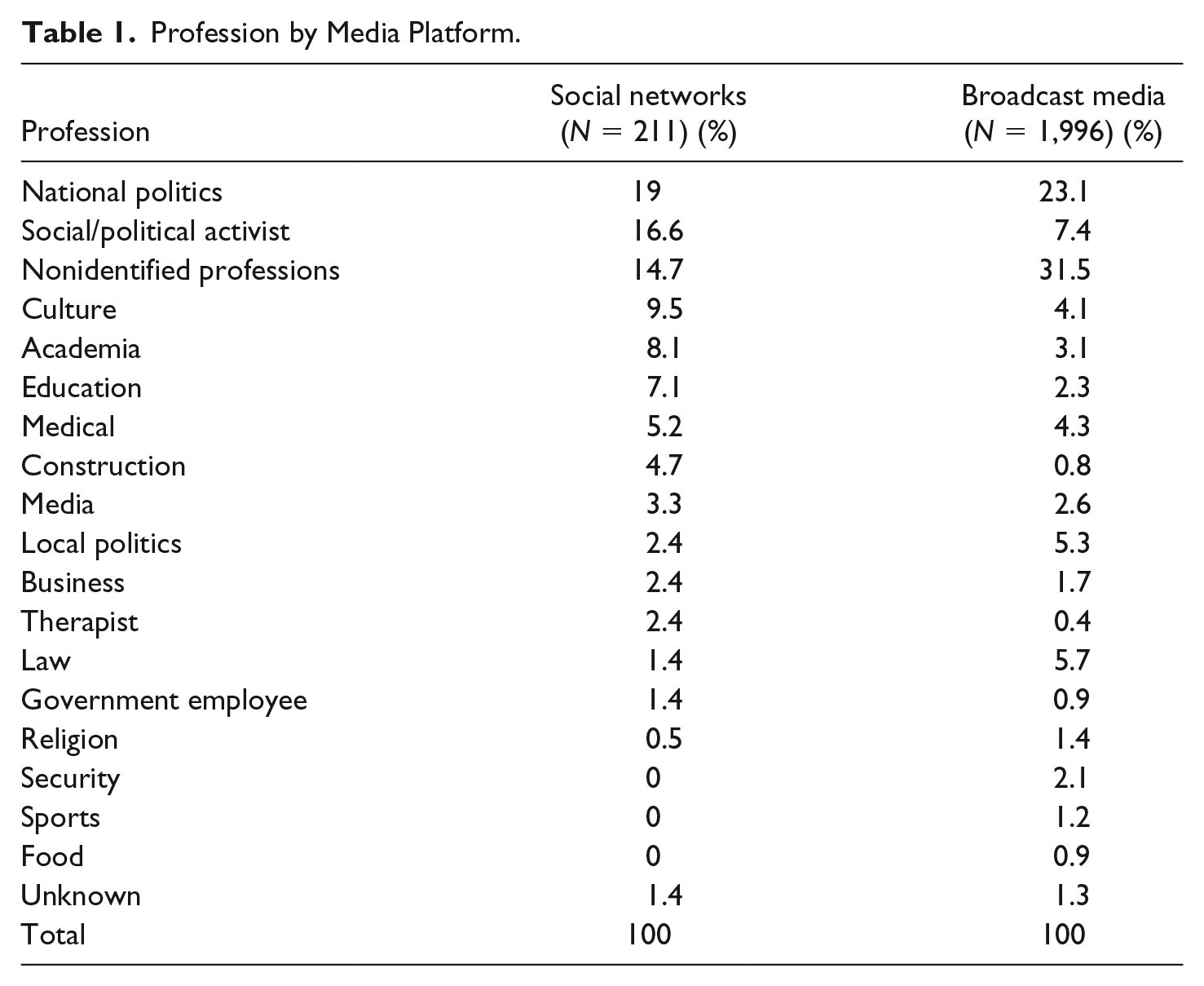
Table 1 presents the professional profile of Palestinian–Israeli interviewees. While Palestinian–Israelis were more likely to appear on broadcast media in less diversified professions such as politics (national and local), security, and law, they were more likely to appear on Facebook and Twitter in more diversified professions such as culture, academia, education, or as social/political activists. Furthermore, they were more likely to have an identified profession online than on broadcast media.
Profession by Media Platform.
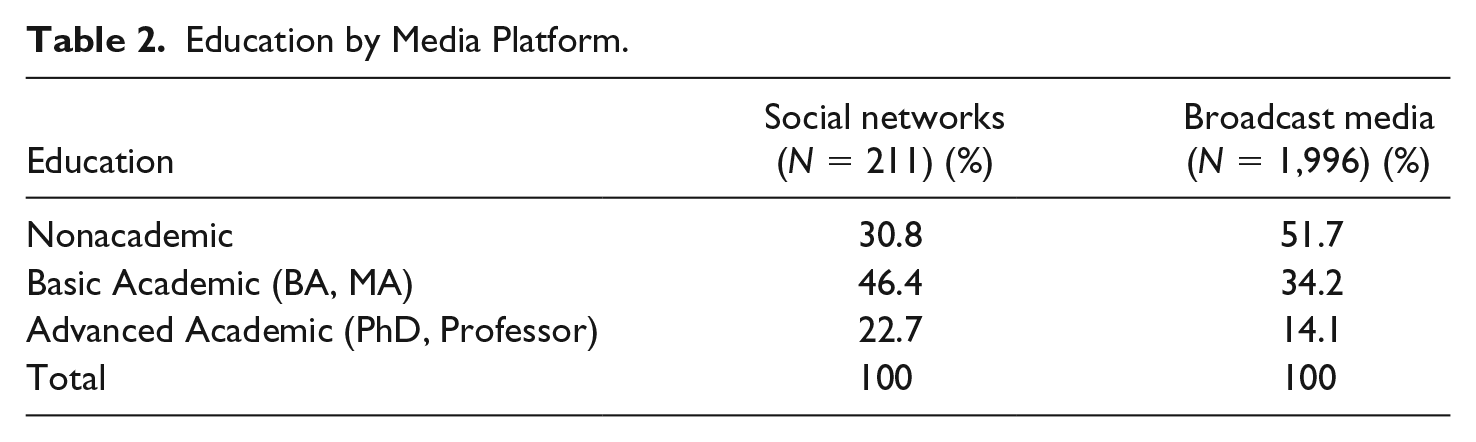
In Table 2, we see the educational profile of the interviewees. Palestinian–Israeli interviewees promoted on Facebook and Twitter were more educated than Palestinian–Israeli interviewees on broadcast media. This was true regarding both levels of education: basic academic education and advanced academic education.
Education by Media Platform.
Palestinian–Israeli interviewees promoted on social networks were more likely to appear as experts, relative to broadcast media (19% vs. 8.6%), though less likely to appear as having family relations relevant to the interview topic (1.9% vs. 11.5%).
Topics Discussed
We conducted cross-tabulations to determine differences in the topics discussed by Palestinian–Israeli interviewees: topic, population, context, order, land ownership, criticism of state institutions, criticism of the ruling political coalition and government, assigned blame, and Palestinian–Israeli deaths.
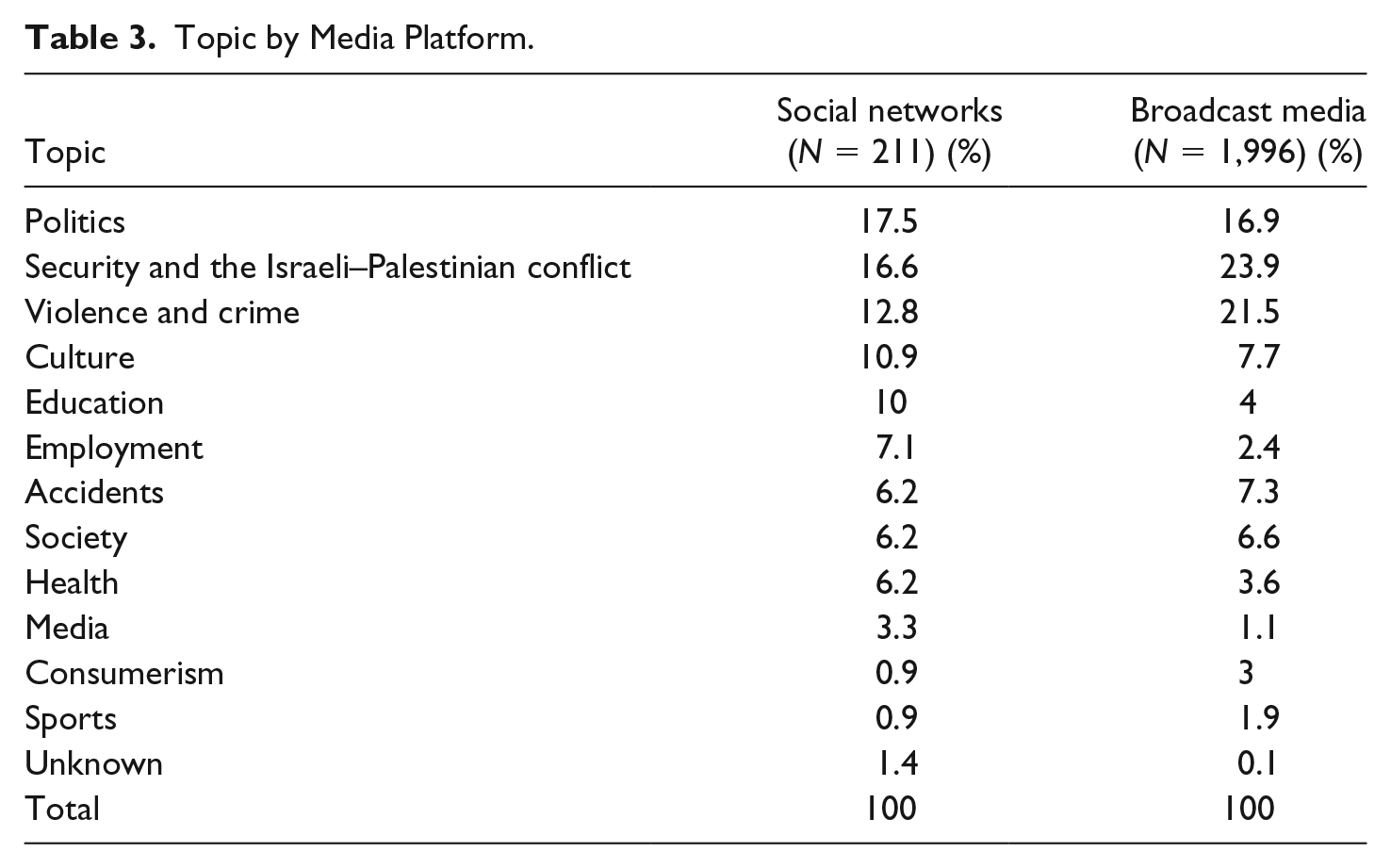
From Table 3, we learn the topics discussed by the interviewees. While Palestinian–Israelis were more likely to appear on broadcast media discussing “hard” topics such as the Israeli–Palestinian conflict and violence and crime, they were more likely to appear on Facebook and Twitter promotions in “soft” topics such as health, education, employment, and culture.
Topic by Media Platform.
Broadcast interviewees promoted on Facebook and Twitter were practically as likely as the total number interviewed on broadcast media to discuss the Palestinian–Israeli population (60.7% vs. 62.1%); however, they were slightly more likely to discuss the general population (28.9% vs. 24.8%).
Interviewees were virtually equally likely to appear in a positive context on Facebook and Twitter relative to the broadcast media (19% vs. 18.3%), and slightly less likely to appear in a negative context (68.2% vs. 75.2%). Furthermore, interviewees were slightly more likely to appear in circumstances of order on the social networking applications relative to the broadcast media (25.1% vs. 21.3%), and slightly less likely to appear in the circumstances of disorder (74.9% vs. 78.7%).
Land ownership was more likely to be discussed on broadcast media than on Facebook and Twitter promotions of those same interviews (0% vs. 5.8%). Interviewees on broadcast media were more likely than interviewees promoted on Facebook and Twitter to criticize state institutions (5.7% vs. 19.2%) and the government and parliament coalition members (8.1% vs. 11.8%). Palestinian–Israeli interviewees on broadcast media were more likely to appear in the assignation of blame for the violence discussed (30.3% vs. 38.7%), as well as to discuss the deaths of Palestinian–Israelis (5.7% vs. 21.1%) relative to those on Facebook and Twitter.
Discussion
In this study, we set forth to assess how the media resource was distributed over the social networking applications Facebook and Twitter relative to broadcasters. In doing so, we compare within the capabilities framework what each media platform can potentially enable people to do (Basu and Lopez-Calva 2011; Hesmondhalgh 2016a, 2016b). The data suggest that Facebook and Twitter feeds of broadcasters were more enabling of capabilities for Palestinian–Israelis relative to the content of the broadcasts themselves. A larger percentage of interviews made with Palestinian–Israelis was promoted on Facebook and Twitter relative to the percentage of total interviews conducted on the shows themselves. In addition, the ratio of professional profiles of Palestinian–Israelis in the Facebook and Twitter promotions was more positive than their ratio in the broadcasters’ fare. Thus, there was a higher likelihood of an interviewee having a profession and being more educated and more expert in the promoted content, than in the content itself. The tendency to promote interviews in which the Palestinian–Israeli interviewees discussed nonstereotypical topics was higher in the Facebook and Twitter promotional material as well. All this contributes to a more enabling environment for capabilities the media can serve.
Social networking applications are potentially more suitable for realizing capabilities, due to their technological characteristics (Schejter and Tirosh 2016). This is mostly due to the fact that they are more personalizable and, thus, potentially allow more applicability to capabilities, which are individualistic in nature, than mass media. However, these personalizable characteristics mostly contribute to the abilities of individuals to actively create content and to actively make decisions about the content they wish to consume as they deem it relevant for the realization of their own capabilities. Only to a lesser degree do these technological characteristics benefit individuals as they consume traditional media organizations’ content on social networking applications, because they are unable to influence the content that originates from traditional media on their broadcast networks, and their capacity to affect them on the traditional media’s online feeds is limited to promoting them through their own feed. The consumption of traditional media’s content online is very much unidirectional in the same manner it is in the traditional media.
Indeed, we cannot explain why media organizations portray Palestinian–Israelis at a higher percentage or why they appear in a more positive context on the broadcast media’s Facebook and Twitter feeds than in the actual shows. We can, however, make a number of hypotheses for this phenomenon: first, it could result from the media organizations’ work dynamics, possibly appointing younger staff to manage these feeds, and perhaps these younger workers are more prone to inclusivity and sensitive to diversity. Furthermore, we hypothesize that traditional media organizations might use these feeds mostly as a promotional tool, and perhaps the enhancement of a more positive depiction of Palestinian–Israelis serves for the branding of their media organization as more diverse and inclusive organizations than they really are. These broadcasters can continue providing their nonrepresentative fare to their more conservative audiences, while trying to attract younger audiences through the presentation of a less conservative face. This could be a result of both conscious or nonconscious decisions. Third, it can be assumed that interviews with Palestinian–Israelis have more of a likelihood to provide drama and conflict and raise consumption of news and current affairs programs. Finally, we hypothesize that the more positive and diverse content could be a result of the unique way in which content is delivered on social networking applications. Unlike broadcasts, in which individuals connect directly to the news source by watching television or listening to the radio, on social networking applications, the news content is actively passed between people (Greer and Yan 2010). Actively passing news content demands a higher level of engagement from individuals (Oeldorf-Hirsch and Sundar 2015); thus, the news content must be more indulging to individuals, to encourage them to share news content with their online “followers” and “friends.”
To answer these hypotheses, we recommend conducting future studies in which media organizations staff and management will be interviewed, to try and assess the process that goes into decision-making regarding promotional activities. In addition, even if underrepresentation and biased conceptualization of representation derive from conservative and hard-to-change media policies and habits, we demonstrate in this study that social networking applications can enhance the awareness to more representative content, enhancing the realization of capabilities.
Mass media are deemed a vital social resource for human flourishing and quality of life (Basu and Lopez-Calva 2011; Hesmondhalgh 2016a, 2016b; Sen 2005). However, as media consumption patterns have changed with technological developments, and many consumers have moved to consuming traditional media content online and digitally (Nielsen and Sambrook 2016), no longer does it suffice to examine traditional media on their broadcast platforms alone, and their activities on social networking platforms should be examined as well, especially as these applications are more disposed to enabling the active realization of capabilities due to their unique technological characteristics (Schejter and Tirosh 2016). In this study, we found that these applications were potentially more enabling of capabilities relative to the content of the broadcast media organizations for which they serve as a promotional face, with regard to the capabilities we identified as media consumption sensitive. Although we cannot explain this phenomenon, we recommend that regulatory efforts to promote diversity should not be limited to mass media activities on media broadcast platforms but include their networking activities as well, because the enablement of capabilities is the goal of public policy (Nussbaum 1997).
Footnotes
Declaration of Conflicting Interests
The authors declared no potential conflicts of interest with respect to the research, authorship, and/or publication of this article.
Funding
The authors disclosed receipt of the following financial support for the research, authorship, and/ or publication of this article: This study has been supported by a Career Integration Grant awarded by the Marie Curie FP7 program of the European Union (project #322207) and by the I-CORE Program of the Planning and Budgeting Committee and the Israel Science Foundation (grant no. 1716/12).
