







Abstract
YouTube-based ASMR (Autonomous Sensory Meridian Response) has become widely popular in South Korea as a readily accessible mode of self-care. However, ASMR scholarship in South Korea has largely overlooked a discussion of its engagement with gender norms. This essay fills the gap by analyzing South Korean male ASMRtists performing digital care through “boyfriend role plays” and “boy’s love (BL) role plays.” Probing into these examples from the perspective of digital gender, I argue that the ASMR’s haptic encounter has the potential to turn the ASMRtist, the audience, and the Internet itself into active performers rehearsing the possibility of subverting the offline society’s normative expectations of gender roles.
ASMR and South Korean Digital Care Culture
“How long have you experience insomnia? A couple of weeks, months, or years?” A bespectacled female doctor, with a stethoscope around her neck and gentle concern in her eyes, asks me in a soft voice. We see her name (“Park Da-ham”) embroidered in Korean above the pocket of her white doctor’s gown; on a table next to her sits an antique lamp and an organized tray of familiar disposable and stainless steel tools including Q-tips, brushes, tweezers, and tongs. On the wall behind her, we see a certificate of sorts. “Breathe deeply, like this,” the doctor says as she guides me through a calming breathing technique and places the stethoscope “on my chest.” A familiar euphoria of tingles slowly settles in, one that Miniyu ASMR—the first Korean ASMRtist on YouTube—would characterize as “feeling the brain drowsily tickling, as if entering a hazy dreamscape by a kind of possession” (YouTube 2015). Harry Cheadle (2012) of Vice also describes this sensation as “a kind of pleasurable headache that can creep down your spine” leading to a “a blissed-out meditative state”. Syncing with the voice, I eventually doze off into a relaxing slumber at some point in the fifty-one-minute session at Dr. Dana ASMR’s Sleep Clinic on YouTube (YouTube 2017c).
In the strangely performative world of YouTube-based ASMR, my spectatorial body is subject to an audiovisual cornucopia of role plays that offers the myriad affective bodily and psychological “tingles” colloquially referred to as noereugajeum (“brain orgasm”) or gwireugajeum (“ear orgasm”). When the performer gazes at me and whispers “Relax,” my body slowly complies. It is almost as if her invitation to relax takes on a performative cadence—words that do things through the very utterance, as J. L. Austin (1962) defined performatives in his speech act theory—but in addition to the words themselves, the compound mechanics and mise-en-scène of their delivery relax me. By listening with my headphones on, I, along with many others on the Internet, silently tune into the so-called ASMRtist (“ASMR artist”)’s solo performance of role-playing as a medical professional, personal tailor, massage therapist, and hair designer, among the many other creative roles that serve to induce my euphoria. The neurobiological mechanics behind such paresthesia—“tingles”—and its effects on the body are currently being actively researched. 1 The relative newness of scholarship on ASMR (the majority produced in the 2010s) can be attributed to a correspondingly recent ASMR boom in user-generated media.
The first piece of news coverage of ASMR in South Korea was a 2014 article in Busan Daily on its widespread use as a cheap and accessible do-it-yourself stress reliever: “High-stress reality issues including unemployment, corporate culture, and dating, have driven many into depression and anxiety-induced insomnia,” it claimed, citing South Korea’s nationwide recruitment agency JobKorea’s poll of 882 job seekers that revealed 92 percent of interviewees reporting themselves “highly stressed,” with symptoms including “anxiety (63.9%), depression (56.8%), insomnia (42.3%), and antisocial tendencies (31.4%)” (Yeo 2014). Significantly, then, ASMR entered the Korean popular culture as part and parcel of the widely popular hil-ling (“healing”) discourse with media attention paid to its purported “tingle effect” that helps ease insomnia and reduce stress. According to Jin Kyu Park (2017), the term hil-ling first appeared in 1996 in Korean news media and became synonymous with pursuits of selfcare and well-being. In no time, hil-ling grew into a cultural phenomenon as more people were interpellated by the notion of a “shared social suffering” derived from structural problems including “job market competition, insecure employment, low income, and social inequality.” (p. 383–84). In a famously broadband-wired nation that consistently tops the United Nations’ Information and Communication Technologies Development Index, cyberspace soon became the default conduit of ASMR; as Robert Koehler (2018) writes in Seoul magazine: “In a country as overworked, over-connected and chronically sleep deprived as Korea, many see ASMR-related content as an expedient way to relax, to give their brains a much-needed break”. Observing the exploding number of news articles that call YouTube-based ASMRtists “hil-ling content creators,” sociologists Joowon Yuk, Euna Kwon, and Shin Woong Yoon also argue that Korean popular media promoted ASMR as a cheap and accessible sleep aid, particularly for twenty and thirtysomethings plagued by an unprecedented youth unemployment rate, a resulting cutthroat chwijunsaeng (job applicant) life, and corporate burnout (2018, 325).
In other words, the surge of ASMR popularity in South Korea is symptomatic of the society’s structural problems. As such, it allows us to rethink the narrative of South Korea’s turbulent twentieth-century, going from a GDP per capita of below $100 in 1961 to $30,000 in 2015 (Trading Economics 2020). When neoliberalism became implemented as a crisis response to the IMF bailout of 1997, South Korean society embraced a “neoliberal ethos” shaping its social policies to align with values such as “employability, rehabilitation capacity, flexibility, self-sufficiency, and self-entrepreneurship” as measures to identify and prioritize differentiating “deserving” neoliberal citizens from the “undeserving” poor (Song 2009, 2). As a result, the entrepreneurial onus of having to keep up one’s social self—in regard to education, career-defining skill sets and physical appearance—fell squarely on the individual citizen’s shoulders, a responsibility fostered by the government, self-help books, and successful entrepreneurs (Cho 2009). In the culture of conformity that informs the lives of urban citizens heading from uniform-wearing school days to methodically stratified corporate jobs, the individualized onus of self-care seems to encourage the use of ASMR in addressing stress-related mental health concerns often stigmatized by the society. “I’ve suffered from depression and digestive issues, but I didn’t seek psychiatric help,” reported an anonymous interviewee for Busan Daily, “I was too worried that the medical record will work against me in the job market and corporate life” (Yeo 2014).
Such concerns inform the culture of do-it-yourself hil-ling rapidly propelling ASMR onto user-generated media platforms including YouTube and AfreecaTV, hosting the now-globalized mukbang (meokbang, “eating broadcast”) and nupbang (“lie-down broadcast”)—both genres frequently associated with ASMR. Catering to millennial single-person households marked by heavy work commitments, these media genres offer their viewers digital companionship; for example, mukbang (eating broadcast) features a person eating in front of the camera while talking to the viewers, many of whom are also solo diners after a busy day of work, finding comfort in “eating together.” Some mukbang broadcasters double-up as ASMRtists, focusing on making deliberate eating sounds that their listeners find comforting. Not surprisingly, then, ASMR is increasingly performed by celebrities and even politicians using a kind of “fan service”: renowned K-pop idol HyunA performed ASMR as a token of thanks after receiving ten million views of her single “Lip and Hip” on YouTube (2017b) in December; and Choi Sung, a member of the Democratic Party of Korea, uploaded an ASMR video on YouTube (2017a) in March for his constituents. In a society where more elementary school children now dream of becoming a fulltime YouTuber than a scientist—“YouTube content creator” was the fifth most popular vocation among elementary school children in 2018—it is striking to observe ASMR’s dominant place in self-broadcast media (Lim 2018).
Accordingly, the burgeoning scholarship on South Korean ASMR culture has explored its interrelations with digital care and media consumption. These endeavors redefine ASMR as a genre of “need fulfillment video contents” analyze its consumption trends (Kang and Cho 2020); assess the uses of ASMR in online advertising (Sin and Yun 2019); identify the patterns and demographics of ASMR use (Kim and Lee 2018); offer a sociological netnography of the most popular Korean ASMRtists (Yuk et al. 2018); assess the merits and limits of ASMR scholarship’s discussions of gender and sexuality (Kim 2018); and interpret the ASMR soundscape through Merleau Ponty’s phenomenological notions of perception (Chang et al. 2016), among other interventions. Numerous existing studies on ASMR in South Korea focus on demystifying the “care” aspects of ASMR’s mainstream popularity and transmedia applications in adjacent capitalist forms such as advertising. While scholars in North America and the U.K. have explored the implications of gender and sexuality in ASMR (Andersen 2015; Bjelić 2016; Iossifidis 2017; O’Meara 2019; Waldron 2017), with the exception of Sujeong Kim’s critical work, scholarship on ASMR in South Korea has yet to directly address the cybercultural phenomenon in terms of gender and sex.
This article fills the gap by exploring how South Korean male ASMRtists’ performances of care redefine, reinforce, and/or resist offline gender norms through the notion of digital gender. Viktor Arvidsson and Anna Foka (2015) define digital gender as an “interdependent origination, or shared becoming, of new social practices and gender roles around new uses of digital technology.” Digital gender reconceptualizes the Internet not as a passive arena but as a complicit doer whose specific uses “[take] part in the materialization of race, gender, and class. . . actively [working] to maintain or transform institutionalized injustice.” In other words, digital gender does not simply expand the research of gender into a neutralized cyberspace but reinterprets the World Wide Web and its technologies as inherently political entities that “do” gender in ways complicit or subversive to hegemonic gender orders. Building upon this theorization, Nishant Shah (2015) further argues that digital gender can let us challenge “the human-computer interaction discourse which thinks of the body and technology either through an aporetic relationship or through access and usage.” Specifically, Shah suggests that we understand digital gender as “a moment of configuration rather than a finite resolved category” by using it as a wedge to “combine the protocols of technology with the metaphors of the body, and look at them as inseparable, inextricable, and inalienable.” As an active method of doing ASMR studies, then, digital gender allows us to rethink and rewire the relationship between body and technology.
Aligning with Shah’s provocation, I specifically look into how some male ASMRtists reflect, refract, or resist contemporary South Korean society’s normative expectation of gender roles. Addressing how gender is performed on the World Wide Web is a particularly urgent inquiry in South Korea, a nation whose highly developed cyberculture calls for more interrogations into how online technologies reproduce and/or interact with offline systems of power in regard to gender normativity. 2 This article offers one such interrogation through the perspective of digital gender, probing how the ASMR’s haptic encounter has the potential to turn the ASMRtist, the audience, and the Internet itself into active performers rehearsing subversive possibilities.
ASMR, The Digital Gender Divide, and Feminized Caretaking Roles
ASMR, a pseudoscientific acronym for “Autonomous Sensory Meridian Response,” was coined by Jennifer Allen, who founded the first Facebook group dedicated to the transient euphoria of brain tingles in 2010. She coined the term to foster a sense of community among those that “felt” ASMR, while distancing themselves from frequent erotic associations. “A phrase that uses words tied to sexual or taboo activity. . .[tends] to cause people to form opinions about the validity or intent of the subject at hand,” Allen revealed in an interview with Craig Richard (2016) of ASMR University on the neologism “ASMR”: “Using a ‘clinical’ word was the best option to improve how the burgeoning community would feel about using and telling others about the word.” If Allen wanted to establish a collective legitimacy around ASMR, Joceline Andersen (2015) points out how the clinical-sounding term might have motivated a recent surge in ASMR research within the science community: “using scientific jargon locates the currently nonnormative ASMR experience as potentially universal by locating its origins in human biology” (687). Perhaps the need to legitimize ASMR characterizes its ephemeral and intangible nature—prior to its proliferation on YouTube, it primarily took place in chance encounters such as visiting a hair salon on a quiet afternoon, or watching the rain while someone brushes one’s hair. Only by virtue of user-generated media did ASMR enter mainstream public discourse, taken up by fulltime ASMRtists on YouTube who made it readily accessible. ASMR itself is not a new phenomenon; but YouTube-based ASMR, and the “ASMRtist,” are.
Also new is the ASMR community’s need to establish the phenomenon as “not sexual,” notes Andersen: “In interviews, comments, and reflective videos on their craft, [ASMRtists] repeat again and again that the ASMR experience is ‘unsexual’, ‘totally unsexual’, and ‘not at all sexual’” (692). We can trace this impulse to dissociate ASMR from its possible semblance to webcam models in the gig economy of digital porn culture. For instance, a popular visual convention of the ASMR “mouth sounds” video involves a close-up of the whispering into a microphone placed in the center of the frame. The imagery of sound waves being transmitted from a young woman’s orifice into a phallic mouthpiece invariably leads to an association with the signature point-of-view shots in the livestream video chat rooms of popular camming sites like CamSoda or LiveJasmin. Promulgating the semblance of a personal connection between the performer and the audience through chat rooms, speech, two-way cameras, and a tipping system, the global camming industry grew into a multibillion-dollar industry in the 2000s, with sites like LiveJasmin garnering 25 million unique visitors per month in 2013 (Rabouin 2016), and some performers making twenty thousand US dollars per month (Breslin 2015).
While the global cam performer demographic has diversified from its initial “camgirl” model to include “women, men, straight, gay, trans,” as well as couples, the demographic of popular YouTube-based ASMRtists is yet quite gendered; “usually female” (Andersen), more specifically “young, female, and good-looking in a nonthreatening way,” (Cheadle) and “white female” (Waldron). Among Korean ASMR contents, sixty-five percent of the twenty most-watched videos in 2017 were made by women, and seventeen of the twenty most popular ASMRtists are women (Yuk et al. 2018). Not surprisingly, then, the predominantly female ASMRtists seem acutely aware of the frequent stigmatization of their acts as digital sex work—South Korea’s Dana ASMR emphasized that she “wants people to see ASMR as a form of art and stop associating it with adult-only contents” (Jeong 2016). On a broader level, this fear of gender bias is also related to the overall digital gender divide of the world Wide Web, which is not only globally male-dominant in terms of user access and skill level (Iglesias 2020), but also in terms of its design and architecture. In the technological sector, “only 12 percent of the leading machine-learning researchers are women” (Chin 2018), a fact that a 2019 report on digital gender equality from UNESCO argues serves to “perpetuate and exacerbate gender inequalities, as unrecognized bias is replicated and built into algorithms and artificial intelligence” (West et al. 2019, 19).
Amid this digital gender divide, discussing gender in the YouTube-based ASMR is further complicated by the fact that popular ASMR content is often gendered in ways that are consistent with offline gender norms. Specifically, ASMR role plays often re-create domestic and vocational roles of care giving conventionally performed by women: brushing hair, giving massages, ear-cleaning, cooking, sewing, ironing, and folding laundry, as well as reenactments from women-dominant service professions including flight attendant work, nursing, cosmetology, and dental hygiene. These role plays seemingly reproduce the offline society’s gender norms by turning very real female labor into fantasies of care giving. Specifically in South Korea, the predominantly female ASMRtists’ function as dijiteol dolbom nodong (“digital care labor”) cannot be separated from socially prescribed and thoroughly feminized unpaid domestic labor (Kim 2018; Yuk et al. 2018). Despite having the highest tertiary education rate among OECD nations for women aged 25 to 34 in 2019, South Korean women often fall out of the workforce due to discriminatory work policies regarding pregnancy and childbirth (Draudt 2016). Seungsook Moon (2005) further argues that such economic construction of gender roles is historically justified through South Korea’s masculinized nation-building narrative. “Men’s military mobilization and economic mobilization were intimately intertwined,” she illuminates, arguing that this “contributed to the consolidation of the modern gender hierarchy, organized around the division of labor between man as provider and women as housewife” (p. 12). And, in turn, this division of labor legitimizes corresponding patriarchal values that construct what R.W. Connell (2005[1995]) defines as “hegemonic masculinity,” or the “configuration of gender practice which embodies the currently accepted answer to the problem of the legitimacy of patriarchy, which guarantees (or is taken to guarantee) the dominant position of men and the subordination of women” (77).
The women’s onus of caretaking, then, is symptomatic of a systemic gender inequality that has been slow to change despite the consistent efforts of feminist activists and civil rights organizations since the 1980s. It is within this South Korean sociocultural context that Sujeong Kim problematizes ASMR’s co-option of heteronormative gender roles—and consequential reification of gender binarism—which dangerously re-creates the gendered system of oppression that characterizes off-line society. Taking up Kim’s provocation through the concept of digital gender, then, the next section will explore how Korean male ASMRtists perform a conventionally “feminized” labor of care. I argue that these performances allow us to rethink the synesthetic experience of the ASMR as an intersubjective, potentially subversive gender role reversal. Specifically, how can we use the notion of digital gender to reclassify ASMR from a solo experience to a kind of virtual theater where a plural network of users accessing the video engage in (“play”) multiple iterations of the ASMR encounter—enacted by the ASMRtist, the many audiences, and the YouTube platform itself?
Case Study A: UNO ASMR’s Boyfriend Role Play
“Jagiya (“honey”), it’s been a while. I spent all my days missing you, waiting for the weekend to come so that I could finally see you,” a wide-eyed young man in his twenties whispers in Korean with a bashful smile, his pale complexion accentuated by dark, slightly curled bangs covering his eyebrows. He wears a string of white earphones and a fuzzy black sweater against a grey blank wall. Placed in front of him but hidden from viewers is a Zoom H6 microphone. Monochrome colors and his soft voice envelop the viewer, inviting a slow doze into the warm winter atmosphere for the next thirty-seven minutes. “I know you’ve been so busy and stressed lately, and haven’t been able to sleep,” he speaks in a comforting whisper, “I want to help you fall asleep at home today.” He softly chatters away—asking about my day, if anything particular happened at work, apologizing for bringing up work, and talking about the mundane little moments in life he has been meaning to share. “I have a special surprise,” he says, and shows me lavender-colored square soap bars. With a small stainless peeler, he starts to carve one close to the microphone. “I hope this helps you catch up on the sleep you haven’t been getting—I’ll head home after making sure that you’re asleep.”
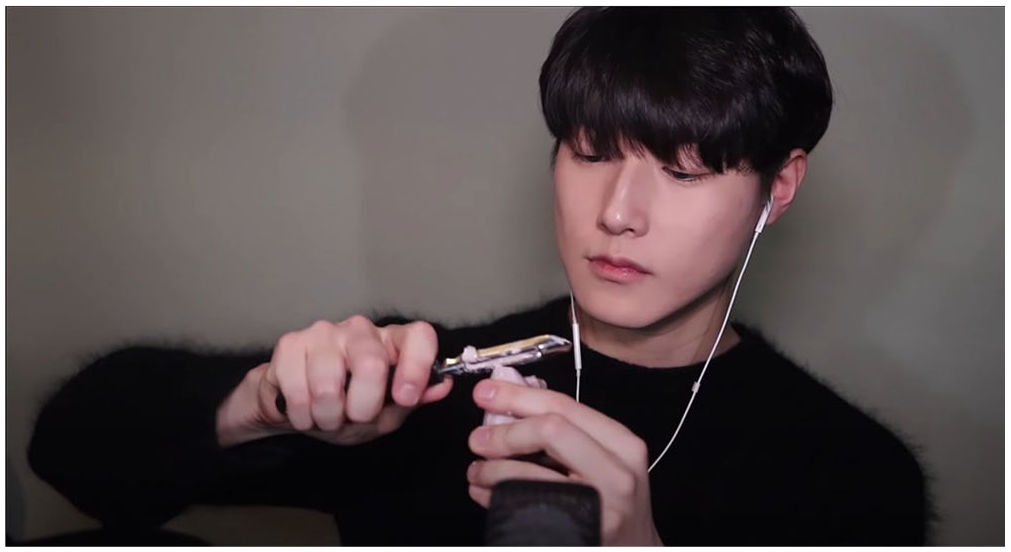
UNO ASMR’s soap-carving role play, YouTube screenshot (YouTube, 2018b).
Since February 2018, UNO’s “Soap-carving boyfriend role play ASMR” has been viewed over seven hundred thousand times on YouTube (2018b). An ASMR aficionado would see why, given the thoughtful construction of its (non)events; subdued monochrome colors allow one to focus on the action without distractions, and UNO’s quiet voice over the rhythmic sound of a knife cutting soap creates a cozy atmosphere—as if dozing off after a tough outdoor activity on a cold winter’s day. For thirty-seven minutes, the listener is subject to audiovisual triggers of hands, soap carving, perfume spritzing, and soft-speaking. Role-playing the ideal male companion thus is one of the most popular gambits among South Korean male ASMRtists, following the general formula of a “boyfriend” putting in voluntary emotional labor to soothe and comfort “the viewer” (often referred to as “girlfriend”). An ideal caring boyfriend has different iterations on YouTube, according to varying definitions of idealized heterosexual masculinity; American ASMRtist ManlyASMR, for instance, shows off shirtless push-ups, fixes bicycles, treats “babe” to a date night, and even simulates sexual foreplay—playing out a macho sex appeal for a presumed heterosexual female audience, which make up about seventy percent of his total viewers (Taylor 2018).
UNO’s visualization of the boyfriend figure, on the other hand, takes a more platonic and sensitive approach. Centralizing a well-groomed and handsome man in black, UNO leads viewers to focus on the brighter colors in the video’s visual composition—silver carving knife, the man’s hands, and his intent face looking down at his hands—as the repetitive, monotonous soundscape of soap-carving continues for the next thirty minutes. Once he starts soap-carving, he rarely looks up; the main focus of the video becomes the sound of carving itself, coupled with the gestures and the whispered “chatter” about the mundanities of daily life. This ASMR boyfriend is romantic without being titillating, turning our attention to the materiality of the interaction of the objects (soap, knife) with his gestures, without heightening the physicality of his own presence.
In other words, the ASMR boyfriend’s sole emphasis is on the eroticism of the haptic audiovisual encounter itself—that between the pixelated performer (UNO) and the sleepy-eyed co-performer (viewer) “touching” one another through synesthetic euphoria across disjointed spatiotemporal dimensions, in contact by vision and the traveling wavelengths of sound from the binaural microphone to the headphones. Soap-carving is but one example among an oeuvre of repetitive hand gestures UNO uses to generate a soundscape; hands-rubbing, object-tapping, hair-brushing, making mouth sounds, microphone-touching, and others performed according to requests from his 356,000 YouTube subscribers. Especially in object-centric role plays featuring various props, the ASMR boyfriend evokes sokkumnori (playing house), a children’s game involving sokkup (dishes and kitchen utensils) for nori (play). In so doing, the ASMR boyfriend doubles and triples up as a partner, a caretaker, and a childhood playdate, closely attuned to the qualities of innocence and domesticity. In this process, he also demonstrates the ability to care, emote, chatter, and nurture—qualities not conventionally associated with the authoritative and patriarchal ideals of masculinity.
Instead, the ASMR boyfriend caters to the heterosexual female fantasy of domestic male companionship built on trust and understanding of the millennial working woman’s need for respite from the competitive neoliberal world. In this encounter, we are reminded of what Laura U. Marks (2000) calls “haptic visuality,” or how a certain materiality of film images can engender a feeling of touching (and being touched) by seeing, so that the human eyes can “themselves function like organs of touch. . . [drawing] from other forms of sense experience, primarily touch and kinesthetics” (162). In the boyfriend ASMR, seeing-as-touching is coupled with hearing, blurred into the virtual gender role reversal in the moment of “streaming” (transmitting and receiving data in a continuous flow) the “video” (moving visual images), merging into a compound experience that synesthetically connects the human body with technology. If Laura Mulvey’s (1975) theorization of the “gaze” in narrative cinema is predicated on the unidirectionality of the male voyeur gazing (pleasuring himself) at the sight of the passive feminine subject, the ASMRtist and viewer co-constructively pleasure one another through a haptic exchange—a “queer” moment of virtual encounter, perhaps, characterized by a promiscuous multi-sensory exchange beyond the spatiotemporal dimensions of the offline world and its rigid definition of sex as “penetrative, heterosexual, genital intercourse” (Waldron 2015). Put another way, the male ASMRtist’s performance of care not only reverses the conventional gender roles ascribed to caretaking but also complicates the conventionally gendered gazer-gazed dyad by prioritizing female visual pleasure.
What happens, then, when male ASMRtistry geared toward female visual pleasure turns overtly sexual, especially within the particularly gendered narrative of BL (“Boy’s Love”)?
Case Study B: Etoile ASMR’s Boy’s Love Role Play
Initially created in Japan, the fictional media genre of “Boy’s Love” (BL) became popular in South Korea as part of a larger dong-in munhwa (“amateur writer collective culture”) in the 1980s and 1990s through manhwa (comics), BBS novels, Internet-based fan fiction, and webtoons. 3 In the 2000s, BL became co-opted into the highly commercialized industries of narrative cinema and K-drama. Primarily produced and consumed by women in their teens to thirties referred to as dong-in-nyeo (“women in dong-in munhwa”), BL is widely known as a “women’s genre” that reimagines attractive male characters in homoerotic relationships for a presumed heterosexual female audience. Critics of BL point out how it sexually co-opts the queerness of men into heterosexual relationships, “making a spectacle of homosexuality for heterosexual female consumers” (Kwon 2016, 1576). Proponents of BL, on the other hand, note its political construction of a distinct social, cultural, and economic space within South Korea’s male-dominated society where women create and publish narrative media for the visual pleasure of other women (Kim 2020, 401).
The YouTube-based ASMR BL role play, on the other hand, is an audio-only male solo performance akin to radio erotica. One prominent creator of these role plays is Etoile ASMR, a heterosexual male and relative newcomer on YouTube when I interviewed him in January 2019. Having uploaded eleven ASMR videos over a span of two weeks, Etoile had just over seventeen hundred subscribers; of his eleven videos, six were BL role plays of erotic scenarios without sexually explicit content. The scenarios included closeted gay friends’ erotic men’s room encounters and—perhaps the most taboo scenario in South Korean society—a military sergeant and private having a nighttime rendezvous. As of April 2020, Etoile had three separate channels with over 140,00 subscribers combined, with such subcategories as BL, boyfriend, dom/sub, horror, furry, historical, and adults-only (sexually explicit). In our personal interview, Etoile indicated that only a slight majority of subscribers were female, and he was pleasantly surprised to find many males tuning in. “Although I haven’t received many comments from men, I do wonder whether a lot of these men are gay,” he said. “I’d be delighted to have a gay male audience, especially since BL in Korea is mostly regarded as a women’s genre” (2019).
Unlike most ASMRtists who actively resist any association with sex, Etoile believed he served a particular demand for those looking for wish fulfillment in ASMR erotica: “Through creative audio-drama role plays,” he told me, “my goal is to fulfill the erotic fantasies of my listeners, inducing stimulus, excitement, and titillation.” Etoile’s voice literally and figuratively adds complexity to the BL genre, disrupting its dominant discourse as a straight female subculture generated by straight female creators. Perhaps one may criticize Etoile for being a heterosexual male inserting himself into a women’s genre or for capitalizing off of someone else’s queer desires. I would argue, however, that Etoile’s BL role plays expand upon BL’s conventional media texts (BBS novels, Internet fan fiction) and images (manhwa, webtoons) by replacing the role of seeing with hearing. Demonstrating how sound alone can generate a titillatingly subjective—and intensely queer—experience of pleasure (literally gwireugajeum, or “ear orgasm”), Etoile’s whispered homoerotic narratives deliciously subvert the patriarchal social order through evocative, fleeting sounds.
This ambiguous aural space also offers the possibility of reconstruing BL ASMR role play in terms of digital gender. Discussing how online slut-shaming discourses operate on a “perpetual re-creation of the gender digital divide,” Nishant Shah problematizes the conventionally aporetic bifurcation of the gendered human body and clean, blame-free technology: “The gendered, the sexual, the messy, and the dirty parts of our gendered selves are considered outside the fold of the digital—our bodies remain dirty, bearers of shame, and technologies, clean” (2015). Extending the metaphor of the human body into the technological workings of the Internet, Shah suggests an alternative configuration in which humans surfing the Internet and the online interfaces themselves co-constructively perform digital gender, complicit in a sticky provocation that “to be digital is to be slutty”; hence, “we are all sluts” as users of the inherently promiscuous World Wide Web. This reconfiguration demands a new way of seeing technologies through bodily metaphors, as well as the human beings using them in the inter-net ecosystem—the users who, by virtue of this connection, are accountable in their cyber-doings.
To take up this provocation is to reconstrue Etoile’s ASMR audience not as anonymous viewers but active role-players of male-on-male erotic scenarios. As such, the viewers not only participate in Etoile’s erotic role plays but also chip in on generating future ones by requesting specific scenarios on Patreon, a membership-based subscription platform. In other words, it is the audience that turn Etoile’s YouTube channel into “an intense emotional experience” and a “social space” by bonding over the ASMRtist’s acousmatic narratives (Strangelove 2010, 4). Shifting the focus of ASMR’s effects on the individual body to the plural bodies/network of users “playing” the uploaded multimedia, then, is to think of YouTube-based ASMR as a mode of digital histrionics co-constructed by multiple acts of technology performed by the ASMRtist, the audience, and the platform of YouTube itself. Only thus, may we begin to reinterpret Etoile’s acousmatic BL stories not as static fantasies divorced from the real world but as pieces in an active virtual theater that continues to rehearse its subversive possibilities.
Coda: ASMR and the Eroticism of Everyday Life
While the ASMR boom in South Korea may attest to how the neoliberal society puts the onus of hil-ling onto individuals in lieu of fixing actual structural problems, it is here to stay. The widespread use of ASMR among women and men well into their thirties calls for more research into its social, cultural, and political implications. This article has probed male ASMRtists’ performance of “boyfriend” and “BL” role plays in terms of digital gender, hopefully as a starting point for more in-depth future analyses of how digital streaming mechanisms and user operations might be reimagined to subvert the conventional power dynamics of gender and sexuality in South Korean society.
As exploratory as this study remains, I want to conclude it by stressing how the most ordinary of “non-erotic” ASMR scenarios may reveal the eroticism of everyday haptic encounters under the magnifying (amplifying) glass of binaural microphones. Marks theorizes the erotic as “the ability to oscillate between near and far,” not only bridging the distance in space and time, but also in the affective realm of trusting a complete stranger by entering into an imagined relationality: “What is erotic is being able to become an object with and for the world, and to return to being a subject in the world; to be able to trust someone or something to take you through this process; and to be trusted to do the same for others” (Marks 2002, xvi). This platonic yet deeply sensual bond embodies what Andersen characterizes as somewhere between mundane pleasure and transgression: “The ASMR community falls precisely into this border zone where ‘the spillage of eroticism into everyday social life seems transgressive in a way that provokes normal aversion’” (2015, 691). Whereas YouTube’s spatiotemporal distance allows one to engage and disengage from ASMR at any point, what ultimately allures with its suggestion of distant intimacy is the way in which ASMRtists promise a trusting relationship perfected by the viewer’s seeing-touching.
Round ASMR, a Korean male ASMRtist who garnered twenty thousand followers within one year of uploading his first video on YouTube, demonstrates this subtle eroticism of mediated relationality through his “friend” role plays. In our 2018 e-mail interview, Round explained that he prefers performing a trusted friend and companion rather than a more specific romantic love interest so that he may “comfort as many people of all ages and walks of life as will visit [his] channel.” Especially informed by how natural and ambient sounds can create new and imagined worlds, Round’s videos not only include the usual ASMR repertoire taking place indoors but also an extensive array of outdoor and mixed-location spaces. Whether it be the bustling streets of Seoul, unnamed rural towns, a quiet sake bar on a rainy evening, inside of a tent in a forest at night, or a windy winter beach—Round takes the viewer through his life, as one would a best friend or the closest of kin. Coinhabiting the “real” spaces that blur the lines between lived life and virtual role playing, then, the semblance of intimacy assumed with the viewer is ever more present in the ordinary soundscape transmitted through the binaural microphone; it is undergirded, once again, by the erotic mechanics of trust.
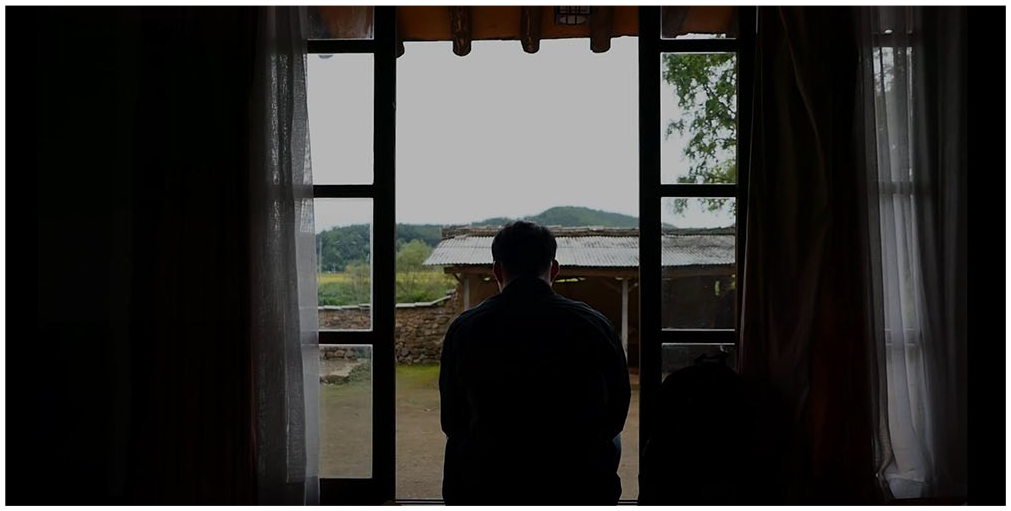
Round ASMR takes viewers to a hanok (traditional Korean house) in a rural town (YouTube, 2018a).
Trust in the digital human connection, more than ever, rings potent as I write this conclusion during the historically unprecedented global lockdown of 2020 due to the COVID-19 pandemic. Quarantined in my living quarters, I am struck by the imminent relevance of distant intimacy offered by YouTube-based ASMR. Using seeing as a means of touching and being touched, one entrusts the ASMRtist to lull one to sleep, willingly “succumbing” to a relaxed flow state; this illusion of relinquishing self-control, then, is built not only on an inherent trust between two digitally mediated individuals, but more critically on a trust of the digital media itself—replacing, perhaps, life’s truly gratifying human experiences with a blue light–emitting screen. As a matter of fact, critics of ASMR cyberculture point out that it normalizes a distant intimacy—one that can never substitute for a real human bond. “The subliminal message in these videos is that the viewer needs someone to take care of them in order to fall asleep, and that’s a notion we try to fight against in mental health,” states Caroline Fleck, further retorting: “Being alone with a guy in your room when you’re having trouble sleeping is not going to look like that” (Wylde 2019). Whether ASMR might foster unhealthy expectations of relationships in real life is an inquiry beyond this essay. But one thing is certain; the concept of digital gender lets us understand that tuning into ASMR is far from being alone with a guy in a room; instead, it is to join a global tribe of ASMR users for an experience of shared intimacy, community, and accountability that often proves elusive in real life.
Footnotes
Declaration of Conflicting Interests
The author declared no potential conflicts of interest with respect to the research, authorship, and/or publication of this article.
Funding
The author received no financial support for the research, authorship, and/or publication of this article.
