







Abstract
In a diverse media ecosystem of transitions and integrations, this research uses polysystem theory to conceptualize the integration of alternative media systems within their mainstream media counterparts. These interactions are examined using interviews and participant observations through three case studies—(1–2) Integration of two independent web-content creator groups into mainstream Israeli television system and (3) integration of ultra-Orthodox filmmakers into mainstream Israeli cinema system. The findings show that stiff and flexible systems are two main forms of characterizing relations between alternative and mainstream systems—defined based on the specific interests and implications for each media system, including integrated content, producer perceptions, and audience reception. It includes themes of recognition, conservatism, novelty, freedom, and authenticity. The interactions reveal processes of diffusion or symbiosis of the source system’s products. The findings contribute to a theoretical model of media interactions that offers ways of examining and defining the characteristics of media system interactions.
Keywords
Introduction
Traditional mainstream media systems, such as network television and the motion picture industry, undergo frequent changes and adjustments. These occur to deal with multiple competitors, to remain relevant, and to be perceived as innovative in the face of media culture changes caused mainly by technological developments (Bolter 2019; Doyle 2016). Broadening of Internet bandwidth has led to transformations in the way television is distributed and consumed. Changes in media have been defined by researchers as the beginning of a new television era—a “post-network era” (Lotz 2007) or the “TVIII” period (Jenner 2016). It includes changes in viewing culture (Jenner 2015; Strangelove 2015), and an increase in consumption of independent content, which also known as “Open tv” (Christian 2018a). Streaming has also led to the development of home theater watching, challenging the continuing power of Hollywood studios (Hadida et al. 2021) and affecting the popularity of watching movies in theaters.
The increasing supply of visual media content, changes in viewing habits, and growing consumer preference for streaming services are having a disruptive effect on traditional network television and the movie industry. But instead of eulogizing traditional media systems or announcing new eras, this research notes that adjustments are being made due to this situation. To face this competition and remain significant players in the mega media system, a key strategy is the integration of media content and actors from other media systems. This includes, for example, adaption of alternative independent web-series to network TV series and expanding content supply with alternative content of minority or ideological groups (Boyle 1997; Christian 2018b). It also includes incorporation of web-content creators and Internet celebrities (social media influencers) into TV shows.
The strategy of transitions of actors and content from different media systems is at the center of this study, represented as a transition from alternative to mainstream media systems. Out of these two main systems, three different study cases will be examined that relate to the film, television, and new media systems—the integration of alternative-community-religious filmmakers to the mainstream (secular) Israeli cinema system, comedians who create web-series, and Internet celebrities who integrate into Israeli commercial television.
This study breaks new ground by incorporating a dynamic functional theory into media studies—Polysystem theory (Even-Zohar 1990), which is based on relational thinking. It used in contrast to common theoretical perspectives that examine encounters between old and new technological media platforms, such as convergence theory (Aharoni 2021a; Jenkins 2006, 2014) or relations between new and old cultural actors in a single media field such as Bourdieu’s (1993) field theory. Both examine the implications of these transitions on only a single system/field, usually one that absorbs new actors or represents a new technology, without examining the mutual implications of the encounters on each system separately. This new theoretical approach proposed here seeks to address diverse contexts in a holistic approach that refers to various dimensions—social, political, commercial, and media consumption—all relevant to the integration of media systems, which are also explored on their corresponding epistemological and temporal levels. That is, the basic values of the systems are also examined compared to temporary conditions that allow for change or preservation of the existing systems being examined.
This research seeks to characterize, classify, and conceptualize the characteristics of these transitions and their implications for all individual systems involved, comprising the two mega systems of mainstream vs alternative media according to polysystem theory. That is, it examines the reciprocal and parallel implications for all five media systems involved in these transitions: Ultra-Orthodox community cinema, Israeli cinema, independent web-content production (web-series and Internet celebrities), and Israeli network television.
Based on the findings, I offer a theoretical model of media system relationships that relate to components such as similarity of media system types as well as epistemological and temporal interests that encourages or harden integrations and their implications for the two media systems. Accordingly, the model defines the media systems in terms of stiff or flexible systems and the products of integration in terms of symbiosis or diffusion.
Polysystem Theory
Polysystem theory (PST) is a continuation of a dynamic functionalism approach, which is based on relational thinking to analyze socio-semiotic phenomena (such as language, literature, television, and films) in the field of social action (Even-Zohar 1990, 2010). PST examines the relationship between organizations and actors in an open, dynamic, and heterogeneous multiplicity of social and cultural systems.
PST’s main goal is to detect the laws governing the diversity and complexity of phenomena, such as the interactions between different media systems, in a multiple system. The various systems intersect with each other and partly overlap, using different options, yet functioning as one structured whole—the main system, whose members are interdependent (Even-Zohar 2010, 42). Thus, any isolatable section/system of culture may have to be studied in correlation with other sections/systems in order to better understand its nature, function, and repertoires.
The study of relations between systems that are perceived to be different and opposite, such as alternative and mainstream media, is important, because, according to PST, it is a crucial part of a system to remain relevant and develop, as Even-Zohar claims: “Without the stimulation of a strong ‘sub-culture’, any canonized activity tends to gradually become petrified” (Even-Zohar, 47). In these intersystemic relations, there is a target system, which is the receptor of new elements and members, and a source system, the provider of new content and members (Codde 2003, 114). Complex relationships take place between them in accordance with other social contexts.
The uniqueness of this theory is that it perceives systems as open and heteronomous (Codde 2003, 107–8) in contrast to Bourdieu’s (1993) field theory. Whereas field theory focuses on the positions of agents in an autonomous field, treats the various fields of symbolical goods as autonomous entities, and analyzes their internal field-specific characteristics, PST tends to focus on changing positions of models, which entails the movement of creators and consumers of the cultural fields in question. It also examines the implications of system integration for the two systems and the broad contexts that lead to these relationships.
Using terms of center and periphery for this relationship suggests that any cultural system will try to preserve its viability through internal, dynamic reshuffling of its central and periphery elements, as well as adding elements from internal or external periphery sources. That is, systems undergo a process of renewal via repertoires imported from neighboring systems (Codde, 114). Accordingly, in the present study, the focus is on the interactions of mainstream (target central system) and alternative media (source peripheral system) and their implications. This analysis contributes new theoretical insights to the nature of relations between target and source systems and their effects.
PST also uses concepts of stasis and dynamism as well as closure and openness to characterize systems (Even-Zohar 2010, 40). The present study adds the concepts of flexibility and stiffness in epistemological and temporal dimensions to express the range and plural possibilities in different contexts. For example, dynamic systems can be epistemologically stiff to changes that do not conform to basic values. Accordingly, epistemologically static systems can be temporally flexible and open to changes that fit their basic perceptions.
Alternative and Mainstream Media—From Binary to Converged Mediascape
Theoretically and historically, alternative media have been defined by their ideological difference from mainstream media, their relatively limited scale of influence in society, their reliance on civil production, and their connections with social movements (Kenix 2011). It is the media which also refers to minority or marginalized groups in society, categorized as independent, amateur, and non-corporate media, which produces and distributes content that does not appeal to the vast majority. Alternative media is perceived as part of an autonomous media system that is constituted by its own rules (Atton 2001).
Mainstream media has been defined in contrast to alternative media characteristics: situated within the ideological norms of society, enjoying a widespread scale of influence, relying on professionalized productions and producers, appealing to the largest possible number of people, and connected with other corporate and governmental entities (Kenix 2011).
Alternative media is a framework for diverse and different types of media, such as radical, guerrilla, citizen, autonomous, activist, independent, and community media (Bennett 2015; Boyle 1997; Rauch 2016). The concept of alternative media also refers to amateur fanzines published for small groups of people, social media projects and influencers’ accounts, ideological artworks, and religious critical web-series (Aharoni 2022).
The archetype of alternative media is a media that is usually seen to fulfill needs of communities which are not provided by mainstream information sources. It is situated in a fluid, nonlinear, and even anarchic network of media organizations and individuals (Carpentier et al. 2003). An alternative can also be expressed in certain characteristics of media consumption, in the type of content and in the characteristics of production and distribution, which can change at different times and be perceived in one way or another—as part of the mainstream.
In accordance with the theoretical approach guiding this study, dynamism characterizes these two types of media, as studies have found in practice. The relationship between the two types of media should be defined as a spectrum, especially in the current digital age and among Western and democratic countries. It is difficult to provide a single concrete definition of alternative media due to constant changes made in these two media types. They continue to undergo processes of integration, hybridization, and convergence (e.g., Atton 2002; Bailey et al. 2008; Hájek and Carpentier 2015; Kenix 2011; Rauch 2016).
Adjustments to the digital media market and changes in the structure of the media industry have led to alternative and mainstream media producers routinely borrowing practices from each other (Atton 2002). Therefore, there are TV series and programs in mainstream media channels or networks that can be considered to belong to alternative genres, as Howley (2019) demonstrates in a study on satirical radio. This integration practice was already documented as early as the nineteenth century, when the printing press started to produce and distribute satirical, critical, and radical texts outside of the mainstream media system. Thus, crime reporting and social criticism were incorporated into the mainstream press (Coleman and Ross 2010, 76–7).
Today, this complexity is manifested when an alternative media site wishes to achieve credibility by adopting a mainstream news style and journalistic production code (Atkinson et al. 2021), with an alternative media program embedded within a mainstream channel to rely on its credibility. With its mainstream integration, the alternative program adds an uncompromising critical style, which demands the audience’s attention (Sandoval and Fuchs 2010).
Economic pressures are also leading corporate media to attract new market segments and increase advertising revenue by integrating marginalized groups (Kenix 2011). Alternatively, the mainstream integrates into the independent and alternative media system, as in producing commercials as nonsense-style web-series (Aharoni and Roth-Cohen 2022).
The innovative representation that is attributed to alternative media has been adopted by mainstream media, as with the popular Australian web-series dealing with a group of lesbian friends (Monaghan 2017), with later seasons of this web-series purchased, produced, and aired by a public media institution without censorship. In doing so, the producers revolutionized television in Australia, with Australia’s first lesbian-themed television series. The present study continues this media spectrum and dynamic approach, although it seeks to examine the characteristics and implications of the encounters between the two media systems—using polysystem theory to add new perspectives and insights to both, while focusing on their mutual relations and different contexts leading to their corresponding changes.
Methodology and Research Questions
In a changing media ecosystem, the present study seeks to characterize and conceptualize the interactions between two media platforms—alternative and mainstream—through three study cases. These study cases show the movement of actors from three alternative subsystems, which will be defined as source systems, into two mainstream media subsystems—the target systems. These transitions will be examined from the source system perspective, although they affect both source and target systems. The first study case focuses on the integration of ultra-Orthodox community filmmakers into the mainstream Israeli cinema system. The second is the integration of “new wave” comedy, nonsense, and satirical web-series creators into Israeli commercial television. Finally, the third is the integration of social Internet celebrities (social media influencers) also into Israeli commercial television.
To achieve the research objectives, three research questions were raised:
How do ultra-Orthodox filmmakers of ultra-Orthodox-community films perceive the process of their integration into mainstream Israeli cinema?
How do Israeli “new wave” comedians who produce web-series and Israeli popular Internet celebrities perceive and experience their integration into Israeli commercial television?
How does the process of integrating alternative content into mainstream systems affect content-creators’ workflow in the mainstream and parallel alternative media systems?
From these three descriptive research questions, which will be answered from information collected directly from informants and from participant observations (Marshall and Rossman 2016), the following clarifying research question will be examined:
How can the encounters between target mainstream systems and alternative source systems be theoretically characterized and molded into a theoretical model?
The rationale for choosing these three alternative-mainstream interactions stems from the aim to examine different types of systems with different levels of proximity and distance in relation to different characteristics of alternative and mainstream, and in terms of structural-formal, values and epistemological characteristics that are expressed in the relations between religious and secular systems and between autonomous/personal and institutionalized systems.
On the one hand, there is an integration between two neighboring systems, which stem from the same format and distribution technology—film. Despite this closeness, there is a significant epistemological, social, cultural, and political distance between the creators, systems, and culture they represent, as the ultra-Orthodox Jews in Israel have several distinctive characteristics and cultural norms that distinguish them from other Jewish communities. These include geographic and cultural isolation from other communities, strict religious adherence, and hesitancy to adopt or use some modern technologies (Friedman 2018). Between them and secular society, which is represented by the Israeli cinema system, there are political and social tensions over resources due to the political power of the ultra-Orthodox, who factor into the Israeli election system.
In contrast, integrations of different systems with a certain level of proximity are also the focus of examination: The integration of alternative nonsense web-series creators into commercial television represent a closeness in format (i.e., the series format) but a difference in distribution technology (new media vs TV). The integration of Internet celebrities into commercial television exemplifies a difference in distribution technology, format, and work habitus (personal subjective work vs professional group work). All of them are characterized as secular.
The first study case is a part of a comprehensive ethnographic study conducted in the years 2010 to 2014 that included participant observations and 18 in-depth interviews with ultra-Orthodox community filmmakers (Aharoni 2014, 2021b). During these years, a few ultra-Orthodox filmmakers and their films began to be exposed to the general (secular) audience. Some of them gained public recognition and an ultra-Orthodox filmmaker even won seven awards from the Israeli Film Academy in 2012. I accompanied the filmmakers throughout the production and distribution processes of their religious-community films. I also attended their meetings with mainstream film foundations and institutions, in their attempts to obtain funding from mainstream film funds. In addition, I was present for script competitions and special screenings of their films. All transcripts of the interviews with the filmmakers and the field notes were re-examined in accordance with the research questions of this study.
To examine the integration of web-content creators into mainstream television, in-depth interviews were conducted with 18 web-series creators, all from the same interpretive community (Schrøder 1994) of stand-up comedians who perceive themselves as part of the “new wave”/alternative of stand-up community in Israel. The interviews were conducted during 2017 and included eleven men and seven women aged 26 to 37. The web-series they produced gained great popularity, which led commercial TV producers to invite them to act or participate in TV show productions. In 2016 and 2017, several adaptations of web-series were made into television series, which were produced and distributed by commercial broadcast channels in Israel. In addition, fifteen interviews were conducted with popular Israeli Internet celebrities which concern with social issues, such as body positivity and shaming, during 2019, at a time when these issues were becoming central to the public and media agenda. The interviewees, aged 18 to 33 (seven women and eight men), were invited to participate in TV shows due to the hundreds of thousands of followers they have on social media.
The number of interviews conducted for each interpretive community was determined according to the recommended optimal range number of interviewees for qualitative research (Gaskell 2000, 43). The interviews were conducted face-to-face and lasted an average of one hour. They were conducted according to the rules of semi-structured qualitative interviews as an informal “flowing conversation” (Rubin and Rubin 2005) aiming to examine the range of opinions, different representations of an issue, and meaning of behaviors and opinions presented to the researcher (Gaskell, 39).
The interview transcripts and field notes were analyzed using thematic analysis, which seeks overt and salient repeated patterns of meaning (Braun and Clarke 2006). Using this inductive analysis, manifest and latent issues were revealed. According to this method, categories were first identified from recurring patterns that emerged in interviewee discourse and topics that came up from discussions, along with recuring patterns also found in the observations.
The thematic analysis process continued with reduction and refinement of the categories by the author according to the degree of similarity and the connection between categories. The results were characterized into main themes. Each theme refers to a recurring and significant specific pattern of meaning or behavior found in the data. After locating the main relevant themes, all the relevant quotes and reports were gathered, with those most representative of the theme selected to demonstrate and explain implied and overt meaning of each theme in this study.
Findings
Two main themes were found to characterize the integration of alternative and mainstream systems: stiff systems and flexible systems. The stiff systems, which derive from epistemological perceptions, characterize the result of integration of two systems from a similar media format and distribution technology—mainstream Israeli cinema and ultra-Orthodox community cinema. Each system sanctifies its basic values and norms and has no tolerance to significant changes in its features. The flexible systems characterize the result of integration of different distribution technology systems which have proximity in their format—web-series creators and commercial television. In this system type, each system accepts changes and adjustments and also allows some degree of stiffness.
Stiff Systems—Epistemological Stiffness in Israeli Cinema and Ultra-Orthodox Community Cinema
Recognition and relevance
Ultra-Orthodox and Israeli cinema differ in their essence and perception of professional practice due to the seemingly opposite epistemological approaches—religious versus secular. However, temporally both systems have interests in maintaining integration. Their integration was created out of different but also basic mutual interests. Their mutual interests consist of ultra-orthodox filmmakers’ need for recognition and relevance and the necessity of the Israeli cinema system to recognize minority groups and perceive them as relevant.
Israeli cinema is required by the Cinema Law (1999) to recognize and give voice to minority culture in Israel, including ultra-Orthodox communities. The Israeli Cinema Council is tasked with ensuring representation of cultural diversity and supporting it financially. To this end, a special film foundation (Gesher Multicultural Film Fund) was established.
Due to this regulation, films about the ultra-Orthodox community for the general public were produced, but mainly from the viewpoint of secular filmmakers. In parallel, in the neighboring media system of mainstream television, TV programs about the ultra-Orthodox community have been produced and become very popular. Therefore, the cinema system’s way to innovate and remain relevant is by integrating ultra-Orthodox filmmakers, who present their unique points of view—but only under the old and stiff conservative conditions set by the system.
From the ultra-Orthodox filmmaker perspective, they seek professional recognition from the Israeli cinematic system in addition to their community’s self-representation. They seek to become relevant in the mainstream cinematic system by offering a new cinematic genre—Jewish films. In the words of Shlomit, a forty-four-year-old ultra-Orthodox female filmmaker: “Jewish films is my niche [. . .] Jewish films deals with Jewish-religious culture and values, its heritage, and its music, with longing for what was and the present, to the Jew.”
Ultra-Orthodox filmmakers see themselves as correcting and resisting stereotypical and offensive mainstream representations of their community, as Jacob, a forty-seven-year-old ultra-Orthodox filmmaker, put it:
I have a strong desire to tell our story [to the general public] as I see it . . . Right now, the religious image is very bad, and it’s important for me to fix it, not to present us as good, but in a more credible and authentic way. Not to present us as stereotypes.
Ultra-Orthodox community films have unique characteristics that stem from their religious beliefs and gender restrictions. As such, there are two main types of movies—men’s movies and women’s movies. The first are low budget, featuring only men, with the presence or reference to females prohibited. A common arc is the ultra-Orthodox hero succeeding in his mission due to religious faith, and these are sold as DVDs or online. In contrast, women’s films are relatively budget-intensive. Likewise, they feature only women and are screened publicly exclusively to ultra-Orthodox women at defined times of the year (especially during community holidays). These screenings occur mostly in banquet halls, with each movie lasting two to two-and-a-half hours. Mostly concentrated on the genre of melodrama. Family conflicts and social criticism are forbidden both overtly and covertly in these films. Typically, they end with the power of faith to solving problems and restoring order.
These conservative and religious-didactic movie characteristics make it difficult to integrate them as they are, as will be shown below. Yet, their production enabled the Israeli cinema system to recognize ultra-orthodox filmmakers as professionals. However, they are in need only of guidance to integrate and produce movies in the Israeli cinema system. In this way, the film funds can fulfill their obligation under the cinema law. Accordingly, meetings were held by film funds with ultra-Orthodox filmmakers to negotiate their integration.
A special meeting was held by the “New Film and Television Foundation” for ultra-Orthodox filmmakers to invite them to join a workshop of script development and to offer them grants. To persuade them to participate and write movie scripts for the general public, Israel, a forty-eight-year-old ultra-Orthodox popular journalist who works in mainstream television was invited. He sought to emphasize the importance of participating in mainstream media to represent authentic images and stories of the ultra-Orthodox communities, thus gaining recognition from the mainstream public. As he said: “Our community is to blame for not using tools to create something normal with the encounter between seculars and ultra-Orthodox. We have missed countless opportunities.”
Along with the desire for social-cultural recognition, ultra-Orthodox filmmakers have a personal desire for recognition as professional filmmakers. This can be realized mainly with their integration into the mainstream cinema system. In the ultra-Orthodox world, filmmaking is not recognized as a profession because it does not fit the religious ethos of a society focused on Torah study (Friedman 1991), in which, ostensibly, there is no place for leisure culture, with free time devoted to even more Torah study. Thus, ultra-Orthodox filmmakers act to gain recognition for their work from mainstream media professionals, claiming their relevance in two phases.
In my research, in the first phase, the ultra-Orthodox filmmakers commissioned mainstream journalistic coverage of their alternative-community cinematic work from the neighboring TV system. During shooting days, when the producers assumed their activities would interest the public, they called mainstream TV reporters to invite them to cover their filming. In this way, the reporters can cover an unfamiliar or unique aspect of a minority group, while the filmmakers have opportunity to represent themselves as industry professional. This type of media exposure has no marketing interests for the filmmakers, as members of their religious community, who are the only ones that consume these films, do not watch television or read mainstream newspapers, as part of their religious-based isolation.
For example, one case that generated mainstream TV news interest was the filming of ultra-Orthodox horror and action movies. These genres had not even been produced in Israeli mainstream cinema until then (horror movies) or were hardly produced (action movies). For the horror movie, the ultra-Orthodox director compared his cinematic work to Steven Spielberg in order to showcase his professionalism and knowledge. These news-items were then uploaded to the producers’ YouTube sites to serve as proof of their professional abilities and relevance.
The second phase of gaining outside personal recognition and relevance is that of the filmmaker’s desire to expose their community films to the general public, continuing with their wish to integrate their productions into the mainstream Israeli cinema system. However, they encounter many limitations due to the epistemological stiffness of the mainstream system, which sanctifies the way a story is told. For example, Arie, a forty-six-year-old director of ultra-Orthodox films, managed to present one of his ultra-Orthodox women’s films at a film festival. However, it was incorporated only in a special program defined as “Fringe Films.” This inclusion was due to the characteristics of the film, which are not accepted by the Israeli mainstream—the absence of male characters and an uncritical religious-faith orientation that accompanies the narrative. His film was thus positioned as a “glimpse” into alternative-religious cinema. That is, it was marginalized and not treated as an integral and equal part of the festival. Arie was asked to adapt his movie to Israeli cinematic system norms by shortening it by forty minutes to an hour and a half. He explained this demand as a needed artistic improvement, claiming he chose to cut “boring sections,” which religious women needed. That is, in his understanding, he adapted it into a mainstream film and considered it as such, but the system still maintained an epistemological rigidity and therefore directed him within the mainstream institution, the Cinematheque, onto the fringe-alternative path.
Similarly, Shlomit wanted to distribute her ultra-Orthodox film to the general public. To this end, from the outset, she produced a faster paced film than what is customary in ultra-Orthodox cinema. However, she also encountered a refusal to screen it as is. She was required to omit religious didactic messages so that it could be accepted into a Jewish film festival and be screened once as a TV movie on Holocaust Day. According to her: “Upgrade to ‘regular cinema’, for that the Gesher Foundation gave me a budget. And now I’m negotiating with Channel Two to ‘take the yarmulka off’—to make it accessible to the secular public’.
In this situation, ultra-Orthodox filmmakers have a dilemma. On the one hand, they want to continue to create alternative-religious films, get their recognition, and improve their professional standing. However, changes to their films’ characteristics result in them not receiving religious audience recognition, as will be shown below. On the other, they wish to integrate into mainstream cinema, produce movies on its behalf, and not just adapt or “domesticate” their films, as this only marginalizes them and marks their films as different or as exotic anecdotes, depriving them of the recognition they desire. Due to the stiff epistemological nature of the two systems, which are intolerant to changes, as each of them sanctifies its own film characteristics, it is almost impossible to combine the two or produce films simultaneously.
Maintaining traditional norms
The integration of ultra-Orthodox filmmakers into the mainstream cinema system is not possible without their full acceptance of basic mainstream norms of representations and narratives, even if they do not meet the standards of ultra-Orthodox culture because of non-mutual interests. So, ultra-Orthodox producers are obligated to change their form of storytelling, which often affects parallel alternative cinematic processes. These changes are not accepted by the ultra-Orthodox audience, who also exhibit stiffness and intolerance to change.
Ultra-Orthodox filmmakers were invited to participate in mainstream screenwriting workshops, competitions, and were encouraged to submit scripts to Israeli film funds. This was done under temporary conditions at a time when politically and culturally in Israel there was an openness to ultra-Orthodox society. However, they encounter inflexibility and lack of understanding of their religious lifestyle and its movie-making implications. Under the pretext of producing high-quality and artistic texts, the epistemological stiffness of the mainstream manifests itself in the fact that it accepts ultra-Orthodox films as long as they present a story with intra-community social criticism, as two CEOs of two film funds claimed. For example, one claimed in his opening speech offering mentorship to ultra-Orthodox creators: “We believe that films can be art, a tool for critical self-expression.”
Some ultra-orthodox filmmakers also exhibit stiffness, as they are unwilling to accept requested changes, leading to conflict without compromise. In the words of Jacob:
‘In the project I just submitted to Gesher Foundation I gritted my teeth. In a slow process, the lecturers and script editors forced me to divorce the characters from religion, abandon their faith, because in their words: “otherwise there is no conflict, the characters do not change.”’
In other words, the gatekeepers of Israeli cinema seek to impose their secular perception through the explanation that this is the only way to tell a story. However, Jacob seeks to preserve religious elements and not criticize his religious community. As he put it: “It’s not acceptable to me, and if the price is to wait a few more years, or not to join the mainstream, then I give up. I will not ‘hang out our dirty laundry’ in front of everyone.”
Another case that demonstrates ultra-Orthodox filmmaker rigidity happened at the end of a screenwriting competition held especially for the integration of ultra-Orthodox women filmmakers into the Israeli cinema system. Yaara, a fifty-two-year-old women’s film producer, expressed her disappointment with the results. According to her, winners are those who adopted secular romantic stories from the mainstream, harming ultra-Orthodox cinematic values and representation. In her words:
I wanted to bring my voice for them [mainstream producers] to hear. Why don’t they accept me as I am? They do not understand us and do not speak our [cultural] language. It is a painful situation that our filmmakers tried to be liked by them. 60% of the scripts were about love, which is unthinkable.
Compared to this epistemologically stiff approach, there are ultra-Orthodox filmmakers who have adopted mainstream production practices and implement them in their films. In these cases, they encountered opposition and stiffness from their ultra-Orthodox conservative audience, unwilling to accept basic changes. This was the case of Arie, who, after screening his edited ultra-Orthodox movie to a secular audience, felt that he needed to professionally “evolve” as a filmmaker: That is, include sub-text, reduce emotional excess, and change the genre from melodrama to drama in his ultra-Orthodox movies. In other words, he wanted to position himself more in accordance with mainstream cinema production norms. Hence, he directed an innovative ultra-Orthodox movie. However, the audience reaction to his change was clear—after the first screening, the number of viewers decreased greatly, and the movie was a box office failure. The producer, Tamar, explained this failure as the audience not receiving the intensified dose of emotion to which they are accustomed, an opposite reaction to her previous movie: “Viewers finished watching the [previous] movie and continued to talk about the experience they went through, as if they got off a roller coaster. In this movie it did not happen.” That is, as far as the ultra-Orthodox viewers are concerned, the film, which before the changes was considered mainstream for them, has become an unacceptable alternative film.
As with Arie, Hodaya, a thirty-five-year-old ultra-Orthodox producer, wanted to produce an ultra-Orthodox women’s film that could also be distributed to the public as part of the Israeli cinema system. This led her to change a basic norm and include men in her movie. She argued that ultra-Orthodox films should be more realistic and felt that the audience was ready for this dramatic change. However, in practice they were not: During the premiere, many viewers left the screening hall. A commotion took place, with Hodaya accused of crossing forbidden religious borders. One viewer shouted: “There have never been men! We are ultra-Orthodox! This is a gentile [not a Jew] film! [. . .]You went five steps ahead!”
From these examples, we can see that non-mutual interests or external pressures, such as regulation pressures, filmmaker’s personal aspiration, and the pressure imposed on them to change community conventions can strengthen conservatism and rigidity toward change. It can also be seen that there are many factors to consider in the integration process—human, institutional, and external. All of them, in this case, work to prevent temporal flexibility (although the conditions were ideal) and to strengthen the epistemological stiffness, which derives, using Asad’s (2003, 57) terms, from the sanctifying of each system’s rules and norms. That is, in an attempt to integrate religious content in the secular system, each system remains in its own practice and enforces power to prevent blasphemy of its basic character.
Flexible Systems—Degrees of Flexibility in Online Content Creators and Commercial Television
Expanding exposure and novelty
Common economic interest has driven the integration of alternative online content creators into the commercial television system. This primary interest also led to the mutual development of content and its novelty and quality. As for television, the integration of web-content creators is intended to increase the number and range of viewers, especially as the system has realized that young viewers turn nowadays more to consuming online content (Jenner 2015). Therefore, Internet celebrity followers continue to follow them on TV as well, as Or, twenty-five-year-old Internet celebrity, claimed: “It is a move that causes the youth audience to return to television because they adore the Internet stars.”
Online creators also bring to television the innovation and novelty that systems need to stay relevant, as in the case of web-series creators. In the words of Gila, a thirty-five-year-old comedian: “We wrote a TV series about a character I play online. This will be the first time we bring the Internet to TV and keep a bit of online style. We’ve cracked the essence of it.” Yaron, a thirty-four-year-old comedian, explained this combination as part of the mainstream need to renew and refresh existing content: “Producers on TV are looking for the next thing, the strangest and newest thing. TV is stuck with old-fashioned humor and we bring something more extreme there.”
Uri, a thirty-five-year-old comedian, noted this shift as a combination of economic and quality-related interests:
“Television has adopted many things from the web that are cheap to produce [. . .] The mainstream is embracing the effects of the fringe. This is done with humor on TV [. . .] Now it’s becoming nonsense, which is considered more sophisticated and high quality but not complex to produce. . . inexpensive.”
As for online creators, their exposure on television also increases their number of followers, with number of viewers practically the exclusive factor in increasing profits—as in television. As Leary, a twenty-three-year-old Internet celebrity, put it: “Why just stay online if followers can see me on TV and online, here and there? Why not enjoy it and earn money from it? When I’m on TV, I broadcast to Instagram, and it raises followers and traffic.” The same point of relationship reciprocity is echoed by Ron, a twenty-nine-year-old comedian: “Television wants me to continue uploading content online to increase the view exposure to the TV content I appear on, so they’re following me on TV, and the number of my followers has increased.”
Along with the economic interest, web-content creators also benefit from their entry into the mainstream in professional development, prestige, and novelty. In the words of Or: “First of all, it’s a livelihood, but it seems that web stars want to challenge themselves regarding their acting skills. On the web you are yourself, but you want to act, open your horizons, and develop in the field of acting and entertainment.” Prestige is also noted by Shay, a thirty-year-old Internet celebrity: “TV is a milestone. You could say it is dead or 'passed its time' but any web star would want to appear on TV because it’s a seal of approval for you to be known and important.”
For online creators, working in the mainstream TV system also has a professional impact on their learning process, which leads to the blurring of the dichotomy between mainstream and alternative, expressing the dynamism between the two. As Galia, a thirty-six-year-old comedian, put it:
“I feel that on a professional level it’s improved something in our online sketches. The last sketch we did online has become a bit more mainstream because everyone involved is now working in the mainstream, so I think it has made us more professional in the things we do online.”
For Ofek, a thirty-two-year-old comedian, working in the mainstream requires more creativity in order to adapt online content to the general public: “When I write for prime-time TV, I know in advance that I have to adapt it, which is more challenging. You must be extra creative and think outside the box that you’re used to.”
Thus, when there are mutual interests both systems can benefit in economic and novelty terms. However, degree of flexibility is important in determining their success.
Degrees of creative freedom
Flexibility is required to implement the common interests of commercial television and online creators, to integrate web-content to the mainstream, and to gain the acceptance of online followers in terms of professional development that creators undergo.
Indeed, flexibility manifests in the encounter between these two relatively different systems. As noted, online creators have relative freedom when they are adapting their alternative content on mainstream TV. Sometimes slight adjustments are needed, although the degree of creative freedom in commercial television can be surprising. For example, Gila understood that television sought to attract her followers, and, therefore, allowed her to import her online nonsense style to television: “In the world of television, I have a lot of freedom. They gave us freedom in an extraordinary way. They let me produce a full-length series with complete freedom.”
In addition, followers of web-content creators tend to accept and even encourage their dual work on TV and the web because it increases their exposure to web-creators they adore. The presence of Internet celebrities in mainstream media raises their symbolic capital, with their followers also sharing this success and prestige. As Leary put it: “Followers compliment me online when they see me on TV. They tag me and are excited and proud when they see me on billboards, which advertise my participation on TV shows.” Interestingly, Ron noted that his followers ask him to imitate online the character he plays in TV series. That is, they want him to export his unique TV character to his online content.
Despite this flexibility expressed by online followers, there is a restriction—web-creators cannot change the main characteristics of their online activity. That is, the flexibility offered by television is a necessary prerequisite for followers to accept them back online. In the words of Shay: “I don’t do anything on television that isn’t me. I won’t lie to my audience. Television is a bonus. We live online so if I show something on TV that’s not real, it’ll harm me online even long after the TV show is over.”
Sanctifying authenticity
Authenticity even in their integration in the parallel TV system is thus a significant issue for online creators. That is, for the relationship between alternative and mainstream media to be successful, an understanding and flexibility on the part of the target system (i.e., the mainstream) is required. The mainstream system must ensure that new actors bring their online alternative characteristics from their parallel system. In this, they cannot replicate the non-mutual and stiff relationship between ultra-Orthodox and Israeli cinema, which caused marginalization, although the current economic conditions of the television force them to be flexible, despite the stiffness of the source system, which maintains its authenticity. As Ohad, a thirty-one-year-old comedian, explained it: “Authentic content is required. People like the truth. People feel when it’s acting and not real. I’m keeping my personal authentic statement on TV, to be who I am.” Oren, a twenty-eight-year-old comedian, used the terminology of trust to explain stiffness in the process of integration into the flexible system: “It works as long as it doesn’t betray our comedy. If something doesn’t suit one of our authentic characters, then we won’t do it. We aren’t willing to change. It’s terrible to betray our online audience.”
The target system accepts this quasi-religious feature—endorsement of authenticity—because in this period of time, authenticity is also a feature that is sought in itself, as in reality TV (Lovelock 2019). That is, it is also a common interest.
Discussion—Toward a Polysystem Model of Media System Interaction
Media systems are dynamic. The constant need to search for innovations and to adapt to media ecosystem changes leads, among other strategies, to collaborations and integrations of different media systems. These integrations involve different and sometimes shared interests between different or similar media formats and distribution technologies. In this study, interests are shown to be a crucial factor in characterizing the relationships between the systems and their implications on other factors, which will be explained below.
In the present study, three study cases were examined, which express interactions between two main media systems: alternative and mainstream media. I focused on the point of view of alternative media actors—ultra-Orthodox filmmakers who produce religious-community films and seek to integrate the Israeli (secular) cinema system. In addition, I looked at two different web-content creators—Internet celebrities and comedians who produce web-series. Both groups seek to integrate the TV system.
When examining the relations and integrations of these media systems from the polysystem theory perspective, both systems operate simultaneously and are influenced by these relations. That is, this stands in contrast to a convergence theory perspective that privileges a single new hybrid system (Jenkins 2006). Thus, this study offers an additional and new perspective for examining the encounters between types of media that have so far been presented in studies, such as those reviewed here, as a dichotomy or as a convergence of mainstream and alternative. This study suggests examining the characteristics of the encounters and relationships themselves and their products. Moreover, these relations do not only represent conflicts between new and old social actors within a single relatively autonomous system, as the field theory would explain it (Bourdieu 1993). In fact, the two systems are differently affected by the interactions in their parallel conduct, while simultaneously operating in each system.
The polysystem theory proposed here for use in media studies has made it possible to examine the mutual influences and different interests in these relations and the dynamics of the two systems in contextual and heterogeneous perspectives. By using PST, the holistic approach focuses on similarities and differences of media platforms. In addition, the interests and reactions of different actors are explored, such as audience reactions to new content produced from these interactions, producer values and norms, producer personal aspirations, and regulations and economic pressure.
It should be noted that I also sought to develop the theory by proposing additional classifications of inter-system relations and theoretical definitions of the results of the interactions by offering to characterize levels of stiffness and flexibility. The model offered here outlines the characteristics of the transition from source system (alternative media) to a target system (mainstream media) and its implications for both systems (see Figure 1).
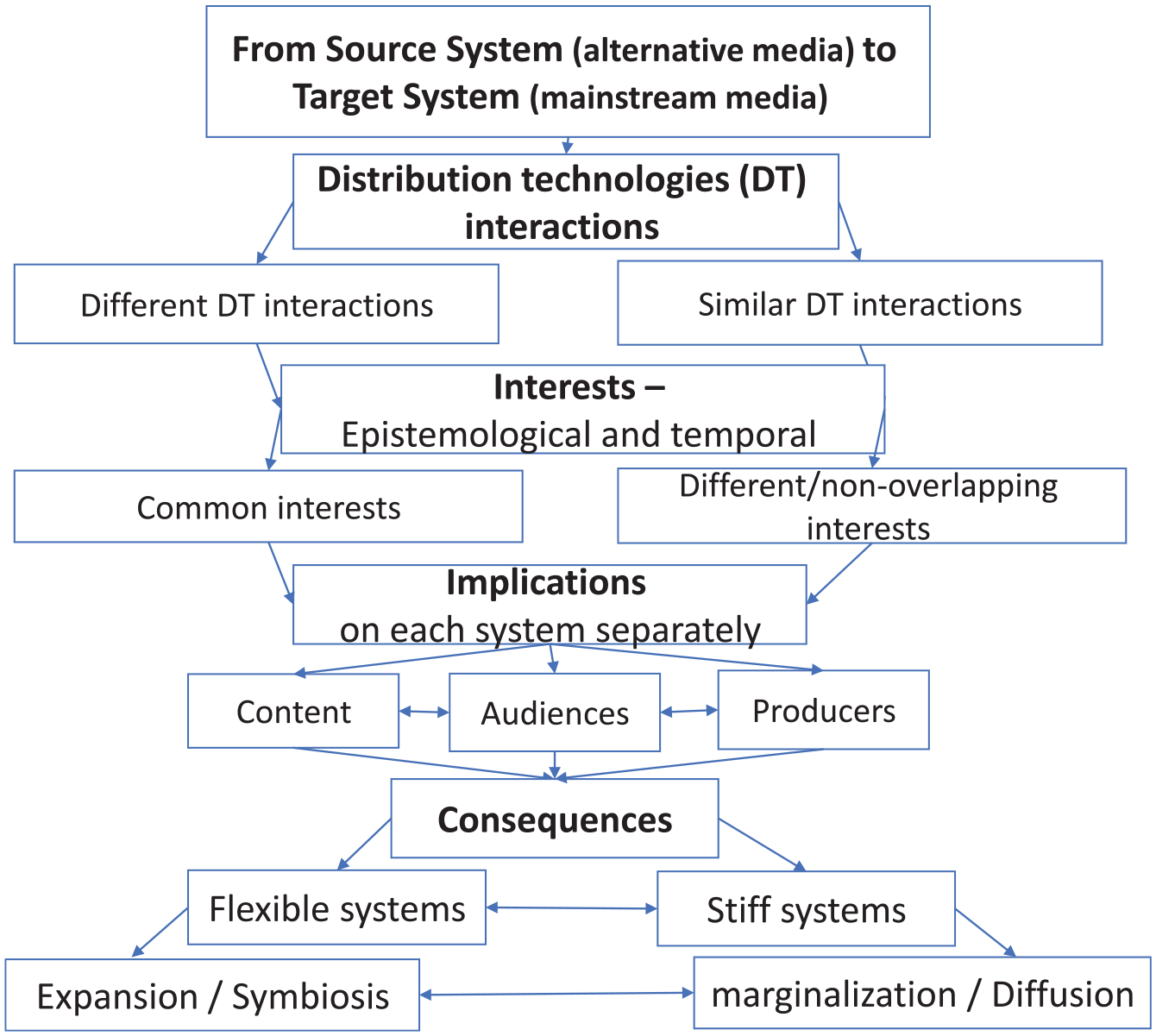
Model of transition from media source system to target system.
The findings reveal that the relations of alternative and mainstream systems can be classified into two polar opposites characterized by level of stiffness or flexibility regarding system changes, which should also be classified as epistemological or temporal.
Relations between stiff systems exist in this study in parallel media systems because of epistemological differences—the conflict between religious and secular perspectives, although both sanctify their belief in how to produce their films.
The relations between flexible systems exist in different media systems, which exhibiting tolerance to system change and allowing the preservation of some of the characteristics of the source system that integrates the target system. That is, despite the source system stiffness, the need to be relevant and increase revenue makes it possible to compromise on features that are also sacred, as long as they do not conflict with common interests.
Thus, the two first factors to be considered are the similarity or differentiation between distribution technologies, their epistemological norms, and the common or different temporal interests to the integration process. The model shows that relations between two similar media systems in terms of media distribution technologies (e.g., films) have little common interests. This has led to a challenging integration between two stiff systems that are not willing to compromise on mutual changes of their basic values and norms. The stiffness is expressed by some filmmakers and by the ultra-Orthodox audience unwilling to accept changes in their religious-community films. From this, we learn about the importance of the audience in the analysis. Their stiffness shows that when minority norms are challenged indirectly by outside forces, they react with extreme conservatism, as postcolonial theory posits (Young 2003). In the unequal relationship between mainstream and alternative cinema systems, the alternative filmmaker’s integration led some of them to accept and adopt through negotiations and compromises the mainstream’s required characteristics. Despite this, the adapted films were directed to the margins. That is, a move of marginalization was made, which can also be defined as a process of diffusion. Diffusion in this case is expressed as the molecular diffusion process (Philibert 2005) of transition from high concentration (from the alternative system’s films) to dispersion at low concentrations that are ultimately not observed in the environment (of the mainstream system).
The reverse process exists between different media format and distribution technologies. It begins when there are common interests without epistemological conflicts. That is, a common temporary interest allows content that characterizes the other distribution channels to be introduced into the system (such as Internet content for TV programs). Mutual economic interests lead to openness to changes and willingness to integrate features of other systems. These relations define the system as flexible. The flexibility is also expressed in the level of production independence that allows freedom of creativity and audience acceptance of the integrated content, which, in turn, grows more professional and gains more prestige. The results of this relationship can be termed a symbiosis, with the content changing into new forms, but still maintaining some ingredients of the original content. This process also expresses an expansion of both systems’ boundaries thanks to the readiness of the systems to stretch the accepted content corpus.
This model refers us to certain elements in both systems when examining relations between media systems. It brings into focus rules, values, and procedures that intersect with personal and system interests in temporal and epistemological contexts. It also places the audience’s reactions as an equal object of analysis, in the form of the producer perspectives and the content generated in these interactions.
Even so, the model is still partial and limited. While it offers ways to classify and conceptualize interactions between different media systems, it focuses on two dichotomous aspects of a possible scale between stiff and flexible systems. There may in practice be more complex intermediate situations. The model also stems from the perspective of producers of alternative media. Therefore, it should be enriched by the perspectives of producers from mainstream media systems. Further studies are needed to examine the relationships and reciprocal effects between other media systems to create a broader and more comprehensive holistic model for relations between different types of media systems.
Footnotes
Declaration of Conflicting Interests
The author declared no potential conflicts of interest with respect to the research, authorship, and/or publication of this article.
Funding
The author received no financial support for the research, authorship, and/or publication of this article.
