







Abstract
Many scholars have noted that the US video rental boom of the mid-1980s led to a surge in horror production, yet few acknowledge that these features were not in fact films. Direct-to-video (DTV) horror movies like Breeders–The Sexual Invasion and Video Violence were not made for and never received theatrical release, yet they were repeatedly pilloried as failed films. Dispensing with the preconception that DTV movies would or should follow the same genre norms as films, this essay argues that DTV horror movies demonstrate their creators’ exploration and creation of a new medium. The conventions of 1980s DTV horror are not the same as those of contemporaneous US horror films, and contrasting them shows how genre helped DTV creators develop the automatisms of videotape and how DTV horror can help scholars identify the norms and logic of contemporary on-demand culture.
In 2016, New York Times film critic Manohla Dargis responded to the already prodigious rise of streaming media platforms by asking, “What happens to movies if they are made to be watched only at home? Isn’t that television?” (Scott and Dargis 2016). Dargis’s question both overlooks the rich history of made-for-television and direct-to-video movie-making and expresses a longstanding conflation medium and genre. Medium and genre are both terms for categorizing and contextualizing works of art. One ostensibly refers to material composition and the other to esthetic tradition, yet they are not discreet. Each influences audiences’ ideas about the other.
1980s direct-to-video (DTV) horror movies are a prime example of this rhetorical confusion and the damage it does to our understanding of individual media texts, not to mention medium and genre. As many scholars have noted, the American video rental market exploded in the early to mid-1980s, leading to a surge in horror production. Horror was popular with both teen and adult renters, so store owners were eager to stock their shelves with new scary movies; this led distributors to finance new titles, often from independent producers. Some of these features were theatrically released before their video debuts, but many were not. The latter collectively forged the subgenre DTV horror, which continues to thrive in the streaming era. Yet even though DTV horror movies like Bio Hazard (1985), Breeders—The Sexual Invasion (1986), Video Violence (1987), and Killer Workout (1987) were not made for and never received theatrical release, they were reviled for their crassness and repeatedly pilloried as failed films (Brooks 2008; James 1997). 1 Put differently: preconceptions about the correlation of genre to medium kept fans and critics from appreciating how DTV horror movies explored and exploited the affordances of videotape. Yet if one stops assuming that DTV movies would or should follow the same genre norms as films, one can begin to assess how DTV horror creators adapted genre formulas for new material conditions.
For indeed the conventions of 1980s DTV horror movies are not the same as those of contemporaneous US slasher films, which dominated the era. 1980s DTV horror movies are organized around serial set pieces in which newly introduced victims are quickly dispatched, in contrast to the gradual elimination of ensemble casts in 1980s slasher films like Friday the 13th (1980), Slumber Party Massacre (1982), and A Nightmare on Elm Street (1984). Through such serialized narratives, DTV productions acknowledge the temporal control that VCRs accorded users; they concede (rather than deny) viewers’ boredom and distractibility and emphasize novelty over fright, curiosity over suspense. This contrast reveals scholars’ operative understanding of horror as a transmedial genre to be based on filmic automatisms—and thus deeply outmoded and exclusionary.
Automatism is Stanley Cavell’s term for the practices and forms of artistic creation that constitute the esthetic tradition of a medium and thus the medium itself. “When such a medium is discovered,” he writes, “it generates new instances [or creative strategies]: not merely makes them possible, but calls for them, as if to attest that what has been discovered is indeed something more than a single work could convey” (Cavell 1979, 107). Film and television have their own automatisms that define them as expressive and commercial media. During the mid-1970s and early 1980s, apparatus theorists such as Laura Mulvey (1975), Stephen Heath (1980), and Christian Metz (1986) sought to elucidate the psychodynamics of cinema, how theatrical films create their imitation of life and ideological sway over the spectator. When other scholars began to ask similar questions of television, liveness and flow quickly emerged as key terms for differentiating the ethos of broadcast TV from that of cinema (Williams 2003; Feuer 1983). Qua automatisms, liveness and flow denote broadcast television’s faculty for sucking spectators into the experience of events unfolding, but they do not pertain to prerecorded media formats. DTV spectatorship did not occur within a broadcast flow; viewers rented or bought videocassettes rather than tuning in at a preordained time. While a video narrative may seem to unfold in the moment of viewing, it is also manifestly prerecorded, as is film. Additionally, VCR viewers were never without the power to manipulate playback: to stop, pause, fast-forward, or rewind their tapes. Possession is nine tenths of the law, after all, including the psychic law of the video apparatus. Home video technologies, particularly the remote control, perpetuate illusions of domestic sovereignty that have governed Western notions of the private sphere since at least the nineteenth century. These illusions, I argue, inform the structure of DTV movies themselves, providing the first inkling of how “on-demand culture” would reorganize American media (Tryon 2013).
Just as 1980s DTV horror movies helped establish video as a medium, then, the automatisms they developed provide insight into the origins of “on-demand culture,” the twenty-first century service economy between media makers and consumers. Breaking with the business models of cinema and television pushed direct-to-video movie-makers toward new forms and structures better suited to their market goals. 2 Furthermore, the over-determination of horror—the organization of the genre around specific feelings—provides an exceptional opportunity to think about medium, genre, and affect, the ways that movies exploit form, formula, and apparatus to excite their spectators.
By articulating some automatisms of DTV horror, this essay pursues a positive definition of the genre, one based on the qualities such movies possess rather than those they lack (e.g., a theatrical or televisual premier). To that end, it focuses on the affects DTV horror produces for the spectator, which do not include horror, even though that term still designates the genre. Looking at what these movies invite their spectator to feel, and how they try to make them feel it, reveals something of their commercial endeavor and the particular forms it encourages. And rather than trying to horrify viewers, DTV horror movies provoke pleasure through temporal dispersals of curiosity and disgust that build on video’s material empowerment of its spectator.
As mentioned, DTV horror movies are typically organized around spectacular special effects set pieces. For this reason, their plots tend to focus on serial violence—serial killers, as in Gary Cohen’s notorious shot-on-video slasher Video Violence, or even alien serial rapists, as in Breeders, an exploitation piece produced and distributed by Wizard Video. In Video Violence, a video-store owner confronts a succession of snuff films made by his clientele. The victims in their series are almost arbitrary, both for the video makers and for Cohen’s audience. Such conceits allow DTV horror narratives to advance through sensational repetition but do not require much more than repetition for that advancement. Importantly, this strategy of death by narrative introjection precludes suspense. Whereas most theatrically-released slasher films let viewers guess in what order and when characters will die, which creates suspense, DTV horror movies narratively isolate victims and partition off set pieces, thereby generating intermittent excitement rather than suspense. Consequently, DTV horror movies also balance narrative and spectacle differently than their cinematic equivalents. They alternate tedious exposition with violence and gore but rarely build toward the latter, instead separating it from other plot developments. As Linda Ruth Williams observes of DTV erotic thrillers, they are “as much about delay as they are about display” (Williams 2005, 332). Most 1980s DTV horror productions were budgeted at $100,000 to $200,000, such that they only needed to sell around 10,000 tapes to turn a profit (Beale 1986). All the Friday the 13th sequels, on the other hand, were budgeted at $1.25 million or more. Far fewer victims spill far less blood in DTV horror films, which may have pushed their producers to isolate and accentuate each individual set piece.
Breeders, for instance, builds set pieces around the protracted identification of a victim and the erotic contemplation of her nude or nearly nude body. Each set piece ends with the woman being raped by an alien seeking to propagate a race of alien-human hybrids and take over the world. Hence the aliens’ second victim, Corinza, initially appears modeling bathing suits, but less than 2 minutes later she is performing naked calisthenics in the photography studio while everyone else is away at lunch. Corinza’s private enjoyment of her body is interrupted when the shoot’s stylist returns unexpectedly. He politely tries to leave but collapses in pain as his chest begins to pulsate unnaturally. The camera cuts between Corinza’s horrified retreat and the stylist’s increasingly mutilated body until an alien bursts from him and attacks her. This rape happens off-screen; an insert of Corinza’s bloodied foot and a point-of-view shot of the alien rapist displace graphic sexual violence or exploitative reaction shots.
Compositional choices aside, what matters automatistically about Corinza’s attack is how Breeders marks it as an interlude. Such fascinating, disgusting set pieces forestall narrative development even as they provide a reason for it. They allow DTV horror to alternate between spectacular episodes of sensational interpellation and tedious scenes of narrative exposition.
As a defining automatism of DTV horror, the interstitial presentation of exploitable elements—particularly the human body’s surfaces and viscera—also conveys the horror genre’s adaptation to home video. After tedious narrative sequences, these set pieces demand and reward attention, creating cyclical patterns of spectatorial engagement and disengagement. They stimulate the viewer with brightly colored gore, inventive monsters, revolting sound effects, and eclectic scores. Exciting the spectator with short bursts of novel violence and bloodshed, they create a periodic economy of sensation uniquely suited to their medium. After all, VCRs feature pause, fast-forward, and rewind buttons prominently on their control panels and remote controls. The temporal control of the video apparatus is thus reflected in DTV horror’s modular economy of attention. Through their set pieces, these movies affirm video as a medium of mediated attention contra cinema’s ethos of immersion.
While DTV horror set pieces typify the stop-and-start temporality of home video, they seldom horrify. It’s not that they fail to horrify; rather, they don’t even try. The philosopher Robert Solomon characterizes horror as a profound “recognition that things are not as they ought to be” (Solomon 2003, 243). Put differently: horror represents a subject’s inability to assimilate or respond to a shocking deviation from their world view. As a genre, DTV horror movies do not seek to psychically destabilize their spectators. Instead these movies disgust, fascinate, titillate, startle, shock, frighten, amuse, and offend. This is important, because by pluralizing and specifying the spectatorial effects of DTV horror, by giving up any preconceived investment in horror as such and focusing on the affects these movies actually create, scholars can more accurately analyze how these movies affect their viewers. Following Eugenie Brinkema, we can read form for affect, which “allows for a nuanced articulation of the ineluctable specificity and complexity of individual texts and individual affects as a way into something new and not as a confirmation of prior static models”—such as prior definitions of horror or the horror genre (Brinkema 2014, 39).
The unmarked snuff cassettes of Video Violence illustrate DTV horror’s commitment to fascination and disgust over horror. Someone keeps delivering these homemade tapes to Steve and Rachel Emery, the owners of The Video Studio. Steve finds the first snuff tape mixed in among the store’s regular returns. He and his assistant Ricky decide to watch it to satisfy their curiosity about local renters, who are only interested in “horror movies and slasher films and occasionally a Triple-Xer from the back.” Steve and Ricky assume that the tape can provide insight into the particular pleasures their constituency seeks in video, pleasures Steve has already distinguished from cinema’s. (Before buying The Video Studio and moving to the suburbs, Steve owned a theater in New York City where, he says, “all anybody wanted to talk about was movies,” implicitly contrasting cinema’s public debate with the privacy and insularity of video rental.) When Ricky pops the tape into a VCR, it reveals the local postmaster being tortured and killed by two amateur videographers. As Steve soon learns, some subsequent snuff videos will extend that documentary mode while others parody a late-night talk-show format or Hammer horror films.
With its snuff tapes, Video Violence does more than just thematize the appeal of watching proscribed violence in the privacy of one’s own home. First, the tapes lightly spoof Cohen’s own entrée into video production. More importantly, their rhythm reveals how video viewers experience duration and affect differently than film viewers. Although only a few minutes long, the tapes are more tedious than one might expect. In the talk-show parodies, videographer-hosts Eli and Howard banter idiotically while getting ready to attack their guests. Puns and dirty jokes delay the assaults without creating suspense, as there’s never any question about what’s going to happen next. The gratuitous dialog is accompanied by a downtempo synthesized score that repeats and repeats and repeats, amplifying the duration of each tape. Consequently, the tapes exasperate rather than titillate.
Such tedium forces the viewer to encounter their incomplete control over video. Waiting to “get to the good parts” defines the DTV viewing experience, as the viewer constantly adjudicates whether and how much they can fast forward. Video Violence draws viewers’ attention to this dynamic by frustrating it, by dragging out the torture and executions that they ostensibly want. In so doing, the snuff tapes embody the automatism’s call for new instances of its medium. They draw attention to the way that generic expectations become a sense of entitlement on video, creating a unique temporality for video viewing. Eli and Howard’s tapes are tedious, in other words, because tedium is a defining characteristic of video and of on-demand culture.
Eli and Howard’s tapes are not failures, however, both because they reveal video’s intrinsic relationship to tedium and because Eli and Howard’s goal is not to create good snuff movies but to amass “the greatest collection of video gore anywhere in the world,” as one of their fans explains. In cinema, films may be part of a series, but on video, they are always part of a collection, be it a private collection, a library collection, or the library of a video store. Distinguishing between the logic of collecting and that of accumulation, Susan Stewart observers, “like other forms of art, [the collection’s] function is not the restoration of context of origin but rather the creation of a new context” (Stewart 1992, 152). Stewart notes that “the objects in a hobbyist’s collection have significance only in relationship to one another” in that “the collection thereby acquires an aura of transcendence and independence that is symptomatic of the middle class’s values regarding personality” (Stewart 1992, 153, 159). Eli and Howard amass weapons and victims in response to their collection’s unsatisfiable requirement for variety and its promise to shore up their identity. The collection ultimately becomes a means for perpetuating group identity, however, when Eli and Howard’s viewers take over The Video Studio. Crucially, the viewers’ collection and the collectivity of store membership relieves them from mingling with strangers. Customers and counter staff feel free to banter about movies in the manner Steve attributed to his cinema patrons because their Video Studio capitalizes on the insularity of both the collection and video rental clubs. It provides a space where snuff fans can isolate together.
Significantly, the member-proprietors of The Video Studio still rent and sell tapes to one another. Collection obfuscates capitalism and labor, but it does not replace them. So even as Video Violence depicts a radical video underground, it does not imagine video beyond the commodity form. Indeed DTV horror movies affirm their commitment to the commodification of affect through their very presentation of video temporality as fluctuations between tedium and excitation. These movies understand affect as a product, as the product they sell. The commodification of affect is intrinsic to their form and medium, yet when Brinkema writes about affect as form, or Cavell writes about automatisms as creating a medium, they do not consider the commercial context for such textual functions. Breeders, Video Violence, and their ilk were all created to take advantage of a booming market for horror and exploitation videos. Film is a commercial art form too, of course, and as I observe elsewhere, B movies bear the mark of the market more explicitly than most art films or blockbusters (Benson-Allott 2013, 16). Many horror films of the home video era betray an ambivalent and even paranoid attitude toward that technology and the industrial changes it augured, but DTV horror movies do not. Rather their forms work to distinguish video as a medium and the DTV movie as a commodity. In as much as these movies sell feelings, then, when we read their affect for form, we must read it as the commodity form.
To evaluate whether DTV horror movies succeed or fail as expressions of their medium, then, critics must stop thinking of them as films and stop assuming they aim to horrify. Both misconceptions are holdovers from prior entertainment cultures. For DTV horror, sensation is the product and video the medium. These movies thus inaugurated the Boolean media culture of the streaming era, in which motion pictures are content and their stars, stories, and style are information whose combination may be and often is analyzed algorithmically. To read their form for affect or their automatisms for medium requires us to understand video as an apparatus of commercialized sensation. Alfred Hitchcock satirically predicted a day when his audience would have “electrodes implanted in their brains, and we’ll just press buttons and they’ll go ‘oooh’ and ‘aaah’ and we’ll frighten them and make them laugh” (quoted in Spoto 1983, 406). DTV and on-demand culture evince a similar telos: the ability to commodify sensation and deliver it reliably for an agreed-upon price. DTV movies should not be scorned for participating in this ideology. If anything, contempt for them just signals disavowal of one’s participation in the ongoing commodification of affect.
Crucially, though, the insights that DTV horror provides on medium, genre, and affect are best appreciated on VHS. All the direct-to-video movies discussed in this article are available on tape in Yale University’s DTV archive (as well as private collections), but they have also been remediated for DVD, Blu-ray, and streaming media. The movies themselves are the same, but in as much as their automatisms helped constitute their natal medium, that medium helps one appreciate and historicize these movies. Packaging is integral to the DTV movie’s commodification of affect, for instance, and thus to video as a medium. As I have argued elsewhere, video packaging is not just paratextual; it is intrinsic to the experience of form (Benson-Allott 2021). For instance, attention to cassette packaging can correct fans’ nostalgic impulse to overly marginalize DTV within 1980s video culture. Joseph Ziemba argues that in the 1980s “home video audiences were unable to distinguish filming methods based solely on box art,” but it’s equally plausible that they were open—however temporarily—to lower-budget productions and lesser-known talent (Ziemba 2018). The surge in horror production in the 1980s, coupled with the uniqueness of the video rental experience, created a new market logic wherein novelty could overcome familiarity as a lure for viewers picking among multiple titles. What would happen if, instead of presuming that viewers rented Video Violence expecting a Hollywood-caliber production values, we posited that some may have recognized it as low budget and shot on video and selected it anyway? The VHS cover of Video Violence doesn’t try to hide its narrative or industrial association with the medium (see Figure 1). With taglines like “When renting is not enough” and “a ‘must see’ for video store personnel and their customers,” Video Violence advertises its exploitation of new technology, more so than theatrically-released horror movies about video like David Cronenberg’s Videodrome (1983). Attending to DTV horror’s original packaging allows scholars to reimagine renters’ affective experience of the video store—their criteria for title comparison and evaluation as well as the excitement of taking a risk to find out what’s inside the box.
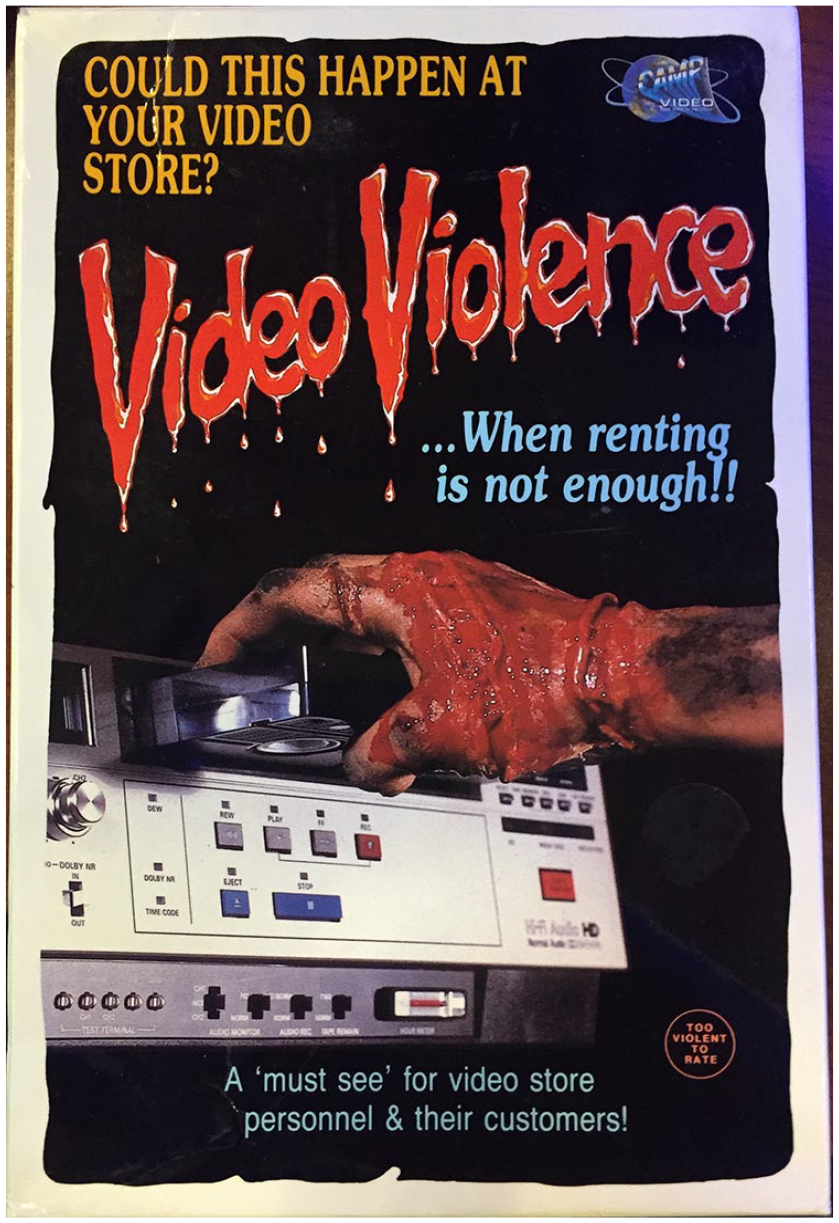
The videophilic cover of Gary Cohen’s Video Violence; photo by author.
By contrast, the DVD and Blu-ray releases of 1980s DTV horror movies either disavow or fetishize their original format. When MGM released Breeders to DVD in August 2001, they reframed the movie for a widescreen aspect ratio and packaged it with an “original theatrical trailer” that was in fact Wizard Video’s promo for the DTV release. MGM also changed the box art and narrative description to downplay the movie’s relationship to VHS and DTV horror. Gone is the original cover illustration of half-naked women being dragged into a UFO. Instead, would-be DVD viewers are lured in by a single glowing green eye. The back cover quotes Variety’s alleged review of the movie and identifies the actors playing lead roles—as if Theresa Farley and Lance Lewman were marquee names.
While MGM gives the Breeders DVD the patina of prior theatrical release, disguising its video past and the notoriety of DTV production, most digital releases of DVT horror fetishize videotape. Olive Films’s partnership with Slasher//Video exemplifies this trend, wherein tape connotes mediocrity rather than industrial history. When Olive Films rereleased David A. Prior’s Killer Workout on DVD and Blu-ray in 2015, they reused cover art from Academy Video’s 1987 VHS release and festooned it with fake store stickers in homage to the movie’s original format. A disclaimer warns—or maybe promises?—that the Slasher//Video edition is “not sourced from an HD Master; [but] remastered from PAL Beta SP and upconverted to Blu-ray and DVD specifications.” Such packaging fetishizes videotape and video rental to facilitate the collection’s subject-affirming simulation of history: “the point of the collection is forgetting—starting again in such a way that a finite number of elements create, by virtue of their combination, an infinite reverie” (Stewart 1992, 152). Camp Motion Pictures seeks to enable precisely that sort of reverie with its multiformat “Retro 80s Horror Collection,” which includes Video Violence and its sequel (1988) as well as The Basement (1989) and Ghoul School (1990). For Video Violence, Camp uses their original VHS cover art but enhances the image, adding more gore to the arm. The updated packaging promises that “Video Violence is one of the best [shot on video] horror flicks” and emphasizes dated hilarity over critical engagement with media history. Their design turns the movie into a joke, which might be savvy marketing but is also historically misleading.
Finally, watching DTV horror on VHS reveals temporal specificity of the format and its unique commodification of time. It takes “‘wind’ time” to fast forward or rewind through videotape, and those intervals metonymize the material control over time that home video promised its viewers (Hilderbrand 2009, 13). Taking the time to manipulate time during VHS playback reminds contemporary audiences of how crucial temporal sovereignty was for 1980s video viewers. As Frederick Wasser points out Veni, Vidi, Video, the desire for leisure efficiency drove VCR sales in the 1970s and 1980s (Wasser 2001, 200–201). Time-shifting, fast-forwarding, and rewinding were supposed to reduce stress for Americans working more—or at least different—hours. VCRs manifested and addressed this anxiety, promising to make movement through time empowering, even pleasurable. There’s a lot to fast-forward through in many DTV horror movies, such as the gratuitous detective work that defers visual investigations of the female body in Breeders and Killer Workout. On VHS we can accelerate through but cannot skip those scenes, which reminds us that merely understanding them as skippable is the result of recent video technologies and the spectatorial position they construct.
DTV horror movies have been marginalized within both popular and scholarly histories of horror media and home video cultures. However, their creators’ willingness to forge new automatisms was crucial to the development and recognition of home video as a medium. Many film and media theorists write as if genre and medium were discreet and transparent terms, yet liminal productions like DTV horror movies reveal both how these categories co-constitute each other and how dependent their definitions are on the technological norms of their era. Research on marginalized subgenres and their automatisms thus demonstrates that media history is not just written by its winners—those with the greatest profits or the most awards—but by its losers: those so overlooked that they could create an artform where none existed before.
Footnotes
Declaration of Conflicting Interests
The author declared no potential conflicts of interest with respect to the research, authorship, and/or publication of this article.
Funding
The author received no financial support for the research, authorship, and/or publication of this article.