







Abstract
This text examines the phenomenon of the wide-ranging acquisition of archive films into the Netflix library and tries to understand it in terms of the current situation in the VOD market and the perspective of redefining the importance of film heritage in the streaming era. It argues that Netflix’s shift to “classics” is not just part of the company’s general expansion strategy but must be seen in broader context of current VOD market regulations as well as Netflix localization tactics in specific national markets. Most of these films, however, are hidden from the general viewer. Therefore, this study combines analysis of personalization tactics and analysis of curation of “classic movies” to explore how Netflix, with the help of archival films, performs middle-brow cultural taste, and at the same time complicates the relationship between accessibility and discoverability of film heritage online.
The European Audiovisual Observatory’s 2016 report on the circulation of film heritage in the digital era assessed VOD platforms to be “too soon to be considered as a sustainable model to promote film heritage” (Fontaine and Patrizia 2016, 65). One year later, in September 2017, Newsweek columnist Zach Schonfeld complained that it was impossible to find too many archival films in the Netflix catalog and already predicted the “slow death of classic film in the streaming era” in the headline of the article (Schonfeld 2017). The prospect of 2022 is that this death will not take place, either slowly or quickly. On the contrary, in 2021, Netflix cataloged the most archival films since its streaming existence, and according to Ungos data, 1 more than 600 titles produced until 1990 alone. These films include various national productions ranging from early films by Victor Sjöström to French films by René Clement, Jean Renoir or Robert Bresson, post-war Italian and British film to American New Hollywood. Although Netflix based its long-term strategy on building a large library, in recent years it has moved more massively into the field of production (Jenner 2018). Yet it was only rarely thought of as a provider of “classic” works—the dominant strategy was determined, as in the case of cinema distribution, by the offer of new titles.
The aim of this text is to understand the reasons for the increase in the volume of archival films offered by Netflix and at the same time reveal their position in the Netflix library. Firstly, using various industrial reports (such as EAO reports, BFI Yearbook) and statements by representatives of the institutions concerned it strives to understand this aspect of catalog acquisitions from the industrial point of view, considering the development of Netflix and its strategies and services in recent years. Secondly, the role of archival films in Netflix’s catalog expansion strategy will be linked with analysis of curation and discoverability of these films, which will help to identify the meanings and values associated with the presentation of this type of films on Netflix. I ask, therefore, why, how and with what implications for the viewer Netflix includes archival movies in its catalog and presents it to its audience. Building on existing research on Netflix strategies I combine an insight into personalization and recommendation tactics with a survey of archival film curatorial practice (selection, annotation, and categorization) to understand how Netflix treats this type of content in its library and to recognize specific tendencies in transformation of cultural values related to what used to be known as a movie classic. I argue that Netflix’s shift to “classics” is not just part of a general expansion strategy but must be seen in the broader context of current VOD market regulations as well as Netflix localization tactics in specific national markets, as “Classic movies” play the role of Netflix’s complementary localizer, helping to symbolically strengthen company’s profile of the “quality” provider.
As a preliminary point, however, it is necessary to consider vocabulary and conceptual frameworks surrounding “classics” encountered in this text. The term “classic movie” is used by Netflix as one of its genre tags. Within the industrial business context so-called “catalog films” refer to films over ten years old. Reports monitoring the circulation of content in the digital era work with the term “film heritage work.” The term is more neutral, does not refer to the “classic” status of the work, allows a broader concept of film history to be embraced and, above all, does not postulate any canon and thus allows for its future redefinitions. In this text, I will work with these terms in a discursive way, as tools used by individual actors who, while using them also perform certain cultural values. As a non-symptomatic, non-discursive term, I will use the term “older film” or “archival film” to avoid confusion with the above categories.
Expansion of Catalog Films on Netflix: Industrial and Symbolic Strategies
As of 2018, monitoring reports of the European Audiovisual Observatory 2 and several other national reports have also started to consider the age of films available on streaming platforms. As mentioned above, these reports differentiate “catalog” content from “recent” content by referring to productions older than ten years, and show that as recently as 2018 and 2019, the share of “catalog” content on all monitored SVOD platforms in Europe, including Netflix, averaged 30 percent of films (Christian 2018, 149). Netflix itself, on the other hand, made 75 percent of “recent” content available on average, and thus only 25 percent of its content was “catalog” (Christian 2018, 149). A year-on-year comparison of the BFI’s more recent reports from 2020 and 2021, monitoring the situation in the UK, shows that compared to the other leading SVOD services in the UK (Amazon Prime Video, Disney+) Netflix provides more than half as much “catalog” content (overall, not just European): it is around 19 percent, compared to Amazon Prime Video with 40 percent and Disney+ with more than 60 percent (BFI Statistical Yearbook 2020, 2021, 11). A comparison of the rest of Europe with Britain over the past few years proves that while in most European countries the share of “catalog” content remained similar—around 23 to 25 percent, in Britain the new 19 percent is down from 26 percent in 2018 (Christian 2018, 149). These shifts occurred at a time when two major phenomena with a global reach influenced the film and TV industry (namely the covid-19 pandemic and Brexit), and therefore point to more general industrial trends regarding “catalog” content in the SVOD business.
While general regulation on the need to maintain a 30 percent share of European content has been in force in the European context since 2018, 3 Britain, which is no longer part of the European Union after Brexit, is not subject to this rule. 4 The fall in the share of “catalogue” content in British SVOD may thus be a consequence of this change. However, a closer look at the year 2021 and Netflix’s individual national catalogues reveals that in some European countries, Netflix has increased the offer of “catalogue” films substantially. For example, in the Czech Republic and Iceland it has approached 25 percent of the “catalogue” content in the total offer, while in the UK it remains at 18 percent, and in other large markets outside Europe it is even smaller (in the US it is about 13%, in Canada it is 15%—see Figure 1). These data clearly point to the specificity of Netflix’s European catalogue content strategy. Although the share numbers do not seem to be very different at first glance (it is a 5%–7% difference), in absolute terms it means up to 500 more catalogue films for the Czech audience, compared to the British audience, and almost 800 more compared to the US audience. “Catalogue” films thus have become part of a strategy of balancing European offerings in the catalogues of large providers, which previously included less European content (both Netflix and iTunes were down 21% in 2015) at a time of the decline in production and new releases due to the covid-19 pandemic.
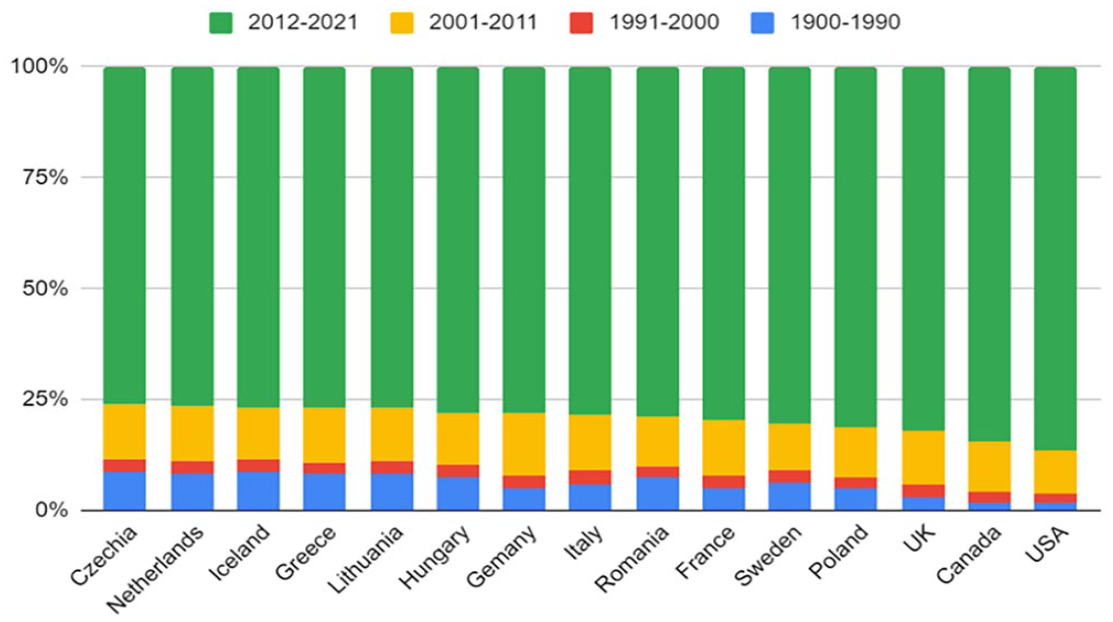
Share of Netflix content according to the year of production in selected national catalogs (Data source: unogs.com, gathered on January 6th, 2022).
As Kate Fortmueller argues, the importance of libraries for streaming services increased during pandemic: “In the streaming era, conventional wisdom holds that new content is essential to attract audiences, but libraries offer a competitive advantage by providing catalog depth. In business terms, this approach combines the long-tail model favored by tech companies with the blockbuster model common among legacy media companies: selling large numbers of inexpensive niche products but anchored by big, splashy content both old and new” (Fortmueller 2021: 42). Based on the above-mentioned data, we can thus consider three main factors that influence how Netflix uses catalog content—in addition to the specific set of circumstances regarding covid-19, the Netflix content catalog serves, firstly, as a cheap supplementary tool to accommodate the regulation of the share of European content, secondly, as a localization tool and, thirdly, as a tool of added symbolic value in some national markets.
Netflix built up its streaming portfolio in the wake of its DVD practice, with DVD services significantly outpacing online offerings in the early years of its existence. It was during this early period that a number of “older films” entered distribution, and although they did not appear to be a suitable draw for the introduction of streaming services, they represented a significant continuity in maintaining the Netflix brand and the original DVD audience in testing the new intent (Tryon 2009). In the later era, however, acquisitions of “older films” on Netflix were not a very significant variable. The last period in which older content suddenly becomes an important item in the catalog, therefore, represents a rapid difference. However, the territorial distribution strategies of these titles differ.
As Figure 1 shows, the availability of older films is bigger in the smaller countries (small markets, small cinemas) of Europe (Czech Republic, Iceland, Lithuania, Netherlands, Portugal, Greece, Hungary). On the contrary, within Europe, it is the smallest in the United Kingdom. The United States of America, on the other hand, is in a similar situation to India or Brazil, and its viewers are thus provided with more than five times fewer older titles than in the aforementioned smaller countries. These differences are significant and, I believe, not accidental, for they confirm the distribution of forces on the maps of cultural hegemony.
The rebalancing of the distribution offer as a response to the hegemony of the dominant film industries through various regulations and quotas is well-known from the history of cinema. Exemplary in this respect is a way of protecting the European market from the dominance of American production in the period of the advent of sound (Chibnall 2007). This is a response typical of a situation of fundamental technological change, to which the American film industry has responded much faster and more expansively than Europe (divided among other things by language barriers). While in the 1990s protectionist tendencies followed the collapse of the Soviet bloc and the new expansion of American media players in Europe (Rivi 2007), in recent years, new quotas are emerging in the context of the global expansion of, usually, American streaming services and their aim is to ensure greater diversity of content in smaller countries (Leiva and Albornoz 2021). The response of the dominant players is then to minimize the economic and cultural impact of these restrictions by means of a variety of strategies, including the offer of older content (Lotz 2019, 29). Following the above analogy with the era of the onset of sound in cinema, which gave rise to the common practice of fast and cheap production of local sound films (called “quota quickies”), we could therefore approach the increasing offer of older titles as “quota oldies.”
Older titles in Netflix European libraries are predominantly of European origin and help to match the necessary share of European content in Netflix’s offerings. At the same time, Netflix’s strategies confirm the disproportions between smaller and larger markets and language areas in the audio-visual industry (Lobato 2019), offering primarily larger cinema titles to multiple territories. While Czech viewers can (according to Ungos data from May 2022), thus familiarize themselves with more than 2,000 “catalog” titles, only seventy-three of them are originally Czech production (3.5%). On the other hand, 13.5 percent of German-language “catalog” films are available to German audiences, and 49 percent of English-language “catalog” films are available in the UK. At the same time, Czech older films are most often offered only for the territory of the Czech Republic or the Czech and Slovak Republics, so their reach is purely local. This tendency supports the previously outlined thesis about the peripherality of small CEE cinemas and the deepening of cultural hegemonies in the VOD market (Parvulescu and Hanzlík 2021).
Nevertheless, in some territories, Netflix market entry was directly tied to the presentation of an alliance with local cultural institutions representing film heritage. Significant in this sense was the example of France, where Netflix announced in January 2021 its new partnership with the French National Film Board (the CNC) and the Cinémathèque Française, a non-profit group devoted to the preservation and promotion of French cinema culture, including its intention to participate in the restoration of Napoleon by Abel Gance (1927). This gesture clearly followed earlier controversies regarding the non/release of Netflix films at the Cannes Film Festival and symbolically affirmed Netflix’s integration into the respected institutions of the French audio-visual market. It is important, however, to see the relationship between traditional memory institutions (in our case usually film archives) and dominant VODs as a relationship with mutual benefits within which both sides exchange certain kinds of symbolic prestige. While archives bring to this relationship their legitimacy as providers of cultural values, platforms such as Netflix or Amazon ensure digital accessibility and the potential to spread cultural heritage to a wide audience.
In Spring 2021 British Film Institute, one of the oldest film heritage institutions in the world, announced its entry to the US streaming market, establishing a special Amazon Prime’s BFI Player’s channel and publishing a list of “greatest films streaming on Netflix and on Amazon Prime.” 5 Robin Baker, Head Curator at BFI, confirms that one of the reasons for the increase in the number of older films on streaming platforms was the covid nineteen pandemic and the growing call of cinephile-profiling audiences 6 to stream archive films: “Some people who love cinema are frustrated by a variety of platforms that don’t enable them to make real discoveries.” (Thompson 2021). At the same time, BFI perceives the focus of these “cinema lovers” as rather wide, associating them with audiences looking for “discoveries” and offering them a not strictly artistic collection of 200 titles: „We brought a range of voices to the table, and hopefully the most varied mix of British cinema that you can imagine, from films that have been massive hits in their time to those that hardly even had a release” (Thompson 2021). Instead of an effort to stream the canon, Baker is presenting an interest in reaching the public through the diversity of British film heritage. Thus, streaming on large platforms now offers archival institutions, on the one hand, the new accessibility of their collections, and, on the other, the redefining of the concept of the canon as we knew it.
It is important to note, however, that to Netflix, which is the subject of this study, archives mostly sell films through intermediaries (it may go to key distributors in a given market with which Netflix alone communicates (Smits 2019, 156), or Netflix buys them from rights holders who are not archives themselves, usually in bigger packages. 7 Thus, archives do not have to participate in the selection of the released package strategically. Also, some intermediaries present the sale of the rights to “catalog” films as a kind of prestige swap, in which they provide Netflix with “critically praised films” and Netflix provides a successful “streaming universe” (Chu 2012). However, if archival institution representatives, like the BFI’s Robin Baker, see this as an opportunity for the audience to make new “discoveries,” we should ask how such titles are presented on Netflix in the first place.
Baker’s mention of “discoveries” directly alludes to what is often perceived as a major problem of SVOD platforms with large catalogs, namely the discoverability of a particular title (Farchy et al. 2022). Not only does Netflix rotate its catalogues, making the availability of films uncertain, but older films are also subject to the consequences of algorithmic invisibility. Indeed, the algorithmically driven main menu rows hide rather than reveal the large volume of films in the entire library. This is also why the way in which digital interfaces are organized is understood as a powerful tool for managing attention and viewer experience (Hesmondhalgh and Lotz 2020, 388), as part of the politics of visibility in digital distribution (Lobato and Scarlata 2022). Following Fenwick McKelvey and Robert Hunt we can consider “discovery” as relying mainly on ways user’s choices are managed by the platform interface (McKelvey and Hunt 2019). Therefore, if archival institutions or licensors, in addition to the commercial exploitation of old works, also expect new visibility from their application on SVODs, it is necessary to ask how specifically films are categorized, annotated, and offered to the audience in the catalogs of these platforms.
Re-Defining “Classics” in the Streaming Era
Older films have, of course, been circulating on the internet for a long time and on platforms or streaming services other than Netflix. Besides film archives themselves (Brunow 2017), targeted arthouse channels profiling themselves as a platform for niche audiences (e.g., MUBI, La Cinetek) provided archival content. Their catalog and the way it is presented are generally the result of more sophisticated curation and also appeal to a much narrower target group. Moreover, older films are also available on larger platforms like iTunes, HBO, or Amazon. However, given Netflix’s current global dominance, these films can gain additional accessibility. As one of the most powerful on-demand content providers, Netflix can also use its tools to challenge what is perceived as “classic”—as “canon.” In her seminal essay on canonization policy, Janet Staiger highlighted the role of categorization practices: “Grouping, challenging, and finding typicality are long-honoured and traditional pursuits in the acquisition of knowledge. Hence, large numbers of films are more easily handled if certain generalizing characteristics are determined” (Staiger 1985, 9). In order to understand what changes occur in the presentation of older films on Netflix, it is, therefore, necessary to examine the ways in which these films are categorized and grouped on Netflix and how, in this process, Netflix uses or disrupts existing generalizations established by academic, critical or other discourse.
While asking about the factors of canon reconfiguration in the post-digital era, Nuria Rodríguez-Ortega draws attention to the parallel role of bottom-up and top-down processes, namely: “social empowerment, participatory cultures, scale, globality, technology-driven processes actors, and algorithmic-generated knowledge” (Rodríguez-Ortega 2018, 11). Thus, according to Rodríguez-Ortega, if we want to address current canon transformations, we need to take into account the ways in which new actors create (new) cultural values in the context of persistent “traditional logic that continues to govern the knowledge of assigning value” (Rodríguez-Ortega 2018, 2) and processes and practices that destabilize these traditional approaches. When we ask how the concept of the film canon influences Netflix’s interest in “catalog films,” the practices of this global actor must be considered in the context of the practice of traditional cultural heritage institutions and their adaptation to digital trends, with the practice of smaller, local actors, but also with broader trends of access to cultural heritage.
As a number of works analyzing the establishment of the canon and classical works indicate, the key processes of canonization are selection, value, and duration (Assmann 2008, 100). To put it simply, for a work to belong to the canon, it must be somehow selected in comparison with others, it must be given a cultural value and this value must remain. Canon is thus, as Aleida Assmann puts it, “actively circulated memory” (Assmann 2008, 98). Therefore, the ongoing circulation of films is a key circumstance of their canonization, while it can happen on several levels—films can circulate physically through distribution and re-release on various platforms, from archive cinemas, through festivals to televisions and newly streaming platforms. They can also circulate discursively, in writing, or as being awarded. Critics, academics and their established rankings or awards tend to be perceived as institutions with a mandate to award cultural value, but festivals and other platforms that evaluate films work similarly (Vallejo 2020). Sociologists refer to a manner, in which the process of valuation and revaluation creates and perpetuates the reputation of cultural producers and their products as “cultural consecration” (Bourdieu 1993; Lampel and Nadavulakere 2009). In the case of film, the role of critical discourse (Allen and Lincoln 2004) and auteur discourse (Hicks and Petrova 2006) in cultural consecration is most often referred to, and it is also recalled that cultural value is enhanced by ritualization of retrospectives, which ascribes to works their cultural significance in retrospect—and in some cases confirms it, in others newly establishes it (Lampel and Nadavulakere 2009). For the formation of the canon, these institutionalized practices of traditional actors within the industry can be seen as persisting to the present day.
As a technology giant and highly popular platform, Netflix’s interest in catalog films is on the one hand contributing to the reappraisal of the canon as it extends the life of older films in the streaming era. At the same time, however, Netflix contributes to the value transformations within this canon, primarily by the way it selects works that it describes as “classical” and the way it handles cultural-valorization categories. David Ramsey-Smith assumes that Netflix may affect, “how regular people define “Classics” or even “classical” (. . .) because Netflix currently includes films from the twenty-first century (like Y Tu Mama Tambien [2001]) in its “Classics.” As a subcategory under “Classics,” the commonalities of “Silent Films” may be massively oversimplified to the point of absurdity.” (Smith-Rowsey 2016, 67) The evolution of cultural values presented by Netflix is described by Marieke Jenner as a shift from an emphasis on quality to values that go toward the more general tastes of a transnational audience: “Netflix draws heavily on existing links between “quality” TV and binge-watching as structuring forces. However, since 2015, Netflix has increasingly moved toward more popular tastes.” (Jenner 2018, 139). This shift has been seen as a differentiation element between Netflix (and other major global players) and some smaller art-oriented platforms such as MUBI, BFI Player, and La Cinetek. According to Roderick Smits and E. W. Nikdel, MUBI and BFI Player build a specific identity benefiting from selected film’s cultural values. Smits and Nikdel call it a “distinctive identity where refinement of choice, the expertise of taste judgments and, (. . .) the appeal to a discerning and highbrow clientele take precedent” (Smits and Nikdel 2019, 24). However, in the constantly changing field of streaming platforms and their battle for the viewer, this model built on a narrow target group probably did not survive the emergence of global players in the European market. As Mattias Frey in his more recent research argues, MUBI “eventually relinquished a pure curation-style system in 2020 to become, in effect, an arthouse version of Netflix or Amazon, settling on the strategy of vertical integration and the tactics of pre-buys, original productions and theatrical distribution” (Frey 2021, 7). The role of catalog (or classic films) in the Netflix offer can thus be viewed from the perspective of these processes as one aspect of the convergence of the practices of larger and smaller players in the VOD market, for, as I want to show in the following analysis, Netflix uses “classic films” to flatter the middle brow cultural taste of the viewer.
Drawing on Ted Striphas’s pivotal study of algorithmic culture (Striphas 2015), texts related to Netflix and other streaming platforms with recommendation systems discuss changes in the ways in which cultural works are labeled, organized, and hierarchized, and the values attributed to these works by algorithmic engines (Hallinan and Striphas 2016; Martínez and Kaun 2019; Mattias 2021). The basic way Netflix handles “classic” films in its library is no different from other films and is based on algorithmic curation. As Neta Alexander puts it, Netflix uses an algorithmic recommendation system, its tags, metadata, and collaborative filters to “make informed choices negotiating the user’s viewing history with a content library that frequently changes” (Alexander 2016, 84). The metadata classification, tagging and recommendation algorithms used by Netflix, like other players in the current digital market, call for a redefinition of the circumstances contributing to shaping viewer tastes. Part of Neta Alexander’s argument is that current recommendation systems replace viewer preferences based on prior knowledge and individual evaluation of experience with calculations, and she calls the taste formed this way “mathematical” (Alexander 2016). According to Emily Lawrence “altgenres function as arguments about and for particular taste preferences and aesthetic experiences. (. . .) Altgenre recommendations are not, then, sound reflections of some stable set of aesthetic preferences; rather, as arguments they discursively mould our taste even as our taste moulds them” (Lawrence 2015, 358).
If we perceive one of these altgeners, “Classic Movies,” in this sense as an argument about taste and for the taste of the viewer, we can understand the way Netflix works with these films as a performative act. Following the viewer’s choices, Netflix tries to offer this viewer other choices, similar to the previous ones, and changing the rows and groupings of films it also adapts the categories the basic menu accordingly. It is these categories that then prove to be the key stage of performance of taste driven by Netflix’s algorithms (Mattias 2021). If we want to know what kind of taste is performed with “Classic Movies,” it is important to ask first what films Netflix refers to in this way and then how it works with these films in the menu and recommendation system (McKelvey and Hunt 2019).
Methods
I examined the way Netflix works with the “Classic Movies” category through three experimental user profiles on which I watched classic films with varying degrees of intensity and then observed and compared the changes in the recommendation menu evolving in time. In the idea of experimenting with user profiles I, like Niko Pajkovic (Pajkovic 2022), followed Tania Bucher’s call for “reverse engineering” through “speculative experimentation and playing around with algorithms to figure out how they work” (Bucher 2018, 60). I deliberately let all the films these users watched run in their entirety. The research took place over a one-month period between March and April 2022 and was conducted in the Czech Republic. Considering that Netflix is a constantly evolving platform and that all profiles were created under my own account, however, the results of this survey can be seen as rather indicative, as a specific case study, typical of the place, time, and conditions in which the survey was conducted.
The three different user profiles entered Netflix with the same set of selected movies, but the behavior of these artificial users subsequently started to differ according to the three criteria: firstly, the frequency of watching classic movies, secondly the activities related to the search for these movies (discovery activities), and thirdly the selection of films watched. These criteria were set keeping in mind that Netflix’s algorithms track the following types of viewing behavior—namely “which content—and how much, how often, and over what time span—each subscriber actually watched” (Mattias 2021, 85). At the same time, I have defined the differences between user accounts taking into account that viewers choose different ways of searching and their choices can be both strictly rational and influenced by the choice management set directly by the recommendation system. With each entry, I made a record of the current menu in the first 15 lines, transferring the individual titles and their metadata into an internal database. Accordingly, it was possible to track the evolution of each user’s menu (and its categories) over time and its saturation with “classic” or generally older titles.
User number one was defined as an active cinephile, a viewer of the “Classic Movies” category who regularly searched by this category on a daily basis, as well as films by specific directors and actors and actresses, and selected older films of different national provenance, from different eras and genres. User number two, a passive cinephile, searched similarly frequently but less actively—after a week of actively following the “Classic Movies” category, s/he did not stop watching older films, but his choices were already based purely on the selection recommended by the system. User number three was defined as an occasional cinephile, a viewer who watches “Classic Movies” from time to time. Her/his choices combined contemporary films and series with older and classic ones. S/he made her/his selection of classic movies using the “Classic Movies” category and did not perform any other active search.
While comparing the changes in the interface of each user’s profile, I focused primarily on the scale at which user personalization toward “classic” films is being promoted. By analyzing the ways of categorizing “classic” films in the basic menu, I also wanted to reveal the value handling of this type of content. I then focused in more detail on the “classic” category itself, and on examples of comparing individual films and presenting them in the Netflix library and libraries of other providers, I sought to understand how Netflix practice transforms a user’s relationship to film heritage while relying on certain existing cultural norms and hierarchies and modifying them with norms and hierarchies of its own, encoded in protocols of recommendation and personalization.
Findings and Analysis
What is important to highlight at the very beginning, is the fact that in its basic settings Netflix hides catalog films behind current ones. But although “classic” films are not the kind of films that Netflix would primarily offer its user, once s/he shows interest in them, they start to be blended in different categories of the basic menu. In the case of the first and the second user, after watching seven “Classic Movies” (i.e., within a few days) this track started to be reflected in the offer provided by Netflix. This initial activity could not have come off from the offer recommended by Netflix itself, but only from a targeted search—of movies labeled “classics” or specific titles. Compared to the original menu layout, which favored new films and traditional genres, new categories associated with previously viewed films began to appear (namely, Acclaimed Writers, Award Winning Films, European Films, Czech Films), and older films (not necessarily labeled as “classics” and especially Czech ones) began to be simultaneously mixed into other selections (e.g., Popular on Netflix—for example Gervaise, Il Posto, Il Boom). After fourteen days, the “older” films also started to appear as the main films that would appear when the profile was opened, but this practice was irregular and rather rare. However, in the case of a few days of inactivity, the categories referring to the cultural status of the work (Acclaimed. . ., Award Winning. . .) began to be mixed up again with more traditional genre categories or Netflix’s altgenres (Comedies, Suspensful Movies). Similarly, the category that remained marked “Tips for you” on the profile of the occasional fan of the classics (user three) bore the title “Gems for you” on the profile of the pure lover of the classics (user one). Both this category and categories of Acclaimed and Award-Winning films show, that through markers encoded in the vocabulary of main menu categories, Netflix addresses classics-seeking users as someone with refined taste. Although the menu started to change both in the case of user one and user two in favor of “classic movies,” what turns out to be a typical aspect of Netflix’s strategy is that the “classics” category itself did not rise to the top of the main menu for the second and third user. What distinguished the categorization of films for the second user from the first was also the lower prominence of rows referring to awards in the title, but instead, a greater tendency to include older films in more traditional genre categories. Thus, even though older films began to feature more prominently in the first 15 rows for the second user, they were framed by more popular categories.
As we can see, Netflix does not assume that the viewer is an exclusive fan of any one category, but that his tastes are based on much more general interests, and above all that he is willing to choose films outside the traditional categories of his preference. Netflix handles the category of “classics” very flexibly and mixes various preferential guides into the always new categories of films appearing in the main menu. In addition to Award-winning or Acclaimed films, “classics” may appear in the categories such as Modern Classics, Classic European Dramas, but also, for example, Filmed in Black and White. Similarly, Scarface (1983), a “Classic Movie,” could appear in the same row (category) as The Fall (2013–2016) based on the relation to action. The recommendation system thus calculates that the reason for choosing a given film is not necessarily because it is “classics,” but it considers a number of other factors (identified in altgenre categories) through which it also tries to offer the viewer other titles that would go beyond his primary interest. In this respect, the category Popular on Netflix is proving to be completely misleading as to what it bears in its name, namely popularity. It presents quite different titles on different profiles and, for the active cinephile, shows as popular films such as: Laughter in Paradise (1951), The Shop on the Main Street (1965), Woman without a Face (1947), Violent Summer (1959), as well as The Queen’s Gambit (2020) and other contemporary series—while the occasional cinephile gets a completely different offer of “popular” films in the very same time period. Netflix is thus not consistent in its recommendations either in terms of popularity or cinephile focus—it mixes the user’s recommendations according to its previous choices, but it also maintains a potential interest in current content with an emphasis on Netflix’s original production.
Performing such flexibility on many levels, Netflix “classics” appears to be a maelstrom of change. If we focus on an altgenre “Classic Movie” itself, a term that occurs in some cases as a genre tag and can thus be searched for separately or used as a clickable filter, we need to remember that this selection appears only to the actively seeking user, who begins to operate with the term himself. This user will never encounter animated or documentary films, as Netflix selects only fiction features as “classics.” At the same time, the filter selection is rather limited (far from including all films available to the user tagged as “classic”) and also an unsystematic and eclectic one. For the Czech user, this selection presents forty-two movies, while, according to Unogs data, 247 “Classic Movies” should be available. 8 Of these forty-two movies, only 64 percent are visibly marked as “Classic Movies,” others (36%) are not, such as The Karate Kid (1984), Mad Max (1979), Bread Love, and Jealousy (1954), and others). At the same time, the selection is dominantly Anglo-American—69% of these titles are US or UK productions, the rest comprises of Italian, French and Swedish titles. At a minimum, these are titles that would qualify as artistic classics, although such titles also appear on the Netflix menu and are assigned the tag “classic movie” (e.g., Les Carabinieres (1963), The Human Beast (1938), Pepe le Moko (1937), The Cremator (1969), etc.). However, it is not possible to find them through this metadata affiliation. On the contrary, such affiliation offers rather genre classics, popular classics, or cult classics, and, as mentioned above, predominantly US or UK productions (Monty Pythons, The Shining (1980), Forest Gump (1994), The Exorcist (1973), etc.). A similar nod to popular taste is reflected in the way Netflix uses categories marked by the decades of the twentieth century. Unlike genre or mood (tone) categories, it clearly historicizes its offerings in this way, but this historicization is again intertwined with markers of popular taste. Netflix in its categories characterizes individual decades using attributes that are not specific to the period from a cultural-historical point of view, but rather interchangeable (Nostalgic ‘90s, Totally Awesome ‘80s). Another way of scaling decades is through genre attributes or categories that refer to classicism, cult, or awards: Classic Movies from the 1980s, Cult Movies from the 1980s, Critically Acclaimed Movies from the 1980s, etc.
If we focus on the way Netflix specifically works with particular titles, it is clear that, apart from the categories mentioned (altags and categories in the main menu), Netflix does not use any traditional quality markers typical of critical or academic discourse. For example, it quite clearly suppresses the auteur tradition by mentioning the director’s name not in the main preview, but as additional information along with other professions. In this way, its presentation clearly differs from other, smaller providers of “classics.” Platforms like MUBI or La Cinetek in turn take advantage of various possibilities to emphasize the film’s cultural values and mention the name of the director in the main preview of a particular title. La Cinetek, which profiles itself as “The Director’s Film Library,” moreover, works with a system of recommendations from other film directors—for example, Francois Truffaut’s film Stollen Kisses is recommended by Chantal Akerman, The Loves of a Blonde, early work by Miloš Forman, is recommended by Ira Sachs, Raymond Depardon, Nicolas Philibert, Jaco Van Dormael and Agnieszka Holland. Similarly, in short annotations of films, these portals often try to refer to authors of literary originals, offer the viewers direct links to the works of the same director or starring same actors and actresses, and embed the film in certain traditions of film history, and so on.
If we look specifically at the 1938 Jean Renoir’s drama The Human Beast, which is offered by all three mentioned platforms, then even here Netflix does not highlight the name of the director. Its plot description in the annotation is very neutral, it does not mention any other cultural references: “After committing a murder, a railroad stationmaster offers up his beautiful wife to buy the silence of a train engineer who witnessed the crime.” In this annotation, Netflix emphasizes the criminal, thriller aspect of the plot, which corresponds to its designation of this film as “dark,” and “suspenseful.” La Cinetek, on the other hand, draws attention to the name of Emile Zola as the author of the novel and emphasizes the romantic motive: “In this classic adaptation of Emile Zola’s novel, a tortured train engineer falls in love with a troubled married woman who has helped her husband commit a murder.” In this sense Netflix does not require or develop any cultural knowledge of its audience, it replaces this cultural awareness with its system of categorization, which is derived from the qualities of the work established by cultural institutions (type of award, adaptation). One of the rare examples of mentioning the director and both main actors in the annotation is Jean-Luc Godard’s Les Carabiniers: “Director Jean-Luc Godard’s surreal, anti-imperialist film follows two moronic peasants (Marino Masé and Albert Juross) who join the king’s army as mercenaries.” Aside from the fact that Juross isn’t one of the best-known actors, this is rather an exception to the otherwise typically story-oriented Netflix annotations.
As we can see, the handling of the term “Classics” is thus highly arbitrary in the case of Netflix. Netflix’s recommendation system uses “classics” rather interchangeably with what we call in this text a “catalog” film or older film. This is a consequence of the fact that, as Daniel Smith-Rowsey argues, “Netflix is programmed with intentional instability (. . .) [it] maintains an algorithm of what its users prefer, but then intentionally offers content that both follows and subverts that algorithm” (Smith-Rowsey 2016, 64). In relation to the classics, we can thus observe, to some extent, contradictory tendencies. On the one hand, Netflix’s recommendation system hides “classics” from the usual user. However, although the platform rather downplays or shadows this particular category, it places “catalog films” (or generally older films) on the main page among the recommended selections for the user profiling through his preferences as a viewer of the “classics” and reorders them into new categories referencing bourgeois cultural legitimacy. Simultaneously, Netflix’s system of recommendations clearly favors Netflix originals, new titles and works with popular legitimacy, that is, categories of current popularity (Trending now, Popular on Netflix, Top 10 in (a given country), etc.), and is able to categorize “classics” within these as well. The categories of the main menu and their structuring of content, “taste clusters” according to Amanda Lotz (Lotz 2022, 133), are the key stage on which Netflix performs its game with the concept of cultural taste, in which older films play a not inconsiderable role.
Debates about cultural taste have traditionally been based on works by Pierre Bourdieu, who in the early 1980s distinguished taste with the help of a class concept, understanding it as one aspect of a class-conditioned lifestyle. Bourdieu’s triad defined legitimate taste (as normatively institutionalized), popular taste (as the lifestyle of the working class), and middle-brow taste (aspiring to upper-class tastes, clinging to institutionalized markers of prestige such as awards, well-known and valued authors) (Bourdieu 1984). However, Bourdieu’s definition has come under a number of criticisms, the most influential of which was in the early 1990s the work by Richard Peterson, who concluded that upper-class is more open to cultural choices and has a broader taste. This does not mean that these people do not choose the lower genres—on the contrary, their cultural capital allows them to choose from a wider variety. Peterson and Simkus thus define the upper class not as snobbish, but as “cultural omnivores” (Peterson and Kern 1996). This is not a negation of Bourdieu, however, but an attempt to better grasp the concept of taste in the changing conditions of availability of cultural content, socio-cultural transformations of elites, and subsequent convergence of upper and middle-class tastes. For this reason, research like this highlights the capacity of the upper and middle-class to adopt cultural influences of various, often opposing origins, that significantly shape their cultural tastes (Peterson and Simkus 1992). In the case of television, research has shown that the influence of class on the genre preferences of television viewers is less than, for example, age. Class is significant only for preferences of news, current affairs, and documentaries, and partly also for “artistic programs” (Bennet et al. 2009, 136–7). Thus, Netflix’s coding of “classics” with markers of cultural legitimacy and “artistry” (Critically Acclaimed, Award Winning, Based on Books) serves as a symbolic courtship of both middle-class and upper-class audiences. Netflix uses “classic films” to perform bourgeois cultural legitimacy and middle-brow cultural tastes, however, it is always only an aspect of the dominant strategy, which is reaching a wide audience and rather an omnivore taste, promoting the current content and especially Netflix productions.
Conclusions
Following the recent call to analyze the libraries of large SVODs (Lotz et al. 2022) and their interface (Eklund 2022; Johnson 2019), this article focused on the relationship between the recommendation and discoverability of what can be considered as film heritage, archival work, or “classic movie” on Netflix and the new ways it works with cultural values related to this type of content. These films function as a two-faced element in Netflix’s strategy. On the one hand, as “quota oldies,” cheap content that helps to fill the library and prepare the company for European regulations, and at the same time content of symbolic value, increasing the potential to work with categories of artistic prestige.
While Netflix tends to generally renounce the reference to the artistic values of cinema, established by traditional actors (critics, academics, memory institutions), it uses “classics” as one way of referencing bourgeois legitimacy and accommodating the middle-brow taste. A survey of “classics” in the Netflix library has further demonstrated that, in addition to the fact that Netflix’s recommendation system, on the one hand, assumes viewer’s genre loyalty and favors content on the basis his/her earlier genre choices, on the other hand, it moves closer to popular taste by emphasizing genre categories and local production, while favoring contemporary content, primarily Netflix originals, and the production of large audio-visual industries, instead of diversity (with the exception of local films). Diversity, viewed in this text both from territorial and temporal perspective, turns out to be a game with a combination of genre and historicist categories, aiming more at leveling the content and, despite the use of quality markers (especially awards and links to literature), tending to “popularize classics.” Netflix treats “classic” films as any of the other films on offer. Netflix is thus taking a two-pronged approach to the classics: firstly, the “classics as usual” approach de-sacrifices the classics and makes film heritage an object of consumption whose cultural value is neutralized, secondly, “classics” enables Netflix to play with categories of cultural values in its main menu and symbolically perform the “quality.”
What is important though, is that it is possible to be a fan of the classics on Netflix, but it is difficult to become one. Older films tend to be hidden on Netflix, and their discoverability presupposes a certain cultural capital. Given the recent development of Amazon, Disney+, and other SVOD platforms and their global outreach, it is therefore even more important not to confuse the concepts of visibility, accessibility, and discoverability of content. In the struggle to hold the viewer’s attention, these platforms assume that the search for satisfactory content will be relatively short—and therefore present key preference choices in the first few lines of the menu. If, even for the occasional classic film fan, the category of classic films does not rise to the upper rows, and classic films remain only loosely mixed into otherwise framed categories, it is clear that the specificity of the category, along with the historical values of film as a cultural heritage, is being erased. Netflix’s strategies, notably its algorithmic management of content, are thus shifting the focus from what is described as classic to how this type of content can be accessed even though it appears to be right in front of us “on demand.”
Footnotes
Acknowledgements
The author wants to thank both reviewers for their valuable comments that helped to improve the article.
Declaration of Conflicting Interests
The author declared no potential conflicts of interest with respect to the research, authorship, and/or publication of this article.
Funding
The author disclosed receipt of the following financial support for the research, authorship, and/or publication of this article: This work was supported by the European Regional Development Fund project “Creativity and Adaptability as Conditions of the Success of Europe in an Interrelated World” (reg. no.: CZ.02.1.01/0.0/0.0/16_019/0000734).
