







Abstract
This essay begins with a brief history of sensitivity training, a therapeutic and organizational protocol for the instrumentalization of empathy that gained traction in the second half of the twentieth century. The reflection on sensitivity training serves as a wind-up to a meditation on the version of insensitivity training that television manufactured in the 1970s and 1980s. Taken together, both gestures provide the basis to make a pedagogical call for an alternative, critical version of insensitivity training for contemporary students. The essay then explores how the meanings of in/sensitivity help to set up that pedagogical project and suggest its lineaments, as well as what that project should look and sound like, within the horizon in which the pandemic still very much establishes the terms and conditions for much pedagogical and scholarly work. More generally, the essay considers how the versions of such work altered by the rise and spread of COVID-19 may have made some subjects laboring in higher education become pandemic television—and what sanguine, ingenious responses to that becoming one may embrace. Finally, the essay moves to a concrete television case study that has instructional value for the would-be instigator of insensitivity training: Jann, a series saturated with elaborations and unfoldings of—which is to say, blueprints for—the uses of awkwardness, discomfort, and insensitivity.
Can We Not Be Up Schitt’s Creek?
In her biggest hit single in the U.S. market—1994’s “Insensitive”—Canadian pop artist Jann Arden sings, “Maybe you might have some advice to give/On how to be insensitive.” Watching Arden in her eponymous role in Jann (CTV, 2019–2021) on Hulu during the pandemic, I began to wonder whether I might have some advice to give on how to be insensitive. Or, more specific to my capacity as a teacher of television studies during the pandemic, I have wondered whether—in my being alert to and caring about my students’ needs and vulnerabilities, yet discomfited by the occasions on which they have been disclosing incapacities to deal with material that is “difficult” (in both senses of the word)—I might be in a position to offer them a promising, rather than foreclosing, version of what, in this essay’s title and below, I am dubbing insensitivity training.
This hopefully promising response to current circumstances is at least in part also a response to what some friends and I (more on a dear one later) have been telegraphically calling “the Schitt’s Creek problem.” An astoundingly overrated television enterprise since its initial airing, the series Schitt’s Creek (CBC/Pop, 2015–2020) was lavished with even more outsize praise—and awards—at the end of its run, not at all incidentally because its gentle, feel-good, and ultimately unchallenging tone and ethos made for a perfect, pandemic-era iteration of comfort television.
Ouch. If that terse but withering paragraph stings, let me pause to offer a disclaimer, a warning, and a warrant. The disclaimer: I may have already tipped my hand in a certain way by calling Schitt’s Creek a “problem,” yet please rest assured that, in what follows, I have no intention to disrupt your love, or like, or even semi-like, of the series. The warning: I do have at least provocative and probably rebarbative (if brief) claims to make about the series, and you may shrink from them. But—and here’s the warrant—if you trust me to guide you through these remarks, then you’ll find with me that the rebarbative has a reason and a virtue that is not simply to be pointed but to point, in the deictic sense: that is, to demonstrate the value of making a move like embracing what could be construed as meanness about television that is, for some, cherished television. I’m taking the risk, and asking you to take it with me, that such putative meanness—which I would rather call attentiveness, seriousness, and realness—could be a useful maneuver for a project that hinges on getting sorted (and getting critical) about the potential, generative implications, meanings, and effects of insensitivity.
But first—back to comfort television. That concept is one that White (2017) mobilizes to describe the mollifying and pacifying addresses of programing like HGTV reality television focused on the buying or renovating of houses (even as she also troubles the category by reflecting on when, by contrast, such series generate unease). Yet it may have long been the case about comfort television, and it is certainly a pandemic-specific amplification and evolution of the mode, that it encompasses a range of genres, including costume dramas like Bridgerton (Netflix, 2020–present), romantic melodramas like Virgin River (Netflix, 2019–present), nostalgia-fueled action-cum-sports series like Cobra Kai (YouTube/Netflix, 2018–present)—and, yes, soothing dramedies like Schitt’s Creek, which basically repurposes the tropes of sitcom forebear Green Acres (CBS, 1965–1971). To be sure, these series differ at a granular level in the ways in which they produce comforting appeals. All the same, they share a family resemblance in their sustained, organized efforts to offer escapism, assuage or divert us from anxiety, evade pressing political questions, and pair companionably with a cup of tea or tumbler of bourbon. And no one in any of these series ever needs to wear a face covering.
I deploy a terse diagnosis of comfort television in this essay’s opening gambit to provide a framework in which to pivot to a set of issues and questions that sometimes supersede or evade the comfort/discomfort binarism. First, I offer a brief glimpse at sensitivity and its discursive manifestation in the techniques of sensitivity training, a therapeutic and organizational protocol for the instrumentalization of empathy that gained traction in the second half of the twentieth century. This reflection on sensitivity training serves as a wind-up to meditating on the version of insensitivity training that television manufactured for my generation in the 1970s and 1980s. In tandem, I reflect on why I desire, even as I offer a corrective to that training and give time and attention to my students’ care, to invite them to risk undertaking an alternative, critical version of insensitivity training. How do the meanings of in/sensitivity help to set up that project and suggest its lineaments, and what should that project look and sound like, at least within the horizon in which the pandemic still very much establishes the terms and conditions for our pedagogical and scholarly work? Indeed, and more generally, how may the versions of such work altered by the rise and spread of COVID-19 have made those of us who labor in higher education become pandemic television, and what sanguine, ingenious responses to that becoming can we embrace? And finally, if Schitt’s Creek is one paradigmatic and emblematic example of comfort television, what may one learn by bracketing it and by rather alighting, as this essay will do, on the opposed case study Jann, a series saturated with elaborations and unfoldings of—which is to say, instructions for—the uses of awkwardness, discomfort, and insensitivity?
The Untouchables
The neoliberal versions of sensitivity training, as well as cognate efforts in Equality, Diversity, and Inclusivity (EDI) training have their mid-twentieth-century, North American origins in overlapping, therapeutic experiments in group training pioneered by figures like Kurt Lewin, Carl Rogers, and William Schutz, spanning across institutional locations such as the National Training Laboratories in Bethel, Maine and the Esalen Institute in Big Sur, California. 1 Sensitivity training’s quick and steady uptake in organizational environments riddled by potential or actual conflicts between managers and workers is no surprise and was getting chronicled at least as early as 1945 in journals like Sociometry (Oxford English Dictionary [OED] 2022). It’s also no surprise, in the version of zombie capitalism in which we currently toil and tarry, that one of the top Google search hits on which I alight for “sensitivity training” now is a corporatized version of same being sold to consumers by Traliant (2022)—nor that the web presentation of Traliant’s course trial is chillingly self-parodic in look and tone (see Figure 1). Of equally little surprise, then, is the manner in which such etiolated counterparts to more searching, dimensional work in (for instance) antiracist and feminist education have made themselves low-hanging fruit for Rightist pushback. 2

Try Traliant’s sensitivity training.
Why the language of sensitivity should have attached to post-WWII efforts in group psychotherapy and their various offshoots and descendants is in no way obvious or transparent—though the Oxford English Dictionary offers some illuminating perspectives on this question. If, among the other things that sensitivity may indicate, the meanings include “delicate and profound appreciation of something, esp. other people’s feelings or the emotional, political, or social complexities of a situation,” and “[t]he quality or fact of being acutely affected by or sensitive to external stimuli or conditions,” then historical enactors of group trainings like those named above would have alighted on a potent term through which to route the agenda of “increas[ing] participants’ awareness of, and responsiveness to, their own and others’ behavior, feelings, and motives” (OED 2022). (It may also matter that sensitivity may have specialized denotations in the mediums of photography and radio—as well as esthetic connotations—but more on these significations below.)
In these same decades of the efflorescence of group work in sensitivity, television was training many subjects watching the Big Three networks how to desensitize ourselves to its rankest offerings. Certainly for young viewers, but also for minoritarian subjects who were being asked to lump the outrages and hostilities of the medium (often directed at them), it simply would not do to dwell in a “delicate and profound appreciation” of the racist, xenophobic, and settler colonial logics of Little House on the Prairie (NBC, 1974–1983) or The Love Boat (ABC, 1977–1986), or to let oneself by “acutely affected by” the blatant homophobia of many television sitcoms and the rampant sexism of most movies-of-the-week, if one wanted to survive the bombardments with one’s wits, and hopefully one’s sense of integral (albeit, for young viewers, emergent) personhood, intact. Not that then-young people like me, who watched inordinate amounts of television (paving the way, ironically, for lifelong professional investments in television studies as a discipline) couldn’t see and hear what was vile in the medium—as well, importantly, as the glorious exceptions thereto—but that, to the extent that a partial, complex agency made it possible, we worked to steel ourselves against the forces that would have this material indelibly, rather than fleetingly, touch us.
I do not want my students to have to undergo that kind of training in inuring themselves—an enduring and durational habituation that is also a form of hardening, one often later difficult to let go. I do, however, want them, without hardening, to look hard at and to listen hard to material that is hard in the other sense of the word, not to flinch or shrink from it. To the greatest extent that the avoidance of their injury or misery is compatible with sensitivity in registers to which I alluded but did not yet make explicit above, I want them to allow themselves to become “very susceptible or responsive to [. . .] esthetic impressions”: as in photography, to become highly “sensitive to light or other radiation”; or, as in radio (and by implication and extension, television), to become highly “capable of picking up or responding to” the transmission of signals (OED 2022). I want I May Destroy You (BBC One/HBO, 2020) not to destroy but to enliven them. And, perversely and paradoxically enough, I want to nominate this intellective project as one in critical insensitivity training, where critical marks both a criticality of the baleful insensitivity training with which I grew up and a criticality about sensitivity itself in its diminishing and potentially (ironically) injurious guises: “[t]he quality of being easily hurt or offended; touchiness” (OED 2022). In the age of idiotic Rightist complaints about so-called “snowflakes,” one may be touchy, bordering on grouchy, about words like touchiness themselves. But I think that such touchiness constitutes a ruse or trap. If one can be less sensitive about insensitivities, then correspondingly one may be openly poised for sensitization to all kinds of fascinating and worthwhile material, even if fascination may sometimes complicatedly cleave to hurt, worthwhileness to offense. In other words, even as we have an ethical obligation as educators to attend to—indeed, to prioritize—our students’ mental health, that agenda may be congruent, if in sometimes tricky and slippery ways, with inviting them to (in another sense of the word) healthy, robust reckonings with challenging material.
Thank You for Being a Friend
Here I want to acknowledge how intellectually necessary and keenly felt my experience is of conversations with fellow travelers in academia, who are similarly grappling with their own, differently inflected versions of the questions I have about sensitivity, its potential compatibility with adventurous spectatorship, and how to combine the generous nurturance of our students with generative expectations for their alertness and responsiveness to a whole host of objects or texts. As any reader of this special issue knows, a lot of those conversations have happened in recent years on Zoom. And perhaps some of those readers will have, like me, cracked too many jokes over the past several years about how Zoom has turned our collegiality and colloquies into twisted versions of The Brady Bunch or Hollywood Squares. If, to the extent that the joking has an indexical relationship to some truths about the ways in which COVID-19 rearranged our worlds, then one of those truths must surely be: we are the “Pandemic TV,” enacting the pandemic TV, that we are also and otherwise watching and interpreting (see Figure 2). But whatever gripes and grievances we may have about Zoom as the locus of so much teaching, advising, collaborating, and so forth, one thing that Zoom does not conduce, at least for me or anyone I know, is writing—a measure of the myriad pandemic-specific ways, at least for me and everyone I know, that scholarly writing, always-already difficult to get right, or simply to do, has become wildly overdetermined. The new blank document lurks and menaces ever more fraught than before.
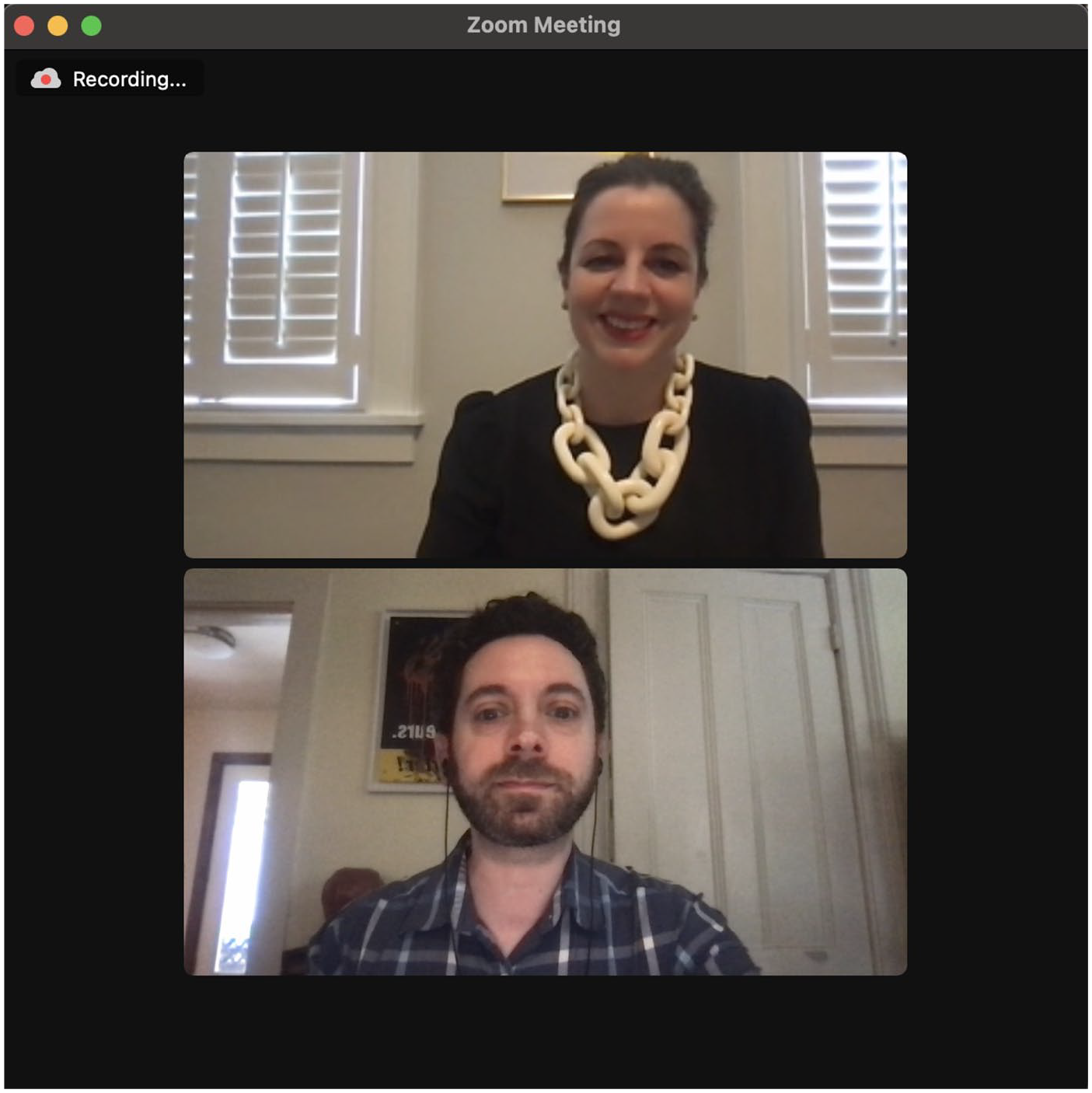
We are Pandemic TV.
About a decade ago, my cherished friend Maria Fackler and I published a co-written essay, which took years of concerted thinking, researching, talking, writing, and editing before it saw its way into the world. More recently, as we found ourselves full of pandemic exhaustion, the idea of writing together again, which in theory we very much desired to do, felt faraway in practice, not least because of other obligations and, frankly, obstructions to the prospect. Perhaps, for instance, Maria and I would have co-written a different version of this very essay if she weren’t, at the time of the essay’s initial drafting, raising and homeschooling a young child then ineligible for vaccination. Under such conditions, a certain flexibility, not simply reducible to the neoliberal imperative to be flexible that has a deservedly bad reputation, must be comprehended—as well as performed—with different accents and emphases from those that we were otherwise attributing to it before the pandemic. And so, this section of the essay is one that I am stretching, as it were, to include an edited, excerpted transcript of a Zoom conversation with Fackler (2022):
The fact that I am hard pressed to think about the stuff that I watched during the pandemic is pretty telling. We started the pandemic watching The Great British Bake Off: we needed that level of inoffensive, let-me-just-watch-people-knead-dough, weighted-blanket viewing. . .or—what is it that dogs wear during a thunderstorm—thunder-jacket viewing, like, that level of cocooning. But I would be hard pressed to say where my taste went next. And I would say also that one of the signal differences between myself and my students is that I have no guilt about watching TV and they are wracked with it.
That’s strange to me, particularly if they’ve elected to take a course with you for instance on queer TV.
Well, I do think that the way that they watch TV is drastically different to the way that you and I consume it. I have a sneaking suspicion that for many of them, watching TV was something that was rationed in their homes, and these are the children, almost exclusively I want to say in these classes, whose viewing was monitored by their parents. They were not allowed to watch anything other than PBS Kids, so they grew up not knowing the shows on Nickelodeon and Disney that their peers did. And so, this manifested in one of two ways. Either they have all this guilt about watching TV that has been thoroughly inculcated in them from the start, or they became over-consumers because it was so rationed in their households.
I still have the sense nonetheless that most of them or at least many of them are doing what we could call “the safety dance”: that’s another jokey way of describing “the Schitt’s Creek problem”—that is, watching things that are anodyne and approaching with trepidation anything that they would deem salacious or dangerous or otherwise “bad” for them. So, this leads to the central question that I wanted to see whether we can engage together, and that is: in the pandemic, how have you been thinking about navigating between abiding care for your students, identifying their needs and vulnerabilities and doing your best to support them, and wishing to push them, especially into more curious and adventurous forms of spectatorship and interpretation?
So, to me, engagement was the most important word at the end of the day. So often I was more interested in slightly different versions of queer TV than they were. I was interested in formal queer coding: the ways in which, you know, queer content could have showed up in something like Police Woman or All in the Family? To them, All in the Family was like a punishment. Like I was doing something really reprehensible by making them view it, compared to the relatively toothless and “sensitive” Lear reboot of One Day at a Time, which they love, obviously. And so, I do want to push them always to look at content and say, well, this may not be your taste. You might find this offensive, this may not gel with your sensibilities, and you may not want to watch it in particular because you’re feeling overburdened or stressed out, but you’ve got to be able to do this kind of labor: what can we value or prize or see anew or glean from what disturbs or discomfits or fails to square with our twenty-first-century sensibilities—and what is the best way for us to be doing that?
The Florets of Arden
I wonder what Maria’s students, so put off by the stings and barbs of All in the Family, would make of Jann. Too buoyant and giddy in tone to be called a species of cringe comedy, the series does nonetheless share some formal features with cringe comedies par excellence like Curb Your Enthusiasm (HBO, 2000–2024). Just as real-life crank Larry David plays a hyperbolically fictionalized “Larry David” in that series, so, too, in Jann do we encounter Arden playing “Jann Arden,” an indulgently appetitive, needy, often clueless has-been whose disastrous efforts to reignite her pop career lead to refreshingly unpredictable hijinks. Yet whereas Curb is drenched in misogyny and wallows in racialized minstrelsy, Jann is guided, both before and behind the camera, by feminist impulses, and its dimensional, nuanced depictions of centrally featured brown women transcend the problematic that Kristen Warner (2017) has astutely diagnosed as the “plastic representation” of BIPOC characters onscreen. All the same, these sanguine and welcome aspects of Jann’s politics do not work—and are not designed—to inoculate viewers from the bracing qualities of Jann, who unleashes all manner of insensitivity on her family, intimates, and business associates. To invoke some well-worn language away from which I endeavor to steer my students, she is neither “likeable” nor “relatable.”
Yet what if one could learn something, along the lines of “seeing oneself,” in such a difficult character? Much has been made of the perils of answering television’s calls to identification and recognition, which are likely to configure a misrecognition somewhere on the spectrum from benign to pernicious. By contrast, an alternative operation may become available in the confrontation and reckoning with an “unlikeable,” “unrelatable” character (a sort of character very much on the rise in twenty-first-century television); in the estrangement and defamiliarization perhaps entailed by the encounter, “seeing oneself” would mean reorienting one’s view of oneself through the prism—a kind of funhouse mirror—that, for instance, Jann holds up. To test this claim, I want to describe and unpack two of the most delightful scenes in the series, though what I take to configure delight may strike others as perverse—or not, if, like me, my readers have been especially cued by the pandemic to appreciate dysfunction when its guises are not in a nail-on-the-head way about pandemic dysfunction itself. (As an aside and by way of framing, I will also note that, when I think of Jann, these two scenes are the ones that come most unbidden and impactfully to mind, and there may be some heuristic value in considering them because of their memorability.).
The first scene cold opens the pilot (Jann, Season 1, Episode 1, 2019). For reasons not yet made clear, a devastated Jann ugly cries into her steering wheel as the radio plays her hit single, “Insensitive.” Blubberingly half-singing the first two lines of the song in narcissistic time with her broadcast self, she then says aloud to no one, “Finally, I understand this song.” The episode proceeds to enact a set of temporal relays, through which we learn retrospectively what happened just prior to the opening scene: Jann, foolishly in denial about the finality of her recent ex-girlfriend Cynthia’s breakup with her, drives to Cynthia’s house, where she is going to correct for her prior insensitivities and solipsism, declare her love, and ask to reconcile. But before Jann can launch into the speechifying that she has imagined will miraculously undo the dysfunction of the ended relationship, she spies Cynthia passionately kissing another woman. Cue the crying, Jann swerving around (and eventually veering comically off) the road, and the playing of “Insensitive”—the meta-joke about which is at least two-fold: how could Jann be so dim that she has never contemplated the lyrical meaning of a song that she has performed thousands of times? And how could she be so self-absorbed that she thinks Cynthia has been insensitive to her, when her ill treatment of Cynthia precipitated their breakup?
The conclusion of the opening episode of Jann’s second season finds Jann returning early from a tour with Sarah MacLachlan, which was canceled after dangerous technical mayhem onstage and the fiery decimation of a tour bus have proven too much for MacLachlan (Jann, Season 2, Episode 1, 2020). Playing up the contrast between “angelic” MacLachlan and “demonic” Jann, the episode slowly and artfully leads to the conclusion that an indeed demonic Jann, envious of MacLachlan and dissatisfied in her role as her opening act, has been responsible for the tour’s sabotage. In a wonderfully winking cameo that undoes the image of MacLachlan as self-regarding in her seriousness, she appears on the stoop of Jann’s sister’s house and confronts her with the demand to return her stolen “lucky scrunchie” (which Jann denies having stolen despite its conspicuous use to hold back her ponytail). In the ensuing catfight on the front lawn, MacLachlan gives almost but not quite as good as she gets, while Jann’s blows upon her are accompanied by her shrieking, “Stay down, MacLachlan! [Beat.] Why won’t you die? [Beat.] Who’s in the arms of the angel now, bitch?!”
It would not, I think, have been initially obvious to me that I might have a lesson to learn about myself in experiencing Jann/Jann. Or, at least, it wouldn’t have been prior to the pandemic. But over the last several years, how routinely have I experienced moments of bathetic self-pity? When have I not played or replayed in my head the fantasy of giving vent to the simmering rage that the pandemic has inspired? 3 Jann literally came to view for me because of its emplacement in my Hulu “Hidden Gems” bloc. But on a conceptual level, it stays abidingly in view on the screen in my mind because of the affects, attitudes, and actions it has conjured, providing (pardon the pun) a channel, strappy and sharp, in which to have felt my way through COVID-19’s very different slings and arrows.
Coda. Odds and Ends
Although an algorithm pitched Jann to me, that technical maneuver is not the only reason to think of the series as an example of algorithmic TV, a term that Hollis Griffin (2017) has deployed more imaginatively and expansively to theorize the tactics and strategies that contemporary makers of television are adopting to take best advantage of, if not game, the algorithm. According to Griffin, even if such makers are not initially creating work for a streaming service on demand, they know that, inevitably, said work will find itself in an algorithmically curated ecology (as is the case with Jann, the first two seasons of which migrated first from CBC to Hulu and then from Hulu to the Roku Channel); and, as a consequence and anticipatorily, they develop certain inputs to play to the algorithm’s eventual outputs. Two of these inputs are what Griffin calls “snow globes” and “Trojan horses”: respectively, the establishing illusion of whole, self-contained worlds, alongside the introduction of outsider characters meant to pull viewers into these worlds, even if viewers may not otherwise be inclined to dwell in them. Sure enough, Jann conforms exactly to these logics, as it ekes a version of Jann’s Calgary, centered in specifically drawn domestic and professional spaces, that feels largely of a piece with itself—and as it deploys fun meta-stunt casting (not just MacLachlan, but k.d. lang as a mean and snobbish “k.d. lang”) to lure pop fans, if not always Arden fans, into the proceeding.
Finally, if Jann may be valuably understood as both cringesque comedy and algorithmic TV, it might also be usefully characterized as gloriously quirky TV—glorious because, unlike in Schitt’s Creek, its investments in the offbeat, loopy, and eccentric are not incidental (quirkiness is routinely set aside in the latter series when it doesn’t conveniently serve a sentimental or otherwise saccharine purpose) but fundamental to the sensibilities of Arden and her collaborators. That quirkiness, delightfully on offer in the first two seasons of Jann, gets doubled down on during the third, perhaps most vividly in the series’ exploration of Jann’s affinity with and fondness for the skunks who roam around—and, at her ridiculous invitation, inside—her house. What better power animal for Jann than the skunk, a putative pest whose attractive cuteness is undercut by its repellent spray? (If you’re sensitive, don’t get too close to either Jann or a skunk!) And, in the end, what better onscreen avatars for pandemic television viewers than Jann’s skunky menagerie: unable to ward off harms that they may sorely wish to avoid, yet equipped nonetheless with curious tools for greeting them?
Footnotes
Declaration of Conflicting Interests
The author declared no potential conflicts of interest with respect to the research, authorship, and/or publication of this article.
Funding
The author received no financial support for the research, authorship, and/or publication of this article.