







Abstract
This article analyzes American cable channel HGTV’s programing strategies in response to the COVID-19 pandemic, and specifically their construction of a “COVID-free” fantasia in their series Home Town and its spinoff, Home Town Takeover. By considering this response through the lens of dissonance, I argue that while the network originally emphasized their social responsibility to mitigating the spread of the virus, their business model incentivized them to move past the virus more swiftly than other channels, pushing the labor of mediating dissonance onto their on-screen talent and their audience. This case study foregrounds how variables like genre, channel, and audience shaped the television industry’s response to the pandemic, with HGTV’s business model built on “evergreen” reality programing leading them to abdicate principles of social responsibility both more quickly and more thoroughly, despite numerous options that would have addressed the dissonance of COVID in a more balanced fashion.
In May 2021, HGTV debuted the series Home Town Takeover (2021–present), a spinoff of the popular Home Town (2016–present) series starring Ben and Erin Napier of Laurel, Mississippi. Originally announced in January 2020, Home Town Takeover started with a contest where struggling towns from across the country could submit themselves for a makeover similar to what the Napiers organized in Laurel, where they painted murals and refreshed public spaces across the town. Wetumpka, Alabama won that contest, and the six-episode series documented the Napiers and other HGTV hosts helping locals with a combination of home renovations and the restoration and rehabilitation of businesses and other locations across the town. Given the timing of the contest, there is no question that the COVID pandemic changed the circumstances of this “takeover”: the winner of the contest was originally going to be announced in March 2020, but that was pushed back to July, while production on the series didn’t begin until the fall. A special preview aired on HGTV in November, with the series itself finally making it to air six months later in May 2021. While these lengthy production timelines are not uncommon in reality television, a genre that weathered the production shutdowns following COVID’s arrival in 2020 better than others (Aurthur 2020), the public nature of the announcements positioned the show as a production that would have been impacted by the pandemic and the related health and safety concerns.
However, when the second episode of Home Town Takeover aired (“The Mayor is Also the Barber”), it featured a scene where Wetumpka’s mayor and barber Jerry Willis works with an elderly male client in his barber shop without any kind of mask, even though the scene was no doubt filmed before COVID vaccines were widely available (see Figure 1). There was also no evidence of any pandemic-related safety precautions throughout the series: while an outdoor performance by Sheryl Crow featured a conspicuously sparse and spaced-out crowd, there were no masks in any of the scenes, and no mention of how the pandemic might be contributing to the challenges facing small businesses in Wetumpka’s downtown. For anyone who had followed the circumstances of the contest, and the promotion HGTV had done for the series, one natural conclusion would be that Home Town Takeover had been produced in wanton disregard for public safety, and for the safety of those participating.
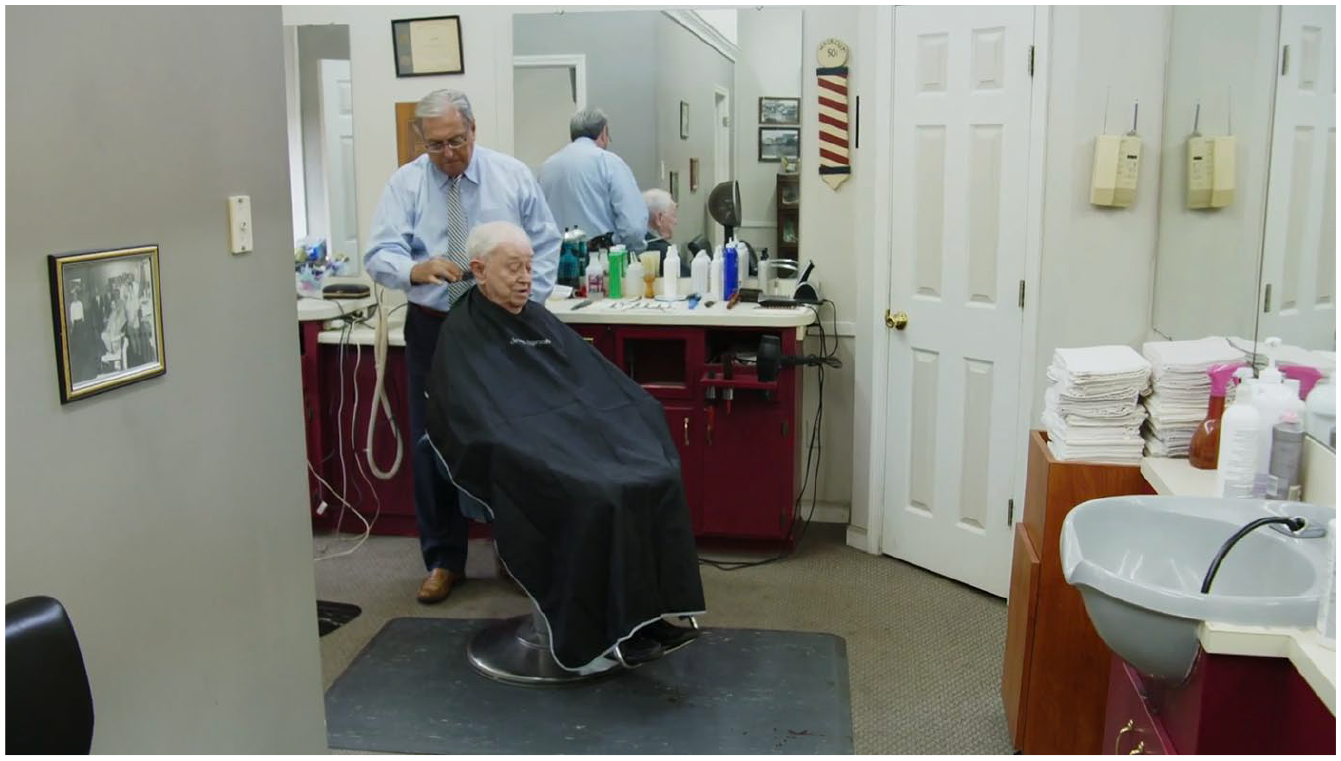
Mayor Willis cuts hair without a mask.
This conclusion would be untrue: like any productions that returned to work in the summer and fall of 2020, Home Town Takeover—and Home Town itself—had strict testing and safety standards in place, which the Napiers discussed in an interview with PopCulture.com surrounding the January 2021 debut of the fifth season of Home Town that was also filmed in 2020 (Coulston 2021). However, none of this work is acknowledged within the show itself, or within the official promotion of the show, which was very much by design. As Erin Napier says in the interview, “we hope [the audience] forgets COVID exists, because we worked really hard to make it not exist in Home Town.”
This article argues that these series’ active erasure of the pandemic reveals how the television industry’s initial, proactive approach to acknowledging and engaging with the lived reality of 2020 gave way to established industrial logics that made such acknowledgments seem detrimental to the business models of cable channels like HGTV. Choosing to present the series devoid of sociocultural context may be defensible from the perspective of cable’s dependence on evergreen programing that can be run and rerun for years without losing its value, but a combination of the pandemic’s longevity and the distinct scale and severity of COVID also created controversy among some viewers when the pandemic-produced seasons debuted with no textual context in 2021. However, engaging with the pandemic would have created controversy within other audiences, foregrounding the challenge the producers and broadcasters of all shows—but especially reality series that document real lives—faced when determining how best to address an ongoing and unpredictable public health crisis within their programing.
After surveying the industry’s larger response to integrating the pandemic into their programing and the principles undergirding their decision making, this article analyzes HGTV’s programing strategies in response to COVID, and specifically their construction of a “COVID-free” fantasia in Home Town and Home Town Takeover. By considering this response through the lens of dissonance, I argue that while the network originally emphasized their social responsibility to mitigating the spread of the virus, their business model pushed them to move past the virus more swiftly than other channels, prioritizing ideological dissonance emerging from conversative viewers over potential dissonance from viewers concerns about a lack of on-set safety. In doing so, HGTV pushes the labor of mediating this dissonance to Erin Napier herself, highlighting the industrial resistance to the management of pandemic politics that were unavoidable for celebrities active on social media. This case study foregrounds how variables like genre, channel, and audience shaped the television industry’s response to the pandemic, with HGTV’s business model built on “evergreen” reality programing leading them to abdicate principles of social responsibility both more quickly and more thoroughly, despite numerous options that would have addressed the dissonance of COVID in a more balanced fashion.
To COVID or Not to COVID: Programing the Pandemic
Producing television during the pandemic always carried a certain degree of risk, but it was considered a necessary risk by the television industry. Fortmueller (2021, 19) notes in her timely study of COVID-19’s impact on Hollywood that “the demand for films, television shows, and commercials never slowed” with the demand for television in particular increasing during the early months of the pandemic as more viewers spent time isolated at home (see also Marketing Charts, No Author 2021). This demand was particularly difficult to meet for broadcast networks, who work on shorter production timelines and produce more episodes of each show per year, with the initial production shutdown forcing them to cut seasons short and delay premiere dates for fall. As a result, the industry was quick to introduce protocols that would keep workers safe, and by late summer crews were back on set with COVID Safety Officers and testing requirements.
A remaining question was whether to acknowledge the pandemic in the stories that were being produced in this controlled environment. When broadcast series returned to the air in late 2020, many integrated COVID-19 into their storytelling to tap into the lived reality of viewers. These were predominantly shows grounded in realistic settings, which often drew on current events to connect with audiences: hospital dramas like Grey’s Anatomy (ABC, 2005–present) or police procedurals like Law & Order: Special Victims Unit (NBC, 1999–present) used the pandemic as a backdrop for their storytelling, while working-class sitcom Superstore (NBC, 2015–2021) saw an opportunity to explore retail workers’ experience of the pandemic. Based on both generic codes and their past reliance on realism in storytelling, these shows blurred the line between fiction and reality to reflect the moment in which they were being both produced and consumed.
However, some critics noted that the inconsistent depiction of mask-wearing on these shows betrayed the controlled environment in which they were produced (VanArendonk 2020), highlighting the inherent risk of dissonance that comes with fictional takes on lived reality. I define dissonance here as an undesired disconnect between the audience and the world presented in a television series. While television’s inherent balance of escapism and realism naturally generates dissonance, I’m interested here in instances where this disrupts the audience’s desired experience of a given text. Often, such dissonance is isolated within a particular group of people with first-hand knowledge of a given profession or geographic region—YouTube, for instance, is filled with videos of real-life doctors or lawyers reacting to television dramas, judging them on their verisimilitude in a way a regular viewer would not. In other cases, however, dissonance emerges based on a viewer’s worldview, which sociological researchers have explored through a homophobic audience’s engagement with LGBTQ+ representation (Youngbauer and Jones 2018) and in Chinese audiences’ response to alternative gender roles in foreign programing (Zhang and Su 2021). It is impossible for television to avoid dissonance altogether, but for broadcast television in particular, the goal of appealing to the widest possible audience necessitates mediating this dissonance to ensure viewers do not resolve the disconnect by turning the channel.
COVID, however, represents a particular challenge in this regard. First and foremost, it has had a near-global impact: everyone has some type of direct experience of living through the pandemic, meaning an issue like inconsistent masking would more likely foster dissonance beyond an isolated group of experts. Second, the pandemic represents a moving target, with even broadcast television’s quick turnaround times unable to account for how changes in public health policy or mutations in the virus could create a stronger disconnect between the audience’s experience and the representation therein. And third, while the pandemic initially manifested as an agreed upon public health emergency, over time it devolved into an ideologically divisive subject in the United States, with Republican-led state governments pushing for the “reopening of the economy” and the removal of key mask mandates. As a result, once a series chose to frame itself as tied to audiences’ lived reality—as opposed to explicitly separating it as a fantasy version of the world—writers created multiple forms of overlapping and contradictory dissonance within their audience.
These competing dissonances turned producing television in the era of COVID-19 into a distinct challenge. Poniewozik (2022) observes that writers were “conscripted. . .into making public-health decisions they never expected to be part of the job description” and “left to guess at Covid’s future like a hapless pop culture C.D.C.” A British producer working on a science fiction project speaks to this anxiety, telling Screen that “It’s a relief I don’t have to think how we factor the post-pandemic world into the story” (Dams 2021). It is telling then that most shows that embraced COVID in their storytelling chose to move past the pandemic faster than the audience could at home: by Fall 2021, Grey’s Anatomy opened its eighteenth season with a title card informing viewers that the show “portrays a fictional, post-pandemic world which represents our hopes for the future.” This title card severs the link to reality that was creating potential dissonance, but it also acknowledges that to suddenly erase COVID from existence creates its own dissonance that must be mediated through this paratextual update. Scripted television embraced COVID to reflect on a moment in viewers’ experience, but its capacity to mediate the dissonances involved with the pandemic proved limited, hastening a forced disconnect from viewers’ lived reality to maintain balance.
Unscripted television, however, does not have the same luxury. While game shows and reality programing went back into production with similar COVID policies to scripted series, audiences know these are real people often in real situations, meaning that disconnecting from the realities of COVID is more challenging. Ouellette and Murray (2009) argue reality TV creates “an unstable text that encourages viewers to test out their own notions of the real, the ordinary, and the intimate against the representation before them” in a way that scripted programing resists (p. 8). Critical here is that there is no objective “reality”: given the ideological dissonance surrounding COVID, some viewers’ notion of reality is one in which the coronavirus is a hoax or just a flu. Accordingly, if producers are hoping to avoid dissonance, they must contend with the notion—whether true or not—that for every viewer who might question if a program was safely produced if no masks are seen, there is another viewer who will turn the channel if there are masks, or if any other COVID-related protocols like social distancing are visible within the text. And while this is present within scripted programing, it is amplified within unscripted series where the setting cannot be formally divorced from reality, embedding dissonance into the very premise of the series.
For some producers, particularly early in the pandemic, the greatest concern was being perceived as failing to live up to a sense of social responsibility. In the case of ABC’s primetime reboot of game show Supermarket Sweep (2020–2022), producer Alycia Rossiter noted in an interview that while it may have been safe for host Leslie Jones to interact with the contestants given the procedures in place, “we didn’t know how much the audience knew about the testing we had gone through, and we didn’t want to get a whole lot of negative feedback that we hadn’t been careful in a time where care was really needed” (Owen 2021). Producers had a clear goal of producing programing that met the same standards as before the pandemic, but they recognized the potential dissonance if they failed to integrate social distancing that audiences could still be living with at the time it aired. But this dissonance expanded as the pandemic wore on, with certain states implementing stricter vaccine mandates while others removed mask policies, making it nearly impossible to establish a clear baseline. With the shifting, uncertain reality of living under COVID in America, any attempt by unscripted producers to mediate audience dissonance had to contend with the temporal and spatial disconnects therein.
However, a given program’s approach to mediating this dissonance is directly shaped by the goals of its distributor. While broadcast programing initially embraced the dissonance of COVID when they returned to production in their effort to connect with audiences’ current circumstances, cable channels—who heavily rely on reality programing—have different priorities. For narrowcast cable channels like HGTV, which draws one of cable’s most upscale audiences (Ryan 2015), the dissonance of the pandemic challenges their business model’s reliance on evergreen programing that retains its value beyond an initial airing. Kompare (2005) writes in his seminal monograph Rerun Nation that “ a media text’s cultural and industrial durability in repetition has been a primary design feature of many forms and entire genres” (p. 169), and this is particularly true for cable channels like HGTV that block schedule reruns of their biggest shows to fill 24/7 programing lineups. As such, while Supermarket Sweep producers were worried about potential dissonance when the season debuted in primetime in the fall of 2020 on ABC, HGTV executives have been historically concerned about how a series will be received years into the future, when the dissonance of an episode focused on the challenges of living alongside COVID could lead viewers to change the channel. And while the uncertainty of the pandemic (including new variants of the virus) meant that it was—and still is—impossible to know when we will reach a “post-COVID” moment, HGTV’s business model encouraged them to construct one, because they believe their programing’s true value lies in its longevity.
This is not to suggest that HGTV never acknowledged the pandemic in its programing. Rather, analyzing HGTV’s evolving relationship to the pandemic reveals the inherent incompatibility of the pandemic to their business model, the variable compatibility of erasing COVID within the channel’s programing, and the shifting responsibilities of the channel in the discourse of dissonance that followed on social media.
“Home Together,” But Not Forever: HGTV and COVID-19
When the pandemic initially led to lockdowns in the United States in early 2020, HGTV joined the rest of the television industry by “doing their part” to encourage public safety measures. During commercial breaks, HGTV began airing “Home Together” PSAs featuring the various hosts from their primetime programing. In these videos, which were posted to social media accounts in late March, the hosts tape glimpses of their life at home alongside statements of support for frontline workers and advice to viewers on how to spend their time at home with their families (see Figure 2). HGTV told Variety on April 1 that they believed their stockpile of filmed programing “could outlast the Coronavirus” (Aurthur 2020), meaning they could avoid mediating any dissonance created by production disruptions and COVID mitigation within their main programing—in this way, they felt their business model was better suited to survive the impacts of COVID than broadcast programing. However, they nonetheless understood the social responsibility of addressing it with their viewers, using the #HomeTogether hashtag as a marketing opportunity by posting a few daily schedules to encourage viewers to tune into the channel.
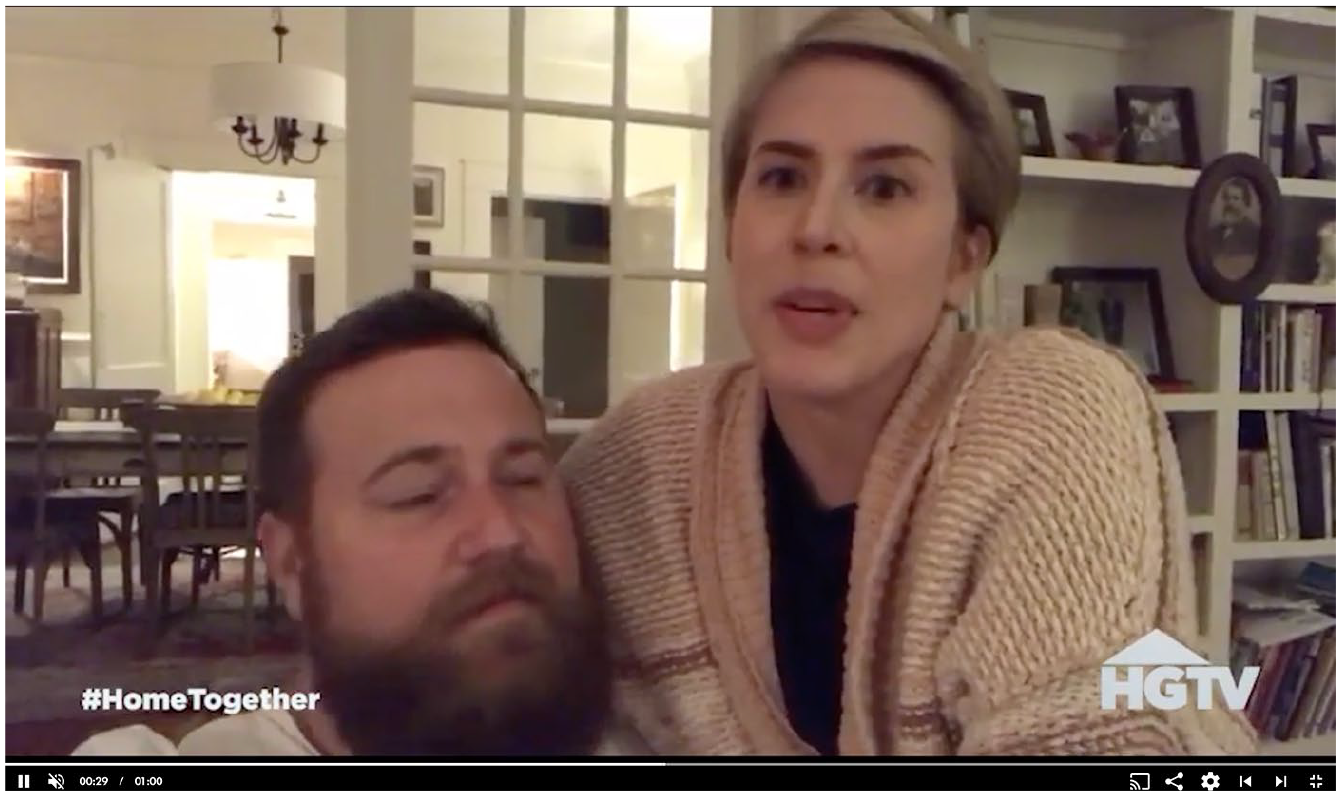
The Napiers’ PSA for #HomeTogether.
But when the pandemic extended beyond initial expectations, HGTV’s programing was forced to address it directly, activating the dissonance of reality programing within the context of COVID. In some cases, this was necessary due to filming that was interrupted by the pandemic: an episode of Property Brothers: Forever Home (2019–present) filmed in Toronto concluded with a video conference with hosts Drew and Jonathan Scott, who were unable to cross the Canadian border to tour the finished house with the homeowners after construction was delayed, while episodes of Love It Or List It (2008–present) similarly used video chats during reveals due to border restrictions making it impossible for the Canadian hosts to travel to North Carolina. Executives also greenlit two series that were produced remotely to fill their schedule. The first, Hot Mess House (2020), debuted in June 2020 and featured professional organizer Cassandra Aarrssen working with clients over Zoom as they filmed their process reorganizing their homes. The second, Design At Your Door (2020), featured designers working over Zoom with clients, sending them materials to complete their own renovations while socially isolating and filming their progress. In the latter case, HGTV specifically highlighted frontline workers and others who had been affected by the pandemic in their casting, with the first episode featuring HGTV star Tamara Day helping a nurse and her young family create a guest room that could double as a quarantine suite. Both aesthetically and narratively, HGTV embraced the dissonance of the pandemic to tie their brand to the social responsibility of the moment they were in.
As these programs were airing in the summer of 2020, however, HGTV restarted production on its long-running series, thus taking on the aforementioned role of “Pop Culture C.D.C.” When Home Town and other series returned to production in late summer, it seemed possible—albeit unlikely—that the new episodes would air at a time when the virus would be more contained. As a result, given the focus on “evergreen” programing that could be easily repeated, Home Town and nearly all other major programs went back into production with no acknowledgment of the pandemic, with COVID safety measures utilized to keep crews healthy. This meant no masks and no social distancing on camera, even in scenes that took place in public spaces like antique stores or other small businesses, where anyone who appeared on camera had to have been tested multiple times. While it was impossible to hide the reality of the pandemic when producing shows remotely, given that the mode of production was entirely contextual and given videoconferencing’s larger signification of “pandemic times,” the formats of Home Town and other home renovation series technically allowed for the erasure of COVID using testing procedures.
However, like all reality programing, it is impossible to entirely erase the dissonance of COVID within HGTV’s programing, albeit to different degrees depending on the format in question. In some cases, the dissonance was so significant that HGTV was forced to allow COVID-19 to become part of the storytelling. The one primetime program to engage actively with the impacts of the pandemic was Renovation Island (2020–present), a series that followed Bryan and Sarah Baeumler as they renovated and reopened a resort in the Bahamas. Originally titled Island of Bryan in Canada, the series debuted in the United States in June 2020, and its initial first season broadcast ended with the completion of the resort and its grand opening in December 2019. Given that the series’ renovation narrative is built around both the resort as a business and the personal and professional challenges of the family’s relocation to the Bahamas from Canada, the program’s return in 2021 naturally dealt with how the pandemic led to the closure of the resort and forced the family to isolate in the Bahamas. To ignore COVID in a series about a family’s personal life and their connection to the hospitality industry would have created an untenable dissonance, especially if viewers also follow the family on social media (as HGTV regularly encourages its viewers to do).
On Home Town, however, the more limited narrative scope of the series created more space in which to create a COVID-free environment without necessarily activating the same dissonance. From a narrative perspective, the format of Home Town is straightforward: audiences are introduced to a homebuyer who is looking to purchase a house in and around Laurel, Mississippi, and then Ben and Erin Napier show them two houses, before renovating the one they choose. The homeowners constitute a very minor part of each episode’s storytelling, rarely returning before the final reveal after they choose which home to purchase. The remaining story focuses on Ben and Erin’s respective labor in completing the renovation: Ben completes woodworking projects in his shop, Erin designs and chooses decor for the homes, and the two embark on road trips to collaborate with craftspeople, shop in antique stores, or visit with relatives of the homeowners to get a personal touch for the design. While other HGTV series introduce at-home narratives for the hosts and their family, the Napiers initially chose not to have their daughters appear on camera, and typically do not introduce a personal narrative into the story. And although the series has a general narrative of restoring and renovating the town of Laurel—often setting scenes within the community—episodic narratives rarely if ever engage with social or cultural dynamics outside of the specifics of a given renovation. With these story elements absent, there are fewer natural places where COVID would enter a given story, making its erasure less dissonant on a textual level.
However, while this format may make removing COVID feasible, it does not mean that it was necessarily easy. Given the story elements that are included in the series, it was a challenge to maintain those same beats under COVID production. As Napier observes in her aforementioned interview with PopCulture.com (Coulston 2021), it had a major impact on the human interaction that was critical to the flow of each episode: she notes that per COVID guidelines a person cannot be on set or in a scene, unless they’ve been tested twice for COVID. And that is very complicated to schedule ahead. Well, because we have last-minute ideas, like “Let’s bring in so-and-so and do a cool thing about stained glass.” Well, they’ll have to go get PCR tested four days in advance and then the morning of, and it’s hard for them to schedule that.
This meant that producers had less flexibility in telling their story, with more advance planning necessary to fill each episode. This rarely created a dramatic or noticeable shift in the final product, given that the show primarily tells its story through small scenes featuring its stars and its collaborators or contractors, but the resulting scenes may have struck viewers the wrong way given an absence of masks or social distancing. However, the context of those scenes does not demand an engagement with the pandemic in the same way, say, as Renovation Island.
When considering the Napiers’ spinoff Home Town Takeover, however, the story being told meant that efforts to erase the pandemic generated a more significant dissonance. As it was originally pitched, the series sought out a town in need of a wide scale renovation, framed through the lens of the struggling American rural small town and the ability for communities to rally together and change their fortunes with the support of the Napiers and other HGTV stars. The producers would eventually choose Wetumpka, with each episode detailing a renovation of a residence, a business, and a community space. But when the show began filming in Fall 2020, the small town businesses renovated in the series (a barber shop, a clothing store, and a sports bar) were not just facing the broad decline of small town business: they were also confronting the challenges of the pandemic, which would shape the narrative of any story being told about them. To tell a story about a struggling small town and its businesses within a pandemic without acknowledging the impact of that pandemic generates a dissonance that cannot be mediated solely through elision, constructing a COVID-free fantasy that brings concerns regarding the safety of the production to the forefront.
That HGTV still chose to produce Home Town Takeover under these conditions points to their priorities in mediating the dissonance of COVID’s impact on their productions. While Renovation Island revealed that there were instances where they felt it was necessary to acknowledge the impact it had on the story being told, the choice to erase it from Home Town Takeover reveals that HGTV was more concerned about the dissonance from conservative individuals critical of COVID policies than they were from viewers who might be critical of the risks of producing television during the pandemic. By exploring HGTV’s lack of reaction to the discourse that emerged upon Home Town and Home Town Takeover’s premieres in 2021, we can understand this as part of a larger pattern of behavior, wherein the labor of mediating the dissonance fell to viewers and the show’s star as the industry rushed to “move past” a pandemic that continued to define life for its viewers.
Discourse of Dissonance: “COVID-Free” in a COVID World
When Home Town’s fifth season began airing in January 2021, the tweets started immediately. Viewers used the show’s hashtags #HGTVHomeTown and #HomeTown to note their horror at the lack of COVID procedures on the show, questioning the lack of masks and social distancing, and wondering if they missed a disclaimer about testing and quarantine procedures. Fans of the show responded by informing these critics that as early as when the series returned to production in September 2020, Erin Napier had been sharing Home Town’s extensive COVID protocols to her social media accounts. Many also linked to the PopCulture.com interview that the Napiers had done, which they shared across their social channels—Napier quote-tweeted the article with the caption “It’s been weird and complicated, but we made a COVID-less world in season 5 of #hgtvhometown.” Others who had seen this material even supported the logic Napier gives for creating this “COVID-less” world as an escape, citing the labor involved and enjoying the “respite” from reality.
This divergent response to the choice to present a COVID-free world points to the varied “realities” among viewers depending on their ideological or experiential disconnect regarding the severity of the pandemic. However, what is notable is that Erin Napier is solely responsible for navigating this dissonance among the show’s viewers: HGTV itself featured no information about the show’s COVID protocols across its linear channel and its social media feeds. Within the text, the erasure of any COVID-related details supports the emphasis on generating repeatable, evergreen content that would avoid being read as dissonant during future marathons—if an episode entitled “COVID Comes to Laurel” were to re-air years later, it could disrupt the flow of the channel’s comfort programing strategy. However, HGTV had many paratextual options to communicate their compliance with COVID policies outside of the text. They could have followed the lead of shows like Grey’s Anatomy and used introductory title cards to help clarify the production circumstances of what they were about to see, or used onscreen chyrons that would emphasize the procedures in place that could—like the title cards—be removed from future reruns. They also could have extended the ethos of the #HomeTogether campaign from the beginning of the pandemic and used their social media channels to communicate their continued efforts to control the spread of COVID while still providing the same type of evergreen content they were before the pandemic.
In the end, HGTV chose none of these paths forward, never even promoting the Napiers’ interview with PopCulture.com nor duplicating the information within on the program’s official website. In doing so, HGTV reveals that while there may be competing dissonances caused by the political polarization surrounding COVID, they perceive the dissonance fostered among liberal audiences concerned about a lack of safety protocols as less damaging to their brand and their viewership than that of conversative audiences desperate to “move on” from the pandemic. The resulting discourse during the airing of Home Town’s fifth season and the debut of Home Town Takeover forced Napier to come to the production’s defense, constantly linking to the PopCulture.com interview that was unlikely to be widely read outside of her social media following. By the time I personally tweeted about the dissonance of the barbershop scene mentioned in the introduction to this article, she quote-tweeted it with simply the word “okay” followed by the link, an exasperated gesture that speaks to her frustration with people’s criticism and the personal responsibility she was forced to take on related to it (see Figure 3). Yet the reason that criticism exists is because HGTV made no effort to address the dissonance behind it, whether through the text itself or through their own social media channels.
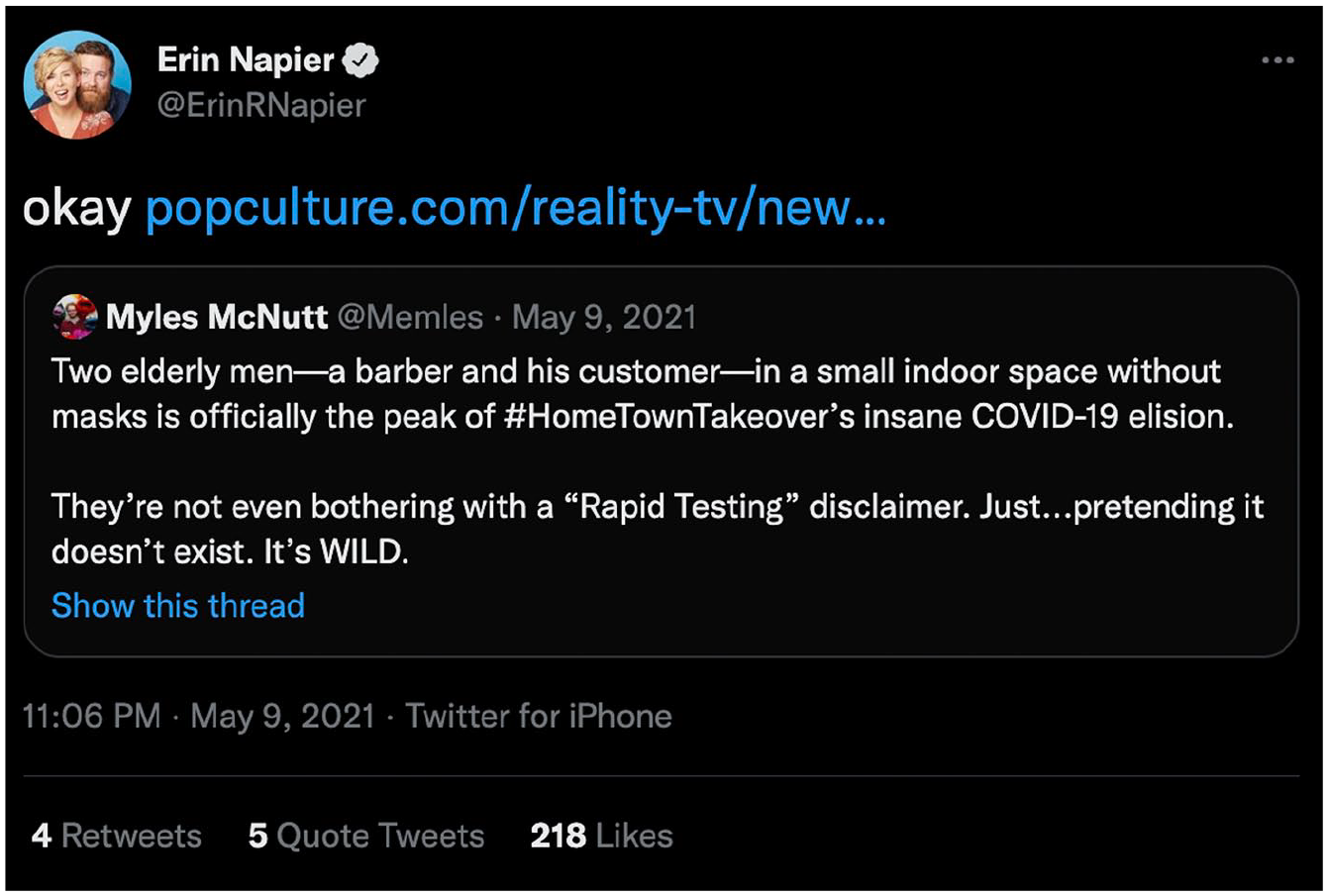
The Author’s Twitter exchange with Erin Napier.
That HGTV’s efforts focused so heavily on mediating dissonance within conservative viewers is supported by the replies Napier received after quote-tweeting my own criticism of the show. One user writes that “I cringe every time I see masks on TV. In a few years nobody will want to watch people virtue signaling,” suggesting a clear resistance to public safety measures and any acknowledgment of them within television programing. This is echoed by another user, who writes “they have said over and over that they tested everyone, probably all of those guys were fully vaccinated. If you want to stay in your house with a mask forever go ahead. Some of us want to live life now.” Beyond the understandable dissonance created by the confusion regarding the timing of the show’s production, which took place before vaccines were available, this tweet also suggests that the show’s depiction of a COVID-free reality indicates support of the removal of public health mandates, which Napier never herself articulates directly on her social media channels but arguably is supported by the text itself given COVID’s erasure.
This interpretation is echoed by another user who writes to Napier, but out of concern: “I realize the vaccine has been used for political gains, however when Mississippi ranks fiftieth on getting vaxxed, do you feel your voice would help and encourage your community?” This viewer acknowledges the ideological dissonance that has made discussions of COVID challenging for the television industry but argues that a sense of social responsibility should be paramount. Yet because HGTV resisted disrupting its “comfort” programing strategy and built an escapist version of reality amid a global pandemic, the labor of addressing this issue fell on Napier. And whereas the channel comfortably shrugged off the responsibility of COVID awareness when it was no longer compatible with their brand, Napier—like other celebrities—was forced to embed it into her own, navigating the dissonance of viewers disappointed with their perceived negligence and the ideological minefield of those thrilled to see the show pushing forward without “pointless” precautions.
Conclusion
Erin Napier was very aware of the dissonance of COVID for her personal brand. When pushed on Twitter about her lack of discussion of the vaccine, she tweeted “we and everyone we know have gotten the vaccine, but what home renovators think about it isn’t going to persuade anyone if doctors can’t.” And earlier, the Instagram comments about COVID on a post about her daughter Helen led her to delete the post, rejecting the criticisms “as if from a tiny vignette you can see the whole picture of precaution and how we wear ourselves out keeping our family safe every day” (Corbett 2020).
While the beginning of the pandemic was marked by a shared social responsibility from channels, celebrities, and viewers alike, the television industry’s relationship with COVID evolved alongside the virus, their response shifting to preserve business models and navigate an increasingly dissonant reality. As COVID became more ideologically divisive, and the arrival of vaccines did little to slow polarization on the value of masking, social distancing, and other prevention efforts, HGTV chose what they perceived as the path of least resistance, which in this case meant erasing COVID from their storytelling. And while that initial decision may have been shaped by optimism about the virus’ containment when the episodes began airing, taking no action to explain what procedures they were using to safely produce escapist reality programing when the episodes eventually aired reveals how their priorities diverged from any sense of social responsibility. While all of television was forced to play “Pop Culture C.D.C.” amidst a complex and everchanging climate, HGTV’s decision and their lack of paratextual negotiation of that decision foregrounds how conservative protests over COVID mandates were considered a greater threat to their business model—built as it is on evergreen reality programing—than any controversy over the safety of the cast and crew of their programs.
All television programing eventually “moved past” the pandemic faster than the rest of the world, which continues to grapple with new variants, long COVID, and the ongoing risk the pandemic poses to their daily lives. But while scripted programing spent the better part of a season embracing the narrative potential of this disruption, HGTV’s response reveals how the genre of reality television and the model of cable channels dependent on reruns hastened their embrace of a COVID-free fantasia, and led them to actively resist available forms of mediation lest they disrupt the escapist vision of reality they were crafting. And while Napier’s tweets and the discourse around them serve as an artifact of the dissonance that emerged based on HGTV’s decision to prioritize the potential controversy of addressing COVID directly among conservative audiences, what matters to them is that when episodes of Home Town produced in 2020 re-air on the channel in five years, their viewers won’t think twice about the circumstances involved.
Footnotes
Declaration of Conflicting Interests
The author declared no potential conflicts of interest with respect to the research, authorship, and/or publication of this article.
Funding
The author received no financial support for the research, authorship, and/or publication of this article.