







Abstract
This article presents key findings from a comparative empirical study of content recommendation on the audiovisual streaming services of six European public service media (PSM) organizations. Due to growing competition with international subscription streaming services, the editorial practices of PSM are developing, combining editorial curation with algorithmic recommendations. Contributing to the fields of PSM, platformization and scheduling studies, the article presents findings from a qualitative reverse engineering approach to interface analysis. We document how the majority of the services exercise what we characterize as light personalization, and we highlight explanations for why the degree of personalization on the PSM streaming services, in most cases, is still limited. The comparative approach enables us to identify the factors most commonly at play across diverse national contexts. The article adds to theoretical debates about how personalization is constructed in a PSM context and discusses whether algorithmic personalization conflicts with PSM values.
Keywords
Introduction
This article presents the findings of a comparative study of six European public service media (PSM) organizations’ digital transition and the way in-house audio-visual streaming services are replacing linear channels as entry points to the televisual experience. Increased competition from global subscription video-on-demand services (SVoDs) offering personalized user experiences underpinned by algorithmic recommender systems are putting pressure on legacy media to attract and retain audiences. To stay relevant and attractive, PSM organizations are increasingly incorporating personalized recommendations. The question is, however, if algorithmic personalization is at odds with core public service values. Existing debates about the digital transition of PSM identify diversity as particularly at risk from algorithmic personalization (Hildén 2022; Iordache et al. 2025a). This article aims to contribute to the scholarly discussion about PSM’s employment of algorithmic recommendation by documenting the extent of personalization on PSM’s audio-visual streaming services. We analyze the different ways in which the PSM in our study deploy algorithmic personalization on their streaming services, and to what degree the level of personalization differs across and within cases when applying a systematic comparative design.
The streaming services of six European PSM organizations are included in the study: VRT MAX and RTBF Auvio in Belgium (respectively Flanders and Wallonia-Brussels), DRTV in Denmark, RaiPlay in Italy, TVP VOD in Poland, and BBC’s iPlayer in the UK. All services are included in the remit of the PSM organizations. The cases represent PSM organizations in Northern, Western, Central-Eastern, and Southern Europe, within large and small media markets, with different funding models, varying degrees of political and public support, and responding to digitalization in different ways. The article employs a qualitative approach to study the micro level of distribution of algorithmically personalized television content. This involved feeding the algorithms of the streaming services, following the possible development of personalization and documenting it, before the outcome was archived using screenshots over the course of a week in November 2023. The screenshots act as primary data and are considered snapshots of the publishing practices. They are supplemented with information from qualitative interviews with management, publishing editors, and data and research analysts at the PSM organizations conducted during 2024.
The study is situated at the intersection between PSM studies, television studies, and platformization studies. We consider the study of interfaces the continuation of scheduling studies and argue for a more nuanced understanding of what personalization is as our findings are far from personalization known from Netflix and other commercial SVoDs (Eklund 2022; Lotz et al. 2022). After presenting the findings, we suggest an array of explanations for the light degree of personalization we find and discuss the potential clash between personalized recommendations and core public service values with a focus on diversity in the offering. Market position, track record, and corporate strategy of the individual PSM organizations influence the implementation of algorithmic recommendations, along with local interpretations of PSM values in the age of platformization (Poell et al. 2022). However, the intention of this study is to provide an empirically based mapping serving as baseline for further analyses, and therefore the focus will be on comparison and overview rather than expansive contextualization and in-depth examinations.
Public Service and Personalization: A Potential Challenge for Diversity
As pinpointed by D’Arma et al. (2021), PSM organizations operate in markets influenced by a variety of different factors, which affect their development and prioritizations. However, diversity is continuously regarded a key value of PSM (Burri 2015; Hellman 2001; Nikunen and Hokka 2020). Relevant in the context of this study is Napoli’s interpretation of diversity as consisting of three components: source, content, and exposure. Regarding the latter, Napoli (1999, p. 24) argues for the necessity to analyze exposure diversity by asking how many sources, types, and formats of programs audiences are exposed to in their media use. It is, however, important to distinguish between exposure and actual consumption. As pointed out by McQuail: “[o]n its own, diversity of supply cannot secure diversity of reception, but it is a necessary condition for this” (McQuail 1993, 157). In contrast to linear television schedules, Hildén (2022) indicates how recommender systems generate unique interfaces for the single user based on previous use and similar viewers. Along this line, Mattis et al. (2024, p. 4) further develop Napoli’s (1999) concepts of diversity by making a distinction between “diversity of supply,” which is diversity in content available for recommendation, “diversity of exposure,” which is the share of supply diversity that the user is exposed to, and, finally, “diversity of consumption,” namely the content the user actually engages with (which equates to “exposure diversity” in Napoli’s terminology). As such, the obligation to offer a diverse range of programs has become an even more complex obligation for PSM organizations than in the broadcast era.
A critical view has dominated the public debate on algorithmic recommendations. Popularized by Pariser (2012) and Sunstein (2001) the concepts of “filter bubbles” and “echo chambers” have been employed to describe the risk of a fragmented public with limited shared knowledge and information as a consequence of a personalized media consumption. The debate has affected the scholarly interest in algorithmic recommendations of media content as several contributions are concerned with disproving the claims of Pariser and Sunstein (e.g., Bruns 2019; Dahlgren 2021). While the fragmenting effect of personalized recommendations might be exaggerated in Pariser’s predictions, it is highly relevant to consider if personalization is compatible with traditional PSM obligations to promote diverse content and facilitate public debate and societal cohesion. Whereas this concern is raised by some scholars (Sørensen and Hutchinson 2018; Van den Bulck and Moe 2018), Helberger (2015, p. 1325) argues that recommendation and personalization strategies “open up new opportunities to guide or even “nudge” the audience toward more diverse consumption.” Algorithmic PSM is also strongly endorsed by Hutchinson (2023) as necessary in the context of platformized societies. For Hutchinson, the specialization of audience interests requires PSM to embrace algorithmic recommender systems to maintain the reach and relevance of their services. Like Mattis et al. (2024), Hutchinson highlights exposure diversity as key to “a healthy balance of both public issues and entertainment” (2023, p. 156). Furthermore, he claims that integrating algorithmic recommendation is a unique opportunity for PSM to demonstrate their continued relevance and to lead the technological charge toward algorithmic construction beyond a commercial focus (2023, p. 162).
Much research on algorithmic recommendations, personalization, and diversity focuses on news media (e.g., Hokka 2019; Mattis et al. 2024; Möller et al. 2018). Literature studying personalization of audio-visual streaming media tends to focus on commercial SVoDs, most often Netflix (e.g., Eklund 2022; Pajkovic 2022). Academic contributions dealing with personalization of PSM organizations’ streaming services are typically conceptual or focusing on the perspective of the organizations themselves (Fieiras-Ceide et al. 2023; Helberger 2015; Hildén 2022; Hutchinson 2023; Iordache and Raats 2023) rather than empirical analyses of the interfaces. Obviously, the limited number of empirical contributions is closely related to the fact that personalization is still in the process of being designed, implemented, and improved by PSM organizations. For instance, in a study based on data from 2018 to 2021, Kelly (2021) finds a remarkable similarity between the personalized and non-personalized versions of the iPlayer. Our findings suggest that the iPlayer has become more personalized since. As such, this article offers an exploratory study of a developing phenomenon in the emerging research field of personalization on PSM services. It contributes to theoretical debates about how personalization is constructed outside purely commercial contexts by asking whether personalization runs counter to the requirement for PSM to provide a diverse offering. It also updates the tradition of scheduling studies, returning to Ellis’s (2000) conceptualization of the television schedule as a text indicating broadcasters’ brand and programing priorities and their “inscribed assumptions” (pp. 26–27) about viewers’ habits. The comparative approach enables us to consider the impact of a range of factors on the use of algorithmic recommendations and provides us with an initial map of tendencies of how personalization is being adopted by European PSM organizations.
Method and Data
We use a comparative case-study methodology to analyze the implementation of personalization in PSM services. The aims of this comparison are both descriptive and explanatory (Vliegenthart 2012), with the observation of differing practices serving as a basis for reflection on the influence of nationally specific contexts on the PSM approach to personalization. The study uses a small-N design, with cases whose similarities enable us to identify recurring patterns and tendencies, but diverse enough to identify contextual differences. They represent PSM in small and large markets across Northern, Southern, Western, and Central-Eastern Europe. All are public organizations but with different business models: some are funded by license fee or taxation (BBC, DR), some combine public income with advertising and/or subscription revenue (Rai, RTBF, VRT, TVP). We also find differences in market position and public and/or political support: At one end of the scale, DRTV is among the most used streaming services in Denmark, and DR enjoys a general support from Danish politicians who consider PSM an important bulwark against global tech companies. At the other end of the scale, TVP VOD has been struggling for many years with the organizational odium of the TVP brand as politicized and untrustworthy, resulting from the existence of strong media capture mechanisms in Poland. For this reason, TVP VOD still struggles to maintain a visible position in a market dominated by commercial platforms. However, as documented by Iordache et al. (2025b) and Bruun et al. (2025) the cases share a commitment to digital development and traditional public service values such as universality and support of the national language/culture. The case selection is also framed by the countries participating in the research project Public Service Media in the Age of Platforms, and the data collection and analysis was carried out by researchers in each of the participating countries. Thus, access to the services and data are not limited by technology (e.g., having to access the service through a VPN) or linguistic knowledge.
Pajkovic’s (2022) analysis of the Netflix recommender system inspired the research design behind this study. With Handke and Herzog’s (2019) terminology, our approach can be characterized as a quasi-experiment, as we study the relationship between input variable and outcome variable. Ranaivoson and Domazetovikj (2023) highlight experiments as a suitable methodological approach for testing algorithmic systems. As such, we created three personalized accounts as well as a control account on each of the PSM streaming services in the study. The aim of this design was to evaluate whether demonstrable personalization of the content on the landing pages of the streaming services occurred in line with the account profiles. And, if this was the case, whether we could detect differences between the profiles of a single service. This is described by Bucher (2018) as “reverse engineering,” a process that “starts by asking what algorithms are suggestive of by observing the outcomes of algorithmic procedures as indicative of its “point of view”” (p. 85). In effect, our study amounts to a textual analysis of these interfaces based on models of their personalization which, as Johnson (2017) indicates, involves subjecting “the visible surface of the VoD interface to scrutiny in order to explore how it is designed to structure and organize television online in ways that might enable certain experiences and limit others” (p. 124).
Content recommendations can be based on a variety of parameters of which genre is just one. However, from interviews with publishing editors in the PSM organizations we have learned that genre is important metadata in content curation. As such, we created the four accounts according to the following guidelines:
an account focusing on quiz and game shows, including reality game shows and shows with competition as the main driver.
an account focusing on crime fiction series (national and international).
an account focusing on documentaries and film documentary, including true crime, excluding natural history documentaries.
a control account that watched nothing and was used via a “clean” browser (history and cookies were deleted prior to every visit and archiving).
The reason for creating accounts based on such extreme consumption was to avoid overlaps between the profiles, make the potential personalization distinct, and to test if the services would react to the narrow consumption patterns with either counterprogramming or by offering more of the same. We are aware of variations between the catalogs of the PSM organizations regarding both size and content, therefore we searched for genres that were present in all catalogs. In a pilot study in September 2023, we slightly adjusted the account profiles to make sure all accounts had a sufficient pool of programs to choose from.
Before the pilot study, each of the three personalized accounts were “fed” for 3 to 4 weeks. The feeding (input variables) consisted of each account watching at least two to three programs per week within the given genre and creating lists with liked (“would like to watch” or “favorite”) programs. As such, we expected the potential personalization (outcome variable) to be built on behavioral and content-based filtering as well as knowledge-based filtering (Hildén 2022, p. 3). A log was kept for each account to evaluate the progression of personalization, if any. The feeding of each account continued until the data collection, which took place in November 2023.
In the participating countries, no official archives of interfaces and catalogs of the streaming services are available for researchers. Systematic data collection is left to scholars, which is problematic for research in domains such as cultural heritage and TV history (Aegidius and Andersen 2024; Kelly 2022). For this reason, we have carried out the archiving of the interfaces ourselves. Data consists of screenshots of the services’ front pages, taken each day of the week 13 to 19 November 2023 between 18 and 23 o’clock. The data collection was made on laptop computers. Even though PCs are not the most common device for watching online television (CIM 2024; Johnson et al. 2022; Ofcom 2024), accessing the streaming services on laptops ensured comparability across devices on which the data collection took place. Obviously, personalization can happen beyond the landing page, but the landing page, and particularly the topmost area, is essential as entry point to a streaming service. Additionally, focusing on the landing page facilitated standardization of data and enabled comparability. The non-automated data collection was a work-intensive process, but the manual feeding, collection, and analysis enhanced the potential development of personalization and helped us determine which factors triggered the personalization.
The interface analysis is supported by data from thirty-six qualitative semi-structured interviews with management, publishing editors, and data and research analysts from all PSM organizations, conducted during 2024. The interviews included discussions about personalization and content curation on the streaming services, providing us with more information on the priorities in algorithmic and editorial curation at each PSM, as well as potential explanations of our findings. To comply with ethics requirements at all research institutions involved, the respondents have been semi-anonymized by referring solely to their organization and area of activity. Quotes are translated by the authors and have been approved by respondents.
Finally, a note on the vocabulary of the article: The “hero-board” is the topmost area of the landing page with content of high priority. A “tile” is a thumbnail image including captions, which provides access to a given program, whereas a “deck” is a horizontal collection of tiles.
Personalized Public Service Television
In the following three subsections we present our findings by pinpointing what personalization consists of on the six services, evaluating the degree of personalization, and considering explanatory factors for the findings.
Personalization as Add-on
This section offers an introductory overview of the differences we encountered on the personalized accounts compared to the control accounts regarding which decks were offered as well as when the personalization took shape. A common feature of the streaming services in our study is that decks were added to the landing page of the personalized accounts. Only RTBF Auvio did not follow this pattern. TVP VOD added one deck, RaiPlay added three, iPlayer added four, VRT MAX added between three and five decks throughout the sample week, while DRTV added eleven decks to the personalized accounts compared to the control account.
There also is a consistency in which types of decks were added. From Table 1, it appears that a deck entitled Continue watching was added on all personalized accounts except those of TVP VOD. Although RTBF Auvio did not add additional decks, decks titled Continue watching and My favorite programs appeared on both the personalized accounts and control account. They were used as placeholders on the control account and populated with personalized content according to user activity on the personalized accounts.
Titles of Decks Added on All Personalized Accounts of the Streaming Services.
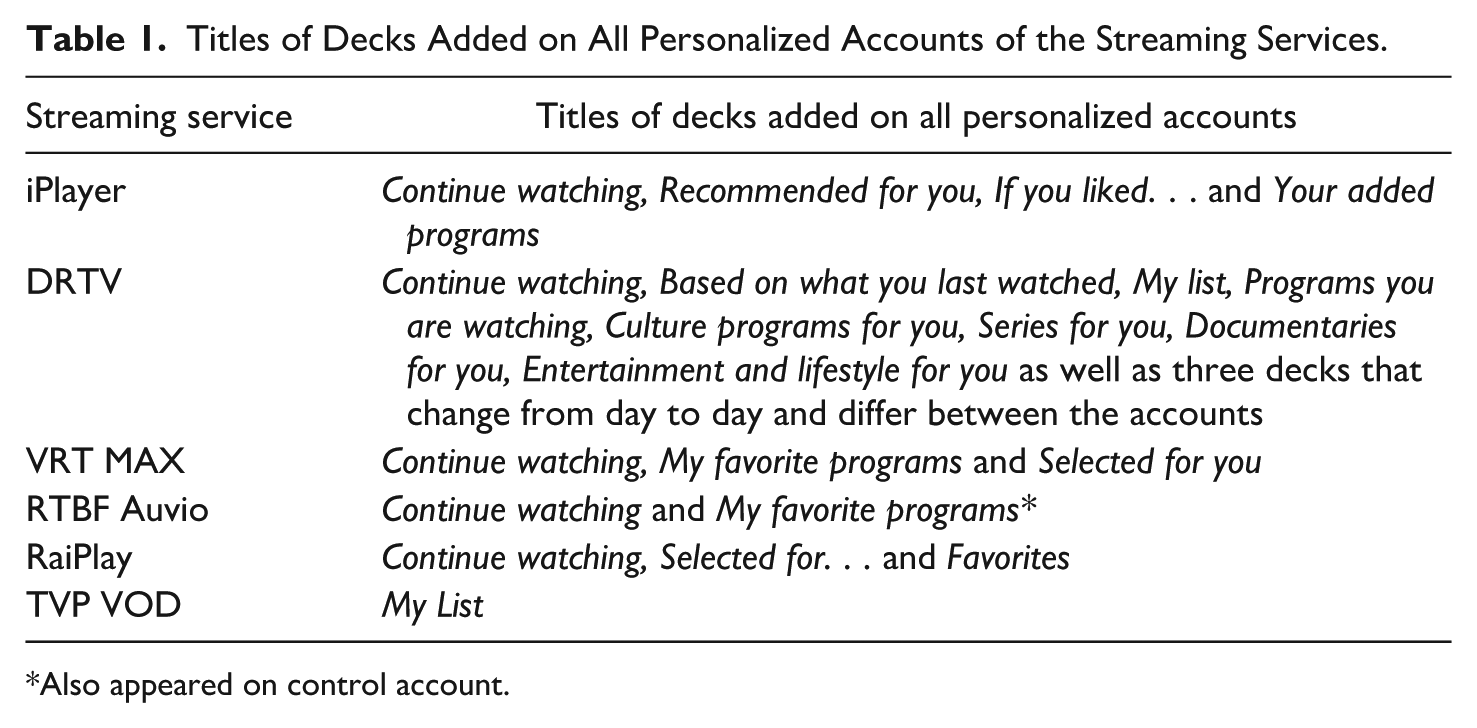
Also appeared on control account.
The deck titles Continue watching, My favorite programs, My list, Programs you are watching, and Your added programs illustrate that an important part of the personalization on the streaming services is what could be categorized as functionality. What is found on these decks is a result of the user’s interaction with the service, that is selecting and/or watching specific programs. Recommended for you, Selected for you, and Series for you indicate that these decks were used for pushing specific content, either as a space for exposure diversity or with the purpose of offering content tailored to the profile’s consumption pattern—or a mixture of these approaches.
The process of feeding the algorithms revealed great differences between how fast the recommendations and offering adjusted according to the profile—if at all. As we will go into detail with, in the following section, VRT MAX, RTBF Auvio, TVP VOD, and RaiPlay showed a light degree of personalization across the three personalized accounts. In contrast, DRTV and iPlayer adjusted their offer after three days of watching, but we did see variations between the accounts on DRTV.
Degree of Personalization
In this section we address the degree of personalization by evaluating to what extent the landing page changed. Handke and Herzog (2019) state that researchers must define what observations regarding the outcome variable would be consistent with a causal effect, that is a clear change in the outcome variable due to the treatment with the input variables. We consider the output to be a strong degree of personalization if the following criteria are met on the personalized accounts compared to the control account:
1. The hero-board differs from the control account.
2. Decks are added AND are personalized in accordance with the usage of the personalized account, for example, More documentaries for you or Because you watched. . .
3. On decks, which are also present on the control account, different/new programs are offered in accordance with the preferences of the personalized accounts.
Based on comparison between the personalized and control account, we consider the personalization of the landing page non-existent or light if one or more of the following observations are made:
4. The hero-board stays the same across all four accounts.
5. No decks are added compared to the control account.
6. No or few tiles on the decks below the hero-board are different to the control account.
7. Decks are added but not related to the profile of the account.
Based on these seven criteria, Table 2 sums up to which degree the landing page of each of the streaming services is marked by personalization. An “X” marks if a criterium is met. Due to the limitations in word count, an overall balance of the three personalized accounts of each service is offered.
Degree of Personalization of the Landing Page of Each Streaming Service.
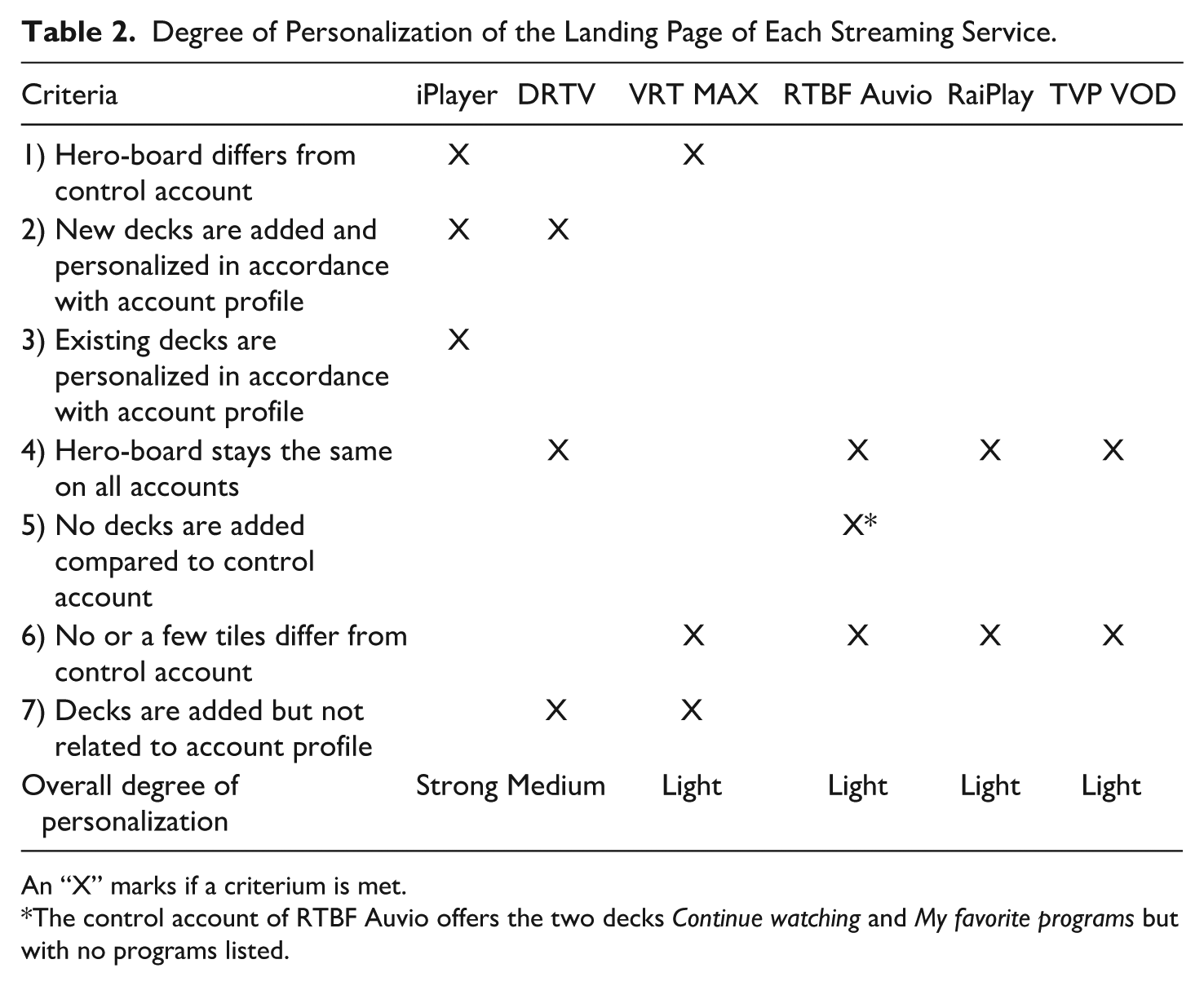
An “X” marks if a criterium is met.
The control account of RTBF Auvio offers the two decks Continue watching and My favorite programs but with no programs listed.
From Table 2, it appears that only iPlayer presents a strong degree of personalization, according to our categorization. This is manifested on the hero-board which changes its recommendation when viewed within a personalized account (criterium 1); on the decks Recommended for you and If you liked. . ., which only appear on personalized landing pages and are almost entirely mono-generic according to viewing history with no cross-over between accounts (criterium 2); and in the programs offered on decks at the top of the landing page which ostensibly offer a combination of personalized and curated recommendations (criterium 3). However, while personalization is broadly strong, there are notable variations between the specific accounts, with the recommendations for the quiz and game shows profile being less appropriate to its mono-generic viewing than the documentary and crime fiction accounts.
On the accounts of VRT MAX and DRTV we see how the offer that differs from the control account is a mixture of personalized content and added content that is not closely related to the profile. As evident from Table 2, the hero-board of the VRT MAX personalized accounts differs from the hero-board on the control account (criterium 1). However, the hero-board on the personalized accounts is identical across all three accounts and thus not tailored to the genre profiles. On DRTV all personalized accounts are offered the same hero-board (criterium 4) as well as the decks Culture programs for you, Series for you, Documentaries for you, and Entertainment and lifestyle for you (criterium 7). The content on these decks is partly shared, partly unique to each account. Besides the shared deck titles, each of the personalized accounts is offered three decks that change during the week. These decks are, to some degree, tailored to the single account as the documentary account is offered decks such as Strong Danish documentaries, Historical documentary series, and In search for the truth (criterium 2). However, the crime fiction account is, to a large degree, offered the same decks as the documentary account, though with slightly different content. What is interesting about the personalization on DRTV is that, from the perspective of the single account, the service does come across as somewhat personalized (although not very accurately for the quiz and game shows account). The similarity between the crime fiction and documentary accounts suggests that the personalization is not necessarily a response to user viewing behavior, offering, to a certain extent, an illusion of personalization.
The illusion of personalization is even more pronounced in the case of TVP VOD. During the sample week a deck titled Recommended for you appeared. However, it was offered on both the control and personalized accounts, and the content on these decks was not related to the profiles of the accounts. RaiPlay offered a deck called Have you watched Mare fuori? Then you might like on all accounts; however, none of the accounts have watched the show. The wording of these deck titles gives the impression of a personalized offering, but as appears from Table 2 we consider the personalization of TVP VOD and RaiPlay light, as the few added decks only seem loosely connected to the profiles of the accounts (criterium 6). Lastly, RTBF Auvio does not offer many variations between the control and personalized accounts (criterium 6), except for the functional decks mentioned above. Other changes on the RTBF Auvio landing page during the period of data collection are generally time-sensitive and related to live broadcasting and weekend programing, not to the usage of the service (criterium 5).
Explanatory Factors for a Light Degree of Personalization
With an offering on the personalized accounts that, in most cases, is not related to user viewing behavior, it is relevant to consider if the featured content is a result of an intended strategy or if it is due to a lack of available tools and/or resources. This section offers reflections on why our findings overall exhibit a light degree of personalization. It is important to emphasize that the stronger degree of personalization we find on iPlayer, and to some extent DRTV, is still far less than we see in studies of personalization on SVoDs using similar methods.
First, it is worth considering the concepts of counterprogramming and serendipity as ways of understanding an intended diversification of the content. Counterprogramming is a scheduling technique from the broadcast era in which programs are placed to create contrast between channels. Counterprogramming can be a means to ensure diversity in the range of a broadcaster’s programs or be applied as a competing element between broadcasters (Adams and Eastman 2013). In an online environment, counterprogramming can be understood as diversity of exposure. Möller et al. (2018) argue that many recommender systems include serendipitous (or unexpected) recommendations. According to the authors, serendipity in recommender systems serves two purposes: First, to avoid users getting bored due to a uniform offer; second, to improve the algorithm. Based on our interviews, we can establish that the PSM organizations of the study have not implemented algorithmic counterprogramming or serendipitous recommendations on the landing pages of their streaming services: DRTV’s Head of publishing explains how editorial curation ensures serendipity, a point also made by BBC’s Lead Data Scientist for Recommenders (personal interviews).
Based on findings from the qualitative interviews with employees from the PSM organizations, Table 3 offers suggestions to explain the light degree of personalization on the landing pages. Not all factors are relevant in each case, but often we find a combination.
Factors Explaining the Overall Light Degree of Personalization on PSM Streaming Services.
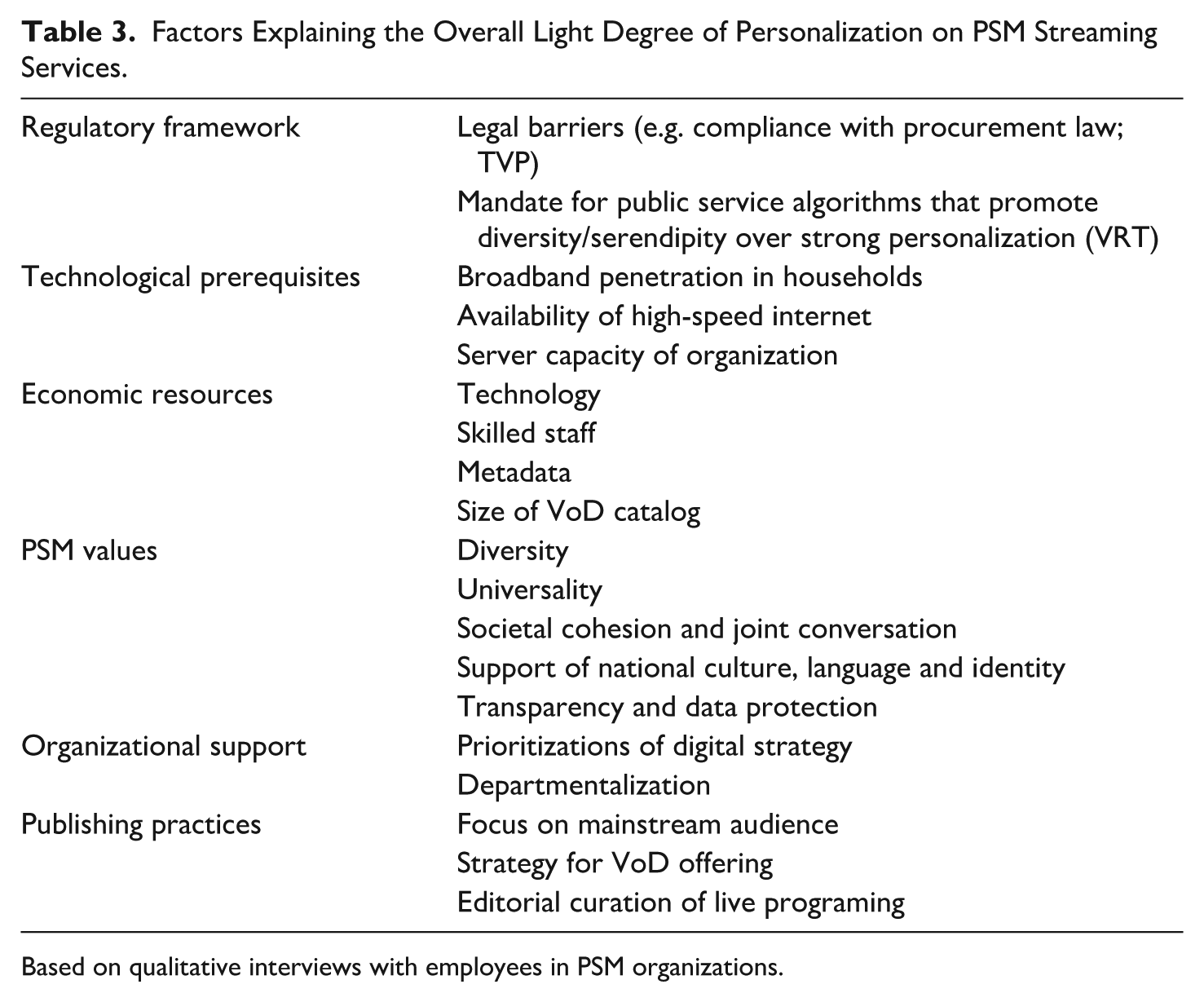
Based on qualitative interviews with employees in PSM organizations.
Three overarching issues are important to highlight from Table 3. First, personalization requires economic resources. In several markets across Europe linear television still dominates consumption, and for broadcasters relying partly on spot advertising (Rai, RTBF, TVP and VRT in our study) there is an economic dependence on the linear offering. For the organizations to invest resources in personalization, the benefits must outweigh the costs. Our interviews document that despite an interest in implementing algorithmic recommendations on the services there are economic constraints: Director of Research at RTBF states that, “[big commercial SVoDs] create a standard and we cannot follow this standard. It’s not that we don’t want to, it’s just that we don’t have the means to do it” (personal interview). This is echoed by respondents from VRT. As indicated in Table 3, the constraints associated with economic resources are related to both technology, staff and having consistent metadata across the catalog, as pointed out by the Recommendation and Targeting area manager from Rai (personal interview). As emphasized by BBC’s Editorial Lead for Recommenders, the size of the catalog is also an important factor: “We don’t have an enormous catalog, so you don’t kind of get down this rabbit hole of personalization because we don’t really have quite enough content for us to be able to do that, so it’s still quite a broad offer usually” (personal interview).
Second, and in continuation of the above, personalization requires organizational support. This concerns strategies for digital development of the organization, organizational structures that advance coordination between divisions (see also Donders 2019; Lassen 2025) and publishing as well as commissioning practices based on the needs of the streaming service (we do see such practices in BBC and DR). Finally, it is evident from the interviews that the organizations in this study are all subject to a public mission. Across organizations our respondents voice awareness of PSM values such as stimulating diverse consumption and facilitating joint national conversations when developing their online offerings. In an online context it is important to also highlight the attention to issues related to user data. As stated by the TVP Technology Management: “We profile our users to a much lesser extent than our competitors. However, this is not due to a lack of technological capabilities, but to the need to protect our users’ data” (personal interview).
Despite different contexts, history and positions in the national markets, all organizations are cautious about letting go of editorial control of their services. In the words of DRTV’s Head of Publishing: “Sometimes we will know that this is what users demand but still make a different choice because we are a public service provider" (personal interview). None of the organizations foresee a future in which editorial curation is replaced by algorithmic recommendations, what is under development is the balance between the two.
Personalized Public Service: Conflicting With Key Values?
As documented by the interface analysis, the overall degree of personalization on the PSM streaming services can be characterized as light. Therefore, it is important not to overstate the role of personalization in the PSM offerings. Also, personalization aimed at enhancing usability (e.g., Continue watching or My list) does not clash with the obligation to ensure diversity of exposure. However, it is necessary to consider whether a stronger degree of personalization conflicts with PSM values, as we have learned from interviews that all organizations work toward implementing more personalized recommendations to attract and retain users.
Van den Bulck and Moe (2018) highlight how managing abundance of content through some form of personalization is not new. However, whereas this was earlier done explicitly by editors choosing what to publish and users deciding what to watch, read and listen to, part of the decision-making is now hidden from the user when it is algorithm-based. This overall lack of transparency is just one challenge worth considering. Others are the tension between agenda-setting of the PSM organizations and user-agency (Sørensen and Hutchinson 2018), (excessive) collection of user data, and limited diversity of exposure (which can lead to limited diversity of consumption). In line with our findings of the iPlayer adapting its recommendations according to the account preferences, a recent study by Benest et al. (2025) observes how personalization does limit exposure diversity on iPlayer and other streaming services of British PSM organizations. While our interview respondents do acknowledge the above-mentioned pitfalls of algorithmic recommendations, all maintain that personalization is not considered a contrast to PSM but a possibility to provide a better service. As stated by BBC’s Controller of Policy, “[t]he genie is out of the bottle, and you should be able to try and use that to deliver a richer and better public service broadcasting experience” (personal interview). As mentioned earlier, Helberger (2015) and Hutchinson (2023) argue that algorithmic recommendations can be an essential tool for encouraging diverse consumption in an on-demand context. VRT offers the most concrete example of our cases regarding integrating diversity in its algorithmic recommender systems, as it was mandated by the previous management contract with the Flemish government to implement a taste-broadening algorithm (see Iordache et al. 2025a for a more detailed description). In its latest management contract for 2026 to 2030, VRT is still required to use “algorithms and other tools to guide Flemish people toward a diverse media experience” (VRT and Vlaamse Gemeenschap 2025, p. 12). Besides this, VRT is obliged to prioritize, not just digital and media literacy, but also algorithm literacy. From the other organizations in our study we hear, correspondingly, that diversity is strongly considered in the editorial and algorithmic curation of the services. Rai’s Recommendation and Target Area Manager emphasized that “[o]ne of the fundamental values in the context of using a personalization service is to ensure that our audience does not close itself off in a bubble and that the users find on RaiPlay a richness of catalog that broadens their personal and cultural horizon” (personal interview). BBC’s Lead Data Scientist for Recommenders highlighted the need “to improve our approach to measure and create diversity within and across our services” (personal interview).
Diversity, as well as cultural proximity and joint national conversation were articulated by the respondents as values and characteristics they aim for, to strengthen their distinctiveness as PSM. On distinctiveness, DR’s Director of Strategy and Users stated: “I don’t believe it is our competitive advantage to pretend we are Netflix. I think we have a huge competitive advantage in a distinct product, that we are doing something that no one else really can do” (personal interview). RTBF’s Head of Content R&D also stressed distinctiveness: I think one of the advantages of RTBF is that [..] we are everywhere in Belgium, and we understand what Belgians are living and what they need. It’s not the case of Netflix, and they don’t care. [. . .] So, I think it’s the proximity with the public, that is the real advantage of RTBF for digital. (personal interview)
Such statements underline that the public service mandate is of great concern to the organizations. However, values and ideals might not be sufficient in a future where usage of algorithmic recommendations is more pronounced in PSM streaming services. Hyzen et al. (2025, p. 8) argue that “the PSM remit could be extended to include a commitment that utilizes datafication to guide procuring and producing epistemically valuable content and ensures this content is recommended to appropriate audiences.” As seen in VRT’s recent management contracts, it is feasible for regulators to require PSM to employ algorithms and other digital technologies in ways that support rather than compromise their foundational values. This, along with development of new metrics to document how PSM obligations are being met online, is needed if PSM are to uphold their reach, distinctiveness and raison d’être (see also Bruun et al. 2025).
Conclusion
Personalization of PSM outlets remains a contested issue. This study provides empirically grounded insights into its implementation across several European PSM streaming services, demonstrating that personalization largely serves a functional role, by enhancing usability, rather than driving personalized content loops. Even in the case of BBC’s iPlayer, which exhibits the strongest degree of personalization among our cases, editorial curation remains dominant. The study identifies key factors shaping PSM organizations’ approach to algorithmic recommendations, including lack of economic resources and technological restraints, but also commitment to public service values such as stimulating diverse consumption, supporting societal cohesion, and protection of user data.
Attention to PSM values is crucial. Our interface analysis demonstrated that personalization did not override editorial decision-making. However, according to our respondents, all organizations in this study are working toward implementing more algorithmic recommendations to personalize the user experience. If PSM organizations are to maintain their distinctiveness, algorithmic recommendations must be utilized to support PSM values and identity. VRT’s taste-broadening algorithm is noteworthy as here we see regulatory requirements to employ digital tools that encourage diverse consumption. This demonstrates that algorithmic recommendations are not necessarily to be considered a contrast to the public mission but can be harnessed to support it. Importantly, personalization must be balanced with editorial curation to meet other values such as facilitating public debates and supporting national culture, addressing societal rather than individual needs.
Some limitations of the study are important to highlight. By centering our analysis on genre, we have not accounted for other personalization parameters such as mood or location, which interviews confirm are being implemented. Additionally, some organizations place significant emphasis on second-order personalization, where recommendations emerge after a program has been watched. While our interviews were conducted in 2024, the interface study draws on data from November 2023—a considerable gap in view of the rapid evolution of digital media. Since then, developments have reshaped personalization strategies: DRTV has introduced mandatory login, RaiPlay has implemented a new algorithm enhancing personalization, TVP has begun developing recommendation engines for TVP VOD, and VRT has integrated a “bandit algorithm” for hero-board curation. These developments underscore a need for ongoing research into PSM personalization. While our study primarily addresses diversity, future work could also engage with dimensions such as transparency, trustworthiness, and editorial independence as well as the development of methods to analyze personalization.
Footnotes
Declaration of Conflicting Interests
The authors declared no potential conflicts of interest with respect to the research, authorship, and/or publication of this article.
Funding
The authors disclosed receipt of the following financial support for the research, authorship, and/or publication of this article: This work was supported by the CHANSE ERA-NET co-fund program, which has received funding from the Horizon 2020 Framework Program (grant number 101004509).
