







Abstract
This essay examines the evolving landscape of content regulation within the American Forces Network (AFN), a U.S. Department of Defense broadcaster serving military personnel and their families overseas. Tracing AFN’s historical adherence to commercial broadcasting standards and its complex relationship with military, political, and diplomatic pressures, the essay highlights how content decisions have been shaped by institutional constraints, host nation sensitivities, and shifting definitions of the public interest. Special attention is given to recent developments under the second Trump administration, particularly the elimination of diversity, equity, and inclusion (DEI) initiatives and the resulting censorship of media content. Through this case study, the essay explores broader tensions between free speech, state power, and market forces in media governance. It argues that AFN’s experience illustrates the precarious balance between democratic ideals and institutional control, offering a cautionary tale about the consequences of unchecked state and corporate influence over public communication channels.
Keywords
One of the first orders Donald Trump signed upon resuming the office of the Presidency in 2025 was a mandate eliminating diversity, equity, and inclusion (DEI) initiatives in the federal workforce. Defense Secretary Pete Hegseth has been particularly aggressive in implementing this mandate declaring “identity months dead” at the Department of Defense (DoD; “Identity Months Dead at DoD” 2025) and calling for a “digital content refresh” that would “remove all DoD news and feature articles, photos, and videos that promote Diversity, Equity, and Inclusion (DEI)” from military communications outlets, including command information spots on the American Forces global radio and television network (Parnell 2025). Specifically, the order bans any content related to “critical race theory, gender ideology, and preferential treatment or quotas based upon sex, race, or ethnicity,” as well as material “which is counter to merit-based or color-blind policies” of the new DoD (Parnell 2025). Hegseth gave military administrators just six weeks to comply with these orders. Predictably, the short timetable and vague directive, led to over-zealous regulation. Pressed for time, Defense Media Activity (DMA), the military unit that oversees all DoD websites, publications, and broadcast platforms, used AI to search for keywords like “gay,” “bias,” “civil rights,” and “female” resulting in the removal of thousands of images and stories referencing the contributions of women, people of color, and LGBTQ+ troops to military history, including at least two images of the Enola Gay, the plane that dropped the first atomic bomb. Some of this material has been restored following public outcry, but, in the absence of vocal resistance, much of this content remains unavailable to the public.
These developments demonstrate, quite clearly, three important insights about content regulation in the media. First, they remind us that policy decisions are, in the words of Jennifer Holt, “designed by those in power, and, as such, policy study ultimately becomes a study in how social and political power is enacted, mobilized, and embedded in our media’s structure and content.” (Holt 2018, 171) Second, these events underscore the messiness of the process of mobilizing power in and through the media, as they involve a range of public and private entities with a variety of goals and expectations. Finally, they remind us that civic activism can and does have material effects on communication practices, as outraged veterans and service personnel quickly drew attention to the sweeping nature of the changes and cried for redress, forcing the administration to backtrack and declare that “history is not DEI.” (Baldor and Copp 2025) Much policy study in the U.S. context is oriented toward understanding the effect of state regulations on non-state entities and market relations. This essay examines the impact of market practices and state regulations on a state broadcaster, the American Forces Network (AFN).
AFN is a global radio and television network run by the DoD for military and diplomatic families deployed overseas. AFN began as an over-the-air radio broadcaster in 1943, and OTA television offerings were added beginning in 1954. At its height, the network contained over 400 radio and 92 television stations plus 250 unmanned “mini-tv” systems at small forward operating bases and on Navy and Coast Guard ships at sea. Today, it uses a combination of proprietary streaming apps (AFN | Now and AFN | Go) and satellites to reach one million troops located in over 170 countries and all seven oceans. Though its official mission is to provide a conduit for command information, it uses decommercialized commercial news, sports, and entertainment programming to capture and hold the audience for such messaging. Product plugs are replaced by public service announcements and information about military matters like operational security, DoD benefits, and the ins and outs of life on an overseas military base. The goal of its programmers is, and always has been, to give troops a “touch of home” by following standards set by the commercial cultural industries.
To ensure AFN looks and feels like a hometown media source, the network follows industry and FCC guidelines regarding signal strength, station operations, and content regulation. Unfortunately, its best efforts to comply with the latter are often thwarted by the institutional constraints of military life and the difficulties of operating in an overseas context. As Cynthia Chris has argued, the U.S. Constitution guarantees a right to free speech, but those rights are not absolute, and context has everything to do with how matters of free expression are adjudicated (Chris 2018, 5). The basic tension between free speech rights and the public interest is exacerbated in the context of overseas military deployment where a minor slip could become an international incident, and broadcasters could be fired for failing to follow government policy, or, more often, for following government policy in the face of resistance from local commanders. The laws and expectations of the host country add an additional layer of pressure, for AFN stations operate only at the host’s discretion. Angering local dignitaries, or inciting the populace, could result in the whole operation being shuttered. Yet, over-regulation is also bad, as it undermines the United States’ claim to support democracy and the “free flow of information” and, to military families deprived of controversial information and popular programming, it can make AFN feel like a propaganda organ. The stakes associated with decisions to regulate or not regulate broadcast speech are thus exceedingly high for military broadcasters.
In what follows, I will outline the history of content regulation on AFN and its outlets. This is something of an unusual regulatory case study since political, military, and diplomatic pressures outweigh FCC policy, the profit motive, or media activism when it comes to shaping AFN’s content and structure. Nevertheless, AFN is bound by the same First Amendment guarantees (freedom of speech and of the press), the same legal prohibitions (against obscenity and some forms of indecent or dangerous speech), and many of the same operational protocols as commercial media enterprises. The study thus exposes core tensions faced by all broadcasters, namely the difficulty of weighing public demands for free expression against institutional needs and constraints, defining and serving the public interest, and navigating the complex web of regulatory forces in play at any given moment. A quick word about terminology before we begin: AFN only became the moniker for the entire network in 2008, so, when speaking of past practices, I will use the historical names for the distribution service, known as the American Forces Radio and Television Service, or AFRTS, and its subnetworks, whose names should be clear from the context.
AFRTS and the Commercial Ethos of American Broadcasting
Established during World War II to keep the nation’s citizen-soldiers informed, entertained, and distracted from deleterious pursuits, like drinking or fraternization, the American Forces Radio Service (AFRS) represented a collaboration between the U.S. government and an industry fearful of federal annexation. The Department of War was initially slow to recognize the benefits of radio as a morale booster, but, in 1942, they hired Young & Rubicam radio executive Tom Lewis to build an “invisible super-highway from home to America’s fighting forces overseas” (Lewis 1945, 2). Lewis’s orders were “to provide education, information, and orientation for our Armed Forces overseas by means of entertainment and special events” (Lewis 1944). The orders reinforced Lewis’s own sense—affirmed through an audience survey—that any radio operation for the troops should place entertainment first and offer “radio as the men have known it” (Lewis 1945, 4). Thus, the AFRS stuck as closely as possible to the formulae of American commercial broadcasting, from continuity scheduling to light-hearted DJ patter and a broad entertainment vibe designed to deliver audiences for the institutional messaging. Though AFRS stations were governed by FCC policies related to signal strength, and the first stations in Alaska were required to be licensed like any other broadcaster, the FCC had no control over stations on foreign soil and no leverage to enforce programming mandates. Instead, AFRS executives voluntarily embraced FCC-approved definitions of free speech, freedom of the press, and the public interest as a means of justifying the service. The best way to “maintain in [the fighting man] the mental attitudes of a free American,” Lewis opined, was to offer a variety of commercial programs free from state censorship, propagandizing, and content manipulation (Lewis 1944, 2).
Because a military at war is an unusual audience, however, one of the network’s earliest forms of content regulation involved cutting commercials and sponsorships from the programs it shipped overseas. The rationale for this decision had to do with morale, rather than an objection to commercialism per se. Soldiers stranded on Corregidor apparently resented hearing plugs for ice cream and other luxuries (Brylawski 1980, 448). Indeed, AFRS protocols referred to the process of ad removal as “denaturing,” as if commercial sponsorship was a “natural” part of the radio flow. Steeped in the art of advertising, military broadcasters filled the sponsorship gap with parody. They created live DJ programs with names like “The Atabrine Cocktail Hour,” said to be “sponsored by Uncle Sam” in the name of promoting morale and anti-malarial drugs. Many command information spots also parodied popular advertising gimmicks and campaigns. The infamous Lucky Strike “LSMFT” whisper promotion of 1944 was a particular favorite, used to sell everything from operational security to the importance of prophylactics (Sherdeman 1944.; Taishoff 1945). Commercials may have been regulated, then, but the commercial ethos remained central to everything the AFRS did.
In addition to personnel and programs, the commercial broadcast industries also supplied the military network with operational protocols and practices. The first official AFRS Broadcast Handbook, circa 1952, carried lengthy passages from the NAB’s Standards of Practice for American Broadcasters and reprinted the “Broadcasters Creed,” with its high-minded rhetoric about the democratic responsibilities of radio, in its entirety (Armed Forces Radio Service Guide 1952) (Figure 1). Later editions of the Handbook incorporated language from the NAB’s Code of Practices for Television Broadcasters to help AF television station managers maintain local standards of decency. The 1961 edition characterized the AFRT stations as “invited guest[s]” in both military and civilian homes, reminded broadcasters that “listening and viewing [in a military context] are communal,” and echoed the NAB Code’s assumption that “common sense [standards] of decency and good taste” exist and should dictate their choices. A verbatim recitation of the NAB Code then followed. Religion, marriage, family relations, and institutional authority were all to be treated with respect while depictions of vice were to be avoided if possible and governed by “good taste, restraint and decency” if absolutely necessary to the performance. Programmers were to avoid disparaging people based on “Race, Color, Nationality” or “Physical and Mental Afflictions,” using materials also governed by those logics (Armed Forces Radio and Television Broadcast Guide 1961). Into the late 1980s, AFN’s training manuals continued to reprint the portions of the NAB code related to race and nationality, profanity and obscenity, and to exclude: “pornography . . . racist propaganda; audio/video materials whose sole purpose is to demean any race, nationality, or religion; materials promoting the use of drugs or alcohol, or promoting deviant or socially unacceptable behavior” (DoD 5120.20-R, “Management and Operations of AFRTS” 1988, 2–8). Thus, pre-satellite AFN operations walked in lock step with the industry and the FCC at the policy level.
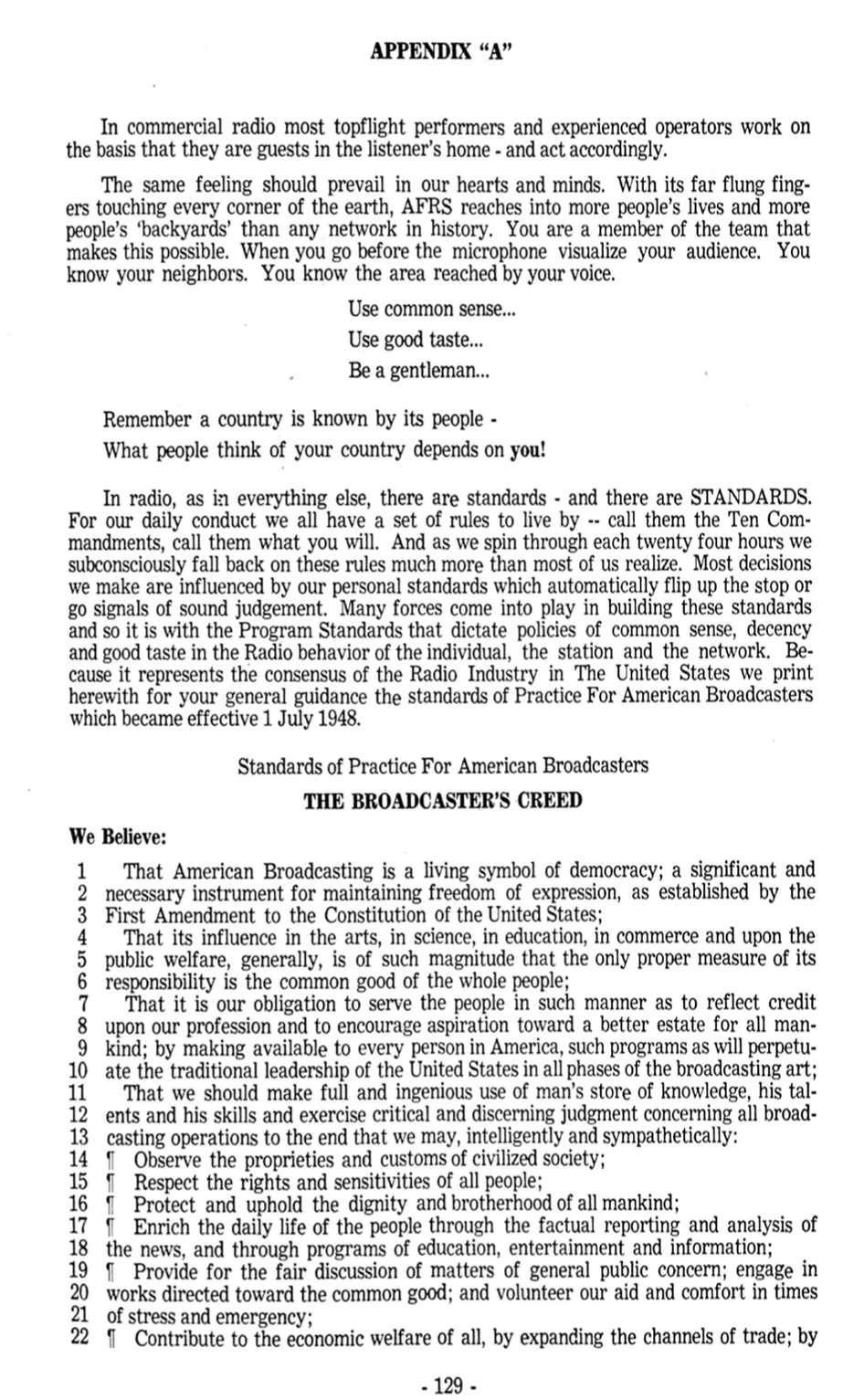
Portion of the1952 AFRS Broadcast Guidelines devoted to content regulation. (Appendix A, AFRS Broadcast Guide 1952, 129).
Military Exigency and Other Political Pressures
Though the AFRTS followed commercial guidelines, protocols, and practices, and its overseers in the Pentagon generally advocated a subtle approach to content regulation, the decentralized structure of the network, and its primary mission to serve the needs of local commanders, sometimes led to more aggressive, apriori forms of censorship.
During the Korean War (1950–1953), for example, General Douglas MacArthur, commander of United Nations forces in the region, censored the radio news to prevent inconvenient facts about the conflict from emerging. Among the information to be suppressed were mentions of troop locations, movements, and battle plans, of course, but also casualty reports, news of enemy gains, negative coverage of the military, and any language that would undermine morale, such as the phrase “battle weary troops.” (Specific Rules Governing Censorship of Articles for Publication (including Scripts & Tapes) 1950; Van Voigtlander 1953). During the Vietnam War, the American Forces Vietnam Network (AFVN) also had to hold and clear all news items about the conflict and were prohibited from discussing battle failures or mistakes or reporting on the widespread use of snipers, tear gas, and napalm by the U.S. and its allies (Hodierne 1970; “Where There Is No Napalm” 1969). AFVN broadcasters fought these prohibitions, citing a memo from Secretary of Defense Robert McNamara, which insisted on the “free flow of information” in Vietnam, but they were often reassigned to more hazardous duty when they spoke up (Fredericksen 2017, 65–68). Thus, the pressures of operating in a war zone acutely curtailed broadcasters’ freedom of expression and constrained the audience’s freedom to access a diverse media diet.
The Cold War context placed additional pressures on AFRTS stations given the need to play nice with local authorities in exchange for frequency rights. Congress, the State Department, and AFRTS executives also fretted about the impression U.S. media might make on the millions of civilian “eavesdroppers” in Europe, Asia, and North Africa. Finally, at this time, most AFRT stations were financed from the local service commander’s morale and welfare budget, which means, if the base commander saw or heard something they did not like on an AFRT station, they could fire employees or decommission the station—the ultimate form of censorship. In general, DoD guidance to broadcasters enjoined them to be conservative and to forge friendly relations with both locals and commanders. The U.S. State Department provided a memo for every station operating overseas on the “sensitive subjects” likely to offend host nation authorities, and broadcasters had to try to refrain from mentioning those subjects. Often this entailed violating explicit policies about not editing commercial material supplied by industry partners. References to Christmas, Israel, and Judaism were often excised from newscasts or programs like The Tonight Show when aired in North Africa and the Middle East, for example, and mentions of political unrest in Korea were routinely suppressed by the AF Korea Network out of deference to that country’s autocratic rulers (Priscaro 1962, 138–9). Episodes of M*A*S*H were also sometimes censored in Korea, just as the made-for-TV movie Enola Gay was withheld by some outlets in Japan (Suid 1983a, 19). Local commanders and technical factors helped determine the relevance of the sensitivity lists in each area, which accounts for the uneven enforcement. Enola Gay did play at the flagship station in Tokyo, for instance, because the Far East Network’s television signals were closed-circuit in the capital city. AFRTS commanders toyed with the idea of bleeping out “sensitive issues,” but local dubbing was prohibitively expensive, and centralized dubbing would require technicians to “[bleep] out all sensitivities world-wide” rendering some shows “ridiculous” (MC David Doughman, Technical Branch, to Vincent Harris, AFRTS-LA; Subject: Possible Methods of Removing Sensitive Audio From Video Tapes 1978). “Cancellation and substitution with an alternate program” appeared the only option until AFRT’s industry liaisons could clear restrictions through diplomatic means (Memorandum for Director AFRTS, AFIS, OASD(PA); Subject: Sensitivities 1978). In the 1970s, stations in Germany, Okinawa, South Korea, Panama, Japan, Puerto Rico, Iceland, Iran, and Libya were all affected by “sensitivities,” as well as commercial restrictions, with Korea losing access to one-third of the available programming and Panama missing about half (Suid 1983b, 93).
Conservative commanders sometimes meddled with the program flow outside the frame of war, too. The most egregious example came from Rota, Spain, where a Naval Captain sent a series of memos to station personnel insisting that they “be cautious” when airing material that could make the U.S. look bad. He created a lengthy “Do Not Air” list and would eventually fire the station manager for refusing to comply with it (Figure 2). The incident came to light when a local public affairs officer wrote to President Jimmy Carter to complain that the list not only violated military policy but was also racist in that the majority of banned songs were by black artists (Richard Swain to President Carter 1977). This incident led to a reorganization of the AFRTS enterprise designed to protect broadcasters and military audiences from the whims of local commanders. Henceforth the service departments (Army, Navy, and Air Force), and later the DoD, would fund operations, and local commanders would have no say over staffing, programming, or policy (Suid 1992, 102).
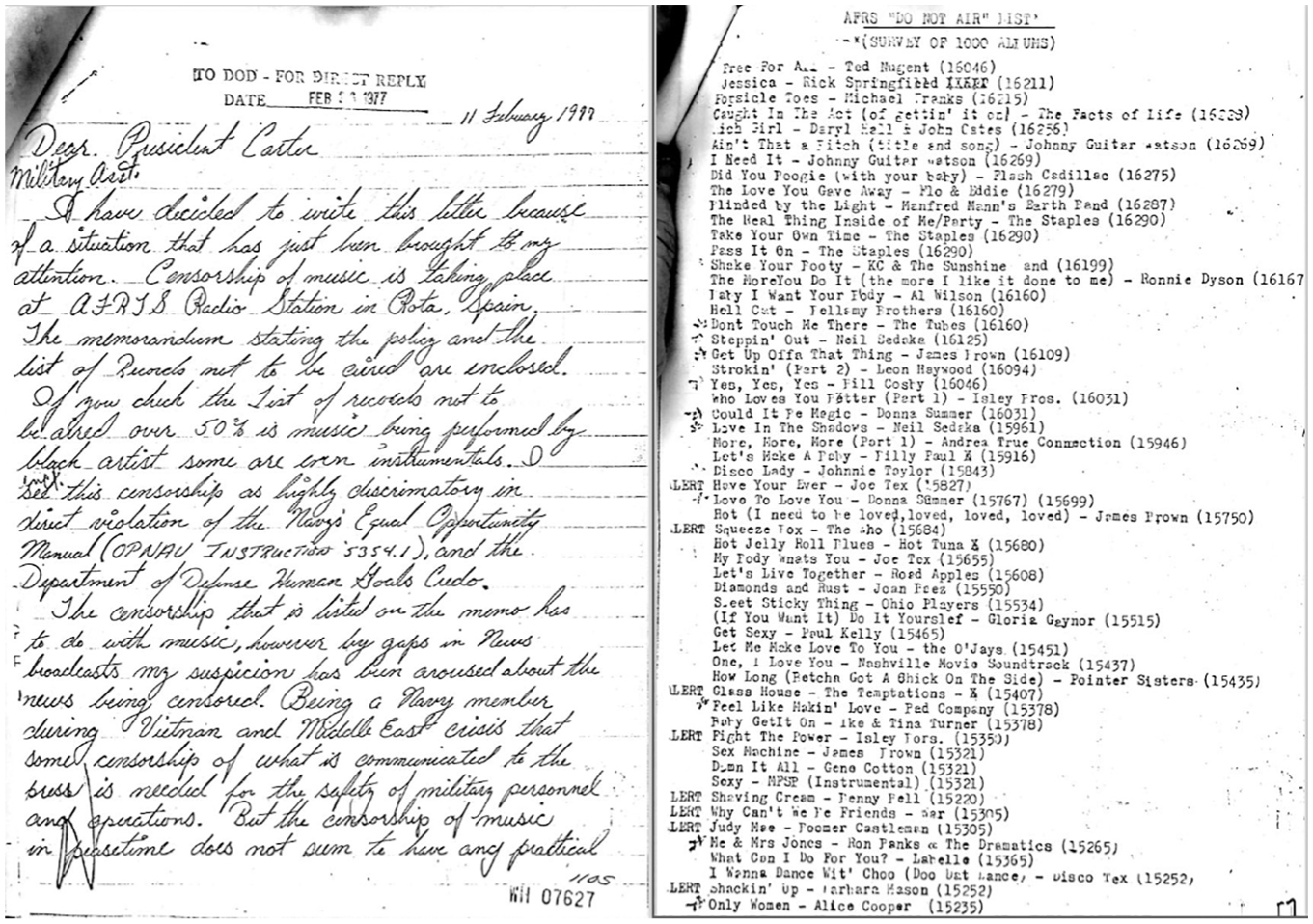
The “Do Not Air” list-Rota Spain, 1976. (Richard Swain to President Carter 1977)
The Rota debacle gained AFRTS and its stations some much needed breathing space. However, the “sensitive subjects” memos continued to overdetermine local content into the satellite age, which, for the AFRTS, began in earnest in 1997. Until the satellite signal could be encoded, programs on the AFRT networks remained visible to eavesdroppers and caution would rule the day.
Audience Demographics and the Selective Tradition of National Programming
In addition to these coercive constraints on broadcasting, spectrum scarcity and a bias toward the military family often dictated a cautious approach to program selection and schedule-building at AFRT stations. Well into the late 1990s, most military families could access only one television channel and one-to-three radio feeds. As in the United States, such scarcity served as an excuse to privilege the tastes of the demographic majority and restrict programs that might otherwise qualify as free speech (Einstein 2004; Holt 2018; Horwitz 1989). In Vietnam, for example, officers reassigned Specialist Chauncey “C.J.” McMurray from the flagship station in Saigon to a backwater outpost in Pleiku because he “emphasiz[ed] black power too heavily” in his Power of Soul program. The program was deemed too niche to appeal to the mass of soldiers, who, according to the officer in charge, “mainly wanted to listen and enjoy soul music” (Letters, Office of Information AFVN - Re: SP5 Chauncey McMurray III and AACA 1971).
In the days before satellite distribution, AFRT’s use of physical media generated additional pressure to streamline available programming. The military simply could not afford to duplicate separate audiovisual packages for different units based on their make-up. The needs of the large concentrations of military families in Europe and Japan thus dictated what everyone else on the service would see or hear. AFRT programmers did try to curate an entertaining balance of programs, but the reliance on stateside material and the need to suit a variety of tastes with a single service meant that most of the schedule consisted of “least objectionable” programming (Klein 1972, 327–8). The result was a “bland centrism” devoid of political engagement and closely identified with the straight, white, middle-class, patriarchal norms embedded in the NAB’s TV Code, which remained in force, if toothless, into the early 1980s (Gray and Gershon 2024, 59). Network-era programs thus conveyed a highly filtered image of national life, which military programmers passed on to their varied audiences.
Again, Vietnam provides the starkest example of the cultural impact of this bland centrism. Though AFVN showed a few adult programs like Combat!, The Dean Martin Show, and Rowan & Martin’s Laugh-In, the bulk of the schedule featured radio simulcasts of old variety programs and tepid fare, including heartland-friendly Westerns (Gunsmoke, Bonanza, and Big Valley), family-friendly sitcoms like My Favorite Martian, Hazel, Andy Griffith, and The Beverley Hillbillies, and juvenilia like Wonderful World of Disney and Batman. Musical tastes, too, were circumscribed by the need to compile a package that would serve all military audiences everywhere. As a result, Motown hits from “girl groups” like the Supremes and Aretha Franklin, whose songs were deemed inoffensive enough by white America to reach the top of Billboard’s “Hot 100” were included in the AFVN package, but edgier tunes like Edwin Starr’s “War” or James Brown’s “Say It Loud, I’m Black and I’m Proud” were censored. For rock “n” roll aficionados, AFVN preferred tunes by the Righteous Brothers, The Monkees, The Beach Boys, and the early Beatles to the angsty sounds of Jimi Hendrix, The Doors, Jefferson Airplane, or the late Beatles (Bradley and Werner 2015; Conaway 1971, 158).
Thus, although the AFRTS was (and is) charged with providing “a free flow of information and entertainment programming to overseas DoD personnel and their dependents without censorship, propagandizing, or manipulation,” the reliance on commercial programming inevitably had a soft propaganda effect (Draft; Memorandum for ASD, PA; Subject: AFRTS Television Programming n.d.). Projected overseas, the selective tradition of Americanism embedded in these commercial programs became a latent form of justification for American political, economic, and military leadership. To eavesdroppers especially, the lushly decorated, seemingly apolitical morality tales that passed as entertainment on U.S. military TV networks had the effect of presenting the “American way” as the superior way and painting American troops as emissaries of the good life (Kackman 2005; MacDonald 1978). We know this because dictators and anti-base activists frequently called out such programming for “corrupting” the local populations (see, e.g., Kim and Shin 2010; Klein 2012; Poiger 2003).
By the 1970s, however, both the broadcast industries and the military experienced sweeping changes. Per Lili Levi, the FCC redefined the public interest in the 1960s to emphasize diversity within the nation and required broadcasters to pay more attention to local community needs and issues (Levi 2008, 834–5). Coupled with the growth of cable and the demographic revolution, these changes altered the calculus of who counts and how much. The rise of narrowcasting as a programming philosophy allowed edgier programs like All in the Family, M*A*S*H, Lou Grant, and Hill Street Blues to win a place on both the stateside and AFRT schedules. Industry pushback against the NAB’s TV Code and the proposed “Family Viewing Hour,” both of which were deemed to violate corporations’ First Amendment rights, eventually led to the abandonment of rigid content regulations in the U.S. and the codification of late night as a “safe harbor” for adult material (Chris 2018, 43). The result was a salutary increase in the diversity of speech and expression available to AFRT programmers and audiences. Meanwhile, the military moved to an all-volunteer format in 1973, enticing more women, people of color, and later gays, lesbians, and transgender individuals to join the service. To counteract division in the ranks, which was already rife post-Vietnam, the DoD began to implement limited diversity, equity, and inclusion initiatives, including mandates to diversify programming and command messaging at AFRT stations. These changes generated confusion and resentment as often as satisfaction, however.
Community Standards and Content Advisories at AFRTS
AFRT station personnel were on the front lines of the raging debates over content on TV in the 1980s and 1990s. The need to provide a balanced diet of programs for a range of viewers virtually ensured they would receive complaints from all sides of the political spectrum. On the right, conservatives who listened to James Dobson’s Focus on the Family on their local AFRT stations heard of the campaigns to regulate stateside TV by groups like the Media Research Center, the National Federation for Decency, and Dobson’s own Family Research Council, and they sometimes participated in those campaigns while deployed overseas. Meanwhile, blacks, women, and their allies on the left castigated military broadcasters for giving voice to conservative views (like those of Dobson and Rush Limbaugh, whose syndicated talk show joined the service in 1993) and relaying “offensive” programs and command information spots related to issues of race, sex, and sexuality. AFRT programmers simply couldn’t win, though they gave it a good effort.
In general, and again following trends in the stateside industries, the AFRTS adopted a policy of channeling adult content by time and adding content advisories to controversial material (Chris 2018, 49). As explained in the 1989 AFN Europe Command Information Booklet, “We make every attempt to put distinctly adult material on late at night.” However, the authors insist, “it isn’t always possible” due to the prevalence of adult themes in daytime and family programming. “When AFRTS notifies us that a program contains adult material,” the booklet continues, “we provide disclaimers to the publishers of the television schedule and broadcast advisories prior to the program.” Like stateside programmers, AFRT commanders “encourage[d] parents to exercise discretion in selecting programming for their children” based on the advisories and invited military families to “use the off-switch” if they were dissatisfied (AFN European Command Information Booklet 1-89: AFN Answer Book 1989, 17).
Throughout the 1970s and 1980s, content advisories appeared in a weekly internal newsletter called “Tele-Tips.” Initially, they used a generic “adult viewing” label to mark a range of controversial subjects, from sex, sexuality, divorce, and abortion to race, racism, civil rights, and partisan politics. After a series of mishaps, including one where a poorly described documentary about the Ku Klux Klan nearly fomented a race riot aboard a Navy ship, the Broadcast Center abandoned the generic slug in favor of more detailed advisories (Cole 1982). These, too, generated confusion and frustration because they were unevenly applied and tended to be biased against certain subjects or groups. Again, many programs slipped through the cracks. Films posed a particular challenge since many R-rated movies could not be edited, and some rated PG or PG-13 still contained coarse language and sexually titillating scenes deemed “offensive” to some military families. The Broadcast Center rarely placed additional advisories on PG/PG-13 films, which frequently generated audience blowback and a flurry of letters between field commands and the DoD. Local broadcasters were told to use “creative scheduling” to avoid exposing young audiences to mature content, but AFRT outlets hard hit by host country restrictions sometimes had to schedule PG-13 and R-rated movies in the daytime to fill out their schedules. Racy films caused so many problems in the 1980s, that the AFRTS Commander decided to amend the rules to allow “some editing . . . provided the substance and continuity of the programs is not damaged” (Draft; Memorandum for ASD, PA; Subject: AFRTS Television Programming n.d.). Because editing was still prohibited by many licensing agreements, however, programmers at the Broadcast Center simply stopped seeking films with an R-rating unless an edited-for-TV version could be found. When premium cable content became widely available in the 1990s, AFRTS likewise chose to ignore “adult” programs like The Sopranos, The Wire, and Sex and the City, rather than offend parts of their audience (Lowry 2000).
The process for determining when to identify risqué content was also riddled with bias. Conversations around the program Soap (ABC, 1977–1981), for example, noted that it should “always” have an “adult” label due to the presence of a gay lead character and frequent discussions of extramarital sex and adultery (Dir., AFRTS-DC to Commander, AFRTS-LA; Subject: Adult Theme Programming 1977). Yet, other shows associated with the era of sexual suggestiveness on network television, aka the “jiggle TV” era, received no such labels (Levine 2007, 37). Notably, the scantily clad women and sexual innuendo on shows like Three’s Company, WKRP in Cincinnati, Charlie’s Angels, and The Love Boat rarely warranted an advisory statement, perhaps because such content catered to the desires of a still largely straight, male force. Since daytime programming targeted women and children, it received special attention from the editors of Tele-Tips, especially as the soap operas and talk shows became racier and more socially conscious in the late 1970s and early 1980s (Levine 2007). Still, depictions of ordinary heterosexual sex on such shows rarely warranted an advisory, but episodes dealing with sexual violence, exhibitionism, male impotence, or female sexual agency always earned an “adult viewing” slug. Luke’s famous rape of Laura on General Hospital rightly received an advisory, for example, but later episodes of the couple “making love” did not (Tele-Tips #337, TD 51-9 1979). Similarly, plots like “Dee has an affair with Barry” and “Jill goes to Ken’s room” merited a warning, but if Barry or Ken initiated the affair, it went unmarked (Tele-Tips #375, TD 37-0 1980).
The sexual double-standard was also applied to soapier forms of prime-time content. For instance, episodes of Dallas would be flagged “Dialogue concerning adulterous affairs, infidelities, desires throughout pgm” only when Sue Ellen or one of the other female characters dared to dream beyond their loveless relationships (Tele-Tips #1261, TW 37-0 1979). Often, Dallas received no advisory at all despite its persistently racy content and 9:00 pm time slot. Prime time dramas like The Waltons, Trapper John, M.D., or Westside Medical also received no warnings when they addressed a surprise pregnancy, an illegitimate son, and spousal abuse, respectively, though an episode of the British drama Shades of Greene containing “sounds of homosexual acts” did get flagged, demonstrating the biases of regulators against queer subject matter (Tele-Tips #1308, TW 44-0 1980; Tele-Tips #1316, TW 52-0 1980). These irregularities (and others) support Chris’s argument that context is key when determining what gets regulated, or not; “factors such as the genre of the program; the time of day the program airs; and the race, ethnicity, gender, and sexual orientation of the speaker who voices or enacts the potentially controversial material” often determine when a program is deemed indecent (Chris 2018, 5).
Regulating Content in the 21st Century Military
When AFRTS shifted to satellite delivery in the 1990s, many of the problems determining if, when, where, and how to regulate content disappeared, as processes of program selection were centralized, and distribution signals were locked down. AFN now uses strict registration requirements to police access to its feeds and punishes those caught selling their access to shadow users with a lifetime ban. The signal enclosure obviates the need for host country sensitivity restrictions and ensures that all outlets receive the same radio and television content. Meanwhile, digital signal compression and multiplexing capabilities enable AFN to offer service members and their families additional options. There are now eight radio channels, eight television channels (four for Navy ships), and ten internet streaming radio options. As of 2022, it has also launched streaming apps for both its radio (AFN Go) and television services (AFN Now). The age of scarcity and push-media are over even at AFN, and complaints about content are now frequently met with indifference. “We’re here to reflect American television,” programmers will say, “We’re not making editorial censoring decisions as to what we’re going to put on. . . . If [its] popular in the States, it’s going to be . . . on AFN” (Q&A with AFN Executives Larry Sichter and Jeff Reilly 2009). In that sense, they echo the hands-off approach of stateside regulators, who have come to define the public interest in market terms, as “whatever interests the public” (Levi 2008, 841–3). Market rhetoric frees broadcasters, for better or worse, from taking a stand on the quality or value of a particular program. When faced with complaints about the divisive Rush Limbaugh Show, for example, AFN public liaisons referenced the show’s stateside popularity and reminded users that the act of airing a program on the military network “does not constitute endorsement of what is said or shown” (Mulrine 2012). Such deflection permitted programs like Limbaugh’s to persist and influence a new generation of soldiers, but this default position cuts both ways. Popular television series like Ellen and Will & Grace, which featured gay characters and queer perspectives, played on AFN in the 1990s, and complaints were dismissed using the same riposte (Lowry 2000).
Today, the process of curating content on AFN has become a bit more sophisticated and there is greater diversity in the program flow, as a result. Per Zoe Stagg, the head of TV programming in 2023, the military now uses a combination of ratings, critical acclaim, niche appeal, and availability to select programs for the service. The goal is to produce diversity of several types: a diversity of genres and formats, voices and opinions, and representational demographics. For instance, troops may access a range of opinion on current events via the news channel. AFN News plays all of the major network morning shows and evening newscasts, as well as opinion programs from the three major stateside cable news channels. These are usually arranged in sequence and switched at the top of the hour, which creates a bit of confusion when the satellite signal from CNN cuts into the Fox feed, which then cuts into MSNBC, and so on. The burden is on the viewer to makes sense of the resulting mélange. By design, there is no unified point of view.
To ensure the morale of all troops, AFN programmers now include demographic diversity as a goal and often lower the popularity threshold to grab up series with “niche appeal.” For women, they provide soap operas, teen dramas, and lifestyle reality series while black soldiers are targeted with programs like The Jennifer Hudson Show, Love & Hip Hop, and Bel-Air. Even sexual minorities can see targeted programming as long as the programs are also PG-14 or critically acclaimed (Meet the Fosters, Transparent, Looking). Until recently, AFN also provided command information spots and specialized programming to help serve the DoD’s diversity, equity, and inclusion goals. When I visited the Broadcast Center in 2017, AFN was supporting a range of such DoD initiatives from celebrations of Juneteenth, MLK Day, and the various heritage and history months to the production of spots combatting sexual harassment and assault and highlighting the contributions of women and minorities in the military. After the repeal of “Don’t Ask Don’t Tell” in 2011, for example, June became LGB (later T) Pride month at AFN outlets. Television programmers scheduled special LGBT-themed movie nights each week for the entire month while local broadcasters promoted the events and incorporated Pride messages into their daily radio shows and other media productions (Figure 3).
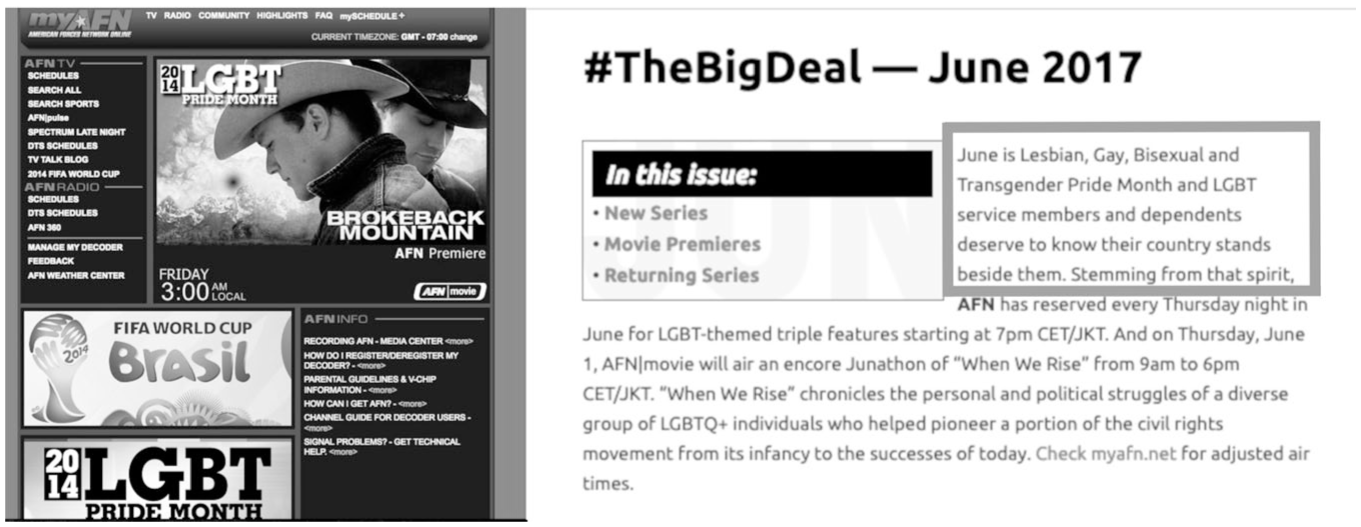
Pride Month on AFN June 2017. (Defense Media Activity 2017)
When asked if they received audience complaints about the Pride content, Mayia Alston, who was programming the AFN movie channel at the time, responded: “We get complaints . . . but our mission is to support things that are supported by the government. Now, LGBT awareness month is supported by the government. . . . It is a recognized government theme” (Takacs 2017b, 2). It became a recognized theme because Pentagon executives understood harassment of GLBT service members to be a threat to military cohesion and mission readiness. According to AFN’s Head of Affiliate Relations in 2017, George Smith (now retired): “The exact reason why we have this programming on is to educate people . . . I mean, it’s tolerance, it’s patience” (Takacs 2017a). Thus, the inclusion of “critical acclaim” and “niche appeal” as prominent criteria for the selection of broadcast materials, along with shifts in policy with regard to diversity, equity, and inclusion training, enabled a broader range of materials to be screened on AFN in the 2010s. Topics formerly deemed “indecent” not only became available; they provided opportunities for the regulation of racist, sexist, and homophobic speech beyond the screen. Alas, as Secretary Hegseth’s various orders undermining DEI initiatives in the military attest, this sword, too, can cut both ways.
Conclusion
AFN’s recent experience with government censorship is extreme and might be read as proof of the regulatory canard that the state represents an inevitable threat to free speech, rather than a potential guarantor of it. I would argue, however, that what is happening at AFN is a harbinger of things to come if the state jumps fully into bed with big business, as it has under the second Trump administration. Historically, defenders of military broadcasting have appealed to the First Amendment to make their case for the network’s existence and persistence. Institutional policies have also affirmed the military public’s right to an information and entertainment diet comparable to that found in the states. They have done this to fulfill institutional needs—to create good order and a common culture, reinforce distinctly American political beliefs, and pacify the labor force—but they have also used AFN as a tool to convey and model American political investments for others. As a state broadcaster, the military network molded itself in the image of a private commercial entity and prided itself on providing a fair and balanced media diet supportive of a democratic culture. However naïve such beliefs may have been—and I’ve shown how the rhetorical commitments often broke down in practice—they ensured that U.S. troops had access to varied sources of news, information, and entertainment.
The DoD’s systemwide experience of censorship under the Hegseth administration represents an extreme, but not improbable, example of what will happen to free speech if the government fails to intervene to protect the rights of the public over and against those of institutions and technology firms. It illustrates precisely the dynamics Jack Balkin and other media policy analysts fear, namely that tech firms and their political sycophants will arrogate free speech claims to themselves to protect practices that are invasive, manipulative, and discriminatory. The government will then cede the argument, based on its long history of granting citizenship rights to corporations, and rely on the good faith of those in control to exercise that control judiciously (Balkin 2018; Holt 2018; Napoli 2019). AFN provides a compelling example of what that might mean and reminds us that the public or private status of a media entity matters far less than the size and power of the institutions charged with regulating it. The state can serve as a handmaiden of antidemocratic forces, or it can serve as a vital counterweight. The AFN story indicates just how quickly the pendulum can swing.
Footnotes
Acknowledgements
Research support was provided by the College of Arts and Sciences at Oklahoma State University, the Oklahoma Humanities, and the National Endowment for the Humanities. I’d like to thank the AFN personnel interviewed for this project for sharing their insights, as well as the editors of this volume for their excellent suggestions for revision. Any views, findings, conclusions, or recommendations expressed in the article are mine and do not represent the National Endowment for the Humanities, the Oklahoma Humanities, Oklahoma State University, or the Department of Defense.
Declaration of Conflicting Interests
The author declared no potential conflicts of interest with respect to the research, authorship, and/or publication of this article.
Funding
The author received no financial support for the research, authorship, and/or publication of this article.
Ethical Approval and Informed Consent Statements
This study used oral history interviews, publicly available documentation, and declassified archival material from the National Archives and Records Administration (NACP) as research material. The interviews are exempt from Institutional Review under the common rule. Regarding the archival material, including the images selected for inclusion, “materials created and produced by United States federal agencies, or by an officer or employee of the United States Government as part of that person’s official duties, are considered works of the United States Government. These works are not eligible for copyright protection, in the United States, and are treated as though they are in the public domain” (NARA.gov). Regarding the interviews, the DOD provided the author with access to vital media workers whose consent, as government workers, is thereby implied.
