







Abstract
Anime media has garnered attention both for its distinct spreadability and the affective bonds audiences have created with its texts. Much of the deeper analysis surrounding anime’s spread however tends to ignore its global cultural impact before the 1990s, thereby overlooking many of its key incursions into the quotidian popular cultures of emerging broadcast landscapes around the world. This investigation focuses on the production and spread of two anime series from the 1970s, Heidi: Girl of the alps and Maya the Bee, in order to explore anime producers’ first collaborative, deliberate efforts to integrate a global media market beyond the usa. In doing so, it addresses the spread and reformatting of these texts through a variety of trajectories, in order to demonstrate antecedents to anime’s current transnationality, as well as highlight the breadth of voices involved in lending to meaning to anime as they integrated these diverse localities.
Globalizing Anime: Journey to the West (and Where Else?)
Japanese animation (anime) has garnered attention for its distinct global spreadability (Iwabuchi 2004, 58; Jenkins et al. 2013, 2). As Daya Thussu notes, anime’s multiple trajectories represent noteworthy exceptions to habitual dynamics of “vertical” cultural flow, traveling from sites of cultural hegemony outwards to their peripheries. As an East-Asian cultural phenomenon, anime thus represents a long-established instance of “contra-flow” to the European sphere’s cultural hegemony (Thussu 2007, 12). Anime’s rise to global prominence is such that, since the 2000s, the Japanese state has habitually tied anime in with its diplomatic strategies via its “Cool Japan” initiative (Suan 2021, 66; Yano 2013, 257).
The question of anime’s global positioning has prompted a vibrant ecosystem of investigation. Anime is at once deeply entrenched in imaginaries of Japan, while also habitually integrating non-Japanese body phenotypes, cultures, and intertexts (Lu 2008, 171). This in turn has prompted broader questions regarding its engagement with Occidental cultures as both referents and markets to be catered to. Amy Shirong Lu’s work posits a range of interpretations toward this internationalization, and how their dynamics may both subvert and perpetuate Western cultural hegemony (173–182). Similar ambivalence and hybridity is at play when engaging with anime’s history of transnationally-dispersed production and management structures (Daliot-Bul and Otmazgin 2017, 35; Johnson 2013, 171–2). As explored by Stevie Suan, and given both its heavy transnationality and the recent proliferation of anime-esque productions made outside of the Japanese animation industry proper, “anime” itself may indeed more fruitfully and functionally now be understood as a modality of media with roots in Japan, rather than simply “animation made in Japan” (Suan 2021, 17–18, 87).
Much of the deeper analysis surrounding anime’s global presence has however tended to ignore its wider global impact before the 1990s. Anime spectatorship prior to this period is indeed framed as largely subcultural, with predominant focus given to tape traders, con attendees and other such affiliations (Daliot-Bul and Otmazgin 2017, 17–8; Horbinski 2019, 14–5; Patten 2004, 58). It has likewise tended to focus on its trajectories into – and relationships with – the Anglo-American mediascape in particular. Daliot-Bul and Otmazgin’s work in this regard is nuanced and comprehensive, as is Suan’s discussion of how Anglo-American sites of discourse have likewise shaped the broader understanding of “anime” as a cultural entity (Suan 2021, 3).
Though valuable, emphasis on this history is highly constrained within the Anglo-American sphere’s specific experience with (and conceptualization of) anime textualities. Consequently, we have tended to overlook less subcultural and more quotidian avenues of anime’s popular impact in many other mediascapes (Darling-Wolf 2015, 107). Given the idiosyncrasies of the Anglo-American mediascape as a hegemonic global presence, a comprehensive understanding of anime’s growth as a truly global phenomenon should also account for how its trajectories brought it to other cultural landscapes. It is however because of the US’s same distinct and impactful positioning that anime’s trajectories into its hegemonic mediascape have necessarily diverged from those which have shaped its travels elsewhere.
It was only after certain key anime franchises such as Pokémon, Dragon Ball, and Sailor Moon found success in the US market during the 1990s that US-based companies sought to interject themselves as dominant actors in anime’s global profile. These companies would eventually assume key roles in anime’s wider re-distribution and the creation of franchise extensions based in Japanese cartoon IP. Live-action Hollywood adaptations such as Dragonball Evolution (2009), Ghost in the Shell (2017), Alita: Battle Angel (2019), Cowboy Bebop (2021) and One Piece (2023–) all fall within this trend. Prior to the 1990s however, US and Canadian-based efforts to import, translate, and often drastically culturally adapt anime texts for local markets would have largely stayed within the Anglo-American media landscape itself. Before this inflection point, anime would predominantly arrive to other mediascapes via independent trajectories. This analysis seeks to explore the dynamics shaping this previous period of anime’s globalization.
Tracing Anime’s Early Trajectories Beyond the Anglo-American Media Market
It is with an eye toward these other channels of flow that this investigation focuses on the anime phenomenon’s development in these earlier and often overlooked decades of anime’s global circulation beyond the direct influence of the Anglo-American mediascape. In order to examine these histories on a more granular and process-driven level, I focus here on two interrelated texts: Zuiyo Enterprise/Nippon Animation’s Heidi, Girl of the Alps (Arupusu no Shōjo Haiji, 1974) and Maya the Bee (Mitsubachi Māya no Bōken, 1975, Sequel Series 1979).
In tracing the transnational trajectories taken by these two shows in their production, distribution, and reconfiguration for different markets, this project accessed media in popular archives on web-based platforms such as YouTube.com, Archive.org, and other such repositories. I engaged with versions of these two series dubbed into in Japanese, Spanish, French, German, Arabic, Farsi, Hebrew, Afrikaans, and (when available) English, comparing iterations and noting differences in use of vocal performance, dialect, voicover, music, titles, editing, and on-screen credits. I likewise accessed testimonials by key industry figures, as well as popular commentary and memory work on internet forums and web archives such as the Dubbing Database, Doblaje Wiki, Lost Dubbing Wiki, and other memory repositories, cross-referencing sources in the process to confirm available data. Given this range of languages, as well as the lost media status of many iterations of these shows, some ambiguities with regard to airdates and specific trajectories are still present in the overall schema covered here. That said, it is precisely for these reasons that these two case studies are compelling. Both represent beloved and thus well-documented and discussed shows for their time period.
The first, Heidi, Girl of the Alps is an paradigmatic example of the “Eurocentric” anime heyday of the 1970s and 80s. This tendency comprised of a wave of shows which either adapted or took inspiration from notable works of the European literary canon (Lu 2008, 171). Heidi’s popularity and impact were such that it has now become a common nostalgic touchpoint to a surprising variety of TV audiences, including but not limited to Western Europe, MENA states, South Asia, and Latin America. The second, Maya the Bee (Jap: Mitsubachi Māya no Bōken, Ger: Die Biene Maja, 1975), was an extension of this same trend, produced just a year after Heidi by a transnational collaboration centered around Nippon Animation, a company formed when Zuiyo split into production and distribution branches. Similar to Heidi in several ways, Maya’s industrial context is distinguished however by its position as a fuller co-production with European partners as well as by other aspects complicating its status as a global(ized) entity.
Together, Heidi and Maya serve as an illustration of a period in anime’s broader history that has been overshadowed by its subsequent boom in the Angloscape. This was a time before “Cool Japan,” in which anime was embedded in a far more broad-based framework of global children’s and family programming, integrating material that we now tend to see cordoned off into narrowcast kid’s TV platforms and channels (McGray 2009). It was likewise a time in which recognition of the so-called anime “style” was far less known or assumed (Patten 2004, 54), thus enabling anime producers and texts to find ways to strategically universalize their products, mostly by making them more “European,” and thus culturally neutralized (Clements 2013, 130). Heidi and Maya’s backgrounds and flows as such speak to a time in which anime was seeking out and forging multiple pathways into the global TV market – often through and into large established media communities. Along these trajectories however, these texts and the ones to follow traced these same pathways into a variety of emergent, peripheral and otherwise unaddressed mediascapes as well, often leapfrogging and otherwise complicating trajectories forged by licensing agreements in the actual flows of footage, translation, dubbing, and audio that ended up making their way into each of the versions audiences actually interacted with.
Seen in juxtaposition, the textual frameworks, production backgrounds and distribution histories of these anime give us a small but representative sample of the broader frameworks that marked this pre-Pokémon global anime media landscape. By tracing these series across the sites they traveled to and integrated, we can likewise tease out a more nuanced global history of anime that accounts for its emergent positioning as a developing media format during these years, thus shedding further light on the transnational dimension and negotiations of anime as a media format in both its form and process beyond its negotiations with Anglo-American entities and industries.
Heidi, Girl of the Alps: Global Spreadability Through Europhilia
Heidi, Girl of the Alps (Arupusu no Shōjo Haiji, 1974), is almost certainly the most impactful anime phenomenon to completely bypass the Anglo-American cultural landscape (Darling-Wolf 2015, 3). Based on the 1881 Swiss novel by Johanna Spyri, this series is a bildungsroman following an orphaned five year old girl in the late nineteenth century as she is sent to live with her grandfather – a severe recluse living in a modest cottage in the Swiss alps. Through her affection, pragmatic optimism, and appreciation for her natural surroundings, Heidi quickly wins him over, later suffering at being separated from him and their home when she is made to move to Frankfurt to be company for a sickly rich girl, Clara. The story resolves when Heidi is allowed to return to her home in the mountains, also bringing Clara, who herself begins to thrive thanks to the fresh mountain air and environment.
Heidi’s production, global circulation, and cultural impact is particularly well-documented and commented-upon for anime of this period, in no small part due to its pedigree as an early collaboration between director Isao Takahata and layout artist/designer Hayao Miyazaki later cofounders and heads of Studio Ghibli along with producer Toshio Suzuki (Clements and McCarthy 2015, 353). Heidi’s production had begun as early as 1967, with a pilot produced by the studio Television Corporation of Japan, or TCJ (Animétudes 2021). This pilot however was shelved, only for the project to be revived by ex-TCJ employees under the newly-founded Zuiyo Enterprise in 1969. During these early years, Zuiyo was involved with several “Europhilic” productions drawing from a long history of Japanese fascination with European fairytales, literature, narrative genres, and settings to create media that would be popular, familiar, and carry a perception of quality in the process expanding its output beyond children’s TV into broader, more family-oriented programming.
Zuiyo had the benefit of collaborating and later being the primary anime studio for the Calpis Comic Theater programming block (most famously known under the World Masterpiece Theater title) running on Sundays at 7:30pm on Fuji TV. This block, launching in 1969, would become one of the most successful platforms for several respected family-oriented anime from the late 1960s well into the 90s, featuring several shows trafficked in the international market, either as licensed properties or full blown transnational coproductions. Among these anime, Eurocentric shows, either directly adapting or evoking literature in the European and North American canon, were by far the majority and primary identity of the block, contrasting pointedly with the more action and commercially-oriented anime that was being produced for sci-fi, romantic melodramas, gag comedies, and superhero-esque action/adventure programming. This is not to say that this batch of Eurocentric anime programming wasn’t interested in being popular, or that it eschewed established genre conventions. Rather, it found, amplified, or otherwise integrated these traits into the material it was working with, while also positioning itself as prestige programming within the Japanese and global children’s media markets (Animation Obsessive 2025).
Heidi ran on Fuji TV on a weekly basis in 1974 for a full year at fifty-two episodes. As Zuyio’s first flagship project, its production was a major undertaking, with staff working intensively even when compared to the already notoriously self-sacrificing culture of Japanese animation production (Miyazaki 2009, 185). In 1973, Takahata, along with scenery designer Miyazaki and character designer Yōichi Kotabe made a research trip to the Maienfeld region of Switzerland and Frankfurt, West Germany, the diegetic settings of the original novel (Fuchs 2019). It was during this trip that Miyazaki (and thanks to his later influence, the broader anime industry) would begin developing his passion for European landscapes (Greenberg 2018, 122). It was also during this trip that the character design for Heidi herself lost the braids Kotabe had initially given her – opting on the advice of a local museum curator to instead give her the short, unfussy hair the character would have had as a rural five year old being raised by a practical, unsociable grandfather (Fuchs 2019). Details such as these evidence the extent to which design became subordinate to a sense of realism and cultural fidelity, rather than the typical mascot-oriented priorities that were then (and still are) ubiquitous in Japanese cartoon culture (Yano 2013, 61).
This trip itself is also significant for the opportunity it gave these creatives to interact with members of the Munich-based Kirchgruppen (Kirsch Group) via their Beta Film (production and distribution) and Taurus Film (rights acquisition) companies. Zuiyo had approached Beta Film during Heidi’s development, and so had already established a licensing deal with Taurus by the time Takahata, Miyazaki, and Kotabe arrived in Switzerland. Members of Taurus Film were thus present as points of contact during their Swiss/West German research trip, laying the groundwork for closer, more significant transnational production frameworks in future collaborations (Goehlen and Eichstaedt 2023).
Research trips such as these are not unheard of in the anime industry, but they are a significant investment of time and resources. That this was done for the first TV production of a young studio is noteworthy, as is the fact that so much documentation of it remains. Part of this availability is due to the specific legacy of its creators. Both Takahata and Miyazaki went on to gain a great deal of acclaim as filmmakers, while Kotabe would likewise go on to work as a character designer for Super Mario in the 1980s, and later as a lead animator for the Pokémon franchise (South China Morning Post 2019). A great deal of this is also due however to the success of Heidi itself. Heidi’s original run was incredibly popular in Japan, with viewership numbers all but guaranteeing that it wasn’t just children who were watching (Clements and McCarthy 2015, 353). These same numbers likewise had some influence in encouraging further Eurocentric anime production and roughly two decades of broadly successful shows focusing on nostalgic and fanciful depictions of European and Anglo-American settings. It was this show that set the rubric, not only for the general tone of shows to come, but also for the institutional affiliations and trajectories they would follow.
Beta Film had gained the distribution rights for Heidi not only in the German-speaking Western European Market, but also the rest of the “Western” world, including Europe, Africa, Latin America, and Oceania. Asian distribution would be held by Zuiyo (Goehlen and Eichstaedt 2023), as would (presumably) Eastern European and Middle-Eastern territories, as these versions of the show tend to evidence their trajectory “around” rather than “through” Europe in the music and editing of their opening and closing credits. While Heidi is broadly seen as a compellingly told story with charismatic characters and fairly universal messaging, the way in which it was primed to travel through a global TV market demonstrates some interesting points of friction – particularly pertaining to its interactions with Western European culture, and which elements of it were highlighted and downplayed.
Zuiyo made several strategic changes to pacing, character interactions, and motivations in Heidi’s adaptation. Some were simply done for the process of platform adaptation itself, but others were more culturally informed, adapting as they were a deeply Catholic nineteenth century novel for 1970s Japanese children’s television (Raffaelli 1997, 124–5). Where the novel’s Heidi finds solace from being separated from her home and grandfather through prayer, the anime adaptation excises religion, casting her resilience and virtue in a much more innate, humanistic light. This extends to Heidi’s eventual triumph over the adults oppressing and ignoring her. She alone realizes her cousin Clara’s inability to walk is psychosomatic, and eventually wins over the family and gets them to bring Clara to the mountains, where the natural environment itself heals her and allows her to walk. As Raffaelli observes, this reframes an event (Heidi’s return to her home, Clara’s ability to walk) from a divine reward for temperance in the original novel, to the result of Heidi’s ability to use her intelligence and social skills to overcome her oppressive circumstances (Raffaelli 1997, 126). This fundamental shift aligns the adaptation with a humanistic bent (particularly that of Rousseau) as well as Japanese concepts of mutual obligation, than with the original work’s Catholicism. This in turn allowed Heidi to become a more spreadable text, finding universal vernacular values that could more easily integrate different media landscapes.
Heidi’s Europhilia is as such carefully navigated. On the one hand it embraces the more universal, fanciful and nostalgic elements of the original text (familiar and nostalgic to non-European audiences in large part thanks to vertical cultural imperialist frameworks), while also obfuscating the more specific and/or alien ideological religious underpinnings that would have been an everyday aspect of its characters’ (and original readers) lives. It is a mode of exoticism certainly, but not Orientalist (Occidentalist?) in its intent or in the cultural hierarchies embedded in its context. One could compare this execution to the adaptation of non-western cultural products by companies such as Disney and other large Western producers. But where Disney texts are rife with the inevitable and thoughtless cultural self-regard of Orientalist discourse, Heidi (and Eurocentric anime in general) does not exoticize Europe in order to “center” a Japanese cultural position. Rather, it exists in something of a negotiated position in which the exact relationship to its Occidental intertexts and inspirations is “flattened,” and may indeed be framed along multiple different matrices of discursive power (Lu 2008, 172). It does however find a shared superseding universality in the story, characters, identities, and landscapes it centers. That this universality is still tethered to a European subjective position via bodies, settings, and cultural referents (as well as its subsequent European distribution frameworks) is significant. It evidences a strategic self-positioning of Japanese producers attempting to speak to a broader global audience via the lingua franca of a shared post-colonial cultural context – a trend that would both continue and be interjected with greater ambivalences and syncretic outcomes as anime continued to ascend in the global media landscape.
Heidi Travels
Arupusu no Shōjo Haiji’s global trajectory ended up forging new paths well into the early 2000s. Though its European license holder Beta Film was based in West Germany, it would not be until 1977 that its own reformatted dub of the show would be first released by ZDF (Internet Movie Database 2013). Beta’s reformatting of the series would be faithful for the most part, changing little in terms of narrative, but having its own distinct (and more pervasive) musical score, new songs, recut credit sequences (other markets would often do this as well) and altering narration – most notably replacing the feminine authorial voice (mirroring the author Johanna Spyri herself) with masculine narration.
The European Spanish version, sublicensed from Beta, pre-empted the German Language version by more than a year, launching in 1975, and in doing so kept far more of the original Japanese content, though it likewise dropped its feminine narrator in favor of a masculine voice (La Vanguardia 2025). Heidi continued to premiere throughout the global TV market in the following years, both branching off from the Beta license and via other licenses and sublicenses. It should be noted that the institutional frameworks covering these distribution channels do not necessarily reflect how the text itself would travel, how it would be altered, or which hands it would pass through. The first Arabic language version, released by several broadcasters in the 1980s and 1990s, was a diverse transnational collaboration, with translation happening in Egypt, and dubbing happening across both Kuwait and the United States (The Dubbing Database 2022 [A]). Later re-releases of Heidi in Arab markets would make use of elements from the German edit created by Beta Film, splicing these with the vocal soundtrack created for the original 1980s dub. Inversely, many of the markets that accessed Heidi via the initial West German Taurus deal did not make any use of Beta’s reformatting at all. The 1975 Spanish dub and its subsequent influence in the creation of the immensely popular Latin American Spanish dub illustrates this in the divergent flows taken by the license and the production of textual elements themselves. While the licensing deal taken by Heidi to Latin America follows a fairly linear pathway from Zuiyo in Japan, to Taurus in Germany, to Ver Halen/Gúzman Productions in the United States, to several broadcasters throughout the Latin American region, the actual trajectory of the text itself adds other sites of media production and administration, and omits the production branch of Kirschgruppe altogether (see Figure 1):
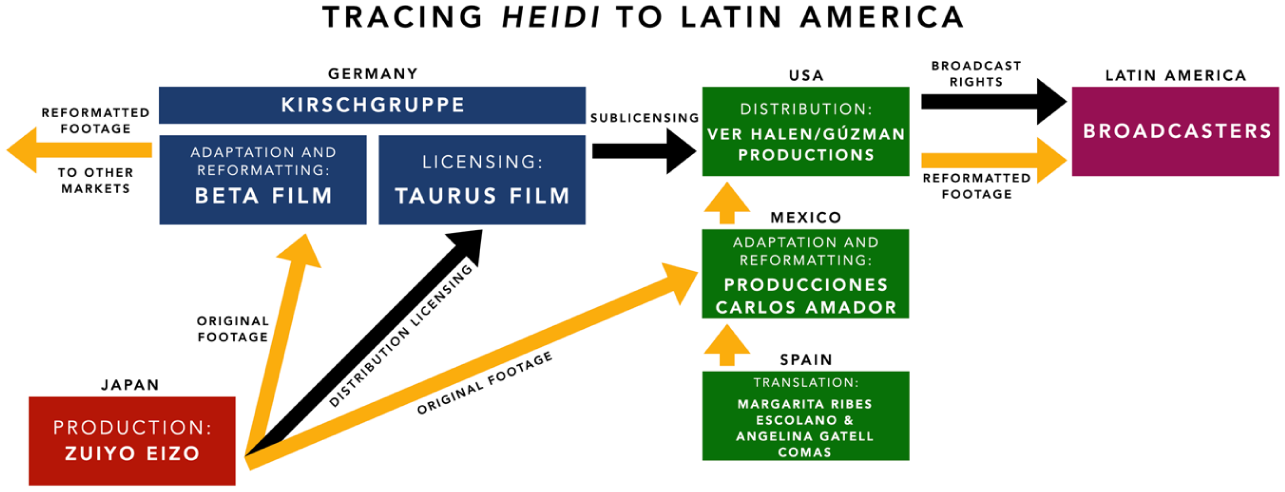
Tracing Heidi to Latin America.
Beyond licensing, and as is evident when engaging with the dubs in question, Beta’s influence on the actual textual flow of Heidi to Latin America was basically absent, as it was for the 1975 European Spanish dub, which directly translated the Japanese text rather than sourcing the (as yet unreleased) German-language version. The Latin American dub likewise draws directly on the Japanese original, though likewise making use of the European Spanish translation by keeping its character names and other details. The dub edit itself was carried out in Mexico as per its credits, and distributed throughout the region by the US-based Ver Halen/Guzman productions, a company co-headed by the Chilean Carlos Gúzman. In this way, Heidi’s trajectory to the Latin American Hispanophone mediascape passed through anywhere from three to five different media capitals, depending on the extent to which we consider the licensing itself as a nodal waypoint (Curtin 2003, 205). The cumulative influence of these steps in the final product does tell us quite a bit about the institutional and cultural affiliations at play. Where Heidi’s Latin American dub demonstrates a segmented trajectory when it comes to the distribution of flow and production, the Arab dub is far more transnationally integrated, with individuals and institutions from multiple sites collaborating at every step and all at once in the production pipeline. The dubbing itself was carried out across both Kuwait and the US with a Jordanian director, while making use of an Egyptian screenplay (The Dubbing Database 2022 [A]). In further contrast we may situate the Afrikaans and Dutch versions (premiering in 1978 and 1981 respectively), both of which are more straightforward re-translations built on Beta’s German language edit (Internet Movie Database 2013). The 1977 French version, also derived from the German dub, is likewise notable as a Quebecois production featuring both Quebecois and French vocal actors (The Dubbing Database 2022 [A]). This dub was distributed throughout the francophone world, first screening in Canada in 1977, and then in France and other localities, including Belgium, Luxembourg, Monaco, and making it to Africa via Algeria. Several English language dubs were likewise created, though these are mostly now considered lost media (Lost Dubbing Wiki 2023). Ver Halen/Gúzman Productions, the distributors of the Latin American Spanish dub, produced an edited-down compilation feature film in the US for home release in English-speaking markets in 1985. This version is still available online via informal distribution. In 2001 to 2003, Cartoon Network India screened an English Language dub derived from the German edit that may or may not have been a 1970s Filipino translation (Lost Dubbing Wiki 2023). This iteration is now largely lost, accessible only via a digitized and highly degraded VHS recording of less than two episodes (Archive.org 2023). That new markets were receiving this series as late as the 2000s is nonetheless significant – as is the fact that it has continued to receive new dubs for established markets as recently as 2010, with a Flemish Dutch adaptation made for the Belgian market which drew elements from both the German and original Japanese versions.
Despite its loving reception and cultural longevity, Arupusu no Shōjo Haiji proved to be something of a pyrrhic success for Zuiyo, providing an insufficient return on investment in the short term when taking costs of development into consideration. It did however succeed in its intent to establish a more robust framework of distribution into Europe, and via European-inflected stories, into the broader postcolonial world. It likewise proved to several markets that anime could constitute prestige flagship programming in the children’s media landscape: a universal(ized) literary canon to work with, family viewing, and even appointment television all in one. With its following projects, Zuiyo would both expand upon this strategy and end up having to substantially restructure itself in order to do so.
Maya the Bee: Production and Distribution Under Consolidated Transnational Frameworks
Where Heidi’s trajectory and global success can be seen as the result primarily of Japanese overtures into European and postcolonial TV markets, Maya the Bee represents a fuller and more concerted integration of transnational institutional actors working at multiple levels of production and distribution, to build upon the prototype represented by Heidi and other earlier collaborations and mobilizing it within a now more formalized process of transnational production.
Following the trajectory set by Heidi and then honed by their subsequent collaboration on the show Vicky the Viking (Japanaese: Chîsana Baikingu Bikke, German: Wickie und die starken Männer) in 1974, Maya the Bee was likewise an adaptation, this time of the eponymous 1912 German children’s book by Waldermar Bonsels (Zubillaga Gomez 2022, 495). As with Heidi, the original book is a bildungsroman, though in this case highly allegorical. It follows a young bee who rebels against her rigidly insular and militaristic beehive, exploring the world on her own. On her adventures she meets other arthropods with different perspectives, and eventually returns to and perpetuates the wisdom of her people in the face of an attack by evil hornets. The original work gained popularity throughout Europe and came to be regarded as a children’s classic, later also undergoing criticism for its allegorical connections to antisemitic and ethnocentric ideologies – an aspect that corresponds with Bonsels’ avowed antisemitism and support of Nazism (Zubillaga Gomez 2022, 497).
Like Heidi, Maya takes many liberties with the ideological framing of its narrative, though in its case this has less to do with separating itself from religious underpinnings than with a re-evaluation of Maya’s non-conformity. Maya is the looser adaptation, with more significant structural and ideological departures from its source material. It in fact preserves only the initial premise of the original text: A rebellious young bee girl learning about the world and meeting other creatures. Building an original plot around this premise, it introduces several new characters and plotlines in which Maya’s friendliness, inquisitiveness and skepticism toward cruel natural relationships are eventually rewarded and celebrated, rather than (as in the original work) abandoned as youthful folly. The original book’s celebration of militarism and submission to the collective allegorically embedded in insect social orders is overtly undercut in several plotlines.
Six episodes into the production of Maya, Zuiyo’s mounting financial problems and overstretched resources would finally rupture the company, and it would eventually be split into two entities that continued to collaborate. Its distribution and licensing division would break off and reform as Zuiyo Company, taking on the original company’s financial debts. The production division for its part would, while remaining affiliated with Zuiyo, handle the rest of Maya’s fifty-two-episode run under the banner of “Nippon Animation” – a name more familiar to casual audiences as a true production powerhouse, creating several of the most successful and widely distributed properties of the pre-Pokémon years
Key to Nippon Animation’s success was its affiliation with the same Calpis Comic Theater, (later World Masterpiece Theater) bloc on Fuji TV that hosted Heidi. Though primarily children’s programming, the choices of source material and the block’s 7:30 Sunday timeslot allowed shows to be likewise focused on collective family viewership – a tendency that both benefited from the nostalgic reframing of this familiar literary source material in Japanese families, and likewise facilitated distribution of these shows to an international market that, as with the prototype constituted by Heidi, was familiar with the broader European and Anglo-American children’s literary canon. In this way, the shows produced for World Masterpiece Theater, though distributed independently on the global stage, would eventually benefit from Nippon Animation’s profile as a producer of high quality adaptations of well-regarded and globally recognized children’s properties.
As a show oriented to younger children, Maya the Bee was not distributed domestically under World Masterpiece Theater itself. It did nonetheless benefit from Nippon Animation’s reputation as it entered the global market. Like the World Masterpiece shows, it was entrenched in the same Eurocentric rubrics, with the bonus of involving very little human representation, focused as it is on the lives of tiny animals in a location that could stand in for many different natural settings. These traits allowed Maya particular mobility. Audiences growing up in the early 1990s in the United States might recognize the program from Nickelodeon’s “Nick Jr.” block from 1990 to 1992. But by this point the show was already a proven fixture in the global children’s TV media market.
The concept for Maya resulted from an initiative spearheaded by Josef Goehlen of the West German TV broadcaster ZDF. Goehlen had taken up a position as head of children’s programming at the ZDF in 1973, after having worked for Taurus and Beta, gaining useful experience in collaborative anime distribution deals (Goehlen and Eichstaedt 2023).He was head of Taurus Film’s delegation during Heidi’s production, and as such had established relationships with both the creative and distribution staff at Zuiyo. Maya was thus structured as a joint venture between Zuiyo/Nippon Animation, Asahi Broadcasting Corporation (ABC - the series’ local Japanese TV platform), ZDF, and Beta Film (under the Kirschgruppe umbrella), as well as the Austrian Apollo films and German language broadcaster Österreichischer Rundfunk (ORF). Speaking on the development of this structure, Goehlen lays out the overall distribution of roles: [. . .] we devised a co-production model that required each co-production partner to make a financial investment commensurate with the amount of rights acquired, depending on the nature and scope of the rights. The production was based in Japan, the writers were based in LA and Munich and the editing was done in Mainz at ZDF, in Munich at Taurus Film and in Vienna at ORF and Apollo Film. Distribution rights for Asia were held in Japan by Nippon Animation and for Western Europe, the Anglo-Saxon world, Africa and South America by Beta Film Munich. This model, which may sound a little complicated, made production inexpensive for each partner, increased production quality and at the same time secured ZDF’s editorial sovereignty. (Goehlen and Eichstaedt 2023)
Originally conceived by Goehlen at ZDF, Character designs for Maya were handled by Los Angeles-based animator/illustrator/writer Marty Murphy (Massie 2009). Murphy is likewise credited with creating story outlines and screenplays, as well as being credited as the sole series screenwriter in the German language cut. Production and further development was then taken on by Zuiyo/Nippon, under the direction of Hiroshi Saitō, Mitsuo Kaminashi and Seiji Endō. Finally, the German language reformatting was credited to Apollo film in Vienna. These were the formal roles as credited, though the actual workflows involved were far more dispersed, simultaneous, and networked at multiple stages. Both formally, and especially in practice, this project was more transnational and reciprocal than the typical linear licensing processes typical of anime in this period. It was likewise less vertically hierarchical than a service-studio model in which the Japanese animation would be conceived as outsourced labor for a “Western” product (Goehlen and Eichstaedt 2023). As Figure 2 demonstrates, Maya’s production flow can be juxtaposed in comparison to both the outsourced service studio model (eg: My Little Pony, 1986, or X-Men ’97, 2024) and licensing models (eg: Heidi). Where these could be more accurately thought of as “inter”-national frameworks of production and distribution facilitated by key transnational relationships and institutional linkages, Maya’s coproduction hints at a level of transnationally integrated coordination that even now is largely ignored by the broader discourse surrounding anime as a cultural, artistic and industrial phenomenon.
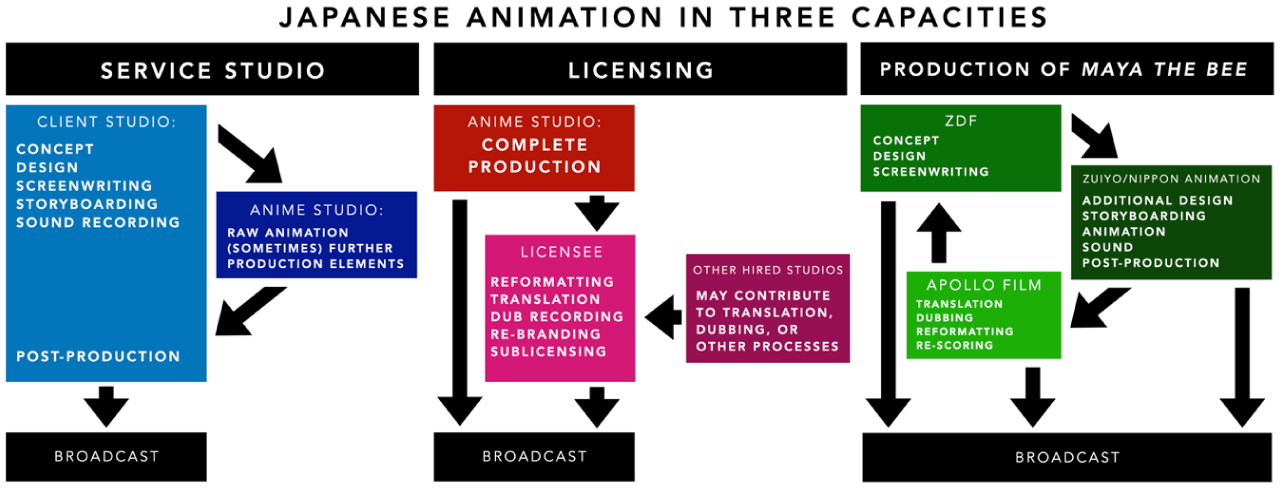
Comparison to of globalized frameworks in Japanese animation production.
Not all transnational co-productions would be as geographically dispersed or organizationally reciprocal as that of Maya the Bee, but the level of coordination and non-linearity of the production processes involved in ZDF, Apollo Film, and Zuiyo/Nippon Animation’s multiple co-productions throughout the 1970s and 80s speaks to the level of sophistication that was already present in these relationships scarcely a decade into the birth of anime as a globally-oriented phenomenon. Maya would thus have several “original” runs across three national broadcast systems in two languages: Asahi Broadcasting Corporation (ABC) in Japan, ZDF in West Germany, and ORF in Austria. Soon after its production, Maya would likewise circulate to further European and Asian TV and home video markets, along the same pathways established in the distribution deal Goehlen details, which likewise Mirrors Heidi’s licensing deal. Markets in Europe proper and its broader colonial world would receive versions of Maya derived from the West German iteration of the show throughout the late 1970s and 80s (Goehlen and Eichstaedt 2023).
Maya’s first English dub was produced for the South African Broadcasting Corporation (SABC) by Sonovision, a postproduction company based outside Johannesburg. Records indicate this dub was produced in 1980, though actual screening dates are unclear, and translation could have been ongoing for the sequel series well into 1985 (Stevens 2022). During this time, South Africa had a single-channel broadcasting system, alternating daily between English and Afrikaans language content. Sonovision thus dubbed Maya into both English and Afrikaans simultaneously, which may explain why surviving releases of this dub tend to alternate between “Maya” and “Maja” in the opening title card. Screenplays for the these dubs were derived rather indirectly, neither from the German nor the original Japanese text, but instead from either the French or Spanish translated screenplays, as these were the skillsets available to Sonovision’s translators at the time (Stevens 2022).
The English dialect follows the parameters of Received Pronunciation (RP) or “BBC” English. this was not unusual for shows dubbed throughout the British Commonwealth at the time, given the ubiquity of RP as a dominant media dialect in many British colonies well into the 1990s (Hannisdal 2019, 195). That said, the decision to employ RP may have been taken with a deliberate eye toward distribution to this same extended mediascape. The South African English dub indeed ended up making its way throughout the Commonwealth (though not the UK itself) during the 1980s and 1990s to broadcast networks in Ireland, Zimbabwe, Hong Kong, and New Zealand. It would likewise screen via Qatar’s BeIN satellite system to audiences throughout its MENA reach (The Dubbing Database 2022 [B]).
As with Heidi, Maya the Bee’s existing iterations reflect a variety of trajectories and sublicenses, sometimes more directly reflecting the geopolitical and commercial relationships laid out in the original deal, and sometimes taking more convoluted pathways. Broadcast systems in the Soviet sphere for example ended up with versions derived from the German cut, where the Farsi dub is clearly derived from the Japanese cut (the presence of footage cut from the German language version confirms this). The Farsi and Arabic language dubs alike retitled the show to more prominently feature Maya’s friend Willy (a character created for the adaptation) perhaps as an attempt to broaden the show’s appeal to boys in promotion, though neither dub otherwise downplays Maya’s primary protagonism. Where the Farsi dub was thus titled Nik and Niko, the show’s Arab language dubs would circulate under multiple different titles throughout the Arab language mediascape, including The Adventures of Zeina and Nahoul (مغامرات زينة ونحول) or just Zeina (زينة), both for the dub produced by Fouad Antoun Productions out of Beirut in the early 1980s (Figure 3), as well as Zeina and Nahoul (زينة ونحول) both for the later dubs produced by the Saudi Al-Majd Network’s Bajmad channel and the dub produced by Venus Center based out of Damascus (The Dubbing Database 2022 [B]). Among these various Arab Language dubs, the provenance of the footage itself varies. When observing the overall editing and the changes made for the German dub, this Arabic version at times draws from the Japanese version, while at others drawing from the Apollo Films version.
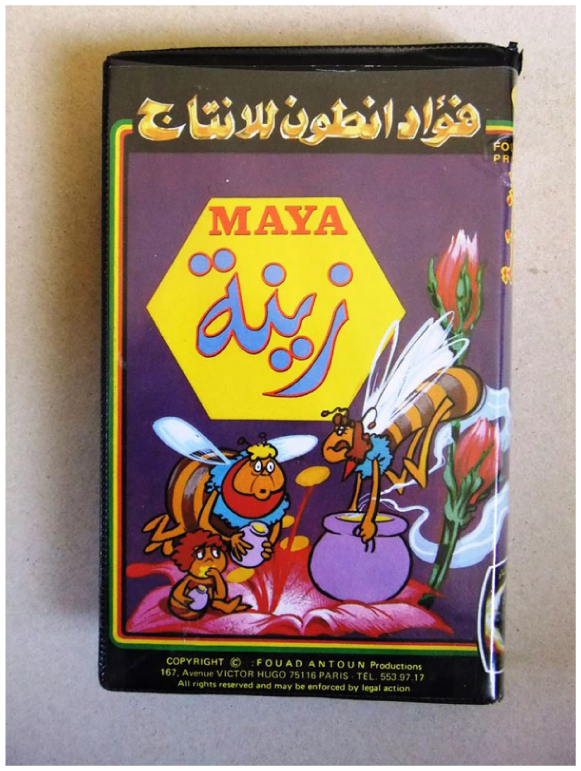
Zeina (Maya) Arabic language dub released by Fouad Antoun Productions.
Via such entangled flows, Maya the Bee became a fixture of children’s TV in a variety of media landscapes, languages and cultural frameworks throughout the following decades, with new dubs produced well into the 2000s for several ex-Soviet broadcast systems, as well as for the previously mentioned Arab language Al-Majd Network. Latin America derived its version in 1982 from the South African English footage, itself based on the Apollo Films recut. Israel got its own version in 1985, likewise from the Apollo Films version, though it sometimes replaces its translated version of the German-language theme song with a Hebrew language translation of the song written for the Latin American credits. A US/Canadian dub of the show would release relatively late in its broader spread, produced in 1989 by Saban Entertainment (later of Power Rangers fame) and airing from 1990 until 1992 on cable broadcaster Nickelodeon’s “Nick Jr.” bloc, alongside several other anime imports (Stevens 2022). Maya’s premier in 1990 in the United States thus represents something of a convoluted and somewhat supplemental trajectory to the center of global media power. Eurocentric anime was never explicitly aimed at the Anglo-American market. It was the result of efforts that took into account the existing trajectories anime productions had forged into the Anglo-American market, and which sought to then diversify their global reach into, first, Europe, and on their way there, countless other broadcast landscapes. In this way, Zuiyo/Nippon animation and its imitators in the Eurocentric anime tendency took advantage of a postcolonial world in which positive familiarity with European environments, subjects, stories, and cultural trappings, (not least in Japan itself) would facilitate (and sometimes obfuscate, given the frequent ignorance of where these shows were produced) the spread of their works.
Conclusions: Filling in the Gaps
There is some foreboding to the fact that Maya the Bee finally reached the US via Saban, and on Nickelodeon. Saban would soon achieve massive success with another Japanese property, reworking the live-action masked hero tokusatsu series Kyōryū Sentai Zyuranger (1992-1993) into the Mighty Morphin Power Rangers franchise in 1993, pivoting heavily into franchisable toyetic projects. Nickelodeon for its part, while still cordoning off its Nick Jr. block for early childhood programming, was in the midst of both embracing a more subversively-tinged “kids rule!” market identity, and attempting to replace its import animation roster with its own brand of in-house animated works, themselves derived from industry dissidents, art school novices, and experimental outsiders (Pecora 2004, 94). The resulting “Nicktoons” projects would themselves premiere in 1991, ushering in a new renaissance of auteur-driven television animation in the Anglo-American field, itself continuing the trend of dependence on service studio work increasingly outsourced to Korea, rather than the increasingly pricey Japanese studio environment. As for the anime phenomenon, Nickelodeon’s embracing of the broader global taste for Eurocentric or otherwise “literary” and family-oriented anime, its adoption of such shows as Maya the Bee, The Adventures of the Little Prince (Hoshi no Ōjisama Puchi Puransu, 1978–1979) and Belle and Sebastian, (Meiken Jorī, 1981–1982), would not become the norm in the Anglo-american market. Rather, it would be the building pressure of shonen (and to a lesser extent shojo) action series which would finally come to a head and breach the Anglo-American mainstream, bolstered by the massive influence of videogame culture and more adult-focused genre media. The 90s would belong to Pokémon, Sailor Moon, and Dragon Ball Z – not just in the Anglo-American market, but soon afterward, worldwide. In this environment, Maya the Bee would be a far less attractive prospect for Saban than its Digimon license.
It would be this final overwhelming push in the mid-90s that broke anime into the Anglo-American mainstream, and it would take several more years for this presence to manifest on the same day-to-day level of expected ubiquity as franchises from Disney, Warner Brothers, and Nickelodeon itself in toy aisles, clothing, and “adult” quotidianity. But in Europe, Latin America, Iran, South Africa, Israel, Lebanon, Saudi Arabia, and many other sites, the anime phenomenon was by then already a daily presence. Under a different guise, via different trajectories, and with different associations. Where the anime phenomenon finally became part of mainstream culture in Anglo-America during the neoliberal age, with properties that thrived within those parameters, it arrived and found a place in these other mediascapes during a moment in which children’s TV was often still being envisioned as a formative element of citizenship, rather than primarily as a market sector. When the new platform represented by TV, and the place it would have in the home, the state, and the culture at large, was still in contention. And when there was suddenly airtime to fill, and choices had to be made about what to fill it with, with an eye toward resource allocation, be these in time, money, and/or the attention of children and their families.
While anime’s distributors were not concertedly seeking out many of these secondary and emergent markets, they found their way to these otherwise underserved or overlooked landscapes on their way to more visible and lucrative horizons. On their way to (and often via their transformation in) Anglo-America, Astroboy, Speed Racer, Battle of the Planets and Robotech found a presence, if not overwhelming success, in a variety of secondary markets . In a comparable way, Heidi, Maya the Bee, Marco: 30,000 Leagues in Search of Mother (1976), and Captain Tsubasa (1983–1986) among others, spread on their way to Europe thanks to the roles they could play in these other broadcast cultures, be it as family melodrama, early childhood programming, a reflection of established ideas of high quality culture, or, (as in the case of Captain Tsubasa) catering to local tastes in sports. And at a cost generally less than that of Anglo-American or “pure” European products.
The Eurocentric anime trend of the 1970s and 1980s represents one successful strategy in anime’s broader global history. Its success speaks to a whole period (and dimension) of anime’s global ubiquity, and to the consolidation of anime itself as a recognized media phenomenon. This is a popular history that has since been overshadowed by anime’s more contemporary inflections (Suan 2021, 70–1). Eurocentric anime in this way represent a once dominant but now overshadowed evolutionary trend; a tendency that could have persisted if the consolidation of the global neoliberal media market had not propelled other tendencies in anime to the forefront. Its trajectories likewise speak to the diversity of production and distribution structures that emerged as anime entered global frameworks of production, licensing and distribution.
Finally, this phenomenon also highlights the latent generative and creative power of all of those other branched-off nodes in the production and reformatting pipeline. A rhizomatic transnational network of writers, translators, dubbing studios, composers, programmers, promotion and packaging specialists, and others who shape what happens with and to cultural objects as they travel and transform, accruing new meanings in new sites. As with Taylor Miller’s exploration of the iterative “retextual” power of syndication to effectively re-make texts for broadcast across different TV platforms (Miller 2021, 7–8), the necessary process of making anime travel across these different pathways and relationships has effectively “exploded” these texts into multiple different entities, each of which could have been an important part of audiences’ lived experiences. The cultural associations (or “odor” to use Iwabuchi’s 2004, 58 terminology) accrued here then are not just Japanese or European, but are, in a very real and tangible way, also infused with the meanings accrued in the process of flow itself.
Footnotes

Funding
The author received no financial support for the research, authorship, and/or publication of this article.
Declaration of Conflicting Interests
The author declared no potential conflicts of interest with respect to the research, authorship, and/or publication of this article.