






Abstract
This article examines the rise and fall of Viaplay’s Dutch scripted slate as a case study of “streaming precarity” in Europe. Drawing on seven interviews with producers, screenwriters, and Viaplay executives, alongside trade press and industry reports, we combine production cultures research with “failure studies” and “unproduction studies” to examine cancelled projects. We find that Viaplay was perceived as a European alternative to US streamers, shaping industry expectations and trust, before being upended by sudden cancellations in 2023 amid financial crisis. We reflect on “failure” as a complex characteristic of streamer imaginaries, encompassing breakdowns in production, financing, or distribution, even for completed series and still-active streamers. We argue that streaming intensifies already precarious film and television production through instability, unfavorable contractual practices and remuneration models, and data secrecy, with harmful consequences for freelance crew especially. Viaplay’s Dutch cancellations are thus understood as a case study of the streaming market shift.
Keywords
Introduction
In early 2022, Nordic streaming service Viaplay enthusiastically launched in the Netherlands. CEO Anders Jensen claimed: “Viaplay is here to play a positive long-term role, and to help shape the Dutch streaming market and creative scene for many years to come” (Viaplay Group 2022a). Simultaneously, the streamer announced “Viaplay’s Dutch scripted slate” (Viaplay Group 2022b), including five original productions. With these productions underway, Viaplay’s ambition of “becoming the European streaming champion” (Whittingham 2021) seemed on track. However, by the summer of 2023, these plans were derailed when Viaplay suddenly cancelled its Dutch productions (Jansen and Tienhooven 2023). Internally, the company was in turmoil losing 72 percent in shares value, carrying a debt of US$180 million, and needing to lay off 30 percent of its workforce (Chalaby 2025, 269).
Chalaby (2025) attributes Viaplay’s collapse to its failed expansion into the UK and USA and to a broader unraveling of European media groups facing digital revenue struggles and competition from US-based streamers. Marking a stark shift from the period of abundance and veritable content boom in Europe, the last few years have seen a streaming market correction with declining investment in television fiction (Ene et al. 2025, 20). Industry reports indicate that “jobs are being lost, businesses are folding, TV production has peaked in the US and is peaking in Europe” (Koljonen 2024, 10) and trace a decrease in streaming releases (Digital i 2025). Our study shows how industry expectations shaped during this phase of perceived abundance and Netflix-style investment can persist even as markets contract. That leads to disconnects between imaginaries and practice.
Chalaby (2025, 269) describes Viaplay’s decline as “the most spectacular fall from grace” within this pattern. Even so, no research to date examines the impact of Viaplay’s cancellations in the Netherlands (or other markets) and strategic pivot away from producing scripted content. Our article addresses this gap by offering new insights into the ramifications for Dutch screen workers, positioning it as a case study within this broader market shift. Through this case study, we build on production “failure studies” (Redvall 2023) in the context of streaming. We see “failure” as a productive analytical lens for understanding a range of challenges related to production, financing, distribution, and corporate strategy changes—and how these are complicated by what Szczepanik (2024, 222) calls “streamer imaginaries,” meaning the “intuitions, expectations and anxieties” that cultural producers hold toward streamers.
Researching Streaming Precarity
Media scholars have long emphasized the precarity of labor in screen production. However, this research has largely focused on the UK and Hollywood (e.g., Banks et al. 2013; Caldwell 2023; Curtin and Sanson 2017; McRobbie 2015). Western screen industries are generally seen as marked by “precarity of employment,” characterized by short-term freelance work “with poor terms and conditions” (Dwyer 2019, 347). “Labor precarity” more specifically refers to increased insecurities for screen workers in a global, post-Fordist economy driven by the pursuit of technological progress and greater demand of individual flexibility and self-optimization (de Peuter 2011). Simon (2022) observes how, in the Nigerian film industry, the economic precarity of the developing VOD market leads filmmakers to adopt new labor practices based on informal social relations. Beyond this and Caldwell’s (2023, 267) observation on increasing “spec-work,” there is little research into how streamers impact already precarious labor conditions. This is where our article intervenes, providing a meso-level case study exemplifying how the increasing dependence of screen workers on an unstable streaming market engenders an intensified form of precarious labor.
The European streaming market is highly concentrated, with three US-based services (Netflix, Prime Video, and Disney+) accounting for 85 percent of viewing time (Ene et al. 2025, 30). Streamers have been producing European content for over a decade, partly incentivized by the need to attract local subscribers and partly due to cultural policy (Hagedoorn and Becker 2025). In this concentrated online screen industry, cultural producers are increasingly dependent on the commercial technological infrastructures of streaming services (Idiz and Poell 2025). For European producers, the business models and contractual arrangements of these streaming services have presented challenges—especially around IP rights, residuals, and windowing for films (Idiz and Poell 2025; Meir and Mitric 2025). In terms of production, research has revealed how streaming data and the unique dual local-global address of streamers filter into creative practices (Idiz 2024; Rasmussen 2025). Rasmussen (2025, 5240) uses the term “data secrecy” to describe how global streamers guard data insights to maintain competitive advantages and power imbalances.
Research on European streaming productions has focused primarily on global streamers, especially Netflix, with a few notable exceptions examining local commercial streamers (Castro and Cascajosa 2020; Keilbach and Surma 2022) and public service media (Bruun and Lassen 2024; Sundet 2021). Within this context, Viaplay is unique as a regional European streamer. As an interview-based study engaging with producers and their meaning-making activities, this article finds its theoretical home within a “production cultures” framework (Caldwell 2008), and specifically “streaming production cultures” (Idiz and Rasmussen 2025). To unpack producers’ perceptions of streamers, Szczepanik’s notion of “streamer imaginaries” (2024) is particularly useful, referring to the collective hopes, expectations, and speculative strategies that producers develop in response to how they imagine global streamers operate. These imaginaries are a form of “industrial reflexivity” (Caldwell 2008) or “industry lore” (Havens 2014), meaning the discourses and beliefs that shape expectations and guide practices in the industry. Often streamer imaginaries are shaped by streamers themselves, for instance with Netflix positioning itself as the benchmark for success (see for e.g., Wayne and Uribe Sandoval 2023). However, in our study, we also see how Netflix becomes a reference point of scale against which other services are defined.
In looking at cancelled productions, we turn to specific approaches in production studies and film studies. Failure studies focus on “studying problematic or failed processes and productions” (Redvall 2023, 67), which help gain insights into precarious and gatekept industries. Approaches to studying “unproductions” or “shadow cinema” (Fenwick et al. 2020) are grounded in film studies through research into never-realized projects (see, e.g., Krämer 2015). Early studies into co-productions between local public broadcasters and global streamers have also addressed such frictions and failures (Nielsen 2016; Sundet 2016).
We position our research as a case study of what we term streaming precarity, arguing that streamers intensify precarity in already fragile production ecosystems. This streaming precarity includes more instability through rapidly shifting production volumes and cancellations (see, e.g., Manfredi 2024); worsened working conditions, such as shorter seasons, more time between seasons, and faster production schedules (Andreeva 2024); unfavorable contracts and remuneration models, especially related to loss of IP rights in exclusive productions and limited residuals (Meir and Mitric 2025); and data secrecy around content performance and cancellations (Rasmussen 2025) .
Methodology
To understand the impact of Viaplay’s cancelled slate on the Dutch screen industry, we conducted seven semi-structured interviews online between August 2024 and April 2025. We interviewed four producers and one screenwriter who each had worked on one of Viaplay’s five planned Dutch productions. Additionally, we interviewed two executives who had overseen Viaplay’s entrance into the Dutch market. To maintain confidentiality, interviewees have been given pseudonyms, and we do not include details about their roles or the specific productions they worked on.
Based on trade press and Viaplay press releases, we sought out individuals who had worked on these productions and whose contact information was accessible through IMDbPro, LinkedIn, or company websites. Emphasis was originally placed on above-the-line crew (producers, screenwriters, directors) who would have direct insight into Viaplay’s production style and cancellation process. Following one interviewee’s description of how the abrupt cancellation impacted the most precarious screen workers, we expanded our recruitment to below-the-line crew (freelancers booked for the shoot). Despite our efforts, we were unable to get in touch with relevant below-the-line workers, which speaks to a wider challenge of accessing these workers in the context of “unproductions” or “failures.”
The interviews were semi-structured to account for the diverse experiences and roles of interviewees, with questions following the phases of Viaplay’s entrance into the Dutch market, production process, and cancellations. They were recorded, transcribed, and subsequently analyzed through close reading, coding using NVivo, and inductive development of themes (Braun and Clarke 2006, 2021). Our findings were contextualized by industry reports, trade press articles, and Viaplay press releases which served especially to trace what was publicly known about the Dutch productions and cancellation process.
Viaplay in the Netherlands
Viaplay launched in the Netherlands in March 2022. Their Dutch slate (see Table 1) included partnering with bestselling writers, award-winning directors, and producing safe genres (e.g., local true crime and historical drama) for a slate of four series and one film (Viaplay Group 2022b, 2022c, 2022d, 2023a). Touching on locality, Viaplay’s Chief Content Officer, Filippa Wallestam, described how this content “blend[ed] local storytelling with our Nordic touch” (Viaplay Group 2022c). Or, as a Dutch director described: “Dutch Nordic noir” (Viaplay Group 2022c). Viaplay’s focus on crime drama was previously observed across Scandinavian markets, in a strategy called “universally local crime stories” (Hansen 2020, 126).
Viaplay’s Dutch scripted slate (per original announcement).
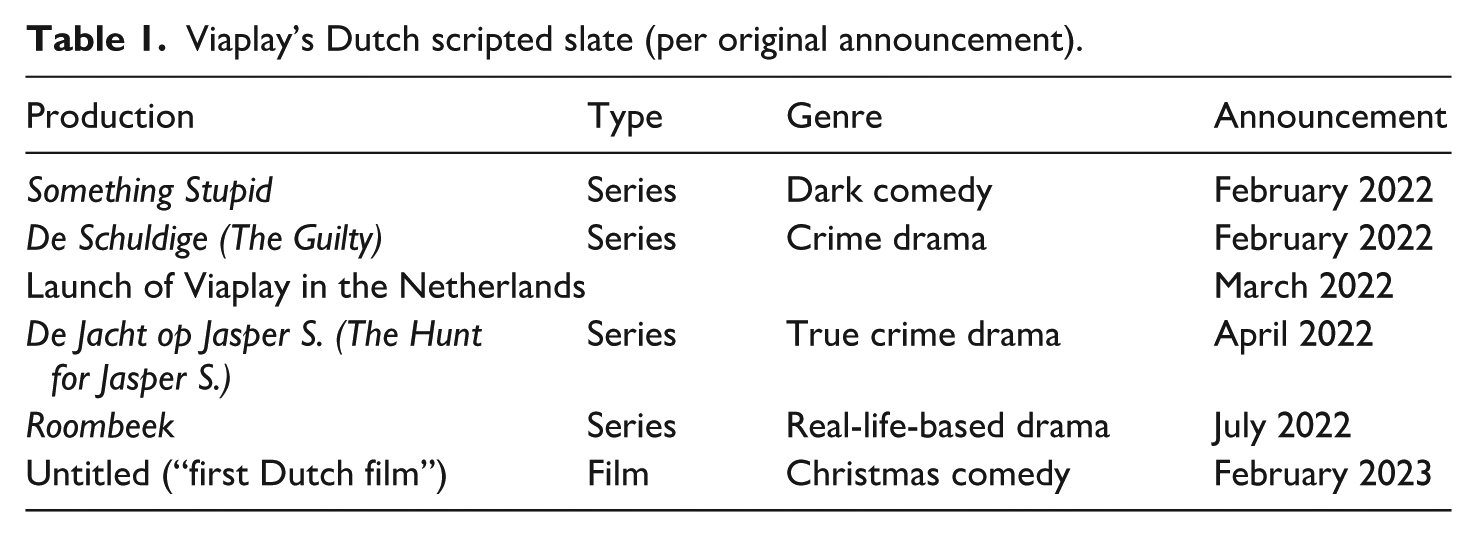
Our interviewees unanimously felt Viaplay was targeting a local audience, as reflected in the content commissioned. Where research into European Netflix productions has shed light on how these series are produced with a global and especially American audience in mind (Idiz 2024), Viaplay instead opted for a highly localized approach. Editorial decisions around the series were made by a Dutch commissioning executive, with producers primarily dealing with them as a point of contact throughout development and production.
Viaplay’s development and production process was described as a “normal way of working” (Anouk), primarily because the commissioning executive had a long career in the Dutch industry. This was echoed by others, who likened it to working with a public broadcaster (Bram). Viaplay was compared to Netflix in terms of its early greenlight process (Bram; Fleur), but described as providing more creative freedom and being more hands off than its American counterpart (Klaas).
Imaginary of Viaplay as a “European” Streamer
A major discussion point in our interviews was the imaginaries around Viaplay, which differed significantly from the “streamer imaginaries” (Szczepanik 2024) related to global streamers like Netflix. In describing their original perception of Viaplay at the time of its Dutch slate announcement, many interviewees noted being unfamiliar with the streamer beyond its Swedish/Scandinavian roots. This origin and its perceived implications had a powerful effect on the screen workers we spoke to, coloring their opinions and interactions with Viaplay. Despite having little reputational knowledge of Viaplay prior to its appearance in the Dutch market, our interviewees believed it was a “stable company” (Bram), because it was Scandinavian. This trust comes through in another example: “They had an eye for work life balance, I think because they’re Scandinavian. They’re just more progressive than the rest of the world” (Jeroen). These expectations and hopes of producers around Viaplay represent a particular type of streamer imaginary (Szczepanik 2024), tied to the company’s regional roots and associated cultural specificities.
Viaplay’s “Europeanness” was nearly always discussed in direct contrast with its American streamer counterparts. Because Viaplay was European, it felt to participants “less rogue than perhaps the Americans would be perceived” (Anouk). Comparing Viaplay to Netflix, Prime Video, and Disney+, multiple interviewees mapped out what they saw as differences between the two models. This included being less controlling and behaving more like a local broadcaster. One interviewee saw data use in production as a key distinction: The European approach means you have a little bit more freedom and responsibility in the choices you make, also from a creative perspective. Netflix and Amazon Prime [Video], they are kind of data companies. They first act like a data company, then as a creative company. For example, with casting, it’s not “Who did the best audition?”, it’s “Who gets the most viewers?” And that’s data. [. . .] The US approach is much harder, much more business-like. The European way is a bit more human. (Klaas)
This echoes common industry lore about European cinema “defined in opposition to Hollywood” (Elsaesser 2014, 17), with the latter being perceived as more commercially driven. Across interviews, a shared sense of optimism was expressed around Viaplay as a European streamer. Interviewees believed Viaplay understood the local market, offering a familiar way of working and creative freedom. Universally, this was described as preferable to US-based streamers like Netflix, Prime Video, and Disney+. Bram described a conversation with a French colleague, who urged them to work with Viaplay by saying: “This is the only European streamer that’s in our market. Let’s be nice, because it’s better to have European streamers become big in our market instead of, well, the other ones.” This industry lore around the European streamer contributed to rose-colored glasses which persisted until Viaplay’s sudden cancellations. As Jeroen put it: “It was one of the best companies I’ve ever worked with until the last month, when everything went to shit.”
The Fall of Viaplay’s Dutch Scripted Slate
On July 7, 2023, news broke in the Netherlands that “Viaplay [was] in trouble” and that the “Saskia Noort project and other drama series [were] canceled” (Jansen and Tienhooven 2023). Reasons for the cancellation of the drama series Roombeek, Jacht op Jasper S., De Schuldige and Something Stupid were cited as “a loss of millions” in the stock market and direct “cost-cutting measures” by Viaplay’s new CEO, Jørgen Madsen Lindemann. It was additionally reported that “several people working for Viaplay’s entertainment division have been laid off” (Jansen and Tienhooven 2023). From our interviews, we were able to uncover more varied outcomes for the different productions (summarized in Table 2). Several factors appear to have contributed to this variation, including the size of production companies, timeline of projects, and ability to source external funding. These differing trajectories indicate the unevenness of outcomes publicly described as cancellations: some projects collapsed, others were sold or rebranded.
Tracing the trajectory of Viaplay’s Dutch scripted slate based on interviews.
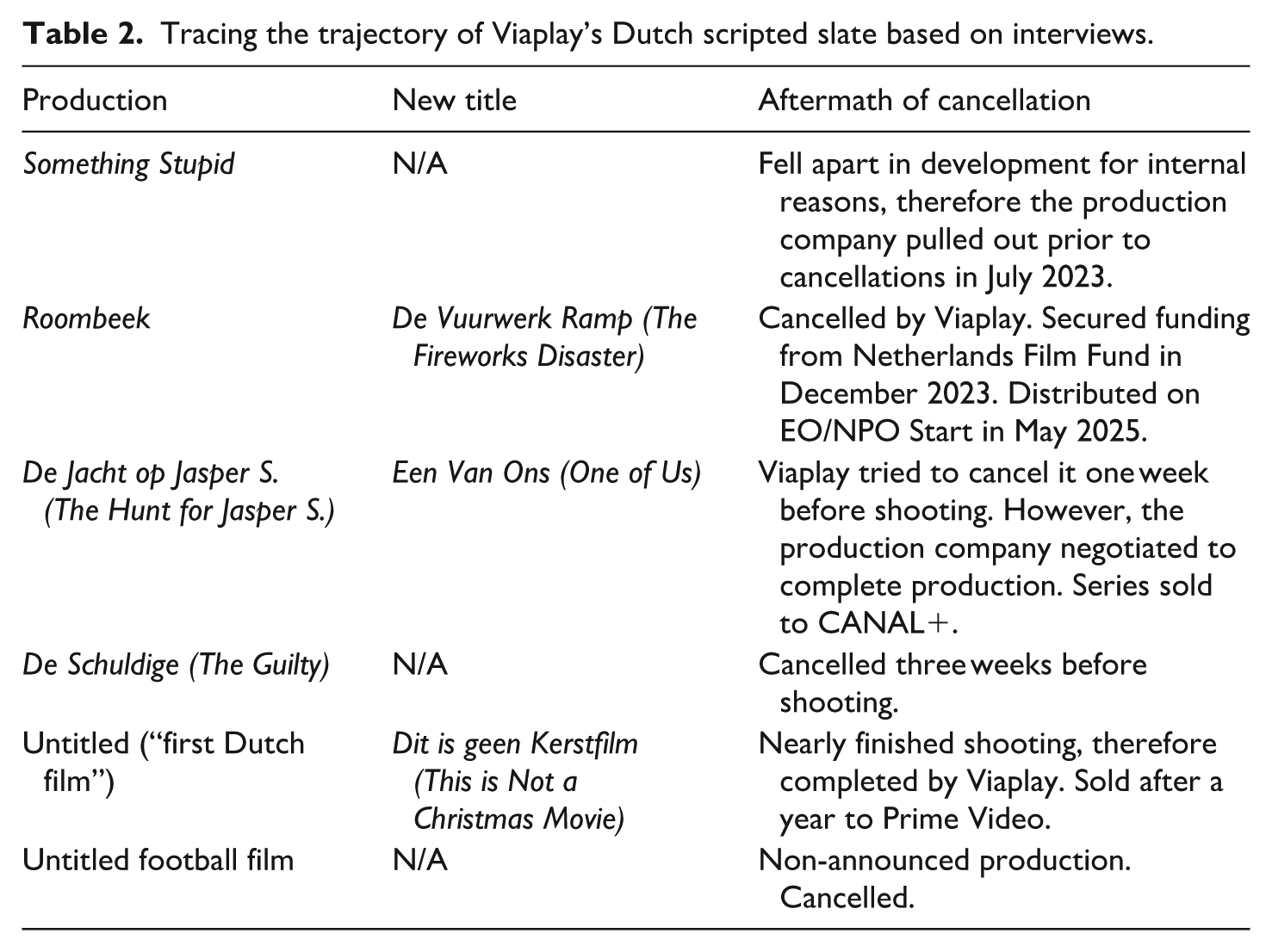
As described by our interviewees, the productions were initially going full steam ahead. The first sign of trouble for our interviewees was the streamer’s negative Q1 report in April 2023 and the replacement of Viaplay’s CEO in June (Frick 2023; Viaplay Group 2023b). Some projects were within weeks of shooting, but Viaplay provided no answers at the time. Then, at the beginning of July, all Dutch producers working on the scripted slate were informed by Viaplay’s local commissioning executive that their projects were cancelled. Meanwhile, Viaplay fired its entire scripted department and every point of contact Dutch screen workers had been working with. Allegedly, a single finance manager at Viaplay was left in charge (Beatrix; Anouk; Bram).
The interviews showed a stark contrast in outcomes between a project led by a smaller production company, with less experience producing for streamers, and one of the largest Dutch production companies that had previously worked with major streamers. The latter leveraged its knowledge and robust legal team to require that Viaplay finish the production (Bram; Jeroen). Meanwhile the smaller one felt there was no recourse when its production was cancelled.
For the cancelled projects where shoots were nearly underway, approximately 80 to 100 people (primarily freelance crew) were impacted (Anouk; Beatrix). For some, this was the most harmful aspect of the cancellations, as these are some of the most precarious workers in the screen industry: “People really rely on that for their income. All of the crew are freelancers. It’s absolutely horrific and it is one of the worst business practices I’ve ever seen” (Anouk).
Reflecting on their experiences over a year later, interviewees were still struggling to make sense of everything. As Beatrix described: “Talent, producers, directors, projects, they deserved to be treated better than they were. It was just so chaotic. We call it building castles in the air, basically, when someone starts looking at the numbers, this will crumble.” This points to a disconnect between Viaplay’s investment ambitions and underlying market realities, also noted by Chalaby (2025), as a possible explanation for its collapse. A month after our last interview, Viaplay’s former CEO, Anders Jensen, stated in the Swedish press that the fiction production budget was not the trigger for the streamer’s financial crisis. He blamed the board for the “bloodbath” in the fiction department since they demanded an abrupt change of strategy (Ek and Mikrut 2025). The explosion in costs was, instead, related to the live sports bubble and inflation that caused a sharp decline of value of the Swedish krona (Ek and Mikrut 2025). This shows a friction between the limited information shared with workers at the time of cancellations, who are left speculating the causes of these cancellations, and what is shared publicly by high-ranking executives. When asked about Viaplay’s role at the time of our interviews, our participants no longer considered the streamer to be a player in the fiction market. In terms of the broader industry, they shared concerns around a shrinking drama market, more risk-averse commissioning, and the pervasive sense that streamers are somewhat unreliable.
A final common thread in interviews was around data secrecy. Interviewees universally had a lack of information around cancellations and around the processes by which certain content was sold to other distributors. Because Viaplay owned exclusive rights to the content, producers were cut out of the negotiation processes between the streamer and other distributors. Additionally, they received no insights into the financials of the deals struck (Bram). The film that ended up on Prime Video after nearly a year in limbo was particularly challenging, as the streamer, like Netflix, is very tight-lipped with its performance data. The interviewee who had worked on this film described how everything was “very secretive,” and they had resorted to tracking the film’s position in Prime Video’s Top 10 to try to gauge its success, echoing the informal tactics described by Rasmussen’s (2025) interviewees. In this context, limited access to performance data complicates how producers interpret success or failure. They also felt disappointed that the film never got a cinematic release, as this is something they had been in the process of negotiating with Viaplay before Prime Video bought the rights. Moreover, securing a theatrical release is a common challenge with streamers (Smits 2024, 86).
Discussion: Dutch Outlook and the Precarious Streaming Market
Describing their imagined future for the Dutch market, interviewees foretold a trend toward fewer productions and risk-averse content such as cheaper scripted and non-scripted titles, remakes, and adaptations (Bram; Fleur). They predicted that few streamers would remain active in scripted production in the Netherlands, following HBO Max’s and Viaplay’s failed launches (Dirk; Fleur). Some hoped that a positive side-effect would be more possibilities of co-productions and mid-level projects, and more reliance on the public broadcaster (Anouk; Fleur). But, in the same breath, Anouk described her impressions of how local broadcasters are trying to emulate streaming budgets: “NPO [the Dutch public broadcaster] said ‘we’re doing less, but we’re spending more.’ I think they should have done the opposite.” At a market level, Dirk expected a decline in production companies, observing that many had started in response to the streaming boom that now would have to close. Our study has shown how industry hopes and expectations formed during periods of abundance can adversely impact producers when investment contracts suddenly. The forward-looking speculations of our interviewees indicate that new lore and imaginaries are already emerging in the wake of these changing realities. Public discourses on streaming often focus on success, leaving failure underexplored or misunderstood. Yet as our findings show, it is precisely through accounts of cancellation that the tensions between streamer imaginaries and industry practice become most visible.
Over the past decade, the Netherlands has seen the arrival, investment, and strategic shifts of major streamers (e.g., HBO Max ceased original series development in the Netherlands in 2022). Precarity, cancellations, and strategic pivots are longstanding and recurring features of screen production. However, we find that these conditions are intensified due to the unpredictability of productions and data asymmetries between screen workers and streamers, contributing to what we term “streaming precarity.” Deuze (2025) has raised the alarm around the mental health crisis plaguing professionals in this field, observing a key tension: creative workers pursue their careers with passion and idealism, but this often collides with the precarious working conditions they face. It is therefore vital to unpack how changing industrial and technological dynamics exacerbate this.
Ultimately, Viaplay’s rise and fall in the Netherlands illustrates how streaming continues to destabilize already fragile production ecosystems by affecting local industries’ production volumes, contractual arrangements, remuneration models, and work practices. While most research focuses on the impacts of streaming on above-the-line crew, our findings show that the unpredictability of streaming productions is also felt by those below-the-line whose work is the most precarious and least visible. As streaming investments continue to fluctuate and industry decisions are increasingly defined by debt (Harris-Bridson 2026), it is all the more important to study the lived experiences of workers who are asked to build these castles in the air.
Footnotes
Acknowledgements
The authors thank the interviewees for generously sharing their time and experiences. They also thank the University of Toronto’s Theories and Praxis of Digital Labour working group for offering valuable feedback on an early draft of this article. Both authors have equally contributed to this article; authorship is in alphabetical order.

Ethical Considerations
The Faculty Ethics Assessment Committee of the Faculty of Humanities at Utrecht University (ref. 24-089-02) approved our study on June 25, 2024.
Consent to Participate
All participants in this study were provided with a detailed information sheet explaining the study’s objectives and participant involvement. Following this, participants were given the opportunity to ask questions and seek further clarification. Informed consent was obtained from each participant through the signing of a consent form, confirming their voluntary participation in the study.
Consent for Publication
Informed consent for publication was obtained from all participants in writing. The consent confirmed that participants understood their contributions could be used in academic publications, conference presentations, and other research outputs.
Funding
The authors received no financial support for the research, authorship, and/or publication of this article.
Declaration of Conflicting Interests
The authors declared no potential conflicts of interest with respect to the research, authorship, and/or publication of this article.
Data Availability Statement
The participants of this study did not give written consent for their personal data to be disclosed in full or without appropriate contextual framing. Due to the ethical and confidential restrictions of the research, supporting data is therefore not available.