






Abstract
This study explores how Netflix has transformed traditional genres of South Korean television dramas, commonly known as K-dramas. The growing presence of Netflix has disrupted established production and distribution mechanisms, prompting local stakeholders to adapt to compete more effectively on a global scale. Interviews with twenty-nine industry practitioners suggest that Netflix’s perceived flexibility and creative autonomy, supported by its financing models and regulatory differences, motivate creators to explore a broader range of genres—something traditional television networks cannot provide due to their financial and regulatory constraints. By analysing how those involved in domestic television production recognise the changes brought about by foreign streaming giants, the findings provide insights into how genres function as industrial arrangements, how local stakeholders have responded to shifts in the media landscape during the streaming era, and how power asymmetry between global players and domestic creators influences television genres.
Introduction: Understanding Genres as Industrial Arrangements
This study explores how local television producers recognise Netflix and the importance of streaming media to the genre of South Korean (hereafter Korean) television drama, also known as K-drama, as well as to the creativity of individual producers. A genre can be understood as a generic identification agreed by audiences and industry stakeholders, based on the “existing traditions, conventions and formulae” (Neale 2000, 28), in which selection is made “from generic elements available at any one point in time” (Neale 1990, 56), through systems of repetition and differentiation (Neale 1980, 13). In popular culture, genre elements are often expressed through texts and textual systems, such as atmosphere, characters, locations, plots, and settings (Alacovska and O’Brien 2021, 642), as represented in media products (Chandler 1997, 2).
In a world where the material production of popular culture follows market logic and is influenced by stakeholders’ interests, genre categories can be seen as a “corporate form of capitalist cultural commodities” (Ryan 1992, 2). This suggests that genres are “associated with an industrial, commercial, and mechanically based art” (Neale 2000, 20), and cannot be separated from broader structural and social conditions (Bruun 2010, 727), as well as the economic necessities of large-scale industrial production mechanisms (Ryall 1975, 10, cited in Neale 1980, 14). Their formation often becomes marketing tools and promotional labels (Alacovska and O’Brien 2021, 642; Peterson 1997, 31), and their elements are often seen as protocols for producers and distributors to turn their ideas into products that align with market preferences, while also guiding audiences to find what they seek (Altman 1984, 8; Frith 1998, 76). While recognising that not all creative activities are subject to market dynamics and corporate interests as expressions of sociocultural dialogue (Negus 1999, 20), genres cannot be separated from the production mechanisms shaped by the pursuit of market demands.
Genres have been crucial for many streaming giants to penetrate various television markets worldwide. On the one hand, using algorithms, big data, and other platform technologies, Netflix has employed computational techniques to group different content, aiming to offer personalised recommendations to subscribers with different tastes (Underwood 2016, 3)—often known as microgenres, which refer to “the classification of increasingly niche-marketed worlds in popular music, fiction, television, and the internet” (O’Donnell and Stevens 2020, 1). In this regard, the data accumulated by the streaming giant from users also matters to its investment in new content (Hallinan and Striphas 2016, 129). On the other hand, they have adopted different genres produced outside of the US to attract audiences with different tastes and backgrounds. Indeed, many original non-English-language series that streaming giants have invested in are the result of negotiations between local characteristics and the genre traditions widely used in the US. Since Netflix aims to make its original series universal and transnational, appealing to multiple markets by blending elements of genres from different cultures (Jenner 2021, 185), its taxonomy cannot be understood without considering its globalisation plans. This often results in asking industrial stakeholders to produce content in a way that Netflix and/or global audiences prefer (Ju 2020, 35; Kang 2024, 33). Drawing on insights from television producers and staff working at television networks, this paper examines how Netflix, now the largest investor in Korean television, influences K-drama production and its genres.
Method
This study is grounded in the tradition of production studies, which analyses “the cultural producers, the organisational sites, and practices they inhabit, through which they exercise their power” (Gandy and Garnham 1995, 65) through the voices of production workers—whose voices are often marginalised (Mayer et al. 2009, 2–3; 7) but whose cultural practices and belief systems, as well as how people negotiate them with broader corporate strategies, significantly influence the outcomes (Caldwell 2008, 1–2). This approach assumes that the way people materialise their ideas and perform on the production site is driven by the power dynamics shaping the market (Lee and Jin 2018, 43–44). In this regard, studying how producers and staff at television networks recognise foreign streaming media can provide insight into the changes in television production and genres.
The study is based on interviews with twenty-nine industry practitioners, including twenty-eight television producers and employees of television networks, production studios, and streaming companies, as well as one public-sector employee with a background in the television industry. All participants have at least five years of experience in the television industry, and the study employed snowball sampling, which is beneficial for recruiting specialists. All interviews took place between June 2023 and September 2024, with each lasting an average of one hour and fifteen minutes. Interviews are designed to be semi-structured, focusing on several key themes, including their previous careers in K-drama production, their thoughts on Netflix, their expectations of incumbent domestic players, and the future of K-dramas. All participants’ information is anonymised following research ethics protocols. By examining how people involved in domestic television production recognise the changes brought about by the emergence of global streaming giants, the findings demonstrate how creators align with the interests of global streaming giants and provide insights into how the power asymmetry between global players and national industry stakeholders influences television genres.
Netflix as a Playground for New Genres
Many genres of K-drama are based on traditional genre characteristics of melodrama and Shinpa (신파 in Korean)—a genre of play focused on the everyday lives of ordinary people, especially the poor and lower classes (Lee 2017, 191). The storylines often depict marriages and romance between characters and various family stories (Choi 2018, 169); characterised by themes of suffering and exaggerated performances (Cho 2013, 10). Besides the popularity of Korean content in the Asia-Pacific market, which is a key reason why foreign investors are interested in Korean television, several participants mentioned believing that foreign streaming companies are attracted to K-drama because “the genre has a strength in inspiring the audience’s emotions” (Participant I), and “focuses on the personality of characters in the storyline” (Participant L). Many participants felt that Netflix and other foreign streaming giants consider these as defining features of K-drama.
When asked about the benefits of working with Netflix, many participants described the streaming giant as more flexible, providing more freedom for creators to try new and different ideas compared with legacy media. Participant I said, “As a producer making limited series, I believe the biggest change that Netflix brought to Korean television is that it encouraged people to diversify genres and draw freely upon their imagination. There are several reasons cited by creators for why streaming giants allow the exploration of various genres. Firstly, many argue that audiences have different expectations when watching content on linear television than on streaming media, and that these expectations vary across domestic and foreign outlets. Apart from different demographics—“television has become a medium for those over 50 while people under 40 are more familiar with streaming media” (Participant M)—they acknowledge that domestic television “targets random viewers, leading [producers] to develop narratives and other genre elements in a way that appeals most to the general public” (Participant I). This production logic is also influenced by the existing sociocultural conditions of society, such as strong patriarchy common among middle-aged and senior viewers who consist important demographics of the television viewership. This results in incumbent media outlets “adopting a more conservative approach to trying new genres” (Participant G). Indeed, despite criticisms of traditional K-dramas for their monotonous characters and plots—ranging from medical dramas to crime series and romantic melodramas—television networks adhered to the same approach, seeing it as a way to minimise risk and secure their audiences (Kim 2022a, 123).
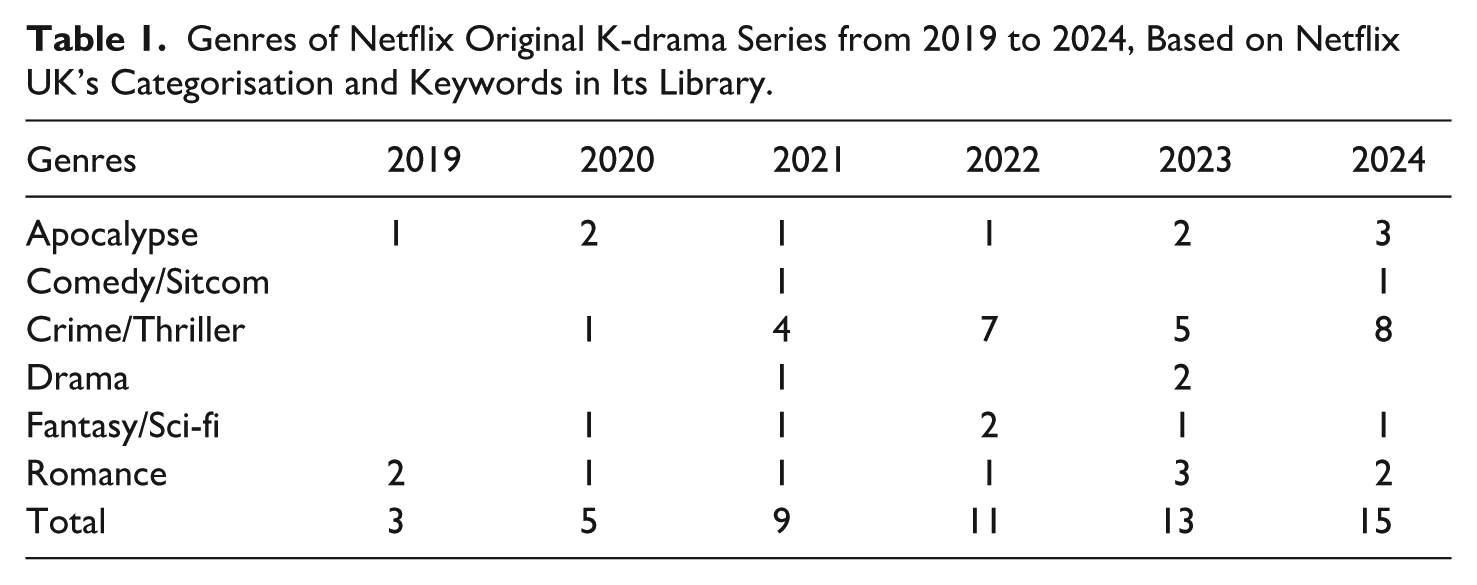
In contrast, those who use streaming media are considered “high-involvement audiences who access the service with a clear intention of what content they wish to watch” (Participant J). These users are seen as more tolerant of streaming media and foreign content, justifying their pursuit of opportunities that traditional television networks have been hesitant to explore. Table 1 below shows the variety of genres in Netflix’s Korean original series, based on Netflix’s genre classifications, highlighting how different the genres have been since the release of its first original series, Kingdom (킹덤 in Korean), a zombie apocalypse series, in 2019. As Table 1 explains, unlike incumbent television networks, which continue to distribute romance and drama series, the streaming giant has released more non-romance genres.
Genres of Netflix Original K-drama Series from 2019 to 2024, Based on Netflix UK’s Categorisation and Keywords in Its Library.
Secondly, some argue that the entry of filmmakers into the production of series for streaming media has helped diversify K-drama genres. Two main factors attracted film industry workers to streaming series: the rapid growth of K-drama production in the late 2010s, which attracted film professionals to television, and the decline in film during the pandemic, prompting many to seek other opportunities. For those unfamiliar with producing standardised sixteen-episode series and genres other than romantic comedies featuring male and female characters or family stories—both rooted in the melodramatic tradition that dominated K-drama genres—streaming media was a breakthrough, as it offered flexibility in genres and formats. Some participants applaud Netflix’s policy of producing limited series, which “would ensure sufficient production time with a guaranteed margin, unlike the previous system of making K-dramas under tight deadlines” (Participant I). Indeed, such policies attracted several renowned film directors whose filmographies consisted solely of directing films: Hwang Dong-hyuk, Yeon Sang-ho, and Yoon Jong-bin—who created Squid Game (오징어 게임 in Korean, 2021, 2024), the horror series Hellbound (지옥 in Korean, 2021, 2024), and the crime series Narco-Saints (수리남 in Korean, 2022), respectively. The flexibility in genres and formats provided by the streaming giant’s financial backing further facilitates the expansion of K-drama genres, blurring the lines between films and television.
Thirdly, many participants noted that the advance payment of the full production cost allows creators and producers to pursue the genre in their preferred way. In retrospect, Netflix was not considered a viable option for producers due to its low profile in the domestic market, whereas “the delayed release of their series on its library would make it difficult for performers to promote themselves in the advertising market” (Participant L). Many participants credited the success of Squid Game in 2021 as a major turning point for Netflix in recognising the potential of K-dramas in the global market, as the streaming giant had regarded “the Korean market as a stepping stone to penetrate larger markets [in the Asian-Pacific region]” (Participant B). In this context, Netflix’s investment in Korean content far exceeded the production costs spent by local players, as it aimed to export Korean content worldwide (Lee 2025). Participant L, an executive producer with experience working with television networks and streaming companies, recalled their first reflection on Netflix as “a rich company that actively invests in production costs” and that “[negotiating the price cap between producers and distributors] is flexible compared to other players.” For example, it is estimated that Netflix spent approximately 743 million USD on the second season of Squid Game (2024), while Disney+ invested 48.4 million USD in its fantasy series Moving (무빙 in Korean, 2023)—an amount that domestic television networks and streaming media companies could not match (Kim 2023).
This financing system, in which the streaming giant guarantees full payment of production costs with fixed profits, contrasts with the traditional funding model for K-dramas, which “would consist of domestic sales [paid by the broadcaster], foreign sales, and advertising revenues if the series becomes successful [in terms of ratings]” (Participant C), often leading to “production studios needing to raise more than half of the production costs themselves” (Participant I). Moreover, the decline in advertising profits has made incumbent television networks unable to afford the full production costs—they “could only fund 40 to 45% of the cost, meaning that producers had to seek other partners like [streaming services that could pay the rest]” (Participant J). The financial difficulties have led incumbent players to adopt a more conservative approach to selecting new content and to cancelling schedules dedicated to K-dramas. Meanwhile, the growing presence of Netflix in the domestic media landscape, both in terms of funding and viewership, led industry practitioners to prioritise collaboration with the US streaming giant, a phenomenon that has also been observed in countries such as Spain (Castro and Cascajosa 2020, 158).
Finally, many participants noted that much of this flexibility comes from the different regulatory frameworks to which television networks and streaming media are liable to. For example, K-drama series broadcast on terrestrial and cable networks must comply with the Broadcasting Act, which imposes stricter regulations than the Promotion of the Motion Picture and Video Products Act, the main regulatory framework for films and content on streaming media (Kim 2022b, 413). Unlike streaming giants, who can review their content themselves, broadcasters criticise reverse discrimination because of the stricter measures imposed on them. As Participant L mentioned below, fewer restrictions are crucial for creators, especially given the guaranteed production costs and fixed margins now necessary in the current market.
They are exempt from existing broadcasting regulations, free from the pressure of attracting advertisements, and face fewer restrictions on their storylines. . . I don’t believe there are even guidelines, unlike traditional broadcasters. . . Creators do not need to worry about how to sell to foreign markets or how to recoup and save costs. . . Instead, they only focus on the script. . . and what they want to create.
In summary, Netflix’s financial, technological, and global market access provide opportunities for creators to explore ideas that could not have been realised previously due to strict regulations, costs, and advertiser demands. Its entry allowed Korean media producers to recoup their costs and expand their market. As long as Netflix seeks content that “appeals not only to domestic audiences but also to those in the Asia-Pacific market, as they do not invest millions of dollars only for the Korean market” (Participant M), its priority is to produce content that resonates with audiences across the Asia-Pacific region and beyond rather than solely with Korean viewers. Combined with Netflix’s licensing deals with incumbent broadcasters, many of which programmes are already romantic comedies, this helps explain why the streaming giant tends to favour different, often non-traditional K-drama genres when investing in Korean original series.
A (Dystopic) View of Content Diversity of K-Drama in the Netflix Era
Alongside other issues that have changed K-drama production, such as the introduction of a fifty-two-hour cap on weekly working hours, which have led to increased staff labour costs (Jung 2023), and strict regulations on media ownership and content (Kim 2022b, 413), Netflix’s entry has disrupted the production mechanisms of the country’s television industry. Unlike domestic television channels that cancelled K-drama programmes due to financial challenges, foreign streaming giants—which offered creators the opportunity to explore new genres and formats, full payment of production costs, and wide releases to international markets—have encouraged creators to collaborate with them. As non-romantic genres on streaming media have gained popularity, other incumbent players have become more active in promoting them to attract more investment and secure their market share.
However, many participants noted that Korean television’s reliance on Netflix raises concerns about its long-term viability; their bargaining power against Netflix has weakened, as domestic broadcasters and streaming outlets have cut back on their investment in original programming. In an era where even production companies associated with television networks are willing to “sell their class-A content to Netflix” (Participant C), it remains uncertain how to protect the interests of domestic stakeholders. Moreover, some participants questioned whether the changes in K-drama production mechanisms would benefit local stakeholders. While many acknowledged Netflix’s respect for creative freedom, several also stated, “Netflix does not have much flexibility regarding the production system; creators must follow its logic and protocols” (Participant E), and “it involves almost every production stage from casting performers to budget management” (Participant J), forcing the production team to adhere to its mechanisms.
They further noted that Netflix’s contracting system might weaken the bargaining power of producers, writers, and staff because “the contract does not specify the release date, allowing the streaming media to control production under the guise of a quality check. . . compared to the old system, where television networks had little influence over creators once they began releasing the series” (Participant G). Together with existing disputes over the loss of intellectual property (IP) rights to the streaming giant, they were concerned that the contract clauses could entrench Netflix’s dominance in the production process, even when their products became viral. It is worth noting that the interests of Korean producers in their IP are relatively recent, as most series were produced and distributed by major networks with in-house teams, and independent studios had limited opportunities to release content without surrendering rights. In this regard, the growing focus on IP rights also results from industry restructuring, as television networks have spun off their production teams into subsidiaries to explore better opportunities with other players, particularly streaming giants. However, as long as there are not many channels available for investing in making series, this structure often benefits streaming giants rather than local producers. Participant A stated, Imagine drifting on the vast ocean. We are taught not to drink seawater, but it becomes difficult to resist when we are thirsty. We [industrial stakeholders] are reaching that point. However, television networks should be aware of Netflix’s requirement to transfer all intellectual property rights when selling their content.
Several participants noted that the growing dependence on Netflix might cause K-dramas to lose their traditional genre characteristics, such as blending family values with individualism, melodramatic love stories, and sentimental plots that fuelled their popularity in Asia. While Netflix’s requirements for local stakeholders to consider cultural sensitivities (common in the US) when creating content are not new (Idiz 2024, 2141), they questioned whether this might lead to losing the East Asian market, where K-drama has become a major genre for decades, and result in K-drama being viewed as Asian copycats of Hollywood series. In response, Participant H said, I get the impression that Netflix demands that Korean producers create blood and guts, which doesn’t reflect traditional K-dramas. . . K-dramas gained popularity in Asia because they are regarded as a wholesome, heartwarming genre that appeals to audiences.
However, industry practitioners remain uncertain about what Netflix seeks when making investment decisions, as they still “do not understand what foreign streaming companies want or how they make their choices” (Participant J). Several participants mentioned that Netflix prefers “new things but not out of the blue” (Participant L), focusing on “major genres we used to do” and emphasising “the entertainment value of the content” (Participant N). All these comments reflect Yoon and Lee’s (2025, 244) observation that Netflix approaches K-drama by highlighting variations within its genre classifications, adopted from Hollywood’s genre categorisation, which raises questions about the future of K-drama’s unique genre characteristics.
Conclusion
Based on the interviews, the study finds that new K-drama genres are linked to shifts in the media ecosystem resulting from the rise of foreign streaming media. These include traditional networks reducing TV investments due to declining viewership and advertising revenue, as well as an influx of film industry staff following the pandemic. In contrast, streaming giants like Disney+ and Netflix, leveraging financial and technological advantages, have attracted top creators and performers to develop new genres that domestic outlets often could not afford.
While such changes have contributed to diversifying the genres of K-dramas, it remains uncertain whether these shifts are sustainable and benefit the creative autonomy of industry practitioners. This is evident as participants responded differently when asked about Netflix’s goals, showing widespread uncertainty among industry stakeholders on how to draw its investments. As more players, including TV networks, depend on Netflix’s (or other foreign streaming services’) funding to create new content, the findings emphasise streaming giants’ power in distribution to influence and reshape the K-drama genres for their benefit. In particular, as long as Netflix is recognised as the leading outlet for creators and performers, it holds the authority to choose which content can be presented to the public as the distributor that decides which content would be funded and delivered to audiences, leading to a restructuring of the entire production mechanism to maximise its interests. If so, it is questionable whether such changes will benefit K-drama production in the long term.
Footnotes

Ethical Considerations
The interviews received approval from the Ethics Review Sub-committee at Loughborough University on January 18, 2023 (approval number 13412).
Consent to Participate
All participants expressed their willingness to take part in this research in writing.
Consent for Publication
All participants were informed of the publication plan for this research and provided their written consent.
Funding
The author disclosed receipt of the following financial support for the research, authorship, and/or publication of this article: This research was supported by the 2024 Korean Studies Grant Program of the Academy of Korean Studies (AKS-2024-R052).
Declaration of Conflicting Interests
The author declared no potential conflicts of interest with respect to the research, authorship, and/or publication of this article.
Data Availability Statement
Data sharing is not applicable to this article as no datasets were generated or analysed during the current study.