






Abstract
This article examines the rise of platformized collective creator cultures in rural India. Focusing on a rural YouTube collective in Telangana, South India, it explores how rural creators in non-urban contexts navigate and sustain their work within the global social media entertainment and creator culture ecology. Drawing upon ethnographic fieldwork and in-depth interviews, the study demonstrates how rural creators produce aspirational digital content through innovative storytelling practices that blend entertainment with social awareness, using cinematic production logics such as spectacular visuals, drone cinematography, and creative editing. Sustained through collective media labor, their professionalized, platformed cultural productions have not only established them as popular creators but also generated persistent economic and creative tensions. This study contributes to the growing scholarship on regional social media entertainment and creator cultures, particularly from non-urban and rural perspectives.
Introduction
YouTube is one of the most popular online video-sharing platforms in India, where a diverse range of people from various geographic locations engage in producing, distributing, and monetizing audio-visual content. For example, a report by Oxford Economics revealed that YouTube’s creator ecosystem contributed Rs 6,800 crore to the Indian GDP in 2020 and supported the equivalent of 683,900 full-time jobs in the country (Shinde 2022). The report also stated that there are over 4,000 YouTube channels with over 1 million subscribers. YouTube’s popularity in India is largely attributed to the rise of regional language content beyond Hindi, with many prominent creators producing videos in Tamil, Telugu, Bengali, Marathi, and other languages, thereby cultivating substantial audience bases both within the country and among the diaspora (see, e.g., Aravind 2019; Mehta 2020; Mohan and Punathambekar 2019). For instance, content creation in indigenous languages such as Santali is gaining prominence and drawing audience attention (Banka 2024).
While some content creators went on to become YouTube stars, the platform in India has also facilitated the emergence of grassroots cultural producers, particularly from small villages and towns (Desphande 2022). For example, more than 1,000 residents of Tulsi, a small village in the state of Chhattisgarh, are involved in creating content for YouTube and have received support from the local district administration in building studios and technical infrastructure (Mugloo 2025). While a few entrepreneurial rural content creators have professionalized their digital productions in an effort to sustain themselves and build careers in the online screen industries, we know very little about how they navigate platform-dependent ecosystems and the dynamics of what Cunningham and David (2019) call “social media entertainment” (see also Poell et al. 2022).
This article examines rural Indian digital production cultures, with a particular emphasis on village-based YouTube creators—a phenomenon largely neglected in existing scholarship on Indian creator cultures (Kumar 2016; Mehta 2019b; Mohan and Punathambekar 2019). It particularly shows how rural creator labor, as a “production culture,” (Caldwell 2008) is collectively organized, negotiated, and embedded within the global creator culture ecology and social media entertainment (Cunningham et al. 2021; Cunningham and David 2019).
The rise of vernacular digital productions and rural creator economies in India can be attributed to several factors, including the availability of affordable smartphones, expanded access to mobile internet, and the growing stardom and popularity of vernacular creative content (Tiwary 2024). Before TikTok was banned in India, marginalized communities from small towns and villages were able to gain visibility and recognition through the platform, using it as a space for entertainment, talent display, and self-expression—though their content was often labeled as “cringe” or dismissed as “lower culture” (Desphande 2022; Verma 2021). Similarly, a few rural online creators transformed into social media influencers by producing diverse content such as comedy, social commentary, lifestyle, and agriculture-related videos on Instagram (Express News Service 2024). However, many rural YouTube content creators struggled to sustain or capitalize on their sudden visibility and fame due to limited access to economic and social capital. In addition, digital platforms such as YouTube impose high demands on creators, requiring the consistent production of original content that meets specific technical standards and aligns with “advertiser-friendly” guidelines (Caplan and Gillespie 2020). This article examines how a group of individuals with no formal media background established themselves as successful content creators through collective branding, the development of innovative storytelling practices that blend entertainment with social awareness, and investment in sophisticated, high-end media technologies—all while navigating the tensions and precarities inherent in platform-dependent creator labor.
Methodology
This article draws from a larger doctoral research study that examined emerging rural YouTube production cultures in South India, particularly in Telangana, which became India’s twenty-ninth state on June 2, 2014, following its separation from Andhra Pradesh. Few people from Telangana own any large mainstream media outlets or have a predominant presence in other news and entertainment industries (Inukonda 2020, 77). Given this representational vacuum, Telangana-language-based media content has proliferated on YouTube, including folk songs, short films, farming videos, and other forms of vernacular creative videos. Using textual analysis, ethnographic fieldwork, and in-depth interviews, this study explores emerging rural Telangana-based digital cultural productions on YouTube as a site of “participatory culture” (Burgess and Joshua 2018). This paper shifts focus from urban, individual creators to rural, non-metropolitan creators, highlighting their collective, professionalizing, and regionally rooted practices. As such, it extends existing Indian scholarship on media production cultures (see, e.g., Kumar 2016; Mehta 2020; Mohan and Punathambekar 2019).
My Village Show (hereafter MVS), a Telugu YouTube channel with more than 3 million subscribers, based in Lambadipally village in Mallial Mandal, Jagtial district in Telangana state, has been chosen as a case study. To map rural creator labor and their quotidian production practices, I conducted fieldwork in Lambadipally village between August and October 2022. MVS offered an interesting site to examine different dynamics of platformed cultural production. These creators are part of “a new wave of cultural producers and entrepreneurs building cultural and commercial value” within the emerging social media entertainment industry and creator culture ecology (Cunningham et al. 2021, 100). First, it is one of the first village-based Telugu YouTube channels to attract a considerable online audience and subscriber base. Second, MVS started as a video log (vlog) channel in 2012 and expanded its portfolio from one YouTube channel to five channels. Lastly, it transformed from a YouTube channel to “Village Show Private Limited,” a government-registered private company with fifteen regular and part-time employees. The production personnel come from diverse socio-economic and caste backgrounds within the village and are primarily self-taught media practitioners. While a few have acquired professional degrees in engineering, others have had limited formal education or are college dropouts. Highlighting the collaborative and multitasking nature of the process, MVS creators often take on multiple roles—writing, directing, filming, editing, sound, lighting, design, and acting—adapting flexibly to each project’s needs.
To know the “behind the scenes” aspects of digital production cultures, I emailed Sriram Srikanth, the founder and CEO of MVS, requesting permission to conduct my study and received a positive response. Prior to my fieldwork, the channel and its production team had attained significant internet celebrity status and media attention, giving interviews to both local and international outlets that covered their rise to viral stardom. Although widely recognized as what Abidin (2018, 15) terms “internet celebrities” whose “prominence and popularity” are native to the internet, they have nonetheless garnered extensive fame across both social and traditional media platforms. During my fieldwork, it was common to see fans and local villagers flocking to shooting sites, eager to take selfies with the cast and crew or watch on-location filming, often causing interruptions to the production schedule (see Figure 1).
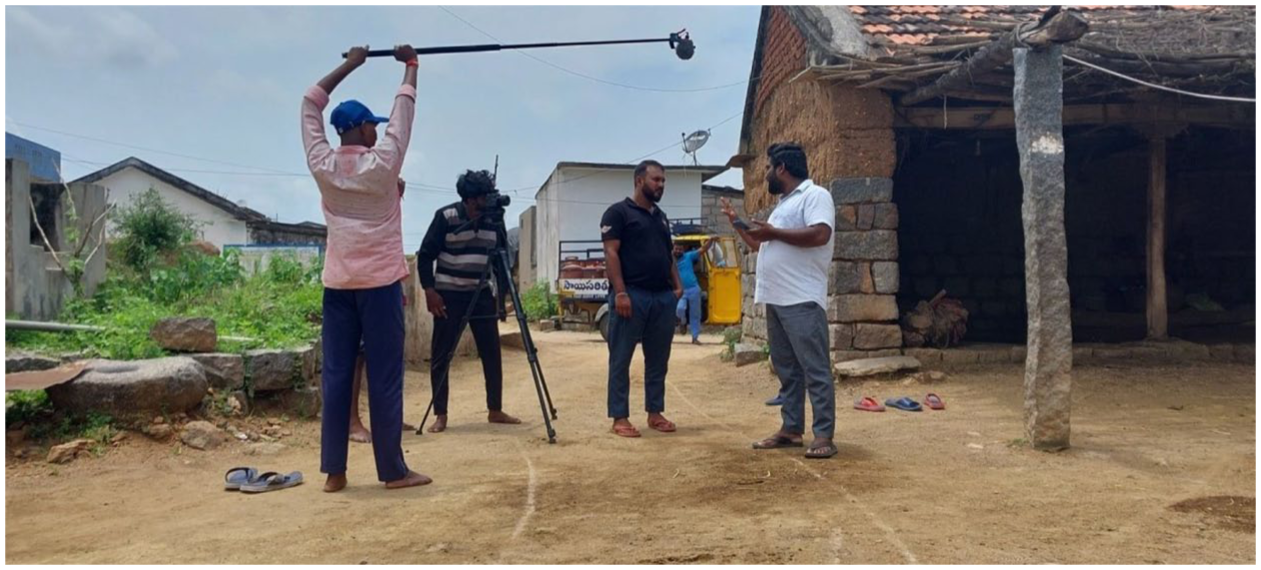
MVS team members shooting a video in Lambadipally village (Photo Credit: Author).
My visit marked their first engagement with an academic researcher. While a few of them were aware of social science doctoral-level research and its potential contributions to broader academic knowledge, for most, this was a new and unfamiliar experience. Before conducting semi-structured in-depth interviews in the field, I actively engaged with all production members to learn about their YouTube experiences. I also addressed their questions regarding my research and explained the purpose of my visit and stay. Apart from sharing the same age group as the key production members and coming from one of India’s premier institutes to conduct this study, I was granted access to various aspects of their professional and personal lives. They showed as much curiosity about my work as I did about theirs.
During my fieldwork, I engaged in “deep hanging out” (Geertz 1998), a methodological approach that involves “immersing oneself in a cultural, group or social experience on an informal level” (Walmsley 2018, 277). As part of my daily routine during fieldwork, I visited the village creators’ studio-office, where they gathered each morning, observed their pre-production preparations, accompanied them to shooting locations, attended various events, watched movies at the local theater, socialized at tea stalls, and participated in community gatherings.
After one month of immersing myself in their production and social settings, I started conducting formal semi-structured in-depth interviews with creators who were comfortable and interested. I conducted in-depth interviews with eight creators of MVS, lasting between 30 and 90 minutes in Telugu (the local language). Except for one woman creator, my interviewees were predominantly male (7). All interviews were recorded on a personal smartphone, then transcribed and translated into English for analysis. I also used a smartphone to collect visual data by capturing on-location photographs and short videos. Participant observation and informal conversations during fieldwork provided valuable context for structuring interviews and developing a thematic understanding of creators’ creative and professional journeys.
Deep hanging out enabled me to observe both what village creators said and what they did, revealing the complexities and everyday negotiations embedded in their creative labor. While some themes—such as the formalization of YouTube productions, self-branding strategies, and the management of fans and online stardom—are addressed in my earlier work (Nayaka et al. 2025; Nayaka 2026), this article draws exclusively on interviews and conversations focused on the motivations, challenges, and processes of producing, managing, and professionalizing YouTube content. With their consent, I have used the real names of several individuals featured in this article. For them, being included in academic research offered not only additional publicity but also, as one creator told me during an interview, a sense of “recognition.”
Crafting Social Message Narratives on YouTube
With over a decade of experience in video production on YouTube—ranging from lifestyle vlogs and short documentaries on village festivals to spoof videos, parody songs, original web series, and other entertainment content—My Village Show, formerly known as Melkolupu (Awakening), was created in 2012 by Sriram Srikanth, an engineering graduate from Lambadipally village in Telangana. Initially conceived as a do-it-yourself (DIY) YouTube channel aimed at raising awareness on various social issues through songs, short-films, and comedy videos, the channel has since evolved into a full-fledged digital media enterprise. Much of the early content was created with the intent of driving social change within the village, particularly through short awareness videos that addressed pressing local concerns. Notably, the short films Toilet (2012), Vavvare Chandranna (2014), and Kaalam Maarindhi (2014) focus on issues of sanitation and public health, reflecting the channel’s commitment to using digital media as a tool for grassroots advocacy and community development. Shot and edited using a third-generation iPad, these DIY videos creatively convey the importance of constructing toilets and sewage systems in every household. Notably, all three videos integrate social messages through the medium of song, making the content both engaging and informative. This hybrid genre of blending social messages with entertainment videos brought initial viewership to MVS YouTube videos. When asked why he has thought of producing this kind of videos, Sriram Srikanth says, I have always liked entertaining and comedy content. I expect a certain kind of content. No content like that is available (on YouTube), so we need to create such content; that’s when people see it, and an audience base gets created. For example, news channels have debates to show people various issues. In the same way, if I want to show people about some issue, I will show it in a comedy video based on humor. We are not making any judgments; we are just showing the scenario.
A new generation of stand-up comedy collectives has emerged in India, using humor not only to entertain and amuse, but also to critique and shed light on pressing issues (Kay 2018; Kumar 2015). However, these digital creators and their audiences are largely concentrated in urban India. Only a few creators from villages and small-towns, like Sriram Srikanth, capitalized on this format early on and began thinking about building an audience base for it. Along with the sanitation awareness videos, Sriram Srikanth has also produced videos on village-level elections and voter awareness in addition to cooperating with the National Service Scheme (NSS) to cover village-level development activities. Most importantly, their scripted and non-scripted content is developed from their everyday village lifestyle or what cultural theorist Williams (2014) calls “ordinary culture.” Williams defines culture in two senses: “to mean a whole way of life—the common meanings; to mean the arts and learning—the special processes of discovery and creative effort” (Williams 2014, 3). Village YouTubers produced videos based on their everyday lives in the village—the issues they dealt with, the cultures and traditions they celebrated—and creatively blended these elements with local dialects into engaging narratives. As explained by Chandu, a popular actor, writer, and director who gained recognition through MVS videos: In my view, a story should connect to people, and it only gets connected when it’s realistic—or else it won’t connect. You can take something that has happened to you and add fun, but you should not change the theme. Ultimately, I want to give something in the video—like fun or a message.
Most of these social message videos emerge from DIY filmmaking practices and are particularly noted for their poetic representation of local issues. In addition to short films, creators also produce parodies and spoofs that are deeply embedded in their everyday lives and contextualized around local concerns such as village elections, unemployment, mobile internet connectivity, drug awareness, and youth addiction to mobile games. For example, MVS has produced a video on how village youth are addicted to PUBG (PlayerUnknown’s BattleGrounds). The video titled “Village PUBG in Real Life” (2018), which went viral on social media and garnered over 25 million views and 308 K likes, illustrates how comedy and social message-driven content are gaining widespread online popularity. Anil Kante, who wrote and directed the “Village PUBG” immediately after joining the MVS team as production crew, explains: My first video was “Village PUBG,” and its main objective was to spread awareness about PUBG. At that time, children, irrespective of rural or urban backgrounds, were addicted to PUBG. I discovered it when I was in Hyderabad, and I played it too. I was so addicted that I used to play PUBG instead of preparing for class the next day.
During my interactions with a few village creators, I found that they had initially prepared for government jobs after completing their education. They aspired to secure government employment due to the financial stability and social respect it provided within their families and communities. While they were unable to clear government job exams, they instead chose to build a career on YouTube, using the platform to raise social awareness within their communities (Figure 2).
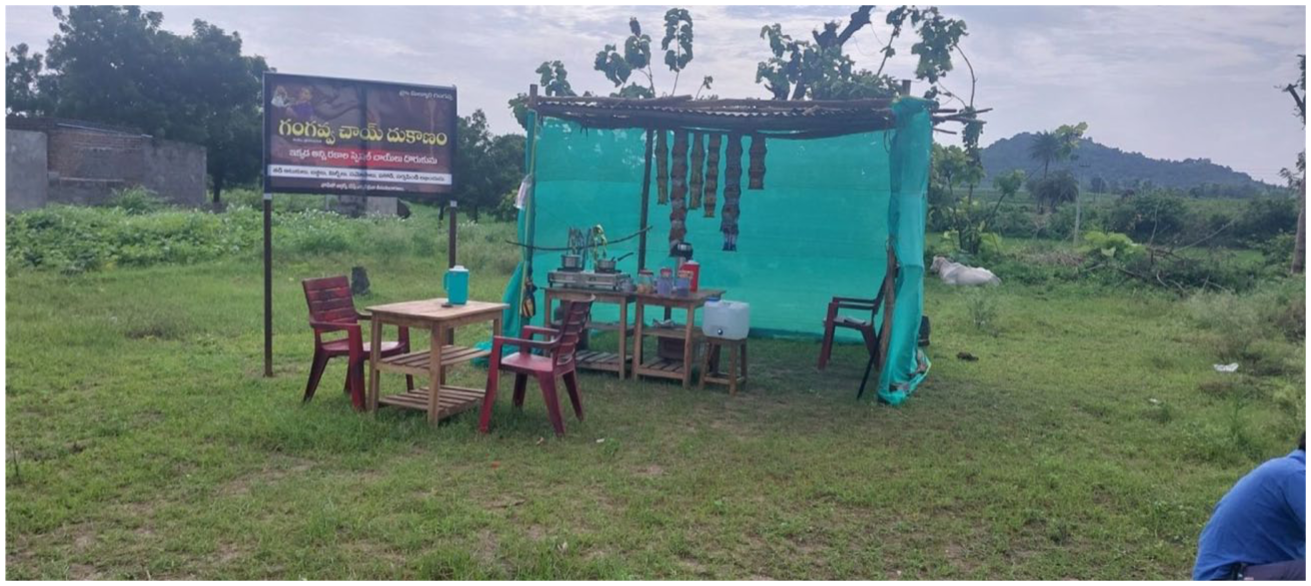
The MVS production team constructed a makeshift tea stall for their video in the open space (Photo Credit: Author).
MVS’s brand image is built on community engagement and village development. Additionally, MVS is one of the first village-based YouTube channels in Telangana to showcase local cultural traditions and lifestyles. Their popularity can be attributed to the authenticity with which they portray Telangana’s culture and regional identity. Shooting in natural village settings, casting everyday people as actors, using local dialects, and creatively portraying serious issues through humor brought them millions of viewers, followers, and subscribers.
Cinematic Productions: High Production Costs, Low Financial Returns
MVS creators regularly consume a variety of Telugu and other language media content, including films, television shows, songs, and other entertainment available on online streaming services. They were always inspired by, and aspired to meet, the technical and creative standards of films, and their professionalized videos closely resemble cinematic productions or what Indian media scholar Tiwary (2024) terms a “film-centered video culture.” They compete in the Telugu YouTube space, where multi-channel networks dominate with professionalized content (see Vonderau 2016), through substantial investment in an in-house studio doubling as a production and coordination hub. A studio equipped with advanced cameras, editing suites, and dubbing facilities also serves as an office for meetings, script discussions, video editing, and routine production tasks. MVS content is professionally produced, requiring extensive shooting, editing, and uploading, all of what judged by cinematic standards. For example, it took over three months to produce high-quality web series like Husharu Pittalu. Initially estimated to cost around half a million Indian rupees, the project extended over two to three months, with additional expenditures on team salaries and externally sourced music. MVS hired a music director to compose the original music, including the background score and the title song. While the creators focused their energy almost entirely on this series, the anticipated paid promotions and platform revenue did not materialize, ultimately rendering the project financially unsustainable.
MVS creators have realized that high-quality content requires significant investment and demands substantial technical, creative, and economic resources. While they have built a brand reputation for producing engaging social change narratives with high production values, these are not commercially viable. Along with this, creators also need to adapt to new technical features and affordances introduced by the platforms. For example, when YouTube released its Shorts feature, village content creators faced a dilemma, as their media productions moved from short videos to full-length web series. YouTube’s new technical feature has brought creative tension among village creators since new creators with Shorts channels are quickly amassing a massive subscriber base, viewership, and greater reach. Given their brand reputation, MVS does not want to lower production values (Figure 3).
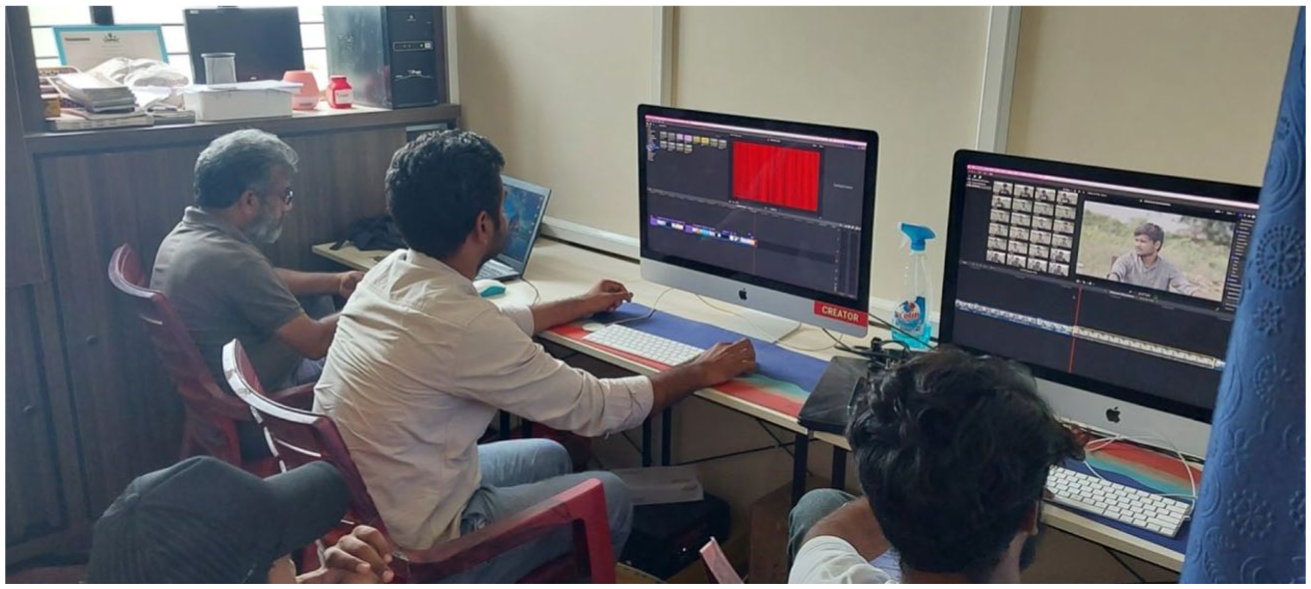
MVS team members engaged in post-production works in their studio (Photo Credit: Author).
Given the popularity of YouTube Shorts, MVS has created a separate channel called My Village Show Daily (formerly known as My Village Show Shorts) on YouTube. Created in October 2020, this channel has amassed over 413 K subscribers, as of November 2025, with over 250 videos uploaded. Only a few videos are specifically produced as Shorts, while the others are uploads from earlier productions. Along with creating original content for Shorts, creators primarily use YouTube Shorts to maintain algorithmic visibility and reach a wider audience. Since YouTube’s algorithm “determines and limits what is seen and consumed by viewers” (Bishop 2018, 71), creators are constantly striving to appear on the platform’s trending list (Figure 4).
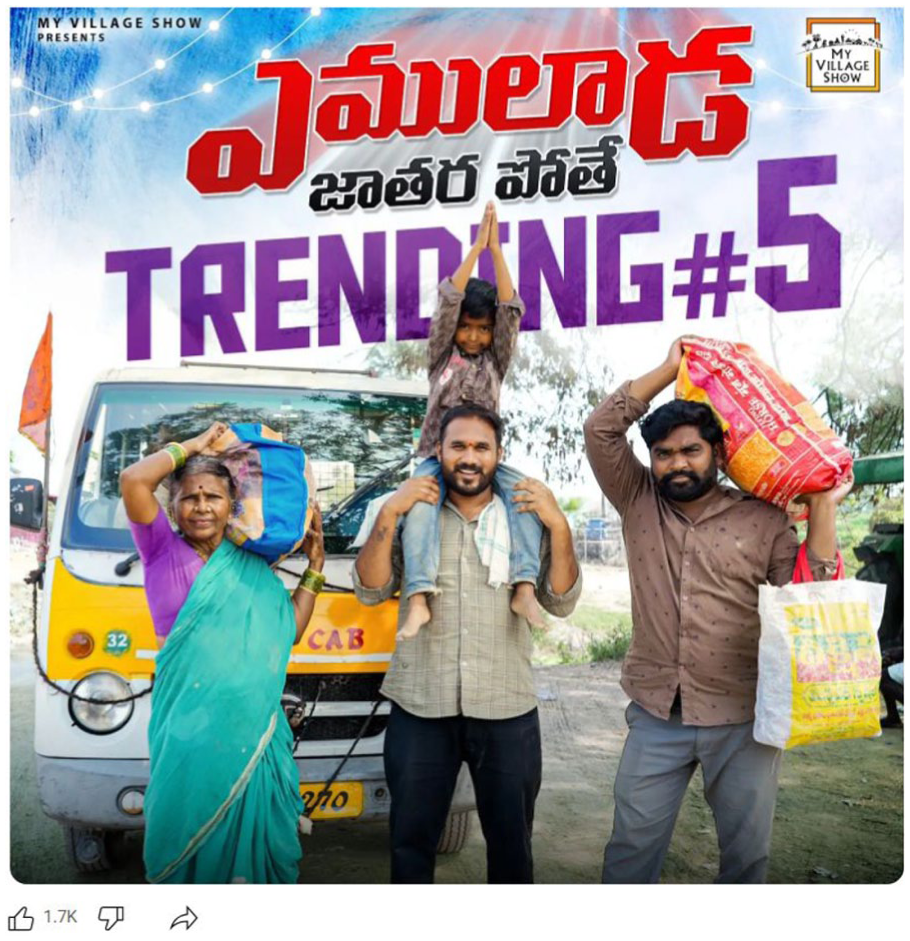
MVS shares a post about recent trending video on YouTube (Photo credit: Screen grab from My Village Show YouTube channel).
Creators are aware that audience engagement metrics—like views, likes, comments, and shares—influence the algorithmic visibility and trending potential of their videos on YouTube (Duffy et al. 2021). They also strategically schedule video releases during late evening hours, based on the belief that viewership increases after typical office hours. For village creators, metrics not only help them understand how their videos are received but also inform their planning of future productions based on a video’s popularity. To this end, MVS creators are innovatively trying different strategies to know the audience’s taste. Sriram Srikanth says: We will make a new video if we get a certain number of likes. For example, we make a video with interest, but we can make a part two if people like it; it makes no sense to make another video if people don’t like it and lose viewership. We mentioned that we would make part two only if we got a certain number of likes. There was a “Drunk and Drive” video. We said we would make a part two if we get 100K likes, we got 100K and even 200K. We realized people liked this video, so we made part two to increase our viewership.
After posting a video, they also engage with viewers by liking and replying to their comments. Such strategies enable village creators to both understand viewer engagement and mobilize audiences to actively participate in shaping digital metrics. Creators have “never had full control over visibility or access to data,” which significantly influences how they plan, produce, and distribute content (Idiz and Poell 2025, 10). Their aspirational cinematic productions, though precarious on YouTube, garnered recognition and creative mobility, with some MVS creators transitioning into Telugu cinema and reality shows, bridging India’s digital platforms and mainstream entertainment spheres.
Conclusion
In this study, I have drawn attention to emerging platform-dependent rural digital production cultures in India through an ethnographic study of My Village Show, a popular Telugu-language media collective based in a village in the state of Telangana. Their platformized cultural productions are sustained through a strategic production logic that involves the sharing of creative and technical resources, the blending of social change narratives with entertainment formats, and the pursuit of high cinematic production values. MVS creators faced multiple forms of platform precarity, including the need to adapt to sudden technical changes, fluctuating monetization revenues, and limited access to paid sponsorships, while consciously engaging with digital metrics and audience management strategies to maintain visibility and navigate global creator cultures. They mitigated various risks with the hope of leveraging their online popularity to access opportunities in mainstream media and entertainment industries, exhibiting their talents through increasingly professionalized cultural productions. In fact, during my fieldwork, several creators expressed aspirations to become actors, film directors, editors, cinematographers, and writers.
This study contributes to growing scholarship on regional online content creation in India, particularly from non-urban and rural perspectives (e.g., Mehta 2020; Mehta and Kaye 2021; Mohan and Punathambekar 2019). Social media creators in India form an integral part of digital production cultures that are becoming increasingly professionalized, formalized, and structurally organized, thereby challenging the notion of creators as mere “amateurs” (Mehta and Kaye 2021, 01). Much of the current understanding of creator cultures and social media entertainment is shaped by analyses that focus on individual creators—typically portrayed as self-managing, negotiating, and resisting platform dependency (Cunningham et al. 2021)-or on multi-channel networks that professionalize and formalize digital production cultures (Vonderau 2016). Instead, this case study highlights the role of inter-dependent and compartmentalized platform labor in social media entertainment—particularly within long-form entertainment media genres—where creators collectively benefit from each other’s contributions while also mitigating the multiple anxieties associated with platform-dependent cultural production. There is a pressing need for more comparative analyses of creator economies in the Global South and other non-Western contexts, in order to better understand the specificities, divergences, and convergences that shape platform-dependent cultural production (see also Bidav and Mehta 2024; Lin 2023). Future research should engage with varied regional territories and socio-cultural contexts to advance a more nuanced and critically informed understanding of digital creator cultures across different geographies.
Footnotes
Acknowledgements
The author would like to thank the editors of this special issue, the anonymous peer reviewers, and all participants in the study for generously sharing their views.

Ethical Considerations
I confirm that all the research meets the ethical guidelines, including adherence to the legal requirements of the study country.
Consent to Participate
Verbal informed consent was obtained from all participants included in the study.
Consent for Publication
Participants provided informed verbal consent to take part in the study, to be identified by name, and to allow the use of their interview data in the author’s publications.
Funding
The author received no financial support for the research, authorship, and/or publication of this article.
Declaration of Conflicting Interests
The author declared no potential conflicts of interest with respect to the research, authorship, and/or publication of this article.