







Abstract

I am pleased and honored to comment on this superb review written by three researchers who have all made pioneering contributions to the literature on self-control. With different disciplinary backgrounds and separate extensive lines of research dealing with self-control, Duckworth, Laibson, and Milkman (2018) bring a diverse but overlapping range of perspectives to bear on self-control, which is, as the authors express it, an “object of fascination for philosophers, social scientists, policymakers and pundits” (p. 102).
One the most important messages of the article, beginning with the first two words of the title—“beyond willpower”—is one I entirely agree with: Willpower has severe limitations as a self-control strategy. Fittingly, I’m writing this on the first day of a new year. One of the major causes of failures to carry through with the myriad resolutions that were made last night will be naivety about the limitations of the brute-force approach and ignorance of the far more effective strategies enumerated in the review.
The most significant contribution of the review, in my view—by itself worth the “price of admission”—is the classification of self-control strategies that move beyond willpower. I anticipate that the distinctions highlighted in Figure 2 and Table 1, between situational and cognitive strategies on the one hand and between those that are self- and other-deployed on the other, will become a mainstay of future thinking about self-control. The distinctions are, to be sure, not always perfectly crisp, but I will not dwell on this issue because the review deals with it in detail and with candor.
I found the tripartite classification of models giving rise to self-control conflicts proposed in the article less helpful, perhaps because it does not fit well into my own mental map of such models. My own perspective (cited in the article), which is closely related to the want should conflicts that Milkman and her colleagues have studied, views self-control as a conflict between affect (encompassing emotions, drives, and motivational feeling states such as pain) on the one hand and deliberation on the other. Unlike the classification of self-control strategies, however, the classification of self-control models does not end up playing a major role in the article, so it, too, will not be my focus.
The focus of my commentary is not, in fact, on the substance of what the authors write, most of which I agree with, but on two assumptions that could be seen as implicit in their review and that I do disagree with.
First, although I know from past discussions with the authors that this does not represent their personal perspectives, the article could leave the impression that inadequate self-control is the source of problems such as obesity and inadequate saving that, in fact, have other major causes. This perspective, in turn, naturally leads to the view, misplaced in my opinion, that such problems can best be combatted by promoting the types of self-control strategies enumerated in the review.
Second, the focus on self-control as a problem of temporal myopia hides the surprisingly wide range of situations in which people perceive themselves as excessively future-minded—and marshal self-control strategies to help themselves live more for the present. The fact that self-control often involves attempts to be more focused on the present than on the future has implications both for our interpretation of self-control problems and for the types of policies that are likely to be welfare enhancing.
These points have been made separately in other articles; I use the occasion of writing this commentary to bring them together in a new way.
Enhancing Self-Control Is Rarely the Most Effective Solution for Problems That Involve Excessively Present-Minded Behavior
My first issue with the article is that it seems to attribute many of the problems plaguing our society to lack of self-control, which in my view risks blaming the victim and, more substantively, risks misidentifying the most effective types of policy interventions. This perspective (and its pitfalls) is already evident in the abstract, which asks, “what can policymakers do to reduce overeating, undersaving, procrastination, and other self-defeating behaviors that feel good now but generate larger delayed costs? In this review, we synthesize contemporary research on approaches to reducing failures of self-control” (p. 102)
It is important to emphasize that these problems are not primarily the result of self-control problems in most adults, even if enhanced self-control could mitigate them.
If one examines the first two of these problems—overeating and undersaving (procrastination is too poorly defined to permit a similar analysis)—it is clear that obesity emerged relatively recently as a major public-health problem in the United States, and the same negative trajectory is true of low savings. Figure 1a shows the increase in obesity from 1960 to 2016; Figure 1b shows the decrease in savings over a similar time period.
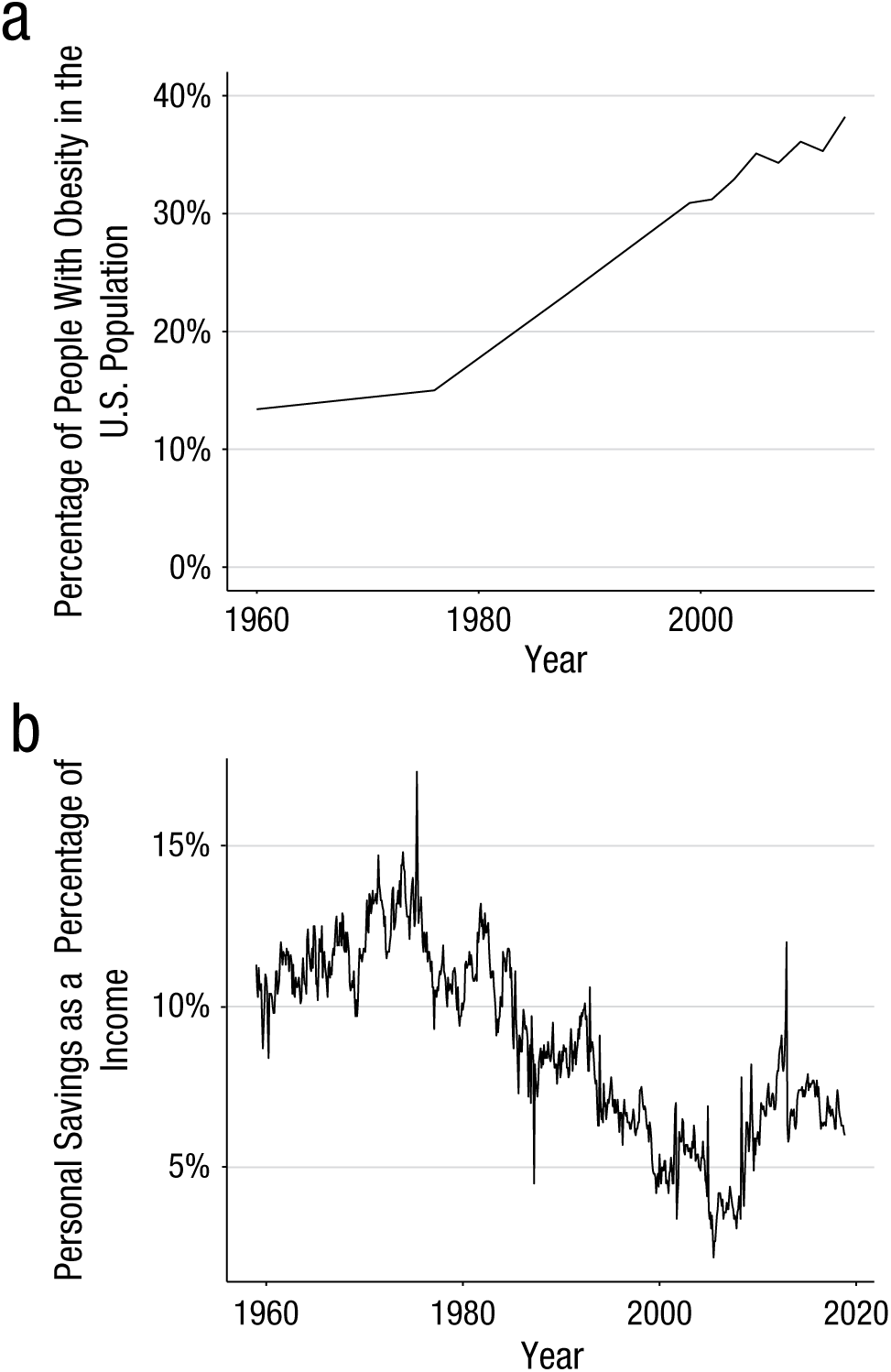
Change in obesity and income over time. The graph in (a) shows the percentage of the U.S. population that is obese as a function of year. Data are from Fryar, Carroll, and Ogden (2016). The graph in (b) shows personal savings as a function of year. Data are from the U.S. Bureau of Economic Analysis (2019).
Although not shown in these graphs, the United States was a relatively ordinary country when it came to both obesity and saving until around 1980 but then started to diverge from both historical trends and levels in other developed countries. Did the United States gradually lapse into becoming a country of people with self-control problems, or a country in which people lost the ability to implement self-control strategies, starting in the 1980s? That seems very unlikely; it does not seem reasonable to attribute these problems to a cause that very likely did not change as the problems worsened. What, then, is responsible for the obesity epidemic and precipitous decline in saving?
One likely contributing factor to both problems has been growing income inequality. Figure 2 shows that income grew substantially during the prewar period for all income strata, until around 1980, when the incomes of the median American (and those in lower strata) began a stagnation that has now continued for nearly 4 long decades. This is also the time when obesity rates began to rise and savings rates to fall. Providing further support, albeit circumstantial, for the role of inequality, the drop in saving and the increase in obesity has been disproportionately greater among the lower income groups that did not share in the growth of aggregate personal income.
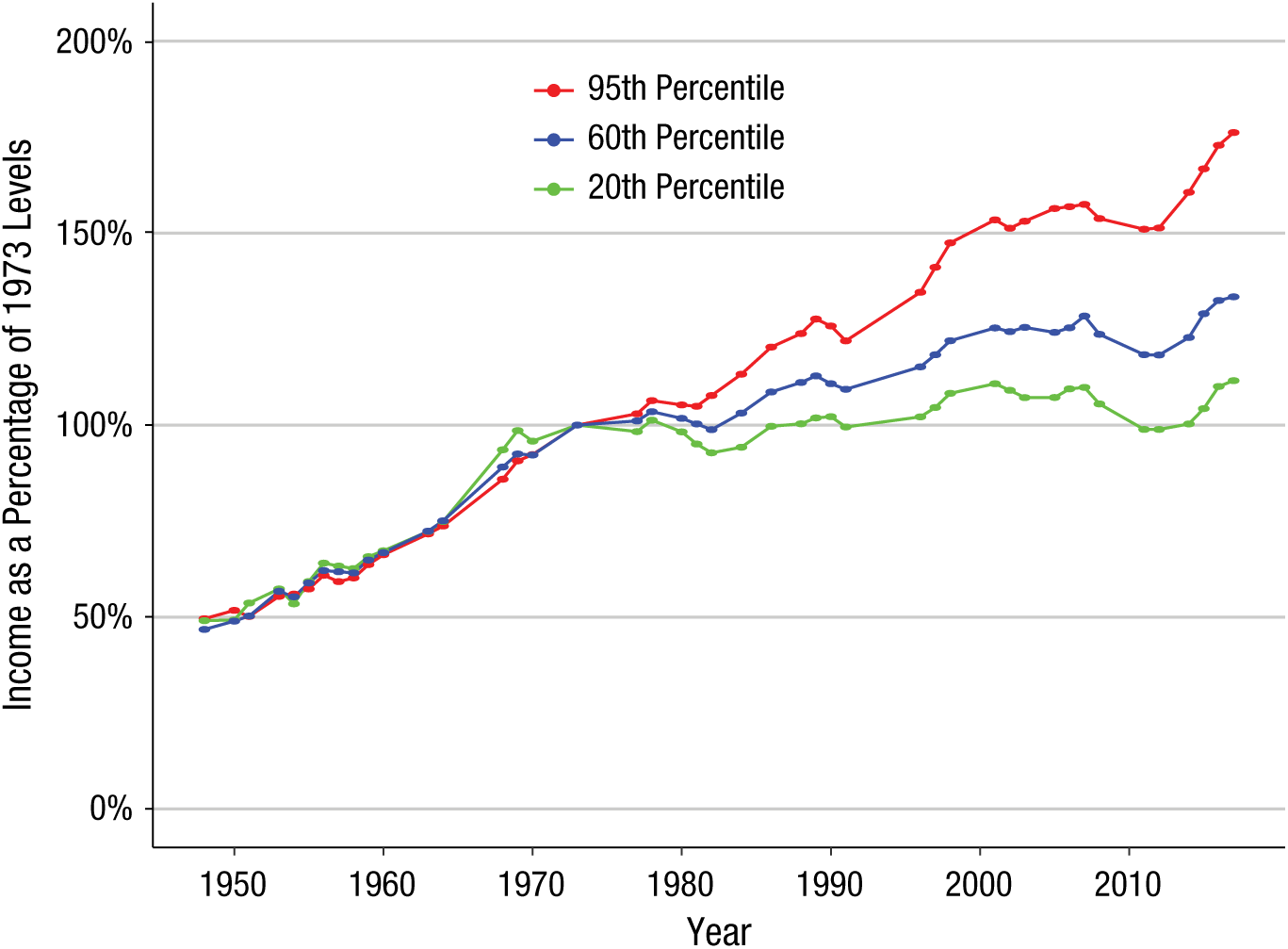
Change in income as a percentage of 1973 levels. Data are from the U.S. Census Bureau (2017).
For obesity, other major contributing factors identified in diverse research were a relative drop in the price of processed foods (Finkelstein, Ruhm, & Kosa, 2005), the growth of eating at fast-food establishments (Chou, Grossman, & Saffer, 2004), an increase in portion sizes (Nielsen & Popkin, 2003; Young & Nestle, 2002), increases in snacking and sugared beverage consumption (Cutler, Glaeser, & Shapiro, 2003), and the increasingly sedentary nature of work and leisure (Martínez-González, Alfredo Martínez, Hu, Gibney, & Kearney, 1999).
For saving, it is possible that the growing popularity of credit cards, which make it especially easy to go into debt without recognizing that one is doing so, may also have played a role (White, 2007). Perhaps the single most important development when it comes to savings—financial preparation for the future—however, is the demise of defined-benefit pension plans and the rise of defined-contribution pension plans, the latter of which is really not a pension at all, but a euphemism for “save for your own retirement.” To be fair, many companies, albeit mainly larger ones, do offer matches—the most common, according to a Deloitte Consulting (2015) survey, is to match 50% of the first 6% of employee contributions—and the government does provide tax breaks to savers. But approximately half of U.S. workers do not even have access to a retirement plan at work, let alone a company match, and the tax breaks for saving come in the form of tax deductions rather than credits, which are much more valuable to affluent savers who are in high tax brackets. Eighty percent of the money saved through tax breaks on retirement saving goes to the most affluent 20% of the population.
Self-control could be thought of as a significant determinant of these problems to the extent that companies exploited consumer weaknesses to promote their own profits, a topic that Laibson has done pioneering research and theorizing about (Gabaix & Laibson, 2006; see also Heidhues, Koszegi, & Murooka, 2017). However, even if this is true, it does not follow that promoting self-control is the best remedy. Some form of regulation, or a realignment of incentives, so that it is no longer in companies’ interests to exploit consumer weaknesses could be more effective. More generally, I am skeptical about whether any combination of self-control strategies of the type discussed in the review (other than, perhaps, hard paternalism, which I would view not as a self-control strategy, but as an approach that renders self-control unnecessary) are likely to make much of a dent in the problems.
In my own view, the most effective solutions to these problems would entail reversing some of the factors that caused them in the first place. Tackling the problem of inequality would, in one fell swoop, make inroads into these and many other problems facing the nation. It is much easier to save when one has income to meet basic needs, and it is much easier to be thin when one can afford healthy food. However, calling for greater equality could be criticized as pie in the sky. Less radical fixes would include expanding the taxation of unhealthy foods (e.g., a sugar tax), shifting crop subsidies away from corn and toward fruits and vegetables, increasing exercise in schools, and shifting to a more paternalistic system of retirement saving funding such as that in place in Australia.
Self-Control Problems Are Not Synonymous With Present-Biased Behavior
Throughout the article, including in the same excerpt from the abstract reproduced in the prior subsection, there is an assumption that self-control involves “self-defeating behaviors that feel good now but generate larger delayed costs.” In my view, as noted earlier, self-control is not about present versus future; it is about deliberation versus affect. Deliberation often does favor long-term, superordinate goals, and affect does often motivate immediately gratifying behavior; however, because many affective influences actually motivate a concern for the future, self-control can and does also often involve conscious, deliberate attempts to become more present-minded. In a series of studies, Kivetz and coauthors (Kivetz & Keinan, 2006; Kivetz & Simonson, 2002; see, also, Haws & Poynor, 2008) document the prevalence of a phenomenon they term hyperopia. Contrary to the prediction of hyperbolic time discounting, these researchers found that a substantial fraction of consumers are more likely to choose, and even to precommit to choosing, hedonic luxury rewards over cash of equal or greater value when they make these decisions in advance, and they do so more the further in advance they are making the decision. They found that “a large segment of consumers perceive themselves as having insufficient indulgence and seek ways to correct this imbalance in their lives” (Kivetz & Simonson, 2002).
Research on patterns of spending that classifies consumers according to whether they are spendthrifts (who perceive themselves as spending when they should not) or tightwads (who perceive themselves as failing to spend when they should; Rick, Cryder, & Loewenstein, 2008) found, in three of four diverse samples totaling more than 13,000 respondents, that a substantially larger fraction individuals surveyed classified themselves as lying further toward the tightwad than the spendthrift side of the scale. The same research also provided evidence that “tightwaddism” is the result of an immediate “pain of paying” that consumers experience when they spend money (Prelec & Loewenstein, 1998). Like other affective motivations, overcoming the pain of paying—spending more in the present—requires willpower or other self-control strategies. For example, mental accounting has generally been seen as helping consumers to fight the urge to spend; it does so by defining subaccounts to restrain spending on subcategories of expenditures such as entertainment. However, mental accounting can be—and sometimes is—used to liberate those who find it painful to spend (Loewenstein, Cryder, Benartzi, & Previtero, 2012). Establishing a mental account for entertainment not only limits the money that one spends on entertainment but also makes the money that one does spend on entertainment more carefree—less subject to the pain of paying—because it does not feel like one is trading off entertainment against other, more prudent, expenditures.
Other cases of pervasive far-sighted rather than myopic behavior include the widespread tendency to get unpleasant things over with quickly so as to avoid dread (another immediate affect that focuses attention on the future), and the perhaps somewhat less common tendency to put pleasurable things off in time so as to be able to savor—pleasurably anticipate—them (Berns et al., 2006; Loewenstein, 1987; Story et al., 2013). These examples further illustrate that immediate emotions do not always drive present-biased behavior. Other research highlights the prevalence of the preference for improving sequences of experiences (Hsee & Abelson, 1991; Loewenstein & Prelec, 1993; Ross & Simonson, 1991) and the prevalence of workaholism (e.g., Schor, 1991; Scottl, Moore, & Miceli, 1997). It is possible, of course, that hyperopia is a privilege of the relatively wealthy, but I am not aware of any research suggesting that any of these tendencies—tightwaddism, getting unpleasant things over with quickly, or the preference for improving sequences of outcomes—is concentrated disproportionately among the affluent.
How can one reconcile these findings with the prevailing low rates of saving and high rates of debt and with the sky-high discount rates observed in some empirical research (e.g., Angeletos, Laibson, Repetto, Tobacman, & Weinberg, 2001; Shapiro, 2005)? First, I would point again to the observation that these problems became acute relatively recently, but it is unlikely that there was a sudden, widespread, change in impatience. Situational factors seem to be the most plausible explanation for them, not individual limitations. Second, it seems difficult to me to reconcile the apparently high rates of time discounting observed in some studies with the parallel presence of far-sighted behaviors, such as investments in education. Whether people seem far-sighted or short-sighted depends critically on their economic circumstances and on the domains of behavior one studies.
Hyperopia and related phenomena have, I believe, two key implications for one’s interpretation of the research on self-control reviewed in Beyond Willpower. First, the prevalence of precommitment to luxury and other self-control strategies that promote behaviors that are more immediately gratifying weighs against simple models of present-bias as the cause of self-control problems and in favor of models that see self-control as a struggle between affect and deliberation (see Loewenstein, O’Donoghue, & Bhatia, 2015; McClure, Laibson, Loewenstein, & Cohen, 2004). The conflict between affect and deliberation can lead to hyperopic self-control problems because many forms of affect motivate future-minded behavior (for new evidence supporting this perspective, see Imas, Kuhn, & Mironova, 2018).
Second, I believe that the prevalence of these behaviors reveals what could be considered a kind of “Calvinist” bias in the review. This bias is prevalent in the more general literature on self-control and also manifests itself in the common tendency for individuals to blame themselves for problems, such as obesity and undersaving, that are not, in fact, the product of individual deficiencies. Certainly, as a society, we are too myopic in certain areas, such as infrastructure maintenance and climate change. Yet in many other areas, such as the long hours that people work and the short vacations that most people take, we are perhaps excessively far-sighted.
Implications for Research
What are the implications of these comments for research? I believe that the first point discussed in this comment (the need to think about the fundamental causes of problems and to devise policy interventions that engage them) demonstrates the need for research to identify the contexts in which the self-control strategies of the type discussed in the article will be most helpful and those in which more heavy-handed solutions are called for. Duckworth, Laibson and Milkman provide a useful categorization of potentially promising interventions and techniques to enhance self-control in a broad range of contexts, but few hints are offered about when these interventions are likely to be helpful or which interventions are most likely to be helpful in which specific contexts. We also have little understanding of how these strategies are likely to interact with one another or their effects over extended periods of time. What is the net, long-run effect of a world in which people are saturated with goals, intention prompts, and reminders? Research addressing these questions could reduce the likelihood that self-control interventions will create negative interactions, externalities, or other unintended consequences.
Second, I think one can draw a parallel between the distinction between self-control strategies and more heavy-handed interventions when it comes to policy, and a similar distinction applied to research. Like many of the interventions applied to problems such as obesity and undersaving, much of the research on these topics tends to be narrow: small-scale studies examining the impact of limited and often subtle interventions on a circumscribed range of behaviors. Even field experiments, which some see as the “gold standard” for policy research, often seem to be subject to something like a “streetlight effect,” manipulating things that are easy to alter, such as the content or framing of mailings, rather than those that are likely to make a substantial difference.
The problem of an overly narrow focus can be seen in research on diet, including much of my own, that examines the impact of interventions, such as calorie labeling or the timing of meal orders, on the composition of a subsequent meal or choice of snack. Some of these interventions do have substantial impacts on the meal or snack under study, but these studies rarely examine food (or exercise) decisions made even later on the same day, let alone long-term behavior or health outcomes (such as obesity). Moreover, the interventions themselves tend to be one-off, which limits the ability to draw conclusions about their likely impact if implemented as long-term policies which people would have the opportunity to adapt to. Such adaptation could lead to a greater long-term than short-term impact if it takes time for people to change their behavior in response to a policy or to a greater short-term impact if people initially notice and respond to the new policy but eventually stop paying attention to it.
A parallel point applies to saving. Certainly the big success story for behavioral economics and public policy has been the substantial impact of auto-enrollment on contributions to defined-contribution retirement plans, as documented by numerous studies beginning with Madrian and Shea (2001). Much less research has examined the long-term impact of such defaults on ultimate retirement saving in the existing environment in which “leakage” can occur because people can borrow against their savings and withdraw funds (with a tax penalty) when they change employers. The small number of studies that have examined such long-term, aggregate impacts, though stymied by limitations on data, have yielded less encouraging (Beshears, Choi, Laibson, & Madrian, 2018; Ghilarducci, Fisher, Radpour, & Webb, 2016) or even discouraging (Butrica & Karmacheva, 2018) conclusions about the ultimate benefits of auto-enrollment. Knowledge of such results could and should play a critical role in policy discussions regarding the viability of our current defined-contribution system of retirement saving and the comparative benefits of alternative, more heavy-handed approaches.
To inform the types of shifts that I believe need to occur in policy, we need much more of this type of ambitious, time-consuming, and typically expensive research examining the broad, long-term impacts of policy. Much as improvements in obesity and saving will require systemic changes in policy, supporting and training researchers to focus on such long-term ambitious projects may require systemic change—in research funding, for example.
The implications of my second point (that the literature on self-control tends to ignore the problem of excessive far-sightedness) for research are, perhaps, less far-reaching. I believe that the field would benefit from more research that questions our existing fundamental assumptions—for example, that self-control necessarily favors the future, and that social problems such as obesity and low saving are mainly problems of individual-level self-control—and that academics would also benefit from some soul-searching about whether our research agenda has a puritanical bias.
Concluding Comments
I assume I was asked to write this review because I established my career doing research on intertemporal choice and self-control—one of my most highly cited papers (Loewenstein, 1996) is titled “Out of Control.” For many decades when I was working on the topic, I was a skeptic of the notion of individual differences in time discounting; indeed, I did not even believe in the concept, in the sense of accepting that people differ in some kind of general attitude toward present and future that they apply to multiple domains of consumption. Then I raised two children and could not escape the conclusion that one was far more future-minded than the other. If raising two children upended my views on individual differences in time preference, however, it also upended my views of which is more desirable.
One child is very focused on the future—perhaps too much so for her own happiness. When she was in middle school, I once attempted to bribe her with the offer of a monetary reward if she would get a low grade in a class: She angrily informed me that “parents are not supposed to do that!” My other child has led an extremely happy, albeit less A-filled, life, focusing mainly on the present. Perhaps at some point his present-mindedness will come back to bite him, but many happy years, so far, is an awfully good run. In a follow-up article on hyperopia, Kivetz and Keinan (2006) investigated consumers’ regrets revolving around self-control. They found that as a choice receded into the past, regret about virtuous, righteous, decisions tended to intensify; in their words, consumers experience “a wistful feeling of missing out on the pleasures of life.” Certainly, many people suffer as a result of obesity, poverty in old age, and addiction, but the best solutions to these problems do not necessarily involve enhancing individual-level self-control, and there are also widespread problems of hyperopia: anorexia, workaholism, and pleasure-squelching frugality and abstemiousness.
Let me close, as I opened, with a substantial point of agreement between myself and the authors. As I noted, perhaps the most prominent theme of the commentary, beginning with the title, is the need to move “beyond willpower.” I believe the authors of the article and I would agree that the best policies for combatting problems such as obesity and undersaving are not those that enhance self-control but those that remove the need for it.
Footnotes
Acknowledgements
I thank the Editor, Valerie Reyna, and Saurabh Bhargava, Gretchen Chapman, Alex Imas, Cait Lamberton, Irene Scopelliti, and Joachim Vosgerau for helpful comments, and Jacob Rothschild for assistance with the figures.
Declaration of Conflicting Interests
The author(s) declared that there were no conflicts of interest with respect to the authorship or the publication of this article.