







Abstract
Background:
Aedes albopictus (Skuse) is a major mosquito vector in Southeast Asia, especially in livestock farm environments. This study evaluated the susceptibility of laboratory and field-collected (Songkhla Province) Ae. albopictus to commercial insecticides.
Methods:
Laboratory colony and field population were tested against temephos larvicides, mosquito coils, and aerosol sprays following WHO protocols. Larvicidal efficacy and persistence were assessed in semifield conditions, while adult knockdown and mortality were measured in controlled assays.
Results:
Both laboratory colony and field population exhibited high initial susceptibility to temephos (97.5–100% mortality), but residual efficacy declined rapidly, reaching 0–27% by 30 days. All adulticides achieved 100% mortality. Knockdown times (KT50) ranged 0.58–2.52 min for mosquito coils and 1.09–2.29 min for aerosol sprays. The coil containing 0.03% metofluthrin showed the fastest knockdown (KT50 = 0.58 min laboratory, 1.37 min field).
Conclusions:
Commercial insecticides remain effective against Ae. albopictus in livestock farm settings. However, rapid temephos degradation highlights the need for more frequent larvicide applications or the use of persistent formulations. Integrated approaches combining chemical and nonchemical interventions are recommended to optimize vector control and delay resistance development.
Introduction
Aedes-borne viral diseases, including dengue, chikungunya, and Zika, remain major public health challenges in Southeast Asia. Aedes albopictus (Skuse) (Diptera: Culicidae), a competent vector for these arboviruses (Delai et al., 2022; Paupy et al., 2010), has expanded from Southeast Asia to over 129 countries (Benedict et al., 2007), demonstrating remarkable adaptability to diverse ecological environments (Johnston et al., 2025). In livestock settings, Ae. albopictus may act as a bridge vector for zoonotic pathogens (Akther et al., 2023), biting both animals and humans. Humans are considered dead-end hosts for many of these pathogens, but potential spillover events underscore the importance of monitoring mosquito populations in farm environments. In southern Thailand, Ae. albopictus predominates in livestock farm habitats, where abundant artificial containers and shaded resting sites promote breeding and increase human–vector–animal contact. With over 7,400 dengue cases reported in Songkhla Province in 2024 (DDC, 2024), understanding vector susceptibility to insecticides in these farm settings is critical for designing effective integrated vector management strategies.
Vector control programs in Thailand and throughout Southeast Asia rely primarily on chemical interventions, with temephos widely used as a larvicide and pyrethroids for adult mosquito control (Chareonviriyaphap et al., 2013; Nobleza et al., 2025; Sathantriphop et al., 2020). Spatial emanators containing metofluthrin and transfluthrin have shown 41–58% protective efficacy against malaria vectors in East Africa; however, their performance against Ae. albopictus in agricultural environments remains poorly understood, particularly given differences in exposure conditions and resistance dynamics (Estrada et al., 2019; Kerdsawang et al., 2025).
Repeated insecticide application can select for resistance, potentially compromising long-term control effectiveness (Paeporn et al., 2004). Therefore, early detection of resistance is critical for guiding alternative insecticide selection and improving operational planning.
Previous studies have revealed heterogeneous susceptibility patterns among Aedes populations in Thailand. Ae. albopictus was generally susceptible to temephos (Jirakanjanakit et al., 2007), whereas Aedes aegypti populations exhibited varying degrees of resistance (Thongwat and Bunchu, 2015). Semifield evaluations demonstrated not only effective larval suppression by temephos but also rapid degradation under environmental exposure (Gass et al., 1985). Resistance mechanisms to pyrethroids have been associated with knockdown resistance (kdr) alleles such as V1016G, S989P, and F1534C (Plernsub et al., 2016), while biochemical assays have revealed that increased activity of esterases, monooxygenases, and glutathione-S-transferases contributes to permethrin resistance in Ae. aegypti (Paeporn et al., 2004). Adult Ae. albopictus populations largely remain susceptible to operational doses of deltamethrin and lambda-cyhalothrin, although some show incipient resistance to permethrin (Chuaycharoensuk et al., 2011). Recent studies underscore the widespread threat of pyrethroid resistance across Thai mosquito populations. Thanispong et al. (2024) demonstrated that Ae. aegypti from eight districts across dengue-endemic areas of Thailand exhibited resistance to deltamethrin at up to 10-fold the discriminating concentration, with pre-exposure to piperonyl butoxide significantly increasing susceptibility. Similarly, Chamnanya et al. (2022) documented high frequency of the L1014F kdr mutation in Culex quinquefasciatus populations with variable deltamethrin mortality and novel kdr alleles (V978E, D992E) contributing to resistance. These findings highlight the importance of continuous monitoring of resistance mechanisms in local mosquito populations.
Despite extensive global research on Ae. albopictus, significant knowledge gaps remain regarding its control in livestock farm environments in tropical regions. This study aimed to assess larvicidal susceptibility of laboratory and field-collected Ae. albopictus to temephos and persistence of temephos under simulated field conditions, and adult susceptibility to commonly used household insecticides, including mosquito coils and aerosol sprays, under semifield and laboratory conditions in southern Thailand. Findings are intended to support operational guidance and integrated vector management approaches in livestock farm environments.
Materials and Methods
Mosquito rearing and field sampling
Laboratory colony
A susceptible Ae. albopictus NIH strain from the Ministry of Public Health, Thailand, was used as a reference colony. This strain was maintained for >50 generations without insecticide exposure at 27 ± 2°C, 70 ± 10% RH, and a 12:12 h (light:dark) photoperiod following standard protocols (Ratisupakorn et al., 2021). The laboratory colony was tested concurrently as a susceptible reference control to validate bioassay procedures and ensure experimental consistency, rather than to reconfirm its established susceptibility status. Any mortality below 100% in the laboratory colony would have indicated a procedural error requiring reassessment.
Field population
Entomological surveys were conducted across livestock farms in four southern provinces (Songkhla, Pattani, Satun, and Phatthalung) (Figure 1) from October 2021 to March 2022 to characterize mosquito species distribution. A total of 59 livestock farms were surveyed, including dairy cattle and goat farms. Immature stages were collected using standard 800 mL dippers (minimum 10 dips per site) from various breeding sites including water-filled containers, discarded tires, and natural water accumulations near livestock areas. Adult mosquitoes were captured during peak activity periods (08.00 and 17.00 h) using sweep nets and mouth aspirators. All living adult specimens were morphologically identified (Rattanarithikul et al., 2010) before mass rearing.
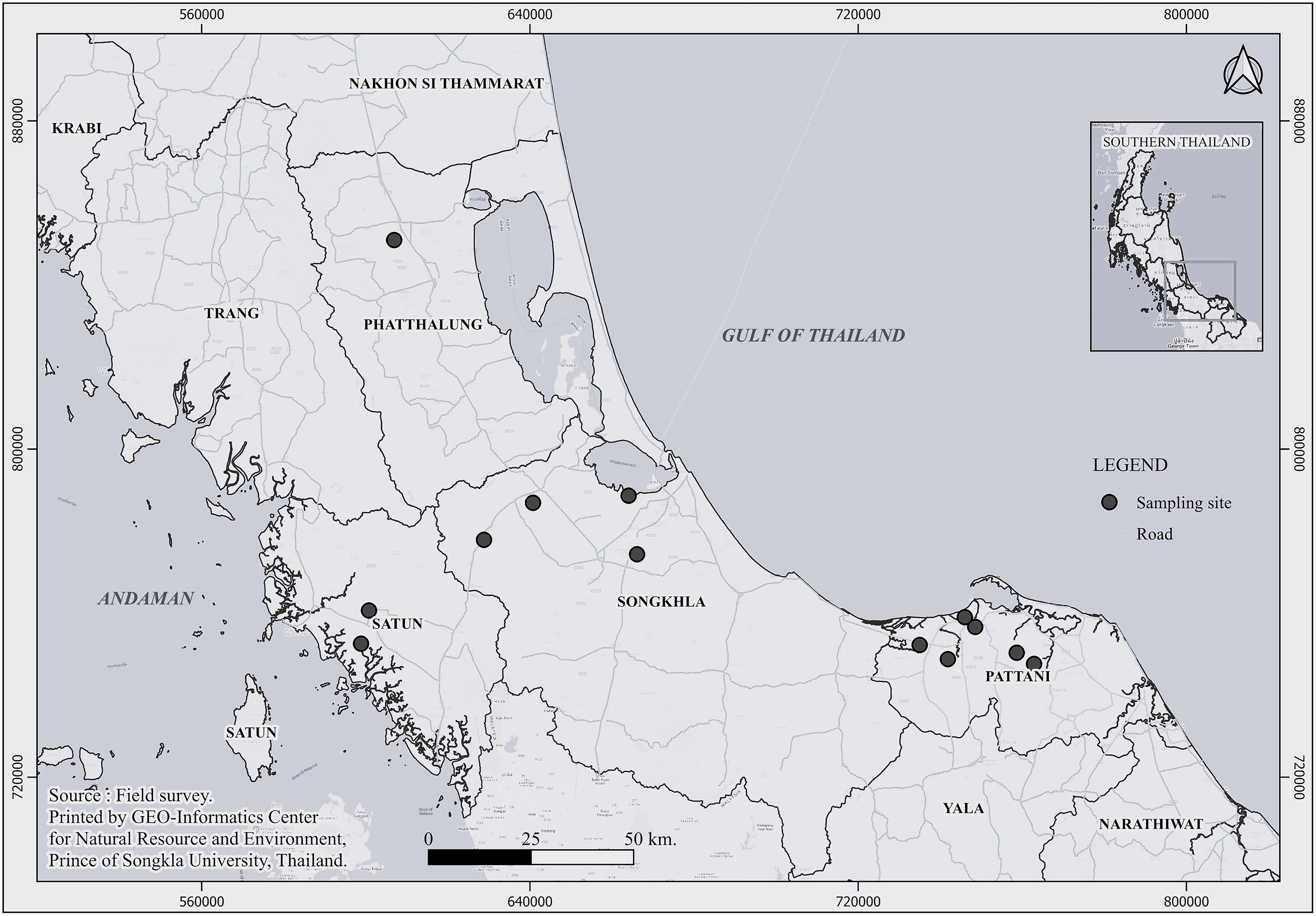
Collection sites for larvae and adult mosquito populations from livestock farms in the lower southern region of Thailand.
For insecticide susceptibility testing, a field population was established exclusively from Ae. albopictus specimens collected in Songkhla Province, which yielded sufficient numbers for mass rearing. The Songkhla-derived field population was reared under identical conditions to the laboratory colony. F1–F5 generation mosquitoes were used for all susceptibility tests: 3- to 5-day-old non-blood-fed females for adult assays and third-instar larvae for larvicidal tests.
Test compounds
A survey of 59 livestock farmers was conducted to identify commonly used mosquito control products in local shops. For larvicidal evaluation, three temephos 1% w/w sand granule formulations were tested (products A, B, and C; mention of trade names or commercial products does not constitute endorsement or recommendation for use). The adult mosquito control products included three brands of mosquito coils (120–150 g, 10–12 coils per pack) containing either metofluthrin at concentrations of 0.0097% w/w (Product D), 0.03% w/w (Product E), or transfluthrin 0.045% w/w (Product F). All coil products featured lavender fragrance. In addition, three aerosol formulations (600 mL) with different pyrethroid combinations were evaluated: Product G containing cypermethrin 0.1% w/w, imiprothrin 0.03% w/w, and prallethrin 0.03% w/w; Product H containing permethrin 0.05% w/w and esbiothrin 0.126% w/w; and Product I containing imiprothrin 0.05% w/w, cypermethrin 0.15% w/w, and transfluthrin 0.06% w/w (Table 1).
Test Insecticide Products and Their Active Ingredients
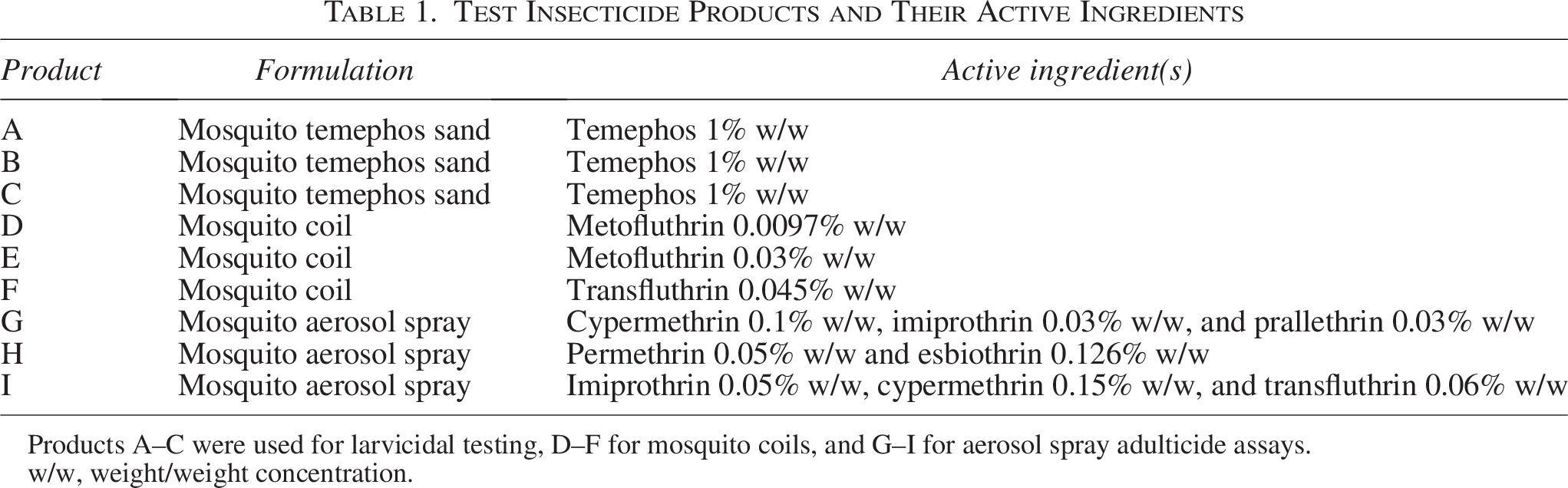
Products A–C were used for larvicidal testing, D–F for mosquito coils, and G–I for aerosol spray adulticide assays.
w/w, weight/weight concentration.
Susceptibility tests
Semifield larvicidal and persistence testing
Larvicidal susceptibility of laboratory colony and field population of Ae. albopictus was evaluated using standard protocols (DDC, 2014; WHO, 2005) at the recommended application rate of 1 mg/L temephos. Tests were performed under semifield conditions in 50-L earthen jars (traditional Thai water storage vessels) filled with 30 L of dechlorinated tap water and placed outdoors under a roofed shelter to prevent dilution by rainwater (Paeporn et al., 2021). Each jar received 3 g of temephos sand granule formulation (1% w/w; 30 mg active ingredient per jar), resulting in a final concentration of 1 mg/L (1 PPM). Environmental parameters were monitored throughout the 90-day study, including temperature (29.5 ± 3.2°C; range 24–35°C), pH (7.2–8.1), and the natural photoperiod. Water loss due to evaporation was compensated with dechlorinated tap water to maintain volume. Residual efficacy was assessed at 24 h and 30, 60, and 90 days posttreatment by introducing groups of 20 late third or early fourth instar larvae into test containers containing treated water. Mortality was recorded after 24 h. Four replicate jars were maintained for each product and strain. Control mortality remained below 5% throughout the study period.
Adult susceptibility testing
Adult susceptibility testing was conducted in glass chambers (70 × 70 × 70 cm) following the methods described by DDC (2014). For mosquito coil evaluation, precisely weighed 0.5 g segments were burned on ceramic holders. After a 2-min pre-exposure period to establish a stable active ingredient concentration, 20 non-blood-fed females (3–5 days old) were introduced. For aerosol testing, products were sprayed (0.22–0.28 g per chamber) before introducing mosquitoes. Each test included four replicates (80 mosquitoes per product). Knockdown was recorded at specific intervals (0.5, 1.0, 1.5, 2.0, 2.5, 3.0, 3.5, 4.0, 5.0, and 20.0 min) following methods established (Ya-umphan et al., 2022). Mosquitoes were considered knocked down when unable to fly or stand. After the 20-min exposure period, mosquitoes were transferred to holding cups provided with 10% sucrose solution, and mortality was recorded after 24 h.
Statistical analysis
Statistical analyses were performed using SPSS version 10.0 (SPSS Inc., Chicago, IL, USA). For larvicidal efficacy (Table 3), mortality rates between laboratory colony and field population were compared using Fisher’s exact test. Resistance status was classified according to WHO criteria: susceptible (≥98% mortality), incipient resistance (90–97%), and resistant (<90%). For adult knockdown assays (Tables 4 and 5), grouped time–mortality data were analyzed using probit regression following WHO guidelines for time–response bioassays. Knockdown times (KT50 and KT90) with 95% confidence intervals (CIs) were estimated from probit models, and chi-square goodness-of-fit tests were used to assess model adequacy. Comparisons between populations were based on overlap of 95% CIs, with nonoverlapping intervals considered indicative of statistical significance (approximately p < 0.05). Statistical significance was set at p < 0.05 for all analyses.
Artificial intelligence assistance
During article preparation (July–November 2025), AI tools ChatGPT (GPT-5-mini, OpenAI) and Claude Sonnet 4.5 (Anthropic Inc.) were used for language editing and structural organization. All scientific content, analyses, and conclusions were produced solely by the authors; AI did not contribute to study design, data collection, or statistical analysis.
Ethics
This study was conducted in accordance with the PSU Animal Standard, Prince of Songkla University (Approval No. 2022-NAT12-061, AUP Ref. AI089/2022) and under animal use license No. U1-06137-2560. Written or verbal informed consent was obtained from all participating farm owners prior to sample collection.
Results
Mosquito species distribution in livestock farms
A total of 726 mosquitoes were collected from 10 livestock farms across four southern Thai provinces (Figure 1, Table 2). Ae. albopictus was the predominant species (50.1%, 364/726), followed by Cx. quinquefasciatus (48.2%, 350/726), Anopheles sundaicus s.l. (1.2%, 9/726), and Toxorhynchites splendens (0.4%, 3/726). In Songkhla, Ae. albopictus dominated collections from beef cattle farms (62.7%, 185/295), whereas Cx. quinquefasciatus was more abundant in Pattani dairy goat farms (87.1%, 249/286). Satun farms yielded exclusively Ae. albopictus (100%, 145/145), while no mosquitoes were collected from Phatthalung due to intensive farm management practices.
Mosquito Species Distribution in Livestock Farms Across Southern Thailand Provinces
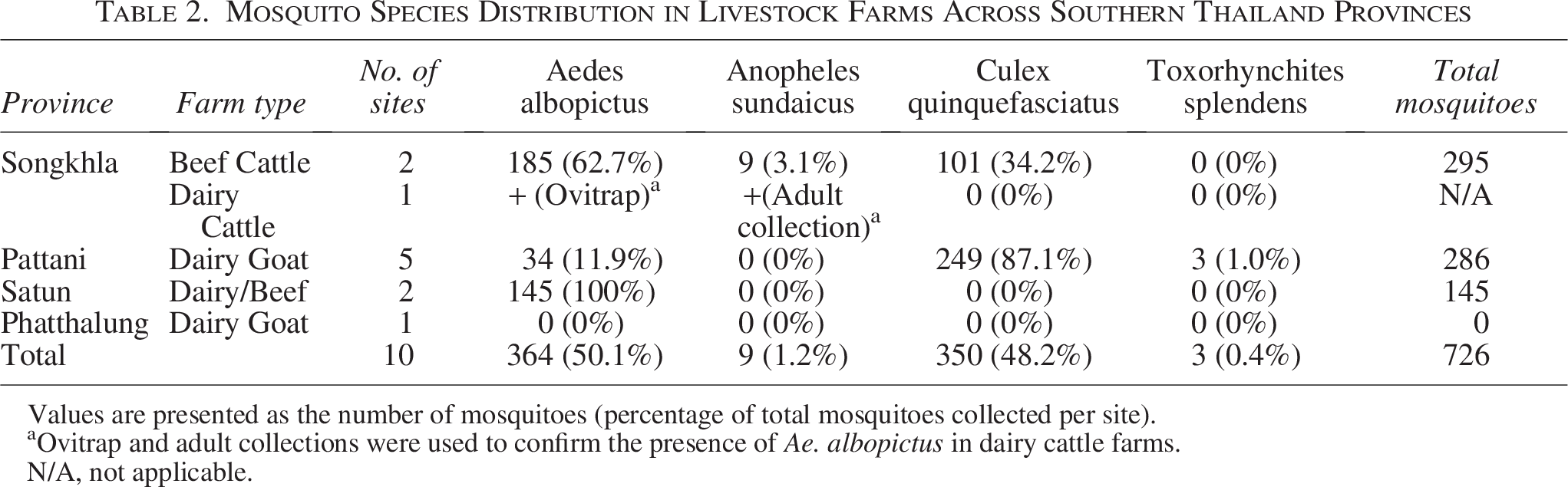
Values are presented as the number of mosquitoes (percentage of total mosquitoes collected per site).
Ovitrap and adult collections were used to confirm the presence of Ae. albopictus in dairy cattle farms.
N/A, not applicable.
Based on collection success and suitability for mass rearing, Ae. albopictus specimens from Songkhla Province (n = 185) were selected to establish the field-derived population for insecticide susceptibility testing. Songkhla provided the largest viable population with successful egg production and larval development under laboratory conditions. Specimens from other provinces were either insufficient in number (Pattani: 34 mosquitoes) or did not produce enough eggs for colony establishment despite higher collection numbers (Satun: 145 mosquitoes). All subsequent susceptibility tests were conducted using this Songkhla-derived field population (F1–F5 generations).
Larvicidal efficacy and persistence
Both laboratory colony and field-derived population of Aedes albopictus exhibited high initial susceptibility to temephos, with 100.00 ± 0% mortality achieved in the laboratory colony for all three larvicide products at 24 h postexposure. The field population demonstrated slightly lower but still high susceptibility, ranging from 97.50 ± 2.50% (Product B) to 100.00 ± 0% (Product A) (Table 3).
Percentage Mortality of Laboratory and Field-Derived Aedes albopictus Larvae Following 24-h Exposure to Temephos
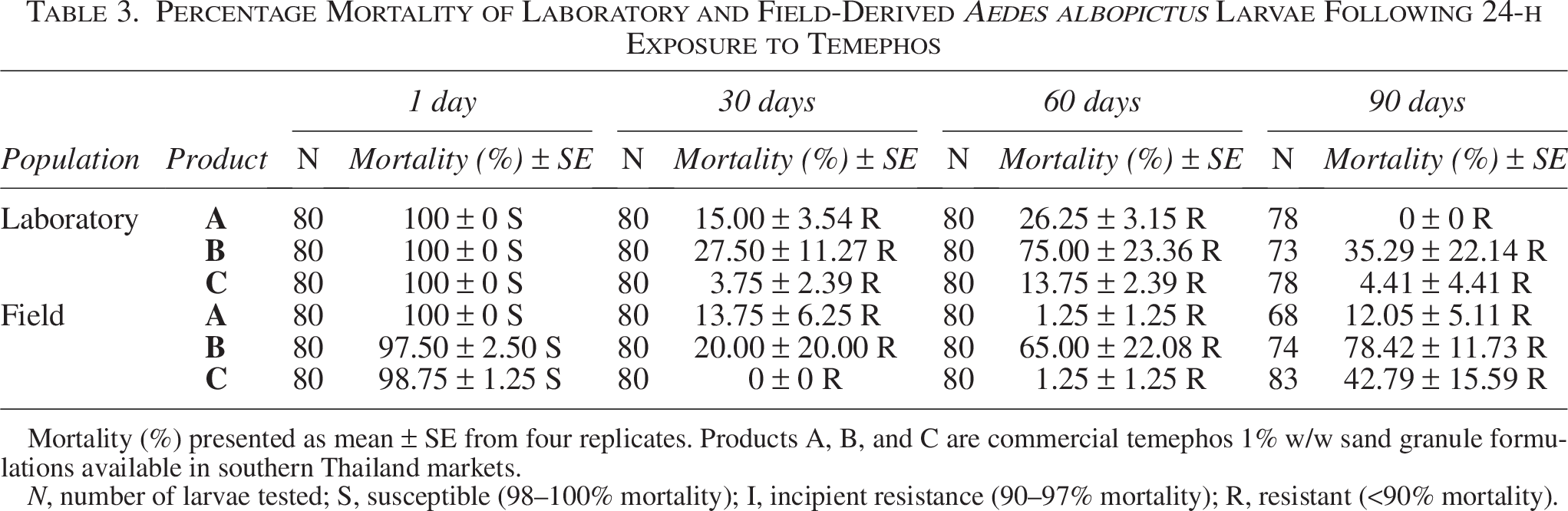
Mortality (%) presented as mean ± SE from four replicates. Products A, B, and C are commercial temephos 1% w/w sand granule formulations available in southern Thailand markets.
N, number of larvae tested; S, susceptible (98–100% mortality); I, incipient resistance (90–97% mortality); R, resistant (<90% mortality).
However, efficacy declined substantially over the persistence period. By 30 days postapplication, mortality rates dropped to 3.75 ± 2.39%–27.50 ± 11.27% in the laboratory colony and 0–20.00 ± 20.00% in the field population, depending on the product. At 60 days, residual activity remained low in most products, except for Product B, which showed 75.00 ± 23.36% and 65.00 ± 22.08% mortality in laboratory colony and field population, respectively. At 90 days postapplication, Product B maintained the highest residual activity, with 35.29 ± 22.14% mortality in the laboratory colony and 78.42 ± 11.73% in the field population, while Products A and C showed minimal or no residual efficacy (Table 3).
Statistical analysis revealed no significant differences in mortality at 24 h between laboratory colony and field population (Fisher’s exact test, p > 0.05 for all products). By 90 days, Product B demonstrated significantly higher efficacy against field populations (78.42%) compared with laboratory strains (35.29%; p < 0.001).
Adult susceptibility—mosquito coils
All three mosquito coil products achieved 100% mortality in both laboratory and field-derived Ae. albopictus populations at 24 h (Table 4). Product E (0.03% w/w metofluthrin) demonstrated the fastest knockdown, with KT50 values of 0.58 min (95% CI: 0.46–1.13) for the laboratory colony and 1.37 min (95% CI: 1.23–1.54) for the field population. Nonoverlapping CIs indicate significantly slower knockdown in field populations (p < 0.05).
Knockdown Times (KT50 and KT90) of Aedes albopictus Following Exposure to Mosquito Coils
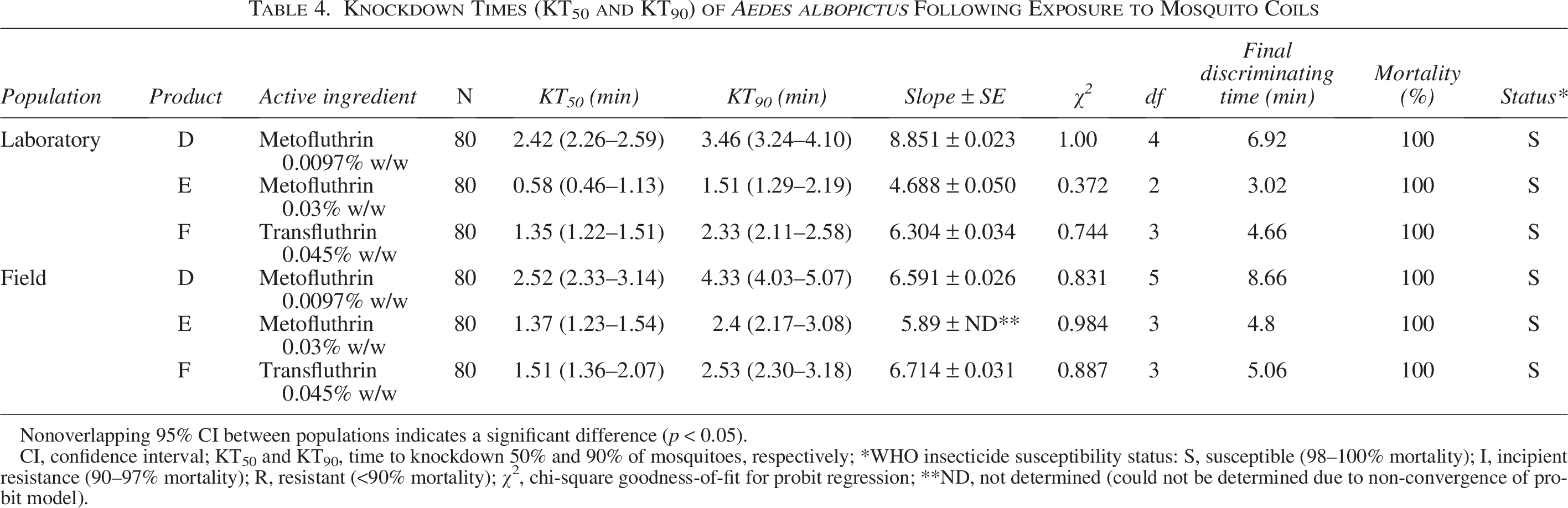
Nonoverlapping 95% CI between populations indicates a significant difference (p < 0.05).
CI, confidence interval; KT50 and KT90, time to knockdown 50% and 90% of mosquitoes, respectively; *WHO insecticide susceptibility status: S, susceptible (98–100% mortality); I, incipient resistance (90–97% mortality); R, resistant (<90% mortality); χ², chi-square goodness-of-fit for probit regression; **ND, not determined (could not be determined due to non-convergence of probit model).
Product F (0.045% w/w transfluthrin) produced moderate knockdown, with KT50 of 1.35 min (95% CI: 1.22–1.51) for laboratory mosquitoes and 1.51 min (95% CI: 1.36–2.07) for field mosquitoes. Overlapping CIs suggest no significant difference between populations (p > 0.05). Product D (0.0097% w/w metofluthrin) exhibited the slowest action, with KT50 of 2.42 min (95% CI: 2.26–2.59) for laboratory mosquitoes and 2.52 min (95% CI: 2.33–3.14) for field mosquitoes, also showing no significant difference (p > 0.05).
All probit models showed adequate fit based on chi-square goodness-of-fit tests (χ2 < 3.84, df = 1, p > 0.05). These results indicate that high-concentration metofluthrin coils provide rapid knockdown and effective adult control for Ae. albopictus in livestock farm settings, whereas lower-concentration metofluthrin and transfluthrin coils act more slowly.
Adult susceptibility—aerosol sprays
All three pyrethroid-based aerosol products achieved 100% mortality in both laboratory and field-derived Ae. albopictus populations at 24 h (Table 5). In the laboratory colony, Product I (imiprothrin 0.05% w/w, cypermethrin 0.15% w/w, transfluthrin 0.06% w/w) exhibited the fastest knockdown, with a KT50 of 1.09 min (95% CI: 0.55–1.26), whereas field populations showed slightly longer knockdown times (KT50 = 2.05–2.29 min). Overlapping 95% CIs across all products indicate that these differences were not statistically significant (p > 0.05), suggesting that field populations remained fully susceptible to the pyrethroid combinations despite potential prior exposure to agricultural insecticides.
Knockdown Times (KT50 and KT90) of Aedes albopictus Following Exposure to Aerosol Sprays
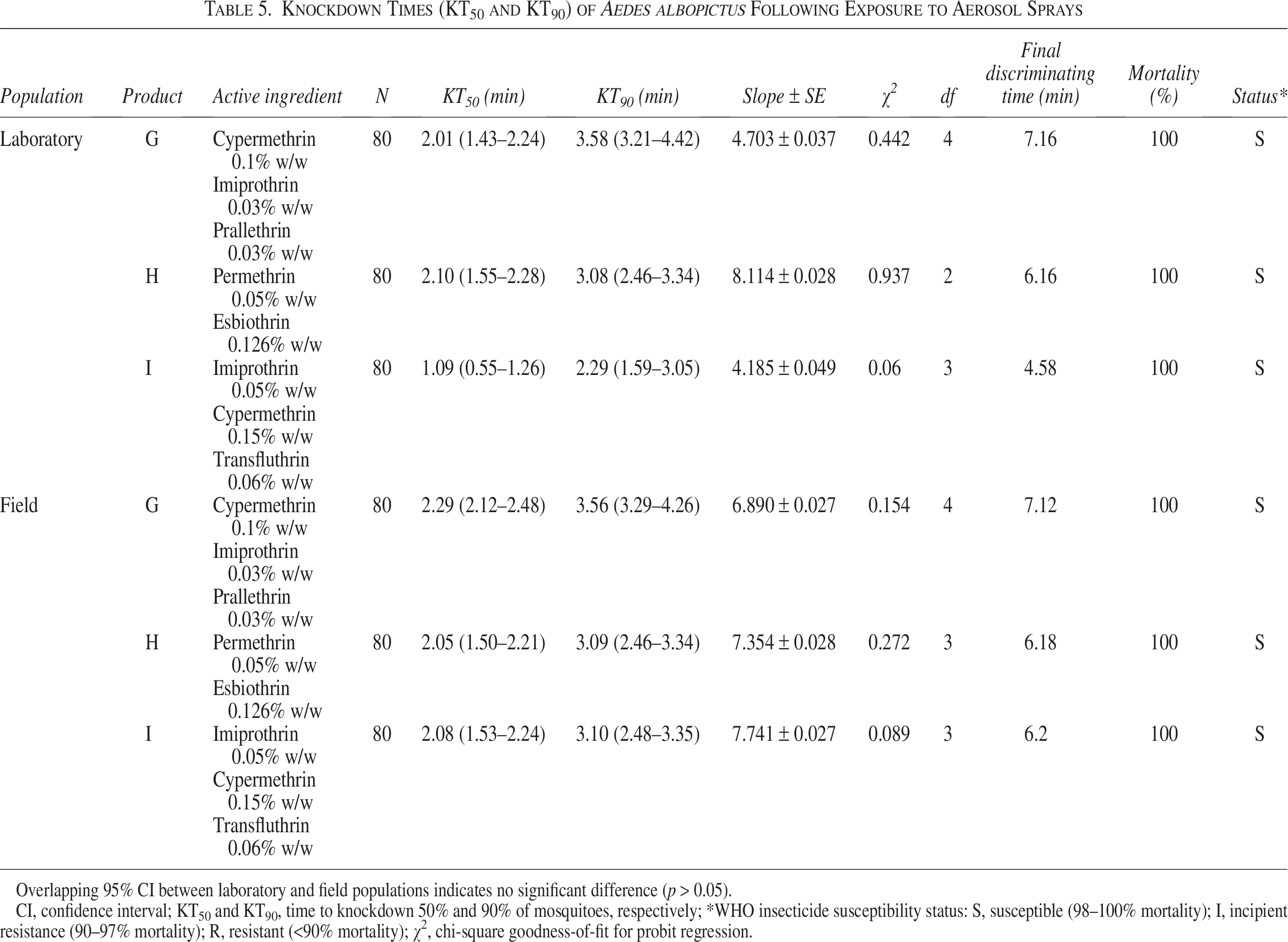
Overlapping 95% CI between laboratory and field populations indicates no significant difference (p > 0.05).
CI, confidence interval; KT50 and KT90, time to knockdown 50% and 90% of mosquitoes, respectively; *WHO insecticide susceptibility status: S, susceptible (98–100% mortality); I, incipient resistance (90–97% mortality); R, resistant (<90% mortality); χ², chi-square goodness-of-fit for probit regression.
All probit models demonstrated adequate fit based on chi-square goodness-of-fit tests (χ2 < 3.84, p > 0.05). These findings indicate that commercial aerosol formulations provide rapid and effective adult control of Ae. albopictus in livestock farm environments.
Discussion
Ae. albopictus is a major mosquito vector in Southeast Asia and plays a potential role as a bridge vector for zoonotic pathogens between livestock and humans. While humans are considered dead-end hosts for many of these pathogens, the presence of Ae. albopictus in livestock farm environments raises concerns for pathogen spillover, particularly in regions with high dengue incidence. This study provides important baseline data on insecticide susceptibility in Ae. albopictus populations from southern Thailand livestock farms, which are critical human–animal interface sites.
Commercial temephos formulations demonstrated high initial efficacy (97.5–100% mortality) against both laboratory and field-collected Ae. albopictus populations. However, efficacy declined rapidly under semifield conditions, with mortality dropping to 0–27% within 30 days. This rapid degradation raises concerns for vector control programs that rely on WHO-recommended 90-day application intervals (WHO, 2005). Similar rapid losses of residual efficacy have been reported in other agricultural settings. Wan-Norafikah et al. (2021) demonstrated high resistance to temephos among Ae. albopictus larvae from paddy-growing areas and rubber estates in Peninsular Malaysia, and Khan et al. (2011) provided the first evidence of field-evolved resistance to agrochemicals in Ae. albopictus from Pakistan, suggesting that repeated organophosphate exposure in agricultural environments—including livestock farms where ectoparasiticides are routinely applied—may contribute to accelerated resistance selection pressure.
Elevated temperatures (mean 29.5°C, peaks 35°C) may accelerate organophosphate hydrolysis (Lacorte and Barcelo, 1996), and ambient UV radiation contributes to photodegradation even under partial shelter (Mulla et al., 1981). Product B maintained superior residual activity (78% mortality at 90 days), suggesting that formulation-specific factors such as stabilizers or protective coatings influence persistence beyond active ingredient concentration. These results underscore the importance of selecting formulations based on residual efficacy, rather than solely on nominal active ingredient content. Operational guidance for tropical agricultural settings should consider shorter reapplication intervals or rotation to more persistent formulations, balanced against potential resistance development. Integrated strategies incorporating synergists, alternative larvicides (Bacillus thuringiensis israelensis, pyriproxyfen, spinosad), and botanical compounds merit further evaluation.
All adulticides caused 100% mortality at 24 h in field populations, indicating maintained baseline susceptibility. Slightly delayed knockdown for Product E mosquito coils (KT50 0.58 vs. 1.37 min) suggests potential incipient tolerance, although ultimate efficacy was unaffected. Higher-concentration metofluthrin formulations (Product E: 0.03% w/w) outperformed lower concentrations (Product D: 0.0097% w/w), demonstrating dose–response relationships. Overlapping CIs for pyrethroid aerosol products indicate limited cross-resistance from prior agricultural exposure. These findings are consistent with reports from comparable livestock farm environments in the region. Chen et al. (2013) reported that Ae. albopictus collected from a pig farm in Selangor, Malaysia, remained fully susceptible to all five pyrethroid adulticides tested, achieving 100% mortality at 24 h posttreatment, supporting the utility of pyrethroids for adulticide applications in farm settings. Ayorinde et al. (2015) similarly found that Ae. aegypti from farm sites in Lagos, Nigeria, were susceptible to permethrin (mortality >98%), whereas nonfarm populations exhibited greater resistance to deltamethrin, indicating that insecticide susceptibility profiles of Aedes populations from agricultural and livestock environments may differ from those of urban populations. Rapid knockdown and high volatility make metofluthrin suitable for livestock farm applications (Kawada et al., 2004). The overlapping CIs for most pyrethroid aerosol products between laboratory and field populations suggest limited cross-resistance development from agricultural pyrethroid exposure to date.
Findings emphasize the necessity of integrated approaches combining chemical and nonchemical interventions in livestock farms. Larvicide application should be guided by residual efficacy and prioritized toward persistent formulations (e.g., Product B), while high-concentration metofluthrin coils may be used judiciously for rapid adult knockdown. Rotation among insecticide classes every 3–6 months can help delay resistance development. Complementary nonchemical measures remain essential, including source reduction through improved container and drainage management, biological control, and mechanical exclusion via animal housing screening.
Future studies could explore the incorporation of insecticide synergists, such as S,S,S-tributyl phosphorotrithioate (DEF), in combination with larvicides to counteract metabolic resistance in mosquito vector populations. Such investigations should initially be conducted under laboratory or semifield conditions due to environmental and safety considerations before considering field application. Additional evaluation of alternative larvicides, including pyriproxyfen, spinosad, and botanical compounds, may further strengthen sustainable mosquito management strategies in livestock farm environments.
Although this study focused on phenotypic resistance evaluation, this approach remains operationally relevant for vector control programs, particularly in resource-limited or field-based surveillance contexts. Phenotypic assays, such as WHO bioassays, directly reflect the functional response of mosquito populations to insecticides and serve as the frontline indicator of control efficacy. Recent studies in Thailand (Chamnanya et al., 2022; Saeung et al., 2020) have emphasized the value of combining phenotypic and molecular data, where knockdown resistance (kdr) mutations (e.g., V1016G, F1534C, L1014F) were found to correlate with reduced pyrethroid susceptibility in Aedes and Culex populations. The present findings therefore provide an essential baseline for future investigations that may integrate molecular diagnostics to identify underlying resistance mechanisms and track the emergence of kdr or metabolic resistance alleles in Ae. albopictus populations from livestock farm environments.
This study has limitations. The field colony used for susceptibility testing was derived solely from Songkhla Province due to insufficient specimens from other provinces, which may limit generalizability across southern Thailand. Semifield persistence tests were conducted under sheltered conditions that may not fully replicate exposure to direct sunlight, organic matter, or rainfall. Molecular characterization of resistance mechanisms was not performed. Despite these constraints, findings provide a valuable reference for vector control in livestock farm environments and may inform operational guidelines in similar agroecological settings.
Conclusions
In conclusion, commercially available household insecticides remain effective against Ae. albopictus in livestock farms, but rapid degradation of temephos necessitates reconsideration of standard 90-day application intervals, favoring monthly reapplication or persistent formulations. High-concentration metofluthrin products offer rapid adult knockdown, and integration of chemical and nonchemical measures is essential for sustainable vector management. Continuous surveillance is recommended to monitor for delayed knockdown trends and potential resistance emergence.
Authors’ Contributions
T.Y.: Formal analysis, data curation, writing—original draft, and writing—review and editing (equal); S.S.: Methodology, formal analysis, validation, and writing—review and editing (supporting); T.T.: Investigation, methodology, data curation, and writing—review and editing (supporting); S.Su.: Resources, validation, formal analysis, and writing—review and editing (supporting); T.M.: Investigation, data curation, and writing—review and editing (supporting); K.T.: Conceptualization, supervision, project administration, funding acquisition, resources, methodology, writing—original draft, and writing—review and editing (lead).
Footnotes
Acknowledgments
The authors thank livestock farm owners for their cooperation during field collections.
Author Disclosure Statement
The authors declare no competing financial interests.
Funding Information
This study was supported by the National Science, Research and Innovation Fund and the Graduate School and the Faculty of Natural Resources, Prince of Songkla University (Grant No. NAT6801167M-NAT6801167c).