






Abstract
The International Mars Prospecting Ride-Share System (IMPRESS) is presented here as a scalable, democratized, and low-cost mission architecture for distributed measurements on the martian surface and in the shallow subsurface. IMPRESS is intended to prospect on Mars in advance of sample return and human exploration. Its primary objective is to survey Mars for extant life, but it also supports geophysical, soil chemistry, resource, and landing-site risk assessments. Instead of relying on soft landers and drilling systems, IMPRESS deploys swarms of planetary penetrators that use descent kinetic energy to emplace instruments 0.2–1 m below the surface. This architecture provides spatial coverage, measurement replication, and mission redundancy. This increases the chance of detecting unevenly distributed biosignatures and gives negative results stronger context. Small penetrator platforms with standardized design, power, and communication interfaces lower the cost per experiment. The probes operate as independent nodes within a network, which enables time-correlated atmospheric, seismic, and environmental measurements that support the broader Mars exploration campaign. Repeatable mission deployments can range from small rideshare implementations with tens of penetrators to larger dedicated campaigns with hundreds or more. We describe the IMPRESS mission architecture, penetrator platforms, compatible payload classes, and how distributed shallow-subsurface surveys reduce scientific and operational uncertainty before future Mars surface activities. Key Words: Planetary penetrators—Mars—Extant life—Planetary protection—Distributed exploration—Rideshare. Astrobiology, XX, XXX–XXX.
Introduction
Mars remains one of the main targets for astrobiological and planetary exploration. Data from orbiters, landers, and rovers show that early Mars hosted long-lived aqueous environments (Grotzinger et al., 2014; Mangold et al., 2021) that preserved organic matter, including long-chain alkanes in Gale crater (Freissinet et al., 2025) in amounts that could only be explained either by allochthonous organics generated by hydrothermal synthesis elsewhere or by an ancient biosphere (Pavlov et al., 2026). Organics associated with iron phosphates in ancient mudstones were documented in Jezero crater. Such associations are known in fossil life on Earth (Dorjnamjaa et al., 2021) and have been discussed as potential martian biosignatures (Hurowitz et al., 2025). Although several abiotic mechanisms have been proposed, no abiotic pathway has yet been shown to provide a plausible explanation of the observed redox mineral associations (Hurowitz et al., 2025).
The mainstream view of martian microbiology now favors a planet where present-day habitability is localized and tied to protected subsurface microenvironments associated with salts, ice, redox gradients, and transient access to water (Carrier et al., 2020). However, a recent reanalysis of the 1976 Viking results argued that data from both Viking landers are more consistent with a biological interpretation (Benner et al., 2026) than with currently proposed abiotic explanations (Quinn et al., 2013; McKay et al., 2025). This suggests that the martian biosphere might not be constrained to only a few favorable niches. Although the existence of past or present life on Mars is still speculative (Rzymski et al., 2024), Mars is no longer widely treated as irrelevant to past or extant life (Carrier et al., 2020).
The presence of potentially habitable locations on Mars (Farley et al., 2022; Schulze-Makuch, 2024; Kite et al., 2025), together with evidence that suggests ancient life (Hurowitz et al., 2025; Pavlov et al., 2026) and potentially extant life (Levin and Straat, 2016; Benner et al., 2026), makes answering the question of extant life a central objective of Mars exploration (Carrier et al., 2020; Stoker et al., 2021; NASEM, 2022). This is reflected in NASA’s Mars Life Explorer concept (Williams et al., 2023), and the search for life has been identified by the US National Academies as the top science priority for the first human landing on Mars (NASEM, 2026). It is also the primary objective of the Mars exploration strategy presented here, the International Mars Prospecting Ride-Share System (IMPRESS) (Spacek, 2024).
The urgency of the search for life has increased because Mars exploration is rapidly moving toward sample return (Hou et al., 2025) and, later, human surface missions (NASEM, 2026). If Mars hosts extant life, its delayed detection creates both scientific and operational problems. Scientifically, later missions may complicate the interpretation of biosignatures and alter the baseline state of a native martian biosphere through forward contamination (Horneck, 2008; Fairén et al., 2017; Fletcher et al., 2024). Operationally, uncertainty about extant life complicates planning for sample containment, precursor site characterization, and long-term human activity on Mars (Spry et al., 2024). A robust robotic survey of the martian surface and shallow subsurface before these later phases is necessary to be consistent with current plans for robotic and human Mars exploration (National Research Council, 2002; Meltzer, 2012).
Conventional mission architectures are not well suited to address the urgent extant life survey problem. These rely on soft landings that are complex to engineer, risky to execute, and (therefore) expensive to fly. Constrained by economic necessities, Mars exploration is expensive and therefore infrequent, with drilling and measurements performed at only one or a few sites (Vago et al., 2017; Williams et al., 2023; Sefton-Nash et al., 2025). That model is poorly suited to a search in which the target may be confined to nonuniformly dispersed locations (Rummel et al., 2014). Negative results from one or a few sites cannot be extrapolated confidently to a wider region. For that reason, the small number of sampling locations remains a major weakness in the current Mars science strategy, especially for the shallow subsurface.
IMPRESS (Spacek, 2024) is proposed to address these problems. It is based on scalable deployment of planetary penetrators, probes that use the kinetic energy of the descent to penetrate the ground (Lorenz, 2011). Thus, penetrators provide access to the shallow subsurface without powered landing or drilling, both of which are major cost drivers in current mission designs (Lorenz, 2011).
Furthermore, instead of concentrating resources in one landed platform, IMPRESS distributes many smaller probes across one or more target regions (Spacek, 2024). IMPRESS probes could be included either as rideshare payloads on existing missions, such as SkyFall or a future high-performance Mars telecommunications orbiter, or as part of a stand-alone mission organized by private or government agencies.
By enabling broad multisite reconnaissance, IMPRESS will also inform conventional Mars missions. Data derived from IMPRESS could help inform site selection for later robotic missions, including Mars Life Explorer (Williams et al., 2023), and future human exploration (NASEM, 2026). The distributed network can support payloads for biosignature searches, environmental and geophysical measurements, resource prospecting, and risk assessment.
In this article, Section 2 introduces the IMPRESS concept and design rationale. Section 3 describes the probe platform and deployment architecture, including penetrator heritage and the current stage of development. Section 4 examines mission design and operations. Section 5 outlines compatible payload classes and proposes biological experiments to test for extant life. Section 6 discusses planetary protection implications, strengths and limitations of the architecture, broader scientific access and conceptual diversity and associated science return, and the role of IMPRESS relative to larger landed missions. Section 7 concludes with the principal takeaways and next development steps. Detailed technical description and experimental results from the ongoing IMPRESS probe development program will be presented in follow-up work.
IMPRESS Rideshare Concept and Design Rationale
IMPRESS is a mission architecture that delivers large numbers of standardized planetary penetrators to Mars as secondary or dedicated mission payloads. Its central purpose is to enable democratized and conceptually diverse exploration of the shallow (0.2–1 m) martian subsurface, an alternative to the costly conventional architectures based on single large landed systems (Changela et al., 2021; Culbert et al., 2022; Huidobro et al., 2022).
The key features of the IMPRESS architecture are (1) redundancy, (2) cooperation, (3) coverage, (4) ridesharing, and (5) democratization. The analytical capacities of the IMPRESS probes are constrained by the size of the probes and the high-force shock during subsurface impact emplacement. However, with dozens or hundreds of probes sharing a ride, redundancy mitigates risk. A network of probes can also complement traditional landers by providing shallow-subsurface survey capability.
Broad coverage enabled by the probe network deployment increases the chance of randomly encountering interesting microenvironments. The risk of failure of a single penetrator due to impact conditions, terrain obstacles, or instrument malfunction may be higher than that of a typical NASA landed mission. It is too early to estimate the relevant probe failure rates for IMPRESS. However, historical data from large-scale military deployments suggest that the failure rate might be ∼20% per penetrator probe (Lorenz, 2019). The potentially high risk is offset by the low cost per probe and by redundancy across the swarm.
An important feature of IMPRESS is its democratized access to Mars subsurface investigations. In situ exploration of Mars has been done by a small number of teams, usually selected through centralized government-led mission pipelines that often favor legacy instrumentation (National Research Council, 2006; Culbert et al., 2022). In contrast, IMPRESS proposes to democratize access to Mars in situ exploration through the use of frequently flown penetrator platforms with standardized electrical, mechanical, power, and communications interfaces.
This standardization is intended to lower the cost barrier to participation for countries, institutions, universities, and mission partners that could not realistically pursue an independent landed mission. It also creates a framework in which participants can choose their own level of technical or scientific risk, allowing exploratory and unconventional payloads that might not be accommodated on a conventional lander mission. In this respect, IMPRESS is intended to play a role for martian shallow-subsurface access analogous to that played by CubeSats in low Earth orbit science (NASEM, 2016).
For coverage, the IMPRESS architecture can distribute instruments across large areas without requiring multiple complete landers, enabling scientific measurements and reconnaissance for resources and risks across those areas ahead of landed robotic or crewed missions. In addition, it can support time-correlated network measurements, including atmospheric (Reynolds et al., 2000), meteorological (Harri et al., 2017), and seismic observations (Pike et al., 2009). Thus, the value of IMPRESS lies not only in an initial mission but also in repeated distributed Mars surveys.
IMPRESS is intended as a mission class rather than a one-time concept. This would allow investigators to iterate on payloads and fly follow-up penetrators in later opportunities. This is particularly relevant for extant life investigations, where ambiguous results or geographically limited detections may require retesting with modified instruments or controls whose design is informed by earlier experiments. If extant martian life is found (Benner et al., 2026), IMPRESS can rapidly deliver subsequent orthogonal confirmation experiments.
The initial IMPRESS missions are unlikely to match the technological capability of larger missions. However, by lowering the threshold for participation and providing repeated flight opportunities, they provide a feasible alternative to soft-lander missions while also providing support and context consistent with the “Frequent. Affordable. Bold.” path that the Keck Institute for Space Studies called for (Culbert et al., 2022).
An IMPRESS mission has five phases: (1) launch and interplanetary flight, (2) Mars atmospheric entry, (3) swarm separation, (4) subsurface emplacement, and (5) in situ operation. In the first phase, after separation from a launch vehicle, a spacecraft carries one or more Mars atmospheric entry vehicles containing clusters of penetrators to Mars. In the second phase, the entry vehicle or vehicles perform atmospheric entry (Fig. 1). In the third phase, penetrators are released from the entry vehicle during descent (Fig. 2). In the fourth phase, individual probes aerodynamically stabilize, impact the surface, and emplace a forebody into the regolith. In the fifth phase, the penetrators perform science operations and relay data (Fig. 3).
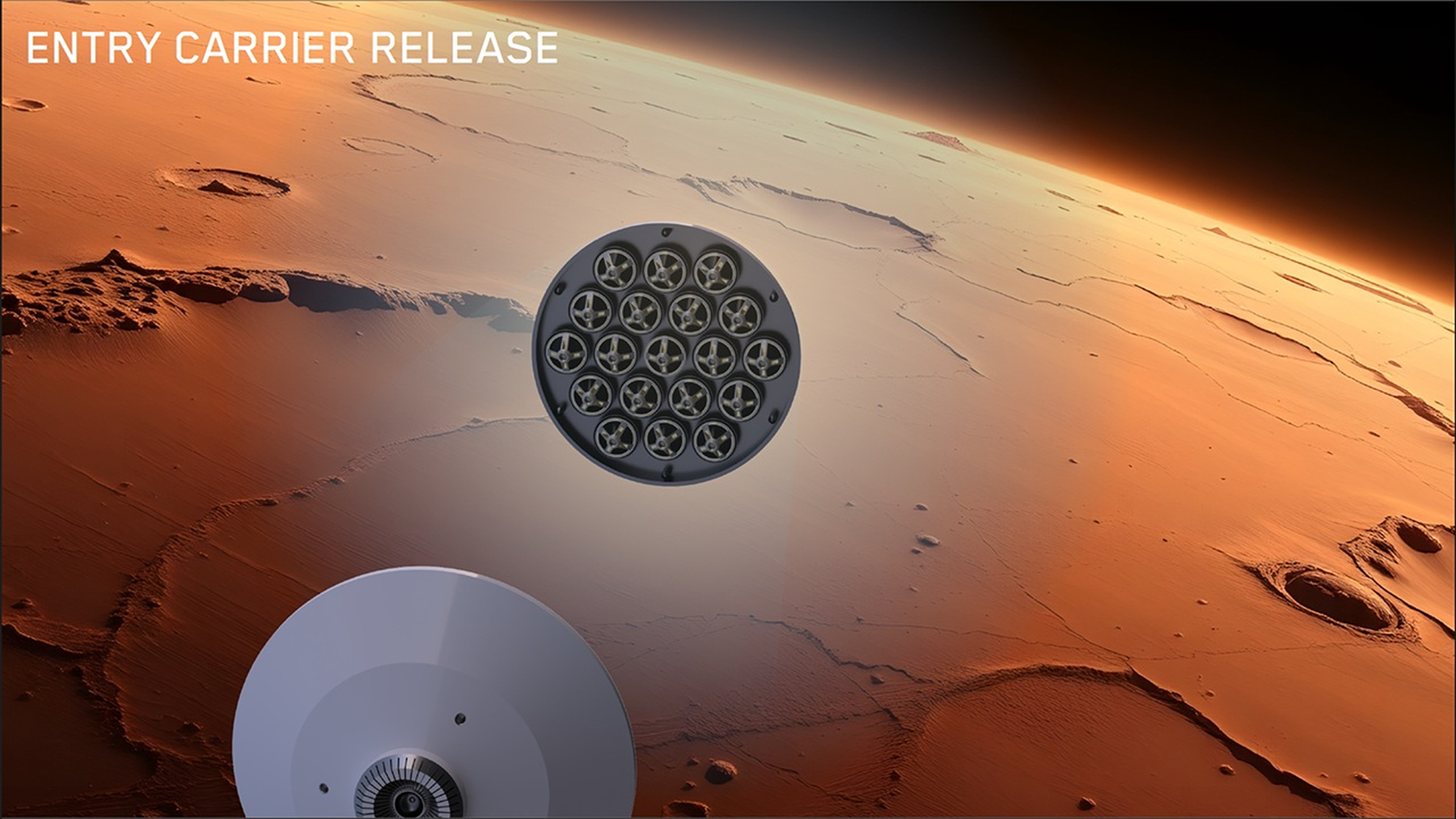
Mars atmospheric entry. Artist’s impression of small Mars atmospheric-entry vehicles carrying 19 probes behind a shared heat shield at the moment of backshell separation.
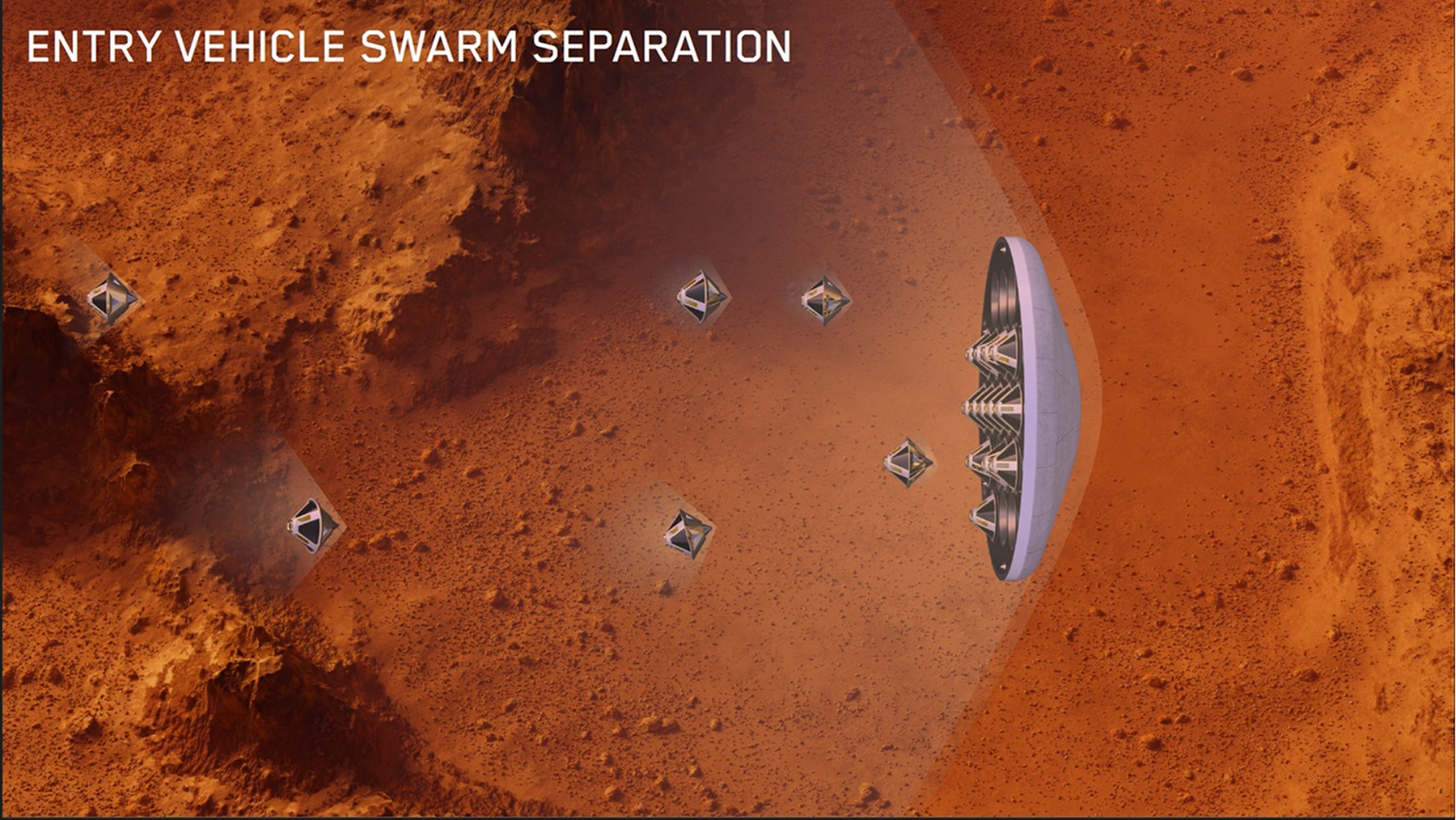
Swarm separation. Artist’s depiction of the probe separation from the reentry vehicle. The landing ellipse and probe distribution pattern can be controlled by the altitude of separation as well as the rate of the probe release.
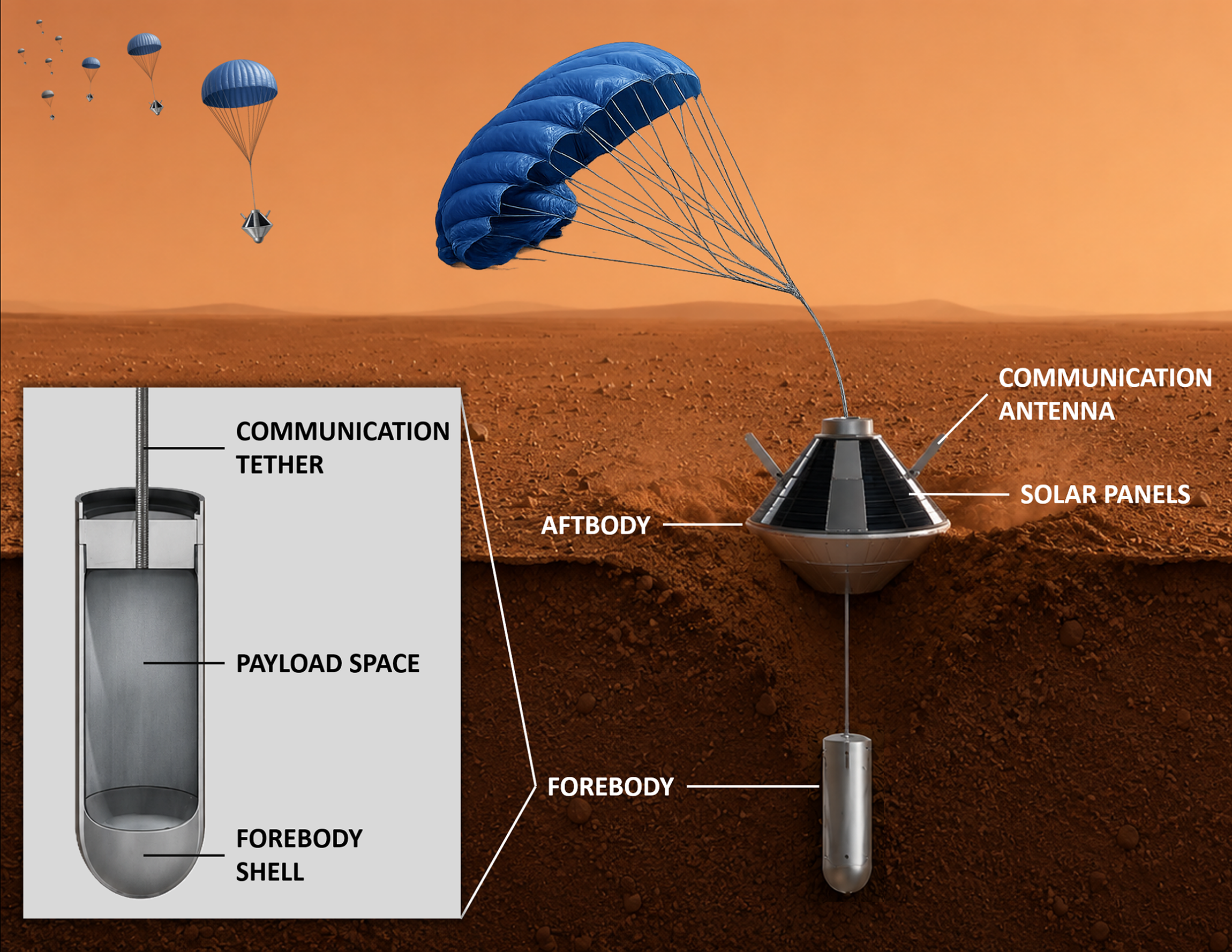
IMPRESS-345 after deployment in martian soil. Artist’s depiction with descriptions of the planetary penetrator. IMPRESS, International Mars Prospecting Ride-Share System.
These phases define the overall framework for the mission and are described in more detail in Sections 3–5.
Planetary penetrators are not new. Their origins and ongoing improvements are related to military applications (Lorenz, 2011; Liang et al., 2008). Since the 1970s, penetrators have been adapted for planetary exploration as a way to emplace instruments in celestial bodies without requiring a conventional soft landing (Lorenz, 2011). Thus, penetrators have been designed for Mars (Surkov and Kremnev, 1998; Smrekar et al., 1999), the Moon (Shiraishi et al., 2008; Ahrens et al., 2021), comets (Swenson et al., 1987), asteroids, and icy bodies (Murphy, 1981) (see Supplementary Table S1–S3 for a more comprehensive overview).
For Mars in particular, the Mars-96 mission included two large (80 cm length, 45 kg) penetrators (Surkov and Kremnev, 1998). Unfortunately, the 1996 mission never reached Mars due to a rocket failure. NASA’s 1999 Deep Space 2 (DS2) mission (Smrekar et al., 1999) flew two Mars microprobes as part of the Mars Polar Lander mission. Both DS2 microprobes were deployed during Mars arrival, but no communication was received from them after deployment.
Although both of the Mars penetrator missions flown in the late 1990s failed, the failure was not due to inherent infeasibility of the penetrator technology (Albee et al., 2000). Many penetrator prototypes have been designed, tested, and flown to other celestial objects. They are summarized in Supplementary Table S1.
Inspired by the design of DS2 microprobes, we have started development and testing of a mass-producible platform called IMPRESS-345. Its name refers to the 345 cm³ payload capacity available in the steel forebody. The platform is the intended workhorse of the first IMPRESS mission; follow-up missions might include different and potentially larger platforms.
IMPRESS-345 is derived from DS2 microprobe architecture with a forebody that emplaces below the surface through impact and remains connected through a communication tether to an aftbody that remains at the surface during operation (Fig. 3). Although the general concept and size are similar to the DS2 microprobes, thanks to advances in electronics, communications, packaging, power systems, and miniaturized instrument technologies since the 1990s (Gonzalo et al., 2025), the probes are expected to deliver increased and new capabilities.
Further improvement in capability relative to the DS2 prototypes comes from network deployment over the landing ellipse, the size of which is controlled by the altitude and probe deployment rate during separation from the entry capsule (Fig. 2). The first stage of development is projected to result in a field-tested (TRL-6) penetrator platform in 2026 (Section 3.1). The follow-up development will result in a Mars-ready vehicle for subsurface instrument deployment on Mars in the late 2020s or early 2030s, depending on funding.
Field-ready probe platform IMPRESS-345
The IMPRESS-345 penetrator probe platform is under development by Guinn Partners under a NASA TechLeap Prize award under the Space Technology Payload Challenge. The development effort is aimed at a system that includes a steel forebody penetrator shell linked via a tether to a detachable aftbody, together with telemetry, battery, power regulation, and telecommunications subsystems, and the mechanical interfaces needed for forebody–aftbody integration (Fig. 4). The current development path targets maturation to a field-tested (TRL-6) system in July 2026.
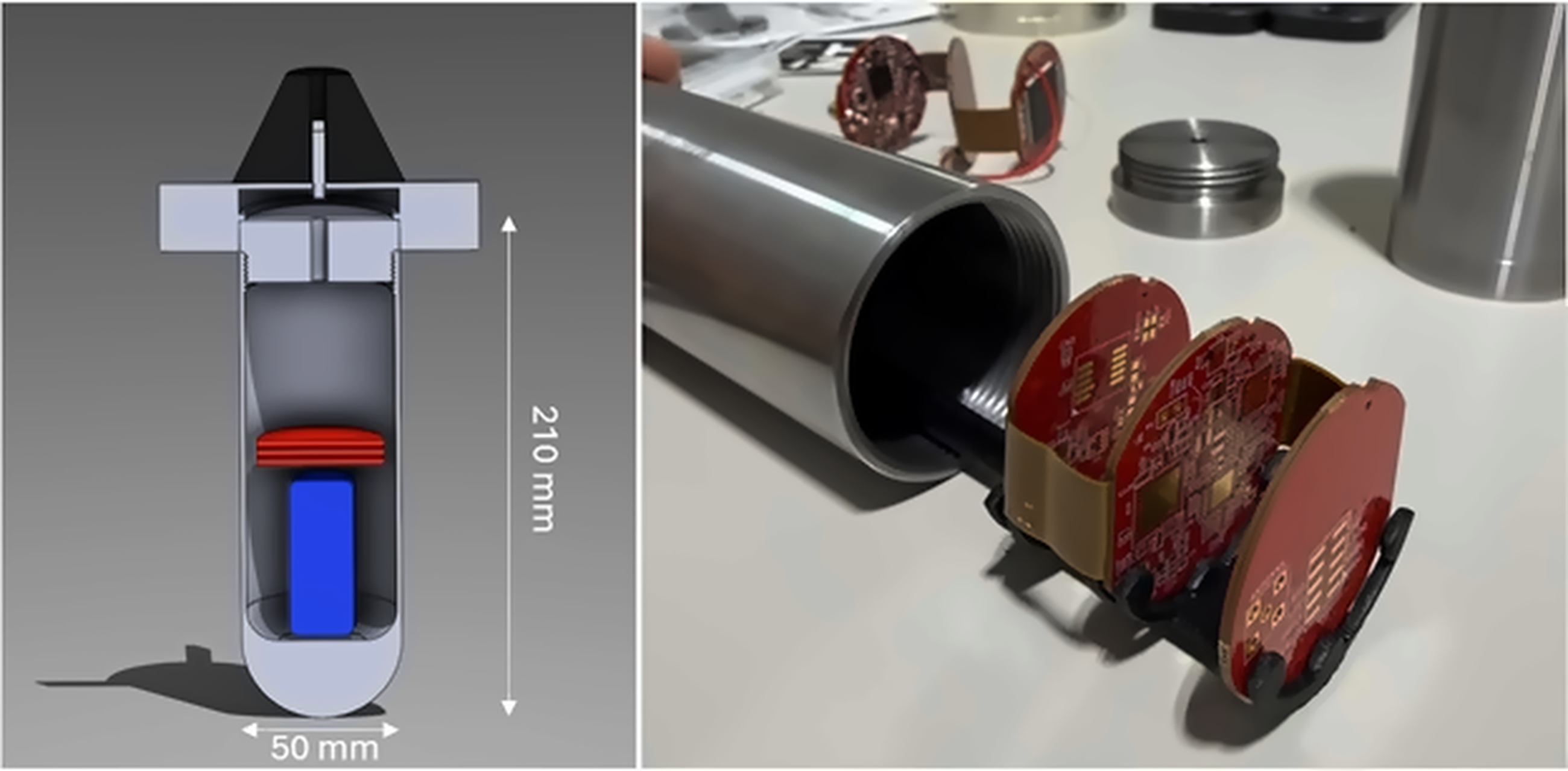
Concept art showing a cross-section of the field-ready IMPRESS-345 penetrator platform with a rechargeable Li-ion 18650 battery (blue) and PCB (red). For impact testing, the cavities will be filled with potting resin (left). Right: photograph of the printed circuit board assembly within the penetrator. Mars-ready probes will use custom disc batteries, with or without thermal insulation (see Section 3.2.2), and more tightly packaged PCBs, maximizing continuous payload volume. PCB, printed circuit board.
The TRL-6 airframe consists of a steel 210-mm longitudinal cylinder with an outer diameter of 50 mm and a uniform wall thickness of 1.5 mm. The forebody features a blunt hemispherical nose optimized for soil penetration (Fig. 4). The internal cavity of the probe is 345 cm3, of which 40 cm3 is in the TRL-6 model allocated to telemetry, battery, and power regulation, leaving 305 cm3 for theoretical science payload. In the present test article, an inert low-shrinkage epoxy resin potting is used in place of the science payload to provide the necessary impact shock resistance.
The subsystem architecture includes a power bus and a sensing suite that comprises the following elements: communications with cross-link capabilities via a UHF radio transceiver, enabling inter-probe networking; instrumentation consisting of a high-g triaxial accelerometer rated up to 10,000 g, with a 10 kHz sampling rate, and thermal sensors for characterizing entry, descent, and impact conditions; and power supplied by an autonomous battery system with an accessible power bus for “ride-along” scientific instruments.
The total mass of the TRL-6 probe including all components described above is 1 kg.
Survivability work includes high-g testing representative of Mars penetrator conditions, including “altitude of 45 km” with “altitude of 15 km” high-altitude balloon-drop field tests organized by Aerostar Aerospace on private property near Madras, Oregon. During the high-altitude test, a swarm of seven probes will be deployed at an altitude of 45 km, impact the ground at a terminal velocity of 115 m/s, and experience deceleration forces of up to 5200 g, after which they will begin transmitting, allowing field recovery.
These tests are intended to validate the survival of structural parts, penetration depth, sustained communications after emplacement, and resistance to Mars-relevant pressure and temperature ranges (as low as −55°C). The onboard triaxial accelerometers in the high-altitude drop test will also allow measurement of dynamic loads during descent, providing data for a model of wind speeds and atmospheric properties. This capability may be relevant if penetrators are flown alongside missions that deploy aerial assets, such as the SkyFall mission (NASA, 2026b) or Dragonfly to Titan (Wright et al., 2026), both of which are projected to launch in 2028.
The goal of this NASA TechLeap Prize-funded development effort is to design a modern, rideshare-compatible penetrator platform that can be mass-produced and integrated with a range of payloads.
Because the flight-ready IMPRESS probe has not yet converged on a single architecture, the main engineering challenges are best framed as a set of coupled development hurdles and candidate operating modes. IMPRESS builds on an existing penetrator lineage that includes Mars-96 (Surkov and Kremnev, 1998), the DS2 microprobes (Smrekar et al., 1999), MetNet (Harri et al., 2017), and the more recent miniature environmental-network probe concept Mars Connect (Gonzalo et al., 2025). It also draws on distributed low-mass biology package concepts such as the Biological Oxidant and Life Detection (BOLD) mission (Schulze-Makuch et al., 2012).
Impact survival and penetration depth
Impact survival and penetration depth remain the first coupled design constraint. Earlier Mars concepts occupied different parts of this trade space. DS2 microprobes used a high-speed forebody–aftbody penetrator (Smrekar et al., 1999). MetNet reduced impact speed by using inflatable deceleration and accepted a shallower, lower-g emplacement regime (Harri et al., 2017). Mars Connect moved back toward a simpler hard-impact approach in order to avoid more complex descent and landing elements (Gonzalo et al., 2025).
IMPRESS addresses the impact speed and penetration depth constraint through the use of drogue chutes that stabilize the descent of individual probes, constraining terminal velocity and therefore penetration depth. Lower impact speeds resulting from a larger drogue chute favor payload survival but reduce subsurface access. Higher speeds (smaller drogue chutes) increase penetration depth, but they also increase structural and instrument loads and increase sensitivity to the physical properties of the terrain at the impact site.
The goal of engineering planning is therefore not simply to maximize penetration depth but to define a survivable operating envelope as a function of descent profile, probe geometry, and plausible martian surface material properties (Yen et al., 1999; Harri et al., 2017; Gonzalo et al., 2025). The drogue chute sizes can be tailored for the upcoming missions’ specifications and for individual probes within the swarm, as they are guided by the science goals.
The g-load experienced by each penetrator during impact will be monitored by onboard high-sampling-rate accelerometers. The resulting deceleration record will constrain penetration depth and local subsurface mechanical properties at the landing site while also allowing payload providers to determine whether the impact shock exceeded the qualified operating or survival limits of their onboard equipment (Lorenz et al., 2000).
Thermal and power architectures
After emplacement, thermal and power management may become the dominant operational constraint, given the low temperatures on Mars. DS2 microprobes represented one extreme: a power-limited system that used low-temperature lithium-thionyl chloride primary batteries, with a nominal operational lifetime of about one sol and possibly up to a week, while forebody electronics were designed to function down to about −120°C (Smrekar et al., 1999).
MetNet was designed to operate for several years embedded in the regolith above −50°C (in equatorial regions). It was to be powered with two rechargeable SAFT MPS176065 Li-ion batteries in a thermally sealed container powered by flexible solar cells on top of the aftbody (Harri et al., 2017).
Mars Connect extends that logic by separating components that can tolerate ambient Mars temperatures down to −120°C from those that must be protected in a warm insulated compartment (above −30°C during recharge). This system was designed with ultra-low-power electronics, rechargeable batteries, 720 cm2 rigid solar panels, and a stated operational timeline of at least one martian year (Gonzalo et al., 2025).
For IMPRESS, three broad operating modes appear plausible. The first is a cold-probe architecture without active heating (as was used with DS2). This simplifies the thermal design and reduces continuous power demand but narrows the admissible battery chemistries and payload classes. In practice, such a probe is better suited to short-lived operations: survive impact, execute a limited measurement sequence, and return the data before the battery reserve is exhausted (Smrekar et al., 1999). That mode is credible for simple short-term geophysical or environmental payloads but less suitable for assays that require prolonged thermal control, repeated actuation, or long-term measurements.
The second is a warm-probe architecture, in which rechargeable batteries and the main instrument compartment are maintained at optimal operating temperatures (above −30°C). This is the more permissive option for analytical payloads, repeated measurements, microfluidic devices, and experiments that require environmental control. The forebody is the natural location for such a compartment, because burial reduces diurnal temperature swings and thermal losses (Yen et al., 1999; Harri et al., 2017; Gonzalo et al., 2025).
The third alternative approach, presented here for the first time, is informed by data provided by the InSight HP3 “mole” heat-flow probe, which showed that dry martian regolith has very poor thermal conductivity (0.039 ± 0.002 W/m·K). In regolith with thermal properties similar to those found at the InSight landing site, even modest continuous heat dissipation (∼1 W) can keep the entire buried probe forebody, including the regolith in immediate probe vicinity, above 0°C. Thus, solar-powered penetrator probes that target dry martian regolith without shallow ice may be able to dispense entirely with internal battery-compartment insulation. In this example, the martian regolith serves not only as the external shock absorber for the impactor but also as an external thermal insulator, which results in more mass and volume dedicated to science and further increases an already high science-per-dollar ratio.
The aftbody, by contrast, remains exposed to large surface temperature variations. Thus, it is better reserved for telecommunications, power generation where appropriate, and only a limited set of rugged surface instruments.
Telecommunications
Telecommunications should be treated as a primary design constraint. DS2 microprobes relied on a tethered forebody–aftbody architecture, with the surface aftbody hosting communications hardware (Smrekar et al., 1999). MetNet likewise treats relay opportunity, transmitter power, and operational timing as central system constraints (Harri et al., 2017). BOLD adopted the same basic logic, with short-lived battery-powered probes returning data through an existing Mars Relay Network (MRN; Schulze-Makuch et al., 2012).
IMPRESS adopts a forebody–aftbody architecture that maximizes design freedom for the science payload. By decoupling the subsurface instrumentation from atmospheric variations, the probes reduce noise in subsurface measurements. The separated forebody also allows instruments to be emplaced across a broad depth range (0.2–1 m), while the antennas and telecommunications hardware remain accessible at the surface. This arrangement, however, introduces clear failure points. The tether must survive impact and emplacement, the aftbody must come to rest in a usable orientation, and that orientation must allow transmission without allowing communications to dominate the duty cycle.
Compared with the DS2 microprobes, the IMPRESS aftbody communication system is expected to be less directionally constrained because of improved antenna design and higher transmit power. The resilience of the communication tether is being tested during the ongoing development program.
Another potential bottleneck is the limited data transmission capacity of the MRN, which is shared by all Mars surface and orbital assets. Although Congress has appropriated $700 million under 51 U.S.C. § 20306(a)(1) for procurement of a high-performance Mars telecommunications orbiter, with delivery to NASA required by the end of 2028, early IMPRESS missions should still be designed around low-bandwidth data return.
For larger IMPRESS deployments, it may be necessary to redistribute data among probes locally and then transmit it to orbit gradually at lower bandwidth over extended periods, since data generation is expected to peak during deployment and immediately after impact. Simultaneous direct transmission from thousands of IMPRESS probes to orbit is unrealistic, at least until a denser Mars communications infrastructure is established.
Mission Design, Operations, and Economics
Reference mission architecture
To illustrate the economic potential of the IMPRESS architecture, we define a reference mission scenario based on a single Falcon Heavy launch delivering a large number of penetrator probes to Mars. Falcon Heavy is selected because its Mars payload capability and launch price are publicly available, which allows a transparent first-order estimate of deployment capacity and cost per probe.
In this reference architecture, Falcon Heavy operates in an expendable configuration and delivers approximately 16,800 kg of payload on a direct transfer to Mars. The mission uses the extended Falcon Heavy payload fairing (5.2 m diameter, 18.7 m height). Within this fairing, four Mars entry capsules are stacked vertically using a structural adapter frame. Each capsule has a diameter of about 4.5 m, a height of about 3 m, and a total entry mass of about 4000 kg. The blunt body capsule design is derived from a simplified version of NASA’s Mars 2020 (Perseverance) entry aeroshell (Mahzari et al., 2022; Way et al., 2022).
Each entry capsule contains 1500 standardized penetrator probes. After peak heating during atmospheric entry, the backshell is jettisoned at an altitude of about 10 km while the vehicle remains supersonic (Mahzari et al., 2022; Way et al., 2022). Following backshell separation, probes are dispersed from the carrier vehicle in a preprogrammed deployment sequence.
Mass accounting and probe capacity
With four capsules, each carrying 1500 probes, deployed from a single Falcon Heavy launch, the total number of probes delivered to Mars in the reference mission is 6000. The approximate mass allocation within each entry capsule is found in Table 1.
Approximate Mass Allocation Within Each Entry Capsule
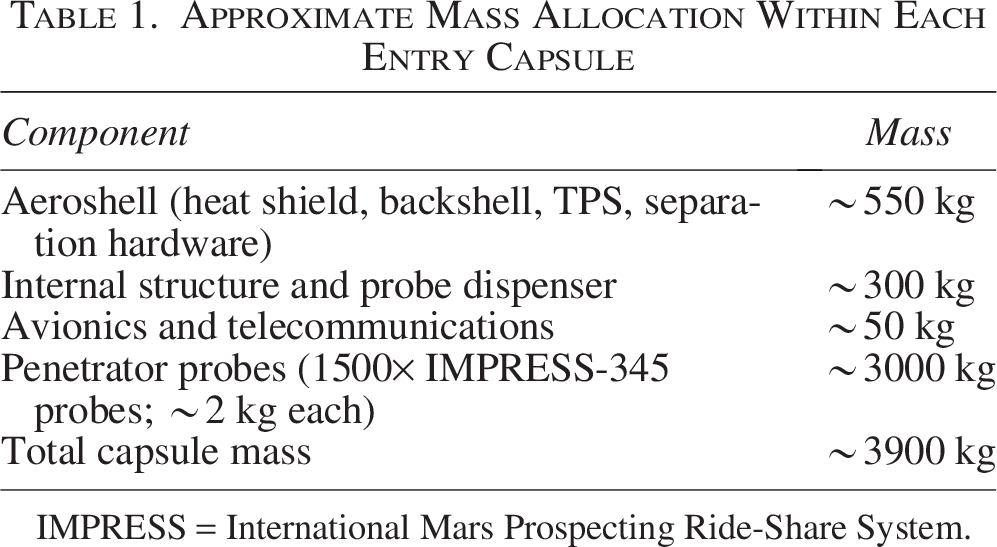
Approximate Mass Allocation Within Each Entry Capsule
IMPRESS = International Mars Prospecting Ride-Share System.
The Mars-ready IMPRESS-345 probe mass is about 2 kg per probe. Each probe consists of a forebody and aftbody connected by a tether. The forebody mass is about 1 kg and includes structure, avionics, communications, power systems, and science instrumentation. The aftbody mass is also about 1 kg and includes structural components, communications tether, drogue parachute, and solar power hardware.
Within the Falcon Heavy extended fairing, four entry capsules can be accommodated in a vertical stack with an adapter frame totaling no more than 1200 kg to fit the total mass budget of the nominal Mars delivery capability of Falcon Heavy.
Using publicly available pricing for Falcon Heavy launches, a first-order estimate of mission cost can be constructed. Fully expendable Falcon Heavy launch services are $150 million.
The manufacturing cost of the standardized penetrator platform, including accelerometers and internal thermometers integrated into the printed circuit board in each probe, is estimated at $1000 per probe based on the bill of materials. For 6000 probes, this corresponds to about $6 million in probe platform manufacturing cost. This excludes the science payloads provided by the rideshare participants.
Simplified passive ballistic entry capsule manufacturing costs are estimated at about $10 million per capsule including the heat shield. With four capsules, this corresponds to about $40 million.
Additional mission costs include integration and assembly of the probes and entry systems, environmental testing, and planetary protection procedures. These activities are estimated at about $20 million. Mission operations are estimated at about $30 million, assuming the use of existing or planned Mars relay orbiters for communications rather than a dedicated telecommunications spacecraft.
The resulting approximate mission cost breakdown is given in Table 2.
Mission Cost Breakdown
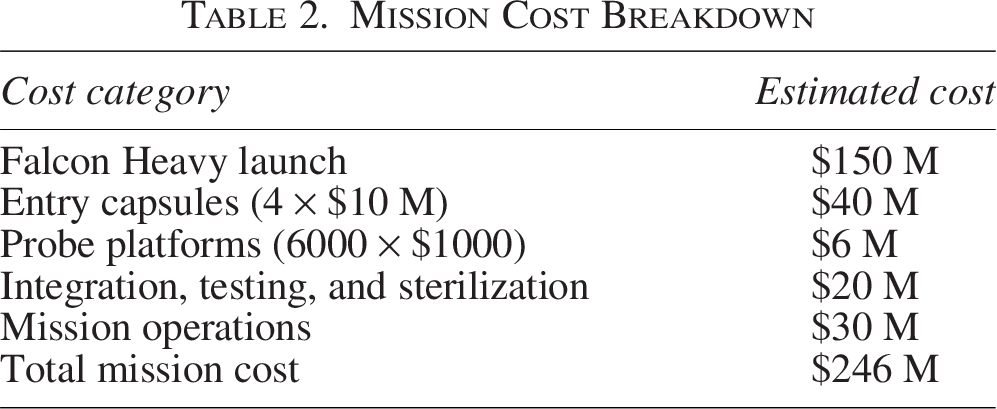
Mission Cost Breakdown
For a total of about 6000 deployed probes, the resulting estimated cost per delivered probe is $41,000, excluding the cost of science payloads contributed by mission participants.
Because penetrator success rates depend on surface mechanical properties and final probe design, the most robust economic metric for this architecture is cost per deployed probe rather than cost per successful measurement site. Even with substantial probe attrition after deployment, the architecture still produces thousands of distributed sampling locations.
The Falcon Heavy reference architecture described above represents an ambitious implementation designed to illustrate the economic potential of large-scale penetrator deployment. This section describes more modest alternatives.
One alternative is the inclusion of a smaller penetrator cluster (as illustrated by Figs. 1 and 2) or clusters as rideshare payloads on government Mars missions. In such cases, one or more entry capsules (e.g., SpaceX Starfall) containing tens to hundreds of probes could be integrated with a primary spacecraft to allow penetrator deployment with significantly lower incremental launch cost. An example of such an opportunity may arise from Mars Telecommunications Network solicitations. An entry capsule with penetrators could potentially be integrated as a secondary payload on the congressionally funded Mars Telecommunications Network mission (NASA, 2026a).
Another option is to include several planetary penetrators as a secondary payload within entry capsule(s) and release them alongside a primary payload. A particularly suitable opportunity would be a rideshare with the SR-1 Freedom 2028 SkyFall mission (NASA, 2026b), in which the penetrators could provide local atmospheric data just ahead of the deployment of the SkyFall helicopters. After embedding in the ground, the IMPRESS probes could provide subsurface reconnaissance complementary to the drones’ aerial observations (NASA, 2026b). They could also serve as data-relay stations for the drones.
Inspired by a recent privately led Venus mission concept (Baumgardner et al., 2022; French et al., 2022) designed to seek evidence of an organic carbon cycle in venusian clouds (Spacek et al., 2024), we believe that private demonstration missions may also provide deployment opportunities, as the prospect of detecting extraterrestrial life may be attractive to philanthropists. Alternatively, early interplanetary missions sponsored by commercial launch providers could include penetrator deployment as a secondary objective. Vehicles currently under development, such as Relativity Space’s Terran R or Rocket Lab’s Neutron, might eventually support small interplanetary demonstration payloads, although such capabilities have not yet been publicly established.
Future heavy-lift systems such as SpaceX Starship or New Glenn could potentially deploy large numbers of penetrators during early Mars demonstration missions. In such scenarios, penetrator deployment could occur before atmospheric entry of the Starship, ensuring useful scientific return even if the Starship landing attempt is unsuccessful.
Together, these alternative deployment pathways illustrate that the IMPRESS architecture is scalable and adaptable across a range of launch vehicles and mission opportunities, from small rideshare deployments to large dedicated penetrator missions.
Candidate Payload Classes and Science Return
The value of IMPRESS lies in the breadth of science payloads that penetrator missions can accommodate. This section illustrates this breadth with a brief overview of scientific instrumentation designed for planetary penetrators. That heritage includes flown hardware (Surkov and Kremnev, 1998; Smrekar et al., 1999), built and tested subsystems (Shiraishi et al., 2008; Harri et al., 2017), and mission-specific concept studies (Swenson et al., 1987; Smith et al., 2009; Schulze-Makuch et al., 2012; Lawrence et al., 2025). A more comprehensive instrument-by-instrument overview is provided in Supplementary Table S2, S3.
Entry, descent, emplacement, and communications
Entry, descent, emplacement, and communications are not only operational functions but also sources of direct scientific information. DS2 microprobes used descent and impact accelerometry to constrain atmospheric and ground properties (Smrekar et al., 1999; Lorenz et al., 2000). LUNAR-A similarly combined tilt and impact sensing with radio-linked geophysical measurements (Shiraishi et al., 2008). MetNet extended this class through an integrated inertial package used for descent control and post-landing orientation knowledge (Harri et al., 2017). The SPIC lunar penetrator concept also treated radio-science functionality as part of the payload space rather than as engineering support alone (Ahrens et al., 2021). Thus, IMPRESS could provide atmospheric structure, burial dynamics, final probe attitude, and network geometry with relatively modest payload overhead (Smrekar et al., 1999; Lorenz et al., 2000; Shiraishi et al., 2008; Ahrens et al., 2021).
Imaging
Imaging has also been repeatedly incorporated into penetrator missions and penetrator-specific studies, from the TV camera system on the exposed afterbody of Mars-96 (Surkov and Kremnev, 1998) to the lightweight four-lens panoramic camera proposed for MetNet (Harri et al., 2017). LunarEX proposed a descent/context camera to document local terrain and deployment conditions (Smith et al., 2009). Penetrator studies for Titan and Enceladus likewise considered close-range imaging for geological and astrobiological context (Coustenis et al., 2009). Such imagers do not replace rover-scale geological investigation, but they can anchor point measurements to local terrain, probe condition, and immediate geological setting (Surkov and Kremnev, 1998; Coustenis et al., 2009; Smith et al., 2009; Harri et al., 2017). The limiting factor for modern imaging operations will be the data transmission rate through orbiting assets.
Sample acquisition
Penetrators are not restricted to passive contact measurements. DS2 microprobes included a miniature drill and soil collector that fed the Evolved Water Experiment (Smrekar et al., 1999; Lorenz et al., 2000). MoonLITE and LunarEX both examined transfer of local material into internal analysis chambers for subsequent volatile and geochemical measurements (Gao et al., 2008; Smith et al., 2008; 2009). Compared to passive sensing alone, sample acquisition broadens the range of compatible analytical payloads by enabling controlled heating, pressure control, controlled chemistry, and chamber-based measurements (Smrekar et al., 1999; Smith et al., 2009). These functions are especially relevant to astrobiological examination of samples (Section 5.6). The active mechanical operations required for sample acquisition and transfer remain among the more demanding penetrator subsystems (Smrekar et al., 1999) and will likely require a significant amount of additional development to become reliable. An alternative passive sample-acquisition approach that uses feed ports in the nose cone during ground impact was shown to be feasible in preliminary Gravedigger 2 experiments by the SaRSEE team (Truitt, 2016).
Geophysics and meteorology
The tight subsurface coupling of the IMPRESS forebody to the ground is well suited to seismic and thermal measurements, whereas the exposed aftbody is well suited to atmospheric and surface-environment monitoring (Surkov and Kremnev, 1998; Harri et al., 2017). With wide spatial deployment, IMPRESS penetrators can combine network seismology, thermal measurements, and site-to-site atmospheric monitoring within a single architecture (Mizutani, 1995; Surkov and Kremnev, 1998; Shiraishi et al., 2008; Harri et al., 2017). These measurement classes were already developed and, in several cases, tested in earlier penetrator missions and studies. LUNAR-A was built around seismometry and heat flow (Mizutani, 1995; Shiraishi et al., 2008). Mars-96 carried a seismometer, thermal probes, and a meteorological complex (Surkov and Kremnev, 1998). The modern MetNet was explicitly conceived as a distributed environmental station (Harri et al., 2017). BOLD also proposed an Atmospheric Structure and Surface Environment Instrument within its penetrator-like payload suite (Schulze-Makuch et al., 2007,2012).
Geochemistry, volatiles, mass spectrometry, and X-ray analysis
Penetrator-specific studies also show that compact chemical analysis extends well beyond simple physical-property sensing. DS2 microprobes flew the Evolved Water Experiment (Smrekar et al., 1999). Mars-96 carried X/α/neutron and gamma-ray spectrometers together with thermal probes for compositional and physical-property interpretation (Surkov and Kremnev, 1998). MoonLITE proposed a miniaturized XRF package to detect and quantify major and trace elements in the lunar regolith (Gao et al., 2008). LunarEX and SPIC further broadened this payload class by including volatile and geochemical analysis options such as X-ray and optical spectrometry, evolved-gas analysis, and related compact laboratory functions (Smith et al., 2009; Ahrens et al., 2021). The Polar Night (Mosher and Lucey, 2006) study also treated mass-spectrometric volatile analysis as a realistic penetrator payload class for volatile-rich environments. Together, these studies show that penetrators can support meaningful volatile prospecting and compositional measurements, especially when combined with sample acquisition (Section 5.3).
Life detection
The penetrator-specific precedent for life detection is BOLD, which was explicitly conceived as a penetrator network for Mars extant life detection (Schulze-Makuch et al., 2007). Its proposed payload suite included a Mars Soil Analyzer, a Multispectral Microscopic Imager (Núñez et al., 2014), a Fluorescent Stain experiment, a Chirality experiment, a Nanopore-ARROW biosensor (Deamer et al., 2007), and an Atmospheric Structure and Surface Environment Instrument coupled to an internal sampler (Schulze-Makuch et al., 2007,2012). BOLD proposed a multi-method biosignature search combining microscopy, chirality, fluorescence, wet chemistry, and molecular detection within one distributed architecture (Schulze-Makuch et al., 2007,2012). This concept illustrates how penetrators can support a variety of instruments and place Viking-successor assays in the broader context of geophysics and geochemistry. Possible IMPRESS biology payloads could include adaptations of the chiral version of Levin’s labeled release experiment (Anbar and Levin, 2012; Levin and Straat, 2016) and of the carbon assimilation/pyrolytic-release experiment. An overview of published astrobiology-related planetary penetrator candidate payloads is presented in Supplementary Table S3. For IMPRESS, the strongest scientific case is therefore not one biology payload repeated across the swarm but a heterogeneous payload set in which orthogonal life-detection experiments are interpreted alongside geophysical, meteorological, and chemical context measurements.
Discussion
Planetary protection and exploration implications
Extant life on the martian surface and in the near subsurface is one of the major known unknowns for future Mars exploration (Spry et al., 2024) and should be addressed before both sample return (Craven et al., 2021) and crewed missions (National Research Council, 2002). In this context, IMPRESS provides a survey architecture that can reduce uncertainty before larger robotic investigations (Williams et al., 2023; Sefton-Nash et al., 2025), sample return (Hou et al., 2025), or sustained human activity on Mars (NASEM, 2026). By sampling many shallow-subsurface sites, IMPRESS probes can constrain whether candidate biosignatures are observed in the surveyed environments and how evenly they are distributed, and provide broader local physical and chemical context before later missions disturb the environments under study or return samples whose biological significance would otherwise remain poorly constrained (Fairén et al., 2017). Thus, IMPRESS can narrow part of the uncertainty related to backward planetary protection (Craven et al., 2021).
The small size of the IMPRESS probes makes the stringent forward-contamination control requirements imposed by biology-detection payloads more manageable. The ∼2 kg probes should make sterilization and contamination-controlled handling substantially more tractable than for larger landed systems, given that final probe assembly and sterilization can be performed in a glove box. Probe design and sterilization protocols should be developed with the stringent sterility requirements in mind, following the latest COSPAR recommendations (Hedman et al., 2026).
Strengths and limitations of the architecture
The main strength of IMPRESS is that its architecture matches the survey problem. If the target is patchy, many shallow-subsurface access points may be more informative than concentrating all capability at one site. This applies most directly to extant-life prospecting (Carrier et al., 2020) but also to shallow volatile reconnaissance, environmental monitoring, and distributed geophysics.
Probe multiplicity is essential to this rationale. The scientific value of IMPRESS depends on creating many measurement sites within a single delivery architecture; its advantage lies in broad spatial sampling at lower cost per site and in tolerance to individual probe failure (Lorenz, 2011).
The limits are equally clear. Penetrators do not provide mobility, detailed geological context, deep drilling, or extensive sample handling. Science return depends on impact survivability, communications from partially buried assets, and payloads designed specifically for penetrator constraints rather than adapted from conventional landers (Surkov and Kremnev, 1998; Smrekar et al., 1999).
Key technical uncertainties remain with regard to the survivability of representative payloads, emplacement across variable regolith, communications reliability, and deployment statistics. Sample acquisition, in particular, remains a demanding subsystem due to possible forward contamination pathways, incomplete soil transfer, and variability in particle size and compaction (Smrekar et al., 1999; Truitt, 2016). All of these issues will require significant research and development to make the probes flight-ready.
Broader scientific access and methodological diversity
The IMPRESS architecture can carry diverse scientific payloads across the swarm (Section 5), allowing potential biosignature measurements to be interpreted alongside geophysical, environmental, and chemical context.
Standardization of the IMPRESS-345 probe platform contributes to this by lowering the threshold for payload development. A standardized platform and repeated flight opportunities can broaden access to Mars in situ experimentation and allow focused payloads to be developed independently of full spacecraft systems by commercial and academic participants (NASEM, 2016). The primary relevance here is scientific, because broader access enables orthogonal approaches and iterative follow-up experiments for problems where no single compact method is likely to be definitive.
Role relative to larger landed missions
IMPRESS is not a replacement for large landed missions. Its role is mainly broad reconnaissance, shallow-subsurface access at many sites, and early reduction of uncertainty before later missions commit major resources to a small number of locations. It provides affordable, repeatable access to Mars in situ exploration for the broader international academic and commercial research community and bypasses the payload constraints usual for Mars lander missions. Thus, it enables rapid testing of new, diverse ideas and rapid iterative improvements.
IMPRESS can support biosignature triage, landing site preselection and risk monitoring, shallow volatile prospecting, and distributed environmental or geophysical measurements. IMPRESS can improve the likelihood that later, more capable missions are directed to better-constrained, preselected targets and interpreted within a broader environmental context (Williams et al., 2023; Spry et al., 2024).
Finally, payload opportunities need not be limited strictly to scientific instrumentation. Participant payloads could also include educational, cultural, or inspirational articles as long as they comply with planetary protection requirements.
Conclusions
IMPRESS is a mission architecture for distributed reconnaissance of the martian surface and shallow subsurface using swarms of standardized planetary penetrators. It can provide measurements on a large spatial scale, either as a stand-alone mission or as a precursor to large landers and crewed exploration. In particular, IMPRESS can search for life and support landing-site preselection, shallow volatile prospecting, risk monitoring, and long-term time-correlated network measurements. It may deliver a heterogeneous set of orthogonal life-detection experiments, together with geophysical, meteorological, and chemical analyzers that provide environmental context for life detection. IMPRESS is especially relevant where potential biosignatures, habitable microenvironments, or engineering hazards are expected to be unevenly distributed. Broad spatial sampling enabled by the swarm increases the statistical significance of both positive and negative results.
The NASA TechLeap Prize funded the development of the IMPRESS prospecting platform, with a field-tested prototype expected to be ready in summer 2026. The space-ready version may be ready as soon as 2028 and would offer a mass-produced Mars exploration platform that can be deployed for as little as ∼$40,000 per probe. These platforms are comparatively easy to handle and sterilize prior to launch, relative to larger landed systems, making them suitable for biological exploration. The IMPRESS swarms can be delivered to Mars either as a secondary payload on planned missions, such as the 2028 SR-1 Freedom/SkyFall mission, or as a primary payload on dedicated private or government missions.
More broadly, IMPRESS is intended to be a repeatable, affordable, and democratizing path to martian subsurface access. By standardizing interfaces and lowering the economic threshold for participation, it can open Mars in situ experimentation to a wider set of academic, commercial, and international teams, while enabling rapid iteration and follow-up deployments. In that limited but important sense, IMPRESS could play a role for Mars shallow-subsurface access analogous to that played by CubeSats in low Earth orbit science (NASEM, 2016). As a “Frequent. Affordable. Bold.” approach to Mars subsurface exploration (Culbert et al., 2022), IMPRESS is designed to make shallow-subsurface reconnaissance a recurring opportunity and to provide the distributed prospecting needed before later robotic and human missions commit to a landing site.
Author Disclosure Statement
Jan Spacek is founder and a major equity holder of IMPRESS Spaceworks Co. Holden Alpern and Thomas Dineen are minor equity holders of IMPRESS Spaceworks Co. Mitchell Richburg was affiliated with Guinn Partners, which is developing the IMPRESS-345 platform under the NASA TechLeap Prize described in this article. The remaining authors declare no competing financial interests.
Supplemental Material
sj-pdf-1-asb-10.1177_15311074261471218 — Supplemental material for IMPRESS: A Planetary Penetrator Network for Astrobiology, Prospecting, and Exploration of Mars
Supplemental material, sj-pdf-1-asb-10.1177_15311074261471218 for IMPRESS: A Planetary Penetrator Network for Astrobiology, Prospecting, and Exploration of Mars by Jan Spacek, Holden Alpern, Thomas Dineen, Janusz J. Petkowski, Gabriella Rizzo, Steven A. Benner, May Lui, Charles Cockell, Marshall Eubanks, Dirk Schulze-Makuch, Christopher Temby, and Mitchell Richburg
Footnotes
Acknowledgments
This work was supported in part by NASA’s TechLeap Prize and in part by a grant from the CHiwi Foundation (Switzerland) under its 2025 Call for Proposals. The CHiwi Foundation supports scientific research, education, and innovation in advanced mathematics, alternative energy, and space exploration.
Funding Information
This work was supported in part by NASA’s TechLeap Prize under the Space Technology Payload Challenge and by a grant from the CHiwi Foundation (Switzerland) under its 2025 Call for Proposals.
Associate Editor: Christopher P. McKay
Abbreviations Used
References
Supplementary Material
Please find the following supplemental material available below.
For Open Access articles published under a Creative Commons License, all supplemental material carries the same license as the article it is associated with.
For non-Open Access articles published, all supplemental material carries a non-exclusive license, and permission requests for re-use of supplemental material or any part of supplemental material shall be sent directly to the copyright owner as specified in the copyright notice associated with the article.
