







Abstract
In February 2011, the dramatic ouster of Hosni Mubarak threw into the spotlight the U.S. policy of granting generous and unconditional aid to the Egyptian regime at a time when the strategic rationale for such aid had become less obvious and calls for inserting human rights considerations into foreign aid allocations more prominent. Focusing on an unprecedented set of roll call votes taken in the U.S. House of Representatives during the years 2004 to 2007, this article offers the first quantitative assessment of the determinants of Congressional support for U.S. economic and military aid for Egypt. It challenges conventional wisdom on the limited role of campaign contributions in Congressional decision making by highlighting the central role of defense lobby contributions in maintaining the Congressional coalition that shielded Egypt’s prerevolutionary regime from increased U.S. pressure in the years leading up to its eventual demise.
Keywords
Introduction
In the early days of Egypt’s “January 25” revolution, a number of U.S. politicians demonstrated public skepticism about the Obama administration’s cautious endorsement of political change. Former vice president Dick Cheney praised Egypt’s long-time ruler Hosni Mubarak as “a good man, a good friend, and ally to the United States” (Blood, 2011) even after his regime had relied, once again, on well-rehearsed violent intimidation tactics in dealing with calls for reform. Republican Conference Chairman McCotter (R-Mich., 2011), one of Congress’s most ardent defenders of aid for Egypt, focused on the prospect of Islamist rule in his appeal to “preserve an imperfect government capable of reform and prevent a tyrannical government capable of harm”. Democratic Representative Adam Smith (Wash.), a long-time member of the House Armed Services committee, who voted against changing aid to Egypt in three of the four votes analyzed here, vigorously defended the need for the continued provision of military aid, but acknowledged that past support of human rights abusing governments had been “long-term bad strategy” (quoted in Rogin, 2011a).
All this raises questions about the extent to which these statements are indicative of a broader set of determinants that have shaped Congressional views on the US$1.5 to US$2.0 billion in unconditional annual aid the United States has been granting to Egypt since 1979. In other words, have those members of Congress, who share Dick Cheney’s foreign policy conservatism, or Adam Smith’s comparatively high share of defense industry campaign contributions, been more likely to oppose any change to the U.S. aid package at a time when its underlying rationale had become strategically and normatively dubious? Were Thaddeus McCotter’s words of support for Hosni Mubarak possibly at odds with the views of his comparatively large Arab and Muslim American constituencies?
At first glance, the quotations above seem to correspond with historical overviews of Congressional support for U.S. security assistance that emphasized the role of conservative lawmakers, ethnic lobbies and the defense industry lobby (Clarke, O’Connor, & Ellis, 1997). Offering a rare quantitative test of the (continuing) relevance of these factors, the following analysis uses a regression analysis of an unprecedented data set of Congressional roll call votes on amendments seeking to condition, rearrange or cut U.S. military and economic aid to Egypt between 2004 and 2007. These extraordinary votes marked the beginning of a new chapter in the U.S.-Egyptian aid relationship that had been shaped by the U.S.-sponsored peace treaty between Egypt and Israel in 1979. They reflect the rise of one of the most pressing questions of current U.S. foreign policies: How to (re)align U.S. interests and norms in the wake of the widely recognized need for genuine political, social, and economic reform in the Arab world?
This study contributes to the literature on two levels: First, it challenges the academic majority view on the limited role of campaign contributions in Congressional decision making (for an insightful overview and critique, see Roscoe & Jenkins, 2011) by highlighting the role of campaign contributions in maintaining Congressional support for generous U.S. aid for Egypt. Second, it builds on studies of the domestic determinants of U.S. foreign aid allocations (Fleck & Kilby, 2006; Milner & Tingley, 2010, 2011) and assessments of Congressional voting on Israel (Oldmixon, Rosenson, & Wald, 2005; Rosenson, Oldmixon, & Wald, 2009) to add a rare quantitative perspective to the ongoing debate about the influence of lobbies that try to shape U.S. Middle East policies (Marrar, 2009; Mearsheimer & Walt, 2007).
The next section offers a theoretical justification for the overall research question and develops the theoretical assumptions about the central determinants of the Congressional votes examined here. A contextualization of these roll call votes sets the stage for the presentation of the independent variables and hypotheses about their impact. This will be followed by the discussion of the descriptive and regression analyses of predictors of Congressional voting on U.S. aid for Egypt. The conclusion will sum up the article’s main findings as well as their significance and highlight areas that warrant further research.
The Congressional Debate on U.S. Aid for Egypt
For a long time, U.S. interest in maintaining the 1979 peace treaty between Israel and Egypt and in keeping Soviet influence in the Arab world at bay constituted two widely accepted rationales for the U.S.-Egyptian aid relationship (Quandt, 1990). Since the end of the Cold War, however, such strategic justifications have appeared increasingly tenuous. First, the withdrawal of the Soviet Union/Russia as a serious challenger to U.S. regional influence meant that the Egyptian regime did not enjoy any attractive military-strategic option beyond continued alignment with the United States and Israel. This is reflected in the gradual, but consistent cooling of public attitudes toward Egypt. From a high watermark in 1978 when, in the context of the Israeli-Egyptian rapprochement, 75% of U.S.-Americans saw their country as having a vital interest in Egypt, these numbers fell to 45% and 46% in 1994 and 1998, only to recover slightly to 53% in the first post 9/11-survey in 2002 (Chicago Council on Global Affairs, 2002, p. 63). Second, the rise of al-Qaeda and related groups prompted Washington to debate whether its staunch support for regimes in Cairo and Riyadh might have played a role in making the United States a target of radical Islamist agitation and terrorism (Berger, 2009a). Third, since the end of the Cold War, U.S. aid allocations began to reflect a general preparedness to incorporate human rights concerns as a criterion of eligibility (Lai, 2003).
The question as to why Congress continued to support outsized aid for Egypt seems even more relevant as donor decisions to tie foreign aid solely to a certain foreign policy behavior irrespective of any domestic political or economic reform have been found to ultimately entrench authoritarian rule (Licht, 2010; Wright, 2009). This is because the provision of unconditional foreign aid makes it easier for authoritarian leaders to provide private goods to the winning coalition to increase the loyalty of its members (Bueno de Mesquita & Smith, 2009a). As authoritarian leaders are also reluctant to expand public goods—as this could empower opposition actors to challenge the status quo—unconditional foreign aid to authoritarian leaders with small winning coalitions perpetuates poverty as well (Bueno de Mesquita & Smith, 2009b). In addition, unconditional aid also served as a disincentive for Egypt to pursue a “warm” peace with Israel. A significant increase in Egyptian public support for the peace treaty with Israel could have caused the U.S. to reassess the need to provide foreign aid at the current levels and thus might have made it more difficult for the Egyptian regime to provide private goods to the winning coalition (Bueno de Mesquita & Smith, 2009b). The old Mubarak regime thus ultimately benefited from the anti-Israeli and anti-Semitic sentiments and stereotypes it rarely challenged and often condoned (Berger, 2009b). All of this highlights the counterproductive role U.S. aid had in propping up a regime whose abject human rights record and poor performance on many human development indicators (Foreign Policy, 2010) ultimately brought about the dramatic revolution of February 2011.
Contrary to recent revisionist accounts that focus more on rhetoric than substance (Abrams, 2011), President Bush had followed his Republican and Democratic predecessors in the steadfast support for the Egyptian regime and the aid allocation on which it depended (Berger, 2011). In fact, even in the context of the harsh crackdown on the peaceful Egyptian political reform movement that was gathering strength in the second half of the previous decade, the Bush administration strongly opposed any Congressional initiative to alter the fundamentals of the U.S. aid relationship with Egypt. However, this did not prevent Congressional leaders and committee chairmen of both parties from ultimately taking the unprecedented step of letting their colleagues publicly record their displeasure by allowing roll call votes on cutting, rearranging or conditioning aid to Egypt.
Following the focus of much recent academic debate on the determinants of U.S. Middle East policies (Marrar, 2009; Mearsheimer & Walt, 2007) and U.S. security assistance (Clarke et al., 1997), this article has a particular interest in testing the role of campaign contributions and constituency demographics in shaping the outcomes of these votes. Expectations about the impact of constituency level variables reflect the academic consensus on their influence in Congressional voting on foreign aid and international affairs (Fleck & Kilby, 2006; Fordham & McKeown, 2003; Milner & Tingley, 2010). More noticeable would be the possible impact of campaign contributions as earlier quantitative studies have offered not more than a mixed verdict. Ansolabehere, de Figueiredo, and Snyder (2003) could not find any evidence for their influence. DeVault (2010) saw the statistical effect on a vote on the Central American Free Trade Agreement in 2005 substantially reduced in models that controlled for endogeneity. 1 Wawro (2001) and Wright (1990) showed how the statistical influence of campaign contributions decreases if models either control for voting predispositions of individual lawmakers or the total number of lobbying contacts. In contrast, Hall and Wayman (1990) found that, at committee level, campaign contributions push legislators to spend more time working on behalf of a position on which they already agree with the relevant lobby group. Fleisher (1993), Gordon (2001), and Witko (2006) showed that donations can have an impact among members with moderate voting records or when votes are close or of low public visibility.
The case examined here offers a particularly muscular test of the influence of special interest groups through campaign contributions. This is because the decision on whether or not to grant such aid to a long-time lynchpin of U.S. Middle East policies and an important market for U.S. agriculture and defense industries directly touches on the interests of some of the best organized political forces on Capitol Hill. U.S. military aid to Egypt, for instance, has important domestic implications because it constitutes a crucial subsidy for the U.S. defense industry. As a U.S. newspaper account pointed out, it allowed the Egyptian regime to curry political favor with representatives from a diverse set of Congressional districts by buying “tanks from Sterling Heights, Mich. [ . . . ]; high-speed boats from Gulfport, Miss., Hellfire missiles from Orlando, Fla.; and Black Hawk helicopters from Stratford, Conn.” (Stockman, 2011). 2 Egypt’s importance as market for U.S. goods and close supporter of U.S. Middle East policies thus provided the regime of Hosni Mubarak with very effective leverage against attempts to change the way the United States grants aid or simply to prevent the discussion of politically sensitive human rights issues. In the end, the convergence of interests among a disparate set of influential lobbies prompted observers to describe U.S. aid to Israel and Egypt as politically “untouchable” (Clarke, 1997). 3
The Votes and Their Context
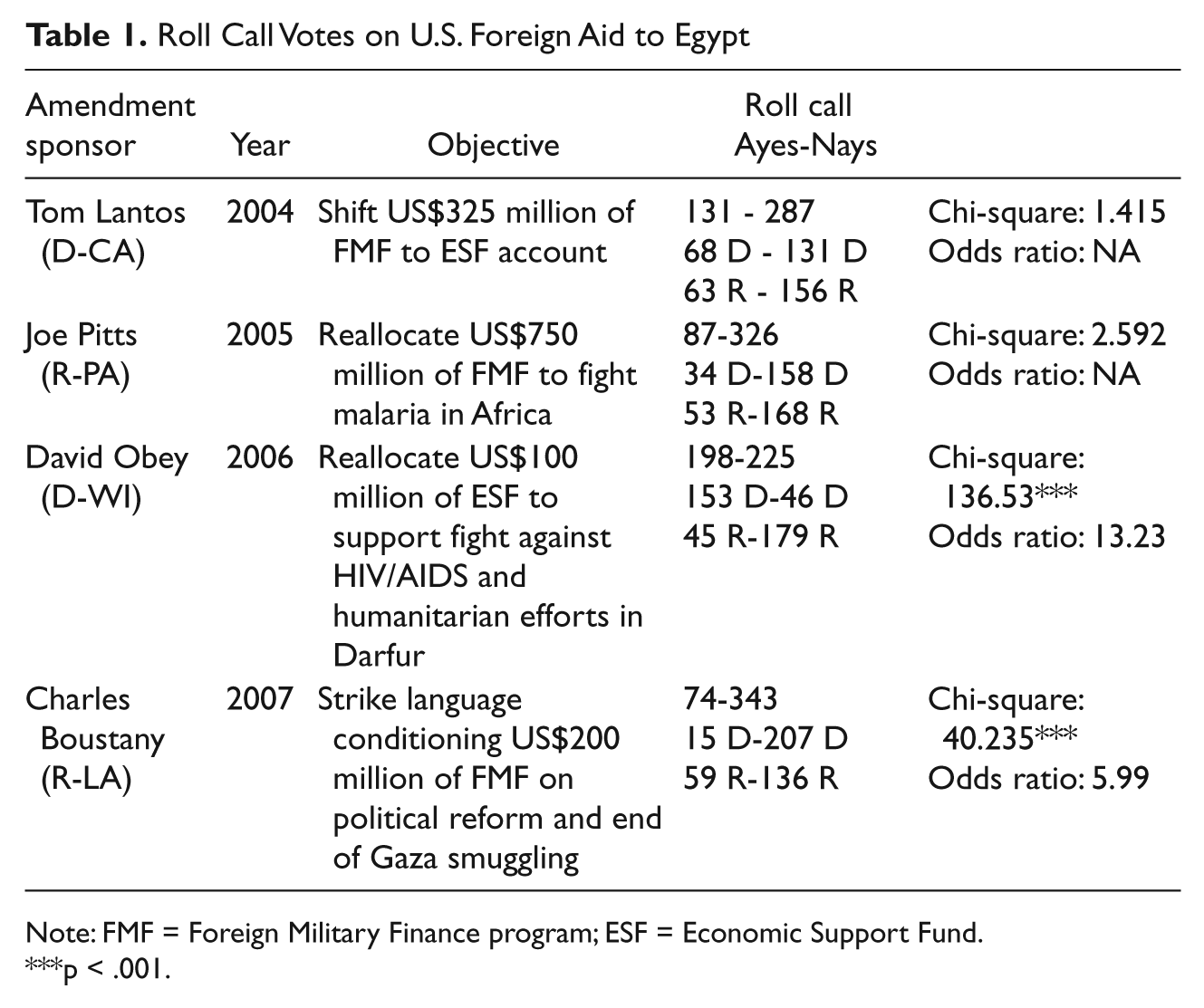
The first vote to be studied here occurred in June 2004 when California Democrat Tom Lantos proposed an amendment that sought to divert US$320 million out of roughly US$1.2 billion in Foreign Military Finance funds to the economic aid account (Table 1). This amendment was significant for two reasons: first, it constituted the first time since the 1979 Egyptian-Israeli peace treaty that either chamber of Congress voted on a proposal to reduce U.S. military aid to Egypt. Second, it highlighted the unraveling of the long-time consensus among those concerned with Israel’s security that U.S. aid for Egypt ultimately makes Israel more secure.
Roll Call Votes on U.S. Foreign Aid to Egypt
Note: FMF = Foreign Military Finance program; ESF = Economic Support Fund.
p < .001.
Gary Ackerman, then-ranking member on the House International Relations Subcommittee on the Middle East and Central Asia, questioned whether Egypt truly needed a U.S.-financed military upgrade when addressing its internal political and social crisis appeared to be the more pressing issue (CR, 2004, p. H5847). Ileana Ros-Lehtinen (R-Fl.), Republican chairwoman of the same subcommittee, even described Egypt as a test case for the “freedom agenda” which President Bush had only launched in earnest with his November 2003 speech at the National Endowment for Democracy (CR, 2004, p. H5848-9).
In their attempt to air frustrations with what they regarded as Egypt’s unnecessary military build-up, supporters of the Lantos amendment threatened to set a precedent that undermined the interest of the U.S. defense industry. This industry’s Congressional allies benefited from the fact that, at this stage, overwhelming majorities of both parties were still willing to follow the Bush administration’s call not to upset the bilateral relationship at a time when Washington’s diplomats were eager to recruit Egyptian support for the Israeli withdrawal from Gaza. The Lantos amendment thus failed with 131 votes to 287 (Table 1).
The second vote occurred in 2005 when Joe Pitts’ (R-Pa.) amendment would have mandated the reallocation of almost half (US$750 million) of the annual U.S. military aid package for Egypt to USAID’s Child Survival and Health Account for fighting such infectious diseases as malaria (Table 1). This vote coincided with U.S. diplomatic pressure which had forced the Egyptian government to announce the first presidential elections in history and the release of liberal politician Ayman Nour, a leading critic of Hosni Mubarak’s intention to simply extend his reign through another heavily orchestrated national referendum.
It also followed outgoing U.S. Ambassador David Welch’s announcement that USAID would, for the first time, offer grants to Egyptian nongovernmental organizations with explicitly political goals (Berger, 2011). It was in this context of cautious optimism that David Obey (D-Wis.), then-ranking member on the Appropriations Committee, was able to insert language into the appropriations bill mandating, for the first time that US$100 million of annual economic assistance could only be used for democracy and education programs. Obey made clear that he was
looking for a way to send a clear signal to Egypt that we find their human rights record to be an embarrassment without thoroughly upsetting the administration’s ability to continue to negotiate in that region, to try to move what is left of the peace process forward. (Congressional Record, 2005, p. H5299)
This move appears to have prompted a number of lawmakers interested in sending Egypt a message on the issue of political reform to oppose Pitts’ more drastic measure which suffered a lopsided defeat of 87 “ayes” against 326 “nays.”
The third vote was significant not only insofar as it was the first time that a partisan gap emerged in 2006. It also reflected increasing Congressional frustration with the Egyptian regime’s unwillingness to react in a constructive manner to ever-expanding calls for political reform. David Obey’s narrowly defeated attempt to reduce or alter aid to Egypt (198 votes to 225, Table 1) resembled the Pitts amendment of the year before as it also sought to transfer portions of U.S. aid to Egypt to aid accounts dealing with other parts of Africa (HIV/AIDS and Darfur). It differed insofar as it proposed to only cut economic aid and even that to a much smaller degree (US$100 million).
By 2007, Egypt’s position had further deteriorated. It suffered from the fact that it was not able to exert the level of influence over the various Palestinian factions necessary to stress its strategic importance in the eyes of skeptical U.S. lawmakers. Smuggling from Egypt’s Sinai to the Gaza strip continued to undermine Israel’s strategic position vis-à-vis Hamas, while Cairo’s diplomatic efforts were overshadowed by Saudi Arabia’s newly confident leadership. On the other hand, the ongoing crackdown on all peaceful opposition infuriated many long-time Congressional supporters of Egypt who felt double-crossed by Cairo’s hollow promises of reform. As David Obey explained in 2007, “I do believe that we have an obligation to expect that countries with whom we are so closely associated will perform within certain norms of decency when it comes to the question of human rights” (CR, 2007, p. H6914-5). Obey consequently inserted a passage into the Consolidated Appropriations Act of 2008 stipulating that US$200 million of foreign military finance funds for Egypt (roughly one sixth of total such outlays) should not be made available
unless the Secretary of State certifies and reports to the Committees on Appropriations that the Government of Egypt has taken concrete and measurable steps to (a) adopt and implement judicial reforms that protect the independence of the judiciary, (b) review criminal procedures and train police leadership in modern policing to curb police abuses, and (c) detect and destroy the smuggling network and tunnels that lead from Egypt to Gaza. (CR, 2007, p. H6913)
An amendment offered by Charles Boustany (R-La.) tried to strike these conditions from the final version of the bill. It failed with 74 votes to 343 (Table 1). The fact that Egypt’s positive impact on Israel’s national security seemed to have diminished and the inclusion of language allowing President Bush to make use of a “national security waiver” soon after the vote explains why 18 Democrats and 48 Republicans, who had consistently voted against altering or cutting U.S. aid to Egypt from 2004 to 2006, now declined to support Boustany’s amendment. Though largely of symbolic nature, this fourth roll call vote was historic insofar as Congress, for the first time, had voted to condition aid to Egypt. It thus marked the culmination of Congressional exasperation with an allied regime that remained stubbornly resistant to genuine political change until an unprecedented public upheaval forced it from power in February 2011.
Data and Method
Dependent Variable
This analysis focuses on the, so far, only post-Cold War roll call votes aimed at cutting, rearranging or simply conditioning the composition of U.S. annual aid to Egypt provided through the Economic Support Fund and Foreign Military Finance program (FMF; Table 1). A vote in favor of altering U.S. aid was coded as “1,” whereas “nays” were coded as “0.” The following models represent results from logistic regression analyses of this binomial dependent variable in each of the four roll call votes over the course of 4 years and three Congressional sessions (108th to 110th).
Independent Variables
To assess the impact of campaign contributions on these votes, the following analysis uses data available from the Center for Responsive Politics. All data were recalculated as the share of the total campaign contributions each representative received in the election cycle preceding the vote from the agriculture, oil and defense lobbies. 4 Although the circumstances and implications of specific amendments differ, the overall effects can be expected to be uniform for the oil, defense and agriculture lobbies across all models because reallocations, cuts and conditionality are all similar in their negative effects on their economic interests. These three lobbies were included in the analysis because agriculture (29%), oil (10%), and defense (10%) products made up a substantial portion of the total volume of U.S. exports to Egypt worth US$23.7 billion from 2005 to 2009 (U.S. Census Bureau, 2009). Reflecting a historical pattern of successful attempts to use foreign and food aid as indirect subsidies for U.S. agricultural products (Winders, 2004), Egypt has consistently ranked among the Top 10 export markets for U.S. agricultural products (U.S. Department of Agriculture, 2007). The annual U.S. military aid package of roughly US$1.3 billion served the interests of a core pillar of the authoritarian regime of Hosni Mubarak by covering between one third and one half of Egypt’s annual defense expenditures as well as 80% of all procurement costs for new military hardware (Clarke, 1997; U.S. Government Accountability Office [GAO], 2006). 5 Without such aid, a poor country such as Egypt could not have afforded to be the United States’ second most important customer of military hardware after Saudi Arabia, purchasing 9.8% of all U.S. arms exports from 1999 to 2008 (DSCA, 2008).
As Egypt’s strategic value for Washington’s foreign policymakers depends to a large extent on its triangular relationship with the United States and Israel (Quandt, 1990), factors that determine roll call votes on the Arab-Israeli conflict are likely to play a critical role as well. Occurring at a time of heightened tensions between Israel and its Arab neighbors, the four votes analyzed here provided ample opportunity to make their mark for members of Congress who were either disillusioned with the Egyptian inability or unwillingness to be more supportive of U.S. and Israeli positions or who remained convinced of the need for continued Egyptian diplomatic and intelligence involvement. The impact of industry contributions is likely to be felt across every of the four votes as the level of either economic or military aid to Egypt was at stake in each of them. The impact of contributions from the pro-Israel lobby is likely to be the strongest in Lantos’ 2004 amendment and Boustany’s 2007 amendment. In both cases, the preceding Congressional debate referenced quite heavily the vote’s impact on Israeli security needs.
Hypothesis 1: Lawmakers who receive a higher share of their campaign contributions from the oil, defense, and agriculture lobbies are less likely to support changes to the status quo in the U.S.-Egyptian aid relationship, whereas lawmakers who receive a higher share of their campaign contributions from the pro-Israel lobby are more likely to support such changes when this is seen as safeguarding Israeli security interests.
Considerations about the U.S. role in the Arab-Israeli conflict are also likely to be linked to the religious faith of individual lawmakers. Oldmixon et al. (2005), for instance, found that Evangelical and Jewish representatives were more likely to sponsor and support legislation deemed as pro-Israel. In the case of Egypt, Evangelicals were also concerned about the ongoing violence and institutional challenges (Tadros, 2009) its substantial Coptic minority has faced. Evangelical activism in the fight against the suppression of (religious) freedoms (Croft, 2007) had already found an early expression in the Freedom from Religious Prosecution Act, which a Republican controlled Congress enacted notwithstanding the Clinton administration’s trepidation over the possible impact on U.S. relations with allied Muslim-majority countries (Holmes, 1997). To test whether this influenced Congressional voting on foreign aid to Egypt, the following models include dummy variables for Jewish and Evangelical members with all others as the omitted category.
Although African American political elites have similarly demonstrated great interest in human rights issues globally, they have tended to identify less with Israelis and more with Palestinians for whom Egypt is an important diplomatic partner (Miller, 2002; Oldmixon et al., 2005). Members of the Congressional Black Caucus could therefore be expected to be more likely to reject attempts to cut aid to Egypt. However, Pitts’ 2005 amendment and Obey’s 2006 amendments would have reallocated funds to support humanitarian efforts in Africa, where members of the Congressional Black Caucus have frequently cooperated with Evangelical colleagues to shape U.S. policies (Heinze, 2007). The following models will therefore include a dummy variable that allows the comparison of African American lawmakers (“1”) with their colleagues (“0”).
Hypothesis 2: Jewish and Evangelical members of Congress are more likely to challenge U.S. aid to Egypt when such changes are seen as safeguarding Israeli security interests whereas African American members of Congress are less likely to challenge U.S. aid to Egypt unless such changes benefit other parts of Africa.
At the same time, representatives interested in reelection need to take into account the interests of ethnic and religious constituencies who tend to mobilize on issues as contentious as Middle East politics. This makes the inclusion of constituency-level variables as a control for the influence of elite-level variables essential. Oldmixon et al. (2005), for instance, linked the share of Jewish Americans among a lawmaker’s constituency with greater support for what they see as a pro-Israeli stance on Capitol Hill. To test whether this factor also helps determine votes on U.S. aid to Egypt, this analysis uses Milner and Tingley’s (2010) data on the share of African Americans, Jewish Americans and Evangelical Christians within each Congressional district. 6
In addition, the following analysis features variables reflecting the percentage of Muslim Americans in a given constituency whose presence has already been shown to be of importance in shaping legislative decisions on domestic issues (Martin, 2009).
7
In one of the first quantitative attempts to assess their influence, a variable measuring the share of Arab American constituents will be included in the analysis as well. Arab Americans are not simply a subcategory of Muslim Americans as two thirds describe themselves as following a Christian faith (Samhan, 2001) and only one quarter of Muslim Americans are of Arab descent (Pew Research Center, 2011). Joseph Baroody, former president of National Association of Arab Americans (NAAA), succinctly summed up the challenges Arab American activists face:
We can’t represent the Arabs the way the Jewish lobby can represent Israel. The Israeli government has one policy to state, whereas we couldn’t represent “the Arabs” if we wanted to. They’re as different as the Libyans and Saudis are different, or as divided as the Christian and Moslem Lebanese (quoted in Spiegel, 1985, p. 8).
Muslim American lobbyists on foreign policy encounter similar problems because the community they represent not only includes Arab Americans, but also Muslim Americans of Iranian, South Asian, African and European ancestry in addition to a sizeable number of African Americans (Pew Research Center, 2011). The influence of the transnational communities (Sheffer, 2006) of Arab and Muslim Americans is thus curtailed by the lack of homogenous country-focus that describes ethnonationalist lobbies such as Cuban Americans (Rubenzer, 2011).
At the same time, Arab and Muslim Americans share an increasing willingness to support the Democratic Party over concerns about Republican views on civil rights and U.S. foreign policies (Arab American Institute [AAI], 2010; Ayers, 2007; Bakalian & Bozorgmehr, 2005; Mazrui, 1996). Indeed, Shain (1996) even claimed that “the Palestinian cause could be said to have provided the very foundations for pan-Arab ethnic identity in America” (p. 46). These two increasingly important voting blocs might thus become involved over the specific political context of the proposals to change aid to Egypt. Representatives of the pro-Arab lobby, for instance, portrayed the “new and recycled allegations” over human rights and anti-Semitism against Egypt and Saudi Arabia as an attempt to weaken their standing in the United States and make it more difficult for these countries to push Washington toward a more active Middle East diplomacy (Dumke, 2006, pp. 91-92). The Arab American Institute (AAI)—set up by James Zogby as an instrument to get Arab Americans involved in the political process (Nimer, 2003)—used a vote in favor of Boustany’s 2007 amendment as an indication of pro-Arab views when constructing its annual Congressional scorecard. This decision reflected Zogby’s retreat from an earlier attempt to establish Arab Americans as a force for political reform in the Arab world. Shain describes the focus on the “safer” issue of the Arab-Israeli conflict as indicative of the financial dependence of many Arab American lobby organizations on Arab regime donors that led leaders of the Arab American Diaspora to effectively stifle debate about Arab authoritarianism. It is thus not surprising that extensive assessments of the successes and failures of the Arab American lobby in the realm of foreign policy (Marrar, 2009) focus on the Arab-Israeli conflict exclusively.
Direct lobbying by Arab governments relied on the services of influential Washington insiders. In late 2010, lobbying by Tony Podesta, former Republican Representative Robert Livingston and former Democratic Representative Toby Moffett successfully persuaded the U.S. Senate against passing Resolution 586 introduced by John McCain (R-Ariz.) and Russ Feingold (D-Wis.) which had called on the Egyptian regime to end arbitrary arrest and ensure that the presidential and parliamentary elections scheduled for 2011 were “free, transparent, and credible.” In the process, Moffett declared that this resolution would be viewed as an “insult” by “an important ally” (Lichtblau, 2011). As currently available data sets of Arab American public opinion focus predominantly on issues relating to the Arab-Israeli conflict, the Iraq war and the U.S. war on terrorism (AAI, 2008, 2007, 2010), media reports about Arab American grass-roots support for Egypt’s revolution provide the only indication that Arab American public opinion was much less tolerant of the Egyptian regime than the Washington lobbyists on its payroll (Dado, 2011). The inclusion of data on the share of Arab and Muslim Americans among a Congressional district’s population will thus offer first insights into which interpretation of attempts to change U.S. aid dominated among the wider Arab and Muslim American communities and those representing them in the years leading up to the Egyptian revolution.
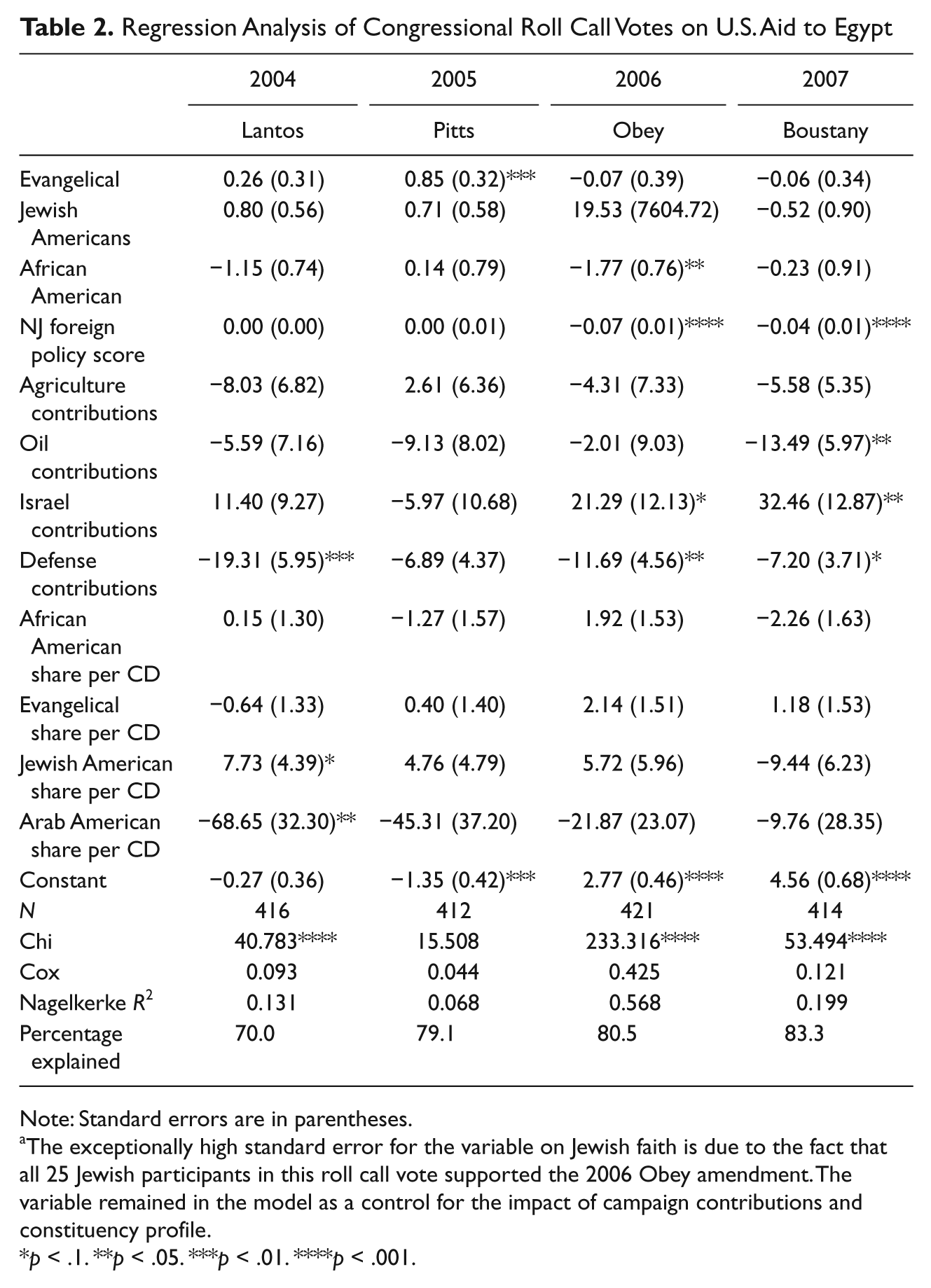
Data on the number of Arab Americans per Congressional district was taken from the 2006-2008 American Community Survey 3-year estimates (U.S. Census Bureau, 2008). 8 Due to their correlation (Kendell’s τ = .454) variables for Arab and Muslim Americans were included in separate models. Although results for both variables are discussed, only models with the variable for Arab American share per Congressional district population are included in Table 2 to conserve space.
Hypothesis 3: In instances where there is a clear link to the conflict between Israel and its Arab neighbors, U.S. representatives from districts with substantial Jewish and Evangelical constituencies are more likely to condition aid to Egypt while U.S. representatives with substantial Arab, Muslim and African-American constituencies will oppose such efforts.
Regression Analysis of Congressional Roll Call Votes on U.S. Aid to Egypt
Note: Standard errors are in parentheses.
The exceptionally high standard error for the variable on Jewish faith is due to the fact that all 25 Jewish participants in this roll call vote supported the 2006 Obey amendment. The variable remained in the model as a control for the impact of campaign contributions and constituency profile.
p < .1. **p < .05. ***p < .01. ****p < .001.
Finally, the partisan controversies over the Bush administration’s “Freedom Agenda” suggest that partisanship and ideology might constitute elite level factors that shaped Congressional views on U.S. aid to Egypt. Milner and Tingley (2011) showed that presidential positions have an important impact on making members of their own party more likely to vote in favor of foreign aid. This effect was particularly strong with regard to the willingness of Republican representatives to follow Republican presidents in supporting military aid. As the decision to grant aid to Egypt is closely linked to national security concerns, President Bush’s views on this issue can be expected to exert influence on members of his own party. As mentioned above, the Bush administration was consistent in opposing all four attempts to change the U.S. aid relationship with Egypt. This lack of variability makes the public stance of the Bush administration redundant as a possible variable.
Some authors also point out that measures of ideology based on patterns of Congressional voting such as Pool and Rosenthal’s DW-Nominate scores should be treated with caution as it can be assumed that they themselves already reflect constituency interests (Fleck & Kilby, 2006; Fordham & McKeown, 2003). Milner and Tingley (2010) found, for instance, that support for foreign aid is mostly determined by the economic characteristics of a Congressional district and the ideologies of its constituents.
Nevertheless, the partisan differences that emerged in the 2006 and 2007 roll call votes (Table 1) when Democrats were significantly more likely to vote for conditioning or cutting aid to Egypt than Republicans mean, however, that omitting this control could potentially result in variables reaching significance that only reflect well-known differences between the two parties in terms of campaign contributions and constituency profile. 9 The addition of a variable for legislator ideology also serves to control for the effects of friendly giving by some of the lobbies included here (Roscoe & Jenkins, 2011). This will increase confidence in possible findings about the effect of campaign contributions. The following analysis will thus use an additional model for each vote that includes ideology as measured in Poole and Rosenthal’s DW-Nominate scores which, in their first dimension, indicate a representative’s view of the appropriate level of government intervention in the economy (Poole & Rosenthal, 2000).
As the immediate distributional effects of conditioning or cutting aid to Egypt were rather limited in at least two of the votes considered here, alternative measures of legislator ideology other than DW-Nominate might serve as more robust predictors. In fact, the decision to introduce human rights concerns into the debate on foreign aid to Egypt is not comparable to the votes on the “high-focus economic aid” with broad domestic repercussions that Milner and Tingley (2010) studied, or the votes on international financial rescues analyzed by Broz (2005). In some foreign aid votes, a representative’s interest in reelection will not necessarily enter the calculation as many voters do not perceive their interests as affected (Irwin, 2000). The votes studied below are thus more likely to reflect a lawmaker’s general belief in whether normative considerations should guide U.S. foreign policy in general and U.S. foreign aid in particular. Previous studies of U.S. security assistance have shown that Congressional liberals tend to be more critical of security assistance for authoritarian governments with poor human rights records than their conservative colleagues (Clarke et al., 1997, pp. 102-104). More recently, Milner and Tingley (2011) have shown that in votes taken between 1979 and 2004, conservative U.S. Representatives more inclined to follow presidential calls for supporting military aid than was the case with calls to support economic aid.
The National Journal offers one such measure of ideology for all lawmakers taking part in at least half of the “key” roll call votes throughout a particular Congressional session. Ranging from 0 to 100, the National Journal’s foreign policy-conservatism score indicates how often an individual representative voted more conservative than others on issues such as withdrawal from Iraq, paying dues to the United Nations, and free trade agreements (for full details on ranking methodology, see National Journal, 2007). The inclusion of this measure of ideology will test whether Congressional foreign policy liberals have been more likely to support changes to the aid relationship with Egypt.
Hypothesis IV: Members of Congress with a more liberal voting record on foreign policy issues are more likely to challenge the status quo in U.S. aid for Egypt.
Analysis
Descriptive analysis
Bivariate correlations reported in Table 1 and Mann-Whitney independent samples tests summarized in Tables 2 a-d of the online appendix 10 show campaign contributions as the only set of predictors that register statistically significant differences between opponents and supporters of changes to U.S. aid for Egypt across all four votes. As suggested in hypothesis 1, the adherents of sustained aid for Egypt received noticeably higher campaign contributions from the defense lobby in 2004, 2005, and 2006. A similar pattern emerges for Republican recipients of agriculture contributions in 2006 and 2007. Those inclined to challenge aid to Egypt received more contributions from the pro-Israel lobby in 2004 in general and among Democrats in 2006.
There is no such consistent empirical evidence for hypotheses 2, 3, and 4 (Tables 2a-d, online appendix). Republican supporters of cutting aid to Egypt were economically more conservative than their Republican opponents in 2005, but more liberal on foreign policy in 2006. Democratic supporters of cutting aid to Egypt were more liberal on both economic and foreign policies than their Democratic opponents in 2006. Although Evangelical members of Congress were more likely to vote for the Pitts amendment of 2005, they were less likely to support Democratic efforts to condition aid to Egypt in the partisan votes of 2006 and 2007. With the exception of 2005, Jewish members of Congress were strongly in favor of changing the U.S. aid relationship with Egypt. But only in 2004 and in 2006 did their support diverge significantly from the House as a whole. African American lawmakers set themselves apart only in 2006 when they proved almost four times more likely to support redirecting aid from Egypt to other parts of the African continent.
The influence of constituency characteristics appeared equally limited (Tables 2a-d, online appendix). Only in 2005 did the higher relative share of Arab and Muslim Americans set apart the opponents of cutting aid to Egypt. The fact that in 2006 U.S. representatives with a higher share of Arab and Muslim Americans were more likely to condition aid is possibly due to the fact that many Jewish American lawmakers, all of whom supported the Obey amendment, represent comparatively large Arab and Muslim American constituencies. Representatives from larger Jewish American constituencies were more likely to be found among supporters of cutting aid to Egypt in 2004 and in 2006. The smaller size of Evangelical constituencies differentiated supporters of changing aid to Egypt from their colleagues in 2004 and 2006. The smaller size of African American constituencies set apart supporters of cutting to Egypt among Democrats in 2004 and 2007. Among Republicans this pattern was reversed in 2004.
With the initial descriptive analysis cautiously pointing toward a fairly consistent role of campaign contribution as compared to other elite or constituencies variables, the following regression analysis will establish which variables acted as robust predictors of Congressional support for U.S. aid to Egypt.
Regression analysis
Results reported in Table 2 provide compelling empirical support for hypothesis 1. Campaign contributions from lobbies with interests at stake in the U.S.-Egyptian relationship emerged as the most consistent type of predictor with relevance in three out of four roll call votes. Particularly noticeable was the impact of contributions from the defense lobby in predicting greater reluctance to change U.S. aid for Egypt. As Figure 1 makes clear, in both 2004 and 2006 the probability of supporting changes to U.S. aid for Egypt was on average at least twice as high for those who did not receive any contributions than was the case for those who received 10% or more of their campaign contributions from the defense lobby.
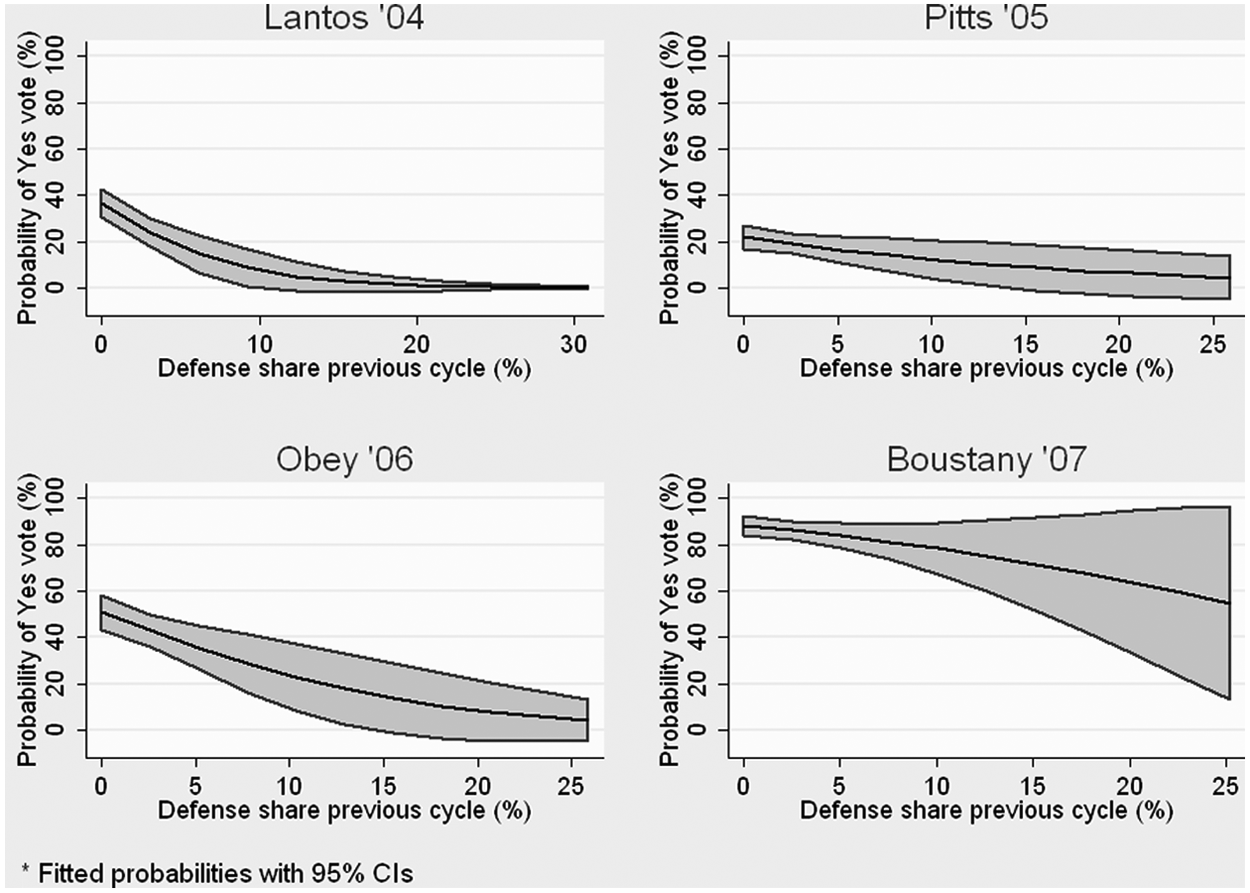
The Impact of defense industry campaign contributions on the probability of voting in favor of changes to the U.S. aid relationship with Egypt
These numbers also found reflection in floor statements by prominent recipients of defense lobby funds. In 2004, Bill Young (R-Fl), then chairman of the Appropriations Committee, was straightforward in expressing the concerns of those members of Congress who were particularly reliant on contributions from the defense lobby. With 19.6% of his campaign contributions in the previous election cycle coming from the defense lobby (ranking fifth overall), Young quoted a letter from Secretary of State Colin Powell who warned that the reduction in military assistance under consideration could lead to the cancellation of almost US$2.2 billion in total contract value (CR, 2004, p. H5848). In 2006, Roger Wicker (R-Miss.), who ranked 30th in terms of the relative size of defense lobby contributions, highlighted Egypt’s pragmatic approach in allowing the passage of U.S. nuclear warships through the Suez Canal and in granting over-flight rights for U.S. aircraft, “We do foreign assistance for altruistic reasons, certainly for humanitarian reasons, of course. But the main reason we do foreign assistance is we do it in the American national interest” (CR, 2006, p. H3539-40). 11
Brian Baird (D-Wash.), who enjoyed defense lobby contributions that put him among the top third among Democrats, even mocked the international outcry over the regime’s violence against peaceful protesters,
Yes, there are concerns. But goodness gracious, could you not turn on the TV occasionally and see demonstrators clashing with police in our own country? And do we not have other allies in that country and elsewhere on this planet that have treated journalists harshly? (CR, 2006, p. H3545)
David Price (D-N.C.) whose dependence on defense lobby contributions was almost twice his party’s median (0.8% versus 0.48%) presented a similarly “realist” argument when he asserted that the Egyptian intelligence service’s mediation efforts under the leadership of General Omar Suleiman in Gaza were becoming even more important in the aftermath of Hamas’ election victory in early 2006 (CR, 2006, p. H3540). 12
Such appeals to Egypt’s service in the U.S. and Israeli national interests explain why contributions from the pro-Israel lobby failed to reach conventional levels of significance in three out of four votes. They reflected disagreements on whether cuts to U.S. aid to Egypt truly served U.S. and Israel interests. In 2004, Republican Jim Kolbe (R.-Ariz.), then-chairman of the Appropriations Subcommittee on Foreign Operations and ranking fourth in terms of the relative size of pro-Israel lobby contributions (7.1% of overall campaign contributions), directly quoted from the aforementioned letter sent by Secretary Powell who claimed that “(o)ur credibility in this relationship depends to a great degree on being a reliable provider of assistance to the Egyptian military” (CR, 2004, p. H5851). Before emerging as a leading voice of conditionality in 2006 and 2007, Nita Lowey (D-N.Y.), ranking member on the same subcommittee and ranking 19th in terms of pro-Israel contributions in 2004 (3.6% of overall contributions), argued that U.S. relations with Egypt should not be subjected to unnecessary provocations at a time when Cairo promised to play a central role in the Gaza withdrawal, which Ariel Sharon’s government had officially agreed on only one month before the vote (CR, 2004, p. H5847).
Hamas’s rise to power in Gaza explains why campaign donations from the pro-Israel lobby ultimately became significant in the 2007 vote (Table 2). Representatives Lantos (ranking 10th in terms of pro-Israel lobby contributions in 2007, 5.0% of overall contributions) and Lowey (ranking 21st in 2007, 2.9% of overall contributions) aired their frustrations over Egypt’s perceived failure on the Gaza issue. Tom Lantos even declared the “nightmare” unfolding after the Hamas takeover to be “in no small measure, the responsibility of the Government of Egypt” (CR, 2007, p. H6914).
Unlike previous years, the negative impact of contributions from the oil lobby on support for aid conditionality was robust to the addition of a control for lawmaker ideology in 2007. It thus seemed rather appropriate that the effort to strike language conditioning aid was led by Charles Boustany, who had received the 29th largest share of oil lobby contributions in the preceding election cycle. Like all other supporters of unconditional U.S. aid to Egypt, he alluded to Egypt’s important regional role since Camp David (CR, 2007, p. H6913).
Hypothesis 2 about the role of elite level variables finds only weak support. If controlled for the impact of other factors, the statistical significance of the voting patterns of Jewish and African American members of Congress vanishes. 13 The 2006 vote constitutes an exception insofar as the variable for African American members remains not only significant, but also changes its sign from positive to negative in the models that control for ideology (online appendix). This seems particularly striking in light of the strong support usually offered by African American lawmakers for such aid (Uscinski, Rocca, Sanchez, & Brenden, 2009) and Table 1 of the online appendix showing that African American lawmakers were almost four times more likely to vote for changes to aid to Egypt in 2006 than their colleagues (Online Appendix). This raises the question as to whether there are statistically significant differences observable in terms of ideology, constituency profile and campaign contributions among the 10 members of the Congressional Black caucus who voted against their thirty African American colleagues and the diversion of US$100 million in aid from Egypt to the accounts for Darfur and the Department of State’s Global HIV/AIDS initiative.
A Mann-Whitney test revealed that both groups only differed in their constituency profiles. In terms of Jewish American constituents, the difference between African American supporters of the Obey amendment (Median = 4.3%) and its African American opponents (1.0%) only very narrowly missed significance (U = 88.500, z = −1.922, p = .055, r = –.30). Even more importantly, Obey’s African American supporters represented larger African American constituencies (Median = 56.7%) than his African American opponents (43.6%; U = 84.000; z = −2.061; p < .05; r = −.33). Reflecting the expected or demonstrated interests of their voters, the overwhelming majority of the Congressional Black Caucus followed the lead of Danny Davis (D-Ill.) and Al Green (D-Tex.) who had only been arrested two days before the vote while protesting in front of the Sudanese embassy in Washington, D.C. According to Green, opponents of the Obey amendment would have to ask themselves, “Where were you when there was murder and rape and hunger in Darfur? Where were you when your brothers and your sisters were suffering?” (CR, 2006, p. H3546). The 2006 vote thus provides an intriguing example of how political leaders can increase the chances of legislative success by making proposed legislation attractive to the overlapping interests of different constituencies. 14
The 2005 vote was the only vote where an elite-level variable other than ideology was robust to various model specifications (Table 2). Having long been concerned about poverty in Africa (Hearn, 2002; Huliaras, 2008), Evangelical lawmakers were attracted to Pitts’ appeal to redirect aid from an “ally like Egypt that refuses to make the necessary political, democratic and human rights reforms” to protecting the poor and vulnerable from infectious diseases (CR, 2005, p. H5298). In 2006, the impact of Evangelical faith becomes insignificant in the models that control for ideology. This reflects the fact that during the respective Congressional session Evangelical representatives were significantly more conservative than all other lawmakers on economic issues (Median = .452 vs. −.188, U = 6484.00, z = −7.536, p < .001, r = −.36) and foreign policy issues (Median = 73 vs. 43, U = 6582.00, z = −7.405, p <.001, r = −.36).
In accordance with previous studies of Congressional roll call votes on U.S. Middle East policies (Rosenson et al., 2009) hypothesis 3 about the impact of constituency-level variables finds only weak support as well. Only in 2004 did these variables play a role robust to model specification (Table 2). Reflecting the significance of the corresponding variable in predicting the 2004 vote, Republican Joe Knollenberg and Democrat John Dingell (both Mich.), who represented the third and fifth most populous Arab American constituencies in relative terms, rose in opposition to the Lantos amendment and recalled the legacy of the Egyptian-Israeli peace treaty (CR, 2004, pp. H5849, H5851). In the case of Joe Knollenberg, the perceived interests of Arab American voters were all the more important due to his consistently slim margins of victory in the marginal 9th Congressional district. The 2004 models thus suggest that Arab Americans, insofar as they became politically involved, understood the Lantos amendment as punishment for Egypt’s criticism of Israeli policies toward the Palestinians in the wake of the so-called al-Aqsa intifada.
The overall influence of Muslim American constituents was also noticeable only on the side of those opposing any change to U.S. aid for Egypt. In 2007, their relative strength explained why five African American lawmakers—Democrats Meeks (New York), Jackson-Lee (Texas), Kilpatrick (Michigan), Clarke (New York), Lee (California)—again broke ranks with the rest of the Congressional Black Caucus. 15 A Kolmogorov-Smirnov test showed that they differed significantly in the higher share of Muslim Americans in their districts, D(36) = .67, p < .05 (Median 2.25 vs. 0.86%), with Arab Americans narrowly missing conventional levels of significance, D(36) = .57, p <.10 (Median 0.66 vs. 0.35%). In 2006, Carolyn Kilpatrick, who ranked 17th overall in terms of Muslim American constituents and 33rd in terms of Arab Americans, had already portrayed the continuing support for Egypt as reflecting the need to respect other cultures and religions (CR, 2006, p. H3540). During the same debate, Jackson-Lee, ranking 45th in terms of Muslim American constituents (1.4%), ridiculed criticism of the show trial of Ayman Nour (CR, 2006, p. H3543). In 2007, Keith Ellison (D-Minn.), the first Muslim American elected to Congress, warned of “a very hostile and unhealthy message” (CR, 2007, p. H6914). The resistance of these five lawmakers to join their Democratic colleagues in conditioning aid to Egypt thus constitutes evidence that at least on a subordinate, intra-party level, the presence of Muslim Americans exerted an influence.
The voting in 2005 constituted a special case insofar as it was the only vote where economic conservatism was significantly associated with greater support for cuts to the aid allocation for Egypt (Table 4, online appendix). This was not simply a reflection of a partisan split, which, as Table 1 illustrates, did not occur, but of a split within the Republican conference, which saw supporters of the Pitts amendment as significantly more conservative than its opponents in terms of economic issues (Table 2b online appendix; U = 2255.00, z = −5.38, p < .001, r = −.36). Interestingly, the alternative measure of foreign policy conservatism as calculated by the National Journal was insignificant.
At first glance, the significance of economic and foreign policy conservatism in the last two votes simply reflects the emergence of partisan differences (see Table 1). In fact, as expected, the lack of economic implications for U.S. constituencies meant that the DW-Nominate variable turned insignificant when a dummy variable was added as a control for party membership (models not shown to conserve space). In contrast, the variable capturing the National Journal’s foreign policy conservatism rankings remained robust to such addition in 2006 and only narrowly retreated outside conventional margins of statistical significance in 2007. Further empirical evidence for the influence of foreign policy conservatism emerges from the comparison of the supporters and opponents of the Obey amendment in 2006. Not only were Obey’s Democratic supporters more liberal (Median = 20) than his Democratic opponents (Median = 31, z = −3.741, p < .001, r = −.27). Obey’s Republican supporters were also significantly more liberal on foreign policy issues (Median = 59) than their Republican colleagues (Median = 73, z = −.046, p = < .001, r = −.40).
The finding that in line with hypothesis 4 foreign-policy liberalism played a role in Congressional voting on Egypt corroborates similar observations on votes where the economic interests of broader segments of the electorate are not at stake (Uscinski et al., 2009). It also marks the convergence within the Democratic caucus on the need to push Egypt much harder on the issue of political reform. The reluctance among many Republicans go along provides another empirical confirmation for the finding (Milner & Tingley, 2011) that Republican presidents have considerable sway over Congressional allies of the same party when it comes to generating support for military aid.
It was no coincidence that David Obey and Nita Lowey, two long-time stalwarts of the U.S.-Egyptian aid relationship on the Appropriations Committee, would plead the case for change. In 2006, Obey described his successful attempt to forestall Pitts’ much more strident proposal the year before as an attempt to give “notice to the Egyptian government that my patience, and the patience of the American people, was wearing thin” (CR, 2006, p. H3538). Referring to brutal assaults on peaceful protestors, Lowey added,
We, as members of this committee, delivered those messages in person. We understand that Egypt is a close, essential, strategic ally which is precisely why we tried to deliver those messages quietly, in private. It did not work. . . . The pictures on CNN when we were even in Egypt kept appearing. (CR, 2006, p. H3542)
Instead, as Obey noted, emergency laws had been extended yet again; the liberal reform candidate of the 2005 presidential election, Ayman Nour, had been sent to prison in a trial widely regarded as politically motivated; municipal elections had been postponed; peaceful protestors arrested and beaten; and, in the week before that debate, the work of the International Republican Institute had been suspended after its country director had criticized the pace of reform (CR, 2006, pp. H3537 and H3542). The powerful example of Obey’s and Lowey’s conversion from opponents to supporters of conditioning aid to Egypt in the name of human rights explains why the 54 Democrats (including party leaders Nancy Pelosi and Steny Hoyer) who had voted against the Lantos and Pitts amendments in 2004 and 2005 would now leave their previous hesitation behind and support Obey in 2006 and 2007.
Conclusion
This analysis has not only highlighted the evolution of Congressional thinking on the U.S. aid relationship with Egypt leading up to the revolutionary developments of early 2011 but also offered new insights into the shape of the coalition that had, for a long time, maintained one of the most prominent items in the annual U.S. foreign aid budget.
In its most important finding, this article unearthed new evidence to suggest that campaign contributions can play a role in determining the voting behavior of U.S. representatives. In its successful effort to shield the regime of Hosni Mubarak from the effects of serious human rights conditionality, the Bush administration could rely on those representatives that depended more heavily on financial support from U.S. defense and oil industries. This finding is even more significant because the models presented here include controls for legislator ideology as well as more than one contribution variable; something meta-analysis has shown is reducing the likelihood of campaign variables reaching significance (Roscoe & Jenkins, 2011).
When in 2007 the relevant vote clearly addressed Israeli security concerns over smuggling from the Sinai Peninsula into Gaza, campaign contributions from the pro-Israeli lobby also became statistically significant. Both observations are of great consequence for further academic inquiry. First, they challenge arguments about the irrelevance of campaign contributions and offer new evidence for the continuing influence of the defense industry lobby in maintaining U.S. security assistance (Clarke et al., 1997). Second, they highlight the influence of the pro-Israel lobby in shaping Congressional decision making. This is important as claims about the link between campaign contributions and a pro-Israeli voting pattern however defined are at the heart of the debate about the Congressional influence of the pro-Israel lobby (Lieberman, 2009; Mearsheimer & Walt, 2007).
Over time, supporters of a cordial relationship with Egypt’s authoritarian ruler had to face not only a cross-party coalition of members who sought greater Egyptian support in safeguarding perceived Israeli security concerns. In light of the unwillingness of the old regime in Cairo to react in a constructive way to domestic and international calls for an improvement in its human rights record, a growing number of foreign-policy liberals were ready to move beyond long-held assumptions about U.S. Middle East policies and to reassess the fundamentals of U.S.-Egyptian relations. As became evident in early 2011, support for these two agendas was much easier to align when an orderly and incremental move toward genuine political reform still seemed possible. In light of the momentous and unpredictable nature of revolutionary change in wake of the collapse of the Mubarak regime, Malcolm Hoenlein, executive vice chairman of the Conference of Presidents of Major American Jewish Organizations, stressed that
we’ve always supported the movement toward democratization. At the same time, you don’t want to see upheaval that could be exploited by extremist elements in the region. We would be very concerned that elements would come into power that would not sustain the involvement of Egypt in the peace process and sustain the commitments in the peace agreements. (cited in Elliott, 2011)
The tension between concerns about Egypt’s domestic predicaments and the ongoing crisis of the Middle Eastern peace process also manifested itself in some early evidence for the emerging clout of Muslim and Arab American political activism. Although the influence of Muslim Americans was noticeable mostly with regard to some otherwise very liberal African American members of the Democratic caucus, Arab American presence helped predict a Congressional vote on U.S. aid to Egypt in at least one instance. Both cases are noteworthy insofar as they offer the first pieces of quantitative evidence that Arab and Muslim Americans are capable of shaping Congressional voting on U.S. foreign policy.
At the moment, the policy preferences of Arab and Muslim Americans are not always fed into the political process due to their geographic distribution. This is because, in many cases, they share culturally diverse districts with long-established and well-organized Jewish communities that have traditionally helped elect Jewish members of Congress. In fact, during the three Congressional sessions studied here, eight (four) lawmakers representing the thirty most populous Arab (Muslim) American communities in relative size were Jewish.
The question further research will have to look into is why the (limited) influence of Arab and Muslim American constituencies was noticeable on the side of those opposing conditioning aid to Egypt. This might be explicable by their unease about measures which some viewed solely in the context of the Arab-Israeli conflict. It could also reflect the reluctance to push for political change seen as destabilizing. One survey conducted during the early stages of the “Arab Spring” suggested that Muslim American public opinion was evenly split (44% to 44%) between those who said that it was more important to have democratic governments in the Middle East, even if there was less stability in the region and those who chose stability over democracy (Pew Research Center, 2011). With similar surveys on Arab American public opinion so far lacking, further research is needed to confirm to what extent the activities of those Washington lobbyists who depended on the generous financial support from Arab regimes (Eggen, 2011) truly represented the political sentiments of the broader Arab American communities in the United States. Given the (in all likelihood) increasing political clout of Arab and Muslim Americans, this question warrants closer attention in further studies of U.S. policies toward the emerging new Middle East.
Footnotes
Acknowledgements
I am grateful to Britta Berger-Voigt, Jeff Biggs, Meghan Davis, Jocelyn Evans, John Garrard, Paul Rundquist, Jan Shinpoch as well as to the editor and anonymous reviewers for helpful comments on earlier drafts.
Declaration of Conflicting Interests
The author declared no potential conflicts of interest with respect to the research, authorship, and/or publication of this article.
Funding
The author received no financial support for the research, authorship, and/or publication of this article.