







Abstract
Using a nationally representative data set (N = 3,000), the Public Religion Research Institute’s American Values Survey, we conduct multivariate regression analysis to determine the empirical impact of attitudes regarding the birth control mandate and abortion on presidential vote choice. We also conduct factor analysis to determine whether voters conceptualized the birth control mandate and abortion similarly. We find that support for the Obama administration’s birth control mandate was significantly related to voting for Obama for both women and men voters, although the impact was stronger for women. However, the impact of the “War on Women” rhetoric on voters’ choices was limited to the issue of insurance coverage for birth control rather than extending to the issue of abortion. Unlike attitudes about abortion, we find that voters conceptualized the birth control mandate less as a “culture war” issue and more as a “role of government” issue. Given this conceptualization of the mandate by voters, our findings reaffirm previous research that suggests that the gender gap in voting is largely driven by attitudinal differences regarding the role of government in providing social welfare benefits and equal opportunity for women.
Women’s issues played a prominent role in the 2012 elections due in no small part to the controversy surrounding the Obama administration’s decision to make insurance coverage of birth control a requirement for all workplaces, even religiously affiliated hospitals and colleges, as part of its health care reform effort. This birth control mandate was met with fierce opposition from the U.S. Conference of Catholic Bishops and other conservative religious organizations. Such organizations viewed the mandate as a violation of religious freedom—a position that was also taken vocally by the Romney campaign. Proponents of the measure, however, sought to paint Romney’s opposition to the mandate as hostility toward women’s health care. Planned Parenthood Action Fund created a giant pack of birth control pills, which they dubbed “Pillamina,” to follow the Romney campaign in the summer of 2012 as a way to portray access to contraception as an economic issue for women. Planned Parenthood President Cecile Richards claimed “[t]hat’s something that President Obama clearly understands, and that Mitt Romney simply doesn’t” (Viebeck, 2012). The birth control mandate controversy followed a heated session of Congress in which congressional Republicans attempted to stop federal funding for Planned Parenthood, one of the nation’s largest providers of basic health care, including abortion and contraceptive services, for poor women. Mitt Romney vowed to defund Planned Parenthood if he was elected President. Romney’s positions on both issues were the centerpiece of several advertisements run by the Obama campaign in the summer of 2012, including one ad featuring two women, Dawn and Alex, who described Romney as being “extreme” and “really out of touch on women’s health issues.” Said Alex in the ad, “[T]his is not the 1950s. Contraception is so important. It’s about a woman being able to make decisions” (Politifact, 2012).
Another reproductive health issue, abortion, was also front and center in the 2012 elections as the rhetoric of several anti-abortion Republican candidates made national headlines. U.S. Representative Todd Akin, running for the Missouri Senate seat, claimed in a televised interview that a rape exception for abortion was unnecessary because victims of “legitimate rape” rarely get pregnant. In a debate against his Democratic opponent Joe Donnelly, Indiana Republican Senate candidate Richard Mourdock defended his stance that abortion should be outlawed in cases of rape because God intends pregnancies to happen “even when life begins in that horrible situation of rape” (Krieg & Good, 2012). Democrats quickly jumped on these statements as indicative that the Republican Party was out of touch on women’s issues. Democratic National Committee (DNC) Chair Debbie Wasserman Schultz described Mourdock’s words as “outrageous and demeaning to women,” claiming that “they’ve become part and parcel of the modern Republican Party’s platform toward women’s health, as Congressional Republicans like Paul Ryan have worked to outlaw all abortions and even narrow the definition of rape” (Wasserman Schultz, 2012). Obama campaign spokeswoman Jen Psaki tied Mourdock’s words to the Romney campaign, claiming that the incident was “a reminder that a Republican Congress working with a Republican President Mitt Romney would feel that women should not be able to make choices about their own health care” (Benac & Agiesta, 2012). Obama himself, in a response to the “legitimate rape” comments made by Todd Aiken, also sought to distinguish his party’s approach to this issue and the GOP, saying,
I think the underlying notion that we should be making decisions on behalf of women for their health care decisions—or qualifying forcible rape versus non-forcible rape—I think those are broader issues, and that is a significant difference in approach between me and the other party. (“Did You See,” 2012)
Republican opposition to the birth control mandate, Planned Parenthood funding, and access to abortion even in cases of rape led many Democratic leaders, including House Minority Leader Nancy Pelosi and Senator Barbara Boxer, to claim repeatedly on the campaign trail that the GOP was leading a “War on Women” (Boxer, 2012; Lillis, 2012). Many pundits argued that this “War on Women” narrative played a direct role in Obama’s clear victory among women voters. Indeed, Barack Obama extended his appeal among women voters, as the gender gap—defined by the difference in the percentage of women voting for Obama compared with the percentage of men voting for Obama—grew from 7% in 2008 to 10% in 2012. Journalist Michelle Goldberg (2012) of the Daily Beast argued that Obama’s success among women voters vindicated the War on Women strategy, writing that “[a]ll modern Democratic presidential candidates run as defenders of Roe v. Wade, but Obama was unique in foregrounding women’s health, turning Planned Parenthood’s Cecile Richards and Georgetown Law graduate Sandra Fluke into major campaign surrogates.” 1 Some conservative leaders also believed that the “War on Women” frame was effective and chastised Republicans for not doing more to gain the women’s vote. Writing in The National Journal, Carrie Lukas (2012) of the Independent Women’s Forum wrote, “This should be a wakeup call for everyone on the right. I count myself among those who assumed—clearly wrongly in hindsight—that the ‘War on Women’ rhetoric wouldn’t work.”
Is this conventional wisdom that Obama won the women’s vote in 2012 due to the War on Women narrative correct? More specifically, did attitudes about the Obama administration’s birth control mandate and abortion rights impact vote choice in the 2012 presidential election, especially for women voters? Using a unique data set that asked voters their attitudes about the Obama administration’s birth control mandate and abortion, we examine whether support for the birth control mandate and abortion rights had a direct impact on voting for Barack Obama, and if so, which issue had greater salience among voters. 2 Moreover, we consider whether these issues mattered more for women as compared with men voters, given the efforts by Democratic strategists to target women voters directly with the “War on Women” theme. Our study represents the first empirical investigation of the effect of insurance coverage for birth control on presidential voting.
We find that women were significantly more likely to back the Obama administration’s birth control mandate than men, and that support for the mandate was a key predictor of vote choice in the 2012 election. Although this effect was stronger among women, male proponents of the law were also significantly more likely to cast their ballots for the president’s reelection than men who opposed the policy. Despite some key differences between men and women, the increased likelihood of a vote for Obama due to support for the mandate rivaled the effects of other salient campaign issues, including opinion on the broader Affordable Care Act, government aid to the poor, attitudes regarding religious liberty, and, for women voters at least, same-sex marriage. In contrast to the importance of the birth control mandate, abortion attitudes were not a strong predictor of respondents’ decision to vote for Obama or Romney.
Our findings suggest that the “War on Women” rhetoric was an effective argument for the Obama campaign, especially among women, but that its reach was limited to the issue of insurance coverage for birth control, rather than extending to the issue of abortion. We argue that this is the case because voters conceptualized the issues differently. Unlike abortion rights, support for the use of birth control is far less controversial, and the birth control mandate is not viewed solely as a reproductive rights issue but also as a necessary economic benefit for women. Through factor analysis, we find that that voters’ attitudes on abortion link strongly to other culture war issues, such as same-sex marriage and legalization of marijuana, while their attitudes about the birth control mandate are related to attitudes about the size and scope of government, particularly as it relates to social welfare concerns. This finding lends credence to efforts by Democratic and progressive groups during the 2012 elections to portray the birth control mandate as an economic issue. Given that we find women’s votes for Obama were more strongly shaped by their attitudes on the birth control mandate than men in the 2012 election, and given that voters’ viewed the birth control mandate largely as a “role of government” issue, our findings are consistent with many of the literature’s most prominent explanations of the gender gap in American politics. The emergence of the mandate as a salient issue likely worked to the Democrats’ advantage among women by tapping into several relevant drivers of the gender gap, including women’s greater comfort with a more active role for government and their stronger support for social welfare policies.
Voting, the Gender Gap, and the War on Women
Scholars who study the impact of gender on political behavior have long found consistent gender differences in a host of measures, starting with men’s greater identification with the Republican Party (Kaufmann & Petrocik, 1999; Norrander, 1999) and conservative ideology (Norrander & Wilcox, 2008). When it comes to specific issues, studies routinely show that women hold more liberal attitudes than men about the use of military force (Kaufmann, 2002, 2006; Shapiro & Mahajan, 1986), tax policy (Alvarez & McCaffery, 2000), gay rights (Herek, 2002; Kaufmann, 2002, 2006), social welfare spending (Elder & Greene, 2008, 2012; Howell & Day, 2000; Kaufmann, 2002; Kaufmann & Petrocik, 1999), and the regulatory scope of government (Shapiro & Mahajan, 1986). Some scholars link women’s more liberal political orientations to inherent biological differences or socialization experiences, maintaining that women, as mothers and as caregivers, engage in maternal thinking (Elshtain, 1981; Ruddick, 1989; Sapiro, 1983) or that they possess a different posture toward moral thinking compared with men, emphasizing cooperation over competitiveness and individual rights (Gilligan, 1982). Others root women’s more liberal views, particularly with respect to the role of government in providing a social safety net, to women’s greater economic vulnerability than men (Carroll, 2006). Some studies suggest that women support a larger government than men because women are more likely to work in occupations affected by redistributive government policies (Howell & Day, 2000). Women also show greater concern than men with ensuring equality of opportunity, which they associate with support for government action, including the provision of social welfare benefits (Howell & Day, 2000; Schlesinger & Heldman, 2001). Also, women’s workforce participation has had a liberalizing effect on women’s political attitudes, promoting women’s psychological and economic independence from men and again reinforcing their greater belief in an egalitarian society (Carroll, 2006; Manza & Brooks, 1998). Elder and Greene (2012) find that motherhood has a liberalizing impact on women’s attitudes about the need for a strong social welfare state, too, even when controlling for marriage, which has been shown to have a conservatizing influence on voting behavior, at least in presidential elections held in 2000 and 2004 (Greenberg & Berktold, 2005), but not 2008 (Elder & Greene, 2012).
On attitudes regarding issues that are perhaps most germane to the “War on Women” rhetoric of the 2012 campaign, such as abortion and feminism, scholars find relatively few gender differences (Cook, Jelen, & Wilcox, 1992; Cook & Wilcox, 1991; Kaufmann, 2002; Kaufmann & Petrocik, 1999; Shapiro & Mahajan, 1986). While feminist consciousness is strongly correlated with liberal values and policy preferences, this correlation works similarly for women and men (Cook & Wilcox, 1991). When applied to voting analyses, Chaney, Alvarez, and Nagler (1998) find that abortion attitudes can have a significant impact on vote choice controlling for other variables. Although men and women are equally likely to be pro-choice or pro-life, they do find salience differences such that in the 1984 and 1988 presidential elections, abortion attitudes were more significantly linked to vote choice for men, while it proved a more decisive factor for women in 1992. However, when reproductive rights are paired with attitudes about the appropriate role of women in society and legal protections for homosexuals to create a broader measure of cultural attitudes, Kaufmann (2002) finds that such cultural concerns led women to increasingly identify with the Democratic Party from 1988 to 2000, although the impact upon men was indirect. In terms of voting behavior, Kaufmann finds in other work that such feminist attitudes are inconsistent in predicting men and women’s vote choice for president (Kaufmann & Petrocik, 1999). Yet, Manza and Brooks (1998) find that feminist consciousness among women who work outside the home helps to explain the gender gap in voting in the 1992 presidential elections.
A more consistent finding in the scholarly literature on voting and the gender gap shows that women and men voters place different salience on economic issues and government social welfare spending. For example, while attitudes about economic circumstances significantly predict vote choice, women are sociotropic voters and men are egocentric voters. That is, women are more likely than men to consider the state of the national economy more heavily in their vote choices whereas men are more likely than women to consider the state of their family’s own personal finances in their vote choices (Chaney et al., 1998; Welch & Hibbing, 1992). Differences in attitudes on social welfare spending also affect the voting calculus of men and women: Women are more supportive of the social safety net and men less so, resulting in women’s greater propensity to vote for Democratic presidential candidates (Kaufmann, 2002; Kaufmann & Petrocik, 1999; Manza & Brooks, 1998).
Research Hypotheses
What are our expectations with respect to the role that attitudes about the birth control mandate and abortion played in the 2012 presidential elections, especially given the literature on voting and the gender gap? For the impact of the birth control mandate, the answer may be related to how voters perceived the issue. Given that the birth control mandate concerns funding for birth control as part of health care reform, and is not an attempt to make birth control illegal, we believe that voters will perceive the birth control mandate as less of a personal morality issue, such as abortion, and more of a social welfare benefit that seeks to ensure equality in access to health care for women. 3 If this is true, and because women are generally more liberal in their views of the role of government, we hypothesize that attitudes about the birth control mandate significantly impacted the likelihood of voting for Barack Obama, but predominately for women voters. Our hypothesis is consistent with literature on the gender gap in voting and political attitudes, which finds that women show a greater tendency to believe that proactive government action is necessary to ensure women’s equality of opportunity and to provide social welfare benefits to those most in need. Add to this the simple fact that the Obama campaign and Democratic operatives clearly targeted women voters with the message about the Obama administration’s birth control mandate, and we expect to find that the birth control mandate will be more salient to the vote choices of women compared with men.
We also test the impact of abortion attitudes—another component embodied in the Democrats’ “War on Women” rhetoric—on vote choice for president. Given that debate about access to abortion played a more significant role in this presidential election than in recent presidential elections, 4 which included extended discussion of the “extreme” pro-life positions of Republican candidates, 5 it is certainly plausible that liberal abortion attitudes would affect the likelihood of voting for Barack Obama, especially for women, who were the target audience for the Democratic message that Mitt Romney and the GOP were hostile to women’s rights. However, the previous literature on the gender gap finds that abortion attitudes are typically not gendered and inconsistently predict vote choice in presidential elections (Chaney et al., 1998). Furthermore, abortion attitudes have to a large extent become sorted by partisan identification over time (Adams, 1997). Because abortion is an issue characterized by such partisan “issue evolution” (Carmines & Stimson, 1989), party identification will likely capture any indirect effects of abortion on vote choice. The issue of insurance coverage for birth control has not undergone a similar process of issue evolution, so it is reasonable to expect less direct effects for abortion attitudes. Thus, in contrast to the anticipated significant relationship between the birth control mandate and voting in the 2012 election, we hypothesize that attitudes about abortion have no impact on the likelihood of voting for Barack Obama.
Data and Method
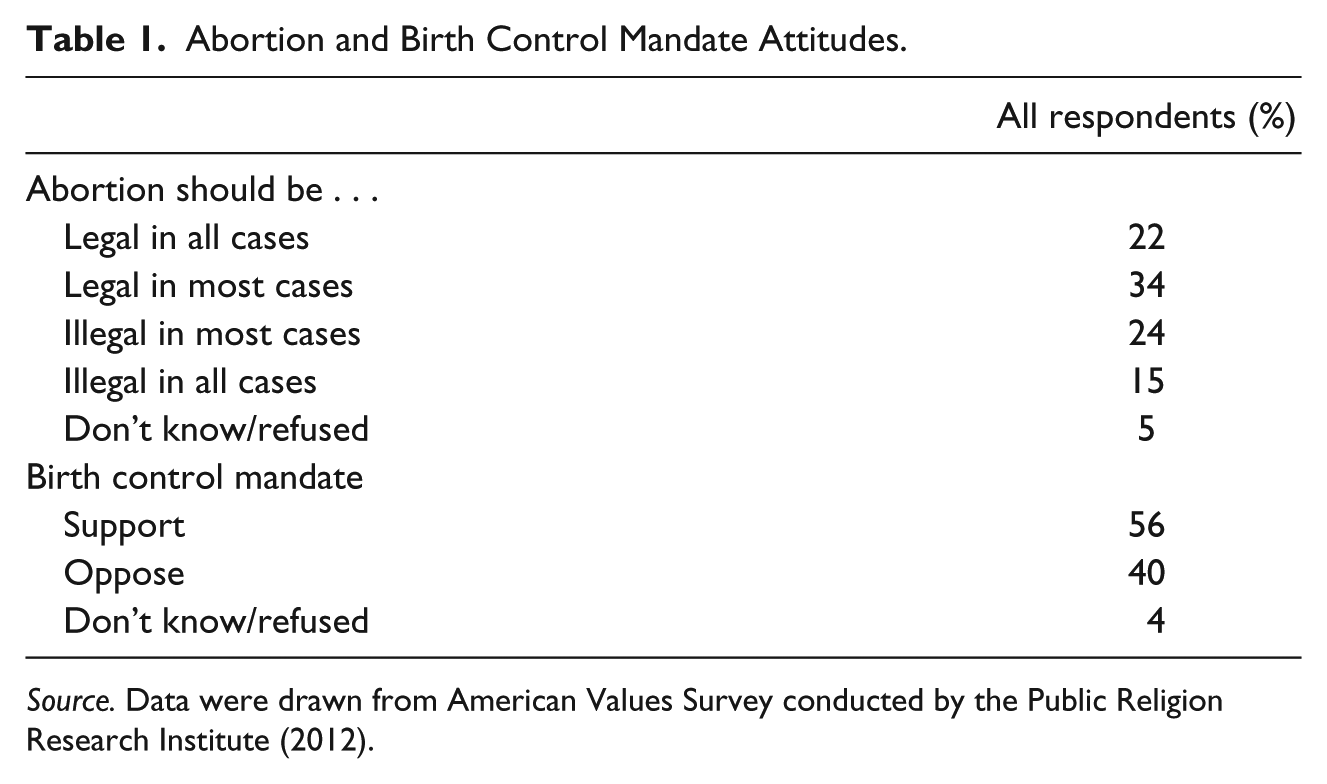
We use data from the Public Religion Research Institute’s (PRRI; 2012) 2012 American Values Survey, 6 a large pre- and post-election survey (n = 3,000, pre-election; n = 1,400, post-election) that examines vote choice in the 2012 presidential elections as well as attitudes on a variety of topical policy issues, including the birth control mandate and abortion—the two issues that we believe best embody the War on Women narrative. Table 1 includes descriptive statistics of these two independent variables. As the data show, a slight majority of Americans agreed with the birth control mandate than opposed it. 7 To measure attitudes about abortion, PRRI asked respondents if they thought abortion should be “legal in all cases, legal in most cases, illegal in most cases, or illegal in all cases.” Of those options, Americans are slightly more likely to side with abortion rights under certain circumstances, which is consistent with previous studies on attitudes about abortion (Jelen & Wilcox, 2003).
Abortion and Birth Control Mandate Attitudes.
Source. Data were drawn from American Values Survey conducted by the Public Religion Research Institute (2012).
Breakdown of Vote for Obama by Birth Control Mandate Attitudes and Abortion Attitudes
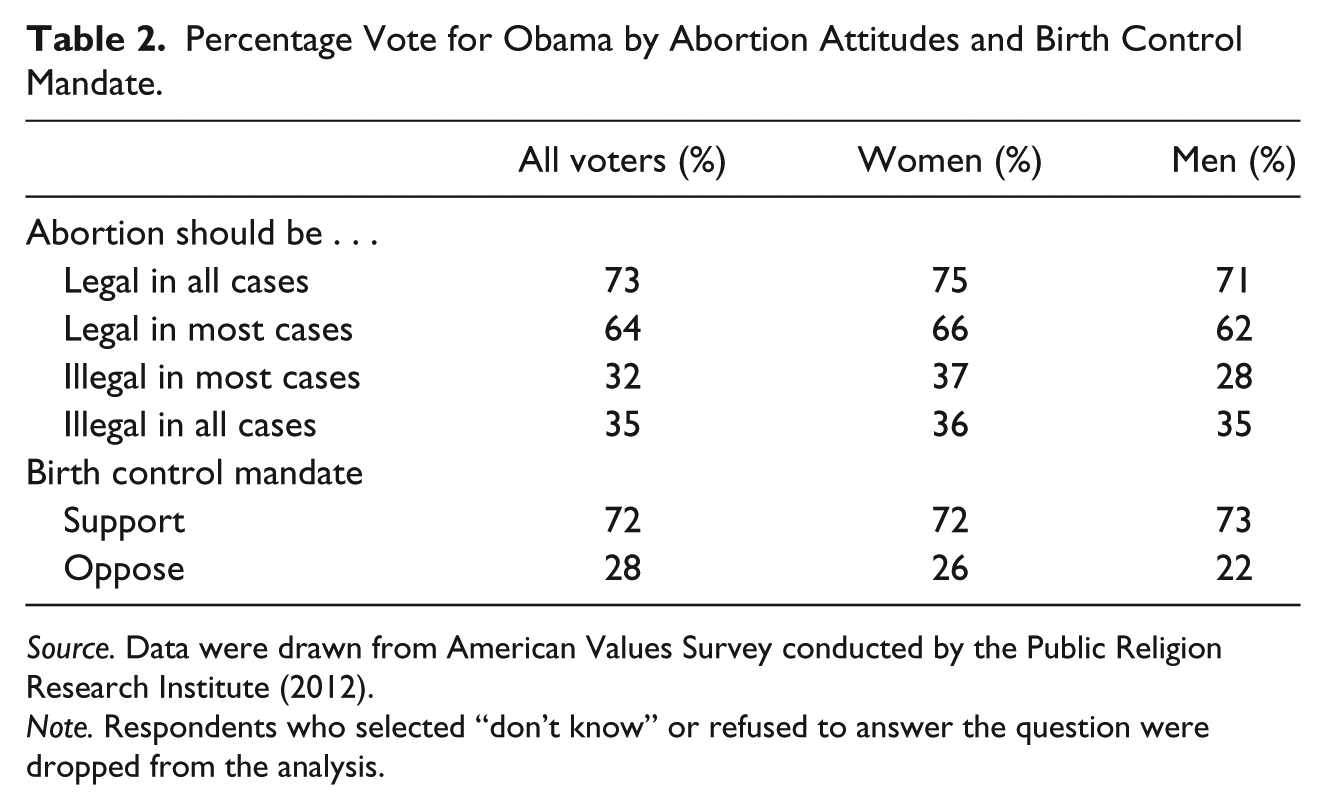
We begin our analysis at the bivariate level, examining the breakdown of vote for Obama by abortion attitudes and attitudes about the birth control mandate 8 (see Table 2). First, we examine all voters by their attitudes on the legality of abortion, and then split the sample by gender. Not surprisingly, there is a high correlation between support for abortion’s legality and vote for Obama: For example, those voters who believe that abortion should be legal in all cases are more than twice as likely than those who believe it should be illegal in all cases to vote for Barack Obama. We see similar patterns regardless of gender: Women and men who would like to see abortion remain legal in all or most cases are far more likely to vote for Obama than those who wish abortion were illegal in all or most cases. In some respects, the vote divide is starker on the issue of the birth control mandate. We find that 72% of voters who support the birth control mandate reported voting for Barack Obama, compared with just 28% of voters who did not support the birth control mandate. In other words, Obama was able to attract more votes from self-described pro-life voters than from voters who disagreed with the birth control mandate. These differences in voting patterns remain once we control for gender as high percentages of women and men who supported the birth control mandate also voted for Barack Obama.
Percentage Vote for Obama by Abortion Attitudes and Birth Control Mandate.
Source. Data were drawn from American Values Survey conducted by the Public Religion Research Institute (2012).
Note. Respondents who selected “don’t know” or refused to answer the question were dropped from the analysis.
These initial findings suggest two things. First, attitudes about the birth control mandate may have affected vote choice in the presidential election more than attitudes about abortion, given that Obama was able to capture more votes from pro-life voters than those voters who opposed the birth control mandate, perhaps suggesting the greater salience of this issue in the 2012 elections. Second, at the bivariate level of analysis, there are no gendered patterns with respect to these “War on Women” issues and presidential vote choice.
Factor Analysis and Multivariate Models
To more comprehensively explore the impact of the “War on Women” on vote choice in the 2012 election, we first conduct an exploratory factor analysis of several issue attitudes to determine whether the birth control mandate was perceived by voters more as a matter of personal morality or more as an issue related to the proper scope of government. Second, we construct a series of multivariate binary logistic regression models exploring both support for the mandate and the mandate’s effect on vote choice. In building our models, one drawback is that the PRRI survey does not contain the same wealth of questions found in most of the data sets that examine the impact of gender on presidential vote, such as the National Election Study or General Social Survey. In many earlier studies, researchers have the luxury of computing scales on a variety of measures tapping into the various issue dimensions that animate the gender gap. As a result, our analyses contain more parsimonious models of the effect of the gender on presidential voting than much of the extant literature. 9
In addition to whether respondents support the birth control mandate, the issues included in our factor analyses consist of whether respondents (a) support abortion rights, (b) are in favor of same-sex marriage, (c) favor the legalization of marijuana, (d) reject the notion that religious liberty is under attack in the United States, (e) oppose repealing the Affordable Care Act, (f) prefer raising taxes on those making an income of more than US$250,000 per year, and (g) support government policies aimed at helping the poor. 10 We include these issues in our analysis because they tap into most of the prominent issue dimensions that animate the gender gap in American politics. Same-sex marriage and the legalization of marijuana potentially relate to issues of personal morality and the culture wars, which are highlighted in previous research as a key facet of the gender gap (Kaufmann, 2002). However, questions relating to taxation, health care, social welfare, and the question of whether religious liberty is under attack tap into “role of government” issues that are known to divide men and women politically (Kaufmann & Petrocik, 1999). Including such a variety of issues permits an evaluation of how the birth control mandate and abortion fit into these broader political cleavages and allows a comparison of the relative effects of cultural and economic issues on the gender gap in 2012, similar to the approach taken in other studies (e.g., Norrander & Wilcox, 2008).
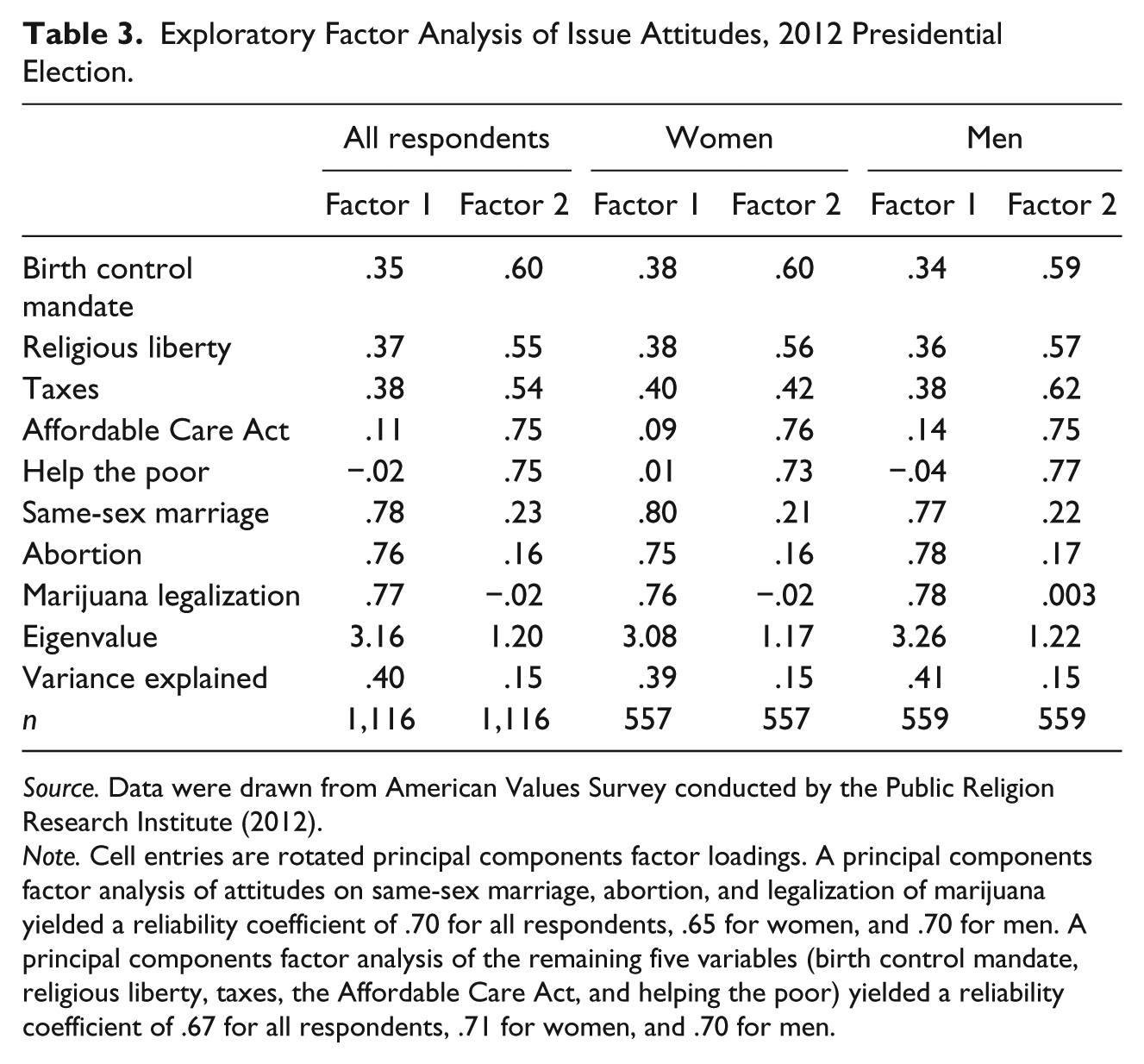
Although we anticipate that attitudes toward the birth control mandate are perceived less as a matter of personal morality and more as an issue related to the proper role of government, consistent with our first hypothesis, we conduct an exploratory principal components factor analysis to allow all eight of our issue attitudes to load on as many factors as the data allow. Table 3 shows the results of our factor analysis for all respondents, and then separated into samples of only women and only men. Two clear underlying factors emerge. The first factor shows strong loadings for attitudes on same-sex marriage (.78), abortion, (.76), and the legalization of marijuana (.77), with all other variables loading lower than .40. This factor clearly represents respondents’ views of personal morality. The second factor reveals strong loadings for attitudes on the Affordable Care Act (.75), whether government policies to help the poor are effective (.75), and strong-to-moderate loadings for support for the birth control mandate (.60), whether religious liberty is threatened (.55) and whether taxes should be raised on the wealthy (.54). On Factor 2, the remaining three variables all register loadings lower than .25. On this second factor, we see issues related to respondents’ views of the proper role of government.
Exploratory Factor Analysis of Issue Attitudes, 2012 Presidential Election.
Source. Data were drawn from American Values Survey conducted by the Public Religion Research Institute (2012).
Note. Cell entries are rotated principal components factor loadings. A principal components factor analysis of attitudes on same-sex marriage, abortion, and legalization of marijuana yielded a reliability coefficient of .70 for all respondents, .65 for women, and .70 for men. A principal components factor analysis of the remaining five variables (birth control mandate, religious liberty, taxes, the Affordable Care Act, and helping the poor) yielded a reliability coefficient of .67 for all respondents, .71 for women, and .70 for men.
Turning to the results separated out by sex, it is clear that women and men mostly perceived these issues similarly, though there is a notable difference in that attitudes toward tax policy load more strongly for men on the second factor than they do for women. For women, taxation loads almost identically and weakly on both factors, registering .40 on the “personal morality” factor (Factor 1) and .42 on the “role of government” factor (Factor 2). For men, taxation loads at .38 on the “personal morality” factor (Factor 1) but an appreciably higher .62 on the “role of government” factor (Factor 2). This finding is a preliminary though potentially telling indication that taxation is more coherently connected to men’s ideologies than women’s, which is consistent with previous research (Norrander & Wilcox, 2008). More specifically, it also shows that taxation is a key component of men’s views of the proper role of government, but this is not the case for women. More generally, based on this analysis, we see clear evidence that the birth control mandate tapped into both men’s and women’s views of the proper role of government (Factor 2), whereas issues related to personal morality, including abortion, were relegated to a separate underlying issue dimension (Factor 1).
We next turn to our first set of binary logistic regression models to identify whether sex is a significant predictor of attitudes toward the birth control mandate. In these models, sex is coded 1 for women and 0 for men. For our other independent variables, we include partisan identification (coded on a 3-point scale ranging from Republican to Independent to Democratic), race (coded 1 for Whites, 0 for non-Whites), education (coded 1 = high school education or less, 2 = some college, 3 = college graduate, 4 = post-graduate training), household income (coded 1 = less than US$30,000, 2 = US$30,000-US$50,000, 3 = US$50,001-US$75,000, 4 = US$75,001-US$100,000, 5 = US$100,001-US$150,000, 6 = US$150,001-US$200,000, 7 = above US$200,000), age (coded as a continuous variable), marital status (coded 0 = not married, 1 = married), and region (coded 1 for residing in the U.S. Census identified South). 11
We also include two variables designed to control for potential religious objections to the birth control mandate. The first of these is a variable measuring religious commitment, which is an additive scale, ranging in value from 0 to 9, constructed from two variables, church attendance (coded 0 = never, 5 = more than once a week) and the importance of religion to one’s life (coded 0 = not at all important, 4 = the most important thing). 12 The second is a question asking respondents whether they agree with the statement: “The right of religious liberty is being threatened in America today” (coded 1 = completely agree, 2 = mostly agree, 3 = mostly disagree, and 4 = completely disagree). In addition to controlling for sex, we also divide our sample by sex and present one model of women respondents and a separate model for men, to determine whether women and men’s support for the mandate is predicated on different factors.
In a second set of models, we regress the same variables noted above, including support for the birth control mandate, plus several additional variables measuring other issue attitudes on presidential vote choice, most of which are featured in the preceding factor analyses (see Note 7). We also control for respondents’ retrospective evaluations of their personal financial situation relative to 4 years prior. 13 These models permit a comparison of the effect of the birth control mandate on the presidential vote with other salient policy issues. The dependent variable is coded 1 as a vote for Obama and 0 as a vote for a candidate other than Obama. Each of these variables measures salient issues both in the context of the 2012 campaign and, more generally, issues that are potentially important to the gender gap. As with the models exploring influences on support for the birth control mandate, we first control for sex as a dummy variable and then present separate models for women and men, respectively.
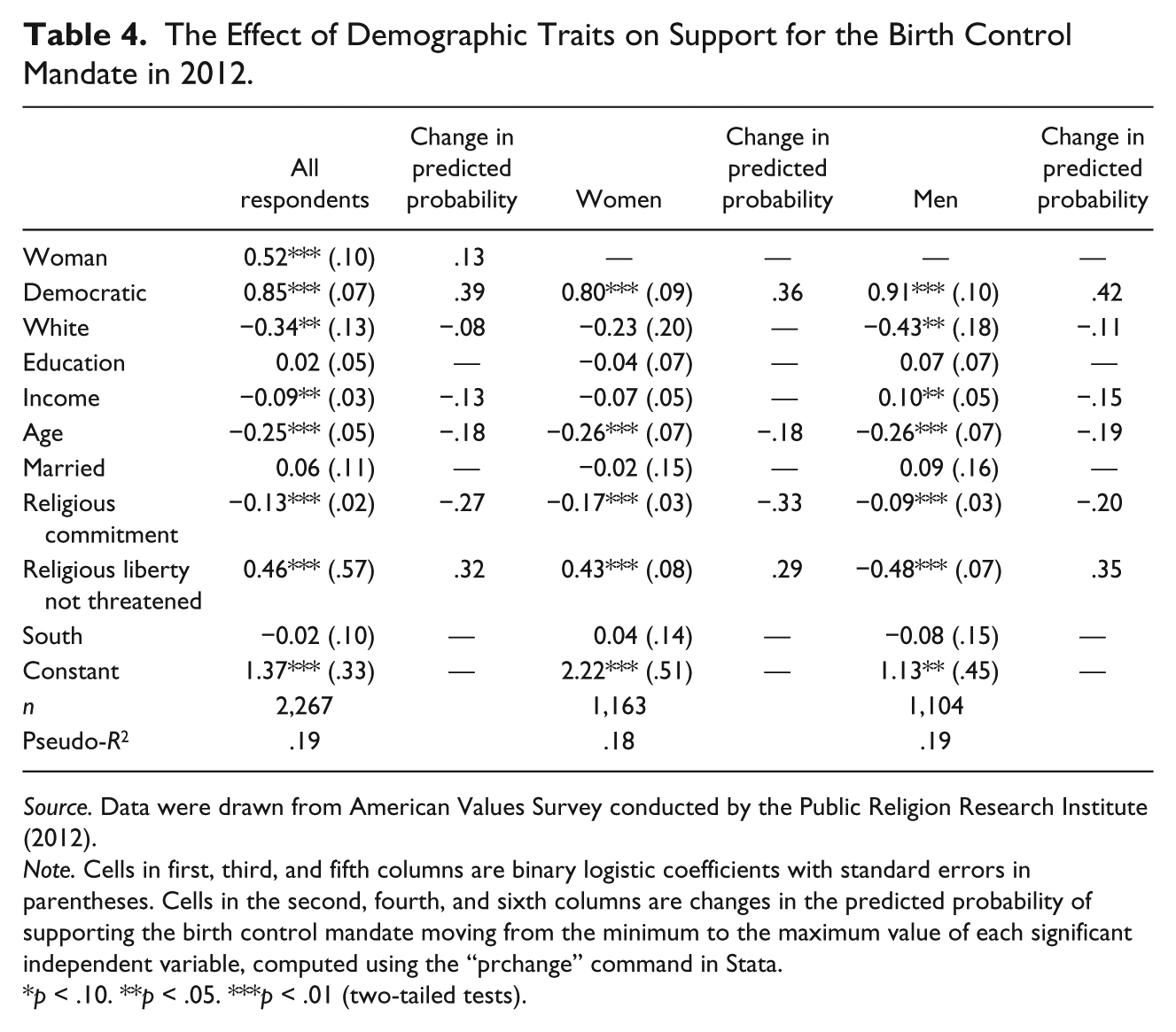
We begin with Table 4, which shows the binary logistic regression coefficients regressed on support for the birth control mandate for each independent variable in the first column of results. In the second column of results, we present each significant variable’s change in the predicted probability of supporting the birth control mandate moving from the minimum to the maximum value of each variable. The results suggest that sex was a significant predictor of support for the mandate, as the predicted probability of backing the law increased by 13 percentage points for women over men, holding all other variables constant at their means. This result reveals a larger difference between men and women than the bivariate results of Table 2, suggesting that the insurance coverage of birth control was to some extent a gendered issue in 2012, despite fairly strong male support. Other factors, most notably partisan identification and perceptions that religious liberty is under attack in the United States, also had a strong effect on support for the birth control mandate. Democrats were 39 percentage points more likely to support it than Republicans, and respondents who completely disagree that religious liberty is under attack were 32 percentage points more likely to favor the mandate than those who completely agree. Race, income, age, and religiosity were also significant predictors of attitudes toward the mandate, with non-White, lower income, younger, and less religious Americans more likely to be proponents of the mandate.
The Effect of Demographic Traits on Support for the Birth Control Mandate in 2012.
Source. Data were drawn from American Values Survey conducted by the Public Religion Research Institute (2012).
Note. Cells in first, third, and fifth columns are binary logistic coefficients with standard errors in parentheses. Cells in the second, fourth, and sixth columns are changes in the predicted probability of supporting the birth control mandate moving from the minimum to the maximum value of each significant independent variable, computed using the “prchange” command in Stata.
p < .10. **p < .05. ***p < .01 (two-tailed tests).
The models in Table 4 that split the sample by sex reveal some interesting differences in the factors that predict opinion on the birth control mandate for women and men, yet the similarities are perhaps more striking. The biggest differences are that income and race have significant effects on opposition to the mandate for men, but not for women. Men at the highest income level are 15 percentage points more likely to oppose the law than men at the lowest levels of income, whereas White men are 11 percentage points more likely to oppose the law than non-White men, controlling for other factors. All other variables are consistent in their effects across men and women in terms of statistical significance, though there are slight substantive differences worth noting. Religious commitment has a stronger negative effect on support for the mandate among women than men, with predicted probabilities of −.33 and −.20, respectively. Democratic party identification is slightly more influential of opinion toward the mandate for men, while age is a more important factor for women, though the differences in predicted probabilities on these variables are not dramatic.
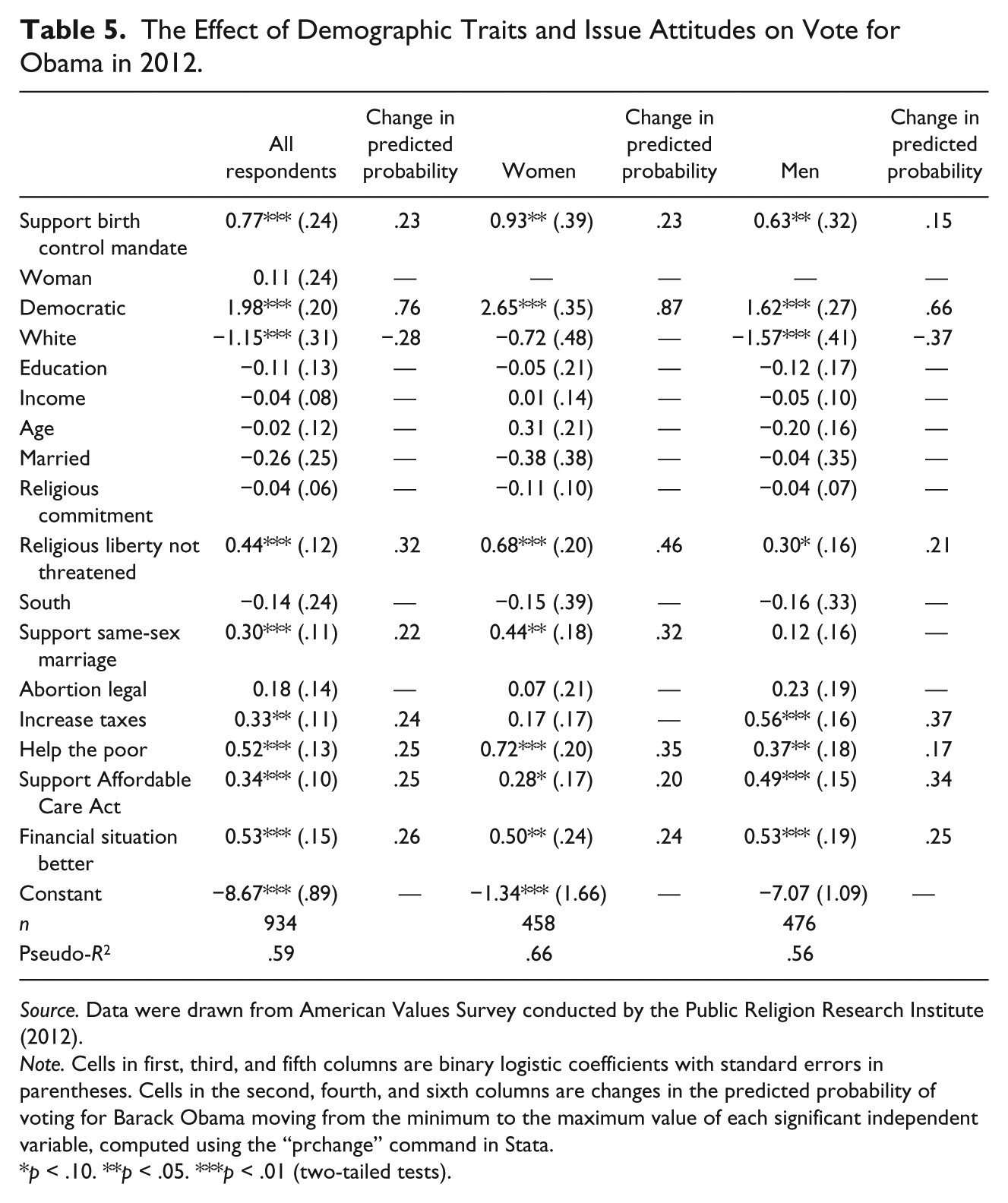
Having established that women were more likely to support the birth control mandate than men, the question remains whether the issue was important to voters’ decision to support the reelection of President Obama for a second term in office. Table 5 shows the results of a set of models exploring this question, with presidential vote as the dependent variable. 14 Looking at the first column of results, it is apparent that sex was not a significant predictor of vote choice once we account for a number of salient issue attitudes, which is consistent with the political science literature on presidential vote choice and gender. Instead, in addition to the significant effects of Democratic party identification and race, seven factors are strongly related to predicting a vote for Obama in the 2012 election: support for the birth control mandate, perceptions of whether religious liberty is threatened, attitudes toward same-sex marriage, tax policy, feelings toward government efforts to help the poor, opposition to repealing the Affordable Care Act, and retrospective evaluations of personal economic conditions. Because there are some key differences in the size and significance of these effects between men and women, our discussion will focus on the second and third models of Table 5.
The Effect of Demographic Traits and Issue Attitudes on Vote for Obama in 2012.
Source. Data were drawn from American Values Survey conducted by the Public Religion Research Institute (2012).
Note. Cells in first, third, and fifth columns are binary logistic coefficients with standard errors in parentheses. Cells in the second, fourth, and sixth columns are changes in the predicted probability of voting for Barack Obama moving from the minimum to the maximum value of each significant independent variable, computed using the “prchange” command in Stata.
p < .10. **p < .05. ***p < .01 (two-tailed tests).
Support for the birth control mandate was a significant factor increasing the predicted probability of voting for Obama for both men and women, but with a more statistically significant and greater substantive effect for women. Among women, support for the mandate increased the probability of voting for Obama by 23 percentage points (p < .01), whereas for men, the increased probability was 15 percentage points (p < .05), controlling for other variables. For women, this effect was comparable with that of opinion toward the larger health care reform bill (predicted probability = .20), egocentric economic evaluations (predicted probability = .24), and greater than the effect of tax policy preferences (coefficient not significant). For men, it represents the smallest significant predicted probability in the model, though it is similar in magnitude to the effect of attitudes toward government programs to help the poor (predicted probability = .17). For women, only attitudes toward same-sex marriage, government programs to help the poor, and religious liberty had stronger effects than the birth control mandate among issue preferences. For men, only tax policy, the health care bill, pocketbook economic evaluations, and religious liberty had substantively stronger effects on their vote choice. Notably, the effect of attitudes toward religious liberty is markedly larger for women (.46) than for men (.21), which is likely due to greater levels of religious conservatism among women (Kaufmann, 2002). Finally, attitudes toward abortion had no effect on the predicted probability of a vote for Obama, indicating that the power of the “War on Women” argument was more limited to the issue of insurance coverage for birth control, and did not extend to the more traditional reproductive rights debate over abortion. 15
In sum, these results indicate that the “War on Women” rhetoric, and its specific connection to the birth control mandate, was a boon to the reelection prospects of President Obama, especially among women. Women and men alike who were strongly in favor of the policy voted for Obama, but it played a larger role in women’s voting calculus. The effect of the mandate rivaled the impact of Obama’s signature and most controversial domestic policy accomplishment in the Affordable Care Act. For women, it also outranked even the perennial bread-and-butter political issue of tax policy, despite its special prominence in the campaign due to the great deal of attention paid to Governor Romney’s personal wealth, his comparatively low 15% capital gains tax rate, and reports speculating that some of his assets were held in non-taxable offshore accounts. That the political resonance of the mandate was able to match or exceed the impact of these other highly salient issues speaks to the potency of the “War on Women” argument promoted by Democrats in the 2012 campaign.
Discussion
Our findings point to a conclusion that the birth control mandate was a winning issue for the Democratic Party in 2012. The gender gap grew from a difference of 7 percentage points between Obama and McCain in 2008 to a difference of 10 percentage points between Obama and Romney in 2012, and insurance coverage for birth control appears to have been a decisive factor for many voters, especially women. Although we cannot precisely pinpoint the degree to which the mandate increased the gender gap in 2012, as an issue that was new to the agenda compared with 2008, we believe it was at least a contributing factor. In an era of closely contested elections and highly polarized politics, every advantage that the parties can translate into greater support among key demographic groups matters. It is clear that the campaigns saw women as an important battleground in this election. As a counter to the Democrats’ “War on Women” messaging, for instance, Ann Romney delivered a speech at the Republican National Convention explicitly designed to appeal to women voters, culminating in the exclamation, “I love you women!” Moreover, prominent Republican women in Congress, such as Cathy McMorris Rodgers, took to the airways to discount the so-called “War on Women,” calling it a “Democratic myth” (quoted in Walter & Scicchitano, 2012) while the 24 Republican women in the U.S. House of Representatives formed their own Women’s Policy Committee in May 2012 as a way to combat the narrative that Republican policies were harmful to women (Cohn, 2012).
Although insurance coverage for birth control was clearly an important issue, questions remain as to exactly why it was important and what this all means for the future of the gender gap. As we anticipated, the potential absence of a gender gap on the mandate would indicate that the issue was perceived as yet another flashpoint in the abortion wars, as men’s and women’s attitudes toward abortion do not typically diverge. However, our results suggest that voters viewed the birth control issue not as a matter of reproductive rights, but rather as an issue that speaks to attitudes on social welfare, health care, women’s economic well-being, and larger ideological beliefs about the proper role of government.
It is on these issues that the gender gap finds oxygen, and in that respect, our finding that the birth control mandate weighed more heavily in the voting decision of women than men is consistent with years of political science research on gender and voting. Looking beyond the 2012 election, there is already evidence that insurance coverage for birth control will enjoy prominence on the political agenda in the years to come. For example, former and possibly future presidential candidate Mike Huckabee attracted controversy over his contention at the Republican National Committee’s 2014 winter meetings that
. . . the Democrats want to insult the women of America by making them believe that they are helpless without Uncle Sugar coming in and providing for them a prescription each month for birth control because they cannot control their libido or their reproductive system without the help of government.
16
If the Republican Party highlights this line of argument in 2016 and beyond, our findings suggest that they will continue to struggle to attract the overwhelming majority of both male and female voters who perceive the insurance mandate as within the proper scope of government action, not as an issue of women’s personal sexual behavior.
Conversely, Democratic attempts to paint the birth control mandate as part of a broader war on women that includes Republican abortion policy may not resonate with voters who view the issues as distinct. In general, though, we anticipate that as long as there is political conflict over social welfare and health care issues, insurance coverage for birth control will remain a potentially salient issue, one that should be of consequence to electoral outcomes and scholarly understanding of the gender gap.
Footnotes
Acknowledgements
The authors would like to thank Shanna Pearson-Merkowitz and several anonymous reviewers for their helpful suggestions in revising the article.
Declaration of Conflicting Interests
The author(s) declared no potential conflicts of interest with respect to the research, authorship, and/or publication of this article.
Funding
The author(s) received no financial support for the research, authorship, and/or publication of this article.