







Abstract
American civil religion places the U.S. Constitution on a pedestal. Although this veneration is well-documented, it is unclear where it originates and why other constitutions do not attract the same reverence. We develop a measure of constitutional respect and conduct a randomized survey experiment testing whether new information can change respondents’ evaluations of their state or national constitutions. We find that people do respond to new information about state constitutions, but not to information about the national document, suggesting that Americans view the U.S. Constitution with the sort of veneration and reverence James Madison advocated, while viewing their state constitutions through a more Jeffersonian lens of legitimacy, one that favors continually revising these constitutions to meet the living generation’s needs.
Keywords
Whatever veneration might be entertained for the body of men who formed our Constitution, the sense of that body could never be regarded as the oracular guide in expounding the Constitution . . . It was nothing more than the draft of a plan, nothing but a dead letter, until life and validity were breathed into it by the voice of the people. Whatever be the Constitution, great care must be taken to provide a mode of amendment when experience or change of circumstances shall have manifested that any part of it is unadapted to the good of the nation. In some of our States it requires a new authority from the whole people, acting by their representatives, chosen for this express purpose, and assembled in convention. This is found too difficult for remedying the imperfections which experience develops from time to time in an organization of the first impression. A greater facility of ammendment is certainly requisite to maintain it in a course of action accommodated to the times and changes through which we are ever passing.
Americans view their Constitution with respect that borders on veneration. Many people regard it so highly that they “find the notion of seriously criticizing it almost sacrilegious” (Levinson, 2006, p. 17). Nearly all Americans (91%) say the Constitution’s “fundamental purpose . . . is to protect and serve the interests of all people, regardless of their wealth and power”; almost as many (85%) call the Constitution “a major reason . . . that America has been so successful,” with just as many believing other countries should imitate it. 1 Three quarters of Americans call the U.S. Constitution “an enduring document that remains relevant today.” 2 Many label it “important” (71%), “wise” (44%), or even “inspired” (40%)—figures that rise to 83%, 64%, and 56% among Republicans—while few call it “outdated” (20%), “flawed” (19%), or “irrelevant” (4%). 3 The median American rates the U.S. Constitution at 9 on a 10 point scale (Stephanopoulos & Versteeg, 2016). This esteem perpetuates itself across generations, contributing to a continuing reverence for the Constitution and its framers—though this reverence seems to be based on something other than a deep knowledge of the document, as the public knows very little about the Constitution’s specifics (Farkas, Johnson, & Duffett, 2002).
Scholarly understanding of this Constitutional veneration remains incomplete, however, for two reasons. First, Americans have not one but 51 constitutions—one federal and fifty at the state level—yet existing research focuses almost entirely on the federal document. 4 And second, political science knows little about where veneration originates or what might affect it. We therefore do not know why Americans venerate the U.S. Constitution, nor do we know whether that veneration extends to state constitutions. With an eye on these two gaps, we report an experiment that provides randomly selected participants with varying information about the national and state constitutions to test whether this new information changes participants’ reactions to each document—and also whether the effects differ across state and federal constitutions. This design allows us to draw inferences about general circumstances that may affect evaluations of constitutions at both levels.
Our findings reveal that Americans apply different standards to the U.S. and state constitutions. Perhaps this comes as no surprise: Although state constitutions vary tremendously in their length (from 9,000 to 376,000 words), amendment rates (from two to 298 amendments adopted over 20 years), and age (from 27 to 233 years), no state constitution is truly comparable with the 1787 federal Constitution—not only by these metrics, but also by the national Constitution’s preeminence in the minds of voters. 5 American veneration for the national Constitution, rooted in its link to the nation’s founding myth, renders their evaluations of that document remarkably stable; none of the treatments reported below meaningfully change respondent evaluations of the U.S. Constitution. In contrast, evaluations of state constitutions rise when respondents learn that their constitution is younger or amended more frequently than they might suppose, suggesting that voters appreciate their state constitutions more when presented with evidence of their democratic nature.
These different results for the national and state constitutions appear to reflect different sides of an argument between two of America’s founders, Thomas Jefferson and James Madison, around whose views we frame our discussion below. Americans today view their state constitutions through a Jeffersonian lens of legitimacy. From this perspective, constitutions become more legitimate and deserving of respect when the document has been revised and updated to reflect current standards and beliefs. Respondents therefore evaluate their state constitutions more favorably when they learn of regular updates. However, Americans view the federal Constitution through a Madisonian lens of veneration that values stability and reverence. Thus, evaluations of state constitutions hinge on perceptions of Jeffersonian legitimacy, whereas evaluations of the national Constitution reflect Madisonian veneration.
Theory
Before the Constitution was yet 2 years old, Thomas Jefferson and James Madison had begun arguing about its proper interpretation and stature. Jefferson wrote to Madison that “no society can make a perpetual constitution, or even a perpetual law. The earth belongs always to the living generation” (Jefferson, 1789). 6 He feared institutional ossification, believing it would bring reduced legitimacy: “Every constitution . . . naturally expires at the end of nineteen years. If it be enforced longer, it is an act of force, and not of right.” 7
Madison’s reply emphasized practical objections: “Would not a government so often revised become too mutable to retain those prejudices in its favor which antiquity inspires[?]” Directly responding to Jefferson’s argument that government should be a reflection of the preferences of those alive at any given moment, Madison responds that previous generations helped create the world in which any generation lives: “Improvements made by the dead form a charge against the living who take the benefit of them,” giving their “tacit assent . . . to established Constitutions and laws” (Madison, 1999, pp. 474-477, emphasis in original). In essence Madison was saying that, in contrast to Jefferson who worried about a previous generation binding a later one, Madison worried much more about excessive fiddling with a constitution.
This was an old theme for him, since in 1788, Madison had argued this point forcefully in Federalist 49 where he had also responded to a Jefferson plan for the Constitution of Virginia (though named in Federalist 48, Jefferson is only referred to as the author of the “Notes on the State of Virginia” in Federalist 49). Jefferson had proposed that a convention should be called whenever any two branches call for a correction to the constitution. While Madison is deferential to this point (and to its author), he firmly rejects it.
First, Madison argues that “frequent appeals” to change the Constitution would “deprive the government of that veneration which time bestows on everything, and without which perhaps the wisest and freest governments would not possess the requisite stability.” 8 Madison believed that the true source of veneration will be opinions that are fortified by examples of the constitution’s goodness, examples that are both “ancient as well as numerous” (emphasis in original). Second, Madison is worried that “public passions” would disturb “public tranquility.” Madison argues that though the current moment had led to an excellent constitution, “It must be confessed that the experiments are of too ticklish a nature to be unnecessarily multiplied.” 9 His belief seems to have been that, at least for a national Constitution, time would provide people with reasons to favor the document and to avoid changes. Both of Madison’s arguments rely on veneration and avoiding constitutional change, not merely to preserve the status quo—after all Madison had just finished engaging in a project to dramatically alter the status quo of the Articles of Confederation—but to preserve the hard-won gains of the Federal Convention of 1787. 10 Moreover, one cannot help but notice the belief here that Madison distrusts the public to make judgments about such weighty matters. Jefferson clearly trusted the public more.
Madison and Jefferson rarely quarreled and were as close political allies as existed in their time, yet this particular disagreement endured. As late as 1824, the topic still on his mind, Jefferson wrote another letter, this time to a British reformer, praising the American states for making “successive improvements” to their constitutions: “[S]everal of them, corrected by experience, have, by conventions, still further amended their first forms.” He praised his home state of Virginia—“not only the first of the states, but . . . the first of the nations of the earth . . . to form a fundamental constitution”—for “now proposing to call a convention for amendment.” He hoped further for “a Convention of the states” to amend the federal Constitution, as “we have not yet so far perfected our constitutions as to venture to make them unchangeable.” To the contrary, “Nothing then is unchangeable but the inherent and unalienable rights of man.” 11 Jefferson’s ideal constitution remained one that reflected consistent revisions in line with changing sensibilities and standards.
To be sure, Bailey (2015) cautions we have “long overestimated the importance of stability for Madison” (p. 11), who worried more about additional conventions than he did the amendment process, which he deemed legitimate. 12 Still, Madison saw stability as leading (rightly) to veneration, whereas Jefferson saw frequent updating as leading (rightly) to greater perceived legitimacy—and it is this tension between Madisonian “veneration” and Jeffersonian “legitimacy” that we explore. Both cared deeply about constitutions and how those constitutions would be seen by the public, but each man emphasized different paths for the documents to gain the respect of the people, a point that has sometimes been obscured in people’s rush to condemn Jefferson’s plans for revised documents, plans that probably should be taken more seriously (Brennan, 2017).
It is not surprising that men with such different experiences with the document would have such disparate opinions. Madison’s efforts to win passage of a new constitution were the culmination of years of effort, during which time Jefferson was away in France (1785-1789). Perhaps Jefferson’s distance from the debates that gripped America’s leaders is at least partly the cause of their differences. In any event, Madison’s relative preference for constitutional stability and veneration is reflected in Americans’ views today. Americans view the federal Constitution with such reverence that many instinctively resist proposals to amend or reinterpret it (Breslin, 2009; Lind, 2011; Sink, 2004; Zink & Dawes, 2016; but see Levinson & Blake, 2016). Many describe the U.S. Constitution as sacred, inspired, or venerable; others, eschewing such religious terminology, nevertheless acknowledge it as “a central feature of American ‘civil religion’” (Levinson, 1988, p. 90). Polls repeatedly find that most Americans believe the Constitution “is an enduring document that remains relevant today” rather than “an outdated document that needs to be modernized” (National Constitution Center, 2012). Most Americans (86%) expect future historians to look back at the U.S. Constitutional system as one of “the most democratic and free” ever. 13 Ironically, this Madisonian veneration for the U.S. Constitution arises despite ignorance of its specifics; only 16% claim a “detailed” knowledge of the U.S. Constitution, with most (66%) claiming only a “general familiarity” (Farkas et al., 2002).
Responding to Madison’s apparent victory, Levinson has revived Jefferson’s legitimacy arguments, claiming that excessive veneration of the U.S. Constitution blinds Americans to its major flaws and prevents them from openly considering needed reforms (Levinson, 1988, 2006, 2012; Dahl, 2003). Levinson’s call for significant Constitutional reform has yet to bear fruit at the federal level, where he has focused his efforts. Although Levinson has leveled a Jeffersonian campaign against the federal Constitution, we will argue below that Jefferson’s legitimacy thinking never really went away—instead, it has endured at the state level. Thus, Americans apply different standards of judgment to their state and federal constitutions, treating state constitutions as practical, Jeffersonian-style governing documents requiring regular updates to remain legitimate. In contrast, the public links the federal Constitution so firmly to the founding that Madisonian veneration inevitably arises.
Dinan (2006), reviewing the debates of the 233 state constitutional conventions held since 1776, concurs that Jeffersonian thinking won in the states, finding further that Jefferson’s victory was no accident; state constitution crafters deliberately rejected Article V’s difficult amendment procedures, and these state-level departures from the federal amendment process became more pronounced as time went on. Lutz (1994) applauds states’ flexible procedures: “Any people who believe in constitutionalism will amend their constitution when needed, as opposed to using extraconstitutional means” (p. 357) like judicial reinterpretation. And as Brennan (2017) reminds us, states indeed rely less than the federal government on extraconstitutional judicial interpretation precisely because they provide workable amendment procedures.
Thus, “constitution” means something different at the state and federal levels. Americans view their state constitutions through a lens of Jeffersonian legitimacy, but the U.S. Constitution through a lens of Madisonian veneration. Far more research has shown that Americans revere their national Constitution than has shown why this veneration arises. Even Levinson’s (1988) critical argument describes the substance of America’s “constitutional faith,” including the moral and legal dilemmas surrounding that faith, without much empirical consideration of why Americans venerate their national Constitution so highly.
This omission becomes glaring when considering the U.S. Constitution in a comparative context. Elkins, Ginsburg, and Melton (2009) argue that the U.S. Constitution “defies expectations” according to their own model of longevity that emphasizes the need for constitutions to have flexibility—a more Madisonian trait that may apply better to state constitutions in the American context. 14 Despite its outlier status (and as manifested by the preceding pages), one can easily find books, articles, and polls demonstrating Americans’ peculiar veneration for their Constitution, yet one would struggle to find a qualitatively similar discussion of other constitutions. Nobody commissions surveys asking German, Japanese, Botswanan, Brazilian, or Canadian citizens whether they see their national constitutions as “sacred” or “inspired.” Perhaps Jefferson, in all his enthusiasm for constitutional revision, would note further that no one commissions surveys asking North Carolinians, Vermonters, Nevadans, or Idahoans similar questions about their state constitutions. Why, then, do Americans revere their national Constitution?
One potential cause for this veneration could be as simple as status quo bias. Psychological and economic research shows that individuals exhibit a general status quo bias (Kahneman, Knetsch, & Thaler, 1991; Samuelson & Zeckhauser, 1988) and risk aversion (Eckles, Kam, Maestas, & Shaffner, 2014; Kam, 2012; Kam & Simas, 2010, 2012; Tversky & Kahneman, 1991). Of the 155 written national constitutions currently in place, 146 (94%) were adopted within the past 100 years; only the U.S. Constitution, the world’s oldest, was adopted as long ago as the 18th century. 15 The longer a status quo has been in place, the more likely people are to attribute normative value to it (Eidelman, Pattershall, & Crandall, 2010). The U.S. Constitution’s unique age could plausibly produce Americans’ unique veneration for it, then. However, Zink and Dawes (2016) report several clever experiments demonstrating that status quo bias alone does not explain American Constitutional veneration. Participants in their randomized experiments showed less support for policy changes presented as Constitutional amendments rather than as mere statutory changes; simple status quo bias would have produced similar resistance to both. After performing several variants on their experiment, they finally conclude that something beyond status quo bias is at play: “In addition to the reasons individuals resist change in general, there is something about [the U.S. Constitution] per se that biases individuals against proposals that would result in constitutional change” (Zink and Dawes 2016, p. 537), though they also note that the frequent amending of state constitutions indicates “that constitutional status quo bias is weaker at the state level” (p. 553).
If not status quo bias, a more likely possible source of this veneration stems from the social and political enculturation American youth receive through their public schooling. Several years ago, Hibbing and Theiss-Morse (1996) found that each additional year of education increases survey respondents’ support for the U.S. Constitution, apparently because of increased exposure to this enculturation: Americans with postgraduate degrees support the U.S. Constitution more than college graduates, who support it more than high school graduates, who support it more than those lacking a diploma. Civics courses may struggle to teach specific facts about U.S. governance (e.g., Pew Research Center, 2015), but they apparently succeed at inculcating respect for America’s founders and the Constitution they enacted.
While we have no qualms with Hibbing and Theiss-Morse’s conclusion, its U.S.-centric analysis may presuppose a certain kind of constitution—or more to our point, their logic may apply very well to the U.S. Constitution but not the state constitutions. Like public schools around the world, American schools teach a national myth, praising national heroes while overlooking many of their flaws. Hibbing and Theiss-Morse’s results imply that those who are more often exposed to this national myth (through additional education) are more likely to reverence the U.S. Constitution. But if teaching a founding narrative always boosted constitutional veneration, then similar veneration should develop in all states and nations. However, we suspect that certain features of the U.S. Constitution give it an especially close link to the American national narrative. In the United States, students learn a national birth story that begins with tales of the Boston Tea Party, of Paul Revere’s midnight ride, of Washington’s troops wintering at Valley Forge, and of victory over the British, finally reaching a climax with the 1787 Constitutional Convention where demigods drafted a nearly scriptural document. Then, students learn that the U.S. Constitution endures today as a living relic of those seemingly ancient tales. Societies around the world are built on national myths, but for Americans, it is the Constitution—not a Bastille, a royal family, a Long March, a Red Square Mausoleum, a Great Pyramid, a Colosseum, or Abraham’s foundation stone—that stands as tangible validation of their founding myth.
State constitutions benefit from no such mythos. Even the best-known state founders—figures like Davy Crockett and Sam Houston in Texas, or Brigham Young in Utah—have only tenuous connections to their state constitutions at best. These figures simply do not compare to George Washington and the other American founders. Small wonder, then, that only half of Americans even know their state has its own separate constitution. 16 To the extent Americans even think of their state constitutions, they have every reason to view them not as sacred relics, but as functional governing documents—fundamentally different creatures from the U.S. Constitution—requiring regular updates to maintain their democratic legitimacy.
Moreover, Americans’ experience with each document serves only to reinforce these views. The median state constitution has received 17 amendments over the past 20 years; because 49 states require all proposed amendments to receive voter ratification, we infer that residents in the median state ratify 1.7 amendments during each biennial election, in addition to any amendments they may reject. Meanwhile, decades have passed since the last U.S. Constitutional amendment. Zackin’s (2013) argument that Americans’ positive rights are to be found in the state constitutions rather than in the federal document fits nicely with this argument about how the two levels in the American context serve different purposes and therefore may be valued in different ways. Speaking comparatively, Dixon (2011, p. 106) notes “the potential for the repeated use of constitutional amendment processes to increase the perceived legitimacy of such processes in the mind of the public” (cf. Vermeule, 2006 and Dahl, 2003). The historian Morton Keller (1981) once speculated that the American “cult of the constitution” applies also to state constitutions, though perhaps more weakly. Our argument, paired with Dixon’s observation, suggests otherwise.
Our theoretical argument that Americans apply Madisonian veneration to the U.S. Constitution but Jeffersonian legitimacy to state constitutions has observable implications. If a constitution is associated strongly with a founding myth (as is the case with the U.S. Constitution), views of it should be fairly stable and impervious to manipulation. That is, reminding Americans of less-known details about the U.S. Constitution should not change their views of it, as their views will reflect their evaluation of the national story more than of the document itself. But if a constitution is seen as a mere organizational document erecting an arena for representative governance, then reminding people of its details should change their evaluations of it. In particular, if people view state constitutions through a Jeffersonian lens, then two specific factual details should influence their evaluations: A constitution’s age and amendment rate. That is, voters should appreciate knowing that their state’s governing documents have been kept current, whether through frequent amendments or recent revision. Again, we do not expect these details—age and amendment rate—to influence evaluations of the U.S. Constitution, because, as we argue, evaluations of that document reflect its association with the founding rather than its modern applicability; we do, however, expect these details to influence evaluations of state constitutions, as respect for those documents stems from their democratic suitability.
We arrive at these two variables—the constitution’s age and amendment rate—through Jeffersonian logic. We also consider one additional variable that grows somewhat tangentially from Jefferson’s paradigm: A constitution’s length. As Chief Justice John Marshall once wrote, a venerable (or Madisonian) constitution should avoid stretching beyond the “great outlines” and “important objects” of governance, or it will take on “the prolixity of a legal code.” 17 Yet the 50 state constitutions do exactly that by including provisions on “ski trails and highway routes, public holidays and motor vehicle revenues” (Tarr, 1998, p. 2). Some argue, with Marshall, that these provisions are so mundane that their inclusion in a constitution suggests “simply a frivolous people who are unable to distinguish between things that are truly important and things that are not” (Gardner, 1992). The terse 1787 Constitution contained only 4,500 words, after all—half the length of the shortest state constitution (9,000 words), one sixth the median state constitution (24,000 words), and one eightieth the longest state constitution (376,000 words). 18 Nevertheless, this attention to localized policies and concerns that struck Marshall as so inappropriate to the celebrated U.S. Constitution makes tremendous sense for those who take a Jeffersonian view of state constitutions, wherein citizens seek ownership of local policies as they regularly update their governing framework. We therefore arrive at the following hypotheses:
Every state constitution is longer and more frequently amended than the U.S. Constitution, and nearly every state constitution is younger. Thus, we expect to observe H1, H2, and H3 among Americans from every state. To be sure, however, we expect these effects to increase where state constitutions are especially young, lengthy, or amended—that is, where the state documents look the least like the national document. If we find evidence in favor of these hypotheses when it comes to state constitutions, then we will conclude that Americans take a Jeffersonian view of their state constitutions—that is, that they see them as functional governing documents that must remain current to retain their legitimacy. And if we find no evidence of similar pattern when it comes to the U.S. Constitution, per H4, then we will conclude that Americans take a more Madisonian approach to the federal document, venerating its association with the founding.
Design
Clearly, we cannot manipulate a constitution’s actual length, age, or amendment rate to see how those changes affect voter perceptions of the document. Instead, our experimental design involves informing randomly selected people of their state constitution’s age, length, and amendment rate, and then testing whether that information changes their evaluations of their state constitution relative to an uninformed control group. As will be shown below (in our discussion of manipulation checks), those in the control condition who do not receive any information about these variables turn out to be largely ignorant about them. The information we provide participants is strictly factual, without any deception. By including participants from throughout the United States, we leverage the immense constitutional variation among the 50 states.
In June 2016, we used Amazon’s Mechanical Turk service to recruit a national sample of 999 U.S. adults with an MTurk rating of 90% or higher, each of whom received US$0.40 for participating. MTurk panels are admittedly a nonrepresentative convenience sample, making them inappropriate for nonexperimental public opinion polling (Huff & Tingley, 2015). However, randomized experiments conducted on MTurk participants produce the same estimated treatment effects as experiments conducted on representative samples (Berinsky, Huber, & Lenz, 2012), leaving us confident of the basic results. On the experiment’s landing screen, participants indicated their state and answered whether, off the top of their head, they happened to know whether their state has a constitution—only 52% did, consistent with other polls cited above.
19
On the next screen, they encountered a short battery of questions about the U.S. Constitution beginning with this prompt: We would like to learn more about how you view the United States Constitution. <Treatment language here, if any.> Here are several different things that people might say about the U.S. Constitution. Please mark whether you agree or disagree with each statement.
Participants were randomly assigned to one of five experimental conditions varying how much information they received about the U.S. Constitution’s age, length, and amendment rate. Those in the control group (30%) received no information at all; those in the full treatment (30%) received the U.S. Constitution’s age, length, and amendment rate; and those in the three partial treatment conditions (13% each) received only the U.S. Constitution’s age, only its length, or only its amendment rate. Full treatment language appears in Table 1. H4 predicts that this information should not influence participants’ views of the U.S. Constitution. After this prompt, participants marked their agreement or disagreement with several items evaluating the U.S. Constitution: “The U.S. Constitution is an enduring document that deserves our respect”; “The people who wrote the U.S. Constitution were only looking out for themselves”; “The U.S. Constitution is an outdated document that needs to be modernized”; and so on. (We discuss measurement of constitutional evaluations in the next section; the complete instrument appears in a supplemental appendix.)
Treatment Language.
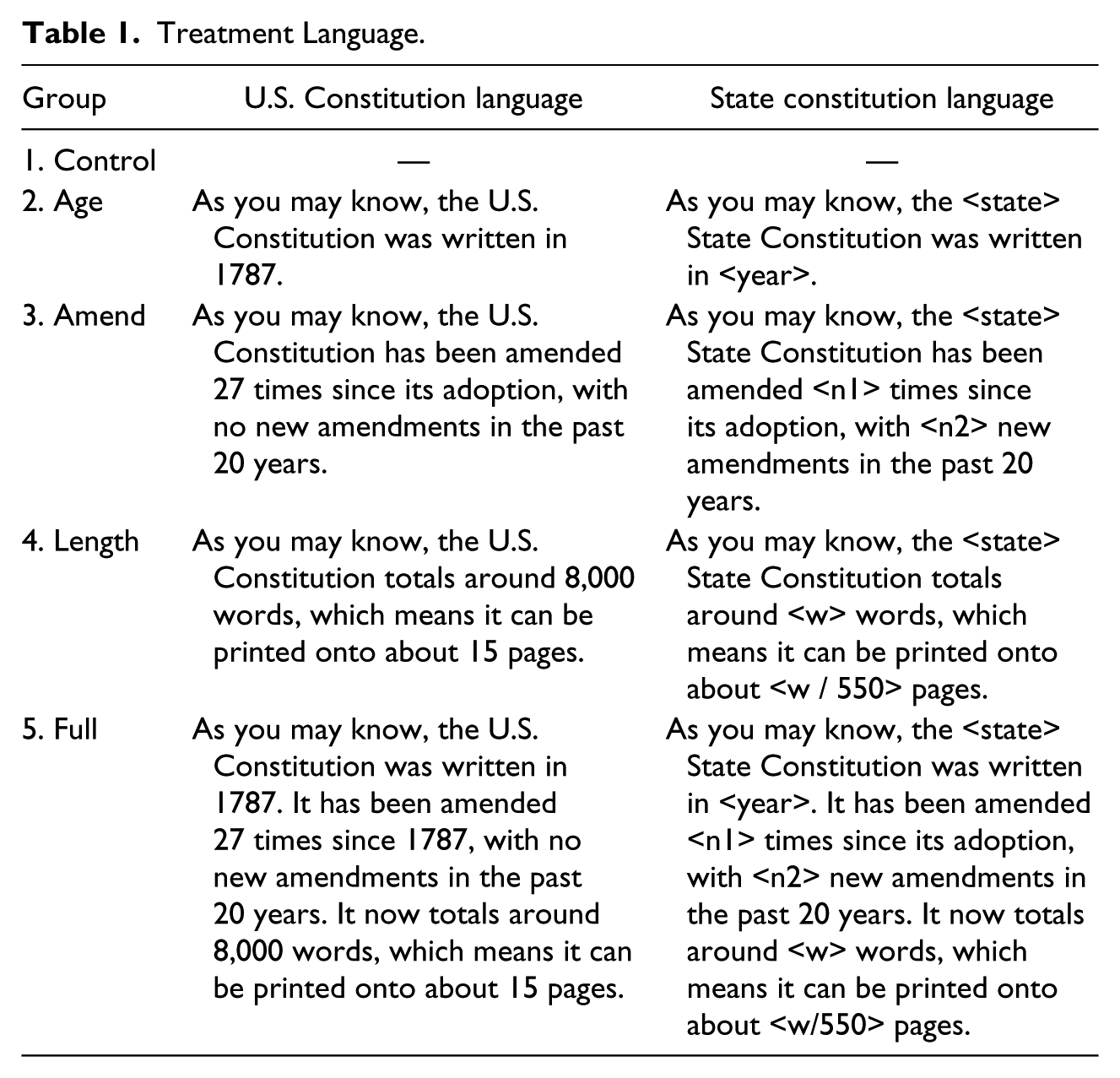
The next screen repeated these questions, but with references to the U.S. Constitution replaced with references to the participant’s state constitution. The treatment language appears, as before, in Table 1. The full instrument appears in a supplemental appendix, along with a table listing the information about state constitutions that was piped into these treatments. Recipients received the same factual information about both constitutions. These items form the core of our experiment, as H1, H2, and H3 predict that information about state constitutions’ ages, lengths, and amendment rates will change participants’ respect for their state constitutions.
Subsequent screens included additional questions measuring participants’ general trust in government and, following Cann and Yates (2016), participants’ perceived legitimacy of courts and of the law. Because participants were assigned randomly into experimental conditions, it is unnecessary to include demographic controls in the analysis below. (In any event, Table A2 in the supplemental appendix demonstrates the demographic balance across groups.) We can therefore attribute any differences in the outcome variables to this study’s experimental treatments.
Following advice from Mutz (2011), we included two manipulation checks at the end of the instrument to assess whether participants had internalized the constitutional information they may have received earlier in the experiment. The first of these questions asked respondents whether their state constitution is longer or shorter than the U.S. Constitution; only 14% of those who did not receive this information answered this item correctly, compared with 58% of those who did receive it. The second of these questions asked participants which constitution, the U.S. Constitution or their state constitution, had received more amendments over the past 20 years; only 19% of those who did not receive this information answered this item correctly, compared with 62% of those who did receive it. 20 These are massive differences. Not only did participants successfully internalize the treatments, but the treatments also provided information that was genuinely foreign to the control group. Those who completed the questionnaire quickly fared as well on the manipulation checks as those who took longer, suggesting that participants were neither looking up information on the Internet nor racing inattentively through the instrument. 21
Measuring Constitutional Evaluations
Existing research has not converged on a consistent measure of respect for constitutions. Instead, each of the various polls and studies cited above has generally adopted its own sui generis approach. Although we admire Zink and Dawes’s (2016) inferred measure of veneration based on participants’ responses to randomly varied question wording (discussed above), such an approach would add an extra layer of complication to our already randomized instrument. Moreover, differentiating Madisonian veneration from Jeffersonian legitimacy requires a measure that goes beyond veneration alone, a measure capturing respondents’ general evaluation of each constitution. Thus, we assembled a battery of seven evaluative questions adapted from the National Constitution Center’s (2012) regular polls and also from Cann and Yates’s (2016) insightful study of respect for American courts and laws. We are less interested in these seven individual questions than in the latent constitutional evaluation they collectively reveal. Our battery begins with five statements: “The U.S. Constitution is an enduring document that deserves our respect”; “The people who wrote the U.S. Constitution were only looking out for themselves”; “We should amend the U.S. Constitution more frequently so that it addresses modern concerns”; “The U.S. Constitution is an outdated document that needs to be modernized”; and “The people who wrote the U.S. Constitution were wise and visionary.” (Tables below reference these five items as enduring, selfish, amend more, outdated, and visionary.) Respondents reacted to each statement using a 5-point scale including strongly disagree (coded as −2), agree (−1), neither agree nor disagree (0), agree (+1), and strongly agree (+2).
Drawing on Cann and Yates (2016), the next item on the battery examined respondents’ preferences for judicial originalism. We presented respondents with two statements anchoring either end of a sliding scale: “Judges should base their rulings on what they believe the U.S. Constitution means in today’s world” and “Judges should base their rulings on what they believe the U.S. Constitution meant when it was originally written.” We invited respondents to move a slider along a horizontal axis to indicate their views; a screenshot appears in the supplemental appendix. We code responses from −50 for a living approach to +50 for an originalist approach. The battery’s seventh and final question asked, “Would you say the U.S. Constitution is amended too much, not enough, or about the right amount?” Respondents chose not enough (coded −1), about the right amount (0), or too much (+1). (We reference these items below as originalism and too amended.)
Participants answered this seven-item battery twice: Once about the U.S. Constitution, and again about their respective state constitutions. Correlations within each battery are high (p < .01 in every pairwise comparison). We conducted separate factor analysis on each battery, producing one set of loadings for national evaluations and another for state evaluations. These factor models yield similar loadings across the two different types of constitutions and yield approximately similar levels of explanatory power: 0.45 for the state factor compared with 0.51 for the federal factor. (Tables A3 and A4 in the supplemental appendix give the factor loadings.) In both cases, inspection of the screeplot and traditional tests suggest a two-factor model, though the first factor in each model captures the vast majority of the variance. Both second factors explain only around 10% of the variance and are probably best thought of as residual dimensions; we will omit these second factors from our analysis. 22
The first dimension factors have a straightforward interpretation: Each is a measure of how favorably people view their state or U.S. constitution. Respondents score higher on each factor if they believe that the document is enduring, written by visionary people, amended too often, or that judges should adhere to an originalist viewpoint when interpreting it. Respondents score lower if they believed that the framers were looking out for themselves, that the document is outdated, or that it should be amended more often. 23
Table 2 presents summary statistics for the U.S. Constitution battery, both in the aggregate and by selected demographics, for all seven items in the battery as well as for the first dimension of our factor analysis. For enduring, visionary, originalism, too amended, and the factor score, a higher value indicates greater respect; the opposite is true for selfish, outdated, and amend more. Within each demographic category, boldface indicates the group showing greater respect, even if the difference is marginal. Republicans, conservatives, men, and respondents above 55 years of age give higher evaluations across every indicator shown. Interestingly, higher education has mixed effects, increasing participants’ sense that the Constitution is “enduring” and that the founders were unselfish and visionary while very modestly pushing some other indicators in the other direction; as a result, education has no net effect on factor scores. Nevertheless, the generally uniform effects that partisanship, ideology, sex, and age exert across all indicators strengthen our confidence in this battery’s reliability.
Evaluations of the U.S. Constitution.
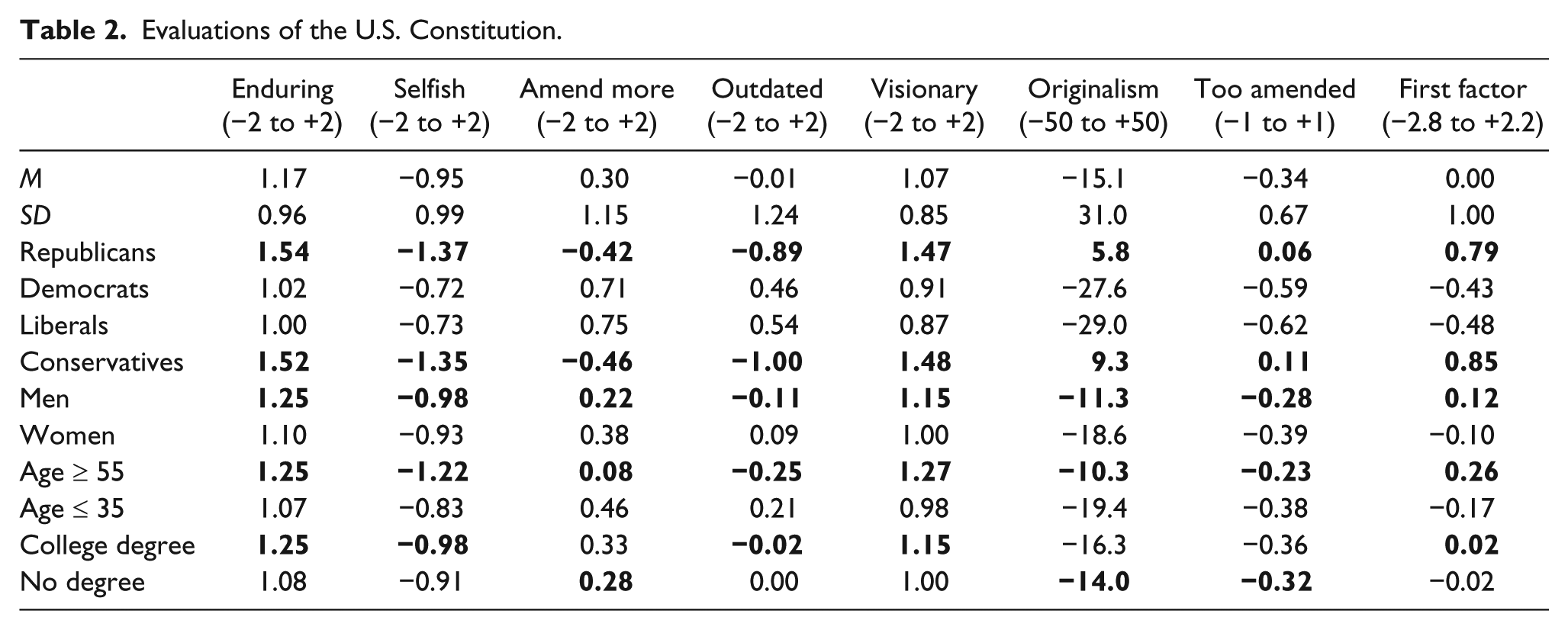
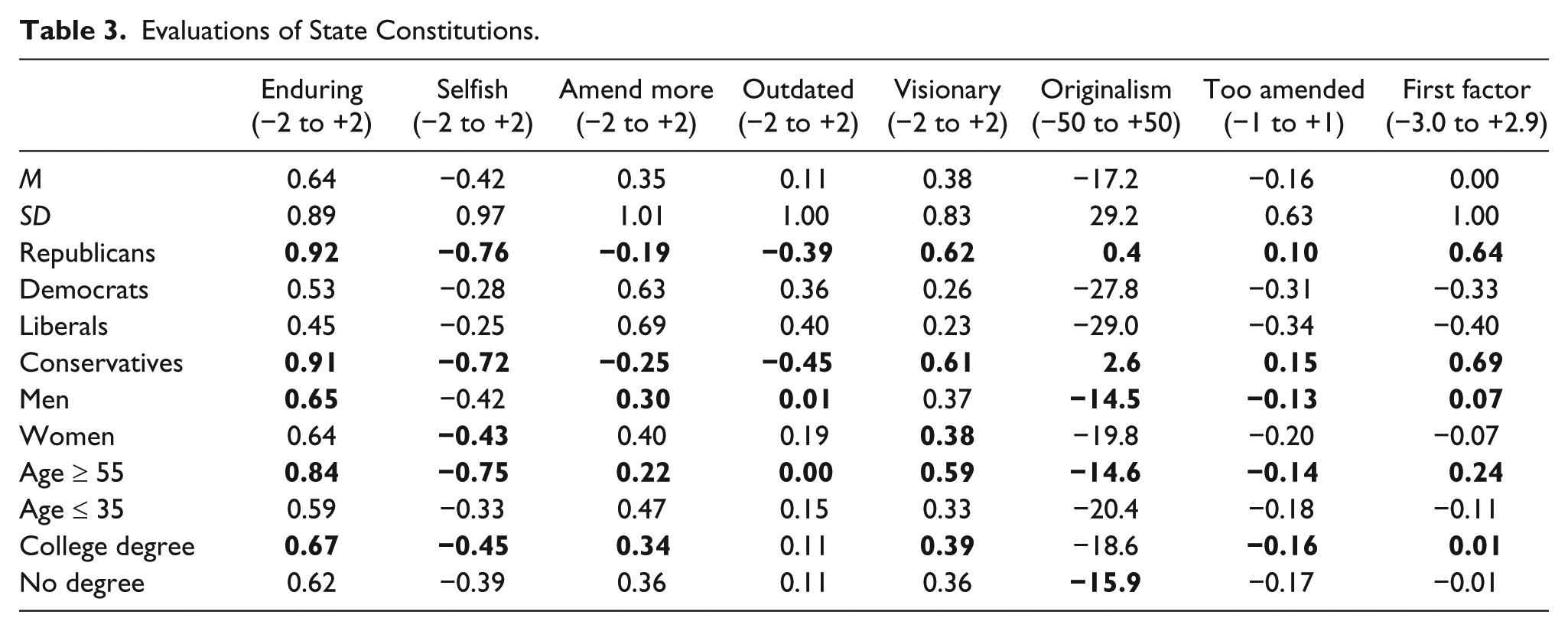
Table 3 presents similar statistics as Table 2 but for state constitutions. Aggregate means are sometimes closer to zero in Table 3 than in Table 2, indicating somewhat less favorability or more ambivalence about state constitutions. However, standard deviations are comparable across both tables, suggesting plenty of variance. Demographic variables generally have the same effects in Table 3 as in Table 2. As in Table 2, the largest differences arise with partisanship, ideology, and age. As our concern is whether or not the randomized treatments produce any change in a person’s responses, we now turn to an analysis of the experiment.
Evaluations of State Constitutions.
Results
Our treatments produce results consistent with our hypotheses. 24 Figure 1 compares the full treatment to the control for each type of constitution. Recall that the full treatment includes information about each constitution’s age, length, and amendment rate; respondents who received only a partial treatment are not included here. Although the full treatment had no effect on evaluations of the U.S. Constitution, it raised evaluations of state constitutions significantly (p = .038). 25 Notably, the effect remains equally strong among the subset of respondents who already knew prior to our experiment that their state had a constitution (p = .038). We can therefore infer that respondents reacted to the specific information we provided them and not simply to the general fact that our questions implicitly informed them of their state constitution’s existence. 26
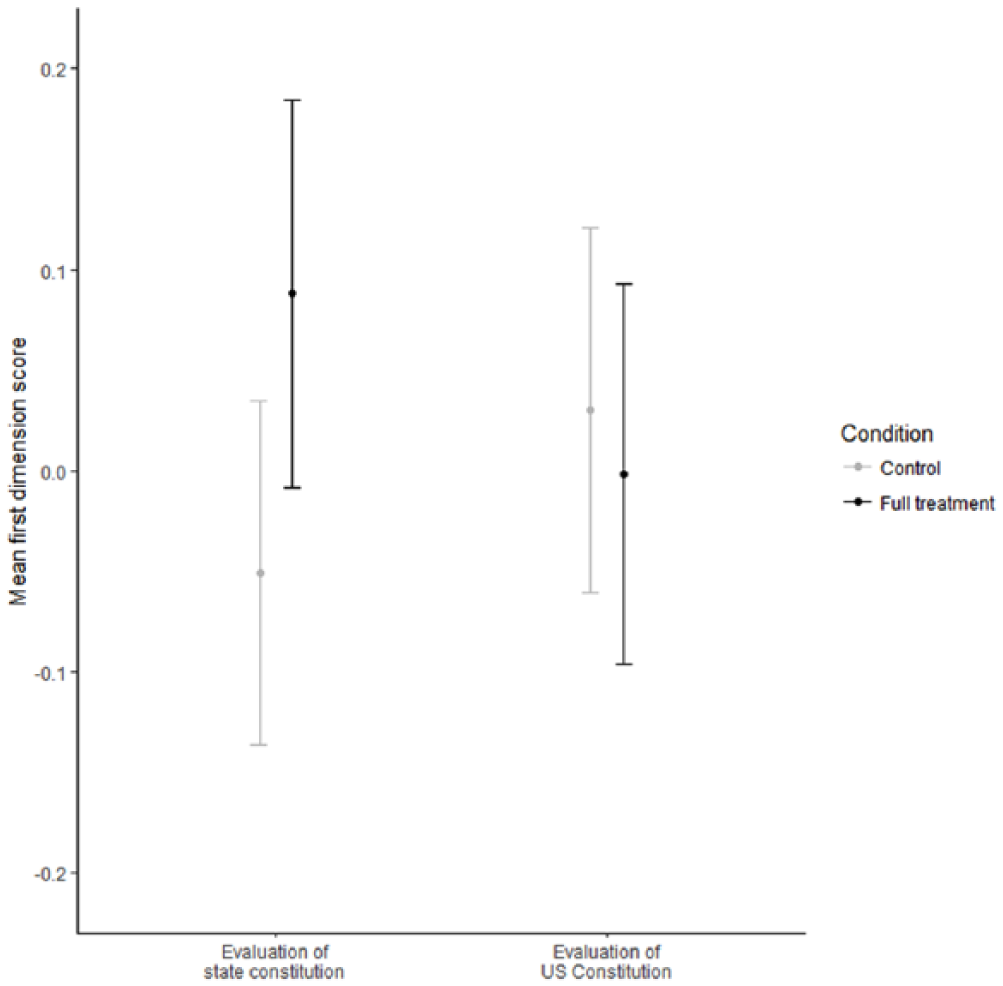
Constitutional evaluations by type of document (90% CI).
Figure 2 further establishes this point and also provides a direct test of H1, H2, and H3, showing how each type of information changes respondents’ evaluations of state constitutions. 27 Every state constitution has a higher amendment rate than the U.S. Constitution. As predicted by H1, respect for state constitutions rises significantly (p = .036) among those who learn of their state’s high amendment rate. 28 This information has the strongest effect in states with the highest amendment rates. The median state constitution received 16.5 amendments over the past 20 years. Our treatment is significant in states above this median (p = .024) but not in states below it (p = .339); Figure A1 in the supplement depicts these results.
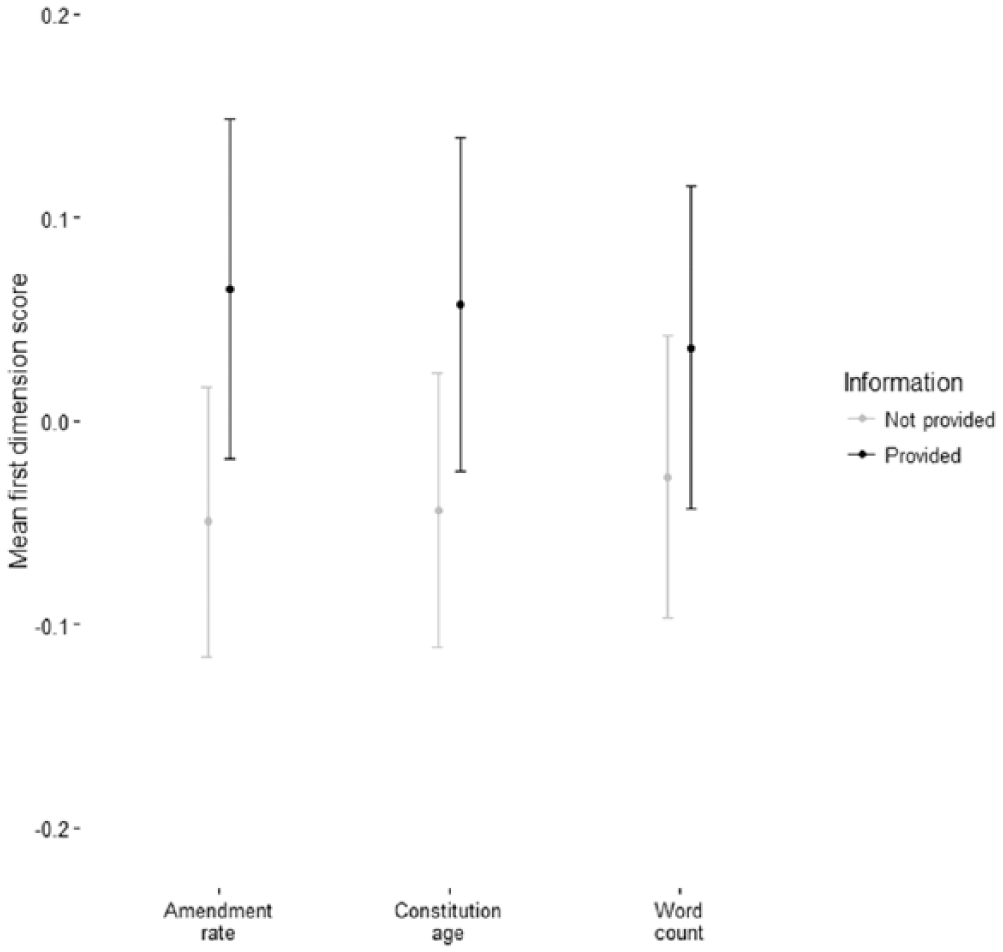
Evaluations of the state constitution, by information provided (90% CI).
Figure 2 also presents evidence in favor of H2: Respect for state constitutions rises meaningfully (p = .057) among those who were provided with their state constitution’s age. Again, the effect is strongest in the most distinctive states. The median state constitution was adopted in 1890. Our treatment is significant in states with younger constitutions (p = .063) but not in states with older constitutions (p = .264), a difference depicted in Figure A2 in the supplement. Informing respondents of their state constitution’s length does not appear to change their evaluations, however. Although Figure 2 depicts an effect in the direction hypothesized by H3, the difference is not statistically significant at conventional levels (p = .160). Still, our treatment comes closer to significance in states with constitutions longer than the median of 24,000 words (p = .128) than in states with shorter constitutions (p = .439), as depicted in Figure A3 in the supplement.
Figure 3 presents the same set of comparisons as Figure 2, but for the U.S. Constitution. As predicted in H4, none of our treatments affect evaluations at all, with no p values lower than .237. Just as Madison might have hoped, respondents venerate the U.S. Constitution regardless of their exposure to these facts about it.
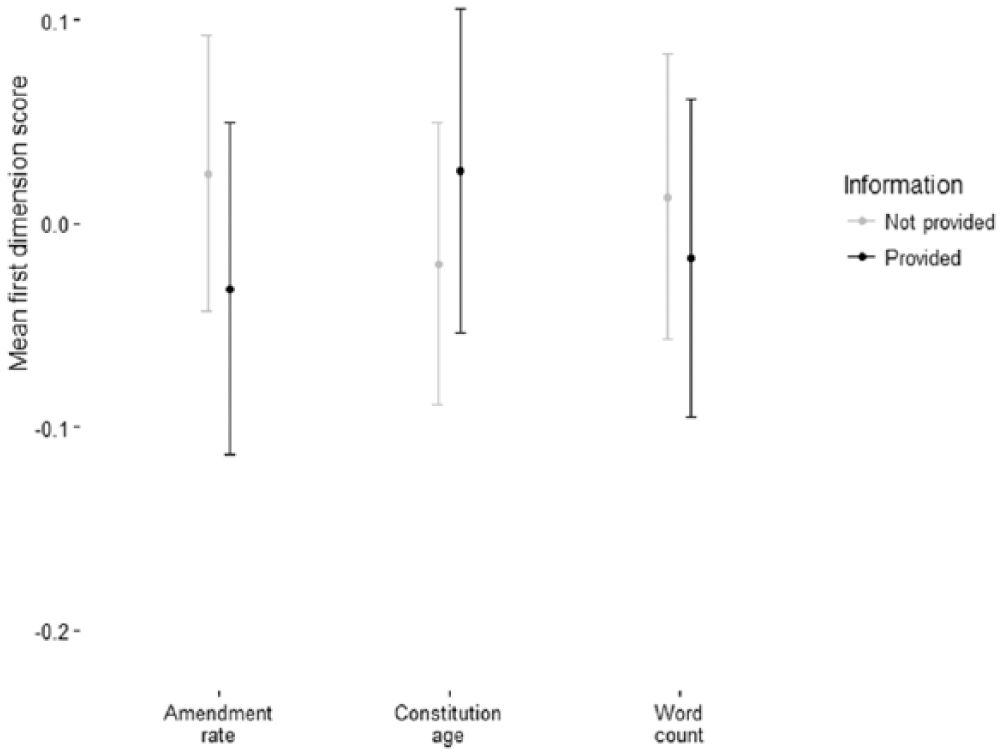
Evaluations of the U.S. Constitution, by information provided (90% CI).
Although not directly tied to our hypotheses, our questionnaire also included some other items that were influenced by our treatments. Setting aside our factor model, Figure 4 summarizes responses to three items about how much confidence the respondent has in the American voter when it comes to making the right decision, how much reform the respondent feels the government needs, and how much trust the respondent has in their state government to do what is right. The figure plots separate means and confidence intervals for those who were in the control condition and those who were in the full treatment. Although our treatment did not affect respondents’ trust in their state government or their confidence in their fellow voters, it clearly raised respondents’ sense that the government needs major reform (p = .040). Evidently, people who learn that their state constitution is younger, amended more, and lengthier than the U.S. Constitution show greater respect for their state constitution (Figure 2), but also have a greater desire to see government reform (Figure 4).
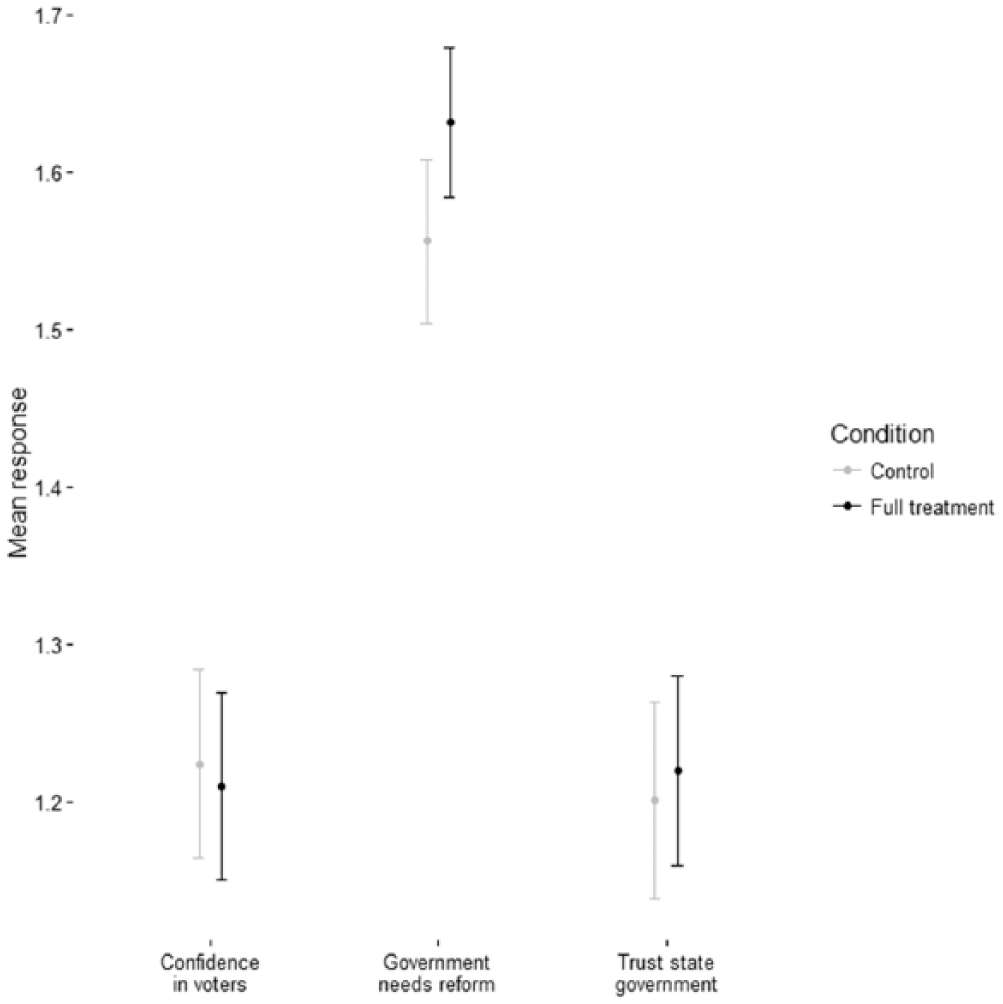
Trust and reform, by treatment condition (90% CI).
Thus, high evaluations do not preclude a desire for reform—to the contrary, constitutional respect and reform may go hand in hand. Although this may seem contradictory, it recalls an old and honorable American tradition. During the American revolution it was common for revolutionaries both to claim the mantle of change—away from the despotism of the current parliament—and also to claim the mantle of being a defender of the true and older faith. That is, colonial revolutionaries saw reform as necessary to return to the principles established during the English Civil War and the Glorious Revolution. 29 Such women and men combined a desire for change with a veneration for first principles as they perceived them. Although we did not theorize ex ante about a relationship between these variables and derived no specific hypothesis, we are intrigued that our treatment seems to have invoked this tradition, increasing both respect and desires for reform. Or, taking the Jeffersonian perspective detailed above, we might conclude that those who learn just how regularly and recently their state constitutions have been updated see them in greater esteem and also have a strengthened desire to continue updating them.
Discussion
Collectively these results are convincing on two key points. First, we are able to manipulate evaluations of state constitutions. People will change their view of their state constitution if given the right information—specifically its age and amendment rate. Treatment effects arise most strongly among respondents from states with the highest amendment rates or youngest constitutions, increasing confidence in this conclusion. This finding implies a Jeffersonian view of state constitutions as practical governing documents rather than pedestalized relics, where respect for the constitution hinges on its democratic legitimacy. Second, we find that informing participants of their state constitution’s high amendment rate does more than increase respect—it also prompts desire for reform. Although the exact nature of that reform cannot be ascertained from these data, it seems likely that one element of it is the need for a document to be changed and altered for a given generation (for “the living” as Jefferson would put it). These facts hold both among those who are completely unfamiliar with their state constitutions (i.e., not even being certain that the constitution exists) and among those who already know about their state constitution, thus showing that respondents were reacting to more than the general effect of knowledge of the constitution’s existence.
The dearth of effects on U.S. Constitutional evaluations, meanwhile, suggests that Americans view that document through a fundamentally different lens, one based less on its content than on its venerable association with the nation’s birth. Despite the null effects, we caution the reader against supposing that respect for the U.S. Constitution is immovable. Enough change may leave people dismayed, feeling that the Constitution no longer reflects their understanding of the founding. A founding myth is something that state constitutions uniformly lack, of course. Perhaps Madison was right to say that the (national) constitution requires veneration that is “breathed” by “the voice of the people.” This kind of allegiance should not be treated lightly, and, as Madison suggested, it may even be crucial to our political system. But we must also understand that the system of government generated by the founders has multiple levels and Jefferson’s vision of constitutions amended and changed to fit the times and retain their legitimacy clearly appeals to people thinking about their state constitutions. At the state level, Americans crave reform and change. They do not want a state constitution of antiquity but a state constitution of the present. Perhaps it is a fitting tribute to the founding generation’s efforts that the thinking of American citizens—two and a quarter centuries later—is not uniform but changes depending upon the level of government and the purpose of the document.
Supplemental Material
Supplemental_appendix – Supplemental material for Measuring and Manipulating Constitutional Evaluations in the States: Legitimacy Versus Veneration
Supplemental material, Supplemental_appendix for Measuring and Manipulating Constitutional Evaluations in the States: Legitimacy Versus Veneration by Adam R. Brown and Jeremy C. Pope in American Politics Research
Footnotes
Declaration of Conflicting Interests
The author(s) declared no potential conflicts of interest with respect to the research, authorship, and/or publication of this article.
Funding
The author(s) disclosed receipt of the following financial support for the research, authorship, and/or publication of this article: The 2016 CCES was supported by the National Science Foundation, Award #1559125.
Supplementary material
Supplementary material is available for this article online.
Notes
Author Biographies
References
Supplementary Material
Please find the following supplemental material available below.
For Open Access articles published under a Creative Commons License, all supplemental material carries the same license as the article it is associated with.
For non-Open Access articles published, all supplemental material carries a non-exclusive license, and permission requests for re-use of supplemental material or any part of supplemental material shall be sent directly to the copyright owner as specified in the copyright notice associated with the article.
