







Abstract
The electoral fortunes of state parties are partly shaped by the positions adopted by national parties. This creates the potential dilemma: The position that is best for the national party might be too extreme for the electorate in some states. Some state parties attempt to address this problem by adopting more moderate positions than their national-level counterparts. We argue that the efficacy of state party moderation hinges on the degree of polarization at the national level. We develop theory and examine empirical evidence that higher relative polarization at the national level exacerbates the degree to which national party positions and loyalties determine outcomes in U.S. state elections. When relative national polarization is high, we find evidence that state legislative election outcomes are determined by states’ orientations toward the national parties rather than the positions taken by state legislative parties.
In November 2016, Republicans seized control of the lower chamber of the Kentucky legislature for the first time in nearly 100 years, and the chairperson of the Kentucky Democratic Party blamed national politics. “It was extremely difficult for any Kentucky Democrat to overcome the Trump tide” (Loftus, 2016). Although scholars have long noted the influence of national electoral conditions on state election outcomes (e.g., Chubb, 1988; Makse, 2014), this leaves some questions unanswered. For instance, Ronald Reagan’s 1984 margin in the state of 60% was only slightly smaller than Trump’s 2016 margin, yet the Kentucky Democrats’ majority in state legislature was not in doubt. Why did Kentucky Democrats overcome Reagan but not Trump? While regional realignment might be a proximate explanation, our study suggests that a complementary answer to puzzles of this sort lies in the interaction between state and national party polarization and party position taking.
U.S. national party polarization has been increasing for decades (Hare & Poole 2014; McCarty, Poole, & Rosenthal, 2006). There has been a similar trend toward increased polarization in many—but not all—states (Shor & McCarty, 2011). This article asks how increased national polarization has altered politics in the U.S. states and whether aspects of the politics of particular states (e.g., party positioning) conditioned the impact of the national pattern. There is evidence that the national- and state-level parties have become increasingly ideologically homogeneous (Wright, 2016; Wright & Birkhead, 2014) which suggests that one response to increased national polarization may be a washing-out of state-level differences in the party coalitions. There is also evidence that individuals have an easier time identifying which party best reflects their policy orientations when the choices they are presented with are distinct because of polarization (Levendusky, 2010; Smidt, 2017; Zingher & Flynn, 2018). David R. Jones (2015) finds evidence that increasing partisan polarization in Congress has increased the importance of evaluations of Congress for perceptions of the party’s brand and has increased the influence of congressional performance evaluations on partisan seat change in state legislatures.
Our analysis builds upon these insights with evidence for a dynamic interaction—National (and state) polarization conditions national influence on state legislative elections. We argue that increased national polarization will increase the weight placed upon national party positions when voters make choices in state elections. We then present aggregate evidence from state election outcomes extending from 1994 to 2014 (and from 1941 to 2014 with less detailed measures) that shows strong evidence for the expected patterns. Theory and evidence indicate that increased national polarization (and the degree to which national parties are more polarized than state parties) increases the role of the national party alignment in voter choices and undermines state party efforts to win on the basis of distinctive policy positions. Where national party polarization dominates, support for national party candidates strongly predicts state legislative electoral choices.
The State Party Versus the National Party
In many federal systems including the United States, the same parties compete for office at both state/province and national levels (Filippov, Ordeshook, & Shvetsova, 2004; Riker, 1964). These political parties have reputations, both for policy positions and policy consequences (McDonald & Budge, 2005; Petrocik, 1996). Voters vote, at least partly, on the basis of the parties’ policy positions (Jones, 2015; Shor & Rogowski, 2018; Woon & Pope, 2008). Voting on the basis of overall party positions (as opposed to candidate positions) appears to be most prominent when voters have less information about candidate policy stances (Jessee, 2012; Woon & Pope, 2008). Hence, because state legislative elections are typically limited information affairs in which voters can rarely name their representatives (Kurtz, Rosenthal, & Zukin, 2003) or hold their representatives accountable for votes (Rogers, 2017), voters often rely on simpler cues like party affiliation and party positions.
The tension this article turns on is between state and national party policy positions. Conflicts of interest between national and state branches of a party arise when the party reputation, issue positions, and consequent potential electoral coalition best calculated to produce success at the national level are rejected by many state voters. Rhode Island Republicans would arguably have been in a better position to win elections in recent decades if RI was less solidly Democratic in national elections, and Utah Democrats would have been more competitive were UT less reliably Republican in national elections.
Figure 1 illustrates the concept and provides a starting point for theoretical argument. RN and DN signify national party policy-position in ideological space and rS and rS represent state positions. If voters choose based on national positions, then some voter (V*N) located near the midpoint between the RN and DN positions will be indifferent, and voters to the left of V*N will generally vote for party D. Similarly, if vote choices are determined by state (ds and rs) positions, then a different voter (v*s) near the midpoint between state party positions will be indifferent, and voters to the left of this voter (v*s) will vote for party D. Whether state or national party position positions guide voter choice clearly matters. Votes cast by those in the shaded region (V*N, v*s) of Figure 1 will depend on the relative influence of state versus national party policy positions, which could decide election outcomes. 1

National versus state party positions and vote share.
Theoretical Expectations Concerning Polarization
What will affect the weight on national versus state party positions when it comes to state legislative elections? Our theoretical expectations concern the impact of national polarization and the ways in which state party polarization and moderation interact with national polarization. We argue that there are multiple reasons to expect increased national polarization, and increased national polarization relative to state polarization, to lead voters to place more weight on national party positions when making choices in state legislative elections: awareness of party positions, voter decisions to award party identification and loyalty, and voters hedging risks as they aggregate information on state and national party positions.
The simplest mechanism is awareness. National party positions get heavy coverage under conditions of high national polarization, because national positions are salient voters are more likely to be aware of national differences (Hopkins, 2018). Hence, national positions will drive choice more under conditions of high national polarization. This pattern is likely stronger when state parties are less polarized and their positions are consequently less clearly drawn. Some voters may simply be unaware of state party positions. A state party may have developed positions that would appeal to a voter, but if the voter does not know he or she cannot respond.
The decision to assign party affiliation or identification and consequent party loyalty to a single party is also likely responsive to changing polarization. Although the national and state branches of a party may have different positions, and hence one might argue they should appropriately receive loyalty from overlapping but distinct groups of voters, many voters establish a single affiliation with one party and the durability of those affiliations appears to be increasing as a consequence of polarization (Smidt, 2017). When national polarization is low, one might argue that national parties are a “cacophony of blocs and individuals” that provide fewer bases for a loyalty decision particularly compared with state parties with distinct and distinguishable programs (Stokes & Miller, 1962, p. 545). As national party positions have become more polarized, they have become a larger influence on assessments of the party brand (Jones, 2015). Once a party affiliation is made, generations of social science research suggest that this choice influences votes at both state and national levels. Increasing national polarization should mean that party affiliation is increasingly driven by national trends.
Voters may also rationally hedge risks in a way that puts more weight on the more polarized level when integrating information about divergent national and state party positions to estimate candidate positions. So long as voters are risk adverse, 2 then higher national polarization (relative to state polarization) will lead to increased influence for national party positions. This is because rational voters will hedge against the much larger losses associated with an unfavorable realization of a candidate position that corresponds to the more polarized level. To pick an intuitive if extreme illustration, suppose that the national party positions are indistinguishable but the state positions are polarized. Clearly, the only dimension it makes sense to attend to is the state dimension.
The two core hypotheses are stated below:
Hypothesis 1 emphasizes that national polarization increases the extent to which state legislative votes are shaped by national voting patterns, particularly in states where the parties are less polarized, while Hypothesis 2 emphasizes the expectation that this will be accompanied by a diminished role for state party positioning.
In both cases, one can characterize the hypothesis in terms of simply changes in national polarization, or in terms of the interplay of national and state polarization—relative national polarization. To a degree, theory suggests that state polarization can counterbalance national polarization by increasing attention to state party positions. As there has been variability in the degree to which states parties polarized (Shor & McCarty, 2011), we test hypotheses including both state and national polarization where data permits. We expect variation in the impact of increased national polarization across states because high levels of polarization on the state-level are potentially a way to offset a tendency for national polarization to focus choices on national party positioning.
Data
Our dependent variable is the partisan balance in each state legislature. If Democrats hold 60% of the seats, the partisan balance is +10 (–10 if Democrats hold 40%). This measure derives from the percentage of seats held by Democrats across both chambers. Lagged partisan balance is also included as an independent variable as the state’s previous partisan balance might affect the current composition of the legislature. Data are derived from Carl Klarner’s “State Partisan Balance Dataset” (Klarner, 2013) and from the National Council of State Legislatures (NCSL). As a robustness check, we replicate with vote share in place of seat share in the online appendix.
The analyses cover years immediately following a state legislative election year for a longer time period (1941-2014) and a shorter subset of that time period (1994- 2014). The key limitation that drives focus on 1994 through 2014 is that measures of state legislative ideology are only available for the later period. Fortunately this still encompasses varied polarization: the range of the 103rd to 114th sessions of Congress (0.35) is over half the (0.68) range of the longer period (Voteview.com, 2016).
We utilize state-level deviations from the national presidential two-party vote to measure state’s national-level preferences. The degree to which each state deviates from the national presidential vote share can be used to assess where citizens in the state fall along the national ideological continuum. All states vote for the same set of presidential candidates, which allows us to make direct comparisons across states as to each state’s preference for national Democrats vis-à-vis Republicans. This common benchmark is essential because state legislative elections are not directly comparable—the slates of candidates differ, institutions vary, and so may the salient issues in each state. Interactions between this normal presidential vote measure and polarization provide a means of assessing changes in the extent to which national political alignment shapes state legislative election outcomes. State-level presidential vote percentages are from Leip (2014). Our primary measure is state-level Democratic vote deviation from the national Democratic vote share over the past two presidential elections.
The second variable we expect will interact with relative national polarization is state policy moderation. This is measured using the relative deviation of each state legislative party compared with the national average of state legislative parties. If both parties are at the national average, or if both deviate symmetrically from that average, then this measure is zero. It is positive when the Democratic Party is more toward the center than the Republican Party, and negative in the opposite circumstance. Typically parties that are more moderate than the national party should win more seats. However, the effectiveness of state position adaptation at improving a state party’s seat share should be conditional upon relative national polarization according to Hypothesis 2.
Our measures of state polarization and state legislative party positions are derived from the Ideological Mapping of American Legislatures dataset (Shor and McCarty, 2015). The dataset includes estimates for all state legislatures between 1997 and 2008 with some missing observations in the periods of time 1994-1996 and 2009-2014. All told, there are 844 state-years where estimates are available. 3 There are a total of 422 years available when state-years that do not immediately follow an election year are excluded.
We operationalize our measure of state-level polarization as the distance between the median Democrat and median Republican in the state legislature. For the longer time period analysis (1941-2014), we omit direct measures of state polarization as the requisite data does not exist. We operationalize national polarization using the difference between the Congressional parties’ median Dynamic Weighted (DW) Nominate Scores (Poole & Rosenthal, 2007). This measure is available for all time periods analyzed. 4
We also include controls for several variables identified in the literature. A table with a comprehensive list of variables (including controls) and their sources can be found in Online Appendix 1. Legislative professionalism (Berry, Berkman, & Schneiderman, 2000; Carey, Niemi, & Powell, 2000; Hogan, 2004; Polsby, 1968) has often been found to increase the likelihood that voters will support incumbents, increasing what Polsby termed the “boundaries” of the legislature. A similar logic suggests that states with term limits will have less insulation from national political trends because incumbents will have less opportunity to develop long-term reputations (Seabrook, 2010). Hence, term-limited states might see a stronger role for the normal party vote. 5 In addition, some models include year- and state-fixed effects. These provide an additional control for state-level and temporal omitted variables. 6
Our analysis includes data from both presidential election year and non-presidential-election-year state elections. Lowry, Alt, and Ferree (1998) and others have found that the effect of the presidential vote share on state election outcomes is stronger for presidential election years, so the strength of the relationships we analyze might well be expected to differ. Therefore, we include controls for midterm and off-year elections as well as the interaction between midterm and off-year elections and state-level presidential vote share. Including these additional interactions allows us to test whether previous presidential vote share is a weaker predictor of state legislative election outcomes in years without a presidential election.
Analysis and Results
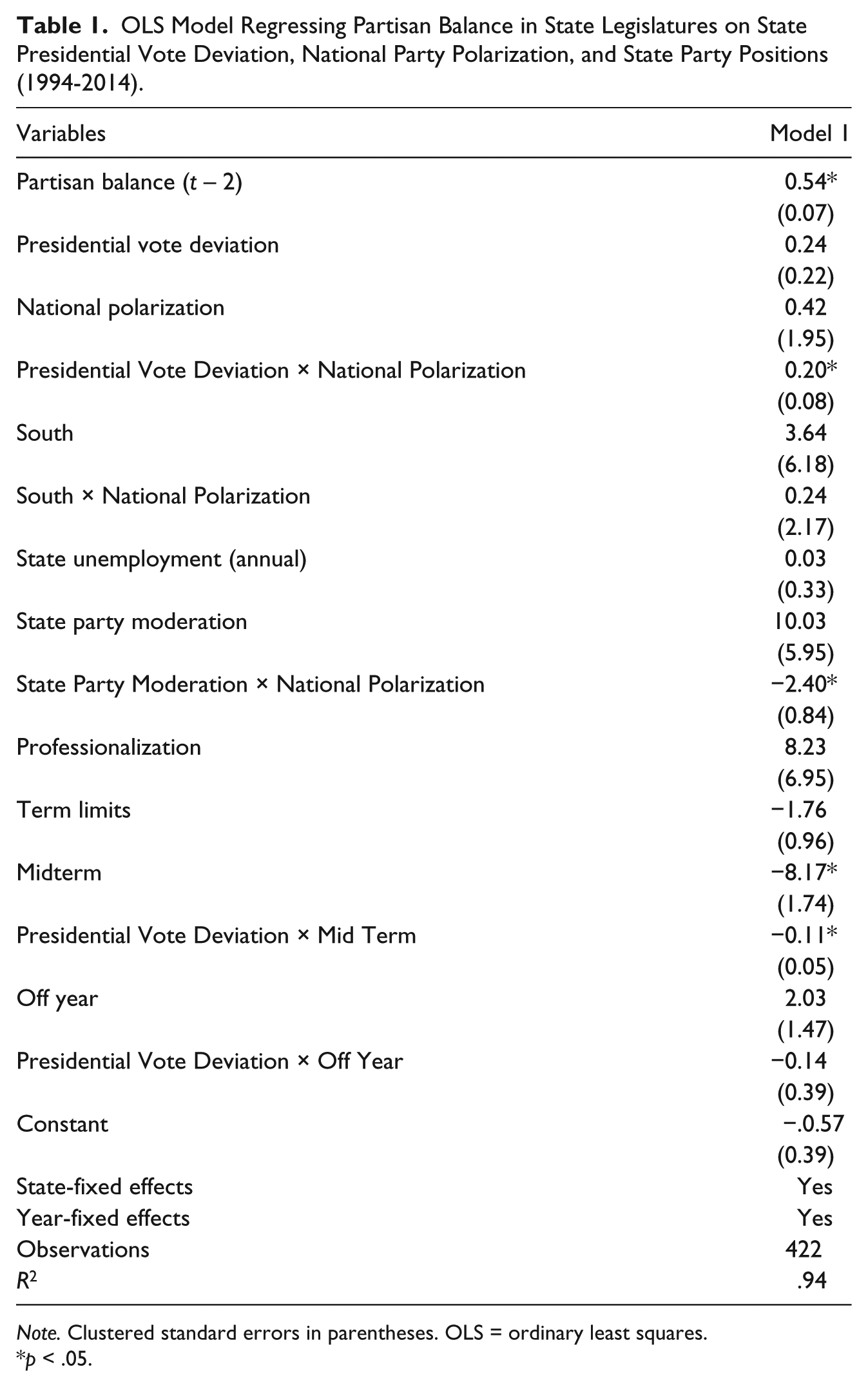
Table 1 presents our primary analysis. The analysis spans the period of time between 1994 and 2014. Two interactions are of particular theoretical interest. First, we assess the interaction between relative national polarization and the national presidential vote to test whether increased relative national polarization heightens the influence of national politics on state election outcomes (Hypothesis 1). 7 Second, we assess whether being more moderate than the opposing party is associated with an electoral advantage and whether that advantage is conditioned by relative national polarization (Hypothesis 2). Being more moderate should grant state parties an advantage (Erikson, Wright, & McIver, 1993, p. 187), but it is possible that this advantage is diminished when the positions of the state parties are overshadowed by the positions of the national parties—which we argue is the case in states subject to high relative national-level polarization. 8
OLS Model Regressing Partisan Balance in State Legislatures on State Presidential Vote Deviation, National Party Polarization, and State Party Positions (1994-2014).
Note. Clustered standard errors in parentheses. OLS = ordinary least squares.
p < .05.
The substantive results of the interactions testing Hypotheses 1 and 2 are displayed in Figures 2 and 3 (calculated using the coefficients from the first column in Table 1). In Figure 2, the interaction between the difference in state and national polarization and Democratic presidential vote share demonstrates that relative national and state polarization meaningfully affects the relationship between presidential voting patterns and the partisan balance in state legislatures. The more polarized the state parties are relative to the national parties, the less the electoral fortunes of these parties are tied to their national-level counterparts. A 1-point increase in Democratic presidential vote share has no impact on the state’s partisan balance in instances where the state parties are considerably more polarized. In instances where the national parties are more polarized than the state parties, the relationship is positive and significant—an increase in Democratic vote share on the presidential level is associated with an increase in the Democratic share of the seats in the state legislature. When the state and national parties are roughly equally polarized (which is typical of the majority of the observations in the sample as demonstrated by the overlaying kernel density plot), a 1-unit increase in Democratic presidential vote share is associated with roughly a .5-unit increase in Democratic seat share in the state legislature. As hypothesized, the less polarized the state legislature is relative to the national average, the stronger this relationship.
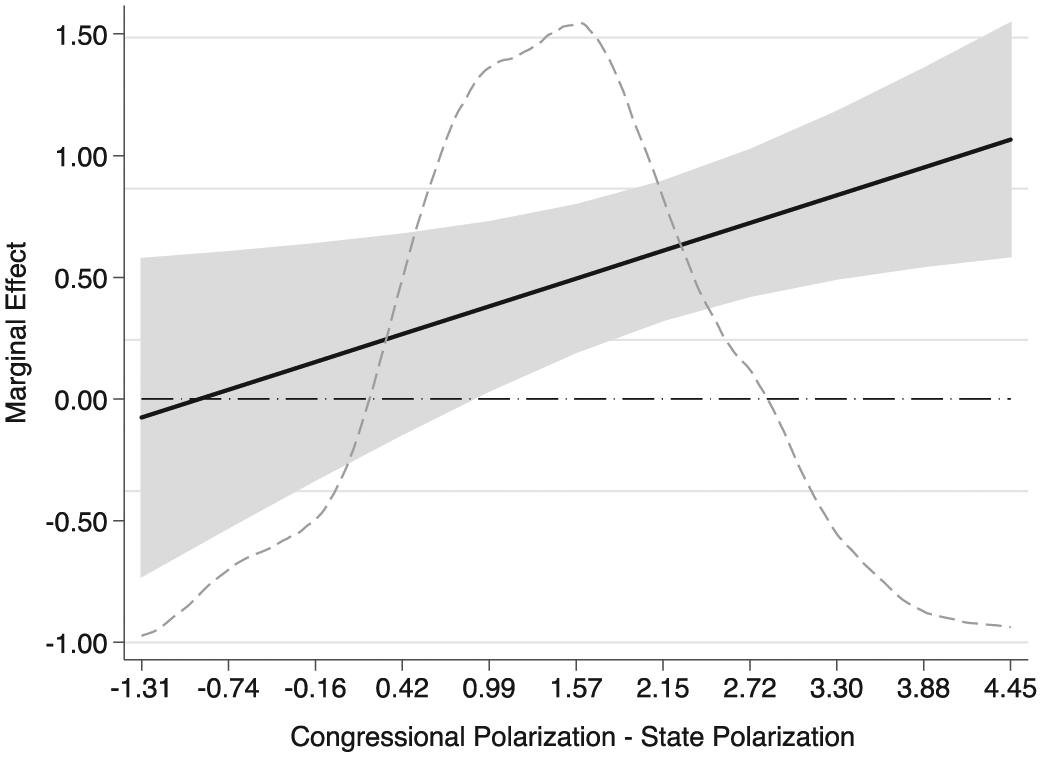
Estimated effect of state-level presidential vote shares on the partisan balance in state legislatures across a range of values of the difference between state and national polarization (1994-2014).
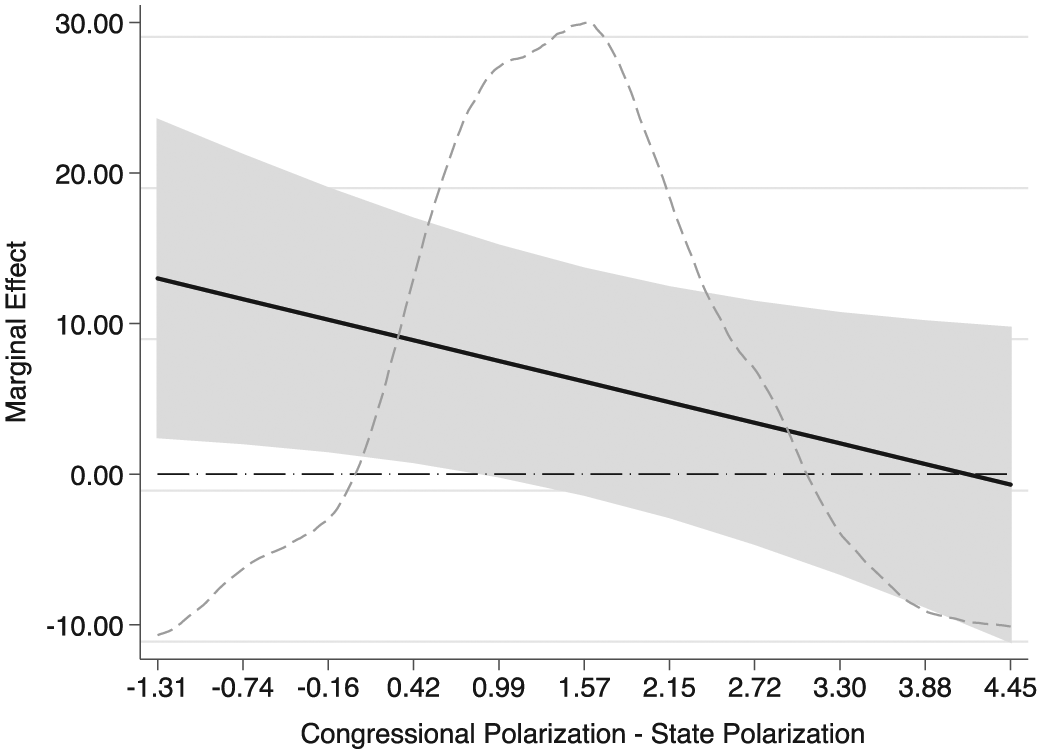
The effect of ideological moderation on the partisan balance in state legislatures across a range of values of the difference between state and national polarization (1994-2014).
The other key interaction is between relative national polarization (the difference in state and national polarization) and state party moderation (i.e., which party is more moderate—negative numbers reflect a more moderate Republican Party while positive numbers reflect the opposite). If state party positions matter, then state parties might improve their electoral fortunes by being more moderate than the opposition. The tactic is for the Democratic (Republican) party in conservative (liberal) states to adopt a more moderate position relative to the national party in an effort to better cater to the state’s median voter. The question is whether this moderation is an effective tactic for winning seats in an era of national polarization. Figure 3 indicates that an increase in policy moderation in favor of the Democrats is only significantly associated with a greater share of the seats in the state legislature when state politics is highly polarized. When relative national polarization is higher, state moderation does not have a significant relationship with legislative vote share. Thus, Figure 3 suggests the hypothesized pattern: More moderate state parties outperform their more ideologically extreme counterparts only under some circumstances.
Control variables indicate other notable effects. The Democratic Party performs worse (i.e., wins a smaller proportion of legislative seats) in midterm elections than the Republicans. The Democratic Party also performs considerably better in the South in states where the national parties are more polarized than the state parties.
Overall, the results of these analyses demonstrate that increasing polarization on the national level has had the effect of increasingly linking the fates of the state parties to their national-level counterparts. State-level presidential voting patterns have become strong predictors of the partisan balance in a state legislature. Yet the positions that the state parties adopt do still affect their electoral fortunes. The state parties that are most insulated from the effects of national-level forces are those that are more polarized than the national parties. In these cases, the state parties have labels and positions that are distinct from the national parties, and this helps to decouple the relationship between presidential voting patterns and the partisan balance in state legislatures. Our analyses demonstrate that policy moderation is only an effective electoral tool in a limited set of contexts (states where the state parties are very polarized). The evidence assembled so far strongly suggests that the outcomes of state legislative elections hinge on the national party’s popularity within the state when there is high relative national polarization.
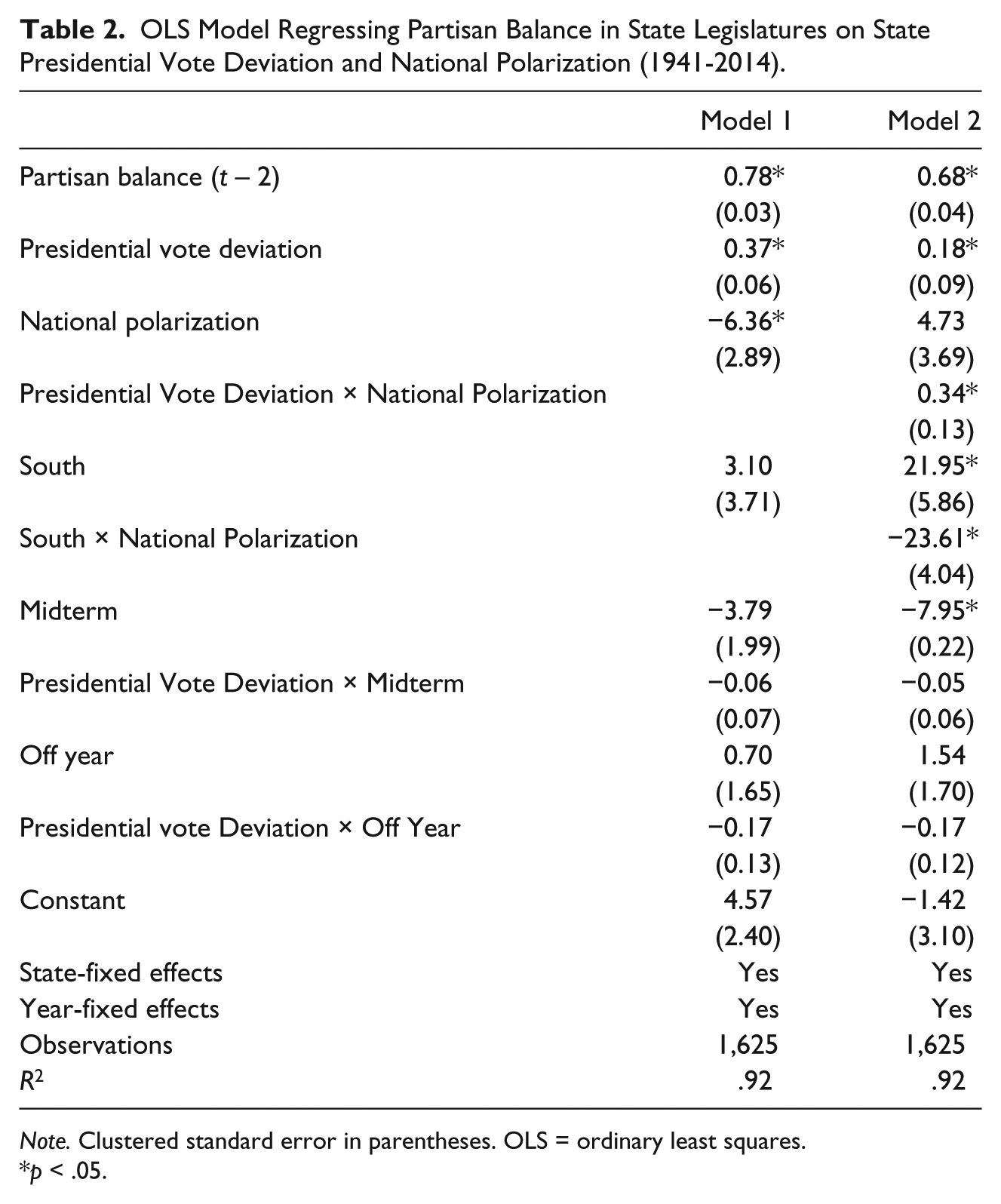
Our final set of analyses have a less comprehensive set of variables and can only test Hypothesis 1 because of data unavailability in the longer time frame. Our interest focuses on how state-level presidential votes, national ideological polarization, and partisan composition intersect: on whether the relationship between presidential votes and the partisan composition of state legislatures has strengthened as the parties’ positions have become increasingly polarized on the national level. If the relationship has strengthened, this is further evidence that suggests national polarization might be reshaping the partisan composition of state legislatures. The dependent variable is the partisan balance in the state legislature and the primary independent variables involve the interaction between the state-level presidential vote deviation and national-level polarization. All standard errors are clustered by state. We present the results of this analysis in Table 2. 9
OLS Model Regressing Partisan Balance in State Legislatures on State Presidential Vote Deviation and National Polarization (1941-2014).
Note. Clustered standard error in parentheses. OLS = ordinary least squares.
p < .05.
The results of this analysis demonstrate that the relationship between state-level presidential votes and the partisan balance in state legislatures has strengthened as national politics have become more polarized. Figure 4 displays the substantive effect of this key relationship—the effect of a 1-point increase in Democratic presidential vote share on the partisan balance in the state legislature across a range of values of polarization (the dashed line is a kernel density plot of the observed values of national polarization in the analysis). The figure indicates that a 1-point increase in Democratic vote share at the presidential level is associated with an increasingly large jump in the Democratic share of the state legislature as polarization increases. A 1-unit increase in Democratic presidential vote share is associated with roughly a .2 increase in Democratic seat share when polarization is low. The magnitude of this relationship increases to over .5 when polarization is high. As hypothesized, the electoral fortunes of state-level parties appear to be more closely tied to those of their national-level counterparts when national polarization is high.
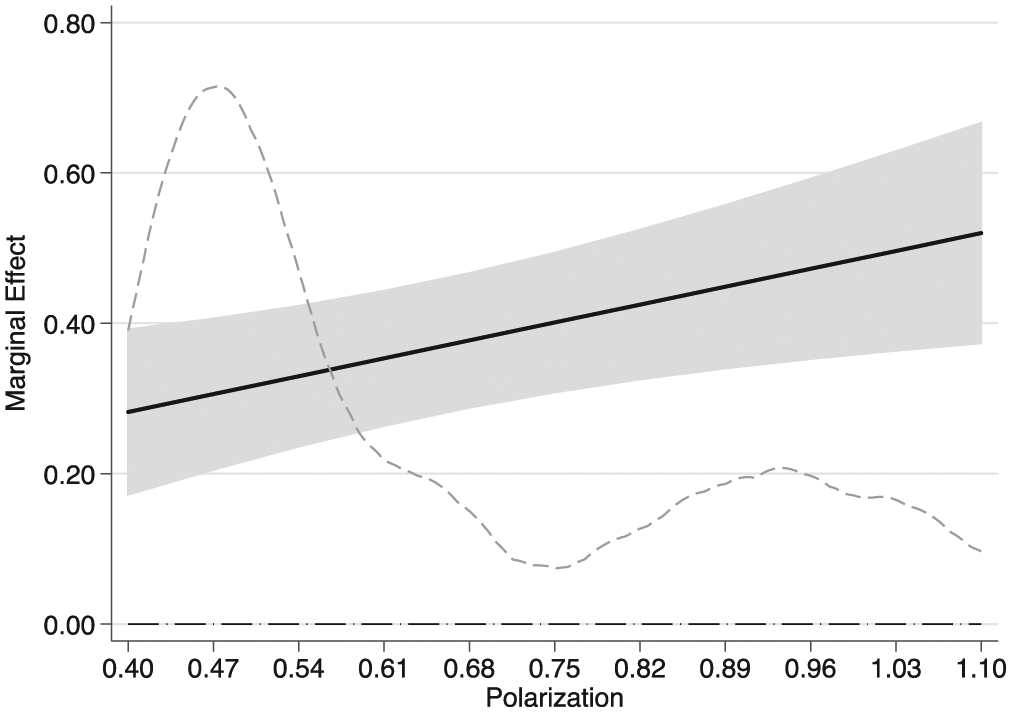
The marginal effect of state-level presidential vote shares on the partisan balance in state legislatures across a range of values of national polarization (difference in DW-nominate party medians).
We briefly note several other model results. First, the coefficient for the South dummy variable is positive (roughly 22) and significant, suggesting that Democrats dominated Southern state legislatures considerably beyond what would be expected based on presidential voting patterns alone. However, we should also note that this relationship evaporates as polarization increases. The negative coefficient (–23.6) on the interaction between South and polarization suggests that the Democratic advantage in Southern state legislatures eroded as polarization increased. By the end of the time series, Democrats were not doing any better in Southern state legislatures than would be expected on the basis of these states’ presidential voting patterns. 10
Consequences for Representation and Conclusions
Our results suggest that it is increasingly difficult for U.S. state-level parties to offset the effects of national party ideology. Our analysis provides empirical evidence that national polarization (and state polarization) condition the extent to which national conditions shape state legislative election outcomes. Overall, we find evidence that state legislative party positioning influences their electoral fortunes only under conditions of low relative national polarization, and strong evidence that national party preferences influence state legislative outcomes, particularly when (relative) national polarization is high. This study both explains and suggests contextual conditions for several recent findings in the literature on representation in the states. This includes a tendency toward overresponsiveness by legislative medians to the preferences of the state median voter (e.g., Batista, Peress, & Richman, 2015), evidence that party supporters are becoming more ideologically uniform across states (Wright & Birkhead, 2014), evidence that state legislators are not held accountable for their votes in most cases (Rogers, 2017), and evidence that weakened correction by median voters has allowed for an emerging party-control effect on state policy outcomes (Caughey, Warshaw, & Xu, 2017).
Our results imply that state legislative partisan composition will increasingly reflect a state’s overall ideological composition. Because parties nearly always are polarized on opposite sides of the state median voter, a pattern of unending victories by the party with a national position closer to the state median voter will produce policy outcomes that are on average biased substantially away from the state median voter. This is broadly the pattern found by Caughey et al. (2017) in their recent analysis of the evolution of public policy in the states. Policy in liberal states is becoming progressively more liberal while policy in conservative states is heading in the opposite direction, and partisan control effects have emerged in recent decades that were absent in the earlier period.
Overall, our results suggest a top-down model of state-level party realignment. Increased national polarization means state parties cannot readily distinguish themselves from the national party brand, and so distinctive state party coalitions are eroding in favor of a uniform national set of party coalitions (Wright, 2016). Thus, our results arguably explain a portion of the realignment in the South (e.g., Black & Black, 2002; Hood, Kidd, & Morris, 2014; Lublin, 2004) as well as realignment in the Northeast (Reiter & Stonecash, 2010) and Pacific coast (Wright, 2016).
Another implication of an increased role for national politics in state election outcomes is that there should be a divergence in the extent to which swing-state and non-swing-state legislative parties are at risk of losing control of their chambers. Figure 5 reports the relative stability of party control across rolling 10-year periods in swing states (10-year average deviation from national vote percentage less than 5%) and nonswing states. The figure focuses on patterns in non-Southern states. In the period with the lowest national polarization—1960s and early 1970s—both swing states and nonswing states had nearly equal probabilities of their legislatures swinging from both chambers being controlled by one party to both chambers being controlled by the other during a 10-year period. In contrast with swing states, alternations in the partisan control of state legislatures in nonswing states had sunk to a very low level by the early 1990s and have remained low since.
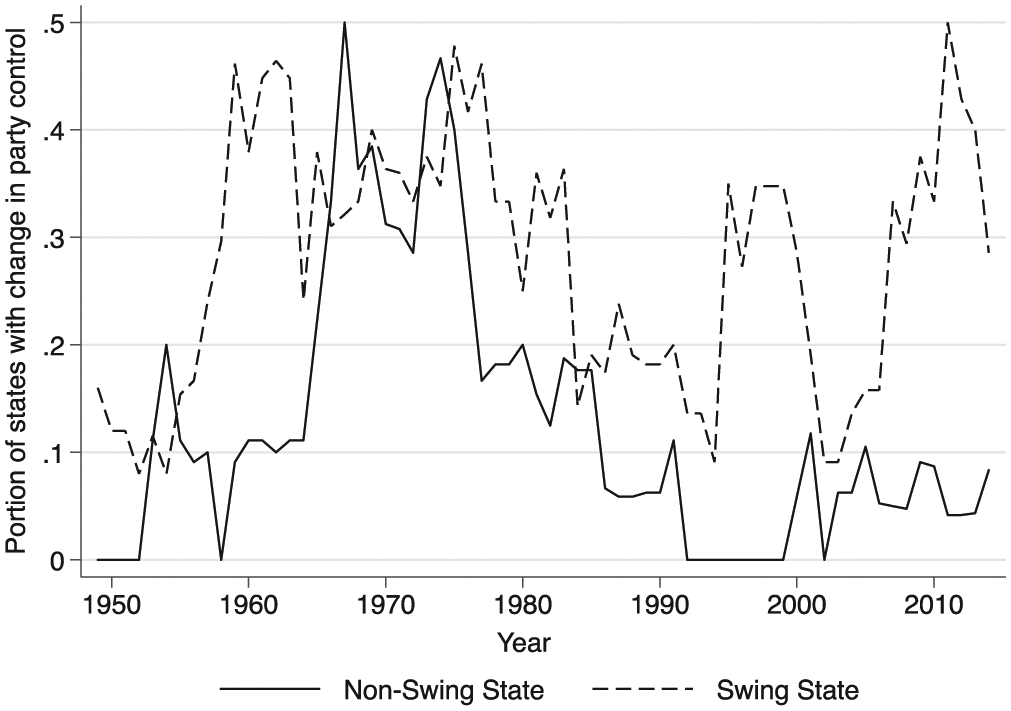
The proportion of non-Southern states that experienced an alternation in partisan control of state legislatures in the previous 10 years.
To the extent that relative national polarization grows more pronounced, the advantaged party in national-level safe party states stand to benefit: our results imply that its legislators can achieve relatively stable domination. If scholars who argue that party competition plays a key role in incentivizing responsiveness and good government are correct (e.g., Aldrich & Griffin, 2010; Key, 1949), then this poses a challenge for the health of democracy in those states. Even in national-level swing states, increased dependence on national trends may short-circuit responsiveness. Swing states may still see frequent legislative party control changes, but perhaps more due to national partisan winds than anything the state parties have accomplished. Overall, the nationalization of state politics leads to state electoral outcomes driven by national political patterns and less likely to respond to and reflect their state’s politics. And arguably state house democracy suffers thereby.
Supplemental Material
APR_RandR_Appendix – Supplemental material for Polarization and the Nationalization of State Legislative Elections
Supplemental material, APR_RandR_Appendix for Polarization and the Nationalization of State Legislative Elections by Joshua N. Zingher and Jesse Richman in American Politics Research
Footnotes
Declaration of Conflicting Interests
The author(s) declared no potential conflicts of interest with respect to the research, authorship, and/or publication of this article.
Funding
The author(s) received no financial support for the research, authorship, and/or publication of this article.
Notes
Supplemental Material
Supplemental material for this article is available online.
Author Biographies
References
Supplementary Material
Please find the following supplemental material available below.
For Open Access articles published under a Creative Commons License, all supplemental material carries the same license as the article it is associated with.
For non-Open Access articles published, all supplemental material carries a non-exclusive license, and permission requests for re-use of supplemental material or any part of supplemental material shall be sent directly to the copyright owner as specified in the copyright notice associated with the article.
