







Abstract
Theoretically, political ambitions paired with elections generate more responsive elected officials. In this paper, we test whether the progressive political ambitions of public officials affect whether and how they respond to their constituents by conducting a experimental audit study where local public officials receive both an electorally related service request and a generic service request. We combine their responses (or non-responses) with data from a survey of these public officials conducted months prior about their political ambition in seeking higher office. On the whole, we find that politically ambitious officials are not more responsive to electorally oriented service requests and that there are not systematic differences in the content of the responses of ambitious and non-ambitious elected officials. In areas of constituency service, ambition does not seem to affect representational behavior, regardless of whether the service requests are electorally related or not.
“The politician as office seeker engages in political acts and makes decisions appropriate to gaining office”
Theories of political ambition, and specifically ambition to seek higher political office (i.e., progressive ambition), argue that policymakers’ ambitions should shape their behavior (Schlesinger, 1966). Though past work examines how progressive ambition impacts officials’ behavior in the policy-making sphere (e.g., Herrick & Moore, 1993; Hibbing, 1986; Maestas, 2003), it has largely ignored a central part of the policy process: the implementation of policies, which often involves officials’ communicating directly with constituents and end-users of these policies (e.g., Butler & Broockman, 2011; Grose et al., 2015)—especially at the local level where elected officials act as street-level bureaucrats (Lipsky, 1980; Hupe and Hill, 2007; Oliver et al., 2012, 90). Though not previously examined, we might expect politicians to be more interested and willing to engage with constituents in certain policy areas of service provision because of the relationship of those policy areas to elected officials’ political goals.
Policy provision through constituency services is essential to elected officials’ job. At the local level, elected officials are often tasked with formulating and implementing policy and also answering constituent questions about that implementation (Clingermayer & Feiock, 1994; Koop, 2016; Oliver et al., 2012; Welch & Bledsoe, 1988). 1 Moreover, policy provision through constituency service affects political careers (Fenno, 1978; Grose, 2011) and is crucial to democratic representation (Clingermayer & Feiock, 1994; Grose, 2011; Hall, 1996; Oliver et al., 2012; Welch & Bledsoe, 1988).
In this paper, we study the relationship between political ambition—both progressive ambition (the ambition to run for higher office) and static ambition (the ambition to run for re-election)—and local officials’ responsiveness to constituent policy service requests in different issue areas. Our work relies on a unique set of data, combining a correspondence study of elected public officials with survey data previously collected from those same officials. While the number of correspondence studies examining the responsiveness of elected officials is rapidly growing, previous studies have largely used between subject designs and have only examined variation in legislator characteristics using externally measurable factors. 2 Our use of a large-scale survey in conjunction with a correspondence study using a within-subject design allows us to measure progressive ambition in a detailed way and observe the relationship between ambition and the responsiveness for different constituent requests.
We look at how officials’ responsiveness varies by progressive ambition across two different types of service requests—a request for information about a non-electorally related government service (recycling) and a request for information about an electorally related government service (voter registration). We focus specifically on public officials who are interested in seeking opportunities for higher office because these public officials must enlarge their electoral base beyond their current electoral coalition. On the other hand, politicians who have only static ambition (a desire to seek re-election) or discrete ambition (a desire to leave office) do not need to expand their electoral base to continue to win elections (and often do not face any significant electoral challenge). Rather, they need only to serve and maintain their current electoral constituency.
We find that requests for information about voter registration are more likely to receive responses (71%) than are requests for information about recycling (67%), a small but statistically significant difference. However, these effects do not appear to be driven consistently by expressed ambition (either progressive or static). While we find significant differences among the response rates to these two different requests for information among politicians who have interest in running for higher office “if the opportunity presented itself,” we do not find that officials who “definitely would like to” run for higher office in the future are any more responsive to a voter registration email than one about recycling.
We also find similar results when examining how public officials respond, another important aspect of policy representation (Grose et al., 2015). Compared to other elected officials, those open to the opportunity to run for higher office are more likely to encourage political action in response to electorally-relevant emails than less electorally-relevant ones, but again, this does not extend to those who indicate they “definitely would like to” run for higher office. Overall, our results do not suggest a strong relationship between elected officials’ progressive or static ambition and their responsiveness to policy service requests. More generally, this paper highlights the importance of examining behavioral outcomes to test prominent theories of representation.
Political Ambition and the Behavior of Elected Officials
Differences in ambition should change politicians’ incentives to take certain actions especially those related to their electoral goals (Schlesinger, 1966). Progressive ambition (the desire of an elected public official to seek higher office) has been shown to have a strong influence on the legislative behaviors of elected officials (Herrick & Moore, 1993; Hibbing 1986; McAdams & Johannes, 1985; Maestas, 2003; Van Der Slik & Pernacciaro, 1979). These broader electoral goals encourage public officials who are interested in seeking opportunities for higher office to work to enlarge their electoral base beyond their current electoral coalition. On the other hand, politicians with static ambition (the desire to run for re-election) or discrete ambition (the desire to leave public office) do not need to do so. In the case of those with static ambition, they need only to serve and maintain the current electoral constituency that they have already gained to continue to win elections 3 while those with discrete ambition no longer need to maintain a constituency for reelection purposes.
These differences between those with and without progressive ambition are likely extenuated because many elected officials occupy seats where there is a chronic lack of competition (Squire, 2000), which reduces the chance that their actions will be fully scrutinized during the re-election campaign. This is especially true in local races (Krebs, 1998). Among our sample of local officials, 86 (67) percent won their election by more than 5 (15) percentage points and roughly a third did not face any electoral competition at all. In order to accomplish their static or discrete ambitions, these public officials do not need to expand their electoral constituencies. 4
In addition, even those in close races have little incentive to actively expand their electoral base. Previous research supports the idea that those most concerned about expanding an electoral constituency are those with progressive ambitions and not static ambition. Fenno (1978, 172) does recognize that members of Congress engage in “expansionism” early in their careers; however, this phase appears to end toward the end of the first term in office (Fenno, 1978), making it unlikely that expansionists are a significant portion of the unambitious. Consistent with this, Maestas (2003) finds that state legislators with progressive ambition allocate more resources to following their current constituents’ opinions while those with static ambition do not differ significantly in their behavior from those with discrete ambition.
One possibility is, however that local officials are different. As others have argued, it could be that they are more civic duty and constituent service oriented (Oliver et al., 2012). On the other hand, while local officials have lower levels of ambition overall than state legislators (Einstein et al., 2020), ambition theory should suggest that the ambitions of local elected officials—be they discreet, progressive, or static—should not affect patterns of behavior for local officials differently than for state legislative officials. Regardless of a politician’s current office, to realize higher ambitions that politician must expand their constituency. As such, we expect local officials without progressive ambition to continue to service their constituencies to maintain their electoral coalitions; however, they do not need to expand their electoral support in the same way as elected officials who harbor progressive ambitions.
As mentioned above, the study of how ambition affects representation has focused almost entirely on the behavior of elected representatives in the policy making sphere (e.g., Francis and Kenny, 1996; Herrick & Moore, 1993; Hibbing, 1986; Maestas, 2003). In this paper, we follow a more recent but also important development in the literature that investigates the responsiveness of representatives to service requests (e.g., Butler & Broockman, 2011; Dropp & Peskowitz, 2012; Grose et al., 2015) and their communications with constituents (e.g., Butler et al., 2012; Hassell & Monson, 2016; Koop, 2016). While this literature has focused on the nature and frequency of elected officials’ responsiveness to service requests, none of these recent works have examined the relationship between responsiveness and progressive political ambition. 5
The exception is McAdams and Johannes (1985), who find that legislative officials who seek a higher political office in the subsequent election cycle do not allocate constituent service resources differently in the current election cycle than those who do not later seek higher office. However, this study fails to distinguish between those who are unambitious, those who are ambitious but lacked the opportunity, and those who are ambitious and have the opportunity (Maestas et al., 2006). Institutional structures and incentives beyond public officials’ control strongly influence whether or not they run for office even after accounting for progressive ambition (Abramson et al., 1987; Maestas et al., 2006; Rohde, 1979). Thus, it is plausible that an individual with only a little ambition may be persuaded to run in a highly favorable district, while another candidate with significantly more desire to run for higher office declines to do so because of unfavorable institutional incentives. As such, the dichotomous measure of ambition used in that study ignores variation in progressive ambition, potentially misclassifying ambitious politicians as unambitious.
Ambition and Types of Constituent Services
As noted previously, scholarship suggests that politicians should have greater incentives to perform better in policy areas that help them to achieve their ambition goals (Maestas, 2003; McAdams & Johannes, 1985; Schlesinger, 1966). This research assumes that progressive ambition incentivizes politicians to be more responsive on the whole in hopes of expanding their electoral constituency. Yet, different policy areas might help politicians achieve their political goals, which is an argument used to explain why public officials are more responsive to certain types of service requests (Butler et al., 2012; Costa, 2017).
In that vein, we also expect politicians to prioritize areas of constituent service that have higher potential electoral rewards, especially if they have progressive ambition. Studies of constituent service that do not differentiate between service requests that are explicitly linked to elections—for example, registering to vote or acquiring citizenship—and other non-electoral policy service requests—for example, assistance with access to government services (e.g., Maestas, 2003; McAdams & Johannes, 1985)—might miss important variation in the actions of elected officials. While all constituent service might be viewed as helping improve electoral margins, constituency services explicitly dealing with elections are more clearly linked and have the advantage of explicitly adding individuals who will likely be supporters to the voter rolls. While helping someone with a less electorally relevant request may help a constituent form a favorable opinion about a public official, that constituent may already be a supporter (indeed, given the initial outreach, it may well be that the elected official expects as such). In contrast, helping constituents with electorally related services helps add voters to their electorate that they know were not already part of it, which can help them advance their political ambitions by growing their potential electoral base.
In short, the differences between politicians who are seeking to facilitate their progressive ambition and those who are not should be greatest in areas of policy service related to elections that help expand the voter base and facilitate opportunities to run for higher office. As such, we consider that progressively ambitious elected officials might be more likely to respond to constituent service requests that have the potential to increase the electoral base of an elected official, such as a request to help register to vote, than a non-electorally related service request, such as questions about recycling procedures.
We also might expect that progressive political ambition will influence how elected officials respond to their constituents. Our expectations are that more ambitious elected officials will write longer, more thoughtful, and more encouraging responses to requests for electorally related service. The need to expand an electoral base incentivizes ambitious politicians to provide better responses. We expect that these higher quality responses will be manifest in two ways. 6 First, elected officials with progressive ambition will be more likely to thank constituents for their actions related to voting and to encourage constituents to vote because both expressing gratitude and encouragement to vote have a strong effect on future electoral participation (Panagopoulos, 2011).
In contrast, we logically would not expect the same effects for non-electoral requests. In these cases, differences between ambitious and non-ambitious politicians should be minimal. Because non-ambitious politicians may still want to retain their seats, we would expect them to continue to serve their districts; however, these non-electoral requests are not as directly tied to ambitious officials’ motivations to enlarge and expand their electoral base which should result in a level of responsiveness that is not significantly elevated above the responsiveness of unambitious politicians.
Survey of Local Public Officials and Email Correspondence Experiment
We test these expectations based on the previous research with data collected from a field experiment that followed a large online survey of municipal officials. The survey of local municipal officials was conducted in the summer of 2016. 7 The survey was sent to 33,787 public officials and had a response rate of roughly 11%. 8 For the purposes of this paper, we limit our analysis to elected public officials, excluding staff from the sample. More details regarding the sampling methodology, characteristics about the sample including the variation on demographic and institutional features, and other aspects of the survey are available in the online appendix. Analyses of the respondents and sampling frame show that the officials who participated in the survey come from a wide variety of municipalities in terms of location, demographics, and institutional features. They also vary widely in terms of individual-level demographic and political characteristics, such as ideology, electoral vulnerability, tenure, etc.
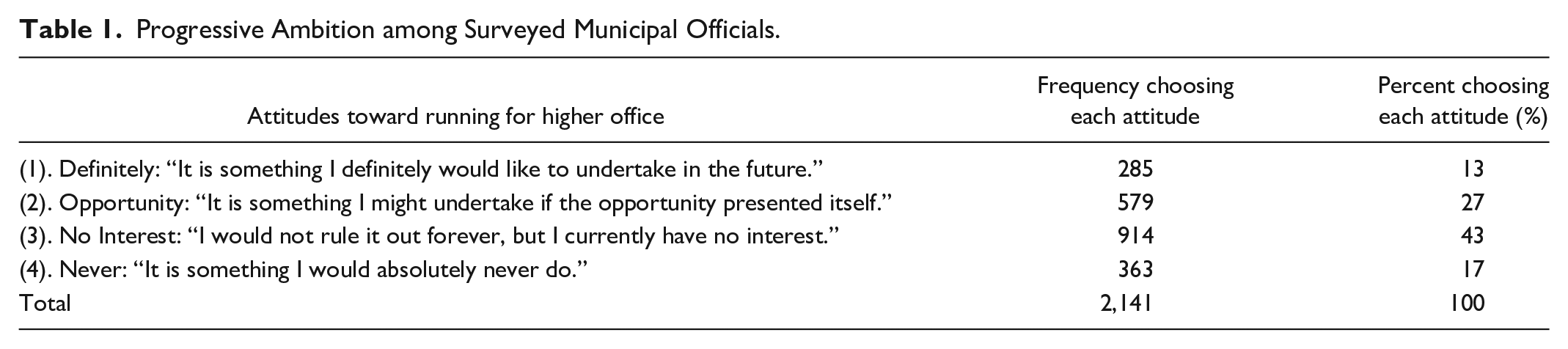
The primary independent variable in our analysis is local officials’ progressive ambition, which we measured by asking elected officials, “Which best characterizes your attitudes toward running for a higher office in the future?” 9 Survey respondents had four options, which we list in Table 1, beginning with the answer that indicates the highest level of progressive ambition. 10 This measure avoids the potential problems of using post-treatment behavior (whether an individual ran for higher office later) as a proxy, as outlined above in our discussion of McAdams and Johannes (1985). In our results, we analyze the effect of each response individually to maximize variation; however, the results hold if we pool those who respond they are “definitely” interested in higher and those would be interested “if the opportunity presented itself.” (See the online appendix.)
Progressive Ambition among Surveyed Municipal Officials.
To measure static ambition, we asked respondents to indicate how many more years they planned on remaining in office. Consistent with Maestas (2003) we coded individuals who indicated they would be in office six or more years as having static ambition. Just over 60% of the sample reported anticipating being in office for more than 6 years. 11
A potential source of confounding is that progressive political ambition is not randomly assigned. Elected local officials who harbor progressive ambitions are substantively distinct from non-ambitious political officials in a number of ways (Dynes et al., 2019; Maestas et al., 2006), many of which could also potentially influence responsiveness to citizen requests for services. As a result, we show in the appendix that our results are robust to models that interact a variety of characteristics that correlate with ambition including individual personality traits, city size, years in office, local government structure, gender, and personality.
Using a list of generic first and last names, we created ten (five male, five female) Gmail accounts from which we sent requests to the officials who had previously participated in our survey. 12 We utilize a three-wave within person design for this experiment. Each elected official received two emails requesting assistance in gathering information sent during one of three waves in August 2016 about a week and a half apart. 13 One of these two service-oriented emails asked for assistance finding information about an electorally related topic (information about how long an individual needed to live in an area prior to registering to vote) while the other asked for assistance with a non-electorally related topic (information about what could and could not be recycled in the community). The exact text of the email and these treatments is displayed in the appendix. We also randomized nearly every aspect of the emails, like the greeting and signature, and waited at least one week between each email wave to prevent public officials from becoming suspicious about the nature of these requests. Response rate did not change over time—71% responded to the first wave while 69% responded to the final 14 —suggesting that this approach was successful.
Results on Response Rates
Overall, municipal officials are responsive to email requests. As reported in Table 2, elected municipal officials responded to 70.8% of the voter registration email messages they received and 67.4% of the recycling email messages they received. 15 Each of these response rates are significantly higher than reported response rates to constituent letters at the Congressional and state legislative levels. 16 As expected, we find that officials are more likely to respond to voter registration email requests than to the non-electoral service request by 3.4% points (p < .01).
Local Officials’ Response Rates Differ by the Email Request Treatments.

To test whether progressively ambitious officials are more likely to respond to service requests that have a direct impact on their electoral goals, we take advantage of the within-subjects design of our experiment and use a subject-level fixed effects model to estimate response rates and how they differ between the treatment conditions. This model accounts for a myriad of individually constant factors that might also affect the behavior and responsiveness of elected officials including gender, city and staff size, electoral security, and time in office. In Figure 1 we show the probability that elected officials responds to the recycling service request (solid point estimates) or voter registration one (hollow point estimates) from the estimates generated in Table 3.
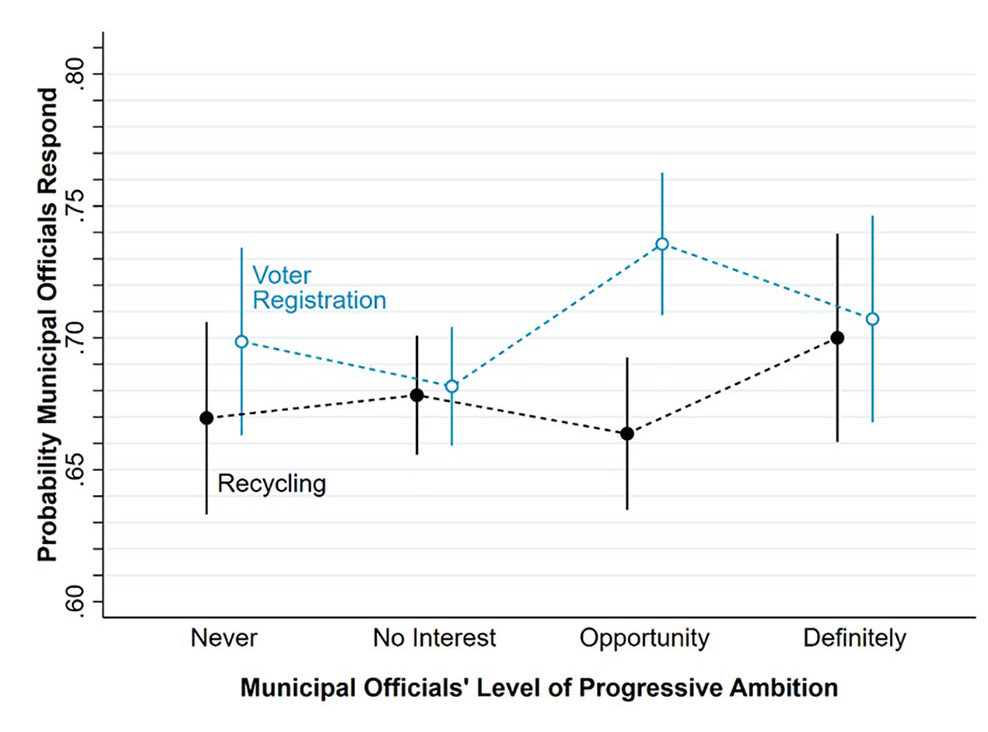
Probability of response by email topic and progressive ambition.
Difference-in-Differences Estimate of Response Rates by Email Topic and Progressive Ambition.
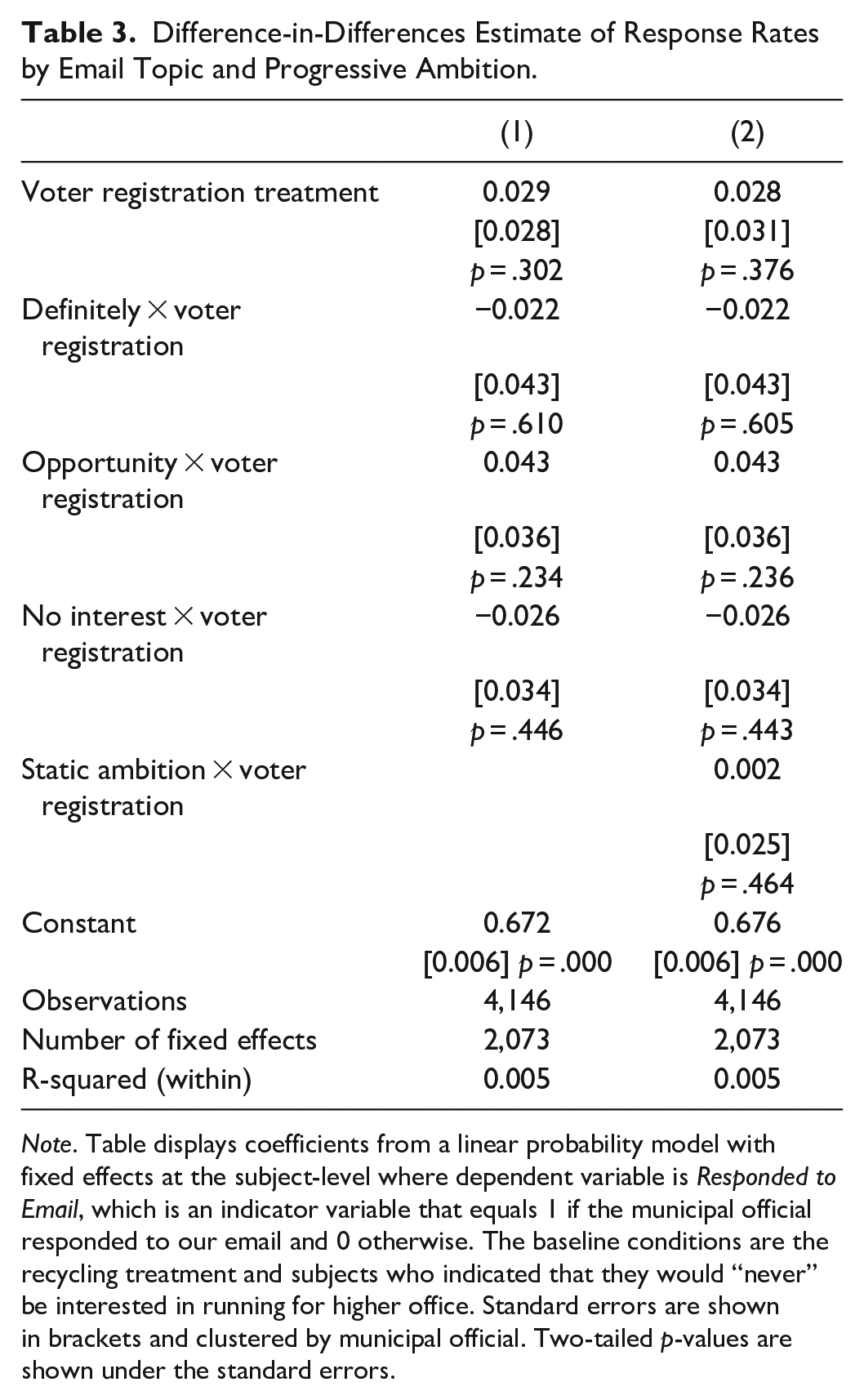
Note. Table displays coefficients from a linear probability model with fixed effects at the subject-level where dependent variable is Responded to Email, which is an indicator variable that equals 1 if the municipal official responded to our email and 0 otherwise. The baseline conditions are the recycling treatment and subjects who indicated that they would “never” be interested in running for higher office. Standard errors are shown in brackets and clustered by municipal official. Two-tailed p-values are shown under the standard errors.
Elected officials are more likely to respond to emails about voter registration than recycling, however, this effect is not systematically larger among ambitious elected officials relative to unambitious elected officials. The difference between response rates is statistically significant among officials who express interest in running “if the opportunity presented itself” (diff. = 7.3; p < .001). Though elected officials who were “definitely” interested in running for higher office had the second highest response rate to the voter registration emails, they also had the highest response rate to the recycling emails, resulting in a small difference in response rates between the two treatments (diff. = 0.6; p = .439).
In Table 3, we examine the difference-in-differences of responses to different service requests across levels of progressive ambition, using an OLS regression with fixed effects that interacts the officials’ level of progressive ambition with the treatment assignment. We also include a measure of static ambition in our model interacted with the email type to test the impact of static ambition. Please note that the component parts of these interactions are not displayed in Table 3 because they are subsumed in the fixed effects.
We find almost no evidence of increased responsiveness among those with higher levels of political ambition. Although there are significant differences between those who were interested in running “if the opportunity presented itself” and those who expressed either no interest or that they would definitely run, the difference in response rates for those with higher levels of ambition is not statistically different from the difference for those who indicated they would “never” run for higher office. We find similar results if we create a dichotomous variable of ambition with those who responded they would “definitely” run or run “if the opportunity presented itself” coded as ambitious. Those results are in the online appendix.
And though the substantive effects of the heterogeneous treatment effects are similar in size to the effect of emailers’ race on elected officials’ response rates as found by Butler and Broockman (2011), the effects here are not statistically significant (with a similar sample size to Butler and Broockman), suggesting that the effects may be spurious. Overall, our findings do not suggest that progressive ambition influences responsiveness to constituency requests in a way that is consistent with Hypothesis 1. Though it is likely that the large difference in response rates among those open to the opportunity to run for higher office is a statistical oddity, we discuss some possible alternative explanations for this results in the conclusion.
We also find no significant effect of static ambition. Consistent with the idea that elected officials with static ambition merely need to service their constituency rather than actively work to expand their electoral constituency, we see no significant difference in the responsiveness of those with static ambition to different types of requests. While static ambition might affect overall responsiveness, it does not appear to have a significant effect on differences in responsiveness to electoral and non-electoral service requests.
Response Content
Although we did not find systematic differences in response rates by ambition, it might be that ambition still affects the way in which elected officials respond. In the appendix we show that there is no effect of ambition on the length of a response to a request for service; however, that simple test does not provide a clear indicator of the overall quality of those responses.
To better test the hypothesis that ambitious politicians will craft better and more thoughtful responses to electoral related service requests than non-ambitious politicians, we had a research assistant dichotomously code whether each email sent by the officials encouraged the respondent to vote, register to vote, or recycle or whether the email thanked the constituent for their interest in voting or recycling. At the same time, several undergraduates were randomly assigned a set of 700 emails to code the same way. The coding was double-blind. None of the coders were aware of the topic of the research project and none of them knew who had been assigned to code other sets of emails. Intercoder agreement for the items presented here was 83% and 84.5% and the Cronbach’s alpha was 0.65, each of which meet dominant thresholds for intercoder reliability (McHugh, 2012). We had at least three coders code each message, and we use a majority rule to create our dichotomous measure. 17
Figure 2 examines whether ambitious municipal officials are more likely to thank or encourage constituents in their response to inquiries about voter registration than about recycling. These point estimates are derived from the same fixed effects model used for Figure 1 and Table 3 but with the thanking/encouraging dependent variable. For sake of space, the regression results showing the difference-in-differences estimate is in the Supplemental Appendix. Similar to the results in Figure 1, we find no systematic increase in the likelihood that ambitious elected officials encourage or thank constituents for voting in response to a voter registration inquiry. As before, however, there is a statistically significant difference among officials who express interest in running “if the opportunity presents itself,” and this difference is statistically different from the differences among those with no interest and no ambition. These results suggest that ambition has a minimal effect at best on both the likelihood of response and the content of those responses.
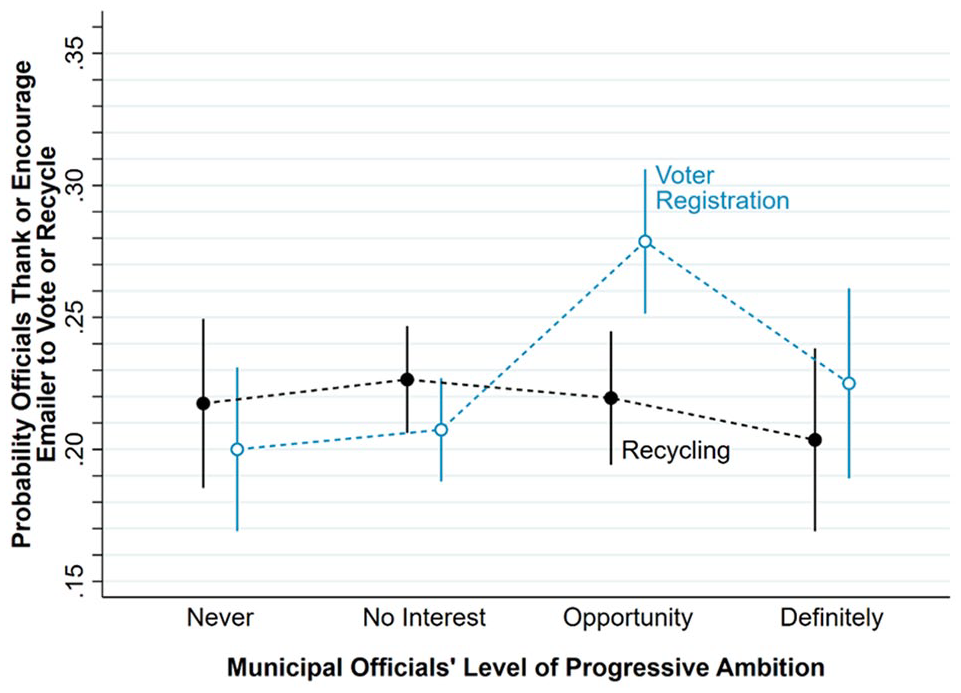
Probability that municipal officials thank or encourage constituent to vote or recycle by email topic and progressive ambition.
Discussion and Conclusion
In this paper we introduce the idea that ambition might affect the decision of policymakers to focus on certain issues. We show, however, that elected officials who are interested in running for higher office do not prioritize election-related policies or appear to fundamentally alter their constituency request behavior. More ambitious local officials do not appear to respond systematically differently to different types of requests from constituents for service, and progressive ambition does not appear to make elected officials more responsive to constituent requests in areas that are especially tied to their electoral goals.
Our results do suggest, however, that ambition might create the highest constituency responsiveness when local officials have opportunistic progressive ambition. While this could be a statistical anomaly and we cannot test the mechanism explicitly, one potential explanation for this is that their progressive ambition motivates them to take advantage of opportunities that do arise to broaden their political base. Ambition is not static (Fox and Lawless, 2011) and increases as opportunities and pathways to higher office become more salient (Maestas et al., 2006; Schlesinger, 1991). Those who are “definitely” interested in running for higher office could be those who are more likely to have already laid the groundwork for such actions including the electoral foundations needed for higher office (Maestas et al., 2006); whereas those who are interested but who do not see a clear path will express interest but be less likely to indicate they are “definitely” running in the future. As such, the differences in behavior between those who would be interested “if the opportunity presented itself” and those who are “definitely” interested in running might be the result of the need to create opportunities.
Another possibility is that politicians open to the opportunity to run are equally ambitious as those who expressed a certainty about running in the future but recognize the strategic aspects of running for office (e.g., Maestas & Rugeley, 2008) and, thus, respond at higher rates and with more encouraging language than those who say they will definitely run.
Finally, it is also possible that those with the highest level of ambition are just more responsive overall. Indeed, Figure 1 suggests that this may be the case (though the confidence intervals are wide given the low number of officials with this level of ambition). High levels of ambition could cause these individual to respond at higher levels regardless of the content with hopes of expanding their electoral constituency in any way they can. 18 Future research would do well to examine this possibility in more detail in the future.
Our findings also have several significant implications for understanding how ambition influences constituency service. The first is that progressive ambition is does not appear to be a key motivator for better constituency service and representation at the local level. Ambition does not increase service representation across the board nor does it appear to systematically affect the more narrow spectrum of electorally related service requests. We do not find that progressively ambitious politicians are more responsive overall or more responsive specifically to electorally related requests. Ambition itself (either static or progressive) appears to be insufficient to increase the responsiveness (and the quality thereof) from public officials to requests outside of electorally related affairs.
While we have tested a number of possible reasons for why public officials with progressive ambitions are not more responsive to constituent requests, we cannot fully exclude every possible heterogeneity. It could be that ambition only affects constituent services among certain subsets of politicians in certain situations where circumstances align. Alternatively, it could also just be that constituent services are not the primary way through which politicians realize their ambition. While constituent services are helpful at generating support one by one, they do not generate the headlines and attract the media attention necessary to introduce oneself to a larger constituency. Although we are not able to explain exactly why, we can say that ambition does not appear to affect the provision of constituent services, electorally related or not.
On the whole, however, we do find that municipal officials are highly responsive to their constituents and much more so than elected officials at other levels of government. The roughly 70% response rates to service requests compare much more favorably to the roughly 50% response rates of members of Congress and state legislators (Costa, 2017). In that sense, local elected officials are doing an excellent job serving their constituents.
Supplemental Material
sj-pdf-1-apr-10.1177_1532673X211013479 – Supplemental material for Political Ambition and Constituent Service: Does Ambition Influence How Local Officials Respond to Electoral and Non-Electoral Service Requests?
Supplemental material, sj-pdf-1-apr-10.1177_1532673X211013479 for Political Ambition and Constituent Service: Does Ambition Influence How Local Officials Respond to Electoral and Non-Electoral Service Requests? by Adam M. Dynes, Hans J.G. Hassell and Matthew R. Miles in American Politics Research
Footnotes
Declaration of Conflicting Interests
The author(s) declared no potential conflicts of interest with respect to the research, authorship, and/or publication of this article.
Funding
The author(s) received no financial support for the research, authorship, and/or publication of this article.

Supplemental Material
Supplemental material for this article is available online.
Notes
Author Biographies
References
Supplementary Material
Please find the following supplemental material available below.
For Open Access articles published under a Creative Commons License, all supplemental material carries the same license as the article it is associated with.
For non-Open Access articles published, all supplemental material carries a non-exclusive license, and permission requests for re-use of supplemental material or any part of supplemental material shall be sent directly to the copyright owner as specified in the copyright notice associated with the article.
