






Abstract
Prior research on economic voting generally finds that national economic performance affects incumbent support. However, the degree to which one’s personal economic situation shapes vote choice remains less clear. In this study, we use novel survey data collected during the COVID-19 pandemic to provide more credible evidence about the effect of changes in personal economic experiences on intended vote choice. Our design uses an objective measure of change in personal economic situation by asking respondents their employment status prior to the pandemic and at the time of the survey. Given the widespread and abrupt way in which the pandemic induced unemployment, we argue that this design reduces concerns about confounders that explain both vote choice and job loss. Our analysis demonstrates that individuals whose personal economic conditions worsened during the pandemic were significantly less like to intend to vote for Trump in the 2020 election.
Introduction
How do changes in individuals’ personal economic situations affect vote choice? There is an extensive body of research in the social sciences on “economic voting,” which broadly argues that economic conditions, either at the individual- or macro-level, have a large effect on vote choice. These effects may be larger than political preferences or ideology. Overall, the general consensus is that voters hold the incumbent government responsible for economic performance, punishing incumbents when the economy is poor (e.g., Grafstein, 2005; Healy & Malhotra, 2013; Lewis-Beck & Paldam, 2000).
While there is agreement that “the economy matters,” how much one’s personal economic experience affects voting, referred to as egotropic or “pocketbook” voting, is much less clear (Kinder & Kiewiet, 1981). Margalit (2019) provides a thorough review of a number of behavioral responses we might see, such as voting against the incumbent, voting for more leftist (or rightwing) policy, or not voting at all. Generally speaking, research in this area suggests that voters’ evaluations of the national economy are stronger predictors of voting behavior than personal economic circumstances (Alvarez & Nagler, 1998; Kiewiet, 1983; Kinder & Kiewiet, 1979). To get at individual-level experience, one promising approach is to use survey data, which can potentially differentiate between personal-level and macro-level experience. However, these approaches are subject to concerns about measurement error (see Kramer (1983) in particular).
There are three main concerns related to measurement and identification in isolating the effect of changes in personal economic experiences on voting, which likely contribute to this ongoing debate. The first is theoretical, which is that changes in individual experiences may affect individual’s beliefs about both their personal well-being and macro-economic performance. This means that “controlling for” national economic perceptions may obscure the effect of personal economic experiences. Likewise, changes to the macro economy may also affect beliefs about one’s own personal standing. Without direct measurement of changes in personal economic experiences, for example, changes in employment status or income, it will be difficult to identify the origin of changes in perceptions.
The second concern is about measurement error. In particular, individuals may misreport their economic perceptions to better align with their reported political preferences (Linn et al., 2010; Wlezien et al., 1997). This problem is likely exacerbated when asking about general perceptions, like beliefs about the health of the macro-economy, or when analyses are based on survey data in which individuals are asked about their political preferences and attitudes at the same time as their economic views, which may heighten the tendency to shape economic perceptions to match pre-existing political views (Conover et al., 1987).
Finally, there is a problem of omitted variables bias, where individuals’ economic standing, specifically unemployment or income, may be confounded by other factors that also correlate with vote choice. For example, individuals already inclined to support one party may be more likely to work in industries where unemployment is more or less common (e.g., low-income workers may be both more Democratic and more likely to work in service sector jobs with more frequent spells of unemployment), leading to a spurious correlation between personal unemployment experiences and voting. More generally, if there is any unmeasured factor correlated with job loss and voting, it may induce bias in the estimated effect of job loss on vote choice. Extant work that proxies personal economic status using measures of unemployment tries to control for many factors that would introduce omitted variable bias but few studies actually measure change in employment status or control for a broad range of factors (e.g., sector of employment) that correlate with average unemployment and well-being. As a result, there is a persistent concern that there are underlying confounders that predict both unemployment and vote choice.
Recent work has offered several promising approaches for understanding the effect of personal economic experiences on voting. Focusing more on the local rather than national setting, Park and Reeves (2020) find that survey respondents who live in areas where local unemployment is higher are less likely to vote for the incumbent. This pattern is consistent either with individuals who are personally affected by unemployment voting against the incumbent (i.e., pocketbook voting) or with those who observe others nearby them becoming unemployed doing so (i.e., sociotropic voting). Healy et al. (2017) use personal tax records of individuals in Sweden merged to their responses on a survey. Their analyses show that evaluations of the economy and reported voting reflect changes in personal economic situations and that voters are more egotropic than previously suggested by the literature. However, it is unclear what explains observed changes in income or whether the same pattern would hold in the United States. On this point, most recent studies of the relationship between individual-level economic experiences and voting use data from countries other than the United States. Finally, work by Margalit and others uses panel data to examine the related question of how economic shocks affect policy preferences and support for populism (Ahlquist et al., 2018; Margalit, 2013). This literature generally finds that shocks that decrease a person’s economic standing increase support for left-leaning policies and may also increase support for populism, but these effects are short-lived. Whether individual-level shocks contribute to anti-incumbent voting, particularly in the US, is not examined.
In this paper, we contribute to extant work on economic voting by exploiting a plausibly exogenous shock to the individual-level economic situation of many U.S. residents. While there is some debate over which economic indicators are most salient (see Nadeau & Lewis-Beck, 2001), we focus on job loss in our analysis. We argue that job loss due to the COVID-19 pandemic provides an economic shock that can be used to identify the effect of an individual losing their job on intended 2020 vote choice. We do not take a position on whether job loss operates through the mechanism of beliefs about individual economic standing or beliefs about the overall macro economy. Instead, we simply attempt a credible estimate of the effect of individual-level job status on voting.
In particular, we use novel survey data to compare the intended 2020 vote choice of individuals who experienced job loss during the pandemic to those who did not experience employment change and control for a number of potential omitted variables that may correlate with job loss and vote choice. Unlike analysis that exploits geographic differences in unemployment, our analysis allows us to focus on individual-level experiences, holding geographic context fixed in certain specifications. We examine the effects of individual-level changes in employment rather than aggregate levels, which we argue, in the context of the economic disruptions wrought by COVID-19, is less likely to reflect omitted variables that might also explain changes in vote choice and turnout. Our main results show that individuals who lose their jobs are less likely to report an intended vote for Donald Trump, the Republican candidate, in the 2020 presidential election. This is true even when accounting for reported 2016 vote choice.
Much of the recent work on the economic consequences of COVID-19 examines macro-level effects, for example, the effect of the pandemic on unemployment, investment, businesses, etc. (Chodorow-Reich & Colgianese, 2020; Fairlie, 2020). However, examining these consequences at the individual-level is necessary to understand individual-level response and provides novel evidence about an important question in political science. We return to the question of whether the patterns uncovered using the relationship between COVID-19 induced unemployment and voting are valid for understanding economic voting more generally in the discussion.
Data and Methods
Our analysis is based on data collected from a weekly survey run from mid-April to early July 2020. The survey was fielded on a convenience sample provided by the survey vendor Lucid. To allow for more representative samples, Lucid relies on quota sampling to recruit online participants to match Census benchmarks (Coppock & McClellan, 2019). Data collection for the study occurred over 12 weeks, with approximately 1,000 respondents recruited each week, resulting in a final sample of 12,235 respondents in this rolling cross section. At the beginning of the survey, individuals were asked about their employment status, both at the time of the survey and on January 1, 2020, as well as the industry of their most recent job. Additionally, we collected demographic data on respondents’ partisanship, age, education, gender, and race and ethnicity, which are included in the analysis as covariates (see Supplemental Appendix A for question wording and coding details). While Lucid samples are not substitutes for nationally probability samples, their lower cost allows us to assemble a larger sample over time. We assess robustness to weighting the sample below, but note that concerns about representativeness affect extrapolation to other populations rather than the validity of the estimates for this sample.
Unemployment in the United States reached an all-time high in April 2020 as a result of the spread of COVID-19 and government policies such as “lockdowns” in many states. 1 Our identification strategy leverages changes in employment due to these disruptions. In contrast to other studies on economic voting, which often measure economic attitudes with questions and beliefs about the economy and unemployment, we instead measure employment status by asking whether the respondent was employed (and to what extent) on January 1, 2020 and whether they are currently employed. The unemployment change measure has two advantages over perceptions measures.
First, this question is asked as part of a set of demographic measures at the beginning of the survey, prior to content about COVID-19 and intended 2020 vote choice. This means that exposure to content about the handling of the pandemic does not prime or induce respondents to misreport their employment statuses (either pre- or during pandemic). Second, we believe it is less likely to be affected by misreporting, both because it is a clear factual item and because any incentive to portray the incumbent in a good (or bad) light likely affects reports for both periods. That is, if the tendency to “cheerlead” for one’s party is constant, it would bias how respondents report their employment statuses similarly in both periods, so that the difference between the two would still provide an unbiased assessment of changes in economic standing. This logic also applies to concerns about recall bias that may arise from asking individuals to remember their employment status from a few months prior. 2 Supplemental Table A2 in the Appendix shows that 2016 Democratic voters are more likely than 2016 Republican voters to report both increases and decreases in employment status in our dataset, implying that partisan bias does not lead to Democrats uniformly reporting only diminished economic standing and also highlighting the different vulnerability of respondents to employment variability by partisanship.
We construct two measures of changes in employment status using the questions about employment on January 1, 2020 and at the time of the survey. The first measure is a general measure of job loss in which we code whether an individual’s employment status improved, worsened, or stayed the same. We consider one’s status improved if (1) they were previously not working (e.g., were temporarily laid off, unemployed, retired, etc.) and are now either working part or full time or (2) they were previously working part time and are now working full time. Conversely, we code individuals’ status as having worsened if (1) they were previously working full time and now are not working full time (e.g., working part time, temporarily laid off, etc.) or (2) they were previously working part time and now not working. If an individual’s previous employment matches their employment at the time of the survey, we code them as having no change.
Our second measure of job change refines the first measure by assigning values to indicate the magnitude of the change in employment status. This scaled measure ranges takes on discrete values from −2 to 2, where 0 indicates no change in employment status, a value of −2 (2) indicates changes from working full time to not working at all (not working at all to working full time), and a value of −1 (1) indicates either going from working full time to working part time (working part time to working full time) or going from working part time to not working at all (not working at all to working part time).
The outcome of interest is a respondent’s intended vote choice in the 2020 general election. Respondents could indicate an intended vote choice for the likely Republican candidate, Donald Trump, the likely Democratic candidate, Joe Biden, another candidate, or an intention to abstain from voting. For ease of interpretation, we follow Huber and Arceneaux (2007) and code the vote choice outcome as a Republican Vote Intention scale, with an intended Democratic vote choice taking a value of −1, an intended Republican vote choice taking a value of 1, and a third-party choice or abstention as 0. We discuss robustness to alternative codings of this outcome below after presenting the main results.
Our key identification assumption is that, conditional on the covariates included in the model, which includes 2016 vote, there is no omitted factor that causes change in vote choice that is also correlated with the change in an individual’s unemployment status, other than those effects that operate through changes in job status. This is a restatement of the standard exclusion restriction assumption. Because our model operates in changes, it is a less restrictive assumption than in cross-sectional analysis. Additionally, for the reasons outlined above, we believe the assumption is less likely to be violated by correlated measurement error than when using generic economic perceptions measure to account for economic circumstances. Finally, the economic disruptions associated with COVID-19 provide a plausibly exogenous source of variation in individual-level employment status. Unlike other measures of job loss, which are more likely to rely on variation in employment induced by changes in certain sectors of the economy or individual-level factors that cause certain people to be more likely to lose their jobs, the employment shocks that arose due to COVID-19 are less likely to originate in (unobserved) factors that both explain vote choice and also predict changes in certain industries or who is most likely to lose their job. Nonetheless, we might still expect industry- and state-level variability in the unemployment effects of the COVID-19 pandemic. For this reason, we test the robustness of our results to accounting for state and industry of employment which provides some reassurance that our results are not driven by some otherwise omitted factor. 3
Results
In our primary specifications, we use OLS regression analysis to estimate the effect of changes in employment on vote choice. We present results from our main analysis using the 12,235 respondents in our survey. Supplemental Table A1 in the Appendix reports the distribution of respondents across various demographic categories, which approximate U.S. population statistics according to Census data. Additionally, Supplemental Table A2 in the Appendix displays cross-tabulated frequencies for two of our key independent variables, employment change and 2016 vote choice. A majority of respondents in the sample report retaining their employment status at the time of the survey, but 13.6% experienced a worsening and 4.81% experienced an improvement.
To account for baseline candidate preferences, as well as omitted factors that may explains changes in vote choice and correlate with changes in employment status, our model includes a variety of covariates. First, we include the respondent’s reported vote choice in 2016. 4 We chose 2016 vote over partisanship out of concerns that self-identified partisanship, in particular being a partisan “leaner,” would change with contemporaneous vote choice. We explore the robustness of our results to including reported partisanship below.
Second, we control for a variety of standard demographic measures. In particular, we include: age, gender, education, race, and ethnicity. Each covariate enters into the regression as an indicator variable for the relevant levels of the variable (e.g., age is recoded into categories and each age category has its own indicator). In the following analyses, the reference (omitted) category for each covariate is the category containing the modal survey respondent (see Appendix A for more details, including complete coding rules). 5
Our main results are presented in Figure 1. We regress a respondent’s intended 2020 vote choice on the employment measures as indicators and a set of covariates and plot the point estimates in coefficient plots with 95% confidence intervals. For convenience, we report the coefficients from the main employment change variables in Figure 1. A table version of the regression specification, including covariate estimates, is provided in the Supplemental Appendix Table A3. The left pane of Figure 1 presents estimates from a specification using the job change indicator measure, while the right pane presents estimates using the scale measure. The reference employment category for both specifications is respondents who did not experience a change in employment between January 1, 2020 and the time they took the survey.
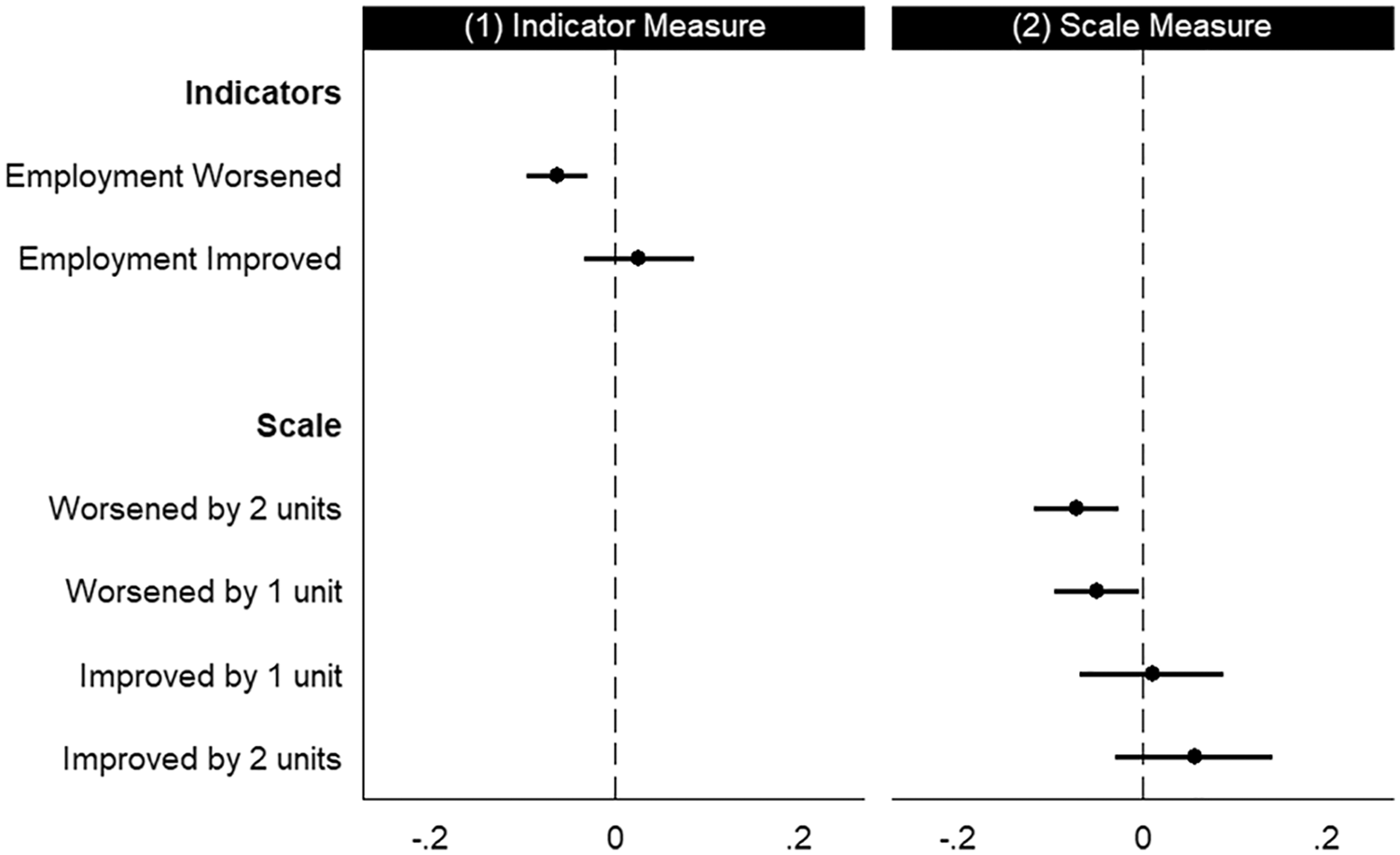
Effect of change in employment on 2020 Republican vote intention.
These results in the left pane provide clear evidence that changes in employment status are associated with changes in reported vote intentions. Respondents whose employment status worsened are less likely to report an intended Trump vote in the 2020 election. The −0.062 (p < .01) unit estimate of reduced employment means that someone who voted for Trump in 2016 is 6 points more likely to abstain or 3 points more likely to intend to vote for Biden. The estimates for the covariates provided in the Supplemental Appendix generally show that voters who are non-white and who are more educated are also less likely to report an intended vote for Trump, even after accounting for their 2016 vote. In the right pane of Figure 1, we see that the effect of going from working full-time to not working makes one 0.073 units less likely to vote for Trump, a slightly larger effect than of either going from full to part-time or going from part-time to not working. In both specifications, there is no substantively important or statistically significant effect of job change for respondents who saw their employment situations improve.
While we rely on results from ordinary least squares regression for our main analysis, we acknowledge concerns related to assumptions about the cardinality and ordering of the outcome variable which is coded trichotomously from a Democratic Vote (−1) to abstention (0) and a Republican Vote (1). For example, it may be that the change in circumstances necessary to move someone from a Democratic vote to abstention is smaller than the change required to move someone from abstention to a Republican vote. To address this concern, we run an ordered logistic regression of Republican Vote Intention on the same set of covariates and present the log odds estimates in Supplemental Table A4 in the Appendix. This specification eliminates the cardinality assumption. We find that the estimates on the indicators for job loss, either as an indicator or as a scale measure, are still statistically significant and negative. 6
We can go further, however. In both the OLS and ordered logit models, we assume that intent to abstain is between an intended vote for Biden and an intended vote for Trump. But it may be the case that the effect of job loss is to move someone directly from a Republican vote to a Democratic vote and abstention is perhaps better modeled as a distinct outcome. To account for this possibility, we examine the robustness of our results when using a multinomial logistic specification, which makes no assumption about the ordering of the discrete outcomes. In particular, Supplemental Figure A2 plots the predicted probabilities of each category of Republican Vote Intention (i.e., intended vote for Biden/Democrats, Trump/Republicans, or Abstain), with the top row showing the indicator-based coding and the bottom row showing the scale-based coding of change in employment. 7 From a baseline of abstention, we find that worsened employment status is strongly predictive of an intended Democratic vote, but that there is no effect of change on employment on transition between abstention and intended Republican vote. This is in line with the results from the OLS and ordered logit specifications and suggests that the negative estimates reported above on intended Republican vote are due to movement toward an intended Democratic vote rather than toward abstention. This can be more readily seen in Supplemental Figures A3 to A5 where we break out the predicted probabilities from Supplemental Figure A2 by a respondent’s 2016 vote (Supplemental Table A6 presents these as log odds). When someone’s employment worsened, the net effect is decreased Republican support (for some groups, the predicted probability of both Democratic and Republican votes increases, but the former by more than the latter). This supplementary analysis (Supplemental Figure A3) shows that respondents who voted for Clinton in 2016 were more likely to report a Trump vote intention in 2020 if their recent employment status improved. While we primarily focus on the effect of job loss because it is more prevalent, we note this evidence is inconsistent with a strong partisan cheerleading account in which Democratic voters would not report improved economic standing or intention to switch to voting for a Republican.
Finally, we perform a series of additional analyses to test the robustness of our main OLS results, with each different specification reported as a panel in Figure 2. First, in Panel A we control for industry of employment, because changes in voting may plausibly be affected by macroeconomic changes for different industries independent of the effect of COVID-19. We continue to estimate that reduced employment is associated with reduced support for Trump (−0.057, p < .01). Second, in Panel B, we add state fixed effects to the industry fixed effects specification, to account for the possibility that there are also state-level changes in conditions that affect vote changes independent of COVID-19. The estimated effect of job loss is again negative and significant (−0.054, p < .01). Panel C is restricted to a much smaller sample, those in the labor force in January 2020 (N = 6,641). Even in this smaller sample, we continue to estimate a negative effect of job loss on Republican vote intention (-0.063, p < .01).
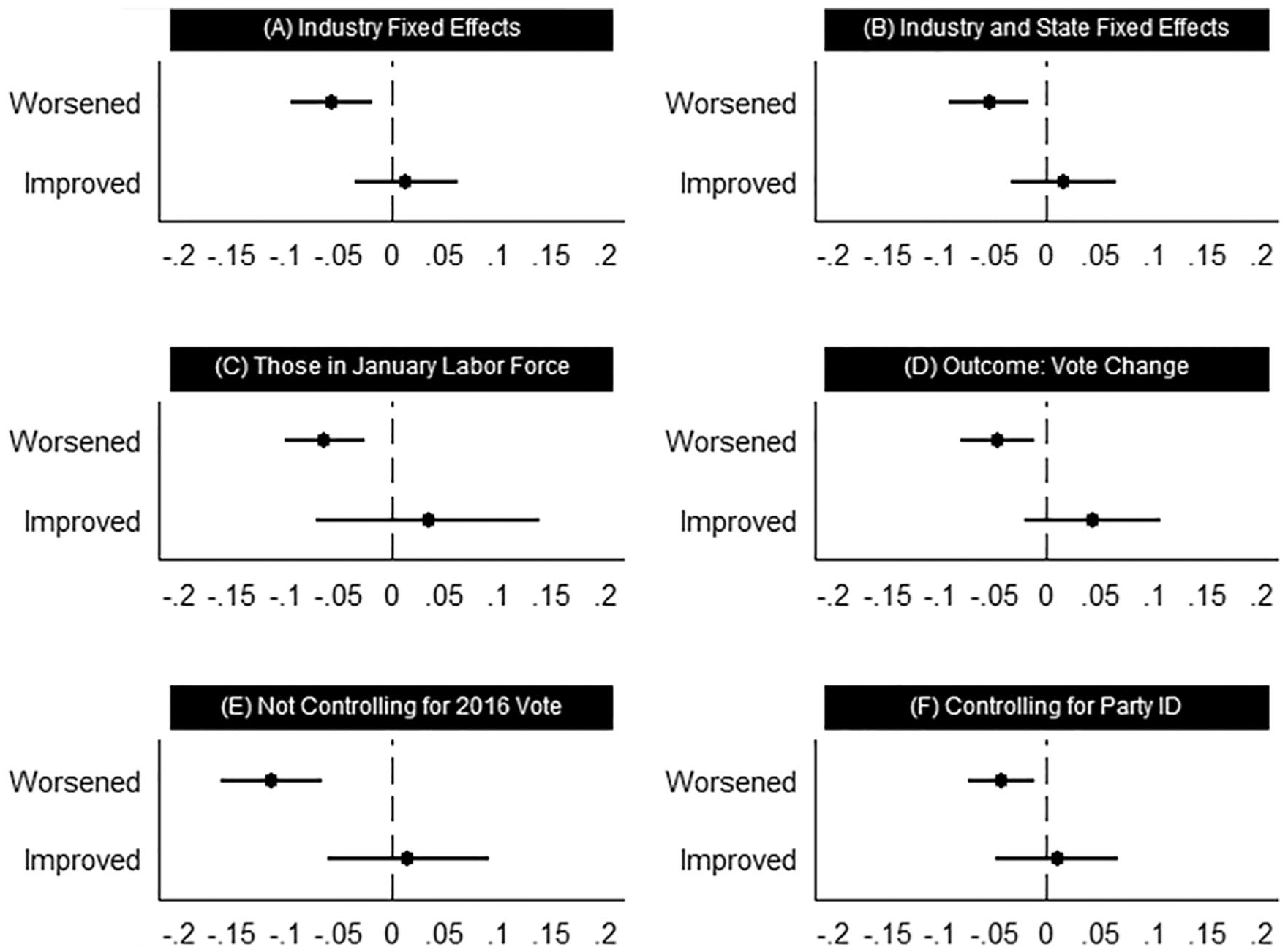
Robustness specifications.
In Panel D we replace the 2020 vote dependent variable with a change in vote intention measure, coded so that positive (negative) values indicate being more likely to vote for the Republican (Democrat) compared to 2016. 8 This means we also drop the 2016 vote indicators from the specification, but the scale range expands to run from −2 to 2. We estimate that the effect of a worsened employment status, while slightly smaller than the previous specifications, is nonetheless negative and significant (−0.047, p < .01). In Panel E we return to our original outcome variable, but we drop 2016 vote as a covariate out of concern that people may misreport their 2016 vote to align with their contemporaneous preferences. This increases the magnitude of the effect of job loss (−0.114, p < .01). Finally, in Panel F, we add indicators for the standard 7-point partisanship scale and find that the estimated effect of job loss is again similar to the main effect and other robustness specifications (−0.043, p < .01).
Overall, across our core specification and a number of robustness specifications, we find persistent evidence that individuals whose employment situation worsened are less likely to support the incumbent president. One potential limitation of our analysis is that we draw on a non-probability sample gathered using the internet. To understand whether results would likely be different using different sampling strategies, we rerun the main analysis after reweighting our data on race, education, and age to approximate Census population proportions (details about weighting procedure are provided in Supplemental Appendix B). As shown in Supplemental Table A8, the main effects of experiencing job loss are similar to those in the main analysis (as shown in Figure 1 or Supplemental Table A3). When we partition change in job status further, the indicator for “Worsened by 1 unit” is no longer significant. Regardless of the specifics of sample construction, we view our key contribution as a more plausible strategy for estimating the causal effect of job loss, acknowledging that effects could be different outside of this sampling frame.
The Role of Blame and Responsibility Attribution
Work in political science also considers the role of blame attribution in linking personal experience to electoral choices (Gomez & Wilson, 2001; Rudolph, 2003). If individuals do not assign responsibility for outcomes to government, then even changes in economic standing may not affect vote choice (Feldman, 1982; Peffley, 1984). Additionally, the possibility that individuals engage in biased assignment, shifting blame for bad outcomes away from co-partisan incumbents and toward other actors or levels of government may undercut accountability (Enns et al., 2012; Malhotra & Kuo, 2008). Considerations of blame attribution do not call into question our main result about the average effect of job loss, which we note is present in both parties. Nonetheless, while we lack a credible way to assess the effect of blame attribution in the absence of exogenous manipulation of blame, we can use other items from our survey to conduct a partial exploration of the relationship between job loss and blame attribution.
To begin with, we use two items we asked in our survey to measure the relationship between job loss and proxies of blame attribution: (1) approval of Trump’s response to the pandemic and (2) approval of the federal response to the pandemic. Supplemental Figure A6 in the Appendix presents coefficient estimates from an OLS regression of each of the approval outcomes on job loss (using the scale measure) with the same set of covariates used in our main specification (in Figure 1, Panel 2). These regressions are run separately on Democratic and Republican respondents. If blame attribution is strongly influenced by partisan concerns, we would expect Democrats (Republicans) to blame Republican Trump for bad (good) news but not to assign him responsibility for good (bad) news. Contrary to this pattern, we find that Democratic respondents who lose their jobs are less approving of both Trump’s and of the federal government’s response to the pandemic, whereas Democratic respondents who gained jobs were more favorable along both dimensions. Republican respondents, on the other hand, were no more nor less approving of either Trump or the federal government regardless of changes in their employment status. At face, this suggests partisan differences in blame attribution will not fully undercut the relationship between changes in employment status and voting.
Additionally, if we assume blaming Trump is the attribution mechanism that links change in employment to vote choice, we can conduct a two-stage least squares analysis in which we instrument for responsibility attribution using change in employment status. That is, in the first stage regression we predict approval of Trump’s handling of the pandemic using our standard control variables, as well as change in employment. In the second stage, we then regress 2020 vote intention on the instrumented (predicted) value of Trump approval and the remaining first-stage control variables (i.e., excluding job change). Subject to standard exclusion restriction assumptions about how the effect of job loss on voting operates only through changes in approval, this provides an unbiased estimate of the effect of changes in employment on vote choice as mediated through change in blame attribution. In Supplemental Figure A7, we see that for both Republican and Democratic respondents, the changes in Trump approval due to job loss are significantly correlated with a Republican vote intention. The magnitude is larger for Republicans than Democrats. The estimate is significant for Democrats at the 5% level and for Republicans at the 10% level. This provides suggestive evidence that responsibility attribution mediates the effect of job loss, though the effect varies by partisanship.
Discussion
In this paper, we examine how vote choice is affected by a change in an individual’s personal economic circumstances, and in particular, changes in their employment status. The unprecedented shock to employment due to the COVID-19 pandemic presents a setting in which we can estimate these effects while being less concerned about issues related to omitted variable bias or misreporting on surveys. We use novel data from a survey fielded during the initial months of the pandemic to compare the intended 2020 vote choice across respondents who experienced varying levels of changes in their economic situations. Our analysis shows that individuals whose economic situations worsened during the pandemic are significantly less likely than individuals whose situation did not change to report an intended vote for the incumbent president, Republican Donald Trump, in the 2020 election. This result is robust to a variety of different model specifications and strongly suggests that individuals change their vote choice based on changes in personal economic circumstances.
As with all research, there are limitations to our approach. The first limitation is that our estimates of the effect of COVID-19 related job loss are likely lower bounds. The effect of changes in the economy on voting can occur through both egotropic and sociotropic mechanisms. We estimate only the effect of change in personal experience, but if other individuals become more pessimistic about the incumbent when they observe different individuals losing their jobs, as happened in early 2020, then comparing those who do and do not lose a job will understate the effect on those who lose a job. A second limitation is that we cannot speak to the underlying psychological mechanisms by which job loss reduces incumbent support, although we can provide a less biased estimate of this effect than in approaches that exploit cross-sectional variation in employment. Nevertheless, our estimates represent the mean effect of job loss, averaged across different groups. 9 Finally, measurement error also likely attenuates our estimates. We code employment change into at most five categories, but many people also experienced more moderate declines in their well-being without having their employment change.
More broadly, as with most studies that rely on an exogenous shock for identification, the context in which the shock occurs has implications for the generalizability of the results. While the Coronavirus pandemic is unprecedented in recent history, we may question whether the employment shocks it induces are more or less likely to be attributed to the government’s response than shocks that occur in normal times. On the one hand, it may be the case that because COVID-19 caused widespread economic disruption, individuals expected the incumbent president to be responsible for fixing it, thereby providing much clearer responsibility attribution. On the other hand, most large and open countries experienced widespread economic disruptions, and President Trump provided a robust defense of his actions and blamed the problem on others. In normal circumstances when someone loses a job because of local economic decline or outsourcing, it may be less obvious why that job was lost, weakening attribution, but at the same time, individuals who experience loss are rarely presented with an incumbent who explains that their experience is someone else’s fault. Thus, it is therefore unclear whether to expect more or less attribution of blame outside of the COVID-19 experience.
Nevertheless, these caveats aside, this study addresses lingering uncertainty about whether personal economic shocks affect vote choice. Compared to prior work, we focus on a measure of personal economic circumstances, employment status, that is less likely to be affected by reporting biases. Additionally, we exploit changes in unemployment, rather than levels, as induced by the unanticipated COVID-19 shock, which we argue is less likely to be affected by omitted variables bias explaining both vote choice and employment. Our results strongly show that one’s personal economic circumstances, in additional to national-level economic conditions, play an important role in voters’ vote choices, and the incumbent is less likely to garner support from those whose personal economic situation becomes worse.
Supplemental Material
sj-docx-1-apr-10.1177_1532673X211026831 – Supplemental material for How Does Job Loss Affect Voting? Understanding Economic Voting Using Novel Data on COVID-19 Induced Individual-Level Unemployment Shocks
Supplemental material, sj-docx-1-apr-10.1177_1532673X211026831 for How Does Job Loss Affect Voting? Understanding Economic Voting Using Novel Data on COVID-19 Induced Individual-Level Unemployment Shocks by Jennifer D. Wu and Gregory A. Huber in American Politics Research
Footnotes
Acknowledgements
Thank you so much! We express our thanks appreciation to Robert Grafstein, Michael Lewis-Beck, Neil Malhotra and Erik Snowberg for suggestions and comments on early versions of the manuscript.
Declaration of Conflicting Interests
The author(s) declared no potential conflicts of interest with respect to the research, authorship, and/or publication of this article.
Funding
The author(s) received no financial support for the research, authorship, and/or publication of this article.

Supplemental Material
Supplemental material for this article is available online.
Notes
Author Biographies
References
Supplementary Material
Please find the following supplemental material available below.
For Open Access articles published under a Creative Commons License, all supplemental material carries the same license as the article it is associated with.
For non-Open Access articles published, all supplemental material carries a non-exclusive license, and permission requests for re-use of supplemental material or any part of supplemental material shall be sent directly to the copyright owner as specified in the copyright notice associated with the article.
