







Abstract
Significant scholarship examines the effects of disasters and disaster management on political behavior and attitudes. Yet, no research has assessed how health crises might shape people’s levels of external efficacy, nor how disaster response affects external efficacy beyond localized extreme-weather events. Using the United States as a case study, we seek to fill these gaps in the literature by exploring how individuals’ external political efficacy is affected by assessments of the federal COVID response. With an original collection of survey data from April 2020, we find that respondents who view the government’s handling of COVID more positively report higher levels of external efficacy. In a secondary analysis, we performed an experiment in February 2021 where people were given different narratives about government management of the pandemic response. The experimental results strongly suggest that disaster management—in this case the handling of the pandemic—shapes individuals’ efficacy.
Introduction
External political efficacy is the feeling that the political process is responsive to an individual’s participation. It is reflected in whether “public officials care about what people like me think.” Efficacy can be affected by the social and political environment, such as one’s party winning a recent election, policy offerings, or a localized disaster (Atkeson & Maestas, 2012; Bowler & Donovan, 2002; Wolak, 2018).
In this paper, we address two gaps in the literature. First, while extant analyses have made important contributions to our understanding of efficacy, we still know very little about how public health crises affect individuals’ external efficacy. It is well known that global health emergencies can influence various political attitudes, such as trust in government (Albertson & Gadarian, 2015; Bol et al., 2021; Schraff, 2020). Curiously, though, the impact of these types of events on political efficacy has not received any attention in the literature. This is particularly salient, as the World Health Organization (WHO) has identified five “Public Health Emergenc[ies] of International Concern” in the past decade alone (Wilder-Smith & Osman, 2020). This demonstrates that these types of crises represent prominent features of the contemporary political landscape, and as we suggest here, they likely have the ability to affect political attitudes, including efficacy.
Second (and relatedly), this paper contributes to the broader literature on disaster responses. Existing work on the connections between national disaster response and efficacy has thus far focused exclusively on the context of localized extreme-weather events. Atkeson and Maestas (2012), for instance, explore the impact of Hurricane Katrina on political efficacy in the United States. While their analysis demonstrates that people’s evaluations of governmental disaster response can influence individuals’ efficacy, it is not clear that this relationship applies to other types of issues and crisis contexts. Using the United States as our case study, we investigate the effects of disaster management on political efficacy in the context of the 2020 COVID public health crisis.
In this research, we focus on external efficacy. 1 Theoretically, we expect that individuals with more positive (negative) evaluations of the federal COVID response will have higher (lower) levels of external political efficacy. Using original survey data, collected in April 2020, we find that respondents who view the government’s handling of COVID more positively report higher levels of external efficacy, providing support for our theoretical expectations. We also performed an experiment in February 2021 where people were given different narratives about government management of the pandemic response. The experimental results strongly suggest that our main findings in the first analyses are not the result of reverse causation. Instead, people’s views about the federal government’s pandemic response have a causal effect on external efficacy. These results suggest that disaster management—in this case the handling of the pandemic—shapes individuals’ efficacy.
The Determinants of Political Efficacy
Campbell et al. (1954) describe political efficacy as the following: “the feeling that individual political action does have, or can have, an impact upon the political process. . . It is the feeling that political and social change is possible, and that the individual citizen can play a part in bringing about this change” (p. 187). In other words, political efficacy is an individual’s conception of their own capacity (or lack thereof) to participate in the political system and the responsiveness of said political system. Subsequent research delves further into the concept of political efficacy, developing two dimensions—internal and external efficacy (Lane, 1959). Specifically, internal efficacy is an individual’s feelings about their own abilities to participate in the political system, while external efficacy centers more on an individual’s views regarding the responsiveness of political leaders and institutions (Balch, 1974; Clarke et al., 2010; Craig et al., 1990). As noted, in this research, we focus on external efficacy, rather than internal efficacy.
Some literature has suggested that political efficacy is a relatively stable characteristic of individuals. In their seminal book, Campbell et al. (1954) describe political attitudes and values, like efficacy, as “longstanding” (p. 187). However, recent scholarship demonstrates that political efficacy is responsive to the social and political environment. For instance, Anderson (2010) finds that sense of community has positive effects on both internal and external efficacy. Wolak (2018) finds that efficacy is higher when individuals’ policy preferences are broadly congruent with state policy outputs. In the vein of more politically centered research, Bowler and Donovan (2002) and Clarke and Acock (1989) demonstrate that individuals who voted for candidates who win feel more efficacious than those who voted for candidates who lost. Davis and Hitt (2016) come to a similar conclusion regarding support for winning candidates and its positive effects on efficacy, but the effect decays within a short period of time. This is to be expected if efficacy is indeed responsive to the political environment. However, the effects of elections on efficacy are likely limited, given that elections occur over a limited timespan and, moreover, do not represent how well a sitting government meets its obligations to care for its citizens. A more ideal situation for understanding how efficacy is shaped by the political environment would be one in which political officials and parties are (or are not) responsive to obligations they have to their citizens.
A major disaster that rises to the national level is such a situation, given that it is an opportunity for citizens to evaluate government and its effectiveness in meeting its obligation to care for its citizens. In fact, research demonstrates that localized disasters and disaster management shape a wide variety of political attitudes and behaviors, like vote choice (Achen & Bartels, 2004; Bechtel & Hainmueller, 2011; Healy & Malhotra, 2009) and trust (Chanley, 2002; Han et al., 2011; Hui, 2009; Nicholls & Picou, 2013; Uslaner, 2016). Other work demonstrates that public health crises also affect political attitudes (Albertson & Gadarian, 2015; Bol et al., 2021; Schraff, 2020). Still, no work has yet examined how public health crises affect political efficacy. Thus far, only one study to date has examined how disaster management shapes political efficacy. Specifically, Atkeson and Maestas (2012) explore how external efficacy is shaped by opinions regarding federal management of Hurricane Katrina. The authors find that those who view the federal government as being responsible for the failed response have lower levels of efficacy. While Atkeson and Maestas (2012) demonstrate that external efficacy is influenced by governmental response to a localized disaster, it is unclear whether these findings also apply to other kinds of crises, like a global public health crisis. In fact, it is possible that the federal management of a hurricane in 2005 might shape efficacy differently than a global pandemic. Indeed, the social dynamics surrounding public health crises are highly technical in nature and, as a result, the most effective policy responses are arguably not immediately obvious to citizens. In this paper, we address this gap in the literature by investigating how federal management of a public health crisis shapes external efficacy in the United States.
Theory and Hypothesis
Existing surveys suggest that citizens in the U.S. differ substantially in their evaluations of the federal COVID response. 2 This variation is likely caused by a variety of factors: how individuals experienced the public health consequences of the pandemic; how individuals experienced the economic consequences of the pandemic; and to what extent people’s daily lives were affected by the pandemic and federal interventions, along with a variety of other factors. Expressed more formally, there are likely multiple antecedent variables that affect how people view the national government’s reaction to the crisis. Our focus, however, is on how overall evaluations of the federal response—whether positive or negative—shape external efficacy.
The political context of the COVID pandemic had several features that increased the likelihood that citizens updated their political beliefs (including perceptions of external efficacy). First, the issue at hand was a significant source of public anxiety. Existing research suggests that anxiety decreases the probability that individuals make political judgments based on prior pre-dispositions (Marcus et al., 2005). Thus, in the context of the COVID-crisis, people should have been less likely to rely on conventional cognitive shortcuts in their formation of political beliefs, and more likely to update their attitudes based on newly available data, such as information about their government’s pandemic response. Second, the pandemic was a significant political focal point for an extended period of time. Previous studies suggest that salient events can encourage individuals to reflect on, and thus change, their longstanding beliefs and attitudes, like external efficacy (Bowler & Donovan, 2002). As Atkeson and Maestas (2012) explain: “When crises and events of extraordinary magnitude occur, citizens tune in to take stock and evaluate the situation. Because of this, [. . .] epochal events and the attributions that they produce toward government have a greater likelihood of reshaping opinions, [. . .] such as external efficacy[. . .]” (p. 139). Third, policy outcomes during the pandemic were also highly publicized in the media and fairly easy to comprehend. As Atkeson and Maestas (2012) point out, a government’s paramount task during a major crisis is the protection of its population. This basic concept allows people to evaluate the responsiveness of their government in the wake of national disasters. Focusing on mass attitudes in the wake of Hurricane Katrina, the authors find that those who viewed the federal government as being responsible for the failed response were more likely to see their political system as unresponsive to the needs of citizens and thus less externally efficacious. As the authors point out, this is because individuals who identified policy failures were more likely to believe that their government was unable to perform its most basic function—protection of its citizenry.
There are two possible complementary mechanisms for how political efficacy could be affected when evaluating the government’s response to COVID. First, a positive evaluation of the government response could boost efficacy. For those who believe that the federal government handled the pandemic well, they will feel that government is fulfilling its most basic functions—protection of its citizenry. This, in turn, should increase efficacy. In other words, if citizens believe that their government was responsive to the public health needs of its people, they are expected to feel more externally efficacious. Second, a negative evaluation could dampen external efficacy. Poorly managing a disaster signals an inability to respond to voters’ demands, in this case, the protection of lives and livelihoods. For those who feel that the government is unable to appropriately handle a pandemic, they will see that government as being unresponsive to the electorate and therefore to them personally, thereby negatively affecting political efficacy. It should be noted that both of these mechanisms could be at work. In this paper, we are not focusing on the relative importance of these mechanisms. Instead, we are assessing their joint impact. Ultimately, we expect individuals’ evaluations of the disaster response to shape their own external efficacy, leading to our hypothesis:
Hypothesis: Individuals with more negative evaluations of the federal COVID response will have lower levels of external political efficacy.
Study 1: Observational Investigation in April 2020
Data Collection and Variable Measurement
For our first study, we partnered with Qualtrics and recruited 1,520 respondents for an online study focusing on “politics in the U.S.” Our sample was designed to match the known population breakdown (based on Census data) on five major dimensions: age, gender, education, household income, and Census region. Prior to data collection, we obtained IRB Exemption from our institution.
We rely on two survey items to measure a respondent’s level of political efficacy (c.f. Blais & Rubenson, 2013; Chang, 2018). More specifically, we asked individuals to what extent they agree/disagree that (1) “public officials don’t care much what people like me think” (nocare) and (2) “people like me don’t have any say about what the government does” (nosay). For both of these questions, respondents indicated their level of agreement on a five-point scale ranging from “strongly agree” (1) to “strongly disagree” (5). Thus, in our analysis higher scores on these items indicate higher levels of political efficacy. Our final dependent variable is a given respondent’s average score across these two indicators.
In order to measure our main independent variable, we asked respondents how “satisfied they are with the way the U.S. federal government is handling the COVID-19 crisis in the United States.” 3 Answer options were: (1) not at all satisfied (24.3%), (2) not very satisfied (24.3%), (3) fairly satisfied (35.3%), and (4) very satisfied (16.2%). Theoretically we expect this item to be positively related to people’s levels of external efficacy.
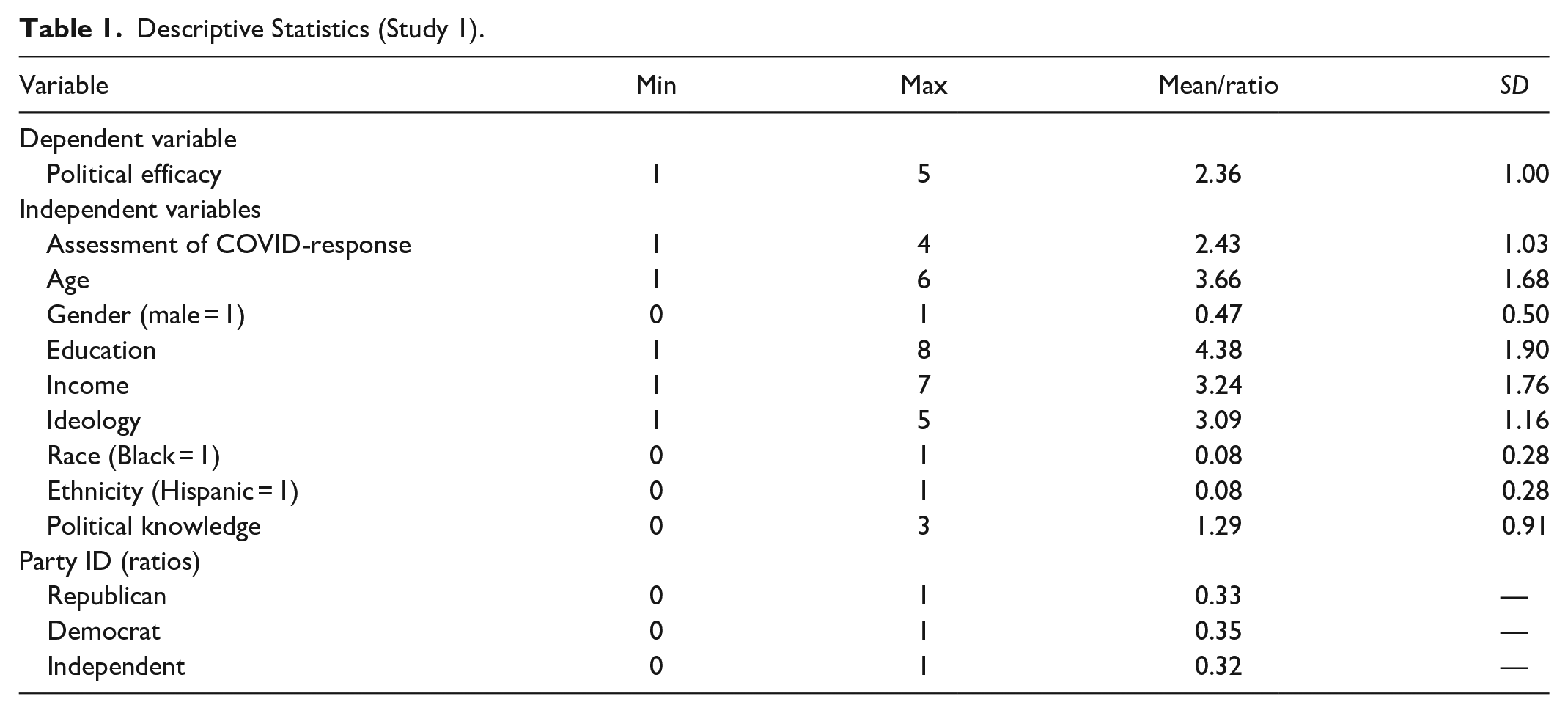
We control for a number of alternative causes of political efficacy identified in previous studies. First, we account for a respondent’s level of education. This variable is captured with an ordinal item ranging from 1 (less than high school) to 8 (postgraduate or professional degree). Based on previous research (Chamberlain, 2013), we expect individuals with higher levels of education to feel more efficacious. According to previous research, those with higher levels of education are thought to have the cognitive abilities to understand, navigate, and engage with political processes, while simultaneously improving social status and material resources that further advance an individual’s ability to politically participate (Condon & Holleque, 2013). The abilities cultivated with higher levels of education allow individuals to more easily gain the attention of elected officials, thereby improving external efficacy. Second, extant analyses have highlighted income as an important predictor of people’s feelings toward their political system (Marx & Nguyen, 2018). As Norris (2015) points out, “unavailability of resources [. . .] prevents [voters] from defining policy alternatives in line with their interests. Furthermore, these voters also witness government respond to the demands of wealthier groups in the political process. The increased inability of these citizens to define policy alternatives, coupled with the perception that government is only responsive to the demands of wealthier citizens, leads to the belief that government is not able or willing to meet their needs.” (p. 798). Given these considerations, we account for the economic context of our survey-takers. This variable is coded on a scale from 1 to 7 in which higher values indicate higher levels of pre-tax household income. Third, we control for political knowledge. As suggested by Davis and Hitt (2016), “more knowledgeable respondents might feel more efficacious in politics, by virtue of the fact that they likely expend more time and resources consuming information about politics” (p. 681). We measure this concept by presenting subjects with three factual questions about politics. The final variable thus ranges from 0 (for individuals who do not answer any of these items correctly) to 3 (people who correctly answer all questions). Finally, we also account for a standard set of demographic predictors. In particular, we control for age, gender (male = 1), ideology, party ID (base category = Republicans), race (Black = 1), and ethnicity (Hispanic = 1). All survey questions used to measure the variables employed in this paper can be found in the online Appendix. Table 1 provides descriptive statistics for all items discussed above.
Descriptive Statistics (Study 1).
Results
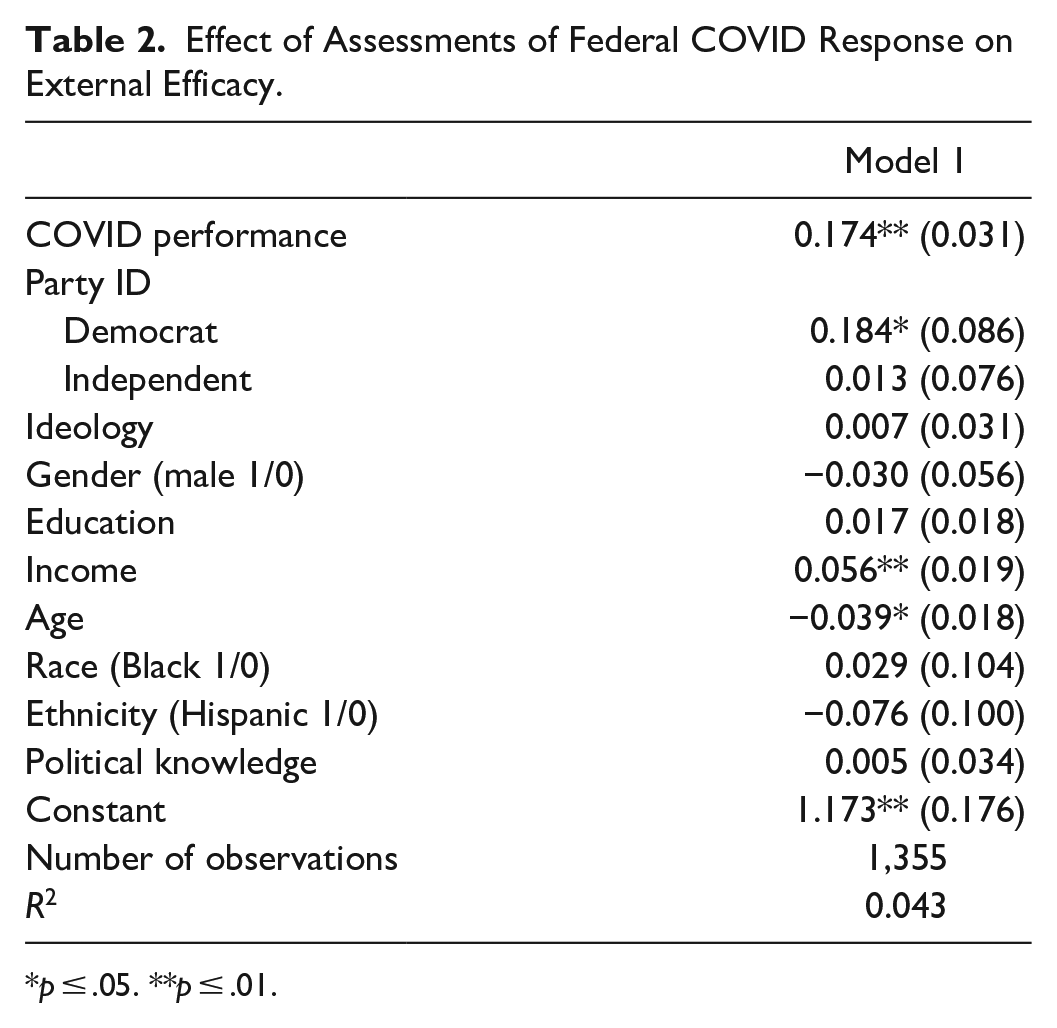
In order to test our theoretical expectations, we rely on linear regression analysis. Results are summarized in Table 2. Consistent with our theoretical framework, we find that people’s assessments of the federal government’s response to the COVID-crisis do influence political efficacy. Our main independent variable of interest is positive and statistically significant (p < .01). This shows that those who believe that the U.S. government handled the COVID crisis well have significantly higher levels of external efficacy than those who hold more negative views about the government’s pandemic response.
Effect of Assessments of Federal COVID Response on External Efficacy.
p ≤ .05. **p ≤ .01.
In order to illustrate the relationship between our two main variables of interest, we calculated predicted efficacy scores for the highest and lowest values of our main independent variable. Holding all other correlates at their observed values, subjects who are “not at all satisfied” with the federal government’s COVID-response are predicted to receive a score of 2.11 on our political efficacy scale. Conversely, the corresponding value for individuals who are “very satisfied” with the government’s handling of the crisis is 2.63. Expressed more formally, across the full range of our main independent variable, the estimated efficacy value for a given respondent increases by 0.52 scale points. In order to contextualize these results, we compared this effect size with the substantive impact of our control variables. In Model 1, three other predictors are statistically significant: older people feel less politically efficacious than younger people, richer people feel more efficacious than poorer individuals, and Democrats score higher on our dependent variable than Republicans. More specifically, across the full range of the age variable, the predicted efficacy score changes by 0.23 scale points; for income, the calculated efficacy change is 0.44 scale points; and the estimated difference between Democrats and Republicans is 0.18 scale points. 4 Taken as a whole, these calculations show that the substantive effect of our main independent variable is comparable to the impact of other predictors in the model.
Additional analyses (provided in the online Appendix) show that our results are robust to a wide variety of model specifications. In particular, our main empirical findings hold after retaining the original five-point efficacy scales, and after controlling for people’s level of political trust. Furthermore, we also find that our main independent variable influences efficacy levels of Democrats, Republicans, and Independents. In other words, all voter groups in the United States (regardless of self-declared partisan affiliation) are affected by their assessments of the federal government’s COVID-response. 5
Discussion
Taken as a whole, our findings provide strong and consistent support for our Hypothesis, and they suggest that people’s satisfaction with the federal government’s response to the COVID pandemic are not just a statistically significant, but also substantively important, predictor of political efficacy in the United States. Nevertheless, while the presented evidence is suggestive, the study discussed above is not without weaknesses. First, our regression analyses are unable to conclusively tease out the direction of the causal arrow. It is possible that people’s views about their country’s political system (i.e., their levels of external efficacy) serve as powerful lenses through which they interpret their government’s response to a complex public health emergency. If that was the case, the observed correlation between our two main variables of interest might be the result of reverse causation. Second, the data discussed above was collected in April 2020 during the early stages of the COVID-crisis. Our findings may therefore only constitute a non-representative snapshot. Indeed, it is possible that federal policies in the second half of 2020, such as the publicly discussed push to speed up the development of a vaccine against the disease, altered the relationship between our two variables of interest.
Study 2: Survey Experiment in February 2021
Data Collection and Variable Measurement
Given the limitations discussed above, we conducted a follow-up study in early 2021. This survey was run on Amazon mechanical turk (mturk) on February 15. Amazon mturk is an online platform on which researchers can post small work assignments, such as completing surveys, which are then completed by “workers” in exchange for monetary compensation. After obtaining IRB exemption from our institution, we invited 1,073 respondents 6 to participate in a study designed to “investigate how Americans experienced the 2020 COVID-crisis.” 7
In line with previous survey research using mturk, our respondent pool is somewhat younger (42% of subjects are in the age bracket 18–34), more educated (63% have completed a bachelor’s degree), and more liberal (46% self-identify as “very liberal” or “liberal”) than the U.S. population as a whole. Nevertheless, while mturk does not generate nationally representative respondent pools, previous research has shown that survey experiments on this platform generally produce treatment effects that are near-identical to country-wide probability samples (Berinsky et al., 2012). As a result, mturk has become a widely-used recruitment platform for experimental social science research (for an overview see: Berinsky et al., 2012; Buhrmester et al., 2011; Kittur et al., 2008; Paolacci et al., 2010).
After agreeing to participate, we presented respondents with one of two randomly assigned news items. Participants were instructed to read the story and they were told that they would be asked follow-up questions later in the survey. Both news items were designed for the purposes of this study and they discussed how the U.S. federal government responded to the 2020 COVID-crisis. Item 1 was entitled “2020 Recap: Federal Government Fumbles COVID Response.” In the body of the story, respondents read that in the previous year a total of 19.7 million Americans were diagnosed with COVID, and over 340,000 people had died as a result of the disease. Importantly, we pointed out that the U.S. scored higher on these two dimensions than any other country in the world. By contrast, news item 2 read “2020 Recap: Federal Government Handles COVID Well.” Individuals read that in the previous calendar year, the U.S. performed more tests than any other country in the world, and that Americans diagnosed with COVID were less likely to die than infected people in many other countries.
While both news items are based on factually accurate information, they present the U.S.’ response to the COVID-crisis in drastically different terms. The first item portrays the U.S. as reacting very ineffectively to the pandemic and failing to protect the health of its population. News item 2 focuses on the more positive aspects of the U.S. response. Here, the provided information suggests that the U.S. did care for the public health needs of its citizens. In the analysis below, we create a binary “Treatment”-indicator that is coded as “1” for respondents who read the positive news item and “0” for individuals who read that the U.S. government fumbled the COVID response.
After respondents read one of these two short news stories, they answered a question designed to check the effectiveness of our experimental manipulation. More specifically, we asked our subjects how satisfied they were “with the way the U.S. federal government handled the COVID crisis in the United States in 2020.” Answer options were (1) Not at all satisfied, (2) Not very satisfied, (3) Fairly satisfied, and (4) Very satisfied. Subsequently, subjects were presented with the same external efficacy questions discussed in Study 1. Analogous to above, our dependent variable in the subsequent analysis is a given survey respondent’s average score across both external efficacy items. 8
Lastly, the survey also included the same socio-demographic questions discussed in Study 1 (age, gender, education, income, ideology, race, ethnicity, political knowledge, party ID) and an item capturing a given respondent’s vote choice in the 2020 Presidential election. This final variable is coded as “1” for Trump voters and “0” for Biden voters. 9 The full survey questionnaire, including the news items that form the basis of our experiment, can be found in the Appendix.
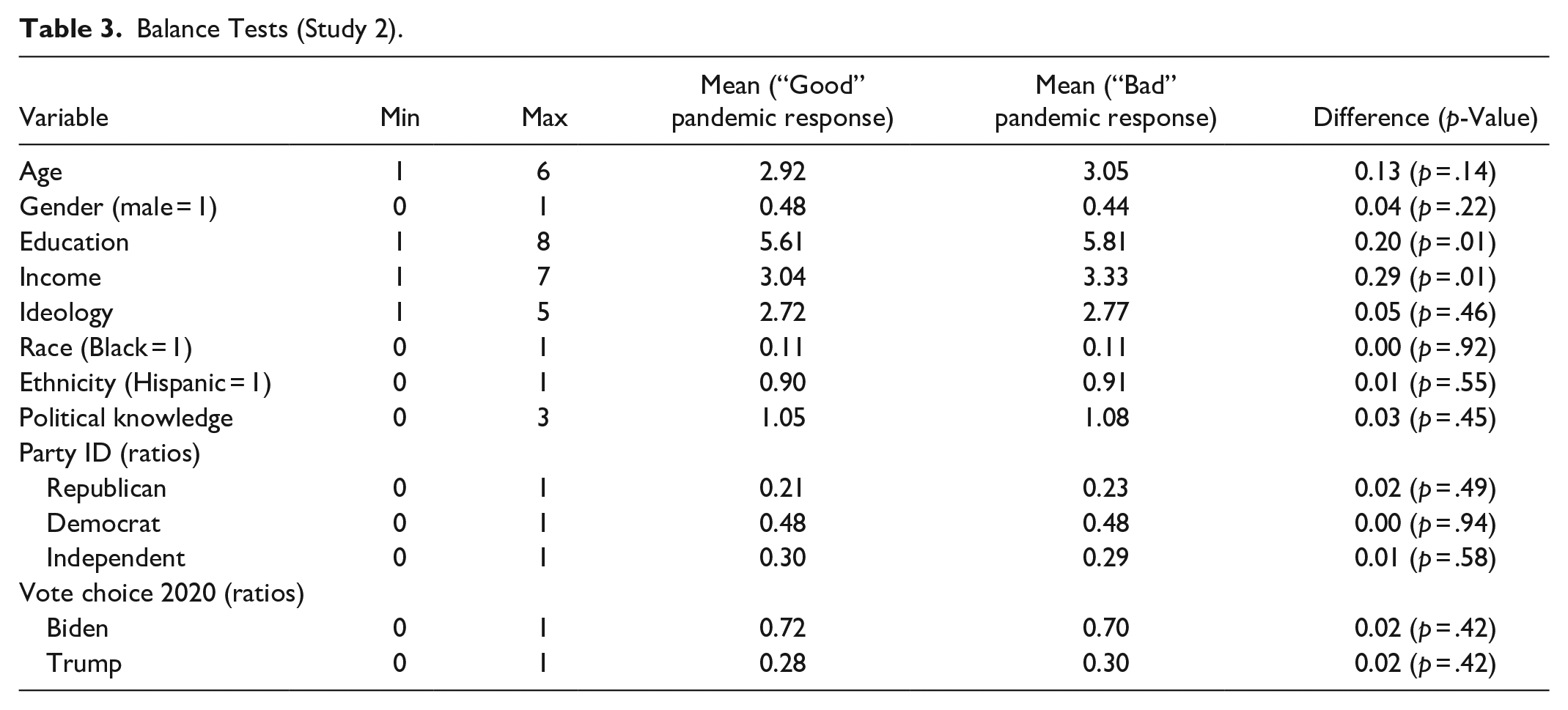
Below, we provide balance tests for all independent variables. In particular, we compare the mean values on all independent variables across both experimental groups. The information contained in Table 3 suggests that the randomization procedure was largely successful. Both groups are near-identical in terms of age, gender, ideology, race, ethnicity, political knowledge, party ID, and vote choice. We do find slight differences for two variables. More specifically, education and income levels are slightly higher in the group that read the negatively-worded news story. While the differences are small, they are statistically meaningful. As a result, we rely on regression analyses to ensure that any observed treatment effects are not confounded by remaining imbalances between our experimental groups.
Balance Tests (Study 2).
Results
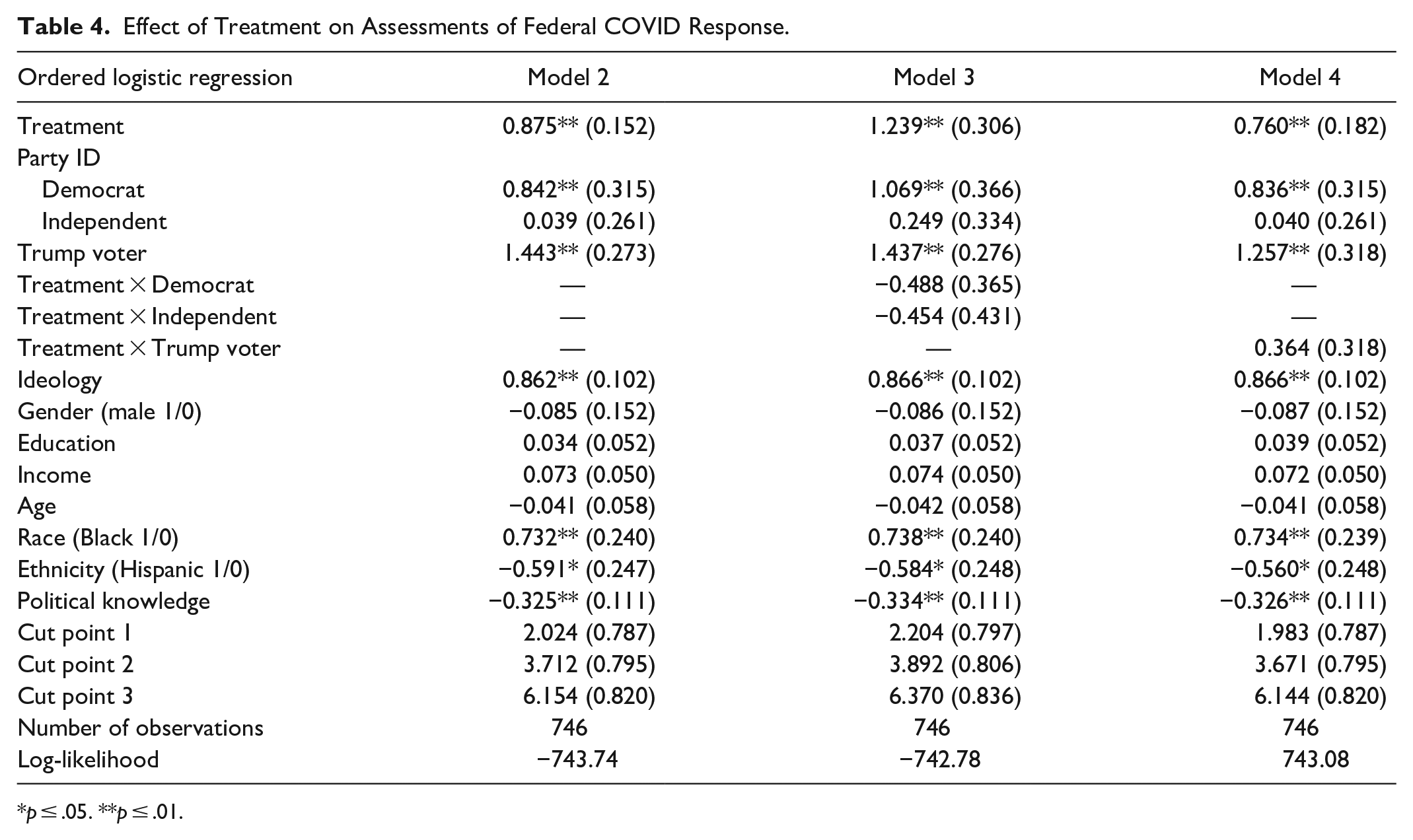
To begin, we assess the effectiveness of our experimental treatment in manipulating people’s evaluations of how the federal government handled the COVID crisis during the year 2020. To that end, we regress our manipulation check question on our binary treatment indicator, controlling for the other correlates summarized in Table 3. As expected, we find that subjects who read that the U.S. government “handled COVID well” are significantly more likely to express satisfaction with the federal pandemic response than individuals who read the negative news item (see Model 2 in Table 4). Descriptively, 23.6% of respondents who were exposed to the negative story indicated that they were “fairly satisfied” or “very satisfied” with the federal government’s COVID response in 2020. By contrast, the corresponding value for subjects who were presented with the positive headline is 33.9%.
Effect of Treatment on Assessments of Federal COVID Response.
p ≤ .05. **p ≤ .01.
Next, we assessed whether this effect differed across people’s partisan and candidate preferences. To that end, we interacted our binary “Treatment” indicator with our categorical “Party ID” (Model 3 in Table 4) and “Vote Choice” variables (Model 4 in Table 4). Interestingly, we see that there is no evidence for a differential effect. 10 In other words, the estimated effect of our experimental manipulation is the same, regardless of people’s self-declared partisan identities and candidate preferences—a point to which we return below.
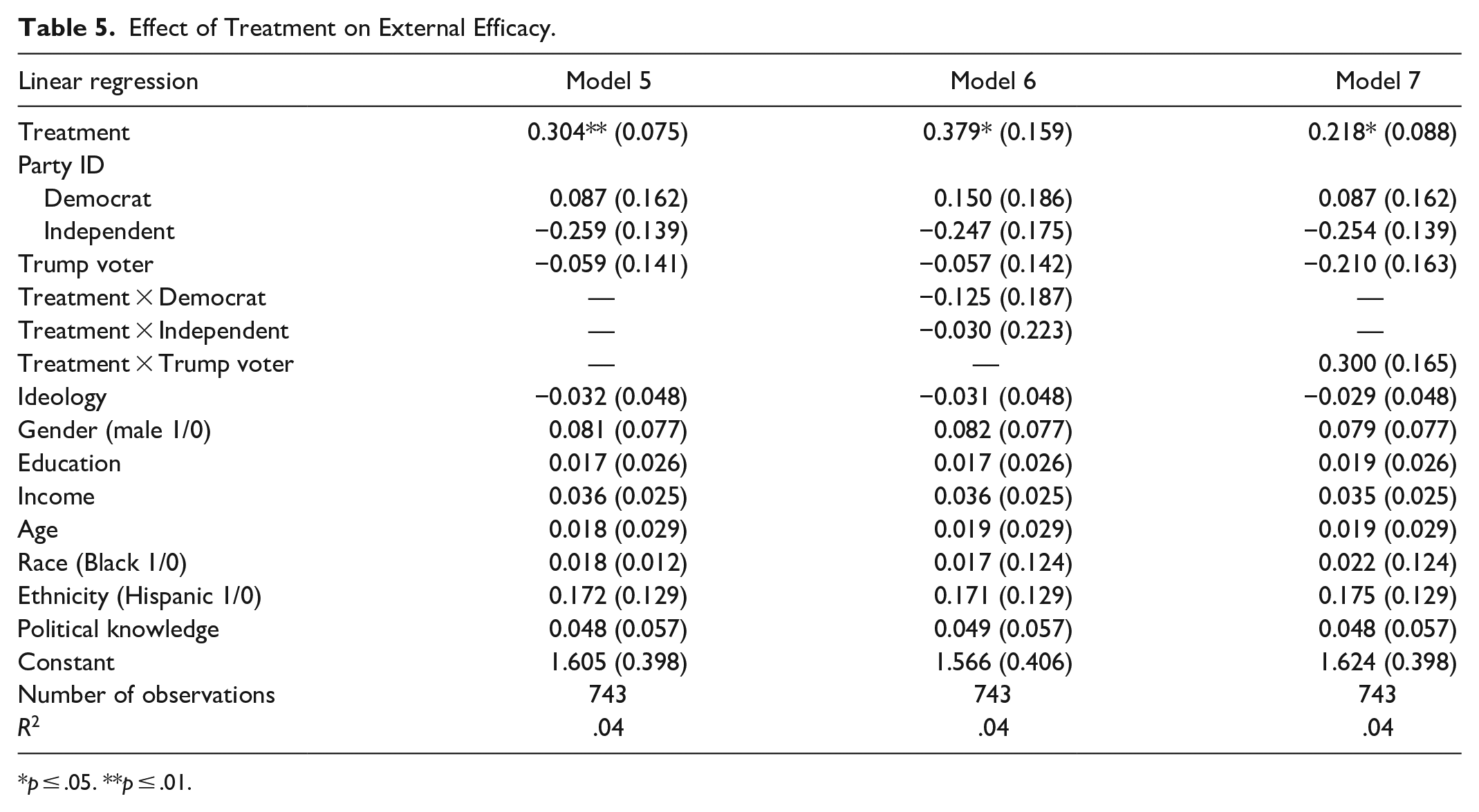
In Model 5 (see Table 5), we move to a statistical test of our main theoretical expectation. In other words, we evaluate the effect of our experimental treatment on political efficacy. As expected, we see that exposure to our news items systematically influences people’s scores on this dimension. More specifically, subjects who read that the federal government “fumbled” the COVID response score about 0.3 scale points lower on external efficacy than respondents who read the more positively framed story (p < .01). Descriptively, 24.4% of respondents who read the positive news item fall above the midpoint on our external efficacy scale. By contrast, the corresponding value for subjects who read the negatively framed news item is 7.9% lower (16.5%). Taken as a whole, these experimental results strongly suggest that our main findings in Study 1 are not the result of reverse causation. Instead, people’s views about the federal government’s pandemic response have a causal effect on external efficacy.
Effect of Treatment on External Efficacy.
p ≤ .05. **p ≤ .01.
Next, we conducted a series of follow-up analyses to assess whether the effect of our experiment is moderated by people’s partisan and candidate preferences. We find very little evidence that this is the case. In Model 6 (see Table 5), we interact our binary treatment indicator with our categorical “Party ID”-variable. Using “Republicans” as our base category, we find no evidence for an interactive relationship. Furthermore, an F-test suggests that the inclusion of the interaction term does not lead to a significant improvement in model fit (p = .76). The same conclusions hold in Model 7 (see Table 5). While the interaction term between our Treatment indicator and our binary “Vote choice”-variable approaches statistical significance (p < .07), we cannot reject the null hypothesis that Models 5 and 7 are identical to each other.
In Figure 1, we plot the estimated treatment effects for Republicans/Democrats/Independents (Panel A) as well as Biden/Trump voters (Panel B). 11 This graph further illustrates that our experimental effect does not differ across voter groups. Subjects who read the story that the federal government handled the 2020 COVID-crisis well are consistently more externally efficacious than individuals who read that the U.S. fumbled its response to the pandemic. Interestingly, this seems to be particularly true for Trump supporters. The calculated treatment effect for this subgroup is bigger than for any other voter group in the dataset. However, it is worth re-emphasizing that the observed effect difference shown in Panel B is not statistically significant (p = .07). Taken as a whole, the patterns in Figure 1 demonstrate that people’s views about the government’s pandemic response have a meaningful impact on their levels of external efficacy regardless of people’s partisan or candidate preferences.
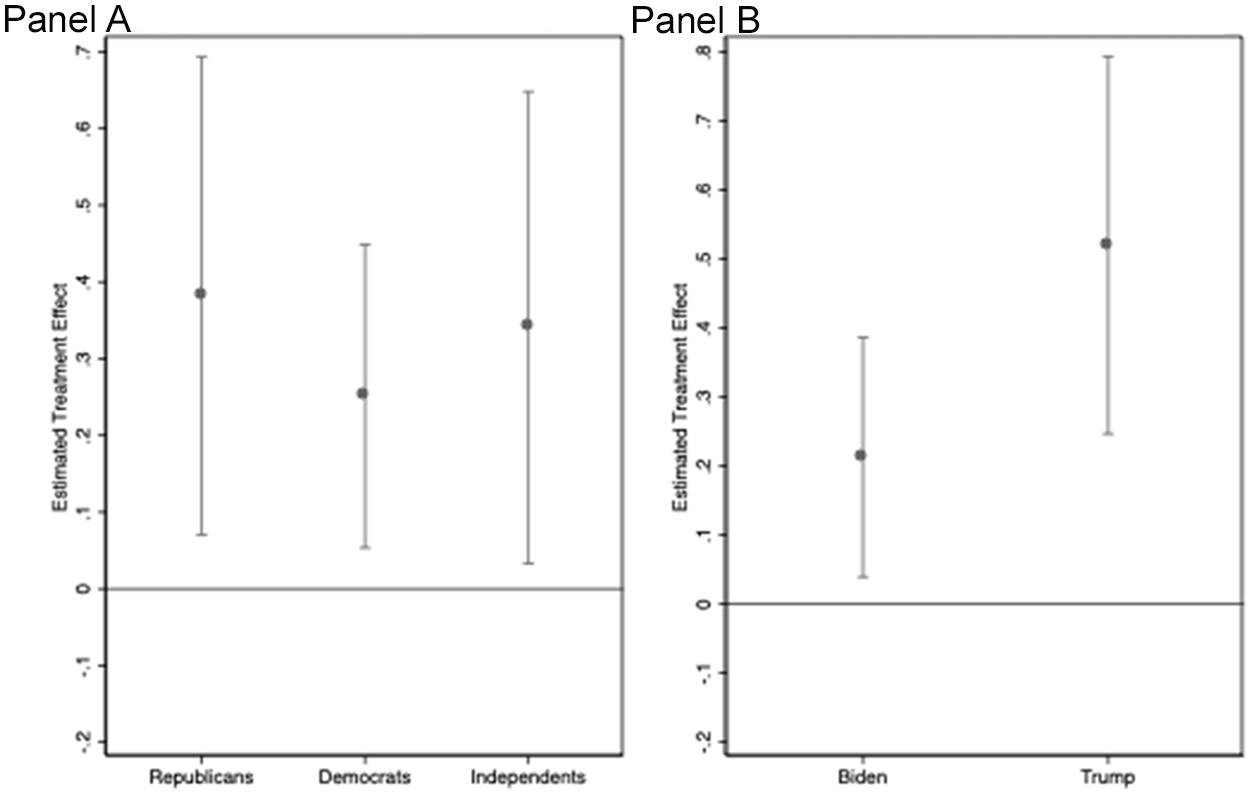
Treatment effects by party ID and vote choice: Panel A: treatment effects by party ID and Panel B: treatment effects by vote choice.
Discussion
This second study was motivated by two considerations. First, while our observational investigation based on data from April 2020 revealed a strong correlation between people’s views of the federal government’s COVID-response and their levels of external efficacy, we were unable to assess whether this correlation was indicative of a causal relationship. Second, Study 1 only provided a data snapshot, and it did not allow us to gauge whether the relationship between our two variables of interest held beyond the early stages of the U.S. pandemic response.
Our results from Study 2 strongly suggest that the relationship identified in Study 1 is causal. Relying on a survey experiment, we show that more positive assessments of the government’s COVID-response are directly tied to increases in external efficacy. Furthermore, given that our survey experiment asked individuals to reflect on the entire year of 2020, we show that our theory does not just apply to the early stages of the pandemic response. As such, Study 2 corroborates the findings presented earlier in the paper.
While this second study provides important insights, two interesting questions remain unanswered. These issues constitute fertile terrain for future research. First, it is unclear whether our main findings are due to the fact that negative views about the pandemic response dampen efficacy, or whether positive policy evaluations boost people’s external efficacy levels. By design, our experiment was only able to assess the aggregate effect of these complementary but distinct psychological mechanisms. We hope that future research will follow-up on our work and assess the relative strength of these two causal pathways. Second (and relatedly), our study cannot fully address the issues of partisanship and candidate preferences. As noted, our analysis reveals that there is no significant difference in how Democrats/Biden voters and Republicans/Trump voters responded to our news stories. While this demonstrates that our experimental manipulation affects all major voter groups in the U.S., it is unclear whether the underlying psychological dynamics are similar too. On the one hand, it is possible that Republicans/Trump voters and Democrats/Biden voters experienced the same efficacy boost after reading the positive news item (and the same efficacy decrease after being exposed to the negatively worded story). Alternatively, it is possible that our newspaper articles affected voter groups asymmetrically. Thus, observed experimental effects among Republicans/Trump voters might have been primarily caused by efficacy increases following the positive story. By contrast, our findings for Democrats/Biden voters might have been primarily driven by adverse reactions to our negatively framed news item. Both of these explanations would lead us to observe near-identical aggregate treatment effects. Here too, we hope that future research will build on our analysis by assessing to what extent partisanship and candidate preferences affect people’s receptivity to different news frames about the COVID-crisis.
Conclusion
The main objective in this paper was to investigate the relationship between people’s evaluations of their government’s response to the 2020 COVID-crisis and external efficacy. Using original online survey data collected in April 2020 and February 2021 in the United States, we found that individuals with more negative evaluations of the federal COVID-response have lower levels of political efficacy. With these findings, our paper provides the first direct examination of how public health crises influence efficacy. Furthermore, we corroborate earlier studies that suggest that governmental disaster response can shape people’s attitudes toward their country’s political system (Atkeson & Maestas, 2012).
While the generalizability of our research findings is ultimately an empirical question, it is worth considering whether our results might travel to other types of national disasters. As noted above, the 2020 COVID-crisis had three major features that likely increased the effect of policy evaluations on external efficacy: it was a significant source of public anxiety, highly salient, and policy outcomes received significant media coverage. In general, we expect that people’s assessments of their government’s disaster response policies affect efficacy in contexts with similar characteristics. In other words, returning to the U.S. context, we would expect that disasters that do not receive much national media coverage or incidents that disappear from public conversation after a fairly short period of time (such as the Virginia Winter Storms or Georgia Tornadoes of 2021) would not affect people’s efficacy levels in the same way. 12 Nevertheless, we hope that future research will build on our work and expand the investigation of disaster response evaluations and people’s attitudes about their political system.
Two additional directions might be pursued in future research. First, in general, public health crises are oftentimes multidimensional in nature, and thus national responses vary quite a bit as well. For instance, the United States largely focused on economic recovery, without significant investments in outbreak containment, like nationwide mask mandates, lockdowns, or contact tracing. By contrast, countries like Germany excelled at many aspects of controlling the spread of COVID, through widespread testing and quick reaction times to outbreaks when they arose, but they fumbled the initial vaccine rollout. This suggests that there are many fronts on which national governments might fail during a public health crisis, and consequently more research is warranted into how these different facets of public health crises and their associated governmental response affect political attitudes.
Second, much of the research on how events affect political attitudes are limited to those that last a short period of time. For instance, Davis and Hitt (2016) note that elections—an event that lasts a short period of time—yield only short-term effects on political attitudes. Yet, little is known about how a protracted public health crisis, like COVID, might affect political attitudes and whether those changes might be more permanent. Future research should explore how sustained events might shape efficacy and the time horizons of those changes.
Supplemental Material
sj-pdf-1-apr-10.1177_1532673X211041322 – Supplemental material for The Effects of COVID-19 on External Political Efficacy
Supplemental material, sj-pdf-1-apr-10.1177_1532673X211041322 for The Effects of COVID-19 on External Political Efficacy by Markie Rae McBrayer, Bert Baumgaertner and Florian Justwan in American Politics Research
Footnotes
Declaration of Conflicting Interests
The author(s) declared no potential conflicts of interest with respect to the research, authorship, and/or publication of this article.
Funding
The author(s) received no financial support for the research, authorship, and/or publication of this article.

Supplemental Material
Supplemental material for this article is available online.
Notes
Author Biographies
References
Supplementary Material
Please find the following supplemental material available below.
For Open Access articles published under a Creative Commons License, all supplemental material carries the same license as the article it is associated with.
For non-Open Access articles published, all supplemental material carries a non-exclusive license, and permission requests for re-use of supplemental material or any part of supplemental material shall be sent directly to the copyright owner as specified in the copyright notice associated with the article.
