







Abstract
Veteran women are better represented in Congress than non-veteran women, but the reasons for this are unclear. Veteran women may be better represented because they run at higher rates and in more winnable races or because their military service leaves them uniquely qualified to overcome gender and partisan stereotypes. Voters often perceive women as lacking leadership ability and ill-suited to handling national security. However, female veterans have experience that may help them overcome gendered beliefs about their abilities. Using election data from the 2012–2020 U.S. congressional elections, we test whether veteran women gain greater voter support compared to non-veteran candidates and whether veteran women running as Democrats outperform male veteran Democrats. We find only limited evidence that military service wins more votes for candidates of either gender. Among Democrats, prior military service levels the playing field between male and female candidates, but veteran women only outperform veteran men in 2018.
Introduction
Observers declared the 2018 midterm elections a second “Year of the Woman” after the historic 1992 election cycle. The 2018 midterm elections brought forth a record number of female candidates, leading to a record-breaking level of female representation. A growing share of women running for Congress each cycle are military veterans, and despite the lagging progress toward gender equality, women military veterans’ share of seats in Congress is proportional to their share of the population (Best, 2019). Why are veteran women better represented in Congress than other women? One possibility is that positive stereotypes about veterans’ characteristics interact with perceptions of women candidates in ways that allow Democratic women to overcome the interaction of gender and partisanship that Holman et al. (2016) have shown to be an electoral disadvantage in times of security threats. Another possibility is that veteran women may be more willing to run for office, even in harder to win districts. Parties may also specifically recruit women veterans to run in some hard-to-win districts as attention grabbing candidates. While survey experiments are a common means of testing theories regarding voter behavior, following Dolan and Lynch (2014), whose findings indicate that survey experiments significantly inflate the importance of gender stereotypes on voter decision-making, we test our theory of a voter preference for veteran women using an original dataset capturing veteran status, gender, and district effects of candidates for the U.S. House of Representatives between 2012–2020. Notably, while our analysis allows us to test whether voters exhibit a preference for veteran women, it does not allow us to directly test hypotheses about why voters might prefer these candidates.
If veteran women do have an electoral advantage, a route to increasing the political power of women and shifting public perceptions of women’s leadership ability may exist. As more women win election to Congress running campaigns that explicitly highlight their military service, they help alter ideas about the military, women’s roles in the military, and who can be an expert in defense and security. Their success may also inspire more women to run for office and contribute to shifting ideas about what a member of Congress looks like (Beaman et al., 2009; Bhavnani, 2009; Shair-Rosenfield, 2012). However, it is not clear that these women behave in office similarly to nonveteran women. Members of Congress who are veterans differ from nonveteran peers on certain foreign policy roll call votes (Lupton, 2017) and at the state level veterans behave differently on domestic issues (Best and Vonnahme 2021). Thus, we might expect female veterans to behave differently than their non-veteran peers.
Alternatively, if the difference is not due to voter preference for these candidates, another explanation could be that female veterans’ overrepresentation in Congress results from their overrepresentation among candidates. If this latter explanation is the case, then the path to increasing women’s representation in office, would seem to lie in increased party recruitment of female candidates and the continuation of the efforts of organizations like She Should Run to recruit women from a variety of backgrounds to run for office.
In what follows, we consider the literature on gender stereotypes and voter behavior and theorize about how veteran status may mitigate negative effects of gender bias for female candidates, even providing female veterans a relative electoral advantage. We hypothesize that veteran women, especially Democratic veteran women, will be more attractive to voters than other candidates.
We use electoral data from 2012–2020 to test the electoral performance of veteran women in general U.S. House of Representatives elections as compared to non-veteran women, veteran men, and non-veteran men, controlling for incumbency, party affiliation of the candidate, region, and baseline partisanship of the district. We find no evidence that military service wins more votes for candidates of either gender. Indeed, male veterans running as Democrats, seem to garner a lower share of the vote as compared to nonveteran men, while we see no significant impact of military service for Republicans or Democratic women when controlling for district partisanship, incumbency, blanket primaries, and districts in the South. Interestingly, veteran status levels the playing field between male and female candidates running as Democrats, but veteran women only outperform veteran men in 2018, and the difference is not statistically significant. We also evaluate whether veteran women running as Democrats perform better than those running as Republicans. We find that in 2018, Democratic veteran women outperform Republican veteran women, but we do not find any statistically significant effect over the full timeframe. We conclude with a discussion of alternative explanations for the greater representation of veteran women in Congress, such as targeted party recruitment and willingness to run. Due to the limitations of our data, we do not empirically test these alternatives. Our data also do not facilitate a direct test of the stereotypes voters hold regarding female veterans.
Gender Stereotypes, Security, and Voter Choice
Stereotypes about women’s political knowledge, decision-making style, aggressiveness, and policy expertise may make voters less supportive of them as candidates. Voters perceive women as less knowledgeable about politics (Ditonto et al., 2014; Morehouse Mendez & Osborn, 2010) and less capable of handling military affairs and national security (Huddy & Terkildsen,1993; Holman et al., 2016; Ortbals & Poloni-Staudinger, 2013). This perception is because people believe women to be emotional, compassionate, and warm, while considering men to be assertive, rational, self-confident, decisive, and better able to handle a crisis - desirable traits for a leader (Schneider & Bos, 2014; Sanbonmatsu, 2003; Williams and Best 1990). The interaction between gender and policy positions and assumptions about gendered areas of policy expertise hinders women’s chances of winning elections, especially when security concerns are salient (Besley and Case 2003; Holman et al., 2016; Schroeder, 2017). Surveys indicate that, though female candidates are more qualified on average and more productive and skilled as legislators, voters are still less likely to vote for them, even when they recognize that women are more capable legislators and consider them to be more competent in domestic affairs (Bauer, 2020).
Indeed, Schneider and Bos (2014, 254) find that survey respondents attribute few of the positive stereotypes associated with women to female politicians, instead associating them with “negative female leader traits” (e.g., egotistical or dictatorial). They conclude that the overlap between stereotypes of women and those of female politicians is sufficiently minimal to consider female politicians a subtype 1 rather than a subgroup of women. Interestingly, the results indicate that female politicians are also associated with fewer positive and more negative stereotypes as compared to the subtype professional women. It is highly plausible that veteran women are a subtype of women themselves, and indeed, veteran women politicians may be a subtype of women politicians. If so, it is likely that the public bring different stereotypes to bear when evaluating these candidates such as the view that veteran women are capable of handling national defense issues.
In the US, the perception that men are more capable of handling defense translates to greater voter support for men (Huddy & Terkildsen,1993; Falk & Kenski, 2006). Immediately after the attacks of 9/11, the willingness of respondents to support a female nominee for president dropped by 10 percent (Lawless, 2004; Lawless & Fox, 2005), likely due to stereotypical beliefs of women’s capabilities. Further, the media give less credence and recognition to women’s expertise in the critical arenas of foreign policy and national security, perpetuating the perception that women have less aptitude in these areas (Swers, 2007; Ortbals & Poloni-Staudinger, 2013). Terror and other security threats harm the electoral prospects of women (Schroeder, 2017; Kang & Kim, 2020), and particularly Democratic women who have the feminine stereotypes attached to their gender and to their partisanship to contend with, but do not harm Republican women or Democratic men (Holman et al., 2011). To overcome this disadvantage, women must find ways to counter the negative beliefs about their leadership ability broadly, and suitability to handle military affairs specifically.
Swers (2007) argues that strategic women on the campaign trail or in office behave proactively to counter voter perceptions of them as less suited to handle security and military affairs. She quotes a US Senate staffer making this point, “Voters don’t question a man’s ability on defense issues…. Women need [defense and foreign policy] committees to show they are tough and fit to lead in that area because the women are not likely to have served in the military.” (Qtd. in Swers, 2007: 582). In other words, adding military service experience to other credentials may improve perceptions of a woman’s ability to handle national security. Behavioral studies back up the aforementioned Senate staffer’s sense that voters seek additional evidence of competence in national security and defense for female candidates more than male candidates (Ditonto et al., 2014). Survey experiments indicate that exposure to a terror threat treatment significantly increases respondent’s evaluation that Republican Condoleezza Rice, a former National Security Advisor and Secretary of State, could handle the issues of terrorism. Exposure to the same treatment decreased evaluations of the ability of military veteran and then Sen. John Kerry (D-MA) to handle a terrorist attack (Holman et al., 2016). The authors attribute the positive evaluations of Rice to a combination of policy experience and party affiliation. However, the combination of gender and partisanship may trump even extensive national security experience for Democratic women (Holman et al., 2019). What remains to be seen is whether this result also holds true for women who have served in the military as well as those who have served in civilian positions in the national security community, such as Secretary Hillary Clinton.
A Gendered Veteran Advantage
Veteran women may be better able than non-veteran women to overcome stereotypical beliefs about their leadership qualities and ability to handle national security. Voters typically use candidate characteristics, stereotypical heuristics, and traits to make inferences about candidates and efficiently choose between them (Hayes, 2005; Sanbonmatsu, 2002). Gallup polling of the American public consistently finds high levels of confidence in the military, suggesting that the public does not consider the military to be corrupt and believes promotion in the military to be merit-based. A successful military career may serve as a powerful symbol of competence generally but is likely to be an especially valuable attribute for women. Veteran women may be able to leverage positive aspects of stereotypical thinking about both women and veterans. Women are commonly perceived as more trustworthy and less corrupt (Buchan et al., 2008), prompting better views of the government when they are in office (Schroeder & Powell, 2018). Women in Congress may also be more collaborative and consensus-oriented (Kathlene, 1994; Reingold, 1996), traits that may appeal to voters in the current political climate of polarization and legislative gridlock. The public perceive veterans as more trustworthy and willing to put the needs of the country before their own and as possessing leadership ability and key national security knowledge and experience, viewing them as better able to handle national security and defense (McDermott & Panagopoulos, 2015; Teigen, 2013). Given the salience of national security in the United States, it is unsurprising that military experience is the single most important positive characteristic in a presidential candidate for voters of both parties (Pew Research Center, 2014), and indeed, veterans are numerically overrepresented in Congress. Despite this edge, evidence that veterans enjoy an advantage on Election Day is elusive (Somit & Tanenhaus,1957; Teigen, 2008; Karsten, 2012). However, research on veteran candidates has focused almost exclusively on men, thus very little is known about whether, how, and to what degree veteran women benefit from these beliefs about veterans.
The positive characteristics attributed to veterans may offset perceived weaknesses of women and particularly Democratic women. While women (and Democrats) are often perceived as softer and less competent on security issues, veterans are credited with greater experience and expertise (Teigen, 2013; Hardy et al., 2019). Similarly, positive perceptions of veterans’ leadership ability may offset doubts about women as leaders. The feminine stereotypes of warmth and compassion may offset negative images of veterans as overly rigid or militaristic. Therefore, we anticipate that veteran women will be stronger candidates than others.
Veteran women gain a higher vote share in general elections than others, ceteris paribus.
Veteran Women and Partisanship
The amplifying effect of being a veteran may be particularly powerful for Democratic women. Their party’s platform focuses on social services, education, health, and women’s reproductive health, all policy areas where voters perceive women to be more capable. Thus, gender stereotypes about women can be a strength for Democratic women. However, voters routinely view Democrats as weak on defense and national security. Further, in a study of U.S. House general election candidates, Dolan (2014, 104) finds that “people who stereotype women as less capable on economic and foreign issues are likely to evaluate their specific Democratic woman candidate lower than her male opponent on these issues.” Thus, Democratic women in particular need some other cue to voters signaling their capability. And, when campaigns and news coverage emphasize masculine characteristics of a candidate, Bauer (2018) asserts that such a news frame improves voters’ assessments of female Democratic candidates’ experience and qualifications for the Senate but does not impact assessments of male candidates or Republican women.
Being a veteran can help counter the view that as a woman, and especially as a Democratic woman, a candidate is less qualified and capable of handling defense, security, and foreign affairs. We contend that it is advantageous for female veterans to run as Democrats because the policy areas Democratic voters typically prioritize are those in which women are seen as most competent, while their military backgrounds enable them to overcome negative perceptions about women and Democrats. Additionally, the Democratic party organization and Democratic PACs and donors have endeavored to increase the representation of both women and veterans (Caul, 1999; Francia, 2001; Crowder-Meyer & Cooperman, 2018; Crespin & Deitz, 2010). 2 Additionally, the percentage of Democratic donors who are women is nearly twice that of Republican donors (Francia et al., 2003), and female donors are more likely to contribute to Democratic candidates, especially female candidates (Thomsen and Swers 2017; National Council for Research on Women, Center for American Women and Politics, and Center for Responsive Politics 2014). Ultimately, in both competitive and safe districts, Democratic women are able to raise more money than Republican women. Given the synthesis of gender stereotypes and the policy platform of the Democratic party, we expect Democratic women veterans to have an advantage over their male counterparts. We therefore expect that:
For Democratic candidates, veteran women will outperform veteran men.
Analysis
The most straightforward method of testing our hypotheses is to examine elections and their outcomes while tracking the germane independent variables, gender and military experience, and control for district-level baseline partisanship and incumbency. Elections to the United States House of Representatives present a convenient set of observations for a few reasons. They are numerous when looking at pooled years of data, giving as many degrees of freedom as possible. This is especially important because relatively few women run for election and military service experience among women is rare. The units of analysis in this study are contested general elections. Each observation includes both major party candidates. Individuals may appear multiple times if they ran in multiple election years, regardless of whether they won. We use election-year as the unit of observation because each election may feature a different challenger and electoral context. Ideally, we would also control for variation in the salience of national security across districts, however our data do not allow us to do that.
We only code candidates as veterans if they signaled service experience in the United States military in their campaign materials. Active duty, National Guard, or Reserve service could be overseas or domestic, combat or noncombat, enlisted or as an officer, and in any branch of the United States armed forces. Former military-adjacent experience, e.g., former Central Intelligence Agency personnel Elissa Slotkin (D-MI) and Abigail Spanberger (D-VA), who ran successfully in 2018, are not coded as veterans in our analysis.
Number of Considered Candidates in U.S. House Races by Party, Gender, and Military Service, 2012–2020.
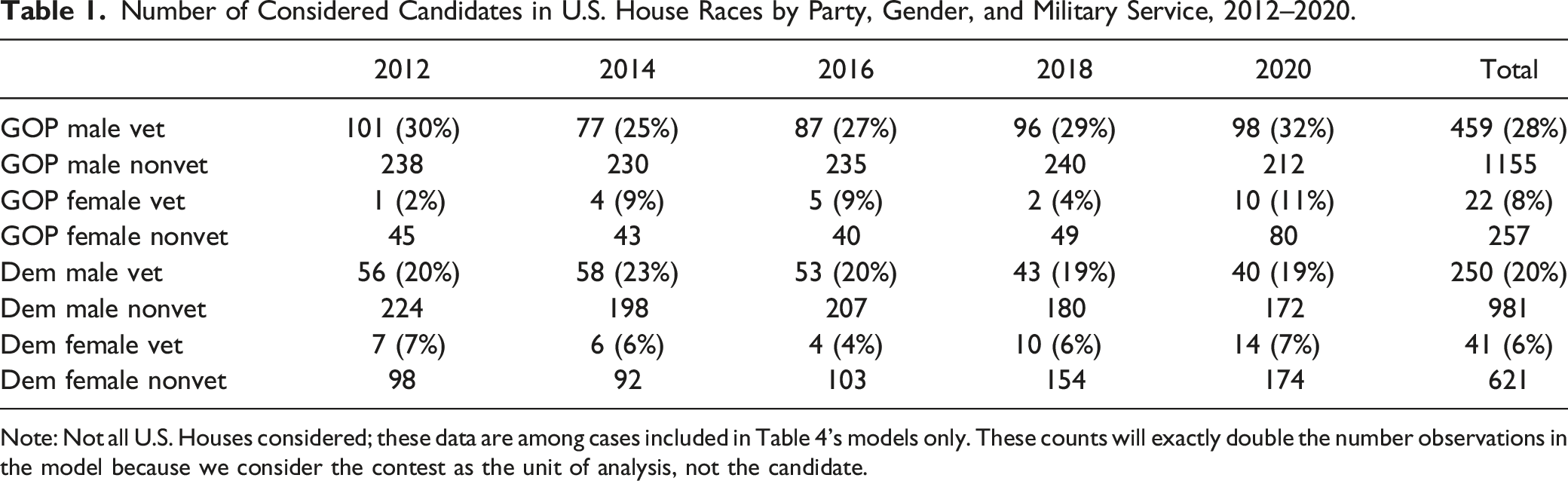
Note: Not all U.S. Houses considered; these data are among cases included in Table 4’s models only. These counts will exactly double the number observations in the model because we consider the contest as the unit of analysis, not the candidate.
Our pooled sample includes a total of 1893 election-year observations across five election years, one Democrat and one Republican in each contest. 3 Veterans make up 7.9% of GOP women candidate observations, 6.2% of Democratic women observations, 28.4% of male GOP observations, and 20.3% of male Democratic observations. Overall, just over a quarter of GOP candidates are veterans while only about 16% of Democratic ones are veterans. Only 14.7% of GOP nominees in these years are women, while 34.9% of Democratic candidates are women. Further, in each year other than 2016, when the two parties ran the same number of veteran women, the GOP has run more male veterans as compared to Democrats, while the Democrats have run more female veterans. The overall number of female veterans running for the House has increased over recent years, from a low of eight in 2012 and 2016 to a high of 24 in 2020.
Selected US House Democratic Candidate Two-Party Vote Share Mean, 2012–2020.
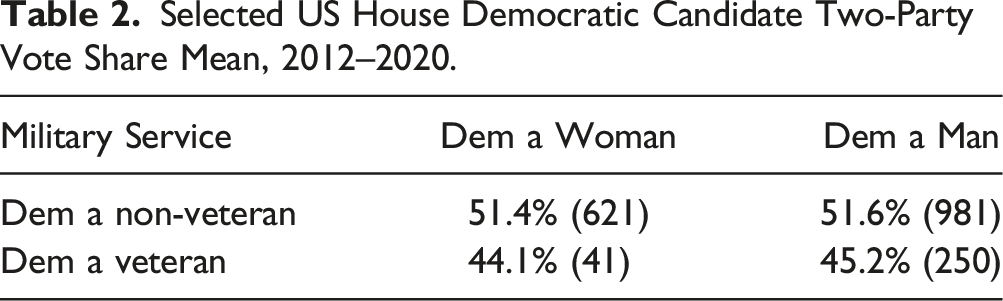
Figure 1 plots these values over time to demonstrate the change in the number of female veteran candidates in the Democratic Party, but also their varying ability to earn votes. The y-axis plots proportion of votes won, and the circles demonstrate the number of Democratic women with service experience running in a given year. The midterms in 2018 stand out in contrast to more typically low average vote proportion for female veterans running as Democrats.
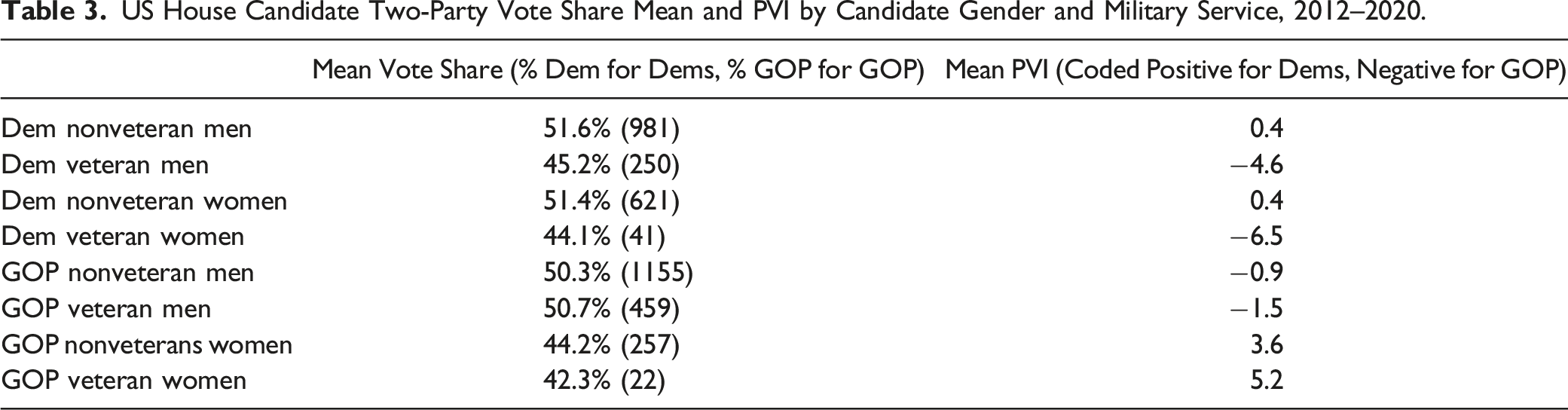
To better contextualize the analysis, we examine the interaction between military service, gender, and general election results controlling for the baseline partisanship of the district, region, incumbency, primary type, and year. In most states, partisan forces and civil rights concerns animate the process of generating district lines, leading to uncompetitive districts that heavily favor one party. Each election year, the Cook Political Report handicaps each contest in advance based on the partisan landscape of the district and assigns a “PVI” score (partisan voting index) that is a benchmark for the election outcome assuming two generic party candidates. It is largely based on recent presidential election trends in the district. We coded the PVI so that positive numbers track toward Democrats while negative numbers track toward Republicans, e.g., a district with a negative 20 PVI indicates a profoundly GOP district while a PVI of positive 8 signals a district to lean blue, and with generic candidates, should end up 54% to 46% in a Democratic win.
4
A PVI of zero indicates an evenly balanced electorate. PVI is included as a control in all our models. To characterize the patterns of district partisanship in the various permutations of candidate service experience and gender, Table 3 presents summary statistics for both the district-level PVI and the percentage of the two-party vote each candidate received. Evidence shows that female Democrats with service experience faced the greatest headwinds on average across the decade considered. Number and average vote proportion of democratic women veterans in US house races. Proportions are indicated on the y-axis while number of candidates is shown in circles on the graph. US House Candidate Two-Party Vote Share Mean and PVI by Candidate Gender and Military Service, 2012–2020.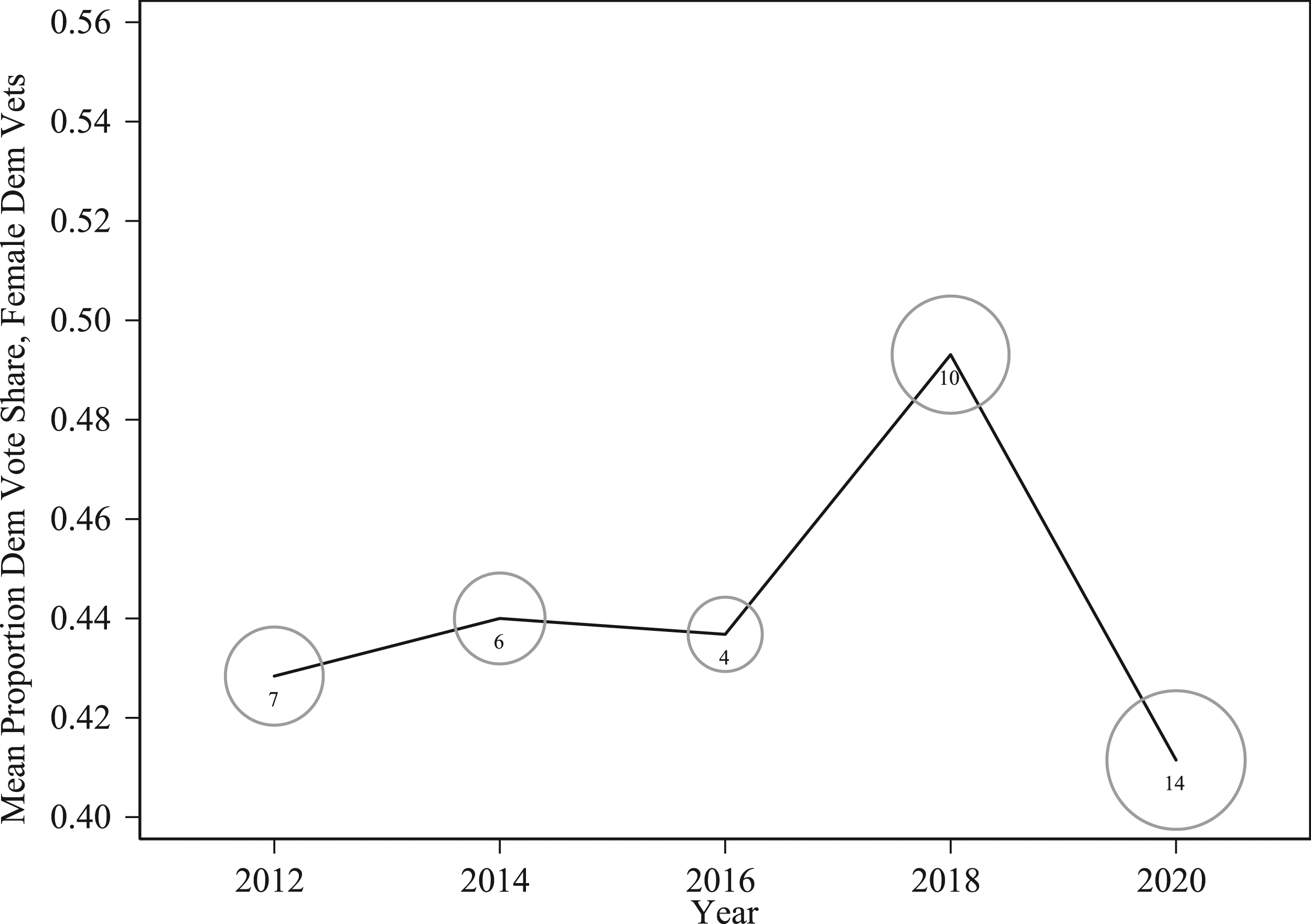
The other important forces that shape congressional election outcomes are incumbency, region, primary type, and election year. Incumbent members of Congress possess strong, well-known electoral advantages (Abramowitz et al., 2006). We include a dummy variable for both Republican incumbent and Democratic incumbent 5 in all models below. We also include a dummy variable coded for congressional contests within the South, defined by the eleven former Confederate states, in order to control for the distinctive election dynamics in that region (McKee, 2018). California, Louisiana, and Washington conduct their party nominations for congressional elections differently than the rest of the states by running some form of a blanket primary where candidates of both parties compete. The models include a dummy for that fact, though contests are omitted from analysis if two candidates of the same party get to the general election. Lastly, for the regressions that pool all the years together, there are dummies for each year except 2012 to control for year-to-year variations such as the differing levels of turnout between years with and without presidential elections.
Modeling U.S. House Election Results as Share of Two-Party Vote, 2012–2020
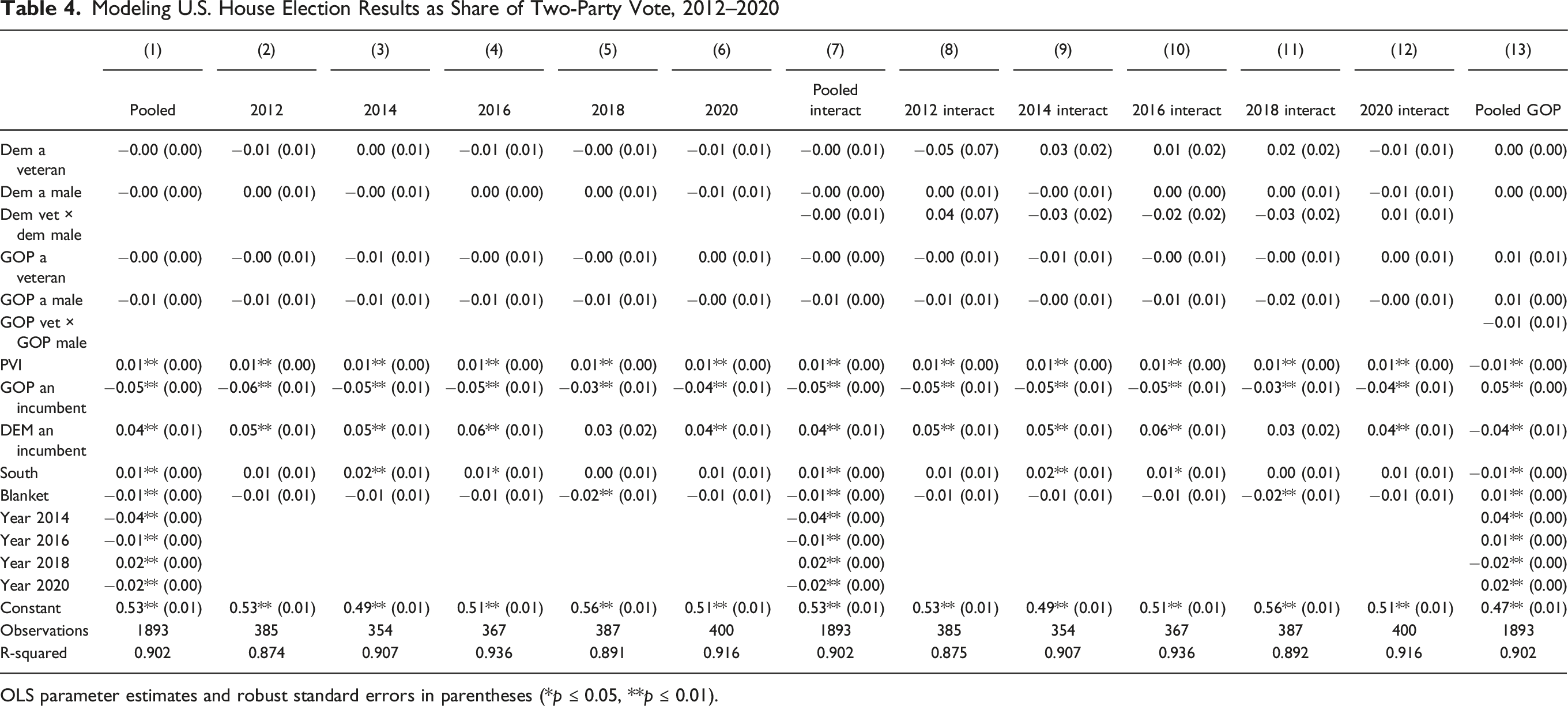
OLS parameter estimates and robust standard errors in parentheses (*p ≤ 0.05, **p ≤ 0.01).
Table 4 displays the parameter estimates for OLS models to help make sense of the interplay of gender and past military service with respect to election results. 6 The first model pools all of the races we consider and includes both our main independent variables of interest, gender of candidates and the veteran indicator variable. It also includes the control variables, district partisanship as measured by PVI score, Southern location, and the two dummies for Democratic incumbent and Republican incumbent. Dummies for each election year inherently control for any presidential- versus off-year election effects. Models 2-6 do the exact same thing as Model 1 except they narrow the focus down to individual years. Table 4’s parameter estimates do not directly test our hypotheses about the interactive effect of gender and military service, but instead show us the independent effect of each of these factors on candidates from each party.
The results reported in Table 4 demonstrate several inferences from the data. District partisanship and incumbency strongly and unsurprisingly shape congressional election outcomes. More importantly, the “veteran effect” of past military service helping candidates win votes in general elections, oft cited as an article of faith among practitioners and journalists (Shane, 2016), does not enjoy support from the data. Democratic veterans, irrespective of gender, do not outperform Democratic non-veterans in the pooled model nor in the year-to-year comparisons. Republican veterans enjoy a slight edge over Republican non-veterans in 2014 but that was the only year that approached statistical significance (t = −1.70, p > |t| = 0.09).
As with any observational study, the challenge is puzzling out the casual pathway. GOP veterans may earn more votes than Republican nonveterans because voters prefer Republican veterans or because Republicans nominate veterans in friendlier territory. The results indicate Republican veterans are doing a little better than similarly positioned Republican nonveterans. The lack of results for Democratic veterans may indicate that the Party nominates veterans in harder districts or that veterans do not have an advantage. The lack of a large veteran effect in general elections accords with past analysis of veterans in recent elections (Teigen, 2018).
Yet, these broad results do not engage the primary question we seek to answer, namely, to assess how the interaction of gender and military service influences election outcomes. The models in Table 4 test whether military service correlates with vote share, controlling for gender and other factors. Our first hypothesis anticipates that female veterans outperform expectations versus other categories of candidates, including men, women, and nonveterans of both sexes. In other words, is there an interaction between gender and military service cues in general elections?
Models 7–13 in Table 4 analyze the data similarly to Models 1–6, but are designed to test the Democrats’ fortunes when nominating female veterans. They do so by including interactions between the Democrat veteran and Democrat male dummy terms in addition to the PVI, incumbency, region, blanket primaries, and year controls. This approach tests for the conditional influence of gender on vote share, depending on military service experience, and vice versa. Yet, with an interactive theory posited, the parameter estimates on the table reveal less than they do in a simple additive model. It is important to express the marginal effects across the different values of the variables of interest rather than rely on the sign and statistical significance of the parameter estimates (Berry et al., 2012; Kam and Franzese 2007).
Figure 2 depicts the predicted election vote share of each combination of gender and military service status for Democratic and Republican candidates, controlling for district partisanship, region, and incumbency in 2018. Parallel lines would indicate a lack of an interaction between gender and military service while different slopes would indicate an interaction effect between service and gender. Gender, military service, and vote share, 2018.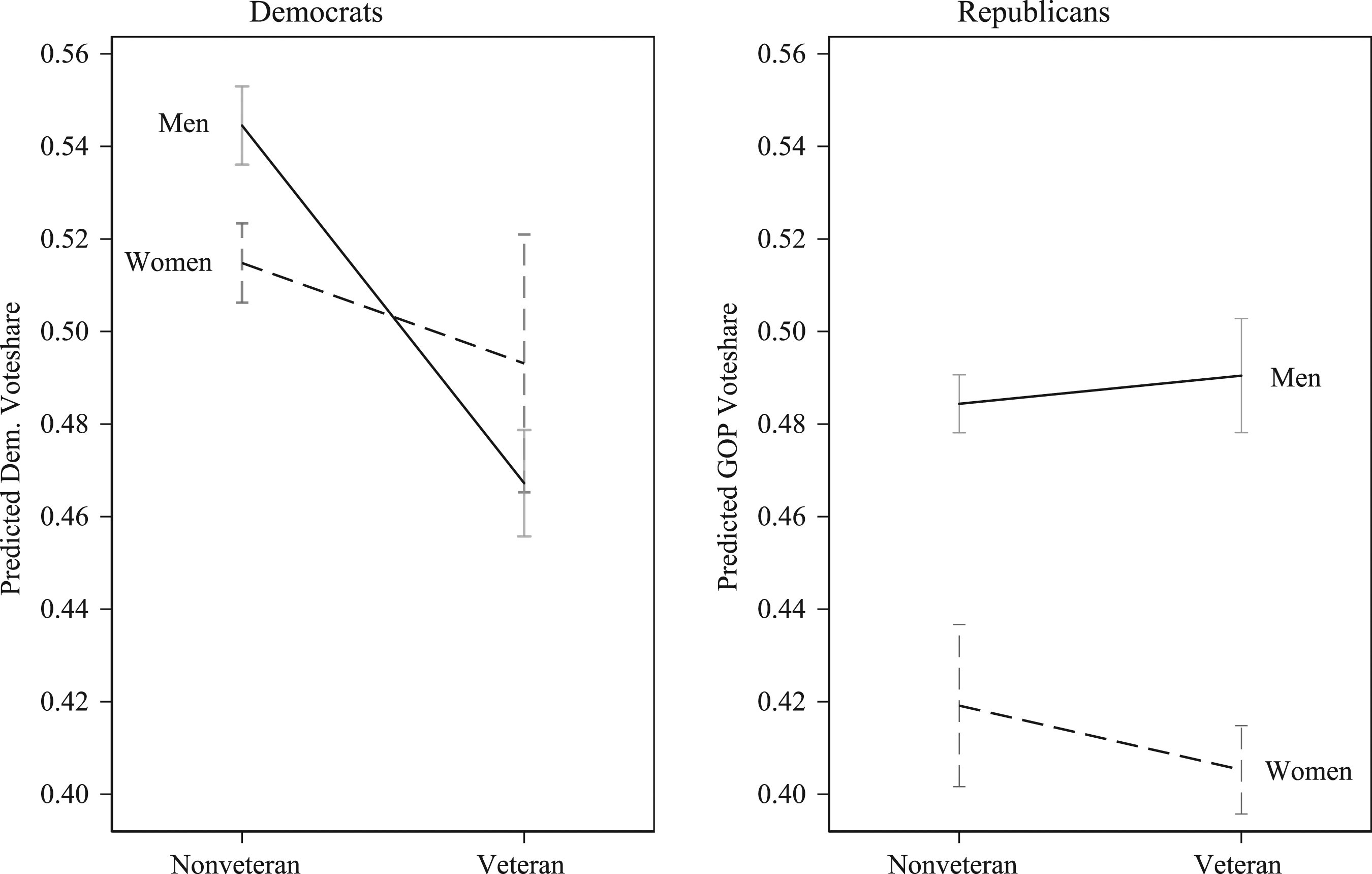
Male and female veteran Democrats along with Republican female veterans fared worse than their nonveteran equivalents. While there is a small difference between nonveteran Democratic men and women, Democratic veteran women performed better than Democratic male veterans in 2018—negating or even reversing the trend for nonveterans. The magnitude of the difference is small, but given the low number of veteran women in our sample, any distinctions based on military service and gender indicate perceptions about how military service colors gender and vice versa are probably real. These results may suggest that military service and gender can influence the share of votes candidates earn, or that parties make decisions about whom to nominate in which districts based on military service, or some combination of these two explanations. Given the distribution of nominations of veterans by Democrats, it is likely that the 2018 cohort of Democratic women are responsible for the contrast. Hence the support for Hypothesis 1 is mixed. In general veteran women do not perform better than other candidates. However, if we ask whether veteran women earn more votes than veteran men, the answer is an emphatic no for Republicans and, consistent with Hypothesis 2, yes for Democrats in 2018.
Discussion
Veteran women are better represented in Congress than are nonveteran women, yet our results do not suggest that this is due to voter preference for veteran women. A plausible alternative is that veteran women run for office at higher rates than their nonveteran counterparts. This may be due to political ambition or party recruitment. Here, we address each of these possibilities in turn, however more research is needed to evaluate the degree to which either or both are at play.
Women are less likely than similarly qualified men to run for office (Lawless and Fox 2005, 2010), a finding that holds regardless of race or ethnicity (Holman and Schneider 2018). While women and men win election at similar rates (Burrell, 1994; Sanbonmatsu 2006), women must be better qualified and face more challengers (Fulton, 2012; 2014; Palmer and Simon 2006). Furthermore, the perception that women are not electable (Brooks and Hayes 2019; Pruysers and Blais 2017) and the masculinized ethos of politics dissuades women from running (Lawless & Fox, 2010; Kanthak and Woon 2015; Preece and Stoddard 2015; Schneider et al., 2016). This problem is likely compounded by the fact that women systematically face more challengers, and more experienced challengers, when they run for office than do men (Atkinson and Windett 2019; Milyo and Schosberg 2000; Palmer and Simon 2006; Piscopo, 2019). Both perceptions of what it means to be a politician and women and girls’ socialization impacts women’s political ambition. Girls who engage in competitive activities, sports or debate team, express higher levels of political ambition (Fox and Lawless 2014). However, the factors that deter women from running for office may not be present for female veterans. The competitive, masculinized ethos of politics may not be an intimidating environment for the female veterans since they voluntarily joined another similarly masculine environment---the military. Further, veteran women may not attract competitors in the same way as nonveteran women.
Being asked to run is a leading reason candidates report ultimately deciding to run (Moncrief et al., 2001), and a more important factor for women (Lawless & Fox, 2010). Despite this, women are significantly less likely to be encouraged to run for office (Lawless & Fox, 2005 p. 85), and evidence suggests that party elites may even be more likely to discourage women from running where their party is stronger (Niven, 2006).
If party elites assume that women are less viable as candidates, they may refrain from recruiting women (Niven, 1998; Sanbonmatsu, 2002). However, experiments by Doherty et al. (2019) reveal that party leaders are generally inclined to view women “as slightly more viable” than men in legislative races. While party elites may evaluate women favorably as candidates, they may not think to recruit women. Party leaders may be more prone to selecting candidates similar to themselves (Niven, 1998), or less likely to think of viable women when they draw candidates from their personal networks (Crowder-Meyer, 2013). Many party leaders report that women are harder to recruit than men, which may be related to the finding that women are more skeptical of offers of support from party elites and tend to expect that parties will be more active in supporting men (Butler and Preece 2016). But because both parties have focused recently on recruiting veterans to run for office (see e.g., Weissert, 2021) and because, due to their ties to the male-dominated military, female veterans may be more likely to be in the extended networks of party leaders, they may find themselves more likely to be asked to run for office.
Conclusion
This study proposed that veteran women, particularly Democrats, would have an electoral advantage and subsequently capture a larger vote share. Following a call for different approaches in studying the intersection of gender and military service experience (Eichler, 2017) and effects of voter bias (Dolan and Lynch 2014), we use empirical data to evaluate the intersection of sex and veteran status in American elections. Democratic women veterans outperformed their male veteran counterparts in terms of vote share in 2018. The difference was not statistically significant, but the number of veteran women running for office in a single year and from a single party is also very small. However, contrary to our expectations they fare worse than non-veteran Democrats of either gender. Veterans, and particularly women veterans who voluntarily joined a predominantly male and masculine institution, may be more likely than others to seek out difficult challenges – such as running in an uphill district. While we control for baseline partisanship of districts, it is still possible that veteran women are running for office in districts that are systematically less favorable to their parties. This question merits further attention to test whether female veterans are recruited to run in more difficult districts or are more likely to run in hard to win districts in which party elites do not recruit candidates. Studies have already found that women are more likely to run in difficult districts compared to men (Ryan et al, 2010). As noted in Burrell, 1994 party leaders are apt to choose a candidate that can shake things up in the hopes of winning the seat when the odds are low due to ideological make-up of the district. As the number of veteran women has increased in the U.S., party leaders may look at veteran women as their last best hope to win (or at least attract funding and support), trying to capitalize on multiple sets of stereotypes.
However, women veteran candidates are not isolated to difficult districts. In fact, the 2018 midterms indicate that if the Democratic Party deploys female veterans in winnable districts, they can over perform expectations. Rep. Mickie Sherrill emerged as a Democratic candidate in a purple district in 2018, effectively scaring a twenty year Republican incumbent into retirement and flipping New Jersey’s 11th congressional district. But further research will be needed in the future to better understand the dynamics of the 2018 election and whether it represents an enduring trend. Alternatively, it is possible that some part of the success veteran women saw in 2018, relative to veteran Democratic men, is due to the particular context of that election, coming as it did in the middle of the Trump administration and multiple foreign policy crises. Women candidates performed better in 2018 as compared to other recent cycles.
Running as a female veteran may carry some additional risks that are not fully offset by any advantages of veteran status. Some veteran women endured attack ads that accused them of “stolen valor.” For example, New Hampshire Republican Lynne Blankenbeker faced such accusations in her 2018 primary for putting the phrase “combat proven” on her signs, despite her deployments to combat zones as a Navy nurse (Landrigan, 2018). Emphasizing prior military service may cost women some of the policy expertise they are assumed on the basis of gender to have in other areas, such as education. Women whose campaigns emphasize characteristics that are more stereotypically masculine, such as military service, may sacrifice some voter confidence in their ability to handle stereotypical “women’s issues” without gaining enough ground in perceptions of foreign policy and security expertise.
As more veteran women run for national office in the coming years for many reasons, including concerted recruiting (Steinhauer, 2019), we expect to see clearer patterns emerge showing how these candidates perform relative to others. As the electorate becomes more accustomed to the idea of women as veterans, we may see a shift in how voters perceive both veteran and non-veteran women as candidates.
Footnotes
Declaration of Conflicting Interests
The author(s) declared no potential conflicts of interest with respect to the research, authorship, and/or publication of this article.
Funding
The author(s) received no financial support for the research, authorship, and/or publication of this article.
