







Abstract
Using an original dataset, we offer an intersectional exploration of psychological violence, threats, and physical violence against U.S. mayors in 2021 in cities of 10,000+ in population. We also explore violence that is gendered and raced. Overall, we find significant and meaningful differences among gender/race groups. Women of color and non-Hispanic white women faced higher rates of threats, gendered, and sexualized violence than men, and women of color were the only mayors to report heightened levels of gendered and raced violence. Non-Hispanic white women mayors were distinctive in that they reported higher levels of psychological violence, including being criticized for their appearance and perceptions that they were too emotional, but were least likely to be called sexist. These findings suggest that there are race- and gender-based costs of holding office. If so, the effects on democratic representation and the benefits from representational diversity will be forfeited.
Introduction
“Diversity is what happens when you have representation of various groups in one place. Representation is what happens when groups that haven’t previously been included, are included. Intersectionality is what happens when we do everything through the lens of making sure that no one is left behind. More than surface-level inclusion, or merely making sure everyone is represented, intersectionality is the practice of interrogating the power dynamics and rationales of how we can be together.” (Garza, 2020)
A growing body of comparative and Americanist research in political science has focused on violence against women in politics. Overall, this research indicates that women officeholders and candidates face more harassment, sexism, and violence than men. However, very little research concentrates on intersectional experiences of violence. As Krook and Restrepo Sanin (2016, p. 7) assert, “…intersectionality has not yet been incorporated widely into theorizing about violence against women in politics….”
Using an original dataset, in this paper, we offer an intersectional exploration of experiences of psychological violence, threats, and physical violence against U.S. mayors in 2021 in cities of 10,000 in population and above. Additionally, we explore specific aspects of violence that are gendered and raced. Overall, this study demonstrates that there are significant and meaningful differences among gender/race groups. Non-Hispanic white women, women of color, non-Hispanic white men and men of color mayors do not have the same experiences of violence as each other. In our survey, women of color and non-Hispanic white women mayors both experienced higher rates of threats, gendered and sexualized violence than men, and women of color mayors were the only mayors to report heightened levels of both gendered and raced violence. Further, non-Hispanic white women reported higher levels than their counterparts of psychological violence, and violence based on evaluations of their appearance and being perceived as emotional, but less likely to be called a sexist. In all, the only types of violence that women did not clearly face at significantly higher rates than men were physical violence 1 and being called sexist or racist.
These findings suggest there are race- and gender-based differential costs of holding office – along with the possibility of limiting the pool of diverse candidates willing to run for office (see especially Thakur & Hankerson, 2022) or increase the pool of current officeholders who will continue their service. If so, the effects on democratic representation and the benefits available from representational diversity will be forfeited (see Dovi, 2002; Mansbridge, 1999; Phillips, 1995; Pitkin, 1967; Young, 2000).
Defining Violence Broadly
A substantial comparative politics literature focuses on political violence. The World Health Organization (WHO) defines political violence as “the deliberate use of power and force to achieve political goals and is characterized by both physical and psychological acts aimed at injuring or intimidating populations” (Krug et al., 2002).
Scholars of political violence against women build on this concept to explore the experiences of women in mass publics, professional roles, and political roles. Although there is still ongoing refinement of the definition of violence against women in politics, there appears to be broad agreement that it is best defined as “a continuum of action that encompass a wide range of behaviors” (Biroli, 2018, p. 678). Those who investigate this phenomenon should not separate harassment, intimidation, and abuse from physical violence, for example, because they are interconnected experiences that are different in degree rather than in kind. Inherent in an attempt to separate such experiences suggests than one form of violence is harmful while others are not. Understanding violence against women in politics as a continuum also clarifies motivations for it. That is, objections to women’s presence in politics, their voices, their public identities (Biroli, 2018), and their power are the instigators to violence against them.
Findings from the Literature
The literature of psychological and physical violence against women candidates and officeholders is multifocal. Some concentrates on women exclusively, often using the term violence against women in politics (VAWIP) to connote violence used to limit women’s political participation (Bardall et al., 2020; Biroli, 2018; IPU, 2016, 2018; Krook, 2017). Some research makes comparisons between women and men to examine whether women face more violence than men (Håkansson, forthcoming 2023; Collignon and Rüdig, 2021; Thomas & Herrick, forthcoming 2023). Other research concentrates on the intention of the violence by perpetrators (Bardall et al., 2020; Piscopo and Bjarnegård, forthcoming 2023) while some explores the extent and content of the violence faced by its targets (Håkansson, 2021; Herrick et al., 2019, 2022; Herrick & Thomas, 2022a; Thomas et al., 2019).
Comparative research on the experiences of violence against officeholders presents consistent findings of gendered experiences. These studies indicate that sexism, abuse, and violence against women parliamentarians is widespread, and that women face sexualized violence to alarming degrees (Bardall, 2018; Bardall et al., 2020; IPU, 2016, 2018; Krook, 2017).
Specific to the United States, the political science literature on the topic centers on officeholders and finds that, among mayors and state senators, psychological and physical violence are common, and that gender differences are apparent (Herrick et al., 2019, 2022; Herrick & Thomas, 2022a; Thomas et al., 2019). Research investigating gender differences in candidates for state house races in 2020 finds few gender differences, however (Herrick & Thomas, 2022b). This may be because candidates are perceived differently from officeholders or because the exceptional nature of the 2020 election (heightened partisanship and the presence of the COVID-19 pandemic) make that cycle sui generis.
This emerging literature, particularly in the U.S., however, is not explicitly intersectional despite the importance of research attention to particularized experiences based on overlapping identities (see, though Thakur and Hankerson, 2022 for analysis of digital threats against women of color candidates for office). Therefore, the extent to which groups of women experience violence differently from each other is an open question. As Kuperberg (2018, p. 687) notes: “…intersecting axes of oppression remain peripheral to existing understandings of VAWIP [violence against women in politics].” With this paper, we hope to bring such questions to the forefront of investigations of violence against women officeholders.
Specific Operationalizations of Physical and Psychological Violence
Based on burgeoning comparative literature and the emerging work on violence against U.S. candidates and officeholders, and from Inter-Parliamentary Union (IPU) research studies (Herrick et al., 2019; Herrick & Thomas, 2022a, 2022b; Herrick et al., 2022; Holm, 2020; IPU, 2016, 2018; Thomas et al., 2019), we use the following definitions of psychological and physical violence. Physical violence is action that could harm an individual’s body or their property. Psychological violence “inflects trauma on individuals’ mental state or emotional well-being” (Krook, 2017, p. 139). Both types involve what Bjarnegård (2018) refers to as violations of personal integrity. They have also been found to harm politicians’ psychological well-being and willingness to serve (see Collignon & Rüdig, 2020; Erikson et al., 2021; Herrick & Franklin, 2019).
In our study, we take these conceptualizations further by examining threats separately. This is done for several reasons. First, methodologically, factor analysis indicated that they were distinct. In addition, some variables related to threats differed from those related to psychological and physical violence. Second, theoretically, threats differ from the other two types of violence. The threats we examined were threats of physical violence, yet they are similar to psychological violence in that their immediate harm is more psychological than physical. Thus, they do not fit well in either the psychological or physical violence categories. Finally, expanding our analysis this way follows the comparative theoretical and empirical literature on obstacles to women’s right to full, free, and safe participation in political processes (See Bardall, 2018; Holm, 2020; IPU, 2016, 2018; Krook, 2017).
An additional focus for this research is the gendered or raced nature of violence. Bardall et al., (2020, p. 924) argues that there are three ways violence can be gendered: motives (the victim is attacked because of their gender), forms (“by exploiting the gendered roles and norms at work in each context”), and effects (would “the meanings, interpretations, and consequences … be the same if a hegemonic man had been attacked”). By extension, violence can be race-based using the same categorical considerations.
Taking into account the broad definitions of violence against women in politics and the findings from the literature, our specific conceptualizations are as follows: • Psychological violence involves acts likely to harm the psychological well-being of individuals by inducing fear or harm to their sense of self-worth or well-being. • Threats are a particular type of violence that often merge psychological and physical violence in that they threaten to but fall short of causing physical harm. Yet, they are likely to cause psychological harm. • Physical violence involves activities that directly harm one’s physical well-being or property. • Gendered violence involves violence that is critical of mayors’ sex or gender, or how the mayor relates to issues of gender. • Sexualized violence is related to gendered violence but involves violence that sexualizes the mayor by depicting the mayor in a sexual way. • Raced-based violence is violence critical of mayors’ race or how mayors relate to issues of race.
Theory and Expectations
There are two theoretical underpinnings of our inquiry. The first concerns reasons why this specific gendered form of violence exists, and the second is the concept of and effects of intersectional experiences.
Why would women’s presence, voices, identities, and power generate violent responses? We posit that women in politics disrupt the status quo and active perceptions that gender norms are being violated.
Status quo threats refer to the fact that women in politics shatter traditional male preserves. First, women’s presence may supplant men in office; second, women holding positions of power may threaten male control over the offices of state and the decisions that flow from them; and third, women’s policy perspectives and priorities may alter male-dominated policy agendas. Regarding the latter, a large body of research over decades indicates that women who hold elective office in the United States have distinctive policy priorities, particularly with respect to women’s issues, and especially Black women (Barnello & Bratton, 2007; Bratton & Haynie, 1999; Brown, 2013; Dodson, 2006; Dodson & Carroll, 1991; Hardy-Fanta, 2013; Martinez, 2022; Smooth, 2011; Swers, 2002; Thomas, 1994, 2002. For mayors specifically, see Beck, 1991; Boles, 2001; Crow, 1997; Mezey, 1978; Holman, 2014, 2014b; Tolleson-Rinehart, 2001; Weikart et al., 2007).
Gender norm violations are based on stereotypes of women and men’s proper role in society in the public and private spheres. Eagly and Karau’s (2002) research on role incongruity emphasizes that when people take on social roles that conform to the stereotypes of those roles, they are accepted. But, when people take on roles that defy stereotypes or break norms, they are perceived unfavorably. Accordingly, women in political office may be seen as violators of public/private divisions of labor that foreground women’s strengths as nurturers and men’s strengths as agents. Relatedly, Brescoll (2018, p. 147) note that many people not only expect women and men to behave in gendered ways but also believe that they “ought” to do so. When that is not the case, moral outrage may result (Brescoll, 2011; Brescoll et al., 2018; Okimoto & Brescoll, 2010).
Violence in all its forms may result from women’s presence in the public sphere specifically, in institutional political roles. For example, in her research on workplace abuse, Berdahl (2007) links gender norm violations to issues of sexual harassment. She states that sexual harassment in the workplace is about maintaining gendered status and hierarchies. Similarly, in the political world, Okimoto and Brescoll (2010) report that women candidates who are perceived to be power-seeking or who exhibit power-seeking behaviors receive fewer votes than others. In short, if women in politics are considered to be threats to men’s claim to executive or legislative offices, the established order, institutional rules and norms, policy preferences, and decision outcomes, reactive behaviors may result (Kathlene, 1994; Mansbridge & Shames, 2008; Miller & Sutherland, 2022).
The second theoretical foundation of our inquiry is intersectionality. As Biroli (2018, p. 681) emphasizes: “Systemic violence targets women because they are women, although they are differently affected and have gendered experiences that are also shaped by race, class, sexuality, generation and nationality.” Although distinctive experiences among women may result in some advantages (see: Sanbonmatsu, 2015), more often than not, disadvantages accompany those who were and are excluded or marginalized in politics (Bedolla, 2007; Crenshaw, 2013; Gershon et al., 2019; Hancock, 2007, 2016; Hardy-Fanta et al., 2016; Junn & Brown, 2008; Key et al., 2012; McCall, 2005; Reingold et al., 2020; Sanchez-Hucles & Davis, 2010; Smooth, 2011, 2013; Swain & Lien, 2017). Similarly, men differ in their race and class, so differ in their advantages and disadvantages. It is the distinctive disadvantages that connect intersectionality theory to research on psychological violence, physical violence, and threats against officeholders.
The focus here, then, is how gender and race affect experiences of violence against women of color, men of color, non-Hispanic white women, and non-Hispanic white men mayors. The specific lens through which we explore this concern is an understanding of the disruption of the status quo embodied in the presence of non-Hispanic white women, men of color, and women of color in office. We make no claims about whether such effects are additive or exponential but posit that each group of mayors will have distinctive experiences, and that women of color and non-Hispanic white women mayors will report more violence in general and more of particular types of violence than their counterparts. The types of violence for which this will be especially true will be those that most reflect disruptions of the gendered/raced status quo.
In specific, we expect that: • Women of color mayors will report higher rates of raced-based, gender-specific, and sexualized violence than others as their presence violates both status quo and gender norm violations. For the same reason, it is also likely that the presence of women of color in mayoral positions will result in higher levels of other types of violence than their counterparts. • Non-Hispanic white women will report similar patterns of violence as women of color mayors with regard to gendered violence and sexualized violence, although, as they violate gender but not race norms, they may have slightly lower rates than women of color mayors. They are also likely to face higher rates of other types of violence than men mayors. • As their presence violates the raced status quo, men of color are likely to follow women of color in their levels of violence related to race, although not, of course on gender. As a consequence, men of color mayors are not expected to report higher rates of violence overall than women mayors regardless of race. • Non-Hispanic white male mayors will report the least of the types of violence - except being called sexist and racist – as the status quo and gender norms are based on white men in politics.
Research Design
To test our expectations, in the fall of 2021, we conducted a survey of all mayors of cities with populations of 10,000 and above 2 The survey was mixed mode with an internet and mail version (Dillman, 2011). 3 Contacts with mayors included: (1) an emailed pre-letter; (2) a letter with the survey; (3) a postcard reminder; (4) another letter with the survey; and (5) an email with a link to the survey. The first contact was made September 27, 2021, and the last November 29, 2021. Of the 3151 mayors contacted, 971 responded for a 30.8% response rate. The rate is larger than those of many recent studies of officeholders (Hanania, 2017; Herrick, et al., 2022; Herrick & Thomas, 2022a; Nownes & Freeman, 2019; Purtle et al., 2019; Thomas et al., 2019).
Nevertheless, we checked for the representativeness of the respondents on several traits of the full population. 4 Although many of correlations between responding and these variables were statistically significant, they were substantively small. The correlations were as follows: population r = −.05 (p = .01); gender r = .03 (p = .12); Midwest r = .09 (p = .00); South r = −.04 (p = .02); Northeast r = −.05 (p = .01); and West r = .00 (p = .97).
Dependent Variables
To measure violence against mayors, we start with dependent variables pertaining to psychological violence, threats, and physical violence in terms of levels of violence and content of violence as follows:
Levels of Violence
To measure levels of violence against mayors, respondents were asked to indicate how frequently they experienced thirteen different behaviors: harassment, disrespectful content about themselves on social media, disrespectful content about them in traditional media, was disrespected at a public meeting, was disrespected at a private meeting with a constituent, received threat(s) of death, beating, abduction or similar actions, received threat(s) of rape or other sexual assault, someone in their family received threat(s) of beating, abduction or similar act, someone in their family received threat(s) of rape or other sexual assault, someone tried to physically harm them, their property was harmed, they were physically harmed, and they were harmed enough to require medical care. Specifically, mayors were asked to indicate if they experienced each of these: never, less than monthly, 1–2 times a month, 3–4 times a month or more than 4 times a month.
From the responses, we created three dependent variables: • Psychological violence: The first five items on the list above were added together (harassment, disrespectful content about themselves on social media, disrespectful content about them in traditional media, being disrespected at a public meeting, being disrespected at a private meeting with a constituent). The index range was 0–20 with a mean of 5.29 and a standard deviation of 3.69. The Alpha was .80. • Threats: To measure the level of threat mayors faced, we added four items together from the list above (received threat(s) of beating, abduction, or similar act, of rape or other sexual assault, someone in their family received threat(s) of beating, abduction or similar act, and someone in their family received threat(s) of rape or other sexual assault). The range was 0–12 with a mean of .36, a standard deviation of .80, and an Alpha of .52.
5
• Physical Violence: To measure levels of physical violence, we added the last four items from the list above (someone tried to physically harm mayors, their property was harmed, they were physically harmed, and they were harmed enough to require medical care). The resultant range was 0–4 with a mean of .22, a standard deviation of .58, and an Alpha of .47.
6
Content of violence
We asked respondents to indicate how frequently the actions noted earlier took specific forms. To measure sexualized violence, we asked respondents if the violence: • Depicted them in a sexual way. • Made inappropriate sexual comments about them or advances toward them. • Were touched inappropriately in a sexual way.
The sexual violence variable ranged from 0–10, with a mean of .35, a standard deviation of 1.09, and an Alpha of .73.
To measure non-sexual gendered content, we use four separate questions as follows:
7
• Mentioned the appearance of mayors (range was 1–5; mean = 1.48; sd = .85). • Directly criticized mayor because of their sex or gender (range was 1–5; mean = 1.29; sd = .73). • Indicated the mayor was too emotional (range = 1–5; mean 1.23; sd = .58). • Were called a sexist (range = 1–5; mean = 1.17; sd = .52).
To measure race-based content, we used two separate questions: • Directly criticized mayor due to their race (range = 1–5; mean = 1.28; sd = .60) • Mayor was called a racist (range = 1–5; mean = 1.48; sd = .84).
Since only mayors who experienced violence could have “violence content”, we limited the analyses concerning content to mayors who reported such encounters.
Independent Variables
The key independent variables in our models are those addressing race and/or gender. To measure these variables, we asked respondents: “What is your gender?” and “What is your race? Please list all that apply and indicate if you are Hispanic/Latinx.” 8 We then classified mayors as either a non-Hispanic white (no other race) man, a non-Hispanic white (no other race) woman, a woman of color, or a man of color. There were 637 non-Hispanic white men (65.6%), 201 non-Hispanic white women (20.7), 97 men of color (10.0%), and 36 women of color (3.7%). These numbers do not allow us to examine differences among individual minority groups such as to compare African American women to Latinas. Nor can we ascertain how well these percentages resemble the population of mayors in cities over 10,000 as this information is unavailable. However, to explore intersectional differences more fully, in the narrative, we discuss whether and how non-Hispanic white women, women of color, and men of color mayors differ from each other to a statistically significant degree.
Control Variables
To help eliminate the possibility of spurious relationships and alternative explanations of our dependent variable findings, we controlled for several factors. First, we controlled for three personal traits of mayors (age, party identification, ideology, and tenure in office). 9 Second, we controlled for several city traits (strong mayor systems, party divisions, whether politicians in the city get along, city population size, median age, city SES, and racial diversity). 10 Third, we controlled for political culture using Elazar’s (1966) classifications: moralistic (reference group), traditionalistic and individualistic. Finally, to account for the effects of both politically divisive times and the presence of the COVID-19 pandemic, we used measures of support for former-President Trump’s rhetoric, the Black Lives Matter (BLM) movement activities, and COVID-19. 11 Armed Conflict Location & Event Data (ACLED) data were used to determine whether each city had protests related to BLM or COVID-19. 12 We used the percentage of vote that former President Trump received in 2016 as a measure of support for his rhetoric. 13
Given possible bias of differential response rates by state, we used mixed effect models. Depending on the range of the dependent variable, we used regression and ordered logit. 14
Findings
General Patterns
Our data reveal that mayors reported extensive exposure to violence in 2021. As Figure 1 indicates, among all mayors, 94.5% faced psychological violence, 24.2% reported threats, and 15.8% suffered physical violence. Among women mayors, 95.8 experienced psychological violence, 33.1% received threats, and 19.1% reported physical violence. In comparison, men mayors reported slightly less violence than women: 94.2% reported psychological violence, 21.4 faced threats, and 14.7% reported physical violence. Among non-Hispanic white mayors, 94.3% experienced psychological violence, 23.0% received threats, and 15.1% reported physical violence. Among mayors of color, 96.2% faced psychological violence, 32.3% received threats, and 20.8% reported physical violence. Violence against Mayors by Type Percentage Reporting.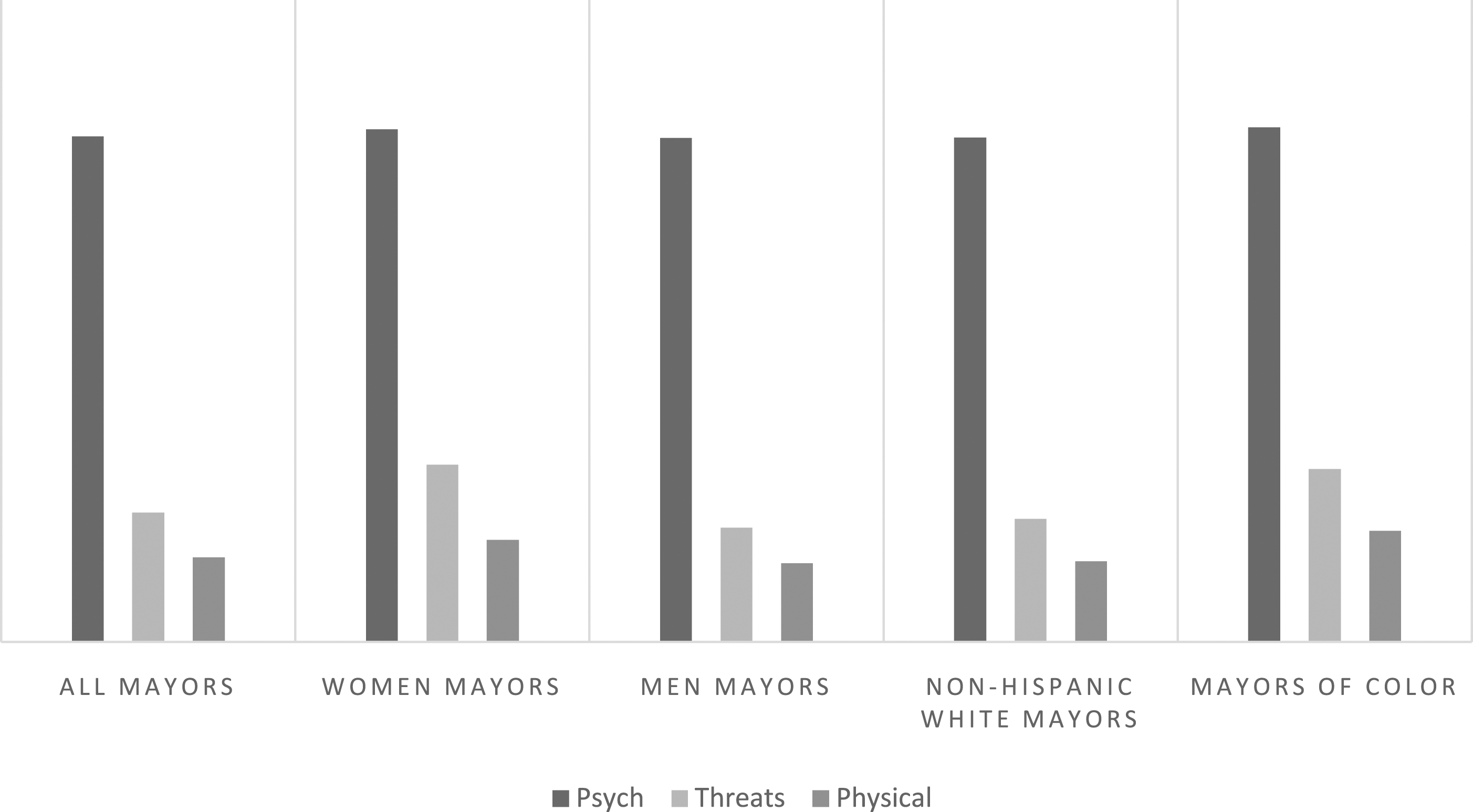
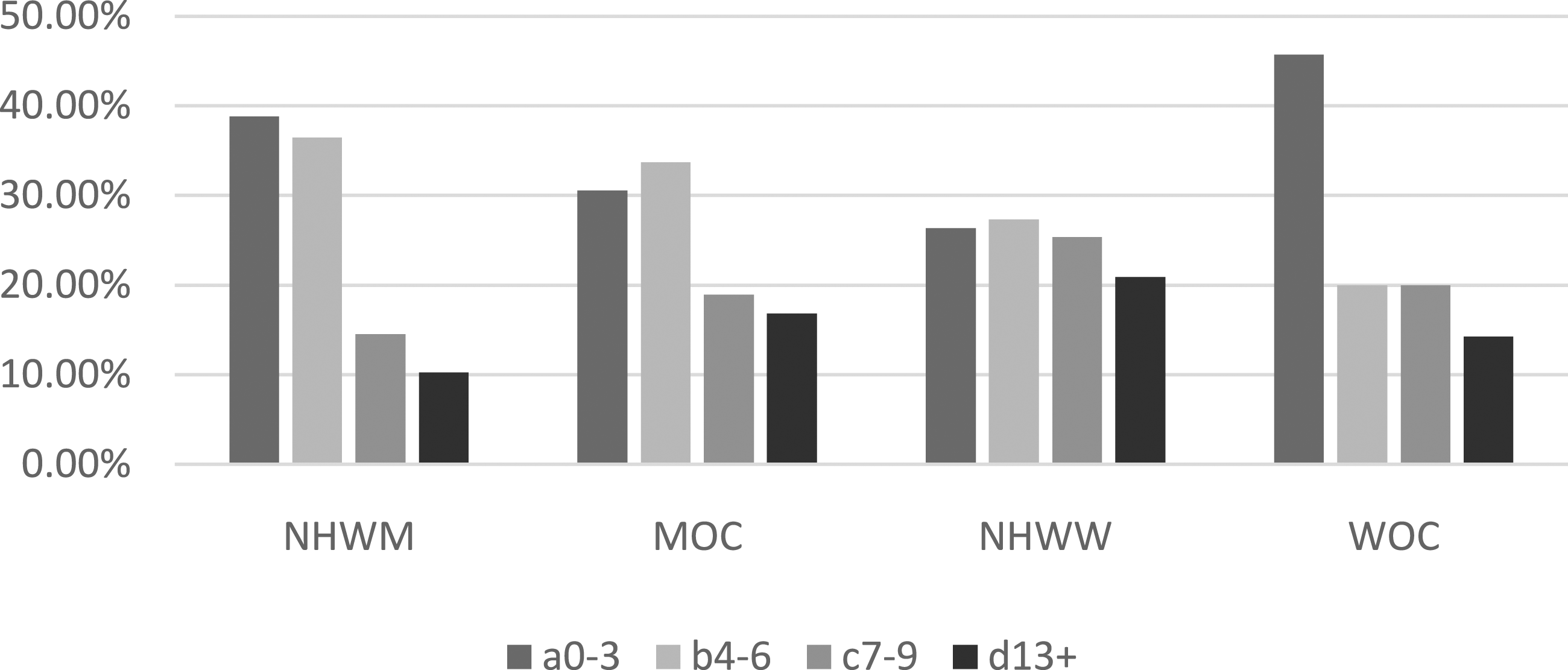
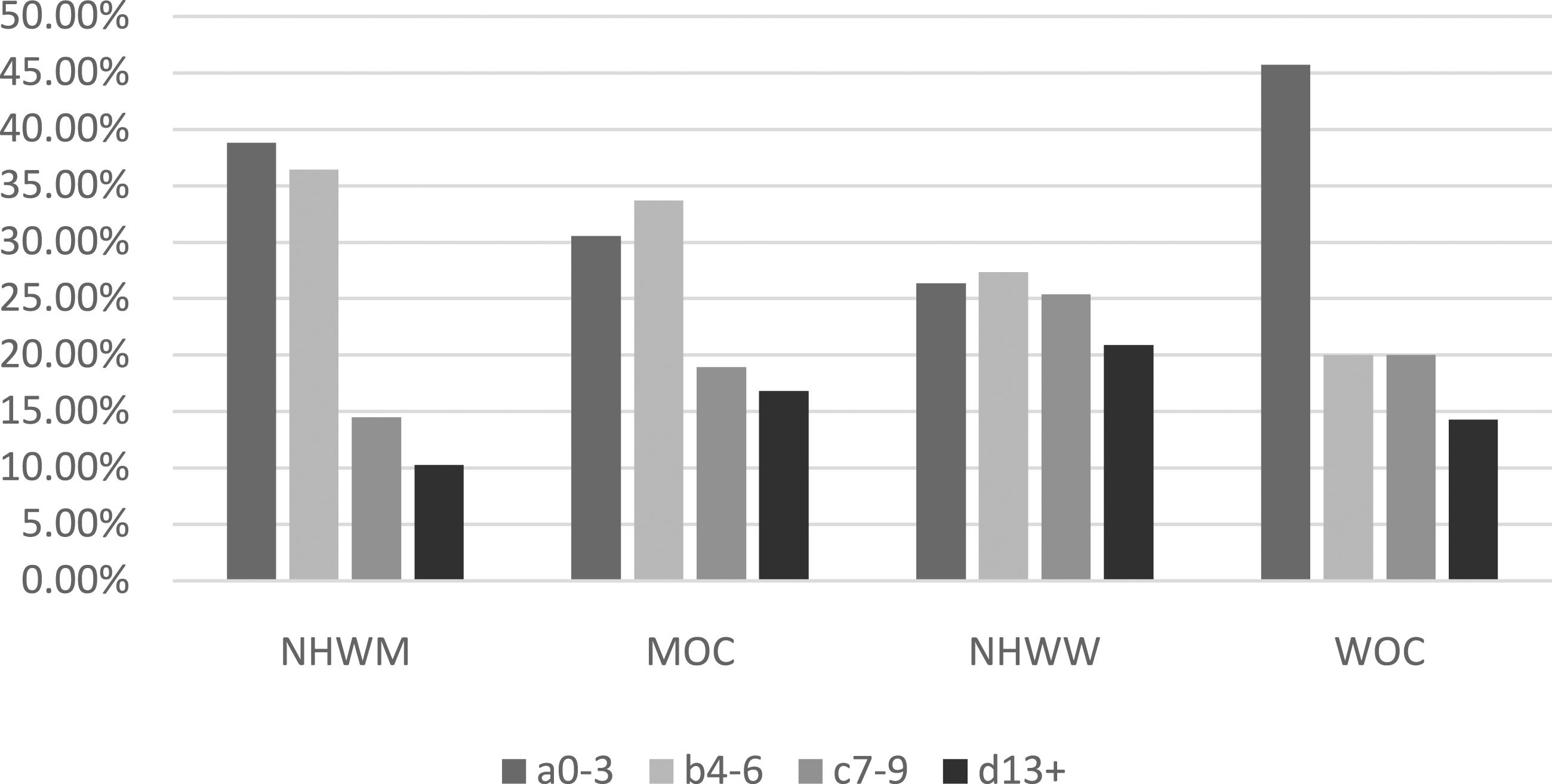
To provide a foundation for intersectional analysis we present the means for non-Hispanic white women mayors, non-Hispanic white men mayors, women of color mayors, and men of color mayors by type of reported violence as follows: • Psychological violence: the average non-Hispanic white woman mayor had a mean of 6.4; the average man of color mayor scored 5.9; the average woman of color scored 5.4; and the average non-Hispanic white man mayor scored 4.8. • Threats: Women of color mayors were distinctive in their higher rates of threats. The mean for women of color was .89. It was .53 for non-Hispanic white women, .44 for men of color, and .26 for non-Hispanic white men.
15
• Physical violence: Men of color mayors experienced the highest rates of all groups. The mean for men of color was .32, compared to .25 for women of color, .24 for non-Hispanic white women, and .19 for non-Hispanic white men mayors.
As means can obscure differences in patterns of violent experiences, we also display histograms that show rates of physical violence, threats, and psychological violence for the four groups of mayors (See Figures 2–4). These data suggest that, although women of color mayors have higher means on the violence variables than other mayors, and that they faced higher rates of violence, a significant number did not report any violence. This pattern is distinctive for women of color. Not only do non-Hispanic white women mayors have higher means, they are also less likely to have reported no violent experiences. Men of color tended to face the highest rates of physical violence and fairly high rates of psychological violence, and threats. Non-Hispanic white men mayors reported low levels of physical violence, psychological violence, and threats. Psychological Violence Percentage by Race/Gender Category. Threats of Violence Percentage by Race/Gender Category. Physical Violence Percentage by Race/Gender Category.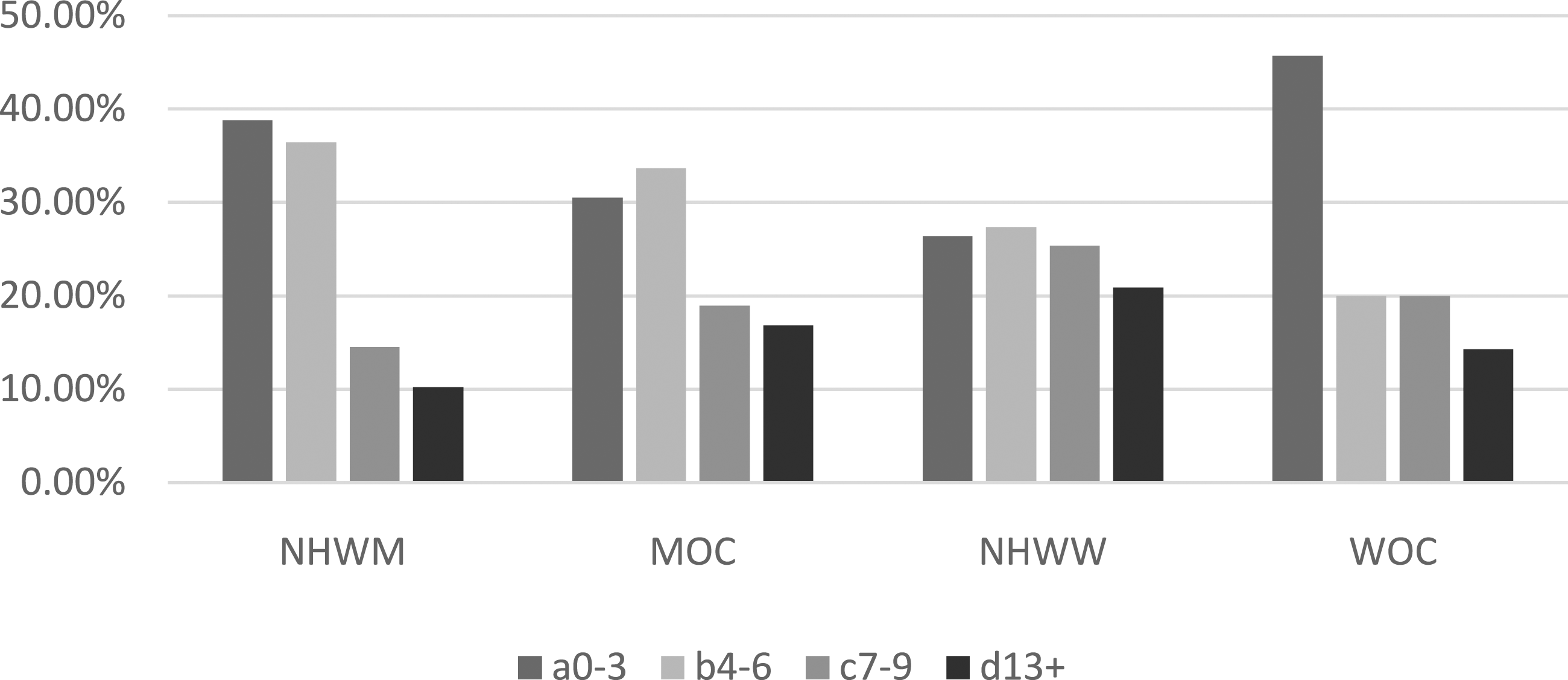
We turn next to multivariate analyses to isolate the effects of race and gender while controlling for possible mediating factors.
Multivariate Results
Levels of Violence
For psychological violence, non-Hispanic white women reported the highest levels of any group of mayors. That is, they faced statistically significantly more psychological violence than women of color, men of color, or non-Hispanic white men. In contrast, there were no statistically significant differences between men and women of color and non-Hispanic white men. With respect to threats, women of color, men of color, and non-Hispanic white women experienced statistically significantly more threats than non-Hispanic white men. But they did not differ significantly from each other. Finally, our model shows similar rates of physical violence across all four groups of mayors. Although non-Hispanic white women and men of color reported higher rates of physical violence than others, the differences were not significant. Thus far, the results of analysis for levels of violence conform only partially to our expectations. Non-Hispanic white men’s experience low levels of violence, but women of color do not experience the highest rates.
To identify possible explanations for the results pertaining to women and men of color in comparison to non-Hispanic white women and men mayors, we considered the effects of mayors of color who represent majority-minority cities. 16 The findings suggest that the average woman of color served a city that is 39.4% white compared to 40.7% for men of color, 68.1% for non-Hispanic white women, and 72.4% for non-Hispanic white men. We do not have enough cases to perform a thorough analysis of the relationship between percentage of white residents and rates of violence for women and men mayors of color. However, the correlations between percentage of cities that are white, and the levels of violence were not statistically significant for either women of color or men of color, except that, the larger the white population, the more threats men of color received (r = .18, p = .09). In contrast, for non-Hispanic white women and men mayors, the larger the percentage of white residents, the less physical violence they experienced (for women, the r = .16; p = .02; for men, the r = −.07, p = .07). More research is clearly needed to fully understand the effects of city racial composition on intersectional variation in violence against mayors.
Finally, with respect to levels of violence, our model offers some insight into other factors that may explain differential experiences. As has been the case in other U.S. and comparative research on violence against women officeholders and candidates, age and party of mayors was associated with levels of violence. All else equal, younger mayors and Democrats reported more violence than older mayors and Republican mayors (Herrick et al., 2019; Thomas et al., 2019). It is not surprising that younger mayors are targeted more than their senior colleagues as they tend to be less experienced and more vulnerable. The party distinction may be related to gender and race differences in the parties. Whereas the Democratic party is perceived as feminine, the Republican party is seen as masculine (Winter, 2010). In addition, Carmines and Stimson (2020) and Mangum (2013) argue that race is one of the dominate factors distinguishing the two parties. 17
City variables also affected levels of violence. Consistent with previous research on U.S. officeholders, mayors in strong mayoral systems reported more violence than their counterparts (Thomas et al., 2019). The implication is that the more powerful a mayor, the more constituents hold them accountable for positions, policy, and outcomes. Additionally, population size, partisan divisions, how well politicians get along, and community wealth were statistically significantly related to levels of violence against mayors. Mayors of cities that are larger, more evenly divided, where the politicians do not get along well, and where there are lesser levels of wealth reported higher rates of violence than their counterparts. Mayors in cities with BLM protests faced more threats than others, and those with COVID-19 protests reported more physical violence.
Content of Violence
Women of color mayors reported the highest levels of violence critical of their race followed by men of color mayors. Both groups reported significantly higher rates than non-Hispanic white men and non-Hispanic white women, but they did not differ significantly from each other. Nor did non-Hispanic white women and men mayors differ significantly from each other.
With respect to sexualized violence and encounters that were critical of the gender of mayors, we find statistically significant differences. Women of color and non-Hispanic white women mayors both reported higher levels of sexualized violence and gendered violence than non-Hispanic white men and men of color. There were not, however, significant differences among women or among men.
To summarize: on measures of specifically raced content of violence, mayors of color were similar to each other, and non-Hispanic white mayors were similar to each other -- regardless of gender. On measures of specifically gendered violence, women mayors were similar to each other, and men mayors were similar to each other -- regardless of race. These results on the content of violence conform only partially to expectations. Although women of color and non-Hispanic white women faced higher levels of gendered and sexualized violence than men, and women of color mayors reported the highest levels of raced violence of any group, there were fewer within gender experiences than expected.
To further explore differences pertaining to gendered violence, we examined indirect measures, such as critiques of appearance, and levels of emotional reactions. Non-Hispanic white women mayors in our sample were distinctive in facing attacks on their appearance. They differed significantly from non-Hispanic white men, women of color, and men of color mayors. Conversely, there were no statistically significant differences between women of color, men of color, or non-Hispanic white men mayors. Non-Hispanic white women were also distinctive in levels of attacks for being too emotional. They differed significantly from non-Hispanic white men, men of color, and women of color mayors in the frequency of such attacks. In contrast, there were no significant differences between women of color, men of color, and non-Hispanic white men mayors. In sum, it appears that, on these variables, gender norms about appearance and emotionality are attached more to non-Hispanic white women than women of color. Perhaps that is not surprising as norms of femininity operate differently between races (Deliovsky, 2008). And, although our data are not able to address this question directly, it may be that this accounts, at least partially, for the fact that women of color did not report more sexualized violence and gendered violence than non-Hispanic white women.
In comparison to experiences with gendered violence, the data pertaining to experiences of being called racist indicate that there were no statistically significant differences among the four groups of mayors. The only difference among the groups in being called sexist was that non-Hispanic white women were less likely than others to be called sexist.
Robustness Test
Intersectional Differences in Levels of Violence.
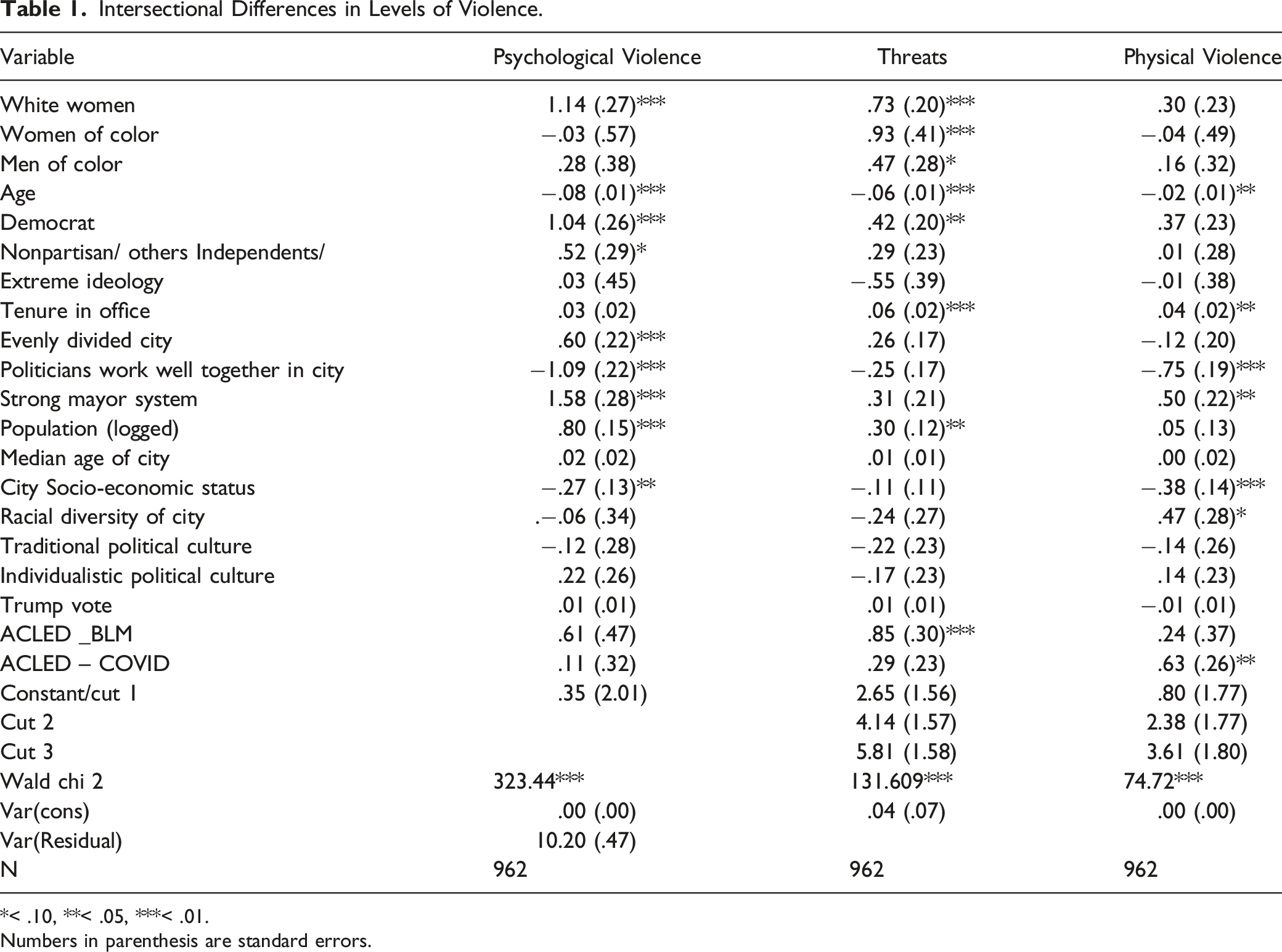
*< .10, **< .05, ***< .01.
Numbers in parenthesis are standard errors.
Intersectional Differences in Content of Violence.
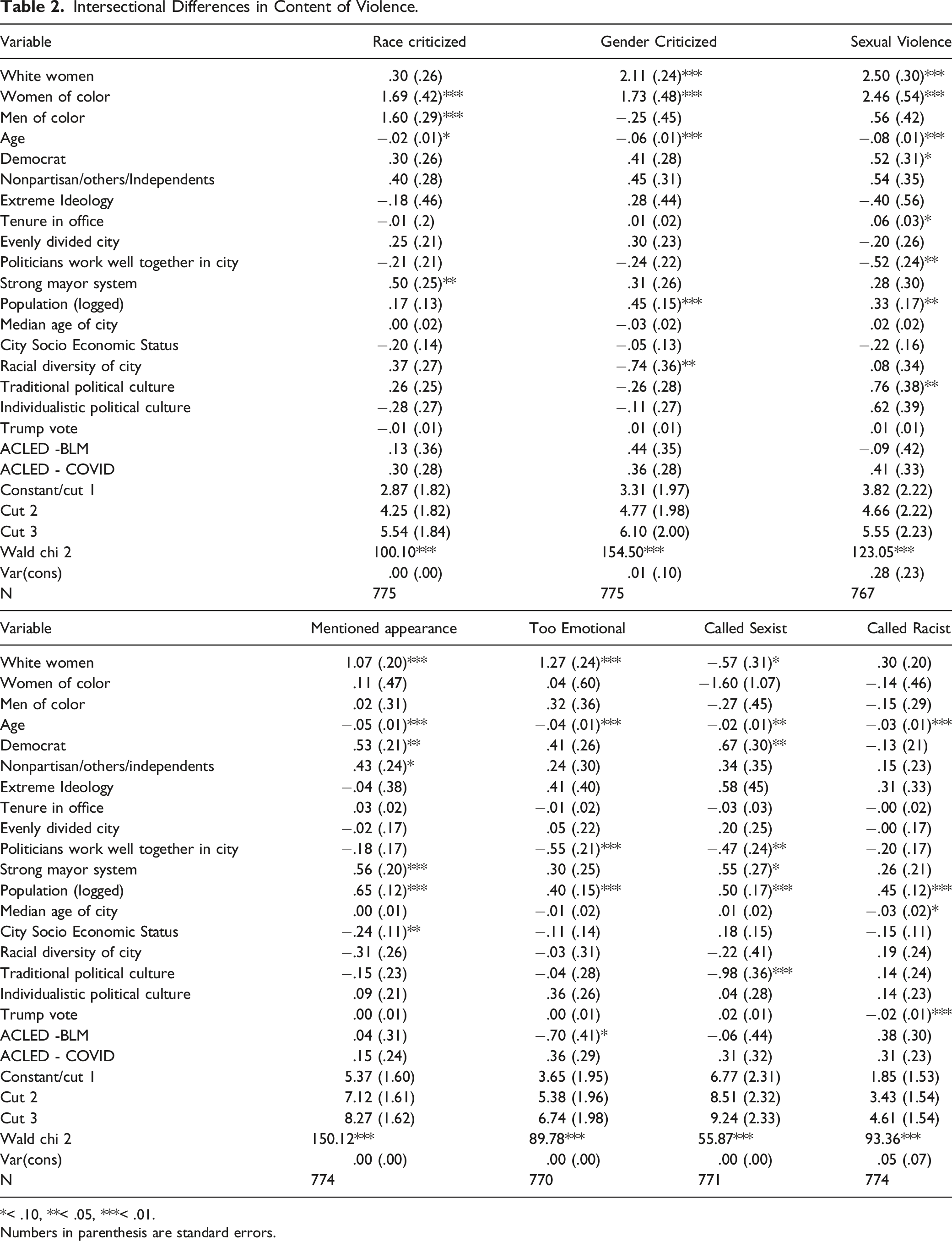
*< .10, **< .05, ***< .01.
Numbers in parenthesis are standard errors.
Our second set of robustness tests used the Heckman method. The first model included the same variables as those reported in Tables 1 and 2, and the second model included city population logged, region (Midwest, west, and south), and gender. These results mirrored those of Tables 1 and 2 in terms of intersectional differences (see Online Appendix A). Non-Hispanic white women mayors were distinctive in their levels of psychological violence, non-Hispanic white men were distinctive in their low levels of threats, and there were no gender differences in levels of physical violence. Non-Hispanic white women also faced less race-related violence than did men or women of color. These results also mirrored previous results in that non-Hispanic white women were distinctive in their levels of violence related to appearance and emotionality. However, two differences between the original models and these newer models emerged. First, non-Hispanic white women mayors reported more violence related to race than did non-Hispanic white men. Second, non-Hispanic white women mayors were not significantly less likely to be called a sexist than non-Hispanic white men but were more likely to be call a racist.
In sum, although there were a few differences between the original analysis and the results of the robustness tests, our main findings remain. Women mayors experienced more threats, sexual violence, and gendered violence than men. Non-Hispanic white women mayors faced heightened levels of psychological violence and indirect gendered violence, while women of color were distinctive in facing higher levels of both raced and gendered violence. In contrast, non-Hispanic white men experienced the lowest levels of violence.
Discussion: Intersectional Patterns
In this paper, our focus has been an intersectional exploration of episodes of psychological violence, threats, and physical violence experienced by U.S. mayors in 2021 in cities of 10,000 in population and above. We also concentrate on violence that is gendered and raced. Overall, we find evidence that overlapping identities result in distinctive experiences for each group of mayors. Women of color were the only group of mayors to have experienced heightened levels of both gendered and raced violence. Women of color and non-Hispanic white women mayors both faced higher rates of gendered and sexualized violence than men. Non-Hispanic white women were distinctive in that they reported higher levels than their counterparts of psychological violence, and violence based on levels of emotionality and appearance. Non-Hispanic white women were also distinctive in experiencing lower rates of being called sexist. Finally, there were no significant differences between the four groups in being called racist.
Overall, this study demonstrates that there are statistically significant and meaningful differences among gender/race groups. Non-Hispanic white women, women of color, non-Hispanic white men and men of color mayors do not have the same experiences of violence as each other. However, that our results conformed to theoretically derived expectations on some types of violence but not others, and did not reveal consistent patterns, suggests that there are deeper, more complex, and more nuanced explanations for these phenomena. A first step toward improving our understanding of how officeholders experience violence in their public roles, we may be wise to rethink the foundations of current theoretical constructs about women’s place in the public sphere.
In all, the research presented here is foundational rather than definitive. We hope that this study opens the door to additional, methodologically diverse research studies with larger samples of officeholders of color. That way, the experiences of all those who represent us may be more fully illuminated.
Limitations of Our Research
In addition to offering the results of this study of U.S. mayors, it is important to note limitations. A first set of limitations pertains to response rates and patterns. Although the response rate to our survey was quite a bit higher than other recent surveys of U.S. officeholders, that does not guarantee representativeness, especially for within group variations among mayors. Second, it is possible that self-selection bias could have skewed the results. More mayors or groups of mayors who experienced violence than did not may have responded—or the reverse. These are common issues with survey research that future researchers might mitigate by exploring the same questions with complementary methodologies. Another set of limitations pertains to the scope of violence toward officeholders and their gendered/raced nature. We did not examine violence against officeholders from colleagues—other officeholders -- staff, the media, or lobbyists—which would address theories of gendered or raced-based institutional challenges. We did not explore issues of economic violence or semiotic/symbolic violence. Finally, because we surveyed officeholders, we know little about the perpetrators of violence. In all, this research is a key step toward increasing empirical evidence of intersectional experiences of psychological and physical violence among mayors.
Conclusion
The research study makes clear that intersectional research on psychological violence, threats, and physical violence among mayors with a focus on gender and raced-based measures is important. Overlapping identities, especially officeholders from marginalized groups, affect how mayors experience their professional world. The implications of these findings are serious. When officeholders of color are attacked because of their race, and women face gendered and sexualized violence, they may be discouraged from running for or staying in office (see Thakur & Hankerson, 2022). Even if they decide to enter politics or stay in politics, the personal costs of their service are higher than for other groups of mayors. Additionally, when mayors are attacked for being female or of a minority race/ethnicity, or both, voters’ perceptions of their value as officeholders may decline. This may make it more difficult for women of color and non-Hispanic white women to win elective office. Further, it is only when democracies whose representatives “Look like America” can they be seen as fully legitimate. And only when democracies are diverse can they provide a full array of symbolic, process, and policy benefits (see Dovi, 2002; Mansbridge, 1999; Phillips, 1995; Pitkin, 1967; Young, 2000).
Supplemental Material
Supplemental Material - An Intersectional Exploration of Psychological Violence, Threats, and Physical Violence of Mayors in 2021
Supplemental Material for An Intersectional Exploration of Psychological Violence, Threats, and Physical Violence of Mayors in 2021 by Rebekah Herrick, and Sue Thomas in American Politics Research
Footnotes
Declaration of Conflicting Interests
The author(s) declared no potential conflicts of interest with respect to the research, authorship, and/or publication of this article.
Funding
The author(s) disclosed receipt of the following financial support for the research, authorship, and/or publication of this article: This work was supported by the Center for the American Women and Politics.

Supplemental Material
Supplemental material for this article is available online.
Notes
References
Supplementary Material
Please find the following supplemental material available below.
For Open Access articles published under a Creative Commons License, all supplemental material carries the same license as the article it is associated with.
For non-Open Access articles published, all supplemental material carries a non-exclusive license, and permission requests for re-use of supplemental material or any part of supplemental material shall be sent directly to the copyright owner as specified in the copyright notice associated with the article.
