







Abstract
On August 2nd, 2022, Kansas held a vote to lift state constitutional protections for abortion access. The vote gained national attention, as it was the first statewide plebiscite on the subject since the U.S. Supreme Court had issued its ruling on Dobbs v. Jackson Women’s Health Organization, which had overturned the remaining U.S. Constitutional blocks on restricting abortion that had been in place since Roe v. Wade. The turnout for the election was unprecedented for a primary in the state, and to the surprise of many, the amendment failed by a large margin in deep red Kansas. In this paper, we use both precinct-level election results and individual-level voter registration and history data to explore who was mobilized to vote in the August 2022 primary and their behavior in the November 2022 general election. We find that the primary mobilized an electorate that had more women and young people, fewer Republicans, and more first-time voters than a normal primary, but that these demographics were also more likely to then abstain in the general election. Thus, the engagement of young people, especially young women, on the abortion issue remains, but preliminary findings suggest the future of this groups’ electoral participation separate from abortion activism is unclear.
Introduction
On June 24, 2022, the U.S. Supreme Court released its ruling on the case Dobbs v. Jackson Women’s Health Organization. Though some of the immediate impact was muted thanks to a leak of a draft a couple months earlier, the effect was still large. The federal court had removed protections on women’s right to choose an abortion, first articulated in 1973’s Roe v. Wade, out of its reading of the U.S. Constitution, moving the responsibility either to the other two branches of the federal government or to the states. By coincidence, Kansas was at that moment less than six weeks from a vote on a constitutional amendment on abortion rights as part of the August primary election; if the “Value Them Both” amendment was passed by voters, the state’s government would be able to enact bans that had previously been restricted by the federal case law that Dobbs had just overturned. Kansas had suddenly become the first test of public opinion on abortion in the post-Roe world. The Kansas abortion vote was also unique because, as it took place during a primary, it did not appear beside explicitly partisan races. The results were stark: the amendment failed in a high-turnout election, with 59% of the state’s voters choosing to uphold the state’s protections for abortion care. The strength of the rejection was a surprise, given the usual conservativeness of Kansas — Donald Trump had won the state in 2020 by nearly a 15-point margin, and both chambers of the state legislature had veto-proof Republican supermajorities.
In this article, we provide some context and analysis of why this unexpected outcome occurred, focusing on voter turnout among the Kansas electorate. While our focus on Kansas alone represents a relatively small case in the national political scene, it can help scholars understand the dynamics at play with the abortion issue in American politics. The selection of Kansas as a case study proves particularly enlightening due to the pronounced Republican dominance within the state. Examining voter participation and electoral outcomes in this distinctly conservative jurisdiction affords us a valuable lens through which to illuminate issue voting on abortion that should be even more pronounced in more balanced or bluer states across the country.
We open with a detailed picture of Kansas in the lead up to the primary vote followed by a discussion of the rich academic literature on issue voting and abortion in particular. We then conduct analyses of precinct-level election results and individual-level voter registration list data using OLS, logistic, and spatial regression models. The dataset was collected from publicly available precinct-level election results and purchased individual-level voter registration data from the State of Kansas. We find that the primary ballot activated an electorate that had more women and young people, fewer Republicans, and more first-time voters than normal. We also analyze whether primary voters stayed activated, finding that the demographics that surged for the abortion amendment vote also had a larger ebb in November than others. The net effect was a smaller, slightly older, more male, and more Republican general electorate in 2022 than in 2018. While this article presents a case study on Kansas, we believe the lessons learned in the Sunflower State can be informative for voter behavior in other states where battles on abortion rights are likely to be waged in the future.
Kansas’ “Value Them Both” Amendment
After the U.S. Supreme Court overturned constitutional protections for abortion access in the 2022 case Dobbs v. Jackson Women’s Health Organization, states across the country immediately began to implement legislation in response. Some states protected access within their borders, while others restricted or banned access. Many of these proposals eventually went to the electorate for a vote, but in the immediate aftermath of Dobbs, all eyes turned to Kansas, where the state was six weeks out from a ballot referendum on abortion and would be the first test of public opinion on the issue. However, the origins of Kansas’ constitutional amendment — the so-called “Value Them Both” amendment — predate the Dobbs decision. In the 2019 case Hodes and Nauser v. State of Kansas, the Kansas Supreme Court ruled that abortion is protected by the state constitution, separate from the federal constitutional protections expressed in court decisions like Roe v. Wade. Less than a year later, the state legislature introduced a proposed amendment that would change the state constitution to negate the Hodes decision. It passed the legislature in January 2021 and was placed on the August 2022 primary ballot for final voter approval — or denial, as the case may be. The proposed amendment stated, § 22. Regulation of abortion. Because Kansans value both women and children, the constitution of the state of Kansas does not require government funding of abortion and does not create or secure a right to abortion. To the extent permitted by the constitution of the United States, the people, through their elected state representatives and state senators, may pass laws regarding abortion, including, but not limited to, laws that account for circumstances of pregnancy resulting from rape or incest, or circumstances of necessity to save the life of the mother.
A yes vote on the amendment would change the state constitution, and thus negate the state supreme court’s ruling in Hodes, allowing the state legislature to pass laws pertaining to abortion. A no vote would maintain the status quo set by the court’s ruling, protecting abortion access in the state’s constitution but still allowing for some restrictions 1 . Many Kansas voters noted that the ballot language was exceptionally, and purposefully, confusing (Chang, 2022).
Additionally, opponents of the amendment argued its placement on the primary ballot was an effort by the state legislature to benefit from depressed turnout relative to a general election. However, after the national uproar following the Dobbs decision, turnout was expected to be high. Throughout the summer leading up to the primary, the rate of new voter registrations in Kansas boomed, and 65% of the new registrants were women (Paris & Cohn, 2022). This spike was not isolated to Democrats, who tend to support protections for abortion access; in the weeks following Dobbs, women made up 74% of new voter registration among Democrats and 60% among Republicans (Paris & Cohn, 2022). This bipartisan spike in voter registration presented the first piece of evidence that the Dobbs decision was motivating voters in Kansas.
This uptick in registrants was followed by an increase in primary voters. Nearly double the number of voters cast a ballot in 2022 compared to the previous midterm primary in 2018. Turnout for the primary also yielded a different electorate than in 2018, being younger and having more women than four years earlier. In total, 942,851 ballots were cast on the amendment — 41% in favor and 59% opposed. The overwhelming opposition surprised many, political scientists and pollsters alike.
There was hope among supporters of abortion rights that the unexpectedly strong success in rejecting the amendment would carry over to general election success for pro-choice and Democratic candidates. Both the gubernatorial and the attorney general races were expected to be competitive, and both would undoubtedly have an impact on future fights on the subject. Abortion rights supporters had reason to be optimistic: voting is habit-forming (Coppock & Green, 2016). A good predictor of a person’s likelihood to vote is whether they have voted previously.
Though there was no direct vote on abortion in the state on the November ballot, pro-choice Democratic governor Laura Kelly was running for re-election and six of seven supreme court justices were up for retention in 2022. In theory, the supreme court majority and their interpretation of the state constitution that the Value Them Both amendment opposed could have been wiped out, leading to the winner of the gubernatorial election having the final pick of their replacements. Though it is rare for a justice in the United States to lose a retention election, the scattering of cases where it has occurred involved a well-funded opposition campaign organized around a contentious issue, like gay marriage pre-Obergefell or opposition to the death penalty (May, 2013). In 2016, four members of the Kansas Supreme Court were targeted by such campaigns, with a focus on their opposition to the death penalty and support for abortion rights (Zeff, 2016), and conservative groups were nearly successful: the “yes” votes for retention ranged between only 55.3% and 56.2%. In 2014, similar campaigns were even closer, with two Democratic-appointed justices earning 52.6% and 52.7% of the vote. However, there was no formal campaign in the 2022 general election to reject the five justices who showed support for abortion rights — though the anti-abortion group Kansans for Life did advocate “no” votes to its members in their general election guide (Bernard & Moore, 2022). Given the results of the abortion amendment, lowering the saliency of the abortion issue may have been a strategic choice by pro-life advocates, as there were competitive statewide races also on the ballot, and re-activating abortion attitudes could have had spillover effects to the partisan candidate races (Nicholson, 2021). Ultimately, the targeted justices received between 64.7% and 66.8% of the vote to be retained. In contrast, the lone justice who received an endorsement from Kansans for Life, Justice Caleb Stegall, had 72.9% approval in the vote.
Descriptive data from 2022 general election exit polls conducted by NORC for Fox News (2022) and the Associated Press give us further insight into issue voting in Kansas. Exit polls showed that 24% of Kansas voters said the Supreme Court’s overturning of Roe v. Wade was the single most important factor to their vote in the 2022 general election. Another 45% indicated it was an important factor, but not the most important factor. These polls suggest that 69% of the Kansas general electorate was thinking about abortion when they cast their ballot, which bode well for pro-choice Democrats. On the other hand, primary voters are normally almost guaranteed to turn out again for the November general, but the turnout data for Kansas in 2022 shows that a relatively large share of primary voters, who were likely mobilized to vote because of the constitutional amendment, did not show up to vote in the general election in November. This trend suggests abortion issue voting is prevalent among Kansas voters, and was particularly strong among the states’s young voters.
Issue Voting
Literature on voting suggests that there are various social, political, and psychological factors that help voters translate policy preferences into votes. This most often occurs during periods of social and economic turmoil and when the parties offer distinct policy options (Nie et al., 1979). Voters who use issues as the basis for their election decision-making are called issue voters, and according to Carmines and Stimson (1980), issue voters are more sophisticated than other voters — they are more educated, informed, and active in politics than both party loyalty and candidate image voters. However, as Key (1966) points out, we should not view all issue-based voting as evidence of voter sophistication; voters are not fools, but they are also not all equally sophisticated. “Hard” and “easy” issues matter for participation.
“Easy” issue voting occurs when a particular issue becomes so prominent over a long period of time that it triggers voters’ “gut responses” to candidates and political parties (Carmines & Stimson, 1980). This often occurs when parties stake out opposing positions on deeply felt issues. Easy issues tend to be ones that spend a great deal of time on the public agenda and are often long-unresolved political conflicts — like abortion. Easy issues do not require voters to be well-informed or sophisticated (Carmines & Stimson, 1980).
However, as seen in Kansas during the 2022 primary election, when voted on directly, support for abortion access can and does cut across partisanship, contrary to much of the academic literature on abortion issue voting. Historically, there has been a link between policy preferences and citizens’ ideological predispositions (Arnold, 1990). In general, liberals are more supportive of abortion rights while conservatives are more likely to champion policies that restrict access to abortion. The Democratic and Republican Parties include the abortion issue in their party platforms, and have since a pro-life agenda was first added to the Republican Party platform in 1976. These partisan-motivated abortion attitudes have long been a driver of issue preference and turnout (Zigerell & Barker, 2011) and have been used by politicians as a source of polarization (Adams, 1997). In this context, parties served to aggregate voter interests on abortion (Jelen & Wilcox, 2003). This seemingly intensified from the 1980s to the 2010s, as Republicans increasingly championed policy opposition to abortion rights (Liebertz & Bunch, 2021), even as aggregate public opinion on the abortion issue stayed quite stable during this period (e.g. Jelen, 2014; Jelen & Wilcox, 2003; Wilcox & Carr, 2010). Though aggregate public opinion on abortion has shifted in recent years — both Republicans and Democrats are becoming more accepting of legal abortion — the change is occurring more rapidly among Democrats (see Jelen, 2017).
In Kansas, a majority of 2022 primary voters were registered Republicans, meaning a significant number of them voted against the amendment, thus breaking from their party and supporting the state’s status quo on protecting abortion rights. In fact, not a single county favored the constitutional amendment as much as it had supported the re-election of Republican President Donald Trump two years earlier. This context suggests that for a subset of Kansas’ Republican voters, abortion may no longer be an “easy” issue. The alternative, “hard” issue voting, is rooted in Downs (1957) and assumes issue voting is the result of sophisticated decision-making — a reasoned and thoughtful calculation — by voters who use policy preferences, rather than party loyalty or candidate affect, to guide their electoral choices.
Policy-Based Abortion Voters
According to Carmines and Stimson (1980), hard issue voters possess the participation levels that political science literature often mistakenly attributes to all issue voters. For example, there is strong evidence of policy-based voting on abortion in presidential, legislative, gubernatorial, and local elections (e.g. Abramowitz, 1995; Cook et al., 1994a, 1994b; Howell & Sims, 1993; Jelen & Wilcox, 2003; Miller & Krosnick, 2004). However, candidates will attract voters for a wide variety of reasons, many of which have nothing to do with their issue positions (see Carmines & Stimson, 1980). For example, Kreitzer (2015) finds that constituent values and partisan factors can both explain anti-abortion rights policies.
The morality politics paradigm has traditionally been used to explain strong engagement on the abortion issue; abortion regulation is highly salient to citizens, resulting in high levels of political engagement (Meier & McFarlane, 1993; Mooney & Lee, 1995) and responding strongly to changes in aggregate public opinion (e.g. Goggin & Wlezien, 1993; Norrander & Wilcox, 1999; Wetstein & Albritton, 1995). More than most issues, abortion mobilizes people to participate politically (Maxwell, 2002).
Demographics of Abortion Voting
The political science literature suggests that the abortion issue is even more salient among certain groups of citizens; we therefore will explore hypotheses specific to the demographics of policy-based abortion voters. Abortion is a particularly salient issue among women (Scott & Schuman, 1988). While some research suggests there is no gender gap surrounding abortion attitudes (e.g. Lizotte, 2015; Sapiro, 2003; Strickler & Dangelis, 2002), other studies find an inverse relationship, where men hold more liberal views than women on abortion (e.g. Barnes & Cassese, 2017; Huddy et al., 2008; Jelen, 2014; Jelen & Wilcox, 2003; Silber Mohamed, 2018). However, Barkan (2014) and Lizotte (2015) argue that the lack of a gender gap is the result of omitted variable bias; when religiosity is included as a control, women do favor abortion rights more than men. More still, there are studies that find women are reliably more likely to support abortion rights (e.g. Bolks et al., 2000; Gibson & Hare, 2012; Loll & Hall, 2019; Patel & Johns, 2009).
While there are inconsistent results in previous studies about gender and abortion attitudes, the data about young women is clear. Gen Z women — those born between 1997 and 2013, per the US Census Bureau — are more supportive of abortion access, and their decision to engage in politics is often driven by these pro-choice attitudes (Deckman, 2021).
Data collected by the Public Religion Research Institute (PRRI) show that younger citizens are more likely to be pro-choice, and Gen Z women in particular have become more liberal in their attitudes about abortion as they have entered young adulthood (Deckman, 2021). Furthermore, regardless of gender identity, Gen Z are twice as likely to say their attitudes have become more supportive of abortion rights, though Gen Z women are still significantly more pro-choice than their male counterparts. According to the PRRI survey, just 15% of Gen Z say that abortion should never be permitted by law, while 43% say that abortion services should always be accessible as a matter of personal choice. There is a stark gender gap in these results, however. Nearly half of Gen Z women believe that abortion should always be legal compared to just 36% of Gen Z men. These attitudes result in the most pro-choice Gen Z women being significantly more engaged in politics than other members of their generation cohort (Deckman, 2021).
This trend is not necessarily surprising, as there has long been a gender gap in voter turnout; since 1980, women have consistently voted in larger numbers than men (e.g. Christy, 1987; Conway et al., 1997; Kittilson, 2016; Norris, 2001). Young women in particular are mobilized to participate in politics because of their staunch support of abortion rights (Deckman, 2021). Simultaneously, abortion attitudes have little impact on Gen Z men’s political engagement. Because Gen Z women have, until recently, grown up with access to legal abortion as a constitutional right, are the largest proportion of individuals to seek abortion services, and are politically mobilized by the issue, we hypothesize that the reversal of Roe v. Wade was highly salient to this generation during the state’s constitutional amendment vote in August 2022. However, we suspect this mobilization did not continue into the November election because abortion was no longer directly on the ballot.
In our analysis to follow, we will first attempt to verify the trends identified by others using data on Kansas’ voter registration, voting history, and 2022 precinct-level election results. We argue that the Dobbs decision led to an immediate shift in the scope and demographics of new registrants and that the demographic makeup of the August electorate should be younger and include more women than recent previous Kansas elections. These trends are expected given the literature on abortion opinion by gender and age. We will also analyze voter turnout to determine if turnout was higher than normal in younger, better educated, and importantly, anti-amendment parts of the state. Should this be the case, it would point to abortion being a hard issue that was highly salient because of the recent Dobbs decision. This suggests that vote choice was not necessarily tied to parties or candidates, and sophisticated voters’ policy preference on abortion mobilized turnout separate from party loyalty and candidate effects (see Downs, 1957), especially for young people and women.
The final sections will examine two previously unresolved questions. First, did the voters who were newly activated because of the August amendment return for the general election? The context is an ideal test of the presence of issue voters, since the August primary was heavily focused on the issue of abortion and lacked contests with explicit partisan cues, while in November, the opposite was true. For this reason, we expect to find the highest likelihood of abstaining in November after voting in August to be among the similar demographics identified previously: young, women, and unaffiliated voters. Our second question is whether the abortion amendment affected the outcome of the general election races. Here, we have a less definitive hypothesis, but expect that the scale of voters involved exceeded the margin of victory in two statewide races.
Data
Individual data on voting behavior appears on the voter registration list, which we purchased from the Kansas Secretary of State. The fields provided to the public include each voter’s full name, statewide voter ID number, home address, county, birth date, gender, party registration, precinct/ward, polling place, date of voter registration, districts to which the voter is assigned, and the previous ten elections that the voter has participated in. Outside of a three-week “closed book” period in the lead up to an election, the voter registration file is in a process of constant change as new voters register, current voters move, and others leave the list due to moving out of state or dying. The Secretary of State only retains the current voter registration file and does not make available past snapshots, so our analysis is limited by the snapshots to which we had access. Ideally, snapshots close in time to each election would minimize the “decay” of quality due to voter file change, and we believe we have collected optimal data for the 2022 elections 2 and the 2020 general election. However, we were forced to use a September 2019 file for our work on the 2018 elections. This is less ideal, but these elections are primarily used for comparison and are not the main focus of the paper 3 . We also obtained data from the Secretary of State detailing voters’ method of voting for the elections in question. 4
Election result data at the precinct level is also made available from the Secretary of State’s office via their website. However, the office does not collect and release precinct geography to map those results. The Voting and Election Science Team (2020) published results and geography for the 2020 general election, and this was used as a starting point for mapping the results for the primary and general 2022 elections. Changes in precinct boundaries were identified by the authors by geocoding the voter registration file and identifying mismatched precinct identifiers. Updates were then made using maps requested from county clerks or GIS departments.
We also use Census data in our analysis. When an analysis mixes Census Bureau and election data, reaggregation of one from its native geographic level to the other’s level is usually necessary. In this paper, analyses of aggregate data are done at the census tract level rather than the electoral precinct level. The former geography is more consistent in scale, with populations normally ranging from just under 1000 to just over 10,000. 5 In contrast, 279 populated precincts in 2022 had twenty or fewer registered voters, which has the potential to amplify outliers. Election results were disaggregated down to the census block level using the method suggested by Amos et al. (2017), then summed to the tract level.
Our primary use of Census data is for questions of turnout. The voter registration list is not the universe of eligible voters, and high turnout with registration as a denominator could be hiding low true turnout when using the eligible population as a denominator (see Nyhan et al., 2017). Thus, we use an aggregate model at the Census tract level to explore turnout further, with citizen voting age population (CVAP) from the 2016-2020 American Community Survey as the denominator of the turnout variable. We use further 2016-2020 ACS data as controls in the model.
Analysis
Primary Registration
New Registrant Statistics in the Weeks Before and After the Dobbs Decision, With Comparisons From the Same Time Frames in 2018 and 2020.
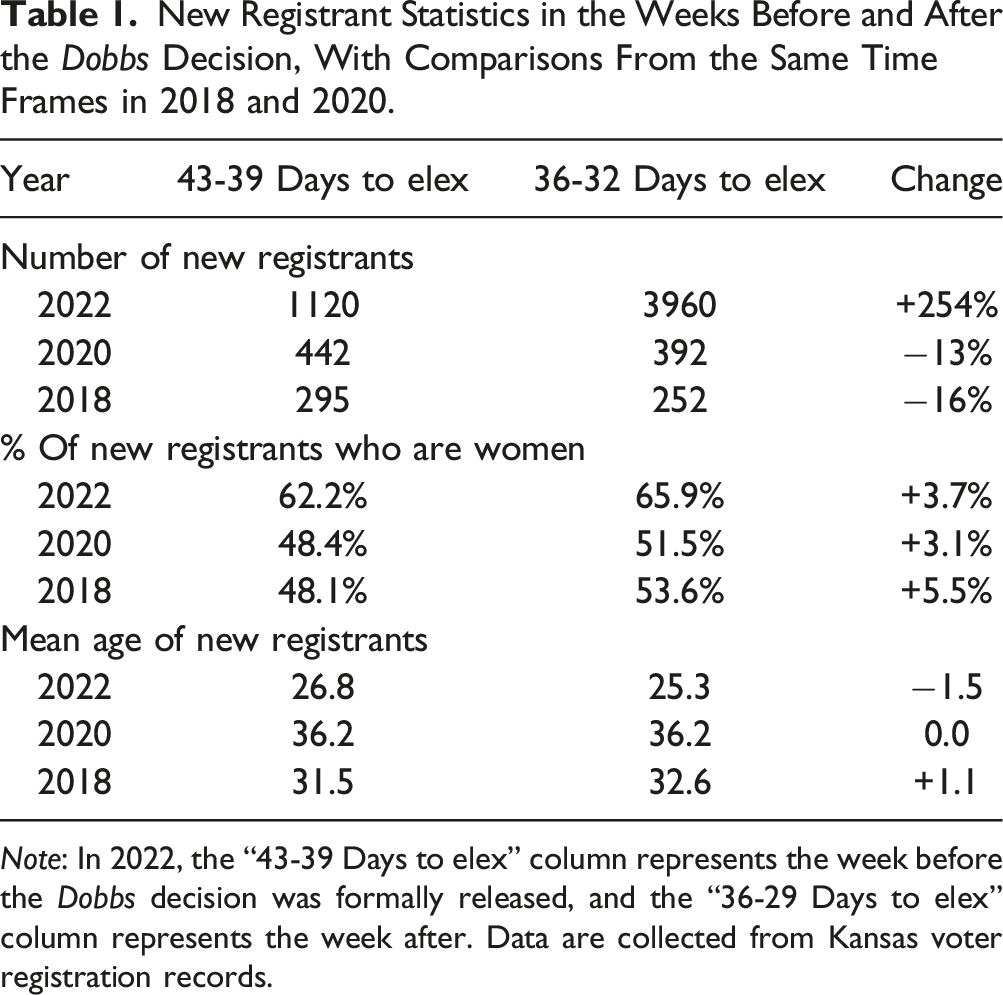
Note: In 2022, the “43-39 Days to elex” column represents the week before the Dobbs decision was formally released, and the “36-29 Days to elex” column represents the week after. Data are collected from Kansas voter registration records.
A couple trends stand out in Table 1. Firstly, the new registrants in 2022 before the Dobbs decision were already a larger group and more likely to be women and younger than those registering in the same time period during the two previous primaries. Though it was formally released in June, the ruling in Dobbs had already been leaked in early May, so the saliency of the abortion amendment was already quite high. This could explain the higher number of registrants in the week prior to Dobbs in 2022 compared to the same week in 2020 and 2018. However, in the week after the decision, the number of registrations increased exponentially (254%), which was not the case in previous years. In both 2020 and 2018, the week representing 36-32 days to the election saw a decrease in voter registration. Additionally, those registering that week in 2022 were even younger and included more women than the prior week before Dobbs was released.
The Primary Electorate
Turnout in the August 2022 election was unprecedentedly high for a primary. At least 951,000 Kansans 7 cast a vote of the 1,948,300 registered as of the July 26, 2022 voter registration file, a date after the “book closing” which marks the deadline for new registrations. The 2020 primary had previously set a new turnout record at more than 628,000 ballots cast, and 2018 had the highest in at least 10 years prior to that point at more than 478,000 ballots cast. 8
Descriptive Statistics of the Primary Electorate in 2018, 2020, and 2022.

Note: Data are collected from Kansas voter registration records.
Turnout by Census Tract
Clearly, the 2022 primary electorate looked different than previous cycles, but was this another case of a Dobbs effect, where voters who were motivated to protect abortion rights were spurred to vote but would not have otherwise? The changes in demographic shares, especially in partisanship, suggest as much. We use an Ordinary Least Squares (OLS) regression to predict CVAP turnout, with our 799 Census tracts as our universe. As a control, we include the proportion of the tract CVAP that had previously participated in the 2018 or 2020 primaries as a proxy for the share of people who were already likely to turnout, and thus likely not mobilized by the abortion amendment. For demographic controls, we use the share of the tract that is aged 65 or older, the share that has no college experience, and the median household income in thousands of dollars. Like the CVAP, these three control variables come from the 2016-2020 American Community Survey. Finally, we include the share of “yes” votes on the amendment. This is an imperfect measure, since it is treated as an explanatory variable even though it is not measuring the sentiment of everyone in the tract, just those who turned out. With the lack of tract-level polling data, however, this is the best option available.
Regression Results for Amendment Vote Turnout in Kansas Census Tracts.
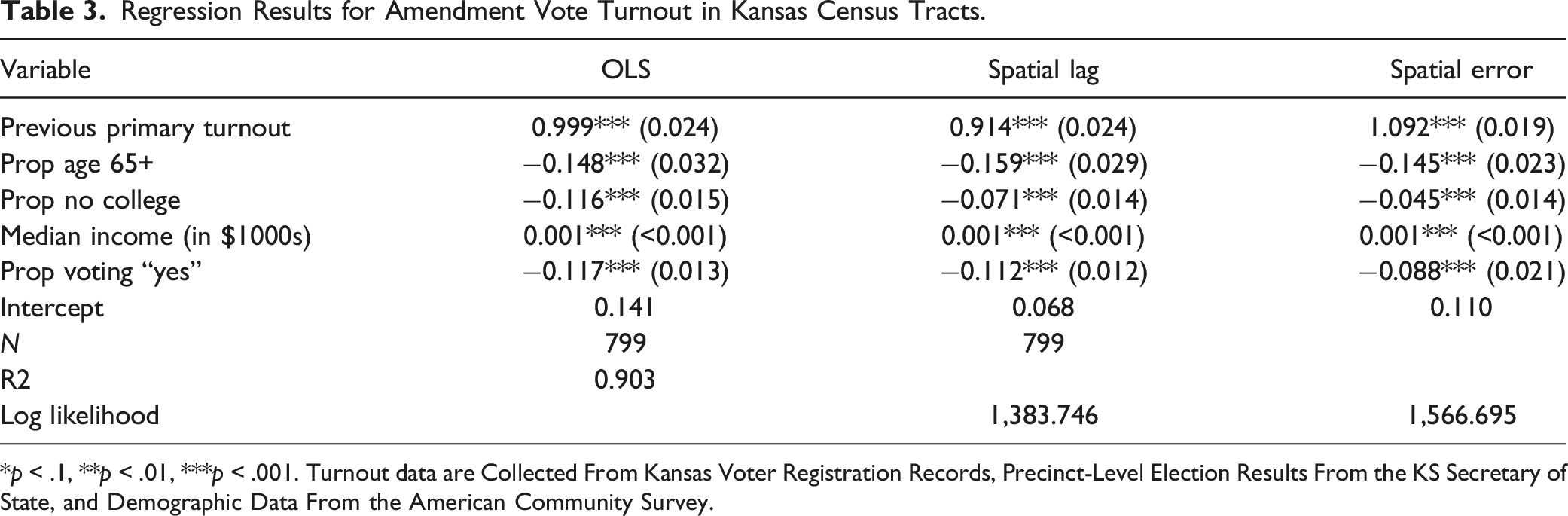
*p < .1, **p < .01, ***p < .001. Turnout data are Collected From Kansas Voter Registration Records, Precinct-Level Election Results From the KS Secretary of State, and Demographic Data From the American Community Survey.
Primary Voter Behavior in the General Election
Share of the Primary Voters Who Also Voted in the General Election of the Same year.
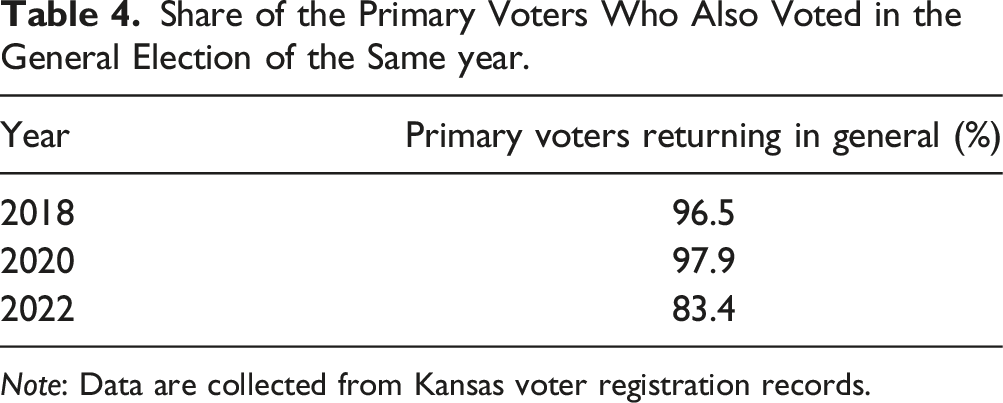
Note: Data are collected from Kansas voter registration records.
A first cut at the question is to look at the simple relationship between “yes” voting on the amendment and share of returning primary voters in the general by Census tract. Figure 1 displays this relationship as a scatterplot, and two trends appear. Firstly, on average, there was more general election abstention in areas that voted in opposition to the amendment than in favor of it. Secondly, the relationship is noisier on the “no” end of the x-axis. While high-support tracts tended to have consistently high rates of return to the general, some strongly opposed tracts had high levels of return and others had very low. Proportion of the primary voters in a Census tract who returned to vote in the November general election by the proportion of the tract’s voters who approved the abortion amendment. Data are from precinct-level election results from the KS Secretary of State and Kansas voter registration records.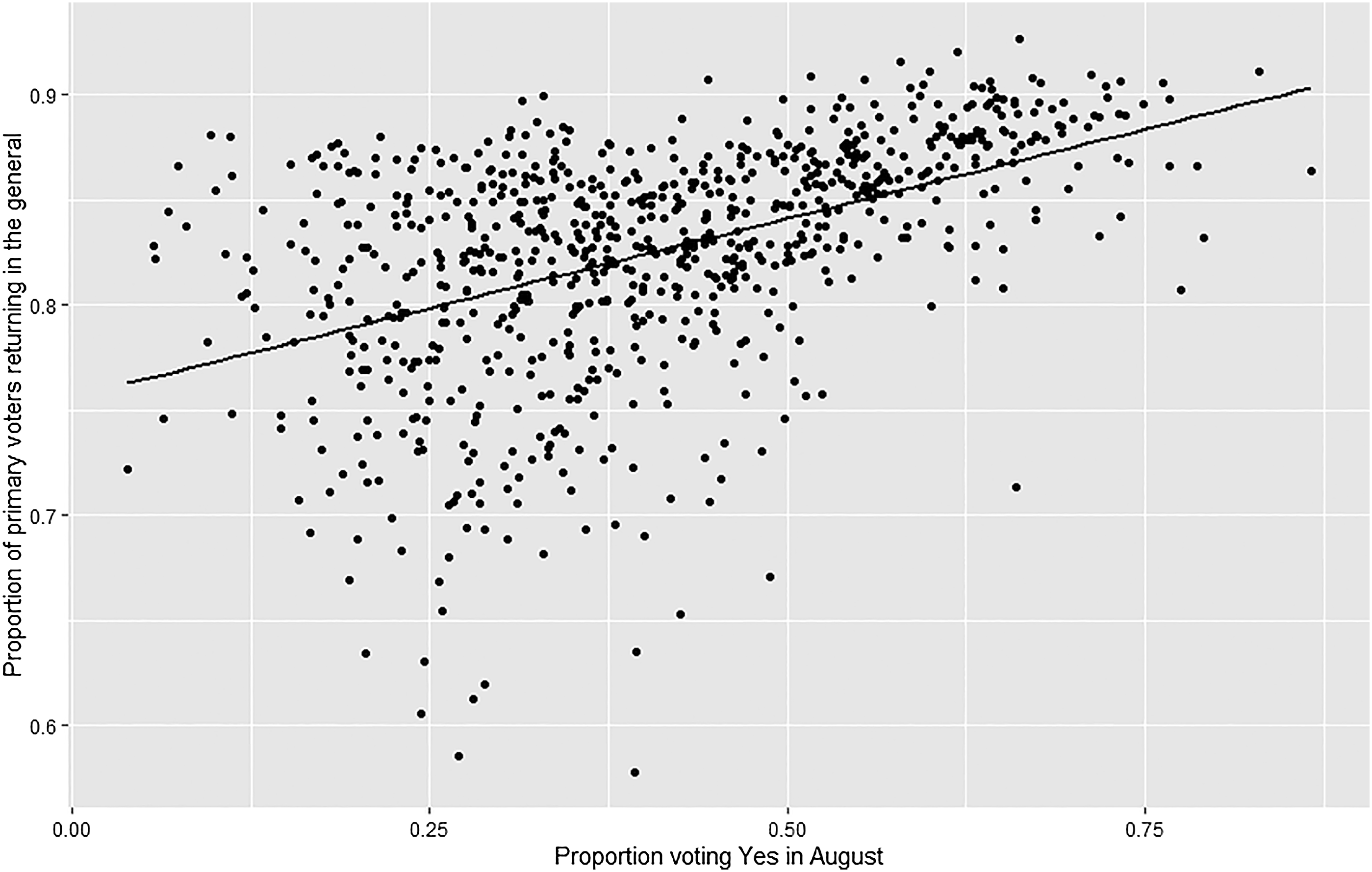
Logistic Regression Results. Standard Errors in Parentheses.
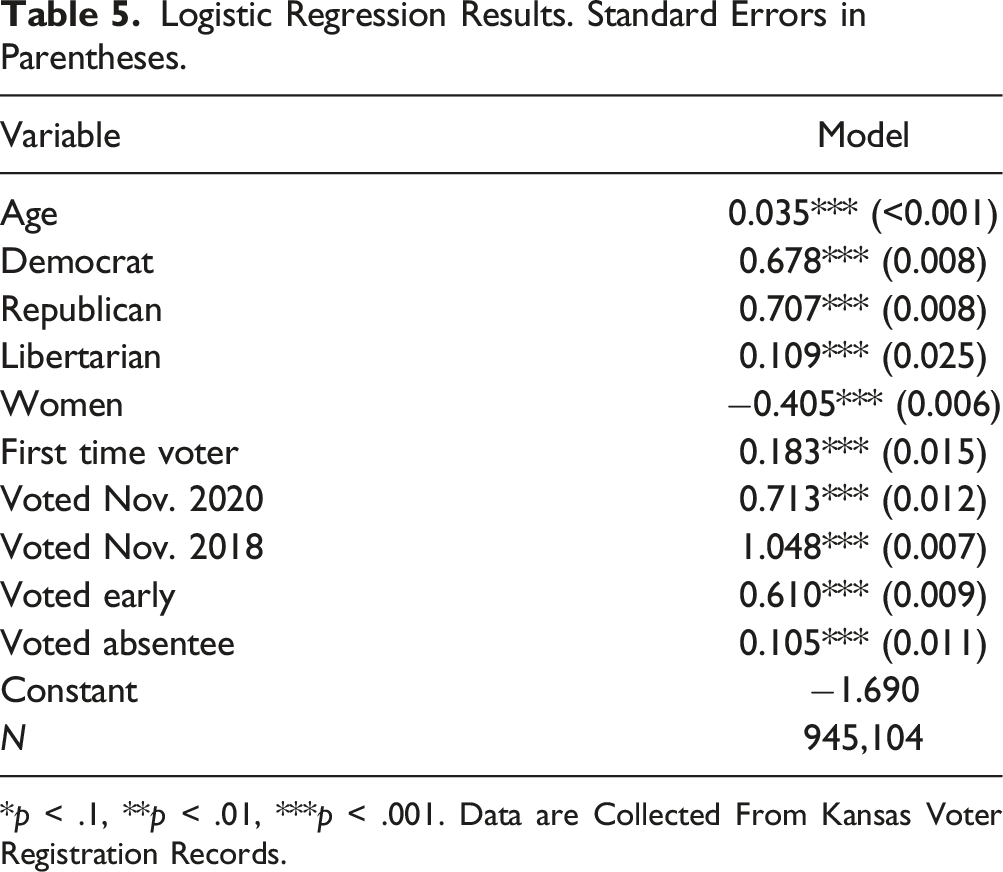
*p < .1, **p < .01, ***p < .001. Data are Collected From Kansas Voter Registration Records.
Figure 2 illustrates the predictions given by the first four coefficients in Table 5. Taking as fixed a woman first-time voter who cast a ballot on Election Day in the primary, the figure varies age on the x-axis and groups based on partisan affiliation to predict the likelihood of turning out in the general. Having an affiliation increased the prediction by about 15 points across all ages, and the gap between a 25-year old and a 75-year old was about 40 points. Moving to the coefficient on the dummy for women in Table 5, the predicted effect was negative: looking just at 45-year-old Election Day registered Republicans who were first-time voters, women voters had a 59.0% predicted probability of turning out in the general, but men voters had a 68.3% probability. The predicted effect of previous turnout was even larger. Locking in 45-year-old registered Republican Election Day women, again, a first-time voter had a 59.0% probability of turning out, a voter who had previously turned out in the 2020 presidential but not the 2018 midterms had a 71.0% probability, and a voter who had participated in both had a 87.5% probability. Predicted probability of turnout in the general for a woman who was a first-time voter in the primary who cast a ballot on Election Day, as party registration and age varies. Data are collected from Kansas voter registration records.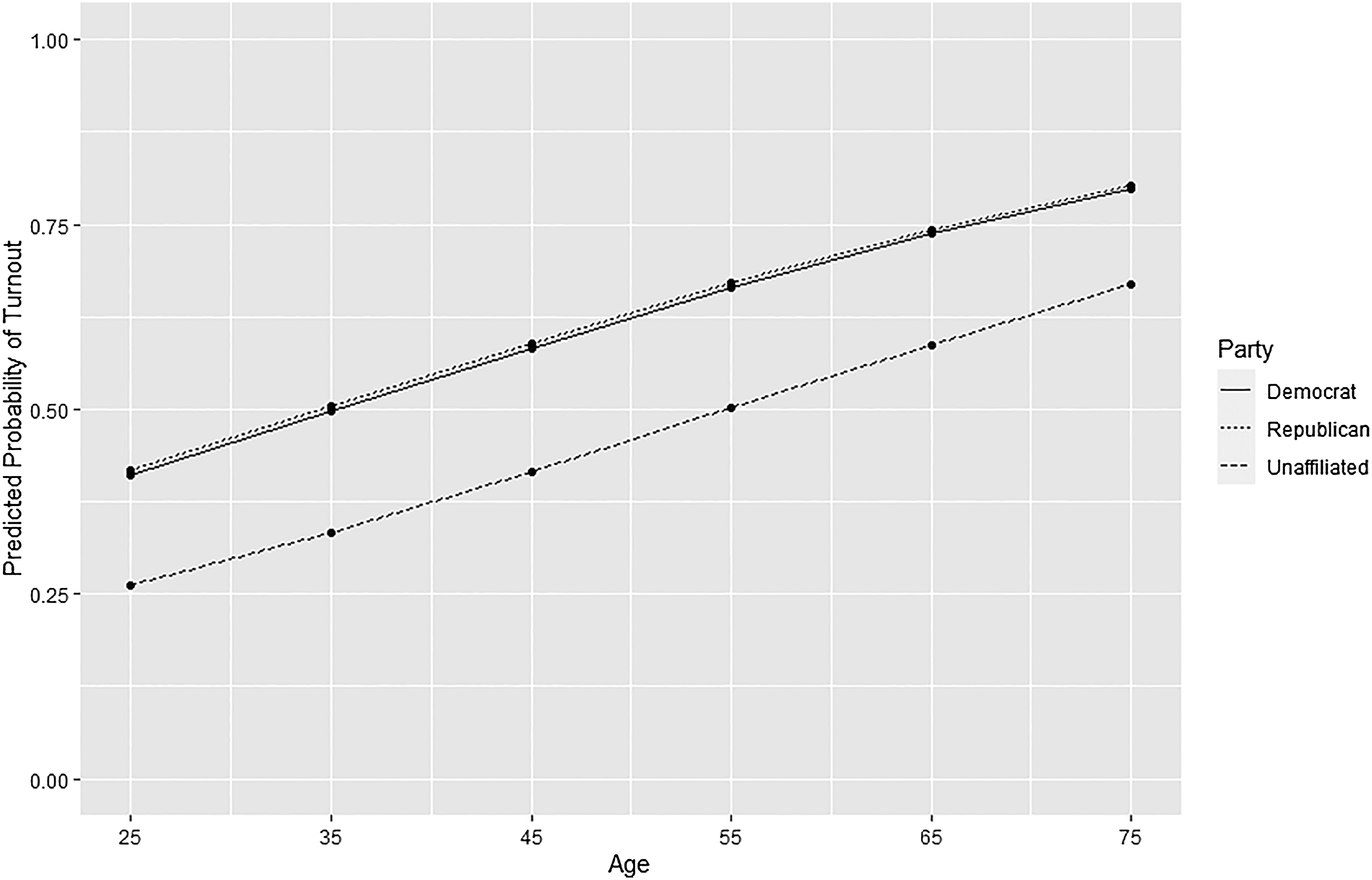
Net Effect
Given the evidence above, it seems clear that the abortion amendment mobilized a large number of voters, and those voters were more likely to be young, women, and first-time voters than a usual primary election. However, we also see that voters in those demographics were the most likely to not return to the polling booth in November. One question to ask is about the balance of those competing trends: did the abortion amendment mobilize a wave of new voters long term, or was this a one-off issue-driven vote that did not impact the general? Obviously, the 2022 general electorate had more primary voters than any previous midterm, but estimating how many would not have voted if the amendment had not been on the ballot in August is more complex.
Turnout Demographics of the 2018 and 2022 General Elections.
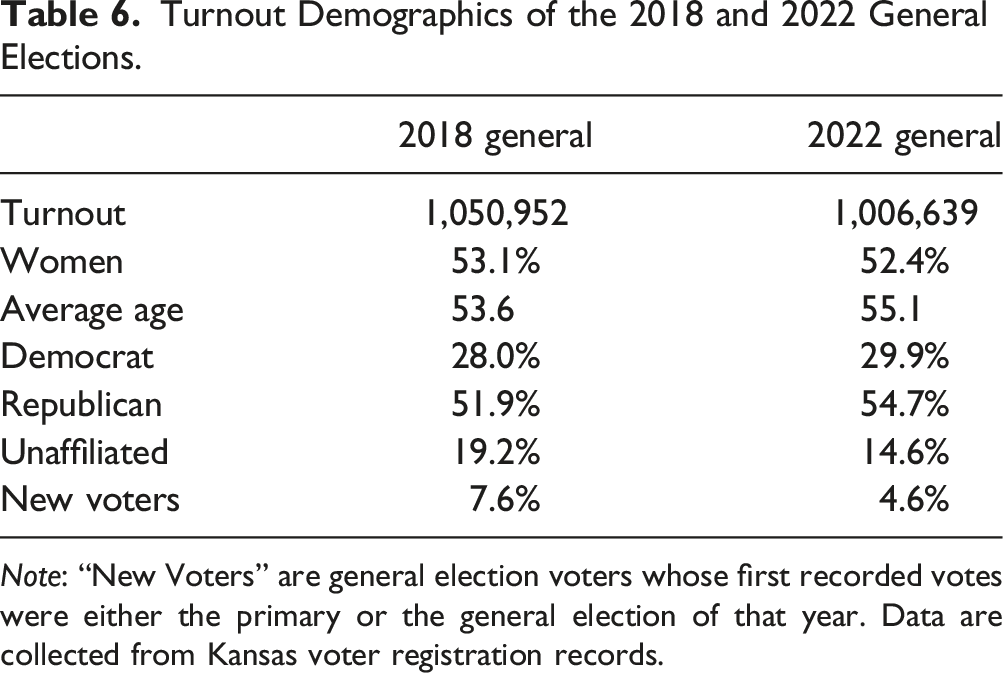
Note: “New Voters” are general election voters whose first recorded votes were either the primary or the general election of that year. Data are collected from Kansas voter registration records.
The difference in interpretation matters. As a reminder of scale, the primary had 58,009 new voters, of which about half returned for the general and half did not. If the findings above look like a failure in keeping a more liberal electorate mobilized, then it could have had a significant impact on election results. For example, it may have been the difference in the attorney general’s race, where Republican Kris Kobach eked out a narrow victory of just under 16,000 votes. If, however, the results look like a successful attempt to hold onto a group of liberal voters who would have been disengaged were it not for the issue of abortion, then it may have been the difference in the governor’s race, where incumbent Democrat Laura Kelly won by just over 22,000 votes. A future study may be able to provide a more confident answer either way.
Conclusion
These findings shed important light on participation around the abortion issue in Kansas and have important implications for other states’ participation on abortion rights. First, abortion restrictions are a mobilizing issue even in deeply Republican states. Young people and women, and especially young women, turned out in droves to vote against the amendment, and had a large impact in deciding the election. Partisanship certainly contributed to people’s vote, but it was not the only variable considered in the calculus, suggesting abortion is a hard issue for some voters where decisions are made based on policy preference and not other factors such as partisanship. Given that a majority of the voters in the primary were registered Republicans, some significant minority of them bucked the legislature’s party line and voted against the amendment. This should be concerning to Republican lawmakers and anti-abortion activists in conservative states across the country. For decades the Republican Party has been the “pro-life” party, but these results suggest that at least some Republicans are in favor of maintaining abortion access. Republican leaders in states that are considering passing restrictive abortion laws should also consider the surge of young people and women that turned out to vote against the constitutional amendment in Kansas.
Second, our findings suggest that public policies still contribute to the creation of civic identities (e.g. Campbell, 2002, 2005). The results from the primary show that young women can be a political force to be reckoned with. We agree with Deckman (2021) that there is every reason to believe that pro-choice young women will continue to organize effectively in opposition to restrictive abortion laws. The Dobbs decision, and the resulting backlash, will undoubtedly influence young people, especially young women, for years to come. The legal status of a given social phenomenon, like abortion, influences young adults’ attitudes toward the socio-political debate surrounding that issue (Sumerau & Cragun, 2018), and socialization during young adulthood influences lasting social identities, attitudes, expectations, and norms (e.g. Bengtson et al., 2013; Cox et al., 2014; Goffman, 1959; Mannheim, 1952; Ryder, 1985; Taylor, 2014).
However, as our results show, not all civic identities are created equal and abortion may not be an effective policy for creating sustained civic participation, as seen in Kansas’ 2022 general election turnout. This suggests that abortion activists can likely count on young people’s and women’s participation in the years to come, but the Democratic Party and activists for other progressive issues may have a harder time mobilizing these groups of voters when abortion is not on the ballot. This angle, in particular, is important beyond Kansas’ borders. This study shows that even in deeply Republican states, protecting abortion access is a mobilizing issue, but the impact of the issue is less pronounced when it is not directly on the ballot. We expect that these results are generalizable to other states across the country considering, after all, every state that had an abortion-related ballot measure in the two years following Dobbs has voted to protect abortion access. Our research shows that if Democrats wish to keep these abortion-focused voters engaged, they will need to find ways to keep the abortion issue relevant or on the ballot, otherwise Democrats risk them staying home.
Footnotes
Declaration of Conflicting Interests
The author(s) declared no potential conflicts of interest with respect to the research, authorship, and/or publication of this article.
Funding
The author(s) received no financial support for the research, authorship, and/or publication of this article.
