







Abstract
This study examines public perceptions of state level political corruption in the United States using original data from two national public opinion surveys conducted in 2014 and 2022. Our analyses reveal several important insights about the underpinnings of state corruption perceptions. First, we find that perceptions of state corruption are modestly related to the actual state corruption context—people are able to connect their perceptions to reality. Second, consistent with previous research on partisanship, partisan biases play a substantial role in shaping perceptions of state level corruption, with people being much more likely to perceive corruption when the incumbent governor in their state is an out-partisan. Finally, the relationship between corruption perceptions and the state corruption context is not significantly moderated by political knowledge.
Introduction
The study of political corruption, or “the abuse or misuse of an office of trust for private gain” (Moodie, 1980, p. 212), has long been an important concept within political science (and other disciplines as well). Efforts to better understand political corruption are critical given the ill effects that corruption can have on political, social, and economic institutions (e.g., Cooray & Dzhumashev, 2018; Richey, 2010; Rivera et al., 2024; Tay et al., 2014; Anderson & Tverdova, 2003). Although political corruption undoubtedly exists across a wide range of countries and levels of government, in this paper we focus on political corruption in the U.S. setting and, more specifically, in the context of the fifty states. 1 To date, most studies of corruption in the American states have focused on measuring and explaining cross-state variation in levels of corruption (Adserà et al., 2003; Alt & Lassen, 2003; Boylan & Long, 2003; Glaeser & Saks, 2006; Goel & Nelson, 2011; Hill, 2003; Meier & Holbrook, 1992; Nice, 1983; Schlesinger & Meier, 2002; Tyburski et al., 2020) or understanding the effects of state level corruption (Depken & Lafountain, 2006; Johnson et al., 2011; Mitchell & Campbell, 2009; Nice, 1986; Woods, 2008). Despite these important lines of research, much remains to be learned about state-level corruption.
In this paper, our focus is on how ordinary people perceive the level of political corruption in their state of residence. To be clear, previous research has examined perceptions of corruption. For example, some studies on corruption in the U.S. context have focused on elite perceptions of corruption, such as how journalists rate corruption in the American states (e.g., Boylan & Long, 2003; Rosenson, 2009). 2 Others have focused on perceptions about what kinds of actions constitute corruption or the severity of different acts of corruption (Dolan et al., 1988; Johnston, 1983; Mendilow & Brogan, 2016; Persily & Lammie, 2004; Redlawsk & McCann, 2005). In addition, numerous studies have examined perceptions of corruption in countries other than the United States (Agerberg, 2022; Bokayev et al., 2023; Canache & Allison, 2005; Canache et al., 2019; Charron, 2016; Tverdova, 2011). Although previous research has studied perceptions of corruption and the abovementioned literature on levels of actual corruption across the fifty states has demonstrated that there is significant variation in corruption across the states, few studies have examined how people perceive the level of corruption in their state of residence and what factors influence their perceptions. To better understand what shapes views about state corruption, we use original data from two national public opinion surveys, one fielded in 2014 and one fielded in 2022.
We are interested in three key questions. First, given previous research showing that corruption levels vary considerably across the fifty states, do perceptions of state level political corruption track with the state level corruption context, that is, with how much corruption there is in one’s state of residence? Second, if perceptions are connected to levels of corruption, is there individual-level heterogeneity in the link between perceptions of state corruption and reality? Research on the “knowledge gap” hypothesis suggests that there are often important differences between the information “haves” and “have nots” (Holbrook, 2002; Jerit et al., 2006; Krupnikov & Ryan, 2022; Kwak, 1999; McCann & Lawson, 2006), and we want to know whether people with high levels of political information are better able than people with low levels of information to connect state corruption levels to their perceptions about state corruption. Finally, are perceptions of state corruption impacted by partisan bias? A significant amount of research in political science has shown that perceptions of many different conditions and situations are colored by partisanship. Partisanship is often viewed as a group identity and in-group members tend to be evaluated much more warmly than out-group members (Achen & Bartels, 2016; Bartels, 2002; Campbell et al., 1960; Greene, 2004). In the context of this study, we want to extend the literature on partisan biases to understand whether people have a more benevolent view of state level corruption when they are co-partisans with the incumbent governor of their state compared to when the incumbent governor is an out-partisan.
Before proceeding, it is important to point out that studying perceptions of political corruption (in addition to actual levels of corruption) is important because public beliefs about political integrity can shape political behavior and institutional outcomes (e.g., Anderson & Tverdova, 2003; Rivera et al., 2024) regardless of whether those beliefs align with objective realities. The long-standing distinction between appearance and reality in politics, often discussed in the context of campaign finance where there is worry not just about actual acts of corruption but also the perception that politicians are being bought by wealthy donors, highlights the idea that public perceptions about corruption need not mirror objective conditions to produce real political consequences. Indeed, when citizens perceive corruption—whether accurately or not—confidence in institutions can erode (e.g., Pellegata & Memoli, 2016). Perceptions about corruption can also influence how voters view government performance and whether officials are held accountable (e.g., Canache & Allison, 2005). Put simply, democratic legitimacy hinges not only on the actual prevalence of corrupt behavior but also on whether politics is seen as fair, transparent, and honest. Thus, even if perceptions diverge from objective levels of corruption, they have implications for political accountability and stability and are therefore important to understand.
The rest of this paper unfolds as follows. In the next section, we provide an overview of previous research and outline our expectations. We then provide an overview of our data and measures before turning to our analysis and results. When discussing our findings, we are able to take advantage of two unique features of our study. First, because we have data collected from surveys in two different years, we can examine whether there have been any changes over the eight years between our national surveys (i.e., in the distribution of perceptions of corruption or in any statistical relationships we uncover). Second, since we have data on state level corruption perceptions, we can make some comparisons to recent findings from studies of perceptions of corruption at the local level in the United States (identifying citation omitted). This allows us to get some sense of whether findings from the local level in the United States hold up in the more partisan context of state politics.
Previous Literature and Expectations
As we noted above, the study of state level corruption in the United States has tended to focus on the causes and consequences of corruption across the fifty states. We know much less about how ordinary people view state level corruption and what factors shape their perceptions about state corruption. In this paper, we extend the study of perceptions of corruption to the American states. Below, we describe our key expectations, which stem from two theoretical frameworks about how people process information in the realm of politics.
Our first question of interest is whether perceptions about corruption are connected to the state corruption context—how much corruption there actually is in one’s state of residence. Although political science research has shown that the average person does not pay a great deal of attention to government and politics (e.g., Delli Carpini & Keeter, 1996), researchers have also found that there is a strong link between perceptions of different conditions, such as the state of economy, the quality of public schools, and levels of crime, and objective measures of those conditions (Erikson & Wlezien, 2012; Holbrook & Weinschenk, 2020a, 2020b; Lewis-Beck et al., 2013). In other words, people do seem to be able to form perceptions that are well-grounded in reality even though they typically lack full information. By using information cues (e.g., news stories), we expect that people will be able to get a general sense of the level of state corruption where they reside (even if they do not have precise information, such as the number of corruption convictions in their state per year).
Although we expect there to be a link between perception and reality when it comes to state level corruption, research on information processing suggests that some individual-level attributes play an important role in shaping whether and how people connect their perceptions to reality. One of the most important individual predispositions that shapes information processing in the realm of politics is political knowledge. Research from several disciplines has found evidence to support the “knowledge gap” hypothesis, which suggests that when information enters a social system, it is likely to exacerbate underlying inequalities in previously held information (Gaziano, 1997, 2013; Holbrook, 2002; Jerit et al., 2006; Krupnikov & Ryan, 2022; Kwak, 1999; Moore, 1987; Prior, 2005). In other words, while people from all segments of society may learn as information becomes available, those with higher levels of preexisting information (often operationalized as political knowledge in political science) are likely to learn more than those with low levels of preexisting information, and the gap between the two groups grows. Previous research on perceptions of local political conditions has found that the relationship between objective measures of conditions and perceptions of those conditions is strongest among individuals with high levels preexisting knowledge (Holbrook et al., 2023; Holbrook & Weinschenk, 2020a). Like local politics, state politics is also a fairly low-information context for most people (Rogers, 2023) and the knowledge gap may be relevant to state level perceptions as well. In the context of perceptions about state level political corruption, the knowledge gap hypothesis implies that respondents with high levels of political knowledge will be more likely than their counterparts to be aware of and respond to cues and information about state corruption. Thus, we expect that there will be a stronger relationship between the state corruption context and perceptions of state corruption among high knowledge people than among low knowledge people.
A second factor that likely shapes how people process information about state corruption is partisanship. One of the most well-known and robust findings in political science is that political partisanship is among the most important predispositions that shapes assessments of politicians, conditions, and events (Achen & Bartels, 2016; Bartels, 2002; Campbell et al., 1960; Citrin & Green, 1986; Gerber & Huber, 2010). Whether due to a need to reduce cognitive dissonance via motivated reasoning (Fischle, 2000) or elevate the group to bolster self-esteem (Tajfel, 1970), incentives to evaluate “in-group” members more favorably than others can be quite pronounced. Put simply, political partisanship very much operates as a group identity and “in-group” members are typically evaluated much more warmly than “out-group” members. Building on the large body of research on “partisan bias” in political assessments (Duch et al., 2000; Jessee, 2010; Weinschenk, 2012), we expect that partisans will be more willing to agree that there is a lot of political corruption in their state government when they do not share partisan identity with the incumbent governor compared to when the incumbent governor is a co-partisan. Thus, we are interested in extending the literature on partisan biases, which has examined many topics, including trust in government, presidential approval, and economic evaluations, to include perceptions of state corruption.
Data & Measures
The data for this paper come from modules that were included in the 2014 (N = 1,266) and 2022 (N = 998) Cooperative Congressional Election Survey (CCES). In brief, the CCES (now called the CES or Cooperative Election Study) is a national online survey (designed to be representative of all national adults) fielded during U.S. presidential and midterm election years. Half of the CCES questionnaire consists of “common content” (e.g., demographics, partisanship, state of residence) that is asked of all of the people who are surveyed in a given year (typically 35,000-50,000 respondents per CCES survey), and half of the questionnaire consists of “team content” designed by a participating research team. 3 Each team gets access to their unique content and the common content questions. In the 2014 and 2022 modules used here, respondents were asked to rate their level of agreement with the statement “There is a lot of political corruption in state government in [respondent’s STATE NAME].” Responses were recorded on a 4-point scale (Disagree Strongly, Disagree Somewhat, Agree Somewhat, Agree Strongly). We use this as our dependent variable in the analyses that follow (higher values correspond to more agreement).
While it is problematic to assume we can capture the exact amount of corruption in each state, we can measure factors within each state that are likely linked to corruption levels, or that at least shed light on aspects of a state’s informational environment that should influence public perceptions of corruption. When there is more corruption in a state, there should generally be more information about it and that should shape perceptions of state corruption. To measure the state level corruption context, we developed an index comprised of three indicators: The average number of federal corruption convictions per 10,000 government employees in the five years prior to each of the 2014 and 2022 surveys; an expert-based evaluation of the level of both legal and illegal corruption in state government in 2014 and 2018, utilizing surveys of reporters who cover politics in the states (Dincer & Johnston, 2018); and a measure of the prevalence of media coverage of corruption, based on the number of corruption stories in the states covered in Associated Press news wires (accessed via Lexis-Nexis). 4 All three indicators were standardized and combined into a single index that is intended to capture the corruption context of state politics in the states where survey respondents reside (higher values indicate more corruption).
The map in Figure 1 shows the distribution of values on our measure of the corruption context in the fifty states. A handful of states stand out as having the lowest levels of corruption, including Wyoming (least corrupt), New Hampshire, Maine, Vermont, Minnesota, Iowa, and Alaska; while another group stands out as most corrupt, including Oklahoma, Arizona, Pennsylvania, New Jersey, Florida, Georgia, and New York (most corrupt). In broad strokes, this is a familiar pattern for those who study state-level corruption, and while this is not a perfect measure of corruption in the states (there isn’t one!), we argue that it is broad enough that it captures the context in which residents are exposed to information about corruption in their state. Estimates of the corruption context in the fifty states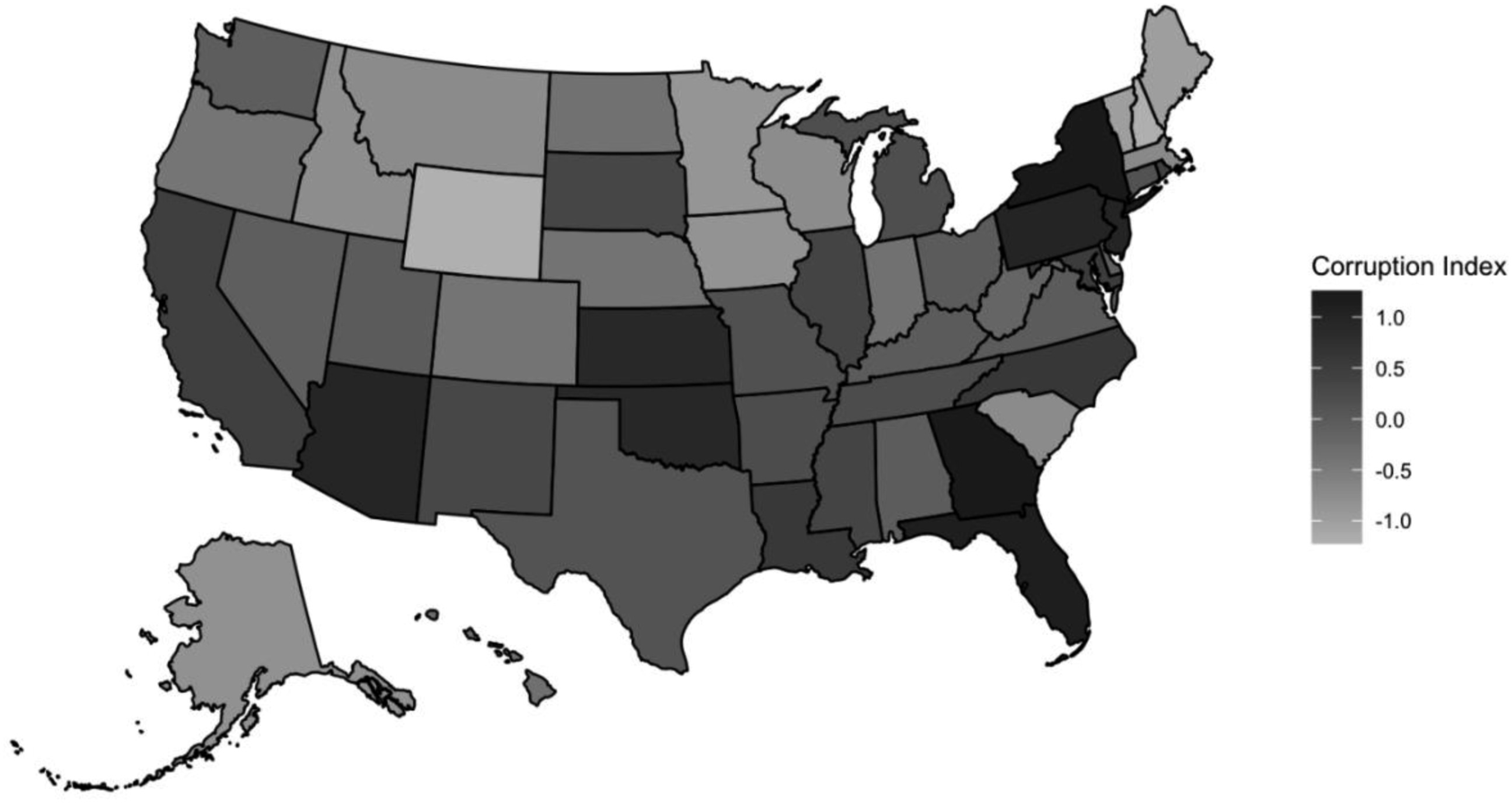
As noted above, we are not interested in just the impact of the state corruption context measure on perceptions of corruption. We also want to know whether the relationship between these two measures is moderated by levels of political information. Thus, we include a variable in the models that follow that measures political knowledge. Our measure is an index of the number of correct answers given when respondents were asked to identify the party of their state’s governor, and the party with the most seats in the U.S. House, the U.S. Senate, and both houses of their state legislature. 5 We interact this measure with the state corruption context measure described above, which allows us to test whether there is heterogeneity in the connection between the state corruption context and perceptions of state corruption.
Our measure of partisan bias is based on two items. First, we include a measure of respondent partisanship (using a standard 7-point measure that ranges from strong Democrat to Strong Republican). Again, though, we are not interested in just the direct impact of this variable on perceptions of corruption. Rather, we want to understand whether the impact of partisanship on perceptions of corruption changes depending on whether the governor in a person’s state of residence is a co-partisan. Consequently, we include a dummy variable in the model that captures the partisanship of the incumbent governor at the time of the survey (1 = Republican Governor, 0 = Democratic Governor). By interacting respondent partisanship with this variable, we will be able to detect whether partisan bias is at play when it comes to perceptions of state-level corruption.
Finally, our models include a handful of control variables. First, we include perceptions of corruption in local and national government, which are intended to serve as blunt controls for the impact of generalized political malaise or distrust on attitudes about state government. For the local measure, respondents were asked about their level of agreement with the following statement: “There is a lot of political corruption in local government in the city or town where I live” (Response categories: Disagree Strongly, Disagree Somewhat, Agree Somewhat, Agree Strongly). The national measure asked respondent to rate their agreement with the following statement: “There is a lot of political corruption in the federal government in Washington, DC,” with the same response categories. 6 We also include measures of respondent race, sex, age, and income to capture group-based factors that might be related to attitudes toward government (variable coding for these items provided in Appendix for interested readers). Redlawsk and McCann (2005), for example, find, using exit poll data from six cities, that these variables all have statistically significant effects on attitudes about corruption. Finally, we include a measure of the total number of statehouse reporters (per 100k state residents) covering each state (in 2014 and 2022), which we obtained from Pew Research. 7 The goal of this measure is to serve as a proxy for the capacity to uncover and disseminate information on corruption. Our expectation is that greater statehouse reporting capacity should increase the likelihood that political misconduct is discovered and communicated to the public via state and local media outlets. 8 Thus, we expect there to be a positive relationship between the number of statehouse reporters per 100k people and perceptions of state-level corruption.
Results & Analysis
We begin with descriptive information regarding the dependent variable, perceptions of state government corruption. The bar chart in Figure 2 illustrates a balanced view of state government corruption, with about 55% of respondents agreeing (“Agree” and “Agree Strongly”) that there is a lot of political corruption in their state government, and about 45% disagreeing (“Disagree” and “Disagree Strongly”). While we had no expectation regarding changes in this distribution over time, it is interesting that the pattern of responses across categories in 2022 is virtually identical to that from eight years earlier in 2014. Perceptions of corruption in Respondent’s own state government, 2014 and 2022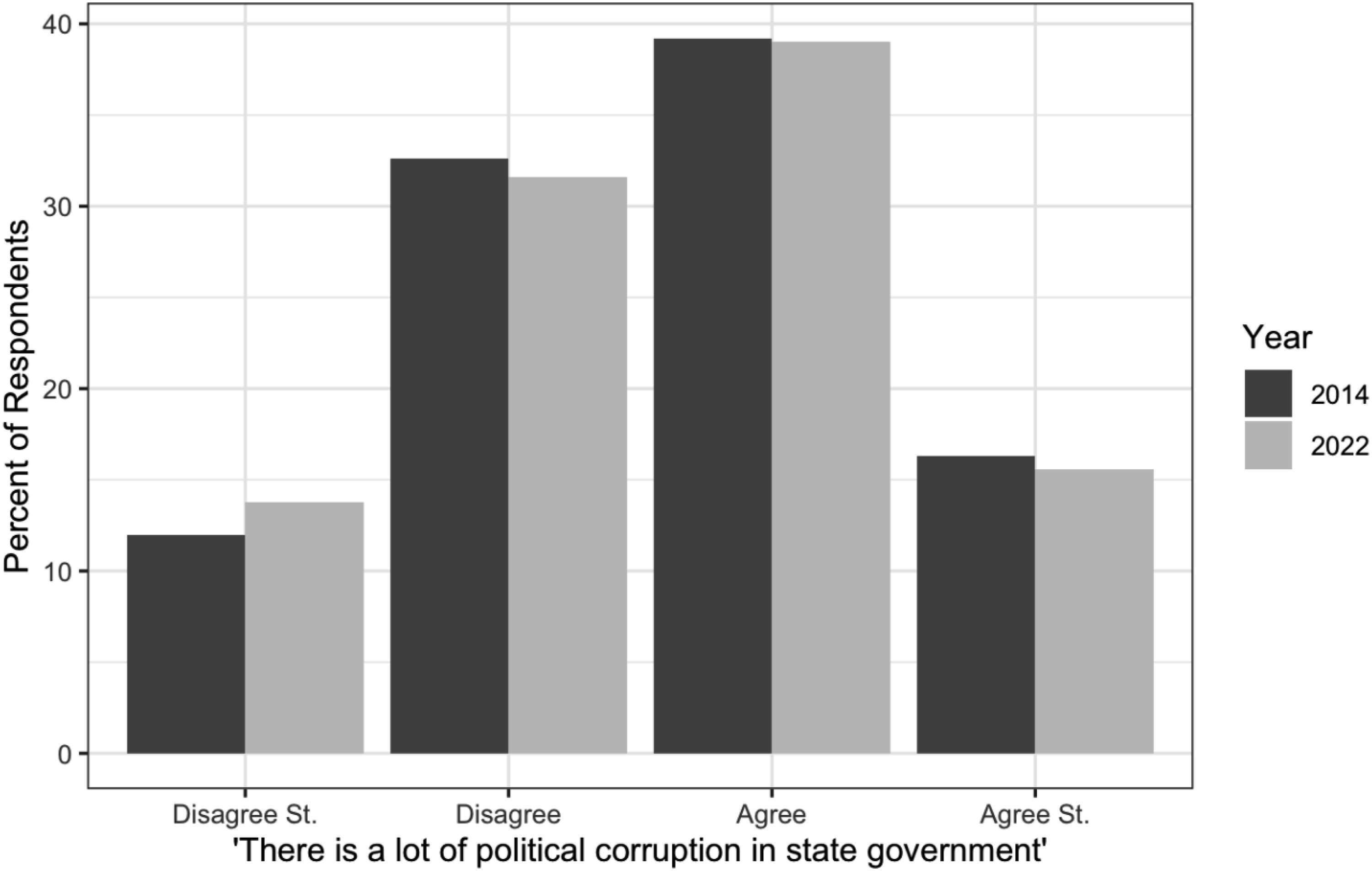
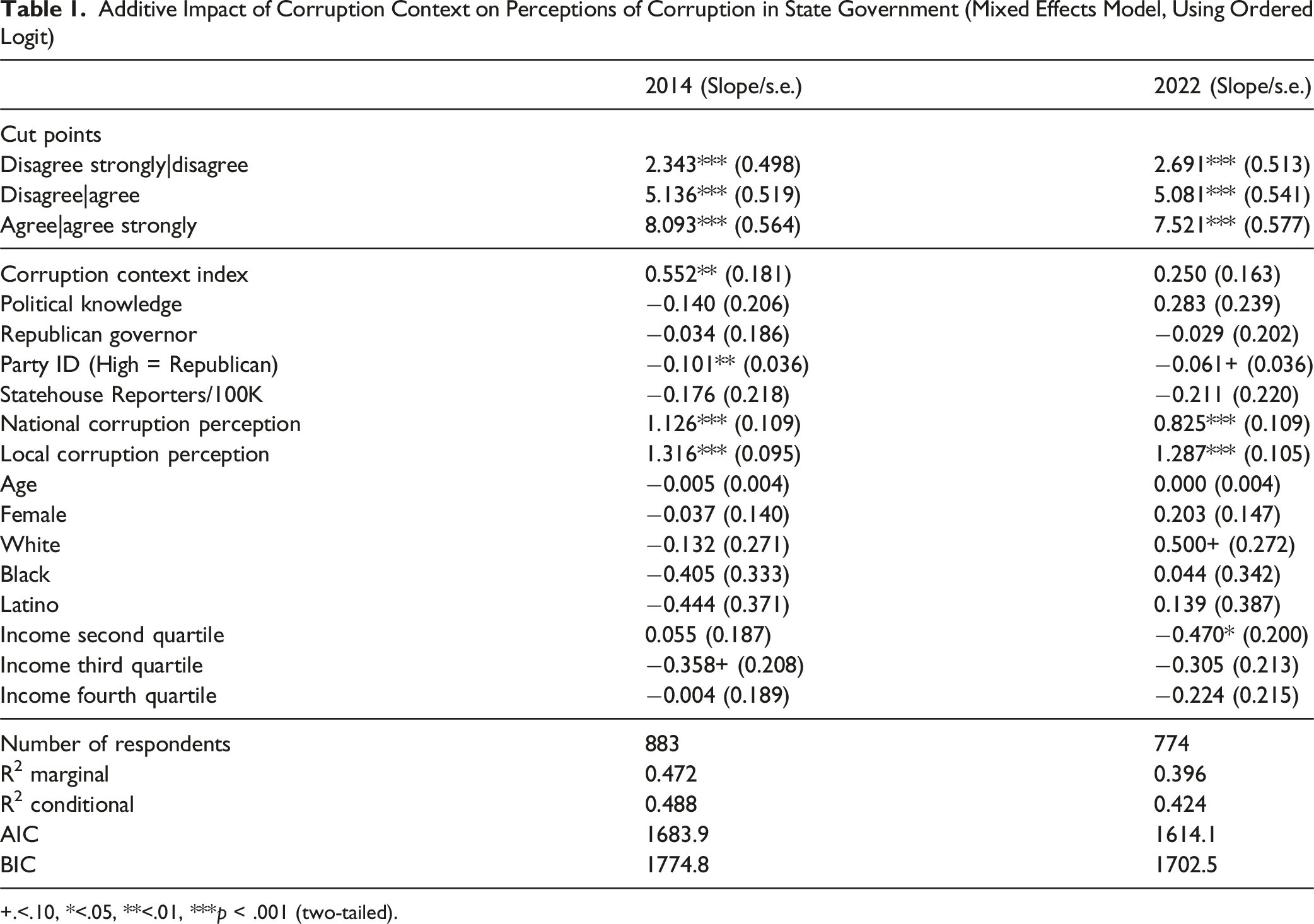
Our primary interest is in how responses to this question are shaped by two different sources: (a) the corruption context of the states where respondents live, as moderated by political knowledge, and (b) the influence of partisan bias, reflected in the interaction between party identification and the party of the governor. We begin with a naïve model of perceptions of state government corruption using simple additive measures of corruption context and party identification. Illuminating the additive effects of these variables should help us appreciate and understand any conditional effects uncovered in subsequent analyses, where the effects are modeled as conditional.
Additive Impact of Corruption Context on Perceptions of Corruption in State Government (Mixed Effects Model, Using Ordered Logit)
+.<.10, *<.05, **<.01, ***p < .001 (two-tailed).
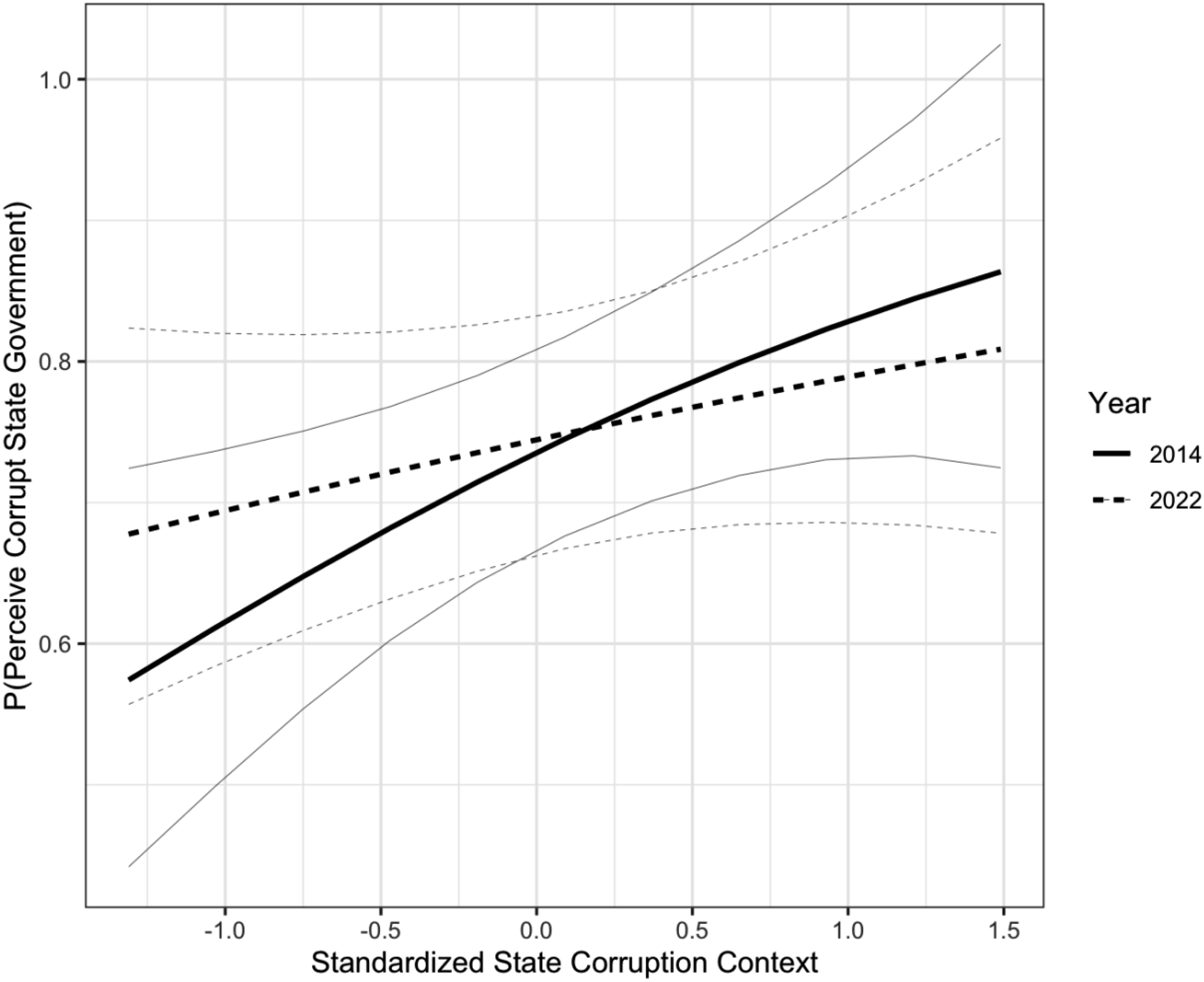
Corruption Context and Individual-level Perceptions of Corruption in State Government. Note: Thicker lines represent the slopes and thinner lines enveloping each represent the 95% confidence intervals
Interestingly, Table 1 shows party identification also plays an additive role in shaping perceptions of corruption in state government, though that role is much more muted. Although we are agnostic about the direction of the additive effect of party identification, the finding in both years points to Democrats being more likely than Republicans to agree that there is a lot of corruption in their state government. These effects are modest when considered across both years, with predicted probability of agreeing (strongly or somewhat) that there is a lot of corruption in state government ranging from .69 (Strong Republican) to .80 (Strong Democrat) in 2014, and from .72 to .78 (p = .09, two-tailed) in 2022.
The crux of our argument is that this additive perspective is a bit naïve, that it makes more sense to consider heterogenous effects across certain population subgroups. As spelled out earlier, we anticipate conditioning effects to come from two sources. First, since the acquisition of corruption cues requires some attention paid to the political environment, we expect a stronger relationship between the state corruption context and individual perceptions of corruption among those with high levels of pre-existing political information than among other respondents. Additionally, we expect perceptions of state government corruption to reflect the political biases that come with partisanship, with partisans being more willing to agree that there is a lot of political corruption in their state government when they do not share partisan identity with the incumbent governor compared to when the incumbent governor is a co-partisan.
Context, Information, Political Bias, and Perceptions of Corruption in State Government (Mixed Effects Model, Using Ordered Logit)
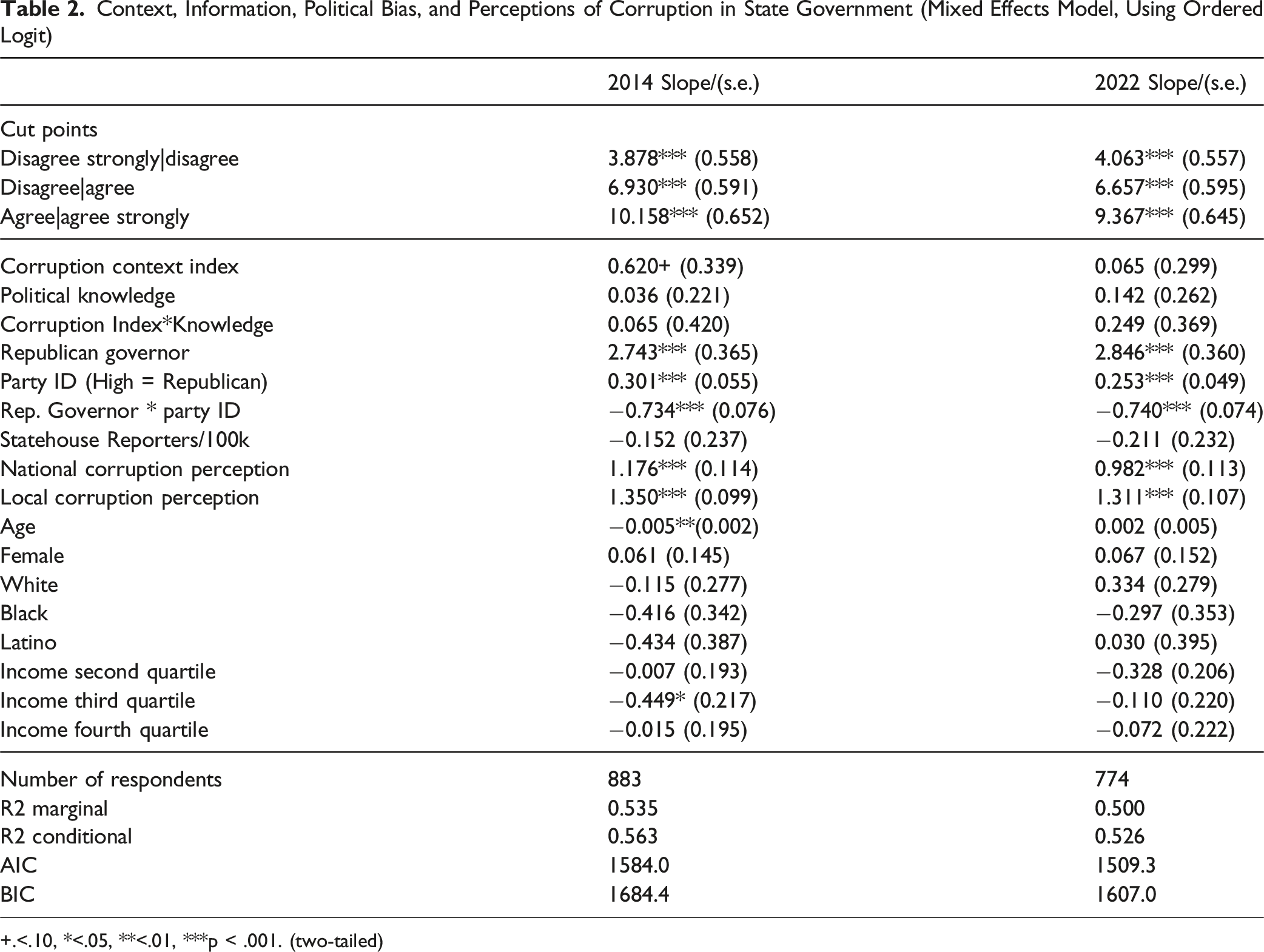
+.<.10, *<.05, **<.01, ***p < .001. (two-tailed)
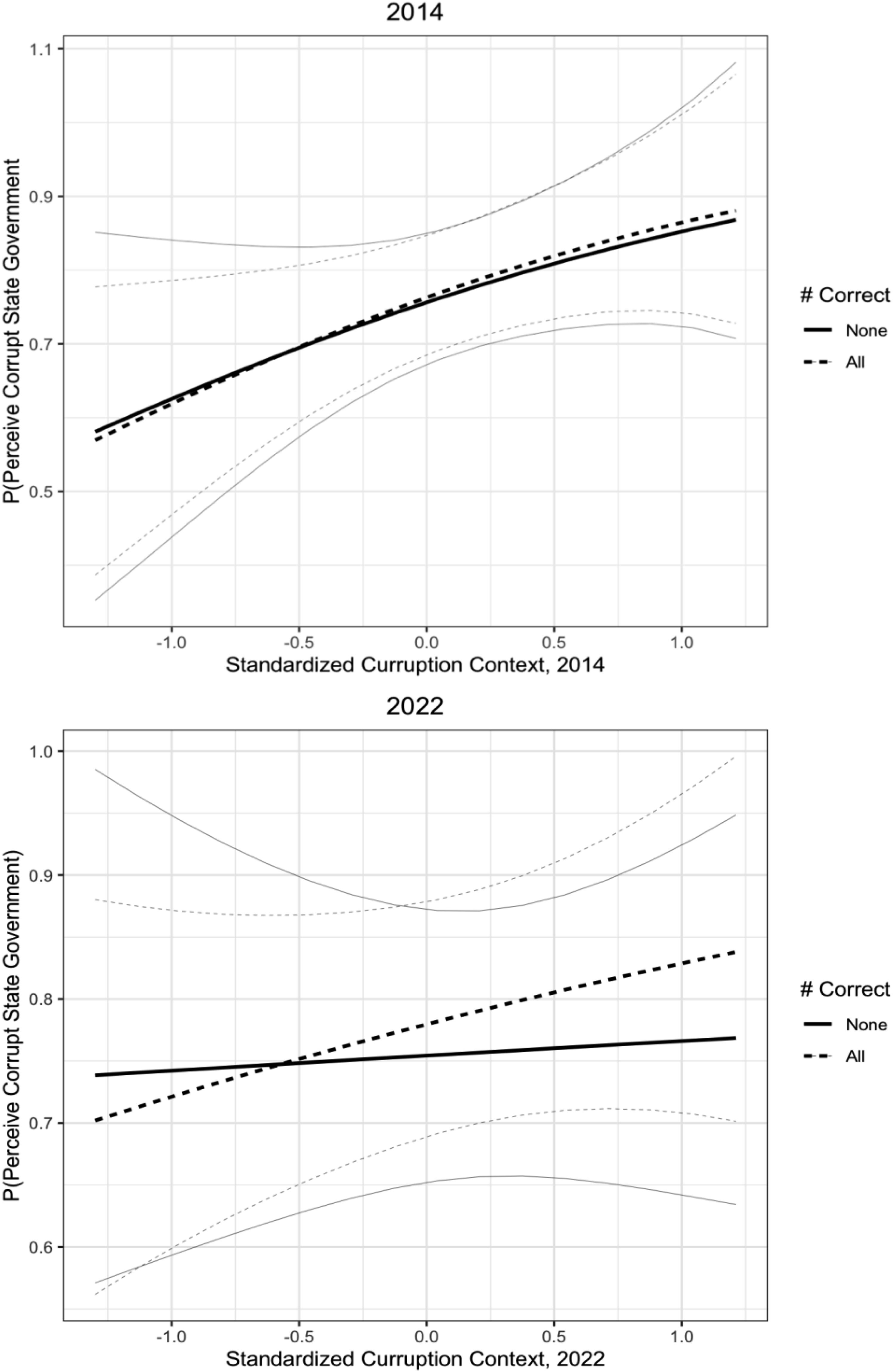
Context, Information, and Individual-level Perceptions of Corruption in State Government (2014) and 2022. Note: Thicker lines represent the slopes and thinner lines enveloping each represent the 95% confidence intervals
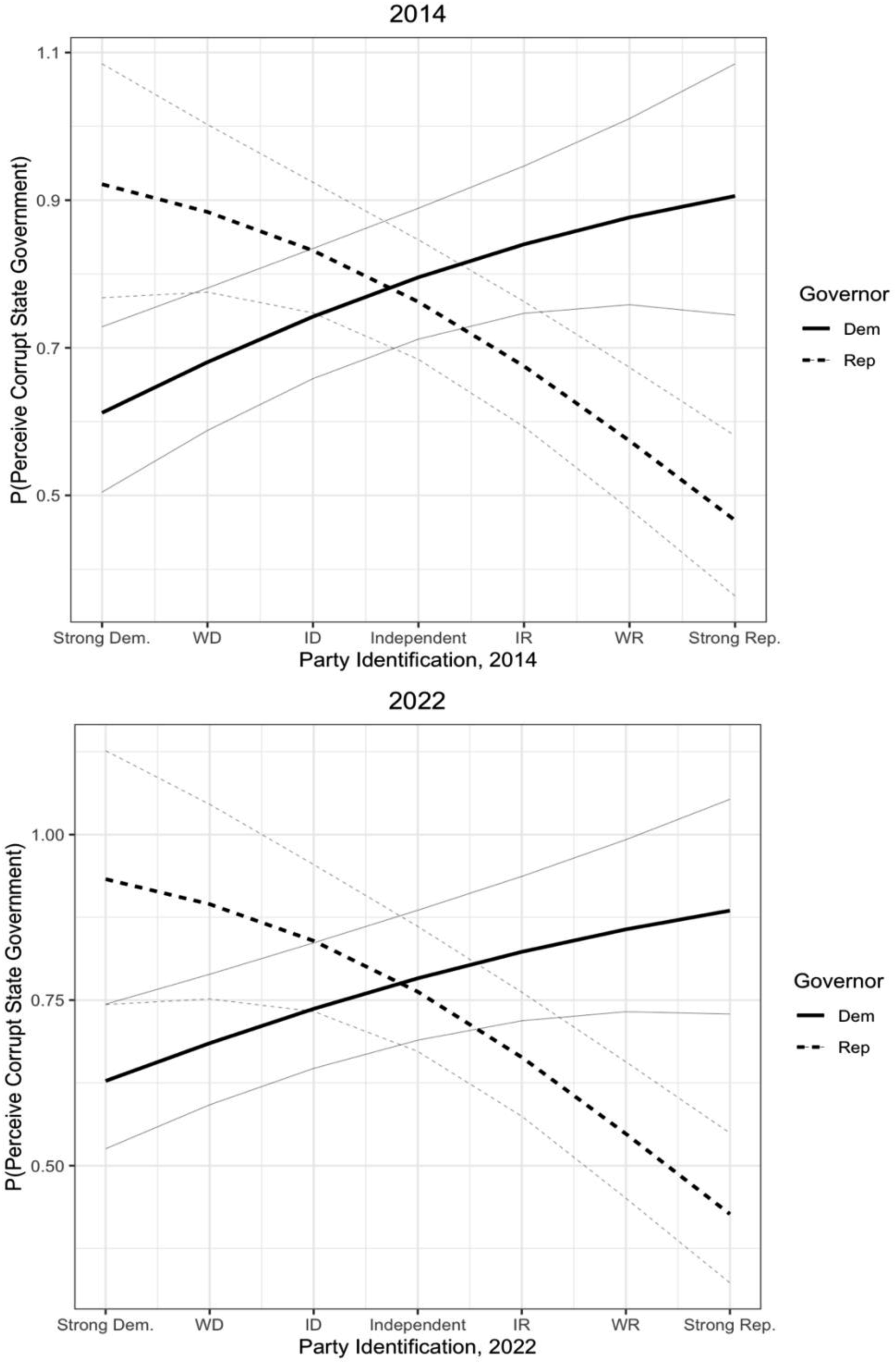
Partisan Bias and Individual-level Perceptions of State-level Corruption, 2014 and 2022. Note: Thicker lines represent the slopes and thinner lines enveloping each represent the 95% confidence intervals
There are several potential explanations for why information about political corruption appears to be equally accessible to both high- and low-information voters. One possibility is that the knowledge gap may be wider on more complex, technical issues, and corruption may be a relatively straightforward issue for the public to grasp. As Carmines and Stimson (1980) have suggested, some political issues are “hard” (e.g., highly technical) and others are fairly “easy” to understand. Corruption is often brought to public attention through highly salient events, such as indictments, resignations, and media exposés, which serve as strong (and easy to understand) cues for the public. Such cues may make it likely that even those with lower levels of political knowledge can pick up on the signals about corruption. Additionally, the nature of media coverage may play a role. If corruption-related cues are frequent and visible in the media, both high- and low-knowledge people may receive enough information to align their perceptions with the actual state of affairs.
In order to examine the robustness of the interaction effects presented in Table 2, we also examined the results when using different measures of information acquisition. While Table 2 uses the five-item political knowledge measure, in Appendix C we examine the corruption context interaction when using (1) just the subset of knowledge items that focus on state politics, (2) just the subset of items that focus on national politics, (3) respondent education level, and (4) political interest. Overall, these analyses indicate that the findings in Table 2 hold even when alternative information acquisition measures are used. Put simply, in both 2014 and 2022, the interactions are not statistically significant, which indicates that corruption information is equally accessible to both high- and low-information people.
Although there is at best a modest relationship between the state corruption context and perceptions of corruption, there is strong evidence that those perceptions are driven by partisan bias, based on co-partisanship with the incumbent governor. Both in Table 2 and Figure 5, the directional relationship for party identification flips depending upon whether the incumbent governor is a Democrat or Republican. This is a very strong interaction effect, and it is virtually identical in both 2014 and 2022. The impact of party identification is somewhat stronger under Republican governors, and it appears to be so because of differences in how Democratic and Republican respondents react to differences in gubernatorial partisanship. In 2014 and 2022, both Democratic and Republican respondents were happy to agree that there was corruption in state government if the governor was not from their party; however, Republican respondents’ perceptions of corruption were a bit more responsive to the party of the incumbent governor.
Among the other variables in the model, perceptions of state-level corruption are strongly related to perceptions of corruption in local and national governments, perhaps reflecting some sort of more generalized sense of political malaise, and demographic indicators are generally unrelated to corruption perceptions. The findings for local and national corruption perceptions are important in that they increase confidence that the variation in state corruption attitudes explained by corruption context and partisan bias is not simply reflecting the influence of some set of factors that might be related a more general sense of political alienation. Finally, it is worth mentioning that our measure of the number of statehouse reporters per 100k state residents is not statistically significant in 2014 or 2022. 10
Taken in combination, the evidence presented here shows that perceptions of corruption in state government are influenced by both partisan bias and the state corruption context, though they are less responsive to cues from the state political environment than to straight-up partisan filtering. Besides the substantive results for both sets of variables, what also stands out is the consistency of the findings across the eight-year period, especially regarding partisan biases, which were virtually identical in 2014 and 2022. Overall, we think that the comparison of our findings from 2014 and 2022 is interesting, especially given the increasing level of political polarization during this time period (Handan-Nader, Myers, & Hall, 2025) and the decline of state and local newspapers and nationalization of news (Moskowitz, 2021). Regarding partisanship, although one might expect increases in party polarization to amplify the effects of partisanship over time, one possibility is that partisan motivated reasoning (at least in the context of corruption perceptions) was already strong by 2014, leaving limited room for further increase in 2022. Although we are not aware of similar datasets collected prior to 2014, it would be interesting to examine our models with surveys conducted after 2022 to see whether the partisan effects are similar to those reported above. In terms of our findings on the relationship between corruption context and perceptions, we note that the stronger correspondence between objective corruption and corruption perceptions in 2014 than in 2022 is consistent with scholarship emphasizing changes to the amount and nature of state and local news reporting. As overall levels of state and local reporting have declined and political information has become more nationalized, people may be less likely to encounter state-specific information that would allow perceptions of corruption to track underlying conditions. Importantly, however, this decoupling does not appear to be driven solely by variation in state reporting capacity (at least in terms the measure of state reporting capacity used here). Broader changes in how political information is produced, framed, disseminated, and consumed may also play an important role in the formation of perceptions over time. In a more nationalized information environment, perceptions of state-level corruption may not correspond as well to institutional realities. It would be interesting to develop corruption context measures for more recent years and examine how the correspondence between reality and perception has changed since 2022. It would also be worthwhile to compare the link between perception and reality across different types of state level issues (e.g., the economy, crime, etc.) to see if there are similar patterns in terms of the link between perception and reality.
It is worth briefly connecting these findings to previous research on perceptions of corruption at the local level, where both the institutional and information environments differ to some extent. Recent work in this area (Holbrook et al., 2024) has found that (a) perceptions of corruption in local governments are more closely tied to a similar measure of the local corruption context, (b) that the impact of the corruption context varies dramatically across respondent political information, and (c) that partisan bias plays very little role in shaping perceptions of local corruption, even in cities with partisan electoral systems. We think the differences in findings at the local and state levels are thought-provoking and make sense given differences across the two levels of government.
One key difference concerns the partisan structure of political institutions. Although there is some recent evidence to suggest that local politics is becoming more partisan and nationalized (Shah et al., 2024), state politics is organized in an explicitly partisan manner: all gubernatorial elections and 49 out of 50 state legislative elections use partisan ballots, providing voters with clear and highly salient partisan cues, while the overwhelming majority of cities use non-partisan ballots (Wright, 2008; Wright & Schaffner, 2002). As a result, partisan identities are likely to be more consistently activated in evaluations of state government, making partisan bias a more powerful factor in shaping corruption perceptions at the state level than at the local level. In short, in this institutional context, citizens may be especially prone to interpret information about state politics through partisan lenses.
A second important distinction involves the information environment. Although knowledge of both state and local politics is generally low (Rogers, 2023), citizens likely encounter more information about state politics than local politics, on average. Broader exposure to state politics may allow even relatively low-information individuals to form perceptions of state-level corruption. In contrast, media coverage of local politics tends to be far more limited and uneven (Abernathy, 2020), making political information harder to obtain and more dependent on individual predispositions. In information-scarce environments, politically engaged and knowledgeable citizens are better positioned to acquire relevant information and integrate it into their evaluations. This may help explain why objective corruption measures and political information play a larger role in shaping perceptions at the local level than at the state level.
Taken together, we think these institutional and informational differences help account for the divergent patterns observed across levels of government. Whereas perceptions of local corruption appear more tightly linked to objective conditions among politically attentive citizens, perceptions of state-level corruption are more strongly shaped by partisan cues that are institutionally embedded and more widely accessible. Thus, the relationship between objective corruption and public perceptions seems to be contingent on the institutional context in which political evaluations are formed.
Conclusion & Future Research
In this paper, we examined public perceptions about political corruption in state government in the United States. To do so, we used original data from two public opinion surveys conducted in 2014 and 2022. We found that perceptions of state corruption are aligned with the actual state corruption context, although the relationship was stronger in 2014 than in 2022. In addition, we found strong evidence in both years that partisan biases play a substantial role in shaping perceptions of state level corruption. Finally, we found that the relationship between corruption perceptions and the state corruption context was not significantly moderated by political knowledge. Information about state corruption was accessible to both high- and low-information individuals.
Overall, we believe that several future research ideas stem from our analyses. First, we hope that other scholars will field surveys that ask people about their perceptions of corruption in state government. Although we were able to use high quality surveys from the CCES with reasonable sample sizes, having even larger samples (and more respondents per state) would be helpful in increasing the statistical power for detecting state-level effects. Thus, we encourage future researchers to examine the relationships uncovered here using larger samples. This would provide stronger leverage for making state-level comparisons. Relatedly, when fielding other surveys, researchers should build on this study by considering asking people multiple questions about their views on corruption in state government. We used a single item to measure perceptions but the development of a state corruption perception index could be interesting and useful. Second, scholars should expand on our findings about the partisan biases that exist when it comes to perceptions of state corruption. Do other group attachments and identities operate in the same way when people are making assessment about state level corruption? Finally, we need to learn more about how people get information about state political corruption. Thus, it might be valuable to ask survey respondents not just their perceptions about how much corruption exists but also to follow up such questions with items asking people where they get their information about state politics and corruption (e.g., television, social media, newspapers, friends). In the end, we believe that much remains to be learned about how people perceive corruption across the fifty states, as well as across other levels of government, and hope that additional studies will pursue these topics or others related to corruption in state government.
Supplemental Material
Supplemental Material - Perceptions of Political Corruption in State Government
Supplemental Material for Perceptions of Political Corruption in State Government by Thomas Holbrook, Aaron Weinschenk, Chan-Song Kim, James Garand in American Politics Research.
Footnotes

Funding
The authors received no financial support for the research, authorship, and/or publication of this article.
Declaration of conflicting interests
The authors declared no potential conflicts of interest with respect to the research, authorship, and/or publication of this article.
Supplemental Material
Supplemental Material for this article is available online.
Notes
References
Supplementary Material
Please find the following supplemental material available below.
For Open Access articles published under a Creative Commons License, all supplemental material carries the same license as the article it is associated with.
For non-Open Access articles published, all supplemental material carries a non-exclusive license, and permission requests for re-use of supplemental material or any part of supplemental material shall be sent directly to the copyright owner as specified in the copyright notice associated with the article.
