







Abstract
Movement-data
In this article we show movement-data, “data” movement, a flow of (dis)connected thoughts, relationships, interactions, and events in the context of research. We conceptualize data as a wave, as flow, as liquid; ever-changing, inconstant, unreliable, noninterpretable; as a dark forest. Data is already there and here, only partially accessible. Data may not need to be collected but may be lived, sensed, and done. Furthermore, we identify moving data that change in place, time, and shape to produce different knowledge and to produce knowledge differently (St. Pierre, 1997). Rather than conceptualize data as a potential source of information, we are interested in data for what it produces, how it moves and for how it can be lived and sensed by researchers, and how data makes us as people and researchers.
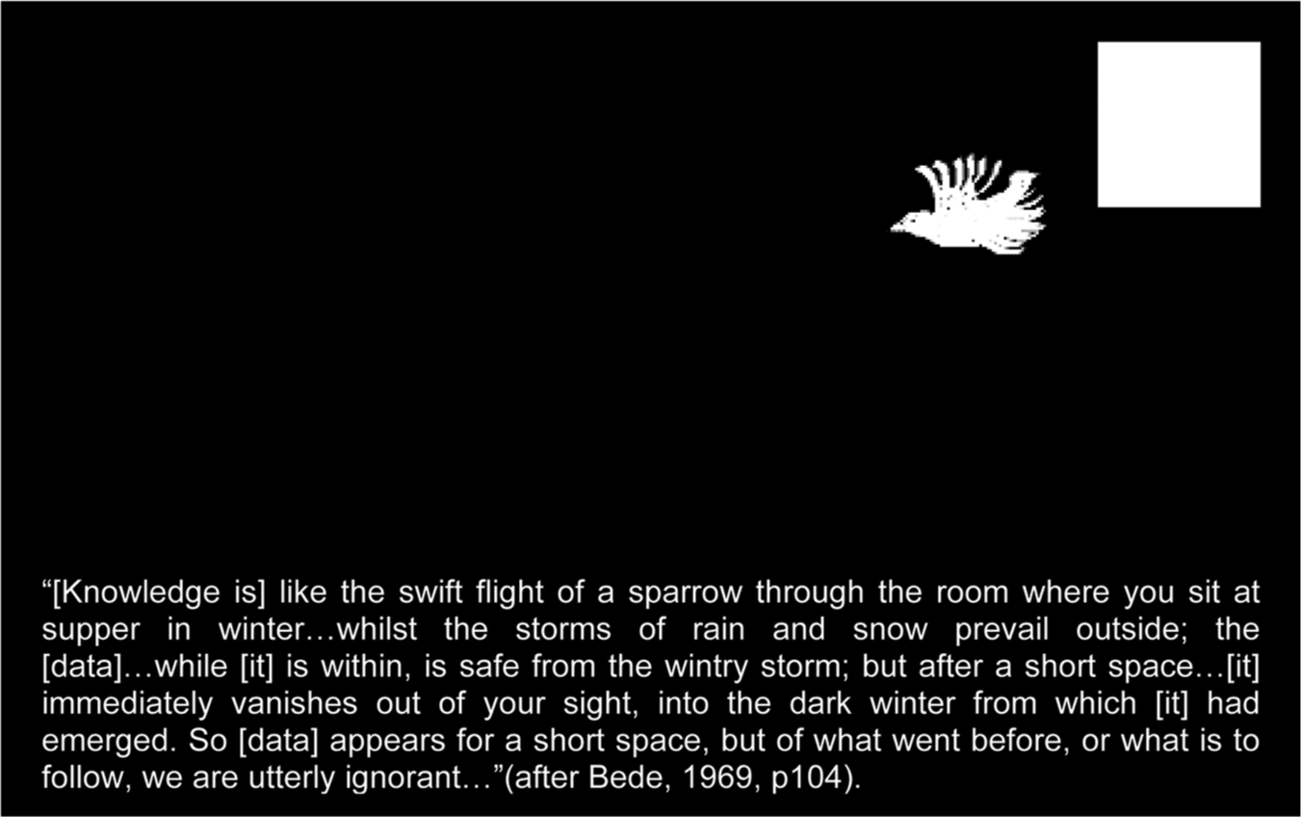
We propose that researchers may live through data both with and without participants. Data does not need a beginning or an end. It may just pass us. Like Bede’s (1969) sparrow, passing through the darkened hall, one thing we can really know of data is that it emerges from and returns to darkness; it passes through our lives—and indeed, our lives pass through it. The images throughout this article invite readers to enter the time and space of our lives where we might encounter data or data might encounter us. We will share a series of encounters and (un)connected variations on the theme of gay men coming out at work. Using mainly Massumi and Derrida to conceptualize movement-data and moving data, and the images of the splinter and of data as a wave, the article explores desolate and unexpected time and spaces able to reconfigure our relationship with data.
Massumi (2002, p. 4) wrote that “when a body is in motion, it does not coincide with itself. It coincides with its own transition: its own variation … in motion, a body is in an immediate, unfolding relation to its own nonpresent potential to vary.” Similarly, we will talk about data as it moves between its numerous variations (becoming, e.g., a nuisance, splinter, or secret). Following Massumi, we use inconsistent “data” without further attempts to define or capture what “data” is. These examples invite the unknown, deviant, and impossible; they deviate, transform, and link to other concepts. We hope our examples create “creative contagion” (Massumi, 2002, p. 19) inspiring readers to create their variations of “data.” In these examples the same problem is being replayed in multiple variations which are nonetheless joined by their unforeseen effect. “Every multiplicity is divisible by its reactions” (Massumi, 2002, p. 150).
Massumi conceptualizes movement and connects it to reconceptualizations of time, which is “the immediate proximity of before and after … nonlinear, moving in two directions at once: out from the actual (as past) into the actual (as future)” (Massumi, 2002, p. 58). In this immediate proximity, movement registers intensities. Intensities in data can be expressed and documented as text, images, sounds, waves, and weights. Movement might not be captured in speed but in intensities; certain events are accentuated, multiplied, maybe over-lived. However, this accentuation is not intentional or planned—it just happens when forces of energy overlap and coincide. Movement and sensation (e.g., living, experiencing, sensing, and feeling) are intrinsically connected. For Massumi (2002), sensation is always self-referential and doubled with the feeling of having a feeling, a self-complication or interference. In other words, any sensation is not singular or autonomous but always carries a reflection—an “interfered form”—of itself.
Massumi (as cited in Rice, 2010) encourages us to think about space, with its “ability to irrupt unexpectedly, to break out of or to break into the existing spatial grid, anywhere, at any moment” (p. 34). Movement, and in this context our “play” with data, data-us-data, are abstract and indeterminate, remaining open to other times and other places. In line with Massumi’s description of data and research as “fellow-travelling dimensions of the same reality” (Massumi, 2002, p. 5), perhaps data is less an object than a passage between objects. Our “data” is data only when it is not in passage, or when it is in a state of arrest (Massumi, 2002), having undergone a qualitative transformation, ceasing to be what it was when on the move. Together, various forms of data form alliances, and in the process fluently connect with the events. Massumi (2002) encourages us to allow concepts to deviate under this pressure, to “reconnect … to other concepts, drawn from other systems, until a whole new system of connection start to form … Follow the new growth … [O]penness of the system will spread” (p. 19)
And in much the same way as the meaning of a word resides not in itself but in its connections to other words, data might be defined not by its semantic content but by the regularities of connections established between it and other concepts. In our examples we illustrate how “data” of coming out or maybe coming out-data-coming out transforms in the passages, in the between-spaces between “coming out” and other things and objects. It is not our intention to clearly identify who owns/creates/lives data. Following our intention to create data movement, passages, and various data events without particular ontological origins speakers and different voices in the following examples will not be identified or labeled. Instead, we hope readers will focus on multiple variations, connections, relationships, emergencies, and alliances that are being formed in a text that somebody might call data. Sometimes text and images may come closer to readers; sometimes they might distance themselves from “data,” coming out, or from the authors.
Nuisance-Data
Luca and I have lived together since 1995. How we present/display in front of our nephews has always been a grey area in our families. By presenting ourselves as just friends, we reinforce our closetedness. Two years ago during a family holiday 15-year-old nephew Marco, said: “Luca and Angelo sleep together. But it is not allowed!” This dropped a veil of embarrassed silence on the conversation, until something diverted our attention. But what does Marco suppose/know about us? What is allowed, and why? Why did he say that …?
Two years later a variation of this scene occurred. Marco again saw that we slept together. Again, we do not know what he knows. Had he spoken with his family about it, and what did they say? We can only interrogate this silence. Next December there will be a new variation with the family and they all will be at our home for the Christmas party. What will happen? What will Marco say? What he will think without asking? And what we will tell him? But does it matter? What matters here is that we have variations that witness the fabrication of the closet, itself a metaphor imbued with silence. The closet is a porous space where sometimes something happens: holes, ladders, gaps appear. But when this happens, strong but invisible forces intervene, trying to patch the gap. In these variations we conspire to reinforce silence, and lose an occasion for “improvisation in a scene of constraints” (Butler, 2004, p. 1).
In this research, the “sources of data” were events that multiply exponentially: how can we exclude the interesting and enlightening moments (events and movements) between the authors about this topic, other scenes, nuisances at home? So what are these nuisances, these splinters of materials? Maybe these scenes are moving data that continue to shift, to interrogate, and affect us. They move in time and space and collapse past, future, and present. The future is represented by the next family Christmas party, which is connected to the previous event. The past becomes the present of my telling but is also already future in the image of what will happen next December. And the past is the present for the reader of this article.
We can’t prevent these variations. At first they seem to have nothing to do with the research project on coming out in the workplace, but they do: these variations started in our listening to the interviews, and forced us to grasp the liminal space of the closet, its violence, and the heteronormative forces that constitute it. This is why we suggest that the word “data” has a property (un)related to “sources” that we need to access, and instead as event or flow, as something that we come across or enter into. These sources move like waves that flex, bend, and fold like the marble of a baroque sculpture. They give rise to vortex and whirlwind. We do not have access to data, they have access to us—and their fluctuating movement provokes and affects us. This is why we also argue that we live by data. Data are lived and sensed, not merely analyzed. The scenes with Marco make the reader glimpse the author’s pain, torment, and disappointment, but in spite of this we come back to them again and again; we like to think about them. Data are here and there, and in this space they catch fire, they light up, they become inflamed with desire. And when these movements/events happen they inundate our existence and become a sweet torment.
Data attract and reject us. We like to play with them but at the same time they, like splinters, provoke pain. They are like the soave tormento of the agony and ecstasy in Bernini’s blessed beata Ludovica Albertoni (http://en.wikipedia.org/wiki/Beata_Ludovica_Albertoni). In this sculpture Bernini represented the ecstasy described by Saint Theresa D’Avila as a pain inflicted by a spear that pierced her soul, but at the same time this pain (expressed in moans and groans) was so delicious that she would have liked it never to have finished.
Data, like splinters, wedge into the flesh; they bless us; they provoke pain; but at the same time we continually return to them. It is not a physical pain, because there is nothing corporeal, they seem quite vaporous and ethereal but at the same time we give them a material representation. In the Marco variations discussed above they have a painful content (otherwise they would not be interesting) and when we start to work on and with them they became intriguing and pleasant. They are a pain that comes with our life, and can make sense—indeed, be sensed—only during life.
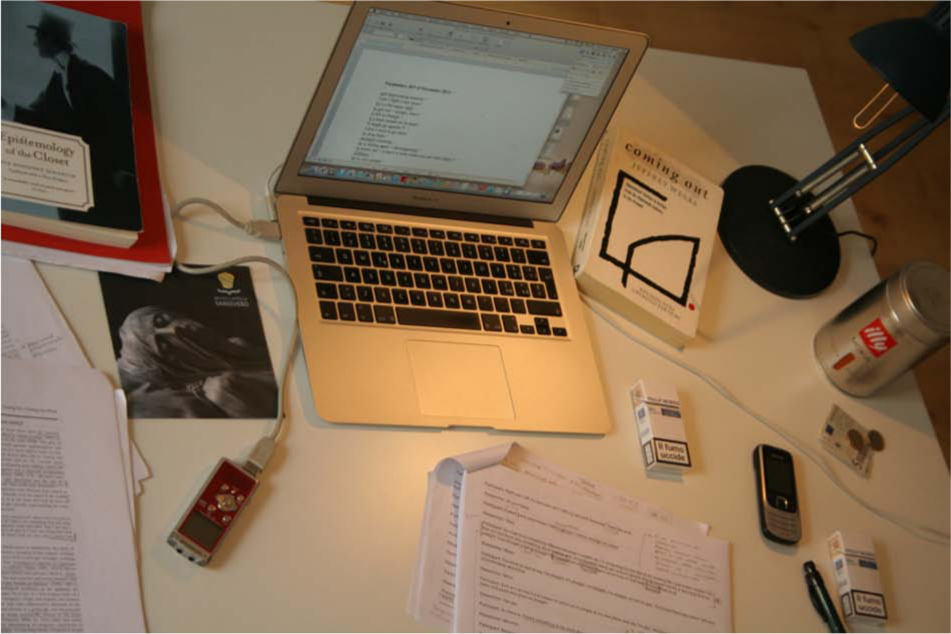
Connections within image I: -technology-transcripts-pen-text-coming out-geometry-closeness-metal-voice-health-light-technology-intimacy-secrets-smoke-money-coffee-images-sculpure-Principe di San Severo-philosophy-epistemology-closet
Data in Manchester
In my research, I have found clues and cues equally interesting not only in the interview transcripts but also in unobtrusive traces (Lincoln & Guba, 1985. p. 333). Living in Manchester for several months I encountered myriad ideas, images, books, TV programs, and thoughts that I find difficult to distinguish, separate, contain, and exclude from the research. I can’t think of the research data as mere transcriptions of the meetings I had with 10 gay men for about an hour, and in which we talked about coming out in the workplace. Some of these unobtrusive traces were built with Huw and others occurred by chance. In Manchester I worked with Huw in both preparing interviews and listening to interviewees. Together with him, I understood the words but at the same time we became sensitive to the intonation, pauses, silences, and noises. And all that became data. What we have done during these moments? It was words on words, sounds on sounds, breath on breath, remembering on remembering, glancing on glancing, laughing on laughing. The text of the transcription became a pretext to speaking and to reconfigure data.
Traditional qualitative research is characterized by an effort to separate, tidy up, cut, classify, contain, clean up, and simplify data. But of course this reduces the chaotic richness of data. Instead if we begin to conceptualize data as movement, as waves and vapors, data become and happen, and we can glance at them in a completely different way. The image that best describes this (becoming of data) is the fluctuating movement of the waves. The wave and vapors extend themselves and potentially return to formations similar to the past, and then again they are reduced in a constant but irregular movement of construction and deconstruction of infinitely new shapes. Similarly, data expand and contract, constantly changing shape and being carried by some invisible forces. Data can hide and open unusual spaces. Opaque data are lowered and stretched both horizontally and vertically. Data pass and envelope us, explode, and shatter: endless particles that become waves and vapor.
Data are oily, opaque, grey, hidden, silent—and now we invite the reader to enter into the silence. Silence is an opaque zone made of broken words, phrases just mentioned, disjointed speech, no words. This work with Huw was a (dis)honest conversation about what surprised, impressed, and amazed us, and we laughed and smiled at ourselves with the interviewee. And listening again and again to our conversations I start to think at what else can be there? (Jackson & Mazzei, 2012). Now, remembering Mazzei, I would like to glance at the silence between words because “What is necessary is a recognition of these silences not just as semantic voids, but as unstated assumptions. What do participants [and we] consider unspeakable, because of what they may reveal about themselves, their prejudices, their ignorances, or their tolerances that perceive as being unacceptable to other?” (Mazzei, 2007, p. 39).
Dis-Honesty-Data
I was waiting at home. I wanted to meet you. I’d been waiting for you all the day and I was savoring the moment when you would arrive. We would be sitting side by side; my body close to yours. A gay male body near a straight male body. We started to hear the voice of another gay man talking about his coming out. Our voices overlapped with his voice, sometimes we spoke all together. We talked as two: him and I. And then as three: you, him, and I. As in a dance our bodies met, fought, and distanced. Suddenly you arrived. I prepared a coffee and turned on the PC. Silence. The tape started and Nicola started to speak again from the point where we had left him.
And there was no issue erm and I think erm the biggest problem I had when I got there was not being accepted as a gay man. It was precisely the opposite—it was the gay women thinking that because I was a priest and because I was Church of England I would be very erm hostile to them as gay women. So once they found out that I was gay they were actually really quite happy.
Yes, yes
And I can remember one or two conversations at the beginning where they were setting traps and they were getting they were talking about their partners and trying to get me to say “oh what is he called?” but of course I didn’t do this.
(Laughs)
Stop the tape! Our bodies started to speak. We smoked.
Ask him how friendly he is with other men, straight men in the prison. He says many of his friends are the gay women. But what about the straight men? Does he have close friends among the men inside?
Yes, yes, yes. But here there is an issue of how. Oh, no, not an issue, it is something we can think about. The friendship between gay men at the workplace. [. . .] He’s not … also because, because I think also a straight man fears in some way a gay man.
Fears a gay man . . .
What do you think?
Possibly. Possibly … I do not know really why, but I think it’s possibly true—or at least they don’t understand them and if you don’t understand something, you don’t understand other cultures, so he fears them, he hates them. You know. Hate—it comes from fear, doesn’t it?
Because you can fear me. You know?
Mm, mm. I suppose I could. I don’t.
No, no, yes but.
I could, yes . . .
It’s a completely alien world. Isn’t it?
Yes.
It’s completely bizarre to a straight man.
[laugh]
It’s true!
[laugh]. I remember once. The first time we met the end of the lesson, at the end of the lesson. You said, you came out as straight to me. You know? You said “I’m not gay.” You needed to say this.
Er, useful information. You know?
[laugh] I’m not arguing, I’m not—
Yeah, yeah—I’m just thinking . . .
You came out as straight. Can I say this? It’s strange.
You can say it. It’s correct English, but I’m thinking about whether it’s true. I mean… It is not the same meaning of come out. Come out means reveal.
Yeah.
You do not reveal that you are straight. Because the assumption is that you are straight.
Yes.
So it is not a revelation.
It is not a revelation.
Go on?
Go on.
Our conversation was opaque. What else can be here–there? What is a straight man afraid of? Were you afraid of me and I scared of you? What did I fear? What was I afraid to tell and to speak of? What could I say or do that you may be scared of me? This dialogue is a splinter clearly still present in my flesh.
“I’m not ….” What I was not saying, doing, supposing, arguing, pronouncing … ? What could I say that could be scary? The silence is a shadow that moves. Silence is a metaphor of the compulsion to not tell, to not speak of the desire and transport, of the will that we can meet each other in intimacy. My body is absent but present in our conversation. Here I’m outing myself. I’m afraid of your refusal, and that the Other [you], might fear the awakening of a homoerotic desire. Silence is also about the impossibility to speak, not only because we can’t say it, but also because we have no words to say something unspeakable, unreasonable, unanalyzable (MacLure, Holmes, Jones, & MacRae, 2010, p. 495).
I’m honest but at the same time dishonest. I live in the hyphen (Fine, 1994) connecting honesty and dishonesty. I was honest while I told you of my research, my life, my coming out at work, my story with Luca and the nuisances I feel. But I was also dishonest (not transparent, not sincere) when, while talking about me, I did not talk about you and me: would the pain of your rejection, separation, keeping distance—would this be unbearable? Only now, when you read this page, will you “discover” something “new.” Is it “really new” or it is only something that we never were able to pronounce? We never had the courage to speak about? Other data have moved in the space represented by the slash, the hyphen, the parentheses—dis/honest, dis-honest, (dis)honest. Data move in the interstices and live “in-between-ness” (Atkinson, 2001; MacLure, 1996); probably they live in the hyphen too, and to accept this opens up new possibilities for data. This space is risky but often overlooked.
Crafting Splinters
I was Angelo’s English teacher. Our lessons focused initially on his research project, but quickly became a project within a project, as we realized that we were part of the data we were discussing. We would listen to some data and deal with any language issues, then consider how the data fit into the larger body of data; our conversations ranged widely over topics such as national cultural differences, homosexuality and heterosexuality, gender, families, data, history … Angelo would regularly reraise issues we had discussed, and these often revolved around words.
The standard transmission model served fairly well at first. But over many hours of Angelo insistent questioning of certain words, I became less and less sure of what I was doing. Very often I would explain some words and the lesson would finish, only for me to discover later that the words and my poor explanations were like splinters, broken away from their context and lodged in me.
An example is “closet.” Our discussion of this term was initially phonetic (/klɒzit/ v /klƏʊzd/), semantic (closet v cupboard), grammatical (adjective v noun); then it dealt with translations (armadio, credenza, privato). But on a wider scale, our discussion illustrates the move from the isolation and fragmentation of a lexemic, “public property” view of word meaning, to a phrasal, holistic, shared negotiation which invokes our joint assumptions about sexual identity and is contextualized in history. I didn’t realize that I didn’t “know” this word, until we reinvented it together.
My “explanations” became wilder, less guarded, more subjective. The process forced in me a realization that we don’t actually know words, or if we do then at least such knowing is little more than a metaphor for our imperfect and fragmentary usage of them. Gradually this idea transferred itself to data, rather than just words, and I found myself all at sea: fallen overboard, scarily afloat, watching the lights of the ship recede. But my fear also receded, and it became clear that this admission—that I didn’t know, and couldn’t know—enabled another kind of vision. The English idiom has it that “you can’t see the wood for the trees,” that a certain distance is necessary to see the whole object. But, on reflection, perhaps this is wrong; the wood is perhaps only trees, an illusion caused by distance.
Angelo was my mentor in this discovery. And the experience of finding that I was part of Angelo’s data set—in fact, that it was not Angelo’s data at all, but ours—was a revelation. And gradually we found that our focus was less on the original data set and more on the new data—the data that included us. Splinters are pieces broken off from a larger body [of data]; pieces of us. This larger thing is too big or too smooth to damage us, but by breaking away a splinter becomes able to pierce our flesh. Splinters remind us that we cannot be wholly separated from the world. The original splinters for me were words, which stuck into me and refused to leave me alone 1 . The splinters—of data, from my perspective mostly lexical—led us to a larger body of data. This is a much less manageable forest, indeed it is more like a wildwood (Rackham, 1990), but it is more interesting for us being inside it.
This experience of data has altered my interior discourse about heterosexuality and homosexuality. I have also been led (forced?) to “reimage” previously unexamined words and phrases, and confront their known and unknown connotations; this process has made me review my beliefs about the ways in which we negotiate word meanings. I started to learn a new language—not Italian, but still a true interlanguage, which can be used to genuinely communicate and construct meaning. I was not expecting this to happen. I find myself remembering and reexamining ideas that made little sense earlier. I no longer look for the wood, I am one of the trees: I am part of the “vanishing story of a girl / and a fox lost for words / in the secret forest” (Clarke, 2009, p. 63).
Secrets-Data
So do you remember any time when you spoke about the fact that you were gay? You don’t use gay, but . . .
Everybody seems to know, it’s like . . .
Everybody seems to know. Yes, yes. And so for example you say that you speak about your partner and er nothing else happened so . . .
No, it’s completely accepted. Because I think that everybody, you know national ideas, the ideas have changed. Maybe fifty years ago. Because homosexuality was illegal fifty years ago. Erm they would report you and you would be fired from your job. But now it’s, people know that it’s fine and sort of modern culture and society has almost fully accepted it, not completely but I think it’s fully accepted it. There’s a difference. I notice a difference when I was younger and when I was a child and if somebody was gay in the news or something like that my parents would say. My dad, my dad used to say “he is a woolly woofter!,” because it rhymes with “poofter,” which means gay.
Ryan’s “woolly woofter” recalls the (supposedly) secret code described by Primo Levi, whose family used a Piedmontese-Hebrew hybrid jargon for its dual “advantage of not being understood [and] of relieving the heart without abrading the mouth” (Levi, 1984, p. 10). My own parents regularly used such a code to say the unsayable: closeting aspects of adult experience felt to be unsuitable for children: innuendo, “bad” language, some jokes, references to sexuality. This mixture of ultra-formal English, rare words and slang, with occasional French phrases, were inevitably combined with the giveaway knowing glances and raised eyebrows which allowed us children to interpret the broad sense with ease. Of course we understood! But we did not and could not admit this; by acting down we could enjoy our secret access to their supposedly secret discourse—to confess would have been to break the rules of the game. The code-breaker cannot let the code-setter know the code is broken; all parties are complicit in the dialogue of secrecy.
And now I do much the same with my own family. Woolly woofter has gone out of currency, but other phrases have taken their place, and so when I watch TV with my family, a glance will sometimes pass between me and my wife, followed by: “Do you think he/she is ….” Thus my wife and I construct a kind of closet, and reaffirm the values the closet represents. Sometimes our values of what should be (un)expressed differ, and she exerts a kind of closeting pressure on me: she tuts or pulls a face when I have stepped outside the boundaries of what is acceptable.
How does this pressure construct and maintain the rules? Who sets the rules? Do we inherit the pressure from our parents, or is it a by-product of having inherited a similar set of operational rules for child-raising? But of much greater importance to our research is how the examination of apparently uncontentious data—Ryan’s biographical narrative—demands that we examine our own life stories. We first talk about the data; we then (re-)consider our own narratives; and our self-examination and reevaluation leads us to view the original data anew. To put it bluntly, the data is always skewed, moving, corrupt; there is no data until we read it. So data is not distinct from us: instead the data appears to absorb us and shift its form to accommodate our own teasing and worrying of it.
I ask myself whether my own daughter also hides behind our poorly constructed protective smokescreen, whether she is aware of what our coded signs really signify. Angelo asks the same question about Marco. I can guess what my daughter knows; but I am much closer to actually knowing that she is not going to tell me, not now at least. I’m more certain of the role our version of Levi’s lasson acodesh, the secret tongue, plays in the transmission and maintenance of the established order. But now I ask, what are the secrets that are (not) being told in my family through our use of the “secret” code? Does our adult jargon really serve to keep secrets from our daughter, or from each other—or from ourselves?
Nobody has access to the “secrets” of language which lurk behind all linguistic signifiers and interpretations (see Derrida, 1997). Language and texts [similar to data] have referents, an assumed correspondence to reality, but these referents are never really what they appear to be: instead they carry secrets and the seeds of their own deconstruction. Derrida argues that there is no “reference without difference, that is, without recourse to the differential systems” (p. 80). Derrida emphasized both the telling and the not telling. In order to experience or have a secret, one must tell the secret to oneself. One needs to frame the representation of the secret to oneself before one can tell it to others (Derrida & Ferraris, 2001). This representation creates a trace of signifiers that in principle are sharable, and if the secret is sharable it is always already shared. The paradox of speaking but being unable to say, sharing what is not shared, knowing in common that we have nothing in common—these exemplify secrets as conceptualized by Derrida and Ferraris (2001). Taking up an issue with the concept of secrets is a strategy for Derrida; a strategy of deconstruction, unseparation, and nonisolation. Derrida preferred not to create separation between secret as he conceptualized it and other things generally called secrets. “I have a taste for the secret, it clearly has to do with not-belonging … belonging—the fact of avowing one’s belonging, of putting in common—be it family, nation, tongue—spells the loss of the secret” (Derrida & Ferraris, 2001, p. 59).
In this article we have spoken of data while recognizing our inability to say anything about it. Similarly, we tried to show belonging and not belonging with data and traditional notions of data. Maybe we lost the data altogether or data has already moved elsewhere, becoming full of new silences, secrets, and splinters, losing the reader and misleading the creator.
Lost in the Afterthought

Footnotes
Declaration of Conflicting Interests
The authors declared no potential conflicts of interest with respect to the research, authorship, and/or publication of this article.
Funding
Angelo Benozzo received financial support for the research from University of Valle d’Aosta.