







Abstract
In an attempt to disrupt arts-based research methodologies that simply fold “art” into its midst, our article enters into the theoretical conversations around critical and materialist research-creation to explore the concept of diagramming as self-organized enfoldings that do not describe or instruct experience, rather they are expressed as an open process that is emergent, vital, and abstract. The purpose of our article is to unfurl a theoretical discussion about materialist diagramming through the concepts of pure edging and cutting. In laying out this theoretical framework, we simultaneously consider how we engendered the diagrammatic within a research-creation project on artist-residencies in schools to offer ways in which one can enter into such a methodology and engage with it as data-in-the-making.
Introduction
There is a robust history of arts-based research methodologies within education. The field has proliferated a significant number of methodological approaches that aim to bring together the process of artistic activity with social science methodologies. In Canada, our largest academic funding body the Social Sciences and Humanities Research Council, as a move to acknowledge that artists teaching in universities were engaged in research and yet required a distinct category and criteria by which their work would be accessed, adopted the term research-creation. This move opened up the ways that research methodologies had previously been framed and accounted for. However, the formal adoption of research-creation did not invent new ways of thinking research, but simply folded “art” into its midst. Thinking critically about research-creation, Manning and Massumi through their work at the Senselab in Montreal have pushed the boundaries of research-creation, re-conceptualizing the “term” beyond simple delineations that recognize the intersections between art practice and research methodology. Manning (2014) argues that current models of research, including most arts-based research, separates matter from perception, which leads to a fragmentation between awareness and the activity that generates awareness. As such “[w]hat emerges is an account of experience that separates out the human subject from the ecologies of encounter” (Manning, 2014, p. 3). This disciplinary model in which the phenomena of research and the knowing subject are separated shapes knowledge as static, fixed, and organized according to pre-formed categories. In other words, positing the conditions or terms of research before the exploration or experimentation “results in stultifying its potential and relegating it to that which already fits within pre-existing schemata of knowledge” (Manning, 2014, p. 4). We must, Manning contends, find ways of activating thought that is experienced rather than known, that is material and affective, and where experience accounts for “more than human” encounters.
In the social sciences, this turn to materiality has shaped new frameworks for thinking about qualitative research. Referred to as “New Materialism” or Deleuzian methodologies, the broader engagement with materialist, vitalist, and posthumanist research has included the Baradian (Barad, 2003, 2011) notion of “cut” and also concepts such as “contrast” (Manning, 2013), “objectiles” (Rotas & Springgay, 2014), and “the figural” (Braidotti, 2002) to think ontologically about research. Entering into these theoretical conversations, this article explores the concept of diagramming within materialist research-creation. While common understandings of diagrams refer to a broad variety of schematic images—graphs, charts, anatomical images, working drawings, and so on—diagrams informed by Deleuze, Guattari, Deleuze and Guattari, Manning, Massumi, and Barad are self-organized enfoldings that do not describe or instruct experience, rather they are expressed as an open process that is emergent, vital, and abstract. Abstract because there is always more to an experience than can be perceived. The purpose of our article is to unfurl a theoretical discussion about materialist diagramming through the concepts of pure edging and cutting. In laying out this theoretical framework, we simultaneously consider how we engendered the diagrammatic within a research-creation project on artist-residencies in schools. Our intent is to perform within the article a diagrammatic procedure, to enter into the theoretical framework “in action,” by examining a diagrammatic approach to “data analysis.”
In the first section of the article, we describe the research-creation project and the problems we encountered in approaching the data through humanist qualitative methodologies. We highlight our struggles with early attempts to “diagram” our data and contrast this with deleuzeguattarian theories of diagrammatic practice. From here, we engage in a more deleuzian approach to diagramming through Massumi’s (2011) concept of “pure edging.” Pure edging is the overseen, the more-than intensity of perception. It is the anticipated next, which enables newness to come into existence; the “more-than” of data. We frame our theoretical discussion of pure edging through a series of images that emerge not as static visual representations of the larger research-creation project, but at its limits and as new modes of thinking about data-in-the-making. In the final section of the article, we turn to Barad’s concept of agential cuts to continue to consider what it means to perform a materialist research-creation methodology. Cutting is a process of entering data to disrupt stratifying tendencies. Cutting does not merely separate data into parts that comprise a whole, rather cutting is a practice of interference. Materialist diagrammatic methodologies of research-creation, we argue, is an orientation to research that finds itself entangled in the middle of data, forcing us to think about data-in-the-making.
The Research Context: Entering Research as a Problematic Field
The Pedagogical Impulse (www.thepedagogicalimpulse.com) is a multi-site research project, which explores how social practice artists working in schools can create the conditions for innovative pedagogical change and how these conditions can be sustained in education. As a site for artistic-research in art and education, the project has initiated a number of experimental, critical, and collaborative projects including a series of artist-residencies that take place across a number of educational sites in Toronto, Canada; a living archive of interviews about art, pedagogy, and knowing; an approach to curricular experimentation as “curating”; ongoing discursive events that employ different forms of action and critical reflection; and the development of research-creation as a materialist methodology.
Each residency was developed by an artist (or in some cases two artists) in collaboration with a classroom teacher and participating students. Over the 2 years of the project, 12 residencies were curated in total. Each residency was unique to the school and varied in duration and execution. The residencies took as a starting place social practice art work that is non-object-based, is embedded in artistic-research facilitated by artists in collaboration with participants, and that is concerned with advancing pedagogy and/or knowledge production. In social practice, the coming together of artists and participants produces variations that are infinite. As this work proliferates, it does not tie back together into one particular form. In opposition to art that is brought into a classroom from the outside, as a concrete form, social practice art resides in the milieu, where students, classroom, artists, and art are not distinct from one another but mutually intra-active agents (Barad, 2011).
Following social art practices, the artists did not approach the residencies with pre-established art projects in mind nor a set of technical skills they wanted the students to master. There were a number of “ideation” days prior to the artists moving into the classrooms, thereby enabling ideas, concepts, and potential nodes to emerge. Nodes activate movement and distil it—individuate it—into something possible. The idea of nodes has proven fruitful to our emerging methodology, and we draw on Deleuze and Guattari’s notions of partial objects here. Partial objects, like nodes, infer gaps and assemblages, but they are not isolated and fragmented from each other. Rather partial objects are “pieces of a puzzle belonging not to any one puzzle but to many” (Deleuze & Guattari, 1977/2009, p. 43). Partial objects refer to a whole that is neither unified nor totalizing, but which establishes “aberrant paths of communication between noncommunicating vessels, transverse unities between elements that retain all their differences within their own particular boundaries” (Deleuze & Guattari, 1977/2009, p. 43). In other words, our understanding of nodes as partial objects gave dimension to the ecologies that were in the making, and, simultaneously, created reference points to help us understand the residencies as expressions of data-in-the-making.
The residencies are only one node of the research topology. They exist, we contend as research-creation in their own right. Our focus in this article is not on the materialist methods at stake in the residencies, but how as a research team we engendered materialist “data analysis” after their completion. What kind of field did the nodes co-compose? During the residencies, we collected digital images of the artists and students composing together. We used researcher journals to record observations paying attention to sensory qualities, problems, and questions. We interviewed the teachers and artists at a number of points throughout the residencies, and used student writing, student blogs, and whole class discussions to record student ideas and thinking. These more “traditional” qualitative methods are not intended to be more rational, representational, or formative models that diminish the artistic-research. Rather, we approached each of these methods with the aim not to use these methods to validate or generalize the artistic work produced—but “rather discover conditions for the production of something new, to be creative . . . in order to extract from them new, non-pre-existent concepts” (Semetsky, 2006, p. 2).
As the residencies in Year 1 ended, and a second year of research-creation unfolded, we found ourselves overwhelmed by the idea of what to do with it all. Thinking ethnographically about the “data”—the hundreds of thousands of digital images, the text-based work, the hours of interview transcripts—not only presented an impenetrable wall of “data” to code or thematically analyze, but further conditioned “art” or the “creative production of the new” as something that existed outside of research; as something that research was to be applied to in discrete ways. Similarly, ABER’s (arts based educational research) constraints of representing research as an “art” form seemed to map already existing frames of reference onto our “data.” What was needed was a methodology that understood “residencies” as “vital research,” and as expressions of data-in-the-making.
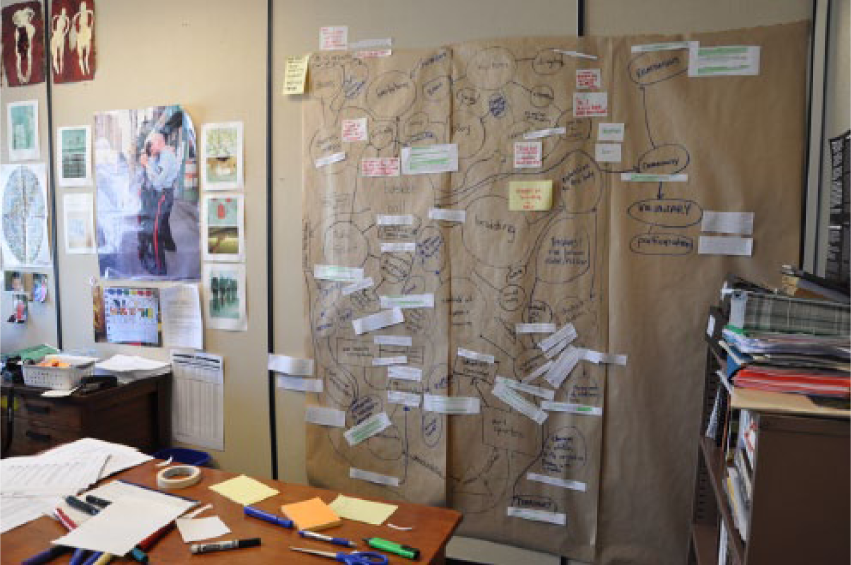
In our first attempts to diagram out the residencies, we drew on large brown craft paper, cut into copies of transcripts and other text-based material, while also linking what was happening on the plane of brown paper with the plane of a laptop situated nearby containing the hundreds of thousands of images from the residencies.
The exercise tore apart the residencies, but as an activity of analysis, it also proved awkward and somewhat static, when what we were aiming for was movement. For some members of the team, the diagramming was alienating, as they were just entering into the research project, and for others, it seemed restrictive and simultaneously overwhelming. The amount of data we had collected only seemed to grow. In fact, these diagrammed “maps” of data seemed more in-line with traditional “diagramming as capture” techniques and qualitative semi-structured coding practices, where words, phrases, and images were mapped onto each other through given corresponding categories. Often when researchers generate excessive data, particularly using digital images and videos, coding practices make wading through the data manageable. Although coding may produce generative and exciting research results, our materialist leanings demanded that we not think about a separation between theory and analysis. As Jackson and Mazzei (2013) note, there can be a tendency in qualitative research to frontload theoretical frameworks and then present what is “found” in the data in subsequent sections of an article or a thesis.
For example, if someone wrote the word “perspective” on the brown paper, others tried to find occurrences of perspective in transcripts, field notes, and in the images. In other words, the proposition being put forth, “perspective,” had to have a referent located somewhere in our data, which further implied that the data were already coded with latent meaning. As Deleuze (1988/2011) writes, “That is the essence of the concrete method. We are forced to being with words, phrases and propositions, but we organize them into a limited corpus that varies depending on the problem raised” (p. 16). In drawing on the brown paper in this way, we were approaching the diagram as a drawing or a figure that visually conveyed an idea (Knoespel, 2001). Our efforts seemed to insist on the diagram being a thing that we, as researchers could instrumentalize. This was in opposition to the deleuzian diagram that we were interested in experimenting with. Rather, we wanted to think about diagramming as a way “to push the concepts with the data to exhaustion” (Jackson & Mazzei, 2013, p. 139).
Deleuze and Guattari (1977/2009) refer to diagrams as “abstract machines” and argue that a diagram does not represent a real, but rather constructs the yet to come. In other words, diagrams are not representations of thought, but thought itself. De Landa (2000) argues that a deleuzian diagram is not an organized form of inert matter, but rather “matter is already pregnant with morphogenetic capabilities, therefore capable of generating form on its own” (p. 34). In this way, diagrams are not ways of organizing matter, but emerge from within matter itself. Ednie-Brown (2000) suggests that given the diagram’s relationship to thought in action, they “should remain invisible—or undrawn” (p. 72). What we realized was that deleuzian diagramming meant we had to abandon the brown paper constructions and think more performatively and materially about diagramming. Moreover, we realized that the drawn diagram simply reinforced what St. Pierre (2013) calls “conventional humanist qualitative inquiry” (p. 223), which produces “brute data”—data that does not require theoretical interpretation because it can “speak for itself” (p. 225). In shifting from a diagram as a representation of thought to thought in movement, we turned to Massumi’s notion of pure edging and Barad’s agential cut to assist us in our next diagrammatic practices.
We’re Just-Beginning-to-Stir: The Diagram as “Pure Edging”
Massumi (2011) describes pure edging as a “[v]irtual line . . . [a]n insubstantial boundary, itself imperceptible . . . which does not effectively enclose” (p. 89). Pure edging refers to affective perception. In pure edging, we rearrange the habitual order of sensation. Perception is no longer about capturing something, but emerges as a quality of expression. Massumi asserts that it’s not about data being perceived as already formed or given, but rather data appears as a sensation of an enveloping edge that folds the body into it. What passes as perceived is just a fraction of the excessive potential immediate to perception. In other words, pure edging does not dispense with traditional data, but rather, pure edging embraces the limits of data as a site of creative intervention. For example, a transcribed interview would not be used to code the events of the residency, extracting information based on latent meanings. Rather, pure edging offers the transcription a new life outside of its coding function. It does so by asking us to pay attention to what is not being said, to disjunctions, paradoxes, and contradictions. In signaling us to this imperceptible space, to the residues of the interview, pure edging is not meant to “fill in the gaps of absence,” but rather, creates an event where new concepts can emerge. The transcription then has the potential to become something more-than, opening us up to a process of questioning that pays attention to the edges of representation.
Pure edging connects what it separates, intra-acting surfaces which “bifurcates into a perceptual contrast between co-present and disjunct elements” (Massumi, 2011, p. 90). This echoes Elizabeth de Freitas’ (2012) work on diagramming. She writes that diagrams function as a “breaching experiment . . . inviting the reader to break with the usual diagram conventions and imagine a new diagramming practice that might better address the irregular and asymmetric tangles of interaction” (p. 589). In our weekly meetings, the weight of trying to find meaning in the data, and the pressure to connect various nodes through themes or across meanings, suddenly seemed to shift. Instead, of brown paper diagrams, the images and the readings reverberated. The nodes no longer needed to connect in a unified whole, but rather existed in “intensifying edginess” (p. 91). We were no longer searching for meaning or connective threads between the partial objects, rather we allowed the edging to occur, which as Manning (2013) argues, makes partial objects “more energetic than object-like” (p. 74). As movement, as occurrence, the nodes of the research are neither object nor subject but event (Manning, 2013). Thus, the various diagramming we had orchestrated became “less of an organization of bodies than a cartography of incipient tendencies, of force of form” (Manning, 2013, p. 81). Rather than looking at the whole of the brown paper and its connective lines we focused on the pure edge of data. Choosing a micro-event to focus on, Olsson (2009) claim is to “draw as much as possible out of what seems to be a tiny little event,” which “gives one a better chance to see all the singularities” (p. 120).
Experimenting creatively with the images and the other residual artifacts from the residencies required an extension of material and affective linkages of perception. Rather than approach an image for what it might contain, we allowed it to live a new life, one that implicates us. In other words, in letting go of our desire to capture these images with pre-formed humanistic categories, we learned to think about the images as more-than. In learning to pay attention to the edges of representation, we simultaneously let go of our desires to instrumentalize and impose meaning on the images, and found the audacity to entangle ourselves with the data-to-come. Pure edging, we contend, has great implications for the “dissemination” and “representation” of critical research-creation. It offers us a way to address the relation between contemporary art, images that exist as residue from contemporary social art projects, and bodies without taking either as a predefined entity. In other words, pure edging deals with the problem of documentation performatively and materially by opening up the confined spaces of representation to open fields of experimentation, where we are all implicated. Pure edging helps us to consider “data” as open-ended assemblages—compositions of varying material, social, and pedagogical forces—and provides a way of thinking about data on the level of emergent perception. Thus, pure edging is both a form of resistance to naturalizing and totalizing modes of representation, and an activist philosophy that opens up data to “the appearance of the novelty astir in it” (Massumi, 2011, p. 5). This challenges us not only to do research differently, but also to represent and articulate our research differently. Sometimes, opening up data to its edginess means resisting traditional modes of representation, modes of representation that “capture” an event either through attention to detail or through a totalizing perspective that encapsulates a story. What does it mean to resist such representations that lead to “brute data”? Often in resisting something—in choosing not to do something—something is created. So what does it mean to challenge all-encompassing representation? How do we represent the edginess of data—the very event that resists representation? How can an image perform its materiality? One way to think about this is to think about the potential for an image to call attention to its mode of perception. This means that the viewer shifts from asking: What am I looking at? to How am I co-composed at the limit of this image? Pure edging as a sensation of an enveloping edge of vision arises through folding the body right into the data field, and as a result, opens up the perceptual ecology, rather than foreclosing it. What passes as perceived is just a fraction of what is possible.
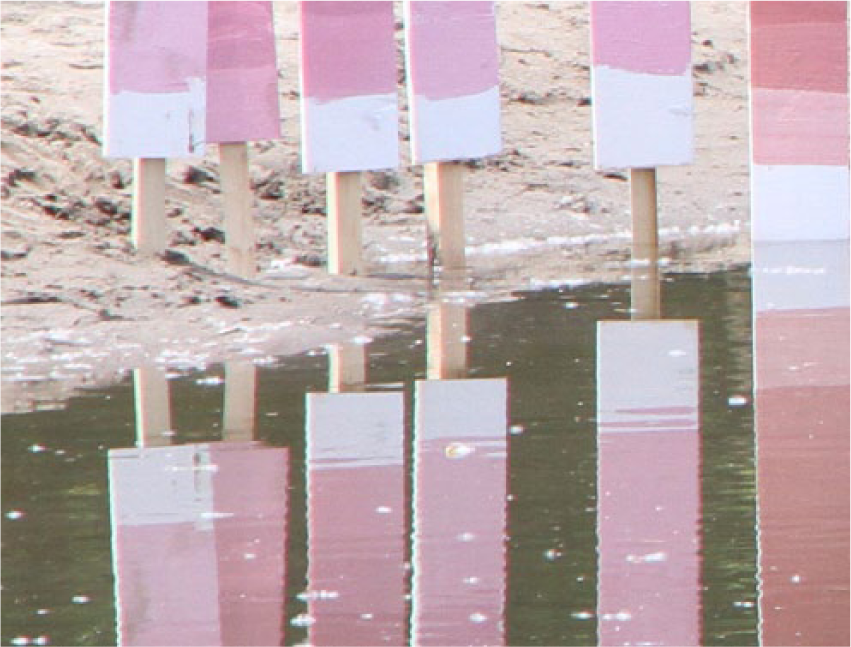
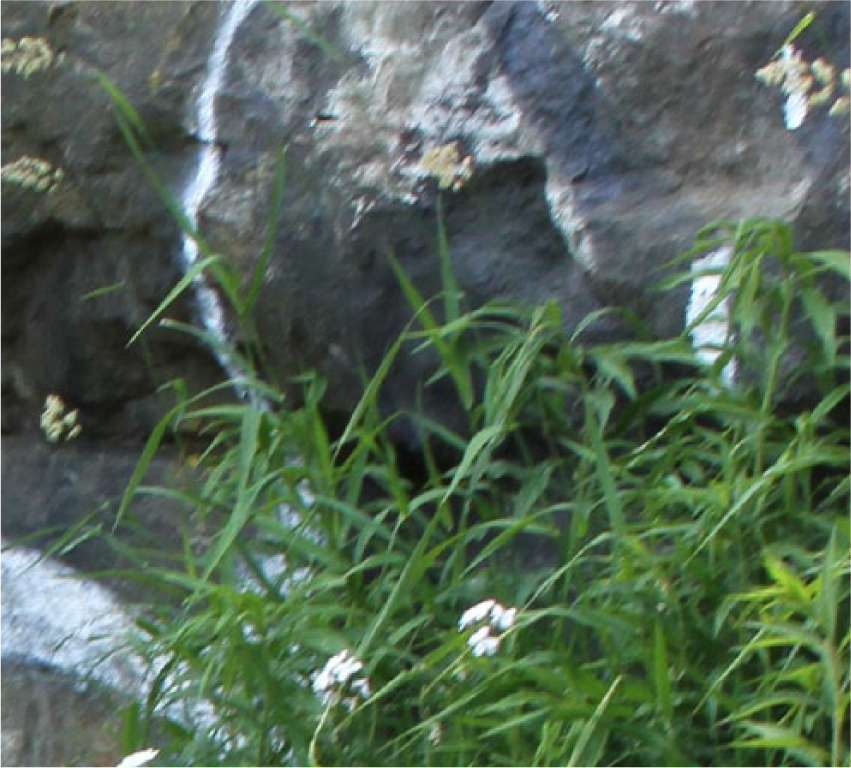
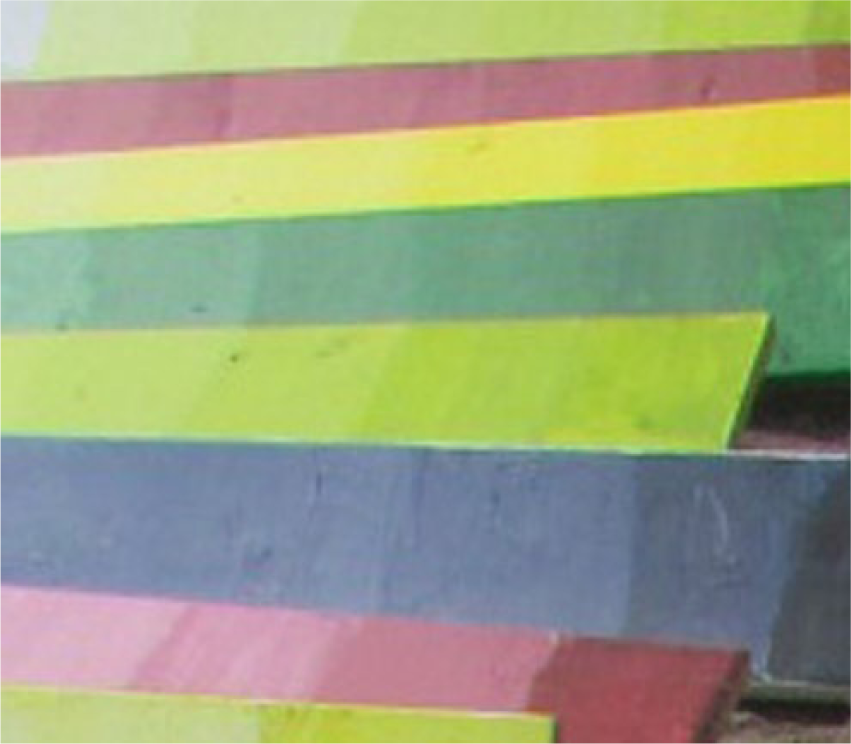
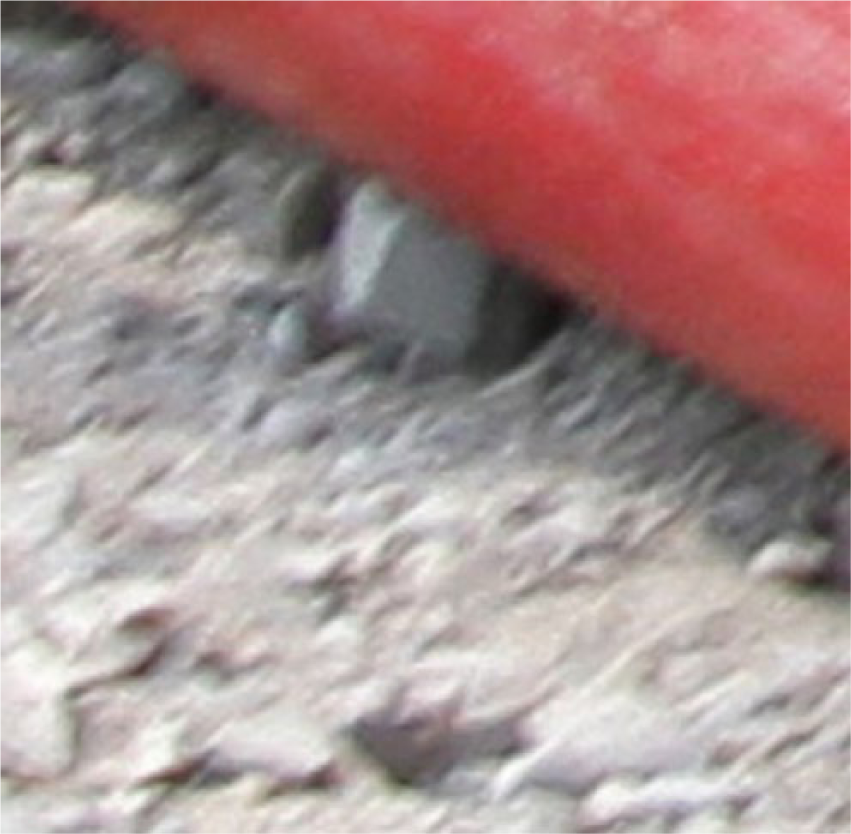
One way that we thought about doing this is to make the images from the residency unfamiliar, disrupting the viewer’s desire to have the image speak for itself. Going through our image bank, we selected a segment of video and cut into them. We focused on matter, by framing the places where different materials touched. This focus on materiality allowed us to enact pure edging, to open up the photo to something more, inviting the viewers to “energetically play out” (Massumi, 2011) form and content so that they can perceive different possibilities.
Moving our diagramming off of the brown paper and toward the pure edging of the data itself required us to think about all of the edges in the video segment as intra-active agents affecting and being affected by each other. This, Manning (2013) contends, means that when you experience it “you can’t quite say where it began or ended, but you can recognize it as a rare example of a work outdoing itself” (Manning, 2013, p. 102). It’s not the form that matters, but its capacity to alter you, to undo you, to move you toward the edging, and thus shift figure and ground.
In further thinking about pure edging, we have shifted from simply reproducing video stills in this paper, which we felt would return us to our earlier attempts at “diagramming as capture.” Instead, we have “created a new” entering into the edges of our data. In doing so, we are reminded of Deleuze’s (1988/2011) words that “micro” does not simply mean “miniaturization of visible and articulable forms; instead it signifies another domain, a new type of relations, a dimension of thought that is irreducible to knowledge. ‘Micro’ therefore means mobile and nonlocalizable connections” (p. 62). The images presented in this paper engender a tentative approach to analysis wherein we begin by beginning again, “differently, impossibly, impractically. It is to begin not with form but with the force of the more-than as articulated by the welling diagram the event calls forth” (p. 147). In this instance, diagrammatic praxis is about “circulation and modulation” (p. 147), or what Manning (2013) contends is their political potential.
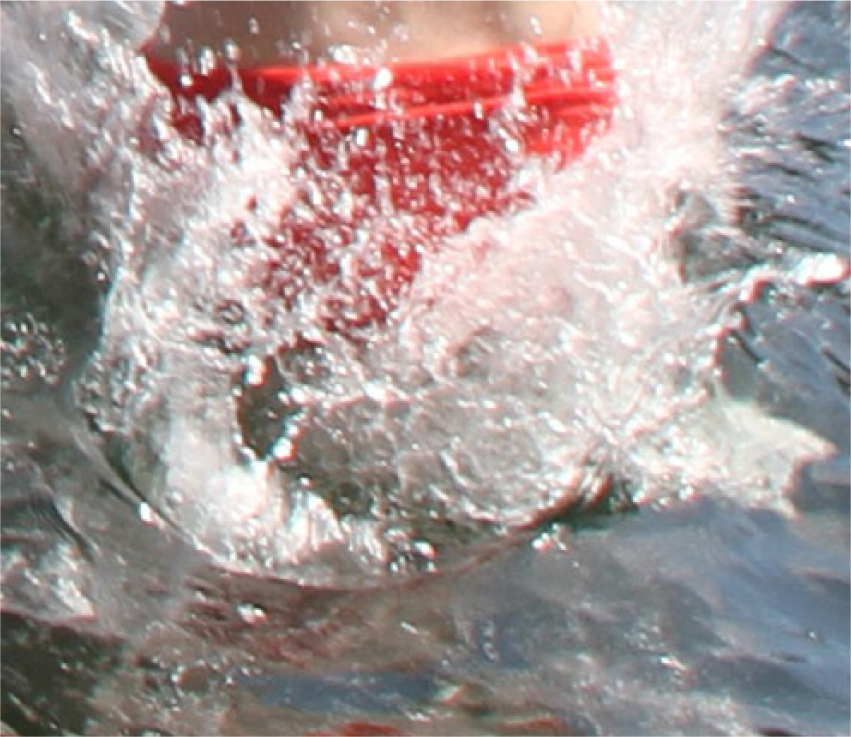
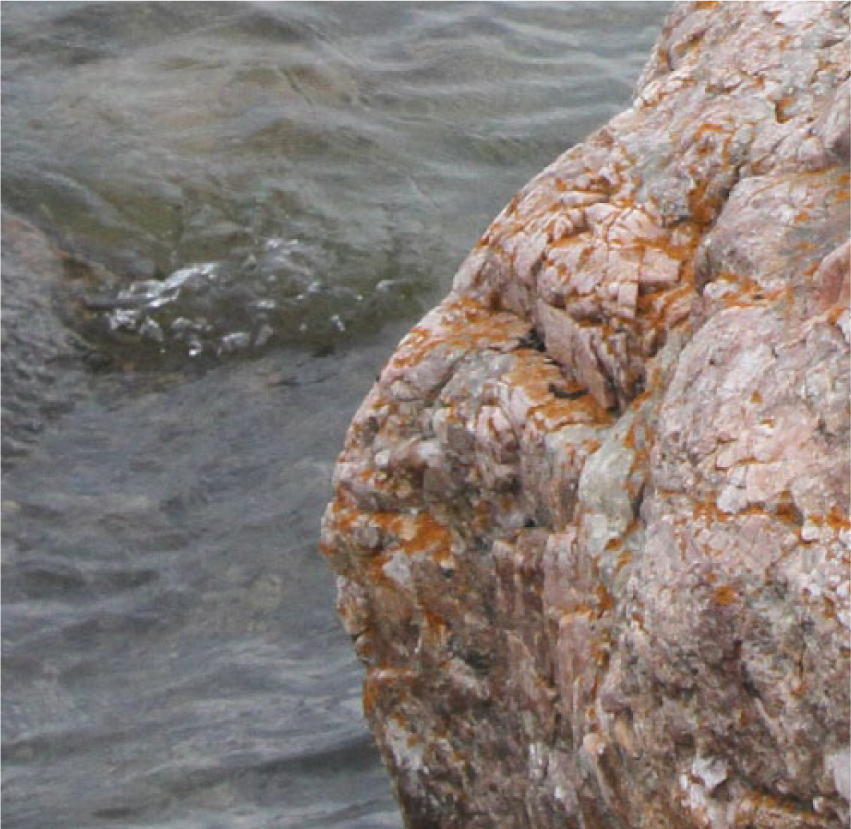
This political potential does not emerge “from the representation of a given content, but through the event’s challenge to the very idea of form” (Manning, 2013, p. 142). In other words, the visual images do not represent a political moment. Rather, they carry the potential, the in-formation of a politics-to-come in their unfolding. This resonates with Deleuze’s (1988/2011) writings on the diagrammatic, which he contends is a relation of forces, where things and perceptible qualities are understood in relation to their productive conditions. He writes, We can therefore define the diagram in several different interlocking ways: it is the presentation of the relations of forces unique to a particular formation; it is the distribution of the power to affect and the power to be affected; it is the mixing of non-formalized pure functions and unformed pure matter. (p. 61)
Our new images function as pure edging, orienting us toward new positions, bodies, and forms as more-than. Hultman and Taguchi (2010) would argue that this intra-activity “simultaneously ‘pose questions’ to each other in the process of trying to make themselves intelligible to each other as different kinds of matter involved in an active and ongoing relation” (p. 6). Thus, the co-compositions of bodies, sand, canoe, cameras, and so on, become a problematic field, whereby problems and solutions do not have a one-to-one correspondence. Manning (2013) refers to intra-acting ecologies of existence as a political question. She writes that co-compositions “coevolve in the realm of the more than human. Politics as an aesthetic-ethical engagement with the forces of becoming that are fleetingly perceptible in an event’s dance of attention. Politics that contains in itself a power of amplification” (Manning, 2013, p. 148). As our diagramming moved away from a collage-like representation of our data (diagramming as capture), toward a new way of thinking about our material as engendering a politics of procedurality (diagramming as pure edging), we released the residencies from latent understandings in favor of a relations of force “which ceases to be translation in order to become expression” (Deleuze, 1986, p. 96). In other words, we began to think about our material as duration, carrying with it the potential to outdo its structure and to become more than brute data.
Cutting Together-Apart: Creating Data Through Agential Cuts
As we began to come to terms with the ways in which we were becoming with the data, accepting the labor of constantly beginning our data-in-the-making, and becoming more comfortable with the discomfort of newness, we were still haunted with the question of humanist research that distinguished data as something outside of or beyond the researcher. Returning to the concept of a residency, the research team felt that creating our own residency with the data might offer a more materialist approach to diagramming. The pure edging images, we argued, needed to be cut into again. Thus, we created our own residency alongside Twelve-Mile Bay, a natural inlet that spills out of Georgian Bay and cuts into the heart of southwestern Ontario’s cottage country. After a 2-hr drive from the concrete jungle of Toronto’s urban sprawl, we finally arrived at what would become the site of our 4-day research-creation event. With no real predetermined itinerary or agenda in hand, with no preconceived notions of what our retreat would look like or do, we were forced to begin with the more-than of our research topology. Leaving behind the brown craft paper, we began cutting into the unique ecology that was hosting our stay. Upon the decision to take a boat trip along Twelve-Mile bay toward the mouth of Georgian Bay, before we even knew it, we took the “first” cut into our data-in-the-making. Piling into the wobbly yet hardy aluminum fishing boat, with each step being met by a dense and vibrating surface sound, we moved into the water notoriously known for its unpredictability. What is often called the sixth Great Lake, Georgian Bay acts as its own node, creating its own weather, waves, and currents. As we moved into the body of water, we became entangled with its dynamic material—as we were cutting into the water’s rhythm, the water was simultaneously cutting into us. Our movement was differentially constituted, or what Karen Barad (2011) would understand as a materializing practice of differentiating, “where one cannot take for granted that all the actors, actions, and effects are human” (p. 124). Cutting into the bay with the aluminum fishing boat, we created an agential cut, effecting a separation between “subject” and “object,” a separation that has its own ontology (Barad, 2011). Similar to Deleuze’s (1986) notion of montage, the agential cut as an act of cutting things together-apart in one movement can be understood as an image of time, a diagramming between subject and object, that “constantly produces itself and grows” (p. 37). Cutting, Barad (2011) contends is a practice akin to diagramming and pure edging in that it is not an activity that simply severs a part from a whole, but engenders a discontinuous passage where something new emerges. Thus, our cutting-as-boating became a further diagram of the research project. As a diagram our actions could not be captured, as they couldn’t occupy the same place at the same time. They could not be represented and therefore could not be repeated. Our intra-action with the water cannot be measured, and in the same way, there is no measurement that can identify where these intra-actions happen. There is no map of these cuts for they are performed, and as such, are deterritorializing. However, if we think about our actions diagrammatically, then perhaps we can think about our intra-action as not representing the territory, but constructing it—“following the affects and percepts in their twisting, braiding, and knotting emergence” (de Freitas, 2012, p. 594). In fact, at some point in our boating trip, the nautical map failed us and we had to rely on our senses to maneuver around the unpredictable currents and hidden boulders. Similar to the diagram as capture, the map was unable to represent the hidden nodes that were boiling to the surface: we had to entangle ourselves within the material, so that we could feel our way through. In the same way that the cuts into our data queered our research, our cuts into the bay troubled our understanding of nature as pristine, immediate, and pure—as something that a map can represent. As a result, the water became what Morton (2010) calls a strange stranger, “whose arrival cannot be predicted or accounted for” (p. 277). By cutting into the water, we moved through our differentially constituting entanglements, a movement that constantly comes back through and builds upon (leaps from) cuts that it creatively leaves behind. The traces of these cuts and their residual material can be found within the movement that it constitutes, within the act itself.
We were becoming diagrammatic, embodying Deleuze’s (1986) notion of the diagram as abstract machine, a “map of relations between forces, a map of destiny, or intensity, which . . . acts as a non-unifying immanent cause which is coextensive with the whole social field” (p. 37). Our trip into the waters allowed us to experience what it means to give up our pre-formed humanistic categories, encouraging us to displace our humanist notions of control, discovery, and agency, so that we can think ontologically about research as enabling “concrete assemblages that execute its relations; and these relations take place ‘not above’ but within the very tissue of the assemblages they produce” (p. 37). Thinking diagrammatically about our boat trip, we realized that the process of pure edging as a way to think about our research analysis extends into and is taken from our everyday experiences of being in the world. Agential cuts enact a pure edging that helps us to pay attention to relationality and the generative potential of being matter. These intimate explorations of our everyday activities enact a pure edging that had great implication in thinking about research-creation as ecologies of encounter; as political potential. To the same effect, thinking about data as its edginess holds potential ramifications for our everyday ways of being in the world and being with human and nonhuman matter.
In the following days, we swam, we cooked, we hiked, we ate, and we collectively read together. No longer restricted by space or time, our four-day retreat opened up a field to think about how research happens and to feel the edginess of data, or what Massumi (2011) would call “the feeling it has of participating in itself” (p. 4). Our residency activated thought that is experienced rather than known, and as such, we became its own diagram. Gathering ourselves outside, around a growing accumulation of coffee, books, and fresh-picked berries, we began as we always do—in the middle. A few stutterings and a handful of utterances later, we found ourselves entangled between the affective and material concepts produced by Deleuze and Barad, generating an edginess where their articulations could outdo themselves. Without “equalization or erasure of their differential” (Massumi, 2011, p. 5), we started thinking about diagramming as an agential cut that “enacts a ‘local’ resolution within the phenomenon of the inherent ontological indeterminacy” (Barad, 2011, p. 125). In using Barad to think through Deleuze, and Deleuze to think through Barad, we were able to give form to their fleeting insights. The creation of these nodes enabled us to sense “the appearance of novelty astir in it” (Massumi, 2011, pp. 4, 5). For a moment, we were able to feel our entanglement within the occurrence, we sensed ourselves becoming entangled parts of “material-discursive intra-actions” (Barad, 2011, p. 125). Free from our customary two-hour sessions and the compartmentalizing walls of academia, we were able to dwell on the edginess of process and experience, allowing us to see the data coming out of our cuts. What we mean by seeing here does not correspond to a visual apparatus, but rather, as a kind of semblance, a “vision effect” where “you feel the movement continuing out of the immediate past when it was just outside your visual field, coming in” (Massumi, 2011, p. 17). Reading, boating, eating, and cutting into the data, we contend is a diagrammatic practice, the formation of various fibers and their molecular interactions coming together-apart. This isn’t a call for researchers to all launch themselves into Georgian Bay, rather the idea that we want to foreground is that materialist methodologies require habitualized perception to be cut across. Research thus becomes not set of “things” one does but an ecology; a relational set in excess of the actualized experience. Data can no longer be something to be consumed and coded, or even understood, but made edgy; materialized through the production of something new. Materialist methodologies require that we co-compose ourselves with data-in-the-making.
At the cottage, we spent a whole afternoon learning to make paper. Setting up our studio outside on the deck, we began to prepare our materials. After soaking the cotton, we shredded the fibers in a blender, creating chunky pieces of particles that came together into shapeless masses of matter. We then returned the pulpy fibers into buckets of water and let them soak while we scavenged for discarded materials around the property. We collected leaves, flower petals, and blueberries, as well as coffee grind, chili flakes, and orange peels. Next, each of us played around with composition, dropping the organic scraps into the heaps of wetted fibers, repeatedly turning the mixture. When a formation struck us, we would grab the deckle—a piece of wire mesh stretched in a wooden frame—and submerge it into the vat of composite slurry vertically and drawing out horizontally. This process would be repeated until we captured an interesting composition of moving particles. Once the wire mesh was coated to our satisfaction, we drained and absorbed the excess water using a sponge, removed the wet mat of fiber, placed it on a damp cloth, and set it away to air dry. We played around with this process throughout the day, cutting into the activity with lunch and swim breaks. In the end, we were met with an accumulation of handmade paper. Our paper making took on its own diagrammatic ecology, its own aesthetic of “becoming more and more of an accumulation . . . bringing about transvers communications, transfinite summarizations, polyvocal and transcursive inscriptions on its own surface” (Deleuze & Guattari, 1977/2009, pp. 6, 43). In fact, with the papers sprawled on the floor of the deck, pinned on clotheslines between trees, and blow-drying with the wind, the composite fibers were cutting back into the spaces where they were scavenged. Maybe this is one way to think about agential cuts as constituting a “pure edge” that “defies our imaginative capacities and transcends iconography” (Morton, 2010, p. 276). The paper making did not represent the school-based residencies, rather it emerges as part of any series of practices that diagrammatically cut together-apart, “as always open to future and past reworkings” (Barad, 2011, p. 143)? Every time we engendered something new we had to resist it, cut back into and approach its edge.
In her most recent article, St. Pierre (2013) describes an ontology and empiricism that differs from conventional humanist understandings in which data may not appear at all. She turns to Deleuzian ontology and empiricism to articulate a contemporary turn in qualitative inquiry where “we first think possible worlds in which we might live differently” as opposed to assuming that there is a given, a real world (data) that can be gathered together (collected) and described (analyzed and known) as in logical positivism/empiricism . . . [which] tell us what the world is really like so we can know it and adjust our living accordingly. (St. Pierre, 2013, p. 225)
To approach data within a Deleuzian ontology, St. Pierre argues, involves the difficult task of believing “in the possibilities of world(s) we haven’t yet thought” (p. 226). In other words, it requires us look at data differently, experimenting with the edginess of diagrammatic practices. At the same time, it asks us to look at our daily activities of being in the world as potential edgy places. This means that we must embrace data as possibility, as a constant not-yet-appearing; a politics-to-come (Rotas & Springgay, 2013). This does not mean that we need to give up data, but rather understand data as a materializing event that cuts from one quality to the next. Perhaps we need to think about data as nodes that are always open to being re-made into what we haven’t yet thought. In diagramming our residency data, and in particular the micro-event from the video, we propose that instead of thinking about what the students in this residency/school were lacking, or the latent meanings within the research data, a materialist approach turns prediction, control, supervision, and evaluation on its head. Instead, we might take seriously ways of thinking, moving, and acting as intense and unpredictable experimentations, as problematic fields in and of themselves. In thinking about relations of forces in research, we can consider all of the intra-active agents as involved in everyday diagrammatic learning.
What becomes the task of research in this fleeting scenario? Diagrammatic practices, we contend, is a labor-intensive process of creating a multitude of partial objects, of nodes that give dimension to the vision effect of data analysis. Diagramming is a way of paying attention to the edginess of data, to that which lies at the limit, and to allow things to emerge from this threshold. As soon as something emerges at the limit though, it requires another cut, and another newness to emerge from yet another limit. This diagrammatic practice understands data as living matter that is abstract and always in movement. Diagramming as a pure edge and as an agential cut puts the researcher constantly in a situation of not being able to entirely differentiate between something seen and recognized and something felt but not actualized. In diagrammatic practices, the researcher does not perceive and order the environment (data) as different or separate from the self, rather perception folds into the perceiving body as co-composing events. This Deleuze (1986) argues shapes new topologies and new potentialities where new states of perception are possible, “a more than human perception, a perception not tailored to solids . . . an eye which would be in things . . . in matter, not subject to time” (pp. 80-81). Diagramming foregrounds a practice that is beyond human-data binaries. As such, perception is detached from phenomenology (human-centered) and rather, engendered through relational events that co-compose subjects and objects of perception. Methodologically, materialist approaches to research-creation, activate particular conditions for diagrammatic practices to occur, in which perception happens on the level of matter, not cognition. Diagramming thus shifts from an image drawn on a piece of brown paper to a relational co-emergence of matter and thought that enables new potentialities to emerge.
Footnotes
Declaration of Conflicting Interests
The author(s) declared no potential conflicts of interest with respect to the research, authorship, and/or publication of this article.
Funding
The author(s) disclosed receipt of the following financial support for the research, authorship, and/or publication of this article: Social Sciences and Humanities Research Council Canada.
Author Biographies

.