







Abstract
Drawing from qualitative research using participatory hand-drawn maps of beginning art teachers, I consider the ways hand-drawn maps are both artistic and contribute to a social justice agenda of hearing unheard voices. I employ anthropologist Tim Ingold’s discussion of taskscape and craftsmanship with arts educator Elliot Eisner’s discussion of craft in teaching to understand the emplaced experiences of four art teachers in K-12 environments. I reflect on qualities of the mapping process and the ways in which hand-drawn maps draw out the unacknowledged stories that affect teachers’ relationships with the power structures, social hierarchies, and cultures of schools.
Educational stories told in isolation of teachers leave unheard one set of voices most affected by the power structures, policies, and social hierarchies of the educational system. Beginning teachers sit at the margins of education, at the intersection between existing school culture and policy, and what they might bring to the field. Their induction experiences (during their first 3 years of teaching) (Feiman-Nemser, 2010) are dependent on stakeholders’ beliefs about what new teachers are supposed to learn during their training and socialization into the field (Flores, 2010). In addition, of the many beginning teachers entering education, beginning art teachers are an underresearched population. As such, this work answers the call for continued research about art education’s newest teachers (Bain, Newton, Kuster, & Milbrandt, 2010). In this article, I consider the ways in which participatory hand-drawn maps used as an elicitation method are both artistic and contribute to a social justice agenda of hearing unheard voices. Specifically, I work to understand the “taskscape” (Ingold, 1993, p. 158) of beginning teachers. In using this term “taskscape,” I refer to anthropologist Tim Ingold’s (1993) discussion of the taskscape as the range of tasks and activities generated by the interaction between a place and people, which I discuss in more depth later on. I describe visual research that took place between January 2013 and June 2013 as four beginning art teachers opened their classroom doors and co-constructed with me an understanding of their teaching experiences. I reflect upon the qualities of the mapping process and on what stories the teachers told about aspects of their teaching that might otherwise have gone unheard.
Theoretical Framework: The Taskscape and Beginning Art Teachers
I invoke Ingold’s (1993) taskscape here as my theoretical framework for understanding beginning art teacher emplacement within a classroom environment. Emplacement is the concept that our embodied knowing and understanding is generated by and within place (Pink, 2009). The “taskscape,” as discussed by Ingold (1993), is the “mutual interlocking” of tasks in a landscape (p. 158). The landscape is not a backdrop of activity, but a place intertwined with our lives and activities. Emplacement is inductive, with meaning generated from our experiences of the taskscape (Ingold, 1993). It is similar to educational ethnographer Ingrid Seyer-Ochi’s (2006) use of the term “lived landscape,” which she defines as the intersections between people and place (p. 170). But, while Seyer-Ochi’s (2006) “lived landscape” is meant to highlight the identity of a place, the “taskscape” is meant to highlight our experiences with and in place.
A discussion of the taskscape becomes important because it allows us to make the distinction, as Ingold (1993) does between land and landscape, between classroom/school as the backdrop of education and classroom/school as a place that teachers and students actively inhabit to create education. This is imperative in understanding art teachers’ variety of educational experiences. Most art teachers are “general art teachers.” That is, they teach about a variety of artists and their media (painting, drawing, ceramics), art concepts (shape, value, appropriation, collage), and purposes of art (expression, creativity, social voice, etc.) to a large number of students (usually everyone in a school). In an elementary school, general art teachers might see every class in the school for an hour once a week. In a secondary school setting (middle and high school), general art teachers might see their students every day or every other day for a 9-week quarter, semester, or the whole year. This curricular set up means that the art room has an endless rotation of materials and learning objects. Every time a new or different material is put in rotation, classroom set up and routines needs to be adapted. Thus, the taskscape of the art teacher is complex and in constant transformation. For a teacher to master this taskscape is to develop their craft of teaching. Arts educator Elliot Eisner (1983), in his hallmark discussion of teaching as craft, argues that learning this craft involves learning to modulate responses in real-time encounters. He asserts that teaching is a qualitative process within which the teacher must have . . . the ability to recognize dynamic patterns, to grasp meaning, and the ingenuity to invent ways to respond to them. It requires the ability to both lose oneself in the act and at the same time maintain a subsidiary awareness of what one is doing. (Eisner, 1983, p. 9)
Ingold (2011) notes that detecting the subtleties of the taskscape is the skill of the experienced crafts(wo)man. The skilled crafts(wo)man is an artisan who understands the nuanced differences of seemingly similar moments. Ingold (2011) employs the example of a carpenter cutting a piece of wood with a handsaw. While the beginning crafts(wo)man sees a repetitive motion activity, the skilled crafts(wo)man knows and can detect that each back and forth motion of the saw requires constant, subtle readjustments in balance, body position, grip, speed, angle, and motion of the saw to be successful. Furthermore, these actions do not exist in a vacuum, they are housed in place and affected by place-bound elements—light, temperature, humidity, studio set up, and so forth. This is the taskscape that experienced crafts(wo)men respond to—the entirety of the task at hand, bound in place. The craft of teaching as described by Eisner cannot be separated from the taskscapes in which teaching occurs. Therefore, the taskscape of the art room is essential in learning to teach. In this section, I have situated teachers as developing crafts(wo)men engaging with the taskscapes of their classrooms and schools. In the next section, I will discuss hand-drawn maps as a methodology that visualizes and narrates these taskscapes.
Methodology: Participatory Hand-Drawn Mapping Elicitations
The Map as Method and Art
Maps have been used as navigational tools and for political and territory demarcation (Ingold, 2007; Thrower, 2007). In this way, they are tools that skim the surface area of the earth, summating and aggregating experience (Ingold, 2007; Piper, 2002; Thrower, 2007). Yet, scholars across fields are resisting this tendency of traditional Western cartography and exploring the potential in maps as a method to tell stories (e.g., Harmon, 2004), relate memory (e.g., Grasseni, 2012), produce meaning and identity (e.g., Seyer-Ochi, 2006), and disaggregate experience (e.g., Elwood, 2010; Piper, 2002). Elsewhere, artists too are working with maps. Harmon’s (2004, 2009) collections You Are Here and The Map as Art: Contemporary Artists Explore Cartography feature artists who work with body maps, fictional world maps, and maps appropriated and manipulated to disrupt their former territorial allegiances. This range of works taps into maps-as-method to understand place-bound experiences. Maps of this kind reveal how place is created through our engagement with it. In this way, “places are always becoming” (Edensor, 2010, p. 71). They are (re)formed, a “meshwork” of culture, habitation, and sensory experience (Ingold, 2007). Maps can capture complexity beyond territory definition.
Hand-drawn maps
To maximize on this quality of capturing complexity, I employ hand-drawn maps. A discursive process, hand-drawn maps are artful in their generation of personal story and place. Hand-drawn maps, as Ingold (2007) observed, are a “gestural reenactment of journeys actually made” (p. 84). Such a reflection stories the maker’s experience allowing them to (re)frame and perceive the time and activities leading to the map in a fundamentally artistic way—one of conscious engagement. Educator and philosopher John Dewey (1934) argued in Art as Experience, that what is artistic is that which shifts us out of autopilot and into a state of conscious, aesthetic awareness. Similarly, arts educator and advocate Maxine Greene (1995) noted that the power of the artistic comes from the ability to engage our imaginations. That which engages us artistically helps us become “wide awake” in our world and to adopt multiple vantage points (Greene, 1995, p. 38). Elsewhere, Eisner (2002) noted that an invaluable function of artistic modalities is that they foster our ability to perceive relationships among things. This gestural reenactment of the hand-drawn map prompts the mapmaker to simultaneously engage with their activities, encounters with place, and mapmaking materials. In this way then, hand-drawn maps fundamentally access aesthetic ways of making meaning.
Gaining Perspectives That Go Unseen: The Map as Social Justice
Hand-drawn maps also meet the goals of social justice work. Social justice work has been defined as work and activities that examine and challenge the “unequal ways in which social hierarchies sort differences to the benefit of some groups over others” (Bell, 2010, p. 11). Such hierarchies often favor one voice or group over another. A variety of scholars have explored the ways in which maps as a method allow multiple voices and perspectives to surface. For example, ethnographer Jan Nespor’s (1997) use of mapping elicitations to discover children’s perceptions of important places in their neighborhoods during a broader study of schools in their communities. Elsewhere, arts-based researcher and ethnographer Kimberly Powell (2010) reflected on a variety of multisensory and visual maps that documented the lived experiences of the members of El Chorillo, a community composed of poor and immigrant community members situated between two developed areas of Panama City. The maps contextualized El Chorillo community members’ “lived experiences” of their home, which was earmarked for destruction and re-development (Powell, 2010, p. 542). Maps, thus, allow us to highlight experiences and perceive points of view that vary from the mainstream.
Storying experience and social justice
Hand-drawn maps as a participatory method provide beginning art teachers with opportunities to consider and story often unseen and unacknowledged experiences. Social justice educator Lee Anne Bell (2010) argues that in unpacking complex issues, we must consider the “stock stories” that are (re)circulated both by individuals and society about an issue and then delve deeper for the “concealed stories” (pp. 29, 43). Situated just beyond, behind, and below stock stories, concealed stories reveal a more complex landscape on an issue by supplying counterexamples, contradictions, and alternative viewpoints (Bell, 2010). Discussing both stock and concealed stories creates opportunities to perceive complexity, thus reinforcing the disaggregation of experience afforded by hand-drawn maps as method. Similarly, in education, researchers D. Jean Clandinin and F. Michael Connelly (1996) differentiate between the “sacred stories,” the official narratives of schools formed by policy, culture, and stakeholders, and the “secret stories” of teachers that occur behind the closed doors of their classrooms (p. 25). It is these “concealed” and “secret stories” of beginning teacher experience that hand-drawn maps allow us to access—adding to and complicating our understanding of the taskscape beginning art teachers face.
Art education contexts and social justice
Social hierarchies that place teachers in power relationships with school structures, administrators, policy, and culture affect the taskscape. Beginning art teachers are positioned precariously within these hierarchies. They join a field that marginalizes their content and contribution (Cohen-Evron, 2002; Efland, 1976; Eisner, 2001) and assigns them—the most inexperienced—the most difficult teaching assignments (Scherff, 2008), sometimes ones that do not fit their content area training (Feiman-Nemser, 2010). They encounter a field that socializes them into preexisting school cultures and norms (Flores, 2010) and rarely provides them with a subject-specific mentor (i.e., another art teacher) (Bickmore & Bickmore, 2010; Feiman-Nemser, 2010; Flores, 2010). Retention rates are low, with as many as 50% of teachers leaving the field within the first 5 years (Cohen-Evron, 2002). In addition, art teachers are often placed in itinerant positions (moving from school to school) and on-a-cart positions (the teaching of art from a cart that visits other classrooms) (Herring, 2011; Mulheim, 2010), which increase the sense of isolation many teachers already report (Cohen-Evron, 2002; Kuster, Bain, Newton, & Milbrandt, 2010). The risk of these teacher induction practices is that beginning art teacher experiences may go unseen and unacknowledged. Beginning art teacher schedules are tightly packed. They may miss meetings, professional development, and social interactions that occur at one school while they travel and work at another. They may also find their classes scheduled while other teachers are taking their planning periods in ways that allow them collaborate, but leave the art teacher no time to contribute or connect. Art teacher experiences are easy to miss.
Study Information
In this study, I worked with four beginning art teachers in the United States—Josefina, Steve, Natalie, and Karen. 1 Concurrent with qualitative methodologist Harry Wolcott’s (2009) assertion that qualitative research ought to resist reduction and work instead to reveal issues in their complexity, I posed the open-ended research question, “How do hand-drawn maps bring out a variety of teacher’s secret stories that help us contextualize beginning art teacher learning?”
Josefina was a second-year art teacher who identified herself as a female, middle-class Latina teaching in a Title I school at the edge of a middle-class, suburban school district in a southern state. She had recently moved into a portable trailer on the back edge of the school’s property after teaching art-on-a-cart for the last year and a half. She was one of two art teachers at her school;; the senior teacher had an art room housed in the main building. Steve was a second-year art teacher who identified himself as a male, middle-class Caucasian teaching in an elementary school in a suburban district in a mid-Atlantic state. Steve taught high school ceramics on a 0.5 contract during his first year and then transferred in district to become the full-time art teacher in the elementary school. He was the only art teacher at his school and had his own classroom. Natalie was a second-year art teacher who identified herself as a middle-class, Caucasian female teaching in a high school in an urban district in a mid-Atlantic state. Though she worked full-time at her high school, only half of her contract was as an art teacher. She worked as a building sub the rest of the day. She shared her classroom space with another art teacher who had a full-time contract. Finally, Karen was a first-year art teacher who identified herself as a middle-class, Caucasian female teaching in a middle school in a suburban district in a mid-Atlantic state. She was hired last minute to teach full-time during the spring semester. She taught art-on-a-cart, rotating into the three art rooms of the three full-time, full-year teachers at the middle school. All four participants taught general art.
Findings
In this section, I will consider various aspects of using hand-drawn maps with my participants while I simultaneously highlight some of Josefina, Steve, Natalie, and Karen’s secret stories drawn out by the mapping process. As a prompt for their hand-drawn maps, I asked Josefina, Steve, Nathalie, and Karen to “draw a map of your classroom and/or the school that shows me where you went and what you did today.” This prompt, structured as an open-end “grand tour” question (Spradley, 1979, p. 86), allowed each of the teachers to take the lead during the interviews. I met with the teachers every other week for 6 months, between January 2013 and June 2013. Each map narrated one school day, and over time became one map in an atlas that created a broader view of each teacher’s taskscape.
Developing Map Styles: Josefina’s Classroom on the “Edge of the World”
Each teacher was provided with a 9ʺ×12ʺ, 140 lb paper sketchbook labeled with the teacher’s chosen pseudonym. The heavier drawing substrate was thick enough to handle a variety of mark-making tools and to allow the pages to be drawn on without any bleed through to the other side of the paper. I also provided mark-making tools in a variety of styles and colors (pens, pencils, markers, highlighters, etc.) and left it up to the teachers to personalize their choices. Over time, the teachers began to develop their own unique style of mapping. Josefina’s maps, for example (see Figures 1 to 3), often began with a zoomed out view of the school and its various buildings.
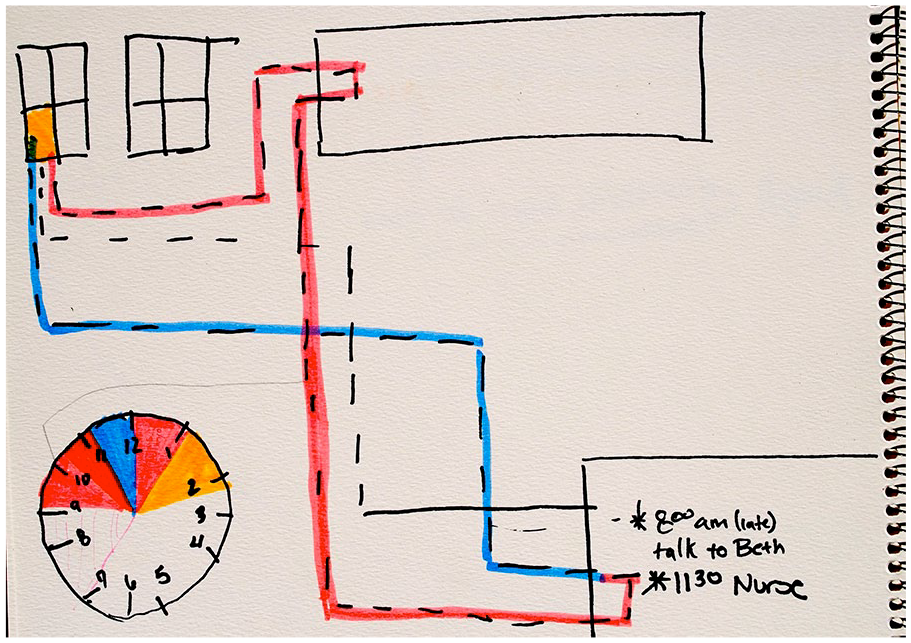
Josefina’s Map, May 9, 2013.
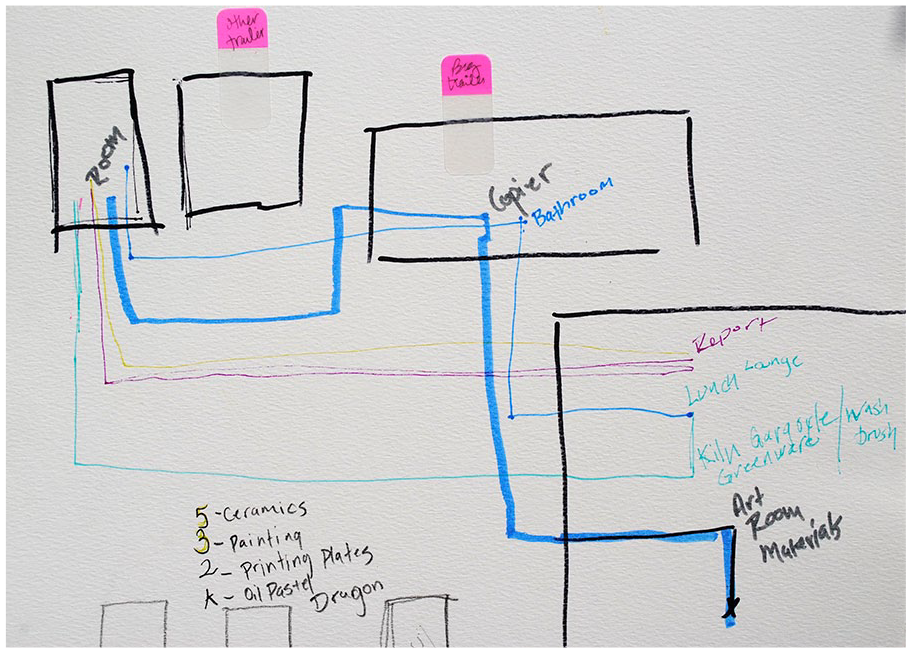
Josefina’s Map, February 14, 2013.
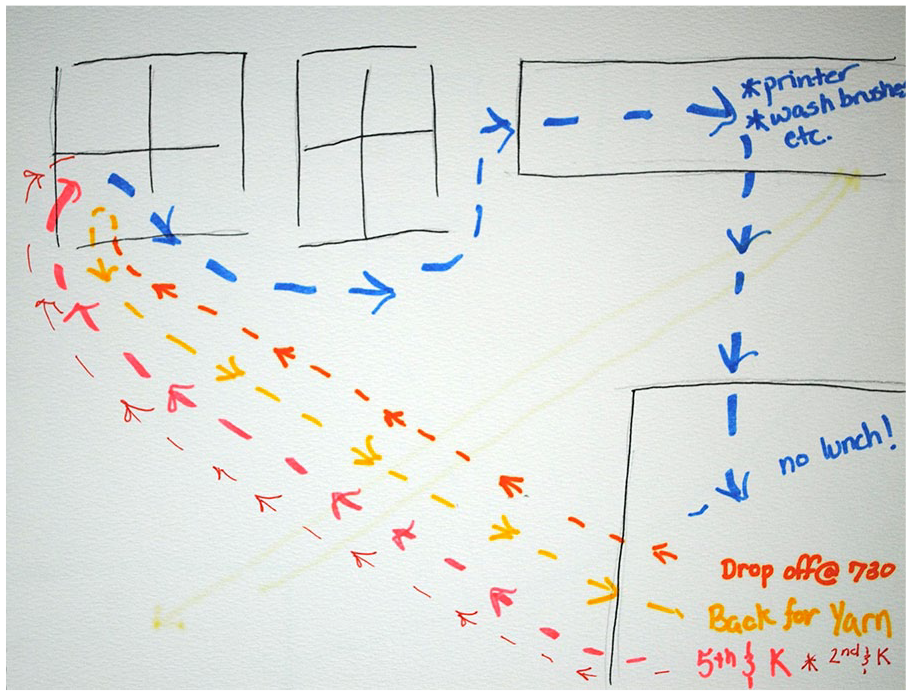
Josefina’s Map, June 6, 2013.
Josefina’s school population was too big for its building so portable doublewide trailers were added to the back of the property to accommodate the population and keep class sizes reasonable. Josefina had been teaching art-on-a-cart the previous 2 years. In this format, the art teacher does not have a room, but rather, is assigned a cart and is expected to haul the supplies and teaching materials they need from either someone else’s art room, or more often, a storage closet assigned to them, from classroom to classroom to see their students. Tired of the cart and feeling that she had “done her time” (Josefina, personal communication, May 23, 2013) on the cart, Josefina begged her principal to find her a space, even if it did not have a sink. During the time of this study, Josefina had just moved in to her own classroom—in the last trailer on the property, the farthest away from the main building, with the nearest bathroom and water supply two trailers away—which she called “the edge of the world” (Josefina, personal communication, January 31, 2013). This meant that to retrieve water for painting, printmaking, or clay projects she had to walk outside to the nearest trailer with water or the main building. This also meant she still needed her cart—to load up supplies from the other art room in the main building, or to bring clay projects back into the main building to be fired in the kilns up on the second floor. Josefina’s map style reflected this constant back and forth movement as she chose different colors for each trip in and out of her classroom. Over time, out of necessity, Josefina became efficient at planning her movements to and from the various buildings in all weathers and for all curricular projects.
Drawing Movement: Capturing Pathway and Obstacles
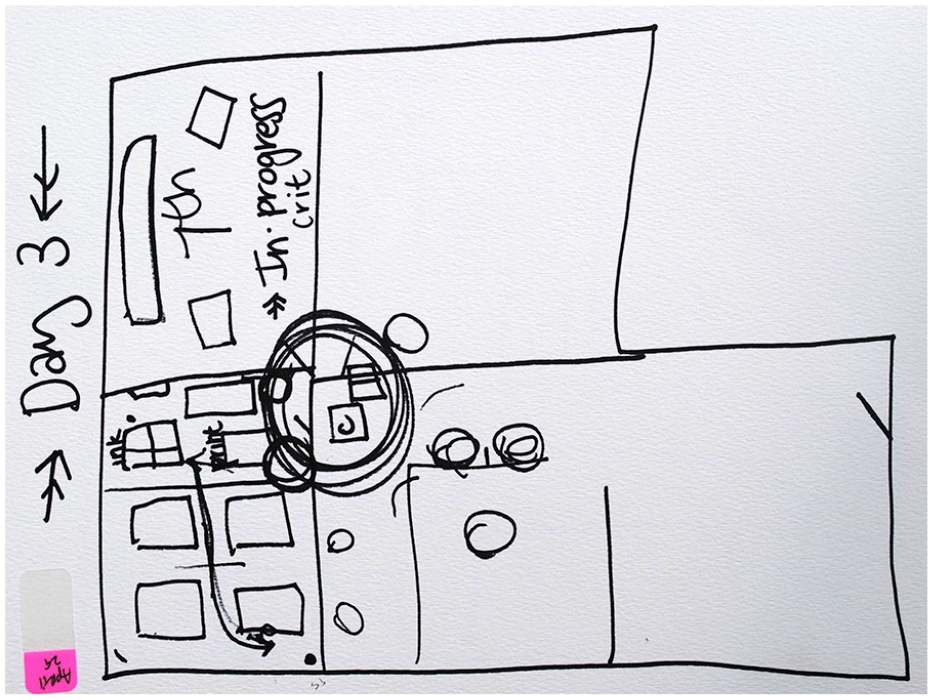
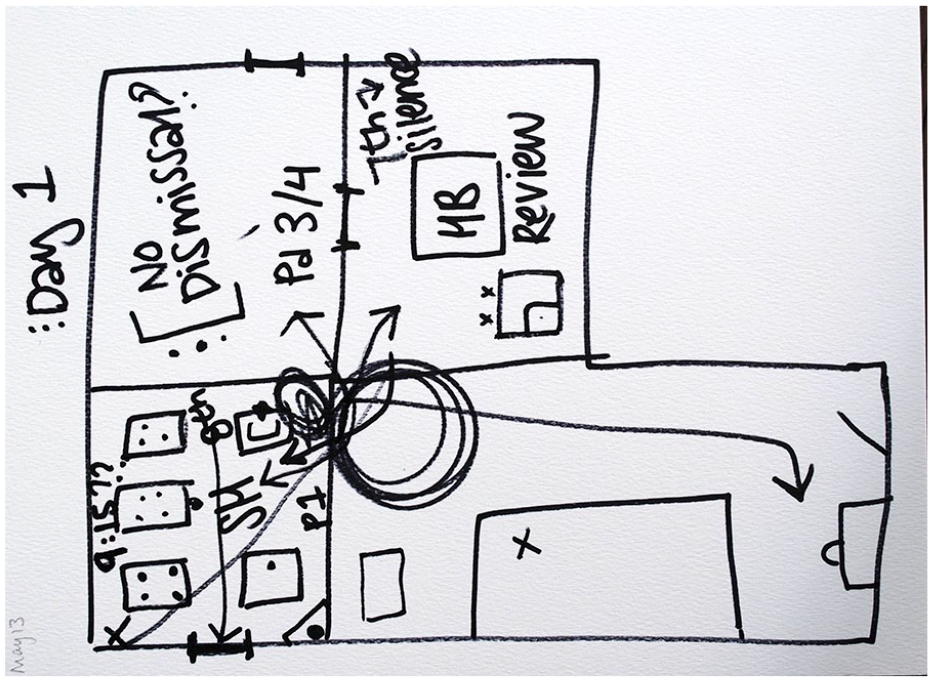
Josefina, Steve, Natalie, and Karen’s maps all captured pathways and movement as they storied their days. Some of them drew solid lines, others dotted, sometimes arrows indicated direction, but all of their maps captured constant motion and sometimes-frantic taskscapes. Karen, who taught art-on-a-cart, moved between three established art rooms. She pushed, pulled, shoved, and occasionally toppled her cart through doorways, over thresholds, and around others’ classroom furniture, which she was not allowed to rearrange. Her maps (see Figures 4 to 6) often showed a series of circles and arrows centering on the adjacent doorways where moving her cart caused her the most problems.
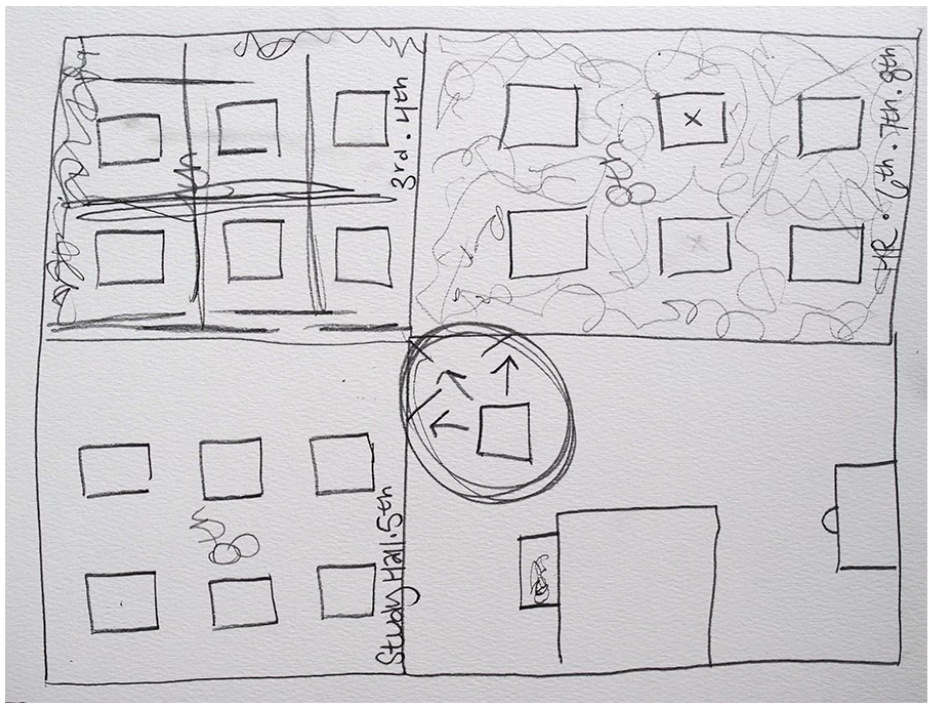
Karen’s Map, February 18, 2013.
Karen’s Map, April 29, 2013.
Karen’s Map, May 5, 2013.
Karen often felt exasperated that she did not have more support from her fellow art teachers, whose rooms she taught in. She expected more empathy from other teachers who may have also started out their careers teaching on a cart. On one occasion, Karen tried to leave a drying rack (a slotted metal apparatus that holds wet papers in isolation of one another while they dry) in one of her classrooms because it was unwieldy and toppled off her cart. The classroom’s host teacher hauled it out of her classroom because it was not hers. Karen attempted to explain that it was difficult to move in addition to her cart in the 4 minutes between class periods and asked to leave it in the classroom for the duration of the project. The host teacher refused. She seemed to want no evidence that Karen taught in her room at all. Toward the end of the study, after Karen drew and described sets from the school play blocking the doorway to a different classroom that prevented her from getting her cart through the door at all, Karen mentioned that the other teacher had relented and given her some storage space in her room. It turned out the host teacher had begun using a cart to temporarily move materials back and forth to the storage room, and after repeatedly bumping in to things, felt empathy for Karen’s working conditions, and thus showed new flexibility in sharing her classroom space.
Talk and Draw and Move
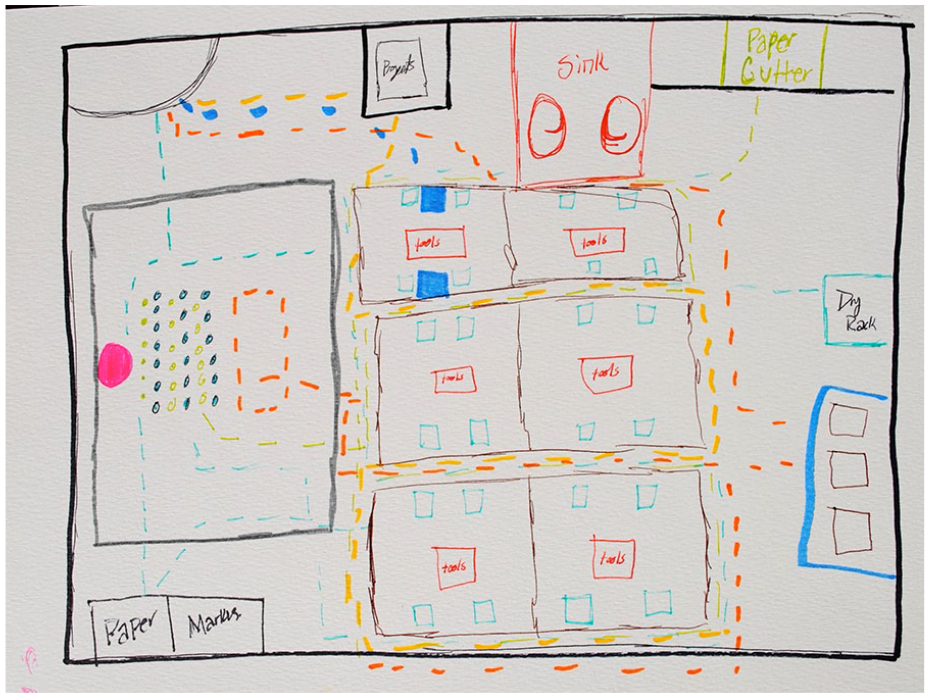
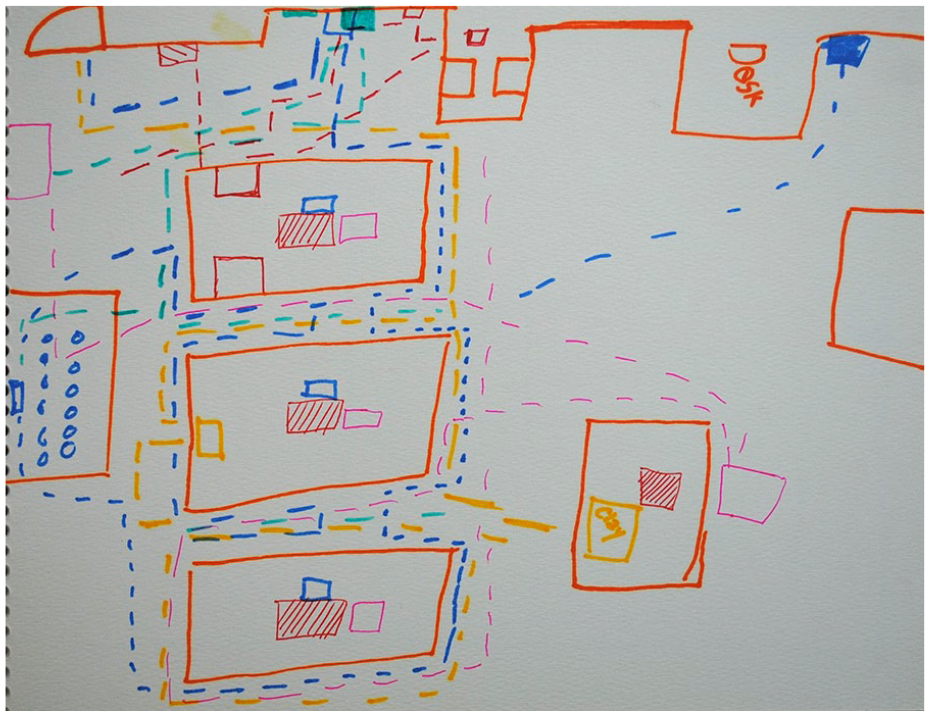
As stated above, hand-drawn maps served as an interactive talk and draw elicitation. One unexpected outcome of this method was that it often prompted Josefina, Steve, Nathalie, and Karen, to talk and draw, and move. That is, they often gestured to areas of their classrooms that they would get up and re-enact a pathway of movement for emphasis or in an effort to remember details. Sometimes the teachers would even visualize and reference a person not actually present. When the maps reflected their taskscapes back to them, they were able to re-embody that interaction. For example, Steve’s maps (see Figures 7–9) would often include dots as well as pathways that indicated where he or someone else would sit.
Steve’s Map, May 7, 2013.
Steve’s Map, June 4, 2013.
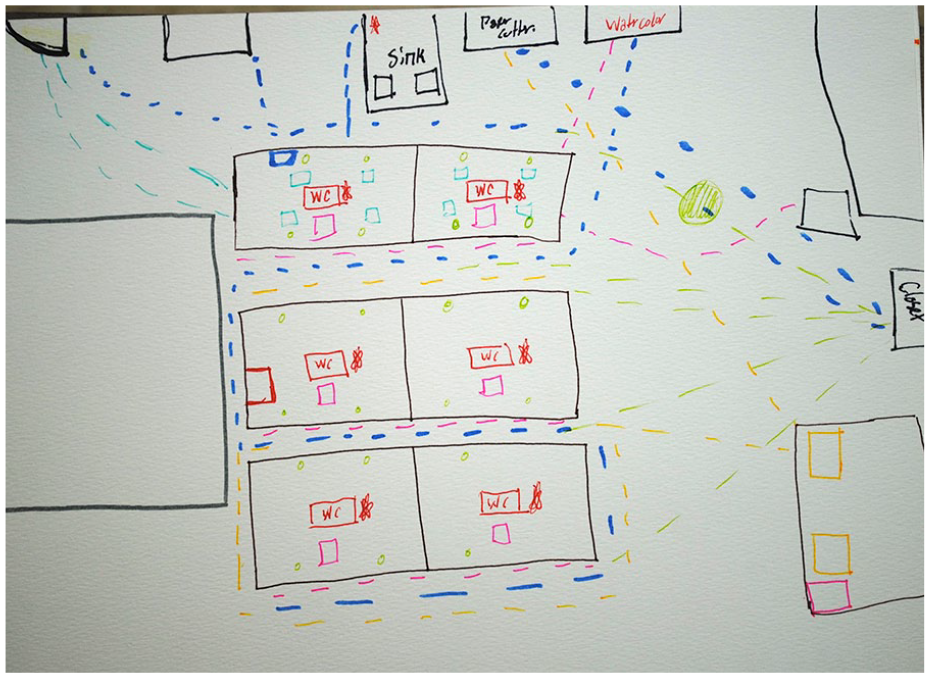
Steve’s Map, June 4, 2013.
The green dot on his map of June 4 (see Figure 9) indicated where his principal sat on the day he came in to observe. Steve was quite frustrated when he drew this map and told me about the visit. The principal had moved the stool Steve had provided from the innocuous spot where Steve had positioned it into the middle of the room and the path students take to get to the sinks. This became quite problematic during cleanup because it ruined the timing of Steve’s cleanup routine. Steve felt like his principal did not have enough understanding of art or what went on in the room to understand how his choice of position affected Steve’s classroom routines. Steve was even more frustrated when his principal asked him to work on this aspect of his pedagogy. During the mapping elicitation, Steve got up with his map in hand to stand in the classroom at the location of the green dot to re-enact how the movement was stalled by the principal’s choice of seat. The principal reinforced Steve’s impression that he did not understand art education pedagogy by constantly stopping in the doorway to ask Steve if he could clean up the “mess” when he wanted to hold a last-minute faculty meeting in the art room. Steve found it cumbersome to displace art works and materials he had carefully prepped for his next day’s work with no warning and at the last minute.
Natalie too moved often. Natalie’s maps (see Figures 10 to 12) were more likely to spread to two full pages as she attempted to capture her classroom as well as the stairwells, girls’ bathroom, and multiple floors of the school where she was often assigned hall duty and substitute teaching.
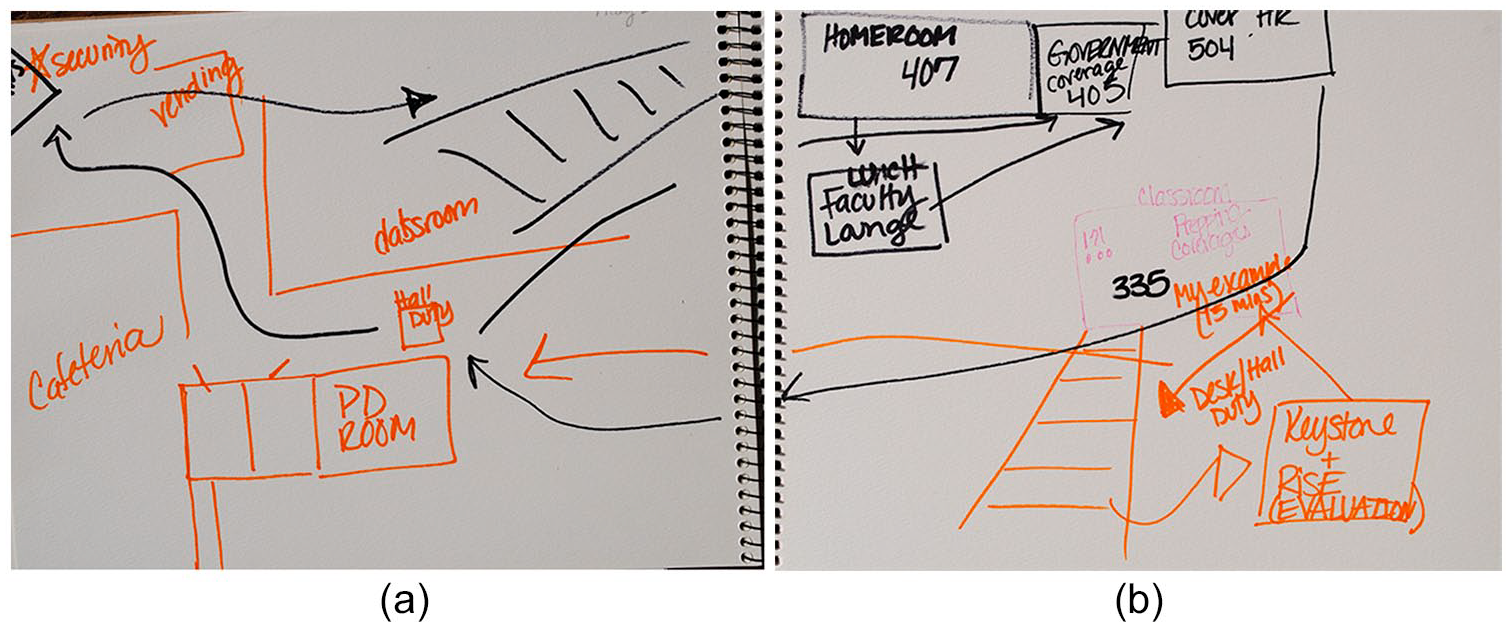
Natalie’s Map, May 2, 2013: (a) Part 1; (b) Part II.
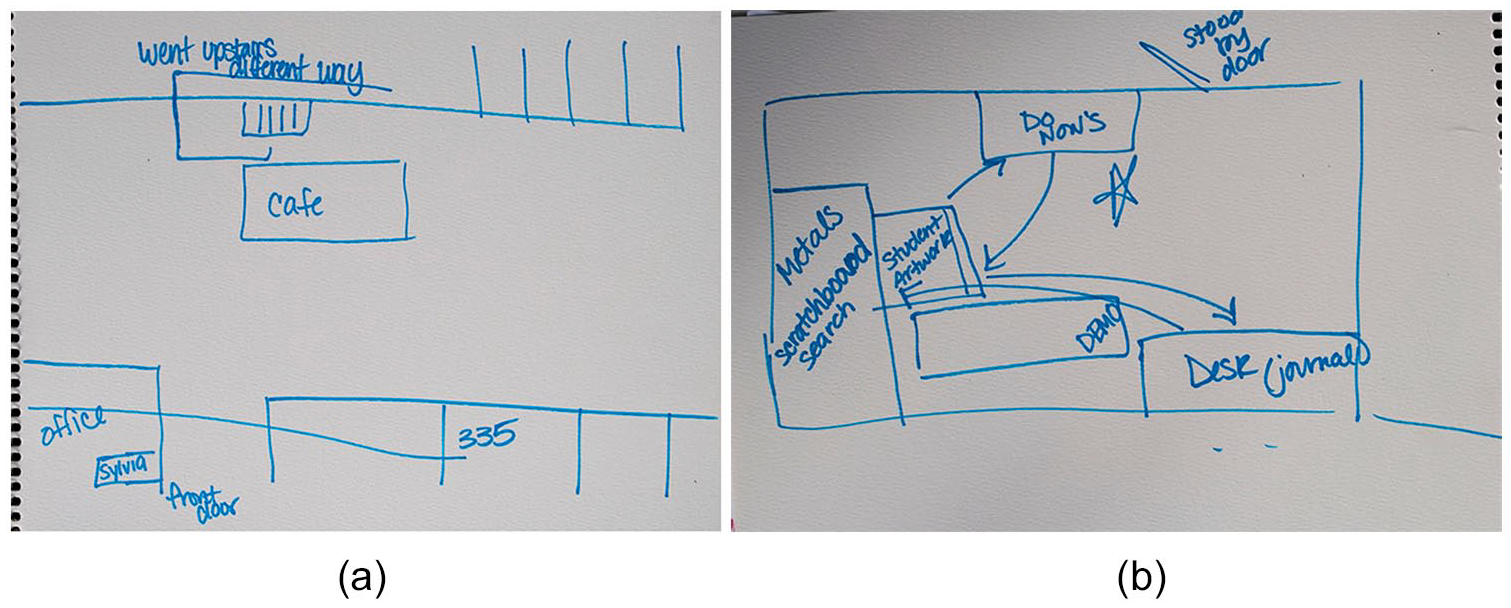
Natalie’s Map, March 21, 2013: (a) Part II; (b) Part I.
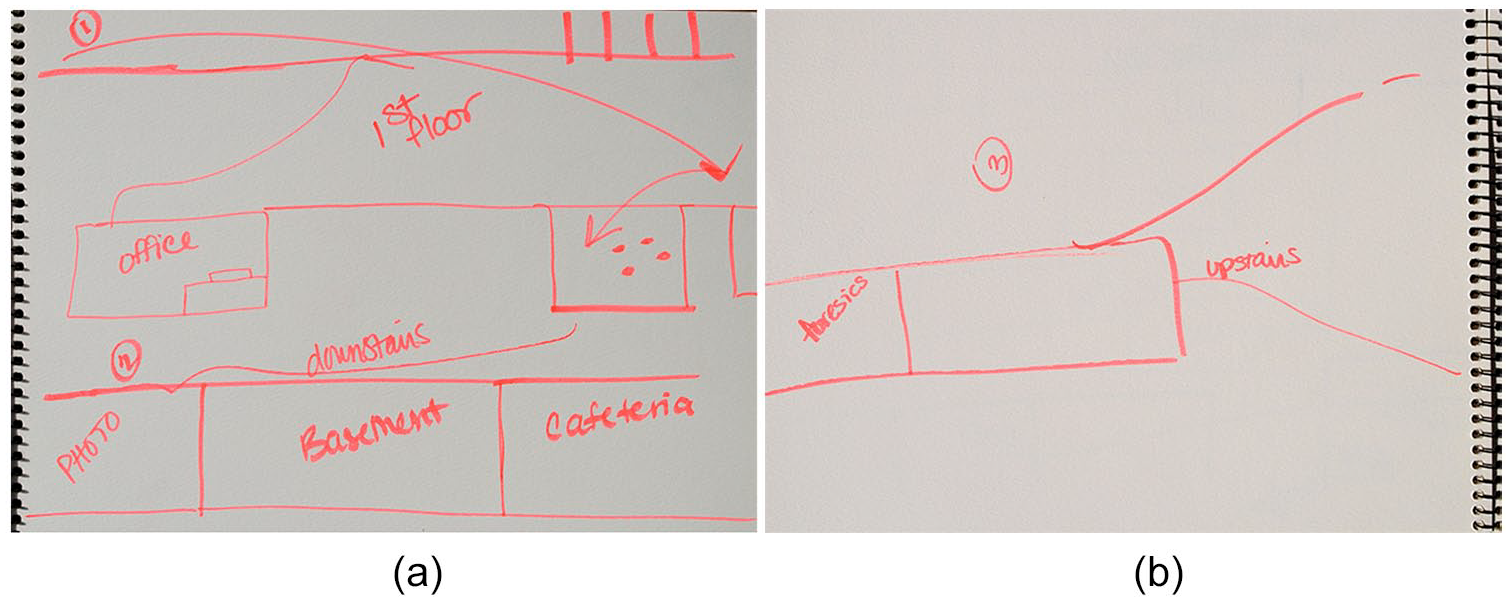
Natalie’s Map, April 4, 2013: (a) Part II; (b) Part I.
Natalie worked in someone else’s classroom during the morning and worked as a hall attendant or substitute teacher in her high school in the afternoon. Though this afternoon work was a kind gesture on her principal’s part to make sure she was employed full-time and could receive medical insurance, Natalie found that this muddled her role in the school. Not a teacher exactly, she was more a floating adult with no real authority. She would often get up and walk around the classroom, thinking back through her path through the entire school. It was apparent to me as a researcher that hand-drawn maps gave Josefina, Steve, Natalie, and Karen a way to talk about a variety of factors that affected their teaching.
Discussion and Implications
I originally chose hand-drawn maps for their natural fit as a means to visualize the place-bound taskscapes of teachers. More than this though, the hand-drawn maps and teaching stories covered in this article also revealed unacknowledged elements of teachers’ taskscapes that had a persistent effect on their teaching—classroom qualities, coworker expectations and interaction, administrator perceptions, and role definition. The aesthetic qualities of the mapping process moved the makers’ into a space of “wide awake-ness” (Greene, 1995, p. 38), one in which they realized how complicated their taskscapes were.
Methodologically, hand-drawn maps have the potential to bring to the surface the complexity of our lived experiences in place. The maps created in this study can be encountered both individually and in groupings which show the viewer the teachers’ habitation of their art rooms on any given day as well as how this habitation changes and accumulates over time. When multiple maps accumulated in sequence they revealed a palimpsest—a layering, a build up over time, an accumulation of meaning. Applied to place, palimpsest allows for the consideration of layers of environment, materials, adornment, and decoration as a manifestation of our “live(d) connection among the past, present, and future that are situated within multiple narratives” (Powell, 2008, p. 19). Hand-drawn maps of this kind also reveal how place contributes to our movement. Cultural geographer Tim Edensor (2010) argues that place affects our movements—how we walk, bend, sit, even the duration, speed, and direction of our movement. Though we may never move the exact same way twice, places foster rhythms to our movement (Edensor, 2010). While place forms us, we also form place as it “present[s] itself as a palimpsest for the inscription of cultural form” (Ingold, 2011, p. 47). Beginning art teachers have a variety of secret-concealed stories that affect their relationship with schools that need to be heard and acknowledged if their learning and meaning making during teacher induction are to be fully understood.
Footnotes
Declaration of Conflicting Interests
The author declared no potential conflicts of interest with respect to the research, authorship, and/or publication of this article.
Funding
The author received no financial support for the research, authorship, and/or publication of this article.
