







Abstract
This article explores the (dis)connections between urban housing development, (post)colonial legacies and expressions of space, and how ideas of sport and leisure are mobilized in the imagination of gated residential living in Gurgaon, India. Focused on the building of large-scale enclaved development built around golf and polo brands and identities, I challenge common analyses of gated residential complexes as examples of the imposition of neoliberal urban development agendas, or as a manifestation of new forms of architectural colonialism. Utilizing Homi Bhabha’s theorization of hybridity, I show how constructing a hierarchical, sport-based, all-encompassing mini-city is reflective of a localized response to middle-class perceptions of the failure of the state to control and develop the city, that also architecturally references urban mega projects unfolding across Asia. In addition, reflecting on the selective referencing of polo and golf brands/identities in both their past (colonial) and contemporary expressions, I argue sport is mobilized to create new forms of urban living attached with new meanings for consumers. Considered together, I assert the lens of hybridity destabilizes understandings of both sport and gated communities as (neo)colonial and neoliberal by-products by illustrating how these institutions are taken up and remade through colonial and postcolonial transmissions.
Introduction
In May 2017, I first met Arjun, a consultant for the prominent real estate development company GLD, operating mostly in Gurgaon, India. Over our 2-hour meeting, the first of many during my fieldwork, he told me that Golf Gardens was a place for people to live their aspirations. The art of it, he drove home, was using themes to make the aspirations, desires, and possibilities of achieving them clear for potential buyers. Though the development was named “Golf Gardens,” both golf and polo, as leisure activities, were additional anchors to the residential experience of Golf Gardens. These two sports were the hook, he explained, but it was all the other amenities included, such as restaurants, shops, educational facilities, and more, that sealed the deal. “Everything of value to life, to sustain life, to entertain yourself and others, has to be inside, it’s the only way,” he concluded. I left that afternoon thinking of Golf Gardens not as a gated community, but more of a small city, self-contained, isolated in the literal and figurative sense from the outside.
In this article, I explore the (dis)connections between urban housing development, (post)colonial legacies and expressions of space, and how ideas of sport and leisure are mobilized in the imagination of residential living in Gurgaon, India. I focus on Golf Gardens, one large-scale gated residential development built around golf and polo identities by a company called Gurgaon Lifestyle Developers (GLD). 1 GLD is an India-based property development firm with over 50 projects, including residential, commercial, hospitality, and retail developments, all at different stages of development. This is a luxury residential project, set to house over 4,000 residents across 23 different condominium towers (excluding service staff living on the premises), built around a 9-hole “executive golf course.” Within the community, there are Golf Gardens branded buildings, “Polo Suites” towers, and one “St. Andrews Residence,” a homage to the Royal St. Andrews Golf Club in Fife, Scotland. Even though sales of gated residential properties have been flat or dipping across the country in the last decade, GLD has been remarkably successful with this particular project sold out to prospective buyers.
This enclave sits on Gurgaon’s southern edge, a satellite city of Delhi, about 30 kilometers to the capital’s southwest. Part of the National Capital Region of India, Gurgaon underwent rapid urbanization and population growth. The last census, conducted in 2011, calculated Gurgaon’s population at 1.5 million, doubling its population 20 years earlier. Current estimates have the population at 2.5 million, with 5.5 million predicted by 2041 (GMDA, 2023). Dotingly referred to as the “Millennium City,” and the poster-child for post-liberalization policies that fast-tracked private investment in urban development country-wide, the city’s landscape is characterized by glitzy corporate parks for Fortune 500 company offices, and privatized gated developments for their employees. This has led some to argue that the cityscape resembles archipelagos, whether corporate or residential, barely connected by slowly catching up infrastructure (Goldstein, 2016; Gururani, 2013).
Much literature highlights how enclaved urban projects in the Global South are exemplars of neoliberal urban development, are reflective of coordinated efforts between pro-growth local governments and private actors that have increasing power to define and reconstitute space, and are manifestations of “actually existing neoliberalism” (Brenner & Theodore, 2002) based on policies that travel globally and land in place (Brosius, 2013; Fernandes, 2006; Pow, 2009; Shen & Wu, 2012). Likewise, there has been significant work on how the aesthetic features of enclaved gated communities in East and South Asia might represent new forms of urban colonization, sometimes mimicking iconic features and architectural design structures in Europe or North America (Bosker, 2013; Shen & Wu, 2012), or promote “international” (read: Western) aesthetics, community layout/design, and naming (Brosius, 2013; King, 2004).
However, Roy (2011) has called for investigations that erode assumptions about original and borrowed urbanisms, and McGuirk and Dowling (2009) have also argued for research that disrupts understandings of gated communities as passive sites where neoliberal policies are enacted. When considering the aesthetic and branding features of gated developments, limited research has explored the place, role, and meanings of sport/leisure brands and identities in the making in India, and how these sporting practices connect to colonial pasts and postcolonial presents in the imagination of residential living (Waldman, 2022; Waldman & Ghertner, 2023; Waldman & Weedon, 2019).
This study extends this literature by exploring how large-scale gated residential complexes are “homegrown” phenomena—linked to global flows of capital, neoliberal forms of urbanism, and legacies of colonialism, but cannot be understood exclusively in these terms. In addition, I show how taking seriously the place, role, and imagination of sporting practices/brands/identities in the construction of residential space can illuminate both localized specificities and global relations in gated community building. To do so, I utilize Bhabha’s (1994) theorizations of hybridity in colonial and postcolonial cultural expressions. As Bhabha (1994) argues, colonial power should be understood as a production of hybridization, rather than as simple commands of the colonizer and repression of local traditions. Every concept or institution brought by the colonizer will necessarily be(come) hybrid—reborn and reinterpreted in local settings through transmissions and encounters. Though not denying the uneven power dynamics in colonialism, hybridized outcomes, he suggests, reflect a subversion of power, the questioning of colonial authority, while also drawing attention to how colonial discourses and outcomes can never be in exclusive control of the colonizer. Through colonialism, all cultural constructions, identities, and institutions are ambivalent, contradictory, and corrupted, undermining the validity and authenticity of any essentialist cultural identity. Though his arguments rest on analyses of linguistic, performative, and aesthetic ambivalences of (post)colonial cultural production, I suggest hybridity can help destabilize ideas of gated developments as case examples of neoliberal urban forms or contemporary urban architectural colonialisms. This is especially pertinent, as I will argue, considering how golf, polo, and the St. Andrews brand are referenced in the imagination of space in Golf Gardens.
In what follows, I first engage with literature on sport and leisure and the colonial project, before contextualizing the “Millennium City” of Gurgaon as a hub of the “new Indian middle class” dream and a center of enclave-based privatized development in India. Then, I outline the research methodology. I emphasize the value of global ethnography (Burawoy, 2000) in exploring how gated communities are connected and disconnected and how they reconnect to structures and histories beyond their specific boundaries. Next, I outline the research findings, highlighting how sport and leisure identities are mobilized in the creation of new enclaved spaces in Gurgaon organized around hierarchical inclusions/exclusions, how and why the development is envisioned as a more than residential space, and the central importance of sporting practices in the imagination of aspirational urban community living. I argue that the Golf Gardens should be understood as hybridized for two main reasons. First, constructing it as a hierarchical, all-encompassing mini-city reflects a localized response to middle-class perceptions of the failure of the state to control and develop the city. Second, selective referencing of polo, golf, and the St Andrews brand in both their past (colonial) and contemporary expressions illuminates how they are used to create new forms of urban living attached with new meanings for consumers. Considered together, the lens of hybridity can destabilize understandings of both sport and gated communities as (neo)colonial and neoliberal by-products, by focusing on how these institutions are taken up and remade through colonial and postcolonial transmissions.
Sport and Leisure and the Colonial Project
Many have highlighted the deep relationship between the British Imperial project and the diffusion of sport in colonial contexts (Appadurai, 1996; Carrington, 2015; Cashman, 1998; Malcolm, 2012; Mangan, 1998). Various sports, including cricket, football, and wrestling, were interpreted by Victorians as ideal vehicles for instilling desirable attributes of masculinity such as discipline, seriousness, health, and fortitude (Malcolm, 2001; Mangan, 1998). Because sport was believed to promote self-reliance as well as obedience, it became a useful colonial tool to “civilize” and control local populations (Malcolm, 2001; Mangan, 1998; Mills & Dimeo, 2003).
In India, while many sports were brought by those involved in the British East India Company, in most cases, local populations were excluded from participation. This changed in 1835 when the British Raj an Anglicization policy, aiming to train Indian elites in English tastes, manners, and customs to assist in colonial bureaucracy (Appadurai, 1996; Cashman, 1998). Though there was no formal policy to utilize sport to support the Raj, sport gradually became part of the British civilizing process (Cashman, 1998). Many British officials, including college teachers, businessmen, military personnel, and bureaucrats, were enthusiastic missionaries for the introduction of cricket and other sports to Indian populations targeted under the Anglicization policy (Appadurai, 1996; Cashman, 1998; Mills & Dimeo, 2003).
Simultaneously, sport was a site for domination of nature and protection of the “natural” environments for privileged groups in colonial contexts. Land acquisition for sporting or leisure environments—golf clubs, cricket pitches, tennis courts, and otherwise—was deeply related to colonial projects that established exclusive and beautified environments for British colonial subjects, or to recreate familiar landscapes from “home” (Bale, 1994; Malcolm, 2001). Nostalgic yearning for British countrysides in the form of cricket pitches and golf courses, alongside fears of overcrowding, dirt, and disease from local populations, led to the production of islands of “purity” that would protect the colonial elite from dangers posed by the poor (Guha, 1993).
As many remind us, sport was not just merely imposed and passively taken up by colonized groups, it was appropriated, resisted, and reinvented in a variety of contexts (Appadurai, 1996; Carrington & McDonald, 2001). Cricket, for example, was embraced by Indian princes and Parsis—privileged groups that developed close links with the British to increase their status, who saw the game as an extension of their own existing traditions (Appadurai, 1996). As Appadurai (1996) argues, a hierarchical cross-hatching of British gentlemen in India, Indian princes, Indians part of the civil services/army under the Raj, and white cricketing professionals who trained the great Indian cricketers in the 19th century laid the groundwork for the contemporary “Indianization” of cricket. Relatedly, the desire to duplicate a nostalgic version of English cricket landscapes throughout the Empire was an impossible task, as “meadows [were] not precisely as English meadows, [there are] no long summer evenings, [and] their society has never known the agricultural background based on a village community” (Millburn, 1966, p. 38). Cricket’s contemporary popularity in India and the nation’s international dominance in the sport have led some to argue that cricket is an Indian game that was accidentally discovered by the English, looking more South Asian than English in its practice (Nandy, 2000).
I extend this literature by using the concept of hybridity (Bhabha, 1994) to further challenge unidirectional understandings of sport as a colonial product by focusing on unanticipated ways that sport/leisure are taken up and remade through (post)colonial interactions. Because the Golf Gardens mobilizes particular sport/leisure identities in the creation of space, taking seriously the histories, uses, and meanings associated with sport as the analytical starting point to understand contemporary expressions of sport and space will aid in destabilizing assumptions of gated communities—especially ones built around golf courses—as a prototypical example of a North American form of living transplanted into Indian contexts.
Gurgaon: The “Millennium City” for the New Indian Middle-Class Dream
Many have noted that the neoliberal economic reforms in India in the early 1990s shifted relationships between the state, the city, and forms of (desirable) citizenship (Baviskar, 2011; Ghertner, 2015). Though having many impacts on privatization, investment, and outsourcing, economic liberalization also led to the evolution of the “new Indian middle class”—a relatively small, but powerful group thought to define boundaries through cosmopolitan tastes in cuisine, clothing, physical practices, and city spaces (Fernandes, 2011). As Deshpande (2003) argues, the idea of the Indian middle class shifted from being the vanguard of the modern Indian nation that everyone could aspire, to the Indian nation itself—the only ones who count, regardless of the struggles of the rest (Deshpande, 2003). While often a projection of a variety of political, cultural, and ideological products, of interest here is how this group is the target of distinctive forms of (sub)urban gated communities predicated on security, exclusive lifestyles, “international” amenities, and marked separation from the poor. Luxury residential gated developments targeting the new Indian middle class have ballooned over the last 20 years in major metropolitan housing markets across the country. Looking to court buyers, developers compete with each other to lure in potential residents through themed projects (golf, health, global geographic lifesyles, etc.), and promises of luxury, exclusivity, and a plethora of amenities (Brosius, 2013; Fernandes, 2006). Gurgaon is a key geography for the expressions of the new Indian middle class. The state of Haryana, where Gurgaon is located, following federal economic liberalization, quickly instituted a range of state-level policy changes that directly increased Gurgaon’s urbanizable area by 300%, concentrated almost 70% of urbanizable land in the hands of three private development firms, and converted at least 40,000 acres of agricultural land into the largest privatized township in the country between 1991 and 2001 alone (Cowan, 2022). Though state bodies are responsible for coordinating urban and infrastructural development between public and private agencies, in practice, land development tends to follow the logic of land assembled by private developers rather than any planned strategies by the state (Kalyan, 2017).
Golf Gardens is one example of an inward-focused, self-contained community in a sea of disconnected islands that characterizes an urban landscape built from the ground up by private corporations with little state oversight (Chatterji, 2013). The landscape is highly fragmented with pristine enclaves—segmented off from urban villages and informal settlements—connected by patchwork infrastructure with little drainage (Goldstein, 2016). However, Gurgaon continues to be presented as an aspirational city looking toward global standards to manufacture the very idea of the township in India. Analyses of promotional materials of such communities have revealed nostalgic references to English (colonial), American, or European architecture and living (Brosius, 2013; Srivastava, 2014), inclusion of schools modeled after the British private system (Falzon, 2004; Waldman et al., 2017), and a duplication/romanticization of English/European identities in naming (Brosius, 2013). This study looks to extend this literature by placing an analysis of the role and imagination of sporting/leisure practices at the center of analysis of gated residential developments to reveal how sport identities mobilized by real estate actors cater to and drive new Indian middle-class desires for new forms of urban living in India.
Methodology
This study was guided by Burawoy’s notion of global ethnography, which uses ethnographic methods to explore everyday life in ways that transcend community or national boundaries—investigating how the global is constituted in the local (Burawoy, 2000, 2001). This methodology is useful for studying gated communities as it helps explore the production of the global in the local through a chain of “(dis)connections and [through the] dissemination of ideologies” (Burawoy, 2001, p. 156)—and how global forces have a different look when viewed from different positions. Studying different locations remains essential, as investigating the interrelationships between the local/global means studying the processes and implications of these projects from diverse perspectives (Burawoy, 2001). This aligns with Pow (2011) and McGuirk and Dowling (2009), who argue that gated communities are too often conceptualized as spaces bounded to particular areas, advocating instead for research attending to the connections of these places with broader social, historical, and structural (global) relationships.
I complement Burawoy’s methodology with a postcolonial theoretical perspective to challenge dominant discourses of capitalism and globalization inscribed through urban development projects (Hayhurst, 2016). As Blok (2010) contends, despite Burawoy’s interest in studying globalization from “below,” he emphasizes that “global forces” either fight back, adapt, or are destroyed. Burawoy already knows which global forces (namely capitalism) are at work everywhere, despite capital not necessarily being the only type of globality in transnational social relations (Blok, 2010). The goal of adopting a postcolonial approach is to see sport-focused gated communities as more than localized examples of transnational capitalism at work.
I draw on multiple methods for this study, including observations, formal and informal interviews, and qualitative document analysis (QDA) of promotional materials and advertisements for Golf Gardens. Fieldwork was conducted between May to August 2017 and December to January 2017 to 2018, and I draw on data collected from time spent in and around the Golf Gardens, including the community, the corporate offices of GLD, the transnational architecture firm designing the spaces, the consultancy group working directly with GLD, and two major real estate investment conferences which took place in Delhi. My observations centered on the production of space, aesthetic choices in design, how the development was being promoted to buyers (i.e., sales pitches, promotional materials), and the role of sport/leisure in the imaginations of place. These observations contextualized formal and informal interviews.
Semi-structured interviews were conducted with a variety of people directly involved in the design, development, and imagination of space for Golf Gardens, including high-level executives from GLD, sales representatives, property brokers in Gurgaon, architects, and a consultant. The goals of the interviews were to get a sense of how the spaces were being imagined, who they were for, how it is promoted to buyers, and the usage of sport/leisure in the conceptualization of the community.
Observations and interviews were supplemented with a QDA of promotional materials (sales books, sales presentations, Instagram marketing, videos), websites, and architectural renderings of the Golf Gardens. Following Altheide et al. (2008), these documents were approached ethnographically, where I immersed myself and constantly compared them with each other as well as to emerging themes in search for new meanings. The goal of this was to examine how particular meanings and representations of Golf Gardens (in documents) circulate.
As Pillow (2003) and Gonzalez (2003) note, hyper self-reflection and uncomfortable reflexivity are essential components of any discussion of postcolonial ethnographic research. Following Gonzalez (2003), the intent here is to “account”—to explain and contextualize the decisions that were made, and who it is featured in this research and why. My identity as a white, young, cis-gender, North American woman shaped this research, who I was able to speak to, and spaces I was able to access. These markers of identity granted me access to elite Indian men and spaces involved in this development for two largely different, yet interrelated reasons—I was perceived as non-threatening and innocent or I was seen as an object of desire. Though I am unable to speak both of these reasons here, 2 I will briefly discuss how viewing me as unthreatening gave me particular access to spaces discussed here.
As Cupples (2002) notes, positionality is as much about how we are positioned by those we research as it is about what we feel as researchers. Sara Ahmed (2000) likewise reminds us that all encounters between Self and Other are shaped by what happens in that particular moment, but also by broader socio-political histories and assumed knowledge of who the “Other” is. In this case, my gender, as it intersected with whiteness and age, is deeply connected to colonial histories of India, and often led to a positioning of me by those involved in the GLD development as naïve and uncritical. This facilitated access to spaces that would likely be closed to white men, Indian women, and Indian men. For example, shortly after I arrived in Delhi in May 2017, I learned of, and attended, a real estate investment conference being hosted by GLD in conjunction with the National Real Estate Development Council. It was there that I first met Arjun, the consultant introduced at the start of this article, who introduced himself and asked me who I was and what I was doing there. After explaining my research interests, he handed me his card and told me his role working directly with GLD, and that with his help, “he could teach me a thing or two about how things work here” and “introduce me to the right people.” He often prefaced information with “you probably wouldn’t understand this,” or “you too young to know this,” and when making introductions would lead with something like “this is Ms. Devra, a young woman from Canada, who has come all this way to learn about how things work from the experts like us.” While this is in part true, he and the others he connected me with had insight into GLD and the real estate context of the region that I did not, many relationships were defined by a patriarchal (and at times) condescending structure that reflected beliefs that I could be “taught a thing or two” (in his words). This reading of my body also meant that I had easy access to the Golf Gardens and GLD executive offices, often allowed in without being stopped by security and freely allowed to move within spaces. This was especially because I introduced as a “special guest” and “young woman” learning of what was happening, and because in all of the spaces I entered—Golf Gardens, GLD offices, architecture firms, and government offices—I was the only white person, and often one of few women. As Nayak (2006) highlights, notions of the meanings of “White Woman” “cannot be understood outside of the specific historical and geographical processes that constitute this subjectivity intelligible and the symbolic regimes of language that summon this representation to life” (p. 417). My body was constantly inscribed according to views about the meaning and place of it in global constellations of power and geoinstitutional imperialism of academia, which facilitated my access to a range of elite spaces (Al-Hindi & Kawakbata, 2002).
Golf and Polo as the Draw to an All-Encompassing, Hierarchical Space
Here, I outline findings that demonstrate how golf and polo were mobilized to create a more-than-residential space organized around hierarchical exclusions. Based on these findings, in the subsection that follows, I argue that imagining and designing Golf Gardens in this manner is reflective of a hybridized urban form that reflects large-scale urban development projects across Asia while also responding to localized concerns about urban planning within Indian metropolitan cities.
Though Gurgaon is steadily creeping further away in Delhi’s hinterlands, this development seemed largely out of place in the periphery. Its size and scope were overwhelming—23 different towers at different stages in development—imposing amid arid fields slowly being converted into privatized developments. It was a 30-minute drive from the nearest metro station and was at least a 45-minute commute from CyberHub (the largest business park) and other major commercial centers. Despite its disconnected location, GLD was demanding at least 50% more for their flats compared with other similarly sized units in more centralized locations. I asked Vijay, one broker who assembles land and brokers property, about the price-point of the units in Golf Gardens, and he admitted that the sale prices should be significantly lower because of its location relative to key city infrastructures. It was because the community was built around golf and polo themes, that GLD was able to successfully ask for double for equivalent properties in the same area just because these particular themes were attached.
Choices utilize golf, polo, and the St. Andrews brand were deliberate by the developers, architects, and consultants involved in the creation of Golf Gardens, and were based on assumptions about the meanings attributed to those who participate in (or desire to be in environments dedicated to) these practices. As Arjun, the consultant working with GLD told me, themes were the primary means to differentiate from competitors: The average unit price for a flat in Gurgaon is roughly $150-$180 per square foot . . . But more premium developments are centred around themes . . . sports themes, golf course themes, entertainment themes . . . if you add any theme like a golf course or attraction, the price automatically goes up 30%-40%.
Ansh, a top-level executive in GLD, further explained these choices: I would like to maximize my profit and if my costs of doing such are the same, might as well do a product which will fetch me a higher return . . . So, for example when I talk about golf, so golf is a theme or a community is always positioned for the people who are rich, super rich, in any given city in the micro market, right. And polo is even more elite than that . . . The point I’m saying is that has been the driving force for all of these, so that was the starting point.
These notions of exclusivity of golf as a leisure activity and lifestyle identity were heavily emphasized through promotional materials: So, just imagine waking up to the sprawling greens and play a game that’s a class apart. And mastered by even fewer. That’s the beauty of this golf course (Golf Gardens promotional materials). A world of exclusivity! It has often been said that the first impression is the last impression. That’s why it is essential to give those who live here and who visit the residents the knowledge at the very glance that this is a different world. People who have made this their abode are in a different league. These are people with fine achievements and finer tastes (Golf Gardens promotional materials).
While golf was utilized as the entry point to demarcate those who could afford to buy in, ideas associated with sport/leisure were also mobilized to create hierarchies of belonging within the gates. The residential buildings are divided into three different types—the general Golf Gardens buildings (16 of 23 towers), the Polo Suites (4 of 23 towers), and the St. Andrews Tower (1 of 23 towers). These three different themed buildings were largely sold at different price points, with the Golf Gardens towers starting at the lowest, the Polo Suites priced higher, and the St. Andrews Tower the most expensive. The Golf Gardens units start at 2,850 square feet to 11,000 square feet for penthouses and price points during fieldwork ranged from $458,316 (2.4 crore INR) for a 2,850 square foot unit to $954,825 (5.0 crore INR) for a 5,900 square foot unit (penthouse pricing is unavailable). The Polo Suites offer units that are either 3,980 or 4,995 square feet and are currently listed at $1.2 million (6.3 crore INR) and $1.5 million (7.9 crore INR), respectively. The St. Andrews Tower offers units that range from 6,200 to 6,450 square feet and are listed at $1.6 to $1.7 million (8.6–8.9 crore INR). In other words, to live in an apartment in the Polo Suites, one would pay 26% more to have 40% less space comparing square footage and price in the largest unit in the general Golf Gardens buildings. One would pay 68% more for 5% more space to live in St. Andrews than a comparably sized unit in Golf Gardens.
Living in one of the themed buildings gives residents exclusive benefits that are used to reinforce hierarchical divisions within the community. While everyone gets access to the golf course, the club, the sports facilities, and community spaces, there are particular advantages for those who reside in the Polo Suites. Though there are no polo pitches or stables on site, according to a range of promotional materials including videos, pamphlets, and brochures, only Polo Suites residents have access to discounts for off-site polo and riding facilities with lessons, complimentary passes for international polo events, an additional lounge and private club, Polo Suites branded clothing and silver house decorations, and an annual gala.
To differentiate further, one could purchase in the branded St. Andrews Tower—the namesake of the St. Andrews Links in Fife, Scotland, known colloquially as the “home of golf.” With “64 limited apartments” across 47 stories in the tallest tower in the compound, residents have an additional multi-floor rooftop club, another lounge and bar, a rooftop garden retreat, a private spa, and additional concierge services, including on-call dog walking and valet housekeeping. The goal, as Ansh, a top-level executive of GLD emphasized, was to use St. Andrews to generate feelings of exclusivity that extend beyond the confines of the apartment: They will have a restaurant, they have a wine and dine, and they’ll have other facilities, a swimming pool . . . it will be used by a limited number of people. And above all, it can be used only by the guests they would like to come . . . it’s just an extension of your drawing room . . . with everybody at your service.
Underscored by the executives, consultants, and architects designing the project was that organizing the community hierarchically was essential to appeal to the perceived desires of their target population. Arjun, the consultant, captures this understanding: Within this project they have special units which are a higher price. One of them is polo . . . it gives a feel-good factor to somebody, eh? It’s only a perception whatever this is, they are selling a dream and nothing else . . . the consumers have grown, propensity to spend has grown. Real estate companies have to cater to these new aspirations . . . so we need new strategies for real estate.
Because the landscape of real estate in Gurgaon has changed, Arjun argues developers must adapt by creatively catering to the assumed aspirations of wealthy individuals to live in exclusive spaces and perform their “eliteness” through choices within a particular residential environment.
Though identities associated with golf and polo were the basis for internal hierarchical differentiation between residents within the gates, catering to the perceived desires of potential buyers also meant that Golf Gardens was envisioned as a more-than-residential space. It was conceived as an all-encompassing, one-stop-shop, where once inside, there would be no necessity to leave. If golf was the draw, the actual sales pitch centered on a vision of a small, exclusive, self-sustaining community. Ansh, a top-level executive of GLD, emphasized this point: That is what matters to the people and if you have [everything] within your own community, within your own tower, you don’t even have to walk out. So, it’s convenience, that’s how it gets added . . . the club is fantastic . . . It has two very nice banquets, it has mini theatre, it has a business centre, all your needs at one location.
The inward-looking, complete experience was highlighted on their website and Instagram, which featured a marketing blitz of “101 Reasons to Live at GLD Golf Gardens” between 2017 and 2019, which included sports facilities such as the nine-hole golf course, a sports arena, indoor cricket pitch, basketball and football pitch, squash courts, and jogging track; four fitness centers; five swimming pools; six restaurants and bars; two libraries and business centers; two salons and spas; a dog park; a shopping center, including two grocery stores, pharmacy, dry cleaning/laundry, and technology outlets; two child care facilities; and entertainment amenities such as two movie theaters, digital games room, amphitheater, and two banquet halls (though not all residents had access to all amenities).
During one of my visits to the Golf Gardens, Manish, a sales director for GLD, welcomed me. While guiding me through the facility, he walked me through the sales pitch his team to those coming through looking for apartments. As he told me, golf and polo were the hook, so to speak, because of their associations with leisure and lifestyle, but having a complete, segregated, self-sufficient space was the mechanism to “reel in the fish.” The goal was crafting an imaginary where you could buy your way into a “complete world” that was just your own, filled with other like-minded people like you.
Hybridity in form: inter-referencing Asian city-making projects and a localized response to new Indian middle-class concerns.
King (2004) argues that because large-scale gated communities in both India and China promote “international” aesthetics, design, and naming, they can be interpreted as new forms of urban colonization through global capitalist expansion. Simultaneously, Roy (2011) reminds us of the importance to question “origin stories,” and erode ideas of original and borrowed urbanisms (Roy, 2011). Conceiving Golf Gardens as a spectacular, more than residential space, challenges notions about gated, leisure-focused developments as transplanted from North American models for at least two reasons. First, they are reminiscent of what Shatkin (2017) calls Urban Real Estate Mega Projects (UREMs)—a dominant urban form across Asian real estate markets. Second, they are a particular response to localized urban development concerns of the new Indian middle class.
As Shatkin (2011, 2017) observes, UREMs are conceived as self-contained entities at the city/urban district scale consisting of a mix of residential, commercial, offices, schools, entertainment, and other facilities built on a for-profit basis by a single developer. The size, scope, and imagination of the Golf Gardens (23 high-rise towers) and its wide array of amenities to sustain daily life more similarly resemble other projects in Indonesia, Cambodia, Thailand, and China than gated residential developments in forms that are prominent in North American suburbs (i.e., sprawling, low density, and low-rise). These relatively small but enclosed mini-cities, as Shatkin (2011, 2017) argues, are increasingly the prominent strategy for urban development agendas peri-urban regions across Asia, South East Asia, and South Asia that states are employing to achieve various goals relating to economic advancement. That is, these UREMs, which the Golf Gardens is an example of, are specific and deliberate interventions employed by the state (or corporate allies) to provide solutions for urban development challenges of population growth, find mechanisms to re-orient cities to attract domestic/foreign capital through speculative development, and to satisfy the perceived demands of growing consumer classes (Shatkin, 2017). Instead of residential urban mimicry, these can be read as hybrid (Bhabha, 1994), especially in the context of frenzied hyperbuilding across major Asian metropoles, where cities compete against each other to persuade middle classes to move into improved conditions of working and living (Ong, 2011). Because this kind of “all inclusive,” inward-looking residential development is also common across other cities in Asia, following Ong (2011), Asian cities inter-reference each other in their architectural forms, alongside their counterparts in the Global North, in the creation of new modes of living that are circulated through symbolic and aesthetic languages of community building.
The hybridity of these spaces is further revealed through a consideration of local context. Golf Gardens and its inward-focused community making can also be seen as a response to what Kaviraj (1997) calls a crisis of bourgeois personhood triggered by a plebianization of public spaces in India through the 1980s to the 1990s. As Kaviraj (1997) notes, in the early decades of postcolonial independence, spaces previously reserved for British colonial elites were governed as extensions of a “purified Hindu inside” dictated by upper-caste codes of civility. This “inside” often violated strict public/private binaries as use of space extended out of the household and into parks and the streets. Following increased political representation of “Other Backward Castes” in the 1980s, working-class populations were invited into public spaces previously governed by colonial elites and then the Hindu middle classes (Kaviraj, 1997; Waldman & Ghertner, 2023). There followed an “intrusion” of lower class and caste populations as the “parks opened to the poor,” allowing uses that “completely destroyed the architectural presupposition of the reciprocity between public and private space, between the houses and the green lawns” (Kaviraj, 1997, p. 106). The middle classes retreated, moving “literally up and away, by retreating into relatively tall high-rise flats” (Kaviraj, 1997, p.110), using architecture to enforce distinctions between the enclaved house, broader leisure spaces, and the streets of the “Other” outside. Though urban gating accelerated rapidly in Indian cities through the 2000s, the explosion of integrated townships of this size and scale should be seen as more than an Indian expression of a global pattern of neoliberal urbanism, and possibly the continued expansion of the purified “insides” of the home to the street and community level, encompassing leisure spaces and activities with them (Waldman & Ghertner, 2023).
Through mobilizing ideologies of the exclusivity of golf and polo to anchor community development, Golf Gardens directly caters to the perceived desires of the new Indian Middle Class in residential community making. As others have observed, the drive to create world-class cities has shifted definitions of desirable citizenship and has justified developments that privilege middle/upper-class groups while excluding “others” that do not align with world-class city aesthetics (Ghertner, 2015; Routray, 2014). Golf Gardens, like other gated communities, is reflective of the increased development of distinctive forms of cultural communities using ideologies attached to particular physical cultural activities to pitch “upmarket clubs,” distinguishing boundaries between those who belong and those who do not (Fernandes, 2006). However, as Searle (2016) reminds us, real estate developers are not waiting for these new consumer desires to appear, they create them by cultivating opportunities for individuals to “upgrade their tastes.” Here, the invitation is to upgrade through the consumption of sport/leisure identities that mark elite exclusion, hierarchically not just between the inside and outside, but within as well.
As Kennelly (2015), Sze (2009), and Silk (2014) argue, sport/leisure symbolizes hierarchies of belonging where some individuals become selectively included in (re)developed city spaces—especially ones connected to the Olympics and World Cup. Baviskar (2011) emphasizes this by arguing that Delhi’s hosting of the 2010 Commonwealth Games was a key moment that enacted significant spatial transformations that dispossessed those perceived as unaligned with “world class city” visions that would be difficult to achieve without the “extraordinary” moment of the temporary spectacle. In this case, GLD’s direct employment of golf, polo, and the St. Andrews brand demonstrates that sport/leisure can act as drivers and anchors of large-scale spatial changes outside of the hosting of mega-events. Even as they are used to denote different hierarchical positions of belonging/privilege within the community, the emphasis of the spaces here is on spatial and social purity—that is, the production of a distinct, yet generic, “utopian” space, filled only with those who are of a similar class and taste in an environment that is self-contained, cleansed, aspirational, transnational, and superior to the outside world (Falzon, 2004; Raposo, 2006).
This is especially pertinent when Gurgaon’s urban development and governance is considered. Instead of being read as a form of urban mimicry of residential forms drawn from “elsewhere,” GLD’s large-scale “golf” gated community is a more-than-residential response to particular urban problems afflicting the city (i.e., lack of public infrastructure, amenities, leisure facilities, etc.). The state enables and facilitates these particular forms of development as a city building tactic, and the Golf Gardens is imagined and designed in this way because it has to be—in part because all the competitors in the region are designed as such, and in part because private developers are expected to provide these amenities and services because there is a lack of public provision by the state. This is reflective of Shatkin’s (2011) and Fernandes’ (2006) assertions that these sorts of developments are driven by perceptions of middle- and upper-class urban residents of the failure of the state to control, plan, and develop the city, which serves to underpin and drive increasing privatization of infrastructure and city building.
Nostalgic and Colonial References to Sport in the Creation of Space
In this section, I unpack how golf, polo, and the St. Andrews brand were also mobilized due to their appeal to nostalgic royal and colonial legacies of power. After illustrating the selective referencing of golf, polo, and St. Andrews in their colonial pasts and contemporary expressions by GLD, in the subsection following, I argue that using these three particular sport/brand identities in the creation of space demonstrates the working of hybridity by challenging understandings of both sport and gated communities as (neo)colonial and neoliberal by-products.
Arjun explained the appeal of polo, especially because it is “a game in India . . . game of rulers, a game of royals.” Similarly, Ansh elaborated on this point by explaining the relationship of the sport to both Indian and English royalty: Polo is even more elite because historically [it] has been played by the maharajas or the kings . . . even if you look at Prince William . . . You know, the people who have always been associated with polo are the people who come from the royal families or the people who come from the Indian army.
Here, Ansh puts emphasis on polo’s deep history as practiced by maharajas—a Sanskrit term used to describe kings of the princely states of India—and by the contemporary English royal family.
References to both Indian and English polo legacies littered the promotional materials of the Polo Suites. One book advertises a space “Where the gentry reside,” with “the spirit of a royal game imbibed in every square inch of your life [and] where Maharaja lifestyles are born.” Similarly, a promotional video advertising the features of the Polo Suites also has a curious mix of English and Indian associations. The video opens quoting Winston Churchill—an avid polo player, learning to play and compete in India—saying: it is believed . . . that a true powerful being is first baptized in the fire of combat, taught never to retreat and never to surrender.” The narrator continues by highlighting that polo is “a game so majestic in nature that it has drawn the attention of the most renowned celebrities of our time.” Images on the screen include famous Bollywood celebrities alongside Prince William and Kate Middleton, as the voiceover wills viewers to believe life in Polo Suites will suit the “contentment of a maharaja.” Concluding its pitch, the narrator proclaims the Polo Suites at Golf Gardens, will, “bring the royal game to the place where it all began . . . India.
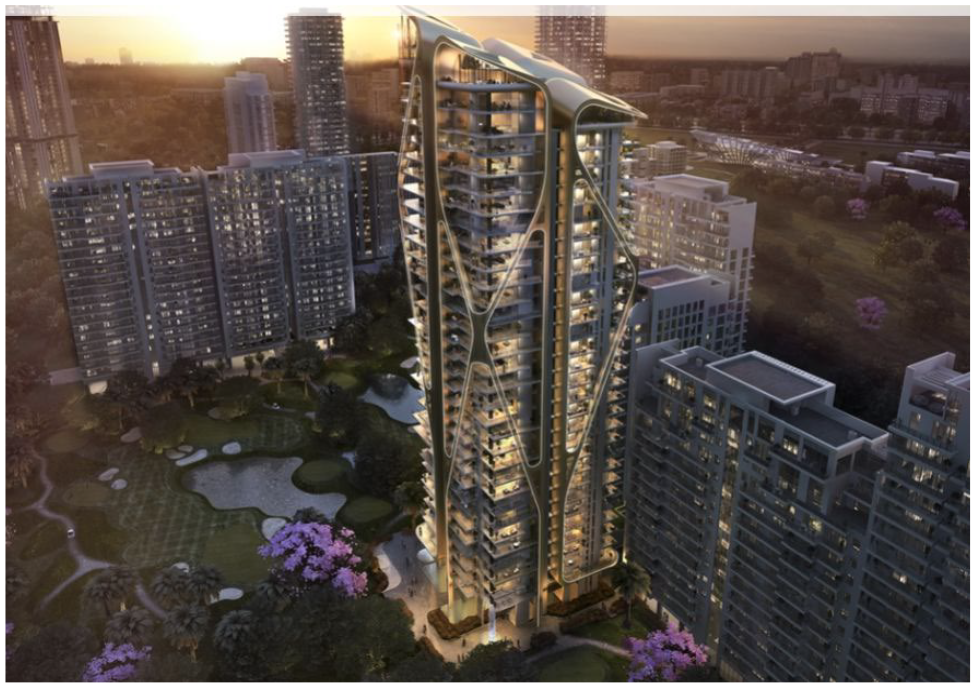
Many references to the distinct history, tradition, and lavishness of the Scottish tradition of St. Andrews as an icon of golf were also prominent. For example: Discover the true extravagance of a distinguished elite life. Inspired from the heritage and lifestyle of refined Scotland, St. Andrews golf residences will be the signature elite living amidst the golf greens. Named after the famous St. Andrews Golf Club in Fife, Scotland, the tower soars to almost 125m, and pays homage to the lifestyle of its namesake—modern healthy living combined with tradition and luxury. Immediately apparent are the intervening ribbons that run the height of the tower, which echo the symbols of this ancient golfing nation and provide shading and privacy to the spectacular balconies that adorn the tower.
Mobilization of St. Andrews, and nostalgia for the “home of golf” is interpreted as desirable for their clientele looking for further exclusivity from other residents. The ribbons are a symbolic nod to the “ancient golfing nation” and are central to the imagination of the structure of the building, as Ajay, the lead architect from the multinational company designing the project, explains: It was cross members that went across the whole tower at an angle, creating an argyle pattern, for the sweaters they have, yeah? So that’s the St. Andrew’s.
The architectural rendering below demonstrates how the building looks to invoke sweaters deemed stereotypically Scottish.
Hybridized Sport in Hybridized Space
Brosius (2013) and King (2004) both highlight how spaces of gated residential developments throughout India reference nostalgic Victorian, English, or European imagery, architecture, and histories—undeniably linked to inherited legacies associated with colonialism. In asserting that “. . . colonial lifestyles are back in fashion,” Brosius (2013, p. 115), drawing on Bhabha’s (1994) concept of mimicry, describes these spaces as not just a replica but an appropriation that are reflective of “transnational asymmetries and flows that challenge us to revise the very concepts of modernity” (p. 120). King (2004), on the contrary, argues that gated residential complexes that mimic colonial or North American forms are new examples of (neo)colonial development unfolding in various locations in the Global South. With Brosius (2013), I agree that these spaces are not merely reflective of passive relationships between the West and the South, though instead of being mimetic, the use of sport-specific imaginaries indicates they are hybridized (Bhabha, 1994) forms of sport and space.
Utilizing polo—and referencing both Indian and English expressions of the game—challenges common notions of sport as a deliberate tool of (British) colonialism. While the popularization and diffusion of polo is a product of colonial encounters, polo did not originate in the “West.” Polo has origins in central Asia (connected to the Parthian Dynasty of 247-224 CE, and in Persia through the Turkic and Mongol rulers) and spread to India through the Islamic conquest of India beginning in 711 (Chehabi & Guttmann, 2002; Parrish, 2018). In the 1850s, British soldiers first witnessed a polo match between tea workers and took to playing the game themselves (Chehabi & Guttmann, 2002; Parrish, 2018). The game was subsequently introduced to other British officers, spreading the sport’s popularity among British army personnel across the country between the 1850s and 1870s. As polo was appropriated by the British stationed in India, it became institutionalized and exported back to England by British soldiers returning from their stations—where it remained a practice restricted to upper and middle-class men (Mcdevitt, 2003).
The history and diffusion of polo is important considering GLD proclaims they are “bringing the game back to home to where it all began.” While there is some nodding to nostalgic forms of the game practiced by Indian rulers and how it continues to be popularized by the English royal family, the imagination of the Polo Suites is not one of mimicry. As Bhabha (1994) asserts, hybridity is “less than one and double” as every colonial concept will be reinterpreted in light of the “Other’s” culture. The Polo Suites is neither a reassertion of Indian royal sporting pastimes nor an invocation of the distinctly English ways upper-class Englishmen have remade it. The imaginations of these spaces are at once neither of these things, but selections of both. GLD offers highly specific meanings of polo as Indian and English and abstracts these meanings in the creation of a new space. There is no polo pitch, no stables, and no open grassy spaces for riding, yet this is a space where sport/leisure—and particularly identities associated with polo—cordon off space that is considered to be more valuable and exclusive to that of golf.
Utilizing the St. Andrews brand to differentiate apartments within the community (and to reference the particular Scottish elite tradition of golf and the St. Andrews Club) is curious, considering the specific relationship between the Royal and Ancient St. Andrews in Scotland and the origins of golf in India, and how golf has been utilized by Indians to construct forms of identity in the postcolonial context. Like other sports, golf was exported to colonies through the British Imperial project; however, unlike other sports, golf courses were exclusively reserved for British elites (Dimeo, 2005). In many cases, and unlike other sporting clubs (like polo clubs in India), even elite Indians were not invited in as guests (Dimeo, 2005). Despite this, the oldest (still used) golf courses outside of Scotland are all in India, with the oldest being the Royal Calcutta Golf Club (established in 1829), founded by an individual stationed in India with the British East India Company, who was also a member of the Royal and Ancient St. Andrews in Scotland. As Dimeo (2005) argues, the boundaries of inclusion and exclusion within spaces of the Royal Calcutta Golf Club remained heavily policed along racial lines; the first Indian member was reluctantly admitted in 1946, and the first Indian captain of the club was appointed in 1963—16 years after formal decolonization (Dimeo, 2005).
And yet, as Dimeo points out, the elite and then middle-class Indians who took over the Royal Calcutta Golf Club after 1947 preserved the club as it was “inherited,” despite its exclusionary politics. The Royal designation was kept, the English names in internal spaces remain (i.e., Mountbatten Room), and portraits of English royalty adorn the walls. This adds nuance to discussions on the relationship between sport and colonization of land and social exclusion, and challenges interpretations of spatial mimicry as the spaces that the British had carved out for their exclusive amusement became a new site for identity formation among the Indian elites (Dimeo, 2005).
GLD’s choice to use St. Andrews makes sense in light of the royal referencing already mobilized through the Polo Suites. St. Andrews is also a natural fit precisely because of the colonial and political history of golf in India—how golf clubs were (and continue) to be heavily exclusionary spaces relegated to the elite. Simultaneously, GLD is not attempting to duplicate or replicate any of the spaces in St. Andrews in Scotland, and yet the selective reference to nostalgic associations of St. Andrews as the “home of golf” reflects the complex histories of the sport and the nuanced ways in which it has been appropriated throughout the country.
The result here is one where both golf and St. Andrews are being selectively utilized to reinterpret gated community living in India. Taking seriously the complex history of golf and St. Andrews in India suggests that these are also spaces of hybridity—reflective of colonial pasts, encounters, and transmissions, as well as postcolonial expressions. The hybridity of these spaces is also apparent in how GLD uses polo and golf side by side in the imagination and production of space. These communities are not just golf, St. Andrews, or polo but are instead an amalgamation of all of them. Using the three together challenges the assumed structures of gated communities built exclusively around golf and shifts focus to the complex colonial histories of these practices as they are mobilized to create new spaces of living. This illuminates Bhabha’s assertion that hybridity is “less than one and double” as these communities do not exclusively reference golf, polo, or St. Andrews or holistically. Rather, they are selectively referenced and drawn on all at once—in their past and present expressions—to create new forms of urban living attached with new meanings for consumers. These are undeniably related to colonial legacies but have mutated in form.
Conclusion
In this paper, I used a case study of the Golf Gardens development in Gurgaon, India, to investigate the interrelationships between urban enclaved housing projects, colonial legacies, and postcolonial expressions of space and how ideas of sport and leisure anchor the imagination of new forms of gated residential living. Guided by Bhabha’s conceptualization of hybridity, I explored the imaginations of space by developers, architects, consultants, brokers, and sales personnel working for GLD, alongside promotional materials marketing this community to prospective buyers to challenge common analyses of gated residential complexes as examples of the imposition of neoliberal urban development agendas, or as a manifestation of architectural colonialism. I reflected on how the community uses distinct associations of golf, polo, and the St. Andrews brand to hierarchically differentiate between residents within the community and how this relates to how Golf Gardens is envisioned as a more-than-residential space. In doing so, I argued that Golf Gardens both drives and caters to the perceived desires of the new Indian middle class for unique options for aspirational urban community living. At the same time, I illustrated that Golf Gardens cannot be read as architectural mimicry of North American/European suburban golf community living, but instead is a hybridized (state-encouraged) solution to urban problems afflicting Gurgaon. Instead, it is architecturally reminiscent and interreferences broader hyperbuilding and urban real estate megaprojects unfolding across Asian cities. The hybridity of spatial imaginations was also explicated by analyzing how specific images and understandings of golf, polo, and the St. Andrews brand are mobilized in the imagination of place, shaped both by colonial histories of these sporting practices and postcolonial interpretations to create new forms of urban living environments. While illustrating how ideas associated with sport and leisure are central to and can act as a driver of large-scale spatial change outside temporary moments of mega-events, I illustrated how Golf Gardens can destabilize understandings of both sport and gated communities as (neo)colonial and neoliberal by-products, by focusing on how these institutions are remade through colonial and postcolonial interactions and transmissions.
Since fieldwork was conducted, the majority of Golf Gardens has been completed and handed over to residents, with the exception of the St. Andrews Tower, which is still under construction. In the face of city-wide residential project development grinding to a halt and tuck in half-built construction purgatory in the wake of financial crisis and an overzealous land market, GLD is one of few developers that has been able to deliver the vast majority of their projects. In this sense, the project is a successful effort to capture the imaginary of luxury consumers in Gurgaon, though questions remain about how the community is lived, experienced, subverted, and used by consumer residents.
Footnotes
Acknowledgements
A sincere thank you to Drs. Brian Wilson, Renisa Mawani, and Michael Silk, who read early versions of this work. Also, to my research participants and interlocuters, without whom, none of this would be possible.
Declaration of Conflicting Interests
The author(s) declared no potential conflicts of interest with respect to the research, authorship, and/or publication of this article.
Funding
The author(s) disclosed receipt of the following financial support for the research, authorship, and/or publication of this article: This research was supported with funds from the Social Sciences and Humanities Research Council of Canada # 771-2016-0115.
