







Abstract
Cross-disciplinary peace research frequently focuses on social and political power differentials between people. Like the tradition found in the broader social sciences, peace studies seeks to raise consciousness about, and address, unequal relationships and lends itself to the application of cross-disciplinary methodologies. It is concerned with relational inequities and how they might be remedied, including those between the researcher and research participants. This article discusses a suite of methods developed for a peace research agenda about Sri Lanka including intersectionality, social interactionism, semi and unstructured interviews, and interpretative phenomenological analysis. The methods were informed by Sri Lanka’s conflicted social and political spaces. Through the creation of spaces influenced by democracy and rights-based approaches, the methods sought to enable the exercise of participants’ democratic entitlements whilst extinguishing the potential for harm. Through the individual experiences of 22 participants, the methods selected helped to crystalise with greater clarity the structural barriers frustrating people’s agency and the reasons behind their resulting marginalisations. The article affirms that with patience and resources, ground constraints can be overcome, harm mitigated, bias reflexivity and positionality managed, and a set of methods constructed consistent with achieving a peace research agenda.
Keywords
‘In the social sciences today, there is no longer a God’s-eye view that guarantees absolute methodological certainty’, The late Norman Denzin.
1
Introduction
This article discusses the construction of a suite of methods for a peace research project in Sri Lanka. The methods selected reflected the cross-disciplinary complexities of peace and conflict studies and the challenges that deeply conflicted spaces present for researchers. They bridge theory with practice, from the realm of what peace seems to promise against the ground realities of marginalised peoples (Denzin, 2009b, p. 61; Denzin & Giardina, 2009, p. 16).
Norman Denzin’s assertion above is reminiscent of that which has long been recognised in the physical sciences – that uncertainty in scientific method and discovery forms a part of the whole. As Heisenberg’s instructive principle helped to fashion the physical sciences so should Denzin’s be understood as instructive for the social and political sciences. ‘All inquiry reflects the standpoint of the inquirer...The days of naïve realism and naïve positivism are over’ and subjectivity, reflexivity and bias become inalienable elements of the inexact scientific method (Denzin, 2009a, p. 153).
Within peace and conflict studies rests a certain necessity to act, albeit within limits, recognising the existence of fundamental biases (Simon & Dippo, 1986, pp. 194, 200). In constructing the methods, I intended to uncover knowledge that was not otherwise clear, or even visible. As a form of scientific discovery, I sought to use the methods to build upon the links between the realm of private problems and public issues, and the uncovering of ‘truth’ (Wright-Mills, 1959 in Rees, 2003, 83, 84: Sontag, 1967, p. 4). The nature of cross or interdisciplinary research lends itself to characteristics of case study approaches including ‘degrees of generalizability’ or ‘simplicity’, with focus upon the ‘distinctive and unique features’ within a particular set of developed parameters (Oliver, 2010, p. 94: Stake, 2010, pp. 26–27). The parameters of this research were mixed, and constrained, both voluntarily and involuntarily, and adopted a case study character. Primary data was derived from interviews with people from marginalised communities. The overall research enabled people who identified themselves as members of marginalised communities to participate and explore emancipatory outcomes in their quest for social and political change.
Selecting and developing the methods was based upon my experience in Sri Lanka and, in some cases, the relationships I formed. The methodology complimented the values of democracy and rights-based approaches, the centrality of justice and of peoples’ participation (Galtung & Scott, 2008, pp. 24-25: Barber, 2003, pp. 8, 117). It was influenced by aspects of ethnography, employing a qualitative lens to ‘describe, clarify and explain human phenomenon’ (Polkinghorne, 2005, pp. 137–145). Moreover, the methods sought to restore the location of qualitative methods ‘within the critical, interpretive framework’ (Howe, 2004, pp. 42–61 cited in Denzin, 2009a, p. 18; Tashakkori & Teddlie, 2003, pp. 3–50). Accordingly, interpretative methods were used to analyse the interviews. Phenomena were not treated as isolated events but rather formed part of a complex labyrinth of place, of past and present practices (Popper, 2002a, 2002b, p. 4).
This paper discusses the methods adopted, points to relevant contemporary theories and recent and current challenges to qualitative methodologies. Moreover, as an interdisciplinary case study on Sri Lanka I remained mindful of the research’s links to fundamental aspects of methods common to social sciences, remaining particularly mindful of issues such as participant diversity, the researcher’s impact on bias, objectivism/subjectivism, reflexivity and doing no harm.
Overview
Armed with Norman Denzin’s emancipatory vision, I sought to give voice to people from Sri Lankan marginalised communities whose lack of power, silence and/or invisibility have evolved due to their exclusion from mainstream social and political engagement. Through an intersectional lens, being conducive to a focus on social inequality, this study examined how marginalised identities intersect with social and political power structures, while positionality addressed how the researcher’s role influences the research process (Romero, 2018, p. 1). Power relationships, within the overarching structures of peace, including democracy, human rights and civil society, were considered in relation to an individual participant’s experiences and their multiple identities including race, class, gender, sexuality, ethnicity and religion (Collins & Bilge, 2016, p. 7).
Whilst sexual orientation, gender identity and expression (SOGIE) helped focus the research, the multiplicity of participants’ identities, and experiences, meant that sexuality and gender were not essentialised nor used as control variables (Collins & Bilge, 2016, p. 2: Romero, 2018, pp. 54–57). I avoided restrictions on identity variables, or fixating on one in isolation of other identities, without also analysing common structural issues of power. I sought to mitigate the production of stereotypes through the interpretative process, avoiding unduly burdensome controls and risks, whilst remaining alive to the polymorphous textures of what it is to be human (Altman, 1973, p. 24).
Essentialism conceives individuals as having unchanged or fixed identities. With the exception of bifurcating the LGBTIQ and non-LGBTIQ participants, I otherwise aimed not to over-emphasise any one identity without due regard to structural analysis for fear of leading me to an essentialist position. In former studies, race, class and gender characteristics have often been treated as controlled variables, especially in sociological research. Controlling any one of these constrains what it means to be of a particular race, class or gender. I was conscious that more constraint leads to more static or fixed sets of meanings. Rather than being drawn towards such approaches, I was instead persuaded by Amartya Sen’s arguments who posits that, whilst not always recognised or acknowledged, each individual harbours multiple identities within themselves (Sen, 2006, pp. 1–17, 4). Intersectionality, I concluded, is critical to avoiding the traps of essentialism, on the one hand, and necessary to expose unjust power differentials, on the other.
I also acknowledged conceptions of positionality, situated knowledges and standpoint theory as elements of intersectional approaches (Romero, 54–57: Collins & Bilge, 35, 82). Consistent with Denzin’s justice-centred transformative approach, I adopted critical and interpretive methods that challenged contemporary narratives. According to Denzin, this approach ‘challenges prevailing forms of human oppression and injustice...is firmly rooted in a human rights agenda’ and will explore ‘links between paradigms, sexuality, gender and ethnicity’ (Romero, 12, 16).
Development of Methods
The methods ensured that democracy and human rights formed part of both the substantive investigation and the methods themselves. They reflect the same normative bias towards collective participation in resolving ‘the big global challenges of our time’ as described by Hilary Cottam (Cottam, 2010, pp. 50–55). Accordingly, the methods were informed by an approach, such as that posited by Roger Smith: ‘by principles of rights, participation and social justice’, as well as by participants from the LGBTIQ community and other marginalised communities who were afforded space for their voices to be heard (Smith, 2009, p. 12).
Interview Preparations and Rationale
Interviews were used for data collection. I was conscious of the relational aspects between the selection of participants, the nature of interviews, and the interpretations of data obtained throughout. Interpretative Phenomenological Analysis (IPA) enhanced meaning in the knowledge accrued during interviews and I was also able to draw upon my own knowledges of the circumstances concerning the substantive issues in Sri Lanka. The interviews were constructed to magnify the significance of circumstances, as understood by both the participants and me. As Jonathan Smith, Paul Flowers and Michael Larkin explain, ‘when people are engaged with “an experience” of something major in their lives, they begin to reflect on the significance of what is happening’ as indeed does the researcher (Smith et al., 2009, p. 3).
Participant List – Characteristics of People Who Do Identify With LGBTIQ Community.
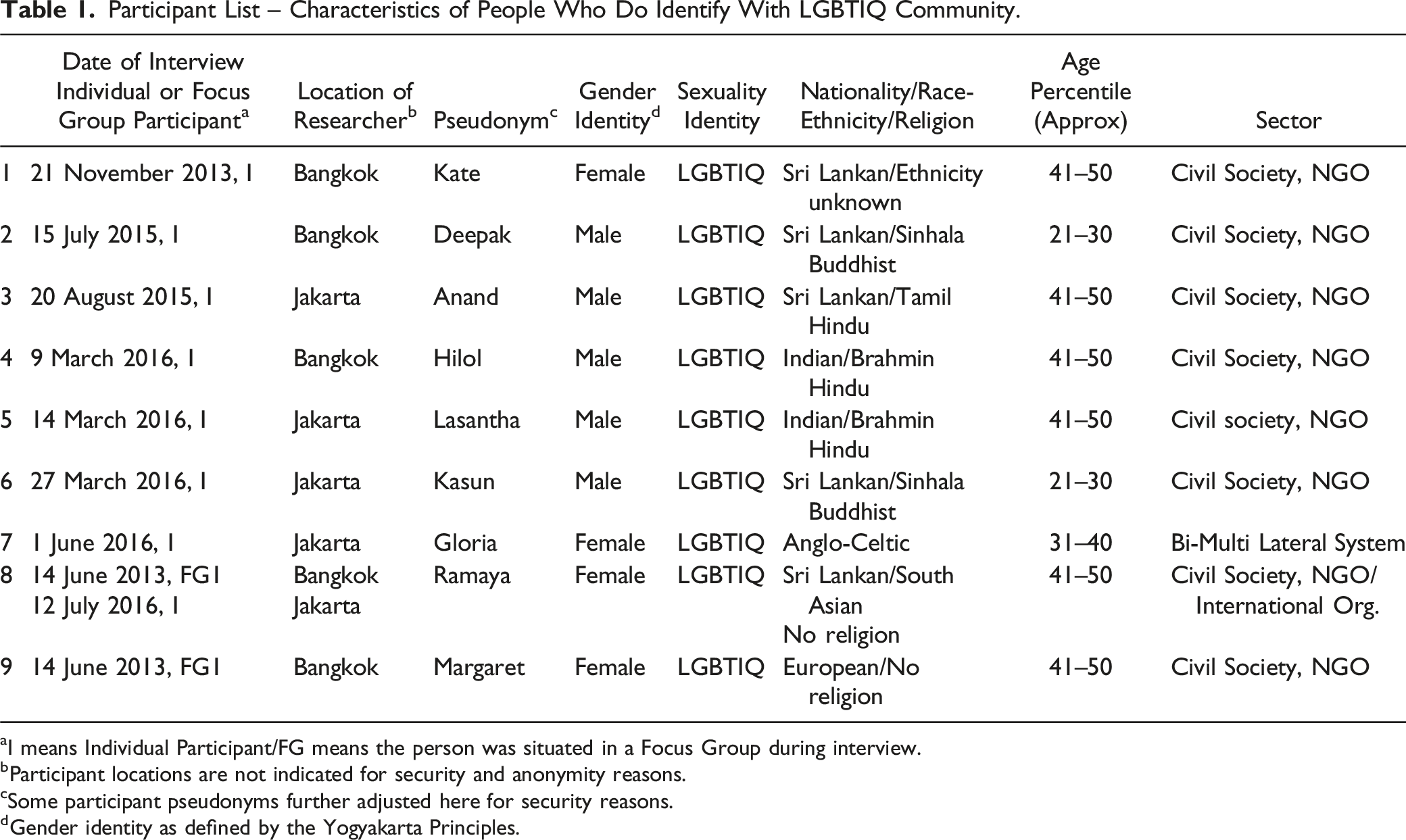
aI means Individual Participant/FG means the person was situated in a Focus Group during interview.
bParticipant locations are not indicated for security and anonymity reasons.
cSome participant pseudonyms further adjusted here for security reasons.
dGender identity as defined by the Yogyakarta Principles.
Participant List – Characteristics of People Who Do Not Identify With LGBTIQ Community.
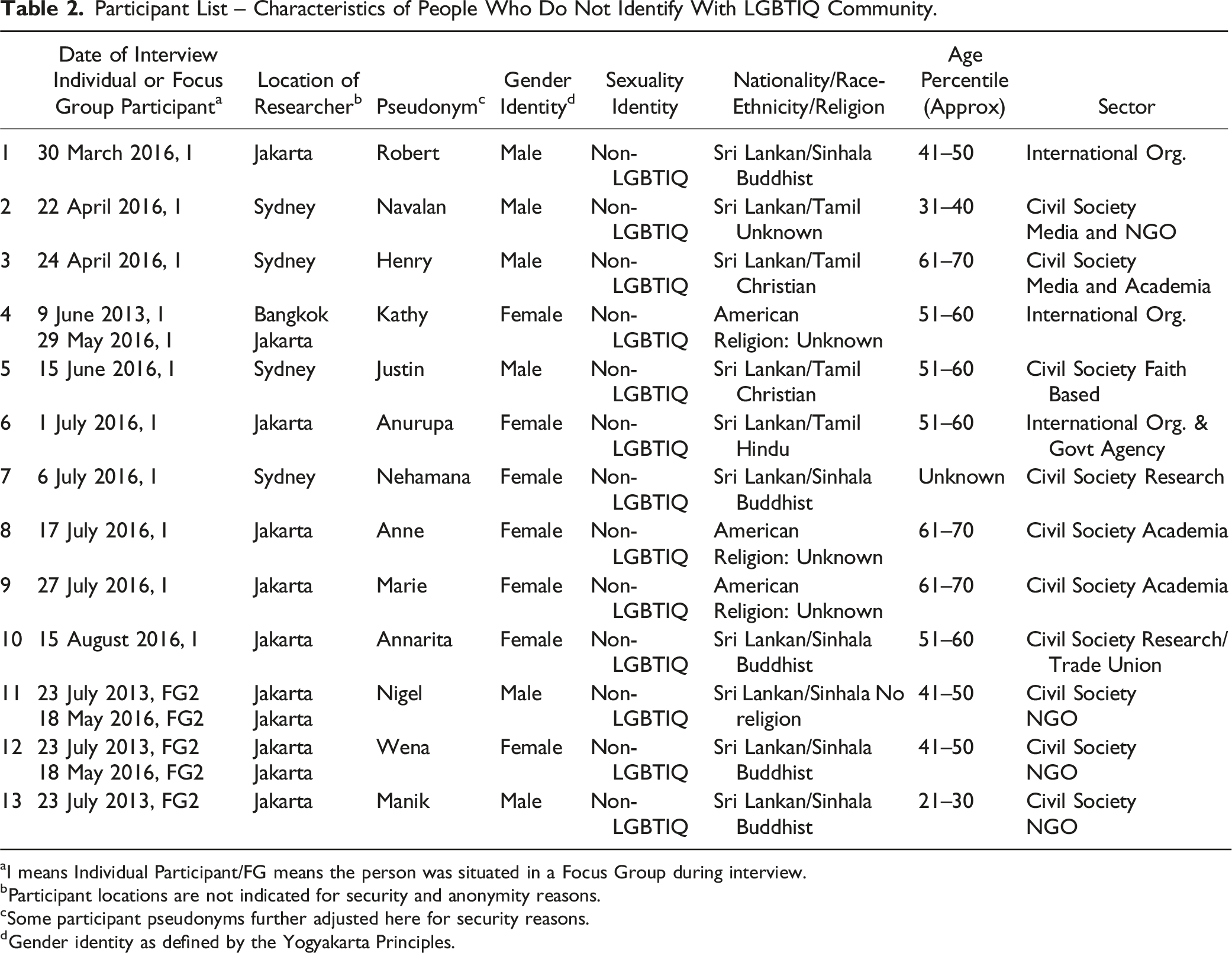
aI means Individual Participant/FG means the person was situated in a Focus Group during interview.
bParticipant locations are not indicated for security and anonymity reasons.
cSome participant pseudonyms further adjusted here for security reasons.
dGender identity as defined by the Yogyakarta Principles.
A wide net was cast in order to select participants from civil society organisations, especially those working in peace, democracy and human rights. I sought potential participants who, as Smith et al. suggest, ‘represent a perspective, rather than a population’ (Smith, Flowers & Larkin, 49). I refined the process by reaching out to those whose experiences could speak to the key issues of marginalisation. My own engagement with people whose identities included members of the LGBTIQ community, amongst other marginalised communities, and their knowledge of my research, led to an enhanced response and snowballing. The samples for interview were therefore selected purposively and the participants spoke as much about their perspectives on key issues as they did to their identities and marginalisations (Smith, Flowers & Larkin, 48). Whilst ‘identities’ are an important first step in the selection process, it was the common characteristics pertaining to those ‘identities’ within that group, rather than merely the group itself, that helped to underpin the selection. They were therefore selected, as Smith et al. have suggested, ‘on the basis that they can grant us access to a particular perspective on the phenomena under study’ (Smith, Flowers & Larkin, 49).
I was also alive to the need to understand my position with respect to the research generally and the participants specifically. The principal issue arises in how ‘the other’ is situated, understood, interpreted and represented in circumstances in which researchers do not share the same ‘axis of oppression but rather have race, class, and gender privilege’ (Romero, 55). The conduct of interviews and analysis of data were therefore influenced by my ‘position’ in relation to the ‘others’.
Positionality and Intersubjectivity
Positionality shapes how inequalities and power relations affect knowledge production, influencing both the researcher’s perspective and the participants’ responses. I remained conscious of the fact that my own presence, and status as perceived by participants, during interviews could impact upon both the conduct of an interview process and its content. Moreover, I was also conscious that the interpretations being made by me were affected by the informants’ own positionality with respect to me (Romero, 54). The reliance upon an Interpretive Phenomenological Analysis (IPA) approach further illuminated the inherent power dynamics in need of mediating within what were essentially both ‘reflective’ and ‘cyclical’ analytical processes (Smith, Flowers & Larkin, 34–37, 41). As Mary Romero states, ‘Social science has a long tradition of studying the powerless, and normalising unequal relationships between the researcher and the participant’ (Romero, 55). Peace studies are similarly concerned with relational inequities and how they might be remedied.
My historical proximity to participants and the knowledge gained during those earlier interactions influenced and helped to contextualise my interpretations of knowledge during the formal collection of data. I was conscious that my own history enhanced the intersubjectivity between the participants and me, and that the information gleaned from such pre-existing relationships, if managed reflexively, strengthened the acquisition and interpretation of knowledge.
Understanding one’s position in relation to the other and vice versa ‘is critical’. My assessment of positionality was made based upon levels of perceived commonality. For example, whilst I, and almost all the participants, identified with degrees of marginalisation, we all, nevertheless, also appeared to enjoy certain levels of shared privilege, such as high levels of education with varying levels of English fluency. Similarly, all participants had experience in the functioning of civil society organisations, varying degrees of engagement with both local and multi-lateral institutions, knowledges of transnationality and to a lesser degree common lived cross-cultural experiences. These factors, on one interpretation, limited the research, given, for example, it diminished the participants’ representational legitimacies. Alternatively, these participants helped me bridge a void sometimes arising in transnational interpretations of local knowledges, especially in the context of peace, democracy and human rights.
I therefore considered the knowledge acquired under these circumstances as comparable to that ordinarily acquired during a formal interactionist setting, thereby strengthening my critique of information obtained. I remained conscious that both positionality and interactionism are used as observational methods and as suggested by Roger Smith, ‘offer the prospect of being able to identify, record and analyse the behaviour of individuals and groups in “natural” settings’ (Smith, 114). Such an interactionist venture enabled me to distil greater meaning during interviews than the words alone might otherwise infer. As Denzin posits, ‘interactionism best fits the empirical nature of the social world’ (Denzin, 2009b, p. 5).
Rather than its formal adoption as a central method in this study, interactionism is used to guide the interviews, the data analysis, and the interpretative approaches. It helps strengthen the linkages between the various participants and me within the research act. In so far as these methods helped to promote the intersubjectivity between the participants and me, they formed the basis of an interpretative process from which data was itself able to evolve. In so far as it lends itself to an ethics of social justice, I remained mindful of Denzin’s call for a ‘repositioned critical qualitative studies project’; an ‘activist project’ and renewed ‘public intellectualism’ from which an emergent ideological and dissident urgency in scientific approach to method is sought (Denzin, 2009a, pp. 26–37).
On the Utility of Symbolic and Interpretative Interactionism
The social theorist Neloufer de Mel believes that the right research consensus is achievable by appropriate proximity to a particular culture in so far as it offers access to ‘a whole way of life [of] values, customary practices, rituals and creative works’ (de Mel, 2007, p. 15). Martha Nussbaum’s research on empathy, pity and compassion, and on the importance of proximity between researcher and subject builds upon de Mel’s approach. ‘the pain of another will be an object of my concern only if I acknowledge some sort of community between myself and the other, understanding what it might be for me to face such pain’, she argues (Nussbaum, 1996, p. 35).
I remained conscious of her formulations about empathy and community whilst discarding ‘indifference or mere intellectual curiosity’ (Nussbaum, 1996, p. 35: Nussbaum, 2001, p. 450). Feminist scholars, West and East, support such approaches, for example, Lila Abu-Lughod, on Muslim Women in the Middle East, ‘insist[s] on working from the ground up, getting to know social and cultural life intimately’ (Abu-Lughod, 2011, p. 2). She describes her methods specifically as a kind of ‘ethnography’, which constitutes ‘the deepest form of respect for others and offers really rich possibilities for challenging dominant ideologies, intellectual and political through the lives of others’.
However, any commitment to these methods must be informed critically, and some cautions exist. Nussbaum reflects upon our ability to empathise or distance ourselves from a subject by challenging our own sense of ‘self’, its reflexive nature and the manner by which the ‘self’ might exist in relationship to those ‘other’ people. She calls for deep introspection of our ‘selves’ and, invites us to not simply be proximate to, but immersed within, those about whom we research (Nussbaum, 2001, p. 451). Nussbaum’s caution relates to the researcher’s own awareness in doing the ‘performance’ of research, and in this study’s case, selecting participants, collecting data and giving meaning to the voices of people from marginalised or oppressed populations in Sri Lanka. Abu-Lughod goes further by challenging what she views as uncritical appraisals within Western public discourse, Western feminism and her own discipline of Gender Studies. For Abu-Lughod, ‘the easy superiority of Western modernity’ found in much social and political research must be avoided (Abu-Lughod, 3).
Accordingly, I continued to grapple with the legitimacy of my own presence within Sri Lanka, as observer participant, and my proximity to those people for whom I aimed to offer a voice and create meaning. I must justify my presence if my observations are to have merit. I am not Sri Lankan; but rather I am from Western modernity. ‘The primary concern is how “the other” is represented by researchers who traditionally do not share the same axis of oppression but rather have race, class and gender privilege’ argues Romero (Romero, 55). Moreover, I am an Anglo-Australian man, of middle-class extraction, from a nation of people whose own history is steeped in the fragmented intrusions of imperial adventure. I am not Sinhala or Tamil; nor am I Buddhist, Hindu, Muslim nor any other faith belonging to Sri Lanka. I remained alive therefore to feminist arguments who, as Romero highlights, challenge positivist notions of ‘objectivity’ and, used in isolation, its potential to produce ‘a masculinist science…of a partial perspective on the social world’ (Romero, 55). However, I do share characteristics with the marginalised populations whom I sought to interview, in particular, but not only, the members of the minority LGBTIQ community. Indeed, it was this doorway through which I believed I ought to transition in order to ethically justify my proximity to the participants in this study.
Over a period of several years, potential participants demonstrated interest in my research; although many expressed reluctance to be involved. Greater interest in, and willingness to participate became evident following the change of government in 2015.
Rationale for Selection of Interpretative Phenomenological Analysis (IPA)
Whilst aspects of ‘interactionist’ methods influenced the selection of participants, the analysis of data was informed by IPA: to examine a phenomenon, an experience, as Smith et al. argue, ‘to be expressed in its own terms, rather than according to predefined category systems’ (Smith, Flowers & Larkin, 32). I examined the significance of lived experiences of individuals and the degree to which those individuals’ experiences enjoyed a ‘relatedness to, or involvement in, a particular event or process (phenomenon)’ (Smith, Flowers & Larkin, 40). Each participant was viewed as a ‘sense-making creature’ and the meanings that a participant attributed to one or more events as they became an experience of significance and, according to Smith et al., ‘be said to represent the experience itself’ (Smith, Flowers & Larkin, 33). Thus the manner by which participants represented their experiences and the manner by which I interpreted such representation formed part of both the hermeneutic and idiographic aspects of the research (Smith, Flowers & Larkin, 28–32).
I was conscious that in order to distil significant meaning from the representations before me, I needed to remain alive to the nature of the processes through which the significance of an experience was transformed from a first order level meaning as ‘being’ to a second order level meaning of ‘becoming’ (Smith, Flowers & Larkin, 17, 19, 36 also citing Kierkegaard, 1991). In so recognising the movement of meaning from one order to another, I was also conscious of it as a process through which meaning evolved in terms referred to by Stuart Hall as ‘the process of representation’ (Hall, 1997, pp. 7–8). For Hall, the representations of the events being described are not isolated from the event but are rather, ‘constitutive of the event’ (Hall, 7–8). Hence, different ‘meanings’ or as Hall refers, ‘interpretations’ reflect the diversity of subjectivities, and hence individual ‘truths’ found in each individual participant’s experience. Whilst I was conscious that participants may conceive of events, or experiences, as singular truths, I was also conscious that IPA’s hermeneutic and idiographic character opens a discussion to the possibility of ‘other truths’, pre-suppositions or, as Smith et al. refer, ‘fore-structure’ (Smith, Flowers & Larkin, 25, 27).
The intersubjectivity of the participants’ relatedness to each of their individual worlds and the inter-relational dynamics between the individual participants and researcher were characteristic of an IPA approach (Smith, Flowers & Larkin, 17). The process is informed by Heidegger’s hermeneutic circle in which a dynamic reciprocity of observation, engagement and interpretation is adopted at a series of levels (Smith, Flowers & Larkin, 28). As Smith et al. state, ‘to understand any given part, you look to the whole; to understand the whole, you look to the parts’ (Smith, Flowers & Larkin, 27–28). The researcher, as the whole, is thus dependent upon their relationships with the various participant parts. The process is therefore iterative and consistent with an exploration that seeks the limits of knowledge throughout both the interview process and data analysis, and in so doing similarly seeks the limits within the context of the research question itself.
Having established the theoretical frameworks guiding this study, the following section outlines how these concepts were operationalised in the data collection process which included the sampling and selection of participants and the conduct of the semi-structured interviews.
Research Design, Data Collection, Interviews and Analysis
Interview design was informed by Denzin’s framework of ‘non-scheduled standardized’ interviewing techniques (Richardson et al., 1965, pp. 32–55 in Denzin, 2009b, pp. 122–143). In this context, degree of ‘structure’ of interviews is also couched in the terms of ‘standardisation’ (Denzin, 2009b, p. 123). First, it helped frame the initial areas or themes enabling the identification of several threshold entry points to use as segues to other identified themes of interest (Denzin, 2009b, p. 123). Second, as Smith et al. suggest, a ‘double hermeneutic’ experience is desirable – the research makes sense of the participant who makes sense of their experience (Smith, Flowers & Larkin, 35, 41: Denzin, 2009b, p. 125). Third, it made me conscious that individuals present unique processes through which they define their worlds and that such worlds must be understood from the perspective of the subject (Denzin, 2009b, p. 125). Finally, bearing both case study and IPA methods in mind, the desired effect was, as Roger Smith argues, to attain specific detail whilst concomitantly acknowledging that the data obtained also lent itself to ‘a sense of an unfolding process of change’ (Smith, 2009, p. 121: Stake, 2010, pp. 27, 201, 210: Oliver, 2010, pp. 93–94).
Sampling and Selection of Participants
Over approximately three years, 22 participants were interviewed commencing 2013 with the majority taking place in 2016 (Tables 1 and 2). The earliest participants had an opportunity to re-examine their contributions following the political changes in 2015. Consistent with IPA approaches of sampling by degrees of homogeneity, I identified participants whose experiences harnessed knowledge about the functioning of civil society in Sri Lanka as well as their own identification as, or relationship with, a minority or marginalised community (Smith, Flowers & Larkin, 48–51). Given this study focuses on participatory practices through the medium of civil society I preferred participants whose experiences and knowledges were familiar with its political character and functioning. Selecting people whose experiences arose from their identification with one or more minority or marginalised communities caused me to reconsider how such communities are constituted and the importance people attribute to their belonging to one or more groups, taking into account that not all minorities are marginalised and conversely, not all marginalised communities are minorities. As Greg Fealy and Ronit Ricci argue, ‘sociologists commonly define a minority as a group with observable characteristics or practices based on such things as gender or sexual orientation, religion, ethnicity or disability’ (Fealy & Ricci, 2019, pp. 6, 1–18). An uncritical assessment might lead to a cohort being identified as having minority group status if an over-emphasise is unreasonably placed on a characteristic which is not unique to that group. For example, an over-emphasise on a group’s numerical weighting within the larger population might not be a strong argument for affording them ‘minority-status’. Rather, a more comprehensive assessment might demand greater scrutiny of behavioural characteristics within the group and of structural barriers that discriminate against or stigmatise the group members. Fealy and Ricci discuss this matter in relation to gender. Notwithstanding women comprise about fifty percent of the world’s population, they argue, they are ‘effectively a minority, such is their lack of political, economic and cultural power’ (Fealy & Ricci, 7). Accordingly, when I selected suitable participants for interview, I adopted these other parameters as selection criteria.
I distinguished those who identified themselves as being from sexuality or gender diverse communities from those who identified their marginality otherwise. Whilst these categorisations lent themselves to a case study approach, and highlighted their ‘representational’ qualities, my interpretative method recognised that the experience of each participant was unique (Moore in Hall, 1983, pp. 7–8). Further rationale is discussed below.
Both ‘emancipatory’ visioning and critical analyses informed the process of selecting participants. Consistent with IPA, it was guided along a ‘purposive’ ethically grounded trajectory which offered ‘insight into a particular experience’ (Smith, Flowers & Larkin, 48). Indeed, ‘to have purposes is to make choices’, integral steps towards ‘self-determination’ (Birch, 1990, p. 18). Accordingly, creating an enabling environment opened the space to people who, like me, publicly identified as being from the community of LGBTIQ people. It established a cooperative action of ‘self-determination’ within my own consciousness and, as I hoped it would for my participant colleagues. 2 The choices were made with a view to identifying participants’ life experiences within the Sri Lankan social and political landscape. They offered unique or insightful ‘information or expressions of opinions or belief(s)’ about each participant’s own experiences, their own places within, or associations with, the structures of vertical power and the manner that these phenomena, directly or indirectly, led to their own marginalisation.
The actual cohort captured through the distribution of a Circular Advertising the Research was less than I had originally planned. However, I also remained cognisant of not allowing the selection of participants to become unnecessarily generalised. Smith et al. recommend that IPA researchers seek a ‘homogeneous sample’ (Smith, Flowers & Larkin, 49). But such homogeneity will vary from study to study, and I refined the recruitment process accordingly, whilst concomitantly observing safety and security concerns.
I visited and wrote to key civil society organisations in Sri Lanka whose work I believed had a central focus on: (a) peace and conflict resolution, (b) policy and law development, and (c) policy and advocacy in relation to most marginalised groups. I focused on the LGBTIQ community, women and girls, the community of people with disabilities and finally organisations that were associated with ethnicity or religion. I also wrote to and visited the Ministry of Defence (MOD), the former Ministry of National Languages and Social Integration (MNLSI) [now the Ministry of National Integration, Official Languages, Social Progress and Hindu Religious Affairs (MNI)], the Human Rights Commission of Sri Lanka (HRCSL) and various heads of agencies at the United Nations (UN) in Colombo. 3 (MNLSI Action Plan, 2011, pp. 1, 8) I made representations to undertake the research formerly within the country through the University of Colombo (UOC). The Circular advertisement was also voluntarily distributed through various organisations’ networks.
Preliminary oral expressions of interest dissipated during follow-up contacts. Those representations were made between 2011–12, when the social and political climate in Sri Lanka was described by participants as difficult. Formal interview processes were postponed until such a time as I was able to meet the safety and security conditions set by the University of Sydney’s Human Research Ethics Committee (HREC). To satisfy those conditions, I timetabled interviews when participants were in secure and safe locations, such as when they were outside the country. I also understood that people faced genuine fears when talking to foreigners about politically sensitive topics, namely, peace, justice, human rights and marginalised communities.
Other factors influenced the final cohort including logistics, sample size and relevance of potential contribution. A subset of the original anticipated cohort was selected based in principle on the common underlying ‘perspective’ of people whose relationship with their external world was one of varying degrees of marginalisation, such as through experiences of discrimination, stigmatisation, exclusion or criminalisation, within whom exists a desire to be free and for whom the importance of civil society might be understood as an advocacy platform for the freedoms they sought. In so doing, my aim was to select participants who were able to demonstrate their relationship with, or an experiential understanding of, those people or groups most marginalised within the country.
I first asked myself what characteristics would define the most marginalised people in Sri Lanka? I did this, as a critical analytical step rather than merely accept the popular narrative that is limited to race and religion. So profound is the question that it became a matter to which participants contributed before and during their interviews. Each prospective participant was assessed as being able to contribute to the research based upon: (a) their familiarity and experience with civil society in Sri Lanka and (b) their identification with, or proven empathy for, one or more sub-populations deemed marginalised. People from acknowledged marginalised groups, such as Tamil and Muslim people, were not excluded; however, I did intend and proactively sought to broaden the focus to include others. Whilst race and religion remain the dominant popular public narrative in Sri Lanka, Dennis Altman insists that an analysis of ‘sexual oppression’ (particularly homosexual oppression) is more useful than ‘race’ because as a subject benchmark of lowest common denominator – ‘sexual oppression is probably, as feminists insist, the oldest of all dominance/subordination relationships’ and is one of, if not the most, oppressed groups universally’ (Altman, 232). My own lived experiences empathised with Altman’s conclusion. I remained conscious of the need to elevate those voices of people whose experience of marginalisation in Sri Lanka was based upon their sexual orientation and/or gender identity (Yogyakarta Principles, 2007).
Indeed, beyond the personal experiences of myself as a gay man, I was able to discover from many of the participants that sexuality in Sri Lanka was a subject area that met the criteria of marginalisation and that for many people the subject could not even be contemplated, let alone discussed. Deepak, a young gay activist in Sri Lanka and participant in this study, working in civil society affirmed this point: We [LGBT] are actually an invisible community within Sri Lanka; and so, then that’s where everyone starts...I personally believe that it is really important that people start coming out so that we can actually open ourselves to the public to see who we are. Unless we do it, nobody's going to understand what kind of issues we face.
Bearing in mind the characteristics of people identified in the Yogyakarta Principles as well as the social, political and legal dislocation of LGBTIQ people on the ground in Sri Lanka, there is sufficient reason to accept that the circumstances which members of the LGBTIQ community endure in Sri Lanka translate into a denial of sexual (or sexuality) rights. I was influenced by the work of Altman and Jonathan Symons whose definition of sexual rights seemed to underpin the circumstances of sexual and gender marginalisation in Sri Lanka (Altman & Symons, 2016, p. 85).
Deepak’s comments about the status of the LGBTIQ community in Sri Lanka resonate with even greater clarity when juxtaposed against the words of another participant in this study. Henry is a non-LGBTIQ retired Tamil academic migrant living outside Sri Lanka. When asked about marginalised populations, his response was limited to the popular narrative of race and religion. He conceded, when asked, that women had ‘traditionally been assigned a role in the kitchen’ and advanced a positive position with respect to protections needed for people with disabilities.
4
However, when asked his views on LGBTIQ Sri Lankans he referred to a mainstream mood in relation to people from sexual or gender diverse backgrounds saying: They will never have a place. They may need protection, but in Sri Lanka society they are hated and discarded, they are considered not acceptable by the culture of the community.
Henry’s remark underscores how multiple axes of identity, for example, sexual orientation and ethnicity, intersect to marginalise LGBTIQ individuals in Sri Lanka reflecting Collins and Bilge’s (2016) analysis of how power and oppression manifest in intersectional identities. Juxtaposed against Henry’s seemingly essentialist response, are the works of Altman (1973) and Sen (2006) who invite reflection upon the polymorphous textures of humankind and of the ease with which the recognition or acknowledgement of an individual’s broader set of identity markers can become lost.
In 2013, seven participants from separate organisations responded to my initial requests for interview. 5 As a result of snowballing, two further participants were interviewed in 2015 and the remaining thirteen participants throughout 2016. 6 A few arose through symbolic interactionist networks, whilst others through my working and social life with marginalised communities (Smith, Flowers & Larkin, 49). Most fall into the category of ‘referrals’ which commenced during 2015 and ‘snowballed’ throughout 2016.
This sampling experience helped characterise the final cohort demographics. Case study and interpretative opportunities became clearer within the small but rich sample. I was unable to secure participants from the community of people with disabilities, nor from the Muslim community. I bifurcated participants between those who identified as being from the LGBTIQ community and a cross section of non-LGBTIQ minority group people. There was also a small cohort of non-Sri Lankan professionals, namely academics and UN development workers.
Most people interviewed harboured multiple identities, for example, a person who identified as an LGBTIQ participant may also identify as being of a particular ethnicity, religion or marginalised age group, such as youth, as indeed are several in the non-LGBTIQ constructed cohort.
The participants and I enjoyed certain privileges and queried how that might impact upon the study. Adopting intersectional approaches helps to hold accountable aspects of multi-dimensional relationships which for reasons of privilege are imbalanced. ‘White, male, heterosexual and citizenship privileges are not personal but are institutional arrangements’ argues Romero, ‘that provide non-disabled persons classified as white, male and heterosexual greater access to power and resources that are not similarly available to people of colour, women, LGBTQ individuals or non-citizens’ (Romero, 38–39). I tried to recognise how imbalances in privilege might marginalise those with whom I engaged and take appropriate steps to reasonably accommodate those less privileged so as not to cause them harm. I was also cognisant of mitigating differences in privilege and power by choosing participants who, for reasons of their own privileged positions, I deemed as being able to meet me as researcher more equitably. Whilst this approach inherently gives preference of access to privilege, I was persuaded by Romero’s arguments who invites us to treat social hierarchies as more than one-dimensional (Romero, 38–39). Important for Romero is the recognition that ‘mono-dimensional approaches…[to]…social institutions preserve the practices that maintain social inequality’. She posits that until we recognise these relationships, we cannot begin ‘to identify and resist the privileges embedded in everyday interactions’ (Romero, 60).
I did not embark upon an investigation of participants’ socio-economic standing because most participants already presented as enjoying some level of privilege. Nevertheless, beyond externally imposed limitations, which frustrated access to a much wider set of participant opportunities, the privilege of those who did participate equipped them with some specific knowledges that enabled them to cross economic and class divisions, such as access to cultural phenomena articulated in specific transnational terminology. Whist I am conscious that aspects of privilege are linked to degrees of marginalisation, some of the limitations on the study, including limitations of participant and researcher agency, did not afford me a broader scope in the selection of participants (Hearnden, 2023, pp. 31–9). Beyond language itself, other indicators of privilege included professional employment in non-governmental or academic environments. Cognisant of the distinguishing features above, the links between marginalisation and privilege, and proactively seeking to mitigate power imbalances, I concluded that I was able to manage both my own and my participants’ degrees of privilege and construct an equitable forum in which to engage.
Tables 1 and 2 include the pseudonyms of participants and were agreed in preliminary discussions prior to interview. A coding system was constructed to identify each participant. I alerted them, consistent with HREC guidelines, that their identity would be protected. I took the view, consistent with this study’s ‘do no harm’ approach to safety and security, to maintain all pseudonyms, which do not necessarily have any cultural significance equating with their true identities. The information gleaned in the Tables arose from informal discussions in pre-interview sequences, information obtained throughout interviews and demographic data collected.
Overall, 22 people were interviewed including 17 individuals and two focus groups of two and three people, respectively. Almost all participants identified with a marginalised, excluded or oppressed group of people within Sri Lanka. All participants had varying experiences with civil society. A few participants were from the United Nations and one Sri Lankan statutory authority. Representations of gender and sexual diversity were significant. More ‘Sri Lankan’ people were interviewed than non-Sri Lankan; with slightly more Sinhala than Tamil participants. No Muslims were interviewed. Of the total participants there were 11 women (50%) and 9 people from the LGBTIQ community (41%), of which 5 people of the total sample were Sri Lankan (23%). Of the total participant sample, there were 5 Tamils (23%) of which 1 (5%) was from the LGBTIQ community. There were 15 Sri Lankan participants (68%) of whom 5 as mentioned were Tamils, 8 Sinhala people (36%) of whom 2 (9%) were from the LGBTIQ community, one whose family ethnicity is of the Indian sub-continent and the other whose ethnic origin is unknown. Of the total participants there were 3 young people (14%), all 3 of whom identified as being Sinhala Buddhist and 2 (9%) of those people also identified as being from the LGBTIQ community.
Conduct of Interviews and Addressing Concerns
Most interviews were conducted face to face or via Skype and took place whilst the participants were outside Sri Lanka. 7 My own commitments in Asia and Australia meant that over time I met or video-linked people for interviews whilst in: Bangkok, New Delhi, Jakarta, Durban, London, Worcester, Berkeley, Massachusetts, Canberra, Brisbane and Sydney. To further protect the security and anonymity of participants their locations are not listed in the Tables.
Data Analysis and Triangulation
Data analysis was couched in the case study method, and the inductive approaches to interpretation and analysis adopted are advocated by Smith et al. (Smith, Flowers & Larkin, 31–39). The analysis of knowledge relied upon an interpretative approach to determine meaning. Each interview was first examined as a unique experience, and as Smith et al. argue, should be examined on its own merits and second, as presented, within the two sample groups: LGBTIQ and non-LGBTIQ communities. Each sample group was carefully examined for similarities and differences which produced granular accounts of individual experiences and patterns that reflected common experiences, on specific issues (Smith, Flowers & Larkin, 38).
There were two levels of primary thematic data. The first related directly to those ‘areas of interest’ that were guided by a semi-structured component of discussion, including the participants’ understanding of the relational aspects of peace to democracy, human rights and civil society. The second level data arose during the less structured or unstructured periods of interview, illuminating emergent areas of common participant interest or experience, including themes of leadership, violence, difficulties/limitations/barriers/challenges, caste and class, international perspectives, transitional justice and ways forward.
As part of a triangulation process, each interview participant was ‘member checked’ to move the credibility of data collection beyond the act of merely ‘being careful’. ‘Member checking’ Robert Stake suggests is about ‘being sceptical’ and puts an onus upon the researcher to check that, participants ‘were seen or heard right’ through a process of ‘checking further’ (Stake, 123). Reminiscent of Susan Sontag’s assertions about the discovery of knowledge, I was reminded of the need for the social and political scientist to adopt cautious repetitive examinations of the matter under inquiry; to seek meaning through its further illumination; and to discover knowledge through a more nuanced comparative application of interpretative methods (Sontag, 7). Triangulation within each interview helped to confirm and validate the knowledge shared (Flick, 2002 in Stake, 124). The analysis of data and the degree to which it was triangulated was informed by Robert Stake’s four rules, prioritised in circumstances whereby ‘the data are evidence for a main assertion’ (Stake, 125).
Managing Subjectivity, Reflexivity and Bias
Whilst I described the cohort of participants as ‘homogenous’, from the point of view that most identified themselves as being of a marginalised pool of people, I was also cognisant of their unique and individual experiences. Indeed, the freedom afforded each participant during the semi and partially unstructured interviews enabled them to consider ideas that went beyond the substantive issues under examination, whilst remaining a part of that person’s experiences. An American academic participant with a research history in Sri Lanka, for example, said she began to explore ideas about ‘uncertainty’ and ‘subjectivity’ within the context of social science and psychology. For her, ‘...the object of study is not fixed. It changes in accord with culture, history and location…..people are self-aware and self-creating…’. 8 If correct, then the methods import the presumption of plurality and ‘the researcher’s sense-making is second order’ (Smith, Flowers & Larkin, 3). Indeed, I remained open to the idea that a plurality of ‘subjectivities’ and ‘uncertainties’ may exist and that the ‘fallacy of objectivity’ was quite real, as was the historical challenges to the merits of the qualitative research itself.
Denzin’s second methodological principle states that, ‘taking the role of the acting other permits the sociologist to escape the fallacy of objectivism’. Read in conjunction with Birch’s view, the fallacy, refutes ‘the notion that science is objective in the sense that subjectivity does not enter into the scientific analysis’ and is persuasive (Birch, 122). Birch was not disqualifying ‘objectivism’ but questions the historical purity it has been afforded. I therefore recognised that ‘subjective’ interpretations, irrespective of their exogeneity or endogeneity, remain as much an imperative throughout the ‘interpretive’ process as objectivity (Denzin, 2009b).
As referred to earlier, the researcher’s own involvement and self-awareness strengthens the ‘research act’ (Nussbaum, 2001, p. 451). Moreover, when discussing ‘participatory action research’, Stake highlights the importance of a researcher’s understanding of their ‘own place’ (Stake, 157–169). Accordingly, the reciprocity between researcher and awareness of the world in which the research is being conducted speaks to the indelible effect of each upon the other and the perceptions of each about themselves. Heidegger’s ‘hermeneutic situation’ and the pervasiveness of the researcher’s ‘predispositions’ are linked – and again demonstrate the tension that ‘subjective’ methods import. ‘We should not be too swayed by objectivity’s reputation’, asserts Stake, ‘as our own situated experiences in the world’, our ‘hunches’ and ‘intuitive feelings’ within a reflexive process add value. It should not be confused however with ‘bias’, which is simply one part of this process: a part which Stake suggests is merely ‘the lack of appropriate subjectivity’ (Stake, 166).
But unlike bias, ‘reflexivity’ encompasses a sense of power differentials at work and asks what harm mitigation strategies ought to inform the research. Scholars writing in this area, Simon and Dippo, for example, embed a ‘do-no-harm’ benchmark as a qualifying characteristic of any ‘critical’ undertaking; ‘the work must be reflexive with regard to its own limitations, and the author critical of the power structures she or he is working within in order to avoid reproducing damaging structures’, they assert (Simon & Dippo, 200: Pimental, 2010, pp. 32–36). An elevated consciousness of the multi-faceted nature of engagement should help the researcher to mitigate ‘harm’ and, in so doing, diminish ‘implicating ourselves in the very hegemonic processes that are the object of the critique implied in our work’ (Simon & Dippo, 199).
Throughout, I challenged myself as to whether I harboured biases which were unreasonably influencing the research: did my views about discriminatory treatment of people by powerful elites distort my judgement? Did my attitudes impact unreasonably on my own interpretation of the world? Had I constructed an agenda detrimental to good research outcomes? I was aware that my own perspectives could be perceived as being consistent with a certain normative framework, but I was also aware that uncritically managed such a framework might lead to the intrusion within interviews of normative biases or certain interpretative processes.
Language, for example, is one aspect of research which may introduce bias. However, in the case of this study, the bias ordinarily anticipated when attempting to bridge different languages was tempered. Whilst I initially prepared my field research and documentation in Sinhala, Tamil and English, and whilst I interacted with some people who did not speak English, I did not, ultimately, interview non-English speakers. It is worth noting that central middle-class Colombo society is largely bi-lingual, with one language being English – although this could not be claimed of greater Colombo society. Whilst it is true, that the absence of non-English speaking participants, if analysed uncritically, will inject some level of bias, it can also be argued that attempting to bridge language barriers in Sri Lanka was likely to import its own set of limitations, including some pertaining to safety and security.
Further to the question of privilege, whilst most participants identified with marginalised communities, their levels of privilege linked variably to their knowledge of and engagement with Western conceptualisations of the world, bringing to the discussion perspectives which enabled them to explore how within the complexities and dynamics of their own cultural frameworks they, as people from marginalised communities within Sri Lanka, understood and experienced peace, democracy and human rights. At the same time, their attitudes and experiences were influenced by their economic and educational advantages and, again, their engagement with the West.
It is not argued that either participants’ individual or collective selves represent the experiences of all Sri Lankans who also fall into the same, or similar, identity groups. But it is argued that they provide a suite of common insights into a set of experiences as people who, whilst quasi-privileged, are also marginalised, by the social and political structures and majoritarian attitudes and behaviours of the wider population generally and the political elite specifically, in Sri Lanka. In other words, whilst participants cannot claim their experiences are representative of others, they do perform a particular representational role.
I was cautious that uncritically identifying phenomena as facts may import the very uncertainties or errors about the utopian notion of a singular or ideological ‘truth’, which I wished to avoid (Birch, 123). There is helpful disquiet amongst theorists on the question of factual accuracy and how the researcher should treat this information. Nietzsche, for example, erred away from ‘facts’ in favour of ‘interpretations’, giving cause to reject them as refutable symbols of truth. As mentioned, I remained conscious during interviews that participants may relate experiences which they offer as ‘facts’ or ‘truths’; but which were analysed rather as representations. Stuart Hall’s discussion on representation was persuasive in this regard and in analysing the participants’ experiences, I considered them as constitutive of each of the participant’s own realities (Hall, 7–8). In so doing, like Hall, I attempted ‘to keep representation open’ with a view to seeking ‘new kinds of knowledges...new kinds of subjectivities...and new kinds of dimensions of meaning which have not been foreclosed by the systems of power’ (Hall, 22).
Harm
Research processes or outcomes that lead to ‘harm’ are antithetical to a peace with justice scholarly framework. To what degree a project should be shaped and to what extent a researcher should intervene in the lives of people is a matter for each researcher to assess. In Stake’s view, the researcher themselves ought to provide the ‘bulwark of protection’, and a minimum threshold benchmark should locate as its ‘core principle of a universal morality...the duty not to harm other people’ (Stake, 206: Linklater, 2006, p. 331).
I contend that observance of Denzin’s ‘methodological principles’ as well as IPA’s ‘double hermeneutic’ cannot work in isolation from the researcher’s own understandings of, and obligations to, both the research and the participants’ short and longer-term security needs. Some conditionality relating to security was addressed in the conditions set by institutional ethics oversight; however, I was also conscious of more nuanced issues. Building upon Cannella and Lincoln’s references to the potential for harm from both endogenous and exogenous sources, the research was informed by applying Denzin’s fourth methodological principle, which invites the researcher to ‘consider the “situated aspects” of human conduct’ (Cannella & Lincoln, 2009 in Denzin & Giardina, 2009, pp. 55, 57). I recognised the uniqueness of each participant’s own situational exigencies and of their particular vulnerabilities given their identities and relationships to marginalised communities (Denzin, 2009b, pp. 10–11). For example, the participant Deepak who identified as being from the Sri Lankan LGBTIQ community re-emphasised the fragility of emergent civil society organisations that worked on contentious social issues, such as sexuality, referring to the dissolution of their Board of Trustees following political interference. The potential harms that arise given the distinctly Faustian trade-offs within the ‘research act’; some less discernible, such as the nature of uncertainty of observation when acted upon from an external source – and those which arise from the peripheries. An uncritical appreciation of the trade-off between competing needs and exercise of power of the researcher, the participant and the public interest may result in the perception that ‘potential good of the research’ necessarily outweighs other, seemingly small, dangers; couched, as Stake reflects, upon the occasional researcher argument expressed by some researchers as a ‘right to know’ (Stake, 206). But harm can manifest itself both mentally and physically and I remained cognisant of both throughout the study. Indeed, the view was corroborated by participants. Accordingly, an elevated caution about potentially revealing participants’ identities was assumed in all cases.
Additional Limitations
Language and Confidentiality
Although research documents were translated in preparation for interviews in Sinhala and Tamil, it became apparent that there were safety and security issues for the participants, interpreters and translators. First, I became aware of the difficulties of finding a translation and interpreter service in which I could have confidence. Second, it equally became apparent that the security and confidentiality of data acquired in the presence of an interpreter could not be guaranteed. The smallness of the Colombo community and the weakness of formal systems of accountability, meant I could not be confident that the interpreters would not know, recognise nor maintain the privacy or confidentiality of the participants or vice versa (UNAIDS, FPA & Ors, 2010, p. 21). Whilst I ultimately found an academic through the University of Colombo (UoC) with whom I established trust for the purpose of translation of documents, and whilst they were submitted consistent with ethics conditionality, I formed the view for reasons of not only logistics, but confidentiality, security and safety that my original proposal to conduct interviews with an interpreter present should not be entertained.
Institutional Uncertainty and Fear of Participation
A commitment to transparency is not without peril and the potential to engender fear. As I have revealed elsewhere, I sought to legitimise my presence as a researcher in Sri Lanka by establishing a relationship through the University of Colombo (UoC), applying first to the School of Political and Social Sciences (Hearnden, 33). Whilst waiting, one senior well-known political scientist at UoC tried to dissuade me from proceeding, based on his own experiences, fearing eventual failure in the face of UoC political and bureaucratic structures. He warned me that ‘it was too political’. Interpreting his words broadly and poignantly, his advice about the ‘political’ nature of my work invited my own further introspectivity and of similar researchers’ analyses. Jonathan Spencer’s analysis of Sri Lanka, for example, characterised ‘the political…as a zone of collective moral disorder’ regarded by many as something that ‘others’ do, and therefore something I should not (Spencer, 2008, p. 618).
The initial application was lodged on 29 April 2011. Surprisingly, approvals were granted at school, faculty, academic and Senate committees. Whilst lengthy, my patience and intermittent monthly follow-up over an 18-month period appeared to have succeeded. Yet, final approval was denied by the Vice Chancellor; the incumbent being one of many personal appointments made to senior positions by the then President. Personal representations to her office as well as a letter from a Deputy Vice Chancellor of the University of Sydney supporting my application were met with no success, and no answers. As a result, no interviews could be conducted in person within Sri Lanka, and as detailed above participants were interviewed in person in other countries or via Skype.
Perhaps equally unsurprising was the differing levels of uncertainty, or even fear, in relation to participating in the study. Those ultimately most reluctant to respond to my requests for interviews were governmental, or related, institutions. One participant who was interviewed from a statutory authority agreed to interview based upon a qualification of anonymity. Despite repeated visits and requests the UoC, HRCSL and MNLSI ultimately declined to agree to being identified in any formal interview process and anecdotal advice suggested that inaction and ultimate disengagement from the research arose from fear.
Conclusion
As Denzin posits, the days of absolute methodological certainty are behind us. Scientific research demands we evolve our methodological skills to meet contemporary inquiries. Scholars of peace and conflict studies as well as those in research methodology have called for a sociologically imaginative approach that advances the creation and execution of methods, conducive to enhanced cross-disciplinary investigations in the social and political sciences. A critical approach is recommended with a view to looking beyond that which can be seen. Discovering the structural dimensions of the social and political fabric which lies beneath social and political facades helps to comprehend the links between the public and private realms. Such innovation calls for transformative inquiries that challenge former practices and seeks, instead, the employment of methods that are emancipatory, empowering and just.
This article presents the development and application of a multi-method approach to an intersectional case study on Sri Lanka. It demonstrates how cross-disciplinary methodologies, particularly IPA and intersectionality, can provide nuanced insights into marginalised communities’ experiences, contributing to more inclusive peace research. Accordingly, the design of the methods which helped frame the larger case study sought to compliment the values of democracy and rights-based approaches, the centrality of justice and of peoples’ participation and to create an enabling environment.
The case study itself, sought to respond to the basic needs of Sri Lankan people within a framework of peace with justice. The substantive research examined directed themes of democracy, human rights and civil society, with particular concern for how marginalised groups of people in Sri Lanka mediated their contemporary and aspirational lives in the face of structural barriers that function to oppose these directed themes. It invited an inquiry as to how such structural barriers shaped people’s experiences and caused their marginalisation. It was therefore apposite that the methods developed addressed and functioned in parallel with these fundamental themes.
The methods selected were designed to not only elucidate new knowledges about Sri Lanka through the participants’ experiences but with a view to enhancing the processes through which the acquisition of such knowledge was acquired. Positionality and interactionism helped guide the acquisition of empirical data of the social and political worlds of participants. Observation of individuals and groups in natural settings were conducive to distilling greater meaning during interviews. IPA and its idiographic character enabled deeper analyses of interviews leading to the possibility of finding latent truths, pre-suppositions or fore-structure. Phenomena in this sense were not understood as merely isolated events but instead as structures composed of time, place and practice.
Finally, the methods selected acknowledged the constrained agency of both the participants and researcher arising from the social and political structural barriers in Sri Lanka. This article illuminates the fragile nature of the power relationships between key stakeholders generally but also the various levels of privilege and power dynamics between the participants and the researcher specifically. Notwithstanding the struggle for both participants and researcher to find agency, nor the necessity to mitigate harm within the relationships established, the paper demonstrates that the methods selected enabled the research agenda to navigate a trajectory conducive to the strengthening of agency and the emergence of a comprehensive set of new data from those interviewed. This was achieved in several ways. First, by affording participants interview environments conducive to meeting their anticipated democratic entitlements, such as the ability to speak freely and confidentially, to express their identities and articulate their grievances of marginalisation. Second, by acknowledging, and respecting, the limitations and proximities of power that existed between the participants and their external worlds in Sri Lanka, on the one hand, and between the participants and researcher, on the other, the potential for harm, was diminished. By constructing a protective civic space, the research itself functioned to remove the kinds of structural barriers that systemically marginalised the participants in their ordinary lives. The corollary of this created space was the evolution of a unique agency for both participants and researcher on a path that was not otherwise available to many of the participants, nor the researcher, in Sri Lanka itself.
Footnotes
Declaration of Conflicting Interests
The author(s) declared no potential conflicts of interest with respect to the research, authorship, and/or publication of this article.
Funding
The author(s) received no financial support for the research, authorship, and/or publication of this article.
