







Abstract
Neurotypical pedagogy presumes able-bodiedness and able-mindedness, reinforcing neuronormative research methodologies. We subvert neurotypical pedagogy by co-designing neurodiverse pedagogy for computational thinking (CT), which demands a critically accountable, neurodivergent methodology that answers to representation, embodiment, and multiplicative understandings. Our study explores the experiences of middle-school teachers of autistic, neurodivergent students within the context of a research practitioner partnership. We introduce score analysis, a neuroqueer methodology that is inventive, accessible, and representational of cross-sensory neurodiversity. Findings indicate teachers’ productive struggle, discomfort as generative, and tension between neurotypical systemic pressures and desires for neuro-inclusive instruction. Discussion extends theorization of neurodiverse practices in CT education.
Keywords
Introduction
Neurotypical pedagogies, designed to center “normality” in educational structures, often frame neurodivergent learners as inconvenient, nonproductive, nonautonomous, and/or incapable of being in traditional classrooms (Erevelles, 2000). Particularly, neurotypical pedagogies presume able-bodiedness and able-mindedness (in all developmental areas), which perpetuate division since they have long been distanced from creativity (Beghetto, 2013). That is, accountability measures have narrowed curricular goals under the “one-size-fits-all” assumption that encourages users of neurotypical pedagogies to treat neurodivergent learners “like everyone else instead of focusing on their individualized needs” (Townsend, 2006, p. 230), leading to shallow (rather than deep, connected) knowledge (Sawyer, 2019). This sustains neuronormativity, a system of oppression that imposes and reinforces neurotypical modes of being and knowing (Huijg, 2020) in the classroom.
Conversely, neurodiverse pedagogies center equitability and accessibility in classrooms, favoring teaching and learning styles that are dialogic, exploratory, and subversive to normality (Beghetto & Vasquez, 2023). Neurodiverse pedagogies feature equitability by building knowledge through neurodiversity, or the natural variation of human neurological differences (Silberman, 2016; Walker, n.d), and by supporting individual needs. Neurodiverse pedagogies also feature accessibility by incorporating Universal Design for Learning (UDL) principles, which emphasize cultural and social strengths (e.g., abilities and languages) through multiple representations, engagements, and actions that serve as bases for differentiating instruction for diverse learners (Baurhoo & Asghar, 2014; Rose, 2000; Rose & Meyer, 2006; Wells, 2022).
Neurodiverse pedagogies have historical roots in critical autism pedagogies (Walters, 2015), cripped (non)pedagogies (Bierdz, 2024; McKinney, 2016), pedagogies of the mad (Tinkle, 2022), and socially just disability pedagogies (Goodley, 2007). Users of neurodiverse pedagogies employ a critical orientation in learning spaces that prioritizes creative inclusivity to combat epistemic injustice (Fricker, 2007) by highlighting neurodivergent students’ voices, experiences, ways of being, and capacities as knowers. The goal is to disrupt neurotypical epistemic privilege (Bertilsdotter Rosqvist et al., 2020) in the classroom such as the “one-size fits-all” assumption. This invites insights into how autistic and non-autistic neurotypes socially co-construct classroom reality (Chown, 2014), how autistic sociality can emerge organically during cross-neurotype student interactions (Bertilsdotter Rosqvist, 2019; Schneid & Raz, 2020), and how neurodivergent onto-epistemologies can produce new practices, knowledges, and norms for remaking society (McKinney, 2016).
In this study, we subvert neurotypical pedagogy by co-designing neurodiverse pedagogy as creative, embodied, and interdependent in ensemble (see Figure 1). We began with groups of students that are typically marginalized in school settings, autistic middle school students, and then expanded into general education and special area classrooms. Neurodiverse pedagogy framework.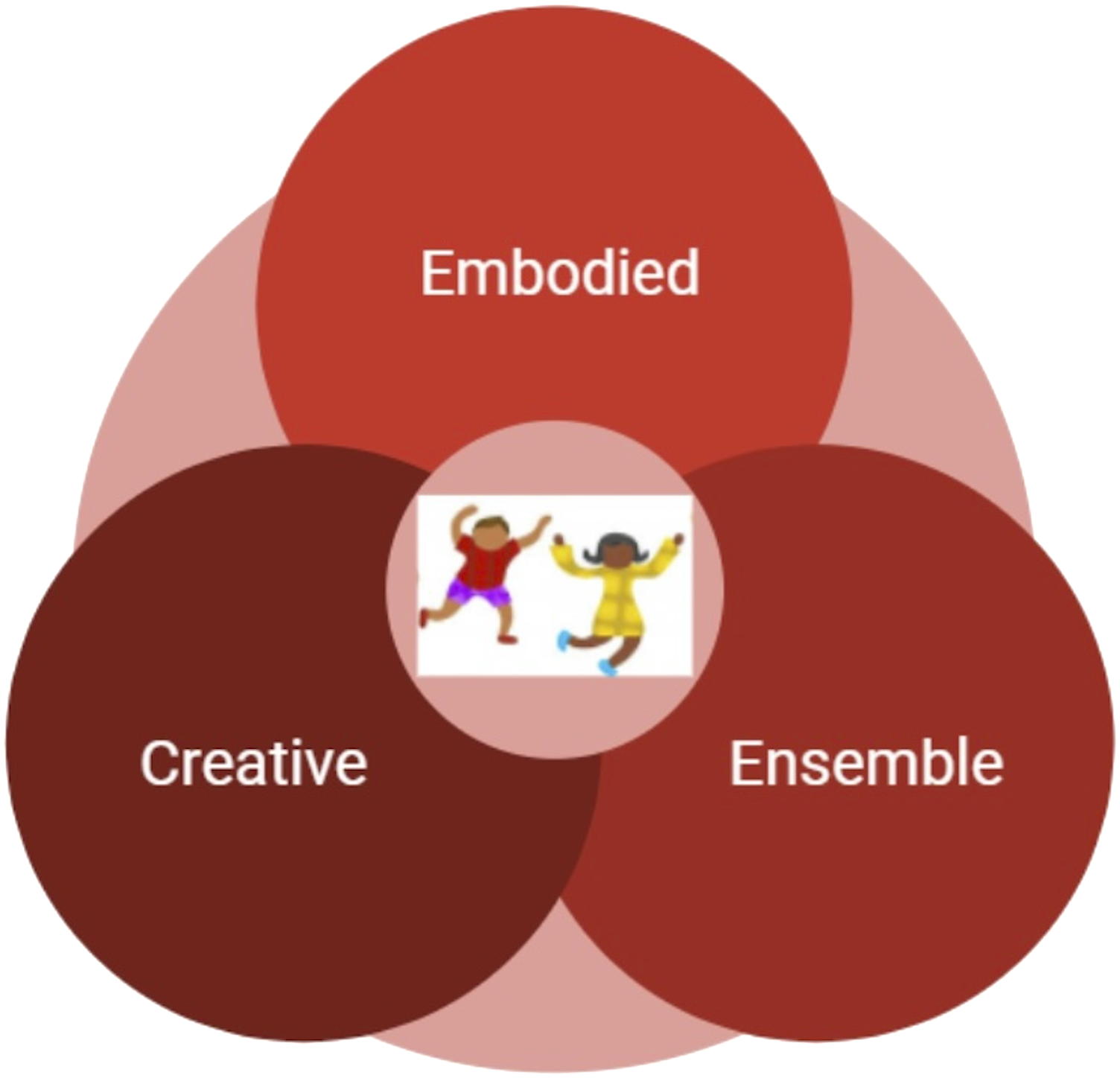
Moreover, we sought to understand how co-designing neurodiverse pedagogies informs and shapes our research practices to mirror methodological designs rooted in Neurodiversity Studies (NDS; Bertilsdotter Rosqvist & Jackson-Perry, 2024). NDS scholars have called for more research designs that contest epistemic injustice against neurodivergent people and shift toward “neurodiversity in autism science” approaches (Pellicano & den Houting, 2022). Our study examines how neurodiverse pedagogical co-design demands a critically accountable, neurodivergent methodology that answers to a pluriverse of representations, embodiments, and understandings. In NDS, neurodivergent methodologies, or neurodivergent-affirmative research methods, implement participatory research processes with “cross-neuro-status” collectives in order to unlearn and reimagine deficit-based narratives (Bertilsdotter Rosqvist & Jackson-Perry, 2024, p. 11). We contribute to this work by exploring the experiences of middle-school teachers of autistic and neurodivergent students during the co-design of neurodiverse pedagogies for computational thinking (CT; Wing, 2006) within the context of a research practitioner partnership. This partnership embraced the neurodiversity paradigm as a baseline and critical framework (Bertilsdotter Rosqvist et al., 2020) to challenge the assumption that neurodivergent individuals are exceptions from meaningful, accessible curriculum for which flexibility is scaffolded into the overall space, time, and philosophy of the classroom (McKinney, 2016) to make students’ “special” needs a forethought as it should be.
In what follows, we draw on qualitative data collected during the first two years of a larger three-year mixed-methods study, which includes teacher workshop mini-interviews, embodied interviews, and online member checking meetings. Specifically, we explored teachers’ embodied experiences in the form of a critical incident analysis by constructing and unsettling a neurodivergent methodology. Or rather, we neuroqueer our co-design to challenge hidden neuronormativity in pedagogy and research, and surmise score analysis as inventive, accessible, and representational of cross-sensory neurodiversity. This leads to the following research question: How does score analysis, as a neuroqueer methodology, engage the cross-sensory, embodied experiences of middle school teachers when co-designing neurodiverse pedagogies?
Literature Review
To understand how neurodiverse pedagogical co-design catalyzes a neuroqueer methodology to represent teachers’ cross-sensory, embodied experiences, and to critically account for neuronormativity underlying pedagogical creation and research design, this section explores (1) neurodivergent methodologies, (2) autistic phenomenology, and (3) neurodiverse co-design research for integrating embodiment into an accessible research creation.
Neurodivergent Methodologies
Neurodiversity Studies (NDS) was founded on previous theorizing and activism from Critical Autism Studies (CAS; Davidson & Orsini, 2013) and Critical Disability/Crip Studies (CDS; McRuer, 2006), diverging from deficit-based, cognitivist frameworks that view autism (and neurodivergence) as asocial, empathy-deficient, hyper-focused, and lacking creativity (Bertilsdotter Rosqvist et al., 2023; Yergeau, 2018). Critiques of NDS have noted its autistic-centeredness (Basten, 2023), but the field has since made strides to include Critical ADHD Studies (CADS; Huijg, 2021), Mad/Trauma Studies (Ingram, 2015; McWade et al., 2015), affect and neuroqueer theories (Shannon, 2020; Walker, 2021), and other critical perspectives (see also Bertilsdotter Rosqvist et al., 2020; Bertilsdotter Rosqvist & Jackson-Perry, 2024). We focus on using neuroqueer theory, which applies queer theory to NDS, intertwining both gender and neurodiversity to reject essentialism, all while transcending identity politics’ limitations (Walker, 2021). The “queering” in neuroqueering can be described as an act of modifying, escaping, or rendering more fluid and can be done by engaging in practices that deviate from normative performance through continually emergent and potentially infinite modes of subversive, transformative action (Walker, 2021) that “uncovers, upsets, and unsettles power structures in normative spaces” (Yergeau, 2018, p. 205). Lewis (2023) explained that neuroqueering is like rearranging the picture the Diagnostic and Statistical Manual of Mental Disorders (DSM) often provides to neurodiversity scholars; it moves them from “the inert and static microscope into a kaleidoscope” (para. 7) for inquiry.
Extant research using neurodivergent methodologies focus on challenging deficit-based narratives (Bertilsdotter Rosqvist & Jackson-Perry, 2024). Some neurodivergent methodologies integrate strengths-based terminology, neurodiversity-oriented ethics, and co-designs (see, e.g., Dwyer, 2022; Le Cunff et al., 2023) such as community-based participatory research (CBPR; Nicolaidis et al., 2019; Pickard et al., 2021). Many methods (e.g., collaborative autoethnography, duoethnography, and creative/visual methods) also rely on neuroqueering to move beyond examination to transformation (Bertilsdotter Rosqvist & Jackson-Perry, 2024), inviting autistexts, or autistic narratives and compilations, to become the bases of methodology to resist pathologization and stigmatic rhetorics (Barkved, 2022; Grace, 2013; Rose, 2008; Yergeau, 2018). For our study, we situate our methodology within neurodivergent/neuroqueer onto-epistemologies by foregrounding ongoing diversity, creativity, and relational worlding.
Unlike other neurodivergent methodologies in NDS (Bertilsdotter Rosqvist & Jackson-Perry, 2024), the focus of our “neuroqueer methodology” is to “make sense” of data as creative, embodied, and interdependent in ensemble—whereby the representation is plural, multi-sensory, and perpetually diversifying rather than simplifying into a neuronormative research modality. When reviewing prior work on echophenomena, Yergeau (2018) found that neuroqueering dominant perspectives of autistic sociality (which views autism as a “disorder of neurological queerness” situated in impaired mimicry) can lead to the inclusion of social interactions where sound and (non)human objects in the environment help to resist pathologization and provide cross-sensory insights into neurodiversity. Neuroqueering can catalyze critical sensibilities, such as in Shannon’s (2020) research-creation project of an inclusive early childhood classroom, which “produced” a 33-min electroacoustic composition of Walking through Leeds on a Windy Day that changed how autistic students qualified the diversity in their language dis/abilities. Similarly, Barkved (2022) applied CDS, feminist queer theory, and posthumanism to neuroqueer autoethnography—“producing” triptychs that incorporated digital drawings to show an affective, playful way to explore “autists as capable, subjective beings with uniquely deep capacity for emotional and social intelligence” (p. iii). Neuroqueering can yield multiple readings and meanings for audiences that resist neuronormative representations in research.
Autistic Phenomenology
Phenomenological analyses often foreground participant experiences and interpretations of phenomena, but they have been utilized alongside co-design and other neurodivergent methodologies (Bertilsdotter Rosqvist & Jackson-Perry, 2024). Although early studies were designed from a clinical (deficit) perspective, linked to prior work with schizophrenia, interpretive phenomenological analysis (IPA) has more recently been used to foreground individual autistic experiences, move towards participatory methods that make in-the-moment adjustments for individuals, and challenge normative autism narratives (Green & Shaughnessy, 2023; MacLeod, 2019) in order to address the “double empathy problem” in research or the idea that neurotypical and neurodivergent people misunderstand each other’s experiences during cross-neurotype interactions (Chown, 2014; Milton, 2012). The philosophical position of IPA extends to this paper where participants are experts at interpreting their own experiences.
Boldsen (2021) considered the phenomenon of autistic social interaction by investigating the controversies of phenomenology in autism research, exploring the literature on theory of mind and its critiques by enactivist theorists, and then by reviewing both interviewing (standard) and observation ( “peripheral”) as phenomenological data collection methods. Through work with autistic adolescents and young adults, Boldsen (2021) suggests that autistic sociality should be studied “as an embodied, dynamic, situated and intersubjective phenomenon” (p. 164). In one participant’s excerpt, Boldsen observes the milieu, or “the things, atmospheres, spaces, bodies and movements in and through which her experience emerges” (p. 179). Green and Shaughnessy (2023) support this shift by advocating for the development of a systematic autistic phenomenology that moves beyond autie-biography to co-designed studies to represent across ability (e.g., speaker, non-speaker, and intermittent speakers). This is because autistic life writing features the sensorium, or the totality of subjective experiences and processes of the world, both interpersonal and physical (Murray et al., 2023). Featuring the sensorium allows individuals to construct their attention differences, sociality, and ontology in relation to their sense of self and their social milieus (Green & Shaughnessy, 2023).
When constructing their method for a phenomenology of autism, Shaughnessy et al. (2024) note how participatory arts (drawing, music, drama, movement, puppetry/objects) can provide neurodivergent-affirmative ways to research autistic interests and the sensorium while being “attuned to the individual and their expressive capacities and preferences” (p. 249). Van Goidsenhoven and De Schauwer (2020) used new materialist theories to disrupt “the normative production of ‘voice’ when working with a person labeled as ‘non-verbal’” (p. 331) by foregrounding a filmalogue or the filming of their participant’s swinging movements on a public playground to capture processual, nonconscious, thought-feeling-expressions (see Manning, 2016). This embodied interviewing approach treats data as event/ful (or as transmutational) rather than “as fixed objects that can be captured and analyzed” (Van Goidsenhoven & De Schauwer, 2020, p. 331). Embodied interviewing has been used to explore nonverbal experiences felt in the body (Tantia, 2020) during knowledge-creation and is key for our project to embrace neurodivergent embodiment, creativity, and ensemble over cognitivism.
Neurodiverse Co-design Research
Design-based research (DBR) is a collection of approaches that builds theory and knowledge about learning and design within a specific context (Barab, 2022). Specifically, DBR uses flexible methodologies “to study learning in environments that are designed and systematically changed by the researcher” (Barab, 2022, p. 177)—with the goal of advancing theory while impacting practice. DBR produces knowledge of current opportunities and challenges as well as of future places and services that connect peoples’ knowledge, skills, and resources into a co-developed process that addresses problems of practice (Barab, 2022; Zamenopoulos & Alexiou, 2018). In DBR, learning and cognition occur within complex systems where “the individual and the learning environment are inseparable” (Barab, 2022, p. 180) and meaning is codetermined. Therefore, co-design research views “intervention” more as “invitation,” treating participants as capable and empowered change makers (i.e., co-researchers and practitioner experts), not as objects of study in need of change (Barab, 2022). The researcher roles also shift to facilitator, advocate, and/or translator (Zamenopoulos & Alexiou, 2018), making research outcomes shared accomplishments.
Thanks to autistic phenomenology, several recent studies have incorporated co-design as a neurodivergent methodology. Sonuga-Barke and colleagues (2024) designed a two-year research process that invited Youth Research Panel participants, who were “young people with diagnoses of ADHD and/or autism,” to become co-researchers instead of research advisors. Le Cunff and colleagues (2023) created a similar co-design study, partnering with a Community Advisory Board involving seven neurotypical and neurodivergent students as co-researchers that iteratively implemented their feedback on all aspects of the research design during focus-group sessions. In both studies, the co-researchers improved inquiry by (a) making more accessible formats that supported neurodivergent participants, (b) changing how processes are captured and outcomes are measured, (c) inventing data collection techniques such as interviews that use art or poetry, and (d) disseminating knowledge through multimedia, public-engagement events. These neurodiverse co-designs answer a call in NDS to move towards research practices whereby neurotypical researchers are willing to reflect on being included in neurodiversity research, rather than doing the including (Bertilsdotter Rosqvist & Jackson-Perry, 2024).
Similarly, Shaughnessy (2022) described a participatory research project with autistic girls using creative practices to explore pedagogy. Her team’s “ecological approach explored the engagement of autistic children with the material environment, social and peer interactions and imaginative play” (p. 131) while co-producing participatory arts workshops “to elicit rich information about the identities and experiences of participants through embodied multimodal approaches” (p. 133). The researchers integrated the girls’ input, including being sensitive to shifts in youth behaviors (such as communication), leading to a co-design that incorporated music, movement, and interactive media into data collection by using creative interviewing approaches. Findings were then disseminated through dramatic performances. In short, neurodiverse co-design studies show the value in being mindful of neurodivergent learning and well-being to combat neuronormative structures and discourses (Fotheringham et al., 2023).
Our Neuroqueer Research Approach
In this project, we used embodied interviews for our critical, yet performative approach for understanding neurodiversity by creating a score analysis—a neuroqueer methodology that accounts for how different bodies and ideologies create silent- and voice-data (Hao, 2011) from neurodiversity in one analytic space. Score analysis was designed to support neurodivergent-affirmative approaches, performative knowledges, and embodied experiences (see also Birringer, 2013). Hence, we un/structure our research design around this unique intersection, which purposefully deviates from a traditional methodological structure, fluctuating between messiness and precision (differentiation and iteration) in the spirit of methodological neuroqueering. We invite readers to embrace a multi-sensory approach while engaging with this section. Footnotes, ellipses (…), side boxes, symbols and arrows (
The Co-Design Research Team and Technology
Middle school adaptive physical education teacher
Professors from a Teachers’ College… Middle school STEM teachers: maker space – Science and Math – STEM Club Elective Professors from a School of Arts, Media, and Engineering…
Middle school Music teacher
RESEARCHERS + COORDINATORS from a neurodiversity-focused non-profit organization… align. co-design.
The four middle school teachers (i.e., teacher fellows [TFs]) had diverse professional backgrounds in adaptive physical education, biomedical engineering, educational technology, early childhood, music, and fine arts. Two TFs exclusively served autistic students
The co-designed wearable music technology draws from research (Mechtley et al., 2019; Sha, 2016; Thorn et al., 2020) that centers digital-physical systems for musical-making in ensemble through gesture and embodied interaction, moving away from cognitivist approaches for mastering CT skills. The technology included wearable microcontrollers with wristbands, or Internet of Things (IoT) motion-sensing devices, that connected to browser-based applications via Bluetooth protocol. Together, the researchers and TFs co-designed prototype digital musical instruments (e.g., wearable jazz and rain stick), which then underwent iterative refinement, modification, and simplification during workshops to become web-based instruments (music apps) after the TFs tested and retested the technology with their students while teaching CT mini curriculum with neurodiverse pedagogies.
Positionality Statement
Our team included neurodivergent and neurotypical individuals. Several members had academic expertise in neurodiversity research, special education, and gifted programming (both in K-12 and higher education contexts), which may have impacted the co-designing of neurodiverse pedagogies, interviewing process, analysis, and interpretation of findings. Further, several authors’ identities intersected race, gender, sexuality, and academic rank, prompting adoption of a critical orientation towards neurodiversity (Bertilsdotter Rosqvist et al., 2020).
Iterative Inquiry Process
After receiving IRB approval (exempt project #14364), TFs provided written informed consent (…) to engage in this study’s iterative co-design process as co-researchers and interviewees. Data sources included audio and photographs (see Figure 2) from (1) twelve, five-to-ten-minute mini-interviews that occurred during three workshops with all TFs, which asked questions about their past, current, and planned CT experiences and neurodiverse pedagogies and (2) four, hour-long, embodied (…) semi-structured interviews (Kvale, 2015) that asked TFs to elaborate their responses while engaging in musical exploration during co-design. Reflexive memos included observations about the embodied interviews and analytic processes (see side boxes labeled Neuroqueer Process Notes [NQPN] 1–4). A teacher fellow using wearable music technology during an embodied interview.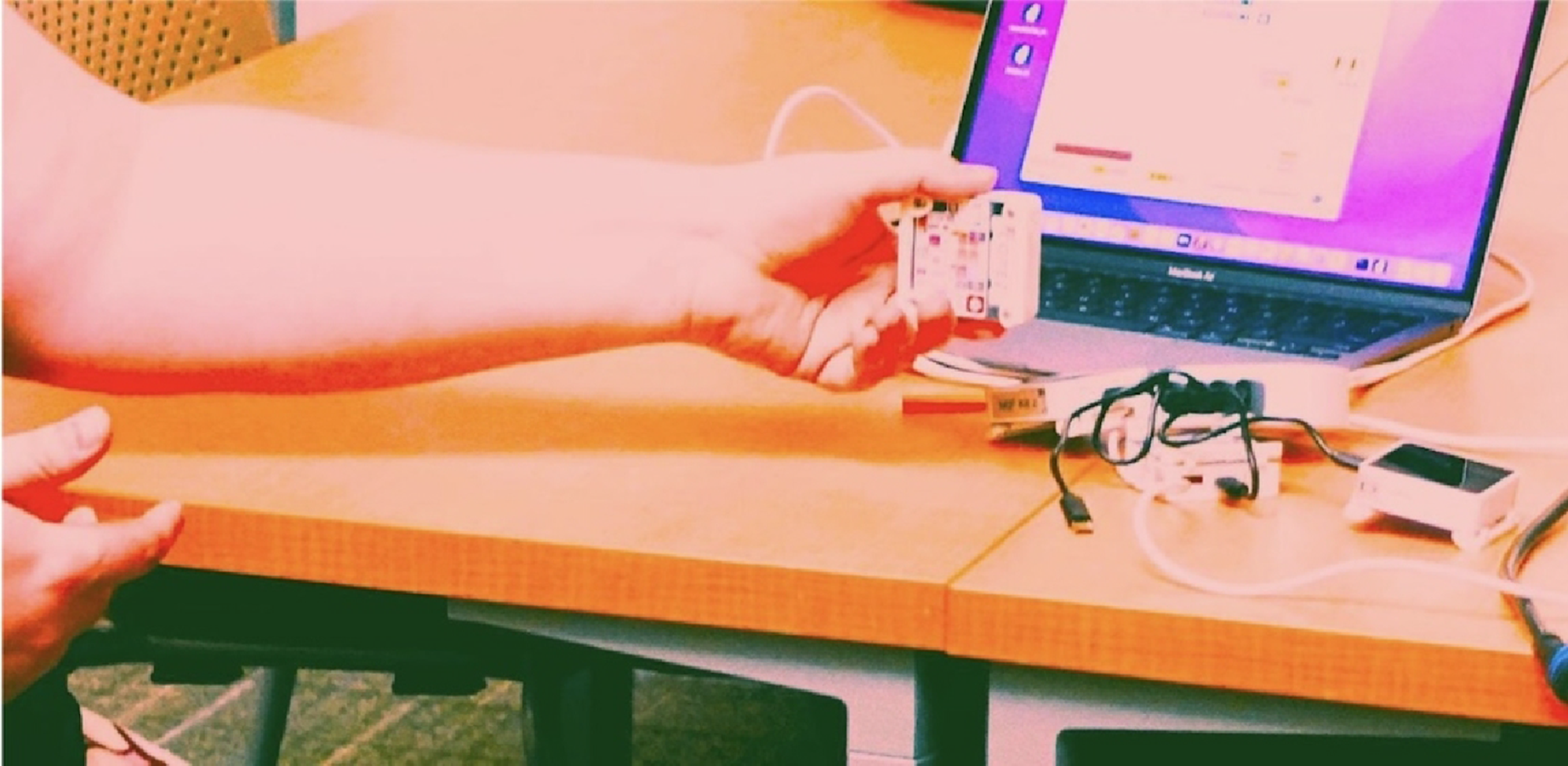
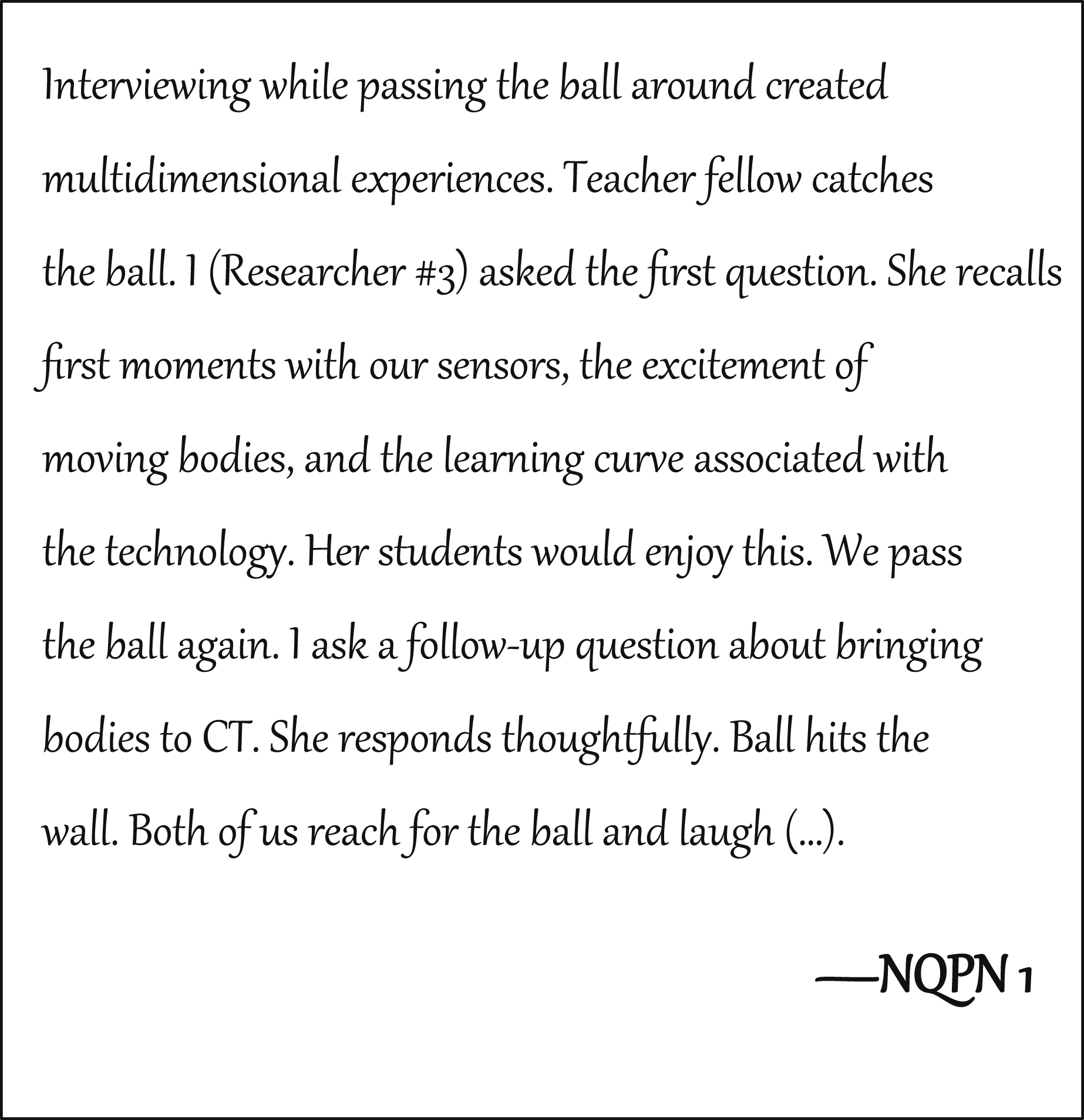
Interview audio was transcribed and then critical incidents, or moments that made considerable contributions to the TFs’ lived experiences (Angelides, 2001; Flanagan, 1954; Tirri & Koro-Ljungberg, 2002), were identified (see NQPN 1 side box). Critical incidents were further described as follows: (a) unexpected/surprising events that TFs indicated caused changes in thinking, (b) moments where TFs mentioned considering new pedagogical possibilities, and (c) shifts in TF development (…) of pedagogical perspectives (see Figure 3). A Miro Board snapshot of teacher fellows’ critical incidents.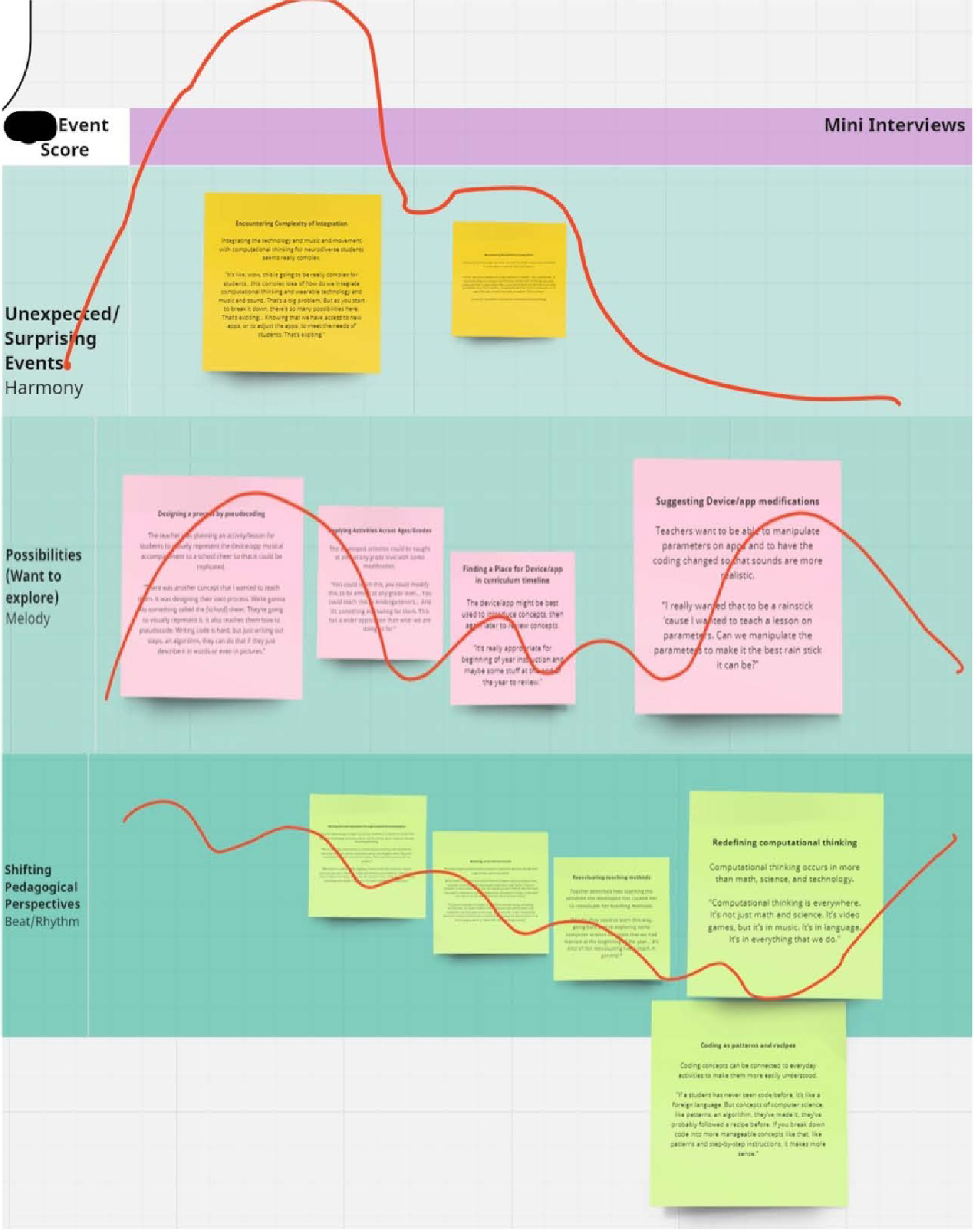
Next, critical incidents were used as material elements to create scores. We used music sheets containing treble, alto, and bass clefs (…) for creating our scores of critical incident data. We began with sixty-minute member checks over Zoom, occurring once with each TF and one researcher. During these checks, we further explored the data with the teachers.
Specifically, Miro Boards were utilized as a collaborative virtual workspace during the member checks. A Miro Board for each TF was designed using a table with three rows to match the three categories of critical incidents listed above, and to represent the musical clefs. These incidents were extracted from the interviews (in order of their appearance) and categorized by title (…), brief description (…), and interview quote (…), each typed into a Miro Board sticky note. TFs were asked to review the sticky notes, revise if needed, move the notes, change their sizes, or reorganize the notes in a way that made sense to them while explaining their process (see NQPN 2 side box). Afterwards, a digital line was drawn to “capture” the movement of the notes and/or the thinking process.
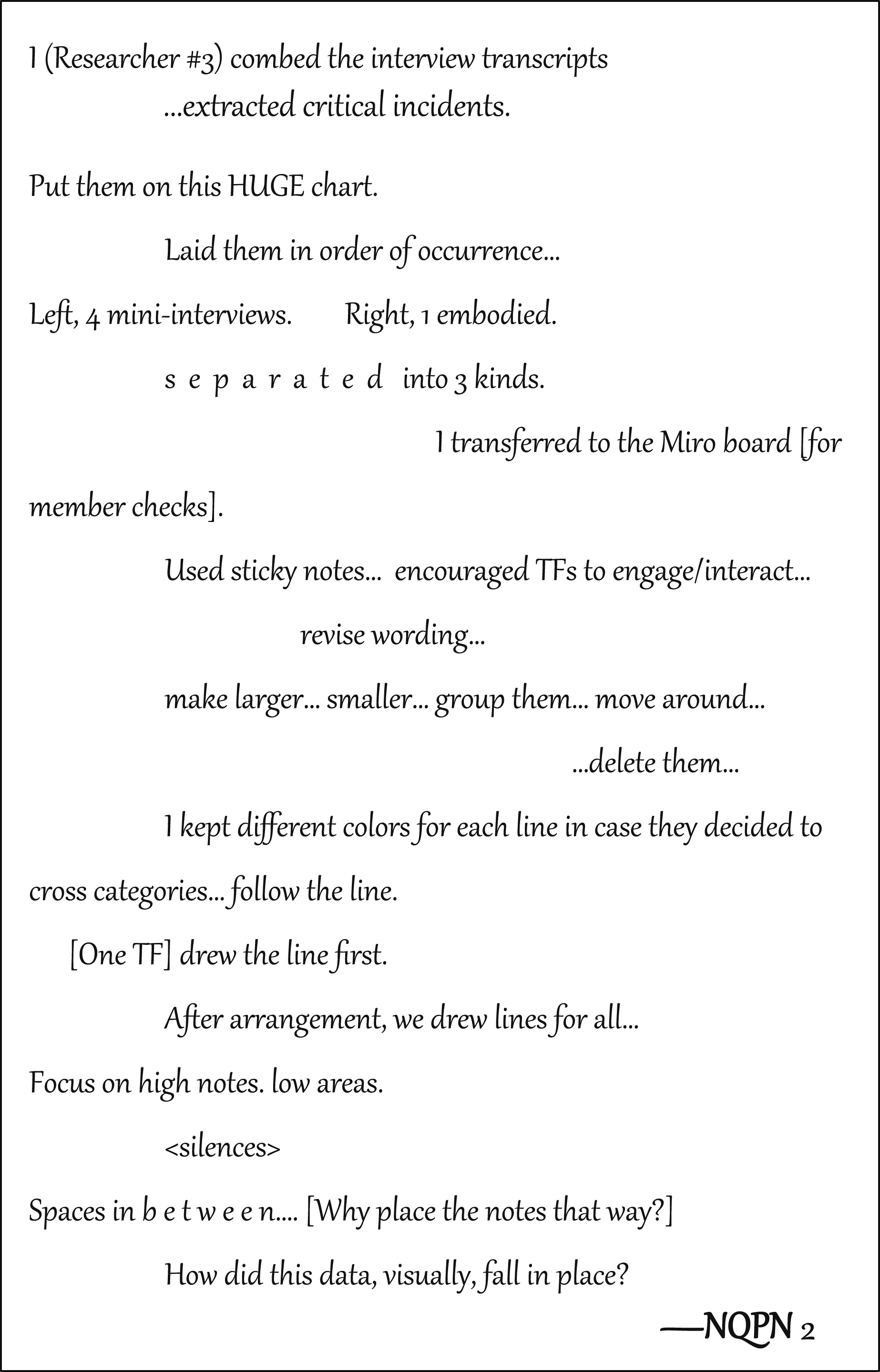
Figure 4 shows the rendering of our critical incident analysis, using musical sheets as background. Surprising events comprised the top row, aligning with data harmony (the treble clef). New pedagogical possibilities comprised the second row, aligning with data melody (the alto clef). The third row consisted of shifting pedagogical perspectives, aligning with data rhythm/beats (…) (the bass clef). These three rows aligned with one of the music apps being co-designed in the study; a line drawn using a virtual pen indicated the movement in each row (see NQPN 3 side box). This approach aimed to align neurodiverse pedagogical co-design with a neuroqueer methodology that extends the idea of a critical incident and reflects neurodiverse ways of thinking and being in the classroom that counter epistemic injustice (Fricker, 2007). Musical rendering of critical incidents.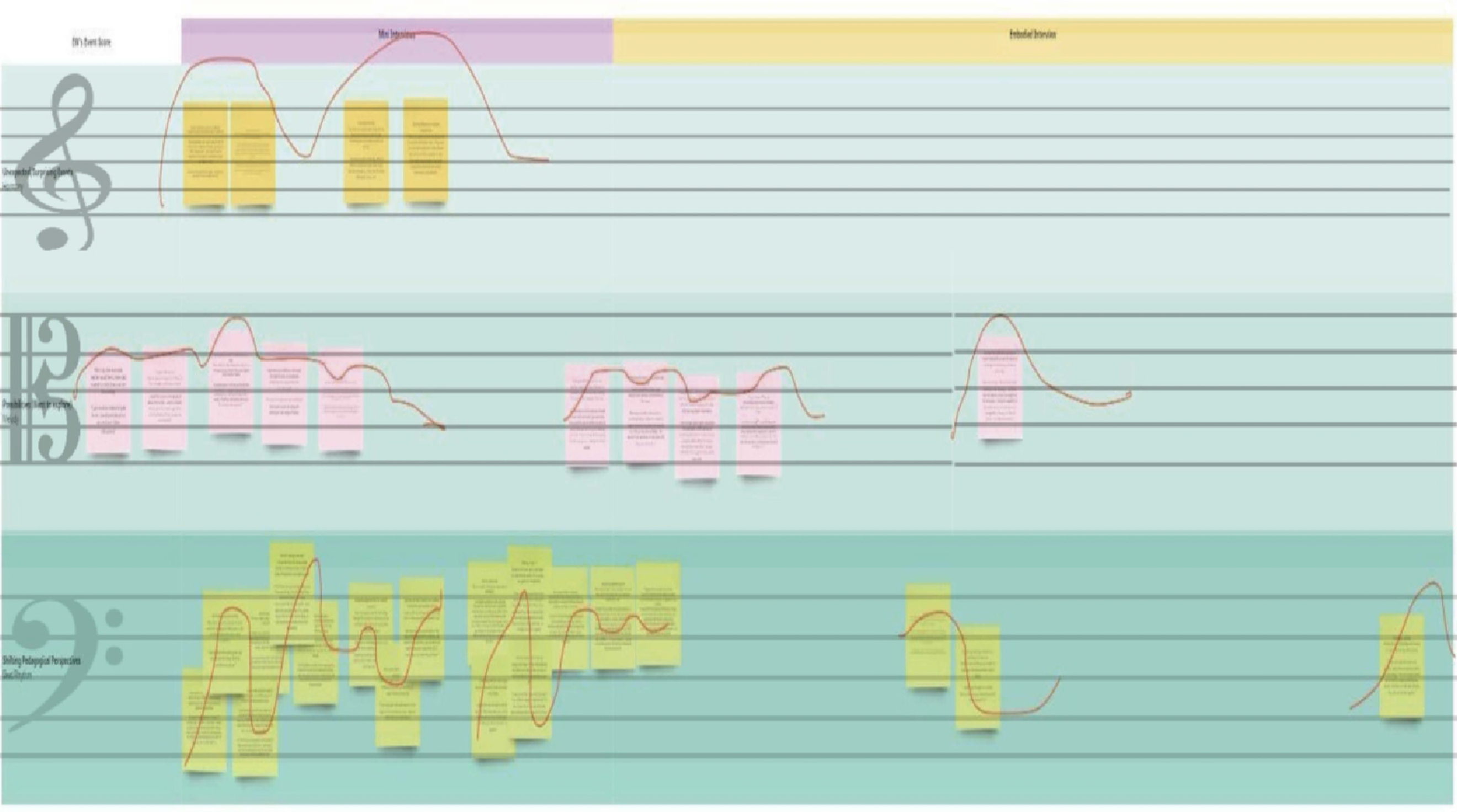
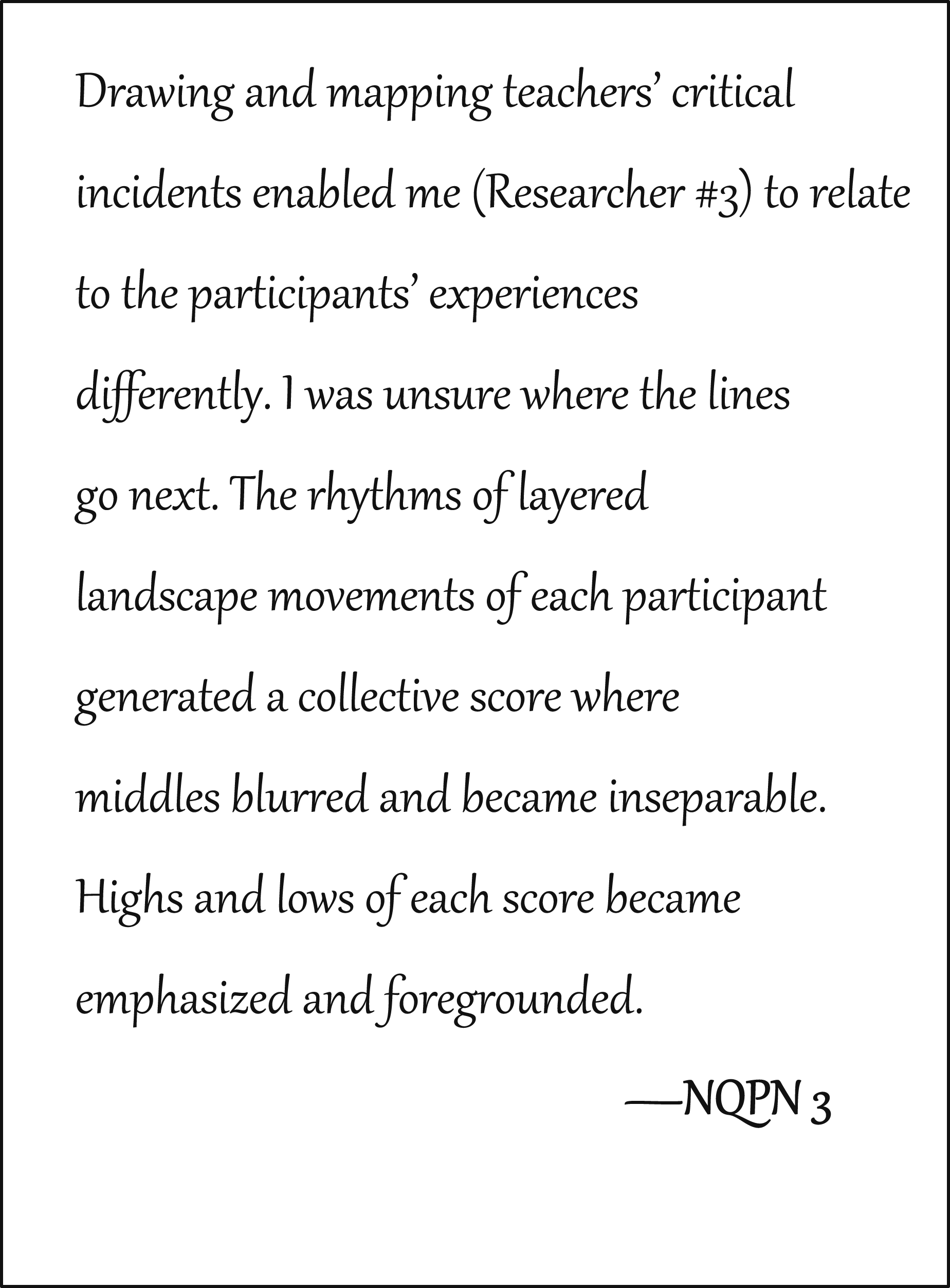
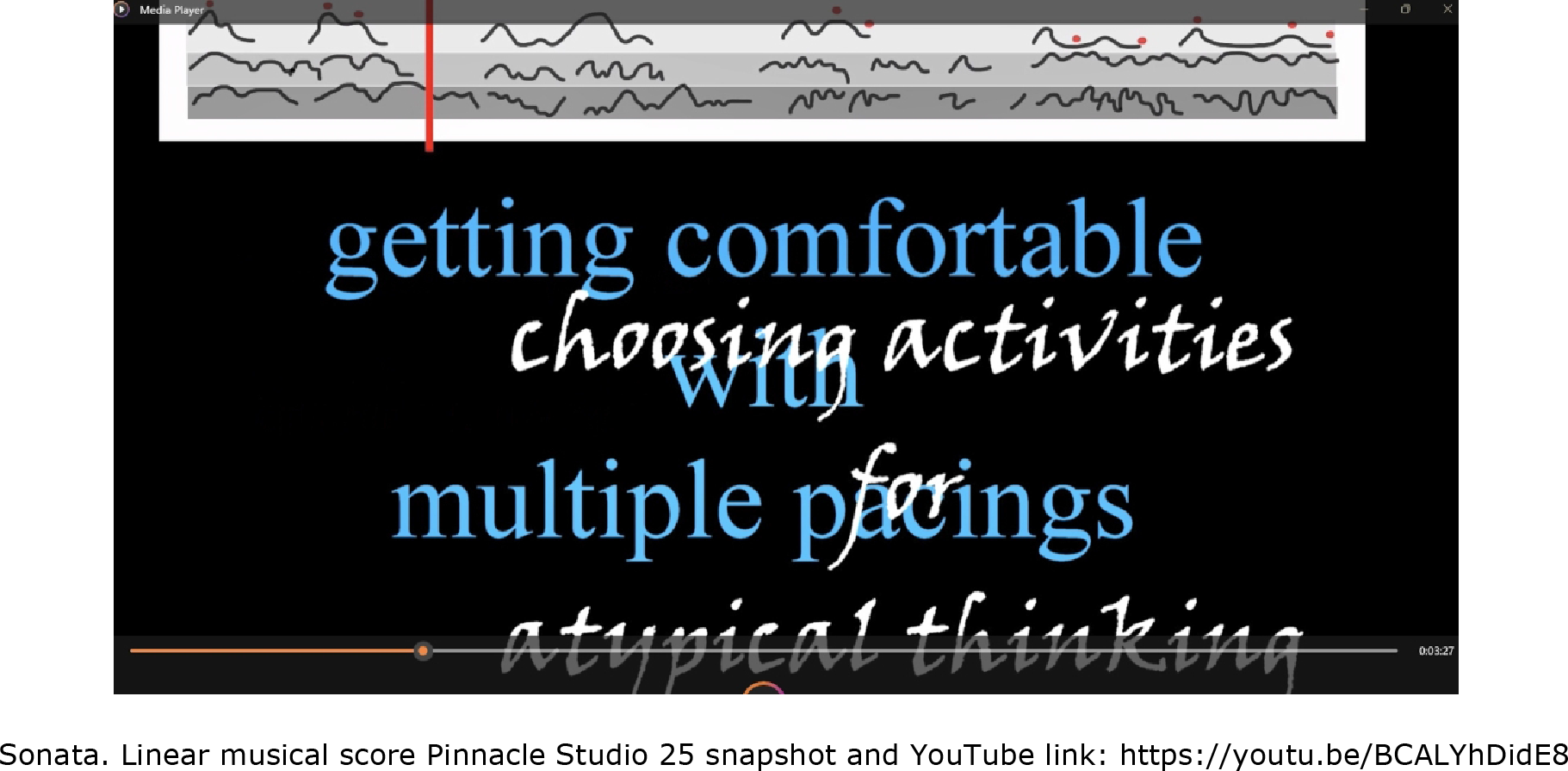
After drawing the lines, we followed the adopted creative processes of Meadows and Wimpenny (2017), White (2022), and Birringer (2013) to turn the lines of critical incidents into cross-sensory, embodied scores. We focused on creating a data representation of neurodiverse pedagogical development that moves beyond a neurotypical manifestation. We used experiential and narrated architecture (…) to create scores that connected to arts, music, and improvisation to work through our data, critical-incident scores, and TFs’ collective experiences of embodied CT learning. We created a polyphony of TFs’ experiences which brought our hearing of sound (and silent) fragments together with different vibrational layers of data. Specifically, we developed two scores of the TFs’ critical incidents: (1) a linear musical score and (2) a collective line score.
Linear Musical Score

Collective Line Score
The collective line score overlaid all TFs’ critical incidents.
Researcher #1 first identified maximal peaks and minimal valleys of the virtual-pen lines on each teacher fellows’ Miro Boards (the highest and lowest notes on each musical clef), which corresponded with Numbered list of content, language, and discourses. Collective line score of extreme critical incidents.
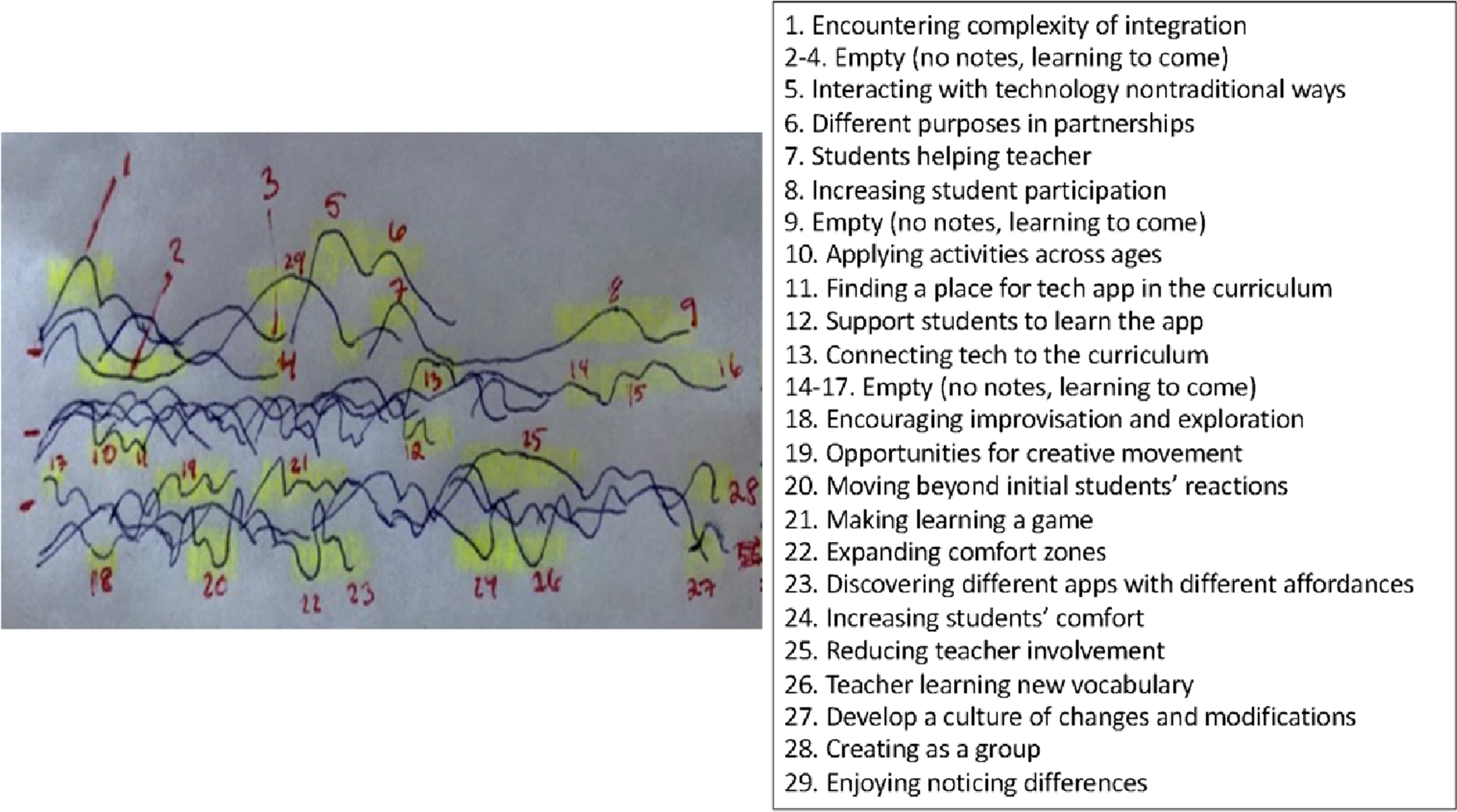
Researcher #2 then Transform: content, language, and discourse
Nvmb3r3d language-based Connectors, shortened into Keywords, now “lyrics.”
Italics. CAPITALIZATION, Various fonts & sizes.
Never repeating. to show Falling off. Or [sOUnd].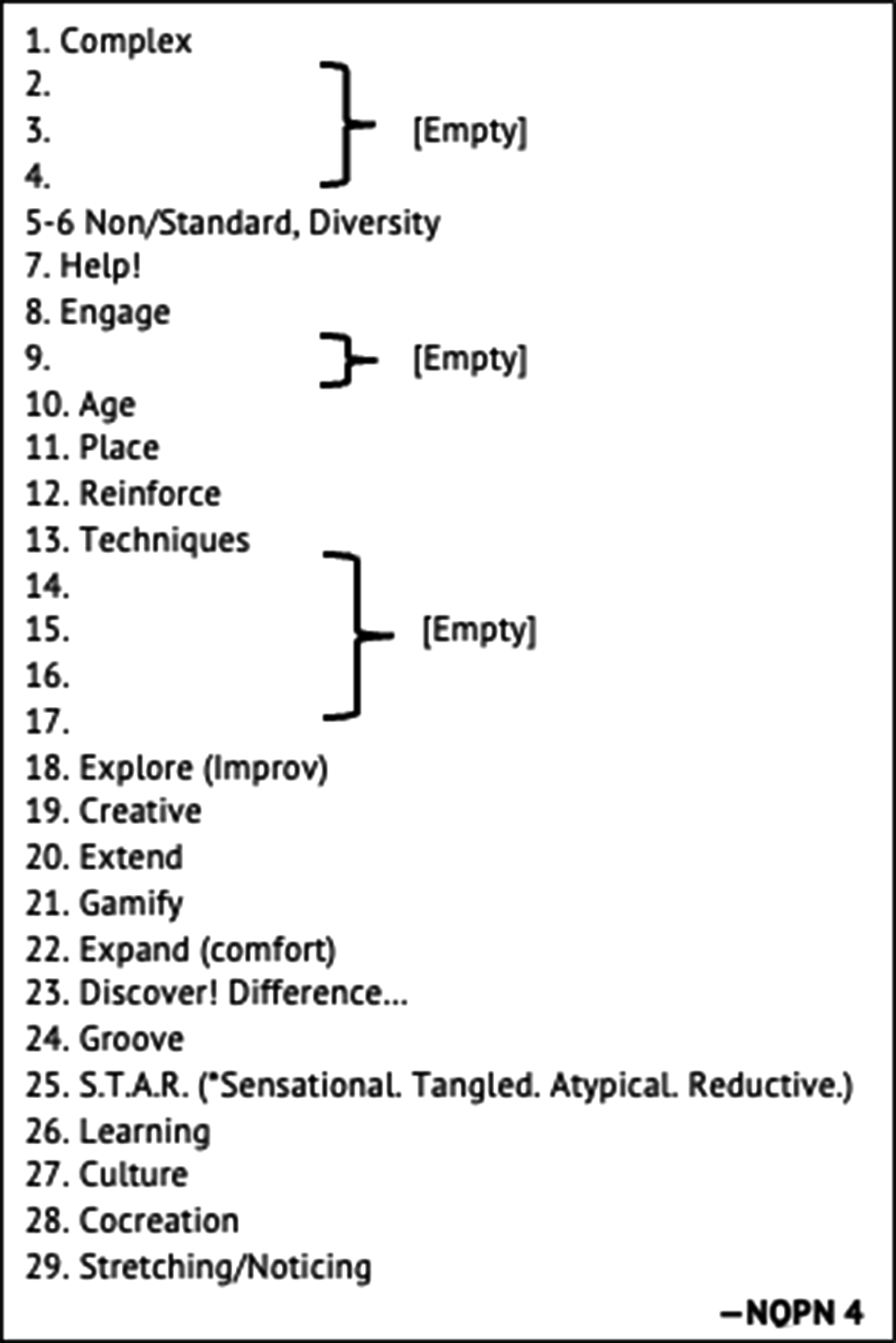
Upon completing textual modifications, Researcher #2 then: Arranged “lyrics” on treble, alto, bass clefs.
Like in Sonata, matching
location, duration, and timing of musical notes (see Figure 7). Keywords arranged on music sheets to fit notes played during linear musical score.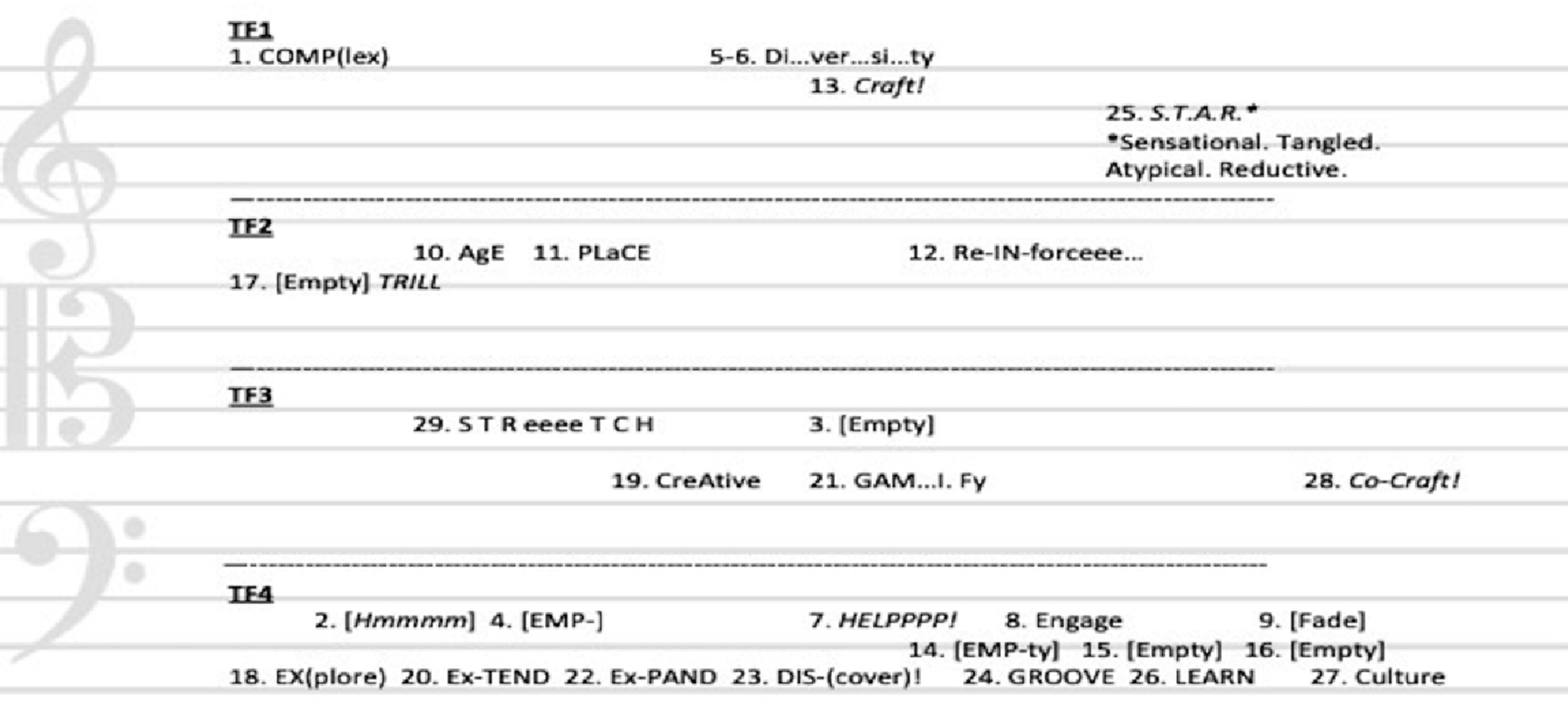
Mix-in “lyrics.” Add treble, alto, bass clefs. D. C. al fine. Stretch keywords along lines. Cross-senses. Result: Cantata. Now, Answer RQ. Coda.

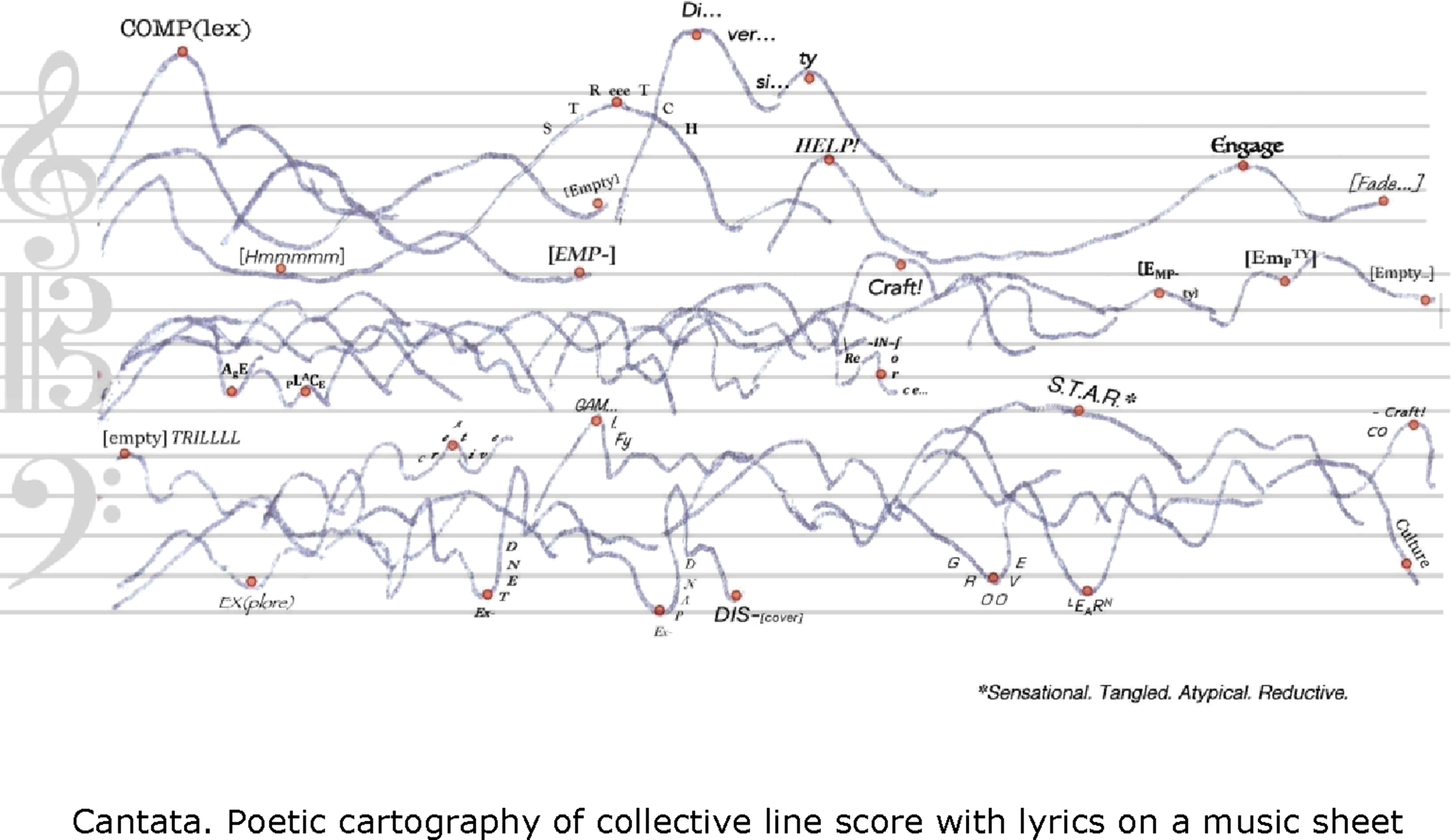
Like Grasseni’s (2012) notion of a “sense-scape,” this final poetic cartography composition signals a cross-sensory response to our research question. It evokes a sensorium beyond sight and sound, creating a “sense” (…) of cultural and discursive placement for neurodiversity while entangled with and pressing against neuronormativity. Specifically, it demonstrates how the embodied experiences of middle school teachers render tacit representations of their knowledges when co-designing neurodiverse pedagogies. This poetic cartography paves a pathway for epistemic justice for neurodivergent bodies and thoughts often silenced by neuronormativity in education and research.
Findings
Score analysis foregrounds a neuroqueer methodology that engages the middle school teachers’ neurodiverse pedagogical codesign experiences in several ways, including through musical noting, echoes, reverberations, and more—all to disrupt neuronormativity when co-designing pedagogy. Analysis of the two scores revealed several findings.
First, during the initial categorization of critical incidents, it became evident that interviews were themselves critical incidents. During member checks, where each TF arranged their sticky notes in different ways on the Miro Boards, one TF reshaped his notes into large, ovular-shaped boxes and placed them across various layers. A second TF arranged her incidents to flow-like sheet music, adding in blank sticky notes to create different kinds of repetitions, similar to musical phrases, to fill up space like in a composition. A third TF added in a red virtual-pen line to visualize the movement of her sticky notes, which then became a tool for interpolating a precise method for analyzing all Miro Boards. Together, the ovular reshaping, blank repetitions, and virtual-pen line constitute a dimension of texture and space, extending an affective reverberation to the sticky notes—one that continues even when the TFs’ notes stop suddenly on the Miro Boards. This act introduces a discontinuation of supposed neuronormative ways of doing, assembling, and sifting through neurodiverse data categorization.
This is apparent when the “how” and “why” of the TF’s new curriculum were represented as the heartbeat in the linear musical score’s video creation (data rhythm/beats). Fluctuation between highs and lows indicated the TFs’ uncertainties with curricular co-design, pressing them to resist scripted curricula formats such as lesson planning and tiered seating arrangements. Playing with the sticky notes encouraged TFs to embrace discomfort, technological change, and spatial situatedness while co-designing their CT mini curriculum with neurodiverse pedagogies. This coincides with the concept of productive struggle, which examines how students build their own classroom constructs (Trinter & Hughes, 2021). Analysis indicates TFs also experience productive struggle when creating neurodiverse pedagogies because it encourages them to extend their thinking beyond their comfort zones (and beyond neuronormative assumptions for “how to” think and be in the classroom), increasing their learning capacity and need for diversifying learning materials. This process generates tethering points of “double empathy,” where teachers can begin relating to neurodivergent students’ desire for inclusivity in neurotypical learning spaces (Milton, 2012). This broadens contemplation about how to structure everyday classrooms to allow for overall accessibility (Baurhoo & Asghar, 2014; Erevelles, 2000; McKinney, 2016; Rose, 2000; Rose & Meyer, 2006; Wells, 2022).
Additionally, the placement of TFs’ sticky notes, tethered by virtual-pen lines, advances an ongoing, yet asynchronous, morphology that starts in one space and builds outward, eventually transcending platforms through audio and video to form a score composition—a testament to improvisational, creative work processes. The Miro Board acted as a generative space where the co-design team could interact by using multiple modes of expression—or rather, assemble a “neurodiverse multilog” that anthologizes critical incidents via cross-sensory tools (Vasquez et al., 2022). Yet, improvisational capacities, such as contemplating how to insert creativity into pedagogical practices, are far more time-consuming than it is to default to outcome-based lesson planning and standardized testing. This tension between neurotypical systemic pressures and the desire for neuro-inclusive instruction accentuates the arduous task of disrupting neuronormativity in education.
The two scores invite multiplicative entry points for engaging the teachers’ embodied experiences. The modular synthesis system “composed” music for the linear musical score by mapping sounds and silences through critical-incident data points. The different kinds of critical incidents and voices interconnect to create temporal reverberations of the embodied experiences, reflecting how various neurotypes might assemble neurodiverse pedagogies. For example, both surprising events and pedagogical possibilities interacted synchronously (melodic echoes increased with harmony distortion). Immediately after this “musical chaos,” the heartbeat accelerated, denoting greater excitement (or anxiety) around pedagogical shifting. The pivotal incidents that changed chord quality happened at peaks and valleys, indicating extreme musical intensity. The beginning of the linear musical score had strong surprising events, which influenced the flow of other pedagogical possibilities; however, towards the end, surprising events were fewer, leading to more unpredictability in the melody and heartbeat. Quotes extracted for the video creation reflect how silence and sound collapse and expand through rhizomatic fashion across the co-development and implementation of neurodiverse pedagogies. This cross-sensory dance between how TFs experience messiness and exploration pluralizes neurodiverse representation and highlights the possibility of expanding data interpretation beyond reductionistic understandings.
Moreover, the collective line score’s poetic cartography extends the rhizomatic chaos into new territories of thought-feeling-expressions via linguistic and spatial transformations. Extracting keywords from maximal peaks and minimal valleys (and adapting them with nonrepetitive fonts and sizes) foregrounded the co-design team’s multiple relationalities with neurodiversity, which assembled a plurality of fixed and situated knowledges. For instance, the word “diversity” is stretched along its virtual-pen line, fractured by punctuation, building a curvature that unravels lingual meaning—an iterative quality often found in neurodivergent experiences. Another example, S.T.A.R* (sensational, tangled, atypical, reductive), extends beyond the musical clefs, indicting tangents and diversification in thinking, moving, and being. It is not anchored to language or space in the Miro Board, thus summoning a turbulence for representing embodied experiences. The [empty] keywords extracted from blank sticky notes teleport experience from visual to acoustic representation, resonating with the sounds and silences composed by the video creation. This beckons an affective meditation on how to experience neurodiversity across senses. The poetic cartography further re/arranges the embodied experiential data of the co-design team through pluriverse modalities, inviting speculation of what is yet discoverable about neurodiversity. Word play, here, defies neuronormativity that often prevent neurodiverse pluralities from emerging.
Discussion
Score analysis was created to align with teachers’ critical-incident experiences during neurodiverse pedagogical co-design. The two scores encourage experiencing data multiply, by multiple co-researchers, and through multiple sensibilities. During analysis, the textural elements of the sticky notes invited co-researchers to modify knowledge-creation in a way that fostered an organic, spatial temporality where embodied experiences could be re/configured and replaced along rhizomatic assemblages of a neuro-space to resist categorization, stabilization, and labeling. This compares to the notion of crip spacetime, a material-discursive, pluriverse reality that neurodivergent people experience when they intra-act with access to resources (or lack thereof), identities, relations, and time (Price, 2024). The sticky notes functioned as temporary placeholders of being and becoming, anchoring the virtual-pen lines as neurodiverse multiplicities that unraveled across the Miro Board and musical clefs to form scores. The sticky notes stretch spacetime and permit the co-researchers to manifest an iterative ecology that maps a cross-neurotype sensorium to press against epistemic injustice (Fricker, 2007).
This implores evaluation of how our neuroqueer methodology is accountable to accessibility, language, and representation (Price, 2024). The video creation and poetic cartography each show lines abruptly beginning and ending, disconnecting and reconnecting, and overlapping to intensify experiences as the scores changed, which produce rhizomes that are visually and audibly accessible. Neuroqueering disrupted the categorization of critical incidents, inviting teachers to experience building neurodiverse pedagogies more holistically. The scores also disrupted language across dimensionality (e.g., the word DIS-[cover] in the poetic cartography had sound only attached to the “dis-” half of word while “-cover” remained silenced in the video creation), opening our methodology to cross-sensory experiences that refuted how language is supposed to function. This percolated into how the co-design team questioned other neuronormative components of the methodology such as intercoder reliability, which typically entails assembling a codebook built around agreed-upon interpretations of data. Yet, the co-design team took the multiplicity of data and diversified it across modalities to produce a pluriverse representation of neurodivergent onto-epistemologies.
Our analysis also deepens theorization of neurodiverse learning, communicating, and interacting in educational contexts. Neurodiversity stems from Neuro(n), or the classical Greek word νεῦρον (neuron), which refers to sinews, tendons, gut, and cords (Mehta et al., 2020), implying the term did not originally intend to describe nervous systems. Instead, Neuro(n) functions as a complex, chaotic root system that invites multiple entryways, exits, and threads that shoot out in unexpected directions, inviting embodiment, plasticity, and affect to entangle (Lenz Taguchi, 2016). This exposes how neurodiversity might manifest in practice. In her construction of the Neuro(n) as concept, Lenz Taguchi (2016) intertwines the Deleuzoguattarian concept of “becoming child” with Colebrook’s (2014) queer vitalism to reimagine a learning body as “becoming student,” where it is “never striving toward or taking on a complete or definite form or wholeness, but [is] always being in a creative process of individuation that might exceed any norm, normality or majoritarian form of existence (Colebrook, 2014)” (p. 221). Neuroqueering our co-design untethered sensibilities around connectivity to various neurotypes, asking users of neurodiverse pedagogy to become (and embody) neurodiverse learners and/or educators. By having the teachers embed CT concepts in creative ensemble activity while using co-designed technologies and techniques, they become learners
Neurodiverse pedagogical co-design includes spatial-temporal components, improvisational capacities, and rhizomatic assemblages that structure neurotypicality and neurodiversity conjointly. Particularly, it perpetuated anchorage to unconscious neuronormative processes and neurotypical classroom geometries. Meaning, to truly embrace what is yet unknown about neurodiversity in the classroom, findings indicated that teachers must undergo productive struggle (Trinter & Hughes, 2021), discomfort/uncertainty as generative (Beghetto, 2020), and tension between neurotypical systemic pressures and desires for neuro-inclusive instruction (Sawyer, 2019) when pushing for pedagogy that is embodied, plural, and representative of epistemic justice. Because neuronormative assumptions are so ingrained in our bodyminds, it requires unlearning neurotypicality in its various forms to reimagine what constitutes neurodiverse thought-feeling-expressions. We propose neuroqueering as a temporarily existent, impartial, and everchanging relationality for disrupting neuronormativity.
Footnotes

Ethical Approval
This study was approved by Arizona State University IRB (Approval ID: STUDY00014364) on August 17, 2021.
Consent to Participate
All participants provided written informed consent prior to participating. Written informed consent was obtained from a member of the research team for anonymized information to be published in this article.
Consent for Publication
Written informed consent was obtained from the participants for the publication of any potentially identifiable images or data included in this article.
Funding
The authors disclosed receipt of the following financial support for the research, authorship, and/or publication of this article: This work was supported by the NSF Computer Science for All (Grant Award # 2122924).
Declaration of Conflicting Interests
The authors declared no potential conflicts of interest with respect to the research, authorship, and/or publication of this article.
Data Availability Statement
Data cannot be shared because raw data includes materials with identifying details of participants, which breaches participant confidentiality.