






Abstract
If given the chance, what consejos would you write to your younger self? In this paper, we draw on the methodological richness of letter-writing to reflect on our experiences as two Guanjuatense scholars living in diaspora. Grounded in the frameworks of diasporic community saberes and transnational funds of knowledge, we engage epistolary methodologies to make sense of our transnational journeys as they intersect with language(s), identity, memory, dreams, and aspirations. Transnational funds of knowledge refer to the cultural, linguistic, and epistemic resources youth accumulate through experiences across borders and mobilize in different contexts. Diasporic community saberes, meanwhile, emerge from collective, place-based knowings shaped by migration histories, kinship, and communal struggle. Inspired by the ways our parents used letters to remain connected across borders, we approach letter-writing as both remembrance and resistance—an act that allows us to inscribe our stories and challenge the containment of diasporic lives. Through this process, we propose epistolary diasporic saberes as both a theoretical contribution and a methodological possibility for understanding the epistemic power of letters. Ultimately, we offer our letters as spaces of reflection and healing, and as a collection of consejos for transnational youth navigating the complexities of diaspora. In sharing these reflections, we hope to sobar las cicatrices donde había una herida and offer words that might reach those who need them.
Write with your eyes like painters, with your ears like musicians, with your feet like dancers.
You are the truthsayer with quill and torch. Write with your tongues of fire.
Don’t let the pen banish you from yourself. Don’t let the ink coagulate in your pens.
Don’t let the censor snuff out the spark, nor the gags muffle your voice.
Put your shit on the paper.
- Gloria Anzaldúa (Anzaldúa, 2021)
Introduction: Abriendo la Carta
Bienvenido/a/es!
We hope that these words find you well as we pen them from Ft Worth, TX—the homelands of the Kirikir?i:s (Wichita and Affiliated Tribe), which includes the Wichita Proper, Waco, Taovaya, Tawakoni, and Kichai, as well as the Caddo nation and all other affiliated tribes and Indigenous communities in the Dallas/Ft. Worth area. As will become evident in our writing, we are guests (and continue to strive toward ethical guesthood) on these territories and we honor the people, Lands, and relations that have provided us residence. Somos del estado de Guanajuato, Mexico and, like many others, we have had to travel through states, borders, and places to arrive at where we are now. We write this letter to our younger selves to honor those stories of diasporic mobilities. We invite the reader into parts of our journies y, en abriendo esta carta, veremos los saberes que nos han acompañado.
Transnational individuals in Mexico and the United States are those who navigate and construct their identities across multiple national, cultural, and linguistic contexts, shaped by migration, displacement, and binational experiences (Hamann & Zúñiga, 2011). We, the authors, are two transnational scholars from the Mexican state of Guanajuato who gathered together to ask, what are the epistolary diasporic saberes that we wish we could aconsejar (advise) to our younger selves? Through letter writing-in-relation (Barillas-Chon et al., 2024; Cisneros, 2018; Escobedo, 2024) we utilize our life experiences and our diasporic saberes and transnational funds of knowledge to write our consejos to our younger selves navigating diasporic journeys. In particular, we focus and write about the intersections of our transnational migrations, relationships to Land, translanguaging, and identities.
Transnational youth inhabit shifting assemblages of language, place, and belonging, forging identities through continual movement across borders, institutions, and racialized linguistic structures (Villenas, 2009), a reality we take up through our own diasporic saberes and letter-writing practice. Our cartas to our younger selves mirror the kinds of reflective, relational meaning-making that scholars have shown to characterize youths’ deployment of transnational funds of knowledge (Pryzums and Serna-Gutierrez, 2022) and diasporic saberes (Urrieta, 2016), positioning memory, language, and embodiment as sites of analysis. By refusing monolingual stylistic norms and writing from with(in) diasporic and transnational migratory inheritances, we model an onto-epistemological stance that treats youth not as problems to be solved but as theorists of their own diasporic lives. In this way, our approach offers a methodological invitation for transnational youth to trace how language, identity, and history co-emerge across time and space, illuminating the layered processes through which they come to know themselves and their worlds.
So, Why Letter-Writing?
We came to letter-writing as an act of reciprocal and ethical care, rooted in the potential that our daily epistolary insurrections could be on the cusp of more liberatory horizons (Rosales et al., 2024). Yet, letter-writing was not the format by which we initially envisioned writing about our diasporic journeys. Letter-writing, in a way, came to us as we discussed how we were moved by our parents cross-bordered journeys and the epistolary formations that they themselves enacted to keep us, the next generation, rooted in our homelands, community, and identity. In a sense, our decision to engage in the epistolary was to pay homage to the sacrifices that our parents made and to imagine how our writing could become a part of the larger intimate webs of cross-border relations and social networks (Chávez-García, 2018). Ultimately, we offer epistolary diasporic saberes as both a theoretical suggestion and methodological opportunity to think about the epistemological power of letter-writing and how they can and do transform our diasporic saberes and transnational funds of knowledge toward intergenerational and textual ways. Remaining rooted (Carrillo et al., 2018) and in defiance of borders (Chávez-García, 2018), we view the act of letter-writing as one of many ways to resist containment and to inscribe our stories, experiences, and realities as we remember them.
Navigating Transnational Experiences: Language, Identity, and Migration
A transnational individual is “one who has transnational experiences of moving to, from, and in between two nation states and educational contexts whilst acquiring knowledges and shaping [their] imagination of self and belongingness in the process” (Serna-Gutiérrez, 2019, p.20). Transnational youth often engage in translanguaging practices and develop hybrid linguistic repertoires that reflect their complex social realities and resist dominant raciolinguistic ideologies. Przymus and Serna-Gutiérrez (2022) highlight how transnational youth draw on transnational funds of knowledge—cultural and epistemic resources shaped by movement across borders—to challenge deficit narratives and assert multifaceted identities. Building on the work of Moll et al., (1992), these transnational funds of knowledge emerge through the lived experiences of crossing, living, and navigating multiple linguistic, cultural, and sociocultural and educational contexts. Transnational youth bring with them transnational funds of knowledge that include cultural and linguistic resources often unrecognized within schools (Serna-Gutiérrez, 2019). Similarly, Urrieta (2016) conceptualized these forms of knowing as diasporic community saberes, or the “saberes (knowings) and ‘smartness’ developed in relation with familia (family) and community life” (p. 1) across borders. Such saberes shape transnational identity as relational and continuously negotiated through participation in communities that extend beyond the nation-state. In this sense, transnational identity is rooted in the collective knowledges, memories, and practices carried across diasporic social fields. As such, transnational youth are not merely products of border-crossing but active agents who reimagine and reshape educational and cultural spaces in multiple contexts. Below, we position our work within transnational studies broadly and transnational curriculum studies specifically.
While not a new phenomenon of our times, “the flows of transnationalism” (Moon, 2022) continue to permeate our lives today. These flows are manifested in the fluid nature of geographies, languaging practices, and identities that transnational individuals navigate and transform. To situate this study among the expansive literature around transnationalism, we turn to transnational scholarship. Khagram and Levitt (2008) outline five interdependent components of transnational studies that include empirical, methodological, theoretical, philosophical, and public transnationalism. For this study, however, we draw inspiration from the philosophical tenet that is “based on the metaphysical view that social life is transnational to begin with—transnational phenomena and dynamics are the rule rather than the exception, the central tendency rather than the outlier” (Khagram & Levitt, 2008, p. 8). We thus position ourselves, our saberes, and our consejos as always already engaged in a transnational flow. This ontoepistemological assumption interrogates the local, regional, national, and global assumptions often held as givens and it troubles bounded and compartmentalized notions of identity, knowledge, and belonging. As Doyle (2009) argued, transnationalism requires us to understand nations and identities not as discrete or self-contained entities, but as “mutually shaping and mutually contingent phenomena” (para. 2) produced through ongoing relations, encounters, and struggles across space and time. From this perspective, transnationality is not simply movement across borders, it’s an existential and relational condition in which individuals are always already ‘outside’ themselves and constituted through histories, bodies, and geographies that exceed the nation-state. Such a framing resonates with Chicanx feminist and decolonial understandings of borderlands consciousness, where identities, knowledges, and ways of being emerge through contradiction, relationality, and nepantla, or the condition of perpetual liminality, rather than through purity and fixity. In intergenerational enactments of memory, survivance and collective theorizing across fractured colonial geographies. For us, as holders of transnational saberes, we use our consejos to interrogate “una herida abierta where the Third World grates against the first and bleeds” (Anzaldúa, 2012, p. 25).
Thinking with Transnational Curriculum Studies
To ground our work within the broad field of transnational studies, we now turn to transnational curriculum studies (TCS) which “examines the fluid dynamics of knowledge creation, knowledge circulation, and knowledge representation across nation-state borders” (Moon, 2021, p. 1). In doing so, we frame our transnational funds of knowledge and saberes as a form of curriculum and our epistolary method as the medium which allows us to transmit these to our younger selves and other transnational individuals. TCS scholars have pushed the methodological and theoretical boundaries of traditional curriculum studies through three major areas of inquiry. According to the Oxford Encyclopedia of Curriculum Studies (Schubert et al., 2021), these major areas of inquiry are: (1) global inequity and postcolonial discourse in transnationalism (see Gilroy, 1993; Winant, 2001), (2) transnational subjectivity and identity discourse (see DuBois, 1996; Beck, 2000) and (3) epistemicide in curriculum and the integration of Indigenous knowledge (see Au, 2012; Au et al., 2016). Essentially, TCS forgoes what Wimmer and Glick Schiller (2003) termed as methodological nationalism, or the assumption that the nation-state constitutes the natural social, political, and analytical lens which obscures transnational connections and cross-border social formations, by blurring academic and nationalist borders.
Within TCS, Moon (2010) has interrogated and challenged “liberal assimilationist conceptions of citizenship education” (p. 1) in South Korea. This work posits collaborations between schools and grassroots organizations that might sustain reciprocal relationships and work toward justice for all people. Expanding on this work, Moon (2022) places Korean Indigenous theoretical frameworks in conversation with curriculum studies to interrogate static notions of identity, nationalism, and curriculum. Scholars, such as Moon (see Eppert & Wang, 2007; Kim & Jung, 2019; McCulloch et al., 2019; Pinar, 2013) call for a hemispheric and transnational framework to curriculum studies that “interrogate [s] how power interacts with time and place to impact identity through social interactions, education, and communication” (Moon. 2022, p. 9).
By grounding our work in TCS, we further engage in transnational scholarship that has often privileged what scholars describe as transnationalism from above, or the forms of mobility, institutional exchange, and knowledge production tied to elite actors, state structures, or formal organizations. While there exists a substantial body of scholarship on transnationalism within the U.S./México context, this work has not always been placed in sustained conversation with curriculum studies, particularly in ways that center the epistemic and pedagogical dimensions of everyday transnational life. Our epistolary methodology contributes to this conversation by demonstrating how curriculum, knowledge, and identity are co-constructed through lived experience, relationality, and memory across borders. In contrast to models of transnational engagement characterized by the “North-to-South transnational aspect and its use of existing institutions […] rather than the creation of new ones […]” (Cortez Román & Hamann, 2014) our letter writing illustrates an epistemic shift in which knowledge is generated from within transnational communities themselves through agency, reflexivity, and diasporic saberes. Thus, rather than positioning transnational individuals as passive subjects moving across preexisting institutional structures, we foreground them as active curriculum makers whose lived experiences produce alternative ways of knowing, remembering, and imagining across national boundaries.
Theoretical Framework: Diasporic Community Saberes and Transnational Funds of Knowledge
Within the rapid era of globalization, nation-state perpetuated violence, forced migration, displacement, and colonial and imperial expansions, people remain inculcated within the processes of transnational movement and diaspora. As such, questions in diaspora studies and im/migrant education have taken up crucial discourses on identity, language, community, and home/land and how such formations shape our shifting understandings of colonial powers, nationalism, and educational mobilities (Lukose, 2007; Villenas, 2007). Troubling the prescriptive category of “immigrant” through the interrogation of diaspora and im/migration studies (Lukose, 2007), conceptualizing diaspora as a site of epistemological inquiry (Shirazi, 2019), unsettling essentialist discourses of nationalisms (Hall, 2021), and centering how diaspora shapes raciolinguistic ideologies (Przymus & Serna-Gutiérrez, 2022; Rosa, 2014), are all but a few examples of the contested landscape of working with/in diasporic and transnational communities. In particular, scholars have challenged the notion of a reductionist diasporic subject by attuning to, what Hall (2021) argues, the complexity of diasporic identities as those “which are constantly producing and reproducing themselves anew, through transformation and difference” (p. 269). Yet, although difference and hybridity can and do shape the diasporic experience, diasporic epistemologies are also those that are culturally-rooted, and emplaced within familial, communal, and place-based kinships (Kovats Sanchez et al., 2025; Urrieta, 2016). While being attentive to the hostility of nation states that fuel such transnational mobilities is imperative (Urrieta & Martínez, 2011), so is articulating diasporic intelligibilities that emerge from community saberes and educational spaces that people re/negotiate and transform in response to their shifting local contexts (Shirazi, 2019; Urrieta, 2016).
To theoretically ground our paper, we deploy transnational funds of knowledge (Przymus & Serna-Gutiérrez, 2022) and diasporic community saberes (Urrieta, 2016), to make sense of our epistolary work. While we discuss in the next section our use of letter-writing, we argue that theory and methodology should not be considered as mutually exclusive, but as co-entangled processes. As Kovach (2021) articulates, theorizing comprises the entirety of the research process and thus we argue that our epistolary aims are also understood through such theoretical groundings. Przymus and Serna-Gutiérrez (2022) describe transnational funds of knowledge (TFOK) as the cultural, linguistic, and epistemic resources that youth accumulate through lived experiences across borders, which they creatively deploy to make meaning in educational and social contexts. Similarly, Urrieta (2016) theorizes transnational diasporic community saberes as collective, place-based knowings rooted in migration histories, kinship, and communal struggle that shape identity and belonging. Both frameworks emphasize that knowledge is not static or confined to a nation-state but is instead relational, dynamic, and forged through ongoing border-crossings and resistance. As two scholars with familial ties to Guanjuato, MX who have had similar yet distinct diasporic and borderized educational experiences, we articulate a necessity to not only think with our experiences in a transnational context, but to create through our writing a kind of diasporic sensibility that “[encourages] us to foreground process and practices through which communities create livelihoods in spaces where borders - physical and metaphorical - are constantly crossed and redrawn” (Rosario-Ramos et al., 2017, p. 219).
Epistolary Method/ologies and Stylistic Refusal
If we could write a letter to our younger selves, what would we say? What story would we share? How would our younger selves react? Would they feel seen? Emboldened? Held? For me, Pablo, I remember my mom mentioning that when my dad migrated to the United States, they wondered, “como nos vamos a comunicar”? Although they had no phone or computer, it was by and through epistolary means that they held on to each other. My mom showed me her box filled with letters of the years when they were apart, holding on to them as a way to remember that even in diaspora, our stories transcend borders (Chavez-Garica, 2018). Letters, in this sense, are a form of diasporic sensibility which challenges the nation-state, foregrounds love through epistolary aims, and ultimately suggests how lived experiences and stories, amidst borders, are theoretically rich and epistemologically imperative. As Chávez-García (2018) reminds us in Migrant Longing: Letter writing Across the U.S.-Mexico Borderlands, letters were not only personal communications they also depicted socially constructed worlds of their new environments that provided insight into “migratory processes, social networks, and individual relationships in alleviating migrant longing for bridging aqui and allá and demonstrate the power of remaking identities in adjusting to a new space” (p. 5).
Although our letters are inherently different than what our parents and what Chavez-Garica (2018) describes, we believe that “letter-writing allows one to time travel to worlds in the past, but also future worlds that do not exist and are yet to be shaped” (Rosales et al., 2024, p. 134). Inspired by a Critical Race Feminista Epistolary Praxis (CFREP) (Escobedo, 2024) and letter writing-in-relation (Barillas-Chon et al., 2024; Cisneros, 2018) as methodological guides, our own letter writing draws from our lived experiences, our embodied memories, and diasporic saberes as points of epistemological entry and depth. The choice to write to our younger selves grew from our repeated conversations throughout the 3 years we have been in-relation, especially regarding how our childhoods and our connections to Guanajuato were always central to many of our stories. Thus, writing back and to our younger selves, was an epistolary exercise to “unsettle dominant forms of writing in qualitative research, providing a more engaging account of Indigenous writers and our research process” (Cisneros, 2018, p. 189). In enacting epistolary refusals, writing-in-relation (Barillas-Chon et al., 2024) encourages us to not only write letters to our younger selves, but to write in-relation with one another as two Guanjuatense scholars in diaspora.
Lastly, although Escobedo (2024) writes and invites Chicanas/Latinas into her framework of CRFEP, as a Queer Indigenous descendant and allied cishetero Chicano we felt moved by engaging with her methodological suggestions. Those epistolary suggestions are to “(1) exert a literary presence as they name experiences of exclusion, (2) write back to systems, structures, and individuals that perpetuate their educational disenfranchisement, and (3) pen [ourselves] into education history for the purposes of historical recovery” (Escobedo, 2024, p. 1336). Of particular importance is to imagine letter writing as a textual space of potential healing, where care, love, and aconsejando are nurtured and sustained. In other words, when we pen our words on how we truly feel, there is a “deeply spiritual, written historical record imbued with layers of emotionality and care” (Escobedo, 2024, p. 1342). Thus, we also deliberately avoid stylistic distinctions (e.g., italics, bolding, or translations) between named languages to enact a translingual approach (Christiansen et al., 2026) that treats our linguistic practices as relational, co-constitutive, and already meaningful rather than as deviations requiring explanation. This stylistic choice functions as a means of refusal of western literary approaches (Canagarajah, 2023) by refusing monolingual norms that racialize and hierarchize language use, and by asserting the epistemic legitimacy of multilingual meaning-making on its own terms.
Once we decided that our research process would entail letter writing-in-relation, we met over the course of 6 months through Zoom, at coffee shops, in our offices, and through text. We first asked ourselves, what would we tell our younger selves about living in diaspora as it relates to our language(s), identities, and homelands? Secondly, we asked, what consejos would we share that could accompany us in our diasporic journey? In our first meetings we retraced some of the stories of our families, how we ended up in Wisconsin and Idaho, our connections to Guanajuato, the memories that have accompanied us amidst borders, and the consejos we received along the way. After multiple meetings together, we then wrote our own letters to our younger selves depicting those memories that have been etched in our journeys of diaspora. In our letters, we also decided to include family pictures, some of which were taken by our parents themselves as they migrated, returned, and moved. Our decision to include these pictures was to engage in a type of intergenerational meaning making that included the voice and lens of our family (Carrillo et al., 2018).
Lastly, we came together in person and through Zoom to engage in an iterative process of aconsejando. We hope that our letters were not only textual spaces of healing for ourselves, but in them, we could offer conesjos for transnational youth who are navigating the complexities of living in diaspora. In our discussion, we offer our collective consejos from our letter-writing-in-relation as a way to sobar las cicatrices donde habia una herida in hopes that “when one writes or reads letters imagining the past or a time in the future, we are able to perceive worlds, including those lived and those that have yet to exist” (Rosales et al., 2024, p. 145).
Sobando Cicatrices: Our Epistolary Findings Para Sanar Las Heridas
Pablo’s Letter
Queride Pablo,
Te escribo esta carta, ya después de lo mucho que ha pasado. Te la escribo para aconsejar, imaginar, y soñar contigo lo que es posible.
Somos de un ranchito que se llama La Luz, Guanajuato en el municipio de Salvatierra. O más bien, del valle de Huatzindeo que se puede traducir como “el lugar de hermosa vegetación.” We have vivid memories of kindergarten in Mexico, where we made a wooden box with our name on it that held all our class supplies like los cuadernos of our activities.” In reflecting, education there felt so alive in a way that is difficult to describe. It felt grounded in a different set of ethics, a different sense of educación not always felt, experienced, or nurtured in el norte. This will become even more pronounced as you make your way to Wisconsin, where you will have to attend school all while yearning to receive una educación like you did en el rancho (Figure 1). Picture of me at the monarch sanctuary in Michoacan, Mexico when I was four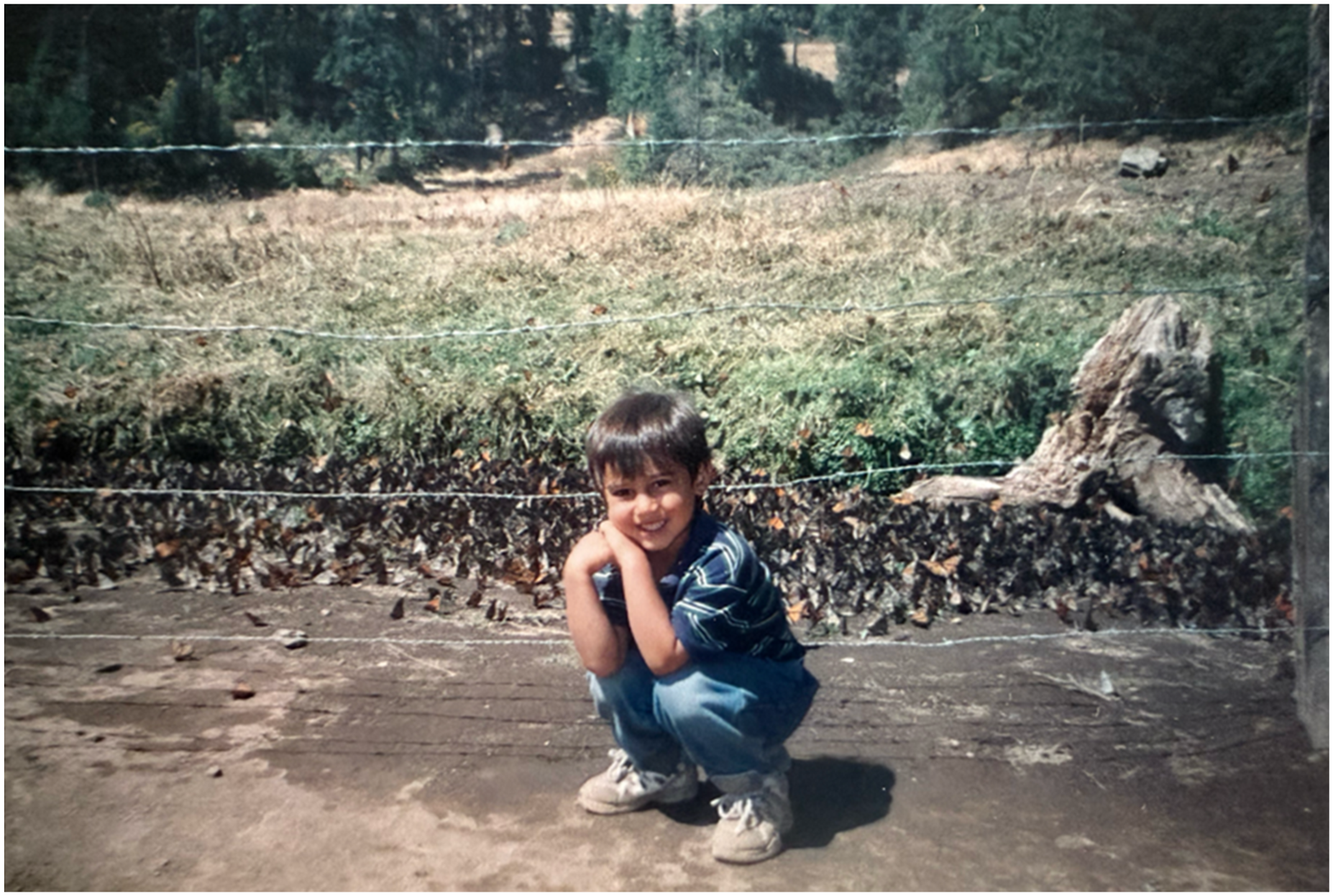
When our parents decided to move to el norte permanently, you didn’t quite know what was yet to come, where life would take you, or the challenges that would transpire on your journey. Yet, I am indebted to my parents who made a journey of selfless love and envisioned a life for a family still yet in the making. I believe that as a Queer person who encountered the struggles of gender and sexuality throughout this life, where I am now (and where you will be) may have looked different had we stayed. Still, I assure you, that although moments of nostalgia and longing will stay with you, otras memorias también te acompañarán. Memorias que, por lo pronto, solo te puedes imaginar. Esperalas y te enseñaran lo dulce que es la vida. Aunque tu mente no quiera, tu cuerpo entenderá que la espera valdrá la pena.
I want to share a short story of our childhood coming to the United States with you and one that I know has been etched too clearly in your memory. The story starts when we are in first grade in a small town called Beloit, WI. Esta bien frio, I remember thinking. You had never seen snow, let alone feel a wind chill of −10°. What was once your daily routine of waking up and seeing la milpa in your backyard was replaced by seeing a blinding white snow as far as your eyes could see. Still, there was a particular beauty about the snow in learning that not one snowflake is ever exactly the same. Our family made the permanent move to this small town in Wisconsin earlier that year without knowing any English. I didn’t realize back then that we would be leaving our homelands, along with the ancestral mountain that looked over us every morning in the west while the sun greeted us in the east. Teoculhuacan, la divina montaña de la cumbre torcida (Figure 2). A picture of el cerro de Culiacán (Teoculhuacan) from the roof of my house in La Luz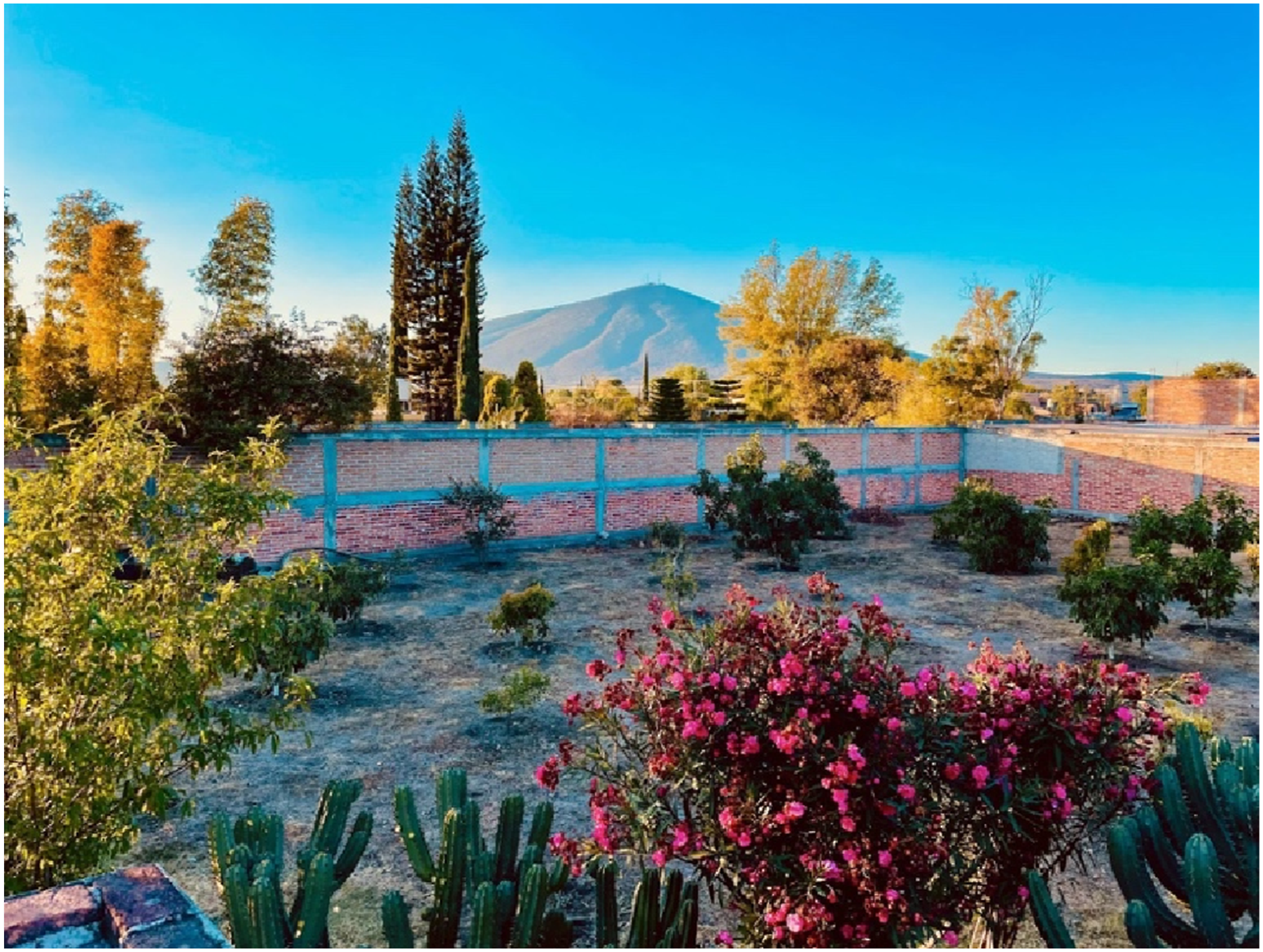
I remember in kindergarten in el rancho, if we needed to use the bathroom, we would get up and find a large wooden key that was hanging beside the door. If the key was gone, someone else was using the bathroom and if we saw it hanging there, we would grab it. One of my first days in first grade in Wisconsin, I assumed that the wooden key rules applied everywhere. I got up to find the wooden key, only for the teacher to yell, or what I assumed she yelled since I didn’t know English, “Hey, what are you doing!?”. Confused, I looked at her and responded “Necesito ir al baño.” We stared at each other and finally someone told her that I needed to use the restroom. She let me go and I stayed in the bathroom for an hour not wanting to go back. I received detention that day (Figure 3). My sisters and I playing in the snow during one of our first Midwest winters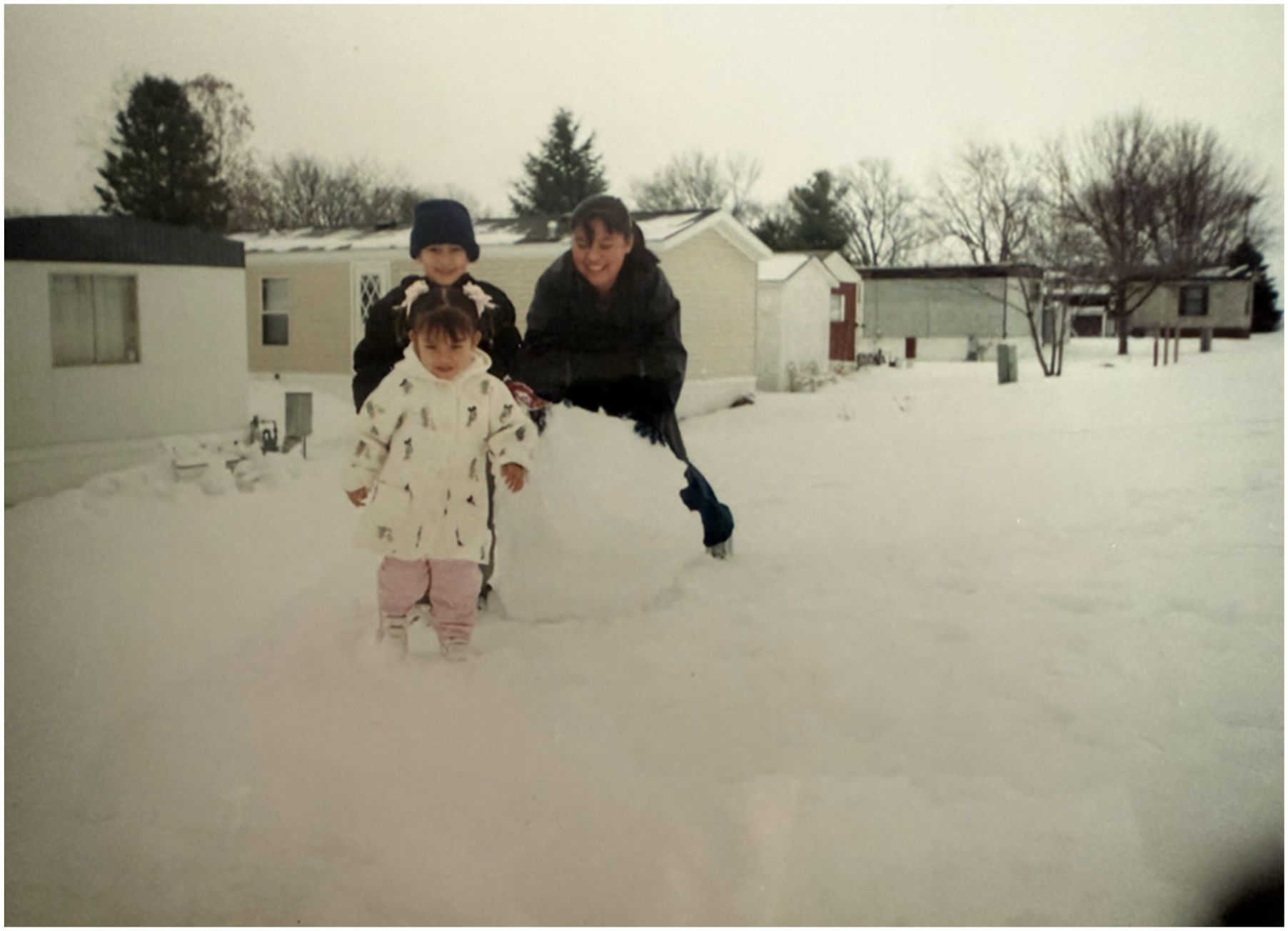
I don’t even remember if that is what really happened, but I do remember how I felt. I realized that my new school did not feel the same as el jardin de niños en el rancho. It felt isolating and distant—almost like I was there just to be there. What do you mean you can’t just go to the bathroom? ¡Es el baño! That day left a residue of the type of schooling that didn’t align with who you are, and importantly, what type of educación I believe I deserved. La memoria de ese día sigue estancada en tu mente y era un recuerdo de lo tanto que extrañabas el rancho. Te decias “no me gusta aquí, quiero regresar a casa.” El olor de la tierra cuando llovía, las guayabas que te comías de la casa de tu abuelita, y las tienditas donde ibas para comprar unos dulces son los recuerdos que te acompañan. I offer this consejo—guarda esas memorias porque es el hilo de tu tejido. I want you to know that your life will be abundant. Who you are, how you speak, and where life takes you, are a part of your journey, ancestors, and family. Those sacred grounds you had to physically leave, have never left you, and they are what roots you firmly—como la milpa que antes sembraban. En tierra ajena, escucharás las voces de tus antepasados. Te llegarán en tus sueños, en tu cuerpo, en tus regresos al cerro, y en las ceremonias donde irás a rezar para los que aún están por venir.
Esperaré tu llegada con mucho amor,
Pablo
Omar's Letter
Querido yo,
Te escribo esta carta desde Boston, un lugar que ahora mismo no existe en tu imaginación, pero que un día se sentirá familiar and extraño at the same time. You will walk these streets more than once. La primera vez con asombro, la segunda con duda, y esta vez, casi diez años después de la primera, con un cansancio que no sabías que el cuerpo podía cargar. Estás en tu tercer año de doctorado y quiero decirte algo desde el inicio: things will not get easier, pero tampoco se volverán imposibles. You will learn how to live inside that tension. Más adelante le pondrás nombre: zozobra. No como miedo puro, but as a constant sway between hope and uncertainty, between seguir adelante and wanting to stop. No huyas de ella. Zozobra is not weakness; it is awareness.
If I told you everything you’ve done, you’d probably believe me. Siempre has sido alguien que cree en los sueños, incluso cuando no sabe cómo nombrarlos. But I’m not writing to impress you. I’m writing to sit next to you. Para que algunas heridas duelan menos. Para que cuando el mundo se vuelva demasiado ruidoso, recuerdes que you are not alone, that you never have been.
Primero: don’t let anyone tell you that you speak badly. Habrá momentos en México y en Estados Unidos en los que te dirán que suenas “funny,” “too Mexican,” “muy agringado,” “pocho,” “mocho,” “ranchero,” “indio,” or whatever word they need that day to push you out of place. Many times it won’t come as an insult, but as a joke, una risa suave, un comentario “bien intencionado.” It still hurts. Aprende esto temprano: those words are not about you; they are about the fear people feel when they see someone living between worlds. No permitas que te silencien. Your voice does not need permission.
Segundo: listen to the stories. Escucha de verdad. The ones from your abuelit@s, from mamá and papá, from l@s tí@s. Some stories will hurt. Others won’t make sense until many years later. But all of them are shaping you. These stories will not always come as words. Sometimes they arrive mientras sostienes la linterna para que papá arregle el motor del carro. Sometimes they come in the huerta with your abuelo, learning when the tierra is ready without anyone explaining it. Pay attention. Las historias también viven en los tortilleros bordados por la abuela y por mamá, en los rosales que el abuelo cuidaba con paciencia. Not everything important arrives in full sentences.
Third: stand up for others, always. Incluso cuando te cueste. Even when your voice shakes. There will be moments when you’ll want to stay quiet, to blend in, to not make things harder for yourself. I understand that desire. But remember this: your silence also teaches. Cada vez que eliges no decir nada frente a una injusticia, something inside you shrinks. This isn’t about being a hero. It’s about not abandoning yourself.
Hay algo que quiero decirte sobre un recuerdo que no recuerdas, pero que vive en tu cuerpo. You were 9 months old when you crossed the Sonora desert in your dad’s old Chevy Impala. You don’t remember the heat, the fear, the endless road, but your body does. That’s why movement feels natural to you. That’s why stillness sometimes feels like suffocation. You were born in transit. Desde el inicio fuiste colocado en nepantla, ese espacio entre aquí y allá, entre un idioma y otro, entre una vida y otra. Don’t try to escape nepantla. It will teach you how to see what others cannot. It will teach you how to translate/transit not just words, but worlds.
There will be days when you ask yourself if you belong. En la escuela, en la academia, incluso dentro de tu propia familia. You will feel like you always arrive with an accent, with too much history, with explanations no one asked for. When that happens, trust your corazonadas. Don’t dismiss them because they don’t sound “rational” or “academic” enough. Your corazonadas come from generations who learned to survive by reading silences, gestures, the air in a room. Not all knowledge fits into a citation. Listen to your body. Escucha ese nudo en el estómago que te avisa cuando algo no está bien, and that strange calm that appears when, even with fear, you know you are doing the right thing.
In school they will tell you to separate who you are from what you study. Te dirán que escribas sin sentir, que investigues sin implicarte. Don’t always believe them. You will learn to speak many languages: the academic one, the family one, the one from the street, the one from memory. No traiciones ninguno. Your strength lives in your ability to move between them.
There will be losses. Personas que no llegarán contigo hasta este punto. Places that will only exist in memory. Let yourself grieve. Permítete llorar. Strength is not constant hardness. La fortaleza también está en saber cuándo sentarte y descansar. Zozobra will return many times, but you will recognize it. Not as an enemy, but as a sign that something matters.
One day, you will realize that your life is not a problem to be solved. No todo lo que hagas será comprendido, and that is okay. Your existence does not need to convince anyone. Sigue caminando, even when you can’t see the whole path. Sigue cruzando, como lo hiciste una vez sin saberlo, sostenido por otros.
I write to you not to change you, but to remind you who you are. De aquí y de allá, and wherever else you might find yourself. When you doubt, come back to this: you are not lost. Estás en proceso.
Con cariño, paciencia, y memoria,
Tu yo mayor (Figures 4–6) Photo of my mother and I playing in the snow in Idaho Photo of my mother placing us in position for the photo while I hold on to my sister Photo of me and my sister holding our brother on the day we first met him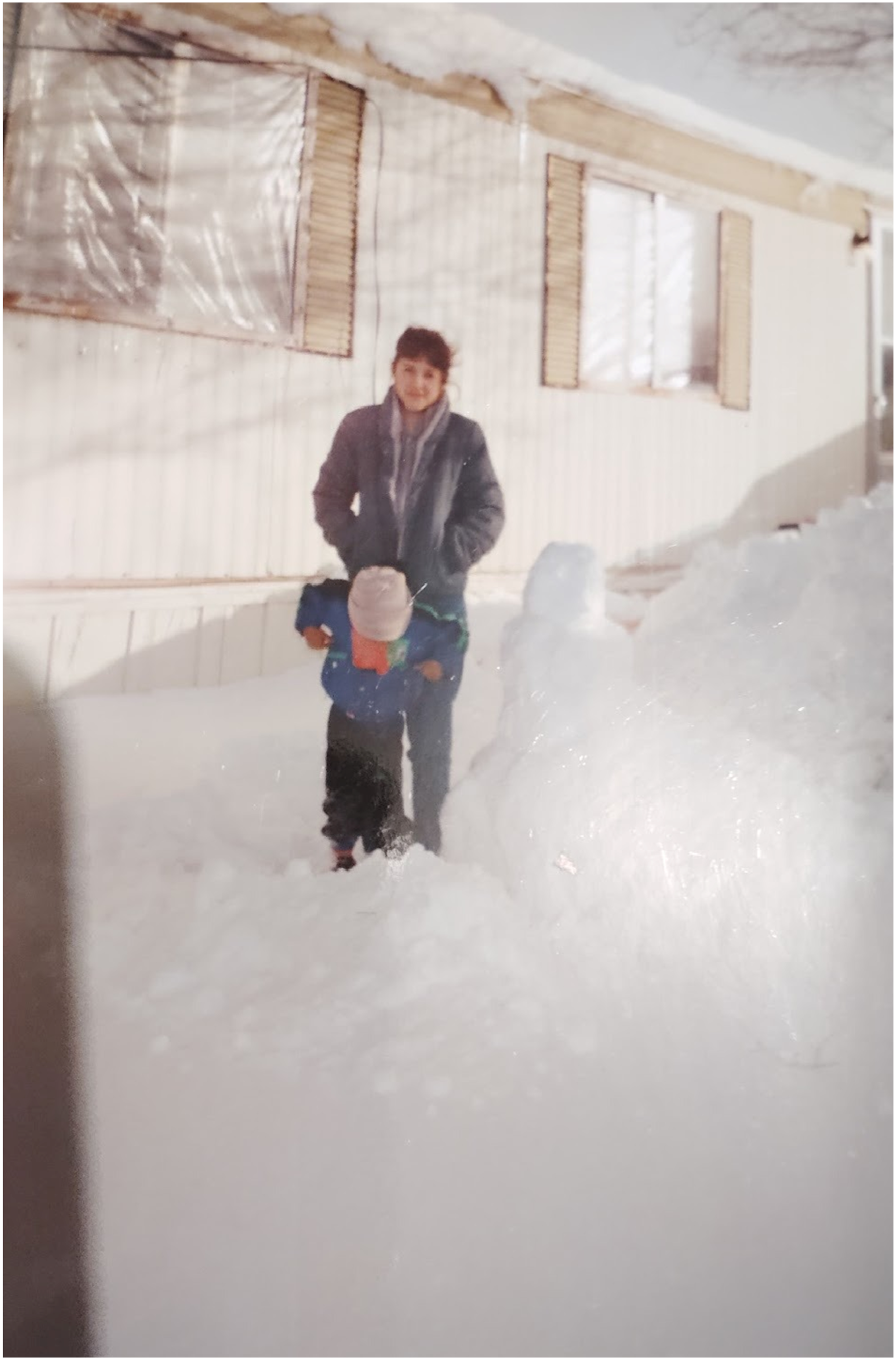
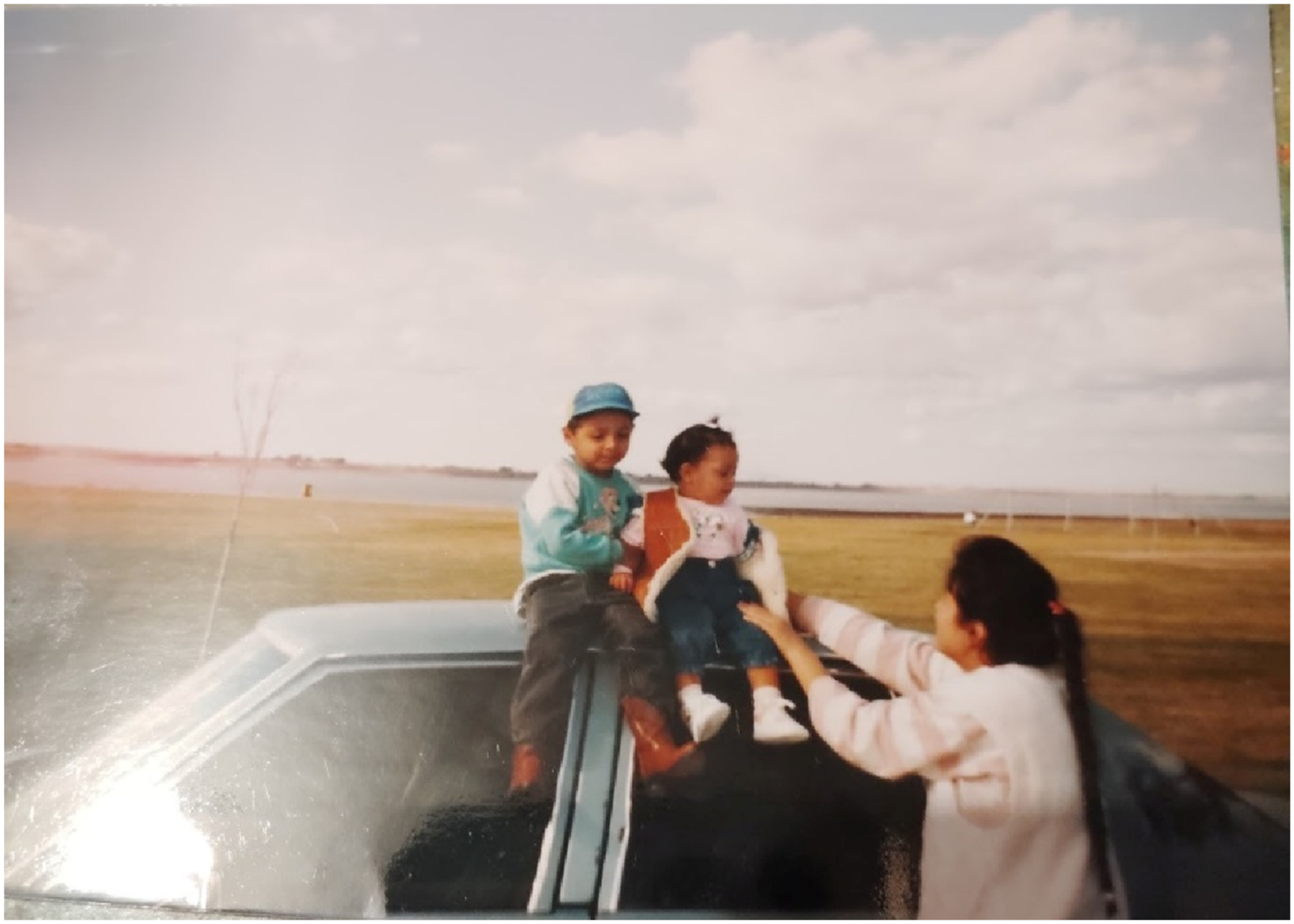
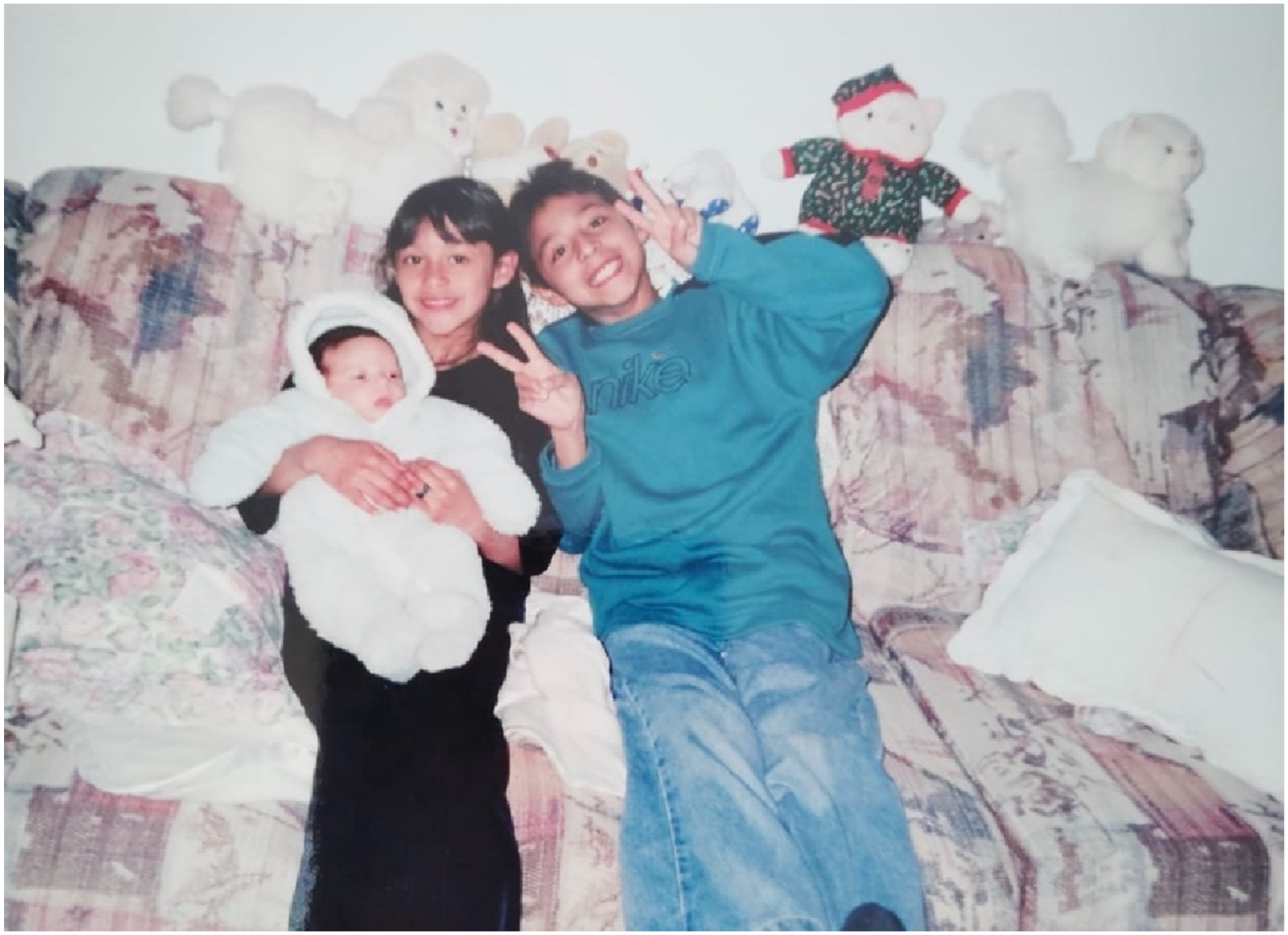
Over the winter break of 2025–2026, as I was writing the letter to my younger self, I asked my mother, who now lives in Mexico, to send me photos of photos from her boxes and albums of photographs. I imagine her pausing over each one, tracing faces and landscapes with her fingers, deciding which moments to release back into circulation and which to hold close. On the surface, each photograph might appear to capture a discrete and self-contained memory, yet together they gesture toward a life lived across shifting homes, climates, and relationships, where time folds back on itself and the past presses insistently into the present. The images invite me to reckon with how transnational experience is carried not only in dramatic crossings but also in the quiet repetition of family rituals, seasonal changes, and ordinary intimacies that accumulate into a sense of self.
These are three of those photos that I have chosen to include here, sealed within the envelope as gifts to myself. They preserve moments when my worries were bounded by the immediate and the bodily: building the largest snowman I could manage, holding my sister steady for the camera, welcoming a new member into the family with joy. Read now, they reveal how belonging was learned through touch, proximity, and shared attention long before I could articulate what movement across borders would later demand of me. The photographs remind me that transnational lives are composed not only of rupture and displacement but also of care, play, and anticipation, and that these early scenes continue to shape how I understand family, memory, and continuity across distance and time.
Entregando Consejos: Toward Epistolary Diasporic Saberes
Consejos can be thought of as nurturing advice between people, and importantly, as a cultural strategy and tool on “how to care for each other while sharing important experiences with each other” (Delgado-Gaitan, 1994, p. 313). As Concha Delgado-Gaitan (1994) distinguishes, although consejo is literally translated to “advice” in English, it is understood through a different sense of cultural meaning that is imbued with emotion, empathy, familial expectations, and compassion. To receive and give consejos is an act of care and intention, where one envisions a better future and a better world than one may currently inhabit. In our letter-writing, we also view this act of aconsejar as a way to preserve and inscribe our family’s intergenerational memory (Carrillo et al., 2018). Gifting consejos to our younger selves, then, serves both as a way to fortify intergenerational epistemologies, as well as, to enact a praxis of healing where our cicatrices of the past can transform into sites of guidance, even in knowing that they may sometimes hurt. Doing so by epistolary means, we argue, invites us to think about how letter-writing can texture and contour our diasporic saberes and transnational funds of knowledge, a theoretical and methodological suggestion we call epistolary diasporic saberes. Put differently, drawing from the way that our parents had to communicate (e.g., via letters), we propose that such moves toward letter-writing enable us to pen otherwise epistemologies often not legible through schooling or academia. Inspired by the transgressive act of sending letters beyond and against borders (Chávez-García, 2018), we accentuate that sending letters is an act defying containment while emplacing our stories as real, lived, and sacred (Brayboy, 2005).
We now take the time to offer four consejos to our younger selves and to the many students who may also find themselves in spaces of transit and mobility, entre aquí y allá, entre tierra ajena y hogares conocidos. These consejos are (1) listen intently to the stories of people, places, and dreams, (2) although language can shape you, you too can shape your language, (3) home can be (re)imagined and felt at different times and places, and (4) although diaspora can elicit grief, it can also bring pedagogies of joy, life, and abundance.
Listening intently to the stories of people, places, and dreams invites you into a world of co-imagining and dreaming of otherwise possibilities (Montes, 2022). Contrary to what school may teach you, stories are not “just” stories. They are theories, carry knowledge, have history, and relay instructions and they arrive in many forms: memories, dreams, silences, dichos, landscapes, consejos, gestures, and letters (Brayboy, 2005; Cisneros, 2018; Lipe & Lipe, 2017). Our parents letters were sent in the late 20th century in the backdrop of newly forming immigration policies and practices, yet, they sent such missives to “communicate the challenges and rewards of the migratory processes and their changing social and cultural environment” and importantly “disclosing their innermost dreams and desires” with each other (Chávez-García, 2018, p. 25). A part of our family’s intergenerational stories lies within their correspondence, in-between the sentences they wrote, and in the margins of their paper. Te aconsejamos, not everything important may come in full sentences but paying attention to the stories one shares, whether written or spoken, will invite you into the multiple words/worlds our families create.
Acknowledge that although language does and can shape you, you are also able to shape language(s). Our ancestors often spoke in conceptual meanings and not always in exact definitions. So, it makes sense that nuestras lenguas defy the orderings of western semantics and grammar because we are remembering knowledges and ways of being that cannot be defined or repressed, even though structures of schooling might try to do so. Saavedra and Marx (2016) explain how school’s tame wild tongues and bodies as they share: The placement and constant surveillance of minority children’s bodies in the classroom demonstrate the pushing out of unruly bodies that do not fit the norm. However, even when linguistic and ethnic minority children do fit into the culture of a noisy, lively classroom, they will be reminded that the inhibitions allowed in the classroom do not apply to them; they must stay in their place. These unsuccessful bodies are controlled in the classroom through physical isolation and/or constant surveillance (Boldt, 2001). (p. 49)
It is true, Spanish and English arrived through histories of violent erasure on our people and as a result many of us carry languages that were imposed on our communities, and yet, they have become the vessels by which our stories survived. Our languages and bodies may not always be nurtured, however te aconsejamos, you are both the language(s) you speak and the languages you remember, restore, and recreate. You might only speak English or Spanish, you might hold your Indigenous language, or you might piece together the fragments of many, but ultimately you are a curator of languaging. Over time, you will come to see how preservation, adaptation, and survival live inside your everyday wor(l)ds despite the noise and discourse of control (Saavedra & Marx, 2016).
Home can be (re)imagined and felt at different times and places. There will be times where the concept of “home” will remain unclear and cumbersome. You might think about a life you could have had back in your homelands, or you might slip into forgetting what the feeling of being with your homelands even means. Te aconsejamos to lean into those diasporic community saberes (Urrieta, 2016) and transnational funds of knowledge (Przymus & Serna-Gutiérrez, 2022) where home is a not just a place, but also a temporality, a feeling, a moment, a connection, and a spiritually rooted practice. As Urrieta (2016) shares, diasporic community saberes are cosmologically abundant and can include “linguistic, sociocultural, scientific, and spiritual knowing(s) as they are explicitly and implicitly taught in the family and community daily life, even as the notion of community expands amongst members across geo-physical and socio-political fields” (p. 4). Ultimately, home is not a singular place, but a multitude of experiences not bound by borders or nation states. You hold it in your body, your memories, your accents, your food, and your ceremonies.
Diaspora can elicit grief, but it can also bring forth pedagogies of joy, life, and abundance. There will be days when distance feels like forgetting, when nostalgia aches, and when the place you once knew feels strange or unreachable. Pero donde vive el duelo, también vive la felicidad. As Liu (2019) suggests, maybe melancholia, or the attachment to the object of loss, may offer us better ways to understand grief with/in diaspora and all that accompanies it. In other words, “instead of regarding the negative affects of melancholia and grief as quantifiable damages or inconsolable wounds” what are the possibilities when reading “melancholia as a refusal to ‘feel better’ under the current condition of neoliberal hegemony within which happiness is narrowly defined” (Liu, 2019, p. 181). In this way, grief may not necessarily exist as a state of contentment but allows joy, life, and abundance to arise in co-constitutive ways. In time, you will understand why the long journey was taken. Within that understanding live your family’s stories, a widening sense of freedom, and the quiet call of those who came before you.
Conclusión: Esperando su Respuesta
As we conclude our article, we await your response to our letters. In our epistolary endeavors, we highlight and address the importance of diasporic saberes and transnational funds of knowledge and how our journeys reflect the temporal, spatial, and layered formations of identity, language, and community. What began as an idea of writing has transformed into a form of textual healing (Escobedo, 2024) where we encouraged ourselves to tend to old wounds que se han cicatrizado. In doing so, sobamos las heridas para aconsejar our younger selves, and by extension other youth, living in diaspora. Brought together by our shared yet nuanced experiences of being Guanjatense scholars in diaspora, we reflect on how epistolary diaspora saberes can invite youth to further navigate these transnational journeys in ways that are attuned to more relational, personal, and embodied ways of being and doing. We sign this letter with gratitude and close the envelope para entragar nuestras cartas. Esperaremos sus respuestas.
En comunidad,
Pablo Montes and Omar Serna
Footnotes

Funding
The authors received no financial support for the research, authorship, and/or publication of this article.
Declaration of Conflicting Interests
The authors declared no potential conflicts of interest with respect to the research, authorship, and/or publication of this article.