







Abstract
Leisure and work are often thought of as independent parts of life. While leisure has the potential of contributing to HRD and vice versa, it has received limited attention in HRD. Therefore, in this study, we used an integrative literature review to explore how leisure can contribute to HRD and become an HRD intervention. To search the literature, we used keywords relating to leisure, work, and HRD. One among several leisure types found was serious leisure. Serious leisure requires engagement in the activity with a sense of self-development. The results from serious leisure could include knowledge and skill development, which might not be related directly to short-term work performance improvement. Despite this, it allows for intrinsically sustainable self-development. Such self-development can yield positive results in every element of life, including work. To facilitate serious leisure as an HRD intervention, practitioners and policymakers need to eliminate leisure constraints.
Keywords
We accepted Bartlett’s (2018) proposition of a false dichotomy between work and leisure in human resource development (HRD). Bartlett (2018) examined HRD definitions and concepts and found that HRD focused on only learning and development efforts that related to work. HRD has not adequately considered life-based efforts related to development, such as leisure. He argued that, while leisure could contribute to work, such a connection is not necessary to include it in HRD. Leisure has received limited attention in HRD. Sometimes, leisure has even received a negative reaction in terms of work-leisure conflict (Shi et al., 2021). Bartlett (2018) sought for evidence of contributions of leisure in learning and HRD. In this article, we build on this concept.
Disrupting the traditional boundary of HRD that divides work and leisure can unleash greater potential for HRD (Bartlett, 2018) because work and leisure are often viewed as independent components of life. As work occupies much of most people’s time, their free time is valued. If people do not have work, they would not know what free time is or could lose track of time (Beatty & Torbert, 2003). Therefore, we identified roles of leisure in enhancing HRD as one’s life cannot be complete with work alone.
Literature shows that leisure can result in many positive outcomes that could contribute to developing human resources in diverse contexts. Many of those outcomes from leisure relate to HRD, such as individual work outcomes (Kuykendall et al., 2015; Wiese et al., 2017), organizational outcomes (Kuykendall et al., 2015; Wiese et al., 2017), creativity and innovation (Mainemelis & Ronson, 2006), work-related learning (Dattilo et al., 2012; Isopahkala-Bouret, 2008), career development (Isopahkala-Bouret, 2008), life-long learning and development (Lyu & Oh, 2015; Morris & Madsen, 2007; Pan et al., 2018), and personal well-being (Pan et al., 2018; Pereira et al., 2019). This study benefits both HRD and leisure by suggesting how leisure could benefit HRD as an intervention.
Our research focused on types of activities and their mechanisms in influencing the quality of other life aspects (Kuykendall et al., 2018). Our purpose was to inform HRD about possible types of leisure and their roles as HRD interventions. We propose serious leisure as a type of leisure that contributes to HRD.
Theoretical Background
Leisure can be interpreted in many ways; it can be referred to in terms of time, types of activities, or purposes for doing such activities, among others. For instance, leisure is the activities that one chooses to do in one’s free time (Beatty & Torbert, 2003; Mete, et al., 2012; Petrou et al., 2017) or away from work (Kuykendall et al., 2018). Yet, leisure is different from doing nothing or idleness (Kashef & Nazri, 2015). Leisure is intrinsically motivated and is done according to one’s free will (Özdemir, 2020). One needs to craft personal activities to become leisure (Petrou et al., 2017). Therefore, an activity that one is forced to do, in some way, is not leisure. Intrinsic motivation to participate in leisure activities results from three basic psychological factors: confidence in personal competence in doing such activities, autonomy in activity selection, and relationship with others either in doing the selected activity or sharing about such activity (Walker et al., 2020). Leisure can also be a method of recovery from work and regaining one’s energy (Kuykendall et al., 2018). Although it is challenging to define leisure universally and to draw a solid boundary around what leisure is, definitions of leisure and the nature of the differences among them (Kelly, 2009) have not been clearly identified. Moreover, what is leisure activity for someone could be torture for others (Beatty & Torbert, 2003). To identify activities that can be considered leisure, there needs to be awareness of one’s attitudes toward each activity and one’s intention of performing this activity (Özdemir, 2020). Based on these concepts, for a person to have leisure, one needs to have time free from immediate obligations in life. One also needs to have the motivation to pursue activities that provide one with enjoyment. The attitude toward such activities is the key to having leisure. Walker et al. (2020) affirmed that factors affecting people’s intrinsic motivation to participate in leisure activities differed across cultures. We take leisure, then, in this article to be about experiences and perceptions about selected activities rather than about specifying types of activities. Specifying types of activities as leisure would violate people’s autonomy of selection. Therefore, we discuss types of leisure in this article as dissimilar to types of activities.
Theoretical Foundations of Leisure: Types of Leisure
Literature suggests that there are many types of leisure. A binary view proposed in a seminal work on leisure by Stebbins (2006) suggested that leisure can be divided into serious and casual leisure. Serious leisure includes activities that are based on one’s personal interests. They can be a hobby with determination to improve oneself to be good at performing that activity. This kind of leisure normally involves the sense of achievement or fulfillment. Serious leisure includes the pursuit of an activity with interest; perseverance; significant effort; and self-expression of skills, knowledge, and experience with a set of beliefs or values different from such expressions at work. The pursuit of serious leisure results in developing identity, personal and group durable outcomes, and maybe a potential career (Gould et al., 2008). Accordingly, the theoretical functions of serious leisure--its purpose, forms, and limitations--suggest that serious leisure is not different in types of activities from casual leisure, but, rather, is how people engage in such activity. The purpose of serious leisure involves fun and positive experience. However, serious leisure, in addition to fun, involves effort to achieve something by doing a selected activity. For activities to be considered serious leisure is not based on what the activity is, but on how that activity is done. A major limitation of serious leisure lies with its potential of getting too serious. Seriousness in the pursuit of an activity with interest; perseverance; significant effort; and expression and development of skills, knowledge, and experience could lead a person to the point at which serious leisure starts to be a career opportunity. Gould et al. (2008) mentioned how career opportunity and opportunity for financial return, if a person is not mindful in maintaining an activity as serious leisure, can change from leisure to work. When that happens, one loses a serious leisure activity.
Casual leisure is different; it is an activity that can be done at any time for fun, being rewarding for oneself. These leisure activities do not require continuous practice or self-development, and they normally provide short-term fulfillment rather than self-achievement (Akyıldız et al., 2016; Stebbins, 1997).
Leisure can also be divided into active and passive leisure (Roy & Orazem, 2021; Smeets et al., 2019). Some scholars have discussed the idea of active leisure as sports, working out, and social and cultural activities (Smeets et al., 2019), such as running, cycling, fishing, photography, and so on (Holder et al., 2009). Passive leisure, on the other hand, does not require activeness by the actor. Passive leisure could be watching television (Holder et al., 2009; Smeets et al., 2019). It provides more relaxation than active leisure. One may argue that reading, as well as many other activities, could be active leisure, too. The definition of leisure could provide an explanation. It is not about the activity, per se. It is about how one engages in the activity. One criterion that can be considered for active leisure is cognitive involvement in doing selected activities. Types of leisure are portrayed in Figure 1, based on the four types described by Stebbins (2006), Smeets et al. (2019), and Roy & Orazem (2021). However, it is important, again, to emphasize that these concepts can be ambiguous; there are not clear boundaries among the types. Matrix of active, passive, serious, and casual leisure (based on Stebbins, 2006; Smeets et al., 2019; Roy & Orazem, 2021).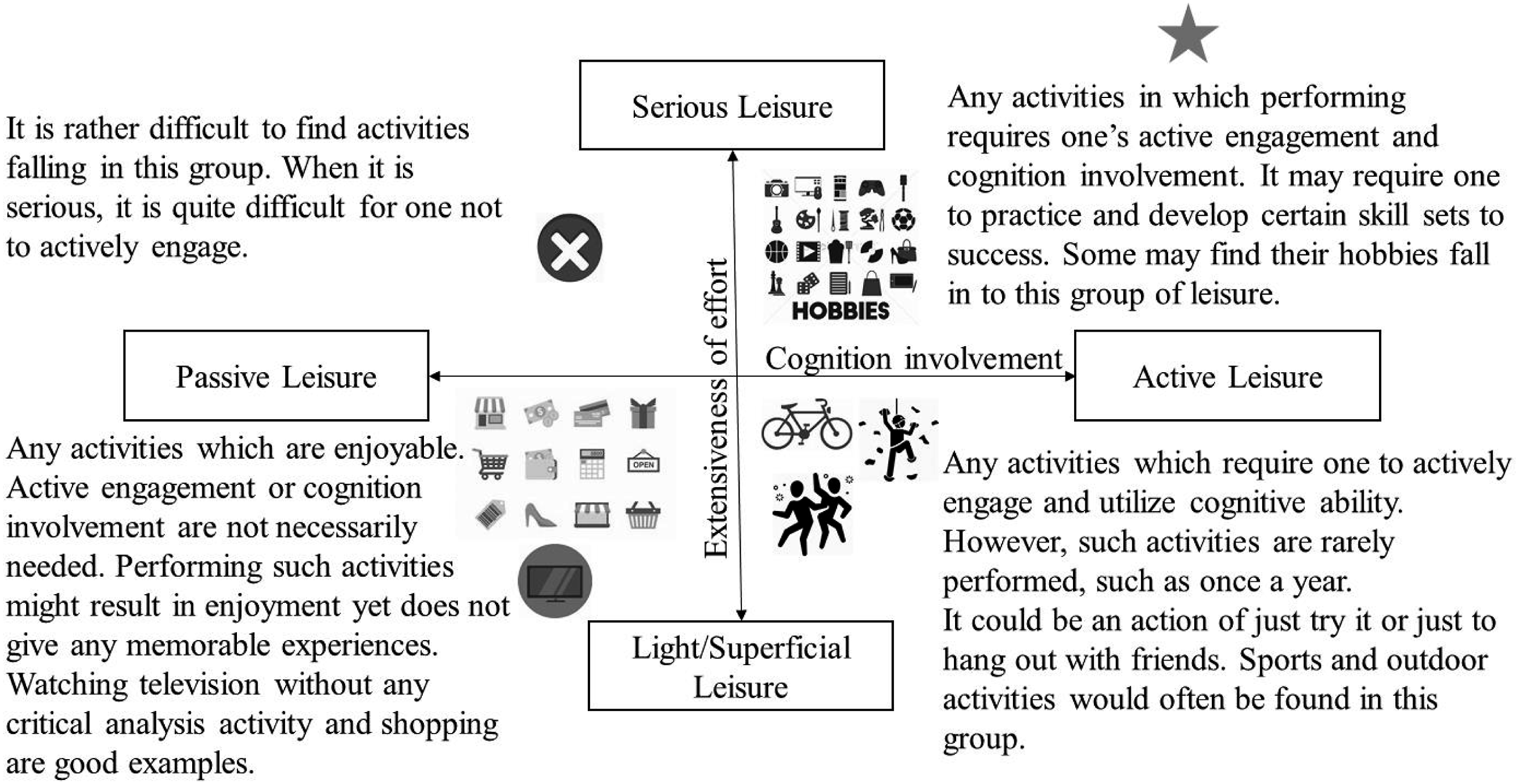
Leisure can play an important role in HRD efforts. Bartlett (2018) suggested that, initially, leisure theories did not pay much attention to the outcomes of leisure—the focus was on the action of leisure. The outcomes of leisure, however, can possibly contribute to HRD. When the outcomes are not considered seriously, it is difficult to study and define the roles of leisure in HRD. Moreover, HRD often limits itself to work-based activities and work-based learning. Currently, the definitions of leisure have expanded, as have those of HRD. Quality of work-life, for example, has been mentioned as an outcome of leisure (Brajša-Žganec et al., 2011). Work-related learning and motivation to learn have been discussed as outcomes of leisure (Dattilo et al., 2012; Isopahkala-Bouret, 2008). Such outcomes result in increasing people’s values and competitiveness in the labor market (Isopahkala-Bouret, 2008), and those outcomes relate closely to HRD. Leisure studies needs a transdisciplinary focus to allow leisure to contribute better to the social sciences (Henderson & Bialeschki, 2005). Leisure has a potential for developing human resources, social inclusion, and empowerment (Dattilo, 2018). Such potential of leisure leads to leisure’s importance for HRD. Therefore, we reviewed and discussed definitions of HRD in the following section to affirm and highlight leisure’s potential of developing human resources.
Definitions of HRD
We combined several accepted definitions of HRD to define HRD as a planned process or activity that provides learning experiences that enhance work-related learning capabilities, knowledge, expertise, effectiveness, and satisfaction in individuals, groups or teams, organizations, communities, or wider contexts (McLagan, 1989; McLean & McLean, 2001; Nadler & Nadler, 1989; Swanson, 1995).
Another definition of HRD is the processes and/or activities, including both short-term and long-term, that allow people to learn (McLean & McLean, 2001). Many such processes and activities have been mentioned as HRD, such as training and development, education, career development, organization development, mentoring and coaching, and the integration of many activities (McLagan, 1989; Nadler & Nadler, 1992).
Definitions of HRD mainly focus on learning in a work-based context. As a result, the dichotomy between work and other aspects of life limits an HRD perspective and its development. Learning in contexts other than work may not be considered as HRD in many definitions. In addition, outcomes of learning in HRD are generally limited to effectiveness and improvement at work, in either the present or the future (McGuire, 2011; McLagan, 1989; Nadler & Nadler, 1992; Swanson, 1995). McLean & McLean (2001) expanded the outcomes of HRD to include levels of stakeholders, including individuals, teams, organizations, communities, nations, and the whole of humanity. Still, HRD is mainly work-based in effort and outcomes.
Despite the work-based focus of HRD, the potential of leisure in contributing to HRD is possible, especially considering the element of personal and group development resulting from leisure. To use insights from Figure 1, there are different approaches to leisure. Each approach contributes differently to personal or group development. To use leisure as an HRD intervention, it is important to understand different characteristics and outcomes that can be expected from each type or leisure. Serious leisure, according to Figure 1, stresses on one’s development through active engagement in selected activities. The following section present show leisure could be used in HRD.
Leisure in HRD
Leisure can relate to satisfaction, positive experiences, and enjoyment. In addition, it can relate to personal development, group development, and social contributions (Gould et al., 2008; Stebbins, 1992). We connected outcomes of leisure to the reviewed definitions of HRD by elaborating on how leisure could contribute to desirable outcomes of HRD, such as motivation to work, reviving energy to work, and development of social skills that could result in teamwork (see Definitions of HRD).
Focusing on the implementation of serious leisure in HRD, we identified several studies showing explicitly how leisure activities are used to develop or change individuals’ behaviors and to reach outcomes related to HRD. Lee & Hwang (2017), for example, found that one’s subjective well-being (SWB) was significantly related to engagement in serious leisure. Further, self-gratification and enjoyment were found to be predictors of SWB, which is positively related to serious leisure (Lee & Hwang, 2017). Self-gratification is also seen from a leisure perspective as a level of depth of satisfaction. Self-gratification could include the feeling of fun, profound and fulfilling (Gould et al., 2008). Marathon running, as leisure, could greatly decrease a person’s stress (Pišot, 2013). It could be concluded that leisure could create subjective well-being for those who participated (Wozny, 2012). According to Wozny (2012), serious leisure can help decrease the risk of fatigue, burnout, and impairment. However, individual perspectives and preferences about leisure activities affect one’s consideration of the activities that would be serious leisure for each person. An activity can be seen as serious leisure or not based on an individual’s personal experiences and perspectives. Determining serious leisure is not totally tied to the kind of activity, but, rather, how an individual interacts with the activity.
Leisure can create a sense of self-fulfillment. Pišot (2013), for example, found that, generally, marathon runners identify their running as a career and a self-fulfilling activity. People who engage in leisure find greater meaning in life (Kuykendall et al., 2018). Not only in the western context, but also in an eastern context it was found by Kono et al. (2019) that balance of enjoyment and effort in leisure activities significantly influence the value of leisure experience, life affirmation, and life vibrancy. The outcomes of leisure highlighted above fulfill some objectives of HRD, such as enhancing learning capability, employee satisfaction, and quality of life, among others.
Apart from this, people who engage in leisure could develop greater knowledge, expertise, and skill sets. Pišot (2013) discovered that, after 5 years of marathon training, runners found that they could improve their skills, knowledge, and experience.
HRD is also focused on soft skills. Sritanyarat et al. (2022) found that there was a strong relationship between serious leisure participation and personal growth mindsets of workers in Thailand. Growth mindset has been considered to be a complementary variable for HRD practices, inviting future research (Han & Stieha, 2020).
A sense of belonging and social inclusion can also be an outcome of certain kinds of leisure. Beatty & Torbet (2003), for example, found that volunteer activities as serious leisure, at the community level, resulted in a sense of belonging for those who engaged in such activities. This kind of serious leisure can provide experience of creating shared values and building relationships within communities and societies (Gallant et al., 2013). Volunteer work and sports, as leisure, can develop a sense of social inclusion (Aksatan & Sel, 2017; Burns et al., 2009; Gallant et al., 2013). It can thus be concluded that there are many kinds of leisure as activity experiences that result in outcomes related to HRD. Gould et al. (2008) and Kono et al. (2019) found that leisure performed with effort provides a degree of positive personal reaction of enjoyment and self-development called serious leisure that can yield outcomes related to HRD.
Internationally, as shown in this section, leisure has potential for both HRD scholars and practitioners. While leisure typically falls outside of the concept of work-based efforts, it can contribute to HRD outcomes.
Methods
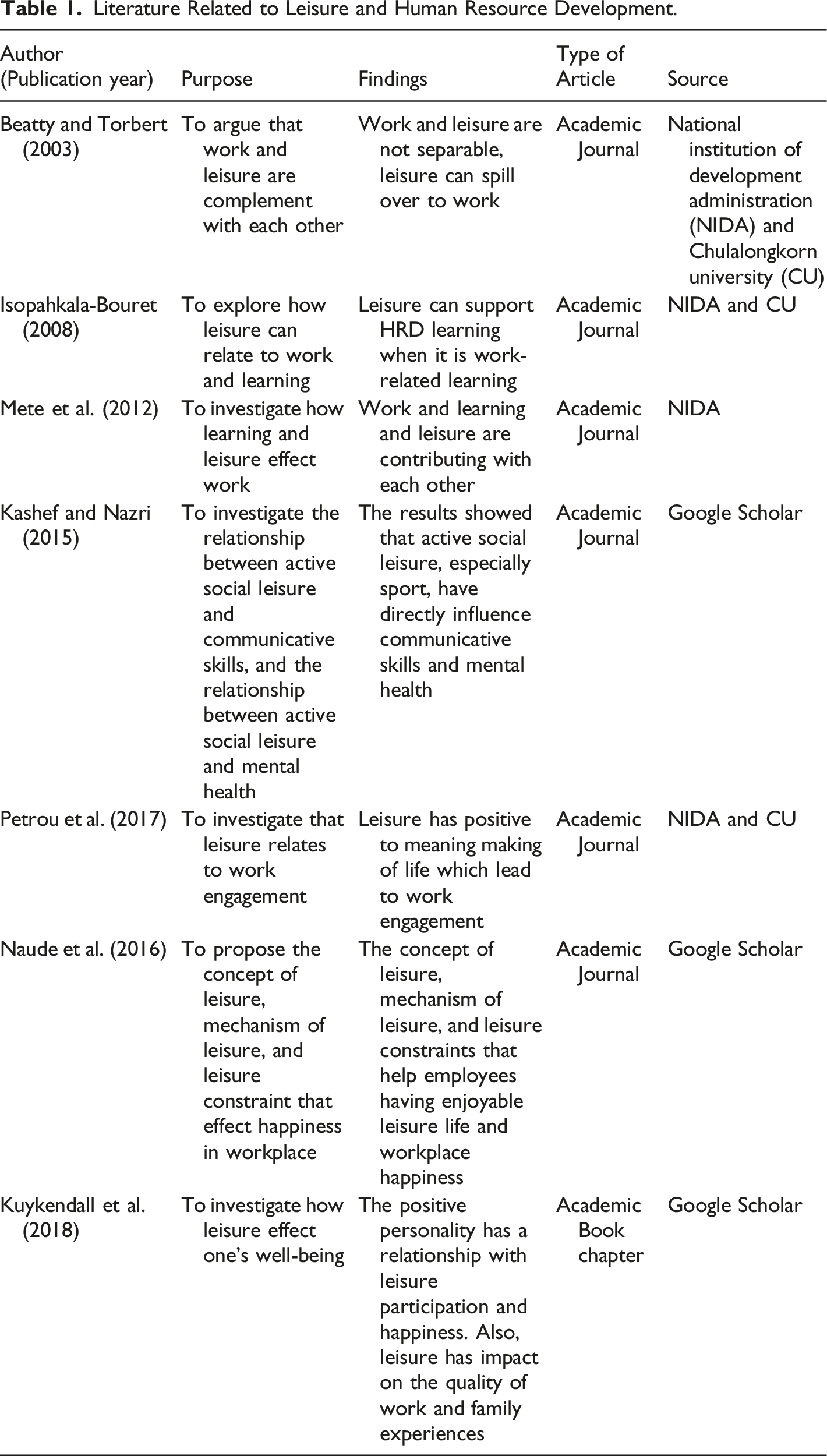
We used an integrative literature review approach suggested by Torraco (2005) to review, critique, and synthesize related articles about serious leisure to uncover and present the possibility and feasibility of serious leisure as an HRD intervention. In other words, integrative literature review is done to understand relevant concepts and match the relationships among them (Rocco & Plakhotnik, 2009). The results allow researchers to explore a topic more deeply and widely (Ravitch & Riggan, 2012). In this study, we explored the potential of leisure being an HRD intervention. To explore such a possibility, a literature search was undertaken, focusing on peer-reviewed articles, using keywords that encapsulated the concepts of interest to our study: a) leisure and work and learning; b) leisure and work and human resource development; and c) leisure and work and HRD.
Literature Related to Leisure and Human Resource Development.
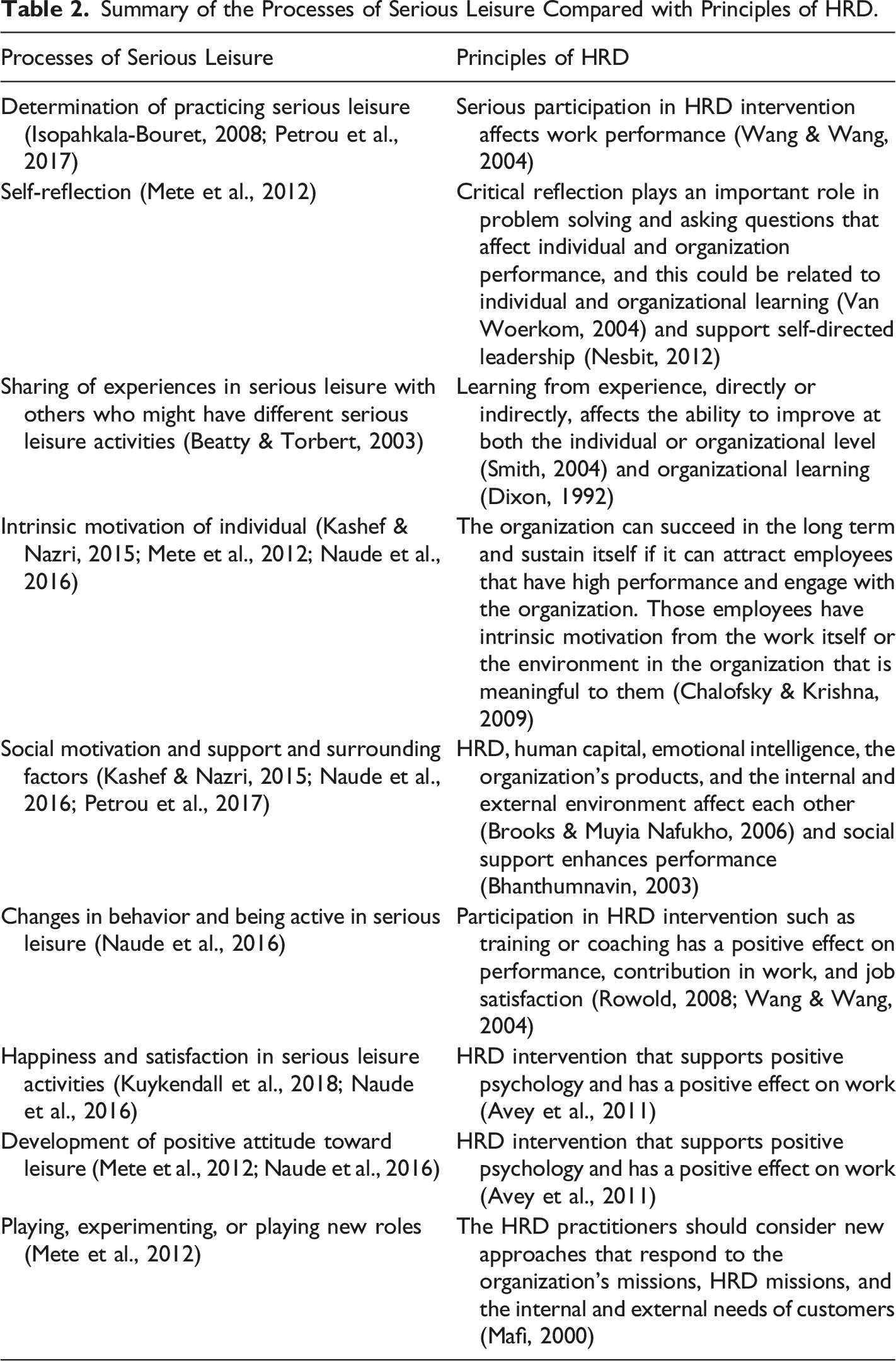
Summary of the Processes of Serious Leisure Compared with Principles of HRD.
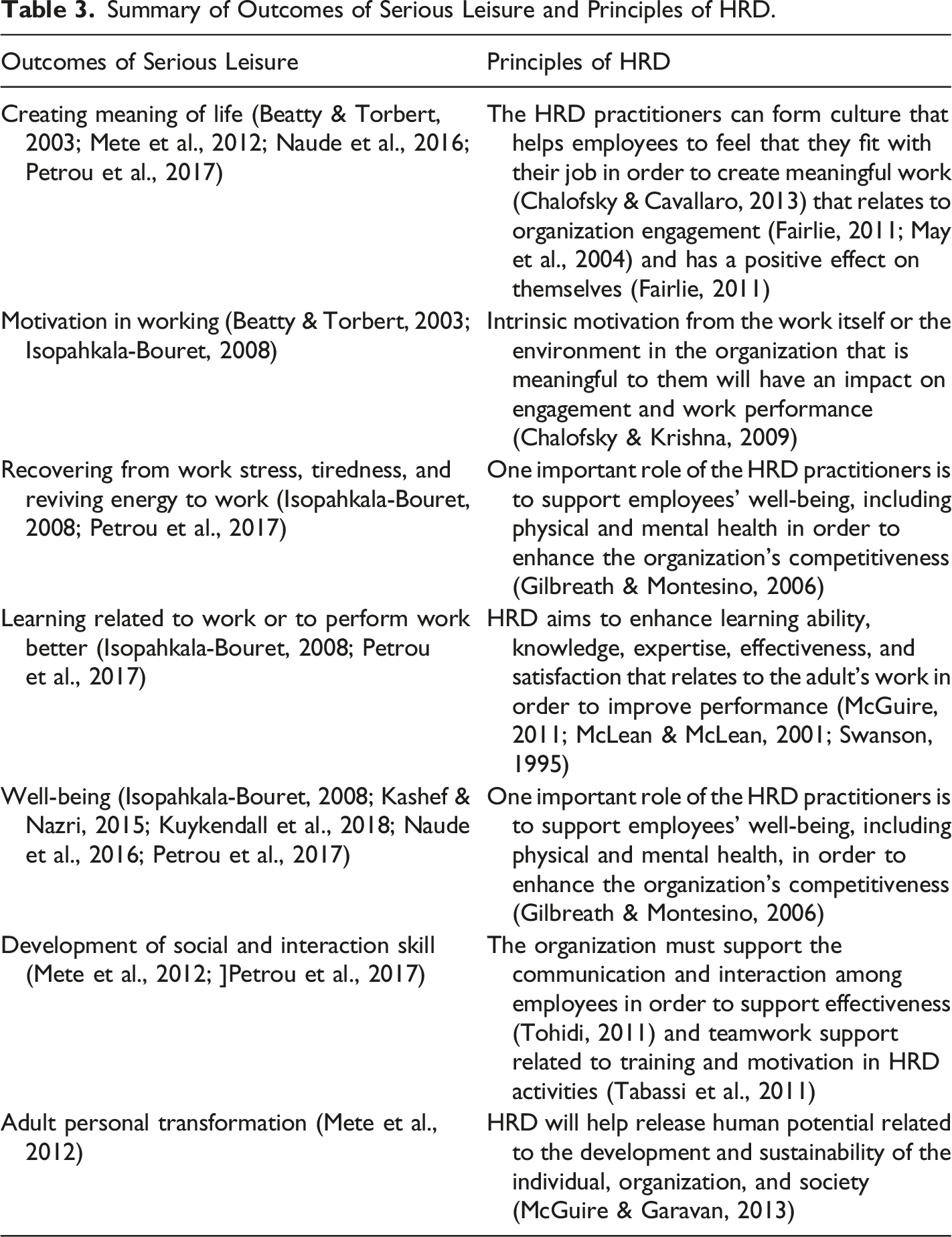
Summary of Outcomes of Serious Leisure and Principles of HRD.
Findings
The results of our analyses are presented below.
Types of Leisure Suitable for HRD
Bartlett (2018) mentioned that learning in either leisure or work can benefit HRD. In this study, we proposed the same idea. Even though work and leisure are not the same, they are interdependent. Without work or other obligations in life, one may lose the sense of time. Consequently, leisure cannot exist without work (Beatty & Torbert, 2003). Considering the interdependence of work and leisure, we developed a continuum of pure work to pure leisure as presented in Figure 2. This figure was developed from our literature review to explore concepts of leisure relating to HRD. As leisure was understood and classified differently among authors, we agreed that leisure could refer to activities that people choose to do (Beatty & Torbert, 2003; Isopahkala-Bouret, 2008; Kashef & Nazri, 2015; Mete et al., 2012). Therefore, leisure in this case differs from doing nothing or a state of idleness (Petrou et al., 2017). Also, it is not work as people can choose not to do such activities when they do not want to. That would be very difficult if it is work. Work-leisure continuum (based on Mete et al., 2012; Naude et al., 2016; Stebbins, 2006).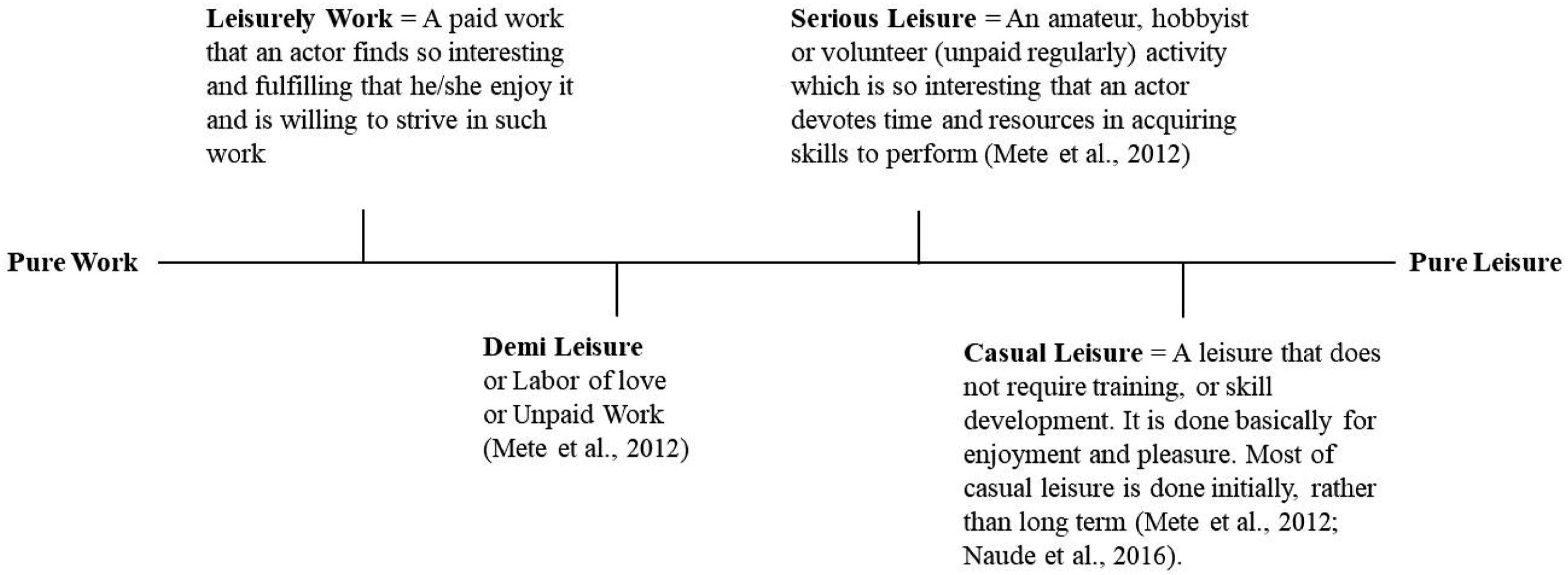
Some authors took leisure as detachment from work (Beatty & Torbert, 2003; Isopahkala-Bouret, 2008; Mete, et al., 2012; Naude et al., 2016). While some authors took leisure as something that people do without fixed compensation (Mete et al., 2012), some would not consider compensation at all. For those who did not consider leisure as being compensated, leisure was identified by intention and interest of people (Isopahkala-Bouret, 2008; Mete et al., 2012). In other words, any activities that people are intrinsically motivated to do with autonomy could be leisure (Beatty & Torbert, 2003; Isopahkala-Bouret, 2008; Petrou et al., 2017). There have been activities mentioned as examples of leisure, such as sports (Kashef & Nazri, 2015), studying about topics of personal interest (Isopahkala-Bouret, 2008), traveling (Mete et al., 2012), and volunteer activities (Mete et al., 2012). Considering the above concepts of leisure, together with what Beatty & Torbert (2003) shared about the relationship between work and leisure, it can be concluded that it is challenging solidly to identify any activity to be work or leisure. It depends on how an individual takes on such an activity. Figure 2 categorizes activities from daily life using the concepts of leisure and work. This continuum shows that one activity could be pure leisure for one person but work for another. For example, many of us who love sports could play tennis with friends when we have free time. For us, tennis is, perhaps, casual leisure. For professional tennis players, it is their work. They must play tennis to earn a living. Some may take tennis as leisurely work, being a weekend tennis coach, for example. Thus, it is not possible to identify whether a given activity is leisure or not; it is not about the activity, per se, but about how people perceive that activity for themselves.
Leisure and work are interdependent according to the continuum in Figure 2. We propose that types of leisure can contribute to HRD and become an HRD intervention. Serious leisure has a strong potential in this regard. The work-leisure continuum builds on the concept of nonwork activity as leisure. Nonwork activity can be done either freely for the sake of the activity, relating to work but still done freely, independent from work but contributing to work, or done as preparation for work (Kelly, 2009).
Processes of Serious Leisure Suitable for HRD
The results from the literature review also revealed the processes and outcomes of leisure. Tables 2 and 3 conclude with the mechanisms and outcomes of leisure and compare them with principles of HRD. Table 2 shows how processes of serious leisure contribute to HRD by comparing those processes with key principles of HRD. Key themes about processes of serious leisure were found to match HRD foci.
The literature review uncovered themes for processes of serious leisure, among numbers of leisure processes, that align with principles of, and contribute to, HRD as follows: 1) Extensiveness and determination, resulting in mastery of specific skills and self-development. Some may refer to this mechanism as perseverance. 2) Reflecting on personal leisure experiences could be a developmental inquiry that could facilitate individual learning and learning at the organizational level (Van Woerkom, 2004), as well as fostering self-directed leadership (Nesbit, 2012). Reflecting on leisure could also result in self-actualization (Gould et al., 2008; Heo et al., 2012; Lyu & Oh, 2015). Leisure also allows people to express their abilities, knowledge, and related competencies without concern for the results (Pan et al., 2018). 3) Sharing one’s leisure experiences with others, whether they share the same types of leisure or not, could affect their ability to learn and develop at both individual and organizational levels (Smith, 2004). 4) When people are intrinsically inspired and have autonomy in selecting leisure for themselves, they tend to develop personal inspiration and more meaningfulness in life. Buchner (2007) and Chalofsky & Krishna (2009) stated that engaged and efficient employees were those with intrinsic inspiration. Intrinsic inspiration results from employees in a meaningful environment. 5) When people are socially motivated to explore and participate in activities at their leisure, as well as to experience affiliation in leisure processes, they could learn and grow. This could facilitate desirable performance, fitting in to HRD broadly but also including social capital, emotional intelligence, and organizational productivity interrelatedly (Brooks & Muyia Nafukho, 2006). Moreover, social support and facilitation could result in better performance (Bhanthumnavin, 2003). 6) Engagement in leisure could result in behavioral modifications. HRD focuses on learning and behavioral modification, as well. Facilitating people to engage in leisure of their choice could be a part of HRD effort. 7) Experiencing satisfaction and pleasure in leisure, as well as development of positive attitude toward leisure could lead to a similar result in HRD activities done to facilitate good relationships, employee satisfaction, and nurturing of positive psychological wellbeing. Avey et al. (2011) proposed that HRD activities that promote positive psychological wellbeing could positively affect work. 8) Playing and trying new things or roles, which one might not risk at work, could facilitate learning by doing. When performance is measured that could affect career opportunities, people may hesitate to take risks. That situation could hinder learning and growth. In leisure, people could try out something new and take risks without fear of consequential failure. Some skills require action learning. With proper design, leisure could provide opportunities for developing these skills.
Outcomes of Serious Leisure Suitable for HRD
In addition to processes of serious leisure, its outcomes were comparable to principles of HRD focusing on developing human resources. Table 3 presents how outcomes of serious leisure align with principles of HRD
The literature review revealed themes for outcomes of serious leisure that align with principles of HRD and contribute to HRD as follows: 1) Leisure could help people create meaning in life or finding purposes in life. Also, it could help in identity development for some. Chalofsky & Cavallaro (2013) believed that HRD practitioners should help employees find their meaning of work. That could relate to employee engagement (Fairlie, 2011; May et al., 2004). 2) Leisure results in motivation to work. Intrinsic motivation about work is meaningful and has an impact on engagement and work performance (Chalofsky & Krishna, 2009). There are several HRD concepts related to employees’ motivation to work. 3) Leisure results in revitalization and re-creation. Leisure makes positive experiences that could revive people’s positive energy (Gould et al., 2008), help people recover from work stress and tiredness, and revive energy to work (Isopahkala-Bouret, 2008; Petrou et al., 2017). HRD could use leisure as an intervention to facilitate employees’ wellbeing. Employee wellbeing is one HRD desirable result that could facilitate an organization’s competitiveness (Gilbreath & Montesino, 2006). 4) Leisure could result in learning that relates to work (Isopahkala-Bouret, 2008; Petrou et al., 2017). HRD is about enhancing learning ability, knowledge, expertise, effectiveness, and satisfaction that relates to the adult’s work to improve performance (McGuire, 2011; McLean & McLean, 2001; Swanson, 1995). Therefore, learning, as an outcome of leisure, could contribute to HRD. 5) Well-being is an outcome of leisure (Isopahkala-Bouret, 2008; Kashef & Nazri, 2015; Kuykendall et al., 2018; Naude et al., 2016; Petrou et al., 2017) that aligns with an important role of the HRD practitioners to support employees’ well-being, including physical and mental health, to enhance the organization’s competitiveness (Gilbreath & Montesino, 2006). 6) Leisure can result in development of social and interaction skills (Mete et al., 2012; Petrou et al., 2017). Social skills resulting from leisure can contribute to HRD when communication and interaction among employees to support effectiveness can be nurtured by the organization (Tohidi, 2011). 7) Leisure can bring about personal transformation (Mete et al., 2012). Personal transformation relates strongly to HRD, as HRD aims to help release human potential related to the development and sustainability of the individual, organization, and society (McGuire & Garavan, 2013).
Conclusion of Findings
It can be said that leisure can contribute to HRD efforts at many levels and in many contexts. However, not every type of leisure can effectively contribute to HRD. The four dimensions of leisure definitions presented in the matrix of active, passive, serious, and casual leisure present the paradigms of leisure, as portrayed in Figure 1. Serious leisure can be considered as a high potential alternative due to the characteristics of intrinsic motivation and enjoyment with an element of dedication of personal time, effort, and resources to develop oneself to be better at such activities. Self-development is included in serious leisure. Consequently, serious leisure holds high potential as an HRD intervention. The four dimensions of leisure definitions presented in the matrix of active, passive, serious, and casual leisure present the different paradigms of leisure. Leisure thus collaborates well with HRD.
Serious leisure is, thus, a type of leisure that can be used as an HRD intervention. The processes of serious leisure relate to skill development and mastery with the element of enjoyment and fulfillment (Kim et al., 2015; Kono et al., 2019; Stebbins, 2006), which are HRD mechanisms as well.
Discussion
Based on our findings, we discussed the significance of our article, thoughts about leisure and HRD, suggestions for practice, limitations of our study, and suggestions for future research.
Significance of the Study
The significant of our study is based on the findings, revealing that serious leisure can be an HRD intervention that challenges the existing assumptions of traditional HRD. This creates changes for the ultimate purpose of HRD that McLean & McLean (2001) included in their definition as benefiting employees, organizations, communities, nations, and entire humanity.
Serious leisure’s roles in HRD also challenge the premise of work based HRD by suggesting that the needs of employees should be considered in developing HRD interventions, in addition to the requirements of work. HRD interventions could be designed considering leisure activities which employees like. Learning could be based on what employee’s experience from leisure activities, in addition to learning through and for work. In addition, serious leisure can benefit organizational performance indirectly by equipping employees with certain skills (Naude et al., 2016), such as leadership, adaptability, and so on, helping them to engage in self-development (Kuykendall et al., 2018), improving work-related self-efficacy (Kelly et al., 2019), and achieving well-being (Pan et al., 2018; Pereira et al., 2019).
Thoughts about Leisure and HRD
Leisure can be an intervention that broaden the horizon of HRD. HRD aims to create changes in organizations (Callahan, 2007; Crocco & Grenier, 2021; Fenwick, 2004, 2005). Organizations should reconsider if HRD policies and interventions really benefit employees (Rocco et al., 2014). HRD also needs to develop theories and practices using different paradigmatic approaches from traditional post-positivistic perspectives (Mumtaz, 2021). In this situation, adopting serious leisure as an HRD intervention could be one approach to creating changes in the organization—it could be a policy that serves employees’ development to gain work-related skills. Moreover, serious leisure encourages one to play and try new things in a creative way (Beatty & Torbert, 2003; Pan et al., 2018), which is consistent with literature about changes in organizations that should focus more on the human side than it has in the past (Callahan, 2007; McGuire, 2011; Trehan & Rigg, 2011).
This agrees with serious leisure in encouraging self-reflection (Beatty & Torbert, 2003; Pan et al., 2018; Petrou et al., 2017), enabling people to develop by using personal reflection about one’s strengths and weaknesses. Critical reflection of self could nurture questioning and problem-solving abilities, resulting in improved work performance (Van Woerkom, 2004). Focusing more on the human side of HRD could foster changes in organizations effectively through employees’ personal development.
In an era of rapid change, HRD scholars and practitioners need to be innovative in exploring new areas in which to create humane organizations and communities (Bierema, 2020). HRD is being challenged to handle new expectations, dilemmas, and challenges beyond traditional HRD perspectives (Torraco & Lundgren, 2020). Therefore, leisure studies could collaborate with HRD in developing humane organizations with a life-based approach. Thus, the definitions of HRD should be expanded from work-related mechanisms and work-related outcomes only (McLagan, 1989; McLean & McLean, 2001; Nadler & Nadler, 1989; Swanson, 1995) to include developmental mechanisms that can be incorporated into other life aspects. Employees could be developed through their desired activities with intrinsic motivation and satisfaction in such activities. HRD could adopt serious leisure as an HRD intervention by guiding employees to discover their serious leisure interests and facilitating self-reflection, as well as encouraging learning and development through experiences while doing serious leisure activities. This may not fit the concept of training or education mentioned in Nadler & Nadler’s (1992) definition of HRD, but it may fit their concept of development.
HRD can shift its focus to maintaining a balance between performance and other aspects of human activities in organizations. Serious leisure can provide enjoyment, satisfaction, and pleasure (Kono et al., 2019; Pan et al., 2018). Serious leisure also supports people in finding purpose in their life (Lyu & Oh, 2015; Pan et al., 2018). HRD policies and interventions can incorporate serious leisure to support employee enjoyment, satisfaction, and pleasure, which could lead to greater engagement with the organization.
In addition, HRD should incorporate the voice of stakeholders (Bierema & Callahan, 2014; Rocco et al., 2014), including those from outside the field of HRD (Torraco & Lundgren, 2020). Employees, as one group of stakeholders, can model adopting leisure that intrinsically inspires them (Beatty & Torbert, 2003; Bădicu & Balint, 2014; Isopahkala-Bouret, 2008; Veal, 2017; Özdemir, 2020).
Suggestions for HRD Research and Practice: Integrate “Future Research Agenda”
We suggested that HRD professionals and scholars consider serious leisure as an HRD intervention by adopting the processes of serious leisure to allow people to explore their interests, participate in self-selected activities, gain positive experiences, and reflect and learn simultaneously. HRD could incorporate the processes of serious leisure presented previously and facilitate such processes in organizations. By setting clear and specific objectives relating to HRD, serious leisure can become an HRD intervention. It is possible for HRD professionals to expect many outcomes from using serious leisure as an HRD intervention. Serious leisure, as proposed here, is not just activities. It refers to activities with qualities that include the pursuit of an activity with personal interest; perseverance; significant effort; and self-expression of skills, knowledge, and experience with a unique set of beliefs or values (Gould et al., 2008). It is not meant for organizations or HRD practitioners to be responsible for selecting and pushing employees to participate in certain activities. What is suggested is that HRD practitioners provide guidance to employees to seek for and participate in their serious leisure.
To integrate leisure effectively in HRD policies and practices, HRD practitioners should consider the following. The value of leisure learning and experiences needs to be perceived by leisure participants (Dattilo et al., 2012). To facilitate leisure as an HRD intervention, HRD practitioners need to design leisure processes, and craft a rationale and objectives clearly to ensure learning from participating in leisure. HRD practitioners could consider guiding employees toward different types of activities to be taken as leisure as an HRD intervention. Many approaches could be used. Research is needed to identify such activities and guide HRD policies and practices.
Research could also be done to design serious leisure as HRD intervention. Degree of seriousness of serious leisure, outcomes of serious leisure, and work similarity of serious leisure could be studies to provide guidance for HRD practitioners. For example, as seriousness of leisure could be perceived differently (Veal, 2017) and the connectedness of work-leisure could vary (Kelly, 2009), HRD practitioners could design leisure that is close to work to be less serious, while designing leisure that is not related to work to be more serious. This is in accordance with Kelly et al.’s (2019) findings that time spent on leisure related to participants’ work-related self-efficacy should apply in only two cases: one is when seriousness of leisure participation is high and work-leisure similarity is low, and one’s seriousness of leisure participation is low and work-leisure similarity is high.
Another suggestion stems from what was found in the literature—that leisure constraints are an important issue. To facilitate serious leisure to be an HRD intervention, HRD policymakers should eliminate leisure constraints as much as possible. Intrapersonal constraints can be reduced by promoting the awareness of leisure and shaping an organization culture that supports leisure and by providing platforms for people to get together and share their interests. Further, structural constraints can be eliminated by providing space, both physically and virtually, for leisure. Time and other resources could be facilitated by organizational leaders. Psychological factors, such as fear of being judged for choosing some types of leisure, guilt for taking time for leisure, and so on, family support, and community awareness could affect one’s imitation into participation in serious leisure. Therefore, it is important for HRD decision-makers, as well as individuals, to craft an environment that nurtures serious leisure, both at work and at home. To use leisure effectively as an HRD intervention, it is important to pay attention to the importance of the environment or contexts that nurture the roles of leisure and HRD. Research could take on the topic of leisure constraints to explore the relationships between leisure constraints and leisure outcomes.
HRD research and practice should consider developing leisure skills, as well, and such skills might not relate directly to work performance; however, it allows employees to experience healthy leisure, which could result in their self-development, and such self-development would have positive results in every element of life, including work.
In this study, we proposed the concept of serious leisure as an HRD intervention. This proposal is limited as a concept, lacking empirical evidence. The concept of serious leisure as an HRD intervention needs further exploration through research.
More research needs to be done to explore more about this concept and practice. Future research agenda could consider taking serious leisure as a focus for empirical study under different methodologies and methods. For example, quantitative research under a post-positivistic epistemology could be done to explore the relationship between processes and outcomes of serious leisure, and HRD outcomes. Findings presented in this article could be explored further as variables in future research. Bridging serious leisure with other topics which are emerging in HRD is important too. Gamification was mentioned as HRD future research potential (Thomas et al., 2022). Gamification’s elements which have been studied, namely individual learning, job performance, employee wellness and well-being, and contexts relating to the use of gamification in HRD (Thomas et al., 2022), align with numbers of serious leisure outcomes for HRD. Serious leisure could take the similar journey. Future research directions about gamification for HRD were stated as gamification design, influencing factors, outcomes of gamification, and nurturing gamification (Thomas et al., 2022). Future research directions of serious leisure for HRD could explore similar path as gamification for HRD.
Moreover, evidence exploring a deep understanding of the experiences of using serious leisure as an HRD intervention is also needed. Phenomenological research could be of benefit, too. Employees’ live experiences on serious leisure being used as an HRD intervention could be studied to inform HRD researchers and practitioners about potential and challenges of serious leisure in HRD.
Limitations
In this study, we displayed the continuum of work and leisure suggesting that it is difficult to delineate and separate work and leisure. This is not a limitation but a reflection of the ambiguity that is present in life (McLean, 2000). It was not our purpose to draw a line and define what work is and what leisure is. Rather, we have shared the idea that work, and leisure could be integrated. This statement does not mean that one activity is both work and leisure. Rather, we have suggested that HRD scholars and practitioners could think about work and leisure in HRD efforts. The difficulty lies in the possibility of HRD scholars and practitioners falling into the trap of the dualism of work and leisure. The attempt to separate work and leisure can lead to the flaw of taking leisure as a less-valued activity than work in HRD. No one can define leisure for everyone. No one can define work for everyone. And no one can define HRD for everyone and every organization. Limitations of the concept of serious leisure as an HRD intervention arise from the concept of leisure itself. When no one can define work nor leisure for everyone, it is difficult for HRD scholars and practitioners to work within this concept.
Conclusions
This study informs the practice of HRD—that serious leisure can be an HRD intervention to promote many aspects of human activities that are the concern of HRD, such as certain skill sets, leadership, and adaptability, for example, motivation, well-being, work-related learning, and personal transformation. We have concluded that learning can spill over from leisure to work. Competencies are frequently mentioned in the field of HRD, especially when discussing leadership development and cultivating supervisory skills. These skill sets could be developed through serious leisure. Some could reach self-transformation through serious leisure. The core message from our exploration is that leisure can contribute to HRD and become an HRD intervention. Processes and outcomes of serious leisure were found to align with principles of HRD. Though serious leisure is not a work-based effort to develop human resources, serious leisure has mechanisms and yields outcomes that HRD values. We encourage HRD scholars and practitioners to involve serious leisure in their HRD strategies, plans, and research topics to broaden HRD’s horizons.
Footnotes
Declaration of Conflicting Interests
The author(s) declared no potential conflicts of interest with respect to the research, authorship, and/or publication of this article.
Funding
The author(s) received no financial support for the research, authorship, and/or publication of this article.
