







Abstract
The main aim of this paper is to analyze the transfer of technical and non-technical skills from the perspective of the mental trilogy of cognition, conation, and affectivity to propose a comprehensive explanatory model. Research on training shows that training is relevant if trainees can transfer what they have learned in the workplace; however, transfer of technical skills differs from the transfer of non-technical skills. The main argument of this research is that the differentiation during the transfer of technical and non-technical skills is due to the mental processes that facilitate learning. From the point of view of practical implications, this work contributes significantly to the understanding of the differentiation between the transfer of hard and soft skills; consequently, companies or organizations can provide specific support to employees who need reinforcement or help for the transfer of skills, considering the singularity of each of them as technical and non-technical skills.
Introduction
Research interest in the topic of training transfer has increased due to the impact of training on employees’ performance and their personal development, and on company growth and competitive advantage (Janev et al., 2018; Jehanzeb & Bashir, 2013; Mdhlalose, 2022). For training to be most beneficial for both employees and the company, trainees must be able to transfer what they have learned to their respective jobs or the broader work environment; furthermore, the company should create favorable conditions for the transfer of training actions (Ford & Weissbein, 1997; Roshaida & Zahidi, 2024). In recent years, scholars have devoted attention to analyzing the transfer of technical and non-technical skills (Baldwin & Ford, 1988; Burke-Smalley & Hutchins, 2007; Gamborg et al., 2024; Robles, 2012). Moreover, the mental processes (cognition, conation, and affectivity) are important drives for the transfer of technical skills and non-technical skills (Hunter, 1986; Kovac, 2008; McGrew, 2022; Omar et al., 2019).
Research has shown that processes such as strategy and creative thinking (cognition), initiative as good intentions and desires (conation), and positive attitudes and emotions (affectivity) are key determinants in the learning process, and its consequent applicability in different contexts (Drigas et al., 2021; Hilgard, 1980; Hynes & Koc, 2024; Omar et al., 2019). The concept of transfer refers to the application to the job of what trainees have learned during the training process. The evaluation of the impact of training in terms of transfer of skills and knowledge into the workplace, as well as its economic profitability, is of capital importance for any company (Alkashami, 2023; Brown, 2005; McSherry & Taylor, 1994; Velada & Caetano, 2007). A sound transfer of training in the workplace requires an analysis of diverse input and at distinct levels in organizations (Baldwin & Ford, 1988; Beke & Tick, 2024; Johannessen & Olsen, 2003). As one of human resources management practices, training plays a relevant role for any organization in terms of process of acquisition of knowledge and skills that can improve tasks performance, enhance productivity, and ameliorate business competitiveness. To be competitive and to ensure productivity, and survival, organizations need to train their human resources, and to constantly improve the technical skills and non-technical skills of their employees.
Training pursues four main purposes, which are the following: (a) the development of knowledge, attitudes and improvement of skills (Baldwin et al., 2009); (b) the improvement of performance in the workplace (Ratten, 2024); (c) the increase of competitive advantage (Beke & Tick, 2024; Blume et al., 2010); and (d) the melioration organizational capacity for internal and external changes (Janev et al., 2018). Trainees need to transfer Knowledge, skills, and attitudes acquired during training to job or to the work environment. Training remains fruitless if there is no adequate transfer in which trainees can apply to the work environment what they have learned or assimilated during the training process (Rahman, 2022). The effective transfer of training to the work environment is important to guarantee the return on the training investment (Baldwin & Ford, 1988). Training transfer refers to the application of knowledge, skills and attitudes acquired in a training process to the workplace. According to Kirkpatrick and Kirkpatrick (2006), training transfer is essential to determine whether the employee applies what he or she has learned in the training activity in the workplace. In the current context of a changing world, technical (hard skills) and non-technical skills (soft skills) are important to address changes, to respond to challenges and demands of globalization, competitiveness, and digital transformation processes. For good corporate governance, organizations management takes into consideration not only strategic aspects, but also the systemic vision and integration of human capital which include knowledge administration and management of skills (Liu et al., 2023; Tejada, 2003).
The transfer of knowledge and skills in the workplace is key to guaranteeing the return on investment in training, and to improve performance. Transfer of skills is a construct that research can approach from the perspective of the trilogy of the human mind processes of learning: cognition, conation and affect. Mental processes are linked to the ability to think and to process information (cognition), and to act (conation) and the ability to feel or express emotional states (affectivity); and they are key to ensuring the transfer of knowledge, skills, and attitudes to jobs (Hilgard, 1980; McGrew, 2022; Ratten, 2024). Cognition focuses on strategy, creative thinking, innovative ideas (creativity), and beliefs; conation emphasizes initiative, intention, and desires; while affectivity focuses on attitudes and positive emotions (Hilgard, 1980; Omar et al., 2019; Tallon, 1997). Therefore, cognition is the capacity to think, to solve problems, to process information and to understand the main aspects that run the world. It covers the fundamental aspects of acquiring knowledge and skills; while conation is the capacity to plan, to monitor and to evaluate purposes and to integrate actions to achieve objectives. Affection refers to emotional and motivational aspects; it is the ability to interact, to build and maintain relationships with others in terms of collaboration, social networks, interaction, and empathy. In general, cognitive, affective, and conative influence human behavior; and they are key mental processes that impact any training process (Kwahk et al., 2018; Sovey et al., 2022). Those three elements are relevant to applying the acquired skills in the work environment (Sudha & Premkumar, 2025). In the case of transfer of training skills, cognition consists of strategy, beliefs and creative thinking in relation to tasks; conation is based on desire, initiative, and the will to carry out training in the workplace; while affectivity focuses on emotions and positive attitudes to apply the skills not only in the workplace but also in interactions with the rest of the work environment (McGrew, 2022; Tallon, 1997; Wood & Holt, 2018).
Training allows the organization to face present and future challenges, increasing the probability of success (Gupta & Teotia, 2023; Rohs, 2004). Success in the workplace depends on technical and non-technical skills that facilitate not only the individual’s adaptation to the job but also to the performance of the company as an entire system. Skills contribute decisively to productivity and to create a friendly work environment. Training provides opportunities to acquire the hard and soft skills that organizations require for success or profitability (Beke & Tick, 2024; Lyu & Liu, 2021; Rainsbury et al., 2002). Business activities require two main types of skills: technical skills (hard skills, technical knowledge and competences, mastery of a specific topic or area of science or technology) and non-technical skills (soft skills, interpersonal or behavioral interaction skills). Furthermore, each job performance requires technical and non-technical skills to contribute to success. The analysis of technical and non-technical skills highlights the following aspects: (1) for the success and productivity of organizations, managers usually distinguish between technical and non-technical skills due to their contribution to the achievement of strategic objectives (Jackson & Hancock, 2010; Mitchell et al., 2010); (2) training methods for technical and non-technical skills are usually different (Laker & Powell, 2011); (3) most positions within an organization require both technical and non-technical skills (Heath, 2000; Laker & Powell, 2011); (4) the transfer of skills in the position is essential to validate the training effectiveness (Al-Mottahar & Pangil, 2021; Razak & Zahidi, 2024); (5) technical skills tend to be transferred jointly with non-technical skills, although their transfer could be different in time and space (Jackson & Hancock, 2010; Laker & Powell, 2011); (6) technical and non-technical skills are two constructs that influence each other because of their close interaction; therefore, they are often difficult to separate (Gamborg et al., 2024).
Research Objective and Questions
Although the transfer of technical and non-technical skills in the workplace have received increasing research attention (Beke & Tick, 2024; Chen, 2023; Duncan et al., 2017; Laker & Powell, 2011), little is known about human mind processes related to learning mechanisms in training transfer. Therefore, the main aim of this paper is to analyze the transfer of technical and non-technical skills from the perspective of the mental trilogy of cognition, conation, and affectivity to propose a comprehensive explanatory model.
This research’s main objective raises two key questions, which are the following: (RQ1) What is the difference between transfer of technical skills and transfer of non-technical skills? (RQ2) Is there a model that might explain the transfer of technical and non-technical skills from the perspective of trilogy of the human mind processes?
Methodological Approach
Conceptual Systematic Review
To reach our objective, this research opted for the conceptual systematic review or CSR (Schreiber & Cramer, 2022) in which emphasis has been placed on conceptual analysis through systematic review, and the proposal of an explanatory framework that incorporates the mental processes of learning. This integrative approach was necessary to study the differentiation between technical and non-technical skills. The conceptual systematic review involves collecting evidence that meets the eligibility criteria previously specified for inclusion or exclusion. For this review, a series of procedures were followed that consisted of (a) clarifying the key terms of the bibliographic search, (b) establishing the search strategies, (c) establishing the inclusion and exclusion criteria, (d) examining the most relevant studies; (e) evaluating the quality of the selected studies in relation to the research objective, and (f) synthesizing the relevant information (Card, 2012; Liberati et al., 2009). For this study, procedures were as follows:
Eligibility Criteria
To achieve the objective of this research, the eligibility criteria considered various elements as follows: • Premier key elements of eligibility: title, abstract and keywords were the premier elements for the eligibility criteria. • Subject: this research included all subjects related to this research objective. • Content type: this study considers all content types; there were no limitations: articles, book, conference papers, congress proceedings, book chapters, among others. • Year: All years (without limitations). This research used an exhaustive search without limitations of period with the intention of identifying the greatest possible number of references that include mental processes in training. • Language: the main language considered was English.
Information Sources
For this study, the focus was set on the following databases: ProQuest, Summon, Web of Science (WOS), Google Scholar (Google Scholar), Springer, ACM Digital, Library, Scopus, Wiley, Udimundus, ScienceDirect, Research Gate, emerald, Dialnet, EbscoHost, SSRN, ERIC, EEE Xplore, PsycCritiques, Sage Research Methods, and PsycINFO.
Search Strategy and Selection Process
The search strategy was adapted to the configuration of each database. The search descriptors are the following: soft skills, hard skills, competences, transfer, transfer of technical skills, transfer of non-technical skills, transfer of training transfer, transfer, transfer of learning, transfer and cognition, transfer and conation, transfer and affectivity, training and mental processes; and performance. The research takes into consideration all descriptors in all fields of databases such titles, abstract, type, keywords, except the year.
This study conducted search using Boolean operators (for instance, AND, OR, or NOT in case of English) to ensure a relationship in the search for the keywords of the study. Therefore, a search for bibliographic references included the terms or groups of descriptors defined for this study.
Figure 1 presents the process of study selection. The initial search produced 5,816 findings in terms of articles (papers), books, working papers, research reports, and administration official documents. From these studies, 3,574 papers were not relevant and removed from this research. The selection process excluded about 1,550 references due to lack of relevant subjects through screening titles, abstracts, and contents. Finally, this study included 692 relevant references. The Process of Inclusion and Exclusion in This Study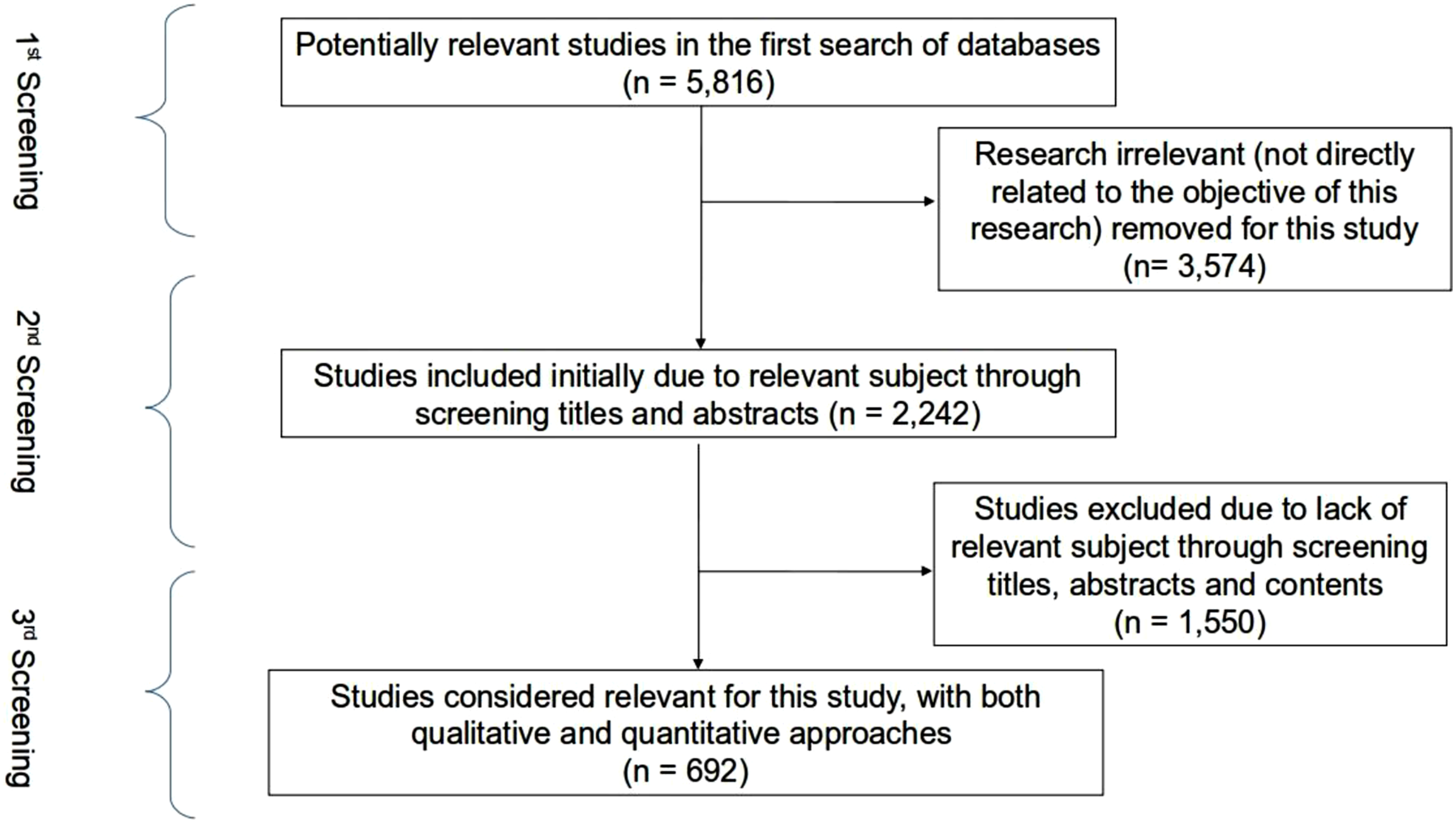
Conceptual Framework: Trends in the Literature on Technical and Non-Technical Skills in the Workplace
In this section, we address the approach to differentiating between technical and non-technical skills based on key criteria of differentiation; besides, we present the literature on mental processes in the transfer of training.
From the conceptual point of view, there are different definitions of skill, which is a multidimensional construct; and scholars have presented various approaches and definitions (Green, 2011; Lamri & Todd, 2023; Succi & Magali, 2020; Vallas, 1990). For Boyatzis (1982) for instance, a skill is a characteristic of an individual that is related to superior performance. It is an individual’s ability to perform tasks using appropriate resources, including those acquired through training and previous experience (Ghaith, 2024; Le Boterf, 2000). Other scholars stressed that skill is a competence which is relevant to a given situation; it arises from the combination of knowledge, mental abilities, physical strength, physical and mental agility, and motor skills (Carroll, 2003; Winterton et al., 2006). For Winterton (2009) and Chen (2023), skill is a real, effective, demonstrable ability for successful behavior to achieve specific objectives. It requires knowledge, attitudes, abilities, motivation, values, and personal attributes. Besides, it includes the ability to process and to understand information, to interpret, and to use it to complete a task (Chen, 2023; Winterton, 2009).
In the context of this research, skill and competence are synonym concepts since both concepts highlight the same key drives which are psycho-social attributes associated with superior performance as defined by McClelland (1973). Skill and competence describe what people need to know, and what they can do to perform tasks associated with specific positions or occupations. In French language, experts translate skill and competence as savoir (knowledge), savoir faire (functional competence) et savoir être (behavioral competence). This is a consistent conceptual framework that makes a best-fit approach and understanding among professionals, managers, and academic community beyond geographical differences on this issue (Ruth, 2006; Winterton, 2009; Winterton et al., 2006). Skills are multidimensional competences that provide people with the possibility of growing and learning in a variety of contexts that include the development of specific tasks (Janev et al., 2018; Liu et al., 2023). They take patterns of observable and habitual behaviors that help people to achieve success in their tasks. They include a set of demonstrable characteristics related to knowledge, abilities and attitudes that facilitate adequate performance of tasks. Likewise, management positions usually require employees with an elevated level of interpersonal and intrapersonal skills such as communication, decision making, problem solving, active listening skills, self-regulation, time management, teamwork, leadership, and empathy (Niazi et al., 2016; Robles, 2012; Valle, 2004). For this reason, during the recruitment and selection process, human resources departments look for people who have more outstanding soft skills than hard ones (Grama et al., 2024).
In general, when recruiting or selecting new talent, companies tend to value soft skills more specifically because they are better indicators of adaptation to job performance requirements, particularly in service sectors and in management positions. From this point of view, people’s skills are relevant drivers which contribute to organization growth and development (Alkashami, 2023; Porras et al., 2011). Companies demand constant improvement of skills among their staff; and they manage their workplace environment to promote progress and learn of desirable skills (Tejada, 2003). In general, although there is still a lack of consensus among scholars, most of the proposed definitions highlight fundamental aspects such as (a) the ability to process and understand information, to interpret and to use it for the purpose of completing a task; (b) cognitive, motor and affective abilities that provide a basis for mastery of a specific topic or aspect; (c) acquired automatism that facilitates the execution of specific tasks; moreover, it is a repetition ability that converts competence into automatic and observable behavior that involves cognitive mechanisms such as memory, reasoning, attention, learning, association, and perception.
Technical Skills
Technical skills refer to hard skills or abilities, a set of technical competences, the mastery of sciences and technologies; therefore, they are cognitive skills that are related to technical competences to perform different tasks in a specific field. Consequently, hard skills are related to the mastery of science, technology, and technical skills for a specific specialty (Azwar, 2013; Beke & Tick, 2024; Hendarman & Jann, 2012; Lamri & Todd, 2023). In practice, in any company, hard skills have 3 components, which are knowledge, competences or abilities, and standardized processes: (a) knowledge is the mastery of specific subject acquired through experience or education based on the five senses and processed by cognitive processes; (b) skill is the ability to do a set of tasks successfully using certain procedures, tools and methods; (c) standardized processes refer to the set of organizational guidelines that are required to achieve organizational objectives efficiently and effectively (Borrego et al., 2019; Garcez et al., 2022; Winarno, 2010). Phillips (1997) considers that technical competences reveal the characteristics of the right people that the company or organization needs to achieve its strategic objectives. On the other hand, non-technical skills favor the creation of more agile organizations, facilitate innovation, make the company the best place to work, and improve the work environment.
In summary, technical skills are those hard skills that people can learn, and measure in a concrete and precise way, such as mathematics, physics, computing, language, medicine, psychology, biology, and other branches of sciences and technology. They are competences and knowledge acquired through educational centers that certify the level of education; and companies require them to access a specific job. Therefore, technical skills refer to a set of knowledge, abilities, and attitudes that an individual acquires through specific regulated training, which are easily measurable. They entail an accreditation (diploma or certificate); and they constitute a reference base for the development of a professional activity in a specific field.
Non-Technical Skills
Non-technical skills or soft skills refer to personal and social abilities or social competences that are innate or acquired through life experience or through training which are key to professional success. They are abilities related to an individual’s characteristics or skills that can facilitate effective and harmonious interaction with other people (Binsaeed et al., 2016). Non-technical skills also include acquired abilities or competences, psychological traits, preferences, motivations, and other predispositions usually called non-cognitive skills (Heckman & Kautz, 2012; Heckman et al., 2006; Rasipuram & Dinesh, 2020). Soft skills are increasingly important for employability, employee mobility, and for success in the workplace (Botke et al., 2018; Deming, 2017; Succi & Magali, 2020). Both, in academic literature and in common language, different terminology tend to be used to refer to non-technical skills, such as soft skills, social competences, white skills, interpersonal or behavioral skills, emotional intelligence, interpersonal skills, social skills, competences to interact with people, communication skills, transferable skills, generic skills, employability skills (Abelha et al., 2020; Fadhil et al., 2021; Ghaith, 2024; Laker & Powell, 2011). Therefore, non-technical skills refer to those aspects of social behavior and of interaction that include social skills that contribute to interpersonal interactions. Also, non-technical skills are interpersonal competences based on personal experience that people can hardly transmit faithfully through training, and they are also more difficult to measure (Balcar, 2016; Fulmore et al., 2023; Mohajan, 2016). These skills are a combination of personality traits, positive emotional attributes, and interaction skills.
To conveniently study non-technical skills, scholars (Kechagias, 2011; Lamri & Todd, 2023; Markaki et al., 2021; Tenedero, 2001) tend to divide them into two categories: intrapersonal skills and interpersonal skills. a. Intrapersonal skills: these are skills to manage or control one’s internal states; and they are related to the person’s personality. They are processes in which individuals can monitor, direct their attention, maintain, and modify their behavior to achieve a specific objective (Ikowska & Engle, 2010). Intrapersonal skills refer to competences that drive the person towards achieving objectives, which cause changes in their personality, beliefs, and management; likewise, they contribute to the implementation of individual strategies for stress management, time management, creative thinking, and innovation, setting objectives and goals in life, and rapid learning techniques (Fulmore et al., 2023; Winarno, 2010). Most relevant intrapersonal skills are such as the ability to self-manage, self-awareness (self-evaluation, self-confidence, self-motivation, self-regulation of emotions, empathy, self-control, trust, continuous improvement, management of time, self-management, proactivity, awareness of one strengths and limitations. People who are strong in intrapersonal skills are excellent at becoming aware of their emotional states, feelings, and motivations; and they are aware of what they want to achieve in life. Furthermore, these intrapersonal skills determine the way in which people conduct their work, which affects their mood, feelings, and their degree of self-motivation. b. Interpersonal skills are abilities of interaction in interpersonal relationships. They are interpersonal competences that are necessary to interact, to communicate and to establish relationships with other individuals, and to create a decent work climate or environment. They are those social skills that facilitate relationships with other people; they enable them to have influence over others, to mediate conflicts and to lead others to a consensus. Among the interpersonal skills, the following are usually mentioned (Markaki et al., 2021; Wibowo et al., 2020; Mohammed et al., 2024): decision-making, leadership, effective communication, motivation to others, negotiation abilities, critical thinking, problem-solving, integrity, public speaking skills, teamwork, interpersonal interaction, teamwork, conflict resolution, decision making, and working under pressure.
To sum up, in organizations, interpersonal skills have become key attributes for success and professional development. They are helpful to access management positions and to obtain excellent remuneration (Lamberti et al., 2021). There is still no consensus on soft skills as a construct and on the scope of their application; besides, they are difficult to measure or to assess. However, the acquisition and development of non-technical skills can improve performance, facilitate promotion, increase production, and maximize the possibility of employability (Connolly & Gobet, 2024; Lamri & Todd, 2023; Meenakshi, 2009).
Differentiation Between Technical and Non-technical Skills
This section highlights the importance of both hard and soft skills; and it identifies why it is important to distinguish between them. Although the differentiation between technical and non-technical skills is a challenging task, it is necessary to analyze elements that could help for a better understanding of those key words. There are considerable reasons that support the need to differentiate technical skills and non-technical skills; and they are the following: a. The lack of differentiation between technical and non-technical skills can lead to a poor approach of training and an inadequate understanding of its transfer (Lamri & Todd, 2023). b. For the acquisition and development of skills, trainers tend to use different strategies when it comes to training for technical skills and for non-technical skills; therefore, they tend to use different approaches or methods (Williams, 2001). c. In most companies, managers are increasing demand for non-technical skills which are so important as technical ones (Jackson & Hancock, 2010; Williams, 2001). d. After the training program, trainees tend to transfer technical skills more easily in the workplace than non-technical skills (Laker & Powell, 2011). e. Companies seek to hire more managers with non-technical skills (which are difficult to obtain) than people with technical skills because of their contribution to productivity (Lee et al., 1995). f. Compared to non-technical skills, technical skills are more closely related to an individual’s formal qualification or official educational systems (Hysong, 2008; Succi & Magali, 2020). g. The measurement of training finds different indicators for technical skills (quantifiable indicators which are easy to identify), and for non-technical ones (indicators which are difficult to quantify) (Gokuladas, 2010). h. Most people can distinguish between technical and non-technical skills and specify their contribution to human behavior and performance (Mitchell et al., 2010). i. Most positions within an organization require both hard and soft skills (Heath, 2000; Laker & Powell, 2011).
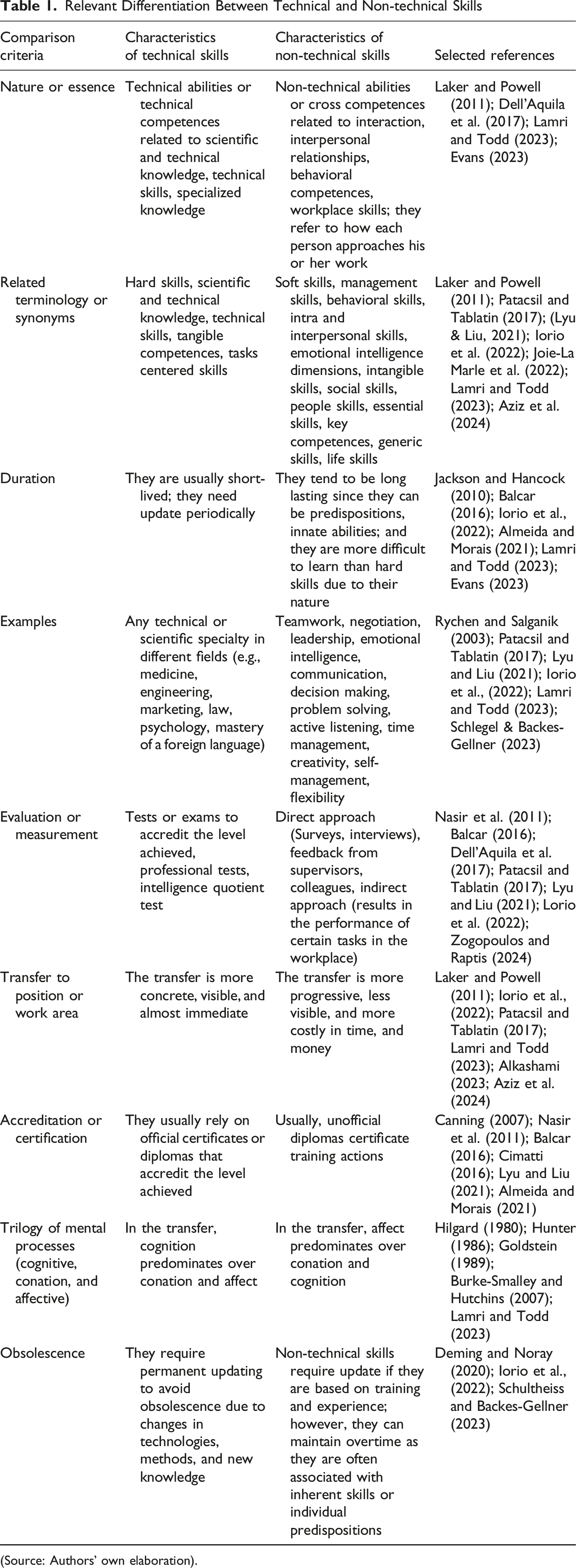
Relevant Differentiation Between Technical and Non-technical Skills
(Source: Authors’ own elaboration).
Individuals possess technical skills when they master knowledge of science, and they demonstrate technical skills in the field related to their specialty. People can acquire, document, measure, and transfer those skills through different activities in educational programs. Likewise, technical skills are “Knowledge” or “how to do”; while non-technical skills usually refer to as competences of “how to be and to how to interact.” To refer to technical skills, scholars tend to use a series of terms such as ‘Hard skills’, ‘scientific and technical knowledge’, ‘technical competences’, ‘tangible skills' (Hendarman & Cantner, 2018; Kennedy, 2016).
Besides, terminology such as ‘soft skills,’ cross competences,’ ‘managerial skills’, ‘behavioral competences’, ‘intra and interpersonal skills’, ‘intangible competences’, ‘social skills’, or ‘emotional intelligence’ refer to ‘non-technical skills. They are non-technical skills which are interpersonal or behavioral skills that facilitate the application of hard skills or technical competences. Moreover, other synonyms of non-technical skills are also “micro social skills” that include aspects such as interpersonal relationships, intrapersonal and interpersonal skills, personal and social skills, and non-cognitive skills (Muzio et al., 2007; Wibowo et al., 2020). Non-technical skills are intangible skills that are difficult to measure, and they are related to the individual’s social interaction or social behavior (e.g., leadership, capacity of adaptation, teamwork, ability of communication, capacity of negotiation, skills of cooperation, and creativity).
Public and private educational centers are priority settings which help to acquire technical skills. Trainees can also acquire them from companies through their corporate training centers. In general, technical skills tend to be long-term, and the training program tends to conclude with official certificates or diplomas that accredit the level achieved. Usually, organizations manage to assess and to identify employees’ needs for training in technical skills. After assessment of needs and training program implementation, companies train employees in skills required, and for positions that do not yet exist or for future positions. Furthermore, the detection of needs for non-technical skills is usually diffuse, and not clear at all, because of lack of direct relationship with a specific position; and they are often cross-competences. Official educational systems and corporate training centers also promote the acquisition of non-technical skills in their programs. Furthermore, companies or organizations may require certain skills (technical and non-technical) to conduct jobs specific activities. Likewise, the employee may also wish to acquire concrete skills for personal or work reasons.
Training centers and universities evaluate technical skills through technical or professional tests. Furthermore, they are associated with Intellectual Quotient (IQ); while non-technical skills are based on relationship interaction. Education process and practice are approaches to acquire and to improve technical skills. They are relevant because they can improve the level of productivity and individual efficiency. Likewise, they provide the expertise or domain needed to conduct a specific job (Balcar, 2016; Deming, 2017; Kagan, 2019).
The measurement and evaluation of technical skills are well structured throughout educational centers. However, in the case of non-technical competences there are a series of problems that complicate their evaluation, and they are as following: (a) delimitation of each non-technical skill: it is not easy to determine the relative importance or its magnitude within the overall set of skills (Jackson & Hancock, 2010); (b) difficulty in defining instruments and criteria: it is not an easy task to have instruments and criteria for measuring the different non-technical skills (Oates, 1992); (c) difficulty in evaluating the transfer of non-technical skills: It is difficult to evaluate the transfer of non-technical skills in the work environment due to a lack of appropriate and agreed instruments. Therefore, the development of measurement system of non-technical skills is still poor compared to technical skills, which have different evaluation systems depending on the subject and field of expertise (Baldwin & Ford, 1988; Joie-La Marle et al., 2023; Russ-Eft, 2002). Despite the lack of consensus on the conceptual framework and terminology, literature highlights the relevance of non-technical skills for individual success in the workplace. Likewise, they are relevant mechanisms to improve job satisfaction, organization climate, and work environment implementation. Furthermore, they are associated with an elevated level of productivity, work engagement and well-being, and creativity and innovation in the workplace (Alharbi et al., 2019; Feraco et al., 2023; Kagan, 2019).
Mental Processes in the Transfer of Training for Technical and Non-Technical Skills
Research shows that transfer of learning differs in kind, occurs at different steps and levels; and it influences learning processes such as memory, attention, problem-solving, cognition (Mayer, 1987). There are pioneering contributions that have significantly influenced the approach of the transfer of training from the perspective of mental processes. This is the case of Bloom’s taxonomy (also known as the taxonomy of training objectives), which is a relevant tool for planning and evaluating training.
Bloom establishes six cognitive levels: knowledge, understanding, application, analysis, synthesis, and evaluation. This hierarchical structure proposed by Bloom allows trainers to identify training objectives, and to develop activities that involve trainees in each of the phases, emphasizing critical thinking and personal reflections. From this perspective, Bloom’s taxonomy facilitates the trainer’s work to guide trainees in cognitive development through a progressive and coherent manner. Bloom’s work (Bloom, 1964) presented a global vision of the learning process, promoting three key dimensions: cognitive, affective, and psychomotor. The cognitive area is related to mental skills (knowledge); the affective domain encompasses feelings or emotional areas (attitudes); meanwhile, the psychomotor field refers to manual or physical skills. This taxonomy is very influential in the development of training activities, particularly in the use of KSA (knowledge, skills, and attitudes). His research influences trainers and trainees in understanding the elements that contribute to the training process that could make learning more realistic in the real world (Ferreira et al., 2018; Voss, 2023). Criticisms formulated toward Bloom’s Taxonomy underlines that it is a superficial model due to the lack of depth in the learning process that does not help teachers and students to progress adequately (Anderson et al., 2001; Marzano, 2001; Tucker et al., 2024; Winterton, 2009).
The Haskell’s Taxonomies of Transfer of Learning is a system that identify 6 levels according to the impact of connecting past learning to new situations: (1) Nonspecific transfer; (2) Application transfer; (3) Context transfer; (4) Near transfer; (5) Far transfer; and (6) Displacement or creative transfer. According to Haskell, level 4 (near transfer), and Levels 5 and 6 (far transfer) are levels that produce transfer since the trainees learn something new. Meanwhile, the 1) Nonspecific transfer; (2) Application transfer; (3) Context transfer are simple learning without transfer. Additionally, he proposed a second taxonomy in which is based on capacity of prediction of kind of transfer (Haskell, 2001).
Moreover, in a Meta-Analytic Review, Blume et al. (2010) determined that there is a positive relationship between transfer of training and predictors such as cognitive ability, conscientiousness, motivation, and a supportive work environment. They identified additional predictor variables, such as motivation and work environment. Cheng and Hampson (2008) underlined that previous models of training transfer describe factors that affect the transfer of knowledge and skills in the workplace. They considered that those models should not be sufficient to potentially explain the transfer of training because of contradiction and unexpected findings from different empirical studies.
Furthermore, Rychen and Salganik (2003) proposed a model that stresses on components of mental processes such as active cognition, conation, and affectivity; they are interrelated notions that contribute to an individual’s life, particularly in the learning process. Additionally, Lamri and Todd (2023) expanded these dimensions; and they concluded that any competence contains five main dimensions, which are: knowledge, active cognition, conation, affect and sensory motor skills. According to this approach, (a) knowledge includes both external knowledge (technical knowledge related to a profession or job) and internal knowledge (e.g. memory); (b) active cognition involves information perceived and processed to make decisions as well as opinions, perceptions, attention, and judgments; (c) conation is the component that describes the preferences, motivations and volitional aspects of behavior (e.g., adaptation, perseverance, self-control, concentration). The knowledge and analysis that people make of their environment belongs to this category; (d) affectivity is the ability of interaction and emotions that helps to relate or establish relationships with other people; (e) motor and sensory skills are competences of control and coordination of movements. They include the abilities to perceive, to interpret, to respond to sensory stimuli; they also cover the skills of planning and executing movements (balance skills, coordination, and motor skills).
In conclusion, cognitive, conative, and affective processes facilitate learning development. They are mental processes that contribute to reception, analysis or processing, comprehension, utilization, storage, and retrieval of information. Therefore, they involve human functions relevant to training, such as attention, reasoning, memory, and association of ideas (the identification of response patterns to a stimulus), critical thinking, decision-making, problem-solving, learning, and perception. Cognitive processes facilitate the acquisition of technical skills, preferably following the training models proposed in official educational systems. Their weight is so relevant in training in schools or universities that they are associated with the IQ for their measurement. It is important to highlight that cognitive processes also intervene in non-technical skills, but to a lesser extent compared to technical skills. Conative processes are mental processes that are related to intentional actions, which promote action, motor skills, perseverance, motivation, and perfectionism in any competition; they intervene in the same way in both technical and non-technical skills. Conation is the ability to generate responsibility and motivation to conduct moral actions and to develop perseverance behavior to face challenges and adverse situations. It is the ability to apply intellectual energy to tasks to achieve a solution or achieve objectives of a specific task (Hannah et al., 2011).
Affective processes are mental dimensions related to emotions, feelings, and attraction-repulsion in interpersonal relationships. In each skill, the dimension of affect determines the level of emotions, empathy, and the need to relate to others. Affects and feelings tend to depend on cognition; for this reason, they do not necessarily take the form of actions. Affection guides the person’s interest towards learning and creates the necessary climate for the expected process to occur that will converge in positive results. Respectful, affectionate, or close relationships with the trainer and with colleagues promote learning, collaboration, and self-assessment (McGrew, 2022; Sampson, 2020). Affective processes participate in the acquisition of knowledge and skills; and they are decisive when it comes to transferring non-technical skills in the workplace. Hence, transfer of any skill (technical or non-technical) is a process that contains cognitive, affective, and conation elements that allow the trainee to apply the competences in the workplace (Hilgard, 1980; Sampson, 2020).
The Transfer of Technical and Non-Technical Skills
This section explores the transfer of skills. On one hand, it presents key factors that affect the transfer of training; on the other hand, it put emphasis on the differences between transfer of technical skills and transfer of non-technical skills, proposing an explanatory model based on the light of the trilogy of the human mind.
Training Transfer
Training is a key instrument for effective development of skills in an organization. It has a relevant impact on individual performance, and business productivity to the extent that employees successfully transfer what they learned in the work environment.
Scholars tend to define transfer of training as the degree to which trainees apply the knowledge, skills and attitudes acquired during the training program on the job or in the work environment (Rahman, 2022; Wexley & Lathan, 1991). Transfer occurs when employee widely applies new learned behavior, knowledge, or competences in the work context over an extended period (Baldwin & Ford, 1988; Zu Knyphausen-Aufsees et al., 2009). Likewise, organizations measure transfer of training of their employees by maintaining knowledge, skills, and attitudes over an extended period (Baldwin & Ford, 1988).
Scholars have designed and proposed different models to evaluate the transfer of training (Rahman, 2022). In his model, Kirkpatrick stressed the need to establish an analytical framework to assess the degree of the effect of training in improving workers’ skills in the workplace; this improvement helps to perform tasks better, in quality, in safety, and in terms of impact on the community. The Kirkpatrick model has received alternative proposals for improvement from authors such as Holton (1996), Kaufman and Keller (1994), Phillips (1997), Kearns and Miller (1997). Despite criticism, the Kirkpatrick model remains a useful framework for training, and particularly for the evaluation of training actions. In addition, it is a model that highlights the need to establish the analysis framework to evaluate the degree of the effect of training in improving the skills of workers in the workplace; this advance must be observed in the improvement in the performance of tasks, in quality, in safety and in the impact on the community (Tamkin et al., 2018).
Baldwin and Ford (1988) identified three key drivers that contribute to the success of training transfer which are based on training Inputs (trainee characteristics, training design, work environment, training outputs (learning and retention) and conditions of transfer (generalization, maintenance, and application). In their transfer model, Grossman and Salas (2011) identified the factors relating to trainee characteristics (cognitive ability, self-efficacy, motivation, perceived utility of training), training design (behavioral modeling, error management, realistic training environments) and the work environment (transfer climate, support, opportunity to perform, follow-up) that seem to have significant relationship with the transfer of training.
Trainees are more likely to transfer training outcomes to the work context when they perceive that the training program matches with their reality, and ability to transfer the training to the job (Holton et al., 2000). Thus, the concept of “transfer climate” proposed by Rouiller and Goldstein (1993) consists of the set of situations and consequences that help or hinder the transfer of what employee learned to the job or work environment. They suggest four types of situational cues: goal cues, social cues, task cues, and self-control indicators. Those signals are types of alerts that remind trained people of what they have learned or at least give them the opportunity to use what they have learned.
Factors That Affect the Transfer of Training
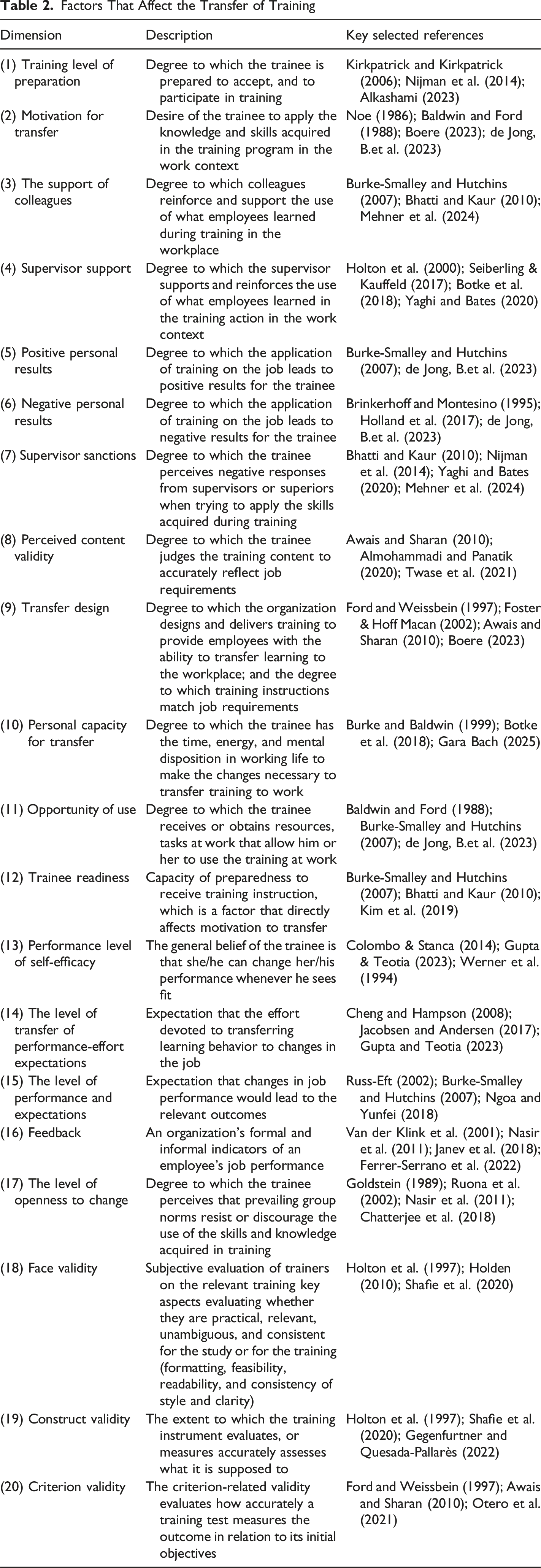
Of the twenty factors, the first 13 (preparation level of the trainee, transfer motivation, peer support, supervisor support, positive personal results, negative personal results, sanctions to the supervisor, perceived content validity, design of transfer, personal capacity for transfer, opportunity for use, and Trainee readiness) are factors that affect any specific training program. Dimensions 14 to 20 (the level of transfer of performance-effort expectations, the level of performance and expectations, feedback, the level of openness to change, face validity, construct validity, and criterion validity) are generic factors that affect all programs of training without exception. Those twenty factors have a relevant influence on the transfer of training to the workplace because they put more emphasis on individual performance through the contributions that trainees can make by applying their knowledge and skills in the work environment. One of the most prominent approaches is the transfer motivation theory, which considers that the motivation of trainees is the key to the application of knowledge and skills in the workplace (Gegenfurtner & Quesada-Pallarès, 2022). Transfer is only possible when there is motivation, passion, and interest from the side of trainees to transfer what they have learned in the work environment (Bhatti & Kaur, 2010; Mihardjo et al., 2020). Motivation is one of the individual factors that allows achieving an elevated level of transfer of motivation skills. In short, the transfer of training is an appropriate approach to improve individual performance and organizational productivity. A training program that does not have adequate transfer to the job is irrelevant; therefore, it constitutes a loss of resources for the company, and of time for workers.
Transfer of Skills in the Light of the Trilogy of the Human Mind: Explanatory Model
The trilogy of human mind is an important construct for understanding and explaining the learning process (Lazarus, 1990). The trilogy of mind process refers to cognition, conation, and affect (Hilgard, 1980). Cognition is the mental process that involves the ability to perceive elements of the environment, to think, and to use intelligence as a capacity for interpretation and adaptation to the circumstances of everyday life (Bayne et al. (2019).
Cognition involves the mental processes that facilitate the acquisition, processing, storage, and retrieval of information. Therefore, it involves processes such as attention, memory, perception, and judgment, which are key to decision-making (Bickhard, 1997). Past and current experiences significantly influence a person’s cognitive process, which determines their behavior. Like cognition, conation also contributes to the learning process (Ratten, 2024). Conation is the mental process of actions and choices for decision-making, problem-solving, and goal achievement. It refers to desire, motivation, will, initiative, and the way a person acts in each situation to achieve specific goals (Gerdes & Stromwall, 2008; Kolbe, 2019). In the training process, conation involves a person’s will, motivation, and disposition to act and evaluate goals for actions. Conation is the process that links cognition and affectivity (Huitt & Cain, 2018). In addition to cognition and conation, affect is also a facilitator of learning. Affect refers to a person’s feelings, moods, and emotions, such as the expression of emotions, lived experience, affection, love, hate, rejection, joy, and fear. It involves processes such as empathy, interpersonal relationships, and emotional intelligence (Fossa & Cortés-Rivera, 2023).
We can explain the transfer of skills (technical and non-technical competences) from the tripartite approach of the human mind (cognition, conation, and affectivity) in the context of training – learning process (Hilgard, 1980; Hynes & Koc, 2024). This trilogy determines the difference between the transfer between these two types of skills (technical and non-technical skills). As detailed in Figure 2, the success of any transfer of training in the workplace depends on variables related to the design of the training action (detection of needs, objectives and contents, the relevance of the contents to cover deficiencies detected, the quality of content, teaching materials and methods used), the characteristics of the trainer (teaching style, the trainer’s experience in teaching, methods used, support and use of didactic materials), the characteristics of the trainee (motivation and interest, previous experience, great adaptation, individual and collaborative learning capacity), organizational environment (e.g., institutional support for training, facilities, and organizational culture regarding training). At the level of training design, it is worth highlighting that any training process must necessarily begin with the detection of needs at the organizational level (integration of training objectives with the organization’s strategic plan), of the position of the tasks (identification of the knowledge and skills required for the adequate performance of tasks) and at the individual level (matching the characteristics of the person with the objectives of the organization). In the workplace, the transfer of technical and non-technical skills takes place differently due to important reasons, particularly due to the trilogy of the human mind that determines strategies to use. Explanatory Model for the Training Transfer of Technical Skills and Non-technical Skills (Source: Authors’ Own Elaboration)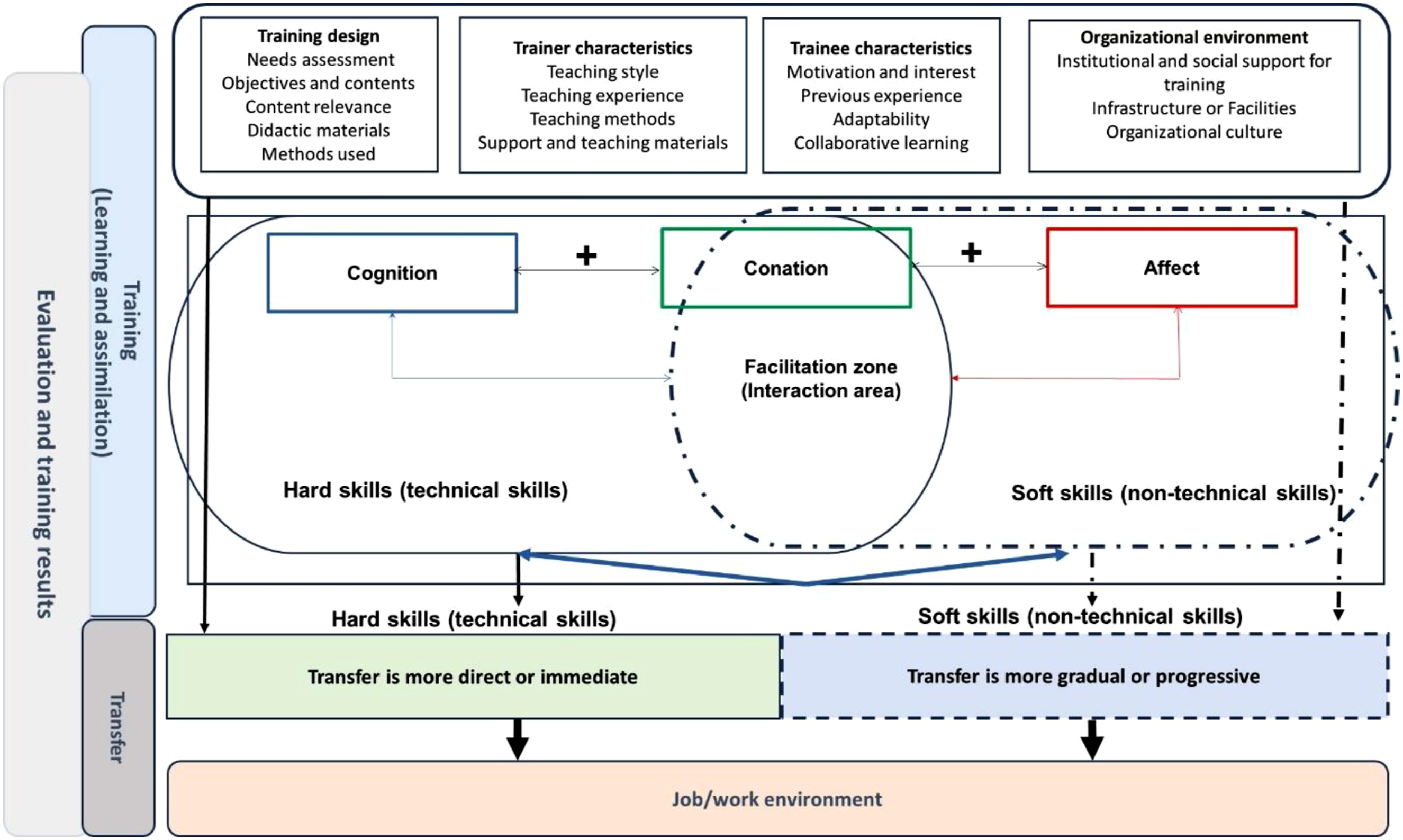
The primary objective of training focuses on improving knowledge, skills or competences and attitudes to ameliorate individual or collective performance and to improve productivity. The objectives of a specific training action relate detected needs and results of training in which the transfer of knowledge and skills is the key. Thus, the definition of training contents must respond to the needs or shortcomings detected and to achieve the planned objectives. Training design, preparation of materials and the choice of teaching methods are key to the success of the training program. The characteristics of the trainer play a determining role in the entire training process, as well as its subsequent transfer to the work environment. Trainers may be employees or workers of the company itself, and they may also come from outside the organization. One of the advantages of having internal trainers is that they have a broader knowledge of the organization; therefore, they can better approach the delivery of training programs from practical and realistic perspectives. In the case of external trainers, they usually have the advantage of being people with experience in the subject, prestigious professionals, and university faculty members. All those elements affect the style or methods of teaching, as well as the way of selecting or supporting teaching with instruction materials.
Without a trainee’s motivation or interest, it is difficult to conduct adequate training or to achieve the expected objectives (de Jong et al., 2023). The organization should motivate trainees and increase employees’ interest to actively participate in a training program. Therefore, the appropriate selection of participants and the constitution of homogeneous groups determine the success of the training and its subsequent transfer to the job. It also facilitates adaptability, and teamwork building to promote collaborative learning. From the point of view of the trainee, the learning experience should be positive and satisfactory, so that it aims to transfer the knowledge and skills acquired in the job or in the work environment in general. The volume of training conducted in organizations increases as the number of workers grows.
Evaluation is a critical phase of any training program; and organizations must consider it from a multidimensional and permanent perspective. Training evaluation provides the opportunity to assess the training program, to make improvements, and to validate accreditation (diplomas) of knowledge and skills acquired. For this reason, evaluation must be permanent and must focus not only on the results but also on each phase of the training process. It is about evaluating whether the training is adequately progressing towards the planned objectives according to the defined criteria and models. Furthermore, as part of evaluation, training transfer can provide relevant information that highlights the justification of the costs (return on investment), the effectiveness of the training design, the relevance of the content and teaching methods used. Kirkpatrick (1996) states that to evaluate the effectiveness of a training program, it is necessary to use four criteria: (a) reactions (the attitudes or perception of the trainees about the effectiveness of the training); (b) the learning process (the evaluation of changes in knowledge, skills and attitudes of those trained at the end of the training program); (c) behavior (performances of trainees when they return to the work environment after training); (d) the results (measures of transfer of knowledge, skills and attitudes for improvements in the position and in the organization). Furthermore, Phillips suggests the five-level ROI framework which adds a fifth dimension to differentiate the evaluation of the monetary benefits of the training in comparison to its costs. His model is comparable to Kirkpatrick since he determines the following levels: reaction, learning, job application, business results, and return on Investment (Phillips, 1997; Tamkin et al., 2018).
Evaluation of training also involves the analysis of the relationship between training and productivity or profitability, increased customer satisfaction, improved financial results, elimination of errors in the workplace, efficient use of resources, and commitment to the environment. Experience in the business world shows that measuring the return on training is a complex task. The return on training as a corporate investment includes both the achievement of training actions’ purpose (specific objectives, content, level of satisfaction, and level of learning achieved), and the implementation of those knowledge and skills (Jasson & Govender, 2017; Palacios, 2008). After achieving training program objectives, the next step is the transfer of the results in the work environment. The transfer of training is a tangible process that has materialized by changes in the behavior of the trainees, by the integration of knowledge, skills and attitudes in the workplace and adaptability (the degree to which trainees adapt their behavior to the new challenges, new tasks, new situations or changes. In relation to transfer in the work environment, it is important to highlight that hard and soft skills are complementary. Likewise, there is a zone of interaction (or facilitation area) in which skills come together, so that the skillfulness of certain technical skills can facilitate the acquisition of non-technical skills and vice versa. Hard skills usually facilitate the acquisition of certain soft skills; besides, non-technical skills tend to have a facilitating effect on the acquisition of technical skills.
The facilitation zone (interaction area) is extremely important in the transfer of skills because it is the area where an individual’s technical and non-technical skills converge and interact. Existing studies show that non-technical skills are as productive and necessary as technical skills. Furthermore, they show that the productivity attributed to technical skills derives from their combination with non-technical skills (Balcar, 2016; Munir, 2021). This combination of both groups of skills takes place in this interaction zone; it is the key area that leads to success when transferring skills in the workplace. In this synergy, technical skills favor the technical and scientific aspects of task execution, while non-technical skills guide people on how to apply these technical skills in conjunction with the rest of the team staff or department to achieve objectives. From the perspective of the trilogy of mental processes, the interaction zone is the area where cognition, conation, and affectivity contribute significantly and harmoniously to facilitate the transfer of skills in the workplace. This constructive collaboration between technical and non-technical skills tends to produce superior results (adequate transfer of training to the workplace) than the sum of the isolated effects of each group of these skills taken separately.
In conclusion, after training program, the success of the transfer depends on the individual’s ability to harmoniously integrate technical and non-technical skills. This harmonious integration takes place in the interaction zone, which provides balance and constructive collaboration that determine the difference between successful employees, and those who fail. Successful employees are those who manage to combine or harmonize technical and non-technical skills. It is the interaction zone that facilitates the balance between technical and non-technical skills necessary for the transfer of skills. Considering the inter-individual differences that exist in the workplace, the facilitation of this interaction zone depends largely on factors such as working memory, individual personality triggers (openness to experience, conscientiousness, extroversion, agreeableness, neuroticism), executive functioning (positive and negative experiences at work), innovation experiences, the individual’s previous experience, perceived support from supervisors and colleagues, motivation to transfer, the individual’s maturity, and level of emotional intelligence. Likewise, the organizational culture, incentives, support, and mentoring arranged by the organization itself play a significant role because it provides a frame of reference that employees need for motivation to transfer skills. National or regional culture is also a factor to consider when analyzing the factors involved in skills transfer. The differences between educational systems between countries or regions have an impact on learning process, particularly on cognition, conation and affectivity, which play a determining role in the transfer of skills in the workplace.
Following Hilgard’s (1980) approach, all skills, both technical and non-technical skills, have three essential components that facilitate their understanding and analysis: cognition (cognitive processes), conation (conative processes) and affect (affective processes). Cognition is the ability to “think;” conation is the individual’s inclination to “act”; and affect is the ability to “feel.” In the context of training, the processes of cognition, of conation and of affectivity intervene in various steps of the training program which includes transfer of training results. The difference between transfer of technical skills and non-technical skills is based on the weight or valence of mental processes involved (cognition, conation, and affectivity). In other words, cognition and conation predominate in technical skills, while affectivity and conation are more prevalent in non-technical skills. Cognition is the ability to think and solve problems, to acquire information, to understand the world. It refers to the process of ideas and facts that allows individuals to make decisions with better information. Cognition presents an active dynamic process that facilitates the acquisition of knowledge in terms of generation, processing, storage, use, and transformation of information or knowledge. Cognitive processes involve consciousness or intellectual activity that refers to the ability to think and to know. Therefore, it involves processes such as memory, learning, attention, reasoning, the decision-making process, and the ability to adapt. Consequently, cognition is related to attributes or concepts such as intelligence, learning, mind, reasoning, and perception. It is a key process for the acquisition of knowledge or technical skills.
Another process linked to learning is the conation, which is the mental process that determines effort or voluntary action, preferences, motivations, and volitional aspects of behavior through the capacity for initiative, persistence, resistance, adaptation, perseverance, self-control, and concentration. It refers to the patterns of actions and choices as consequences of cognitive processes when undertaking an action to achieve specific objectives. Conation is a direct relationship between cognition and action that leads to decision making and motivation. Consequently, conative processes identify inclination or tendencies; it is about “acting” skills.
As for affect or affective processes, it refers to the ability to create and maintain interpersonal relationships with other people, promoting social interaction and facilitating collaborative work, and joint social activities. It involves ability to interact, to create a good group environment, to understand and to have empathy towards others. Affective processes represent the influence of emotions and feelings. It is about skills of feeling, of sharing emotions, of empathizing, of being with others. In short, affective processes constitute the basis of non-technical skills since they predominate more than cognitive processes. Conative processes serve as a springboard for decision-making and actions to be taken. The transfer of non-technical skills is slower and more elaborate because it is based on affectivity, rather than cognition; but it relies on conation just as in the case of technical skills. The transfer of non-technical skills is a long-term, a remote or a future action; while the transfer of technical skills is an immediate action because it is easy to transfer what employees learned during the training program to the workplace.
There are some reasons that affect the learning process and the transfer of non-technical skills, of which can be highlighted as follows: (a) the previous experience with some specific skills; (b) the level of resistance to change when training focuses more on specific skills than on others; (c) the level of institutional support, (d) the level of identification of training needs and objectives; (e) the degree of self-efficacy linked to the motivation to train and to transfer (Botke et al., 2018; Laker & Powell, 2011). After studying the transfer of training to the workplace, Baldwin and Ford (1988) recommended not measuring results immediately after completing a training action, because of the halo effect generated by the training itself, and because of the difficulties evaluating the results of transfer to the work environment.
Discussion
The principal objective of this research was to analyze the transfer of technical and non-technical skills from the perspective of the mental trilogy of cognition, conation, and affectivity to propose a comprehensive explanatory model. To achieve such purpose, on the one hand, this study explores the difference between transfer of technical skills and transfer of non-technical skills.
On the other hand, this research proposes a model that could explain the transfer of technical and non-technical skills from the perspective of trilogy of the human mind processes. Numerous models of training transfer process highlight the existence of relevant factors that can influence the success of the transfer. Based on the taxonomy defined by Kirkpatrick’s Taxonomy in 1959, various authors such as Hamblin (1974), Baldwin and Ford (1988), Kaufman et al. (1995), Kearns and Miller (1997), Grossman and Salas (2011) have proposed different training evaluation models that include training transfer aspects. Those generic models identify and relate factors such as context (training needs, objectives, actors involved in training), input (methods, participation strategies, support materials), reaction (participants’ suggestions, trainers’ points of view, training program evaluation) and outputs (training results, transfer). Compared to existing transfer of training generic frameworks, the proposal of this research is a specific explanatory model, which tends to explain the differentiation between the transfer of technical skills and the transfer of non-technical skills taking as reference the trilogy of the human mind (cognition, conation and affectivity).
To be effective, the transfer of skills (technical and non-technical) requires processes such as strategy and creative thinking (cognition), initiative as good intentions and desires (conation), and positive attitudes and emotions (affectivity) which are key determinants in the learning process; consequently, they are crucial for their transfer and application in the workplace (Hilgard, 1980; Hynes & Koc, 2024; Omar et al., 2019).
To respond to the first question of this research related to the differentiation between the transfer of technical skills and the transfer of non-technical skills (RQ1), it is important to underline that individual needs to possess technical skills and non-technical skills to guarantee success in the work environment. Scholars have determined that both types of skills are necessary; and their combination leads to professional success (Lamri & Todd, 2023; Lyu & Liu, 2021; Succi & Magali, 2020). The assemblage of technical and non-technical skills improves individual performance and fosters the potential of everyone’s capacity in an organization. Training in the development of non-technical skills is essential for the survival of any organization. In an organization, employees that complete more hours of non-technical training tend to have a greater perception of improvement in their work performance, compared to those who have not completed this type of training (Lyu & Liu, 2021). To understand the impact of non-technical skills, it is necessary to align the needs detected with the objectives of the training program, as well as the evaluation of the training. Non-technical skills are people-focused skills, while technical skills are task-focused (Rodríguez-Jiménez et al., 2022). For this reason, non-technical skills are associated with the interpersonal aspects of work such as communication, teamwork, and customer orientation. As indicated in this study, there is a positive relationship between non-technical skills and technical skills. Training is also one of the elements that impact productivity (Colombo & Stanca, 2014).
Training actions play a relevant role in the acquisition and development of skills of employees in organizations and the transfer of these skills to the workplace has an impact on productivity. Knowledge and skills transfer to the workplace should be a priority for companies. The effects of non-technical skills tend to remain unclear and their relationship with success is not so evident. Although the impact of non-technical skills is not so direct, it should be visible with action, activity, and organizational change. To select and hire new employees, companies usually look for people who have technical and non-technical skills. They require candidates to have a higher level of qualification and expertise in relation to the position, and to also possess non-technical skills. Phillips and staff (2015) consider that non-technical skills (a) facilitate organizations to become more agile entities, (b) allow the development of innovation in companies, (c) improve the work environment and a better place to work, (d) allow employees to adapt to the organization’s strategy.
Regarding the second question (RQ2) of this research about a model to explain the training transfer differentiation between technical and non-technical skills, the tripartite explanatory model of the human mental process based on cognition, conation and affectivity can explain the differentiation in the transfer of technical and non-technical skills. The transfer of technical skills tends to take place immediately upon completion of training, while the transfer of non-technical skills usually requires more time to apply in the work environment. This differentiation is due to the mental processes involved in each set of skills: for technical skills, cognition and conation mostly contribute significantly as mental processes, meanwhile affectivity dimension contributes to a lesser extent. On the other hand, in the case of non-technical skills the involvement of affectivity and conation is mostly higher, and cognition to a lesser extent. Three dimensions of human mind intervene in any skill competence (technical and non-technical) skills; however, the difference in the transfer lies in the weight of each of the mental processes involved [cognition-conation-effectiveness] in the case of technical skills, and [affectivity-conation-cognition] for non-technical skills. The weight of cognition facilitates the acceleration of the transfer of technical skills; while affectivity makes the transfer of non-technical skills slower due to the complexity of affective processes that include personality, feelings, interests, motivation, and emotions.
Conclusions and Practical Implications
This paper analyzes the transfer of training; and it approaches the differentiation between transfer of technical skills and transfer of non-technical skills. The development of skills is a necessity for employees and companies, as well as for educational centers, and the labor market. Job tasks and organizational performance require technical skills and non-technical skills. Technical skills are objective and measurable or quantifiable skills; while non-technical skills are interpersonal skills that are difficult to measure or to quantify. Non-technical skills are relevant to any job, and for any industry; meanwhile, technical skills are often specific for a particular job or a specific industry; in most cases, they are not subject to generalization.
From the perspective of the trilogy of the human mind process, any skill has components related to cognition, conation, and affectivity. The difference between the transfer of technical and non-technical skill lies in the weight or portion of these dimensions of mind process (cognition, conation, and affectivity). For technical skills, cognition and conation predominate in the transfer process which is more direct and rapid. On the other hand, for non-technical skills, affectivity and conation are predominant in the transfer process (more than the cognition mental process). In this case, the transfer process is more gradual and slower due to the variety and complexity of affective processes involved that include personality, feelings, interests, motivation, and emotions. In addition, non-technical skills contribute to any occupation. In case of transfer of technical skills, they need a strong relationship of cognition-conation-effect where cognition has a relevant weight, and where mental functions such as intelligence, memory, attention, and learning are in action. Meanwhile, the transfer of the non-technical skills is based on affect-conation-cognition where affective aspects have greater relevance, and where we can highlight emotions, feelings, personality, empathy, interpersonal relationships in the key to attraction – rejection. Although the transfer of non-technical skills to the workplace take more time, they are important as technical skills. Managers and human resources staff should set up strategies to help their employees to transfer their skills to their workplace. They could focus those strategies on structured approaches, which include clear follow-up, measurable objectives related to performance indicators, recognition, encouragement, and retention.
This work has significant practical implications. First, this research highlights the relevance of non-technical skills that complement technical skills in the workplace. Skills are instruments to guarantee the success of the company or organization. This study provides answers to the common question whether it is better to invest in technical or non-technical skills. In different countries, education systems tend to focus more attention on technical skills than on non-technical skills. Both technical skills and non-technical skills are important to be successful for job performance at the workplace. Leaders, managers, and practitioners should pay more attention to this set of skills (technical and non-technical skills) to increase their performance and competitiveness. In this case, managers should consider that training in non-technical skills is a long-term investment. Therefore, the measuring ROI of training for non-technical skills should not view as loss of time (“capture of smoke with hands”), but it is challenging, and impactful asset for organizations productivity and profitability.
Another implication of this paper is the differentiation between technical and non-technical skills. Practitioners, managers, professionals, and students will find in this paper a comprehensive framework of differentiation between technical skill and non-technical skills. Besides, this research stresses their relevance for success in organizations.
Furthermore, for employees, skills can be an opportunity to access better economic incentives, to achieve promotion, to get power, and prestige in the work environment. Likewise, non-technical skills are related to behavioral and interpersonal relationships in terms of organizational commitment, job satisfaction, work environment, and well-being in the workplace. Secondly, this work highlights the importance of ensuring the training transfer not only of technical skills but also of non-technical skills. It also presents an attempt at an explanatory model that would explain the difference between the transfer of technical and non-technical skills. Entrepreneurs, managers, and professionals in general will find in this work key elements to promote the transfer of technical and non-technical skills. In the current context in which information society, globalization and competitiveness predominate, technical skills are important, but they are not sufficient by themselves; organizations also require non-technical skills, which are skills that are not limited to a specific position; but they contribute to tasks’ performance. To be successful in conducting tasks, any specific job requires not only the possession of technical skills but also non-technical skills. Technical skills and non-technical skills are relevant to guarantee good individual performance, collective productivity, or organizational success. Companies understand this reality, and they are implementing various practical mechanisms such as recruitment and selection by competence, skills-related promotion, and compensation.
Future Research and Development
This paper opens wide fields of study with 4 keys ideas for future research and development:
Differentiation of Technical Skills and Non-Technical Skills
This research is a comprehensive effort to approach the differentiation between technical skills and non-technical skills to understand and explain better their training transfer into the workplace. We agree with previous studies (Balcar, 2016; Lamri & Todd, 2023; Nasir et al., 2011) that the concepts of technical skills and non-technical skills need more research development; and they remain an ongoing area of research to determine their differences, relationship and use in the work settings. Furthermore, technical and non-technical skills often overlap because they share various dimensions. There is a necessity to help individuals to develop efficiently and effectively skills involved in their tasks. Transversal and longitudinal studies are necessary to understand and explain the causal and effect of technical skills and non-technical skills on individuals’ performance in the workplace as results of training transfer. Moreover, in this research, we used a set of databases which have limitations; we encourage researchers to find more sources of data to continue to explore the heterogeneity and robustness of the training transfer issue. Therefore, this issue requires more research to deepen and expand the study of differentiation between technical and non-technical skills, as well as the best way to ensure their transfer at the workplace. Non-technical skills have a positive impact in the workplace particularly on salary, promotion, career management, and mobility since they play a significant role in supporting technical skills. For this reason, close collaboration between companies and scholars is necessary to get more data on skills, and to know better about the transfer of training.
Mental Processes of Learning Approach in the Differentiation of Training Transfer of Technical Skills and Non-Technical Skills
In previous research, few numbers of studies that included human mind factors related to individual characteristics in their training transfer models. Besides, as scholars (Baldwin & Ford, 1988; Beke & Tick, 2024; Grossman & Salas, 2011; Holton et al., 2000) pointed out, trainee mental ability, transfer motivation, and transfer design influence training transfer and effectiveness. Therefore, the transfer models should include, among others, transfer design, training methodology, trainers’ characteristics (e.g., mind process, self-motivation, perceived content validity) that influence training transfer. Besides, it would be convenient to study the variability or percentage of the explained variance to understand the weight of mental processes (cognition, conation, and affectivity) in each of the categories of skills (technical and non-technical skills). It is necessary to conduct more studies on the explanatory model proposed in this study to explain the differentiation between technical skills and non-technical skills, which is based on the trilogy of the human mind process (cognition, conation, and affectivity) which contribute to the training transfer of technical skills and non-technical skills. Additionally, research on the Bloom taxonomy of training objectives which focuses on domains such as cognitive, affective, and psychomotor could help to clarify differences in the transfer of technical and non-technical skills. We encourage scholars to develop a more robust and comprehensive qualitative and quantitative research on mental processes involved in the transfer of training to the workplace. The knowledge of weight of cognition, conation and affectivity is relevant to focus better methodological and practical aspects of training. Likewise, more research is essential to get more knowledge on the facilitation zone (or interaction zone) between technical and non-technical skills. For future research, our recommendation is to study the interaction zone that facilitates mutual support between these two sets of skills in order to explore the impact of variables such as working memory, individual personality triggers (openness to experience, conscientiousness, extraversion, agreeableness, neuroticism), executive functioning (positive and negative experiences in the job), innovation experiences, organizational culture, and national or regional culture. Knowledge of the facilitation zone that facilitates mutual support for the transfer of technical and non-technical skills is relevant to better understanding transfer mechanisms of technical and non-technical skills in the workplace.
Technical and Non-Technical Skills, and Related Terminology
Concepts related to skills are subjects of debate; more research is essential to determine the link between skills and other related terminology such as competence, competency, emotional intelligence, tangible and intangible abilities, capacity, and ability. Moreover, the development of measurement of non-technical skills is still insignificant compared to technical skills, which have different evaluation systems depending on the subject and field of expertise (Balcar, 2016; Dell’Aquila et al., 2017; Lyu & Liu, 2021). Research needs more inquiry into the differentiation between technical skills and non-technical skills, which would contribute to developing more tools for measurement of non-technical skills. Furthermore, the richness and complexity of each language could influence and add nuances to these notions when compared with other languages. Therefore, it would also be interesting to compare the use of those concepts in different languages, which would enrich our understanding of skills and related terminology.
The lack of adequate knowledge on training transfer of skills (technical and non-technical skills) could become severe problem for any company. As underlined by Grossman and Salas (2011) and Gupta and Teotia (2023), companies spend money annually on employee training; employers could consider as wasteful if the return of training investment is not clearly determined for both technical and non-technical skills. To better understand the training transfer of skills, this paper reviews their main differentiation and proposes an explanatory model based on mental processes that justify their differences in application in the workplace. Further research is vital to get more data on this important construct in human resources development.
Multidimensional Analysis of Training Transfer
Based on our review, research on transfer of training is multidimensional construct to analyze as an integrative issue from psychological dimension (cognitive, conation and affective), from cultural perspective, and economic dimension. Scholars are still using short-term, single-source data, limited methods to study training transfer in the workplace (Baldwin & Ford, 1988; Burke-Smalley & Hutchins, 2007; Deming, 2017; Ford & Weissbein, 1997). We need more empirical research to analyze transfer from multidimensional perspective, and to evaluate variables that are not only related to the training methods and training settings but also to the trainee’s related attributes such as motivation, mental processes, individual and collective performance.
Footnotes

Funding
The author(s) received no financial support for the research, authorship, and/or publication of this article.
Declaration of Conflicting Interests
The author(s) declared no potential conflicts of interest with respect to the research, authorship, and/or publication of this article.