






Abstract
Human Resource Development (HRD) plays a critical role in advancing learning at the individual, team, and organizational levels by enabling cognitive mechanisms such as Transactive Memory System (TMS). Although TMS was originally conceptualized within the framework of general system theory, prior research has predominantly emphasized its implications for team performance, with limited attention to its integration within HRD scholarship. To address this gap, the present study systematically reviews TMS research published between 2000 and 2025 through the lens of general system theory, positioning TMS as a developmental mechanism within HRD. The review synthesizes the literature into an integrative framework that identifies key developmental and relational inputs, as well as outcomes across individual, team, and organizational levels, while also incorporating relevant moderators. Importantly, the synthesis not only highlights specific HRD practices that contribute to the development of TMS but also proposes a future research agenda calling for deeper and more nuanced exploration of the HRD –TMS linkage.
Keywords
Human resource development (HRD) is widely recognized as a strategic investment in fostering human capital and building core competencies that support sustainable competitive advantage (Blackman & Lee-Kelley, 2006). Extending beyond conventional notions of training, HRD is conceptualized as an organization-wide process that embeds learning into everyday work practices and actively engages employees at all levels. Contemporary perspectives highlight five key dimensions of HRD in cultivating a learning culture: training and education, rewards and recognition, information flow, vision and strategy, and individual as well as team development (Griego et al., 2000). This people-centered approach aligns with systems theory by emphasizing the critical role of human input in the generation, dissemination, and utilization of knowledge within organizations. Within the organizational contexts, group development and facilitation are considered integral components of HRD (London, 2022), as employees are encouraged to share information about themselves during the early stages of team formation and to continuously reflect on their collective contributions. Accordingly, HRD initiatives are designed not only to enhance employees’ knowledge, skills, and attitudes but also to foster positive behaviors that strengthen both individual and group competencies (Clardy, 2008; London, 2022). These practices contribute to superior performance outcomes and long-term organizational effectiveness. Building on this foundation, scholars have increasingly emphasized the importance of shared cognitive structures in linking HRD practices with team effectiveness (Blackman & Lee-Kelley, 2006; Waight & Edwards, 2021). In particular, mental models have been identified as critical mechanisms that integrate diverse expertise, enable the development of complex skills, and ultimately enhance both team and organizational performance.
Scholars suggest that mental models, initially rooted in individual cognition, gradually evolve into shared knowledge structures through interaction and collaboration among team members (Waight & Edwards, 2021). These shared structures enable members to anticipate one another’s behavior, coordinate effectively, and apply specialized expertise toward collective goals. A central mechanism in this process is the transactive memory system (TMS), defined as a shared division of cognitive labor for encoding, storing, and retrieving information based on a collective awareness of where specialized knowledge resides within the team (Wegner et al., 1985). At its core, TMS comprises three transactive processes: directory updating, information allocation, and retrieval coordination (Wegner, 1995). Directory updating refers to the process of knowing and continuously updating “who knows what” within a team—specifically, identifying who possesses expertise in a given domain and who is reliable for particular types of information. In essence, it involves constructing and maintaining a mental directory of group expertise. Information allocation refers to the process of distributing information to the appropriate team member based on their expertise. Rather than requiring every team member to possess all knowledge, this process ensures that information is directed to those who need it to perform effectively or further develop their expertise. Finally, retrieval coordination refers to the team’s ability to access stored knowledge by identifying the appropriate source, supported by trust in members’ expertise and effective communication (Wegner, 1995). In a well-developed TMS, team members exhibit three key behavioral manifestations—specialization, coordination, and credibility, which reflect the effective functioning of these processes. Lewis (2003) suggested that individuals within a group develop domain-specific expertise and function as “knowledge specialists” responsible for encoding and storing relevant information. The collective awareness of “who knows what” facilitates the efficient use of distributed expertise and enables teams to function as integrated knowledge systems (Lewis, 2003; Moreland, 1999). In this sense, TMS represents a structured form of knowledge sharing that strengthens group-level cognitive capability. Thus, aligning TMS development with HRD’s focus on learning, knowledge sharing, and human capital cultivation (Waight & Edwards, 2021) positions TMS as an important mechanism through which individual learning is transformed into collective capability and enhanced performance.
Wegner et al.’s (1985) seminal research on TMS laid a strong foundation for subsequent scholarship that has advanced understanding in this domain. Since then, substantial progress has been made, with scholars examining diverse aspects of TMS, including its development, maintenance, and impact on group performance (Kollmann et al., 2020). Over time, researchers across multiple disciplines, such as hospitality (Donate et al., 2023), sports (Barraclough et al., 2024), communication and information systems (Talat et al., 2022), and business management (Martin & Bachrach, 2018), have increasingly explored the applications of TMS in team and organizational contexts from varied theoretical perspectives. Ren and Argote’s (2011) review, which synthesized studies published between 1985 and 2010, remains one of the most influential contributions to the field and continues to be widely cited. Drawing on the Input–Mediator–Output (IMO) model (Mathieu et al., 2008), their review systematically categorized the antecedents and consequences of TMS. Similarly, Yan et al. (2021) reviewed the role of communication in TMS, emphasizing that groups continuously update and refine their shared memory systems through communicative learning. While these contributions have advanced the theoretical and empirical understanding of TMS, explicit research examining its intersection with HRD remains limited. Given HRD’s emphasis on training, knowledge sharing, and team development, this gap underscores the need to explore how HRD can be a critical driver of TMS. Accordingly, this review seeks to address this gap by examining the following central question: How does HRD facilitate the development and functioning of TMS within teams and organizations, and which HRD practices play a crucial role in sustaining this system?
While the Input–Mediator–Output (IMO) model provides a useful foundation for framing performance outcomes, adopting a systems perspective offers a more holistic and integrative approach. General system theory emphasizes that “a system is composed of interrelated parts or elements, and every system has at least two elements, and these elements are interconnected” (Kast & Rosenzweig, 1972). This perspective highlights the dynamic interrelationships among system components and underscores that systems can be either closed or open. Closed systems operate with minimal interaction with their environment, whereas open systems continuously exchange information, energy, and resources with their surroundings. Biological and social systems are inherently open, while mechanical systems may be either open or closed. Open systems, in particular, function as transformation models that receive inputs, process them, and generate outputs. Notably, in their seminal work, Wegner et al. (1985) conceptualized transactive memory as a system. Viewed through the social systems lens of general system theory, TMS can be understood as an open system that receives information as input, encodes and organizes it through team processes, and generates collective outcomes. Reflecting this systemic orientation, Ren and Argote (2011) also defined TMS as “a shared system that people in relationships develop for encoding, storing, and retrieving information about different substantive domains” (p. 191). Drawing on the foundational principles of general system theory (Kast & Rosenzweig, 1972), several system properties, such as interdependence, feedback, adaptability, and holism, come to the fore when TMS is examined as a system, offering deeper insights into its development and influence on team and organizational performance. (a) A system, by definition, is composed of interrelated parts or elements. TMS is a distributed memory system constituted by individual memory structures of its members (i.e., parts of the system), connected through and further developed by transactive processes of directory updating, information allocation, and retrieval coordination (Wegner, 1995). (b) The whole is not just the sum of the parts; the system itself can be explained only as a totality. Accordingly, any attempt to measure TMS requires data to be collected and analyzed at the team or organizational level, with TMS operationalized as a composite construct. (c) Systems can be considered in two ways: (1) closed or (2) open. Open systems exchange information, energy, or material with their environments. Biological and social systems are inherently open systems. As a social system, TMS is fundamentally an open system that interacts with its environment through various antecedents and contextual factors to produce outcomes. Adopting this open systems perspective, our review conceptualizes TMS within an Input–Process–Output logic. Specifically, developmental and relational factors are identified as key antecedents (inputs) that shape the formation of TMS. The resulting outcomes are examined at the individual, team, and organizational levels. In addition, contextual factors are incorporated as moderators that influence the strength and direction of the relationship between TMS and its outcomes.
This review is structured into three main parts. The first part outlines the methodological approach adopted for the systematic literature review, detailing the search strategy, inclusion criteria, and analytical procedures. The second part presents the key findings, including the development of an integrative HRD–TMS framework that synthesizes existing evidence on antecedents, outcomes, and moderating variables. This section also identifies and categorizes HRD practices that shape the development, functioning, and performance outcomes of TMS. The third part advances an HRD-informed research agenda by highlighting critical gaps and proposing future directions for theory development and empirical investigation. Finally, the concluding section offers actionable implications for HRD scholars and practitioners, emphasizing the value of cross-disciplinary engagement in leveraging the TMS construct to address complex organizational and team-related dynamics.
Methodology
Inclusion and Exclusion Criteria
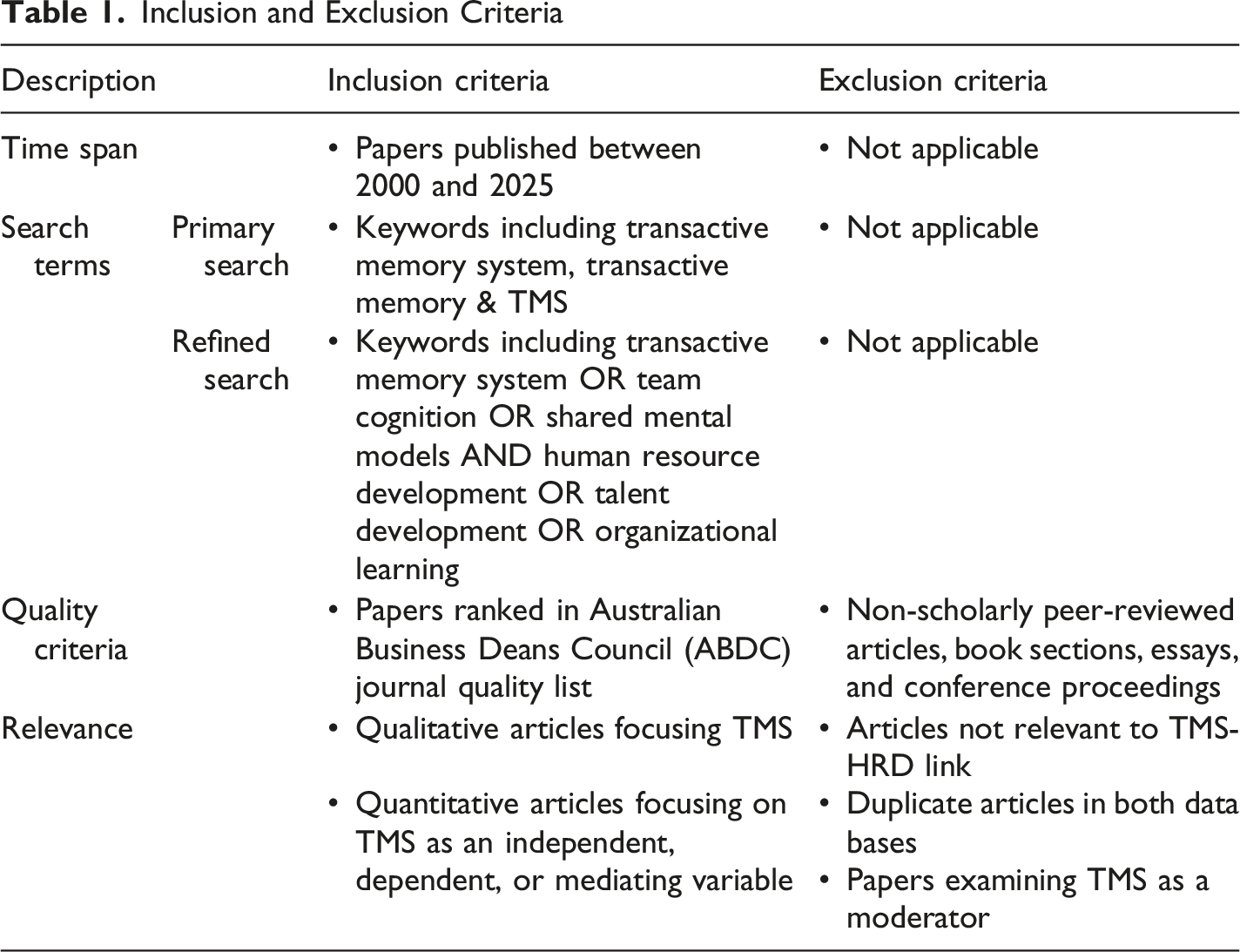
To ensure methodological rigor and transparency, this study followed the PRISMA 2020 guidelines, as outlined by Page et al. (2021), for conducting a literature review (Figure 1). In line with PRISMA, a structured search strategy was developed and applied across multiple databases. An initial search in Scopus using broad keywords (“transactive memory,” “transactive memory system,” and “TMS”) yielded 396 records. This was followed by a refined search using Boolean operators to combine the initial terms with HRD-related constructs across the Scopus and Web of Science databases. The search terms (“Transactive Memory System” OR “TMS” OR “Team Cognition”) AND (“Human Resource Development” OR “HRD” OR “Human Capital Development” OR “Human Development”) were used, yielding 13 records from Scopus and 6 from Web of Science. Given the limited results, a broader set of search terms was adopted to capture HRD–TMS-related concepts. The revised search terms (“Transactive Memory System” OR “Team Cognition” OR “Shared Mental Models”) AND (“Human Resource Development” OR “Talent Development” OR “Organizational Learning”) generated 62 records from Scopus and 27 from the Web of Science databases. The records identified through the refined Boolean search (n = 19) were also captured in the subsequent broader search; therefore, they were not counted separately in the total number of identified records to avoid duplication. A manual search of Google Scholar identified an additional 4 records. In total, 489 records were identified at the identification stage. Subsequently, duplicate records (n = 20) were removed, and the remaining records were carried forward to the screening stage. This systematic approach ensured comprehensive coverage of the HRD–TMS literature while minimizing the risk of omission. PRISMA flow of article selection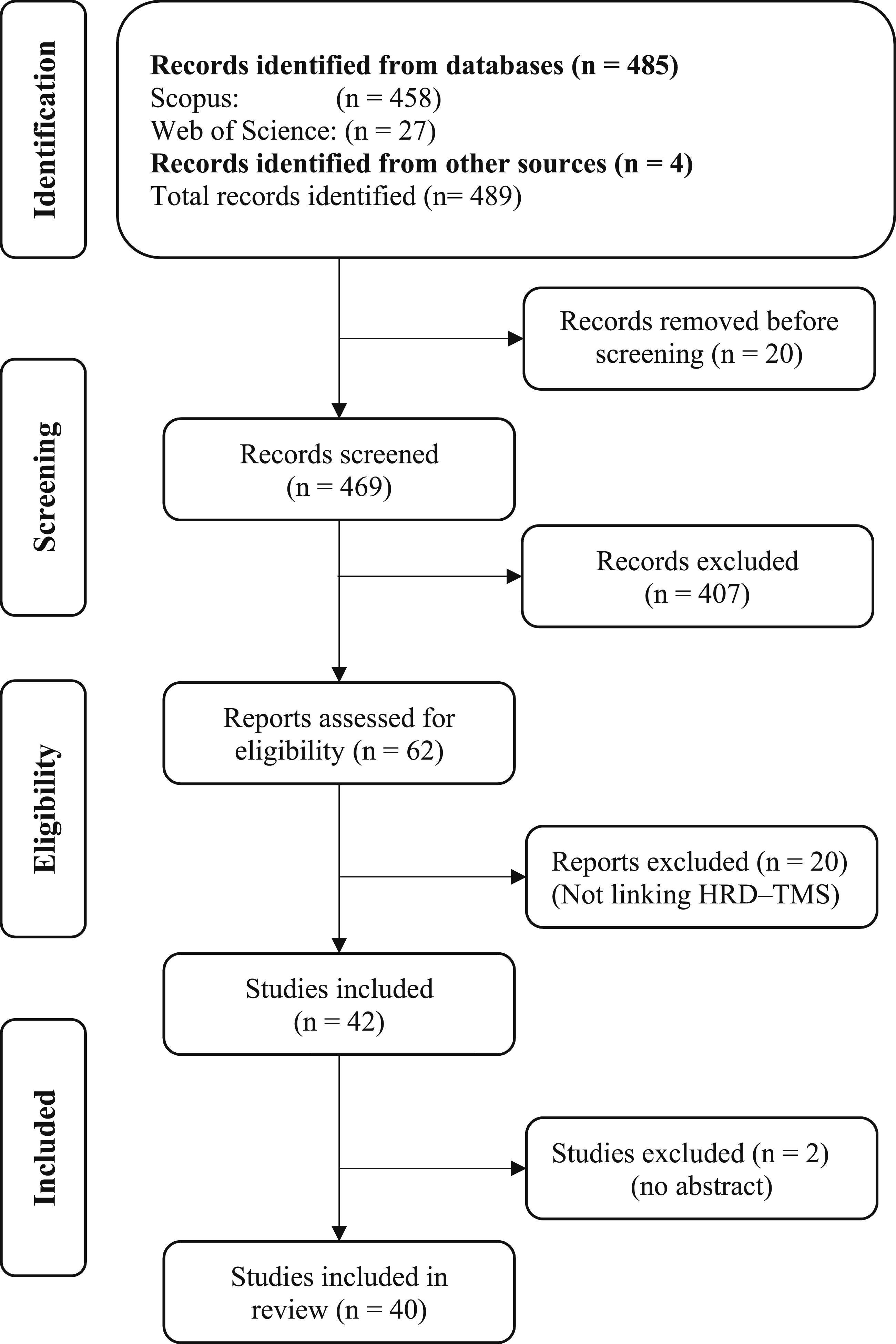
At the screening stage, a total of 469 records were evaluated based on predefined inclusion and exclusion criteria. Of these, 279 records were excluded due to lack of relevance, while an additional 128 non-peer-reviewed publications—such as books, book chapters, editorials, commentary pieces, and conference proceedings were removed in line with the guidelines of De Keyser et al. (2019). This resulted in the exclusion of 407 records, leaving 62 reports to be assessed at the eligibility stage. To enhance methodological rigor, each author independently reviewed approximately 15 reports based on their titles, abstracts, and keywords, and examined full texts where necessary. This process led to the exclusion of a further 20 reports that did not address the TMS–HRD relationship, resulting in a sample of 42 studies included in the review. Finally, two studies were excluded due to the absence of abstracts, yielding a final sample of 40 studies for analysis.
Following the selection of the study sample, a structured Excel-based data extraction sheet was developed to systematically capture information from both qualitative and quantitative studies. The extracted data included study characteristics (e.g., title, author, and publication year), theoretical frameworks, mediating and moderating variables, research methods, sampling approaches, key findings, and suggested future research directions. To ensure consistency and transparency, the research team engaged in iterative discussions throughout the process. Finally, the dataset was analyzed to identify recurring patterns, which informed the synthesis of findings and the development of an integrated TMS framework (Figure 2). Detailed descriptions of the included studies are provided in Appendix A. An integrative HRD-TMS model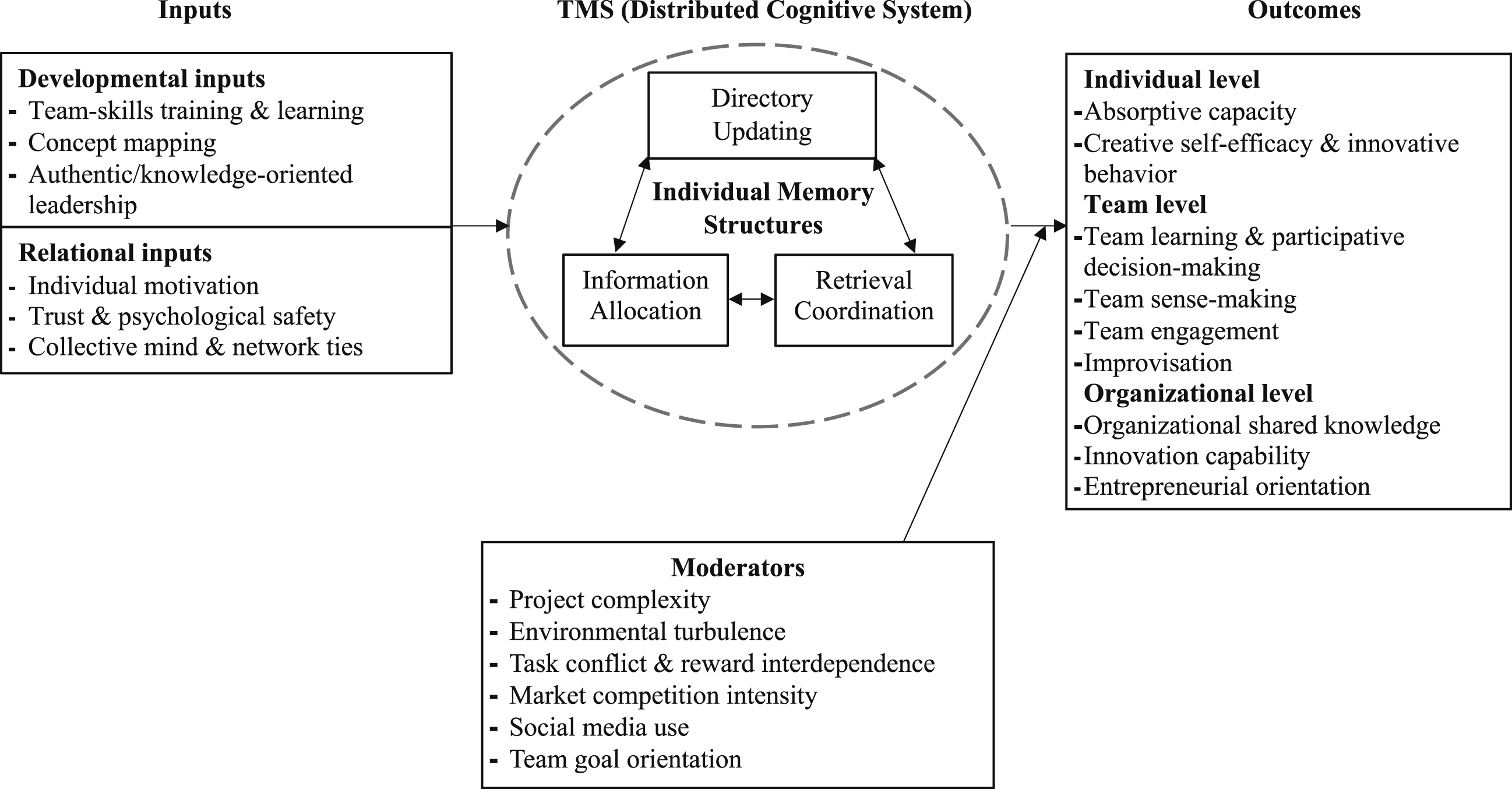
Findings
During the analysis, we identified 28 quantitative studies, 8 qualitative studies (including 7 case studies and 1 phenomenological study), and 4 conceptual papers. The inclusion of qualitative and conceptual studies facilitated a deeper understanding of the phenomenon by revealing emerging patterns and identifying critical gaps in the existing literature.
Qualitative research findings indicate that although shared mental models (SMM) and TMS both represent forms of team cognition, they are distinct constructs that contribute to individual and organizational learning, as well as overall performance (Acharya & Mishra, 2021). SMM denotes overlap, or similarity, in team members’ knowledge structures regarding goals, procedures, and patterns of interaction (Barraclough et al., 2024), whereas TMS refers to a distributed memory system constituted by the individual memory structures of team members concerning “who knows what” (Wegner et al., 1985). Thus, while TMS is concerned with specialized and differentiated knowledge, SMM emphasizes similarity in understanding. At the team level, effective communication, shared goals, and a strong professional identity provide the foundation for TMS, enabling teams to distribute expertise, reduce cognitive load, coordinate more efficiently, and allocate tasks appropriately. These dynamics highlight the critical role of HRD interventions in shaping learning systems that not only develop but also challenge existing mental models, thereby ensuring openness to new ideas and promoting continuous knowledge sharing (Blackman & Lee-Kelley, 2006). Training and development interventions—whether through formal programs, on-the-job learning, or mentoring—further strengthen this process by fostering expertise differentiation, clarifying roles, and building credibility among team members, thereby reinforcing TMS as mechanisms for sustained learning and improved performance (Peltokorpi, 2014). Group development complements these efforts, as members define roles, establish patterns of interaction, and build shared cognitive frameworks that evolve into stronger TMS (London & Sessa, 2007). These dynamics not only shape overall team climate and readiness to learn but also enable progression to more advanced stages of collective development. Extending beyond organizational boundaries, TMS also operates in cross-organizational networks, where leaders engage in collaborative sensemaking, shape developmental choices, and advance both intra- and inter-firm learning (Martin & Bachrach, 2018). Collectively, SMM and TMS function as complementary cognitive infrastructures that enhance organizational learning, adaptability, and long-term effectiveness.
Integrative Model of TMS
According to Kast and Rosenzweig (1972), a system is “composed of interrelated parts or elements,” a view that underpins general system theory. As a foundational lens for understanding TMS, general system theory emphasizes the interconnections among system components and explains their functioning through an Input–Process–Output (IPO) model. Consistent with this logic and Wegner et al.’s (1985) original conceptualization, TMS can be understood as an open system comprising interdependent transactive processes, such as directory updating, information allocation, and retrieval coordination (Wegner, 1995), which enable teams to convert dispersed individual knowledge into coordinated collective capability. Team process is defined by Marks et al. (2001) as “members’ interdependent acts that convert inputs to outcomes through cognitive, verbal, and behavioral activities directed toward organizing taskwork to achieve collective goals.” In contrast, emergent states capture dynamic cognitive, motivational, and affective conditions that evolve over time as a function of team interactions and contextual influences. Consistent with this distinction, directory updating, information allocation, and retrieval coordination are conceptualized as core transactive processes (Wegner, 1995), whereas specialization, credibility, and coordination are treated as emergent properties or observable manifestations of a well-developed TMS (Lewis, 2003). Accordingly, the present review synthesizes the inputs, processes, outcomes, and moderators identified across 28 quantitative studies within the IPO framework to provide a more integrated and conceptually rigorous understanding of HRD–TMS dynamics.
Inputs
The inputs represent the initial conditions and factors that contribute to the development and functioning of TMS. The review identified a wide range of TMS inputs, which are categorized as developmental and relational inputs.
Developmental Inputs
Relational Inputs
Outcomes
TMS has demonstrated significant positive relationships with a range of desirable outcomes. Drawing on the general system theory perspective (Kast & Rosenzweig, 1972), these outcomes are categorized at the individual, team, and organizational levels.
Individual Level
Team Level
Organization Level
Moderating Variables
The study sample identified a variety of moderators that influence the relationship between TMS and various outcomes. For example, project complexity was found to significantly moderate the relationship between TMS and software quality, strengthening its impact on flexibility and responsiveness, but not on operational efficiency (Açıkgöz et al., 2014). This highlights the role of rational information processing in enabling teams to interpret novel situations and perform effectively in dynamic contexts. Similarly, environmental turbulence was found to enhance the impact of TMS on team learning under moderate conditions by facilitating the integration of diverse knowledge resources (Akgun et al., 2006). However, under highly turbulent conditions, TMS may hinder team learning by limiting adaptability and the team’s information-processing capacity. Moreover, during task conflict, teams with high reward interdependence demonstrate stronger sensemaking, as shared incentives promote cooperation, discourage knowledge hoarding, and facilitate the effective use of collective expertise to navigate ambiguity (Talat et al., 2022).
The intensity of market competition strengthens the indirect effect of improvisation in linking TMS observable manifestations, such as specialization, credibility, and coordination, to entrepreneurial performance. However, market competition does not significantly moderate the indirect effect of improvisation between TMS coordination and entrepreneurial performance (Hu et al., 2023). In highly competitive environments, TMS expertise and credibility gain greater value, as improvisation and knowledge sharing facilitate rapid responses that enhance entrepreneurial performance. The use of social media strengthens the relationship between TMS and shared leadership, emphasizing the need for training opportunities and organizational support for the adoption of social technologies (Ali et al., 2021). Moreover, team goal orientation moderates the link between shared leadership and innovation ambidexterity, with TMS showing stronger associations with innovation ambidexterity when leaders emphasize learning or performance goal orientation (Chen & Liu, 2018). Leaders can therefore reinforce these dynamics through training and incentive systems that promote continuous learning and development.
HRD Practices and TMS
Key HRD Practices, TMS Manifestations and Outcomes
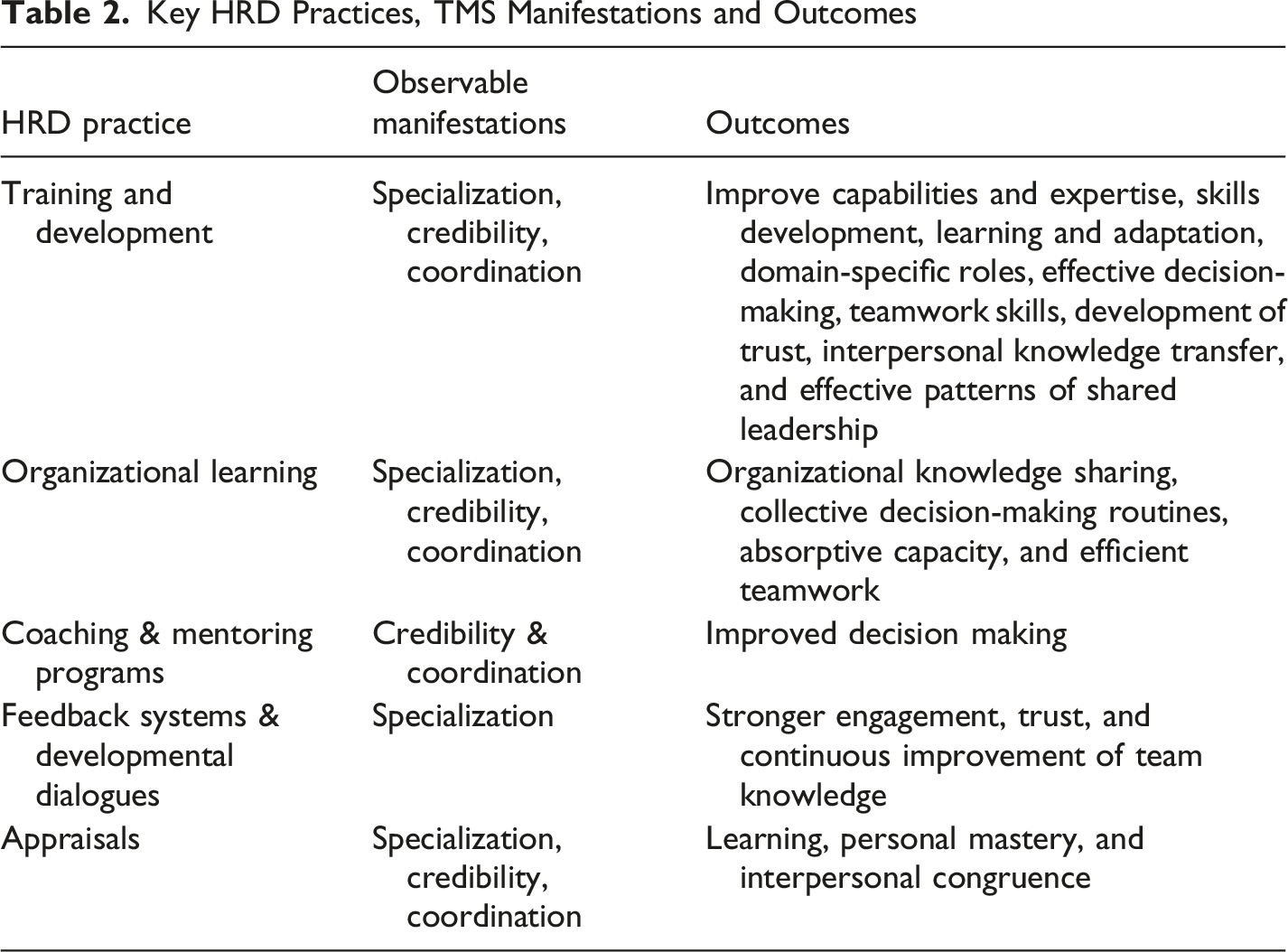
Alongside training, organizational learning emerges as another HRD practice that significantly influences TMS (Ali et al., 2020; Chen & Liu, 2018; Fan et al., 2016; Veestraeten et al., 2014). Several theoretical perspectives highlight its significance. For instance, upper echelons theory suggests that the cognitive bases, experiences, and values of senior leaders play a central role in shaping organizational processes and outcomes. When leaders actively foster organizational learning, they create an environment in which decision-making routines are established, absorptive capacity is strengthened, and knowledge-sharing mechanisms become embedded. In this way, leaders’ orientations and values directly support the development of TMS by integrating learning practices into the organizational culture (Chen & Liu, 2018). Similarly, the learning beliefs and behavior model highlights how collective beliefs about the value of learning influence team behaviors (Veestraeten et al., 2014). When organizations invest in learning and development, they cultivate positive beliefs—such as the importance of reflection, experimentation, and shared responsibility for growth. These behaviors strengthen key observable manifestations of TMS, including coordination and credibility, thereby enabling teams to more effectively align their expertise and achieve shared objectives.
Coaching and mentoring programs also play an important role in shaping the observable manifestations of TMS, particularly credibility and coordination. Shared mental model theory helps explain this link by demonstrating that teams perform better when members share a clear understanding of each other’s knowledge and roles. Through guidance and role modeling, coaching and mentoring help align these understandings, build trust in one another’s expertise, and make coordination more seamless (Barraclough et al., 2024). Feedback systems and developmental dialogues reinforce specialization in TMS by clarifying roles, expectations, and expertise (Hsu et al., 2012). From a social cognition perspective, these practices shape how team members perceive and interpret one another’s knowledge, thereby making expertise more visible and credible (Waight & Edwards, 2021). Iterative feedback and reflection further enable members to update these perceptions over time, which not only builds trust but also ensures that shared knowledge is continuously refined and aligned. Finally, performance appraisal systems contribute to the development of shared mental models by aligning individual goals with collective objectives (Fan et al., 2016). From a general system theory perspective, such alignment creates feedback loops that connect individual performance to team outcomes, ensuring that tasks, responsibilities, and expectations are understood as part of an integrated system. This shared understanding reinforces the cognitive alignment necessary for TMS to function effectively (Blackman & Lee-Kelley, 2006).
HRD Informed Research Agenda
The reviewed literature indicates that TMS functions as a system that integrates various inputs and contextual factors to generate outcomes across diverse settings. This system enhances team members’ cognitive capabilities and facilitates knowledge sharing for goal attainment and organizational effectiveness. Given its multidisciplinary application and multidimensional nature, research on the effective development of TMS remains a critical focus. Future research may explore four key areas: revisiting the HRD–TMS link, advancing theoretical perspectives, strengthening methodological rigor, and examining contextual influences.
Revisiting the HRD and TMS Link
Although HRD and TMS share strong theoretical underpinnings, particularly through their common grounding in general system theory, direct scholarly engagement with their nexus remains limited. A preliminary search of two major academic databases revealed only a small number of studies explicitly linking HRD and TMS, despite both constructs being fundamentally concerned with learning, knowledge sharing, and capability development in organizations. This gap highlights the need for future research that explicitly integrates HRD perspectives into TMS scholarship and, conversely, examines how TMS contributes to HRD outcomes.
Among HRD practices, training and development emerge as the most significant drivers of TMS. Prior studies have highlighted various forms of training, including cross-training (Guchait et al., 2014), team interaction training and self-correction training (Guchait, 2016), group training (Hsu et al., 2012), and team skill training (Prichard & Ashleigh, 2007). Moreover, Moreland and Myaskovsky (2000) demonstrated that structured group training facilitates the development of TMS by enabling members to differentiate and recognize expertise domains, thereby improving team performance. Despite this early evidence, subsequent research has rarely directly examined the effects of training on TMS. One possible explanation is methodological: TMS research is largely dominated by cross-sectional designs, whereas the development of TMS—given its iterative processes (i.e., directory updating, information allocation, and retrieval coordination), is better captured through longitudinal or experimental designs, which are often difficult to implement and resource-intensive. Beyond training, scholars have identified other HRD practices that influence TMS development, including organizational learning (Ali et al., 2020; Chen & Liu, 2018; Fan et al., 2016; Veestraeten et al., 2014), coaching and mentoring programs (Barraclough et al., 2024; Waight & Edwards, 2021), feedback systems and developmental dialogues (Hsu et al., 2012), and performance appraisal systems (Blackman & Lee-Kelley, 2006; Fan et al., 2016). However, these practices have not yet been systematically examined in relation to TMS. A stronger integration of HRD and TMS, therefore, offers the potential to enrich HRD theory, expand the scope of TMS research, and contribute to sustainable organizational learning and competitiveness.
Theoretical Advancements
As knowledge creation, retention, transfer, and application are central to organizational learning, scholars may examine the role of TMS in facilitating and enhancing these learning-oriented practices (Wang et al., 2018). These practices represent the essence of learning and development within organizations, warranting a deeper understanding of how TMS supports them. In addition, HRD–TMS research may broaden its scope by exploring contextual factors such as innovation type (radical vs. incremental), market and technical uncertainty, and resource constraints, as these may influence the strength of TMS–learning linkages (Hsieh & Chen, 2008). Socioemotional aspects also require greater attention, as teams often need to work effectively across demographic and knowledge-based differences, which can create emotional challenges (London et al., 2005). Group mental models, by facilitating discussion and knowledge sharing, can enhance talent development and improve decision-making processes (Barraclough et al., 2024). Moreover, when embedded within HR systems, leadership behaviors play a critical role in reinforcing the observable manifestations of TMS—namely, specialization, coordination, and credibility, and therefore warrant closer scholarly examination (Asim Shahzad et al., 2022; Donate et al., 2023). Finally, extending research beyond the team level to organizational and inter-organizational contexts, such as global firms or university–industry partnerships (Argote, 2015; Cabeza-Pullés et al., 2018), may provide deeper insights into how HRD systems and networks sustain knowledge transfer and collective learning across boundaries.
Methodological Rigor
Methodological rigor is vital for advancing the HRD–TMS link. Research is needed to refine and validate frameworks that capture how HRD interventions influence team learning and TMS development. Longitudinal designs, for instance, are needed to assess whether interventions such as concept mapping, dialogic facilitation, and structured training programs sustain TMS over extended periods (Chiang et al., 2014; Santos et al., 2021; Waight & Edwards, 2021). Although cross-sectional studies dominate the literature, longitudinal research can reveal the role of these practices in building durable shared cognition and capability. Multi-level approaches are also essential, enabling scholars to examine how tailored strategies enhance absorptive capacity at the individual level, team learning at the group level, and knowledge integration at the organizational level (Ali et al., 2020). Measurement validity and reliability also warrant closer attention. Future research may focus on developing robust key performance indicators (KPIs) and rigorously validating leader performance ratings to ensure accurate assessment of team outcomes (Barraclough et al., 2024). Additionally, future research may investigate communication mechanisms in organizational settings by examining how help-seeking behaviors evolve in the context of group training (Moreland & Myaskovsky, 2000). Comparative research across different cultural contexts may further extend this line of inquiry (London & Sessa, 2007) by examining how HRD practices interact with cultural norms to shape readiness to learn, the sustainability of TMS development, and patterns of team engagement.
Contextual Considerations
Research is required to expand the application of HRD–TMS frameworks into diverse organizational contexts, aligning theory with practice. A key direction is to examine the role of team governance factors, such as schedule articulation, milestone frequency, and decision-making autonomy, in shaping the relationship between TMS and team learning under conditions of uncertainty and complexity (Hsieh & Chen, 2008). The growing influence of digital technologies also offers new opportunities. For example, tools such as immersive training environments, predictive analytics, metaverse-based learning, and digital twin technologies may reshape how teams acquire, share, and apply knowledge, thus transforming TMS development (Donate et al., 2023). Another important line of inquiry involves examining the impact of Artificial Intelligence (AI) and Generative AI. Specifically, it is worth investigating how these technologies enhance individuals’ capacities to update directories, allocate information, and coordinate the retrieval of information.
Practical applications may also be considered for the role of communication methods in supporting the emergence of TMS. For example, structured reflection sessions, coaching, and collaborative learning routines can enable teams to clarify the distribution of expertise and coordinate their knowledge more effectively (Moreland & Myaskovsky, 2000; Oertel & Antoni, 2015). Similarly, the use of social media platforms and collaborative technologies deserves attention for their role in maintaining knowledge credibility and supporting collective learning (Ali et al., 2020, 2021). Researchers may also apply TMS frameworks to high-stakes domains such as military contexts, new product development, and university–industry collaborations (Sáiz-Pardo et al., 2021; Veestraeten et al., 2014). These contexts can provide fertile ground for demonstrating how HRD practices cultivate TMS, thereby promoting innovation, workforce learning, and organizational competitiveness.
Conclusion
This review set out to explore the intersection between HRD and TMS, two domains that share strong theoretical foundations yet remain insufficiently integrated in scholarly work. Drawing on general system theory, the review synthesizes evidence from multiple disciplines and sectors to conceptualize TMS as an open system of distributed cognition that receives inputs, evolves through interaction, and generates outcomes.
Although TMS research has matured over the past three decades, most studies have focused on antecedents and outcomes related to team performance, with limited attention to HRD perspectives. The findings underscore training and development as the most consistently emphasized HRD practice influencing key TMS processes—namely, directory updating, information allocation, and retrieval coordination. However, research directly linking training interventions to TMS remains limited, with only a few studies providing empirical evidence. Beyond training, other HRD practices, such as organizational learning, coaching and mentoring, feedback systems, and performance appraisals, have been identified as potential enablers of TMS, although they have not yet been systematically examined. At the same time, the reverse relationship—that is, how TMS contributes to HRD outcomes, including knowledge creation, retention, transfer, and application, remains underexplored, despite its potential to strengthen workforce learning and organizational adaptability.
Theoretically, this review argues that HRD and TMS should not be viewed as distinct domains but rather as mutually reinforcing mechanisms of organizational learning and development. Drawing on the team process perspective of Marks et al. (2001), this review suggests that HRD provides the developmental inputs and structured interventions that enable TMS to emerge and evolve through team processes and observable manifestations. In turn, TMS enhances the learning dynamics, decision-making processes, and knowledge mechanisms that lie at the core of HRD. Bridging these two domains holds significant promise for enriching HRD theory, broadening the scope of TMS scholarship, and advancing practical strategies for capability development in complex organizational environments. Looking ahead, future research may systematically examine the effects of HRD practices on TMS development, investigate the mediating and moderating mechanisms underpinning this relationship, and explore cross-sectoral applications to enhance external validity. Greater methodological pluralism, including longitudinal and mixed-methods designs, is also needed to capture the evolving and systemic nature of TMS. Finally, explicitly embedding HRD perspectives in TMS research can contribute to sustainable organizational learning and competitiveness, aligning with contemporary demands for adaptability, innovation, and human-centered performance.
Despite its significant contributions, a key limitation of this study is the absence of a formal quality appraisal of the included studies. This decision was made due to the exploratory and integrative nature of the review, which aims to synthesize diverse empirical insights rather than evaluate studies according to strict methodological hierarchies.
Footnotes
Funding
The authors received no financial support for the research, authorship, and/or publication of this article.
Declaration of Conflicting Interests
The authors declared no potential conflicts of interest with respect to the research, authorship, and/or publication of this article.
Disclosure Statement
In line with the guidance of  , we disclose that ChatGPT (OpenAI) was used solely for copyediting purposes to enhance the clarity, readability, and consistency. The identification, screening, sample selection, literature extraction, synthesis, interpretation of findings, and development of conclusions were conducted by the authors.
Appendix
Summary of Articles (n = 40) Note. OLT = organizational learning theory, SDT = self-determination theory, SMMT = shared mental model theory, LB&BM = team Learning Beliefs and Behaviors model, COR = conservation of resources theory, ITI = interactionist theory of innovation, TMS = transactive memory system, ITI = interactionist theory of innovation, SCT = social cognition theory, TC&P = theory of compilation and performance, CCET = cognitive collective-engagement theory, CMT = conflict management theory, UET = upper-echelon theory, SET = social exchange theory, SIT = social interdependence theory, DMC = dynamic managerial capability theory, NCT = networking capability theory, RDT = resource dependency theory, SCT = social constructionist theory, GST = general system theory, SLT = situated learning theory, TAS = theory of adaptive structuration.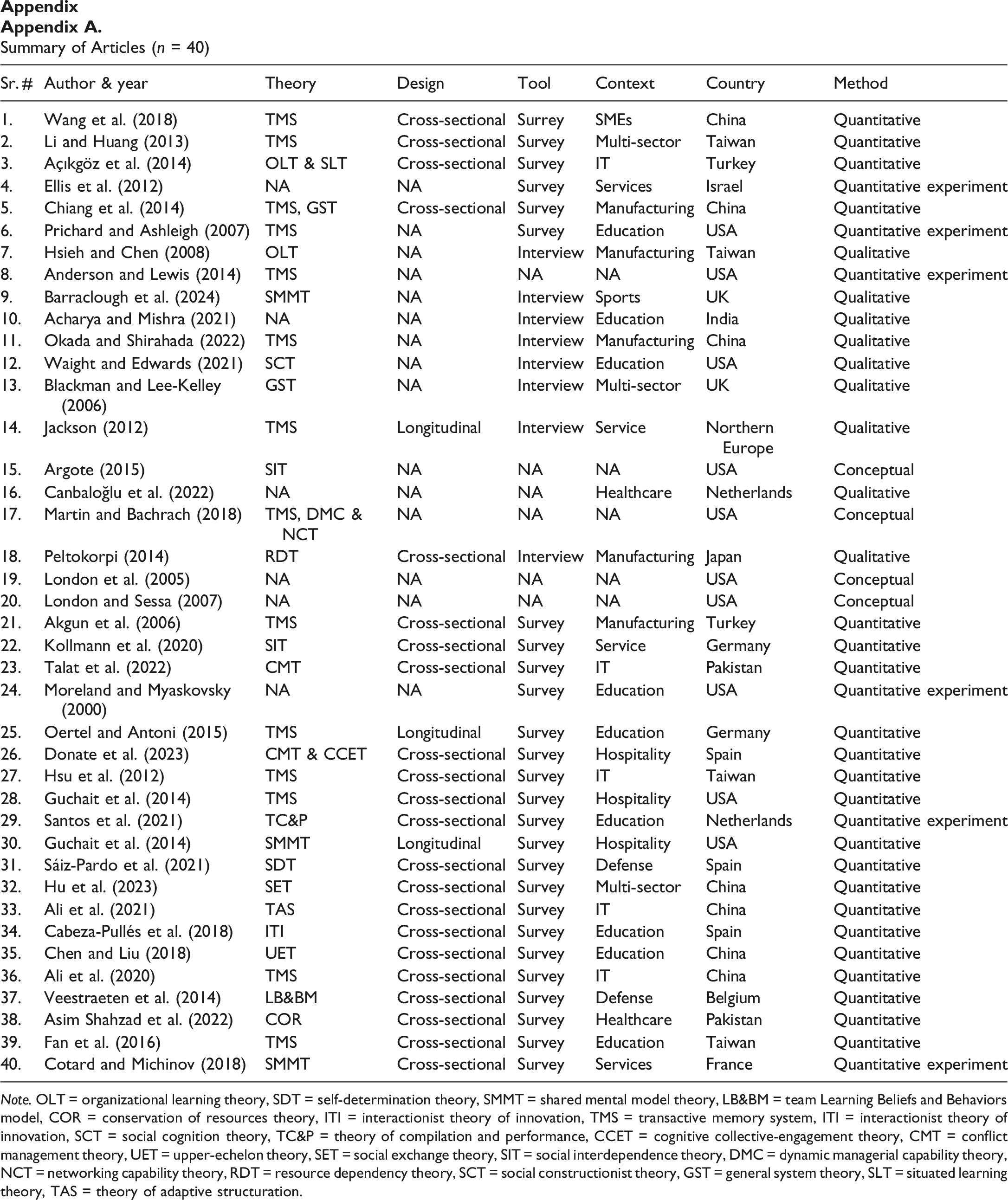
Sr. #
Author & year
Theory
Design
Tool
Context
Country
Method
1.
Wang et al. (2018)
TMS
Cross-sectional
Surrey
SMEs
China
Quantitative
2.
Li and Huang (2013)
TMS
Cross-sectional
Survey
Multi-sector
Taiwan
Quantitative
3.
Açıkgöz et al. (2014)
OLT & SLT
Cross-sectional
Survey
IT
Turkey
Quantitative
4.
Ellis et al. (2012)
NA
NA
Survey
Services
Israel
Quantitative experiment
5.
Chiang et al. (2014)
TMS, GST
Cross-sectional
Survey
Manufacturing
China
Quantitative
6.
Prichard and Ashleigh (2007)
TMS
NA
Survey
Education
USA
Quantitative experiment
7.
Hsieh and Chen (2008)
OLT
NA
Interview
Manufacturing
Taiwan
Qualitative
8.
Anderson and Lewis (2014)
TMS
NA
NA
NA
USA
Quantitative experiment
9.
Barraclough et al. (2024)
SMMT
NA
Interview
Sports
UK
Qualitative
10.
Acharya and Mishra (2021)
NA
NA
Interview
Education
India
Qualitative
11.
Okada and Shirahada (2022)
TMS
NA
Interview
Manufacturing
China
Qualitative
12.
Waight and Edwards (2021)
SCT
NA
Interview
Education
USA
Qualitative
13.
Blackman and Lee-Kelley (2006)
GST
NA
Interview
Multi-sector
UK
Qualitative
14.
Jackson (2012)
TMS
Longitudinal
Interview
Service
Northern Europe
Qualitative
15.
Argote (2015)
SIT
NA
NA
NA
USA
Conceptual
16.
Canbaloğlu et al. (2022)
NA
NA
NA
Healthcare
Netherlands
Qualitative
17.
Martin and Bachrach (2018)
TMS, DMC & NCT
NA
NA
NA
USA
Conceptual
18.
Peltokorpi (2014)
RDT
Cross-sectional
Interview
Manufacturing
Japan
Qualitative
19.
London et al. (2005)
NA
NA
NA
NA
USA
Conceptual
20.
London and Sessa (2007)
NA
NA
NA
NA
USA
Conceptual
21.
Akgun et al. (2006)
TMS
Cross-sectional
Survey
Manufacturing
Turkey
Quantitative
22.
Kollmann et al. (2020)
SIT
Cross-sectional
Survey
Service
Germany
Quantitative
23.
Talat et al. (2022)
CMT
Cross-sectional
Survey
IT
Pakistan
Quantitative
24.
Moreland and Myaskovsky (2000)
NA
NA
Survey
Education
USA
Quantitative experiment
25.
Oertel and Antoni (2015)
TMS
Longitudinal
Survey
Education
Germany
Quantitative
26.
Donate et al. (2023)
CMT & CCET
Cross-sectional
Survey
Hospitality
Spain
Quantitative
27.
Hsu et al. (2012)
TMS
Cross-sectional
Survey
IT
Taiwan
Quantitative
28.
Guchait et al. (2014)
TMS
Cross-sectional
Survey
Hospitality
USA
Quantitative
29.
Santos et al. (2021)
TC&P
Cross-sectional
Survey
Education
Netherlands
Quantitative experiment
30.
Guchait et al. (2014)
SMMT
Longitudinal
Survey
Hospitality
USA
Quantitative
31.
Sáiz-Pardo et al. (2021)
SDT
Cross-sectional
Survey
Defense
Spain
Quantitative
32.
Hu et al. (2023)
SET
Cross-sectional
Survey
Multi-sector
China
Quantitative
33.
Ali et al. (2021)
TAS
Cross-sectional
Survey
IT
China
Quantitative
34.
Cabeza-Pullés et al. (2018)
ITI
Cross-sectional
Survey
Education
Spain
Quantitative
35.
Chen and Liu (2018)
UET
Cross-sectional
Survey
Education
China
Quantitative
36.
Ali et al. (2020)
TMS
Cross-sectional
Survey
IT
China
Quantitative
37.
Veestraeten et al. (2014)
LB&BM
Cross-sectional
Survey
Defense
Belgium
Quantitative
38.
Asim Shahzad et al. (2022)
COR
Cross-sectional
Survey
Healthcare
Pakistan
Quantitative
39.
Fan et al. (2016)
TMS
Cross-sectional
Survey
Education
Taiwan
Quantitative
40.
Cotard and Michinov (2018)
SMMT
Cross-sectional
Survey
Services
France
Quantitative experiment