







Abstract
The psychometric properties of the Coping With Acculturative Stress in American Schools (CASAS-A) scale were examined using a sample of 148 Latino middle school students. CASAS-A is a self-report scale designed to identify students in need of culturally responsive social–emotional interventions due to having high levels of school-related acculturative stress. Confirmatory factor analysis (CFA), analyses of internal consistency, correlations with related measures, and group differences among Latino English Language Learners (ELLs) and non-ELLs were examined. The CFA results indicate that the data fit the hypothesized factor structure. The results also support adequate levels of reliability and validity. In addition, significant group differences were found between Latino ELLs and non-ELLs, with Latino ELLs reporting higher levels of acculturative stress in CASAS-A. Implications for future research, as well as recommendations for practitioners who implement culturally responsive interventions, are discussed.
Latinos have become the largest ethnic minority group in the United States and contribute to an increasingly diverse school-aged population. Currently, Latinos account for 21.2% of all children enrolled in elementary and secondary public schools (Aud, Fox, & KewalRamani, 2010). These percentages are even higher in larger states such as California and Texas, where Latinos make up 51.2% and 48.3% of the K-12 population, respectively (Passel, Cohen, & Lopez, 2011). Furthermore, the proportion of the Latino population is expected to continue to grow, and many of these students will be classified as English Language Learners (ELLs), a population that also is increasing rapidly. In fact, over two thirds (68.9%) of Latino children enrolled in public schools reported speaking Spanish at home (Aud et al., 2010).
Latino ELLs face many educational challenges. The National Center for Education Statistics (NCES) reported that ELLs are more likely to score below basic on state achievement tests and to drop out of school at much higher rates than do students of other ethnic groups (NCES, 2006; Suarez-Orozco & Suarez-Orozco, 2001). In addition, ELLs have consistently been identified as being at higher risk for academic and social–emotional difficulties (Albeg, 2010; Castro-Olivo, Preciado, Sanford, & Perry, 2011). Given the current size of the Latino ELL population and its projected rapid growth, addressing the educational needs of these children may be the most critical educational challenge that this nation will face in the coming decades.
The literature suggests that some of the academic problems that Latino ELLs face are related to various psychosocial stressors that may be alleviated or, alternatively, aggravated in school settings (Blanco-Vega, Castro-Olivo, & Merrell, 2008; Castro-Olivo et al., 2011; Olsen, 1997). Some of these stressors include language barriers, perceived discrimination, lower socioeconomic status, a low sense of school belonging, familial acculturative gaps, and acculturative stress (Blanco-Vega et al., 2008). Due to these stressors, school personnel face many challenges in meeting the varying mental health needs of these students as they adapt to and learn to navigate mainstream American culture. The literature has suggested that acculturative stress is an important factor to consider when assessing these students and when planning for appropriate, culturally responsive mental health interventions for such populations (Dawson & Williams, 2008; Gil, Vega, & Dimas, 1994; Hawley, Chavez, & St. Romain, 2007; Lara, Gamboa, Kahramanian, Morales, & Bautista, 2005; Williams & Berry, 1991).
Acculturative stress is the psychological tension that results from attempts to adapt to a new culture or society and the need to resolve linguistic, social, and behavioral differences or conflicts that arise between one’s native and host culture (Berry, 1980; Born, 1970). In recent years, the term has been expanded to include an individual’s perception of the pressure to conform to the majority culture, in an effort to avoid discrimination, while still desiring to hold on to his or her native cultural or ethnic identity (Mena, Padilla, & Maldonado, 1987). Although acculturative stress may manifest differently across cultural groups, it is theorized to encompass multiple psychosocial difficulties and stressors that can be summarized by four factors: (a) perceived discrimination (PD; Williams & Berry, 1991; Born, 1970); (b) familiar acculturative gaps (FamAGs; Williams & Berry, 1991); (c) immigrant/English learner-related stress (ELLRS; Chavez, Moran, Reid, & Lopez 1997; Suarez-Morales, Dillon, & Szapocznik, 2007); and, for children and adolescents, school-based issues such as (d) decreased sense of school and community belonging (LSBel; Blanco-Vega et al., 2008). All of these factors are hypothesized to have a negative impact on the school adjustment of acculturating youth, such as Latino ELLs (Blanco-Vega et al., 2008).
Despite evidence of increased attention to acculturation and the incidence of acculturative stress among minority populations, few studies have examined the role that schools play in this phenomenon. This is of concern because schools are the gateway to American society for many immigrants and other ethnic minority youth (Olsen, 1997). For some Latino ELLs, schools are the first, and occasionally the only, exposure that they might have to mainstream American culture. Therefore, understanding the impact of the acculturation process at schools on ELL students’ social–emotional well-being should be a priority for educators and mental health care professionals. However, such evaluation is difficult due to the lack of measures that explicitly, and validly, address acculturative stress from a school socialization perspective.
Measurement of Acculturative Stress in Children
The measurement of acculturative stress in children and adolescents has typically relied on adaptations of Padilla and colleagues’ original 60-item Acculturative Stress scale for adults, the Societal, Attitudinal, Familial and Environmental Acculturative Stress Scale (SAFE; Padilla, Alvarez, & Lindholm, 1986; Padilla, Wagatsuma, & Lindholm, 1985). Validated with immigrant and non-immigrant Japanese Americans and Mexican Americans, the original adult SAFE scale adequately differentiated between cultural and immigrant groups (Mena et al., 1987; Padilla et al., 1986; Padilla et al., 1985).
Chavez et al. (1997) modified the 24-item SAFE scale for use with school-age children and adolescents, which resulted in a 36-item scale for children (SAFE-C). Based on the belief that children acquire an understanding of ethnic identity by age 9, this modification was accomplished primarily by adapting the items for use by children through age-appropriate language and the inclusion of three subscales to reflect stress common to all children (16 items), stress related to the acculturative process (immigrant-related stress; 14 items), and stress due to perceived discrimination (6 items). In a study of 71 U.S.-born children, aged 8 to 10 years, Chavez et al. reported an internal consistency of .86. They also noted significantly higher levels of stress for the Hispanic subsample (n = 26), which indicated adequate internal consistency and predictive validity.
Despite evidence of SAFE-C’s psychometric properties, Suarez-Morales et al. (2007) criticized the measure’s lack of empirical evidence and questioned the construct validity of the subscales, particularly for use with more diverse populations. Suarez-Morales et al. thus revised the SAFE-C scale to its most present iteration, the Acculturative Stress Inventory for Children (ASIC). The ASIC includes only items with a strong empirical and theoretical foundation. It consists of a total of 12-point Likert-type scale items that reflect immigration-related stress (4 items) and perceived discrimination (8 items). Its factor structure and adequacy, test–retest reliability, and convergent and divergent validity have been demonstrated, as has its internal consistency, which was reported at .84 (Suarez-Morales et al., 2007). When compared with their Caucasian peers on the ASIC, Latino children demonstrated higher levels of PD. Latino children also demonstrated higher levels of acculturative stress than did Caucasian and African American children in the sample.
While SAFE-C and ASIC appear to be adequate and reliable measures of acculturative stress for children (Chavez et al., 1997; Suarez-Morales et al., 2007), they may not adequately measure acculturative stress in the context in which it is most likely to arise: the school setting. Neither the SAFE-C nor ASIC explicitly includes items on the school environment as a possible source of acculturative stress. Although the SAFE-C includes two general social stress items related to school (“It’s hard for me to ask questions in class”; “I worry about getting my report card”) and one item related to PD in school, also included in the ASIC (“Because of the group I am in, I don’t get the grades I deserve”), both scales are limited in their measurement of the school environment as a source of acculturative stress. Although the SAFE-C and ASIC contain items that reflect PD by peers and language barriers, both neglect to include items that illustrate PD by teachers, low sense of school and community belonging (LSBel), and the impact of FamAGs and stress related to limited English language proficiency on school experiences, all of which have been theorized as school-based acculturative stressors for children and adolescents (Blanco-Vega et al., 2008).
Because children spend a significant amount of their waking hours in school, assessing how the school setting contributes to acculturative stress is critical for understanding acculturative processes and identifying at-risk youths. Apart from their insufficient focus on school-related issues, the SAFE-C and ASIC lack empirical validation with ELL samples. ELLs are one of the most significant Latino subpopulations and the one who, based on theory, would be more likely to experience high levels of school-based acculturative stress. Furthermore, although Suarez-Morales et al. (2007) provided evidence of the adequate psychometric properties of the ASIC, we believe that it fails to assess some major indicators of acculturative stress (i.e., LSBel and stress related to FamAGs).
Purpose
The purpose of this study was to conduct a preliminary validation of a measure of school-related acculturative stress in Latino children of ELL and non-ELL backgrounds. We aimed to validate the Coping with Acculturative Stress in American Schools-A (CASAS-A) scale as a self-report measure that attempts to gauge acculturative stress through the four theorized factors that pertain to acculturative stress, as presented hereinbefore: PD; FamAG; LSBel; and ELL-related issues in the context of school socialization (ELLRS). The CASAS-A scale is intended to help identify children who are struggling with acculturative stress and who could benefit from culturally responsive school-based interventions as a means to prevent related behavioral, social–emotional, and academic problems.
To validate CASAS-A, we examined the factor structure, internal consistency, and test–retest reliability. We also evaluated the concurrent, convergent, divergent, and discriminant validity of the CASAS-A by using existing measures of acculturative stress (ASIC), symptoms of internalizing mental health problems, ethnic identity, resiliency, and school belonging. We hypothesized that ASIC, a validated measure of acculturative stress, would positively correlate/have concurrent validity (i.e., “the extent to which two measures assess the same construct”; Kazdin, 2003, p. 359) with CASAS-A. We examined CASAS-A construct validity by evaluating its convergent and divergent validity with other validated measures. For convergent validity, or “the extent to which the measures assess similar or related constructs” (Kazdin, 2003, p. 359), we hypothesized that symptoms of internalizing mental health problems and ethnic pride would be positively correlated with CASAS-A. Although the relationship between acculturation, acculturative stress, and mental health has been found to be equivocal (e.g., Cabassa, 2003), we hypothesized that students who reported higher levels of acculturative stress also would report higher levels of symptoms related to anxiety and depression, as found by Dawson and Williams (2008).
In addition, ethnic identity was expected to be positively correlated with acculturative stress, as only those who have strong ties to their native culture are expected to feel stress when having to conform to a conflicting culture (Sánchez & Fernández, 1993). An inverse correlation was hypothesized between CASAS and the school belonging subscale, as students with high levels of acculturative stress are expected to feel alienated from school social networks (Blanco-Vega et al., 2008). To examine divergent validity, or “the extent to which two measures assess different constructs” (Kazdin, 2003, p. 359), we examined the relationship between CASAS and resiliency. Blanco-Vega et al. (2008) theorized that social–emotional resiliency and acculturative stress could, in some instances, be independent of each other, as some children who report high levels of acculturative stress also might evidence strong social–emotional resiliency (intrapersonal and interpersonal skills). For example, children who can effectively show empathy (interpersonal skill), cope with emotional distress and solve most social problems (intrapersonal skills) may be able to successfully navigate their native culture. However, these children still may be unable to manage acculturative stress issues, which require an awareness of differences between the values of their native and host cultures and the ability to reconcile these differences (Blanco-Vega et al., 2008).
Finally, in terms of predictive validity, or “the extent to which a measure accurately predicts an expected outcome” (Kazdin, 2003, p. 360), we hypothesized that Latino ELL students, as compared with non-ELL students, would report higher scores on the CASAS-A. Due to their limited English language proficiency, low exposure to mainstream American culture, and high exposure to less-acculturated parents at home, Latino ELLs are more likely than non-ELL Latino students to experience high levels of acculturative stress (Blanco-Vega et al., 2008).
Method
Participants
The sample consisted of 148 Latino middle school students from two urban districts in southern and northern California. After obtaining approval from the host university’s institutional review board and the participating school districts, we obtained written parental consent and student assent from all participants. Of the participants, 97 (65.5%) self-identified as ELL (Spanish as the primary language spoken at home) and 51 (34.5%) as non-ELL (English as the primary language spoken at home). The mean age was 12.8 (SD = 0.86) and the mean grade level was 7.29 (SD = 0.69). Fifty-four percent of participants were female (n = 80). Participants were recruited from six schools in Southern and Northern California with student populations that consisted of at least 50% Hispanic/Latino students and at least 50% of students eligible for a free or reduced-cost lunch.
Procedure
Trained researchers administered the surveys in a standardized manner (i.e., read instructions and items to participants in their preferred language). Survey administration took place in a group setting during regular school hours in the participating students’ classrooms (N = 17). Of the participants, 112 completed the surveys in English and 38 in Spanish. In addition, 24 participants, selected based on convenience of location, were asked to retake the CASAS-A and ASIC questionnaires 3 weeks after the original data collection to establish test–retest reliability. All participants received a small incentive (i.e., a pencil or candy) and the opportunity to participate in a raffle (i.e., movie tickets or a $25 gift card to a local store for their participation).
Measures
Due to the nature of this study, which was to preliminarily validate CASAS-A, two data collections were conducted. All participants were asked to complete a demographic questionnaire, CASAS-A, and ASIC scales. Additional measures were administered to evaluate the convergent and divergent validity of CASAS-A. The ASIC scale was used to test for the concurrent validity. To further assess for convergent validity, the researchers had 94 of the participants complete the Internalizing Symptoms Test (Merrell, Juskelis, Tran, & Buchanan, 2008) and the School Belonging Subscale of the People in My Life (PIML) scale (Cook, Greenberg, & Kusche, 1995). In addition to the CASAS and ASIC scales, the remaining 52 participants completed the Behavior and Emotional Rating Scale–2 (BERS-2; Epstein, 1998), a measure of resiliency used to evaluate divergent validity, and the Commitment subscale from the Multigroup Ethnic Identity Measures (MEIM; Phinney, 1992) to assess convergent validity. All measures were made available in English and Spanish. The measures that did not have a published Spanish version went through a back translation process. For this process, three native Spanish speakers collaboratively translated the directions and items of each form. Once everyone felt comfortable with the language of each item, an independent bilingual editor translated the form back to English. At that point, English-only speakers reviewed the quality of the new English form and documented the parallels. This process verified that the Spanish version of the scale was accurate and equivalent to the English version. This procedure was conducted for the BERS-2 and the school belonging subscale. All other scales had a previously published Spanish version.
Demographic information
A self-report questionnaire was administered to determine age, grade, gender, ethnicity, primary language(s) spoken at home, years of attendance at the current school, place of birth, generational status, number of years living in the United States (if applicable), and ELL status.
CASAS-A
CASAS-A is designed to identify and screen school-aged children in grades 6 through 12 who may be experiencing acculturative stress from various interactions and from conflicts between their school and home sociocultural networks. Acculturative stress is gauged according to the extent to which students respond that they feel, think, or act in the way that the CASAS-A items or specific stressor implies. Items are rated on a Likert-type scale of 0 to 4, with 0 = does not apply and 4 = always or almost always feels, thinks, or acts in this way. Sample items include, “I feel bad when my family members do not understand the cultural changes that I am experiencing in school” and “It bothers me when kids at school make fun of me because of the way I speak English.” Higher scores indicate higher levels of acculturative stress, with the exception of item 11, which was positively worded and must be reverse coded prior to its inclusion in the overall score. For this item, a score of 1 implies higher levels of stress.
CASAS-A, which takes approximately 15 min to complete, consists of 16 Likert-type items divided between four subscales related to acculturative stress. Table 1 shows each item and hypothesized subscale correspondence. Four items measure PD, five items measure ELL-related stress (ELLRS), and three items measure FamAGs. The other four items measure LSBel.
Items and Corresponding Subscales.
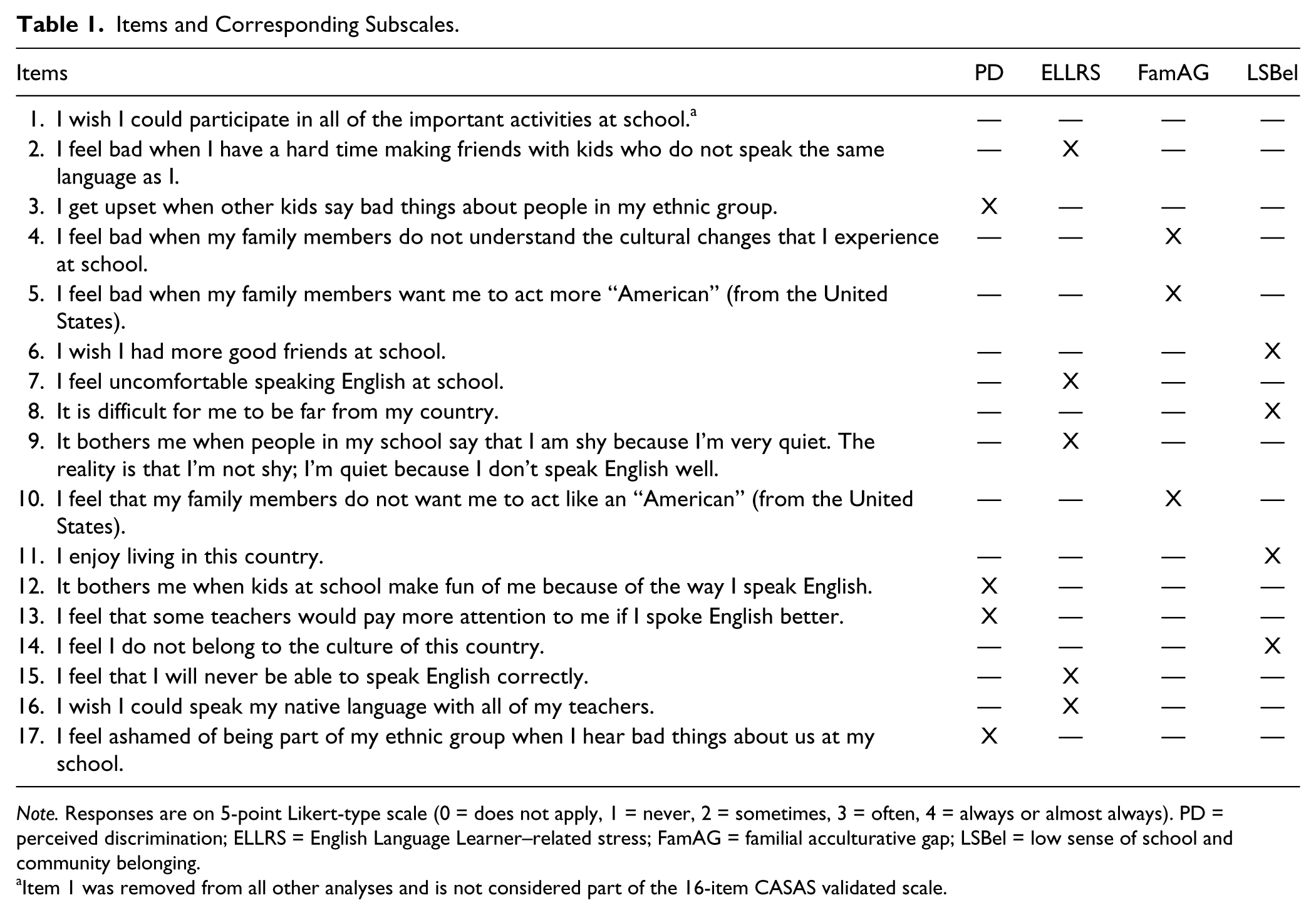
Note. Responses are on 5-point Likert-type scale (0 = does not apply, 1 = never, 2 = sometimes, 3 = often, 4 = always or almost always). PD = perceived discrimination; ELLRS = English Language Learner–related stress; FamAG = familial acculturative gap; LSBel = low sense of school and community belonging.
Item 1 was removed from all other analyses and is not considered part of the 16-item CASAS validated scale.
Most items (9 out of 16) in the CASAS scale were adapted from the SAFE-C (Chavez et al., 1997). The SAFE-C was selected over the ASIC, because it had more items related to the four factors of interest in the current study (PD, ELLRS, FamAG, and LSBel), whereas the ASIC focused on only two factors (PD and ELLRS). Several new items were developed and added to the current scale, with the goal of the new subscales focusing more on school-related experiences. A panel of expert school mental health care providers, who each had a minimum of 5 years of experience working with Latino youth, were asked to participate in the selection and wording of the items of the CASAS scale. Table 2 provides possible and obtained scores, means, and standard deviations of the total CASAS scale and each subscale.
Mean, Standard Deviations, Possible and Obtained Score Ranges of CASAS Total Score and Subscales.
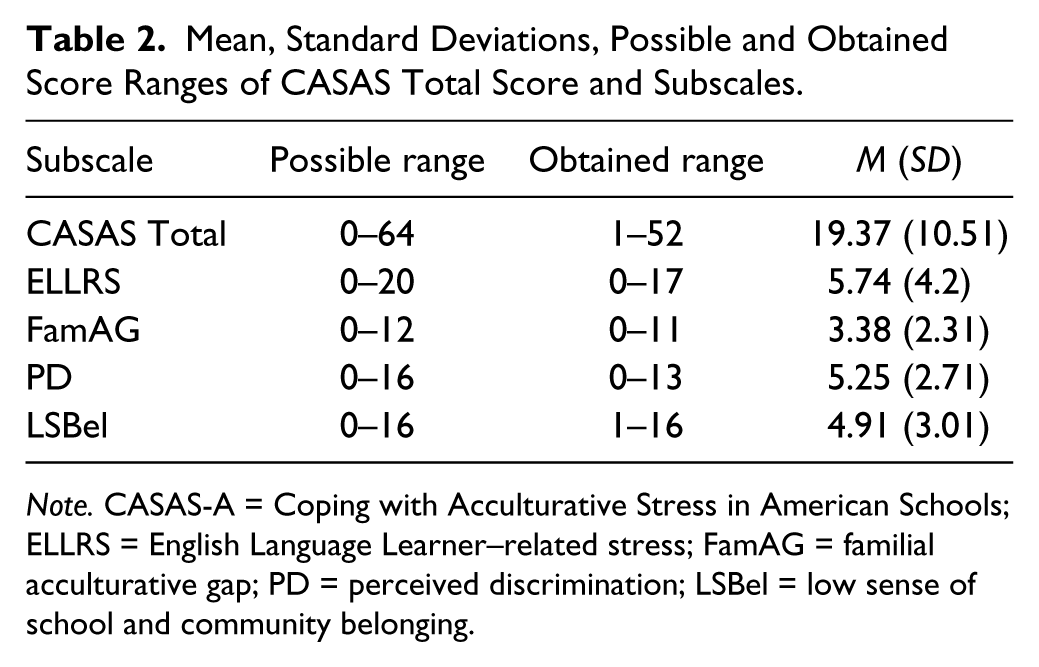
Note. CASAS-A = Coping with Acculturative Stress in American Schools; ELLRS = English Language Learner–related stress; FamAG = familial acculturative gap; PD = perceived discrimination; LSBel = low sense of school and community belonging.
ASIC
The ASIC is a 12-item Likert-type scale that measures acculturative stress based on the amount of discrimination and immigration-related stress that children perceive in their community. This scale was used to estimate concurrent validity for CASAS-A. Acculturative stress is measured according to how much the stressors bother the child. Items are rated on a scale of 0 to 5, with 0 = does not apply and 5 = bothers me a lot. Sample items include, “It bothers me when people force me to be like everyone else” and “Because of the group I am in, I don’t get the grades I deserve.” Higher scores indicate higher levels of perceived acculturative stress. ASIC has been found to be reliable and valid, with internal consistency at α = .84 (Suarez-Morales et al., 2007). Internal consistency for the current combined sample was α = .79.
The Internalizing Symptoms Test
The Internalizing Symptoms Test was completed by 94 of the 149 participants, based on convenience sampling. This 10-item self-report measure is used to screen children for internalizing mental health symptoms (i.e., depression and anxiety). Internalizing symptoms are measured according to how true the items are for the student. Items are rated on a scale of 0 to 3, with 0 = never true and 3 = often true. Sample items include, “I can’t deal with my problems” and “I worry about things.” Higher scores indicate higher levels of perceived internalizing symptoms. Previous studies have found the Internalizing Symptoms Test to be a valid and reliable measure (Merrell et al., 2008), with reliability estimates ranging from α = .70 to .80 and convergent validity estimates with the Children’s Depression Inventory and the Internalizing Symptoms Scale for Children ranging from .70 to .88. The Symptoms Test also was found to be reliable for the present sample at α = .82.
School belonging subscale of the PIML scale
The PIML also was completed by 94 of the 149 participants, due to convenience sampling. This subscale is a self-report, 8-item Likert-type survey that evaluates children’s quality of school-based relationships with teachers and peers. School belonging is measured according to how true the items are for the student. Items are rated on a scale of 0 to 4, with 0 = I don’t want to respond and 4 = almost always or always true. Sample items include, “I feel safe at my school,” “My school is a place I enjoy,” and “The kids in my school have a good chance to grow and succeed.” Lower scores indicate lower levels of perceived school belonging. Previous studies have found this subscale to be a valid and reliable measure (Murray & Greenberg, 2000), with a reliability of α = .80. This subscale was reliable based on the current sample as well (α = .72).
Behavioral and Emotional Rating Scale–Second edition (BERS-2)
To assess students’ level of social–emotional learning (SEL) resiliency, we administered the BERS-2 to 52 participants, also based on convenience sampling. The BERS-2 is a strength-based, standardized, norm-referenced scale designed to assess the behavioral and emotional assets of children. Higher scores on the BERS-2 indicate greater SEL competencies. Sample items include, “I believe in myself”; “I do my schoolwork on time”; and “I can express my anger in the right way.” Internal consistency for the current sample of the adapted BERS-2 was α = .88.
The MEIM
Six items of the MEIM Ethnic Commitment subscale were used to assess the ethnic identity/pride of 52 of the 149 participants, also due to convenience sampling. Items are answered on a 4-point Likert-type scale, where 1 = very much disagree and 4 = very much agree. Sample items include, “I am happy to be part of my ethnic group” and, “I’m very proud of my ethnic group and its accomplishments.” The internal consistency of the MEIM scale has been reported to range from α = .69 to .90. Internal consistency for the present sample was α = .79.
Data Analysis
Internal consistency was established for the total scale and for each of the four subscales of CASAS-A using Cronbach’s alpha. Test–retest reliability was determined by correlating the overall CASAS-A scores from two administrations, three weeks apart. Total scores of the ASIC and CASAS-A were correlated to establish concurrent validity, and total scores of the Symptoms Test, school belonging scales, and MEIM were correlated with CASAS to establish convergent validity. To determine divergent validity, we correlated total CASAS and BERS-2 scores. An independent samples t-test also was run to assess the predictive validity and sensitivity of the CASAS-A scale for identifying group differences between Latino ELLs and non-ELLs, and to test the hypothesis that Latino ELLs would report higher levels of acculturative stress.
Confirmatory factor analysis (CFA), a multivariate statistical procedure customarily used to validate the factor structure of educational and psychological assessment scales (Brown, 2006), was used to validate the factor structure of CASAS-A. We were particularly interested in testing the fit of the hypothesized factor structure to the data and comparing the fit with two alternative structures. As described above, CASAS-A was designed to measure four subscales related to acculturative stress in schools: PD; FamAGs; LSBel; and ELLRS. Each item was designed to contribute to a single subscale, and as such, items were hypothesized to load to a single factor. Together, the subscales were designed to measure the more general construct of acculturative stress in schools.
The conceptualization of acculturative stress used in this study and the structure of the CASAS-A scale were based on the notions of Berry and Annis (1974), who stated that acculturative stress “may derive from many antecedent factors” (p. 385). This conceptualization is consistent with a second-order CFA model in which a central construct consists of a number of subconstructs (Joreskog, 1971; Rindskopf & Rose, 1988). Therefore, CASAS-A was hypothesized to have a second-order factor structure in which the individual items load on one of four first-order factors that comprise the subscales and the subscales load on a second-order factor that reflects Acculturative Stress in School. We refer to this factor structure as the “Hypothesized Model.”
Two alternative models were also compared with the Hypothesized Model. Alternative Model A consisted of a single factor onto which all items load. This more parsimonious structure tests the premise that Acculturative Stress in School does not consist of subscales, but rather is a single scale. Alternative Model B is a first-order, four-factor model and does not include a general factor for Acculturative Stress. This structure indicates that there are four inter-correlated subscales, but that they do not converge to a general Acculturative Stress scale. Compared with the Hypothesized Model, Alternative Model B has two additional parameters. If the inter-correlations between subscales are sufficiently important to model fit, Alternative Model B should fit better than the Hypothesized Model. The specification of these models and the chi square difference test used to compare their relative fit with the data are consistent with methods described in the literature on applications of second-order CFA (Marsh, 1987).
As recommended by Hu and Bentler (1999), the fit of each model was assessed using a combination of goodness-of-fit indices, including comparative fit index (CFI; Bentler, 1990), Tucker–Lewis index (TLI; Tucker & Lewis, 1973), and Root Mean Square Error of Approximation (RMSEA; Steiger & Lind, 1980). Values greater than .95 on CFI and TLI and less than 0.06 on RMSEA indicate good fit (Hu & Bentler, 1999). When evaluating RMSEA, Steiger (1990) recommended using a confidence interval around the estimate. However, because all CASAS items are Likert-type and, thus, ordinal scale, confidence intervals could not be computed. Moreover, because the data are ordinal, a weighted least-squares (WLS) estimator was used for the analysis, which has been recommended for latent variable models with non-linear outcomes and, in particular, ordinal outcomes (Finney & DiStefano, 2006). Unlike maximum likelihood estimators, WLS does not assume multivariate normality, which may be untenable with Likert-type scale items.
Results
Reliability of CASAS-A
Cronbach’s alpha coefficients were calculated to estimate the internal consistency for the entire scale as well as for each of the four subscales. Cronbach’s alpha for the overall scale was .88. Internal consistency of the PD subscale was .65, ELLRS subscale was .81, LSBel subscale was .55, and the FamAG subscale was .53. The three-week test–retest reliability coefficient for the overall scale score was .84. The three-week test–retest internal consistency for each of the subscales was: PD, α = .66; ELLRS, α = .77; LSBel, α = 61; and FamAG subscale, .76. The three-week test–retest reliability coefficient for the overall scale score was .84.
Construct Validity of CASAS-A
Bivariate correlations were run to determine the concurrent, convergent, and divergent validity of the CASAS total score. Both samples were used to examine the concurrent validity of the CASAS-A with the ASIC scale. Significant correlations were found between CASAS-A and ASIC, r(128) = .66, p < .001. Convergent validity was established by analyzing the correlations between the CASAS-A scale and the Symptoms of Mental Health Problems test r(86) = .11, p = .33; school belonging,r(74) = −.21 p = .07; and the Ethnic Identity Commitment Subscale of the MEIM r(33) = .45 p < .01. Divergent validity of the CASAS-A scale was determined by analyzing the correlations between CASAS-A and BERS r(42) = .23,p = .14 (Table 3).
Correlation Matrix for Both Samples.
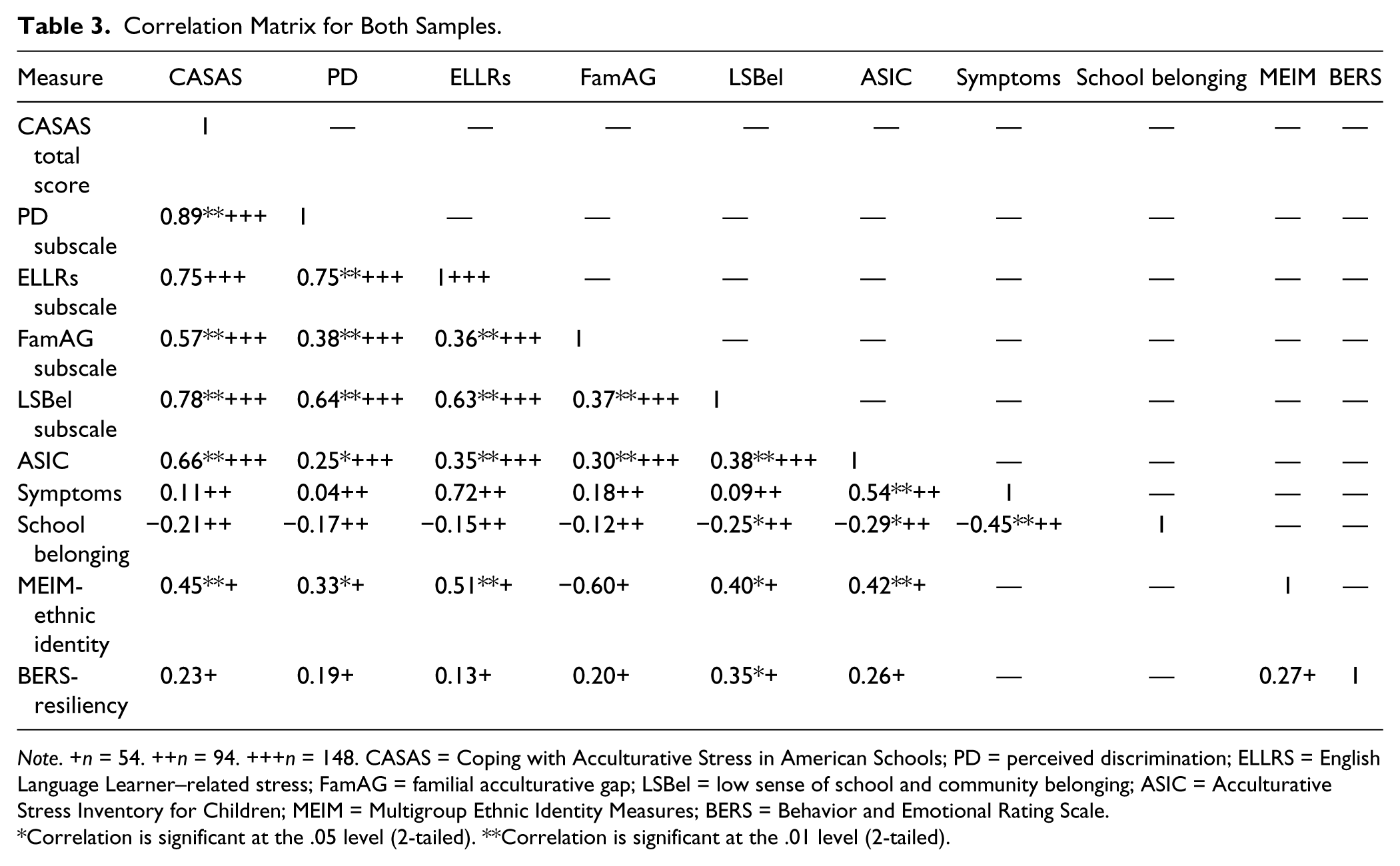
Note. +n = 54. ++n = 94. +++n = 148. CASAS = Coping with Acculturative Stress in American Schools; PD = perceived discrimination; ELLRS = English Language Learner–related stress; FamAG = familial acculturative gap; LSBel = low sense of school and community belonging; ASIC = Acculturative Stress Inventory for Children; MEIM = Multigroup Ethnic Identity Measures; BERS = Behavior and Emotional Rating Scale.
Correlation is significant at the .05 level (2-tailed). **Correlation is significant at the .01 level (2-tailed).
CASAS Confirmatory Factor Analysis
The path diagrams in Figure 1 show the results for the Hypothesized Model and the two alternative models. Note that with the exception of item 1, all items loaded significantly in each model. Although items 3 and 6 have relatively low loadings, of approximately .20, both are statistically significant (p < .01). The Hypothesized Model’s fit to the data is “good” based on two of three goodness-of-fit indices (CFI = .982, TLI = .981) and is on the margins of good for the third (RMSEA = .061).
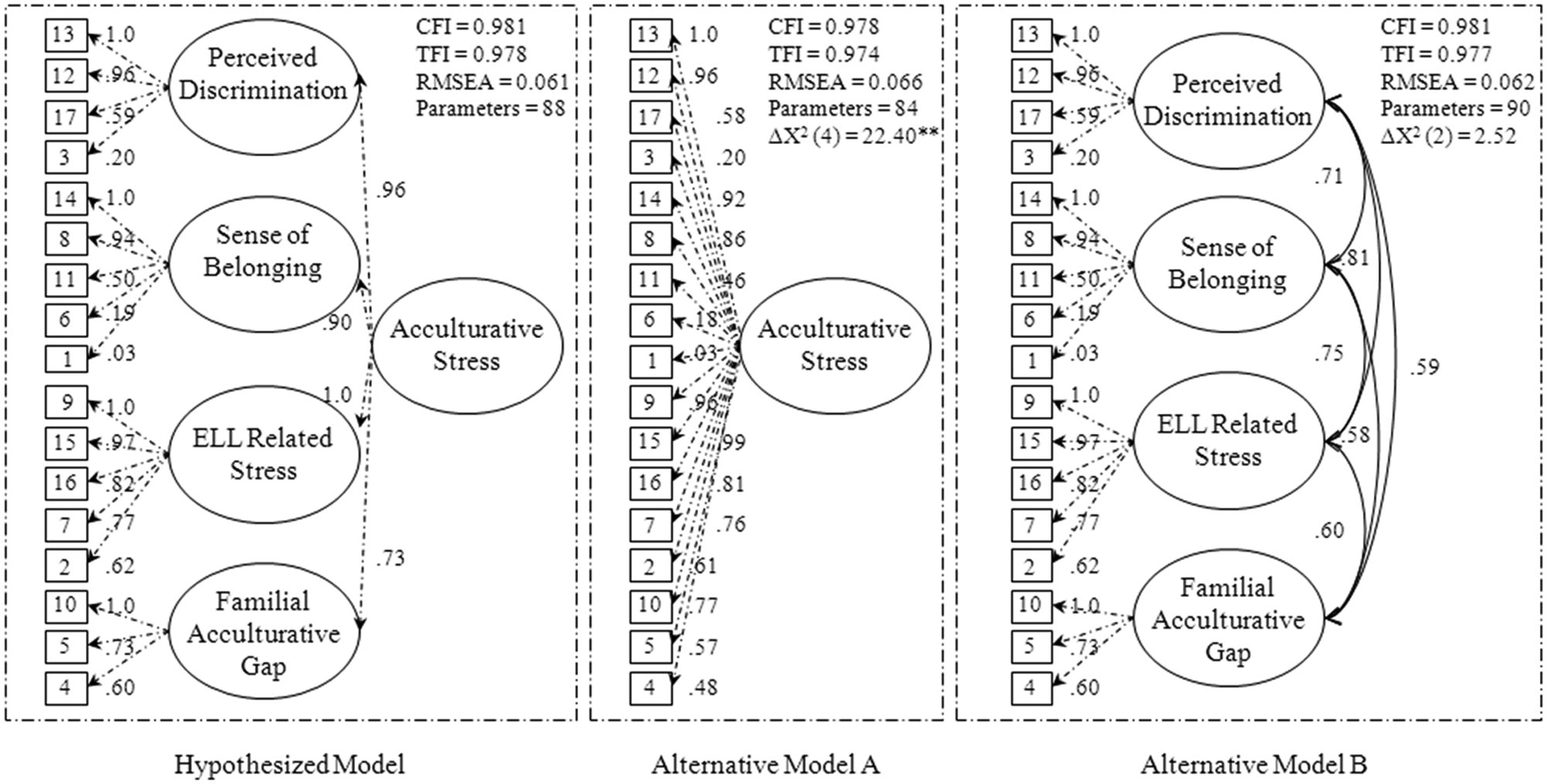
Path diagrams of hypothesized model and two alternative CFA models.
The fit of Alternative Models A and B were compared with the Hypothesized Model using a chi square difference test. 1 The additional four parameters in the Hypothesized Model significantly improved model fit compared with Alternative Model A, χ2(4) = 22.40, p < .001. The addition of two parameters in Alternative Model B compared with the Hypothesized Model did not significantly improve model fit, χ2(2) = 2.52, p = .30. Given that the Hypothesized Model is more parsimonious than is Alternative Model B, it was selected as the better fitting of the two. The three goodness-of-fit indices all confirm that the Hypothesized Model fits the data as good as or better than does either alternative model.
Recall that CASAS was designed based on the general construct of acculturative stress in schools and consists of four subconstructs. While the results confirm this, given that items 1, 3, and 6 had low factor loadings, indicating that they contribute little or nothing to the respective subscale, a post hoc analysis was conducted using modification indices to explore whether these items load higher to another subscale than hypothesized. We refer to this new exploratory model as the Revised Hypothesized model. The results of this exploration indicate that item 1 did not load significantly on any subscale and, thus, was excluded from the revised Hypothesized Model. Items 3 and 6 did not load on any of the other factors and were retained as specified in the Hypothesized Model. Modification indices also indicated that item 15 loaded highly on all four factors, which suggests that it is a general measure of acculturative stress. To test that, we specified that item 15 was to load directly to the second-order factor of acculturative stress. In addition, modification indices identified three correlations between item error terms that improve model fit, which were added. Item 9 was correlated with items 8 and 12, and items 14 and 15 were correlated. Together, these changes resulted in minor improvements to the fit of the data to the Hypothesized Model (CFI = .985, TLI = .982, RMSEA = .058). However, considering the exploratory nature of the analysis, the revised Hypothesized Model should be considered tentative.
Group differences and predictive validity
Table 4 presents the means, standard deviations, and effect sizes (Cohen’s d) of the total scores for CASAS-A and ASIC. An independent samples t-test was conducted to evaluate the extent to which CASAS-A differentiated between-group differences by participants’ ELL status (Latino ELL [M = 22.68, SD = 11.20] and Latino non-ELL [M = 15.54, SD = 6.52]). Significant group differences were identified (t = 4.05, p < .001). A t-test was also conducted to evaluate the extent to which ASIC can differentiate between-group differences by participants’ ELL status. The results were non-significant (t = 1.54, p = .13).
Means and Standard Deviations for CASAS and ASIC by ELL Status.
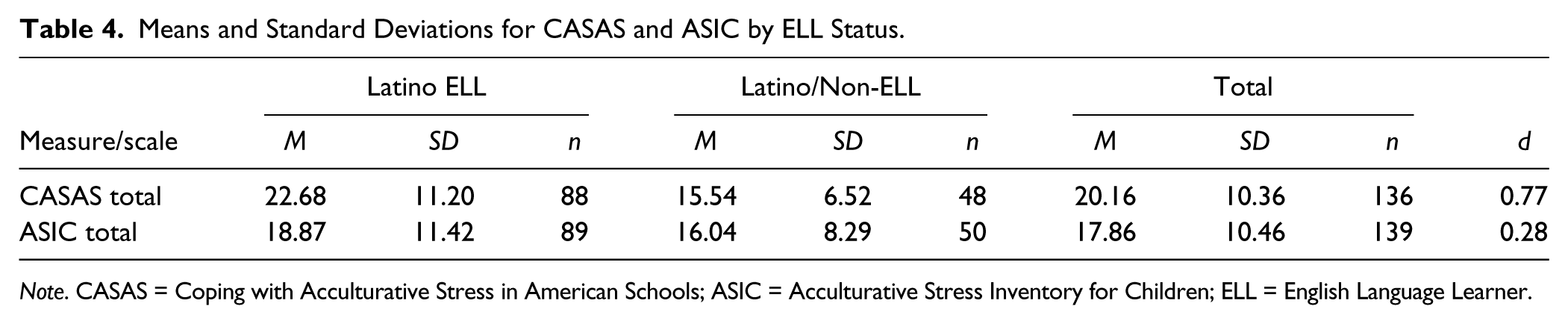
Note. CASAS = Coping with Acculturative Stress in American Schools; ASIC = Acculturative Stress Inventory for Children; ELL = English Language Learner.
Discussion
This study examined the psychometric properties of the CASAS-A scale in a sample of Latino middle school students. Literature related to acculturative stress, including factors theorized to comprise acculturative stress, i.e., LSBel, PD, ELL-related stress, and FamAG, were considered when modifying the SAFE-C to develop CASAS-A. Overall, the results indicate that CASAS-A is a valid and reliable screening measure of acculturative stress with a factor structure that is consistent with its design.
Reliability
The overall internal consistency and test–retest reliability of the scale were α = .88 and r = .84, respectively. These scores indicate that CASAS is more than adequate for screening purposes, based on the criterion of α = .80 or above recommended by Salvia, Ysseldyke, and Bolt (2010). As expected, the individual subscales yielded lower internal consistency scores, ranging from moderate α = .53 (FamAGs) to strong α = .81 (ELL-related stress); therefore, the subscales of this measure are not recommended for individual use. The moderate internal consistency scores could have been mediated by the low number of items in these subscales (only three items in FamAG and only four in LSBel). In addition, LSBel had items that reflected low belonging to the American culture and the country of the United States, but only one item related to low sense of “school” belonging. Future research should focus on refining these subscales by increasing the number of items and perhaps by assessing LSBel separately, as some students who feel part of their community or country might not feel part of their school and vice versa. However, the results suggest that, when used as a comprehensive scale, CASAS-A is a reliable measure of acculturative stress and is appropriate for individual decision making.
Construct Validity
Evidence for concurrent, convergent, and divergent validity was established using bivariate correlations. Each type of validity is discussed below.
Concurrent validity
Significant correlations between CASAS-A and ASIC for the overall sample (r = .66) provide evidence of concurrent validity for the CASAS-A scale and indicate that CASAS-A is an adequate measure of acculturative stress (correlation matrix in Table 3).
Convergent validity
Bivariate correlations were run to identify convergent validity between CASAS-A, symptoms of mental health problems, ethnic identity, and sense of school belonging, with an inverse correlation expected for the latter association. A significant correlation between CASAS-A and ethnic identity was found (r = .45; Table 3). This relationship is aligned with findings that suggest that strong identity with one’s native culture can be a risk factor for higher levels of acculturative stress (Mena et al., 1987; Sánchez & Fernández, 1993).
Contrary to our hypothesis, scores from CASAS-A, symptoms of mental health problems, and sense of school belonging were not significantly correlated. These results could have been, in part, affected by the fact that symptoms of mental health problems and sense of school belonging were assessed by brief scales (10 and 8 items, respectively). The small number of items in each instrument could have undermined the ability to detect minor mental health problems of students enrolled in general education settings. Merrell (2008) stated that the social–emotional needs of general education students (those without clinically significant problems) are more difficult to detect when using brief measures. Furthermore, the non-significant correlations between CASAS-A and symptoms of mental health problems could be due to the fact that PD, the one theorized factor of acculturative stress that has consistently been found to correlate to mental health problems (Pascoe & Smart Richman, 2009; Umana-Taylor & Updegraff, 2007), is not the dominant factor in this scale.
Acculturative stress measures that put a stronger emphasis on assessing PD might have higher correlations with mental health problems. For example, it is likely that students who are already suffering from anxiety and depression and, in turn, may have a negative bias toward ambiguous social stimuli, are also more likely to report PD, whereas students who are not experiencing those difficulties might be able to perceive certain acts as neutral. This may explain why the ASIC, which focuses largely on PD, was more highly correlated with the symptoms test than was CASAS-A, which focuses on broad acculturative stress in a more comprehensive fashion. In addition, the pre-existing mental health problems could be less likely to have a strong impact on students’ FamAG and sense of ELL-related stress, which are included in CASAS-A.
Divergent validity
The non-significant correlation found between CASAS-A and personal resiliency (Table 3) provides evidence of divergent validity for CASAS-A. This indicates that CASAS-A measures a unique construct (acculturative stress) and not personal resiliency (or the lack thereof). Previous research has found a correlation between acculturative stress and mental health problems (Dawson & Williams, 2008; Hwang & Ting, 2008). However, no previous research has found a relationship between acculturative stress and social–emotional resiliency. Children who demonstrate resiliency skills in other contexts might still struggle in coping with acculturative stress, as this experience might require more complex coping skills.
Factor structure
The CFA results indicate that the hypothesized second-order factor structure had a good fit to the data and a superior overall fit compared with two alternative factor structures. The Hypothesized Model and Alternative Model B fit the data significantly better, than did Alternative Model A. This finding indicates that the addition of the four subscales significantly improves the fit of the models to the data. The Hypothesized Model also was compared with Alternative Model B to determine whether the addition of inter-correlations between subscales significantly improved model fit. The results show that they do not and that the Hypothesized Model fits the data slightly better on each of the goodness-of-fit measures. These conclusions are strengthened by the fact that the Hypothesized Model is based on the theory behind the instrument’s design.
As noted above, items 1, 3, 6, and 15 did not perform as expected. Item 1 was not associated with the LSBel subscale, and, while items 3 and 6 had significant factor loadings, the magnitudes of those loadings were low (approximately .20), which indicates that they contribute little to their respective subscales. In light of these findings, a post hoc analysis was conducted to explore whether adjustments could be made to address these issues and improve the Hypothesized Model. To that end, modification indices were used. The findings showed that item 1 does not load significantly to any factor and, as such, was omitted from the model. It is speculated that the wording of item 1 (“I wish I could participate in all of the important activities at school”) may have been confusing to adolescents, who may not have understood the meaning of “important activities” or other aspects of the item. The modification results show that items 3 and 6 loaded significantly only on the hypothesized factors, albeit not as strongly as expected. Hence, items 3 and 6 were retained as specified in the Hypothesized Model.
The modification indices also identified two other changes that improve the fit of the Hypothesized Model. Item 15 (“I feel that I will never be able to speak English correctly”) was found to load significantly on all four subscales. As noted, this suggests that it is a general indicator of acculturative stress and captures the broader complexity of the acculturative stress construct as compared with other items. In retrospect, this finding is consistent with the literature on acculturation. Cuellar, Arnold, and Maldonado (1995) found that speaking the official language of the host culture is the most robust indicator of acculturation. Adolescents who believe that they will never be able to speak English correctly may be prone to feelings of hopelessness about their ability to ever be fully integrated into the host culture and may develop a sense of disenfranchisement.
Modification indices also indicated that three item pairs have correlated error terms. Item 9 was correlated with items 8 and 12, and items 14 and 15 also were correlated. These findings suggest that some unmodeled multidimensionality is being captured by item error correlations. In retrospect, these correlations are supported by previous research and theory and suggest that the unmodeled dimension of ELL-related stress is associated specifically with being an immigrant. For example, previous research suggests that questionnaire items highly similar to items 8, 9, and 12 are indicators of another construct, “immigrant related stress” (Chavez et al., 1997; Suarez-Morales et al., 2007). The correlation between these items is likely due to foreign-born individuals experiencing some unique difficulties. The correlation between items 14 and 15 also may be due to the “immigrant related stress” construct. However, while this construct was supported by previous research, it may not accurately differentiate between the experiences and attitudes of U.S.- and foreign-born ELLs within the framework of CASAS-A. Additional research is needed to examine the impact of immigration status on acculturative stress.
Together, these adjustments to the Hypothesized Model moderately improved model fit. However, due to the exploratory methods used to revise the Hypothesized Model, the adjustments should be considered tentative and in need of cross-validation.
Group differences and predictive validity
The results showed that CASAS-A was more sensitive than ASIC at identifying ELLs with higher levels of acculturative stress. This is an important finding for two reasons. First, previous research on the measurement of acculturative stress in children and adolescents (for example, in the samples used to validate the SAFE-C and ASIC) has not included ELL youths in their validation samples, a population expected to be at higher risk of acculturative stress because of their low English-language proficiency. Second, ASIC does not discriminate between these groups, suggesting that it is insensitive to this distinction, whereas CASAS-A discriminates as expected. Language barriers significantly hinder students’ ability to communicate and navigate American schools’ social networks and systems, thus contributing to higher levels of marginalization and discrimination that could lead to subsequent social–emotional problems. Such problems may be adequately addressed only through appropriate culturally responsive interventions (Blanco-Vega et al., 2008; Olsen, 1997).
Implications for Practice
The results of this study have implications for school-based educational and mental health practices. As previously stated, students with elevated acculturative stress are expected to experience social–emotional problems that can interfere with their learning and sense of school belonging (Blanco-Vega et al., 2008). Although more research is needed to validate the use of CASAS-A as a screening measure, practitioners are encouraged to consider using CASAS-A to screen and identify students who are experiencing elevated levels of acculturative stress and are in need of culturally responsive evidence-based treatments (EBTs). Culturally adapted EBTs have been found to be effective in improving participants’ mental health outcomes, intervention participation rates, and overall satisfaction with evidence-based interventions (Castro-Olivo & Merrell, 2012; Smith, Domenech-Rodriguez, & Bernal 2011). More research on culturally EBTs in school settings, especially with adolescents, is needed. CASAS can be used as a first step to screen for adolescents who are in need of culturally adapted EBTs. In addition, although requiring further research, CASAS could be used to identify which areas of the selected EBTs are in need of culturally responsive adaptations and/or to evaluate the effectiveness of a given intervention program used with diverse or ELL populations.
Given that CASAS-A was developed to accurately assess the four components of acculturative stress (ELL-related, familial acculturation gaps, PD, and LSBel), practitioners could use this measure to inform the implementation and adaptation of interventions that sensitively and explicitly address these issues. Blanco-Vega et al. (2008), Bernal, Bonilla, and Bedillo (1995), and Castro, Barrera, and Martinez (2004), among others, have argued that the accurate identification of risk factors for a particular population can be used to inform adaptations to EBTs. The main goal of these interventions is to help the target population cope with contextually based problems. Addressing contextual risk factors in the development of cultural adaptations to school-based existing evidenced-based interventions has shown to be a valid and effective practice (Castro-Olivo & Merrell, 2012). For school-based practitioners in particular, Castro-Olivo and Merrell have suggested that interventions should focus on teaching students basic social–emotional resiliency skills, with an explicit emphasis on helping students to cope with acculturative stress and the related cultural demands that can lead to educational risk.
Footnotes
Authors’ Note
The CASAS-A scale is part of a multiple gating system where CASAS-A only assesses levels of acculturative stress and CASAS-C (a separate scale) assesses adaptive coping styles.
Declaration of Conflicting Interests
The author(s) declared no potential conflicts of interest with respect to the research, authorship, and/or publication of this article.
Funding
The author(s) disclosed receipt of the following financial support for the research, authorship, and/or publication of this article: This research was in part funded by two small grants from the faculty academic senate of the University of California, Riverside awarded to the first author.